1. Introduction
Artificial intelligence (AI) has become increasingly integrated into journalism, transforming news production, newsroom organisation, content distribution, and professional roles (
A. F. Sonni et al., 2024;
Shi & Sun, 2024). This transformation has accelerated following the widespread adoption of generative AI systems since late 2022, marking a significant shift from earlier applications centred primarily on automation, algorithmic decision-making, and computer-assisted news production towards the use of foundation models and large language models capable of generating original content and supporting complex editorial tasks (
Cools & Diakopoulos, 2024;
Pavlik, 2023;
Shi & Sun, 2024).
Following the
Organisation for Economic Co-operation and Development (
OECD, 2024), artificial intelligence refers to machine-based systems that infer, from the inputs they receive, how to generate outputs such as predictions, recommendations, content, or decisions that can influence physical or virtual environments. This conceptualisation is consistent with the definition adopted in the European Union Artificial Intelligence Act (
European Parliament & Council of the European Union, 2024). Within journalism, AI encompasses both earlier forms of automation—including automated reporting, recommendation systems, and computational journalism—and the more recent emergence of generative AI technologies, which have substantially reshaped newsroom practices, journalistic routines, and professional competencies (
Zhang & Pérez Tornero, 2021;
Shi & Sun, 2024).
Understanding AI in journalism and communication requires moving beyond a purely technological perspective to examine its multiple dimensions, including technological applications, newsroom integration and workflow transformation, professional identity and role reconfiguration, ethical and deontological challenges, implications for audiences, and educational and media literacy concerns. Recent scholarship increasingly conceptualises AI in journalism as a socio-technical phenomenon in which technological innovation, professional transformation, regulatory frameworks, and educational responses evolve simultaneously (
Hermida, 2024;
A. F. Sonni et al., 2024;
Porlezza, 2024). Among the most widespread applications in journalistic practice are automated reporting, fact-checking, content personalisation, and audience engagement through recommendation systems and targeted advertising (
Banafi, 2024;
Cools & Diakopoulos, 2024;
Shi & Sun, 2024). These applications reflect a broader thematic convergence in the literature around efficiency, scalability, and audience-centric production models. Although these dimensions have been present in earlier research on AI and automated journalism, recent scholarship increasingly frames them through the lens of generative AI, reflecting profound changes in editorial workflows, authorship, verification, and human–AI collaboration (
Cools & Diakopoulos, 2024;
Shi & Sun, 2024;
Pavlik, 2023).
The integration of AI into journalism necessitates a comprehensive theoretical framework capable of addressing the multifaceted transformations within the field. Such a framework should consider the interaction between emerging technologies and traditional journalistic norms, emphasizing both opportunities for innovation and risks related to autonomy, transparency, and accountability (
Thurman et al., 2019). While earlier scholarship primarily examined AI from technological and organisational perspectives (
Guzman & Lewis, 2020), more recent research has expanded this focus to include AI literacy, ethical governance, newsroom transformation, and professional competencies (
Cools & Diakopoulos, 2024;
Hermida, 2024;
A. F. Sonni et al., 2024).
The intersections of AI, media literacy, and journalistic innovation are reshaping the landscape of news production and consumption. As AI becomes embedded in journalistic practices, it calls for an expanded understanding of media literacy that includes AI literacy (
Ghani et al., 2024). AI literacy is broadly defined as a set of knowledge, skills, attitudes, and ethical awareness that enables individuals to interact critically and responsibly with AI systems (
Ng et al., 2023;
Long & Magerko, 2020). This evolution underscores the need for both journalists and audiences to develop competencies that allow them to interpret algorithmic processes, assess credibility, and understand the socio-technical implications of automated content. This need is reinforced by the increasing use of generative AI systems capable of producing highly realistic synthetic content, making it more difficult for both journalists and citizens to critically assess the credibility, provenance, and transparency of information. Consequently, recent research increasingly positions AI literacy as a complementary dimension of media literacy, emphasising not only technical understanding but also critical evaluation, ethical reasoning, and responsible human–AI interaction (
Ng et al., 2023;
Ghani et al., 2024;
Foà et al., 2024;
Shi & Sun, 2024).
Recent empirical studies indicate a growing adoption of AI tools in news organizations: approximately 73% use AI for news writing and 68% for data analysis (
A. F. Sonni et al., 2024). This reflects a broader trend toward the automation of routine tasks, enabling journalists to focus on higher-level cognitive, investigative, and creative work (
Túñez-López et al., 2021). However, these developments also reveal geographical disparities, with higher levels of adoption concentrated in North America and Europe, while regions in the Global South show uneven integration due to infrastructural and economic constraints (
A. F. Sonni et al., 2024;
Graefe, 2016). These disparities relate not only to publication output but also to unequal access to AI infrastructure, computational resources, newsroom investment, and regulatory frameworks, which influence the adoption and integration of generative AI across different journalistic contexts (
Shi & Sun, 2024;
Cools & Diakopoulos, 2024).
The evolution of AI in journalism has transitioned from early automation—such as computer-assisted reporting—to more sophisticated integrations that influence editorial decision-making and content generation (
Verma, 2024). This shift reflects a move from a predominantly technocentric perspective to a more normative and socially oriented approach, where ethical considerations and public value are increasingly central (
Couldry & Mejias, 2019). This trajectory underwent a structural shift from late 2022 onwards with the rapid diffusion of generative AI. Unlike earlier task-specific automation, generative AI has become integrated across multiple stages of journalistic production, reshaping human–machine collaboration, authorship, editorial responsibility, professional roles, and verification practices.
A notable example is El Surtidor, an independent Paraguayan media outlet focused on culture, art, politics, and society. As part of its innovation strategy, the outlet developed “Eva,” an AI-powered chatbot narrating the story of a woman imprisoned for drug trafficking. The chatbot allows users to interact with the narrative, facilitating co-construction of meaning and offering new ways to address issues such as gender and human rights (
Oi2, 2025). This case illustrates how AI can be used not only for efficiency but also for narrative innovation and audience participation, particularly in underrepresented geographical contexts.
Over time, the field has increasingly embraced a hybrid model in which journalists and AI systems collaborate (
Hermida, 2024). Nevertheless, this integration raises critical questions regarding professional authority, labor conditions, and audience trust, reinforcing the need for socially responsible and transparent AI practices (
Peña-Fernández et al., 2023;
Shi & Sun, 2024). According to
Cools and Diakopoulos (
2024), journalists’ attitudes toward AI remain ambivalent. While many participants in their study acknowledged the potential of AI to improve efficiency and productivity, they also expressed concerns regarding job displacement, ethical risks, and the erosion of core journalistic values. Similar concerns have been identified in recent studies examining the integration of generative AI into newsroom practices (
Shi & Sun, 2024).
Early studies highlighted limitations in AI literacy among journalists and communication professionals (
Jones et al., 2022). More recent research suggests that these challenges have evolved with the widespread adoption of generative AI, extending beyond basic technological understanding to include competencies related to the critical evaluation of AI-generated content, transparency, prompt literacy, and responsible human–AI collaboration (
Ng et al., 2023;
Foà et al., 2024;
Ghani et al., 2024). Addressing this gap requires coordinated efforts at individual, organizational, and institutional levels, including training programs, curriculum development, and policy frameworks that promote transparency and accountability.
Academic research on AI in journalism has grown rapidly, particularly since 2015, with recurring thematic lines including automated journalism, algorithmic bias, misinformation, and platformization (
A. Sonni et al., 2024;
Carlson, 2015). From late 2022 onwards, however, the widespread diffusion of generative AI marked a structural shift in the field, redirecting attention towards content generation, verification, authorship, professional roles, and AI-related competencies. Additionally, studies have explored the integration of AI in journalism education (
Tejedor et al., 2024), the benchmarking of tools, and journalists’ perceptions of technological change (
Cervi et al., 2024).
Significant gaps remain, particularly in relation to regulatory frameworks and ethical governance. While ethical concerns are widely acknowledged, comprehensive and context-sensitive analyses—especially across different institutional and geographical settings—are still limited (
Ioscote et al., 2024). Moreover, disparities in research output suggest that academic production is concentrated in specific regions and institutions, pointing to the need for a more globally inclusive research agenda (
A. Sonni et al., 2024).
Despite these advances, the literature underscores the need for further empirical and comparative research to better understand the implications of AI for journalistic integrity, professional practices, and public trust. In this context, systematic reviews play a crucial role, as they allow for the identification of recurring themes, methodological trends, geographical distributions, and institutional contributions. By synthesizing existing knowledge, such reviews provide a comprehensive understanding of the transformative impact of AI on journalism and help guide future research, policy development, and professional practice.
Although this review covers the period from 2020 to 2024, the findings are interpreted considering the profound transformation introduced by generative AI after late 2022. The synthesis therefore conceptually distinguishes between earlier AI applications centred on automation and the subsequent emergence of generative AI when examining the thematic evolution of the field. Rather than assuming a homogeneous trajectory, the study considers this period as a phase of rapid transition from AI-assisted journalism to the widespread adoption of generative AI technologies.
Against this background, the review addresses the following research question: How has the academic literature conceptualized the role of artificial intelligence in journalism between 2020 and 2024, and what thematic, methodological, geographical, and competency-based trends characterize the evolution of the field? To answer this question, the study examines the principal thematic areas, methodological approaches, geographical patterns, institutional contributions, and the emerging role of AI literacy as a transversal analytical dimension.
2. Materials and Methods
This study adopts a systematic literature review (
Okoli, 2015) with the aim of mapping and critically analyzing the academic production on AI in the field of journalism over the past five years. Special attention is given to its applications, challenges, and implications in relation to media literacy and journalistic practices. In addition, the analysis seeks to identify recurrent thematic lines, geographical trends, predominant methodological approaches, and institutional affiliations of the included works.
The bibliographic search was conducted using two high-impact academic databases: Scopus and Web of Science, covering publications (articles, books, book chapters, and proceedings) published between 2020 and 2024. Taken together, this time frame ensures that the results reflect the latest state of the art and technological transformations that directly affect current journalistic practices. The decision to limit the literature search to Scopus and Web of Science is based on the criteria of methodological rigour and thematic coverage. Both databases are widely recognized as leading indexes of scientific literature internationally, due to high quality and editorial control, robust interdisciplinary coverage, advanced search and standardization tools, and international recognition in systematic reviews. Given the global nature of the analysis, these two databases provide the broadest and most standardized coverage, avoiding duplications and inconsistencies present in more specific or less curated databases.
The search strategy was developed by a specialized researcher to ensure both sensitivity and specificity in retrieving the most relevant studies. The research was carried out in collaboration with a team of scholars from four universities in Spain.
The keyword combinations included: “Artificial Intelligence” and “Journalism”; and “Artificial Intelligence” and “Media Literacy”. These combinations were adapted to the syntax and filtering options specific to each database. We deliberately limited the search string to (“artificial intelligence” and “journalism”) to ensure conceptual consistency and replicability across databases. Although a broader set of keywords (e.g., “machine learning,” “automated journalism,” “algorithms,” “generative AI,” or “large language models”) could have captured additional relevant publications, such terms are often used inconsistently and may refer to partially overlapping research areas. By using the umbrella term “artificial intelligence,” we aimed to retrieve a corpus explicitly framed within AI scholarship, while reducing ambiguity and avoiding the inclusion of studies focused on adjacent but conceptually distinct topics (e.g., general digital journalism, platform studies, or computational methods not necessarily framed as AI). This strategy ensured a manageable and coherent dataset aligned with the scope of the review.
To ensure a focused and relevant corpus of literature, the following inclusion criteria were applied: peer-reviewed journal articles, books, book chapters, and conference proceedings; publications written in English or Spanish; works published between 2020 and 2024; studies explicitly addressing the use or impact of AI in journalistic and media literacy contexts; and empirical research or conceptual analyses offering relevant insights. The inclusion of both English-language and studies published in Spanish aimed to capture a broader and more diverse representation of research in the field, particularly considering the prominence of Spanish-speaking scholarship in studies on AI and journalism. Rather than treating them as separate corpora, all selected studies were analyzed as a single dataset. The language of publication was used solely as an inclusion criterion and not as an analytical variable. Geographical analyses were based on the institutional affiliations of the authors and the geographical scope of the studies rather than on the language in which they were published. This approach seeks to identify overarching trends and patterns in the literature while allowing for the observation of potential differences related to linguistic and geographical contexts during the interpretation of results.
The exclusion criteria included: studies focused on digital technologies without a specific emphasis on AI in journalism or media literacy; works that mentioned AI only tangentially; and duplicates or non-academic sources.
No separate formal critical-appraisal or risk-of-bias tool was applied to individual studies, as the primary objective of the review was to map and critically characterize the development of the field rather than to estimate intervention effects or synthesize evidence of effectiveness. Nevertheless, the corpus was restricted to academic publications indexed in Scopus and Web of Science and selected through predefined inclusion and exclusion criteria. This database-based eligibility strategy was used as a threshold for scholarly relevance and editorial curation, while not being considered a substitute for study-level quality appraisal.
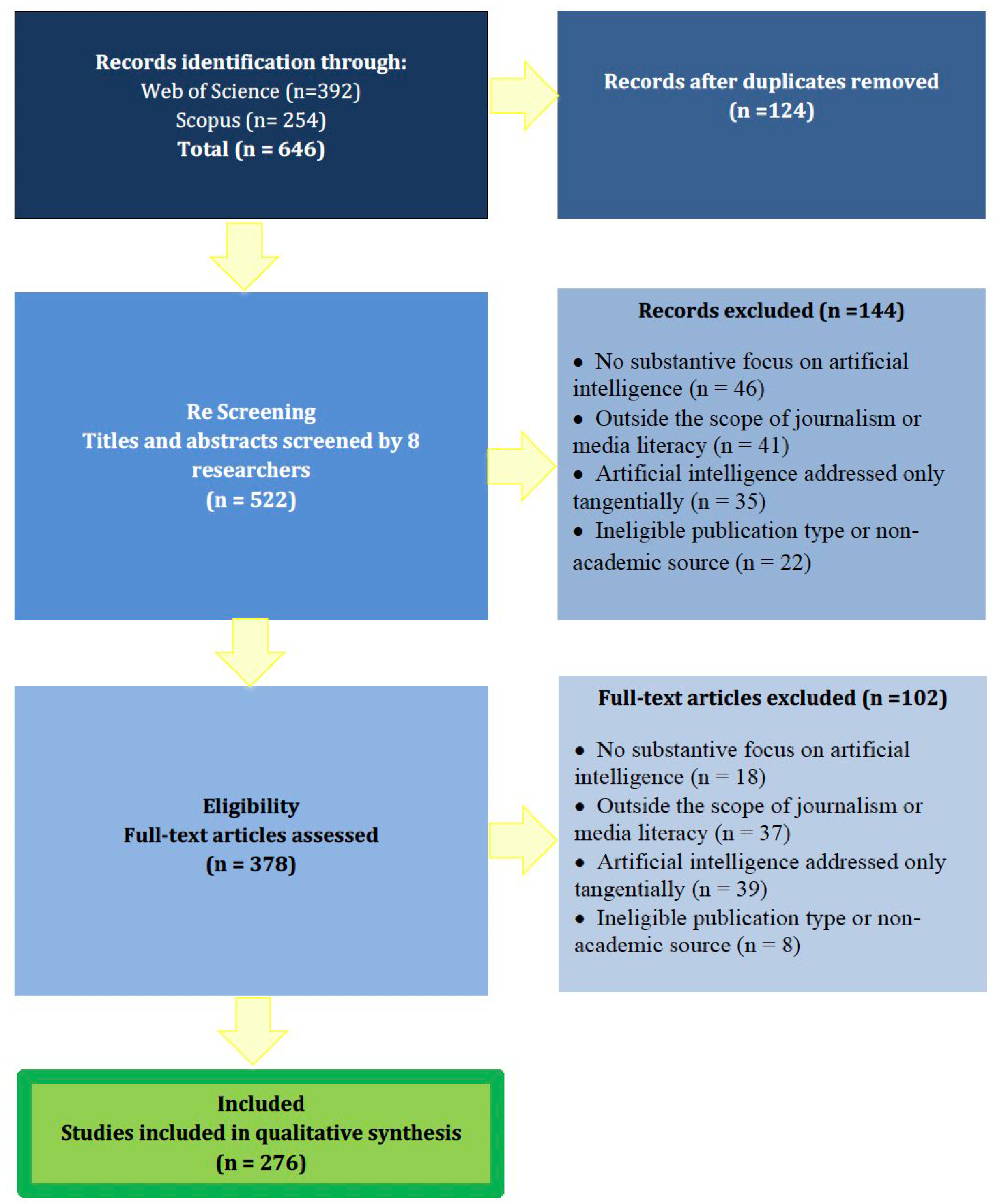
The selection process was carried out in two stages. First, eight researchers independently reviewed the titles and abstracts to identify potentially eligible studies. In the second stage, the full texts of the preselected studies were reviewed in detail, applying the predefined inclusion and exclusion criteria. To ensure consistency across the eight researchers, the review process was overseen by a designated review coordinator and supported by regular consensus meetings aimed at harmonizing the application of the predefined criteria. Any uncertainties or discrepancies arising during screening and coding were discussed collectively and resolved through consensus, with the review coordinator acting as the final methodological arbiter when required. Because the review followed a consensus-based screening protocol, methodological consistency was ensured through structured discussions and agreement among the eight researchers rather than through duplicate independent coding. Consequently, formal inter-rater agreement statistics were not calculated.
All stages of the review process—including eligibility screening, full-text assessment, data extraction, and analytical coding—were conducted manually by the research team. Each included study was individually reviewed by the researchers, and methodological decisions were subject to human verification, discussion, and consensus procedures.
The analytical synthesis was conducted through an iterative qualitative content analysis. An initial coding framework was developed from the objectives of the review and the main dimensions identified in previous literature on AI and journalism. During the coding process, the research team continuously refined the categories through inductive comparison of the included studies until six stable thematic areas were identified. Therefore, the final analytical framework combined deductive guidance from the literature with inductive refinement emerging from the reviewed evidence.
The review followed a structured protocol inspired by PRISMA guidelines, ensuring transparency and replicability (
Figure 1).
3. Results
3.1. Growth, Geographical Distribution, and Structural Characteristics of the Field
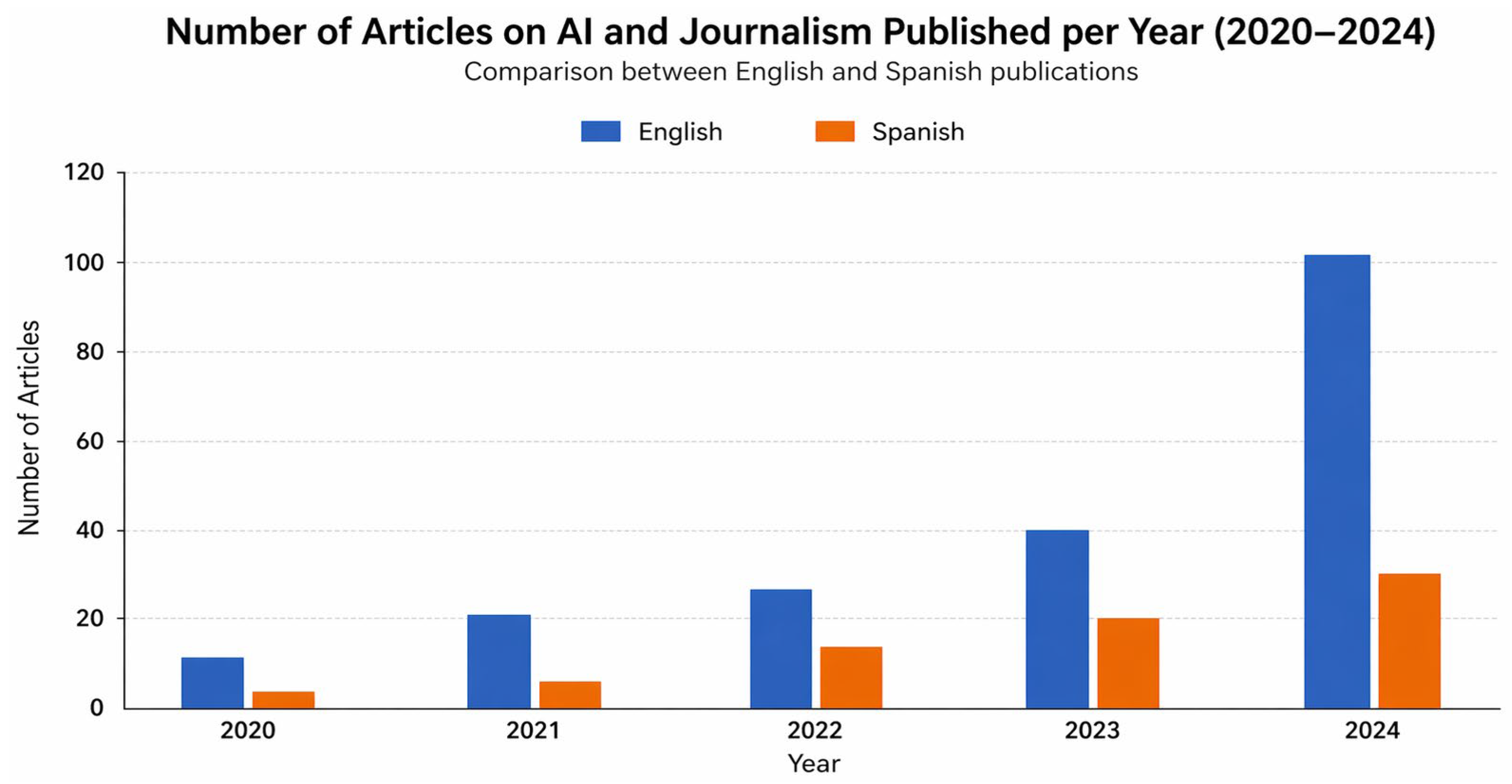
Analysis of the literature published between 2020 and 2024 shows a marked increase in academic interest in AI applied to journalism. As shown in
Figure 2, analysis of the literature published between 2020 and 2024 shows a marked increase in academic interest in AI applied to journalism. Among publications authored by researchers affiliated with Spanish institutions, the growth was progressive, with a notable rise in 2024 to over eight articles per month. Similarly, studies published in English showed an exponential growth pattern, particularly from 2023 onwards, with publication rates increasing by 155% in 2024 compared to previous years.
Geographically, the results show that Europe dominates research on AI and journalism in terms of both authorship and article scope across the studies included in the review, regardless of the language of publication. Among the ten most productive countries, six are European: Spain, the United Kingdom, the Netherlands, Norway, Germany, and Switzerland. Spain accounts for 82% of the publications authored by researchers affiliated with Spanish institutions included in the review. This leadership is sustained throughout the whole period analysed and reflects the strong institutional presence of Spanish universities and research centres in this field.
Other relevant countries include the United States and China, while regions such as Sub-Saharan Africa and Latin America remain underrepresented in both datasets. This confirms a previously identified trend according to which research on AI and journalism has paid limited attention to Global South contexts, including the Middle East, Latin America, and Sub-Saharan Africa. Australia also appears as an outlier, showing weak representation both in terms of authorship and scope.
Importantly, the total number of papers reported in
Table 1 (
n = 349) exceeds the number of unique articles included in the PRISMA flow diagram (
n = 276) because the unit of analysis in
Table 1 is the geographical scope rather than the individual article. Since some studies address multiple regions or adopt comparative or transnational perspectives, they are counted in more than one geographical category. Therefore, the figures in
Table 1 should be interpreted as the total number of regional occurrences rather than unique articles.
In terms of publication venues, articles published in English between 2020 and 2024 are distributed across 106 journals, with a core of 28 publishing more than one paper on the topic. Studies published in Spanish is spread across 27 journals, with a core group of 11 publishing more than one article. In the English-language corpus, the ranking is led by Digital Journalism (19 papers) and Journalism and Media (18), whereas in the Spanish-language corpus the leading journals are El Profesional de la Información (13 articles) and Revista Latina de Comunicación Social (10). In both corpora, the predominant outlets are Q1 and Q2 journals.
Methodologically, over 90% of publications in both corpora are empirical research papers, while theoretical and commentary articles represent a small minority (See
Table 2). Studies published in Spanish rely mainly on content analysis (27), case studies (19), and literature reviews (13). Studies published in English employ a wider range of methods, including surveys (44), interviews (43), content analysis (42), and some experimental studies (16). Nevertheless, longitudinal and comparative research remains scarce across both language groups. Across both language groups, limiting a deeper understanding of AI’s sustained impact on journalism over time.
3.2. Applications of AI in Journalism: Automation and Newsroom Integration
A prominent thematic strand concerns the practical applications of AI in journalism, especially in relation to automation and newsroom integration. In Studies published in Spanish, a subset of studies (
n = 12) focuses on the automation of structured news genres, such as sports and electoral coverage, as well as on technical applications in media organizations. These studies not only document the implementation of automated systems but also provide critical reflections on their limitations, particularly in terms of narrative depth, contextualization, and interpretative quality (
Túñez-López et al., 2021;
Fieiras-Ceide et al., 2023).
Within this subset, a smaller group of studies (
n = 5) offers detailed empirical analyses of automation in real-world media contexts, illustrating how AI technologies are operationalized in journalistic practice. Similarly, earlier research conducted by the RTVE-UAB group demonstrates how AI has been integrated into digital news production processes across multiple media outlets, confirming that automation is no longer a future prospect but an established practice (
Tejedor, 2021).
Beyond the Spanish context, several international case studies consistently show that AI has become integrated into newsroom workflows across diverse media environments, including local news organisations, large international newsrooms, and data-intensive reporting contexts. Across these settings, AI is primarily used to automate routine production tasks, improve workflow efficiency, and support editorial decision-making, while also revealing important challenges related to editorial quality and organisational adaptation (
Rivas-de-Roca, 2021;
De-Lima-Santos & Ceron, 2022).
In contrast, the English-language publications tends to adopt a broader and more systemic perspective on automation. A significant subset of studies (
n = 18) examines AI not only in relation to specific applications but as a transversal component of newsroom workflows. These studies cover a wide range of tasks, including transcription, translation, archiving, data processing, and the use of generative AI for writing, editing, and idea generation (
Gutierrez Lopez et al., 2023).
Rather than focusing on isolated use cases, this body of research conceptualizes AI as a structural element of journalistic production, reshaping organizational routines and professional practices. In this sense, automation is not understood merely as a tool for efficiency, but as a driver of deeper transformations in how news is produced, distributed, and consumed.
At the same time, the literature highlights a tension between efficiency and quality. While automation enables the rapid production of large volumes of content and reduces the burden of repetitive tasks, it also raises concerns about the homogenization of news, the loss of editorial nuance, and the potential erosion of journalistic standards. These findings suggest that the integration of AI into journalism should be understood not only in technological terms but also as a process with significant implications for professional practice, editorial values, and the broader media ecosystem.
Taken together, these studies reveal a broad consensus that AI has moved beyond isolated automation tools to become an integral component of newsroom organization, although important differences remain regarding the pace and depth of adoption across institutional and geographical contexts.
3.3. Ethical Implications and the Fight Against Disinformation
Ethical concerns and disinformation emerge as a central thematic strand and represent one of the most consistent and well-established areas of research across both corpora. Both the English-language (n = 62) and Spanish-language (n = 52) literature included in the final sample identify ethical implications and the fight against disinformation as central concerns in the analysis of AI in journalism.
The reviewed studies address a broad range of ethical challenges associated with the integration of AI into journalistic processes. Among the most recurrent issues are transparency, algorithmic bias, editorial responsibility, and the need to update professional and deontological frameworks in light of AI-driven editorial decision-making (
Porlezza, 2024;
Forja-Peña et al., 2024;
Al-Zoubi et al., 2024). These concerns reflect the increasing complexity of journalistic production in environments where algorithms mediate the selection, generation, and distribution of content.
A central issue highlighted in the literature is the problem of transparency and algorithmic opacity. Many AI systems operate as “black boxes,” making it difficult for journalists—and even more so for audiences—to understand how information is produced, filtered, or prioritized. This lack of transparency poses significant risks for editorial accountability and public trust, as it challenges traditional norms of journalistic responsibility and traceability (
Cools & Diakopoulos, 2024;
Porlezza, 2024).
Closely related to this is the issue of bias and fairness. Several studies emphasize that AI systems may reproduce or amplify existing social, cultural, or political biases embedded in training data, potentially affecting news selection, framing, and representation (
Vaccari & Chadwick, 2020). This raises important questions about the role of journalists in supervising algorithmic outputs and ensuring that automated processes do not undermine pluralism and diversity in news coverage.
Another key dimension concerns editorial responsibility and accountability. As AI systems increasingly participate in content production—whether through automated writing, recommendation systems, or moderation tools—the attribution of responsibility becomes more complex. The literature highlights the need to clarify who is accountable when errors, biases, or misinformation arise in AI-assisted journalism (
Peña-Fernández et al., 2023;
Porlezza, 2024). This challenge is particularly relevant in hybrid environments where human and algorithmic actors jointly shape editorial outcomes.
In parallel, a significant body of research focuses specifically on the role of AI in the detection, verification, and dissemination of disinformation. Studies on AI-supported fact-checking systems highlight both their potential to improve verification processes and their limitations, particularly regarding transparency, explainability, and reliability (
Montoro-Montarroso et al., 2023;
Santos, 2023). In the Spanish context, research shows that while transparency is widely recognized as an ethical imperative, its practical implementation remains inconsistent, especially when disclosing the use of AI in verification processes (
Cuartielles et al., 2024).
More broadly, the literature underscores the ambivalent role of AI in the contemporary. On the one hand, AI technologies are increasingly used to combat disinformation through automated detection, content verification, and data analysis. On the other hand, the same technologies can be exploited to generate and disseminate misleading or false content at scale, particularly through generative AI systems capable of producing highly realistic texts, images, and audiovisual materials (
Vaccari & Chadwick, 2020).
This dual role reinforces the idea that ethical considerations are not peripheral but central to the study of AI in journalism. As a result, several authors advocate the development of newsroom-level ethical guidelines and regulatory frameworks that explicitly address the use of AI, including issues such as transparency, labeling of AI-generated content, human oversight, and accountability mechanisms (
Porlezza, 2024;
Forja-Peña et al., 2024).
Taken together, these findings indicate that the integration of AI into journalism cannot be understood solely in terms of efficiency or innovation. Instead, it requires a critical examination of its ethical implications and its impact on the credibility, reliability, and social function of journalism. In this sense, the fight against disinformation and the need for robust ethical frameworks emerge as key pillars in the ongoing transformation of the media ecosystem.
Overall, the literature shows a high level of consensus regarding the centrality of ethical governance in AI-assisted journalism. Although studies differ in their emphasis on transparency, bias, regulation, or accountability, they converge in identifying ethical oversight as an essential condition for the responsible integration of AI into journalism. While the previous section examined the practical integration of AI into newsroom workflows, the following section explores the ethical challenges and disinformation risks accompanying this technological transformation.
3.4. AI, Journalistic Practices, and Professional Reconfiguration
The ways in which AI is reshaping journalistic practices and discourse constitute another key area of analysis. This focus is particularly prominent, with 80 English-language and 70 Spanish-language articles focusing on this issue. These studies examine how AI technologies are transforming newsroom routines, professional roles, editorial decision-making processes, and the broader discursive construction of journalism in the digital era.
A substantial part of the literature focuses on the reconfiguration of newsroom workflows. Research shows that AI is increasingly integrated into different stages of news production, from data gathering and processing to content creation, distribution, and audience engagement (
De-Lima-Santos & Ceron, 2022). This integration contributes to the emergence of hybrid production models in which human journalists and algorithmic systems collaborate, rather than operate in isolation.
In this context, several studies highlight how AI is redefining professional roles and competencies within news organizations. Journalists are no longer only content producers but also supervisors of automated systems, data interpreters, and decision-makers in algorithmically mediated environments (
Lopezosa et al., 2023). However, this transformation is uneven, as many media organizations still show limited levels of AI adoption and lack specialized expertise, particularly in smaller or resource-constrained newsrooms.
Another line of research examines how AI is framed and represented within journalistic discourse. These studies show that media narratives about AI are not neutral but shaped by broader socio-cultural, political, and economic contexts. For example, research analyzing press coverage demonstrates that AI is often portrayed simultaneously as an opportunity for innovation and a source of risk, reflecting broader societal ambivalence towards automation and technological change (
González-Arias & López-García, 2024).
In addition, the literature highlights the growing relevance of so-called “synthetic media” and automated content generation, which are increasingly incorporated into journalistic workflows. These developments expand the boundaries of what is considered journalistic production and raise questions about authorship, originality, and authenticity in digital environments (
De-Lima-Santos & Salaverría, 2021;
Moravec et al., 2020).
This transformation has important normative implications. Several studies argue that core journalistic principles—such as truthfulness, independence, and accountability—need to be reinterpreted in contexts where editorial processes are partially mediated by algorithmic systems (
Porlezza, 2024;
Gutiérrez-Caneda & Vázquez-Herrero, 2024). The increasing automation of tasks such as writing, content curation, or moderation complicates the attribution of responsibility and challenges traditional notions of journalistic authority.
Taken together, these findings suggest that AI is not only transforming journalistic practices at a technical level but also reshaping the professional identity of journalists and the epistemological foundations of journalism. As a result, understanding AI in journalism requires moving beyond a purely technological perspective and engaging with its broader implications for professional norms, organizational structures, and public communication.
Collectively, these findings indicate that the transformation of journalism extends beyond technological innovation to encompass changes in professional identities, newsroom routines, and editorial responsibilities. Despite differences in geographical contexts and organizational settings, the literature consistently portrays AI as a catalyst for redefining journalistic practice rather than simply automating existing tasks. Beyond ethical concerns, the literature also examines how AI is reshaping journalistic identities, newsroom routines, and professional practices.
3.5. Media Literacy, AI Literacy, and Training Implications
Media literacy emerges as a distinct thematic strand that, although less quantitatively dominant, is analytically central to understanding the broader implications of artificial intelligence in journalism. This dimension encompasses media literacy, AI literacy, and training, and directly aligns with the overarching objective of this study. Rather than merely documenting technological adoption, the reviewed literature consistently engages with the competencies required to critically understand, evaluate, and use AI within journalistic contexts. In doing so, it shifts the analytical focus from tools to capacities, highlighting the skills needed by both journalists and audiences to meaningfully engage with algorithmic systems.
Although this theme represents a smaller proportion of the total sample, it appears recurrently across the reviewed studies as a key emerging concern. A subset of publications in English (
n = 39) and Spanish (
n = 12) identifies significant gaps in AI-related training among journalists and communication students. These studies point to structural limitations within existing educational frameworks and emphasize the urgent need to adapt journalism and communication curricula to a rapidly evolving technological environment (
Tejedor et al., 2024;
Lopezosa et al., 2023;
Wenger et al., 2024). In particular, they highlight a misalignment between the pace of technological innovation and the slower transformation of educational institutions.
Research on journalism education further reveals that AI-related content remains marginal in many academic programs. When present, it is often confined to technical instruction, lacking integration with ethical, critical, and societal dimensions of AI (
Cervi et al., 2024;
Jones & Jones, 2024). This limitation is especially problematic given the increasing centrality of AI in shaping journalistic practices, as discussed in previous sections. The literature thus underscores the need for a more holistic educational approach that combines technical proficiency with critical and reflective competencies.
Beyond formal education, several studies expand the discussion toward media literacy in algorithmically mediated environments. These contributions argue that traditional conceptions of media literacy—centered on access, evaluation, and content production—are insufficient in the context of AI-driven communication systems. Instead, they advocate for the incorporation of AI literacy or algorithmic literacy as an essential extension of media literacy (
Foà et al., 2024;
Pantserev, 2021). This reconceptualization reflects a broader shift in how media competencies are defined in the digital age.
From this perspective, AI literacy is framed as a multidimensional competence that integrates technical knowledge, critical understanding, and ethical awareness. It involves not only the ability to use AI tools but also to interpret how algorithms operate, identify potential biases, assess the reliability of automated outputs, and evaluate their societal implications (
Jones & Jones, 2024;
Foà et al., 2024). These competencies are increasingly considered essential for ensuring informed and responsible decision-making in journalistic practice.
Importantly, the literature also highlights the role of media literacy in addressing systemic challenges such as disinformation and declining public trust in the media. By equipping both journalists and audiences with the skills to critically engage with AI-generated content, media literacy functions as a key mechanism for strengthening the resilience of contemporary information ecosystems (
Pantserev, 2021;
Wenger et al., 2024). In this sense, literacy is not only an individual competence but also a structural component of democratic communication.
Taken together, these findings suggest that media literacy should not be treated as a secondary or complementary issue, but rather as a transversal dimension that connects technological innovation, ethical challenges, and journalistic practice. The integration of AI literacy into journalism education and professional training thus emerges as a strategic priority for ensuring the responsible, critical, and sustainable adoption of AI in the media sector.
Taken together, these studies suggest that AI literacy is emerging as one of the most consistent transversal themes across the field. Rather than representing a separate area of research, literacy increasingly functions as the conceptual bridge connecting technological innovation, ethical governance, professional practice, and journalism education. These technological and professional transformations ultimately raise questions about the competencies required to engage critically with AI, leading to the growing prominence of media literacy and AI literacy in recent scholarship. The complete list of coded studies for this thematic category has been included in the
Supplementary Materials.
4. Discussion and Conclusions
Rather than simply documenting the rapid expansion of research on AI in journalism, this review reveals a progressive conceptual evolution of the field. The evidence suggests a transition from an initial focus on technological innovation and automation towards a broader competency-based perspective centred on AI literacy, professional transformation, and ethical governance. This evolution has occurred alongside a sharp increase in academic production, particularly since 2023, closely linked to the widespread adoption of generative AI in newsroom practices (
A. Sonni et al., 2024;
Verma, 2024). However, this growth is geographically concentrated, with Europe and North America dominating the research landscape, while the Global South remains underrepresented (
A. Sonni et al., 2024;
Soto-Sanfiel et al., 2022). This imbalance reflects not only disparities in technological adoption but also structural inequalities in knowledge production. The particularly strong presence of studies conducted by Spanish institutions deserves careful interpretation. Rather than reflecting exclusively higher research productivity, this pattern may also be explained by the well-established academic tradition of journalism and communication studies in Spain, together with the strong representation of Spanish journals indexed in Web of Science and Scopus. Furthermore, because the review included publications in both English and Spanish, research produced by Spanish institutions may be more visible within the corpus. Therefore, this finding should be interpreted in light of publication practices, database coverage, and institutional specialization, rather than language alone.
Across both corpora, the literature converges around key thematic areas, including automation, newsroom integration, ethical challenges, disinformation, and professional transformation (
Túñez-López et al., 2021;
De-Lima-Santos & Ceron, 2022;
Hermida, 2024). However, the findings of this study point to a broader shift from a predominantly technocentric perspective toward a competency-based understanding of AI in journalism. While early research emphasized efficiency gains derived from automation, particularly in routine tasks such as data processing and structured news production (
Túñez-López et al., 2021), more recent studies highlight how AI reshapes journalistic knowledge, skills, and responsibilities (
Lopezosa et al., 2023). In this sense, automation is no longer conceptualized merely as a tool but as a structural force transforming editorial processes and professional roles. This transformation implies a redefinition of journalistic competencies. As discussed in
Section 3.5, journalists are increasingly required to understand not only how to use AI tools but also how algorithmic systems operate, including their limitations, biases, and societal implications (
Jones et al., 2022;
Foà et al., 2024). This shift from tool-based to competence-based approaches constitutes a key contribution of the present study.
The centrality of ethical concerns and disinformation across the reviewed literature confirms that AI integration cannot be understood solely in terms of technological innovation (
Porlezza, 2024;
Peña-Fernández et al., 2023). Issues such as algorithmic opacity, bias, and accountability are consistently identified as key challenges (
Cools & Diakopoulos, 2024). At the same time, the literature highlights the dual role of AI in relation to disinformation. On the one hand, AI supports verification and fact-checking processes (
Montoro-Montarroso et al., 2023;
Santos, 2023); on the other hand, it facilitates the large-scale production and dissemination of misleading content (
Vaccari & Chadwick, 2020). These findings reinforce the need to rethink media literacy in the context of AI-driven journalism. As outlined in
Section 3.5, media literacy must evolve toward AI literacy, understood as the ability to critically interpret, evaluate, and engage with algorithmic systems (
Ng et al., 2023;
Foà et al., 2024). This expanded literacy is essential not only for journalists but also for audiences navigating increasingly automated information environments (
Ghani et al., 2024).
Another key finding concerns the transformation of journalistic roles and professional identities. The literature consistently describes a shift toward hybrid models in which human journalists and AI systems collaborate within newsroom workflows (
Hermida, 2024;
De-Lima-Santos & Ceron, 2022). This transformation redefines professional responsibilities, positioning journalists as supervisors, interpreters, and critical mediators of automated processes (
Lopezosa et al., 2023). At the same time, it raises questions about authorship, accountability, and editorial autonomy in contexts where decision-making is partially automated (
Porlezza, 2024;
Peña-Fernández et al., 2023). In this context, media literacy and AI literacy emerge as core professional competencies. As highlighted in multiple studies, the ability to critically engage with AI systems is essential for maintaining journalistic autonomy and ensuring responsible integration of these technologies into editorial practices (
Jones et al., 2022;
Pavlik, 2023).
Another important finding concerns AI-related training within journalism education. This aligns with previous research showing that educational institutions have been slow to adapt to technological change (
Tejedor et al., 2024;
Cervi et al., 2024;
Lopezosa et al., 2023). AI remains marginal in many curricula and is often treated as a technical skill rather than a critical and ethical competence (
Jones et al., 2022). This reveals a structural limitation in current educational models, characterized by a disconnect between rapid technological innovation and slower institutional transformation. The literature therefore emphasizes the need for integrated training models that combine technical skills with critical understanding and ethical awareness (
Ng et al., 2023;
Wenger et al., 2024). Such models are essential to prepare journalists for algorithmically mediated environments and to ensure the responsible use of AI in professional practice.
A central contribution of this study is the identification of media literacy—particularly AI literacy—as a transversal dimension connecting the different thematic areas identified in the review. Rather than being a secondary concern, literacy functions as a unifying framework linking technological adoption, ethical challenges, professional transformation, and disinformation. This perspective aligns with recent scholarship advocating for the integration of AI literacy into broader media literacy frameworks (
Ng et al., 2023;
Ghani et al., 2024). By foregrounding competencies such as critical evaluation, algorithmic understanding, and ethical awareness, AI literacy becomes a key condition for responsible engagement with AI technologies in journalism. In this sense, the findings of this study contribute to shifting the focus of the field from technological innovation to critical engagement, highlighting the importance of literacy as a central axis in the transformation of journalism.
Despite the rapid growth of the field, several gaps remain. First, there is a lack of longitudinal studies examining the long-term impact of AI on journalism, limiting the ability to assess sustained changes in newsroom practices, professional roles, and audience relationships (
Cools & Diakopoulos, 2024;
Shi & Sun, 2024;
A. F. Sonni et al., 2024). Second, audience-centered research remains limited, particularly in relation to trust and perceptions of AI-generated content (
Cervi et al., 2024). Third, the field lacks strong interdisciplinary integration, with limited collaboration between communication scholars and technical disciplines (
De-Lima-Santos & Ceron, 2022). Finally, geographical imbalances highlight the need for more inclusive research that incorporates perspectives from the Global South (
A. Sonni et al., 2024). This imbalance is likely associated with unequal access to technological infrastructures, research funding, AI development ecosystems, and publication opportunities within high-impact international journals, highlighting persistent structural asymmetries in global knowledge productions.
Beyond identifying research gaps, the review also reveals different levels of maturity across thematic areas. Ethical challenges and newsroom automation constitute relatively consolidated research domains characterised by recurrent theoretical frameworks and empirical evidence. In contrast, AI literacy, audience engagement, and long-term societal impacts remain emerging fields that require further conceptual development, comparative research, and longitudinal designs. This uneven maturity reflects the accelerated development of generative AI research after late 2022, which has stimulated rapid growth in emerging topics while leaving other research areas comparatively underdeveloped.
The predominance of qualitative and exploratory designs appears to reflect the novelty and rapid evolution of AI technologies in journalism. As newsroom practices continue to change rapidly, researchers have primarily prioritised descriptive and exploratory approaches over longitudinal or experimental designs. Although appropriate for an emerging field, this methodological profile also limits cumulative knowledge and makes it difficult to assess long-term impacts.
Artificial intelligence represents a transformative force in journalism, reshaping production processes, professional identities, and information ecosystems (
Cools & Diakopoulos, 2024;
Hermida, 2024). The findings indicate that the widespread adoption of generative AI after late 2022 represents a clear turning point in the evolution of the field, accelerating the shift from research focused primarily on automation towards studies centred on AI literacy, newsroom transformation, professional competencies, and ethical governance. While AI offers significant opportunities for efficiency and innovation, it also raises critical challenges related to ethics, accountability, and public trust. In this context, media literacy—and specifically AI literacy—emerges as a central dimension for the future of journalism. As demonstrated throughout the findings, these competencies enable journalists and audiences to critically understand, evaluate, and responsibly engage with AI systems (
Ng et al., 2023;
Foà et al., 2024). Without the integration of AI literacy into journalism education and professional practice, the risks associated with AI—such as bias, opacity, and disinformation—are likely to intensify (
Ghani et al., 2024). Conversely, strengthening these competencies offers a pathway toward more transparent, accountable, and resilient information ecosystems. Ultimately, this article contributes to the field by providing a systematic and integrative analysis that connects technological developments with ethical and literacy-based perspectives, advancing a more comprehensive understanding of AI in journalism.
Limitations
This review has several limitations. First, the analysis covers publications up to 2024 and therefore does not fully capture the rapid evolution of generative AI during 2025, including developments related to autonomous AI agents, multimodal systems, and the implementation of the European AI Act. Second, the review was restricted to publications indexed in Web of Science and Scopus and to studies published in English and Spanish, which were used as inclusion criteria. Although these criteria ensured methodological consistency and quality, they may have excluded relevant contributions published in other languages or indexed in additional databases. Finally, given the pace of AI development, the findings should be interpreted as representing a rapidly evolving field. Moreover, although this review analyses publications from 2020 to 2024 as a single period, the rapid emergence of generative AI after late 2022 represents a major conceptual and technological turning point. Consequently, the findings should be interpreted as reflecting a transitional phase rather than a homogeneous stage in the evolution of AI in journalism.