1. Introduction
This qualitative paper investigates a media archaeology discovery involving an apparent transgression in a television broadcast featuring one of the most respected figures in American popular culture. The incongruity between revered 1960s–1970s television pop icon Mary Tyler Moore (MTM) and the uncensored appearance of what seems to be her topless bare skin in online digital video frames seems absurd and demands explanation. Widely recognized symbols and figures of popular culture like Mary Tyler Moore become meaningful through the visible physical forms in which they circulate, are perceived, and are interpreted by the masses (
Storey, 2024). This paper examines the sequence of events that produced an unusual media discovery in legacy television and visual pop culture.
In today’s media environment, saturated with fabricated and manipulated video, a compromising image of Mary Tyler Moore might be easily dismissed as just another fake. Yet the image in question emerged autonomously in an online video, seemingly persisted unnoticed for decades, and appeared to depict a momentary lapse in broadcast production standards. This paper explains how that topless image came into existence, why it remained undetected for so long, and how comparison with a higher-definition version ultimately debunked the illusion—vindicating the professionalism and sterling reputation of the television pop icon.
Media archaeology techniques used in this paper unravel both the technological and historical conditions that produced the media artifact in its current form Leading media archaeologist Jussi Parikka defined media archaeology as a form of excavation, an approach that treats media artifacts as stratified constructions whose visible surface is shaped by deeper layers of technological operations, storage formats, and transmission histories that must be uncovered to understand how an image was formed (
Huhtamo & Parikka, 2011;
Parikka, 2012). As television has shifted from fleeting electronic broadcasts to durable digital media artifacts that can be physically examined, media archaeology offers a way to make sense of the changes that occurred along the way. Early television existed only as a live signal that disappeared after airing, but home videotape, professional archiving, and later digitization gradually turned it into something that could be stored, copied, and circulated (
Television as digital media, 2011). In the streaming era, television now survives mainly as a stable digital artifact, shaped by software encoding and platform algorithms rather than by the conditions of broadcast. Accordingly, media archaeology investigates and interprets the deeper layers that shaped Mary Tyler Moore’s excavated image, including the 1970s analog broadcast environment within which Moore thrived, the later digitization of archival footage, and the low-resolution (360p) online copies through which contemporary viewers may encounter the scene.
The source of the discovered artifact in question is embedded within a bubble-bath scene from a 1976 episode of
The Mary Tyler Moore Show. The artifact’s discovery emerges exactly fifty years after the episode first aired, a temporal distance that suggests a past event in television history, although the digital format of the image also suggests a media artifact originating in the present digital age. In the reviewed frames of the video, the eponymous show’s leading actress performs a bathtub farce—a comedy trope used as “visual shorthand,” which allowed television shows at the time to represent adult subjects such as nudity indirectly through strategic scenic arrangements while navigating broadcast standards (
Spigel, 1992).
The frustration of the MTM bubble-bath scene operates on three levels: narratively, as written in the television script; production-wise, due to a faulty stage effect; and more recent frustration associated with the discovery of a compromising online video image of the television pop icon. In the script of the scene, Moore’s character, Mary Richards, is frustrated by the intrusion of three male co-workers into her bathroom who are oblivious to her mounting embarrassment and mortification. Equally frustrating is that the quantity of bath foam in the production appears insufficient to provide the necessary safeguards to ensure compliance with ethical broadcast codes. Indeed, Mary Tyler Moore is seen throughout the sequence constantly gathering the scanty bits of foam around her for coverage. Even more frustrating is that with no undergarment visibly in place to provide backup protection, Ms. Moore appears topless in online video frames for a very brief instant as she sits upright above the waterline in her bathtub before quickly ducking back down under the sudsy bath water. This “blink-and-you-miss-it” moment appears to be a combination of a miscalculated stage effect and a wardrobe malfunction.
Fortunately, this embarrassing incident was likely lost in the low-resolution 1976 analog broadcast conditions and was invisible to television viewers who encountered it only once, in real time, without the benefit of playback. Its discovery today is made possible by digital media sources and applications to locate, screen-capture, and scrutinize individual digitized frames that reveal this controversial artifact of visual pop culture. However, why did this incident occur, and how was an unintentional distortion generated by software? This paper aims to answer those questions.
The significance of the compression-induced transformations examined in this paper lies in how they function as subtle, technically generated forms of visual misrepresentation—an effect that this study subsequently defines in more technical terms as materiality collapse. Because compression-induced blending, smoothing, and boundary dissolution appear so natural to the viewer, the resulting distortions function as a stealth form of deception—unintentional, yet fully capable of reshaping what viewers believe they are seeing. Importantly, unlike overt manipulation or digital fakery, which may quickly raise suspicion, materiality collapse is difficult to detect precisely because it arises from ordinary encoding processes that sometimes leave little visible trace of alteration. This makes the phenomenon highly consequential: compressed digital artifacts may be easily misinterpreted and quickly accepted as reliable material evidence even when their underlying materiality has partially collapsed.
Indeed, the apparent stealth deception associated with materiality collapse in the Mary Tyler Moore compressed video image is perceptual rather than intentional, becoming visible only because of its striking incongruity with the public’s enduring understanding of Moore’s life, work, and professional standards—a point documented in the narrative of this paper. While it is important to acknowledge Moore’s cultural position and her role as a model of female agency and sexuality within the broadcast norms of her era, a fuller exploration of these cultural dimensions lies outside the methodological scope of the present media-archaeological study. The focus here remains on excavating the technical and historical layers that produced the digital artifact—specifically the historical 1970s television production practices, broadcast standards, and technological conditions that shaped how the MTM scene was originally staged and recorded. The paper further describes how Moore navigated 1970s broadcast codes and demonstrates how materiality collapse can lead to subtle but consequential misinterpretations when compressed images circulate as material evidence. In an era when digital images circulate widely and increasingly inform public judgments and institutional decisions, understanding media vulnerability to the subtleties of materiality collapse is essential.
4. Discussion
The following discussion includes an interpretation and conceptual model of the results, grounded in a review of contextual evidence. Several research questions are discussed: Why did Mary Tyler Moore’s apparent wardrobe malfunction occur in the bubble-bath scene, and why did she appear to be topless in the online version of the scene when a protective undergarment is clearly visible in the DVD version? Furthermore, because media archaeology attempts to connect media artifacts with the cultures that produced them, the narrative includes an investigation of MTM’s television career to identify information that is contextually relevant to the discovered digital artifact.
The reader may question the relevance of a single isolated case as representative of a significant issue, especially if it has received little recognition by the general public. Media archaeology, however, does not evaluate significance by viewership metrics or by the visibility of an artifact in public discourse. Its purpose is to excavate media formations that lie beneath ordinary perception—precisely the kinds of artifacts that remain unnoticed, unremarked upon, or buried within technical processes. The fact that no viewers commented on the apparent nudity and that the artifact was discovered decades after the media source was produced is consistent with this methodological premise: compression-induced distortions appear natural and, therefore, easily escape detection.
The value of the present case lies not in its popularity but in its function as a natural experiment that reveals how low-resolution encoding can dissolve material boundaries and generate misinterpretations. The compressed image reflects the intersection of two cultural layers: the production norms of 1970s sitcom television and the technical conditions of contemporary online video. Analyzing this artifact, therefore, provides insight into both the historical media environment that created the original scene and the digital encoding processes through which its appearance changed. Finally, because materiality collapse occurs largely beneath ordinary perception, its significance often becomes apparent only after an artifact is excavated, analyzed, and made visible through scholarly investigation. The discovery of this MTM artifact therefore illustrates how a media-archaeological inquiry can surface previously unnoticed distortions and, in doing so, may contribute to the refinement of future digital-media analysis techniques.
4.1. Mary Tyler Moore’s Television Career
Mary Tyler Moore’s 1976 appearance in a bathtub scene in Mary’s Insomnia coincides with her earlier work as Laura Petrie on The Dick Van Dyke Show. In the prior show’s 1965 episode Never Bathe on Saturday, written by Carl Reiner (
The Dick Van Dyke Show, 1965), Laura’s toe becomes stuck in a bathtub faucet—a scene in which the embodiment of MTM’s character is reduced to an invisible off-camera voice locked behind a bathroom door. Writing in her autobiography (
Moore, 1995), Moore singles out the emotional trauma she experienced during the episode’s production, recounting how “I was eagerly awaiting the script that Carl had been alluding to without detail for weeks.” Upon finally receiving the script, Moore was deeply disappointed to find that her role was reduced to nothing more than a disembodied voice, recalling that “my great expectations were dashed.” She uncharacteristically walked off the set.
Moore continued to write that after consuming an alcoholic drink in her dressing room that morning, “I placed my tail firmly between my legs and slinked to the set. For the rest of the day, I gave a good impression of an unwilling actress going through the ‘moves’.” While bravely acknowledging that the bathtub episode received good notices from the public and industry people, the hurt in her voice is apparent. Despite claiming to have been “in the throes of nicotine withdrawal” on the morning of her walk-off, the salient point remains that from the moment she received the script, Mary Tyler Moore likely understood—and resented—that she had been physically banned from the scene.
To understand why this pop icon’s physical presence was perceived as a threat in her earlier appearance on Never Bathe on Saturday, one needs only to view Mary Tyler Moore elegantly posed in her bubble bath at the beginning of the 1976 scene from Mary’s Insomnia. Her appearance conveys a level of suggestive sex appeal that producers of the earlier era likely considered too risqué for family-hour sitcoms. The decision to ban Laura Petrie from appearing on camera appears to have been based on the perceived risk of filming a glamorous 29-year-old actress in a bathtub during a period of strict broadcast decorum.
In her later 1976 bubble-bath scene, any legacy of the emotional trauma that MTM previously endured is defiantly confronted in her postural attitude as the scene opens. She reclines comfortably in the tub, one foot casually raised out of the water and resting against the tub’s rim with her toes prominently pointing upward. Perhaps merely by coincidence, Moore appears to be recreating the precise physical configuration that her character Laura Petrie would have assumed in 1965 when her upright toe became stuck in the faucet. The significance of this scene reveals how Mary Tyler Moore eventually rose above censorship obstacles and triumphantly reclaimed her on-screen physical presence years later. Just as Carl Reiner had used visual shorthand to imply nudity by showing a locked bathroom door with her voice behind it, Mary Tyler Moore metaphorically unlocked the door on her own show and invited viewers to come inside and watch her taking a bubble bath.
The absence of any reference to the 1976 bubble-bath scene in Mary Tyler Moore’s 1995 autobiography is noteworthy, suggesting that she perceived nothing unusual or improper about the moment. The actress’s unawareness is supported by the scene’s video frames. During the brief lapse in foam coverage, Moore’s gaze remains fixed on her co-star’s eyes, allowing the accidental exposure to escape visual confirmation by either actor. Plausibly, the live audience may have also been aware that Moore was wearing a protective undergarment, having seen her enter the set and position herself within the foam. If so, this would explain why the brief exposure of the garment during the live performance did not interrupt audience laughter, which may reflect an implicit acceptance of the garment’s presence as a necessary precaution.
Moore’s own description of the show’s production environment supports this interpretation. In her autobiography, she characterizes the set as casual and open, with audience members free to come and go between takes as scenery was moved and actors changed wardrobe. This context suggests that the visual exposure was not perceived as a serious transgression at the time of filming. The presence of a protective undergarment likely satisfied network television broadcast censorship standards, allowing the scene to pass through review without objection. The brief lapse in foam coverage, while visible on set, would have appeared less distinct to television audiences due to the low resolution of analog broadcast formats, thus shielding the garment’s exposure from the general public.
The subsequent release of the scene on commercial DVD, followed by its reproduction in compressed online media, created a modern natural experiment for visual interpretation. The DVD version, encoded at higher resolution, reveals the undergarment clearly in a way that was not likely perceived during the original television broadcast. By contrast, the garment’s visual boundaries become dissolved in the online 360p digital version, revealing the appearance of exposure. This divergence illustrates how media migration across platforms can generate culturally consequential misreadings through material transformations. But how?
Moore’s autobiography further provides evidence that any exposure in the bubble-bath scene was unintentional and that Mary Tyler Moore consistently prioritized protecting her “modesty.” She recounts sunbathing in front of her Malibu beach house, lying face-down on a towel with her top undone, when she suddenly heard the voice of superstar Cary Grant above her, appearing to say, “I admire your work.” Startled, she immediately fumbled to reattach her top “to preserve my modesty,” only to hear Grant apologize for disturbing her as he backed away before she could say thank you. “To this day,” she wrote, “I agonize over the lost opportunity to have had a conversation with the man I had most admired for his comedic ability and on whom I had had a major crush.” Moore paid a steep emotional price for prioritizing her modesty.
MTM’s commitment to modesty remained unshakeable despite her physical attractiveness. She writes in her autobiography that “I never calculated how to be sexy.” She doesn’t need to—Moore described how every husband across America seemed to be in love with Laura Petrie’s natural feminine charm, yet wives felt unthreatened because of Laura’s devotion to her on-screen marriage, which exemplified strong monogamous values. Even Elvis Presley confessed his earlier crush on Mary Tyler Moore when she appeared as his leading lady in the 1969 movie Change of Habit. When Presley remarked that he had slept with all his leading ladies but one, Moore boasted in her autobiography that she knew exactly who the “one” was. Although Mary Richards’ values may have differed from Laura Petrie’s, Mary Tyler Moore’s commitment to her modesty never changed. After Carl Reiner’s young son Rob “reached out and swatted my behind,” Moore wrote how she took ladylike action and promptly reported his inappropriate behavior to the elder Reiner for disciplinary action. When meeting Pope John Paul II with her parents, Moore described the Pope as “someone whose power is beyond comprehension” and worried if her wardrobe would be “Pope-appropriate.” Taken together, these examples of modesty underscore the incongruity of an ethical-standards transgression supposedly occurring in her 1976 bubble-bath scene. The veracity of the digital clip’s low-resolution evidence remains questionable, while Mary Tyler Moore’s ethical standards remain rock solid and beyond reproach.
4.4. Wardrobe-Lapse Hypothesis
Based on the evidence reviewed in this paper, the most plausible hypothesis explaining why the wardrobe lapse occurred in the 1976 Mary’s Insomnia bubble-bath scene is that the foam quantity was likely not sufficiently tested and adjusted in advance by production staff at MTM Productions. The bubble-bath foam visible in the broadcast forms only a thin, superficial layer floating on the water’s surface. It was sufficient to cover Mary Tyler Moore’s body below the waterline, but it never had the depth or volume required to provide sufficient coverage above the waterline. Indeed, at the beginning of the scene, Mary Richards’ lower extremities are partly exposed immediately above the waterline. As long as Moore kept her upper body submerged, the foam preserved her modesty. Had the production run the full bubble-bath scene during dress rehearsal, the insufficient foam depth above the waterline would have been immediately apparent as she shifted her upper body in the tub to an upright position. Although the actress seemed aware of the limited movement she was allowed in the bathtub, it does not appear she had an opportunity to test run the scene.
Moore’s behavior in the scene is consistent with a performer coping with a risky situation in real time. Throughout the scene, she keeps her upper body underwater and repeatedly gathers foam around herself, suggesting an intuitive awareness that her coverage is marginal. At the key point in the dialog, where her boss Lou Grant asks if she thinks he came over to cop a peek at her, she briefly sits up above the waterline and vigorously protests “Of course not!”. Because no foam existed at that height, the protective undergarment became visible. Although she does not look down, she would almost certainly have felt the sudden shift from warm water to cool air on her exposed skin, prompting her immediate return to a submerged position. This response is consistent with her lifelong modesty, as described in her autobiography.
The performance itself contains further evidence of inadequate rehearsal. Several line flubs and timing irregularities occur during the dialog, including Lou Grant’s awkward phrasing that he had been “home relaxing with my shoes on.” Mary’s near-slip occurs when she begins to say that Lou is “here in my bath…,” before hesitating and completing the line to “room,” perhaps preventing a flub in which she seemed about to say that Lou Grant was “here in my bathtub.” These errors may be characteristic of performers whose stress has suddenly increased—in this case because the full performance of the bubble-bath setup was being experienced for the first time in front of a live audience. Delivering lines while submerged in water, maintaining modesty, monitoring foam coverage, and responding to another actor’s cues contribute to a much more stressful performance than rehearsing from a script at a table. The resulting dialog hesitations, overlaps, and self-corrections are consistent with a scene being partially improvised during live taping rather than a fully rehearsed performance.
This hypothesis is grounded in converging lines of evidence, including the actors’ tenuous behavior in the scene, the compromised physical properties of the bubble-bath foam, and Moore’s account of reduced rehearsals for special effects, consistent with on-camera practices. Like any archaeological interpretation, this hypothesis does not claim causative proof; rather, it offers the most coherent explanation for the physical and behavioral evidence associated with the discovered artifact.
4.5. Video Compression Artifacts and Materiality Collapse
Having explained the association of the discovered media artifact with 1960–70s television pop culture, what remains to be clarified is the technical transformation of the MTM image into a low-resolution digital version posted online. Visual compression artifacts are unintended visual distortions that occur when digital media is compressed using lossy algorithms that permanently discard data deemed unessential to human perception. Unterweger noted in 2013 that while video compression efficiency had technically improved, avoidance and compensation of coding artifacts were not receiving the attention they deserved (
Unterweger, 2013). Although lossy algorithms reduce file size for easier digital storage and transmission, missing data from over-aggressive compression results in noticeable flaws that differ from the original content. According to Unterweger, “In the end, it is the casual user, unaware of the mere existence of the most sophisticated coding tools, who judges the visual quality and the visibility of coding artifacts.” The casual user’s judgement and perception of a coded video-compression image address an important research question in the current paper: what does the user perceive, and how does a compressed image become distorted?
While the DVD of
The Mary Tyler Moore Show typically utilizes the MPEG-2 standard—a format that maintains higher bitrates and preserves more subtle textures—online distribution almost exclusively employs H.264/MPEG-4 Advanced Video Coding (AVC) (
Wiegand et al., 2003). This modern codec is designed to achieve significant bitrate reductions (approximately 50% compared to MPEG-2). In low-bitrate streaming, H.264 utilizes aggressive quantization that often fails to preserve low-contrast, fine-grained textures (
Zeng et al., 2014).
One of the most consequential distortions introduced by low-resolution compressed digital media is a loss of materiality—the collapse of the physical form that once distinguished bodies from the objects that surround them. Media archaeology scholars such as Ernst (
Ernst, 2013) have shown how digital systems diminish or erase the material properties of analog media. This phenomenon is not merely a matter of poor quality but involves a structural transformation in which compression algorithms erase the optical and material cues that allow viewers to accurately perceive image details. This collapse is a type of video compression artifact documented in the literature, along with macroblocking (chunky blocks of pixels), chroma subsampling (color bleeding), gradient quantization (smooth lines transformed into staircase bands), and motion prediction errors (blurring) (
Richardson, 2011).
While materiality loss describes the disappearance of physical features in digital media, the present case reveals a more specific, compression mechanism and effect. The author therefore introduces the term materiality collapse to describe this specific image transformation. Materiality collapse in digital compression is formally defined as the collapse of distinct visual features within an image into a single reduced transformation. The encoder does not merely degrade the image; it reorders object relationships and merges disparate textures into a uniform digital texture.
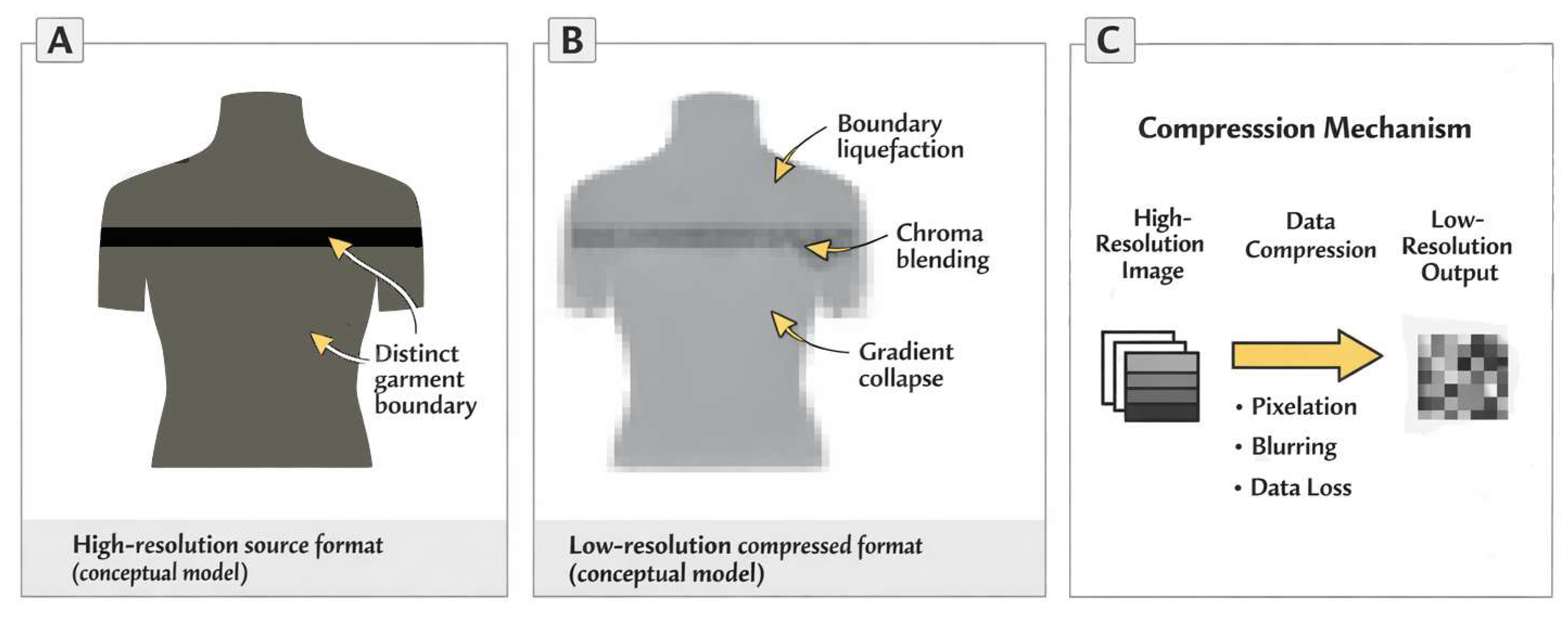
A simple example of materiality collapse illustrates the mechanism. Consider a woman wearing a low-cut top whose fabric is close in brightness (luma) and color (chroma) to her skin. The garment is clearly visible on the original high-resolution image; the fabric has texture, and the boundary between cloth and body is unambiguous. But in a low-resolution compressed version of the image, the top can effectively disappear. The garment collapses to a dark patch that appears not as fabric but as a shadow on bare skin. The viewer perceives the woman as topless, even though the original image shows nothing of the sort. This distorted perception is a predictable outcome of compression systems that simplify images into averaged color regions (
Richardson, 2011).
While Mary Tyler Moore’s physical undergarment in the bubble-bath scene remains visible on high-bitrate media like the DVD release, it effectively vanishes in lower-bitrate compressed versions due to materiality collapse. Because compression algorithms maintain high-contrast features and often discard low-contrast, fine-grained textures, the encoder misinterprets the garment as redundant data. This subsequent digital erasure creates a compression artifact that falsely suggests a wardrobe malfunction where none existed.
The transformation in materiality collapse occurs through several technical processes, illustrated in the conceptual model in
Figure 1.
First, compression eliminates fine details that signal material differences, such as edge definitions (
Winkler, 2005). When the garment and the skin share similar brightness and color, the encoder treats the boundary between them as redundant and averages the pixels into a single block. The result is a materiality collapse as textile and tissue become visually indistinguishable. This is the same mechanism that underlies chroma bleed in heavily compressed streaming video, where the encoder merges adjacent regions of similar color into a single simplified patch (
Poynton, 2012).
Second, low-resolution encoding cannot preserve subtle gradients. The soft shadow created where fabric meets skin becomes a single, crushed dark block. In the absence of texture or edge information, the viewer’s perceptual system interprets this block as a shadow cast by the body rather than as the presence of clothing. The artifact thus reconstructs the scene according to its algorithm, not the original physical environment. This gradient-crushing effect is a hallmark of low-bitrate encoding (
Winkler, 2005). Media archaeologists refer to this as liquefaction—a state in which the human form and the objects upon it melt into a single, continuous surface (
Huhtamo & Parikka, 2011;
Parikka, 2012). Clothing loses its structure; hems, seams, and folds vanish; and the image bleeds into a simplified, skin-colored field. Under these conditions, the digital artifact can hallucinate a perception of nudity even when none existed.
Additionally, the interpretation of the compressed image is shaped not only by the material transformations of low-resolution encoding but also by the cultural visual heuristics or mental shortcuts that viewers rely on to interpret ambiguous forms. Research on visual culture shows that images are not passively received but interpreted through shared aesthetic ideals and culturally embedded schemas—mental frameworks that organize and interpret information. As MacCallum and Widdows note, even when images do not appear to make sense, “images are interpreted, critiqued, rejected and renegotiated as individuals and groups,” and contemporary beauty ideals are “increasingly globalised and homogenised,” shaping how viewers share cultural evaluations of bodies and surfaces (
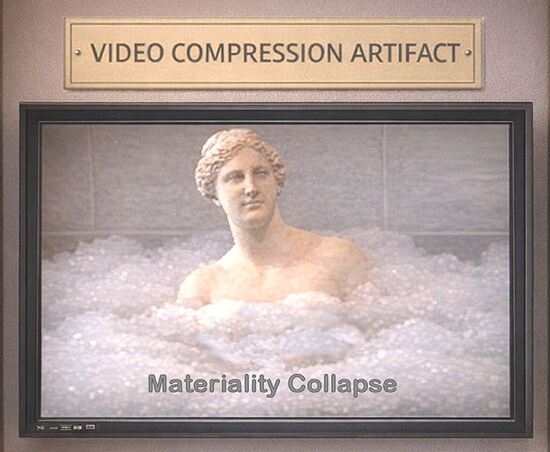
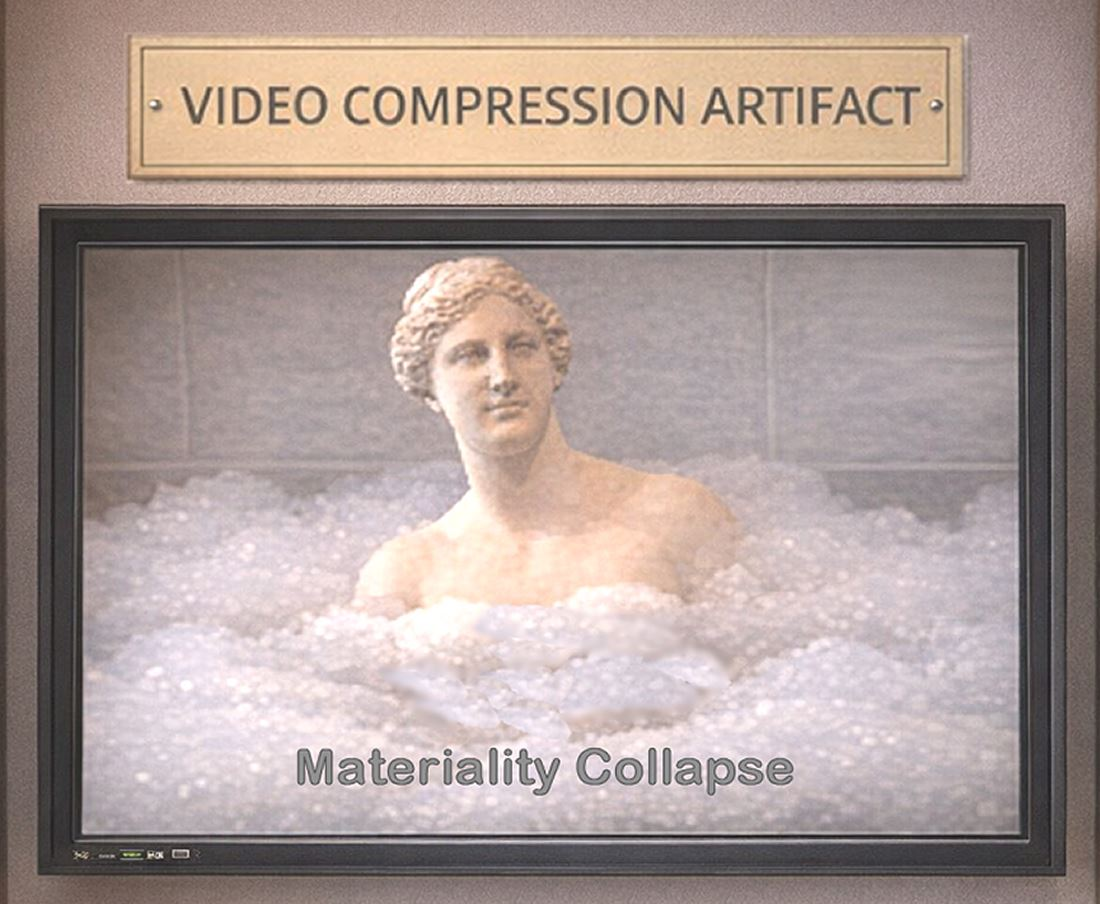
MacCallum & Widdows, 2018). When compression smooths edges, erases garment boundaries, and reduces surface detail, the resulting figure aligns with familiar Western aesthetic conventions of the classical nude, such as the simplified contours and continuous tonal surfaces of the Venus de Milo. This cultural familiarity provides a perceptual heuristic through which ambiguous or degraded images are resolved, helping explain why the compressed frame is readily perceived as nudity even if the high-resolution source reveals clothing. The cultural consequences are significant. A viewer encountering a low-resolution clip from a 1970s television show may believe a performer is dressed provocatively—or even indecently—when the original broadcast presented a modest, fully clothed figure.