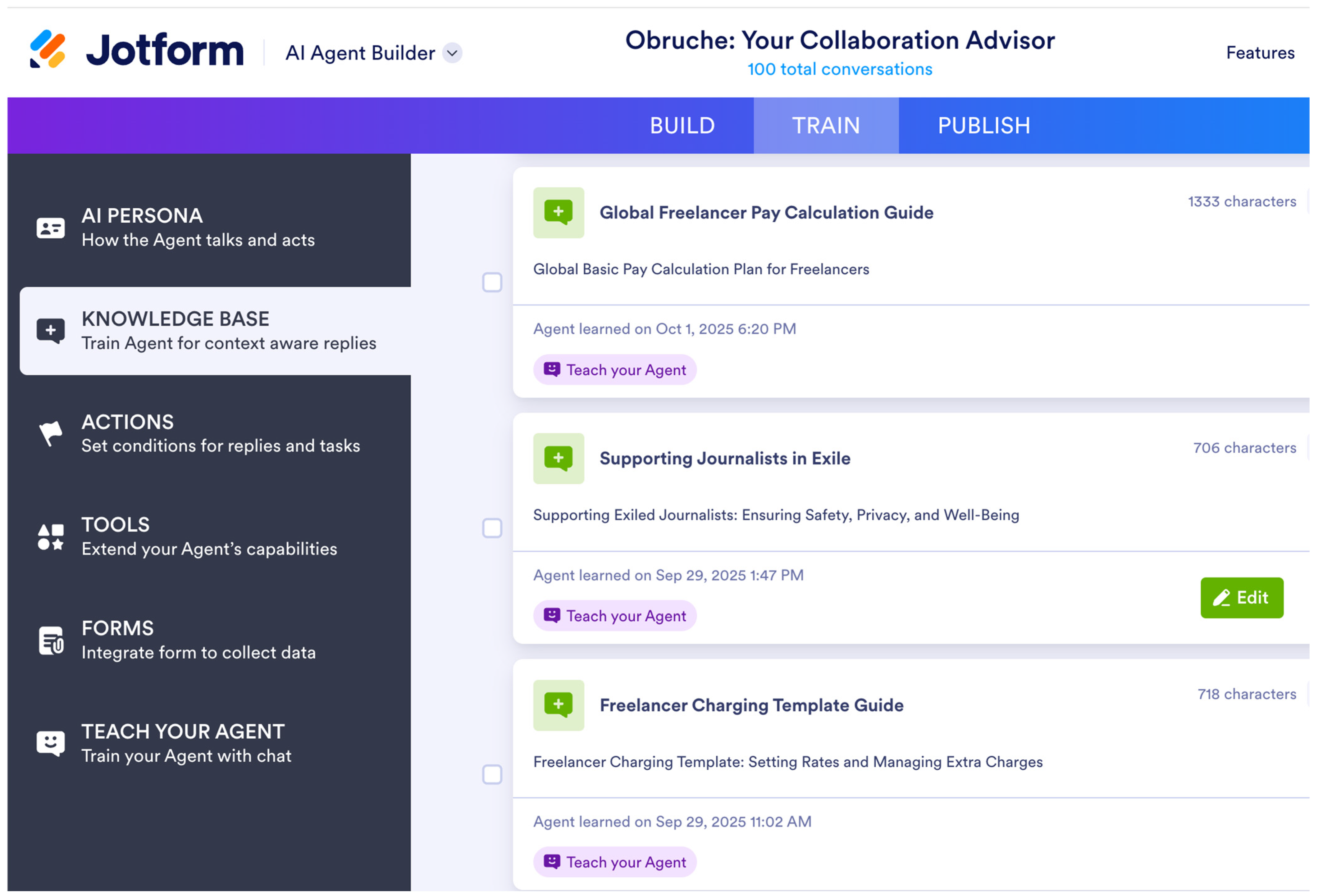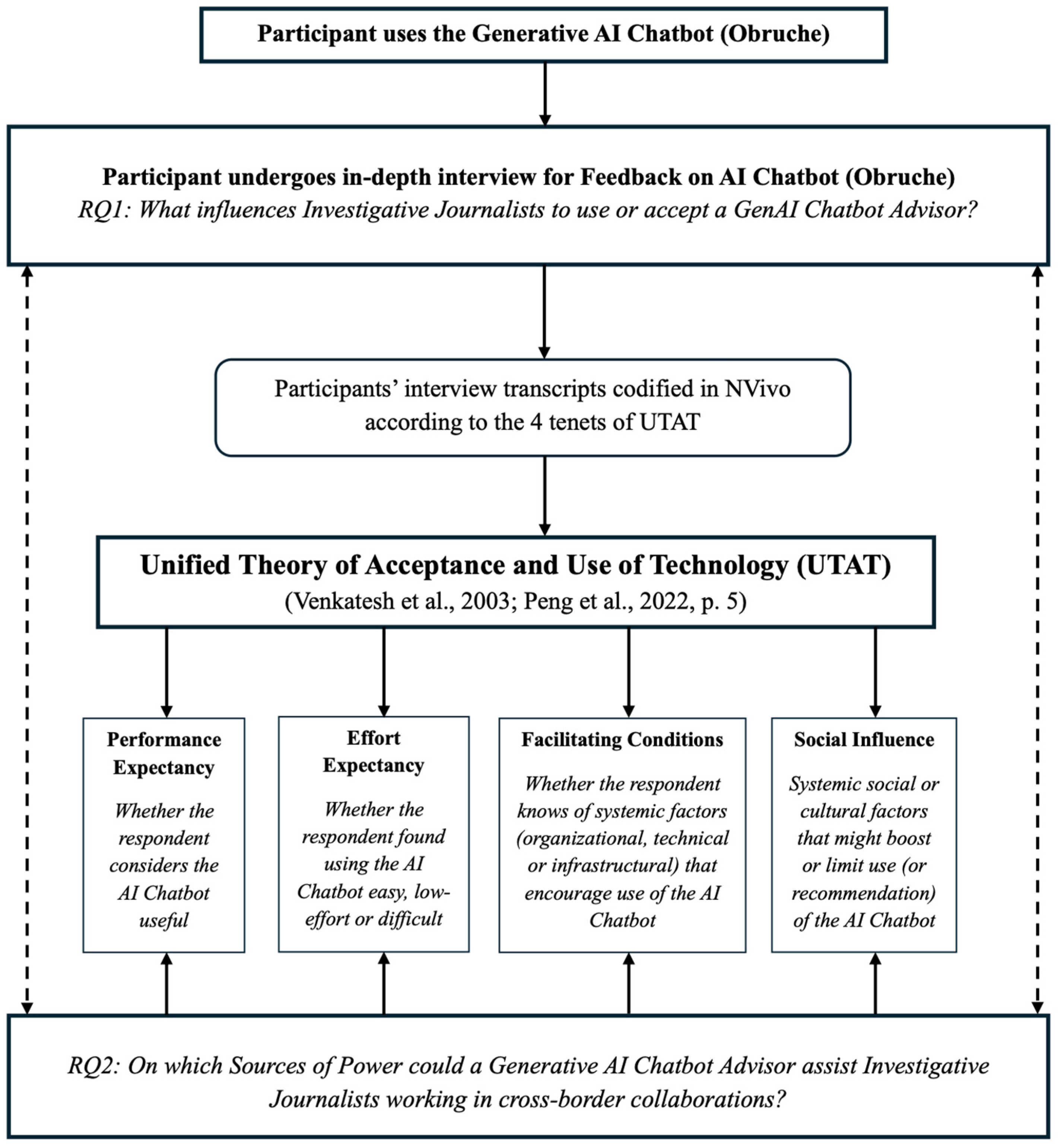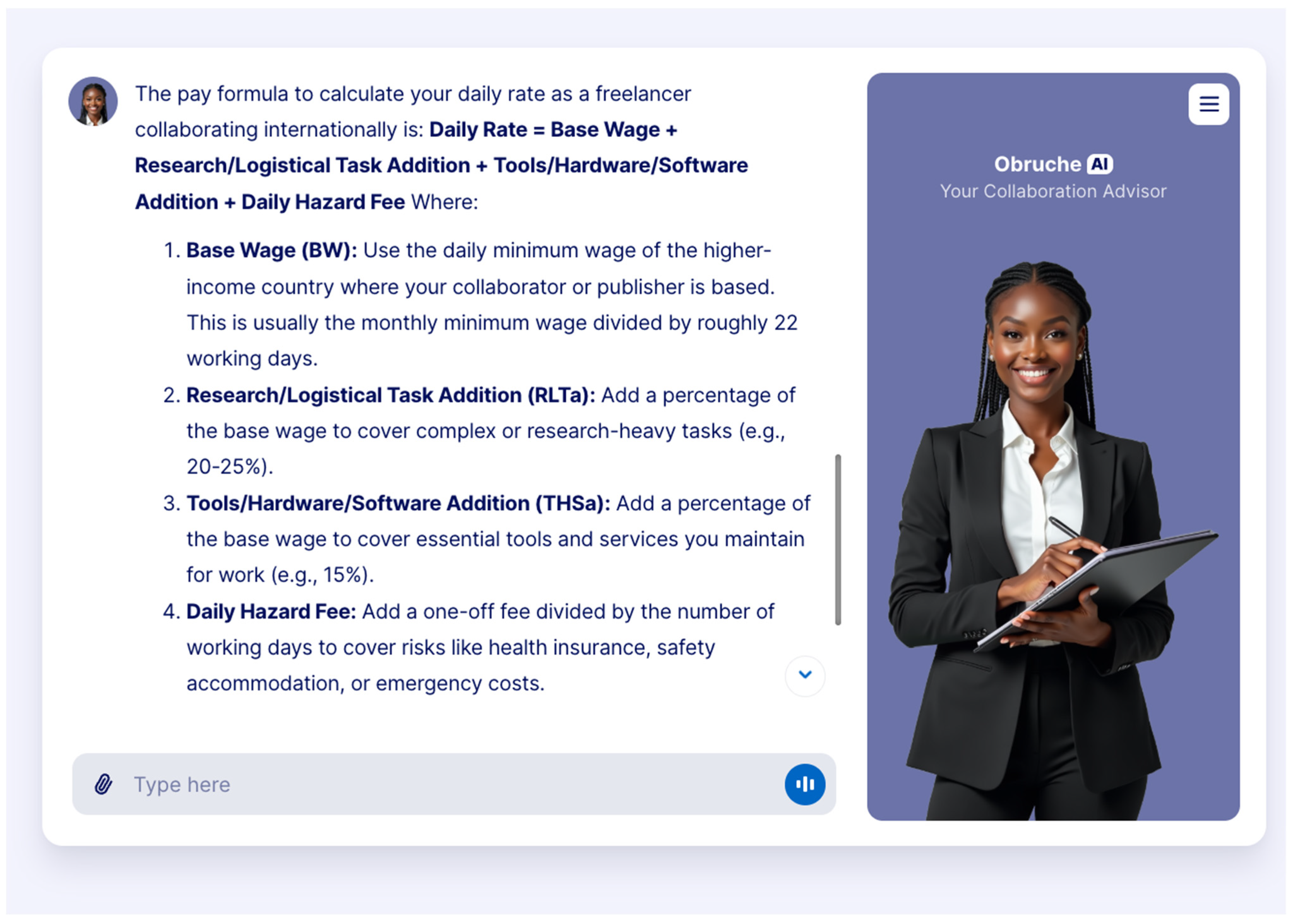


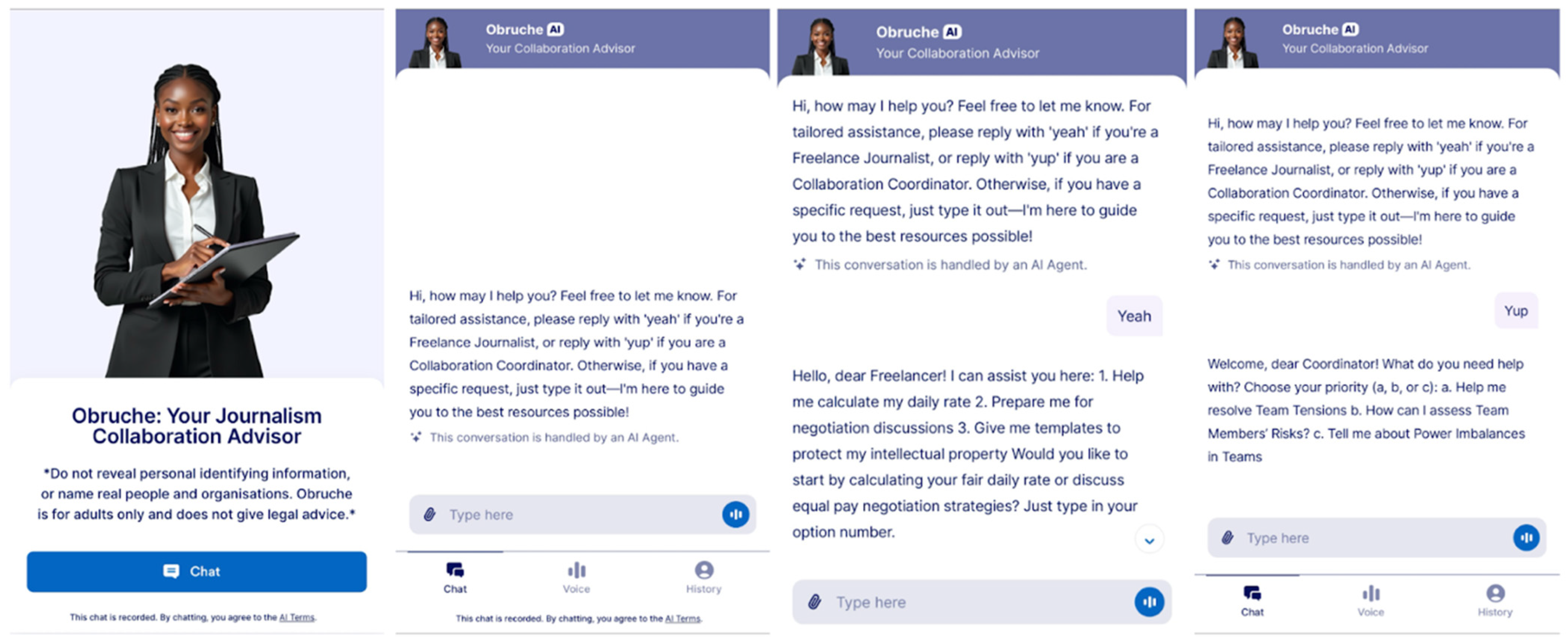
‘Now There Is Somebody I Can Go to, Although It’s an AI’: Evaluating Acceptance and Use of Obruche, a Pilot Chatbot to Prevent Power Asymmetries in Cross-Border Journalism Teams


Abstract
1. Introduction
1.1. GenAI, Chatbots, and Investigative Journalism
1.2. Power and Cross-Border Investigative Journalism
2. Study Background
2.1. AI Assistant Obruche
2.2. UTAUT as Analytical Framework
3. Methods
3.1. Participant Recruitment
3.2. Data Analysis
4. Results: Factors That Affect Journalists’ Use of a Chatbot Advisor
4.1. Performance Expectancy
4.1.1. Contributors to Positive Performance Expectancy
“Me being in [country A], I asked Obruche ‘I want to do an investigation in [country B]. And it gave me a lot of context. I live next to [country B] but I didn’t know. Maybe this is a personal problem, but … the way it was doing it, I don’t know what I expected, but it gave me more than what I expected. I was like, ‘Okay, this is actually actionable.’”[P2]
“You know when the bot gives options ‘would you like me to do this or that’ I was copying and pasting everything. I wanted to make sure that this time I go for option 1 but the second time I go for option 2 because I want to see what the chatbot will give me in both cases. I copied and saved the tips. I felt I could definitely use a lot of things later on.”[P12]
Another freelancer-coordinator from India felt less judged and supported:“Obruche is telling me I’m not alone in this collaborative investigative journalism work I want to do in [African country]. Now there is somebody I can always go to, although it’s an AI, that I can always reach out to, to have a conversation with.”[P8]
“I felt very seen that I could have all these questions without fear of judgment or without revealing the identity of people—my collaborators, my clients. I could just keep asking it questions. That felt quite relaxing.”[P12]
“Some of us just want the work, experience the credentials, so you don’t think through negotiating or costing collaborations well. It gave me a better perspective. It’s actually something that’s going to live with me. The fundamentals and the basics it gave me, I wrote some of them down; I don’t know if I’m allowed to but henceforth, this is how I’m going to progress with collaborations.”[P3]
“I asked it to design a safety planning template. I liked the emphasis on self-protection, and ethical clarity. It included things I could immediately do.”[P1]
“I’m in the middle of applying for something. When I put in a prompt ‘prepare pay proposal and this is the role,’ I put in the role and the description, everything that’s in the job advertisement. That’s where it really gave me what I wanted.”[P5]
“The pay calculation formula is excellent. It also gave me a sense of ‘ah you’ve done a lot of work for free.’ But hey, it came really timely and it was very helpful.”[P3]
“It told me ‘if the collaboration is coming from the US, use the US rate.’ This is something that I never thought about. I’ve just been a random freelancer. When I look back on some of the other jobs I’ve done, I think ‘oh no I was underpaid,’ because I was supposed to consider these things.”[P9]
“You mention you want to work with somebody in [African country], you need more clarification about payment and [the chatbot asks] ‘what about asking about the copyright issues for your photos?’ I was like, “wow.” So, the AI was even suggesting questions I could ask too. I feel the AI is, should I say, compassionate, to do that.”[P8]
“I asked it to give me story ideas about climate. And it gave ideas about climate, on agriculture. It added sources for me to interview, sources where I can get specific information.”[P7]
“I was surprised with some of the negotiation tactics and the email drafts or specific sentences that she proposed to use when communicating with publishers. So this was useful for me.”[P6]
4.1.2. Playful Interactions
“With these role-play sessions with the chatbot, now I know what to do, how to say certain things. I’d thought ‘how would it customize responses’ because it doesn’t really know everything about that project or my situation. But what was happening was, it was becoming a little more personal in a nice way. Every contract clause was being explained. Practicing made me feel more confident.”[P12]
“I asked Obruche, ‘what do you think about the concept of equal wage and paying people equal wages no matter the location?’ and she had very thoughtful answers. It’s not just templates or instructions, but it can also give something like an opinion.”[P6]
“I even tested for chauvinism and racism. I said ‘okay there is this stupid guy from eastern Europe, maybe he’s so backward because he’s coming from a backward country called Moldova.’ Obviously, I don’t think that. But Obruche didn’t react like being pissed, but very calmly explained what the problem was, and how to change, and how to approach this differently. So this was also good.”[P6]
“Deliberately, after getting an answer, I said ‘translate to [African language]’ and it gave me a very good translation, honestly. When I got the [African language] version I said ‘translate to English.’ It translated the draft back to English.”[P4]
“Using ChatGPT, it is not that I’m condemning another person’s work, but let’s say I’m [names African tribe]… when you ask ChatGPT to translate a document or a paragraph, you don’t just copy and paste, you have to go through it. There are times you just discard some translations because they are not what you requested or what the document or draft is talking about. So I was surprised… The translation is very good. I was impressed with what the app translated, honestly. It switched between languages.”
4.1.3. Desirable Features to Enhance Performance Expectancy
“The AI told me it could connect me with a specific media outlet in [names African country and organisation] but it didn’t provide any answer. I don’t know if that is a network error… I said the AI should connect me with the outlet. I didn’t mention that it should give me the contact details of people. So maybe my prompt was not very explanatory enough for it. Maybe that is why?”[P8]
“There appeared to be a glitch and suddenly it addressed me as a freelancer, but I found it very strange because at the very top I had already said I’m a collaboration coordinator.”[P10]
“It gave me one response like three times. It was frustrating. I didn’t like the frustration but it also taught me that now be specific about what exactly you want, what exact help you need.”[P3]
You must be specific on the exact area of the topic you want it to give you information on. Telling Obruche ‘I want to investigate illicit financial flows,’ it said something like: ‘illicit financial flows is a wide topic about oil, human trafficking, drugs, so which part do you mean?’ So you must narrow it down.”[P7]
4.2. Effort Expectancy
4.2.1. Design Features
“When I saw Obruche I was surprised. I couldn’t believe that there will be a generative AI tool that can help journalists in regard to sorting out publishing times, copyrights, contract clauses, and what not when it comes to doing investigative journalism.”[P8]
“It was a discovery, I felt ‘ah there’s something else that I can use.’”[P9]
“I had never thought of it until I saw your LinkedIn post [recruiting participants] and I thought oh this is something. This is the first time I ever thought that such a thing existed or has been created.”[P12]
4.2.2. Chatbot Persona
“I’m not a gender biased person. But I like that she was a lady and I like that that lady looked very African. That was very important because I’m coming from this background where a lot of content on AI is still very built around what bias exists. Like when you tell Descript, ‘give me images of people in a boardroom,’ then it will be white men in suits. …You have to keep on prompting it, saying, ‘wait, I want a woman too,’ or ‘the woman should also be dressed as if she’s there for business’…coming from that context of using that type of AI, to having this one that actually looks like you. Wow.”[P2]
“I think in all cultures you have mostly women working for example as social workers or in different shelters giving you advice, so I think it’s quite intuitive that it’s a woman. I don’t think the gender is a problem.”[P6]
“There are these stereotypes about who is better at managing relations in the collaboration: ‘oh, maybe a woman is better because a woman has a softer touch.’ And it [this chatbot with a female persona] also reminds me of how when technology companies built service robots, they started gendering the robots because they think people doing the mopping and the shopping are women, therefore they put a skirt on the robot.”[P10]
“What I didn’t like about that lady being there is the fact that because I know, being an African woman, I’m made to overthink everything. I’m made to be sensitive about everything around me. So for me I was like, can a [names own country] man or can an African man trust this chatbot? because there’s this thing of undermining ladies, and there’s this thing of ‘no, I can’t talk with a lady.’ People are now asking personal questions to chatbots. So I thought; can someone ask or talk about things that are personal, very personal to a lady chatbot?’[P9]
I’d choose something that is not gendered for the purpose that it should have wider usage. There should not be any stereotypes associated with the chatbot. If they’re given ideas, it would be like ‘after all it’s a woman who has told me this.’ So to be safe, it’s better to just be neutral.”[P9]
4.2.3. User Menu
“I love that before you start there’s the caveat that you don’t have to give personal identifying information. I don’t think a lot of tools have that. They let you figure it out until it’s too late. So I love that disclaimer; the chatbot was thinking of me, kind of.”
“It’s good that the chatbot offers suggestions, but if you are offering templates right from the beginning then you may make the user pause, and instead of getting very directed specific information particular to the problem that the user is seeking answers for, then the person may just go to the template, which kind of defeats the purpose of a chatbot. Because a chatbot is supposed to give you answers specific to your problem.”[P10]
“Right now I feel like I’m getting led by its suggestions; ‘I can help you do this, that’.”[P12]
“It can offer much more. So it would be good to put that [more information] immediately in the beginning menu because obviously it can do more.”[P5]
4.2.4. Responses
“It was trying somehow to at least push me: ‘please tell me’ or I’d ask a question and it would say, ‘please tell me where you are based so that I can help you better.’ The other chatbots, some that I’ve used, don’t do that; it just responds.”[P9]
“It’s a chatbot, but it was quick. Sometimes for some of the other AI platforms you’d have to wait, give some time for the response. This was quicker.”[P3]
4.3. Facilitating Conditions
“I’ve just been like confined, maybe being old-fashioned. I’m like okay wow this is a kind of AI, are there others I don’t know about? I don’t know the minimum wage, I don’t know how certain things are done. If I didn’t use this AI to help in the process, then I might be ripped off. I might be underpaid.”
“I had to figure the chatbot out, because it’s the first time I‘m even introduced to an idea that something can help me negotiate pay, or collaborations better. So, I also had to think along the lines of how, or what kind of things could such a chatbot help me with?”
Desirable Features to Facilitate Further Use
“You know the way you’ll go to your phone screen and you’re looking for the app Obruche so that you can just click then just pick up where you are? I did that. Then I realized I have to remember the website. But I’m on my phone, so the bookmarks are not even visible. I’m like ‘where is this Obruche again?’ I don’t know why I thought if I used it on my phone it will tell me ‘download app here.’ That’s really why I went to the phone. I’m lobbying for an app.”
“People are already trained to talk to bots on WhatsApp. Everyone is working with different phones, some of them are very old, they can’t buy a new one right now. So instead of loading it as another app, the chatbot should just be on WhatsApp.”
4.4. Social Influence
“I wondered…whatever question I’m going to ask, is it just going to throw me this standard thing? I didn’t spend long on the chatbot.”[P10]
“Related to Obruche, I have changed my AI skepticism, but not [skepticism] to AI in general. I haven’t seen anything very super beneficial about chatbots, but then with Obruche I need to say I started with negative bias but I have changed my opinion.”[P6]
“I had to forward it to the general manager of one of the networks that I work with, and I said, you need to share this on your platform for the seniors in the newsroom to try and go through this because it’s very insightful”[P3]
“It acknowledges the challenges that we African journalists face when having negotiations with international media partners, which can make a person want to use it.”[P1]
4.5. Sources of Power Where Obruche Can(Not) Intervene
“Now, my conversations will no longer come from a place of ‘I do not know anything.’ And the editor there will not be like, ‘why are you asking those kinds of questions? In (country) you cannot do this here.’ So it gives me the power of nuance in even the way I frame my questions and how I communicate this to the different teams or editors.”
“Power was practicing responses, because when you are speaking to a collaboration coordinator, you know that you have already said these words somewhere. You already asked these questions somewhere, so it is no longer unthinkable or undoable.”
“I was empowered, learning about the day rate in Europe and that I should apply using that day rate because the organization for a thing I’m applying for is based in Europe.”
“I never knew that I had to consider how much people with my level of experience are paid in the region that I’m going to work for. It got me reflecting about the kind of risks I took years back as a young journalist for literally voluntary service. Knowledge is power. I feel more powerful.”
“I asked how to make my network visible. About how to deal with a co-coordinator that is self-centered, that holds information from other network members. And I received some tips…those tips made me feel powerful, but not in a way to hurt or sideline members of my network. And through the chatbot, by knowing things I can do to make sure I am safe, I feel I am just as equal as other coordinators too.”
“When someone is commissioning you, they already have more power than you. Knowing how to justify my rates with evidence, that one makes me powerful, because that’s not something I knew before…This one empowered me with negotiating skills, with how to professionally drop-off from a contract that I feel I cannot do because maybe we are not reaching an agreement based on the rates they are offering.”
“Chatbots can help in having different perspectives about collaborations and introduce important perspectives you were not thinking about, but I do think in collaborations where there are these systemic power imbalances, no chatbot can help with this.”
“The more ideal thing is for us to get the information on Obruche to the people, the funders, to actually use this and work their way backwards. Instead of it coming from the point of the lesser powerful party being the one telling them: ‘hey, this is what you pay’ and stuff like that. So I hope it can reach more coordinators; the ones who are commissioning projects, they’re the ones who need to refer to this so that they do not leave people in a weird situation.”
5. Discussion
6. Limitations
7. Conclusions
Supplementary Materials
Funding
Institutional Review Board Statement
Informed Consent Statement
Data Availability Statement
Conflicts of Interest
| 1 | Obruche is the Urhobo word for “arbitrator”. Urhobo is a language from southern Nigeria. |
References
- Alghalbie, F., Elnaem, M. H., & McCarron, P. A. (2026). Perspectives on artificial intelligence use in pharmacy education in Northern Ireland: A qualitative study based on the unified theory of acceptance and use of technology. Currents in Pharmacy Teaching and Learning, 18(1), 102490. [Google Scholar] [CrossRef]
- Alhadreti, O., & Mayhew, P. (2017). To intervene or not to intervene: An investigation of three think-aloud protocols in usability testing. Journal of Usability Studies, 12(3), 111–132. [Google Scholar]
- Amiot, C., Charoy, F., & Dinet, J. (2025). Chatbots in collaborative settings and their impact on virtual teamwork. Proceedings of the ACM on Human-Computer Interaction, 9(2), 1–18. [Google Scholar] [CrossRef]
- Ashton, L. M., Adam, M. T., Whatnall, M., Rollo, M. E., Burrows, T. L., Hansen, V., & Collins, C. E. (2023). Exploring the design and utility of an integrated web-based chatbot for young adults to support healthy eating: A qualitative study. International Journal of Behavioral Nutrition and Physical Activity, 20(1), 119. [Google Scholar] [CrossRef] [PubMed]
- Benke, I. (2020, June). Towards design principles for trustworthy affective chatbots in virtual teams. In Research-in-progress papers (p. 41). European Conference on Information Systems. Available online: https://aisel.aisnet.org/ecis2020_rip/41 (accessed on 22 February 2026).
- Bélair-Gagnon, V., Holton, A., Deuze, M., & Mellado, C. (Eds.). (2024). Happiness in journalism. Routledge. [Google Scholar]
- Bianchini, F., Braccini, A. M., De Luzi, F., Macrì, M., & Mecella, M. (2025). Exploring AI chatbot adoption for knowledge workers: A unified theory of acceptance and use of technology extension. Cureus Journals, 2(1), 1–19. [Google Scholar] [CrossRef]
- Borau, S., Otterbring, T., Laporte, S., & Fosso Wamba, S. (2021). The most human bot: Female gendering increases humanness perceptions of bots and acceptance of AI. Psychology & Marketing, 38(7), 1052–1068. [Google Scholar] [CrossRef]
- Bradshaw, P. (2026). Investigative journalism and AI. In Insights on investigative journalism (pp. 155–170). Routledge. [Google Scholar]
- Braggaar, A., Verhagen, J., Martijn, G., & Liebrecht, C. (2023, November). Conversational repair strategies to cope with errors and breakdowns in customer service chatbot conversations. In International workshop on chatbot research and design (pp. 23–41). Springer Nature. [Google Scholar] [CrossRef]
- Braun, V., & Clarke, V. (2016). (Mis)conceptualising themes, thematic analysis, and other problems with Fugard and Potts’ (2015) sample-size tool for thematic analysis. International Journal of Social Research Methodology, 19(6), 739–743. [Google Scholar] [CrossRef]
- Brown, S. A., & Venkatesh, V. (2005). Model of adoption of technology in households: A baseline model test and extension incorporating household life cycle. MIS Quarterly, 29, 399–426. [Google Scholar] [CrossRef]
- Buckley, R. (2022). Ten steps for specifying saturation in qualitative research. Social Science & Medicine, 309, 115217. [Google Scholar] [CrossRef]
- Bunce, M., Wright, K., & Scott, M. (2018). “Our newsroom in the cloud”: Slack, virtual newsrooms and journalistic practice. New Media & Society, 20(9), 3380–3399. [Google Scholar] [CrossRef]
- Cannanure, V. K., Wolf, S., Jasińska, K., Brown, T. X., & Ogan, A. (2025). Applying think-aloud in ICTD: A case study of a chatbot use by teachers in rural Côte d’Ivoire. arXiv, arXiv:2501.05840. [Google Scholar]
- Casero-Ripollés, A. (2021). O impacto da COVID-19 no jornalismo: Um conjunto de transformações em cinco domínios. Comunicação e Sociedade, (40), 53–69. [Google Scholar] [CrossRef]
- Caswell, D., & Dörr, K. (2018). Automated journalism 2.0: Event-driven narratives: From simple descriptions to real stories. Journalism Practice, 12(4), 477–496. [Google Scholar] [CrossRef]
- Cândea, Ş. (2021). Data feudalism: How platforms shape cross-border investigative networks. In L. Bounegru, & J. Grey (Eds.), The data journalism handbook: Towards a critical data practice (pp. 295–298). Amsterdam University Press. [Google Scholar]
- Chang, A. (2012). UTAUT and UTAUT 2: A review and agenda for future research. Journal the Winners, 13(2), 10–114. [Google Scholar] [CrossRef]
- Cheah, M. H., Gan, Y. N., Altice, F. L., Wickersham, J. A., Shrestha, R., Salleh, N. A. M., Ng, K. S., Azwa, I., Balakrishnan, V., Kamarulzaman, A., & Ni, Z. (2024). Testing the feasibility and acceptability of using an artificial intelligence chatbot to promote HIV testing and pre-exposure prophylaxis in Malaysia: Mixed methods study. JMIR Human Factors, 11, e52055. [Google Scholar] [CrossRef]
- Cheas, K. (2025). Psychological capital and safety in Global North-South cooperation: A field analysis of collaborative investigative journalism across the US-Mexico border. Journalism, 26(4), 781–799. [Google Scholar] [CrossRef]
- Chen, N., & Zhang, X. (2025). When misunderstanding meets artificial intelligence: The critical role of trust in human–AI and human–human team communication and performance. Frontiers in Psychology, 16, 1637339. [Google Scholar] [CrossRef]
- Cheng, R. M. (2025). Remote newsrooms: The place and labor of digital news production [Doctoral dissertation, University of Minnesota]. University of Minnesota Conservancy. Available online: https://hdl.handle.net/11299/262241 (accessed on 22 February 2026).
- Cherubini, F., Newman, N., & Nielsen, R. K. (2021). Changing newsrooms 2021: Hybrid working and improving diversity remain twin challenges for publishers. Reuters Institute for the Study of Journalism. [Google Scholar] [CrossRef]
- Cifliku, B., & Heuer, H. (2025, April). “This could save us months of work”-Use cases of AI and automation support in investigative journalism. In Extended abstracts of the CHI conference on human factors in computing systems (pp. 1–8). Association for Computing Machinery. ISBN 979-8-4007-1395-8. [Google Scholar] [CrossRef]
- Cools, H., & Diakopoulos, N. (2024). Uses of generative AI in the newsroom: Mapping journalists’ perceptions of perils and possibilities. Journalism Practice, 20, 878–896. [Google Scholar] [CrossRef]
- da Silveira Colissi, M., Vieira, R., Mascardi, V., & Bordini, R. H. (2021). A chatbot that uses a multi-agent organization to support collaborative learning. In International conference on human-computer interaction (pp. 31–38). Springer International Publishing. [Google Scholar] [CrossRef]
- de Andrés-Sánchez, J., & Gené-Albesa, J. (2025). Drivers and necessary conditions for chatbot acceptance in the insurance industry. Analysis of policyholders’ and professionals’ perspectives. Journal of Organizational Computing and Electronic Commerce, 35(3), 189–216. [Google Scholar] [CrossRef]
- Do, H. J., Kong, H. K., Tetali, P., Lee, J., & Bailey, B. P. (2023). To Err is AI: Imperfect interventions and repair in a conversational agent facilitating group chat discussions. Proceedings of the ACM on Human-Computer Interaction, 7(CSCW1), 1–23. [Google Scholar] [CrossRef]
- Dodds, T., Zamith, R., & Lewis, S. C. (2025). The AI turn in journalism: Disruption, adaptation, and democratic futures. Journalism, 27, 530–544. [Google Scholar] [CrossRef]
- Fieberg, C., Hornuf, L., & Streich, D. J. (2023). Using GPT-4 for financial advice (CESifo working paper, No. 10529). Center for Economic Studies and ifo Institute (CESifo). Available online: https://hdl.handle.net/10419/279279 (accessed on 8 December 2025).
- Fridman, M., Krøvel, R., & Palumbo, F. (2025). How (not to) run an AI project in investigative journalism. Journalism Practice, 19(6), 1362–1379. [Google Scholar] [CrossRef]
- Gao, J., Agarwal, R., & Garsole, P. (2025). AI testing for intelligent chatbots—A case study. Software, 4, 12. [Google Scholar] [CrossRef]
- García de Blanes Sebastián, M., Sarmiento Guede, J. R., & Antonovica, A. (2022). Application and extension of the UTAUT2 model for determining behavioral intention factors in use of the artificial intelligence virtual assistants. Frontiers in Psychology, 13, 993935. [Google Scholar] [CrossRef] [PubMed]
- Gondwe, G. (2023). CHATGPT and the Global South: How are journalists in sub-Saharan Africa engaging with generative AI? Online Media and Global Communication, 2(2), 228–249. [Google Scholar] [CrossRef]
- Goodman, R. S., Patrinely, J. R., Stone, C. A., Jr., Zimmerman, E., Donald, R. R., Chang, S. S., Berkowitz, S. T., Finn, A. P., Jahangir, E., Scoville, E. A., Reese, T. S., Friedman, D. L., Bastarache, J. A., van der Heijden, Y. F., Wright, J. J., Ye, F., Carter, N., Alexander, M. R., Choe, J. H., … Johnson, D. B. (2023). Accuracy and reliability of chatbot responses to physician questions. JAMA Network Open, 6(10), e2336483. [Google Scholar] [CrossRef]
- Graefe, A. (2016). Guide to automated journalism. Available online: https://files01.core.ac.uk/download/pdf/161457017.pdf (accessed on 27 February 2026).
- Graham, C., Murray, R., & Pinkerton, J. (2024). “All by myself”: Professional, emotional and ethical isolation for remote Australian journalists. Ethical Space: The International Journal of Communication Ethics, 21(4), 5–21. [Google Scholar] [CrossRef]
- Gray, B., Purdy, J., & Ansari, S. (2022). Confronting power asymmetries in partnerships to address grand challenges. Organization Theory, 3(2), 1–25. [Google Scholar] [CrossRef]
- Griffin, A. C., Khairat, S., Bailey, S. C., & Chung, A. E. (2023). A chatbot for hypertension self-management support: User-centered design, development, and usability testing. JAMIA Open, 6(3), ooad073. [Google Scholar] [CrossRef]
- Guest, G., Bunce, A., & Johnson, L. (2006). How many interviews are enough? An experiment with data saturation and variability. Field Methods, 18(1), 59–82. [Google Scholar] [CrossRef]
- Henderson, K., Raheja, R., & Crowston, K. (2022, January 4–7). Communicating with the masses from isolation: What happened when local television journalists worked from home. 55th Hawaii International Conference on System Sciences, Maui, HI, USA. Available online: http://hdl.handle.net/10125/79659 (accessed on 22 February 2026).
- Hennink, M., & Kaiser, B. N. (2022). Sample sizes for saturation in qualitative research: A systematic review of empirical tests. Social Science & Medicine, 292, 114523. [Google Scholar] [CrossRef]
- Hoxha, A., Andresen, K., & Mulliqi, G. (2024). Solidarity, safety and journalism: Collaboration between Ukrainian and Kosovar journalists in times of war. Journalism, 26(4), 843–861. [Google Scholar] [CrossRef]
- Hua, Y., Siddals, S., Ma, Z., Galatzer-Levy, I., Xia, W., Hau, C., Na, H., Flathers, M., Linardon, J., Ayubcha, C., & Torous, J. (2025). Charting the evolution of artificial intelligence mental health chatbots from rule-based systems to large language models: A systematic review. World Psychiatry, 24(3), 383–394. [Google Scholar] [CrossRef]
- Ioscote, F., Gonçalves, A., & Quadros, C. (2024). Artificial intelligence in journalism: A ten-year retrospective of scientific articles (2014–2023). Journalism and Media, 5(3), 873–891. [Google Scholar] [CrossRef]
- Ivask, S., & Lon, A. (2023). “You can run, but you cannot hide!” Mapping journalists’ experiences with hostility in personal, organizational, and professional domains. Journalism & Mass Communication Educator, 78(2), 199–213. [Google Scholar] [CrossRef]
- Jotform Inc. (2026). Jotform AI agents. Jotform. Available online: https://www.jotform.com/ai/agents/ (accessed on 5 December 2025).
- Jörke, M., Genç, D., Teutschbein, V., Sapkota, S., Chung, S., Schmiedmayer, P., Campero, M. I., King, A. C., Brunskill, E., & Landay, J. A. (2025). Bloom: Designing for LLM-augmented behavior change interactions. arXiv, arXiv:2510.05449. [Google Scholar] [CrossRef]
- Kennedy, B. L., & Thornberg, R. (2018). Deduction, induction, abduction. In U. Flick (Ed.), SAGE handbook of qualitative data collection (pp. 49–64). SAGE. [Google Scholar]
- Konow-Lund, M., & Høiby, M. (2023). Female investigative journalists: Overcoming threats, intimidation, and violence with gendered strategies. Journalism Practice, 17(8), 1591–1606. [Google Scholar] [CrossRef]
- Kotenidis, E., & Veglis, A. (2021). Algorithmic journalism—Current applications and future perspectives. Journalism and Media, 2(2), 244–257. [Google Scholar] [CrossRef]
- Kunert, J. (2025). Using artificial intelligence for investigative journalism. In A. Sarısakaloğlu, & M. Löffelholz (Eds.), The handbook of artificial intelligence and journalism (pp. 223–233). Wiley. [Google Scholar]
- Le Bonniec, A., Sauvaget, C., Lucas, E., Nassiri, A., & Selmouni, F. (2025). Design and validation of a chatbot-based cervical cancer screening decision aid for women experiencing socioeconomic disadvantage: User-centered approach study. JMIR Cancer, 11, e70251. [Google Scholar] [CrossRef] [PubMed]
- Lewis, S. C., Guzman, A. L., Schmidt, T. R., & Lin, B. (2025). Generative AI and its disruptive challenge to journalism: An institutional analysis. Communication and Change, 1(1), 9. [Google Scholar] [CrossRef]
- Lewis, S. C., & Westlund, O. (2015). Actors, actants, audiences, and activities in cross-media news work: A matrix and a research agenda. Digital Journalism, 3(1), 19–37. [Google Scholar] [CrossRef]
- Liu, M., Yang, Y., Ren, Y., Jia, Y., Ma, H., Luo, J., Fang, S., Qi, M., & Zhang, L. (2024). What influences consumer AI chatbot use intention? An application of the extended technology acceptance model. Journal of Hospitality and Tourism Technology, 15(4), 667–689. [Google Scholar] [CrossRef]
- MacDougall, C., & Baum, F. (1997). The devil’s advocate: A strategy to avoid groupthink and stimulate discussion in focus groups. Qualitative Health Research, 7(4), 532–541. [Google Scholar] [CrossRef]
- Mainwaring, S. D., & Wrapp, M. K. (2021). Opportunities and risks of conversational AI for credit unions (Report #537 21 May 2021). Available online: https://www.filene.org/reports/opportunities-and-risks-of-conversational-ai-for-credit-unions-empathy-and-intimacy-in-automated-financial-customer-service (accessed on 23 February 2026).
- Malterud, K., Siersma, V. K., & Guassora, A. D. (2016). Sample size in qualitative interview studies: Guided by information power. Qualitative Health Research, 26(13), 1753–1760. [Google Scholar] [CrossRef]
- Massa, P., de Souza Ferraz, D. A., Magno, L., Silva, A. P., Greco, M., Dourado, I., & Grangeiro, A. (2023). A transgender chatbot (Amanda selfie) to create pre-exposure prophylaxis demand among adolescents in Brazil: Assessment of acceptability, functionality, usability, and results. Journal of Medical Internet Research, 25, e41881. [Google Scholar] [CrossRef]
- McDonald, S., Cockton, G., & Irons, A. (2020). The impact of thinking-aloud on usability inspection. Proceedings of the ACM on Human-Computer Interaction, 4(EICS), 1–22. [Google Scholar] [CrossRef]
- Menon, D., & Shilpa, K. (2023). “Chatting with ChatGPT”: Analyzing the factors influencing users’ intention to use the open AI’s ChatGPT using the UTAUT model. Heliyon, 9(11), e20962. [Google Scholar] [CrossRef]
- Mesquita, L., de-Lima-Santos, M.-F., & Nicoletti, J. (2025). Collaborative journalism and cross-border collaborations for newsafety: Navigating security and solidarity mechanisms in cooperative practices in Latin American news media. Journalism, 26(4), 900–922. [Google Scholar] [CrossRef]
- Meyer, R. (2019). “Wearing a bullet-proof vest”: Social media use in journalism production within African–intercontinental investigative networks. African Journalism Studies, 40(3), 89–106. [Google Scholar] [CrossRef]
- Meyer, R. (2025). The threat within: Power dynamics impeding cross-border journalism practice–perspectives from African investigators. Journalism, 26(4), 800–822. [Google Scholar] [CrossRef]
- Mitra, S., Valderrama, Y. Z., & Krøvel, R. (2025). Special issue: Cross-border, collaborative and cross-boundary journalism practices: Challenges and opportunities for ensuring safety of journalists. Journalism, 26(4), 759–766. [Google Scholar] [CrossRef]
- Mogaji, E., Balakrishnan, J., Nwoba, A. C., & Nguyen, N. P. (2021). Emerging-market consumers’ interactions with banking chatbots. Telematics and Informatics, 65, 101711. [Google Scholar] [CrossRef]
- Morgan, G. (2017). Exploring power. In A. Hooper (Ed.), Leadership perspectives (pp. 243–270). Routledge. [Google Scholar]
- Møller, L. A., Cools, H., & Skovsgaard, M. (2025). One size fits some: How journalistic roles shape the adoption of generative AI. Journalism Practice, 1–22. [Google Scholar] [CrossRef]
- Munoriyarwa, A. (2024). Unravelling socio-technological barriers to AI integration: A qualitative study of Southern African newsrooms. Emerging Media, 2(3), 474–498. [Google Scholar] [CrossRef]
- Munoriyarwa, A., & Chiumbu, S. (2024). Transnational networks in global collaborative journalism: Mapping opportunities and challenges in Africa. In L. Barkho, J. Lugo-Ocando, & S. Jamil (Eds.), Handbook of applied journalism: Theory and practice (pp. 261–279). Springer. [Google Scholar]
- Munoriyarwa, A., & de-Lima-Santos, M. F. (2025). Generative AI and the future of news: Examining AI’s agency, power, and authority. Journalism Practice, 19(10), 2177–2188. [Google Scholar] [CrossRef]
- Mwita, K. (2022). Factors influencing data saturation in qualitative studies. International Journal of Research in Business and Social Science, 11(4), 414–420. [Google Scholar] [CrossRef]
- Ng, Y. M. M. (2021). Understanding collaborative journalism with digital trace data and crowdsourced databases. In V. Bélair-Gagnon, & N. Usher (Eds.), Journalism research that matters (pp. 115–130). Oxford University Press. [Google Scholar]
- Nori, H., King, N., McKinney, S. M., Carignan, D., & Horvitz, E. (2023). Capabilities of GPT-4 on medical challenge problems. arXiv, arXiv:2303.13375. [Google Scholar] [CrossRef]
- Nyangulu, W., Mungwira, R., Nampota, N., Nyirenda, O., Tsirizani, L., Mwinjiwa, E., & Divala, T. (2019). Compensation of subjects for participation in biomedical research in resource–limited settings: A discussion of practices in Malawi. BMC Medical Ethics, 20(1), 82. [Google Scholar] [CrossRef]
- O’Brien, L., & Wilson, S. (2023). Talking about thinking aloud: Perspectives from interactive think-aloud practitioners. Journal of User Experience, 18(3), 113–132. [Google Scholar]
- Othayoth, P. K., & Khanna, S. (2025). Implementation of artificial intelligence and chatbot for the enhancement of new age banking systems: A systematic review. In Generative AI in FinTech: Revolutionizing finance through intelligent algorithms (pp. 1–19). Springer. ISBN 978-3-031-76956-6. [Google Scholar] [CrossRef]
- Otis, N. G., Delecourt, S., Cranney, K., & Koning, R. (2024). Global evidence on gender gaps and generative AI (Working Paper, No. 25-023, October 2024, Revised August 2025). Harvard Business School. Available online: https://www.hbs.edu/ris/Publication%20Files/25023_52957d6c-0378-4796-99fa-aab684b3b2f8.pdf (accessed on 24 March 2026).
- Örnebring, H. (2018). Journalists thinking about precarity: Making sense of the “new normal”. In International symposium on online journalism (Vol. 8, No. 1, pp. 109–127). University of Austin. [Google Scholar]
- Peng, M. L., Wickersham, J. A., Altice, F. L., Shrestha, R., Azwa, I., Zhou, X., Halim, M. A. A., Ikhtiaruddin, W. M., Tee, V., Kamarulzaman, A., & Ni, Z. (2022). Formative evaluation of the acceptance of HIV prevention artificial intelligence chatbots by men who have sex with men in Malaysia: Focus group study. JMIR Formative Research, 6(10), e42055. [Google Scholar] [CrossRef]
- Puspitasari, I. W., Rinawan, F. R., Purnama, W. G., Susiarno, H., & Susanti, A. I. (2022). Development of a chatbot for pregnant women on a Posyandu application in Indonesia: From qualitative approach to decision tree method. Informatics, 9(4), 88. [Google Scholar] [CrossRef]
- Reiter, E. (2024). Natural language generation. Springer Nature. [Google Scholar]
- Ronagh Nikghalb, M., & Cheng, J. (2025). Interrogating AI: Characterizing emergent playful Interactions with ChatGPT. Proceedings of the ACM on Human-Computer Interaction, 9(2), 1–23. [Google Scholar] [CrossRef]
- Salyers, A. J., Bull, S., Silvasstar, J., Howell, K., Wright, T., & Banaei-Kashani, F. (2025). Building and beta-testing be well buddy chatbot, a secure, credible and trustworthy AI chatbot that will not misinform, hallucinate or stigmatize substance use disorder: Development and usability study. JMIR Human Factors, 12, e69144. [Google Scholar] [CrossRef]
- Schuster, R. C., Wutich, A., Brewis, A., & SturtzSreetharan, C. (2022). Ethnographic methods in cross-cultural research. In P. Liamputtong (Ed.), Handbook of qualitative cross-cultural research methods (pp. 273–289). Edward Elgar Publishing. [Google Scholar]
- Sonni, A. F., Hafied, H., Irwanto, I., & Latuheru, R. (2024). Digital newsroom transformation: A systematic review of the impact of artificial intelligence on journalistic practices, news narratives, and ethical challenges. Journalism and Media, 5(4), 1554–1570. [Google Scholar] [CrossRef]
- Stellenbosch University. (2025). “Compensation of research participants”. Health research ethics. Available online: https://files.su.ac.za/public/ethics/documents/2025-12/compensation-research-participants.pdf (accessed on 22 February 2026).
- Šimunjak, M. (2022). Pride and anxiety: British journalists’ emotional labour in the COVID-19 pandemic. Journalism Studies, 23(4), 320–337. [Google Scholar] [CrossRef]
- Takhsha, M. (2024). The interplay of chatbot language style and perceived user experience on group decision making performance [Doctoral dissertation, HEC Montréal]. Available online: https://biblos.hec.ca/biblio/memoires/takhsha_mina_m2024.pdf (accessed on 22 February 2026).
- Tang, H., Wang, J., Liu, Q., Bao, J., & Zeng, W. (2024). Exploring the use of ChatGPT-4o in enhancing career development counselling for medical students: A study protocol. BMJ Open, 14(11), e083697. [Google Scholar] [CrossRef]
- Tavanapour, N., Theodorakopoulos, D., & Bittner, E. A. (2020). A conversational agent as facilitator: Guiding groups through collaboration processes. In International conference on human-computer interaction (pp. 108–129). Springer International Publishing. [Google Scholar] [CrossRef]
- Terblanche, N. H. D., Wallis, G. P., & Kidd, M. (2023). Talk or text? The role of communication modalities in the adoption of a non-directive, goal-attainment coaching chatbot. Interacting with Computers, 35(4), 511–518. [Google Scholar] [CrossRef]
- Thäsler-Kordonouri, S., & Koliska, M. (2025). Journalistic agency and power in the era of artificial intelligence. Journalism Practice, 19(10), 2189–2208. [Google Scholar] [CrossRef]
- Tian, W., Ge, J., Zhao, Y., & Zheng, X. (2024). AI chatbots in Chinese higher education: Adoption, perception, and influence among graduate students—An integrated analysis utilizing UTAUT and ECM models. Frontiers in Psychology, 15, 1268549. [Google Scholar] [CrossRef]
- Usiña-Báscones, G., Carrión-Bósquez, N., Veas-González, I., García-Umaña, A., Ulloa-Meneses, L., Guerra-Regalado, W., & Samaniego-Arias, M. (2025). Exploring the moderating effect of price on the relationship between intention and use of voice assistants. IEEE Access, 13, 143800–143812. [Google Scholar] [CrossRef]
- Veglis, A., & Maniou, T. A. (2019). Chatbots on the rise: A new narrative in journalism. Studies in Media and Communication, 7(1), 1–6. [Google Scholar] [CrossRef]
- Vella, J. (2024). In pursuit of credibility: Evaluating the divergence between member-checking and hermeneutic phenomenology. Research in Social and Administrative Pharmacy, 20(7), 665–669. [Google Scholar] [CrossRef] [PubMed]
- Venkatesh, V. (2022). Adoption and use of AI tools: A research agenda grounded in UTAUT. Annals of Operations Research, 308(1), 641–652. [Google Scholar] [CrossRef]
- Venkatesh, V., Morris, M. G., Davis, G. B., & Davis, F. D. (2003). User acceptance of information technology: Toward a unified view. MIS Quarterly, 27, 425–478. [Google Scholar] [CrossRef]
- Waisbord, S. R. (2025). Afterword: Cross-border journalism: Issues and questions for research and practice. Journalism, 26(4), 923–928. [Google Scholar] [CrossRef]
- Wutich, A., Beresford, M., & Bernard, H. R. (2024). Sample sizes for 10 types of qualitative data analysis: An integrative review, empirical guidance, and next steps. International Journal of Qualitative Methods, 23, 16094069241296206. [Google Scholar] [CrossRef]
- Wutz, M., Hermes, M., Winter, V., & Köberlein-Neu, J. (2023). Factors influencing the acceptability, acceptance, and adoption of conversational agents in health care: Integrative review. Journal of Medical Internet Research, 25, e44548. [Google Scholar] [CrossRef]
- Yin, Q., & Zheng, S. (2024). “Journalists” without a press card-cross-border cooperation of Chinese private news organizations. Journalism, 26(4), 881–899. [Google Scholar] [CrossRef]
- Zhang, R. W., Liang, X., & Wu, S. H. (2024). When chatbots fail: Exploring user coping following a chatbots-induced service failure. Information Technology & People, 37(8), 175–195. [Google Scholar] [CrossRef]




| Source of Power | Characteristics | Power Breach Scenarios |
|---|---|---|
| Control of Knowledge and Information | Ability to influence the content, timing, and direction of information flows | Withholding information about available training opportunities from some colleagues, not including reporters in pre-publication editing of their own investigations |
| Control of Scarce Resources | Ability to control funding, personnel, and sought-after goods or services relevant to the workplace or work tasks | Payment arrangements that leave some colleagues waiting longer for smaller amounts of money, compared to their peers working on the same investigation |
| Control of Boundaries | Ability to control access, integration, or isolation between actors within and external to the workplace | Preventing colleagues from accessing specific people and entities that may lead to further work opportunities |
| Ability to Cope with Uncertainty | Possessing enough influence to deal with or avoid unpredictable situations that are directly or indirectly related to accomplishing work tasks | Downplaying unique risks faced by colleagues because attending to such risks would affect production timelines; a work arrangement where colleagues cannot access definite solutions to navigate unique risks |
| Control of Decision Processes | Ability to influence where, when, and how decisions that bind all workers are made, including controlling the outcomes of decision-making agenda, processes, and issues. | One actor or a few actors setting meeting venues, times, and formats that repeatedly disadvantage or exclude most colleagues |
| Formal Authority | Title-based, role-dependent, and team-recognised power | Conflict over production processes and byline allocation done by the authority actor |
| Structural Factors that Define the Stage of Action | Historical, geopolitical, and other underlying factors embedded in wider society that determine who emerges as influential in the workplace and what roles they occupy | Pre-determined working conditions and budgets offered by coordinators are unfavourable for colleagues on the ground |
| The Power One Already Has | Ability to use existing influence to attract more power; enhanced when the actor is of a demographic, social, or professional group that is perceived or accepted by others as more influential | The appearance of influential colleagues in certain reporting or filming sites puts their less powerful colleagues in danger |
| Symbolism and the Management of Meaning | Ability to influence the structures that boost or retard colleagues’ professional visibility and reality (ceremonies, language, appearances) | Exclusion of colleagues from attending career-advancing events (conferences, award ceremonies); Veteran colleagues denouncing the skills and techniques of perceived younger colleagues on the sidelines of career-enhancing events |
| Control of Technology | The power to introduce, adjust, and control any technology used for work | Asking team members to communicate or produce investigations using an application that may be dangerous or too expensive for some colleagues to access. |
| Interpersonal Alliances, Networks and Control of Informal Organisation | The power that comes from having interlinked social circles within the profession, which brings advanced information and provides backing for personal interests | Influential actors and their social circle blacklisting colleagues from working or accessing career-enhancing opportunities |
| Gender and the Management of Gender Relations | The power to include or exclude colleagues based on gender, or to influence work relations based on gender-related issues | Consistently relegating female journalists to support tasks and tasks without bylines |
| Use of Organisational Structure, Rules and Regulations | The ability to proactively/retrospectively create, readjust, or use rules and regulations to advance the actors’ interests or the group’s interests | Influential colleagues maliciously invoke one country or continent’s journalism ethics to prevent context-relevant publishing for other countries during a cross-continental investigation |
| Control of Counter organisations | The ability to create and control an entity that is not part of the established power structure in the wider profession. | A regional association of journalists was established as a response to non-inclusion that ends up also excluding journalists in one form or another |
| Control of Cultural Norms | Power to promote or downplay ethnicity, social, or faith-based beliefs held by individual colleagues | Non-recognition or non-prioritisation of heritage-based mental health interventions for relevant colleagues at risk |
| Age Range | Gender | Role | Location | AI User Level | Experience | |
|---|---|---|---|---|---|---|
| P1 | 30s | Male | Journalist | Africa | Basic | 4 years |
| P2 | 30s | Female | Coordinator | Africa | Advanced | 8 years |
| P3 | 40s | Female | Journalist | Africa | Intermediate | 10 years |
| P4 | 40s | Female | Coordinator | Africa | Basic | 14 years |
| P5 | 20s | Female | Journalist | Africa | Intermediate | 8 years |
| P6 | 40s | Female | Coordinator | Europe | AI Sceptic | 25 years |
| P7 | 30s | Female | Journalist | Africa | Basic | 7 years |
| P8 | 20s | Male | Journalist | Africa | Advanced | 4 years |
| P9 | 40s | Female | Journalist | Africa | Basic | 20 years |
| P10 | 40s | Female | Coordinator | Europe | Basic | 15 years |
| P11 | 40s | Male | Journalist | Europe | Intermediate | 16 years |
| P12 | 30s | Female | Coordinator | Asia | Basic | 10 years |
Disclaimer/Publisher’s Note: The statements, opinions and data contained in all publications are solely those of the individual author(s) and contributor(s) and not of MDPI and/or the editor(s). MDPI and/or the editor(s) disclaim responsibility for any injury to people or property resulting from any ideas, methods, instructions or products referred to in the content. |
© 2026 by the author. Licensee MDPI, Basel, Switzerland. This article is an open access article distributed under the terms and conditions of the Creative Commons Attribution (CC BY) license.
Share and Cite
Meyer, R. ‘Now There Is Somebody I Can Go to, Although It’s an AI’: Evaluating Acceptance and Use of Obruche, a Pilot Chatbot to Prevent Power Asymmetries in Cross-Border Journalism Teams. Journal. Media 2026, 7, 75. https://doi.org/10.3390/journalmedia7020075
Meyer R. ‘Now There Is Somebody I Can Go to, Although It’s an AI’: Evaluating Acceptance and Use of Obruche, a Pilot Chatbot to Prevent Power Asymmetries in Cross-Border Journalism Teams. Journalism and Media. 2026; 7(2):75. https://doi.org/10.3390/journalmedia7020075
Chicago/Turabian StyleMeyer, Ruona. 2026. "‘Now There Is Somebody I Can Go to, Although It’s an AI’: Evaluating Acceptance and Use of Obruche, a Pilot Chatbot to Prevent Power Asymmetries in Cross-Border Journalism Teams" Journalism and Media 7, no. 2: 75. https://doi.org/10.3390/journalmedia7020075
APA StyleMeyer, R. (2026). ‘Now There Is Somebody I Can Go to, Although It’s an AI’: Evaluating Acceptance and Use of Obruche, a Pilot Chatbot to Prevent Power Asymmetries in Cross-Border Journalism Teams. Journalism and Media, 7(2), 75. https://doi.org/10.3390/journalmedia7020075