


Abstract
This article examines the Americanization of television news in post-communist media systems through an in-depth case study of bTV, Bulgaria’s first national commercial television broadcaster, launched by News Corporation in 2000. Drawing on original in-depth qualitative interviews with founding executives, journalists, regulators, and consultants, alongside archival materials and documentary analysis, the study traces how U.S. journalistic norms were introduced, negotiated, and ultimately hybridized within a fragile post-socialist media environment. Building on Gabriel Tarde’s theory of imitation, the article proposes a three-stage analytical model—transmission, transnationalization, and appropriation—to capture the dynamics of media transformation beyond simple adoption or rejection. The findings show that Americanization initially operated as a professionalizing force, reshaping visual storytelling, newsroom routines, and narrative structures, while also functioning as a symbolic and structural shield against overt political interference. Foreign ownership, particularly American ownership, was widely perceived by media actors as a buffer separating newsrooms from local power networks and enabling a degree of editorial autonomy. At the appropriation stage, however, the analysis reveals a more ambivalent outcome. While American formats and aesthetics were rapidly internalized at the surface level, deeper journalistic identities and democratic functions (most notably the Fourth Estate ideal) were only partially and unevenly appropriated. The result was a hybrid media model characterized by format mixing, depoliticization, and selective adaptation to local cultural and institutional legacies. The article conceptualizes this outcome as a Copycat Fourth Estate: a media system that appears American in form yet remains shaped by post-communist legacies of control, accommodation, and limited civic engagement. By offering a historically grounded, outlet-level analysis, the study contributes to debates on media Americanization, hybridization, and media capture, and advances understanding of how imported journalistic models are reshaped in transitional democracies.
1. Introduction
The classic Four Theories of the press famously stated that “the press has always taken on the form and coloration of the social and political structures within which it operates” (Siebert et al., 1956, p. 42). The processes of globalization and the technological revolution of the 20th century have put the theory’s rigid Cold War separations to a test. Following the collapse of the Berlin Wall many multinational media corporations have launched successful operations in the former Soviet World exporting their business and professional footprint and attempting to apply a Western liberal type of journalism to an environment of increased political polarization and media parallelism and under weak and immature democratic conditions. These Western corporate newcomers encountered fragile media ecosystems shaped by authoritarian legacies: party-aligned newsrooms, politicized staffing, low professional standards, weak advertising markets, and a lingering statist mindset (Dobek-Ostrowska, 2015; Gross, 2002). In Bulgaria, for example, the press has been described as captured by vested private interests and plagued by corruption (Trifonova-Price, 2019). Attempts to transplant Western-style journalism often clashed with Balkan style political and economic patronage.
This project seeks to analyse these competing powers through examining qualitatively the case study of bTV—the first American-owned national broadcaster in Bulgaria—a country with deep Soviet media roots and persistent political interference. Launched by News Corp in 2000, bTV represents the first private full-scale, U.S.-owned commercial national operator in Bulgaria and a rare such example in post-communist Europe so close to the fall of communism. This work also addresses a long-identified gap in the post-communist media systems literature, which has remained largely conceptual and macro-comparative, clustering countries into broad media models with limited empirical validation. Instead, this paper offers a grounded, historically informed case study based on original field data from a specific country and media outlet. Using archival records, contemporaneous news coverage, and in-depth interviews with founders, executives, journalists, and licensing regulators, it reconstructs bTV’s formative years to map adaptive practices and limitations.
Grounded in Gabriel Tarde’s theory of imitation (Tarde, 1903), this article argues that the Americanization of Bulgarian television news resulted in performative modernization rather than real structural reform and institutional stability. While visual and narrative conventions were successfully transmitted and internalized, deeper governance norms, ownership safeguards, and professional autonomy did not consolidate. The resulting hybrid model, or what I term here the “Copycat Fourth Estate”, combined imported esthetics and commercialization with totalitarian institutional reflexes to produce a hybrid media system structurally predisposed to capture.
The study is guided by the following research questions:
- RQ1: How were American journalistic formats, newsroom routines, and organizational practices transmitted and institutionalized within bTV during the 2000–2010 transformation period?
- RQ2: To what extent did this adoption result in substantive institutional transformation and how did commercialization and inherited organizational logics shape the newsroom’s vulnerability to political and market pressures?
By documenting how American-style journalism was negotiated in Bulgaria’s fragile media ecosystem, this study contributes to the media history of Eastern Europe and to wider debates on journalism’s adaptation under globalization.
2. Literature Review
2.1. Eastern Europe’s Fragile Media: From State Control to Imitative Freedom and Media Capture
After decades of direct state control, Eastern Europe’s media landscape declared itself “free” by the late 20th century, but largely as a legal consequence of regime change, not the result of gradual institutional reform, professional or market demands. In general, unlike Western democracies, where the press evolved through a long process of pluralism, professionalization, and commercialization, media in much of Eastern Europe was fundamentally a political invention. As Jakubowicz (2007) and Gross (2002) argue, national press systems, state broadcasters, and even journalism education were built by socialist regimes for ideological control. When those regimes collapsed, there was little professional memory of editorial independence, and few norms to guide the creation of a genuinely free media system. The independent media framework in the early 90s therefore also emerged as a political convention. The term media capture describes how this declared independence, not grounded in tradition and sustainable professional cultures, often deteriorated either into renewed direct government control or into hybrid systems where both state institutions and media organizations are subordinate to entrenched political–economic elites (Schiffrin, 2017). These actors, whether oligarchs, local tycoons, or media barons, retain formal democratic facades but dominate the media sector through regulatory capture, financial leverage, or indirect coercion (RSF, 2016). Broadcast media is particularly vulnerable. Eastern European television emerged in the 1960s under mature socialism. After 1989, attempts were made to transform state broadcasters into public service institutions and to liberalize the frequency spectrum (Dobek-Ostrowska, 2015; Jakubowicz, 2007). Yet these reforms occurred in fragile institutional contexts where political interference was never fully eliminated. Foreign investment arrived by the late 1990s, and in countries like Bulgaria, it soon dominated both print and broadcast sectors (Dragomir, 2018; Štětka, 2012). These investors were expected to bring capital, professional standards, and liberal democratic values (Gross, 2002, 2004). But the cultural transmission of journalism and business ethics was uneven. Commercialization outpaced professionalization, and some foreign firms adapted to the local political economy instead of transforming it, often trading neutrality for influence (Sparks, 1998; Štětka, 2012). Governments remain key “captors” of the media, using regulation, state advertising, and EU funds to shape the media environment (SELDI, 2022). Recent scholarship has shifted from defining media capture to examining its systemic effects on professional norms, market viability, and audience exposure (Dragomir, 2024), underscoring that capture is not only a governance issue but a transformation of the entire media ecosystem. Press freedom indexes reflect that continuously. Bulgaria specifically is a good illustration of this, as the country experienced its greatest press freedom deterioration in the years after its accession to the European Union around 2007 By 2018 the country was ranked lowest among EU members, with Reporters Without Borders stating that it can be “dangerous to be a journalist in Bulgaria.” And this was no exception in the region. By 2017, only Estonia and the Czech Republic had shown press freedom improvements since EU accession; most other countries had declined (Stockholm School of Economics, 2021). Long-tenured governments proved to often correlate directly with deeper capture, showing how prolonged political dominance erodes media independence over time.
2.2. Commercialization and Politicization: When Business Becomes Politics
In such post-communist landscape, commercialization did not guarantee autonomy. Instead, media systems were often shaped by what scholars call “paternalist commercialism”—where business and politics merge into an overlapping domain of power (Beachboard & Beachboard, 2006; Splichal, 2001; Štětka, 2012). Regulatory agencies remained politicized, and even private ownership did not insulate outlets from state influence (Splichal, 2001). Western capital brought improvements in infrastructure and management, and in some cases, foreign owners allowed more editorial leeway than local oligarchs might have. But with commercial priorities such as audience size and advertisers, demand often dictates the content. Many outlets played what Sparks (1998) called the “game of political capitalism,” trading editorial restraint for market access or regulatory favors. The result was widespread tabloidization and the dominance of infotainment. EU integration complicated matters further. While structural funds were meant to modernize institutions, they were directly distributed through national governments, enabling indirect media control through state subsidy. In some cases, these funds reached 3.5% of a country’s GDP without transparent allocation criteria (Dragomir, 2018; Swinford, 2015). This deepened the system’s dependency on political goodwill, undercutting the very independence the EU sought to promote. In such environments, public appetite for investigative or civic journalism was not sustainable (Salovaara & Juzefovics, 2012). Instead, sensationalism, celebrity coverage, and entertainment crowded out substantive news, not because of coercion, but because of a media logic shaped by short-term commercial imperatives (Metyková & Waschková Císařová, 2009; Rasmussen, 2014). That said, exceptions existed. Some commercial outlets provided more pluralism and quality journalism than state broadcasters, transformed into public entities overnight. News Corp’s bTV is often cited as one such example: while commercially driven, it maintained a professional news division, aired oppositional voices, and carved out space for centrist reporting (Lozanov & Spasov, 2008; Open Society Institute, 2005).
2.3. Murdoch Goes East: The Regional Footprint of a Global Empire
In early 2000, Rupert Murdoch’s News Corporation, via its Balkan News Corporation subsidiary, secured the first national commercial broadcast TV license in Bulgaria. By June, it launched bTV on BNT’s former Efir-2 frequency, reaching roughly 83% of the population (Marketing Week, 2000). From the start, bTV positioned itself as a Western-style, commercially driven broadcaster. News Corp invested heavily in equipment, branding, and management, importing foreign expertise to build a newsroom that could compete with both the state monopoly of BNT and smaller domestic players. Within months, bTV surpassed independent stations and quickly eroded BNT’s audience. By early 2003, it led the national ratings and had turned a profit (European Federation of Journalists, 2003). By the mid-2000s, it reached 95% of the population and dominated the advertising market, outperforming both BNT and private competitors like Nova TV (Raycheva & Leandros, 2015). Although bTV did not radically challenge political power, it brought editorial pluralism and improved news standards, which affected the overall market dynamics in the country. As the Open Society Institute (2005) points out, these transformations made television a “a competitive industry,” ending BNT’s reign as the uncontested national platform. Building on bTV’s success, News Corp expanded across the region, acquiring or launching channels in Poland, Serbia, Turkey, and Latvia by 2007 (Lozanov & Spasov, 2008). But the Eastern European venture proved relatively short-lived. In 2010, News Corp sold bTV and other assets to CME (Central European Media Enterprises), a U.S.-based media investment company operating across several post-communist markets). In 2020, CME was acquired by Czech-based PPF Group. This study focuses on the 2000–2010 period, while the legacy of the Murdoch era remains pivotal. It shaped not just market structure, but newsroom culture, audience expectations, and the boundaries of editorial independence in Bulgaria’s evolving media system.
2.4. Theoretical Framework: Modernization, Imitation and Structural Variabilities
Americanization of media in post-communist Europe has often been framed between two extremes—celebratory accounts of Westernization and democratization or critical diagnoses of superficial reform and hybridization. While both these perspectives provide valuable normative insights, they are limited in assessing outcomes only without theorizing the processes and mechanisms of how this transformation unfolds over time. This study shifts the analytical focus from whether Western journalistic norms were adopted or even possible in post-communist context, to how the adaptation happened following institutional imitation and to what structural consequences.
To do this, the article turns to Tarde’s (1903) theory of imitation. For Tarde, imitation is not simple replication but a social mechanism through which practices diffuse across hierarchies and are selectively adapted within new contexts. Imitation, in this sense, is selective, relational, and shaped by power. It does not produce exact replicas of the original model; rather, imported practices are adapted, negotiated, and transformed within the receiving context.
Applied to post-communist media systems, imitation theory provides a useful framework for analyzing how Western journalistic models traveled and how they were negotiated and embedded within existing institutional structures.
Modernization theory has long suggested that exposure to Western media institutions would gradually implant democratic and capitalist norms within transitional societies (Thussu, 2006). Americanization, similarly, has been defined as the diffusion of U.S.-based journalistic standards, formats, and organizational practices across national contexts (Van Elteren, 2006), often unfolding through stages of transmission, transnationalization, and local appropriation. These frameworks identify the direction of influence and the broader structural expectations of reform. However, they do not always specify how imitation consolidates at the organizational level. Hallin and Mancini (2011) note the scarcity of granular, outlet-level studies examining this very question. By drawing on interviews with Bulgarian and American media professionals, archival materials, and content analysis, this study responds to that gap and examines how American norms were operationalized within bTV’s institutional development.
Building on Tarde’s theory, the article conceptualizes Americanization at bTV as a staged process comprising transmission, transnationalization, and appropriation. This staged model enables a distinction between procedural modernization and substantive institutional consolidation. By applying this theoretical framework, this study shows how in the case of bTV imported models do not simply get accepted or rejected, but rather selectively adapted—in parts reinforcing western liberal norms, but also conforming to local political–economic constraints.
3. Methodology
This study adopts a case study approach, combining semi-structured interviews with historical and textual analysis of archival documents, audience research, ratings data, and contemporaneous media coverage. Fieldwork was conducted between 2018 and November 2025.
The study draws on ten semi-structured interviews with key actors involved in bTV’s formative period (2000–2010), including former executives, senior newsroom managers, journalists, consultants, and state regulators. Participants were selected through purposive sampling. Recruitment followed the principle of saturation (Guest et al., 2006). Nine interviews were audio-recorded and transcribed. One interviewee declined recording, and no direct quotations from that interview are used. Given this individual’s extended involvement in ownership structures, the testimony was used to contextualize and corroborate other sources.
Most interviews were conducted during the initial research phase (2018–2021), when the primary reconstruction of the 2000–2010 period was undertaken. Follow-up interviews (2022–2025) clarified discrepancies and refined interpretations during manuscript development. Interviews lasted between 55 and 120 min and were conducted in English and Bulgarian. Although most participants were affiliated with bTV, interview accounts were systematically cross-checked against archival and documentary sources to mitigate institutional bias.
To triangulate findings, a qualitative content analysis and archival review were conducted. The content corpus (2000–2008) includes over 30 evening newscasts from the first year of operation and a later stabilization phase (2006–2008), four annual year-in-review programs, three anniversary specials reflecting on newsroom practices, and samples from over 12 morning-show editions sampled from early and mature stages. Content was selected through systematic sampling to capture routine production across two key phases—initial launch period and later more mature production period, with broadcasts selected at regular intervals to ensure randomized newsroom output. The analysis focused on the following coding dimensions:
- (1)
- Topical distribution including (a) hard vs. soft news; (b) domestic vs. international coverage; (c) issue category (politics/governance, economy/business, social issues, crime, culture/entertainment).
- (2)
- Narrative form (official framing vs. human-centered storytelling).
- (3)
- Production features (pacing, live reporting, use of reporter’s on camera, editing style, anchor configuration).
Those were all coded as markers of format borrowing and localization.
Archival materials included internal newsroom documents outlining workflows and hierarchies, audience research analyses (2001–2003), ratings data from the same period, and media coverage of the station’s launch. These sources were used to corroborate interview testimony and mitigate retrospective bias. This approach allows for the interpretation of lived experiences, acknowledging the coexistence of multiple realities and enabling the identification of shared patterns that help explain the broader phenomenon (Christians & Carey, 1989).
Data were analyzed using a hybrid thematic approach combining deductive and inductive coding (Fereday & Muir-Cochrane, 2006). Initial coding was conducted in NVivo followed by secondary coding for conceptual refinement. AI-based tools were used for transcription (Otter), translation (DeepL), and language editing support. They were not used for coding, thematic analysis, or interpretive decision-making. All analytical content was authored and verified by the researcher.
Reflexivity Statement
The researcher herself brings 18 years of prior experience in Bulgarian television journalism, including an editorial role in bTV’s newsroom (2003–2013). This insider perspective informs the study through an autoethnographic lens, grounded in established literature that defends this approach as a valid response to traditional ethnography’s limitations—particularly its colonialist and extractive tendencies (Adams et al., 2014; Ellis & Bochner, 2000). Such positionality enhances local knowledge while addressing longstanding concerns about representation in social research. To mitigate the risks of bias inherent in qualitative inquiry, a structured process of bracketing was applied, in line with the view of the researcher as an instrument of analysis (Starks & Brown Trinidad, 2007; Tufford & Newman, 2012). This involved sustained reflexivity and methodological transparency throughout the study’s design, data collection, and interpretation phases.
4. Findings and Discussion
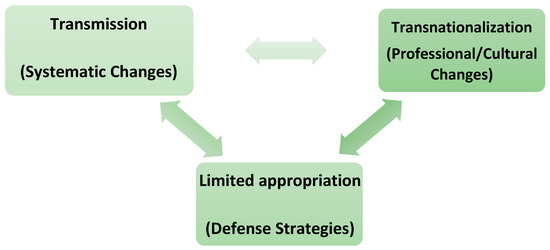
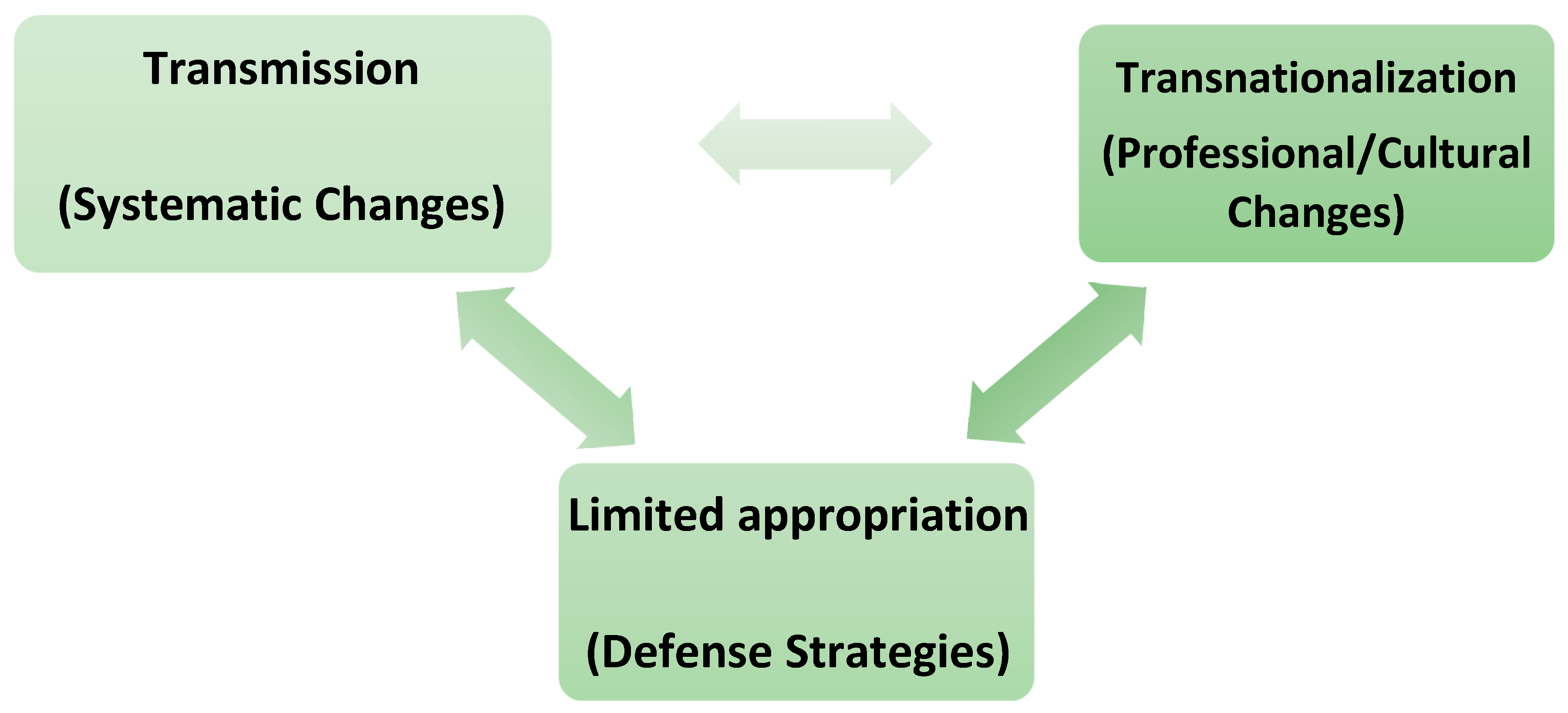
After looking at more than 300 pages of archival documents, over 24 h of media content, and over 12 h of in-depth interviews with ten key participants—the study suggests the following model of Americanization of Bulgarian broadcast media and bTV specifically (Figure 1). It identifies specific points of transmission (processes originating in the US that are exported abroad), transnationalization (the contact zone where foreign and local practices and values interact), and appropriation (the volume of the new culture adopted and the extent of its reach). The model adopts the theoretical framework of Americanization as suggested by (Van Elteren, 2006).
Figure 1.
Americanization of Bulgarian broadcast media.
4.1. Transmission Stage
The entry of commercial broadcast media into the formerly strictly state-controlled Eastern European landscape marked more than the arrival of new players. It signaled a shift to an entirely different game, guided by its own set of rules. What replaced the centralized, top–down propaganda machine was not simply more pluralism, but a competitive marketplace driven by audience share, branding, and profitability. The transformation included a multidimensional shift:
- From state-controlled mammoths with guaranteed airtime and no competition to commercial broadcasters competing for viewers, advertisers, and influence.
- From a model where political alignment ensured survival to one where credibility became a commodity and news was no longer just an ideological tool, but a business asset.
- From editorial compliance as political currency to market leadership as strategic capital, where dominance in ratings and revenue could offer as much leverage as party loyalty alone once did.
This recalibration of purpose, incentives, and institutional logic shaped not only what news looked like, but how media actors understood their roles and their value in the post-communist public sphere.
4.1.1. From State-Controlled Mammoth to Competitive Market
When News Corp entered Bulgaria in 2000, the local advertising market was still in its infancy. The television landscape was dominated by a single, state-run broadcaster with no real advertising model, and a fragmented private sector made up of over 100 small local cable operators. This played out in a country of just over six million people, with an average monthly income of about $200 per person, according to the National Statistical Institute. As one executive described it: “Effectively a state playground with limited commercial dynamics” and advertising revenue stagnant due to “lack of any commercial logic” (Al Parsons, interview). At the time, the total TV ad market stood at $22 million. By the time News Corp exited the free-to-air space and sold its Bulgarian entity, that figure had grown exponentially to over $180 million.
“The fact that Rupert Murdoch’s News Corporation had won the license to launch and operate the first private national free-to-air TV channel in the country was a high bar, and naturally, the audience had very high expectations”—Viki Politova, Founder and COO
The bTV license was awarded through a competitive procedure involving major international companies and detailed scoring criteria covering budgeting, programming, management, and commitments to Bulgarian film production. From the outset, regulators defined bTV as a commercial broadcaster with explicit public-interest obligations. As Svetlana Bozhilova, then a member of the National Council for Radio and Television (NCRT), recalls: “the private TV license was described as a public benefit license, with obligations to culture, education, children’s and minority programming.” (Bozhilova, interviews).
The license was awarded in a context where only one analogue national commercial channel could exist, giving bTV structural dominance from the outset. Although commercially operated, the station was expected to balance market logic with broader social responsibilities. Bozhilova later contrasts these original ambitions with the subsequent dominance of entertainment formats and ratings-driven strategies, noting the tension between Western professional expertise and the aggressive commercialization that followed.
According to members of bTV’s early management team, American and broader Western influence entered primarily through ownership, the appointment of the first CEO, Al Parsons, and the import of programming formats and newsroom practices. The channel gradually expanded its schedule by combining acquired international content (most notably the UEFA Champions League) with locally produced formats, including late-night comedy (Slavi’s Show) and an extended morning program modeled on American television staples, alongside a strong news lineup. Local management saw the key to success in “the introduction of commercial and audience-based programming… focused on what consumers were looking for… allowing the audience to stay tuned on the channel for longer hours”.
“The relationship with viewers was a key priority, and every opportunity was used to strengthen that bond.”—Vicky Politova
News programming played a central role in redefining television’s relationship with the viewers. As founding News Director Luba Rizova puts it:
“Before bTV, at 8 o’clock (the start of the main news bulletin), the state spoke, and the people listened to the state. We reversed the model so that it could be seen not only what the state had to say to the people, but also what people had to say to the state.”
Interviewees describe political interference as initially limited, buffered by the station’s international backing and strict editorial rules emphasizing factual accuracy, credible reporting and editorial process mitigating bias. Audience research, ratings data, and advertising performance became central benchmarks of success, measured in time-slot dominance and viewer loyalty. Over time, however, growing commercial pressures and powerful local investors and advertisers complicated this picture, raising renewed concerns about political influence and media capture. As Svetlana Bozhilova observes, “modern Americanization of the news” was followed by concerns about “offshore ownership structures and financial conglomerates making it harder to know who really controls the media”. (Bozhilova, interviews).
4.1.2. News as Business, Not Just Politics. Credibility as a Commodity
Coming froma post-communist country, where the news was for decades controlled by the government bTV’s strategy could only work if built “on trust, integrity, and respect—something that resonated with the audience’s desire to be objectively and timely informed” (Viki Politova, CEO, interview). Even commercially, the core idea is that the station “sells trust”, hence independence and credibility are seen as the main long-term business assets, even when that conflicts with short-term political or commercial pressures.
“We don’t sell propaganda. We sell trust. Once you lose trust, you have nothing left to sell. Advertisers come because people trust you. If you sacrifice that trust for a sponsor, you lose both.”—Luba Rizova, Founder News Director
With the backing of a global media empire used as a shielding mechanism for editorial decision-making, and distant from local political and economic interests, while generating solid profit for the shareholders, shifted the standard in the early years:
“Political interference in the work of the media was eliminated, principles of true commercial TV and commitment to editorial independence were established”—Viki Politova, COO.
What emerged was a new model where brand credibility and news integrity seem to secure monetary value. Previously, newsrooms across the region functioned primarily as propaganda arms or bargaining chips in political games (Bajomi-Lázár, 2014; Dobek-Ostrowska, 2015). Here, commercialization and Americanization served as shields against the politicization of the news. The introduction of a Western media model, as embodied by bTV, challenged the longstanding dynamic where editorial lines followed party interests. This became one of the most significant appropriations of the American TV model in Bulgaria, and a key theme analyzed in later sections. Staffers were trained in up-to-date production techniques—many via News Corp’s international training programs. Foreign consultants, mostly American professors and media professionals, worked with the team to develop modern editorial practices.
“We had to unlearn the old state-TV habits and build a newsroom that sets its own agenda and standards.”—Luba Rizova, interview
As one American media consultant noted, the legacy mindset among journalists was hardwired by BNT.
“They had all come out of a background of watching news on BNT… pro-government, content centered around what I called the “Three Ps”—what matters to the president, the prime minister, and the parliament. My job was to introduce and prioritise another important “P”—the publics.”—Dr. Sam Swan, US Consultant, interview
bTV’s editorial model emphasized professionalism, speed and human-interest storytelling. News bulletins were redesigned to be visually dynamic, ending the era of talking heads, studio-bound, power-driven top–down reporting. According to one study, bTV’s approach led to a dramatic shift in news content: for example, ordinary citizens (victims, neighbors, small business owners) began to appear in news far more often than government officials—a 20:1 ratio was noted in one analysis (Lozanov & Spasov, 2008). The shift in editorial tone and agenda was swiftly embraced by the audience, leading to more commercial success. In the late 1990s, BNT held 76% of the national viewership share. A report conducted by Market Links for bTV in 2002 shows that just a year after bTV’s launch-BNT’s share dropped to 31%, and by 2003 it had fallen further to 22% (bTV’s first internal market test in 2001 found that what viewers appreciated most was the network’s more relatable, everyday tone, its conversational delivery, and the clear break from “long political discussions that have nothing to do with my life”.
4.2. Trans-Nationalization Stage
In the absence of a shared professional tradition, the transnationalization processes and the role of the American ownership, consultants, and trainers led to attempted—but often contested—transformations of identities and ideals of journalism in post-communist media systems.
4.2.1. Identity Negotiations
The American ownership appointed American management and attracted American consultants; American college graduates or journalists trained in Western universities were appointed in the local editorial team, and American training and background were all important assets in the recruitment processes (Politova & Parsons interviews). Another attribute was strictly required: no history with the state television (Rizova, interview).
“That was a conscious decision—no state TV journalists. Period. It was my understanding that once a part of a state, a propaganda type of media, no training can undo the damage. So, I wanted young bright people with potential, with some experience, but not the popular faces from the past. The strategy was building something from scratch, with its own face, and its own identity, and above all: an unequivocal alternative to what was known before—which was State TV.”—Luba Rizova, News Director and founder of bTV News
In Bulgaria, circa 2000, this meant young people, with limited to no TV experience, mostly came from print or smaller local or cable stations. Against this backdrop, the transnationalization of Bulgarian TV news through bTV meant not only importing formats and routines, but also consciously breaking with the only model that most journalists knew—the state television model:
“The consultants’ job was to not let us repeat the only model we knew—the old state television model. Mind you, the old way of doing things was the only way we knew even as viewers, so it was tempting to go back to the familiar. Maybe it was the right way for them to be pushing us to the extremes, offering a radically different model at the beginning, and then let us process it with time and reach the relevant state of what’s acceptable and normal for the local market”—Victoria Behar, Executive producer and founder of bTV News
In some instances, the foreign owner was seen as a shield that made it easier to resist local pressures; in others, it was a pressure point and an additional source of suspicion:
“Of course there were some reputation problems, that we were American, superficial, Jewish, foreign, not Bulgarian—that we were doing ideological propaganda. But those are just insinuations”—Behar, interview
In this stage of contact between the foreign and the local, standards of the fourth estate (independence, accountability, watchdog function) were negotiated under the weight of local legacies—entrenched practices of clientelism, a history of propaganda, and nationalist suspicions towards foreign media ownership.
4.2.2. News with a Human Face
One of the central narrative transformations associated with Americanization in the Bulgarian context was the move from a power-centric, protocol-driven news agenda to what interviewees repeatedly call “news with a human face”.
“We were trained into the American approach to TV journalism. Our packages had to be based on a small personal story, that is representative of a systematic issue. Visually, we were challenged to a completely different standard—high-quality videography, dynamic editing, short soundbites. We were working to generate interest in the news, but there was a clear understanding that we were to do that through making the important interesting, not the interesting important.”—Genka Shikerova, Senior Reporter at bTV (2001—2015)
“We had the clear idea that for the first time in Bulgaria, the news had to speak the language of the people, and political topics also had to be translated into everyday language. Until then, the news reporting on the state TV had failed to distil the big questions of the day—the electricity pricing, the War in Serbia, the pensions, health issues, education issues—to the everyday life of the viewers and how those big topics find reflection in their small world, in their very homes.”—Mirlouba Benatova, Senior Reporter at bTV (2000–2013)
The same tendency of peopletization/humanization of news was tracked as part of Americanization processes in the British broadcasting system as well, with the growing role of audience research and the work of media consultants (Gulyas & Baines, 2020).
“It sounds pretty mainstream now, but it was a radical change and a very bold one for its time. But we had a proven model to follow—the news had to stop sounding like administrative reports and start sounding like information spoken in short, clear sentences stemming from real life and human experiences. But it didn’t go without a pushback, mainly from the local journalistic community—I remember news articles predicting our failure and minimizing our reporting cause it was not “serious” enough. Meaning not official enough”—Luba Rizova, Founder News Director
At the same time, the initial team of journalists recalls struggling with this more engaged style of storytelling while still trying to cover some serious political and economic news, and not merely replacing them with soft features. As Behar recalls:
“There was this inclination towards as little politics as possible. If we were to cover a political topic, it has to be translated into a human-interest story, written in a human language, with a real-life example, and made into a nice package. So, political topics were kept to the minimum, human stories to the maximum. …But unlike the U.S. at the time, politics and economy in Bulgaria are very heavily related to people’s everyday life. So, you cannot spare those topics in the news. Yes, you do want to put professional efforts into translating those matters into human language, but you have to cover those topics.”—Victoria Behar, Executive producer and founder of bTV News
The local adaptation of “news with a human face” did not signal a retreat from politics, but rather a shift in how politics was framed—through the lived experiences and concerns of ordinary people, rather than simply repeating official statements from elites. One clear example of how Western formats were indeed negotiated locally was bTV’s morning show. The station initially experimented with a softer, infotainment-style format—featuring weather and traffic updates, cooking segments, and lighter content—but it failed to resonate with viewers. By around 2003, this approach was replaced with a more serious, hard-news journalistic format, along with a new anchor team and an overhauled concept.
“The morning show needed a different format because society was highly politicized; people wanted live dialogue, not monologues.”—Luba Rizova, interview
For years after, the show and the whole morning show TV tradition in the country remained firmly focused on serious political and social issues, investigative reporting, and hard-hitting commentary.
As a general rule, bTV News and current affairs subscribed to the eyewitness format, introduced in the USA in the 1960s—a particular style of faster-paced television newscast emphasizing visual elements, action video, and the reporter in the field serving as an “eyewitness” to news events for the anchor in the studio and the viewer at home. Parallel to that, processes of “Cronkytization” of the News Presenter Role are to be observed. The term is coined by media historians (Silcock & Liseblad, 2019) to describe the transformations happening with the role of the TV News presenter in the UK in the 1990s, as journalists were hired to host the news instead of actors/actresses, which was the dominant model in the past. In Bulgaria, that was also a novelty attributed to American consultants and trainers. The dominant model in the post-Soviet world prior to that was numerous different anchors, mostly with acting/public speaking background, hosting the news in no particular order. Adopting from American local news tradition, BTV introduced the two-person anchor model, preferably trained journalists, with weekdays and weekend anchor teams, who would come back night after night, establishing a strong para-social interaction with the audiences.
“The role of the anchors and reporters, the faces of BTV News, initially was a major thing. I believe the initial team of journalists was purposely recruited to include professionals with memorable and distinguishable names and TV characters. The branding of the anchors and reporters was reinforced as an additional credibility element.”—Miroluba Benatova, interview
Similar transformations were encouraged for the reporters’ on-screen presence as well—reporters’ standups were emboldened by trainers and consultants, and reporters were established as trusted experts on the matter they are discussing, through the beat system newsroom organization and with emphasis on personalization of the storytelling. Moving actors out and journalists in, the on-air delivery became conversational in tone and more visually pleasing.
4.2.3. Visual Revolution—Seeing Is Knowing
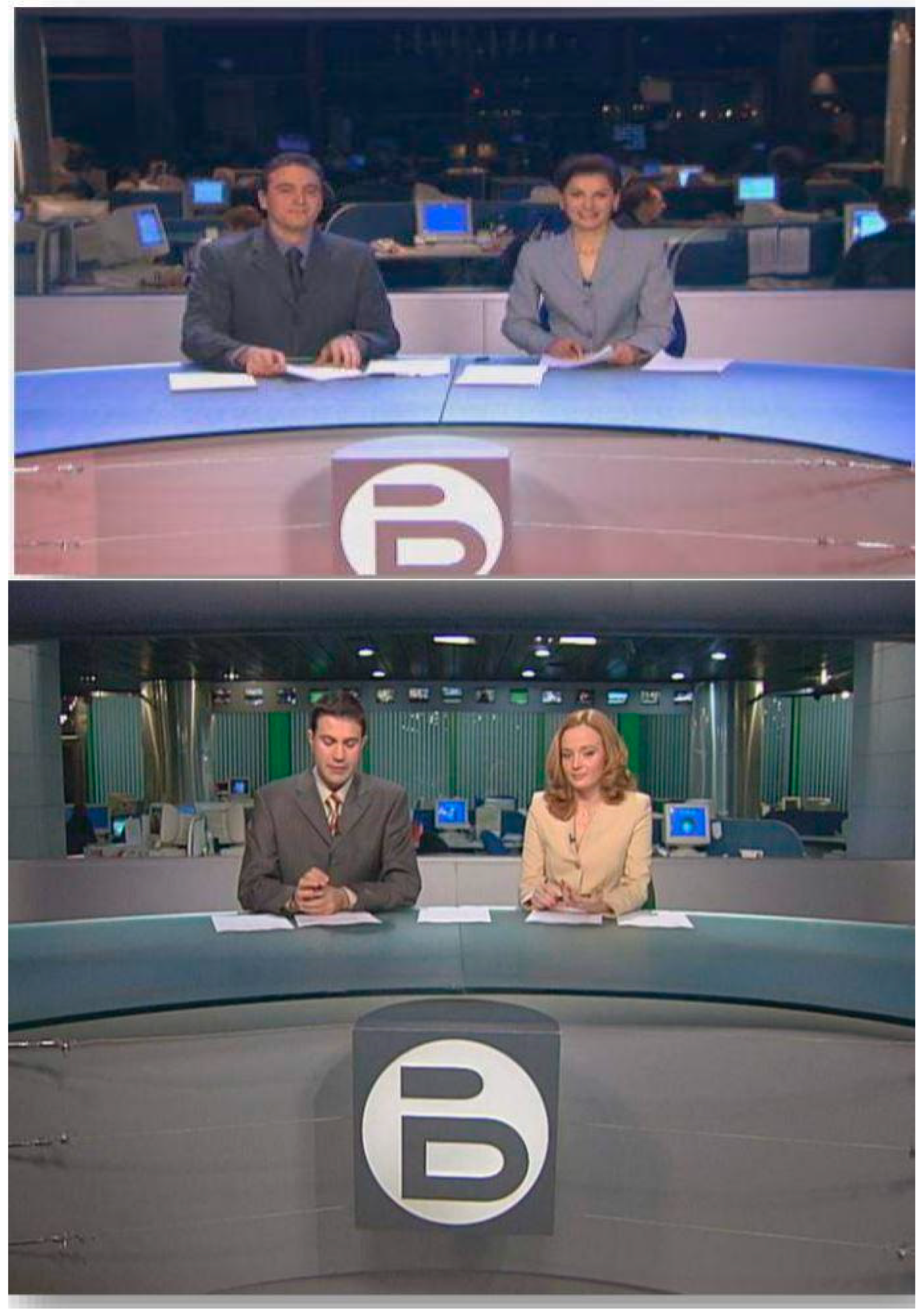
A second axis of transnationalization concerned visual storytelling. Imported formats and consultancy input pushed bTV toward a visually driven, human-interest approach to news, marking a sharp break from the static, talking heads, top-looking studio-bound aesthetics of state television. A completely new visual code was introduced—beginning with the American design of physical space, including an open-plan newsroom and a studio facing the newsroom, and extending to the adoption of new technologies, production routines, and on-screen presentation.
Following the American model, bTV prioritized strong images, live coverage, and the logic of “being there.” Technical routines such as live shots, stand-ups, and on-the-scene reporting were combined with new visual grammar-close-ups, reaction shots, dynamic graphics-largely absent from the previous state-TV model. The station also introduced, for the first time on the Bulgarian market, the U.S.-style anchor team model and an open-space, newsroom-facing studio (Figure 2).
Figure 2.
BTV News—the first American-looking TV News studio.
News was reconceived as a visual narrative in which seeing became central to knowing. This visual shift was closely tied to the broader editorial move toward “news with a human face.” Several participants link the personification of journalism directly to these visual changes: cameras were turned toward ordinary people, their homes, workplaces, and daily struggles, rather than toward ceremonies, podiums, and official statements. As a result, television journalism in Bulgaria moved away from what had long been described as “televised radio.” Under the slogan “Seeing is knowing,” bTV explicitly foregrounded visual storytelling, and local scholars later coined the term “visual Americanization” to describe this transformation (Lozanov & Spasov, 2008). The impact was immediate and market-wide. Although the new visual style initially met skepticism and criticism—news was described as too theatrical, too entertaining, and “too American”—its commercial success made it sustainable and, ultimately, influential beyond bTV itself. The overall aesthetics of television news in Bulgaria shifted in response.
At the same time, the visual and emotional turn carried structural risks. While it enabled journalists to translate complex political and economic issues into accessible, human-scale stories, it also introduced a bias toward what was visually compelling or emotionally engaging. As Victoria Behar later reflects, “important political or economic topics were sometimes neglected because they were not visual enough or not ‘interesting’ enough,” and under the pretext of humanizing the content, audiences were occasionally “spared” relevant information.
In this sense, visually compelling and emotionally resonant items, often focused on everyday life, social problems, disasters, or minor heroisms, functioned simultaneously as a democratic resource and a ratings tool. They made social problems visible and relatable, but they also encouraged a form of news selection driven by spectacle, emotion, and audience retention. This double function lies at the heart of the Americanized visual turn: seeing is knowing, but also not seeing is not knowing.
Rather than a simple transfer of a ready-made American model, transnationalization via bTV involved processes of negotiation and adaptation. Global visual norms, professional standards, and audience logics were appropriated and domesticated within a media system still shaped by its state-television legacy and by journalists’ own professional biographies. The result was not just modernization, but a gradual hybridization of news, where visual intensity, human interest, and commercial logic increasingly intersected with journalistic judgment.
4.3. Appropriation: The Copycat Fourth Estate
At the appropriation stage, not just bTV but commercial television in Bulgaria at large became increasingly shaped by Western, and especially American, templates: pacing, structure, late-night formats, and scheduling logic was mimicked across the market, to imitate the commercial success of the early model. The key point, however, is that originally these formats were not copied mechanically. They were gradually domesticated. As Al Parsons describes it, Western formats traveled, but they did not land unchanged:
“Bulgarian TV is increasingly adopting Western formats, but we still have to tailor them to local culture and humor.”—(Parsons, interview)
At the operational level, imported consultancy and know-how introduced methods for structuring newsroom workflows and program schedules, often prioritizing ratings and commercial performance. That institutional shift created a persistent tension: commercial imperatives (fast pace, “must-see” programming, entertainment logic, marketing forces in the news) competed with television’s public-interest role as per the national licensing. In practice, appropriation meant an ongoing negotiation between global templates and local specificity: keeping a Bulgarian “flavor” while adopting Western production and business logic.
4.3.1. Commercialization as a Shield in an Immature Democracy
While Western liberal media theory treats commercialization and media concentration as structural threats to media independence, in post-communist contexts, those same risks played a different role. It functioned as a defensive mechanism against political interference, with foreign ownership described by interviewees unanimously as a buffer separating newsrooms from local power networks and shielding day-to-day editorial decisions. Both Parsons and Politova made this argument explicitly:
“The motto in the station was that the best relationship with the politicians and government was no relationship.”—(V. Politova, interview)
“That model-having an American, a foreigner for a general manager-it shields the operations. I think it helped. It puts some authority between the local people, the management, and the official government people.”—(Parsons, interview)
This logic extends beyond newsroom actors to local business intermediaries, who describe “Americanness” as both a symbolic and practical guarantee of autonomy:
“Having an American General Manager helped create the impression that bTV is 100% American… That helped not only the freedom of the media itself but the freedom of speech in general.”—(Krasimir Gergov, Founder and Financial Consultant, interview for “The Fourth Estate Journal.”)
Several journalists echo the same point: in the early years, bTV was widely seen as “Murdoch’s TV,” which mattered because American ownership was associated with independence and professionalism (Benatova, interview). This finding aligns with prior research that links limited foreign ownership (and the absence of external capital) to lower levels of media freedom in Central and Eastern Europe (Kostadinova, 2015).
4.3.2. Limitations of the Shield: Balkanization of the American Model in Practice
While interviewees consistently frame foreign ownership as a protective shield against political interference, data also reveals a more ambivalent dynamic. The “shield” was real, but partial and negotiated by practices that simultaneously reproduced local, post-communist modes of governance. The general manager Al Parsons repeatedly emphasizes the absence of direct editorial interference, noting that political actors “didn’t push very hard” and that management would “mostly say no” (Parsons, interview). This framing relies on a narrow definition of interference as overt and direct pressure on content. Yet Parsons describes a more subtle procedural and organizational forms of influence—such as numerous state-linked board appointments through the years, informal accommodation, and financial arrangements, that complicate this claim. Most revealing is the strategy of “paying for peace.” After a politically recommended board member was appointed, Parsons recalls:
“I said I was going to pay the consulting fee, or board fee, but that’s it. I didn’t want to see him around. I didn’t want him coming by the office. And he agreed.”—(Parsons, interview)
While Al Parsons insists this did not constitute interference because it did not translate into editorial pressure, still this points to an internal inconsistency: political influence is acknowledged but discarded as irrelevant because in the words of the interviewee it is treated as attempted but not achieved. News Director Luba Rizova also acknowledged some guardrails to attempted political influence during her tenure:
“Of course, there were attempts of political influence, but they were very timid and never resulted in a real open war.”—(Rizova, interview)
This normalization of political interjection can be understood as banalization and shows certain limitations to the foreign ownership shielding theory. The absorption of political pressure into everyday corporate governance becomes explicit:
“Yes, there were requests to put somebody on the board, but that didn’t mean anything to us. We didn’t care.”—(Parsons, interview)
These findings align with Splichal’s (2001) argument that post-communist media change is driven by imitative revolutions, where Western models are adopted alongside residual authoritarian practices. It also resonates with Hallin and Mancini’s (2011) observation that imported media models do not replace existing logics but interact with them, producing hybrid systems shaped by historical legacies and power relations.
The appropriation stage therefore produces a paradoxical outcome: the organization becomes American by face—in formats, professional language, and dressed in global legitimacy while remaining partially shaped by post-communist governance habits. Western corporate norms were selectively adapted to accommodate inherited post-communist expectations: state presence, informal negotiation, and symbolic compliance. Rather than eliminating political influence, foreign ownership seems to have reshaped its form. This is not failed Americanization, but a Copycat Fourth Estate, where Western forms are imitated and domesticated rather than fully internalized.
4.3.3. Copycat Fourth Estate: American by Face, Captured by Legacy
While Americanization unfolded rapidly at the surface level—through formats, visual grammar, pacing, and storytelling conventions, still deeper journalistic identities and democratic functions remained only partially appropriated. One visible outcome of this process was the intensification of format hybridization. Hard news and political coverage increasingly blended with infotainment, while election coverage blended post-communist power representation with U.S.-style “horse-race”. News shifted away from dry factual reporting toward narrative-driven storytelling, popularizing the genre of “human stories.” But at the same time, this humanization carried a structural ambivalence. The emphasis on personal stories and emotional resonance expanded the visibility of everyday social problems, but it also introduced tendencies toward tabloidization and depoliticization of narratives. Consistent with existing literature, in politically constrained environments, lighter content—domestic topics, crime, celebrity affairs—could function as a coping strategy, allowing broadcasters to avoid politically risky reporting (Downey & Mihelj, 2012). Depoliticization thus operated not simply as audience accommodation, but as a risk-management strategy, translating the informal logic of “no news is good news” into media–politics relations. The evolution of bTV’s morning show though illustrates the opposite dynamic. Initially designed as a light, American-style format focused on weather, traffic, and soft news, it quickly transformed into a powerful platform for political debate and confrontational, crossfire-style journalism (Lozanov & Spasov, 2008). This trajectory still captures the essence of limited appropriation: borrowing the external shell of an imported format while reworking its function to fit local political and cultural expectations.
At the cultural level, however, the most consequential limit of appropriation lies in the partial internalization of the Fourth Estate ideal itself. Evidence from bTV’s 10th anniversary documentary, where journalists reflect on their professional identity and the history of the channel, reveals a striking absence of core Western watchdog concepts. Ideas such as holding power accountable, providing checks and balances, or “speaking truth to power” are largely missing from journalists’ self-representations. This absence is analytically significant: it suggests that adopting an American face does not automatically produce a liberal democratic soul. One revealing example comes from senior reporter Kanna Racheva, who describes the core purpose of her journalistic work in the legal beat as follows:
“I am in this business for 18 years… and I see the core purpose of my work to be proving that the Bulgarian judicial system is functioning well and is effective…”—(Racheva, documentary excerpt)
This understanding of journalism as a tool for validating institutions rather than scrutinizing them reflects what Slavtcheva-Petkova (2018) identifies as a Soviet legacy of journalism—a patriotic, system-affirming totem rather than an adversarial democratic actor. In this context, the Western notion of the watchdog becomes distorted. The idealized watchdog ideal of journalism morphs between a lapdog that promotes institutional legitimacy and an attack dog mobilized selectively in pursuit of strategic agendas.
Finally, the limits of appropriation were reinforced not only by newsroom cultures alone but also by audience behavior shaped by communist legacies. The “bastards of communism” mentality as per Adam Michink’s famous saying, manifested in a silent public sphere, and lack of wide public engagement in an open discourse, leaving the space to political appointees or talking heads. This was observed and captured in the case of bTV by foreign consultants:
“The longer I went there, I began to understand how difficult it was for them to get real people to talk… Because in this country, Americans love to be on camera. But not the case in Bulgaria, apparently”—(Swan, interview)
The appropriation stage, therefore, produces a paradoxical outcome. Americanization provides a usable script—in terms of newsroom practices and content strategies. In post-socialist conditions, commercialization can even function as a shield, because credibility becomes the commodity. Yet appropriation remains uneven: managerial and political practices are partially localized, interference becomes procedural and normalized, and news content grows increasingly hybrid. The Fourth Estate ideal, while visible in form, remains shallow or distorted in substance.
This is how the Copycat Fourth Estate is not just a metaphor. It names a structural condition: a media system that becomes American by face, while remaining deeply shaped by post-communist legacies underneath.
5. System-Level Consequences of Institutional Imitation
While the analysis draws on multiple sources, including interviews, archival materials, and industry observation, systematic comparative data remain limited. The patterns identified here should therefore be interpreted as indicative of broader trends rather than definitive sector-wide measurements.
5.1. Professionalization and Competitive Diffusion
The institutional transformation at bTV did not remain confined to a single newsroom. As the first privately owned national broadcaster operating under a U.S.-influenced managerial and editorial model, bTV introduced production standards that gradually reshaped expectations across the Bulgarian television market. Most visibly, the station implemented a faster-paced, visually driven news format grounded in human-centered storytelling. Reporting moved away from predominantly official, press-release-and press-conferences-based narratives toward eyewitness accounts, live reporter stand-ups, personalized framing, and emotionalized storytelling. The “human face” of the news—stories anchored in identifiable individuals rather than abstract institutions—became a defining editorial strategy. While personalization and emotionalization were not entirely absent from Bulgarian television prior to 2000, bTV systematized and normalized them as core elements of mainstream news production. Over time, this narrative shift influenced not only commercial competitors but also public broadcasting, contributing to a broader people-centered framing of news across the sector.
Competitors responded quickly. Format elements introduced by bTV—such as the two-anchor model for main newscasts and a clearer segmentation of news and current affairs programming—became industry standards. These elements were subsequently replicated, adapted, or strategically countered by commercial competitors, most notably Nova TV, signaling that the American-inspired production model had become a reference point for competitive positioning.
Organizationally, the transformation introduced new newsroom hierarchies that also quickly became standard across the market. Roles such as assignment editor and news producer—previously absent in Bulgarian television—were institutionalized within bTV’s structure. The newsroom adopted a clearly delineated managerial hierarchy, including a news director, executive producer for news, executive producers for current affairs programs, a structured assignment desk, and dedicated producers attached to individual broadcasts. Subsequent reviews of organizational charts at competing networks suggest that similar structures were later adopted across the sector, reflecting the diffusion of an American-style newsroom model at the institutional level. For example—the role of the assignment editor or the executive producer were introduced within the BTV newsroom and replicated later on in Nova in 2010. Another such indicator is the public broadcaster BNT adopting in 2003–2004 the co-anchor model (male and female news presenters anchoring together) after a long tradition of solo news-hosts.
5.2. Audience-Level Effects and Shifting Expectations
Early audience research conducted during this period, including internal ratings analyses reviewed as part of this study, indicated that viewers associated bTV’s news product with credibility, modernity, and dynamism (Lozanov & Spasov, 2008). While direct measurement of audience impact falls beyond the scope of this study, available data and competitive responses indicate that bTV’s format innovations contributed to a recalibration of viewer expectations, prompting competitors to recalibrate their own editorial strategies. Infotainment elements also expanded during this period. While infotainment was not introduced by bTV alone, its integration within a commercially competitive framework contributed to the legitimization of hybrid formats that blended information and entertainment within mainstream broadcasting schedules. Taken together, these put bTV as a structural reference point within the Bulgarian television landscape. Its adoption of American-inspired production standards did not simply modernize one organization; it recalibrated professional norms, competitive dynamics, and audience expectations across the sector.
6. Limitations and Future Research
This study is subject to several limitations that also point toward productive directions for future research. First, the analysis is based on a single, in-depth case study of bTV, Bulgaria’s first national commercial television broadcaster. While this approach allows for a historically grounded and empirically rich examination of media Americanization in a post-communist context, it necessarily limits the generalizability of the findings. The patterns identified here should be considered analytically illustrative rather than representative of all post-communist or Central and Eastern European media systems.
Second, the study relies heavily on retrospective interviews with key actors involved in bTV’s founding and early development, including executives, journalists, consultants, and regulators. Although these accounts provide rare insider perspectives on institutional decision-making and newsroom culture, they are shaped by memory, later career trajectories, and subsequent political and market developments. The analysis addresses this by triangulating interviews with archival materials and secondary sources, but the interpretive nature of qualitative recall remains a constraint.
Third, the empirical focus privileges elite and organizational perspectives over everyday newsroom routines and audience reception. While this aligns with the article’s aim to examine structural dynamics of ownership, governance, and professional ideology, it leaves less room for analyzing how Americanized formats and hybrid journalistic practices were experienced by rank-and-file journalists or interpreted by audiences over time.
Future research could build on this framework in several ways. Comparative studies applying the transmission–transnationalization–appropriation model to other national broadcasters in the region would help clarify which dynamics are case-specific and which reflect broader structural patterns. Longitudinal research could further examine how early hybridizations evolved under changing ownership regimes and increasing media capture. Finally, closer ethnographic or audience-focused work could complement this institutional analysis by exploring how hybrid journalistic norms are enacted in everyday practice and negotiated by viewers.
Funding
This research received no external funding.
Institutional Review Board Statement
The study was conducted in accordance with the Declaration of Helsinki, and approved by the Institutional Review Board of the University of Tennessee (IRB number: UTK IRB-18-04721-XP; IRB approval date: 12 October 2019) for studies involving humans.
Informed Consent Statement
Informed consent was obtained from all subjects involved in the study.
Data Availability Statement
Restrictions apply to the availability of these data. Data were obtained from bTV and individual subjects and are available from the authors with the permission of bTV or mentioned subjects.
Conflicts of Interest
The authors declare no conflict of interest.
References
- Adams, T. E., Jones, S. H., & Ellis, C. (2014). Autoethnography. Oxford University Press. [Google Scholar]
- Bajomi-Lázár, P. (2014). Party colonisation of the media in Central and Eastern Europe. Central European University Press. [Google Scholar]
- Beachboard, M. R., & Beachboard, J. C. (2006). Implications of foreign ownership on journalistic quality in a post-communist society: The case of finance. Informing Science, 9, 143–162. [Google Scholar] [CrossRef] [Scilit] [PubMed]
- Christians, C. G., & Carey, J. W. (1989). The logic and aims of qualitative research. In G. H. Stempel, & B. H. Westley (Eds.), Research methods in mass communication: The logic and aims of qualitative research (pp. 354–374). Prentice Hall. [Google Scholar]
- Dobek-Ostrowska, B. (2015). 25 years after communism: Four models of media and politics in Central and Eastern Europe. In Democracy and media in Central and Eastern Europe 25 years on (Vol. 4, pp. 11–46). Studies in communication and politics. Peter Lang Group AG. [Google Scholar]
- Downey, J., & Mihelj, S. (2012). Central and Eastern European media in comparative perspective: Politics, economy and culture. Ashgate. [Google Scholar]
- Dragomir, M. (2018). Control the money, control the media: How government uses funding to keep media in line. Journalism, 19(8), 1131–1148. [Google Scholar] [CrossRef] [Scilit]
- Dragomir, M. (2024). The capture effect: How media capture affects journalists, markets and audiences. Central European Journal of Communication, 17(36), 162–184. [Google Scholar] [CrossRef] [Scilit]
- Ellis, C., & Bochner, A. P. (2000). Autoethnography, personal narrative, reflexivity: Researcher as subject. In N. K. Denzin, & Y. S. Lincoln (Eds.), Handbook of qualitative research (2nd ed., pp. 733–768). Sage. [Google Scholar]
- European Federation of Journalists. (2003). Eastern empires: Foreign ownership in Central and Eastern European media. EFJ. [Google Scholar]
- Fereday, J., & Muir-Cochrane, E. (2006). Demonstrating rigor using thematic analysis: A hybrid approach of inductive and deductive coding and theme development. International Journal of Qualitative Methods, 5(1), 80–92. [Google Scholar] [CrossRef] [Scilit]
- Gross, P. (2002). Entangled evolutions: Media and democratization in Eastern Europe. Woodrow Wilson Center Press. [Google Scholar]
- Gross, P. (2004). Between reality and dream: Eastern European media transition, transformation, consolidation, and integration. East European Politics and Societies, 18(1), 110–131. [Google Scholar] [CrossRef] [Scilit]
- Guest, G., Bunce, A., & Johnson, L. (2006). How many interviews are enough? An experiment with data saturation and variability. Field Methods, 18(1), 59–82. [Google Scholar] [CrossRef] [Scilit]
- Gulyas, A., & Baines, D. (Eds.). (2020). The Routledge companion to local media and journalism. Routledge. [Google Scholar]
- Hallin, D. C., & Mancini, P. (2011). Comparing media systems beyond the western world. Cambridge University Press. [Google Scholar]
- Jakubowicz, K. (2007). Rude awakening: Social and media change in Central and Eastern Europe. Hampton Press. [Google Scholar]
- Kostadinova, P. (2015). Media in the new democracies of post-communist Eastern Europe. East European Politics & Societies and Cultures, 29(2), 453–466. [Google Scholar] [CrossRef] [Scilit]
- Lozanov, G., & Spasov, O. (2008). bTV: The new vision. Фoндация „Медийна демoкрация”. [Google Scholar]
- Marketing Week. (2000, June 15). Murdoch takes first step to fulfil Balkans promise. Available online: https://www.marketingweek.com (accessed on 13 April 2024).
- Metyková, M., & Waschková Císařová, L. (2009). Changing journalistic practices in Eastern Europe: The cases of the Czech Republic, Hungary and Slovakia. Journalism, 10(5), 719–736. [Google Scholar] [CrossRef] [Scilit]
- Open Society Institute. (2005). Television across Europe: Regulation, policy and independence. OSI. [Google Scholar]
- Rasmussen, A. B. (2014). The Americanization of Danish journalism. Nordicom Review, 35(1), 17–31. [Google Scholar] [CrossRef] [Scilit]
- Raycheva, L., & Leandros, N. (2015). Media trends and concentration of capital in two Balkan countries: Greece and Bulgaria. NewMedia21. Available online: http://www.newmedia21.eu/analizi/media-trends-and-concentration-ofcapital-in-two-balkan-countries-greece-and-bulgaria/ (accessed on 14 April 2024).
- Reporters Without Borders. (2016). Media oligarchs go shopping: Digital upstarts in the hands of traditional media owners. Available online: https://rsf.org/sites/default/files/2016-rsf-report-media-oligarchs-gpo-shopping.pdf (accessed on 18 May 2025).
- Salovaara, I., & Juzefovics, J. (2012). Who pays for good journalism? Accountability journalism and media ownership in Central and Eastern European countries. Journalism Studies, 13(5–6), 763–774. [Google Scholar] [CrossRef] [Scilit]
- Schiffrin, A. (2017). In the service of power: Media capture and the threat to democracy. Center for International Media Assistance. [Google Scholar]
- Siebert, F. S., Peterson, T., & Schramm, W. (1956). Four theories of the press. University of Illinois Press. [Google Scholar]
- Silcock, B. W., & Liseblad, M. (2019). Beyond walter cronkite’s “And that’s the way it is”. Journalism Practice, 13(2), 122–139. [Google Scholar] [CrossRef] [Scilit]
- Slavtcheva-Petkova, V. (2018). Russia’s liberal media? The struggle for press freedom since the collapse of communism. Routledge. [Google Scholar]
- Southeast Europe Leadership for Development and Integrity. (2022). Geopolitics, state capture and peak corruption: Risks and threats to democratic governance in Southeast Europe. Available online: https://seldi.net/wp-content/uploads/2022/09/SELDI_Geopolitics-State-Capture-and-Peak-Corruption-1.pdf (accessed on 22 April 2024).
- Sparks, C. (1998). Communism, capitalism and the mass media. Sage. [Google Scholar]
- Splichal, S. (2001). Imitative revolutions: Changes in the media and journalism in East-Central Europe. Javnost—The Public, 8(4), 31–58. [Google Scholar] [CrossRef] [Scilit]
- Starks, H., & Brown Trinidad, S. (2007). Choose your method: A comparison of phenomenology, discourse analysis, and grounded theory. Qualitative Health Research, 17(10), 1372–1380. [Google Scholar] [CrossRef] [Scilit] [PubMed]
- Stockholm School of Economics. (2021). What are the challenges to media freedom in Eastern European countries? Available online: https://www.hhs.se/en/about-us/news/site-publications/publications/2021/what-are-the-challenges-to-media-freedom-in-Eastern-European-countries/ (accessed on 16 March 2023).
- Swinford, S. (2015). EU spends £500m a year promoting itself. The Telegraph. Available online: https://www.telegraph.co.uk/news/worldnews/europe/11795146/EU-spends-500m-a-year-promoting-itself.html (accessed on 11 August 2025).
- Štětka, V. (2012). From multinationals to business tycoons: Media ownership and journalistic autonomy in Central and Eastern Europe. The International Journal of Press/Politics, 17(4), 433–456. [Google Scholar] [CrossRef] [Scilit]
- Tarde, G. (1903). The laws of imitation. H. Holt. [Google Scholar]
- Thussu, D. K. (2006). Media on the move: Global flow and contra-flow. Routledge. [Google Scholar]
- Trifonova-Price, L. (2019). Post-communist media and the impact of democratization in Bulgaria and Romania. In Public service broadcasting and media systems in troubled European democracies (pp. 305–329). Springer International Publishing. [Google Scholar]
- Tufford, L., & Newman, P. (2012). Bracketing in qualitative research. Qualitative Social Work, 11(1), 80–96. [Google Scholar] [CrossRef] [Scilit]
- Van Elteren, M. (2006). Americanism and Americanization: A critical history of domestic and global influence. McFarland. [Google Scholar]

Disclaimer/Publisher’s Note: The statements, opinions and data contained in all publications are solely those of the individual author(s) and contributor(s) and not of MDPI and/or the editor(s). MDPI and/or the editor(s) disclaim responsibility for any injury to people or property resulting from any ideas, methods, instructions or products referred to in the content. |
© 2026 by the author. Licensee MDPI, Basel, Switzerland. This article is an open access article distributed under the terms and conditions of the Creative Commons Attribution (CC BY) license.