Article

Narrative Journalism as a Design Framework for Newsgames

Surrey Institute for People-Centred Artificial Intelligence (PAI), Faculty of Arts, Business and Social Sciences, Entrepreneurship and Innovation, University of Surrey, Guildford GU2 7XH, UK
*
Author to whom correspondence should be addressed.
Journal. Media 2026, 7(2), 73; https://doi.org/10.3390/journalmedia7020073
Submission received: 30 November 2025 / Revised: 13 March 2026 / Accepted: 23 March 2026 / Published: 30 March 2026

Abstract

Newsgames integrate journalism and digital game design to communicate news through interactive storytelling. This study examines how narrative journalism can function as a design framework for newsgames by exploring how its storytelling techniques—such as characterisation, scene construction, and narrative structure—can inform the design of interactive journalistic experiences while maintaining factual integrity. Using a narrative literature review, the research synthesises scholarship from journalism studies, narrative theory, and game studies to analyse how narrative structures and gameplay systems shape the communication of news in digital games. The paper proposes a conceptual model that integrates narrative journalism and newsgames with Symbolic Interaction Theory (SIT) and the Values at Play (VAP) heuristic, providing a theoretical framework for interactive journalistic storytelling. Within this framework, gameplay operates as a narrative structure through which players engage with journalistic content by interacting with simulated environments, characters, and decision-making processes. The analysis indicates that the communicative capacity of newsgames depends on how journalistic information is embedded within gameplay mechanics and narrative systems, where interactivity, player agency, and ethical design shape how audiences interpret complex social and political issues. The study concludes that newsgames function as interactive narrative systems of journalism, in which gameplay serves as a storytelling mechanism that enables audiences to engage with news through participation and interpretation. By positioning narrative journalism as a design framework for interactive news experiences, this research contributes a theoretical foundation for analysing and developing narrative-driven newsgames.

1. Introduction

Storytelling remains one of the most effective forms of human communication (Heravi, 2024), shaping perceptions, fostering interactivity, and aiding memory retention (Cousineau, 2020; Lugmayr et al., 2017). Narrative journalism, sometimes called literary or long-form journalism, uses literary techniques such as plot, character, dialogue, and emotion to deliver factual reporting, offering immersive accounts of actual events (van Krieken, 2019; Vanoost, 2013). Newsgames are a type of serious game designed to share news through interactive play (Bogost et al., 2010). However, newsgames often struggle to have a lasting impact. This is due primarily to a disconnect between the narrative and its mechanics, the aims of journalism and the methods used in game design (Alexiou et al., 2020; Bogost, 2020; Grace, 2018; Mustaro & Mendonça, 2012). This research draws on insights from journalism studies, game studies, and narrative theory to examine whether narrative journalism could serve as a design framework for newsgames. The storytelling techniques and principles of narrative journalism are explored, with analysis of their similarities to narrative games and a delve into the theoretical and practical aspects of incorporating them into newsgames. This paper proposes that applying narrative journalism techniques could strengthen narrative complexity, narrative engagement and interactivity, and the journalistic credibility of newsgames. It will investigate how the storytelling techniques employed in narrative journalism can inform newsgame design and propose a conceptual model for transferring narrative techniques from narrative journalism into game design, grounded in the theoretical principles of the SIT and VAP heuristics. The study will also discuss whether those narrative elements promote user interactivity and journalistic credibility and consider the theoretical and practical implications of integrating them into interactive news experiences.
In light of the above, this research poses three key research questions:
RQ 1: How can narrative journalism be conceptualised as a design framework for the analysis and development of newsgames?
RQ 2: In what ways can storytelling techniques from narrative journalism be adapted into game design while maintaining journalistic integrity and differentiating from traditional journalistic methods?
RQ 3: How can Questions 1 and 2 inform the development of a conceptual model for analysing narrative newsgames and guide game design?

2. Method

A narrative literature review methodology is used to explore how the storytelling techniques of narrative journalism can inform the design and development of newsgames. This method was chosen for its interpretative and integrative capacity, specifically the ability to synthesise multiple theoretical and empirical evidence across various disciplines, including narrative journalism, storytelling, SIT, VAP and newsgames (Baumeister & Leary, 1997; Green et al., 2006; Sukhera, 2022). Narrative reviews differ from systematic reviews, which are based on a positivist framework and teach researchers to be narrowly defined by research questions. Narrative reviews support critical interpretations and the development of theories across complex, interdisciplinary fields of journalism studies, narrative theory, and game design (Jahan et al., 2016). Existing scholarship on narrative journalism has centred mainly on stylistic and historical analyses, with limited attention to its effects, reception, and broader societal role (van Krieken & Sanders, 2016). Research has primarily examined traditional textual media—such as books, newspapers, and magazines—while digital, multimedia, and broadcast forms remain underexplored. In parallel, research on newsgames and serious games has tended to focus on design and content-related aspects rather than on the narrative or learning dimensions that may enhance interactivity and comprehension (McCauley et al., 2020; Naul & Liu, 2019). Research by Mustaro and Mendonça (2012) demonstrate that narratives in games can be compelling in supporting learning, especially when interactivity allows them to connect with the game environment. That interactivity enhances narrative engagement1 and information retention, providing a real opportunity to merge journalistic narratives with game design. Resources for this paper were located using searches done in databases including Scopus, Web of Science, Google Scholar, and Communication & Mass Media Complete and the University of Surrey Search Library Database with keywords combinations such as “narrative journalism,” “literary journalism,” “newsgames,” “serious games,” “storytelling in games,” “values of journalism,” and “journalism structure of narrative”. The inclusion criteria were for scholarly articles or research that discussed “narrative journalism” or investigated storytelling in terms of gameplay or gameplay experience, and for articles that examined the application of narrative structures in digital gaming, especially those relevant to journalistic practice or the theory-practice nexus.
To address these interdisciplinary gaps, this review synthesises literature published between 2000 and 2025 across the intersecting domains of what a narrative is, narrative journalism, literary journalism, newsgames, serious games, narrative game design, and references to earlier and current works in SIT (1960s), VAP, and digital games. The collected literature discusses (1) narrative journalism principles and values—examining storytelling ethics, voice, and structure; (2) narrative mechanics in games—investigating how interactivity, immersion and player agency shape meaning2; (3) the state and critiques of newsgames—evaluating their journalistic credibility and limitations; and (4) points of convergence and divergence between journalism and game design—identifying areas of conceptual overlap and potential innovation through the lens of Values at Play and Symbolic Interaction Theory. Through interpretive synthesis, the analysis brings together these thematic strands to identify conceptual gaps and theoretical potentials for proposing narrative journalism as a design-oriented narrative logic for newsgames. The review also considers the implications of such integration for enhancing player engagement, ethical storytelling, and journalistic credibility within interactive digital environments. By adopting a narrative literature review approach, this study not only maps the intellectual terrain but also contributes to the existing literature and ongoing debate for understanding digital games as a modality for journalism.

3. Newsgames

The rise of newsgames, which are digital games designed to present news (and other information), was an important innovation in journalism at the outset of the 21st century. Bogost et al. (2010, p. 6) defined newsgames as “a broad body of work produced at the intersection of videogames and journalism” and as part of the serious games movement, which seeks to identify forms of video game methodology for educational, political, or cultural purposes beyond entertainment. In journalism, newsgames were seen as a new medium to engage both traditional and younger, digitally native news consumers through a combination of interactivity, simulation, and narrative (Bogost et al., 2010; García-Ortega & García-Avilés, 2020). Early examples, such as Gonzalo Frasca’s political game 12 September, demonstrated the potential of games as a form of editorial commentary (Bogost, 2020). Through simple mechanics, the game invited players to consider the moral implications of military retaliation following the 11 September attacks in the United States, embodying the concept of “procedural rhetoric”—the idea that meaning in games arises from rules and player actions rather than linear storytelling (Bogost, 2007). This experiment, often cited in academic discourse (James, 2017), illustrated that games could serve as critical, interpretive spaces rather than mere representations of events. Following this initial wave of experimentation, scholars began classifying newsgames into interpretive, informative, and opinion-based categories (Gómez-García & de la Hera Conde-Pumpido, 2023). These typologies reflected divergent design goals: some sought to replicate journalistic reportage through interactive infographics, while others aimed to provoke reflection through simulation or narrative immersion3. Despite early enthusiasm, however, the evolution of newsgames into a sustainable journalistic practice has been limited. Bogost (2020) observes that while the 2000s saw optimism about games as a new type of journalism, their development was ultimately constrained by newsroom economics, lack of technical expertise, and the dominance of simpler, shareable media formats on social platforms (Lopezosa et al., 2023). Consequently, newsgames often appeared as isolated experiments rather than integral components of editorial strategy. The shift from newsgames to gamification—the use of game-like elements in non-game contexts—exemplifies this trend (Conill & Karlsson, 2015). Gamified features such as quizzes or interactive timelines proved easier to integrate into digital newsrooms than full-fledged games (Deliyannis et al., 2023; García-Avilés et al., 2022). However, this pragmatic turn also diminished the experiential depth and replayability that distinguished newsgames as narrative artefacts (Mustaro & Mendonça, 2012). Moreover, few practitioners fully embraced games as designed experiences, leading to superficial treatments of complex issues (Grace, 2018). Without a coherent synthesis between narrative intent and procedural design, many projects failed to communicate their journalistic message effectively (Alexiou et al., 2020; Ferrer-Conill et al., 2020).
Nevertheless, several cases illustrate how newsgames can operate as journalistic storytelling. Budget Hero (The New York Times, 2010) invited players to balance the U.S. federal budget, combining policy data with interactive decision-making. The Syrian Journey (BBC News, 2015) placed players in the role of refugees navigating perilous routes to Europe, thereby transforming distant geopolitical crises into lived moral dilemmas. The Uber Game (Financial Times, 2017) simulated the life of a gig-economy worker, allowing players to confront economic precarity firsthand. Its project manager, Robin Kwong, articulated the game’s journalistic rationale: by granting “meaningful choices,” the game aimed to foster interactivity and critical awareness of systemic inequalities (Blood et al., 2017, p. 1). These examples demonstrate that when embedded within coherent editorial strategies, games can extend journalism’s interpretive reach and emotional resonance.
Despite these successes, systemic challenges persist. Bogost (2020) and Conill and Karlsson (2015) contend that the field remains immature, hindered by contradictions between journalism’s factual ethos and gaming’s ludic conventions. Journalism traditionally privileges accuracy, verification, and neutrality, while games thrive on interactivity, simulation, and agency (Cheng, 2007; Day & Zhu, 2017). The collision of these epistemologies often results in tension: interactivity may oversimplify or distort complex socio-political realities, while strict factuality can suppress the expressive potential of play (García-Ortega & García-Avilés, 2020; Sun, 2024). Arafat (2020) argues that many newsgames reduce multifaceted issues into binary decision structures, trivialising subjects such as migration or war into moral puzzles rather than facilitating critical inquiry. The absence of shared design principles has led to inconsistent quality—ranging from overly didactic simulations to mechanically polished but journalistically vacuous experiences (Plewe & Fürsich, 2020). From an audience perspective, narrative engagement remains uneven. Empirical studies indicate that while players often express curiosity toward news-based games, their retention of factual knowledge tends to be low, particularly when gameplay emphasises abstract mechanics over contextual storytelling (Lin & Wu, 2020). Newsgames’ demand for active participation contrasts sharply with the traditionally passive modes of news consumption, leading some audiences to perceive them as non-serious or even disrespectful when addressing sensitive topics (Arafat, 2020; Ferrer-Conill et al., 2020). Ethical critiques further underscore this ambivalence: the gamification of a news topic around suffering risks trivialising real events and alienating users seeking credible information (García-Ortega & García-Avilés, 2020). Without robust evidence of pedagogical or communicative efficacy, newsgames remain at the experimental periphery of digital journalism (Gómez-García & de la Hera Conde-Pumpido, 2023). The core limitation, as Grace (2018) and Mustaro and Mendonça (2012) observe, lies in the failure to align procedural rhetoric4 with journalistic narrative. Games are not neutral vessels for information but systems that produce meaning through interaction (Hayes, 2020). When a game’s mechanics do not reinforce its narrative or ethical stance, the result is ludonarrative dissonance—a disconnect that undermines both journalistic credibility and player immersion (Hocking, 2009). Integrating narrative journalism’s storytelling techniques—characterisation, emotional resonance, and narrative structure—into game design may therefore provide a pathway toward resolving these tensions. By treating gameplay as a narrative grammar rather than an ornamental layer, designers can create procedural stories that sustain journalistic integrity while exploiting the unique affordances of interactivity (Ferrer-Conill et al., 2020; Plewe & Fürsich, 2020). This perspective positions newsgames not as diversions from journalism but as a continuation of its narrative evolution. The convergence of narrative journalism and game design could enable journalism to reclaim depth and interactivity in an age of digital brevity. As McCauley et al. (2020) note, games are now integral to mainstream media culture, offering dynamic ways to explore complex sociopolitical systems through player agency, functioning as a form of journalistic engagement that invites audiences to interrogate, rather than passively consume, mediated realities (Arrambide, 2019; Day & Zhu, 2017; Guo & Lo, 2023). While newsgames have yet to achieve widespread institutional adoption, their conceptual significance remains profound. They expose journalism’s struggle to reconcile factuality with interactivity and highlight the need for a genre that integrates the narrative sophistication of literary reportage with the procedural expressiveness of games. Aligning with Bogost’s (2020) reflection, the future of newsgames lies not in replicating news but in reimagining it—transforming reporting into playable narrative inquiry. Through this lens, newsgames may evolve from experimental artefacts into a legitimate extension of narrative journalism, offering an interactive modality for storytelling.
Considering the above, this research views newsgames as interactive digital games that convey journalistic information, commentary, or analysis through gameplay systems and narrative structures. Emerging from the convergence of journalism and digital game design, newsgames integrate the epistemological goals of journalism—such as informing the public, explaining complex events, and fostering public debate—with the procedural and experiential affordances of games (Bogost et al., 2010; García-Avilés et al., 2022). Unlike traditional journalistic formats that rely primarily on textual or audiovisual narration, newsgames use rules, mechanics, and player interaction to structure the communication of news content (Meier, 2018). Through these procedural systems, players engage with journalistic issues by making decisions, navigating simulated scenarios, or exploring dynamic systems that model real-world processes. This form of procedural rhetoric, in which arguments are communicated through interactive processes rather than purely verbal explanation, enables audiences to understand complex issues through experiential participation (Yin, 2026). Within journalism studies, newsgames are widely conceptualised as a hybrid digital genre situated at the intersection of journalism, simulation, and play. They combine journalistic principles of factual accuracy and public relevance with the design conventions of games, creating interactive artefacts that allow users to explore current affairs and social issues in a participatory way (García-Avilés et al., 2022). A key distinction between newsgames and entertainment games lies in their journalistic orientation. While commercial video games primarily pursue entertainment, newsgames are grounded in real-world events or issues and are designed to explain, interpret, or comment on matters of public importance. They are also distinct from other forms of interactive journalism because they incorporate structured gameplay systems—goals, rules, feedback loops, and player agency—that organise the user’s engagement with the news topic (Teixeira et al., 2015). For the purposes of this research, newsgames are conceptualised as a form of narrative-driven digital journalism in which gameplay functions as a storytelling device. Rather than replacing journalistic narrative, game mechanics can structure and extend it by allowing audiences to explore events, systems, and perspectives through interactive participation. In this sense, newsgames can be understood as a design space in which narrative journalism provides the narrative framework through which gameplay experiences are organised and communicated.

4. Narrative Journalism

Narrative journalism is a genre of reporting that blends factual accuracy with literary storytelling techniques to convey complex human experiences (Jović, 2020). It is grounded on the premise that real events can be narrated with the emotional depth, characterisation, and structural coherence typically associated with fiction, without sacrificing journalistic credibility (van Krieken & Sanders, 2021; Vanoost, 2013). By reconstructing real-life events through plot, dialogue, and character development, it offers readers not only information but also an in-depth understanding of lived realities. This form of journalism is different from the conventional model of news delivery—focused on brevity and neutrality (Heravi, 2024)—by immersing audiences in the sensory and emotional texture of events (Gómez, 2019). Narrative journalism draws from the broader theory of narrative as a communicative structure that organises events and characters to produce meaning (Jović, 2020; Panasenko & Petrovičová, 2024). It emphasises the crafting of emotionally engaging stories that mirror human experience while maintaining factual integrity. Vanoost (2013) defines a journalistic narrative as a story in which real characters act within specific settings and timeframes, requiring every detail to be verified and meaningfully contextualised. Through meticulous observation and imaginative storytelling, narrative journalists seek to render reality as an experience rather than a sequence of facts (Sri, 2019). In this sense, storytelling becomes an epistemological tool—a way of knowing and communicating truth through narrative immersion. Immersion, accuracy, structure, and voice are central principles of this genre. Immersion refers to both the journalist’s deep engagement with the subject matter and the reader’s psychological absorption in the story (Rzeszewski & Naji, 2022). When readers feel ‘inside’ the story, they develop emotional trust in its authenticity (Thier et al., 2021). Structure entails the intentional organisation of narrative events to generate coherence, tension, and resolution. Accuracy underscores the genre’s ethical commitment to truthful representation. Voice—whether personal or institutional—reveals the journalist’s interpretive stance and serves as a bridge between subjective experience and factual narration (Panasenko & Petrovičová, 2024; Tulloch, 2014). Together, these principles balance narrative craft with factual responsibility, ensuring that storytelling enhances rather than compromises truth.
van Krieken (2019) conceptualises narrative journalism as a triadic process encompassing process, product, and practice. The process involves immersive fieldwork and interpretive observation; the product is the written narrative that translates these observations into emotionally resonant accounts, and the practice refers to the professional and cultural norms that guide journalistic ethics. Jones (2019) adds that narrative journalism operates within cultural systems of meaning, where stories shape and are shaped by societal values. As such, journalists are not neutral transmitters of information but mediators who construct symbolic representations of reality. One of the most enduring debates surrounding narrative journalism concerns the relationship between objectivity and subjectivity. Traditional journalism’s emphasis on objectivity is rooted in the belief that detachment and neutrality guarantee credibility (Heravi, 2024; Wahl-Jorgensen, 2013). However, narrative journalism challenges this notion, arguing that information can also be experienced subjectively (Aare, 2024; Swanson et al., 2017; Topouzova, 2021; Wahl-Jorgensen, 2013). Aare (2024) contends that the task of narrative journalism is not merely to present facts but to engage readers emotionally with others’ lived realities. This approach aligns with what M.-P. Chen and Wang (2009) term “experiential game-based learning,” wherein interactivity and narrative immersion foster deeper comprehension of complex issues. Subjectivity in this sense does not negate factual accuracy but rather expands journalistic ways of knowing to include human perception and emotion (Dawson, 2019).
RQ 1: Narrative Journalism can be positioned as a design framework for digital games by applying its stylistic hallmarks to game design—operationalised through characterisation, scene reconstruction, and chronological storytelling—that function as mechanisms for interactivity and immersion (Rønlev & Moestrup, 2023). Characters personify abstract social phenomena, transforming systemic issues into personal experiences. Scenes situate readers within specific temporal and spatial contexts, encouraging them to perceive events as unfolding in real time (Boudreau, 2024). Chronological narration replaces the inverted pyramid of traditional news writing with a narrative arc that sustains attention and emotional continuity (Heravi, 2024). van Krieken (2019) describes this approach as a “free indirect style” that allows readers to access characters’ inner worlds, blending journalistic detachment with literary intimacy.
Subjectivity, therefore, becomes an ethical and narrative value rather than a transgression. Through first-person narration, emotional framing, and dramatisation, journalists make their interpretive presence visible (Bochner, 2012; Rønlev & Sommer, 2024). Emotional framing, in particular, shifts focus from abstract statistics to human consequences, allowing audiences to form personal connections with public issues (Aare, 2024). This technique has been shown to increase interactivity and trust, as readers engage with stories that foreground lived experience rather than detached analysis (Thier et al., 2021). Character-driven storytelling further humanises journalism by presenting individuals as active agents rather than subjects of circumstance (Wahl-Jorgensen & Schmidt, 2020). In this light, subjectivity becomes a mode of engagement that reinforces, rather than diminishes, journalistic credibility. As journalism today embraces digital and interactive environments (Hermida, 2013), these narrative values acquire renewed significance. Digital platforms facilitate multimedia storytelling that merges text, video, sound, and interactivity, transforming narrative journalism into a multisensory experience (Lassila-Merisalo, 2014; Panasenko & Petrovičová, 2024). Such convergence allows for greater audience participation, reflecting a shift from journalism as transmission to journalism as dialogue. Heravi (2024) and van der Nat et al. (2023) highlight how interactive design and data storytelling engage users through exploration and choice, mirroring the immersive goals of narrative journalism. However, as Neveu (2014) cautions, these innovations also raise ethical challenges, requiring vigilance against sensationalism or distortion. The journalist’s responsibility remains to ensure that narrative engagement does not compromise factual accuracy. The evolution of narrative journalism into digital formats—particularly interactive and game-based storytelling—illustrates its adaptability as both a method and a philosophy. Narrative journalism’s core techniques and values naturally align with interactive systems, where users participate in constructing meaning. Rønlev and Sommer (2024) argue that the incorporation of interactivity, immersion, and narrative structure within digital contexts represents a continuation of the genre’s long-standing pursuit of interactivity and understanding. As audiences increasingly seek participatory and emotionally resonant information, subjectivity and immersion emerge not as deviations from journalistic norms but as essential mechanisms for engagement in the digital era.
Narrative journalism’s principles—immersion, structure, accuracy, and voice—offer a foundation for sustaining the intended message through storytelling. By uniting factual integrity with narrative depth, it transforms the act of news consumption into an experiential encounter with reality. Its willingness to embrace subjectivity as a form of truth-telling expands journalism’s communicative potential, particularly in interactive media where audiences co-create meaning. As digital games and other participatory platforms continue to evolve as storytelling media, narrative journalism offers a transferable model for crafting immersive, ethical, and emotionally resonant news. This convergence marks a critical moment in journalism’s evolution, repositioning narrative not as an alternative to factual reporting but as its most human expression.

5. Convergence and Divergence Between Narrative Journalism and Game Design

RQ 1: Narrative is storytelling—a communicative exchange between a sender and a receiver through which meaning is created and shared (Munganga, 2016). As Munganga (2016) explains, narrative transcends medium, taking shape through language, imagery, sound, or movement while maintaining its structural essence—the organisation of events, characters, and emotions to convey meaning (Hayes, 2020). Whether expressed as text, film, or interactive media, a story preserves its core while adapting to each medium’s unique affordances, demonstrating that narrative is defined less by form than by its enduring capacity to communicate and transform meaning across contexts (Munganga, 2016). Within this understanding, the convergence and divergence between narrative journalism and game design can be viewed as part of this broader transmedia form of storytelling. Both share a commitment to narrative as a vehicle for communicating meaning and fostering interactivity (Mustaro & Mendonça, 2012). However, they differ fundamentally in how the story is told, received, and experienced. Digital games function as hybrid narrative systems in which storytelling emerges through the interaction of representational elements and rule-based mechanics rather than through linear narration alone (Aarseth, 2012; Ryan, 2001). Game narratives are conveyed through characters, settings, audiovisual design, and player action, allowing meaning to be constructed through participation, interpretation, and choice (Beltrán-Palanques, 2024; Jenkins, 2003). While early debates in game studies positioned games as either stories or systems, scholarship recognises that narrative and mechanics operate in tandem to shape players’ emotional, cognitive and ethical engagement (Bogost, 2007; Koenitz, 2018). This synthesis is particularly relevant for newsgames, where narrative coherence and player agency must support the communication of real-world events without undermining factual integrity. Understanding how games organise, frame, and deliver meaning through interactive storytelling, therefore, provides a necessary foundation for examining how narrative journalism’s storytelling principles can be adapted within game-based journalistic contexts. Narrative journalism employs the techniques of literary storytelling—characterisation, temporal sequencing, and emotional depth—to communicate factual truths and social realities (Panasenko & Petrovičová, 2024; van Krieken & Sanders, 2016). It seeks to immerse readers in lived experience through carefully crafted prose, privileging authenticity, empathy, and interpretive understanding (Vanoost, 2013). Game design, by contrast, reconfigures the narrative process through interactivity and procedural systems, transforming the reader into a participant who shapes meaning through choices and actions (Aarseth, 2012; Ryan, 2009). Whereas narrative journalism is traditionally author-driven and fixed (Lerner, 2011), game design decentralises authorship, distributing narrative agency between designer and player within a rule-bound environment (Sellers, 2018).
The convergence between these forms arises from their shared aspiration to engage audiences cognitively and interactively through storytelling. Both seek to humanise information, to render abstract or complex realities tangible by embedding them within experiential frameworks. This alignment makes narrative journalism an apt framework for designing journalistic games—newsgames—that aspire to combine factual integrity with immersive interactivity (Riedl & Bulitko, 2013). The divergence, however, lies in their epistemic and structural foundations. Journalism demands accuracy, coherence, and ethical responsibility (Deuze, 2005), while games prioritise agency, exploration, and replayability (Mustaro & Mendonça, 2012). Without deliberate design principles, the open-endedness of games can conflict with journalism’s obligation to truth and clarity in its message (Bogost, 2020; Gómez-García & de la Hera Conde-Pumpido, 2023). Thus, the convergence of journalism and games is valuable only when gameplay helps communicate or explain the news, not when interactivity is used to make the story more entertaining. Integrating the principles of narrative journalism into game design requires conceptual grounding in communication and ethical theory. SIT offers a theoretical perspective on how meaning is co-constructed between players and the designed environment (Blumer, 1969): narratives are not static but are negotiated through interaction and interpretation (Cousineau, 2020). The VAP heuristic (Flanagan & Nissenbaum, 2014) complements this by embedding journalistic values—truthfulness, accountability, and social responsibility—within the mechanics of play. Together, this research proposes that interactivity can extend journalistic storytelling without diluting its integrity, allowing players to encounter factual narratives experientially while maintaining ethical alignment.
The relationship between narrative journalism and news game design goes beyond a mere mix of the two media—it marks a shift in how stories are told. As narratives move from page to play, they show how storytelling adapts across different forms while maintaining a focus on structure, ethics, and meaning in both the story and the design. The balance between author control and audience participation is not a problem but an opportunity for journalism to grow, while maintaining its truth-seeking purpose and embracing interactivity. In this way, the connection between journalism and game design reflects what Munganga (2016) describes as narrative’s ability to be a translatable communicative form that evolves across media, preserving truth-seeking and humanistic intent while expanding the ways stories can be experienced and understood.

5.1. Adapting Storytelling Techniques into Game Design Without Compromising Integrity

RQ 2: Adapting narrative journalism’s storytelling techniques to game design requires balancing interactivity (Weber et al., 2014) and factual integrity (Flanagan & Nissenbaum, 2014). In journalism, immersion and interactivity are achieved through detailed scene construction, characterisation, and voice (Vanoost, 2013). In games, similar effects are produced through environmental storytelling, decision-making mechanics, and character embodiment (Bizzocchi & Tanenbaum, 2012; Suter et al., 2021). Both forms seek to evoke interactivity and understanding. However, games add dimension—agency—by allowing players’ actions to influence narrative outcomes (Cole, 2018). This agency transforms the audience from observer to participant, enabling them to experience journalistic events as systems of cause and effect rather than static accounts (Day & Zhu, 2017). However, the introduction of agency raises ethical and epistemological concerns. As Arafat (2020) and García-Ortega and García-Avilés (2020) argue, the gamification of news risks trivialising complex realities or distorting factual narratives. The key challenge is designing interactive systems that preserve journalistic integrity while enabling meaningful participation. This can be achieved by embedding journalistic verification processes—such as evidence evaluation and source triangulation—into game mechanics (Flanagan & Nissenbaum, 2014). Sun (2024) demonstrates that players engage in “credibility scrutiny” when interactive narratives present opportunities for verification, mirroring journalistic practices of corroboration. Such mechanics transform the player’s engagement into an investigative act, aligning game interactivity with journalistic epistemology.
Narrative journalism’s techniques—chronological storytelling, emotional framing, and character-centred perspectives—can also be adapted into ludic contexts through conditional and associative decision mechanics (Äyrämö, 2016; Suter et al., 2021). Games such as 1979 Revolution: Black Friday employ branching narratives that simulate moral dilemmas and political tensions (Arrambide, 2019; Muriel & Crawford, 2020). These design strategies parallel narrative journalism’s goal of interactivity through situated storytelling (Aare, 2024; Thier et al., 2021). Nevertheless, unlike passive reading, player agency requires designers to anticipate interpretive variability. Each player constructs a unique version of the story, an idea consistent with Blumer’s (1969) notion of meaning as a negotiated process. SIT thus becomes a valuable theory for understanding how interactivity and interpretation coalesce in newsgames. Meaning emerges dynamically through the player’s interactions with symbolic structures—characters, environments, and moral choices—embedded within the game world (Husin et al., 2021; Mead & Morris, 1997).
Narrative interactivity and immersion—core to both narrative journalism and game design—require careful message implementation to prevent misrepresentation or bias. As Mustaro and Mendonça (2012) observe, immersion replaces reality with virtuality; hence, designers must ensure that virtual representations remain anchored in verified truth claims. The VAP heuristic proposed by Flanagan and Nissenbaum (2014) provides an ethical structure for this integration. It comprises three iterative stages: discovery (identifying core values), implementation (embedding them into mechanics and narrative design), and verification (ensuring they are communicated effectively through gameplay). When applied to newsgames, VAP ensures that journalistic principles such as accuracy, transparency, and social responsibility are encoded in both mechanics and the narrative structure of the story. For example, decision trees can be designed to reflect the complexity of real-world ethical dilemmas faced by journalists, such as choosing between protecting sources and revealing the truth. By aligning mechanics with journalistic ethics, VAP offers a pathway to integrating narrative-journalism techniques into game design without sacrificing integrity.

5.2. Conceptual Model for Integration and Future Implications

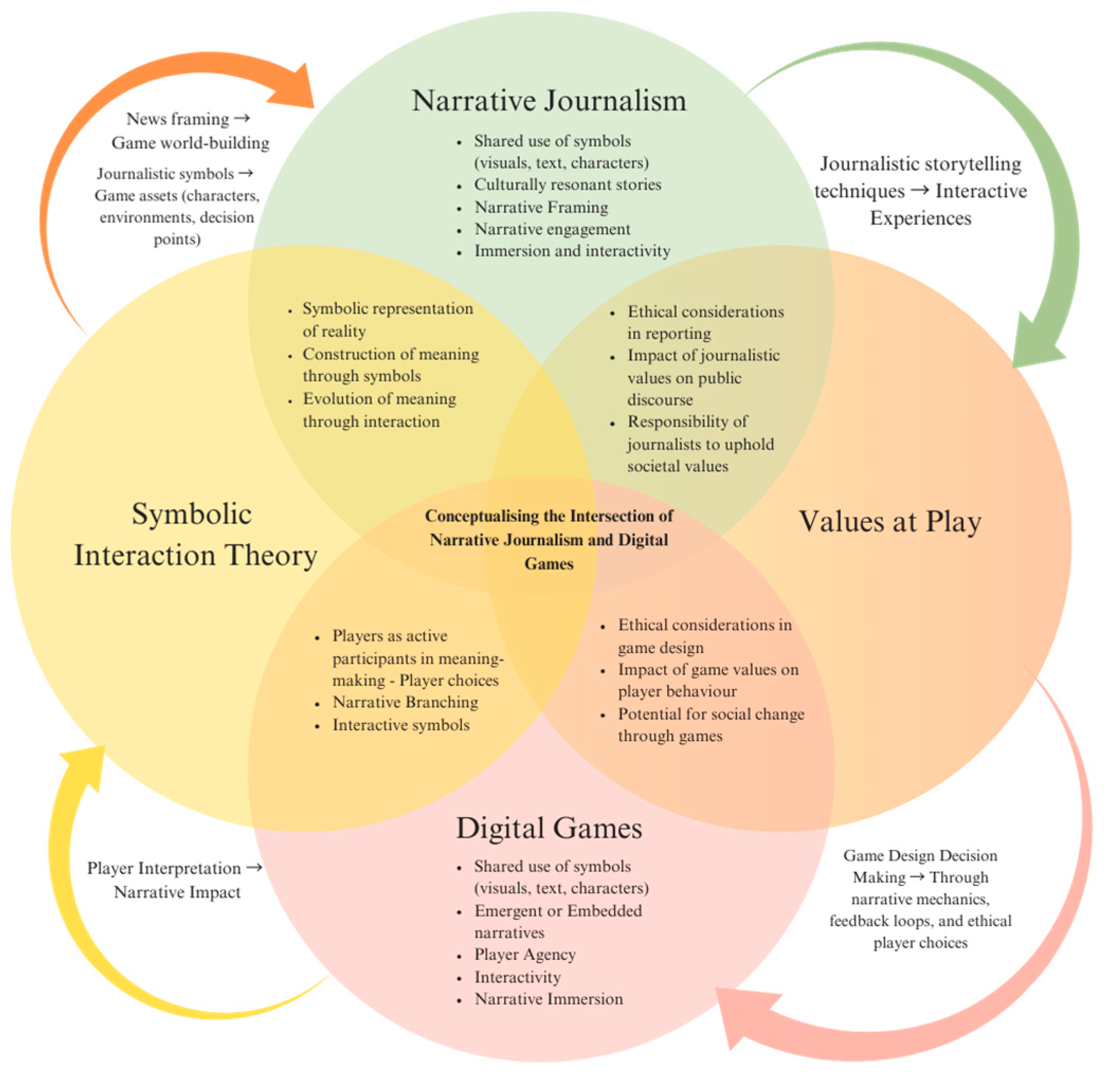
RQ 3: The conceptual model presented in Figure 1, integrating narrative journalism into newsgames, emerges from the convergence of Narrative Journalism, Digital Games, SIT, and the VAP heuristic, which further expands Table 1. Together, they form a structure encompassing symbolic storytelling, interactivity, agency, and ethical design. The model below situates newsgames as performative acts of meaning-making rather than mere simulations of news events.
First, symbolic storytelling and representation draw from narrative journalism’s commitment to constructing meaning through character, structure, and emotional resonance (Aare, 2024; Panasenko & Petrovičová, 2024). In game design, these same techniques can be applied to interactive elements such as environmental storytelling and character-driven quests, ensuring that narrative coherence supports factual interpretation (Bizzocchi & Tanenbaum, 2012). Symbolic Interaction Theory reinforces this process by explaining how meaning is co-created through player interpretation. Players engage with symbolic cues—visual, textual, and auditory—to reconstruct journalistic realities within the game world (Carter & Fuller, 2015; Cousineau, 2020). For instance, in Through the Darkest of Times, players interpret coded messages, propaganda, and documents to form an experiential understanding of Nazi-era resistance. Such symbolic engagement parallels the interpretive labour readers perform in narrative journalism, where understanding arises through reconstructing contextual meaning.
Second, interactivity and player agency serve as the mechanics through which players co-author journalistic narratives (Zimmerman, 2004). This interactivity transforms journalistic storytelling from a monologic to a dialogic process. Games allow audiences to navigate stories from multiple perspectives, akin to investigative journalism’s multi-sourced approach (Elson et al., 2014; Ryan, 2009). However, maintaining narrative coherence requires balancing freedom with guidance. Ludonarrative dissonance—when mechanics conflict with narrative meaning—can undermine credibility (Hocking, 2009). Designers must therefore employ procedural constraints that guide interpretation without negating player autonomy. Narrative journalism’s focus on causality and consequence provides a blueprint for such alignment, ensuring that every choice resonates with the journalistic truth of the underlying story.
Third, ethical design and value integration—guided by the VAP heuristic—anchor this convergence within journalistic professionalism. By embedding normative values into game architecture, designers ensure that interactivity reinforces journalistic goals rather than distorting them (Flanagan & Nissenbaum, 2014). This integration transforms the game into a performative ethical space in which players confront moral dilemmas reflective of real-world journalism. The iterative process of discovery, implementation, and verification parallels journalistic processes of research, writing, and fact-checking, suggesting that playing itself can be a form of journalistic inquiry. Consequently, games become platforms for civic engagement and critical reflection rather than mere vehicles for entertainment (Conill & Karlsson, 2015).
This conceptual synthesis produces several implications for the future of newsgame design, audience engagement, and evaluation. First, it proposes newsgames as participatory journalism—interactive systems where players construct knowledge through experiential learning. By combining narrative journalism’s emotional depth with digital games’ procedural interactivity, newsgames can foster interactivity and understanding of complex sociopolitical issues (Lin & Wu, 2020; Plewe & Fürsich, 2020). Second, this integration enhances audience engagement by transforming users into co-authors rather than consumers. Research by Carstensdottir et al. (2021) and Guo and Lo (2023) shows that player agency increases narrative engagement, retention, and critical reflection. Third, incorporating narrative journalism into game design introduces new evaluation criteria for assessing journalistic quality in interactive media. Traditional metrics such as factual accuracy and audience reach must be complemented by new measures—agency coherence, ethical alignment, and emotional resonance—to capture the multidimensional nature of narrative engagement (Busselle & Bilandzic, 2009; Denisova & Cairns, 2015).
Furthermore, by grounding design in SIT, researchers can develop methodologies to study how players negotiate meaning within interactive journalistic contexts. This approach recognises that the “message” experienced in games is relational and performative, shaped by symbolic interaction between player and system (Blumer, 1969; Mead & Morris, 1997). It opens possibilities for analysing how player choices reflect cognitive and ethical engagement with real-world issues. For instance, when players in 1979 Revolution: Black Friday decide whether to engage in the Iranian Revolution, they engage in a moral calculus akin to the ethical decision-making at the heart of journalism. The game thus becomes a site for practising ethical reasoning and empathic understanding—central objectives of narrative journalism. Finally, the convergence of narrative journalism and game design redefines the cultural function of journalism. It shifts the locus of storytelling from observation to participation, challenging audiences to engage with news as an interactive social experience rather than a consumable product. This participatory turn reflects broader trends in digital culture, where media users demand agency, interactivity, and transparency (Deuze & Witschge, 2018; Nack, 2022). As a result, narrative-driven newsgames can serve as laboratories for journalistic innovation, exploring how digital interactivity can sustain journalism’s civic role in an era of fragmented attention and media scepticism. By deliberately integrating narrative journalism principles—truthfulness, interactivity, structure, and moral inquiry—into the design of newsgames, developers can create playable systems that not only inform but also transform how audiences understand the world.
The convergence between narrative journalism and game design in Figure 1 illustrates the potential for a design framework of interactive, immersive, and ethically grounded journalistic storytelling. By positioning narrative journalism as a design framework for newsgames, designers can leverage its narrative depth to enhance factual storytelling in digital environments. Adapting its techniques—characterisation, emotional framing, and narrative structure—to ludic systems enables audience participation without undermining journalistic integrity. Finally, integrating SIT and the VAP heuristic provides a conceptual and ethical foundation for this synthesis, ensuring that meaning is co-created through interaction while preserving accuracy and moral responsibility. As such, newsgames informed by narrative journalism stand poised to redefine journalism’s role in the digital age—not as static reportage but as participatory, meaning-making experiences that engage audiences as active contributors to the narrative of truth.

5.3. Integrative Bridge: Linking SIT and the VAP Heuristic

While the conceptual model in Figure 1 is organised around four core domains, these are operationalised through four interrelated design dimensions that translate theory into practice. As shown in Figure 1, SIT and the VAP heuristic together provide a complementary foundation for understanding the symbolic and ethical dimensions of narrative journalism in digital games. SIT explains how meaning is constructed through interaction, symbolic exchange, and player interpretation, while VAP operationalises what values inform this meaning-making process. Through SIT, player agency and journalistic storytelling are understood as interpretive acts—forms of negotiated understanding between the player and the system that mirror the dynamic between the journalist and the audience. VAP extends this interactional process by embedding journalistic values—truthfulness, accuracy, transparency, and civic responsibility—into the game’s design and mechanics.
When integrated, both theories ensure that digital games do not simply convey news through play but do so ethically and interactively, preserving journalism’s credibility while fostering participatory engagement. As illustrated in the conceptual model (Figure 1), this synthesis demonstrates how meaning and values operate in tandem to transform gameplay into a site of symbolic negotiation and value-driven storytelling. In this sense, digital games emerge as a legitimate journalistic modality in which interactivity serves as a conduit for ethical representation, narrative depth, and interpretive participation. The practical application of this synthesis can be structured around four interrelated design dimensions that align SIT and VAP principles within game development:
  • Symbolic Storytelling and Representation: Employing narrative journalism techniques to construct meaning through interactive story elements and player interpretation.
  • Interactivity and Player Agency: Ensuring player choices shape narrative construction while maintaining journalistic integrity and factual grounding.
  • Game Design and Decision-Making: Applying VAP principles to guide ethical design choices, embedding journalistic values within gameplay systems.
  • News Framing and Gameworld Building: Using narrative structures and mechanics to incorporate news content strategically without compromising factual accuracy.
Together, these dimensions operationalise the theoretical synthesis of SIT and VAP, offering a model through which digital games can convey journalistic narratives that are both ethically grounded and meaningfully interactive.

6. Conclusions

This study has examined the intersection between journalism and digital games to explore how newsgames function as a journalistic medium and how their narrative, interactive, and design structures shape the communication of news. Drawing on the literature reviewed and the conceptual synthesis presented in Table 1 and Figure 1, this paper argues that newsgames are best understood not merely as experimental media formats but as interactive narrative systems of journalism, in which gameplay functions as a storytelling device that enables audiences to engage with news events through participation and interpretation. The literature highlights that newsgames operate within a hybrid media environment where the logics of journalism and digital games intersect (Bogost et al., 2010). Journalism has traditionally been grounded in verification, factual accuracy, and the communication of public-interest issues (Twain et al., 2020), whereas digital games rely on rule-based systems, mechanics, and player interaction to produce meaning (Giddings & Kennedy, 2006). This intersection has sparked debate about whether games can adequately represent complex social issues or risk trivialising serious topics (Foxman, 2015; Meier, 2018). However, research increasingly suggests that when designed carefully, newsgames can integrate playful interaction with journalistic information in ways that enhance audience engagement and understanding of complex systems and processes (Ferrer-Conill et al., 2020; García-Ortega & García-Avilés, 2020; Gómez-García & de la Hera Conde-Pumpido, 2023).
A central finding of this study is that the communicative potential of newsgames depends on how journalistic information is embedded within gameplay structures. As illustrated in Figure 1, the design of mechanics, dynamics, and player choices shapes how audiences perceive and interact with journalistic information. Gameplay, therefore, functions not merely as an interactive tool but as a structural component of storytelling within the medium. García-Ortega and García-Avilés (2020) argue that the selection of mechanics and dynamics directly influences how users interpret the information presented, demonstrating that game design decisions are closely connected to journalistic meaning. Similarly, Teixeira et al. (2015) highlight that newsgames construct their narratives through gameplay systems that allow players to simulate real-world situations and interact with journalistic information through decision-making processes. The study also addressed whether newsgames prioritise playful elements over journalistic content or achieve a meaningful balance between the two. The literature suggests that this balance largely depends on the integration of narrative design into gameplay systems. Through procedural rhetoric, arguments and interpretations can be embedded within the rules and processes of the game itself, enabling players to experience the consequences of decisions and systems rather than simply reading about them (Bogost, 2007; Nelson et al., 2007). In this way, newsgames extend the communicative possibilities of journalism by presenting news events as interactive systems that audiences can explore. This development reflects broader transformations in digital journalism, in which emerging formats increasingly emphasise interactivity, user participation, and immersive storytelling to improve engagement with news content (L. Chen et al., 2023; Sixto-García et al., 2023).
Drawing on the findings of the analysis and the conceptual synthesis presented in Table 1 and Figure 1, which explored whether newsgames provide adequate narrative resources to explain the issues they represent. As illustrated, narrative structures play a central role in enabling players to interpret the events and systems represented in a newsgame. Narrative within digital games does not consist solely of scripted story elements but emerges from the interaction among rules, player decisions, and the game’s simulated environment. From a game studies perspective, narrative can therefore be understood as a cognitive strategy through which players make sense of the fictional or simulated worlds created by game systems (Laas, 2014). This perspective challenges the traditional separation between gameplay and narrative by demonstrating that storytelling can occur through interaction as well as through text or audiovisual representation. Furthermore, the literature suggests that newsgames can facilitate deeper engagement with complex social and political issues by allowing users to experiment with systems and experience the consequences of different choices. Newsgames can encourage reflection, empathy, and critical understanding of real-world events (Ferrer-Conill et al., 2020; Plewe & Fürsich, 2018). This aligns with broader theories of serious storytelling, which emphasise the use of narrative structures to communicate knowledge, stimulate emotional engagement, and support reflection in contexts beyond entertainment (Lugmayr et al., 2017). Similarly, narrative theory highlights that stories function as a fundamental mechanism through which individuals organise experience and interpret complex events, reinforcing the importance of narrative frameworks in communicating meaning (Gilbert, 2002).
Taken together, the findings of this research support the central argument of this paper: newsgames should be conceptualised as interactive narrative systems of journalism. Rather than treating gameplay as a supplementary interactive mechanism, this perspective recognises gameplay as a core narrative structure through which journalistic stories are experienced. Through the interplay of rules, mechanics, and narrative framing, newsgames create environments in which audiences participate in the unfolding of journalistic narratives, interpreting events through exploration and decision-making rather than passive observation.
The framework presented in Figure 1, therefore, proposes narrative journalism as a design framework for newsgames. Narrative journalism traditionally emphasises immersive storytelling, contextual depth, and the reconstruction of events through narrative structures. When applied to the design of newsgames, these principles can guide the development of interactive systems that maintain journalistic values while leveraging the participatory affordances of digital games. Gameplay becomes a narrative device that allows audiences to explore relationships between actors, events, and systems in ways that conventional journalistic formats cannot easily replicate. Ultimately, this study contributes to the growing field of research on newsgames and digital journalism by proposing a conceptual shift in how these projects are understood. Rather than viewing them as isolated experiments in gamification, they should be recognised as part of the broader evolution of journalism toward interactive and participatory storytelling. As journalism continues to adapt to the changing technological and communicative landscape, newsgames represent a significant opportunity to expand the narrative and experiential possibilities of news communication, enabling audiences to engage with complex issues through interactive interpretation and participation.

Author Contributions

Conceptualisation, B.D.; methodology, B.D.; investigation, B.D.; resources, B.D.; writing—original draft preparation, B.D.; writing—review and editing, B.D.; visualisation, B.D.; supervision, B.H.; project administration, B.D. All authors have read and agreed to the published version of the manuscript.

Funding

This research received no external funding.

Institutional Review Board Statement

Not applicable.

Informed Consent Statement

Not applicable.

Data Availability Statement

This research is literature-based; therefore, no new data were created.

Conflicts of Interest

The authors declare no conflicts of interest.

Abbreviations

The following abbreviations are used in this research:
SITSymbolic Interaction Theory
VAPValues at Play

Notes

1
Narrative engagement can be defined as when a viewer or reader locates themselves within the mental mode of the story (Busselle & Bilandzic, 2009).
2
Meaning’ as a narrative element facilitating learning is central to Narrative Journalism and Digital Games (Hayes, 2020; Schmidt, 2017; Suter et al., 2021; Tanenbaum et al., 2009). Meaning in this context refers to intentional and personally meaningful learning for the audience (Naul & Liu, 2019).
3
Narrative immersion is the feeling of being inside the story, completely involved and accepting the world and events of the story as real (Rzeszewski & Naji, 2022).
4
Procedural rhetoric is how digital systems and games convey messages through their rules and processes rather than words or images. It is a method of providing relatable arguments or messages by demonstrating an idea through the logic and composition of a specific game or system a player engages with, thereby establishing credibility and an understanding of real-world issues (Bogost, 2007).

References

  1. Aare, C. (2024). Subjectivity conditioned by narrative form: A narratological approach to emotion in narrative journalism. Journalism, 26, 1411–1427. [Google Scholar] [CrossRef]
  2. Aarseth, E. (2012). A narrative theory of games. In Foundations of digital games 2012, FDG 2012—Conference program (pp. 129–133). Association for Computing Machinery. [Google Scholar] [CrossRef]
  3. Alexiou, A., Schippers, M. C., Oshri, I., & Angelopoulos, S. (2020). Narrative and aesthetics as antecedents of perceived learning in serious games. Information Technology and People, 35(8), 142–161. [Google Scholar] [CrossRef]
  4. Arafat, R. K. (2020). Rethinking framing and news values in gamified journalistic contexts: A comparative case study of Al Jazeera’s interactive games. Convergence, 26(3), 550–571. [Google Scholar] [CrossRef]
  5. Arrambide, K. (2019). Interactive narratives in games: Understanding player agency and experience. In CHI PLAY 2019—Extended abstracts of the annual symposium on computer-human interaction in play (pp. 1–5). Association for Computing Machinery. [Google Scholar] [CrossRef]
  6. Äyrämö, S.-M. (2016). Narrative constitution for instructional game design: A semiotic-cognitive model of narrative. StoryWorlds, 8(2), 53–72. [Google Scholar] [CrossRef]
  7. Baumeister, R. F., & Leary, M. R. (1997). Writing narrative literature reviews. Review of General Psychology, 1(3), 311–320. [Google Scholar] [CrossRef]
  8. Beltrán-Palanques, V. (2024). Assessing video game narratives: Implications for the assessment of multimodal literacy in ESP. Assessing Writing, 60, 100809. [Google Scholar] [CrossRef]
  9. Bizzocchi, J., & Tanenbaum, T. J. (2012). Mass effect 2: A case study in the design of game narrative. Bulletin of Science, Technology & Society, 32(5), 393–404. [Google Scholar] [CrossRef]
  10. Blood, D., Kao, J., Knoll, N., Kwong, R., Locke, C., & Rininsland, A. (2017). How (and Why) the financial times made the uber game—Features—Source: An opennews project. Open Source News. Available online: https://source.opennews.org/articles/how-and-why-financial-times-made-uber-game/ (accessed on 12 February 2025).
  11. Blumer, H. (1969). Symbolic interactionism: Perspective and method. Prentice-Hall. [Google Scholar]
  12. Bochner, A. P. (2012). On first-person narrative scholarship: Autoethnography as acts of meaning. Narrative Inquiry: NI, 22(1), 155–164. [Google Scholar] [CrossRef]
  13. Bogost, I. (2007). Persuasive games: The expressive power of videogames. The MIT Press. [Google Scholar] [CrossRef]
  14. Bogost, I. (2020). Curiosity journalism, or the first decades of newsgames. Convergence, 26(3), 572–576. [Google Scholar] [CrossRef]
  15. Bogost, I., Ferrari, S., & Schweizer, B. (2010). Newsgames: Journalism at play. Mit Press. [Google Scholar]
  16. Boudreau, K. (2024). Beyond aesthetics: Players, player-characters and interactivity-as-demand in cozy games. Replay. The Polish Journal of Game Studies, 12(1), 7–22. [Google Scholar] [CrossRef]
  17. Busselle, R., & Bilandzic, H. (2009). Measuring narrative engagement. Media Psychology, 12(4), 321–347. [Google Scholar] [CrossRef]
  18. Carstensdottir, E., Kleinman, E., Williams, R., & El-Nasr, M. S. (2021, May 8–13). Naked and on fire: Examining player agency experiences in narrative-focused gameplay. Conference on Human Factors in Computing Systems, Yokohama, Japan. [Google Scholar] [CrossRef]
  19. Carter, M. J., & Fuller, C. (2015). Symbolic interactionism. Sociopedia, 1, 1–17. [Google Scholar] [CrossRef]
  20. Chen, L., Dowling, D., & Goetz, C. (2023). At the nexus of ludology and narratology: Advances in reality-based story-driven games. F1000Research, 12, 45. [Google Scholar] [CrossRef] [PubMed]
  21. Chen, M.-P., & Wang, L.-C. (2009). The effects of type of interactivity in experiential game-based learning. In M. Chang, R. Kuo, Kinshuk, G.-D. Chen, & M. Hirose (Eds.), Learning by playing. Game-based education system design and development (pp. 273–282). Springer. [Google Scholar]
  22. Cheng, P. (2007, September 24–28). Waiting for something to happen: Narratives, interactivity and agency and the video game cut-scene. Situated Play, Proceedings of DiGRA 2007 Conference, Tokyo, Japan. [Google Scholar] [CrossRef]
  23. Cole, A. (2018). Connecting Player and Character Agency in Videogames. Australasian Association of Writing Programs, 49(22), 1–14. [Google Scholar] [CrossRef]
  24. Conill, R. F., & Karlsson, M. (2015). The gamification of journalism. In Emerging research and trends in gamification (pp. 356–383). IGI Global. [Google Scholar] [CrossRef]
  25. Cousineau, M. J. (2020). A blumerian approach to storytelling. Symbolic Interaction, 43(4), 721–738. [Google Scholar] [CrossRef]
  26. Dawson, G. (2019). Storytelling in “post-conflict” times: Narrative, subjectivity and experience in community-based peacebuilding. Available online: https://www.semanticscholar.org/paper/Storytelling-in-%E2%80%98post-conflict%E2%80%99-times%3A-narrative%2C-Dawson/8dc0c8b6f0414fbce92add59afd9c0ce354c1abe (accessed on 22 March 2026).
  27. Day, T., & Zhu, J. (2017). Agency informing techniques: Communicating player agency in interactive narratives: Extended abstract. In ACM international conference proceeding series, Part F130151. Association for Computing Machinery. [Google Scholar] [CrossRef]
  28. Deliyannis, I., Kaimara, P., Poulimenou, M. S., & Lampoura, S. (2023). Introductory chapter: Games, gamification, and ludification, can they be combined? In I. Deliyannis (Ed.), Gamification analysis, design, development and ludification (1st ed., Vol. 1, pp. 3–10). IntechOpen. [Google Scholar] [CrossRef]
  29. Denisova, A., & Cairns, P. (2015). First person vs. Third person perspective in digital games: Do player preferences affect immersion? In Proceedings of the 33rd annual ACM conference on human factors in computing systems (pp. 145–148). Association for Computing Machinery. [Google Scholar] [CrossRef]
  30. Deuze, M. (2005). What is journalism? Professional identity and ideology of journalists reconsidered. Journalism, 6(4), 442–464. [Google Scholar] [CrossRef]
  31. Deuze, M., & Witschge, T. (2018). Beyond journalism: Theorizing the transformation of journalism. Journalism, 19(2), 165–181. [Google Scholar] [CrossRef]
  32. Elson, M., Breuer, J., Ivory, J. D., & Quandt, T. (2014). More than stories with buttons: Narrative, mechanics, and context as determinants of player experience in digital games. Journal of Communication, 64(3), 521–542. [Google Scholar] [CrossRef]
  33. Ferrer-Conill, R., Foxman, M., Jones, J., Sihvonen, T., & Siitonen, M. (2020). Playful approaches to news engagement. Convergence, 26(3), 457–469. [Google Scholar] [CrossRef]
  34. Flanagan, M., & Nissenbaum, H. (2014). Values at play in digital games (1st ed.). MIT Press. [Google Scholar] [CrossRef]
  35. Foxman, M. (2015). Play the news fun and games in digital journalism. Tow Center for Digital Journalism, Columbia University. [CrossRef]
  36. García-Avilés, J. A., Ferrer-Conill, R., & García-Ortega, A. (2022). Gamification and newsgames as narrative innovations in journalism. In Studies in big data (Vol. 97, pp. 53–67). Springer Science and Business Media Deutschland GmbH. [Google Scholar] [CrossRef]
  37. García-Ortega, A., & García-Avilés, J. A. (2020). When journalism and games intersect: Examining news quality, design and mechanics of political newsgames. Convergence, 26(3), 517–536. [Google Scholar] [CrossRef]
  38. Giddings, S., & Kennedy, H. W. (2006). Digital games as new media. In Understanding digital games (pp. 129–147). SAGE Publications Inc. [Google Scholar] [CrossRef]
  39. Gilbert, K. R. (2002). Taking a narrative approach to grief research: Finding meaning in stories. Death Studies, 26(3), 223–239. [Google Scholar] [CrossRef] [PubMed]
  40. Gómez, J. (2019). 4 articles you must read that will turn you into a fan of narrative journalism—Cultura colectiva. Available online: https://culturacolectiva.com/en/art/books/how-to-write-narrative-journalism-examples/ (accessed on 12 September 2024).
  41. Gómez-García, S., & de la Hera Conde-Pumpido, T. (2023). Newsgames: The use of digital games by mass-media outlets to convey journalistic messages. Games and Culture, 18(4), 449–474. [Google Scholar] [CrossRef]
  42. Grace, L. D. (2018). Newsjam: Making games at the pace of news. In ACM international conference proceeding series (pp. 17–20). Association for Computing Machinery. [Google Scholar] [CrossRef]
  43. Green, B. N., Johnson, C. D., & Adams, A. (2006). Writing narrative literature reviews for peer-reviewed journals: Secrets of the trade. Journal of Chiropractic Medicine, 5, 101–117. [Google Scholar] [CrossRef] [PubMed]
  44. Guo, Z., & Lo, C. H. (2023). An empirical framework for understanding a player’s sense of agency in games. International Journal of Human-Computer Interaction, 40, 5717–5736. [Google Scholar] [CrossRef]
  45. Hayes, C. (2020). Meaning-making in indie games: The intersection of narrative and interactivity in non-traditional videogames. In CHI PLAY 2020—Extended abstracts of the 2020 annual symposium on computer-human interaction in play (pp. 21–23). Association for Computing Machinery. [Google Scholar] [CrossRef]
  46. Heravi, B. (2024). Storytelling structures in data journalism: Introducing the water tower structure only a small fraction of data. Routledge. [Google Scholar]
  47. Hermida, A. (2013). #JOURNALISM. Digital Journalism, 1(3), 295–313. [Google Scholar] [CrossRef]
  48. Hocking, C. (2009). Ludonarrative dissonance in Bioshock: The problem of what the game is about. Available online: https://api.semanticscholar.org/CorpusID:141037652 (accessed on 27 May 2024).
  49. Husin, S. S., Ab Rahman, A. A., & Mukhtar, D. (2021). The symbolic interactionism theory: A systematic literature review of current research. International Journal of Modern Trends in Social Sciences, 4(17), 113–126. [Google Scholar] [CrossRef]
  50. Jahan, N., Naveed, S., Zeshan, M., & Tahir, M. A. (2016). How to conduct a systematic review: A narrative literature review. Cureus, 8, e864. [Google Scholar] [CrossRef]
  51. James, J. (2017). Newsgames—Journalism innovation through game design. American Journalism, 34(3), 379–381. [Google Scholar] [CrossRef]
  52. Jenkins, H. (2003). Game design as narrative architecture. Computer, 44(3), 118–130. Available online: https://paas.org.pl/wp-content/uploads/2012/12/09.-Henry-Jenkins-Game-Design-As-Narrative-Architecture.pdf (accessed on 3 July 2023).
  53. Jones, S. (2019). Two schools: Narratology vs. Ludology. Available online: https://sites.google.com/view/eternalpolymath/game-studies/the-rise-of-game-studies-series/two-schools-narratology-vs-ludology (accessed on 4 June 2025).
  54. Jović, S. (2020). The narrative games we play: Varied use of narrative strategies across genres and socioeconomic positions. Language and Communication, 74, 87–102. [Google Scholar] [CrossRef]
  55. Koenitz, H. (2018). What game narrative are we talking about? An ontological mapping of the foundational canon of interactive narrative forms. Arts, 7(4), 51. [Google Scholar] [CrossRef]
  56. Laas, O. (2014). Narratives in digital games their place and function in the study of digital games. Available online: http://www.gamestudies.org/0301/kucklich/ (accessed on 9 March 2021).
  57. Lassila-Merisalo, M. (2014). Story first-publishing narrative long-form journalism in digital environments. Journal of Magazine & New Media Research, 15(2), 1–15. [Google Scholar] [CrossRef]
  58. Lerner, K. (2011). The structure and style of narrative journalism. Journal of Magazine Media, 12(2), 1–2. [Google Scholar] [CrossRef]
  59. Lin, J. H. T., & Wu, D. Y. (2020). Newsgames for the greater good: The effects of graphic realism and geographic proximity on knowledge acquisition and willingness to help. Journalism and Mass Communication Quarterly, 97(1), 30–51. [Google Scholar] [CrossRef]
  60. Lopezosa, C., Codina, L., Fernández-Planells, A., & Freixa, P. (2023). Journalistic innovation: How new formats of digital journalism are perceived in the academic literature. Journalism, 24(4), 821–838. [Google Scholar] [CrossRef]
  61. Lugmayr, A., Sutinen, E., Suhonen, J., Sedano, C. I., Hlavacs, H., & Montero, C. S. (2017). Serious storytelling—A first definition and review. Multimedia Tools and Applications, 76(14), 15707–15733. [Google Scholar] [CrossRef]
  62. McCauley, B., Nguyen, T. H. T., McDonald, M., & Wearing, S. (2020). Digital gaming culture in Vietnam: An exploratory study. Leisure Studies, 39(3), 372–386. [Google Scholar] [CrossRef]
  63. Mead, G. H., & Morris, C. W. (1997). Mind, self, and society: From the standpoint of a social behaviorist. University of Chicago Press. [Google Scholar]
  64. Meier, K. (2018). Journalism meets games: Newsgames as a new digital genre. Theory, boundaries, utilization. Journal of Applied Journalism and Media Studies, 7(2), 429–444. [Google Scholar] [CrossRef]
  65. Munganga, B. M. (2016). Inference and narrative processing in fiction and film: (Where) (does) narrative reading part(s) ways with its viewing and vice versa (?). Cogent Arts and Humanities, 3(1), 1252138. [Google Scholar] [CrossRef]
  66. Muriel, D., & Crawford, G. (2020). Video games and agency in contemporary society. Games and Culture, 15(2), 138–157. [Google Scholar] [CrossRef]
  67. Mustaro, P. N., & Mendonça, R. L. (2012). Immersion, narrative, and replayability as the motivational and attractiveness factors in serious games. In Handbook of research on serious games as educational, business and research tools (pp. 991–1008). IGI Global. [Google Scholar] [CrossRef]
  68. Nack, F. (2022). Interactive digital narrative (IDN)—A complexity case. New Review of Hypermedia and Multimedia, 28(3–4), 69–75. [Google Scholar] [CrossRef]
  69. Naul, E., & Liu, M. (2019). Why story matters: A review of narrative in serious games. Journal of Educational Computing Research, 58(3), 687–707. [Google Scholar] [CrossRef]
  70. Nelson, M. J., Mateas, M., Basili, R., & Pazienza, M. T. (2007). Towards automated game design. In AIIA 2007 (pp. 626–637). Springer. [Google Scholar]
  71. Neveu, E. (2014). Revisiting narrative journalism as one of the futures of journalism. Journalism Studies, 15(5), 533–542. [Google Scholar] [CrossRef]
  72. Panasenko, N., & Petrovičová, I. (2024). The narrative in literary journalism. RUDN Journal of Studies in Literature and Journalism, 29(1), 103–113. [Google Scholar] [CrossRef]
  73. Plewe, C., & Fürsich, E. (2018). Are newsgames better journalism?: Empathy, information and representation in games on refugees and migrants. Journalism Studies, 19(16), 2470–2487. [Google Scholar] [CrossRef]
  74. Plewe, C., & Fürsich, E. (2020). Producing newsgames beyond boundaries: Journalists, game developers, and the news business. Convergence, 26(3), 486–502. [Google Scholar] [CrossRef]
  75. Riedl, M. O., & Bulitko, V. (2013). Interactive narrative: An intelligent systems approach. AI Magazine, 34(1), 67. [Google Scholar] [CrossRef]
  76. Rønlev, R., & Moestrup, S. (2023). Embracing narrative journalism in the Nordic countries. Journalistica, 17(1), 10–12. [Google Scholar] [CrossRef]
  77. Rønlev, R., & Sommer, S. (2024). The multifunctional “I” in narrative journalism: First-person narration, character functions, and voice in audio stories. Journalism Practice, 1, 1–17. [Google Scholar] [CrossRef]
  78. Ryan, M.-L. (2001). Game studies 0101: Ryan: Beyond myth and metaphor: The case of narrative in digital media. The International Journal of Computer Game Research, 1, 1–17. Available online: http://www.gamestudies.org/0101/ryan/ (accessed on 6 August 2022).
  79. Ryan, M.-L. (2009). From narrative games to playable stories: Toward a poetics of interactive narrative. Storyworlds: A Journal of Narrative Studies, 1, 43–59. [Google Scholar] [CrossRef]
  80. Rzeszewski, M., & Naji, J. (2022). Literary placemaking and narrative immersion in extended reality virtual geographic environments. International Journal of Digital Earth, 15(1), 853–867. [Google Scholar] [CrossRef]
  81. Schmidt, T. R. (2017). Rediscovering narrative: A cultural history of journalistic storytelling in American. University of Oregon. [Google Scholar]
  82. Sellers, M. (2018). Advanced game design. Addison-Wesley Professional. [Google Scholar]
  83. Sixto-García, J., Silva-Rodríguez, A., Rodríguez-Vázquez, A. I., & López-García, X. (2023). Redefining journalism narratives, distribution strategies, and user involvement based on innovation in digital native media. Journalism, 24(6), 1322–1341. [Google Scholar] [CrossRef]
  84. Sri, P. (2019). Narrative journalism and digital journalism. International Journal of Linguistics, Literature and Translation, 2, 64–67. [Google Scholar] [CrossRef]
  85. Sukhera, J. (2022). Narrative reviews: Flexible, rigorous, and practical. Journal of Graduate Medical Education, 14(4), 414–417. [Google Scholar] [CrossRef]
  86. Sun, H. (2024). The Negotiation of truth claims in newsgames: The tension between “Fact” and “Fiction”. Journalism Studies, 26, 220–239. [Google Scholar] [CrossRef]
  87. Suter, B., Bauer, R., & Kocher, M. (2021). Narrative mechanics—Strategies and meanings in games and real life (1st ed.). Transcript Verlag. [Google Scholar]
  88. Swanson, R., Gordon, A. S., Khooshabeh, P., Sagae, K., Huskey, R., Mangus, M., Amir, O., & Weber, R. (2017). An empirical analysis of subjectivity and narrative levels in weblog storytelling across cultures. Dialogue & Discourse, 8(2), 105–128. [Google Scholar] [CrossRef]
  89. Tanenbaum, K., Tanenbaum, T. J., & Tanenbaum, T. (2009). Commitment to meaning: A reframing of agency in games commitment to meaning: A reframing of agency in games. Available online: https://escholarship.org/uc/item/6f49r74n (accessed on 16 January 2024).
  90. Teixeira, C., Carvalho, B., Soares, M., Neves, A., Lins, A., Agra, J., Martins, V., & Soares, G. (2015). Usabilility and gameplay in newsgames: A comparative analysis of the genre of documentary published in Brazilian news portals. Procedia Manufacturing, 3, 6060–6067. [Google Scholar] [CrossRef]
  91. Thier, K., Abdenour, J., Walth, B., & Dahmen, N. S. (2021). A narrative solution: The relationship between solutions journalism, narrative transportation, and news trust. Journalism, 22(10), 2511–2530. [Google Scholar] [CrossRef]
  92. Topouzova, L. (2021). Truth and subjectivity in narrative inquiry: Augmented reality & digital storytelling in the university classroom. Journal of Visual Literacy, 40(2), 94–103. [Google Scholar] [CrossRef]
  93. Tulloch, J. (2014). Ethics, trust and the first person in the narration of long-form journalism. Journalism, 15(5), 629–638. [Google Scholar] [CrossRef]
  94. Twain, M., Johnson, S., Marx, K., Clemenceau, G., Swift, J., Man, P., Joyce, J., Hemingway, E., Defoe, D., & Wilkes, J. (2020). Journalism |definition, history, & facts. Britannica. Available online: https://www.britannica.com/topic/journalism#ref3769 (accessed on 16 January 2024).
  95. van der Nat, R., Müller, E., & Bakker, P. (2023). Navigating interactive story spaces. The architecture of interactive narratives in online journalism. Digital Journalism, 11(6), 1104–1129. [Google Scholar] [CrossRef]
  96. van Krieken, K. (2019). Literary, long-form, or narrative journalism. In The international encyclopedia of journalism studies (pp. 1–7). Wiley-Blackwell. [Google Scholar] [CrossRef]
  97. van Krieken, K., & Sanders, J. (2016). Framing narrative journalism as a new genre: A case study of the Netherlands. Journalism, 18(10), 1364–1380. [Google Scholar] [CrossRef]
  98. van Krieken, K., & Sanders, J. (2021). What is narrative journalism? A systematic review and an empirical agenda. Journalism, 22(6), 1393–1412. [Google Scholar] [CrossRef]
  99. Vanoost, M. (2013). Defining narrative journalism through the concept of plot. Narration in Journalism, 2(2). Available online: https://www.diegesis.uni-wuppertal.de/index.php/diegesis/article/view/135 (accessed on 16 January 2024).
  100. Wahl-Jorgensen, K. (2013). Subjectivity and story-telling in journalism: Examining expressions of affect, judgement and appreciation in Pulitzer Prize-winning stories. Journalism Studies, 14(3), 305–320. [Google Scholar] [CrossRef]
  101. Wahl-Jorgensen, K., & Schmidt, T. (2020). News and storytelling. In K. H. Wahl-Jorgensen Thomas (Ed.), The handbook of journalism studies (2nd ed., pp. 261–276). Routledge. [Google Scholar]
  102. Weber, R., Behr, K. M., & DeMartino, C. (2014). Measuring interactivity in video games. Communication Methods and Measures, 8(2), 79–115. [Google Scholar] [CrossRef]
  103. Yin, X. (2026). Bridging news and play: The concept, characteristics, and challenges of newsgames. Literature Language and Cultural Studies, 4(1), 85. [Google Scholar] [CrossRef]
  104. Zimmerman, E. (2004). Narrative, interactivity, play and games: Four naughty concepts in need of discipline. Available online: https://www.anabiosispress.org/VM606/1stPerson_ezimmerman.pdf (accessed on 16 January 2024).
Figure 1. A Conceptual Model for Integrating Narrative Journalism and Digital Games.
Journalmedia 07 00073 g001
Table 1. Theoretical Intersections of Narrative Journalism, Digital Games, and SIT–VAP Heuristic.
IntersectionShared PrincipleDesign Implication
Narrative Journalism + Digital GamesStory StructurePlayable Narrative Systems
Narrative Engagement
Interactivity
Narrative Journalism + VAPInformation AccuracyEthical Game Design
Ethics
Credibility
Digital Games + Symbolic InteractionMeaning-making through
Interactivity
Player Interpretation
Disclaimer/Publisher’s Note: The statements, opinions and data contained in all publications are solely those of the individual author(s) and contributor(s) and not of MDPI and/or the editor(s). MDPI and/or the editor(s) disclaim responsibility for any injury to people or property resulting from any ideas, methods, instructions or products referred to in the content.