
Article

How Students Evaluate Fake News and AI-Generated Content on Social Media: Insights from Hong Kong Post-Secondary Students

by
William Ko-Wai Tang
1,*,
Chammy Yan-Lam Lau
2 and
Ao Zhang
1
1
School of Education and Languages, Hong Kong Metropolitan University, Hong Kong
2
College of Professional and Continuing Education, Hong Kong Polytechnic University, Hong Kong
*
Author to whom correspondence should be addressed.
Journal. Media 2026, 7(2), 109; https://doi.org/10.3390/journalmedia7020109
Submission received: 23 February 2026 / Revised: 24 April 2026 / Accepted: 5 May 2026 / Published: 20 May 2026
(This article belongs to the Special Issue Social Media in Disinformation Studies)

Abstract

Social media has become a primary news source for post-secondary students in Hong Kong; however, there is substantial disinformation and misinformation on these platforms. This study offers an initial qualitative window into how Hong Kong post-secondary students identify and respond to online disinformation and misinformation on social media. The qualitative interviews were conducted based on the traditional “Content–Appearance–Motivation” (CAM) framework. The findings show that students actively draw on common-sense reasoning and CAM-related cues. The study proposes a provisional Contextualized Dual-Loop Verification Model in which traditional CAM assessment is embedded within a broader loop of platform literacy, technical authenticity awareness, perceived risk and efficacy, and metacognitive regulation, highlighting the need for journalism and media education to move beyond conventional information literacy toward AI-era verification competencies. Future large-scale and cross-cultural studies are needed to test and refine this model.

1. Introduction

1.1. Background

Social media platforms have become a primary source of news and information for the general public, particularly for young adults and postsecondary students (Chen & Wang, 2021; Sumayyia et al., 2019). However, the convenience and accessibility of these platforms also facilitate the rapid spread of both misinformation (false information shared without intent to mislead) and disinformation (deliberately fabricated information intended to deceive) (Wardle & Derakhshan, 2017). The term “fake news” has been broadly defined as news articles that are intentionally and verifiably false and could mislead readers (Allcott & Gentzkow, 2017), often characterized by low facticity and a high intention to deceive (Egelhofer & Lecheler, 2019). It encompasses various forms, from entirely fabricated stories to misleading content and imposter news sites. For the purpose of this study, fake news encompasses disinformation in the form of intentionally fabricated or deceptive news content (Allcott & Gentzkow, 2017), while misinformation refers to inaccurate content shared without demonstrable intent to deceive.
In recent years, the nature of fake news has evolved with technological advancements. The advent of sophisticated Artificial Intelligence (AI) has given rise to AI-generated content (AIGC), such as deepfake videos and hyper-realistic synthetic images (Jaidka et al., 2025). AIGC has significantly lowered the technical barriers to producing disinformation; it enables the fabrication of realistic events, personas and media artifacts that are increasingly difficult to distinguish from authentic content. The environment in Hong Kong presents a unique landscape for the proliferation of misinformation and disinformation, driven by the intense collision of information flows between mainland Chinese and Western media. This is amplified by high social media penetration and a bilingual environment, which enable conflicting discourses to circulate concurrently in both Cantonese and English. Within this fragmented information ecosystem, the “dilemma of identification” surrounding national identity (Wong & Wong, 2024) emerges as a critical point of tension when local and national belonging are in conflict. Such conditions make Hong Kong people increasingly susceptible to fake news (Chan & Blundy, 2019). While previous research and policy discussions in Hong Kong have addressed fake news in general, there remains a critical gap in understanding how digitally native students confront the full spectrum of online fake news, including the emerging threat of AIGC. This study addresses this gap.

1.2. Traditional Fake News Identification Approach

Past research has established information literacy as a foundational competence for combating fake news. Frameworks such as the Association of College and Research Libraries (ACRL) Framework for Information Literacy (ACRL, 2015) and the Hong Kong Education Bureau’s Information Literacy for Hong Kong Students (Education Bureau, 2018) offer structured principles for evaluating information authority, creation processes, and value. Prior work in Hong Kong has shown that many first-year undergraduates still struggle with core information literacy skills, such as identifying information needs, locating credible sources, and evaluating online information, even though they are frequent internet users (Tang, 2018). This challenge is not unique to Hong Kong. Cruz (2020), in a case study of undergraduate communication students in Portugal, found persistent difficulties in identifying misinformation and disinformation even among students with formal media training.
In line with these frameworks, fake news has often been defined as “news articles that are intentionally and verifiably false and could mislead readers” (Allcott & Gentzkow, 2017), typically marked by low facticity and a high intention to deceive (Egelhofer & Lecheler, 2019). Tandoc et al. (2018), in their review of 34 studies published between 2003 and 2017, proposed a typology of fake news along two key dimensions: levels of facticity and levels of immediate intention to deceive. The current definition focuses on fabrication that is low in facticity (e.g., false connections and misleading, fabricated, and false contexts) (Egelhofer & Lecheler, 2019) and high in the immediate intention to deceive (Tandoc et al., 2018). To ensure conceptual clarity, this study adopts the following definitions, which align with prominent scholarship in information disorder research.
Building on these conceptual distinctions, it is also necessary to understand how individuals actually recognize and identify fake news in real-world social media environments. Recent work on misinformation has proposed cue-based models that describe how audiences attend to message content, surface appearance, and perceived motivation when deciding whether something is real or fake.
In this study, the Content–Appearance–Motivation (CAM) framework is used as a combined approach from prior work on fake news and information disorder, rather than an established model with a single originating source.
Regarding the content dimension, fake news includes fabricated, intentionally false, and verifiably false information (Allcott & Gentzkow, 2017; Molina et al., 2021). Research has shown that message quality can help identify fabricated information, including grammatical or spelling errors, emotional language (Allcott & Gentzkow, 2017), and misleading content (Wardle, 2017). In addition to the main text, Paschen (2020) found that the titles of fake news were the most significant differentiators between fake and real news. Fake news titles generally show significantly higher levels of anger and lower levels of joy (Paschen, 2020). This may also extend to the consideration of source credibility heuristics. It is the signal to evaluate a source of the message, including the reputation of the publisher, the credibility and posting history of the account and platform-level cues such as verification badges. It captures how users actually navigate contemporary social-media news environments.
Regarding the appearance dimension, fake news has always been misleading by design (Gelfert, 2018). Fake news always has a false connection between headlines, visuals, and captions (Wardle, 2017). Molina et al. (2021) found that some photos in fake news were unrelated to the content and that fake news was presented in all caps and misleading headlines.
Regarding the motivation dimension, social media enables users to rapidly disseminate misinformation, which may increase the circulation of false or misleading information (Klein & Wueller, 2017). According to Vosoughi et al.’s (2018) study, fake news/false stories were 70% more likely to be disseminated than actual news on Twitter. Many people share fake news with specific goals in mind. Some create eye-catching but false stories to attract views, followers, and advertising revenue (Osman, 2024). Others spread fabricated information to promote political or social agendas, influence public opinion, or damage opponents. In these cases, fake news is shared not by accident, but on purpose, in order to gain attention, power, or profit.
Building on studies that emphasize textual/content cues (e.g., facticity, emotional language, misleading headlines), presentational and visual features (e.g., image–headline mismatch, layout, design), and inferred producer motives (e.g., profit, attention, political influence), CAM summarises these three long-standing strands into a practical triad for analysing how users evaluate online news.

1.3. Research Gap

Existing frameworks, such as information literacy models and the CAM framework, have been developed mainly in response to traditional forms of fake news, where deceptive content often carries visible flaws in language, layout, or sourcing. These approaches assume that users can rely on cues in content, appearance, and perceived motivation to judge whether information is trustworthy. However, the evolving information environment, particularly with the rise of AIGC, necessitates a critical look at the sufficiency of these frameworks. This study explores whether students’ existing literacy skills are adequate and identifies potential gaps.
This exploratory qualitative study addresses this gap by qualitatively examining how Hong Kong tertiary students identify and respond to online fake news on social media, including AI-generated content. It investigates not only how they use traditional CAM-related cues, but also what new behaviours, risk perceptions, and self-regulatory processes become crucial for verification in the current information landscape. This study contributes not only to media literacy education but also to core debates in journalism and media research around how audiences construct credibility and trust in an AI-saturated news environment.
Based on the above information, this study aims to respond to the following research questions:
  • How do Hong Kong post-secondary students identify and respond to fake news on social media, including AI-generated content?
  • To what extent, and in what ways, are their existing skills sufficient for identifying fake news and AI-generated content in an AI-saturated environment?

2. Materials and Methods

This study employed a qualitative, exploratory research design. The aim of this design was to gain a deep understanding of how post-secondary students in Hong Kong think and behave when they encounter information on social media. The study is intended to generate exploratory insights into underlying mechanisms and patterns, which can serve as a foundation for future large-scale quantitative research or further theory development (Braun & Clarke, 2006).
Participants were recruited from three universities in Hong Kong. Recruitment advertisements were shared through (1) internal university email lists, (2) student WhatsApp and WeChat groups, and (3) snowball sampling starting with initial participants. The inclusion criteria were: (1) being a full-time diploma, undergraduate, or postgraduate student in Hong Kong, and (2) being an active user of social media platforms (e.g., Instagram, Facebook, Weibo, Xiaohongshu). The exclusion criteria were: (1) students enrolled in journalism or media studies programs; (2) non-Cantonese or non-Mandarin speakers. The first author and a trained research assistant recruited and screened participants. Participants were not screened for political affiliation or religious beliefs.
This study uses data saturation to determine the number of interviews required. A total of six students participated in the in-depth interviews. The selection of a sample size of six participants is based on two different frameworks drawn from the qualitative methodology research literature. First, we utilize the information power framework suggested by Malterud et al. (2016), who argue that the sufficiency of a qualitative sample depends on the amount of information it provides to the study in question, not on the number of observations. There are five factors that determine the information power: (1) the aim of the study; (2) sample specificity; (3) use of established theory; (4) quality of dialogue; and (5) analysis strategy. In our study, each of these factors points to the necessity of having a relatively small sample: the aims were focused and narrow; the sample itself is highly specific (only full-time university students, active social media users without journalism/media students); the study has a strong theoretical background (the established CAM framework); the interviews lasted an average of 60 min each and were conducted in participants’ native language; finally, the analysis used a structured approach—Reflexive Thematic Analysis under the guidance of the CAM framework. Overall, these factors result in high information power, which allows us to rely on a smaller sample than in broad studies or in studies without theory. Another argument in support of the selected sample size is empirical evidence of data saturation, as described by Guest et al. (2006), which shows that 94 percent of all codes and the core of metathemes were identified within the first six interviews. Following this logic, the six interviews conducted in our study provided sufficient data to formulate the hypotheses and themes, establishing a solid basis for an exploratory study (Creswell & Poth, 2016). We nonetheless acknowledge two limitations: the sample lies at the lower end of the ranges commonly reported in qualitative interview studies, and the variation in educational levels (BA to EdD) introduces heterogeneity that limits generalization to any specific student subgroup. Future studies should employ more homogeneous or purposively stratified designs, and the Contextualized Dual-Loop Verification Model proposed here should be treated as a preliminary, theory-building proposition to be refined through larger-scale empirical work.
Table 1 shows the background information of the participants.
Data were collected through online, semi-structured in-depth interviews conducted via Zoom, with an average duration of 60 min. Interviews were conducted in their first language to facilitate participants’ ease in expressing complex ideas.
To elicit concrete discussion and observe real-time judgment processes, a standardized packet of five real and five fake news cases was prepared. The ten cases were selected through a two-stage process. In Stage 1, the research team compiled a pool of over 30 items that had circulated on Chinese-language social media within the two years preceding data collection, sourced through (a) fact-checking platforms, (b) platform-native warning labels, and (c) review of reports on AI-generated media. In Stage 2, the team applied criteria: (1) coverage of both traditional fake news and AIGC; (2) topical diversity; and (3) prior circulation on Chinese-language social media. Items whose authenticity could not be verified were excluded. All participants were presented with the identical set of cases to ensure a comparable baseline for discussion. Table 2 shows an overview of the cases.
The interview began with obtaining informed consent and a brief overview of the study. The conversation was then guided by a protocol structured around the three-dimensional “Content–Appearance–Motivation” (CAM) framework. This framework is conceptually aligned with models of digital media literacy and information evaluation (Wineburg & McGrew, 2019; Wardle & Derakhshan, 2017), which posit that individuals do not assess information in a single step, but rather engage in a multi-faceted process of scrutiny. This process includes verifying the factual content, evaluating the presentational appearance and source characteristics, and inferring the underlying motivation behind the message.
To minimise order effects and prevent participants from inferring any patterns, a subset of fake and real news cases was presented in a randomised order. For each case, participants could examine the headline, image, and brief context for as long as they wished, with no time limit imposed. The interviewer then posed questions aligned with the three dimensions (e.g., “What is your first reaction to this content?”, “What makes you think it might not be real?”, “What do you think the creator’s purpose was?”). Probing techniques such as “Could you elaborate on that?” and “Why do you say that?” were consistently used to deepen understanding of participants’ reasoning and uncover tacit strategies. All interviews were audio-recorded and transcribed verbatim for analysis.
The transcribed interviews were analyzed using Reflexive Thematic Analysis (RTA) (Braun & Clarke, 2006, 2019), an approach well-suited to exploring complex socio-cognitive processes, as it emphasizes the researcher’s active engagement with the data. The analysis followed a systematic, six-phase process:
  • Familiarization: Repeated reading of the transcripts was conducted while noting initial ideas.
  • Generating Initial Codes: A hybrid coding approach was employed. First, deductive coding was performed using the predefined CAM framework, tagging statements related to content, appearance, and motivation. Concurrently, inductive open coding was conducted to capture any other recurrent or significant ideas not directly covered by the framework (e.g., mentions of specific platforms, expressions of futility, reflections on personal knowledge limits).
  • Constructing Themes: All codes were collated and organized using NVivo software (version 12). Codes were then compared, clustered, and grouped into potential theme candidates based on shared meanings and patterns. For instance, various codes about “only trusting official accounts” and “distrusting self-media” were grouped together.
  • Reviewing and Refining Themes: The candidate themes were critically reviewed against the entire dataset to ensure they accurately represented the data and formed coherent patterns. This phase involved iterative discussion and refinement, merging, splitting, or redefining themes. For example, initial candidates related to “platform trust” and “source confusion” were merged and refined into the more core theme of “Platform-Source Conflation.”
  • Defining and Naming Themes: The final four themes were defined and named. In this study, a “theme” is defined as a recurrent, significant, and meaningful pattern in the data that captures a crucial aspect of participants’ shared experiences, strategies, or dilemmas in navigating fake news, particularly AIGC. Each theme goes beyond mere description to offer an interpretive insight into the limitations of the traditional CAM framework and the new cognitive-contextual factors required to address them.
  • Producing the Report: The final step involved weaving the thematic analysis into a coherent narrative for this report, selecting vivid and compelling data extracts to illustrate each theme.
This study was approved by the Institutional Review Board of Hong Kong Metropolitan University (Approval No: HE-RGC2022/EL02). All participants provided written informed consent prior to participation. Participant data were pseudonymised and stored securely.

3. Results

This section presents how participants evaluated fake news and AI-generated content on social media, organised into four themes that map onto and extend the CAM framework.

3.1. Theme 1: Platform-Source Conflation in Assessing Content

This theme offers a direct response to RQ1, suggesting that participants do not merely evaluate content in isolation. Instead, they lean heavily on platform identity as a heuristic proxy for credibility. These findings both extend and complicate the ‘Content’ and ‘Source’ dimensions of the CAM framework.
In this small sample, participants heavily used platform identity as a proxy for source credibility. They expressed systematic distrust of “self-media” or “personal users” on platforms like Weibo or Reddit, while vesting greater trust in content from “official media” or “news websites.” As one participant explained, “For social media personal users, I find credibility very low unless a user provides sufficient evidence…” (P5, distrust of self-media; trust in official media), while another stated directly, “I only watch official media and official content. I don’t take any self-media seriously” (P4, trust in official media). This platform-first orientation was also evident in P6’s description of following only mainstream accounts on Douyin, such as People’s Daily and CCTV: “Generally, I don’t look at news from non-mainstream media. If you really want to understand current affairs, you still need to follow mainstream media.” (P6, platform as credibility proxy).
At the same time, some participants recognised that even seemingly authoritative formats could be misleading. They drew a distinction between institutional outlets and sensationalist or emotionally charged reporting: “This likely isn’t official media because official media wouldn’t be so rabble-rousing… So likely a tabloid” (P5, tabloid suspicion); “Larger newspapers or more official, like CCTV in mainland China, absolutely cannot carry personal emotions reporting. But some tabloids might” (P3, tabloid suspicion). These accounts suggest that participants layered emotional tone as a secondary cue onto their initial platform-level judgement.
Participants also navigated a blended information environment in which institutional apps drew on user-generated content from social platforms, complicating source evaluation further. One participant noted that HK01 “obtains information from Xiaohongshu, including images, because many Xiaohongshu users really experience the event and share on-site photos” (P3, cross-platform content circulation). Additionally, encounters with unsolicited AI-generated videos on Instagram from P3: “On Instagram, some AI videos are really disgusting, for example, a woman with many breasts or several hundred kilos of fat, or an animal face on a human body. I don’t browse Instagram reels much, but when I accidentally click the video section, I appear and am often startled.” (P3, exposure to AI-generated content) illustrated the code exposure to AI-generated content, as participants faced algorithmically surfaced synthetic media without actively seeking it out.
While source evaluation is implicit in the CAM framework, this finding suggests that in the social media age, ‘source’ has differentiated into ‘Platform/Channel’ and ‘Creator/Entity’. The CAM framework has traditionally emphasized the newspaper and the author as key components of source evaluation. However, students often make more immediate judgments based on the platform itself. In this small sample, source evaluation thus operated less at the level of individual outlets or authors and more at the level of platform identity.

3.2. Theme 2: Heuristic Visual Judgments and Strain on Appearance Cues

This theme responds to RQ1 and RQ2 by demonstrating the functional limits of intuitive visual analysis. Such strategies remain adequate for detecting “cheapfakes”, but they appear ill-equipped for the sophisticated AIGC. This study distinguishes cheapfakes, lower-effort audiovisual manipulations produced with basic editing or recontextualization techniques, from high-quality AIGC, such as deepfakes, which rely on machine-learning methods to fabricate highly realistic synthetic media (Paris & Donovan, 2019).
When evaluating images and videos, participants relied heavily on intuitive, heuristic judgments, such as whether something “looked fake,” violated basic scientific knowledge, or resembled advertising. It was illustrated by some participants. “I think it’s fake because, based on my knowledge of scientific principles, it should melt.” (P1, scientific implausibility) and “Deep-frying ice cubes… seems like an illogical thing.” (P6, scientific implausibility). Other participants drew on advertising aesthetics to signal inauthenticity: “The video looks so fake… from the lighting to the props, it all feels very… like an ad… definitely not shot on the street.” (P5, advertising aesthetics). One participant noted AI-specific tells that they had learned to recognise: “This looks like obvious AI… AI still has certain tells” (P6, AI-specific tells).
For traditional or low-effort fake news, these intuitive strategies were often sufficient. However, these cues became unreliable when students encountered sophisticated AIGC that closely replicated the appearance of credible media. When assessing a sophisticated fake TIME magazine cover, judgments became noticeably less confident: “It looks very well” (P2, confidence breakdown under high-quality AIGC); “I haven’t seen TIME much… so hard to detect without long-term accumulation” (P5, confidence breakdown under high-quality AIGC). Some shifted to secondary signals such as font style or reliance on platform labels, noting that in mainland China, if the video is synthesized, it will have a label.” (P6, reliance on platform labels), rather than performing independent verification.
This theme reveals a critical vulnerability in the ‘Appearance’ dimension of the CAM framework. The framework assumes that deceptive content can often be identified through visual indicators such as poor design or inconsistent imagery. However, participants tended to rely on intuitive cues and their prior exposure to AI-generated content, as well as platform-provided labels, rather than engaging in systematic analysis.

3.3. Theme 3: Externalizing Risk and the Action Gap Around Motivation

This theme addresses RQ1 and RQ2 by demonstrating that motivation recognition is not a reliable predictor of verification action.
Participants generally understood that fake news and AIGC are often produced for attention, clicks, and profit, and could articulate these motives clearly. “Maybe to get attention, clicks, or views… for the purpose of boosting account data for commercial activities” (P4, motive recognition); “Website traffic, because you need views, right? With traffic comes money” (P6, motive recognition); “I think it’s a form of fan creation that promotes the work and increases its influence” (P1, motive recognition).
Despite this awareness, participants consistently externalized the risk of misinformation, identifying the elderly and minors as the main groups at risk while minimizing their own susceptibility. “For some elderly, they can be affected by this kind of news, but for adults with common sense, they might not be fully influenced” (P3, third-person risk perception); “For most people, first, they will not take online news seriously… But for the elderly and minors, they are very susceptible” (P1, third-person risk perception); “I definitely wouldn’t casually believe… though elderly might” (P5, third-person risk perception).
This tendency to see misinformation as someone else’s problem was linked to a general lack of action. When participants came across suspicious content, they usually chose to ignore it rather than verify or report it. “I don’t need to spend my time proving it’s wrong… For fake news, just swipe away” (P4, passive non-engagement); “If I see such news on my phone, I don’t care much” (P5, passive non-engagement); “I will not interfere with them” (P2, passive non-engagement). Only occasional minimal reporting behaviour was noted, largely instrumental: “Just report it directly. Nowadays, reporting is quite effective” (P6, minimal reporting behaviour).
This theme reveals a limitation of the CAM framework in explaining behavioural outcomes. CAM enables users to identify potential misinformation by examining the motivation of the creator, such as gaining profit, provoking emotions, or attracting attention. It does not account for how individuals evaluate risk or decide how to respond. Our findings show that recognizing misinformation does not necessarily lead to action.

3.4. Theme 4: The Emergence of Metacognitive Monitoring as a Crucial Regulatory Process

This theme addresses RQ2 by demonstrating that the successful application of CAM cues is heavily contingent on accurate metacognitive regulation.
Beyond evaluating the external message, participants demonstrated varying levels of awareness about their own cognitive processes during verification. This metacognition involved monitoring their knowledge limits, confidence levels, and emotional responses. Several acknowledged that their judgements were bounded by their personal knowledge reserves: “I judge all news as true or false based on my knowledge reserve. If low, or truly an unknown field, then I might misjudge” (P3, knowledge-limit awareness); “If I sense something off, like a topic shift, I’d consider motive. If I unfortunately didn’t notice, I wouldn’t think about it” (P5, selective monitoring). The latter quote illustrates selective monitoring, in which metacognitive engagement was conditional on an initial trigger rather than systematic.
Participants often expressed strong belief in their ability to detect false information, even when the strategies they described were vague or based on intuition rather than systematic evaluation. “I am relatively rational, neutral and objective. I have my own logic and judgement. So I haven’t been misled… I am confident this won’t happen in the future either” (P4, overconfidence in detection ability). Others adopted emotional neutrality as strategy, framing a composed, case-by-case stance as sufficient protection: “So I’d remain neutral, not sweepingly say it’s fake. Can’t say that, but case by case” (P3, emotional neutrality as strategy); “If you think it’s a very small or unknown odd announcement… you just treat it as a joke” (P6, emotional neutrality as strategy).
The CAM framework is an external evaluation model, and it catalogues features of the information to check. It does not explicitly incorporate the internal state of the evaluator. Our findings show that metacognition is not just an extra skill but a key part of how people identify information. A student may correctly identify all CAM cues but still fail if they are overconfident and do not initiate a deeper check, or if they lack the awareness that their knowledge is insufficient on a topic. This overconfidence, especially when facing realistic AIGC, exposes an important gap.

4. Discussion

4.1. Principal Insights

This study offers a detailed examination of how tertiary students in Hong Kong identify fake news on social media. The results show that students are actively engaged in the process, although their effectiveness varies. They employ a variety of strategies based on logic, source evaluation, and visual analysis. While participants expressed concern about the wider societal impact of fake news, they tended to believe that the elderly and minors are more at risk than themselves. Importantly, recognizing fake news rarely prompted corrective actions. The most common response was passive disengagement, often driven by feelings of futility and limited time. Some participants demonstrated the ability to reflect on their own judgment processes and understand the motivations behind content creation; however, this was not universal, and many relied on intuitive shortcuts. These findings are in line with earlier work showing that, when faced with misinformation in high-uncertainty contexts such as the COVID-19 pandemic, audiences often rely on familiar information routines and a small set of trusted channels rather than systematic verification (Ferreira & Borges, 2020). This analysis highlights two significant limitations of the existing CAM framework: its focus on external message features and its underlying assumption of a rational, step-by-step evaluation process. This study makes three contributions beyond existing CAM-based research. First, it examines how students respond to both traditional fake news and AI-generated content within a single qualitative framework. Second, it proposes the Contextualized Dual-Loop Verification Model, which extends CAM by incorporating platform literacy, technical authenticity awareness, perceived risk and efficacy, and metacognitive regulation. Third, it translates these findings into a Three-Pillar Educational Intervention Framework.

4.2. Extending the Traditional Model: A Contextualized Dual-Loop Perspective

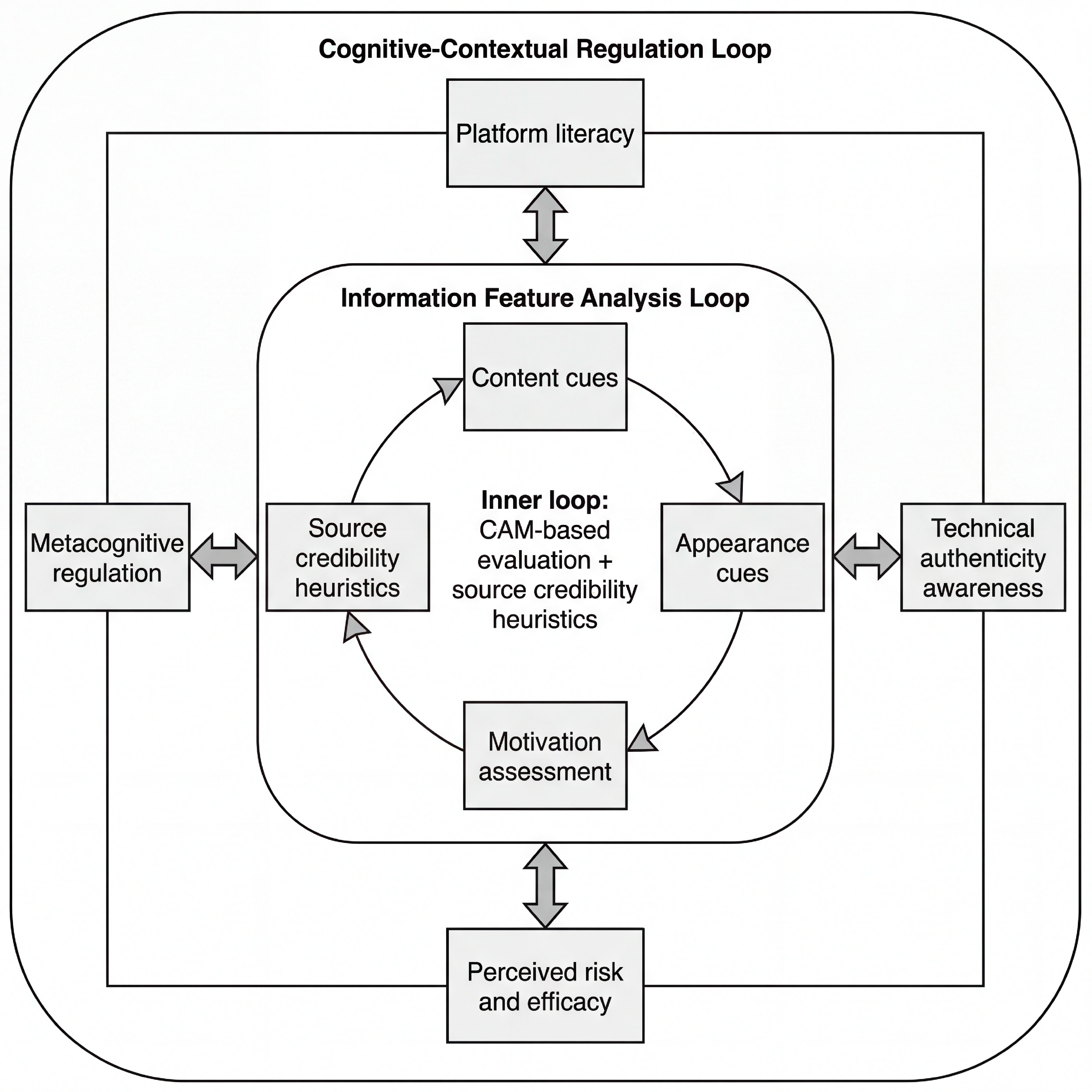
To better capture these dynamics, this study proposes a provisional Contextualized Dual-Loop Verification Model, which can be read not only as a framework for student evaluation but also as a way to conceptualise how audience-side verification processes relate to professional fact-checking workflows and platform-level governance of misinformation. In the inner Information Feature Analysis Loop, audiences apply CAM-style checks to content, appearance, and inferred motivation. In the outer Cognitive–Contextual Regulation Loop, four factors modulate when and how these checks are used: (1) platform literacy, (2) technical authenticity awareness, (3) perceived risk and efficacy and (4) metacognitive regulation. Figure 1 shows the contextualized dual-loop verification model. These factors directly address our research questions by highlighting new cognitive and contextual layers that shape how students verify information in an environment saturated with AI-generated content.

4.2.1. Platform Literacy

Platform literacy emerged as an important extension of the Content dimension, capturing how students use platform features to assess the trustworthiness of information. Students often relied on simple platform-based shortcuts, such as distrusting user-generated posts on Weibo or Reddit while placing more trust in “official” channels, to make quick decisions about reliability. However, this approach breaks down with AI-generated content, which can appear on any platform and imitate credible sources, blurring the line between personal and institutional content. Adding platform literacy, including an understanding of risks such as echo chambers, algorithmic bias, and cross-platform content flows, may strengthen the framework by recognizing how digital environments shape content evaluation (Gagrčin et al., 2024).

4.2.2. Technical Authenticity Awareness

In the Appearance dimension, technical authenticity awareness becomes crucial as AI-generated content weakens traditional visual warning signs. Students initially relied on quick visual judgments, such as noticing poor lighting or unrealistic movement in low-quality fakes, but these strategies proved ineffective against high-quality AI-generated content that closely matches professional media. Recent work on visual misinformation and digital media literacy similarly highlights reverse image search as one of the most effective practical methods for verifying out-of-context or manipulated visuals in social media news posts (Qian et al., 2023). This shift from passive looking to active investigation exposes a gap in the framework.

4.2.3. Perceived Risk and Efficacy

Perceived risk and efficacy help explain the transition from recognizing the creator’s motives to deciding how to respond within the Motivation dimension. Students often correctly identified deceptive aims, such as profit or attention-seeking, in clickbait-style AIGC, but they tended to see the main risks as affecting others (e.g., the elderly) rather than themselves, which contributed to low personal efficacy and inaction, such as simply swiping away doubtful content. This pattern is consistent with research showing that higher perceived severity and efficacy can motivate protective actions, but that effects vary across behaviours and contexts (Paciello et al., 2023; Rui et al., 2021). Bringing perceived risk and efficacy into the framework clarifies why detecting misinformation so rarely leads to engagement by foregrounding personal evaluations that shape whether students decide to act.

4.2.4. Metacognitive Regulation

Metacognitive regulation functioned as an overarching process that shaped how students applied CAM cues by monitoring their own thinking, including their knowledge limits and possible biases. Some participants adjusted their confidence appropriately, for example, by acknowledging when they lacked expertise, whereas others displayed overconfidence and relied on vague intuitions without further checking. This miscalibration increased their vulnerability to AI-generated content because unexamined judgments often stopped them from engaging in more careful analysis. Incorporating metacognitive regulation would allow the framework to reflect the evaluator’s self-awareness, shifting it from a static checklist to a more dynamic, reflective process.
The study revealed that participants demonstrated an emerging but still limited sense of metacognitive awareness. While they recognized the boundaries of their knowledge and the role of emotions in shaping judgment, many exhibited clear signs of overconfidence. This “metacognitive miscalibration” (Salovich & Rapp, 2021) can be especially problematic, as it discourages individuals from seeking additional verification. The interview data align with Greene and Murphy’s (2020) argument that analytical thinking is essential, and with Salovich and Rapp’s (2021) finding that metacognitive accuracy affects one’s ability to detect misinformation. For example, when a participant stated, “I just feel it’s fake,” the comment indicated a reliance on intuitive, possibly biased judgment rather than a carefully reasoned, analytical evaluation. Although some participants expressed strong confidence in their ability to identify false information, their explanations often lacked specificity and detail. This overconfidence is particularly concerning in an age of increasingly sophisticated AI-generated content, as it may reduce their motivation to verify information. These factors represent one provisional way to conceptualize the interactive layers of cognition and context that surround and inform the core acts of applying CAM, and they offer an initial explanatory account of why, in this small sample, students might correctly apply CAM yet remain vulnerable to AIGC or choose passive disengagement.

4.3. Implications for Educational Interventions: A Three-Pillar Framework

Based on the above results, the traditional model and traditional media literacy may be insufficient for identifying fake news. To address the identified gaps, we propose a three-pillar educational intervention framework that builds on the CAM model while integrating the four emergent factors. The framework is designed to cultivate resilient digital citizens by strengthening literacy skills, embedding relevant technical competencies, and nurturing reflective and metacognitive habits.

4.3.1. Pillar 1: Strengthening Foundational Literacy to Address Motivations and Bias

This pillar argues that education cannot stop at surface-level source assessment; it must explicitly teach motive analysis (such as “traffic attraction” or “emotional incitement” identified in our data) alongside how cognitive biases like confirmation bias are deliberately exploited by misinformation creators. Pennycook and Rand (2019) show that susceptibility to fake news is driven more by shallow or “lazy” reasoning than by partisan identity, underscoring the need to strengthen analytic engagement rather than treating bias as purely ideological. Complementing this, Kahan et al. (2017) find that science curiosity can buffer against motivated reasoning in polarized contexts, suggesting that fostering an active desire to seek disconfirming information may counteract bias-driven processing.
Building on these insights, interventions under this pillar could include case-based workshops where students analyze real AIGC examples, systematically mapping deceptive motives and tracing how these messages appeal to specific cognitive shortcuts. For instance, students could learn to categorize at least three common creator motivations while also identifying how particular biases make certain audiences especially receptive. A sample small-group activity might involve working with social media news posts to: (1) analyze and debate the primary motivation behind each post; (2) discuss which audience biases the post is likely to exploit and why it might seem persuasive; and (3) reflect on how their own biases could make them vulnerable to similar content.

4.3.2. Pillar 2: Embedding Technical Verification Skills and AI Literacy in the Curriculum

This pillar responds to the collapse of the Appearance dimension and the limited awareness of technical verification methods. Students’ quick, surface-level visual checks were largely ineffective against sophisticated AIGC, which highlights the need for proactive investigation skills such as reverse image search, basic metadata inspection, and artifact detection as core competencies that extend the Appearance dimension. Wineburg and McGrew (2019) show that expert fact-checkers rely on lateral reading rather than trusting on-page cues, a strategy that can be adapted to multimodal verification using tools like deepfake analyzers. Köbis et al. (2021) further demonstrate that people struggle to detect deepfakes, tend to misclassify them as authentic, and are overconfident in their weak performance, which shows the importance of structured guidance and confidence calibration in training.
In parallel, AI literacy focuses on understanding how generative systems work, which enables students to anticipate how content might be manipulated. Curriculum integration could involve hands-on “digital verification labs” that simulate AIGC-rich environments and train students to dismantle synthetic deceptions step by step. Some specific methodologies, such as Error Level Analysis (ELA), are used to assess manipulations in images originating from social media platforms like TikTok. The ELA technique allows experts to capture digital evidence effectively, which is crucial in a practical lab setting (Fauzi & Anwar, 2023).
To provide training to students, a lab activity could provide small groups with three to four images or short clips with a mix of authentic, edited, and AI-generated content. Students would apply reverse image search, conduct systematic visual inspections, and then prepare a concise verification report justifying their authenticity judgments while also articulating any remaining uncertainties.

4.3.3. Pillar 3: Cultivating Metacognitive Habits to Bridge the Identification-Action Gap

This pillar addresses the challenges of metacognitive regulation and perceived risk and efficacy. Many students “knew” what they should do but “did not act,” making metacognitive training central to closing the gap between recognizing questionable content and taking meaningful action. Interventions can include confidence calibration exercises in which students first rate their confidence in a credibility judgment, then compare their judgments with verified answers, followed by guided reflection prompts such as, “Did I reach this conclusion because it fit my expectations, or because I had solid evidence?” Drawing on dual-process perspectives, such activities encourage students to move from fast, intuitive responses to more deliberate, analytical evaluation (Salovich & Rapp, 2021).
Building on work that links metacognitive accuracy to improved detection of deceptive content, this pillar emphasizes structured opportunities for students to monitor, question, and revise their own thinking. Classroom activities can incorporate brief reflective journals on verification steps taken, as well as peer debriefs in which students explain how they evaluated specific posts and where they felt uncertain. Over time, these practices aim to reduce overconfidence and normalize the admission of “not knowing,” thereby strengthening self-regulatory habits that support more responsible engagement with AIGC.
The guidance for educators is to integrate explicit metacognitive components into misinformation-related tasks rather than treating them as optional add-ons. Students can be taught to use a simple confidence scale when making credibility judgments and to seek additional evidence when their confidence is low or their topic knowledge is limited. To address the passivity observed in both personal and societal responses, students may role-play different responses, such as ignoring, reporting, or correcting the content, and then discuss how risky and effective each case is. In higher education settings, this direction is consistent with evidence that closer collaboration between faculty and librarians by embedding focused, course-relevant instruction into existing modules, is effective (Tang, 2020). A key outcome is that students identify at least one low-risk, high-efficacy action they are willing to take when encountering unverified or suspicious information.

4.4. Implications for Journalism Practice

Beyond educational settings, the Dual-Loop Verification Model offers a practical framework for professional journalism. The outer-loop factors address the precise pressures journalists face when evaluating digital evidence. The integration of AI literacy and specialized verification tools into routine newsroom workflows may help organizations better align with emerging industry standards. In addition, the “action gap” identified in this research highlights a critical vulnerability in the newsroom. There is a tendency for production demands and high-pressure deadlines to result in truncated verification. In this context, technical skill alone is insufficient if the workflow does not account for the human element in decision-making. Newsrooms might adopt structured pre-publication verification audits. Such interventions encourage a more reflective, disciplined approach. This ensures that accuracy is not sacrificed for the sake of immediacy.

4.5. Limitations

The Contextualized Dual-Loop Verification Model and the Three-Pillar Educational Intervention Framework should be treated as tentative, hypothesis-generating propositions rather than established theories. The primary limitation of this study involves the significant heterogeneity within our interview sample. The six participants represent a wide range of educational levels and diverse disciplines, and their baseline digital literacy and familiarity with generative AI may vary. While this diversity provides a wide lens, it also means the findings may reflect individual personal backgrounds rather than broader, representative patterns. To refine these insights, future research should consider employing either a more homogeneous sample to isolate specific variables or a much larger, diverse group structured specifically for comparative analysis between different academic fields. Furthermore, incorporating quantitative large-scale surveys would be a valuable next step. The triangulation of our qualitative findings with quantitative data would help validate these observed behaviors and provide a more comprehensive and statistically robust understanding of the practices.

5. Conclusions

This study investigated how Hong Kong tertiary students detect fake news, with a focus on emerging cognitive behaviours and contextual factors in an AIGC-saturated environment. Using an exploratory qualitative design, we conducted in-depth interviews with six students to examine their real-world verification practices. The analysis shows that although students actively apply strategies consistent with the traditional Content–Appearance–Motivation (CAM) framework, encounters with sophisticated AIGC reveal critical vulnerabilities in both the model and their practices.
The contributions of this work are threefold, each addressing a gap identified in the introduction. First, the exploratory qualitative findings provide rich, nuanced evidence of students’ cognitive and behavioural processes. Key patterns include an over-reliance on quick surface cues that are easily fooled by AIGC, a persistent “action gap” where recognizing problematic content seldom leads to corrective action, and frequent miscalibration of confidence in their own judgments. These results move beyond speculation by pinpointing specific failure points in current literacy practices.
Second, we propose an extended framework to address the limitations of the existing CAM framework. This model posits that effective verification requires two interacting loops: a core Information Feature Analysis Loop (traditional CAM-style evaluation) and an outer Cognitive–Contextual Regulation Loop. The outer loop incorporates four key factors emerging from our data: platform literacy, awareness of technical verification methods, perceived risk and efficacy, and metacognitive regulation. This framework offers a more holistic lens for understanding verification behaviour in the age of AIGC.
Third, we articulate concrete educational implications through a Three-Pillar Educational Intervention Framework. This framework moves from diagnosis to prescription by advocating: (1) curricula that upgrade traditional literacy to explicitly teach motive analysis and bias recognition; (2) embedded development of practical technical verification skills and AI literacy; and (3) learning activities that cultivate metacognitive habits to bridge the identification–action gap. Each pillar is directly grounded in the specific gaps identified in our findings.
In conclusion, this study provides a timely and empirically grounded perspective on a pressing challenge in an AI-mediated environment. By bringing together exploratory evidence, a tentative theoretical model, and actionable educational strategies, it offers a coherent foundation for researchers, educators, and policymakers seeking to foster more resilient digital citizens. These findings suggest that combating AI-driven misinformation cannot rely solely on individual media literacy but must be supported by aligned efforts in journalism education and professional training. In particular, the dual-loop model and three-pillar framework can inform journalism curricula and newsroom training that integrate platform literacy, tool-based verification of AIGC, and explicit reflection on journalists’ own heuristics and confidence when judging contested content.

Author Contributions

Conceptualization, W.K.-W.T.; methodology, W.K.-W.T.; validation, W.K.-W.T., C.Y.-L.L., and A.Z.; formal analysis, W.K.-W.T., and A.Z.; investigation, A.Z.; writing—original draft preparation, A.Z.; writing—review and editing, W.K.-W.T., and C.Y.-L.L.; supervision, W.K.-W.T.; project administration, W.K.-W.T.; funding acquisition, W.K.-W.T. All authors have read and agreed to the published version of the manuscript.

Funding

This research was funded by the University Research Council, Hong Kong. Grant number: UGC/FDS16/H06/22.

Institutional Review Board Statement

This study was approved by the Institutional Review Board of Hong Kong Metropolitan University (Approval No: HE-RGC2022/EL02, Approval Date 24 February 2022).

Informed Consent Statement

Informed consent was obtained from all subjects involved in the study.

Data Availability Statement

Data can be made available on request to authors.

Acknowledgments

The work described in this paper was fully supported by a grant from the Research Grants Council of the Hong Kong Special Administrative Region, China, UGC/FDS16/H06/22.

Conflicts of Interest

The authors declare no conflicts of interest.

References

  1. Allcott, H., & Gentzkow, M. (2017). Social media and fake news in the 2016 election. Journal of Economic Perspectives, 31(2), 211–236. [Google Scholar] [CrossRef]
  2. Association of College & Research Libraries (ACRL). (2015). Framework for information literacy for higher education. American Library Association. [Google Scholar]
  3. Braun, V., & Clarke, V. (2006). Using thematic analysis in psychology. Qualitative Research in Psychology, 3(2), 77–101. [Google Scholar] [CrossRef]
  4. Braun, V., & Clarke, V. (2019). Reflecting on reflexive thematic analysis. Qualitative Research in Sport, Exercise and Health, 11(4), 589–597. [Google Scholar] [CrossRef]
  5. Chan, E., & Blundy, R. (2019, July 22). Fake news amplifies fear and confusion in Hong Kong. Hong Kong Free Press. Available online: https://hongkongfp.com/ (accessed on 4 May 2026).
  6. Chen, J., & Wang, Y. (2021). Social media use for health purposes: Systematic review. Journal of Medical Internet Research, 23(5), e17917. [Google Scholar] [CrossRef]
  7. Creswell, J. W., & Poth, C. N. (2016). Qualitative inquiry and research design: Choosing among five approaches. Sage publications. [Google Scholar]
  8. Cruz, M. J. (2020). Fake News & Desinformação: Estudo de caso numa instituição de ensino superior em Portugal [Master’s thesis, Instituto Politecnico de Viseu]. (In Portugal) [Google Scholar]
  9. Education Bureau. (2018). Information literacy for Hong Kong students. Hong Kong Special Administrative Region Government.
  10. Egelhofer, J. L., & Lecheler, S. (2019). Fake news as a two-dimensional phenomenon: A framework and research agenda. Annals of the International Communication Association, 43(2), 97–116. [Google Scholar] [CrossRef]
  11. Fauzi, R. N., & Anwar, N. (2023). Multimedia forensic analysis of tiktok application using national institute of justice (nij) method. Jurnal Ilmiah Teknik Elektro Komputer dan Informatika (JITEKI), 9(4), 1009–1023. [Google Scholar] [CrossRef]
  12. Ferreira, G. B., & Borges, S. (2020). Media and misinformation in times of COVID-19: How people informed themselves in the days following the Portuguese declaration of the state of emergency. Journalism and Media, 1(1), 108–121. [Google Scholar] [CrossRef]
  13. Gagrčin, E., Naab, T. K., & Grub, M. F. (2024). Algorithmic media use and algorithm literacy: An integrative literature review. New Media & Society, 28(1), 423–447. [Google Scholar] [CrossRef]
  14. Gelfert, A. (2018). Fake news: A definition. Informal Logic, 38(1), 84–117. [Google Scholar] [CrossRef]
  15. Greene, C. M., & Murphy, G. (2020). Individual differences in susceptibility to false memories for COVID-19 fake news. Cognitive Research: Principles and Implications, 5(1), 63. [Google Scholar] [CrossRef]
  16. Guest, G., Bunce, A., & Johnson, L. (2006). How many interviews are enough? An experiment with data saturation and variability. Field Methods, 18(1), 59–82. [Google Scholar] [CrossRef]
  17. Jaidka, K., Chen, T., Chesterman, S., Hsu, W., Kan, M. Y., Kankanhalli, M., & Yue, A. (2025). Misinformation, disinformation, and generative AI: Implications for perception and policy. Digital Government: Research and Practice, 6(1), 1–15. [Google Scholar] [CrossRef]
  18. Kahan, D. M., Landrum, A., Carpenter, K., Helft, L., & Hall Jamieson, K. (2017). Science curiosity and political information processing. Political Psychology, 38, 179–199. [Google Scholar] [CrossRef]
  19. Klein, D., & Wueller, J. R. (2017). Fake news: A legal perspective. Journal of Internet Law, 20(10), 6–13. [Google Scholar]
  20. Köbis, N., Doležalová, B., & Soraperra, I. (2021). Fooled twice: People cannot detect deepfakes but think they can. iScience, 24(11), 103364. [Google Scholar] [CrossRef]
  21. Malterud, K., Siersma, V. D., & Guassora, A. D. (2016). Sample size in qualitative interview studies: Guided by information power. Qualitative Health Research, 26(13), 1753–1760. [Google Scholar] [CrossRef]
  22. Molina, M. D., Sundar, S. S., Le, T., & Lee, D. (2021). “Fake News” is not simply false information: A concept explication and taxonomy of online content. American Behavioral Scientist, 65(2), 180–212. [Google Scholar] [CrossRef]
  23. Osman, M. (2024). Public evaluations of misinformation and motives for sharing it. Journalism and Media, 5(2), 766–786. [Google Scholar] [CrossRef]
  24. Paciello, M., Corbelli, G., & D’Errico, F. (2023). The role of self-efficacy beliefs in dealing with misinformation among adolescents. Frontiers in Psychology, 14, 1155280. [Google Scholar] [CrossRef] [PubMed]
  25. Paris, B., & Donovan, J. (2019). Deepfakes and cheap fakes. Data & Society. Available online: https://datasociety.net/wp-content/uploads/2019/09/DataSociety_Deepfakes_Cheap_Fakes.pdf (accessed on 4 May 2026).
  26. Paschen, J. (2020). Investigating the emotional appeal of fake news using artificial intelligence and human contribution. Journal of Product and Brand Management, 29(2), 223–233. [Google Scholar] [CrossRef]
  27. Pennycook, G., & Rand, D. G. (2019). Lazy, not biased: Susceptibility to partisan fake news is better explained by lack of reasoning than by motivated reasoning. Cognition, 188, 39–50. [Google Scholar] [CrossRef]
  28. Qian, S., Shen, C., & Zhang, J. (2023). Fighting cheapfakes: Using a digital media literacy intervention to motivate reverse search of out-of-context visual misinformation. Journal of Computer-Mediated Communication, 28(1), zmac024. [Google Scholar] [CrossRef]
  29. Rui, J. R., Yang, K., & Chen, J. (2021). Information sources, risk perception, and efficacy appraisal’s prediction of engagement in protective behaviors against COVID-19 in China: Repeated cross-sectional survey. JMIR Human Factors, 8(1), e23232. [Google Scholar] [CrossRef]
  30. Salovich, N. A., & Rapp, D. N. (2021). Misinformed and unaware? Metacognition and the influence of inaccurate information. Journal of Experimental Psychology: Learning, Memory, and Cognition, 47(7), 608–624. [Google Scholar] [CrossRef] [PubMed]
  31. Sumayyia, M. D., Al-Madaney, M. M., & Almousawi, F. H. (2019). Health information on social media. Perceptions, attitudes, and practices of patients and their companions. Saudi Medical Journal, 40(12), 1294–1298. [Google Scholar] [CrossRef]
  32. Tandoc, E. C., Jr., Lim, Z. W., & Ling, R. (2018). Defining “fake news”: A typology of scholarly definitions. Digital Journalism, 6(2), 137–153. [Google Scholar] [CrossRef]
  33. Tang, W. K. W. (2018). Assessing information literacy skills of undergraduate freshmen: A case study from Hong Kong. International Journal of Media and Information Literacy, 3(1), 11–17. [Google Scholar] [CrossRef]
  34. Tang, W. K. W. (2020). One plus one is greater than two: Faculty-librarian collaboration for developing information literacy in higher education. IAFOR Journal of Literature and Librarianship, 9(2), 82–86. [Google Scholar] [CrossRef]
  35. Vosoughi, S., Roy, D., & Aral, S. (2018). The spread of true and false news online. Science, 359(6380), 1146–1151. [Google Scholar] [CrossRef] [PubMed]
  36. Wardle, C. (2017). Fake news. It’s complicated. First Draft. Available online: https://firstdraftnews.org/articles/fake-news-complicated/ (accessed on 4 May 2026).
  37. Wardle, C., & Derakhshan, H. (2017). Information disorder: Toward an interdisciplinary framework for research and policymaking. Council of Europe. [Google Scholar]
  38. Wineburg, S., & McGrew, S. (2019). Lateral reading and the nature of expertise: Reading less and learning more when evaluating digital information. Teachers College Record, 121(11), 1–40. [Google Scholar] [CrossRef]
  39. Wong, J. M. S., & Wong, S. M. F. (2024). A struggle of identification: Hong Kong pre-service teachers’ perceived dilemma of introducing ‘national education’in preschools. Compare: A Journal of Comparative and International Education, 54(2), 241–258. [Google Scholar] [CrossRef]
Figure 1. Contextualized Dual-Loop Verification Model for Evaluating Fake News and AI-Generated Content.
Journalmedia 07 00109 g001
Table 1. Respondents’ demographics.
Respondent NumberAgeEducationDiscipline
126MasterSocial Sciences
226PhDComputer Science
323MAVisual Arts Education
426BAEconomics
518BABiology
633EdDEducation
Table 2. Overview of the cases.
IDFake/RealBrief DescriptionPlatform/FormatAI-Generated Content
1Fake“Deep-fried ice
cubes” viral video
Short-video platform (Reels)Yes (AIGC video)
2FakeFabricated TIME magazine cover
using real photo
Image shared via
social media
Yes (AI/edited)
3FakeAlleged avian flu outbreak news storyOnline news article screenshotUnclear/mixed
4FakeProtest footage with uncertain originShort video on social mediaPossible AIGC/edit
5FakeControversial post about the moon-landing hoaxOpinion piece/
social post
No (text, image)
6RealPokémon Go launch and public safety
issues
Local news article (Hong Kong)No
7RealTai Mo Shan
freezing weather and rescue
operation
Local news article (Hong Kong)No
8RealConvenience store stabbing case in Yau Ma TeiLocal crime news
article
No
9RealSamsung Note recall and safety warningsConsumer council news releaseNo
10RealChou Tzu-yu “flag” controversy and cross-strait rowEntertainment
/political news
No
Disclaimer/Publisher’s Note: The statements, opinions and data contained in all publications are solely those of the individual author(s) and contributor(s) and not of MDPI and/or the editor(s). MDPI and/or the editor(s) disclaim responsibility for any injury to people or property resulting from any ideas, methods, instructions or products referred to in the content.