

“Somebody Get Me Some Prozac!”: Trivializing Language and the Stigma of Drug Brand Names


Abstract
1. Introduction
2. Literature Review
2.1. Background on SSRIs and Mental Illness in Media
2.2. Stigma and Trivialization
- R1: Do the mentions of SSRIs in passing trivialize and/or stigmatize Prozac and other SSRIs?
- R2: How does this newspaper content construct a picture of the overall beliefs, assumptions or ideologies about SSRIs and antidepressant treatment in society?
3. Materials and Methods
3.1. Sampling Strategy
3.2. Data Analysis
4. Results
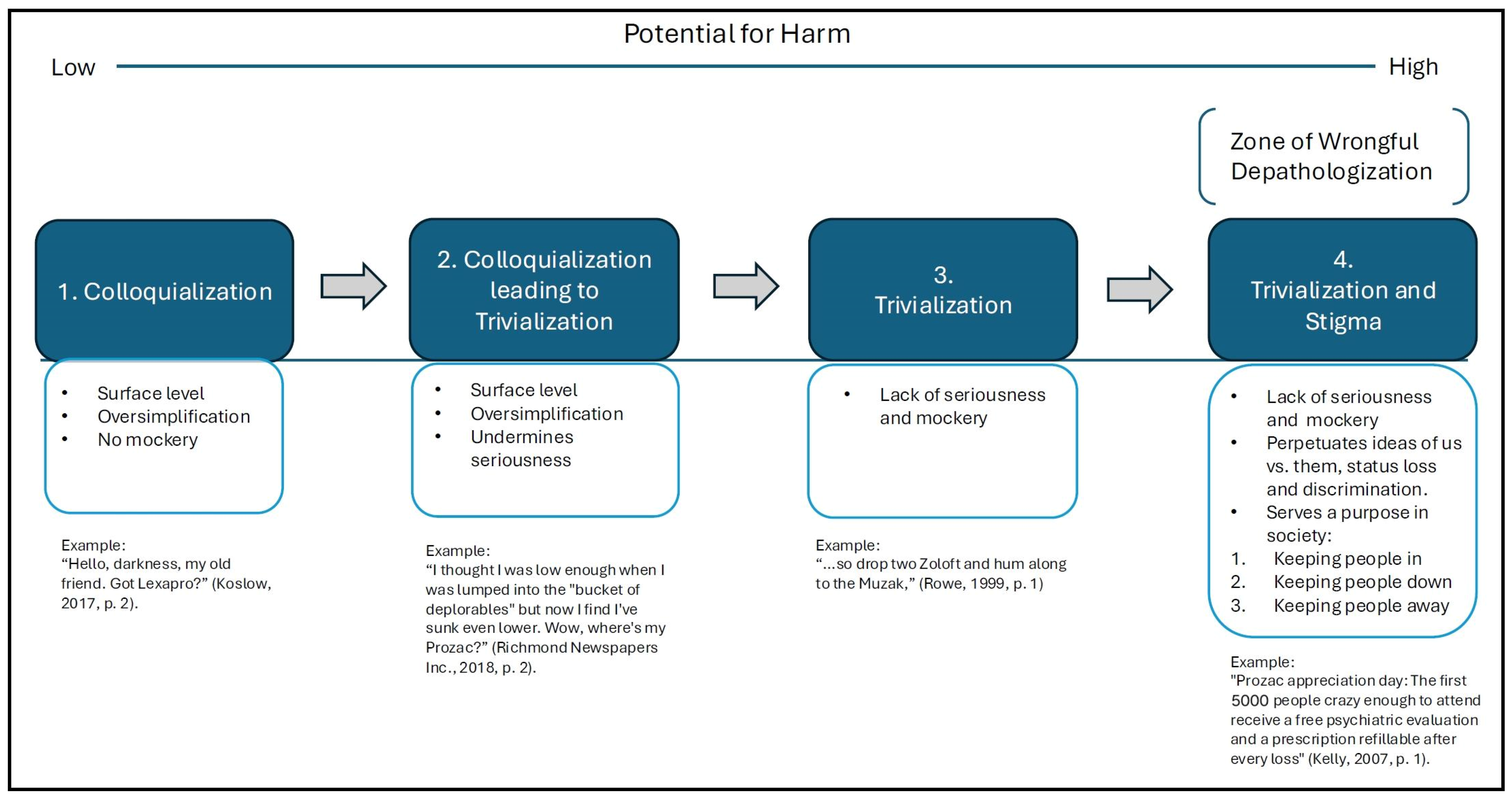
4.1. Colloquialization
4.2. Colloquialization Leading to Trivialization
4.3. Trivialization
4.4. Trivialization and Stigma
5. Discussion
6. Conclusions
7. Limitations and Future Research
Author Contributions
Funding
Institutional Review Board Statement
Informed Consent Statement
Data Availability Statement
Acknowledgments
Conflicts of Interest
References
- An, M. H., Kim, M. G., Kim, J., Chang, S., Lee, D. Y., & Park, R. W. (2025). Public perception and changing attitudes toward antidepressants over a decade in social media: Lessons learned from online discussion using artificial intelligence. PLoS ONE, 20(9), e0318464. [Google Scholar] [CrossRef] [Scilit] [PubMed]
- Babbie, E. (2007). The practice of social research. Thomson Wadsworth. [Google Scholar]
- Bay Area News Group. (2009, October 9). The eye on the east bay. Contra Costa Times.
- Bødker, H. (2015). Journalism as cultures of circulation. Digital Journalism, 3(1), 101–115. [Google Scholar] [CrossRef] [Scilit]
- Brantley, B. (2004, March 27). It’s springtime for Dresden in a bubbly era of inhibition. The New York Times. Section B, Column 1. p. 7.
- Brennen, B. S. (2025). Qualitative research methods for media studies. Routledge. Available online: https://www.routledge.com/Qualitative-Research-Methods-for-Media-Studies/Brennen/p/book/9781032600710 (accessed on 5 March 2026).
- Buchwald, A. (1999, December 2). A sport that’s all the rage. The Washington Post. C02.
- Chart-Pascual, J. P., Goena, J., Lara, F., Torres, M. M., Napal, J. M., Muñoz, R., Montero, C. G., Martínez, O. F., Ortega, M. Á., de Pablo, G. S., Pinto, A. G., Quintero, J., Alvarez-Mon, M., & Álvarez-Mon, M. Á. (2025). Understanding social media discourse on antidepressants: Unsupervised and sentiment analysis using X. European Psychiatry, 68(1), e51. [Google Scholar] [CrossRef] [Scilit] [PubMed]
- Dolbee, S. (2001, June 26). Got hope? It’s closer than you think; just look inside. The San Diego Union-Tribune. E1.
- Du Gay, P., Hall, S., Janes, L., Mackay, H., & Negus, K. (1997). Doing cultural studies: The story of the Sony Walkman. Sage Publications. [Google Scholar]
- Elliott, D. (2002, August 1). Alien, get thee behind me!; All the ‘Signs’ say this one’s a stinker. The San Diego Union-Tribune. p. 11.
- Fisher, M. J. (2010, November 26). Frumpy middle-aged mom: No officer, that’s not my child. Deseret Morning News.
- Freudenheim, M. (1994, January 9). The drug makers are listening to Prozac. The New York Times. Available online: https://www.nytimes.com/1994/01/09/business/the-drug-makers-are-listening-to-prozac.html (accessed on 2 February 2020).
- Friedman, L. (2006, December 4). The icing is off the cupcake. The News and Observer.
- Gates, A. (1995, September 10). So many events, so little time. The New York Times. Section 2, Column 1. p. 53.
- Goldman, H. H., & Grob, G. N. (2006). Defining “mental illness” in mental health policy. Health Affairs, 25(3), 737–749. [Google Scholar] [CrossRef] [Scilit] [PubMed]
- Green, J. (2018, March 2). A new Evan brings a new balance. The New York Times. Section C, Column O. p. 4.
- Gwarjanski, A. R., & Parrott, S. (2018). Schizophrenia in the news: The role of news frames in shaping online reader dialogue about mental illness. Health Communication, 33(8), 954–961. [Google Scholar] [CrossRef] [Scilit]
- Hall, S. (1993). Encoding/decoding. In S. During (Ed.), The cultural studies reader (pp. 90–103). Routledge. (Original work published 1977). [Google Scholar]
- Hanauer, C. (2024, June 18). A hot, fraught, cape cod family drama; fiction. The New York Times.
- Hanes, L. (2010, October 17). Gifts for the broken hearted. The New York Times. Section ST; Column 0; Style Desk. p. 8.
- Harris, M., Harrington, S., & Harrington, A. (2021, September 12). Time of our lives. The New York Times. Section M2, Column 0. p. 93.
- Healy, D. (1997). The antidepressant era. Harvard University Press. [Google Scholar]
- Healy, D. (2003). Let them eat Prozac. James Lorimer & Company Ltd., Publishers. [Google Scholar]
- Hunter, S. (2004, August 24). ‘Little black book’; Way too much face time. The Washington Post. C05.
- Jenkins, S. (2002, May 12). Tyson’s foul mouth is a window to his soul. The Washington Post. D06.
- Kekatos, M. (2025, February 20). Trump, RFK Jr. go after antidepressants, weight loss drugs. Here’s what the science says. Available online: https://abcnews.go.com/Health/rfk-jr-studying-threat-ssris-weight-loss-drugs/story?id=118937552 (accessed on 10 September 2025).
- Kelly, J. (2007, September 14). U-M worse off by a Carr-length. South Bend Tribune. C1.
- Kempley, R. (2000, January 12). Buried alive in the blues; ‘Girl, Interrupted’ resurrects the disturbed ‘60s. The Washington Post. C01.
- Koslow, S. (2017, August 5). Hire women your mom’s age. The New York Times.
- Kuppin, S. (2006). The drug we love to hate: Prozac and representations of medication to treat depression in American newspapers, 1993–2003 [Doctoral dissertation, University of Pennsylvania]. (Order No. 3215163). ProQuest Central; ProQuest Dissertations & Theses Global. (305359783). Available online: https://www.proquest.com/dissertations-theses/drug-we-love-hate-prozac-representations/docview/305359783/se-2 (accessed on 10 October 2025).
- Lindlof, T. R., & Taylor, B. C. (2011). Qualitative communication research methods (3rd ed.). SAGE Publications. [Google Scholar]
- Link, B. G., & Phelan, J. C. (2001). Conceptualizing stigma. Annual Review of Sociology, 27, 363–385. [Google Scholar] [CrossRef] [Scilit]
- Ma, Z. (2017). How the media cover mental illnesses: A review. Health Education, 117(1), 90–109. [Google Scholar] [CrossRef] [Scilit]
- McNally, R. (2011). What is mental illness? The Belknap Press of Harvard University Press. [Google Scholar]
- Murphy, B. (2024, December 4). Lance morrow, Time magazine essayist of history and infamy, dies at 85. Lewiston Sun Journal.
- NAMI. (2021, July 19). Criminalization of people with mental illness. Available online: https://www.nami.org/advocacy-at-nami/policy-positions/stopping-harmful-practices/criminalization-of-people-with-mental-illness/ (accessed on 9 August 2025).
- Newsweek Staff. (1956, May 25). Pills vs. worry: How goes the frantic quest for calm in frantic lives? Newsweek. pp. 68–70.
- Pakulski, G. (2010, December 23). Tale of loss became love story to cherish. The Blade. [Google Scholar]
- Park, R. (1940). News as a form of knowledge: A chapter in the sociology of knowledge. The American Journal of Sociology, 45(5), 669–686. [Google Scholar] [CrossRef] [Scilit]
- Parrott, S., & Eckhart, N. (2021). Stigma in the news: The representation and trivialization of stigma in US news publications. Health Communication, 36(4), 440–447. [Google Scholar] [CrossRef] [Scilit] [PubMed]
- Pavelko, R., & Myrick, J. G. (2016). Tweeting and Trivializing. Imagination, Cognition and Personality, 36(1), 41–63. [Google Scholar] [CrossRef] [Scilit]
- Pavelko, R. L., & Myrick, J. G. (2020). Measuring trivialization of mental illness: Developing a scale of perceptions that mental illness symptoms are beneficial. Health Communication, 35(5), 576–584. [Google Scholar] [CrossRef] [Scilit] [PubMed]
- Peterson, K. (2002, November 14). Somebody get me some Prozac! Despite strong start, Pearl Jam’s ‘Riot Act’ is ultimately a downer. The San Diego Union-Tribune. 19.
- Phelan, J. C., Link, B. G., & Dovidio, J. F. (2008). Stigma and prejudice: One animal or two? Social Science and Medicine, 67, 358–367. [Google Scholar] [CrossRef] [Scilit] [PubMed]
- Plotnikoff, D. (1998, October 19). The internet, the web, the difference. St. Louis Post-Dispatch. p. 46.
- Richmond Newspapers Inc. (2018, November 24). Letters to the Editor; Remembering the founder of ‘Battle of the Brains’. Richmond Times Dispatch. 12A.
- Robinson, P., Turk, D., Jilka, S., & Cella, M. (2019). Measuring attitudes towards mental health using social media: Investigating stigma and trivialisation. Social Psychiatry and Psychiatric Epidemiology, 54(1), 51–58. [Google Scholar] [CrossRef] [Scilit] [PubMed]
- Rowe, P. (1999, October 3). Press 10 if you think Chargers’ ticket deal stinks. The San Diego Union-Tribune. D1.
- Rudd, L. (2000, April 24). Savannah morning news, GA., streetwise column. Savannah Morning News.
- San Diego Union Tribune. (1997, December 13). Sweeney accused of sexual harassment. The San Diego Union Tribune. D5.
- Sanger-Katz, M., & Parlapiano, A. (2023, September 8). Surprise medicare fact: It’s costing less than expected. The New York Times. A0. p. 14.
- Sharpe, K. (2012). Coming of age on Zoloft. Harper Perennial. [Google Scholar]
- Shorter, E. (1997). A history of psychiatry. John Wiley & Sons, Inc. [Google Scholar]
- Slater, L. (2018). Blue dreams. Little, Brown and Company. [Google Scholar]
- Smardon, R. (2007). ‘I’d rather not take Prozac’: Stigma and commodification in antidepressant consumer narratives. Health: An Interdisciplinary Journal for the Social Study of Health, Illness and Medicine, 12(1), 67–86. [Google Scholar] [CrossRef] [Scilit] [PubMed]
- Souhan, J. (2023, October 3). Are Twins or Vikings more cursed? Star Tribune. 3C.
- Speaker, S. (1992). Too many pills: Patients, physicians, and the myth of overmedication in America, 1955–1980 [Doctoral dissertation, University of Pennsylvania]. ProQuest Dissertations & Theses Global. [Google Scholar]
- Spencer, L., & Carel, H. (2021). Isn’t everyone a little OCD? Philosophy of Medicine, 2(1), 1–18. [Google Scholar] [CrossRef] [Scilit]
- Stafford, R. S., MacDonald, E. A., & Finkelstein, S. N. (2001). National patterns of medication treatment for depression, 1987 to 2001. Primary Care Companion to the Journal of Clinical Psychiatry, 3(6), 232–235. [Google Scholar] [CrossRef] [Scilit] [PubMed]
- Stossel, S. (2014). My age of anxiety. Alfred A. Knopf. [Google Scholar]
- Stout, P. A., Villegas, J., & Jennings, N. A. (2004). Images of mental illness in the media: Identifying gaps in the research. Schizophrenia Bulletin, 30(3), 543–561. [Google Scholar] [CrossRef] [Scilit] [PubMed]
- The Atlanta Journal-Constitution (AJC). (2007, February 28). Gwinnett vent. The Atlanta Journal-Constitution. p. 2J.
- Thompson. (2019, August 16). Music meets hungry heart in ‘Blinded’. The Philadelphia Inquirer. W2.
- Tribune-Review Publishing Company. (2020, January 27). Bolton’s claims scramble impeachment trial as Trump lawyers resume their defense. Tribune Review.
- Trigaux, R. (2001, February 2). St. Petersburg Times, Fla., Robert Trigaux column. St Petersburg Times. 1.
- Trigaux, R. (2002, April 26). St. Petersburg Times, Fla., Robert Trigaux column. St Petersburg Times. 1.
- Tuller, D. (2004, October 10). Why do Americans take so many pills? It may have more to do with business than science. The Washington Post. T04-05.
- University Wire. (2018, January 15). Fantz in your pants: Who’s lazy here? Colorado Daily. p. 1.
- Weston, A. (2018, September 26). Alonzo Weston: The sights, sounds and smell of fall. St. Joseph News-Press.
- Whitaker, R. (2010). Anatomy of an epidemic. Crown Publishers. [Google Scholar]
- Wilkes-Barre Times Leader. (2002, July 8). SAYSO. Wilkes Barre Times Leader. p. 14a.
- Williams, R. (1977). Marxism and literature. Oxford University Press. [Google Scholar]

Disclaimer/Publisher’s Note: The statements, opinions and data contained in all publications are solely those of the individual author(s) and contributor(s) and not of MDPI and/or the editor(s). MDPI and/or the editor(s) disclaim responsibility for any injury to people or property resulting from any ideas, methods, instructions or products referred to in the content. |
© 2026 by the authors. Licensee MDPI, Basel, Switzerland. This article is an open access article distributed under the terms and conditions of the Creative Commons Attribution (CC BY) license.
Share and Cite
Walker, T.; Amendola, C. “Somebody Get Me Some Prozac!”: Trivializing Language and the Stigma of Drug Brand Names. Journal. Media 2026, 7, 63. https://doi.org/10.3390/journalmedia7010063
Walker T, Amendola C. “Somebody Get Me Some Prozac!”: Trivializing Language and the Stigma of Drug Brand Names. Journalism and Media. 2026; 7(1):63. https://doi.org/10.3390/journalmedia7010063
Chicago/Turabian StyleWalker, Tara, and Conor Amendola. 2026. "“Somebody Get Me Some Prozac!”: Trivializing Language and the Stigma of Drug Brand Names" Journalism and Media 7, no. 1: 63. https://doi.org/10.3390/journalmedia7010063
APA StyleWalker, T., & Amendola, C. (2026). “Somebody Get Me Some Prozac!”: Trivializing Language and the Stigma of Drug Brand Names. Journalism and Media, 7(1), 63. https://doi.org/10.3390/journalmedia7010063