
Generative AI and the New Landscape of Automated Journalism: A Systematized Review of 185 Studies (2012–2024)


Abstract
1. Introduction
2. Literature Review
2.1. Early Automation
2.2. AI and Automated Journalism
2.3. Generative AI
2.4. Systematically Reviewing Automated Journalism Scholarship
- RQ1
- What patterns arise from an updated and expanded systematic retrieval of peer-reviewed automated journalism scholarship?
- RQ2
- How does an expanded and more nuanced selection of key search terms impact the results?
- RQ3
- What theoretical and conceptual frameworks are most prominent when a systematic review is expanded beyond empirical studies?
3. Methods
3.1. Search Strategy
3.1.1. Inclusion Criteria
3.1.2. Databases
3.1.3. Search Terms
- automat* nX (journalis* OR news).
- algorithm nX (journalis* OR news).
- AI AND (journalis* OR news).
- “artificial intelligence” AND (journalis* OR news).
- computational journalis*.
- robot journalis*.
- machine journalis*.
(automat* n5 (journalis* OR news)) OR (algorithm n6 (journalis* OR news)) OR (AI AND (journalis* OR news)) OR (“artificial intelligence” AND (journalis* OR news)) OR computational journalis* OR robot journalis* OR machine journalis*)
3.2. Data Collection
3.3. Data Analysis
4. Results
4.1. Patterns Arising from an Updated and Expanded Review (RQ1)
4.1.1. Study Tags and Types
4.1.2. Publication Dates and Journals
4.1.3. Keywords
4.1.4. Authors
4.1.5. Regions of Study
4.1.6. Research Methods and Tools
4.2. Expanded Selection of Search Terms (RQ2)
4.3. Theories, Concepts and Frameworks (RQ3)
5. Discussion
5.1. Exponential Growth
5.2. Lack of Consensus and Conceptual Clarity
5.3. A Call for Common Language and Future Research
6. Conclusions
Author Contributions
Funding
Institutional Review Board Statement
Informed Consent Statement
Data Availability Statement
Acknowledgments
Conflicts of Interest
Appendix A. Full List of Included Articles

| Studies Tagged as Fully About Automated Journalism (n = 130) | |||||||
|---|---|---|---|---|---|---|---|
| Study | Title | Author | Country | Year | Journal | Study Type | |
| 1 | (Ambeth Kumar, 2019) | Efficient daily news platform generation using natural language processing | Ambeth Kumar VD, Thirulokachander VR | India, India | 2019 | International Journal of Information Technology (Singapore) | Applied |
| 2 | (Ayapova, 2022) | AI and Human Created Media Texts: Experiment Results. | Ayapova S M, Skripnikova A I | Kazakhstan, Kazakhstan | 2022 | Herald of Journalism/Жyphaлиctиka cepияcы | Empirical |
| 3 | (Aydin, 2024) | Can Artificial Intelligence Write News: A Research on Determining The Effect of Artificial Intelligence on News Writing Practice. | Aydin B, İnce M | Turkey, Turkey | 2024 | Intermedia International e-Journal | Empirical |
| 4 | (Baptista, 2024) | Are Journalists no Longer Needed? Comparative Analysis of the Perceived Quality of Real News and ChatGPT News | Baptista JP, Gradim A | Portugal, Portugal | 2024 | Conference Proceedings | Empirical |
| 5 | (Barrolleta, 2024) | Artificial intelligence versus journalists: The quality of automated news and bias by authorship using a Turing test | Barrolleta LJ, Sandoval-Martín T | Spain, Spain | 2024 | Analisi | Empirical |
| 6 | (Blankespoor, 2018) | Capital market effects of media synthesis and dissemination: evidence from robo-journalism | Blankespoor E, deHaan E, Zhu C | United States, United States, United States | 2018 | Review of Accounting Studies | Empirical, Analytical, Applied |
| 7 | (Canavilhas, 2022) | Artificial Intelligence and Journalism: Current Situation and Expectations in the Portuguese Sports Media | Canavilhas J | Portugal | 2022 | Journalism and Media | Empirical |
| 8 | (Carlson, 2015) | The Robotic Reporter: Automated journalism and the redefinition of labor, compositional forms, and journalistic authority | Carlson M | United States | 2015 | Digital Journalism | Empirical, Conceptual |
| 9 | (Caswell, 2018) | Automated Journalism 2.0: Event-driven narratives: From simple descriptions to real stories | Caswell D, Dörr KN | United Kingdom, Switzerland | 2018 | Journalism Practice | Applied |
| 10 | (Caswell, 2019a) | Structured Journalism and the Semantic Units of News | Caswell D | United Kingdom | 2019 | Digital Journalism | Conceptual, Applied |
| 11 | (Caswell, 2019b) | Automating Complex News Stories by Capturing News Events as Data. | Caswell D, Dörr KN | United Kingdom, Switzerland | 2019 | Journalism Practice | Conceptual |
| 12 | (Cheng, 2024) | SNIL: Generating Sports News From Insights With Large Language Models | Cheng L, Deng D, Xie X, Qiu R, Xu M, Wu Y | China, China, China, China, China, China | 2024 | IEEE Transactions on Visualization and Computer Graphics | Applied, Empirical |
| 13 | (Clerwall, 2014) | Enter the Robot Journalist: Users’ perceptions of automated content | Clerwall C | Sweden | 2014 | Journalism Practice | Empirical |
| 14 | (Cloudy, 2023) | The Str(AI)ght Scoop: Artificial Intelligence Cues Reduce Perceptions of Hostile Media Bias | Cloudy J, Banks J, Bowman ND | United States, United States, United States | 2023 | Digital Journalism | Empirical |
| 15 | (Cools, 2024a) | News Automation and Algorithmic Transparency in the Newsroom: The Case of the Washington Post | Cools H, Koliska M | The Netherlands, United States | 2024 | Journalism Studies | Empirical |
| 16 | (Dangovski, 2021) | We Can Explain Your Research in Layman’s Terms: Towards Automating Science Journalism at Scale | Dangovski R, Shen M, Byrd D, Jing L, Tsvetkova D Nakov P, Soljacic M | United States, United States, United States, United States, Bulgaria, Qatar, United States | 2021 | Conference Proceedings | Empirical |
| 17 | (Danzon-Chambaud, 2021) | A systematic review of automated journalism scholarship: Guidelines and suggestions for future research | Danzon-Chambaud S | Ireland | 2021 | Open Research Europe | Analytical |
| 18 | (Danzon-Chambaud, 2023a) | Changing or Reinforcing the “Rules of the Game”: A Field Theory Perspective on the Impacts of Automated Journalism on Media Practitioners | Danzon-Chambaud S, Cornia A | Ireland, Ireland | 2023 | Journalism Practice | Conceptual |
| 19 | (Danzon-Chambaud, 2023b) | Automated news in practice: a cross-national exploratory study | Danzon-Chambaud S | Ireland | 2023 | Open Research Europe | Analytical, Empirical |
| 20 | (Danzon-Chambaud, 2024) | The cultural capital you need to work with automated news: Not only ‘your beautiful piece of work’ but also ‘patterns that emerge’ | Danzon-Chambaud S, Cornia A | Ireland, Ireland | 2024 | Journalism | Empirical |
| 21 | (Diakopoulos, 2017) | Algorithmic Transparency in the News Media | Diakopoulos N, Koliska M | United States, United States | 2017 | Digital Journalism | Empirical |
| 22 | (Díaz-Noci, 2020) | Artificial Intelligence Systems-Aided News and Copyright: Assessing Legal Implications for Journalism Practices | Díaz-Noci J | Spain | 2020 | Future Internet | Analytical |
| 23 | (Dierickx, 2018) | Between fear and confidence: The dual relationship between journalists and news automation | Dierickx L | Belgium | 2018 | Journal of Applied Linguistics and Professional Practice | Analytical |
| 24 | (Dierickx, 2020) | The social construction of news automation and the user experience. | Dierickx L | Belgium | 2020 | Brazilian Journalism Research | Empirical |
| 25 | (Dierickx, 2023) | News automation, materialities, and the remix of an editorial process | Dierickx L | Belgium | 2023 | Journalism | Conceptual |
| 26 | (Dörr, 2016) | Mapping the field of Algorithmic Journalism | Dörr KN | Switzerland | 2016 | Digital Journalism | Empirical, Conceptual |
| 27 | (Dörr, 2017) | Ethical Challenges of Algorithmic Journalism | Dörr KN, Hollnbuchner K | Switzerland, Switzerland | 2017 | Digital Journalism | Conceptual |
| 28 | (Duncan, 2024) | Attitudes to automated and human written sport journalism | Duncan S, Kunert J, Karg A | Australia, Germany, Australia | 2024 | Journalism | Empirical |
| 29 | (Ekşioğlu, 2019) | Robot Journalist or Human Journalist?: An Analysis is Over News Articles | Ekşioğlu NBS | Turkey | 2019 | Conference Proceedings | Empirical |
| 30 | (Galily, 2018) | Artificial intelligence and sports journalism: Is it a sweeping change? | Galily Y | Israel | 2018 | Technology in Society | Conceptual |
| 31 | (Gavurova, 2024) | An information-analytical system for assessing the level of automated news content according to the population structure—A platform for media literacy system development | Gavurova B, Skare M, Hynek N, Moravec V, Polishchuk V | Czech, Czech, Czech, Czech, Ukraine | 2024 | Technological Forecasting and Social Change | Applied, Empirical |
| 32 | (Ghosh, 2022) | SpecTextor: End-to-End Attention-based Mechanism for Dense Text Generation in Sports Journalism | Ghosh I, Ivler M, Ramamurthy SR, Roy N | United States, United States, United States, United States | 2022 | Conference Proceedings | Applied |
| 33 | (González-Arias, 2024) | The anthropomorphic pursuit of AI-generated journalistic texts: limits to expressing subjectivity | González-Arias C, Chatzikoumi E, López García | Spain, Chile, Spain | 2024 | Frontiers in Communication | Empirical |
| 34 | (Gotmare, 2024) | A multimodal machine learning approach to generate news articles from geo-tagged images | Gotmare A, Thite G, Bewoor L | India, India, India | 2024 | International Journal of Electrical and Computer Engineering | Applied |
| 35 | (Govindaraju, 2021) | Classifying Fake and Real Neurally Generated News | Govindaraju A, Griffith J | Ireland, Ireland | 2021 | Conference Proceedings | Applied |
| 36 | (Graefe, 2018) | Readers’ perception of computer-generated news: Credibility, expertise, and readability | Graefe A, Haim M, Haarmann B, Brosius H-B | Germany, Germany, Germany, Germany | 2018 | Journalism | Empirical |
| 37 | (Graefe, 2020) | Automated Journalism: A Meta-Analysis of Readers’ Perceptions of Human-Written in Comparison to Automated News. | Graefe A, Bohlken N | Germany, Germany | 2020 | Media and Communication | Analytical |
| 38 | (Haapanen, 2020) | Recycling a genre for news automation: The production of Valtteri the Election Bot | Haapanen L, Leppänen L | Finland, Finland | 2020 | AILA Review | Applied, Empirical |
| 39 | (Haim, 2017) | Automated News: Better than expected? | Haim M, Graefe A | Germany, Germany | 2017 | Digital Journalism | Empirical |
| 40 | (Hamna, 2024) | Artificial Intelligence in the Context of Robot Journalism | Hamna DM, Akbar M, Mau M | Indonesia, Indonesia, Indonesia | 2024 | Smart Innov. Syst. Technol. | Analytical |
| 41 | (Henestrosa, 2023) | Automated journalism: The effects of AI authorship and evaluative information on the perception of a science journalism article | Henestrosa A, Greving H, Kimmerle J | Germany, Germany, Germany | 2023 | Computers in Human Behavior | Empirical |
| 42 | (Henestrosa, 2024a) | Understanding and Perception of Automated Text Generation among the Public: Two Surveys with Representative Samples in Germany. | Henestrosa A, Kimmerle J | Germany, Germany | 2024 | Behavioral Sciences | Empirical |
| 43 | (Henestrosa, 2024b) | The Effects of Assumed AI vs. Human Authorship on the Perception of a GPT-Generated Text | Henestrosa A, Kimmerle J | Germany, Germany | 2024 | Journalism and Media | Empirical |
| 44 | (Hong, 2024) | Can AI Become Walter Cronkite? Testing the Machine Heuristic, the Hostile Media Effect, and Political News Written by Artificial Intelligence | Hong J-W, Chang H-CH, Tewksbury D | South Korea, United States, United States | 2024 | Digital Journalism | Empirical |
| 45 | (Ioscote, 2024) | Artificial Intelligence in Journalism: A Ten-Year Retrospective of Scientific Articles | Ioscote F, Gonçalves A, Quadros C | Brazil, Portugal, Brazil | 2024 | Journalism and Media | Analytical, Empirical |
| 46 | (Jamil, 2020) | Artificial Intelligence and Journalistic Practice: The Crossroads of Obstacles and Opportunities for the Pakistani Journalists | Jamil S | United Arab Emirates | 2020 | Journalism Practice | Empirical |
| 47 | (Jamil, 2023) | Automated Journalism and the Freedom of Media: Understanding Legal and Ethical Implications in Competitive Authoritarian Regime | Jamil S | United Arab Emirates | 2023 | Journalism Practice | Analytical, Empirical |
| 48 | (Jang, 2022) | Knowledge of automated journalism moderates evaluations of algorithmically generated news | Jang W, Kwak DH, Bucy E | South Korea, United States, United States | 2022 | New Media and Society | Empirical |
| 49 | (Jang, 2023) | The Effects of Anthropomorphism on How People Evaluate Algorithm-Written News | Jang W, Chun JW, Kim Soojin, Kang YW | South Korea, South Korea, United States, South Korea | 2023 | Digital Journalism | Empirical |
| 50 | (Jang, 2024) | Knowledge of automated journalism moderates evaluations of algorithmically generated news | Jang W, Kwak DH, Bucy E | South Korea, United States, United States | 2024 | New Media and Society | Empirical |
| 51 | (Jia, 2020a) | An Eye-Tracking Study of Differences in Reading Between Automated and Human-Written News | Jia C, Gwizdka J | United States, United States | 2020 | Lecture Notes | Empirical |
| 52 | (Jia, 2020b) | Chinese Automated Journalism: A Comparison Between Expectations and Perceived Quality | Jia C | United States | 2020 | International Journal of Communication | Empirical |
| 53 | (Jia, 2021a) | Algorithmic or human source? Examining relative hostile media effect with a transformer‚ Äêbased framework | Jia C, Liu R | United States, United States | 2021 | Media and Communication | Empirical |
| 54 | (Jia, 2021b) | Source Credibility Matters: Does Automated Journalism Inspire Selective Exposure? | Jia C, Johnson TJ | United States, United States | 2021 | International Journal of Communication | Empirical |
| 55 | (Jung, 2017) | Intrusion of software robots into journalism: The public’s and journalists” perceptions of news written by algorithms and human journalists | Jung J, Song H, Kim Y, Im H, Oh S | South Korea, South Korea, South Korea, South Korea, South Korea | 2017 | Computers in Human Behavior | Empirical |
| 56 | (Kim, 2016) | Automated news generation for TV program ratings | Kim Soojin, Oh J, Lee J | United States, South Korea, South Korea | 2016 | Conference Proceedings | Applied, Analytical |
| 57 | (Kim, 2017) | Newspaper companies’ determinants in adopting robot journalism | Kim Daewon, Kim Soojin | South Korea, United States | 2017 | Technological Forecasting and Social Change | Empirical, Analytical |
| 58 | (Kim, 2018) | Newspaper journalists” attitudes towards robot journalism | Kim Daewon, Kim Seongcheol | South Korea, South Korea | 2018 | Telematics and Informatics | Empirical |
| 59 | (Kim, 2019) | Designing an Algorithm-Driven Text Generation System for Personalized and Interactive News Reading. | Kim Dongwhan, Lee J | South Korea, South Korea | 2019 | International Journal of Human-Computer Interaction | Empirical |
| 60 | (Kim, 2020) | A Decision-Making Model for Adopting Al-Generated News Articles: Preliminary Results | Kim Soojin, Kim B | United States, South Korea | 2020 | Sustainability | Empirical |
| 61 | (Kim, 2021a) | Towards a sustainable news business: Understanding readers” perceptions of algorithm-generated news based on cultural conditioning | Kim Y, Lee H | South Korea, South Korea | 2021 | Sustainability (Switzerland) | Empirical |
| 62 | (Kim, 2021b) | A model for user acceptance of robot journalism: Influence of positive disconfirmation and uncertainty avoidance | Kim Daewon, Kim Suwon | South Korea, South Korea | 2021 | Technological Forecasting and Social Change | Empirical |
| 63 | (Kothari, 2020) | Challenges for journalism education in the era of automation | Kothari A, Hickerson A | United States, United States | 2020 | Media Practice and Education | Empirical |
| 64 | (Krausová, 2022) | Disappearing Authorship: Ethical Protection of AI-Generated News from the Perspective of Copyright and Other Laws | Krausová A, Moravec V | Czech, Czech | 2022 | “Journal of Intellectual Property, Information Technology and E-Commerce Law”, Information Technology and E-Commerce Law | Empirical |
| 65 | (Kreft, 2023) | (Lost) Pride and Prejudice. Journalistic Identity Negotiation Versus the Automation of Content | Kreft J, Boguszewicz-Kreft M, Fydrych M | Poland, Poland, Poland | 2023 | Journalism Practice | Empirical |
| 66 | (Kuai, 2024) | Unravelling Copyright Dilemma of AI-Generated News and Its Implications for the Institution of Journalism: The Cases of US, EU, and China | Kuai J | Sweden | 2024 | New Media and Society | Analytical |
| 67 | (Kunert, 2020) | Automation in sports reporting: Strategies of data providers, software providers, and media outlets | Kunert J | Germany | 2020 | Media and Communication | Empirical |
| 68 | (Lee, 2017) | Implementation of robot journalism by programming custombot using tokenization and custom tagging | Lee N, Kim K, Yoon T | South Korea, South Korea, South Korea | 2017 | Conference Proceedings | Empirical |
| 69 | (Lee, 2020) | Predicting AI News Credibility: Communicative or Social Capital or Both? | Lee S, Nah S, Chung D, Kim J | South Korea, United States, United States, South Korea | 2020 | Communication Studies | Empirical |
| 70 | (Leppänen, 2017) | Finding and expressing news from structured data | Leppänen L, Munezero M, Sirén-Heikel S, Granroth-Wilding M, Toivonen H | Finland, Finland, Finland, Finland, Finland | 2017 | Conference Proceedings | Empirical |
| 71 | (Leppänen, 2020) | Automated journalism as a source of and a diagnostic device for bias in reporting | Leppänen L, Tuulonen H, Sirén-Heikel S | Finland, Finland, Finland | 2020 | Media and Communication | Applied |
| 72 | (Lewis, 2019a) | Libel by Algorithm? Automated Journalism and the Threat of Legal Liability | Lewis SC, Sanders AK, Carmody C | United States, Qatar, United States | 2019 | Journalism and Mass Communication Quarterly | Conceptual, Analytical |
| 73 | (Lewis, 2019b) | Automation, Journalism, and Human—Machine Communication: Rethinking Roles and Relationships of Humans and Machines in News | Lewis SC, Guzman AL, Schmidt TR | United States, United States, United States | 2019 | Digital Journalism | Conceptual |
| 74 | (Li, 2022) | Technology or content: Which factor is more important in people’s evaluation of artificial intelligence news? | Li Y, Yu M, Li S | China, China, China | 2022 | Telematics and Informatics | Empirical |
| 75 | (Linden, 2017) | Decades of Automation in the Newsroom: Why are there still so many jobs in journalism? | Lindén CG | Finland | 2017 | Digital Journalism | Empirical |
| 76 | (Liu, 2018) | Reading Machine-Written News: Effect of Machine Heuristic and Novelty on Hostile Media Perception | Liu BJ, Wei LW | United States, United States | 2018 | Conference Proceedings | Empirical |
| 77 | (Liu, 2019) | Machine Authorship In Situ: Effect of news organization and news genre on news credibility | Liu BJ | United States | 2019 | Digital Journalism | Empirical |
| 78 | (Melin, 2018) | No landslide for the human journalist—An empirical study of computer-generated election news in Finland | Melin M, Leppänen L, Back A, Södergard C, Munezero M, Toivonen H | Finland, Finland, Finland, Finland, Finland, Finland | 2018 | IEEE Access | Empirical |
| 79 | (L. A. Møller, 2024) | Reinforce, readjust, reclaim: How artificial intelligence impacts journalism’s professional claim | Møller LA, Skovsgaard M, de Vreese C | Denmark, Denmark, The Netherlands | 2024 | Journalism | Conceptual |
| 80 | (Montal, 2017) | I, Robot. You, Journalist. Who is the Author?: Authorship, bylines and full disclosure in automated journalism | Montal T, Reich Z | Israel, Israel | 2017 | Digital Journalism | Empirical |
| 81 | (Mooshammer, 2022) | There are (almost) no robots in journalism. An attempt at a differentiated classification and terminology of automation in journalism on the base of the concept of distributed and gradualised action. | Mooshammer S | Germany | 2022 | Publizistik: Vierteljahreshefte für Kommunikationsforschung | Conceptual |
| 82 | (Moran, 2022) | Robots in the News and Newsrooms: Unpacking Meta-Journalistic Discourse on the Use of Artificial Intelligence in Journalism | Moran RE, Shaikh SJ | United States, The Netherlands | 2022 | Digital Journalism | Analytical |
| 83 | (Moravec, 2020) | The robotic reporter in the Czech news agency: Automated journalism and augmentation in the newsroom | Moravec V, Macková V, Sido J, Ekštein K | Czech, Czech, Czech, Czech | 2020 | Communication Today | Applied, Empirical |
| 84 | (Moravec, 2024) | Human or machine? The perception of artificial intelligence in journalism, its socio-economic conditions, and technological developments toward the digital future | Moravec V, Hynek N, Skare M, Gavurova B, Kubak M | Czech, Czech, Czech, Czech, Slovakia | 2024 | Technological Forecasting and Social Change | Empirical |
| 85 | (Munoriyarwa, 2023) | Artificial Intelligence Practices in Everyday News Production: The Case of South Africa’s Mainstream Newsrooms | Munoriyarwa A, Chiumbu S, Motsaathebe G | South Africa, South Africa, South Africa | 2023 | Journalism Practice | Empirical |
| 86 | (Nanekar, 2023) | Automated Journalism Based on Sports Analysis | Nanekar E, Nalawade S, Castelino Z, Rukhande S | India, India, India, India | 2023 | Conference Proceedings | Applied |
| 87 | (Noain-Sánchez, 2022) | Addressing the Impact of Artificial Intelligence on Journalism: the perception of experts, journalists and academics | Noain-Sánchez A | Spain | 2022 | Communication and Society | Empirical |
| 88 | (Oh, 2020) | Understanding User Perception of Automated News Generation System | Oh C, Choi J, Lee S, Park S, Kim Daewon, Song J, Lee J, Suh B, Kim Dongwhan | United States, South Korea, South Korea, South Korea, South Korea, South Korea, South Korea, South Korea, South Korea | 2020 | Conference Proceedings | Applied, Empirical |
| 89 | (Olsen, 2023) | Enthusiasm and Alienation: How Implementing Automated Journalism Affects the Work Meaningfulness of Three Newsroom Groups | Olsen GR | Norway | 2023 | Journalism Practice | Empirical |
| 90 | (Ombelet, 2016) | Employing Robot Journalists: Legal Implications, Considerations and Recommendations | Ombelet P-J, Kuczerawy A, Valcke P | Belgium, Belgium, Belgium | 2016 | Conference Proceedings | Analytical |
| 91 | (Piasecki, 2024) | AI-generated journalism: Do the transparency provisions in the AI Act give news readers what they hope for? | Piasecki S, Morosoli S, Helberger N, Naudts L | Japan, The Netherlands, The Netherlands, The Netherlands | 2024 | Internet Policy Review | Empirical, Analytical |
| 92 | (Porlezza, 2022) | The Missing Piece: Ethics and the Ontological Boundaries of Automated Journalism. | Porlezza C, Ferri G | Switzerland, Switzerland | 2022 | ISOJ Journal | Empirical |
| 93 | (Primo, 2015) | Who and what do journalism?: An actor-network perspective | Primo A, Zago G | Brazil, Brazil | 2015 | Digital Journalism | Analytical, Conceptual |
| 94 | (Qin, 2021) | Comparable Study on Readability of Machine Generated News and Human News | Qin Y | China | 2021 | Conference Proceedings | Empirical |
| 95 | (Rossner, 2024) | Do Users Really Care? Evaluating the User Perception of Disclosing AI-Generated Content on Credibility in (Sports) Journalism | Rossner A, Cassel M, Huschens M | Germany, Germany, Germany | 2024 | Conference Proceedings | Empirical |
| 96 | (Sandoval-Martín, 2023) | Research on the quality of automated news in international scientific production: methodologies and results | Sandoval-Martín T, Barrolleta LL | Spain, Spain | 2023 | Cuadernos Info | Analytical |
| 97 | (Sarkar, 2024) | Advancing Cricket Narratives: AI-Enhanced Advanced Journaling in the IPL Using Language Models | Sarkar S, Yashwanth TS, Giri A | India India, India | 2024 | Conference Proceedings | Empirical |
| 98 | (Schapals, 2020) | Assistance or resistance? Evaluating the intersection of automated journalism and journalistic role conceptions | Schapals AK, Porlezza C | Australia, Switzerland | 2020 | Media and Communication | Empirical |
| 99 | (Schultz, 2017) | Newspaper trust and credibility in the age of robot reporters | Schultz B, Sheffer ML | United States, United States | 2017 | Journal of Applied Journalism & Media Studies | Empirical |
| 100 | (Sirén-Heikel, 2023) | At the crossroads of logics: Automating newswork with artificial intelligence-(Re)defining journalistic logics from the perspective of technologists | Sirén-Heikel S, Kjellman M, Lindén CG | Finland, Finland, Finland | 2023 | Journal of the Association for Information Science and Technology | Empirical |
| 101 | (Tandoc, 2020) | Man vs. Machine? The Impact of Algorithm Authorship on News Credibility | Tandoc EC, Yao LJ, Wu S | Singapore, Singapore, Singapore | 2020 | Digital Journalism | Empirical |
| 102 | (Tandoc, 2022) | What is (automated) news? A content analysis of algorithm-written news articles | Tandoc EC, Wu S, Tan J, Contreras-Yap S | Singapore, Singapore, Singapore, Singapore | 2022 | Media & Jornalismo | Empirical |
| 103 | (Thäsler-Kordonouri, 2023) | Automated Journalism in UK Local Newsrooms: Attitudes, Integration, Impact | Thäsler-Kordonouri S, Barling K | Germany, United Kingdom | 2023 | Journalism Practice | Empirical |
| 104 | (Thäsler-Kordonouri, 2024)a | Too many numbers and worse word choice: Why readers find data-driven news articles produced with automation harder to understand | Thäsler-Kordonouri S, Thurman N, Schwertberger U, Stalph F | Germany, Germany, Germany, Germany | 2024 | Journalism | Empirical |
| 105 | (Thäsler-Kordonouri, 2024)b | What Comes After the Algorithm? An Investigation of Journalists’ Post-editing of Automated News Text | Thäsler-Kordonouri S | Germany | 2024 | Journalism Practice | Empirical |
| 106 | (Thurman, 2017) | When Reporters Get Hands-on with Robo-Writing: Professionals consider automated journalism’s capabilities and consequences | Thurman N, Dörr KN, Kunert J | Germany, Switzerland, Germany | 2017 | Digital Journalism | Empirical |
| 107 | (Toff, 2024) | “Or They Could Just Not Use It?”: The Dilemma of AI Disclosure for Audience Trust in News. | Toff B, Simon FM | United States, United Kingdom | 2024 | International Journal of Press/Politics | Empirical |
| 108 | (Torrijos, 2019) | Automated sports journalism. The AnaFut case study, the bot developed by El Confidencial for writing football match reports | Rojas Torrijos JL, Toural Bran C | Spain, Spain | 2019 | Doxa Comunicacion | Empirical |
| 109 | (Torrijos, 2019) | Automated sports coverage. Case study of bot released by The Washington post during the Río, 2016 and Pyeongchang, 2018 Olympics | Torrijos JLR | Spain | 2019 | Revista Latina de Comunicacion Social | Empirical |
| 110 | (Tosyalı, 2021) | Development of Robot Journalism Application: Tweets of News Content in the Turkish Language Shared by a Bot | Tosyalı H, Aytekin Ç | Turkey, Turkey | 2021 | Journal of Information Technology Management | Applied |
| 111 | (Tsourma, 2021) | An ai-enabled framework for real-time generation of news articles based on big eo data for disaster reporting | Tsourma M, Zamichos A, Efthymiadis E, Drosou A, Tzovaras D | Greece, Greece, Greece, Greece, Greece | 2021 | Future Internet | Applied |
| 112 | (Túñez-López, 2019) | Automation, bots and algorithms in newsmaking. Impact and quality of artificial journalism | Túñez-López J-M, Toural Bran C, Valdiviezo Abad C | Spain, Spain, Spain | 2019 | Revista Latina de Comunicacion Social | Empirical |
| 113 | (Ufarte-Ruiz, 2019) | Algorithms and bots applied to journalism. The case of Narrativa Inteligencia Artificial: Structure, production and informative quality | Ufarte-Ruiz M-J, Manfredi Sánchez JL | Spain, Spain | 2019 | Doxa Comunicacion | Empirical, Analytical |
| 114 | (van Dalen, 2012) | THE ALGORITHMS BEHIND THE HEADLINES How machine-written news redefines the core skills of human journalists | van Dalen A | Denmark | 2012 | Journalism Practice | Analytical |
| 115 | (van Dalen, 2024) | Revisiting the Algorithms Behind the Headlines. How Journalists Respond to Professional Competition of Generative AI | van Dalen A | Denmark | 2024 | Journalism Practice | Analytical |
| 116 | (Waddell, 2018) | A Robot Wrote This?: How perceived machine authorship affects news credibility | Waddell TF | United States | 2018 | Digital Journalism | Empirical |
| 117 | (Waddell, 2019a) | Attribution Practices for the Man-Machine Marriage: How Perceived Human Intervention, Automation Metaphors, and Byline Location Affect the Perceived Bias and Credibility of Purportedly Automated Content | Waddell TF | United States | 2019 | Journalism Practice | Empirical |
| 118 | (Waddell, 2019b) | Can an Algorithm Reduce the Perceived Bias of News? Testing the Effect of Machine Attribution on News Readers” Evaluations of Bias, Anthropomorphism, and Credibility | Waddell TF | United States | 2019 | Journalism and Mass Communication Quarterly | Empirical |
| 119 | (R. Wang, 2024) | Behind the black box: The moderating role of the machine heuristic on the effect of transparency information about automated journalism on hostile media bias perception | Wang R, Ophir Y | United States, United States | 2024 | Journalism | Empirical |
| 120 | (S. Wang, 2024) | The Impact of Machine Authorship on News Audience Perceptions: A Meta-Analysis of Experimental Studies | Wang S, Huang G | China, Hong Kong–China | 2024 | Communication Research | Analytical |
| 121 | (Weeks, 2014) | Media law and copyright implications of automated journalism. | Weeks L | United States | 2014 | Journal of Intellectual Property & Entertainment Law | Analytical |
| 122 | (Wischnewski, 2022) | Can AI Reduce Motivated Reasoning in News Consumption? Investigating the Role of Attitudes Towards AI and Prior-Opinion in Shaping Trust Perceptions of News | Wischnewski M, Krämer N | Germany, Germany | 2022 | Frontiers in Artificial Intelligence and Applications | Empirical |
| 123 | (Wölker, 2021) | Algorithms in the newsroom? News readers’ perceived credibility and selection of automated journalism | Wölker A, Powell TE | The Netherlands, The Netherlands | 2021 | Journalism | Empirical |
| 124 | (Wu, 2019a) | When Journalism and Automation Intersect: Assessing the Influence of the Technological Field on Contemporary Newsrooms | Wu S, Tandoc EC, Salmon CT | Singapore, Singapore, Singapore | 2019 | Journalism Practice | Empirical |
| 125 | (Wu, 2019b) | A Field Analysis of Journalism in the Automation Age: Understanding Journalistic Transformations and Struggles Through Structure and Agency | Wu S, Tandoc EC, Salmon CT | Singapore, Singapore, Singapore | 2019 | Digital Journalism | Empirical |
| 126 | (Wu, 2019c) | Journalism Reconfigured: Assessing human—machine relations and the autonomous power of automation in news production | Wu S, Tandoc EC, Salmon CT | Singapore, Singapore, Singapore | 2019 | Journalism Studies | Empirical |
| 127 | (Wu, 2020) | Is Automated Journalistic Writing Less Biased? An Experimental Test of Auto-Written and Human-Written News Stories. | Wu Yanfang | United States | 2020 | Journalism Practice | Empirical |
| 128 | (Young, 2015) | From Mr. and Mrs. Outlier To Central Tendencies: Computational journalism and crime reporting at the Los Angeles Times | Young ML, Hermida A | Canada, Canada | 2015 | Digital Journalism | Empirical |
| 129 | (Zhang, 2023) | Dissecting Automated News Production From a Transdisciplinary Perspective: Methodology, Linguistic Application, and Narrative Genres | Zhang W, Tornero JMP, Tian QS | China, Spain, China | 2023 | SAGE Open | Analytical, Conceptual |
| 130 | (Zheng, 2018) | When algorithms meet journalism: The user perception to automated news in a cross-cultural context | Zheng Y, Zhong B, Yang F | China, China, United States | 2018 | Computers in Human Behavior | Empirical |
| Studies Tagged as Partially About Automated Journalism (n = 25) | |||||||
| Study | Title | Author | Country | Year | Journal | Study Type | |
| 131 | (Albizu-Rivas, 2024) | Artificial Intelligence in Slow Journalism: Journalists’ Uses, Perceptions, and Attitudes | Albizu-Rivas I, Parratt-Fernández S, Parratt-Fernández M | Spain, Spain, Spain | 2024 | Journalism and Media | Empirical |
| 132 | (CalvoRubio, 2024a) | A Methodological Proposal to Evaluate Journalism Texts Created for Depopulated Areas Using AI | Calvo Rubio LM, Ufarte Ruiz MJ, Murcia Verdú FJ | Spain, Spain, Spain | 2024 | Journalism and Media | Empirical |
| 133 | (CalvoRubio, 2024b) | Criteria for journalistic quality in the use of artificial intelligence | Calvo Rubio LM, Rojas Torrijos JL | Spain, Spain | 2024 | Communication & Society | Empirical |
| 134 | (Craig, 2024) | The role of affective and cognitive involvement in the mitigating effects of AI source cues on hostile media bias | Craig MJA, Choi M | United States, South Korea | 2024 | Telematics and Informatics | Empirical |
| 135 | (Fernandes, 2023) | Data Science, Machine learning and big data in Digital Journalism: A survey of state-of-the-art, challenges and opportunities. | Fernandes E, Moro S, Cortez P | Portugal, Portugal, Portugal | 2023 | Expert Systems with Applications | Analytical |
| 136 | (Forja-Pena, 2024a) | The Ethical Revolution: Challenges and Reflections in the Face of the Integration of Artificial Intelligence in Digital Journalism | Forja-Pena T, García-Orosa B, López-García X | Spain, Spain, Spain | 2024 | Communication & Society | Empirical, Analytical |
| 137 | (Heim, 2023) | Consumer Trust in AI-Human News Collaborative Continuum: Preferences and Influencing Factors by News Production Phases | Heim S, Chan-Olmsted S | Germany, United States | 2023 | Journalism and Media | Empirical |
| 138 | (Jia, 2024) | Promises and Perils of Automated Journalism: Algorithms, Experimentation, and “Teachers of Machines” in China and the United States | Jia C, Riedl MJ, Woolley S | United States, United States, United States | 2024 | Journalism Studies | Empirical |
| 139 | (Kuai, 2022) | AI ≥ Journalism: How the Chinese Copyright Law Protects Tech Giants’ AI Innovations and Disrupts the Journalistic Institution | Kuai J, Ferrer-Conill R, Karlsson M | Sweden, Norway, Sweden | 2022 | Digital Journalism | Empirical |
| 140 | (Li, 2024) | Redefining Truth in the Context of AI-Truth Era: A Practice-Led Research of “From Post-Truth to AI-Truth” | Li YL, Chiu CY | Taiwan, Taiwan | 2024 | Conference Proceedings | Applied |
| 141 | (Meier-Vieracker, 2024) | Automated football match reports as models of textuality | Meier-Vieracker S | Germany | 2024 | Text and Talk | Empirical |
| 142 | (H. J. Møller, 2024) | The Algorithmic Gut Feeling—Articulating Journalistic Doxa and Emerging Epistemic Frictions in AI-Driven Data Work | Møller HJ, Thylstrup NB | Denmark, Denmark | 2024 | Digital Journalism | Empirical |
| 143 | (Nah, 2024) | Algorithmic Bias or Algorithmic Reconstruction? A Comparative Analysis Between AI News and Human News | Nah S, Luo J, Kim Seungbae, Chen M, Mitson R, Joo J | United States, United States, United States, United States, United States, United States | 2024 | International Journal of Communication | Empirical |
| 144 | (Peña-Fernández, 2023) | Without journalists, there is no journalism: the social dimension of artificial intelligence in the media | Peña-Fernández S, Meso Ayerdi K, Larrondo-Ureta A, Díaz-Noci J | Spain, Spain, Spain, Spain | 2023 | Profesional de la Informacion | Analytical |
| 145 | (Porlezza, 2024) | The datafication of digital journalism: A history of everlasting challenges between ethical issues and regulation | Porlezza C | Switzerland | 2024 | Journalism | Empirical, Conceptual |
| 146 | (Scheffauer, 2024) | Algorithmic News Versus Non-Algorithmic News: Towards a Principle-based Artificial Intelligence (AI) Theoretical Framework of News Media | Scheffauer R, Gil de Zúñiga H., Correa T | Spain, United States Chile | 2024 | Profesional de la información | Conceptual |
| 147 | (Siitonen, 2024) | Mapping Automation in Journalism Studies 2010–2019: A Literature Review | Siitonen M, Laajalahti A, Venäläinen P | Finland, Finland, Finland | 2024 | Journalism Studies | Analytical |
| 148 | (Sonni, 2024) | Bibliometric and Content Analysis of the Scientific Work on Artificial Intelligence in Journalism | Sonni AF, Putri VCC, Irwanto I | Indonesia, Indonesia, Indonesia | 2024 | Journalism and Media | Analytical |
| 149 | (Splendore, 2016) | Quantitatively Oriented Forms of Journalism and Their Epistemology | Splendore S | Italy | 2016 | Sociology Compass | Conceptual |
| 150 | (Strauß, 2019) | Financial journalism in today’s high-frequency news and information era | Strauß N | The Netherlands | 2019 | Journalism | Empirical |
| 151 | (Sun, 2022) | Redesigning Copyright Protection in the Era of Artificial Intelligence. | Sun H | Hong Kong–China | 2022 | Iowa Law Review | Conceptual, Analytical |
| 152 | (Tejedor, 2021) | Exo Journalism: A Conceptual Approach to a Hybrid Formula between Journalism and Artificial Intelligence | Tejedor S, Vila P | Spain, Spain | 2021 | Journalism and Media | Empirical, Analytical, Conceptual |
| 153 | (Tessem, 2024) | The future technologies of journalism | Tessem B, Tverberg A, Borch N | Norway, Norway, Norway | 2024 | Procedia Comput. Sci. | Empirical |
| 154 | (Ufarte-Ruiz, 2023) | Use of artificial intelligence in synthetic media: first newsrooms without journalists | Ufarte-Ruiz M-J, Murcia-Verdú F-J, Túñez-López J-M | Spain, Spain, Spain | 2023 | Profesional de la Informacion | Empirical |
| 155 | (Wilczek, 2024) | Transforming the value chain of local journalism with artificial intelligence | Wilczek B, Haim M, Thurman N | Germany, Germany, Germany | 2024 | AI Magazine | Analytical, Applied |
| Studies Tagged as Tangentially About Automated Journalism (n = 30) | |||||||
| Study | Title | Author | Country | Year | Journal | Study Type | |
| 156 | (Bayer, 2024) | Legal implications of using generative AI in the media | Bayer J | Hungary | 2024 | Information & Communications Technology Law | Conceptual |
| 157 | (Bien-Aimé, 2024) | Who Wrote It? News Readers’ Sensemaking of AI/Human Bylines | Bien-Aimé S, Wu M, Appelman A ,Jia H | United States, United States, United States, United States | 2024 | Commun. Rep. | Empirical |
| 158 | (Boyles, 2024) | A New(s) Copyright Balancing Act: How American Journalism Institutions Approached the Early Era of Artificial Intelligence and Fair Use | Boyles JL | United States | 2024 | Journalism Studies | Analytical, Conceptual |
| 159 | (Böyük, 2024) | Artificial Intelligence Journalism: An Enquiry within the Framework of News Values and Ethical Principles. | Böyük M | Turkey | 2024 | Journal of Communication Theory & Research/Iletisim Kuram ve Arastirma Dergisi | Empirical |
| 160 | (Breazu, 2024) | ChatGPT-4 as a journalist: Whose perspectives is it reproducing? | Breazu P, Katsos N | United Kingdom, United Kingdom | 2024 | Discourse & Society | Empirical |
| 161 | (CalvoRubio, 2021) | Artificial intelligence and journalism: Systematic review of scientific production in web of science and scopus (2008–2019) | Calvo Rubio LM, Ufarte-Ruiz M-J | Spain, Spain | 2021 | Communication and Society | Analytical |
| 162 | (Carlson, 2018) | Automating judgment? Algorithmic judgment, news knowledge, and journalistic professionalism | Carlson M | United States | 2018 | New Media and Society | Conceptual |
| 163 | (Ceide, 2024) | AI Implementation Strategies in the Spanish Press Media: Organizational Dynamics, Application Flows, Uses and Future Trends | Ceide CF, Vaz-Álvarez M, González IM | Spain, Spain, Spain | 2024 | Tripodos | Empirical |
| 164 | (Cools, 2024b) | News Automation and Algorithmic Transparency in the Newsroom: The Case of the Washington Post. | Cools H, Koliska M | The Netherlands, United States | 2024 | Journalism Studies | Empirical |
| 165 | (de-Lima-Santos, 2024) | Guiding the way: a comprehensive examination of AI guidelines in global media | de-Lima-Santos M-F, Yeung WN, Dodds T | Australia, United Kingdom, The Netherlands | 2024 | AI & Society | Empirical |
| 166 | (Díaz-Noci, 2024) | The Influence of AI in the Media Workforce: How Companies Use an Array of Legal Remedies. | Díaz-Noci J, Peña-Fernández S, Meso-Ayerdi K, Larrondo-Ureta A | Spain, Spain, Spain, Spain | 2024 | Tripodos | Analytical |
| 167 | (Dierickx, 2024) | A data-centric approach for ethical and trustworthy AI in journalism | Dierickx L, Opdahl AL, Khan SA,L indén CG, Guerrero Rojas DC | Belgium, Norway, Norway, Finland, Norway | 2024 | Ethics Inf. Technol. | Conceptual |
| 168 | (Grimme, 2024) | AI in the newsroom: a collective case study about newsworker-AI collaboration in the German newspaper industry | Grimme M, Zabel C | Germany, Germany | 2024 | Journal of Media Business Studies | Empirical |
| 169 | (Gutiérrez-Caneda, 2024) | Ethics and journalistic challenges in the age of artificial intelligence: talking with professionals and experts | Gutiérrez-Caneda B, Lindén CG, Vázquez-Herrero J | Spain, Finland, Norway | 2024 | Frontiers in Communication | Empirical |
| 170 | (Hermida, 2024) | From automata to algorithms: A jobs-to-be-done approach to AI in journalism | Hermida A | Canada | 2024 | Estudios sobre el Mensaje Periodístico | Conceptual |
| 171 | (Jones, 2019) | Atomising the News: The (In)Flexibility of Structured Journalism | Jones R, Jones B | United Kingdom, United Kingdom | 2019 | Digital Journalism | Empirical |
| 172 | (Klimashevskaia, 2021) | Automatic News Article Generation from Legislative Proceedings: A Phenom-Based Approach | Klimashevskaia A, Gadgil R, Gerrity T, Khosmood F, Gütl C, Howe P | Austria, United States, United States, United States, Austria, United States | 2021 | Lecture Notes | Applied, Empirical |
| 173 | (Komatsu, 2020) | AI should embody our values: Investigating journalistic values to inform AI technology design | Komatsu T, Lopez MG, Makri S, Porlezza C, Cooper G, MacFarlane A, Missaoui S | United Kingdom United Kingdom, United Kingdom, Switzerland, United Kingdom, United Kingdom, United Kingdom | 2020 | Conference Proceedings | Empirical |
| 174 | (Mahony, 2024) | Concerns about the role of artificial intelligence in journalism, and media manipulation | Mahony S, Chen Q | United Kingdom, China | 2024 | Journalism | Conceptual |
| 175 | (Milosavljević, 2019) | Human Still in the Loop: Editors Reconsider the Ideals of Professional Journalism Through Automation | Milosavljević M, Vobič I | Slovenia, Slovenia | 2019 | Digital Journalism | Empirical |
| 176 | (Milosavljević, 2021) | “Our task is to demystify fears”: Analysing newsroom management of automation in journalism | Milosavljević M, Vobič I | Slovenia, Slovenia | 2021 | Journalism | Empirical |
| 177 | (L. A. Møller, 2025) | A Little of that Human Touch: How Regular Journalists Redefine Their Expertise in the Face of Artificial Intelligence | Møller LA, van Dalen A, Skovsgaard M | Denmark, Denmark, Denmark | 2025 | Journalism Studies | Empirical |
| 178 | (Montaña-Niño, 2024) | Beyond the “critical incident”: COVID-19, data journalism and the slow road to editorial automation in Australian newsrooms | Montaña-Niño SX, Burgess J | Australia, Australia | 2024 | New Media and Society | Empirical |
| 179 | (Nocera, 2021) | Crosstown Foundry: A Scalable Data-driven Journalism Platform for Hyper-local News | Nocera L, Constantinou G, Tran LV, Kim Seon Ho, Kahn G, Shahabi C | United States, United States, United States, United States, United States, United States | 2021 | Conference Proceedings | Empirical |
| 180 | (Owsley, 2024) | Awareness and perception of artificial intelligence operationalized integration in news media industry and society | Owsley CS, Greenwood K | United States, United States | 2024 | AI & Society | Empirical |
| 181 | (Quinonez, 2024) | A new era of AI-assisted journalism at Bloomberg | Quinonez C, Meij E | United Kingdom, United Kingdom | 2024 | AI Magazine | Analytical, Conceptual |
| 182 | (Shilina, 2023) | Artificial journalism: the reverse of human-machine communication paradigm. Mapping the field of AI critical media studies | Shilina MG, Volkova II, Bombin AYu, Smirnova AA | Russia, Russia, Russia, Russia | 2023 | RUDN Journal of Studies in Literature and Journalism | Conceptual |
| 183 | (Sigsgaard, 2024) | Striking the (im)balance: a review of the relative prevalence of meta-ethical models in AI journalism research | Sigsgaard ME | Denmark | 2024 | Journalism | Analytical |
| 184 | (Stalph, 2024) | Exploring audience perceptions of, and preferences for, data-driven “quantitative” journalism | Stalph F, Thurman N, Thäsler-Kordonouri S | Germany, Germany, Germany | 2024 | Journalism | Empirical |
| 185 | (Yu, 2021) | Friend or foe? Human journalists’ perspectives on artificial intelligence in Chinese media outlets. | Yu Yang, Huang Kuo | China, China | 2021 | Chinese Journal of Communication | Empirical |
Appendix B. PRISMA Checklist
| Section and Topic | Item # | Checklist Item | Location Where Item Is Reported |
| Title | |||
| Title | 1 | Identify the report as a systematic review. | The paper is identified as a systematized review in the title. |
| Abstract | |||
| Abstract | 2 | See the PRISMA 2020 for Abstracts checklist (Table 2). | n/a—this is a full paper |
| Introduction | |||
| Rationale | 3 | Describe the rationale for the review in the context of existing knowledge. | Page 5, in the Section 2.4. Systematically Reviewing Automated Journalism Scholarship |
| Objectives | 4 | Provide an explicit statement of the objective(s) or question(s) the review addresses. | Page 6, summarized in the research questions. |
| Methods | |||
| Eligibility criteria | 5 | Specify the inclusion and exclusion criteria for the review and how studies were grouped for the syntheses. | Inclusion criteria are summarized on page 7 in the Section 3.1.1. Inclusion Criteria. Exclusion criteria are listed on page 8 under Section 3.2. Data Collection. |
| Information sources | 6 | Specify all databases, registers, websites, organizations, reference lists and other sources searched or consulted to identify studies. Specify the date when each source was last searched or consulted. | Databases are listed beginning on page 7 in the Section 3.1.3. Databases. Collection dates are included on page 8 under Section 3.2. Data Collection. |
| Search strategy | 7 | Present the full search strategies for all databases, registers and websites, including any filters and limits used. | Page 7, in the Section 3.1. Search Strategy. |
| Selection process | 8 | Specify the methods used to decide whether a study met the inclusion criteria of the review, including how many reviewers screened each record and each report retrieved, whether they worked independently, and if applicable, details of automation tools used in the process. | Page 8 beginning in the Section 3.2. Data Collection and continued in the Section 3.3. Data Analysis. |
| Data collection process | 9 | Specify the methods used to collect data from reports, including how many reviewers collected data from each report, whether they worked independently, any processes for obtaining or confirming data from study investigators, and if applicable, details of automation tools used in the process. | Page 8 beginning in the Section 3.2. Data Collection and continued in the Section 3.3. Data Analysis. |
| Data items | 10a | List and define all outcomes for which data were sought. Specify whether all results that were compatible with each outcome domain in each study were sought (e.g., for all measures, time points, analyses), and if not, the methods used to decide which results to collect. | Page 7 in the Section 3.1.1. Inclusion Criteria. |
| 10b | List and define all other variables for which data were sought (e.g., participant and intervention characteristics, funding sources). Describe any assumptions made about any missing or unclear information. | Page 9 in the Section 3.3. Data Analysis. | |
| Study risk of bias assessment | 11 | Specify the methods used to assess risk of bias in the included studies, including details of the tool(s) used, how many reviewers assessed each study and whether they worked independently, and if applicable, details of automation tools used in the process. | n/a—This systematized review does not include a quality assessment of the included studies. |
| Effect measures | 12 | Specify for each outcome the effect measure(s) (e.g., risk ratio, mean difference) used in the synthesis or presentation of results. | n/a—This systematized review does not include a quality assessment of the included studies. |
| Synthesis methods | 13a | Describe the processes used to decide which studies were eligible for each synthesis (e.g., tabulating the study intervention characteristics and comparing against the planned groups for each synthesis (item #5)). | Page 7 in the Section 3.1.1. Inclusion Criteria and page 8 under Section 3.2. Data Collection. |
| 13b | Describe any methods required to prepare the data for presentation or synthesis, such as handling of missing summary statistics, or data conversions. | Any synthesis methods or calculations are reported alongside specific results, beginning on Page 9. | |
| 13c | Describe any methods used to tabulate or visually display results of individual studies and syntheses. | ||
| 13d | Describe any methods used to synthesise results and provide a rationale for the choice(s). If meta-analysis was performed, describe the model(s), method(s) to identify the presence and extent of statistical heterogeneity, and software package(s) used. | ||
| 13e | Describe any methods used to explore possible causes of heterogeneity among study results (e.g., subgroup analysis, meta-regression). | ||
| 13f | Describe any sensitivity analyses conducted to assess robustness of the synthesised results. | ||
| Reporting bias assessment | 14 | Describe any methods used to assess risk of bias due to missing results in a synthesis (arising from reporting biases). | n/a—This systematized review does not include a quality assessment of the included studies. |
| Certainty assessment | 15 | Describe any methods used to assess certainty (or confidence) in the body of evidence for an outcome. | n/a—This systematized review does not assess health outcomes. |
| Results | |||
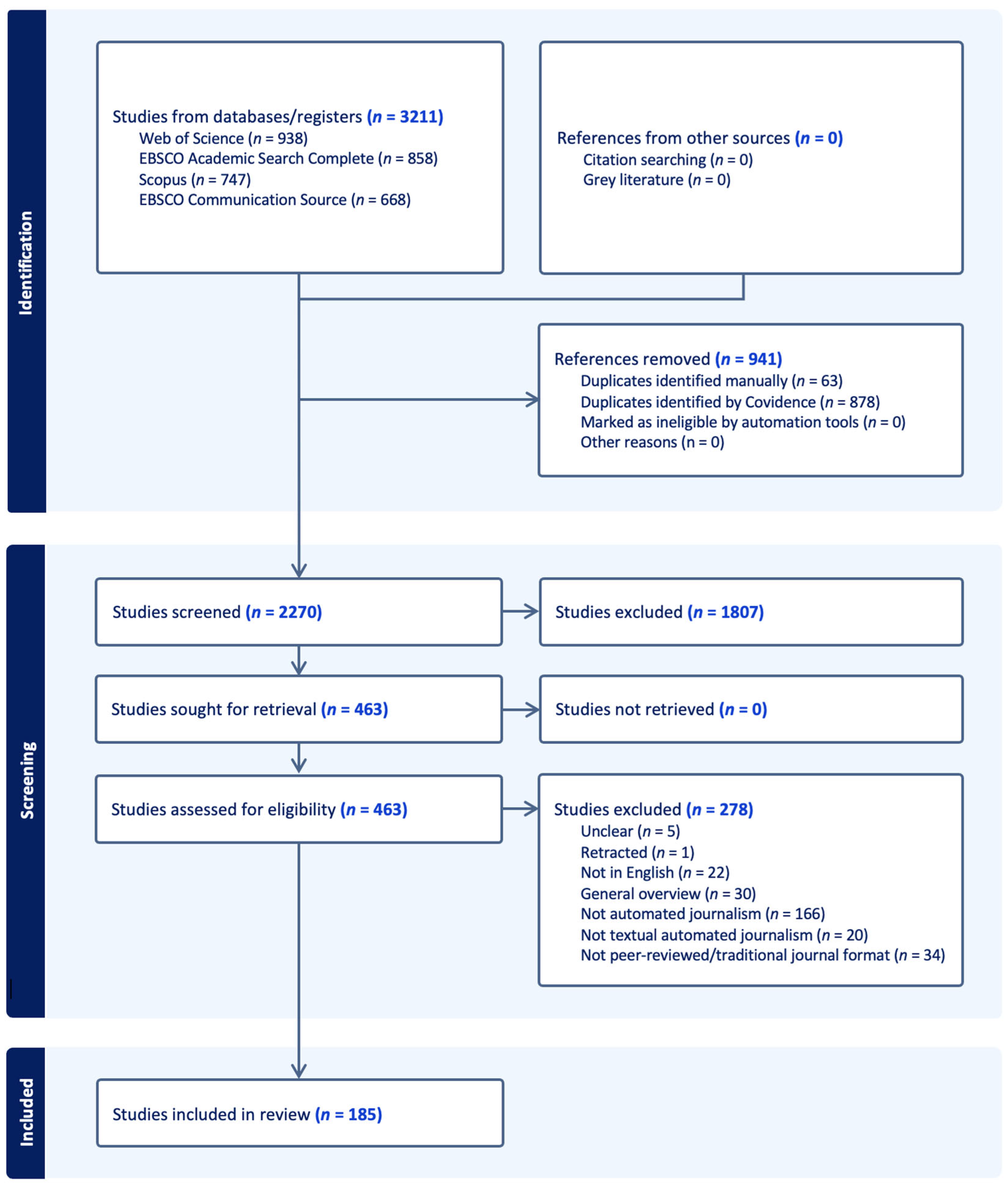
| Study selection | 16a | Describe the results of the search and selection process, from the number of records identified in the search to the number of studies included in the review, ideally using a flow diagram (see Figure 1). | Page 8 beginning in the Section 3.2. Data Collection and continued in the Section 3.3. Data Analysis. |
| 16b | Cite studies that might appear to meet the inclusion criteria, but which were excluded, and explain why they were excluded. | Page 8 under Section 3.2. Data Collection describes studies from the original corpus that were excluded. | |
| Study characteristics | 17 | Cite each included study and present its characteristics. | Appendix A |
| Risk of bias in studies | 18 | Present assessments of risk of bias for each included study. | n/a—This systematized review does not include a quality assessment of the included studies, does not address health issues and does not include any statistical synthesis. |
| Results of individual studies | 19 | For all outcomes, present, for each study: (a) summary statistics for each group (where appropriate) and (b) an effect estimate and its precision (e.g., confidence/credible interval), ideally using structured tables or plots. | |
| Results of syntheses | 20a | For each synthesis, briefly summarize the characteristics and risk of bias among contributing studies. | |
| 20b | Present results of all statistical syntheses conducted. If meta-analysis was done, present for each the summary estimate and its precision (e.g., confidence/credible interval) and measures of statistical heterogeneity. If comparing groups, describe the direction of the effect. | ||
| 20c | Present results of all investigations of possible causes of heterogeneity among study results. | ||
| 20d | Present results of all sensitivity analyses conducted to assess the robustness of the synthesized results. | ||
| Reporting biases | 21 | Present assessments of risk of bias due to missing results (arising from reporting biases) for each synthesis assessed. | |
| Certainty of evidence | 22 | Present assessments of certainty (or confidence) in the body of evidence for each outcome assessed. | |
| Discussion | |||
| Discussion | 23a | Provide a general interpretation of the results in the context of other evidence. | Pages 18–21 in Section 5. Discussion |
| 23b | Discuss any limitations of the evidence included in the review. | n/a—This systematized review does not include a quality assessment of evidence from the included studies. | |
| 23c | Discuss any limitations of the review processes used. | Issues with inconsistent terms is discussed throughout, but addressed specifically on Pages 20–21 in Section 5. Discussion. | |
| 23d | Discuss implications of the results for practice, policy, and future research. | Pages 18–21 in Section 5. Discussion and pages 21–22 in Section 6. Conclusion. | |
| Other information | |||
| Registration and protocol | 24a | Provide registration information for the review, including register name and registration number, or state that the review was not registered. | n/a—This systematized review does not assess health or medical issues, does not include a quality assessment of the included studies, and is not registered. |
| 24b | Indicate where the review protocol can be accessed, or state that a protocol was not prepared. | ||
| 24c | Describe and explain any amendments to information provided at registration or in the protocol. | ||
| Support | 25 | Describe sources of financial or non-financial support for the review, and the role of the funders or sponsors in the review. | Page 22 |
| Competing interests | 26 | Declare any competing interests of review authors. | Page 22 |
| Availability of data, code, and other materials | 27 | Report which of the following are publicly available and where they can be found: template data collection forms; data extracted from included studies; data used for all analyses; analytic code; any other materials used in the review. | Data are available from authors on request. |
References
- Aissani, R., Abdallah, R. A.-Q., Taha, S., & Al Adwan, M. N. (2023). Artificial intelligence tools in media and journalism: Roles and concerns. In 2023 international conference on multimedia computing, networking and applications (MCNA) (pp. 19–26). IEEE. [Google Scholar] [CrossRef]
- Alexander, J. C., Breese, E. B., & Luengo, M. (Eds.). (2016). The crisis of journalism reconsidered: Democratic culture, professional codes, digital future. Cambridge University Press. [Google Scholar]
- Arguedas, A. R., & Simon, F. M. (2023). Automating democracy: Generative AI, journalism, and the future of democracy. Available online: https://ora.ox.ac.uk/objects/uuid:0965ad50-b55b-4591-8c3b-7be0c587d5e7 (accessed on 19 December 2025).
- Benson, R. (2018). Can foundations solve the journalism crisis? Journalism, 19(8), 1059–1077. [Google Scholar] [CrossRef]
- Blankespoor, E., deHaan, E., & Zhu, C. (2018). Capital market effects of media synthesis and dissemination: Evidence from robo-journalism. Review of Accounting Studies, 23(1), 1–36. [Google Scholar] [CrossRef]
- Broussard, M., Diakopoulos, N., Guzman, A. L., Abebe, R., Dupagne, M., & Chuan, C.-H. (2019). Artificial intelligence and journalism. Journalism & Mass Communication Quarterly, 96(3), 673–695. [Google Scholar] [CrossRef]
- Carlson, M. (2015). The robotic reporter: Automated journalism and the redefinition of labor, compositional forms, and journalistic authority. Digital Journalism, 3(3), 416–431. [Google Scholar] [CrossRef]
- Caswell, D., & Dörr, K. (2018). Automated journalism 2.0: Event-driven narratives: From simple descriptions to real stories. Journalism Practice, 12(4), 477–496. [Google Scholar] [CrossRef]
- Caswell, D., & Dörr, K. (2019). Automating complex news stories by capturing news events as data. Journalism Practice, 13(8), 951–955. [Google Scholar] [CrossRef]
- Cheng, L., Deng, D., Xie, X., Qiu, R., Xu, M., & Wu, Y. (2024). SNIL: Generating sports news from insights with large language models. IEEE Transactions on Visualization and Computer Graphics, 31(7), 3973–3986. [Google Scholar] [CrossRef]
- Clerwall, C. (2014). Enter the robot journalist: Users’ perceptions of automated content. Journalism Practice, 8(5), 519–531. [Google Scholar] [CrossRef]
- Cools, H., & Diakopoulos, N. (2024). Uses of generative AI in the newsroom: Mapping journalists’ perceptions of perils and possibilities. Journalism Practice, 1–19. [Google Scholar] [CrossRef]
- Cools, H., & Koliska, M. (2024). News automation and algorithmic transparency in the newsroom: The case of the Washington Post. Journalism Studies, 25(6), 662–680. [Google Scholar] [CrossRef]
- Cools, H., Van Gorp, B., & Opgenhaffen, M. (2022). New organizations, different journalistic roles, and innovative projects: How second-generation newsroom innovation labs are changing the news ecosystem. Journalism Practice, 18(6), 1605–1620. [Google Scholar] [CrossRef]
- Danzon-Chambaud, S. (2021). A systematic review of automated journalism scholarship: Guidelines and suggestions for future research. Open Research Europe, 1, 4. [Google Scholar] [CrossRef] [PubMed]
- Danzon-Chambaud, S. (2023). Automated news in practice: A cross-national exploratory study. Open Research Europe, 3, 95. [Google Scholar] [CrossRef] [PubMed]
- Danzon-Chambaud, S., & Cornia, A. (2021). Changing or reinforcing the “rules of the game”: A field theory perspective on the impacts of automated journalism on media practitioners. Journalism Practice, 17(2), 174–188. [Google Scholar] [CrossRef]
- Darr, J. (2023). How sticky is pink slime? Assessing the credibility of deceptive local media. Annals of the American Academy of Political and Social Science, 707(1), 109–124. [Google Scholar] [CrossRef]
- Diakopoulos, N. (2019). Automating the news: How algorithms are rewriting the media. Harvard University Press. [Google Scholar]
- Dierickx, L. (2023). News automation, materialities, and the remix of an editorial process. Journalism, 24(3), 654–670. [Google Scholar] [CrossRef]
- Díaz-Noci, J. (2020). Artificial intelligence systems-aided news and copyright: Assessing legal implications for journalism practices. Future Internet, 12(5), 85. [Google Scholar] [CrossRef]
- Dodds, T., Zamith, R., & Lewis, S. C. (2025). The AI turn in journalism: Disruption, adaptation, and democratic futures. Journalism. [Google Scholar] [CrossRef]
- Dörr, K. N. (2016). Mapping the field of algorithmic journalism. Digital Journalism, 4(6), 700–722. [Google Scholar] [CrossRef]
- Dörr, K. N., & Hollnbuchner, K. (2017). Ethical challenges of algorithmic journalism. Digital Journalism, 5(4), 404–419. [Google Scholar] [CrossRef]
- Galily, Y. (2018). Artificial intelligence and sports journalism: Is it a sweeping change? Technology in Society, 54, 47–51. [Google Scholar] [CrossRef]
- Gotmare, A., Thite, G., & Bewoor, L. (2024). A multimodal machine learning approach to generate news articles from geo-tagged images. International Journal of Electrical and Computer Engineering, 14(3), 3434–3442. [Google Scholar] [CrossRef]
- Goudarzi, S. (2024). To protect democratic values, journalism must save itself. Bulletin of the Atomic Scientists, 80(5), 314–320. [Google Scholar] [CrossRef]
- Graefe, A., & Bohlken, N. (2020). Automated journalism: A meta-analysis of readers’ perceptions of human-written in comparison to automated news. Media and Communication, 8(3), 50–59. [Google Scholar] [CrossRef]
- Graefe, A., Haim, M., Haarmann, B., & Brosius, H.-B. (2016). Readers’ perception of computer-generated news: Credibility, expertise, and readability. Journalism, 19(5), 595–610. [Google Scholar] [CrossRef]
- Grant, M. J., & Booth, A. (2009). A typology of reviews: An analysis of 14 review types and associated methodologies: A typology of reviews. Health Information & Libraries Journal, 26(2), 91–108. [Google Scholar] [CrossRef]
- Guzman, A. L., & Lewis, S. C. (2024). What generative AI means for the media industries, and why it matters to study the collective consequences for advertising, journalism, and public relations. Emerging Media, 2(3), 347–355. [Google Scholar] [CrossRef]
- Haim, M., & Graefe, A. (2017). Automated news. Digital Journalism, 5(8), 1044–1059. [Google Scholar] [CrossRef]
- Hamilton, J. T., & Turner, F. (2009). Accountability through algorithm: Developing the field of computational journalism. Center for Advanced Study in the Behavioral Sciences. [Google Scholar]
- Henestrosa, A. L., Greving, H., & Kimmerle, J. (2023). Automated journalism: The effects of AI authorship and evaluative information on the perception of a science journalism article. Computers in Human Behavior, 138, 107445. [Google Scholar] [CrossRef]
- Ioscote, F., Gonçalves, A., & Quadros, C. (2024). Artificial intelligence in journalism: A ten-year retrospective of scientific articles (2014–2023). Journalism and Media, 5(3), 873–891. [Google Scholar] [CrossRef]
- Jang, W., Chun, J. W., Kim, S., & Kang, Y. W. (2021). The effects of anthropomorphism on how people evaluate algorithm-written news. Digital Journalism, 11(1), 103–124. [Google Scholar] [CrossRef]
- Jang, W., Kwak, D. H., & Bucy, E. (2022). Knowledge of automated journalism moderates evaluations of algorithmically generated news. New Media and Society, 26(10), 5898–5922. [Google Scholar] [CrossRef]
- Jarvis, J. (2014). Geeks bearing gifts: Imagining new futures for news. New CUNY Journalism Press. [Google Scholar]
- Jung, J., Song, H., Kim, Y., Im, H., & Oh, S. (2017). Intrusion of software robots into journalism: The public’s and journalists’ perceptions of news written by algorithms and human journalists. Computers in Human Behavior, 71, 291–298. [Google Scholar] [CrossRef]
- Kim, S., & Kim, B. (2020). A Decision-making model for adopting Al-generated news articles: Preliminary results. Sustainability, 12(18), 7418. [Google Scholar] [CrossRef]
- Kim, Y., & Lee, H. (2021). Towards a sustainable news business: Understanding readers’ perceptions of algorithm-generated news based on cultural conditioning. Sustainability, 13(7), 3728. [Google Scholar] [CrossRef]
- Klimashevskaia, A., Gadgil, R., Gerrity, T., Khosmood, F., Gütl, C., & Howe, P. (2021). Automatic news article generation from legislative proceedings: A phenom-based approach (Vol. 13062, pp. 15–26). Lecture Notes in Computer Science (Including Subseries Lecture Notes in Artificial Intelligence and Lecture Notes in Bioinformatics), LNAI. Springer. [Google Scholar] [CrossRef]
- Kotenidis, E., & Veglis, A. (2021). Algorithmic journalism—Current applications and future perspectives. Journalism and Media, 2(2), 244–257. [Google Scholar] [CrossRef]
- Kovach, B., & Rosenstiel, T. (2021). The elements of journalism (Revised and updated 4th ed.). Crown. [Google Scholar]
- Latar, N. L. (2018). Robot journalism. In Robot Journalism: Can Human Journalism Survive? World Scientific Publishing Co. Pte. Ltd. [Google Scholar] [CrossRef]
- Lee, S., Nah, S., Chung, D. S., & Kim, J. (2020). Predicting AI news credibility: Communicative or social capital or both? Communication Studies, 71(3), 428–447. [Google Scholar] [CrossRef]
- Moravec, V., Macková, V., Sido, J., & Ekštein, K. (2020). The robotic reporter in the Czech news agency: Automated journalism and augmentation in the newsroom. Communication Today, 11(1), 36–52. [Google Scholar]
- Munoriyarwa, A., & de-Lima-Santos, M.-F. (2025). Generative AI and the future of news: Examining AI’s agency, power, and authority. Journalism Practice, 19(10), 2177–2188. [Google Scholar] [CrossRef]
- Newman, N. (2024). Journalism, media, and technology trends and predictions 2024. Reuters Institute for the Study of Journalism. [Google Scholar] [CrossRef]
- Noain-Sánchez, A. (2022). Addressing the impact of artificial intelligence on journalism: The perception of experts, journalists and academics. Communication and Society, 35(3), 105–121. [Google Scholar] [CrossRef]
- Oh, C., Choi, J., Lee, S., Park, S., Kim, D., Song, J., Kim, D., Lee, J., & Suh, B. (2020, April 25–30). Understanding user perception of automated news generation system. 2020 CHI Conference on Human Factors in Computing Systems (pp. 1–13), Honolulu, HI, USA. [Google Scholar] [CrossRef]
- Oremus, W. (2014, March 17). The first news report on the L.A. earthquake was written by a robot. Slate. Available online: https://slate.com/technology/2014/03/quakebot-los-angeles-times-robot-journalist-writes-article-on-la-earthquake.html (accessed on 20 December 2025).
- Page, M. J., McKenzie, J. E., Bossuyt, P. M., Boutron, I., Hoffmann, T. C., Mulrow, C. D., Shamseer, L., Tetzlaff, J. M., Akl, E. A., Brennan, S. E., Chou, R., Glanville, J., Grimshaw, J. M., Hróbjartsson, A., Lalu, M. M., Li, T., Loder, E. W., Mayo-Wilson, E., McDonald, S., … Moher, D. (2021). The PRISMA 2020 statement: An updated guideline for reporting systematic reviews. Systematic Reviews, 10, 89. [Google Scholar] [CrossRef] [PubMed]
- Peiser, J. (2019, February 5). The rise of the robot reporter. The New York Times. Available online: https://www.nytimes.com/2019/02/05/business/media/artificial-intelligence-journalism-robots.html (accessed on 20 December 2025).
- Peña-Fernández, S., Meso-Ayerdi, K., Larrondo-Ureta, A., & Díaz-Noci, J. (2023). Without journalists, there is no journalism: The social dimension of artificial intelligence in the media. Profesional de la Informacion, 32(2), e320227. [Google Scholar] [CrossRef]
- Rojas Torrijos, J. L. (2021). Semi-automated journalism: Reinforcing ethics to make the most of artificial intelligence for writing news. In M. Luengo, & S. Herrera-Damas (Eds.), News media innovation reconsidered (1st ed., pp. 124–137). Wiley. [Google Scholar] [CrossRef]
- Sarkar, S., Yashwanth, T. S., & Giri, A. (2024). Advancing cricket narratives: AI-enhanced advanced journaling in the IPL using language models. In 2024 IEEE international conference on electronics, computing and communication technologies (CONECCT) (pp. 1–6). IEEE. [Google Scholar] [CrossRef]
- Schapals, A. K. (2020). Automated journalism: Expendable or supplementary for the future of journalistic work? In The future of creative work: Creativity and digital disruption. Edward Elgar Publishing Ltd. [Google Scholar] [CrossRef]
- Schapals, A. K., & Porlezza, C. (2020). Assistance or resistance? Evaluating the intersection of automated journalism and journalistic role conceptions. Media and Communication, 8(3), 16–26. [Google Scholar] [CrossRef]
- Shi, Y., & Sun, L. (2024). How generative AI Is transforming journalism: Development, application and ethics. Journalism and Media, 5(2), 582–594. [Google Scholar] [CrossRef]
- St-Germain, N., & White, P. (2021). The impact of artificial intelligence on journalistic practices in Canada. SSRN. [Google Scholar] [CrossRef]
- Syed, M., & Nelson, S. C. (2015). Guidelines for establishing reliability when coding narrative data. Emerging Adulthood, 3(6), 375–387. [Google Scholar] [CrossRef]
- Tandoc, E. C., Yao, L. J., & Wu, S. (2020). Man vs. machine? The impact of algorithm authorship on news credibility. Digital Journalism, 8(4), 548–562. [Google Scholar] [CrossRef]
- Túñez-López, M., Toural-Bran, C., & Valdiviezo Abad, C. (2019). Automation, bots and algorithms in newsmaking. Impact and quality of artificial journalism. Revista Latina de Comunicacion Social, 74, 1411–1433. [Google Scholar] [CrossRef]
- van Dalen, A. (2012). The algorithms behind the headlines: How machine-written news redefines the core skills of human journalists. Journalism Practice, 6(5–6), 648–658. [Google Scholar] [CrossRef]
- Verma, D. (2024). Impact of artificial intelligence on journalism: A comprehensive review of AI in journalism. Journal of Communication and Management, 3(2), 150–156. [Google Scholar] [CrossRef]
- Waddell, T. F. (2018). A robot wrote this?: How perceived machine authorship affects news credibility. Digital Journalism, 6(2), 236–255. [Google Scholar] [CrossRef]
- Waddell, T. F. (2019a). Attribution practices for the man-machine marriage: How perceived human intervention, automation metaphors, and byline location affect the perceived bias and credibility of purportedly automated content. Journalism Practice, 13(10), 1255–1272. [Google Scholar] [CrossRef]
- Waddell, T. F. (2019b). Can an algorithm reduce the perceived bias of news? Testing the effect of machine attribution on news readers’ evaluations of bias, anthropomorphism, and credibility. Journalism & Mass Communication Quarterly, 96(1), 82–100. [Google Scholar] [CrossRef]
- Wagner, M. (2022). Automated journalism: The effects of automated news generation on news organizations. Technische Universität Wien. [Google Scholar]
- Wilkinson, S., & Winseck, D. (2019). Crisis or transformation? Debates over journalistic work in Canada. Canadian Journal of Communication, 44(3), 373–395. [Google Scholar] [CrossRef]
- Wu, S., Tandoc, E. C., & Salmon, C. T. (2019). A field analysis of journalism in the automation age: Understanding journalistic transformations and struggles through structure and agency. Digital Journalism, 7(4), 428–446. [Google Scholar] [CrossRef]
- Wu, Y. (2020). Is automated journalistic writing less biased? An experimental test of auto-written and human-written news stories. Journalism Practice, 14(8), 1008–1028. [Google Scholar] [CrossRef]
- Zade, H., Drouhard, M., Chinh, B., Gan, L., & Aragon, C. (2018, April 21–26). Conceptualizing disagreement in qualitative coding. 2018 CHI Conference on Human Factors in Computing Systems (pp. 1–11), Montreal, QC, Canada. [Google Scholar] [CrossRef]


| Term | Source | Test Search | Refined Search String |
|---|---|---|---|
| automated journalism | automat* AND journalis* | ||
| AI authorship | (Henestrosa et al., 2023) | 2 | |
| AI journalism | (Moravec et al., 2020) | 37 | |
| AI news | (Lee et al., 2020) | 27 | AI AND news |
| AI-generated news | (S. Kim & Kim, 2020) | 2 | |
| artificial journalism | (Túñez-López et al., 2019) | 57 | artificial AND journalis* |
| algorithm authorship | (Tandoc et al., 2020) | 2 | |
| algorithm-generated news | (Y. Kim & Lee, 2021) | 429 | algorithm* AND news |
| algorithm-written news | (Jang et al., 2021) | 154 | algorithm* AND news |
| algorithmic journalism | (Dörr, 2016) | 25 | algorithm* AND journalis* |
| algorithmically generated news | (Jang et al., 2022) | 22 | algorithm* AND news |
| auto-written news stories | (Y. Wu, 2020) | 1 | |
| automated content production | (Kotenidis & Veglis, 2021) | 3 | |
| automated journalistic writing | (Y. Wu, 2020) | 2 | |
| automated news | (Haim & Graefe, 2017) | 65 | automat* AND news |
| automated news content generation | (Y. Kim & Lee, 2021) | 13 | automat* AND news |
| automatic news article generation | (Klimashevskaia et al., 2021) | 0 | |
| automatically produced content | (Galily, 2018) | 1 | |
| news automation | (Danzon-Chambaud, 2023) | 43 | automat* AND news |
| computational journalism | (Cools et al., 2022) | 52 | computational journalis* |
| computer-generated news | (Graefe et al., 2016) | 2 | |
| machine authorship | (Waddell, 2018) | 0 | |
| machine-written journalism | (Danzon-Chambaud, 2021) | 1 | machine AND journalis* |
| machine-written news | (van Dalen, 2012) | 1 | |
| robot journalism | (Clerwall, 2014) | 28 | robot journalis* |
| robo-journalism | (Blankespoor, 2018) | 2 |
| Journal | Count | Publishing Country | Discipline (According to scimagojr.com) |
|---|---|---|---|
| Digital Journalism | 25 | United Kingdom | Communication |
| Conference Proceedings | 18 | ||
| Journalism Practice | 16 | United Kingdom | Communication |
| Journalism | 14 | United Kingdom | Communication Arts and Humanities (miscellaneous) |
| Journalism and Media | 8 | Switzerland | Arts and Humanities (miscellaneous) Linguistics and Language |
| Journalism Studies | 7 | United Kingdom | Communication |
| Raw Keywords | Count of Studies | Keyword Grouping | Count of Studies |
|---|---|---|---|
| automated journalism | 66 | automated journalism | 99 |
| artificial intelligence | 57 | artificial intelligence | 65 |
| journalism | 43 | journalism | 48 |
| robot journalism | 33 | robot journalism | 41 |
| computational journalism | 20 | algorithmic journalism | 24 |
| algorithmic journalism | 19 | credibility | 22 |
| automation | 18 | ethics | 22 |
| automated news | 13 | computational journalism | 21 |
| credibility | 12 | algorithm(s) | 20 |
| news | 12 | automation | 18 |
| algorithms | 11 | natural language processing | 17 |
| natural language generation | 11 | media | 16 |
| news production | 10 | technology | 16 |
| Country | Count of Authors (n = 351) | |
|---|---|---|
| United States | 76 | 21.7% |
| Spain | 36 | 10.3% |
| South Korea | 27 | 7.7% |
| Germany | 25 | 7.1% |
| China | 18 | 5.1% |
| United Kingdom | 17 | 4.8% |
| Finland | 15 | 4.3% |
| India | 12 | 3.4% |
| Netherlands | 11 | 3.1% |
| Norway | 9 | 2.6% |
| Author | Country of Institutional Affiliation | Count of Studies (n = 185) |
|---|---|---|
| Konstantin Nicholas Dörr | Switzerland | 5 |
| Chenyan Jia | United States | 5 |
| Edson C. Tandoc Jr. | Singapore | 5 |
| Shangyuan Wu | Singapore | 5 |
| Samuel Danzon-Chambaud | Ireland | 4 |
| Laurence Dierickx | Belgium | 4 |
| Daewon Kim | South Korea | 4 |
| Soojin Kim | United States | 4 |
| Leo Leppanen | Finland | 4 |
| Carl-Gustav Linden | Finland | 4 |
| Václav Moravec | Czech Republic | 4 |
| Colin Porlezza | Switzerland | 4 |
| Sina Thäsler-Kordonouri | Germany | 4 |
| Neil Thurman | Germany | 4 |
| Types | Individual Studies (n = 185) | |
|---|---|---|
| Qualitative methods | 66 | 35.7% |
| Interviews | 52 | 28.1% |
| Case study | 18 | 9.7% |
| Ethnography | 7 | 3.8% |
| Focus Group | 3 | 1.6% |
| Content analysis | 54 | 29.2% |
| Thematic analysis | 21 | 11.4% |
| Content analysis | 14 | 7.6% |
| Qualitative data analysis | 8 | 4.3% |
| Discourse analysis | 5 | 2.7% |
| Legal analysis | 4 | 2.2% |
| Survey | 47 | 25.4% |
| Online survey | 28 | 15.1% |
| Manipulation check | 6 | 3.2% |
| Experimental design | 45 | 24.3% |
| Online experiment | 30 | 16.2% |
| Between-subject | 17 | 9.2% |
| Statistical analysis | 30 | 16.2% |
| Other research approaches | 22 | 11.9% |
| Sampling | 20 | 10.8% |
| Snowball sampling | 8 | 4.3% |
| Purposive sampling | 6 | 3.2% |
| Systematic review | 17 | 9.2% |
| Applied | 8 | 4.3% |
| Category | Example | Number of Tools (n = 139) | |
|---|---|---|---|
| Software & apps | NVivo, Zoom, SPSS, MaxQDA, Skype, Excel | 34 | 24.5% |
| Database | Scopus, Lexis Nexis, Web of Science, Google Scholar, MediaCloud | 27 | 19.4% |
| Computation & coding | Python, APIs, HTML, JavaScript | 15 | 10.8% |
| Survey Tools | Prolific, Qualtrics, SoSci Planet, YouGov | 10 | 7.2% |
| Measures | Computer Attitude Scale (CAS), Trust in News Media scale | 9 | 6.5% |
| Language models | Chat GPT, Chat Open AI, GPT, Paddle NLP, Google GeminiAI | 7 | 5.0% |
| Platforms | OSF, Twitter, LinkedIn, WeChat, Weibo, Facebook, Slack | 7 | 5.0% |
| Dataset | AP Index, ActivityNet Captions, RealNews Dataset | 6 | 4.3% |
| AI tools | StatsPerform, HeyWire AI | 4 | 2.9% |
| Search Engines | Google, ResearchGate | 4 | 2.9% |
| Recruitment | Prolific, Amazon Mechanical Turk, Research Match | 3 | 2.1% |
| Other | Including organizations, projects, repositories, websites | 13 | 9.4% |
| Raw Term | Count of Studies (n = 185) | Term Grouping | Count of Studies (n = 185) | ||
|---|---|---|---|---|---|
| automated journalism | 119 | 64.3% | automated journalism | 126 | 68.1% |
| robot journalism | 65 | 35.1% | robo(tic) journalism | 82 | 44.3% |
| algorithmic journalism | 48 | 25.9% | algorithm(ic) journalism | 61 | 33.0% |
| computational journalism | 40 | 21.6% | automated news | 59 | 31.9% |
| automated news | 23 | 12.4% | computational journalism | 40 | 21.6% |
| algorithm journalism | 12 | 6.5% | machine-written (…) | 18 | 9.7% |
| machine-written news | 11 | 5.9% | automated content | 17 | 9.2% |
| news automation | 10 | 5.4% | AI-generated (…) | 12 | 6.5% |
| robo-journalism | 7 | 3.8% | AI journalism | 12 | 6.5% |
| automated content | 6 | 3.2% | automated text (…) | 11 | 5.9% |
| Term Element | Examples | Count (n = 157) |
|---|---|---|
| automated, automation, automatic(ally) | automatic journalism automated production of news automatically generated articles automated computer-written articles | 63 |
| news | machine-written news news automation automated news production computer-generated news content | 54 |
| journalism, journalist, journalistic | machine-written journalism automated journalistic writing AI-generated journalistic content machine-produced journalism | 45 |
| generation, generated, generative | AI-generated articles automated journalistic text generation automatically generated news stories autogenerated news | 36 |
| AI, artificial intelligence | AI-driven content generation AI-written media texts artificial intelligence journalism AI-authored articles | 34 |
| writing, written | AI-written news (articles) automated computer-written articles algorithm-written news (stories) machine-written journalism | 34 |
| content | automated content production machine-generated content automated production of journalistic content computer-generated news content | 26 |
| algorithm(s), algorithmic, algorithmically | algorithmic news production algorithm-generated stories automated news-making algorithms algorithmically assembled news | 24 |
| produced, production | automated content production machine-produced journalism algorithmically produced news AI-based news production | 21 |
| text(s), textual | automated text generation AI-written text(s) automatically generated textual news automated text production | 21 |
| Term | Count of Studies (n = 185) | |
|---|---|---|
| news credibility | 12 | 2.80% |
| natural language processing (NLP) | 10 | 2.33% |
| natural language generation (NLG) | 10 | 2.33% |
| MAIN model theory | 9 | 2.10% |
| machine heuristic (MH) | 9 | 2.10% |
| human–machine communication | 8 | 1.86% |
| large language models (LLM) | 8 | 1.86% |
| Bourdieu Field Theory | 7 | 1.63% |
| journalism ideology | 7 | 1.63% |
| journalism ethics | 7 | 1.63% |
| Concepts | Count of Studies (n = 185) | |
|---|---|---|
| News & media credibility | 26 | 14.1% |
| Human–computer interaction/collaboration | 19 | 10.3% |
| Heuristics | 11 | 5.9% |
| Transparency/Disclosure | 9 | 4.9% |
| Journalistic identity/Role conceptions | 8 | 4.3% |
| Institutional logics | 8 | 4.3% |
| Theories & Frameworks | Count of Studies (n = 185) | |
| Hostile media theories | 11 | 5.9% |
| MAIN model | 9 | 4.9% |
| Expectancy theories | 8 | 4.3% |
| Philosophical frameworks | 8 | 4.3% |
| Socio-technical theories | 8 | 4.3% |
| Hostile media theories | 11 | 5.9% |
| Applied practices | Count of Studies (n = 185) | |
| Natural language processing | 20 | 10.8% |
| Journalism & media ethics | 15 | 8.1% |
| Legal frameworks | 14 | 7.6% |
| Language models | 9 | 4.9% |
| AI and generative AI | 8 | 4.3% |
| Theme | Description | Prevalence |
|---|---|---|
| Journalism theories | journalism ideology, role conception, authority, boundaries, identity, judgement, innovation as well as meta-journalistic discourse | 46 |
| Credibility and trust | news, media, source, message and medium credibility; perceptions of credibility and related trust. | 44 |
| Machine language | Natural language processing (NLP) and natural language generation (NLG); language modeling, and related concepts such as named entity recognition (NER), semantic representation, and post-editing. | 34 |
| Socio-technical theories | technological drama, imaginaries, determinism, media effects, memory, reductionism, adoption and appropriation; socio-technical construction; the SCOT model; technology acceptance models; and technological innovation theories. | 29 |
| Institutional theories | new/neo, discursive and historical institutionalism; institutional logics, entrepreneurship and isomorphism; multifactorial resistances; structural inertia and anticipatory practices. | 23 |
| Human–machine interaction (HMI) | human–machine communication, human–computer interaction, human–artificial intelligence [AI] interaction, and human–computer collaboration. | 22 |
| AI and algorithms | Algorithmic aversion, judgment, transparency and literacy; adaptive, generative, general purpose and communicative AI; media synthesis; uncanny valley effect and word-of-machine effect. | 22 |
Disclaimer/Publisher’s Note: The statements, opinions and data contained in all publications are solely those of the individual author(s) and contributor(s) and not of MDPI and/or the editor(s). MDPI and/or the editor(s) disclaim responsibility for any injury to people or property resulting from any ideas, methods, instructions or products referred to in the content. |
© 2026 by the authors. Licensee MDPI, Basel, Switzerland. This article is an open access article distributed under the terms and conditions of the Creative Commons Attribution (CC BY) license.
Share and Cite
Bartleman, M.; Schapals, A.K.; Dubois, E. Generative AI and the New Landscape of Automated Journalism: A Systematized Review of 185 Studies (2012–2024). Journal. Media 2026, 7, 39. https://doi.org/10.3390/journalmedia7010039
Bartleman M, Schapals AK, Dubois E. Generative AI and the New Landscape of Automated Journalism: A Systematized Review of 185 Studies (2012–2024). Journalism and Media. 2026; 7(1):39. https://doi.org/10.3390/journalmedia7010039
Chicago/Turabian StyleBartleman, Michelle, Aljosha Karim Schapals, and Elizabeth Dubois. 2026. "Generative AI and the New Landscape of Automated Journalism: A Systematized Review of 185 Studies (2012–2024)" Journalism and Media 7, no. 1: 39. https://doi.org/10.3390/journalmedia7010039
APA StyleBartleman, M., Schapals, A. K., & Dubois, E. (2026). Generative AI and the New Landscape of Automated Journalism: A Systematized Review of 185 Studies (2012–2024). Journalism and Media, 7(1), 39. https://doi.org/10.3390/journalmedia7010039