
Dissonance in the Algorithmic Era: Evaluating Showcase Digital Competence and Ethical Resilience in Communication Training


Abstract
1. Introduction
1.1. Background and Context
1.2. Objectives and Hypotheses
2. Materials and Methods
2.1. Disclosure of Generative AI Usage
2.2. Instruments, Procedure, and Analytical Constraints
- Initial Monitoring Questionnaire: Based on the DigComp 2.2 framework (Vuorikari et al., 2022) and adapted from Somos Digital (2020) indicators. It evaluates self-perception across three dimensions: (1) Data protection and privacy; (2) Digital health and well-being; and (3) Environmental protection and sustainability. This instrument targets Kirkpatrick’s Levels 1 and 2.
- Author-Developed Performance Rubric: This ad hoc instrument integrates Bartram’s (2005) competency framework with specific pedagogical criteria. It evaluates technical rigor, synthesis capacity, and—most critically—the veracity and verification of documentary sources. This component is specifically tailored to test student resilience within the “Globofriction” theoretical landscape (Aspachs, 2025; Self-elaboration).
- Reflective Checklist & Forum: These tools focus on self-assessment and qualitative interaction (Kirkpatrick’s Level 3). They are key for identifying the “behavioral gap” between known norms and executed practice (H1) and for collecting qualitative evidence of ethical awareness (H3) through content analysis (Kucukalic Ibrahimovic & Quirós-Fons, 2025). To ensure anonymity and ethical integrity in the Forum, participants were assigned alphanumeric codes (S1…).
- Final Impact Triangulation: This final stage is specifically oriented toward evaluating Kirkpatrick’s Level 4. It correlates the quantitative data from the diagnostics with the qualitative outcomes of the intervention. This instrument assesses the broader impact of the training on democratic resilience and digital sovereignty, validating the transformation of students into “Ethical Prosecutors” capable of mitigating the automated erosion of discourse.
3. Results
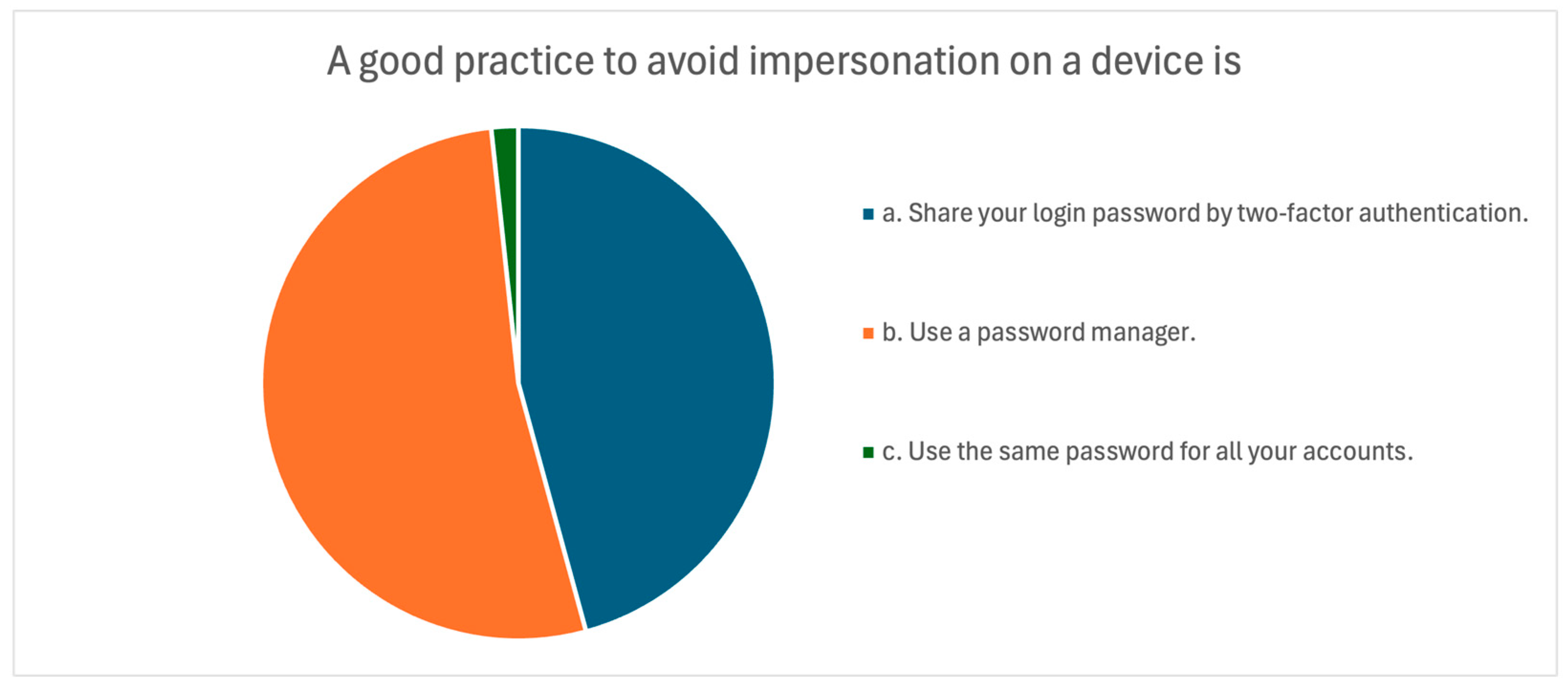
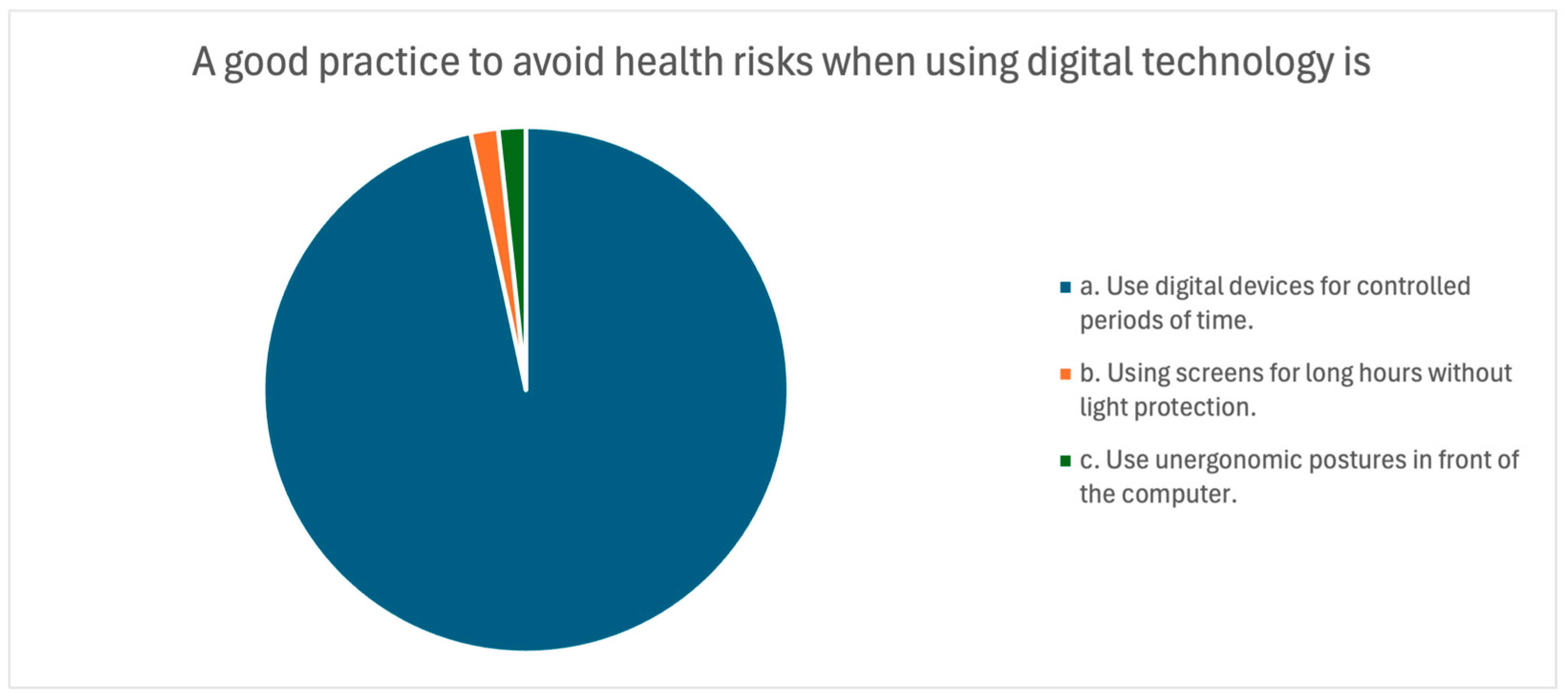
3.1. Initial Assessment: Mastery of Regulatory Literacy (Kirkpatrick Level 2)
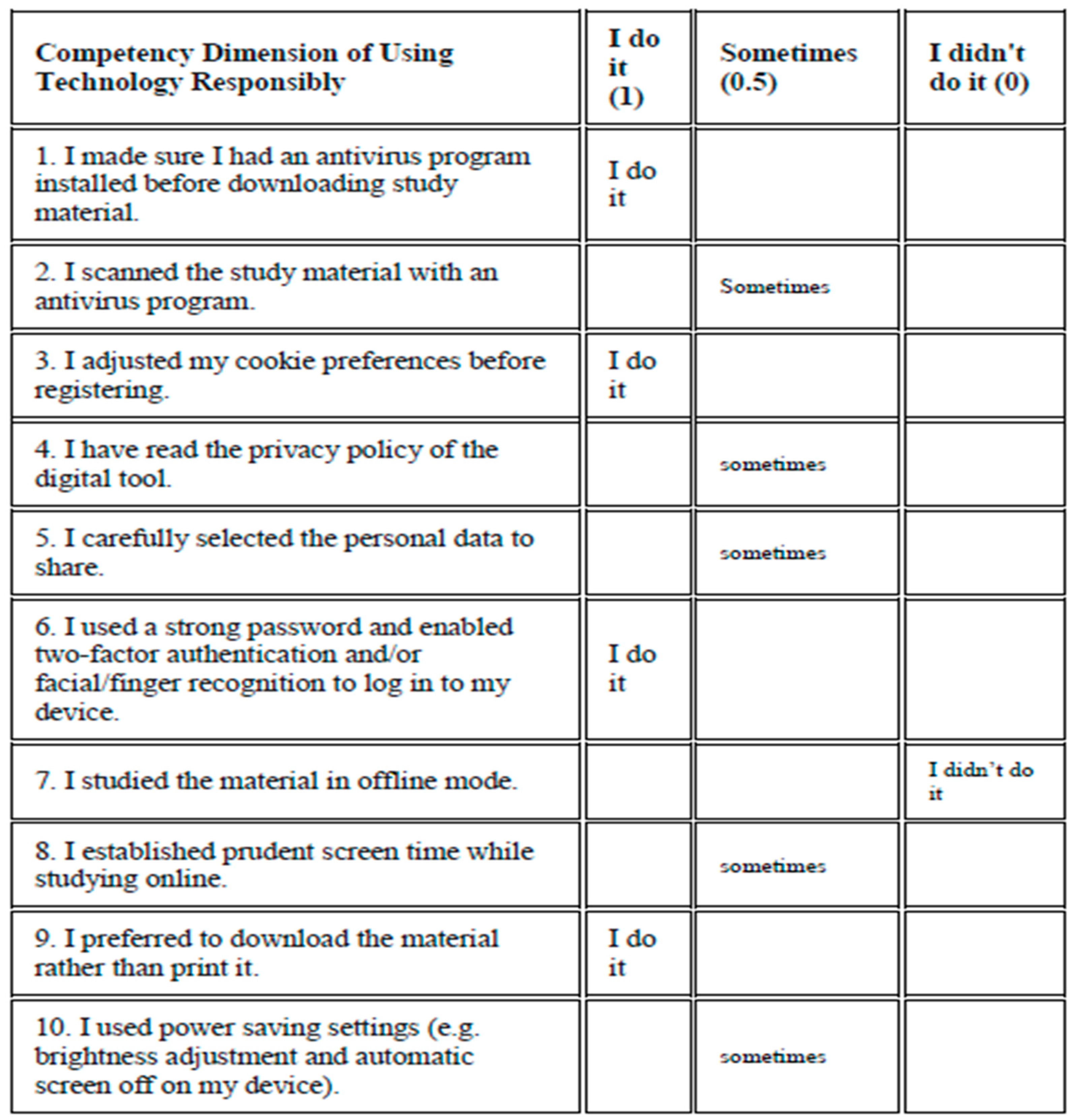
3.2. Performance Evaluation: The Academic “Showcase” (n = 25)
- File Scanning: Conducted only “occasionally.”
- Privacy Policies: Read only “at times.”
- Offline Mode: Systematically ignored.
3.3. Self-Perception Assessment: The Prosumer Gap (H1)
- Systemic Security Negligence: While students ensure that antivirus software is installed, the actual scanning of study material is frequently relegated to “sometimes” or directly ignored. The prevalence of this inconsistent management suggests that risks are recognized but not addressed through systematic protocols.
- The Privacy Paradox: Students demonstrate a “check-the-box” mentality. They may adjust basic cookie preferences, yet they admit to “never” reading the privacy policies or terms and conditions of the GAI tools they utilize. This confirms a conscious negligence often driven by a perceived lack of time or interest.
- Infrastructure Dependency and Self-Regulation: Working in “offline mode” is the most systematically rejected practice, identified by the majority as something they “didn’t do.” This dependency is linked to inconsistent self-regulation; students struggle to establish prudent screen time or use power-saving settings, even while admitting to significant digital fatigue.
3.4. Qualitative Analysis: Perceptions of Traceability and Governance from the Forum
4. Discussion and Conclusions
Funding
Institutional Review Board Statement
Informed Consent Statement
Data Availability Statement
Acknowledgments
Conflicts of Interest
Abbreviations
| GAI | Generative Artificial Intelligence |
| C-RIL | Collaborative Research and Innovation-based Learning |
| STEM | Science, Technology, Engineering, and Mathematics |
| SSH | Social Sciences and Humanities |
| DigComp | European Digital Competence Framework for Citizens |
| INCIBE | Instituto Nacional de Ciberseguridad (Spanish National Cybersecurity Institute) |
| OSI | Oficina de Seguridad del Internauta (Internet User Security Office) |
| UEV | Universidad Europea de Valencia |
| CRUE | Conferencia de Rectores de las Universidades |
| SDG | Sustainable Development Goals |
| LO | Learning Outcome |
| H1, H2, H3 | Research Hypotheses |
| DANA | Depresión Aislada en Niveles Altos (Isolated High-Altitude Depression) that causes extreme rainfall occurred in 2024. |
References
- Al-kfairy, M., Mustafa, D., Kshetri, N., Insiew, M., & Alfandi, O. (2024). Ethical challenges and solutions of generative AI: An interdisciplinary perspective. Informatics, 11(3), 58. [Google Scholar] [CrossRef]
- Aspachs, O. (2025). La globofricción. In Anuario internacional CIDOB 2026 (F. Fàbregues, & O. Farrés, Coord.; pp. 42–51). CIDOB edicions. [Google Scholar]
- Bartram, D. (2005). The great eight competencies: A criterion-centric approach to validation. Journal of Applied Psychology, 90(6), 1185–1203. [Google Scholar] [CrossRef] [PubMed]
- Blanco, S., Sánchez González, M., Martín-Martín, F. M., & Sánchez Gonzales, H. M. (2026). The challenge of generative artificial intelligence for future communication professionals: Experiences and usability. Telecommunications Policy, 50(1), 103083. [Google Scholar] [CrossRef]
- CRUE. (2024). La inteligencia artificial generativa en la docencia universitaria: Oportunidades, desafíos y recomendaciones. Crue Universidades Españolas. Available online: https://www.crue.org/wp-content/uploads/2024/03/Crue-Digitalizacion_IA-Generativa.pdf (accessed on 10 February 2026).
- European Parliament. (2025). Media literacy–EPRS briefing: Strengthening citizen resilience against disinformation. European Parliamentary Research Service. Available online: https://www.europarl.europa.eu/RegData/etudes/BRIE/2025/772886/EPRS_BRI(2025)772886_EN.pdf (accessed on 10 February 2026).
- Fernández-Torrers, Y., Gutiérrez-Fernández, M., & Palomo-Zurdo, R. (2019). ¿Cómo percibe la banca cooperativa el impacto de la transformación digital? CIRIEC-España, Revista de Economía Pública, Social y Cooperativa, (95), 233–264. [Google Scholar] [CrossRef]
- Gallent-Torres, C., Zapata-González, A., & Ortego-Hernando, J. L. (2023). The impact of Generative Artificial Intelligence in higher education: A focus on ethics and academic integrity. RELIEVE-Revista Electrónica de Investigación y Evaluación Educativa, 29(2), 1–19. [Google Scholar] [CrossRef]
- Hall, K. L., Vogel, A. L., Huang, G. C., Serrano, K. J., Rice, E. L., Tsakraklides, S. P., & Fiore, S. M. (2018). The science of team science: A review of the empirical evidence and research gaps on collaboration in science. Stanford University. Available online: https://domteamscience.stanford.edu/wp-content/uploads/2023/02/The-Science-of-Team-Science-A-Review-of-the-Empirical-Evidence-and-Research-Gaps-on-Collaboration-in-Science.pdf (accessed on 10 February 2026).
- INCIBE-Instituto Nacional de Ciberseguridad. (2019). Guía para aprender a identificar fraudes online. Available online: https://www.incibe.es/ciudadania/formacion/guias/guia-para-aprender-identificar-fraudes-online (accessed on 10 February 2026).
- INCIBE-Instituto Nacional de Ciberseguridad. (2020). Guía de ciberataques. Available online: https://www.incibe.es/ciudadania/formacion/guias/guia-de-ciberataques (accessed on 10 February 2026).
- Kirkpatrick, D. L., & Kirkpatrick, J. D. (2007). Implementing the four levels: A practical guide to effective training evaluation. Berrett-Koehler Publishers. [Google Scholar]
- Kucukalic Ibrahimovic, E., & Bañon Castellón, L. (2025). Integrando competencia digital, perspectiva de género y sostenibilidad en el periodismo de soluciones: Una estrategia de capacity building probada en el Máster de Periodismo Internacional. In A. Diestro Fernández (Ed.), Inteligencia artificial responsable y sostenibilidad curricular: Oportunidades y retos para la innovación docente (pp. 36–38). Universidad Europea de Madrid. Available online: https://hdl.handle.net/11268/16277 (accessed on 12 March 2026).
- Kucukalic Ibrahimovic, E., & Quirós-Fons, A. (2025). Educación superior y ciudadanía digital en la era de la IA: Un enfoque competencial necesario. In Propuestas educativas en la era de la IA. Regulación y uso ético (pp. 351–365). Dykinson. [Google Scholar]
- Livingstone, S. (2004). Media literacy and the challenge of new information and communication technologies. The Communication Review, 7(1), 3–14. [Google Scholar] [CrossRef]
- López Carrión, A. E., & Llorca-Abad, G. (2025). Desinformación durante la crisis producida por la DANA de 2024 en España: Análisis, características, tipologías y desmentidos. Revista Mediterránea De Comunicación, 16(2), e29303. [Google Scholar] [CrossRef]
- Martínez, S. (2024, January 14). Digital Heroes [Presentación de Genially]. Available online: https://view.genial.ly/65a413f729757a0013692dab/interactive-content-digital-heroes (accessed on 10 February 2026).
- Moeller, S. D. (1999). Compassion fatigue: How the media sell disease, famine, war and death. Routledge. [Google Scholar]
- OSI-Oficina de Seguridad del Internauta. (2020). Guía de privacidad y seguridad en Internet. Instituto Nacional de Ciberseguridad (INCIBE). Available online: https://www.osi.es/es/guias-y-infografias (accessed on 10 February 2026).
- Pachuca Ortiz, R., Hernández Pacheco, F. J., García Cerda, A., Ricárdez Cortés, R. A., & García Rivera, X. (2025). La alfabetización mediática desde una mirada crítica en tiempos digitales. Ciencia Latina Revista Científica Multidisciplinar, 9(3), 6255–6283. [Google Scholar] [CrossRef]
- Pedreño Muñoz, A., González Gosálbez, R., Mora Illán, T., Pérez Fernández, E., Ruiz Sierra, J., & Torres Penalva, A. (2024). Informe IA en universidades: Retos y oportunidades. 1MillionBot Group. Available online: https://raeia.org/books/la-inteligencia-artificial-en-las-universidades-retos-y-oportunidades/ (accessed on 10 February 2026).
- Portillo Gil, G. (2021). Modelo de evaluación Kirkpatrick en Educación para el Desarrollo y ciudadanía global: Recomendaciones para su adaptación en proyectos de Farmamundi [Master’s thesis, Universitat Politècnica de València]. Riunet. Available online: https://riunet.upv.es/server/api/core/bitstreams/4a80fed7-e515-42e0-81e6-4328bbc2aa2c/content (accessed on 10 February 2026).
- Power, M. (1997). The audit society: Rituals of verification. Oxford University Press. [Google Scholar]
- Sanchez-Acedo, A., Carbonell-Alcocer, A., Gertrudix, M., & Rubio-Tamayo, J. L. (2024). Retos de la Alfabetización Mediática e Informacional en la ecología de la Inteligencia Artificial: Deepfakes y desinformación. Communication & Society, 37(4), 223–239. [Google Scholar] [CrossRef]
- Sánchez Rodríguez, A. N., Martínez Romero, M. E., Rodríguez Agreda, C. J., Romero Saldarriaga, J. G., & Romero Saldarriaga, M. A. (2024). Impacto de la inteligencia artificial en las prácticas educativas: Percepciones y actitudes del profesorado. LATAM Revista Latinoamericana de Ciencias Sociales y Humanidades, 5(2), 1038–1055. [Google Scholar] [CrossRef]
- Simon, F., Rasmus, K., Nielsen, R., & Fletcher. (2025). I A AI AND THE FUTURE OF NEWS Generative AI and news report 2025: How people think about AI’s role in journalism and society. Available online: https://reutersinstitute.politics.ox.ac.uk/sites/default/files/2025-10/Gen_AI_and_News_Report_2025.pdf (accessed on 10 February 2026).
- Slimi, Z., & Carballido, B. V. (2023). Navigating the ethical challenges of artificial intelligence in higher education: An analysis of seven global ai ethics policies. TEM Journal, 12(2), 590–602. [Google Scholar] [CrossRef]
- Somos Digital. (2020). Guía tecnologías para la sostenibilidad ambiental. Available online: https://somos-digital.org/wp-content/uploads/2020/03/Guia-TecnologIas-para-la-sostenibilidad-ambiental_Asociacion_Somos_Digital.pdf (accessed on 10 February 2026).
- The European Parliament and the Council of the European Union. (2024). Regulation (EU) 2024/1689 of the European Parliament and of the Council of 13 June 2024 laying down harmonised rules on artificial intelligence (Artificial Intelligence Act). Official Journal of the European Union, L 2024/1689. Available online: https://eur-lex.europa.eu/eli/reg/2024/1689/oj (accessed on 10 February 2026).
- Turpo-Gebera, O., Rosales-Márquez, C., Gutiérrez-Aguilar, O., & Rivera-Mansilla, E. (2025). Alfabetización Mediática e Informacional y Formación Ciudadana en estudiantes universitarios. Revista Latina De Comunicación Social, (83), 1–23. [Google Scholar] [CrossRef]
- UNESCO. (2025). Media and information literacy for all: Closing the gaps in global policy and practice. United Nations Educational, Scientific and Cultural Organization. Available online: https://unesdoc.unesco.org/ark:/48223/pf0000396030 (accessed on 10 February 2026).
- Universidad Europea. (2024a). Guía para el desarrollo de la competencia digital. Unidad de Innovación del Vicerrectorado de Profesorado e Investigación. [Google Scholar]
- Universidad Europea. (2024b). La universidad en la era de la Inteligencia Artificial (2.º Informe del Observatorio de IA). Available online: https://universidadeuropea.com/resources/media/documents/OBSERVATORIO_IA_-_Informe_Abril_24.pdf (accessed on 10 February 2026).
- Universidad Europea. (2025). Plan de desarrollo competencia digital: Presentación inicial curso 2025-2026. Unidad de Proyectos de Evaluación de Aprendizajes. [Google Scholar]
- Vuorikari, R., Kluzer, S., & Punie, Y. (2022). DigComp 2.2: The digital competence framework for citizens. Publications Office of the European Union. [Google Scholar] [CrossRef]
- World Economic Forum. (2025). Rethinking media literacy: A framework for information integrity. Available online: https://www.weforum.org/publications/rethinking-media-literacy-a-new-ecosystem-model-for-information-integrity/ (accessed on 10 February 2026).



| Phase/Parameter | Kirkpatrick Level | Instrument/Action | Learning Outcome (LO) | Reference Framework |
|---|---|---|---|---|
| Population | …. | Convenience Sampling | n = 59 (Social Sciences) | Universidad Europea (2024a) |
| Deliverables | …. | Countryfile Activity | 25 Interactive Infographics | Universidad Europea (2024a)/Martínez (2024) |
| 1. Diagnosis | Levels 1 and 2 | Initial Test (Google Forms) | Privacy, Health, and Sustainability | Vuorikari et al. (2022)/Somos Digital (2020) |
| 2. Intervention | Level 2 | Process Log (Activity Table) | Risk identification and GAI management (H2) | Martínez (2024)/Bartram (2005) |
| 3. Evaluation | Level 2 | Author-developed Rubric | Technical rigor and source verification | Aspachs (2025)/Self-elaboration |
| 4. Attitude | Level 3 | Checklist and Forum | Behavioral gap (Norm vs. Practice) (H1) | Kirkpatrick and Kirkpatrick (2007)/Bartram (2005) |
| 5. Final Impact | Level 4 | Result Triangulation | Democratic resilience and ethics (H3) | Kucukalic Ibrahimovic and Quirós-Fons (2025)/Self-elaboration |
| Grading Level | Frequency Competency | Achievement Level |
|---|---|---|
| Excellent (9.0–10.0) | High concentration | Kirkpatrick Level 2 (Superior Learning) |
| Good (7.0–8.0) | Residual concentration | Kirkpatrick Level 2 (Adequate Learning) |
| Sufficient/Low (<7.0) | Only non-submissions | Need for attitudinal reinforcement |
| Category | Subject | Key Testimony (Direct Evidence) | Identified Impact |
|---|---|---|---|
| Epistemic Integrity | S1 | “The output is a ‘data porridge’; everything is mixed so homogeneously that you lose track of the original source.” | Erosion of rigor: Loss of bibliographic traceability. |
| S2 | “AI creates logical explanations, but mixes real facts with false information without showing references.” | Inconsistency: Risk of academic hallucinations. | |
| Systemic Risk | S4 | “AI can act as a weapon of disinformation… it amplifies false narratives faster than we can debunk them.” | Manipulation: Threat to public opinion during crises |
| S5 | “In the DANA case, AI tends to omit critical factors like climate change, generating distrust.” | Institutional Bias: Omission of political and climatic variables. | |
| Ethical Governance | S7 | “It is useful for clarifying concepts, but it should never replace peer-reviewed sources.” | Ancillary Role: AI as a support tool, not a replacement. |
| S8 | “Sovereignty is ours; the researcher must take full responsibility for verification and bibliography.” | Human Agency: Reclaiming critical judgment. |
Disclaimer/Publisher’s Note: The statements, opinions and data contained in all publications are solely those of the individual author(s) and contributor(s) and not of MDPI and/or the editor(s). MDPI and/or the editor(s) disclaim responsibility for any injury to people or property resulting from any ideas, methods, instructions or products referred to in the content. |
© 2026 by the author. Licensee MDPI, Basel, Switzerland. This article is an open access article distributed under the terms and conditions of the Creative Commons Attribution (CC BY) license.
Share and Cite
Kucukalic Ibrahimovic, E. Dissonance in the Algorithmic Era: Evaluating Showcase Digital Competence and Ethical Resilience in Communication Training. Journal. Media 2026, 7, 38. https://doi.org/10.3390/journalmedia7010038
Kucukalic Ibrahimovic E. Dissonance in the Algorithmic Era: Evaluating Showcase Digital Competence and Ethical Resilience in Communication Training. Journalism and Media. 2026; 7(1):38. https://doi.org/10.3390/journalmedia7010038
Chicago/Turabian StyleKucukalic Ibrahimovic, Esma. 2026. "Dissonance in the Algorithmic Era: Evaluating Showcase Digital Competence and Ethical Resilience in Communication Training" Journalism and Media 7, no. 1: 38. https://doi.org/10.3390/journalmedia7010038
APA StyleKucukalic Ibrahimovic, E. (2026). Dissonance in the Algorithmic Era: Evaluating Showcase Digital Competence and Ethical Resilience in Communication Training. Journalism and Media, 7(1), 38. https://doi.org/10.3390/journalmedia7010038