1. Introduction
The widespread adoption of online platforms such as Instagram, Facebook, and TikTok has become an integral component of the daily lives of billions of people worldwide (
Bunker & Kwan, 2024). It is estimated that these platforms captured hours of time from approximately 5.17 billion users in the past year, engaged in scrolling through new posts, sharing photos and thoughts, and interacting with others’ content (
A. Y. Lee & Hancock, 2024). This phenomenon has profoundly transformed social and personal dynamics, highlighting the pervasive impact of technology in contemporary society (
Ardi & Putri, 2020;
Laughter et al., 2023). Social platforms not only facilitate communication and social interaction but also serve as powerful tools for behavioural shaping. Individuals’ behaviour, cognition, and emotions are influenced by their surrounding environment, including the technology they interact with (
Fabio & Suriano, 2023). Through processes of observation and imitation, users can internalize social norms, values, and expectations that are continuously represented in the content shared online (
Brady & Crockett, 2024;
Zhou et al., 2023). Moreover, the use of social media can affect self-identification, body perception and other psychological constructs, such as body image (
Hamid et al., 2024;
Scully et al., 2023).
1.2. Influence of Fitspiration and Thinspiration Social Media Contents on Body Image
Today, in the digital age, the internalization of the thin ideals and appearance comparison can occur within the context of social media, such as Instagram and Facebook. These social media platforms, with their emphasis on visual content and curated profiles, can expose individuals to idealized and often unattainable body types, prompting them to compare themselves and internalize these standards, also leading to body dissatisfaction. It was found that viewing different desired body types on social media can differently impact an individual’s body image in men and women (
Arrington, 2021;
Fardouly et al., 2015;
Limniou et al., 2021).
In the literature, two types of visual content on social media are examined in relation to the development of thin-ideal internalization and appearance comparison: fitspiration and thinspiration images. Fitspiration refers to images that express an idealized and glorified view of fitness by depicting highly trained physiques (
Jerónimo & Carraça, 2022). These are usually photos of people in sportswear or images showing before and after transformations from a workout regimen. Thinspiration refers to images depicting individuals with low body mass percentage, which are used as inspiration for weight loss, often with less emphasis on fitness unless it contributes to slimming down (
Hogue et al., 2023).
Different studies have examined how the online exposure to these types of images can affect body image, leading body image dissatisfaction.
Mingoia et al. (
2017) have identified a positive correlation between increased engagement with thinspiration content and the internalization of thinness as an ideal of beauty among women.
Yee et al. (
2020) have found that men reported lower levels of dissatisfaction with their body fat and muscularity following exposure to thinspiration images.
Compared to thinspiration, studies on fitspiration content are relatively fewer. A study investigated fitspiration and thinspiration exposure on men’s body image using an ecological momentary assessment (EMA). All participants were required to install the InstantSurvey app, which, over a seven-day period, sent six notifications per day at semi-random intervals between 8:00 a.m. and 11:00 p.m., prompting participants to complete brief one-minute assessments (i.e., EMAs). At each EMA, participants were randomly assigned to one of the three images (fitspiration, thinspiration, or neutral). It was found that viewing fitspiration compared to neutral images increased the state of body fat dissatisfaction, whereas viewing thinspiration compared to neutral images reduced both the state of body fat and muscularity dissatisfaction (
Yee et al., 2020). This same study was replicated in a female sample, and it was found that online exposure to fitspiration images significantly heightened perceived pressure to achieve an idealized physique (
Krug et al., 2020).
Moreover, a review has confirmed that the online exposure to fitspiration images has a negative effect on individuals’ body image, increasing their body dissatisfaction; however, this review has highlighted that most of the studies were conducted in a sample of women and younger participants. Consequently, the results cannot be generalized for gender and age (
Jerónimo & Carraça, 2022).
Summarizing the research above, it is apparent that the online exposure to fitspiration and thinspiration on social media increases body image preoccupation, so appearance-related content on social platforms emerges as a critical factor in understanding concerns around body image (
Vandenbosch et al., 2022).
However, body image, body dissatisfaction and body image preoccupation are distinct constructs (
Askew et al., 2020;
Mitchison et al., 2017;
Valutis et al., 2009). Body image refers to an individual’s internal representation of their body, how they perceive, interpret, and mentally picture their physical appearance. This construct is primarily descriptive and representational, not inherently emotional or evaluative. Body dissatisfaction reflects the emotional and evaluative response to one’s body image, specifically, negative feelings or discontent with appearance (
Karazsia et al., 2013). This construct captures how someone feels about their body, but not how frequently or intrusively they think about it (
Heider et al., 2018). Body image preoccupation refers to the degree of cognitive salience and persistence of appearance-related thoughts, how often, intrusively and uncontrollably, individuals think about their body. This construct is fundamentally cognitive and process-oriented, emphasizing mental occupation rather than emotional evaluation.
Body image preoccupation was selected as the specific variable for the present study because this study focused on cognitive engagement with appearance, rather than emotional valence alone (
Goldfein et al., 2000). Unlike dissatisfaction, which captures negative evaluation, preoccupation reflects the intensity, persistence, and intrusiveness of body-related thoughts. This distinction is critical because individuals may experience high preoccupation without extreme dissatisfaction. In addition, this study prioritized cognitive burden and attentional capture, which dissatisfaction alone cannot adequately represent. Hence, body image preoccupation was chosen as the specific variable for this study because it reflects a central cognitive mechanism underlying body image disturbance, one that operates independently of emotional evaluation and offers greater explanatory power for behavioural and psychological outcomes than body dissatisfaction alone.
1.4. The Current Study
The present study focused on the impact of online exposure to fitspiration and thinspiration images, a contemporary and highly salient form of media influence. Social media platforms intensify and personalize appearance-related content, potentially amplifying sociocultural pressures described by the TIM. Fitspiration and thinspiration images often idealize extreme thinness, leanness, and muscularity, making them particularly relevant to the internalization mechanisms proposed by the model. Thus, the TIM offers a coherent explanation of how repeated exposure to such content may increase body image preoccupation in both women and men.
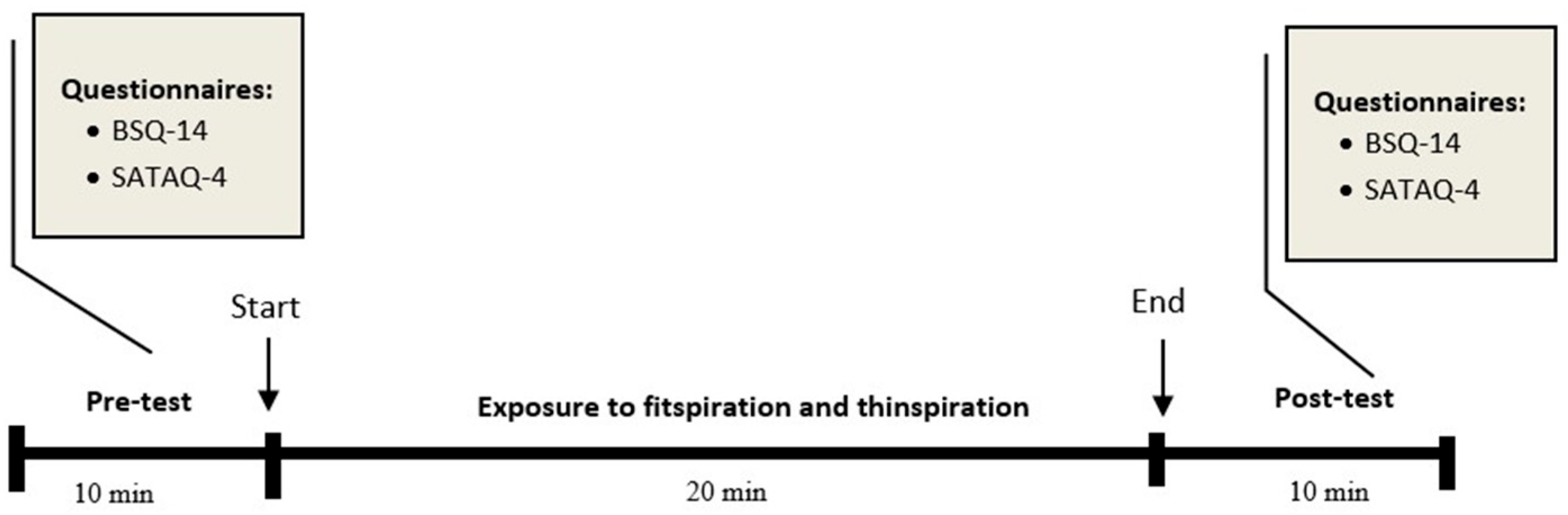
Guided by the TIM, to address the research gaps argued above, the primary aim of the present study was to examine the influence of the online exposure to fitspiration and thinspiration images on body image preoccupation in women and men. Given the TIM, which identifies media, peers, and family as the primary sources of appearance-related pressures and the internalization of the thin and muscled ideals, the secondary aim of this study was to explore the influence of the online exposure to fitspiration and thinspiration images on appearance-related pressures and the internalization of esthetics ideals by family, peers and traditional media.
Recognizing that social media has become a major source of appearance pressure in the digital age, in addition to the original sources proposed in the tripartite influence model, this study also measured the amount of time participants spent using social media, such as Instagram.
The TIM directly guided the selection of the study variables. Online exposure to fitspiration and thinspiration images was conceptualized as a specific manifestation of social media influence. Body image preoccupation was identified as a primary outcome variable consistent with the model’s emphasis on body-related concerns. Furthermore, appearance-related pressures and the internalization of esthetic ideals from family, peers, and traditional media were included as theoretically grounded variables, reflecting the tripartite sources of influence outlined in the model.
Based on the literature explored above and the TIM, it was hypothesized that: (1) viewing online fitspiration and thinspiration images would affect body image preoccupation in both women and men, comparing this construct before and after online exposure to these types of images, and (2) in both groups, viewing online fitspiration and thinspiration images would affect both perceived appearance-related pressures by family, peers and traditional media and the internalization of thin and muscled ideals related to these sources of social influence. Due to the limited amount of the previous literature specifically focused on body image preoccupation, and due to the fact that most studies were conducted in a sample of women, specific hypotheses taking gender into account were not made.
4. Discussion
The main aims of the present study were two: (1) to examine the influence of online exposure to fitspiration and thinspiration images on body image preoccupation in women and men, and (2) to explore the influence of online exposure to these types of images on appearance-related pressures and the internalization of esthetic ideals by family, peers and traditional media in a group of women and men.
As regards the first aim of this study, we found that the body image preoccupation of women decreased after the online exposure to fitspiration and thinspiration images, whereas it increased in men. Post hoc comparisons confirmed this result for women but did not confirm it for men; this may be due to the differences between the pre- and post-test measures in the male group being too small to remain statistically significant after adjustments for multiple comparisons.
However, it is challenging to interpret these findings in comparison with previous results, as the majority of past research has primarily examined body image and body dissatisfaction in relation to the online exposure to fitspiration and thinspiration images, whereas body image preoccupation has not been sufficiently investigated, as stated in the introduction of this paper. Thus, the present study introduces a novel perspective to the literature on gender differences in body image, suggesting a reverse trend when body image preoccupation is specifically evaluated. In the literature, it is documented that females generally have a higher level of body dissatisfaction than males (
He et al., 2020;
Prichard et al., 2020;
Yee et al., 2020); instead, this study shows that men exhibit greater body image preoccupation than women following online exposure to fitspiration and thinspiration images. However, caution is needed to interpret this finding, because it is just not clearly stated.
This sex-based result may be since we specifically measured body image preoccupation before and after online exposure to fitspiration and thinspiration images. Hence, the present study suggests specifically investigating body image preoccupation to observe and reveal gender differences related to fitspiration and thinspiration online content.
As regards the second aim of the present study, we found that, following online exposure to fitspiration and thinspiration images, both men and women showed a decreased adherence to sociocultural attitudes promoting extreme thinness as a beauty ideal. This result is in line with previous studies (
Blowers et al., 2003;
Yee et al., 2020), which highlighted the role of online contents in internalizing thinness as the ideal body type and how they influence its affirmation. We also found that the internalization of the muscled ideals decreased in the men after online exposure to fitspiration and thinspiration images, whereas it increased in women. This result could be explained by the fact that males generally have a higher level of body appreciation than females (
Jerónimo & Carraça, 2022).
As regards appearance-related pressures by family, peers and traditional media, we found that online exposure to fitspiration and thinspiration images led to a reduction in perceived family related appearance in both groups. We also found no significant group differences in appearance-related pressures by peers. Interestingly, we found that men reported increased perceived media-related appearance pressure from pre-test to post-test, whereas women showed no significant change across the two phases. This result is consistent with predictions of the TIM and data in the literature (
Cataldo et al., 2021;
Thompson et al., 1999), indicating that men who viewed muscular media stimuli showed higher body dissatisfaction than women.
In line with the TIM’s assumptions, the findings of this study confirmed that appearance-based pressures from parents and media contribute to body image preoccupation in different levels (increase or decrease) among women and men. Our findings did not confirm appearance-based pressures from peers both in women and men. Probably, the pressure from peers has a greater influence in adolescents and not in young adults, which were the sample of this study (
Jarman et al., 2021). With reference to the mechanisms of the TIM, our findings demonstrated that online exposure to fitspiration and thinspiration images contributed to the internalization of appearance ideals in women and men, but only the internalization of the muscled ideals showed an increase.
The present study implies some methodological considerations, unlike the study by
Krug et al. (
2020), which employed different measurement tools in the pre- and post-test phases; the present study used the same instruments before and after image exposure (i.e., in pre- and post- test phases). This approach minimized the risk of confounding variables, enabled a direct assessment of the effects of image exposure, and facilitated comparison with the baseline.
However, the present study has some limitations related to methodology. The absence of a control group exposed to neutral images prevents a clear comparison between the effects of fitspiration/thinspiration images and non-influential images. This study only measured the immediate influence of image exposure, without considering whether this influence persists in the long term. Future studies could replicate this study, inserting a follow-up phase, or could conduct longitudinal studies to examine the long-term influence of exposure to fitspiration and thinspiration images on body image preoccupation. Moreover, future studies could include a control group exposed to neutral images to enhance the internal validity of the study or also administer neutral images to all groups. It is also important to further explore the use of diversified measurement tools, such as physiological or behavioural assessments, to reduce subjective bias and gain a more comprehensive understanding of the effects of images on participants. Finally, future research should examine the influence of moderating factors, such as initial self-esteem or critical thinking ability, to determine how these factors may affect vulnerability to the negative effects of fitspiration and thinspiration images.
This study has some practical implications for behavioural and mental health, since it reinforces the importance of promoting media literacy and encouraging critical reflection on social media content to mitigate negative influences on body image and to promote individual well-being in both sexes. Educators and practitioners should explicitly include men in media literacy and media education interventions about body image in online contents. They should avoid framing body image as a “women’s issue” and use gender-inclusive language. Also, they should promote the discussion of male body image concerns in educational and clinical settings, using male examples and testimonials where appropriate.
Funding
This research was funded by the PRIN2022 European Union-Next Generation EU. (project code: 20229R3JMA, grant number or CUP: B53D23014420008).
Institutional Review Board Statement
The study was conducted in accordance with the Declaration of Helsinki, and approved by the Ethics Committee of Link Campus University (protocol code 1077/2025 and 16 June 2025).
Informed Consent Statement
Informed consent was obtained from all subjects involved in the study.
Data Availability Statement
The data presented in this study are available on request from the corresponding author due to privacy reasons.
Conflicts of Interest
The author declares no conflicts of interest.
References
- Ardi, Z., & Putri, S. A. (2020). The analysis of the social media impact on the millennial generation behavior and social interactions. Southeast Asian Journal of Technology and Science, 1(2), 70–77. [Google Scholar] [CrossRef]
- Arrington, A. (2021). Exploring the relationship among social media use, body image, and gender. Journal of Undergraduate Research, 18, 151–156. [Google Scholar]
- Askew, A. J., Peterson, C. B., Crow, S. J., Mitchell, J. E., Halmi, K. A., Agras, W. S., & Haynos, A. F. (2020). Not all body image constructs are created equal: Predicting eating disorder outcomes from preoccupation, dissatisfaction, and overvaluation. International Journal of Eating Disorders, 53(6), 954–963. [Google Scholar] [CrossRef]
- Barnes, K., Newman, E., & Keenan, G. (2023). A comparison of the impact of exposure to fit ideal and non-fit ideal body shapes in fitspiration imagery on women. Computers in Human Behavior, 144, 107728. [Google Scholar] [CrossRef]
- Blowers, L. C., Loxton, N. J., Grady-Flesser, M., Occhipinti, S., & Dawe, S. (2003). The relationship between sociocultural pressure to be thin and body dissatisfaction in preadolescent girls. Eating Behaviors, 4(3), 229–244. [Google Scholar] [CrossRef]
- Brady, W. J., & Crockett, M. J. (2024). Norm psychology in the digital age: How social media shapes the cultural evolution of normativity. Perspectives on Psychological Science, 19(1), 62–64. [Google Scholar] [CrossRef] [PubMed]
- Bunker, C. J., & Kwan, V. S. (2024). Similarity between perceived selves on social media and offline and its relationship with psychological well-being in early and late adulthood. Computers in Human Behavior, 152, 108025. [Google Scholar] [CrossRef]
- Castellanos Silva, R., & Steins, G. (2023). Social media and body dissatisfaction in young adults: An experimental investigation of the effects of different image content and influencing constructs. Frontiers in Psychology, 14, 1037932. [Google Scholar] [CrossRef]
- Cataldo, I., De Luca, I., Giorgetti, V., Cicconcelli, D., Bersani, F. S., Imperatori, C., Abdi, S., Negri, A., Esposito, G., & Corazza, O. (2021). Fitspiration on social media: Body-image and other psychopathological risks among young adults. A narrative review. Emerging Trends in Drugs, Addictions, and Health, 1, 100010. [Google Scholar] [CrossRef]
- Fabio, R. A., & Suriano, R. (2023). The influence of smartphone use on tweens’ capacity for complex critical thinking. Children, 10(4), 698. [Google Scholar] [CrossRef]
- Fardouly, J., Diedrichs, P. C., Vartanian, L. R., & Halliwell, E. (2015). Social comparisons on social media: The impact of Facebook on young women’s body image concerns and mood. Body Image, 13, 38–45. [Google Scholar] [CrossRef]
- Goldfein, J. A., Walsh, B. T., & Midlarsky, E. (2000). Influence of shape and weight on self-evaluation in bulimia nervosa. International Journal of Eating Disorders, 27(4), 435–445. [Google Scholar] [CrossRef]
- Gonzaga, I., Ribovski, M., Claumann, G. S., Folle, A., Beltrame, T. S., Laus, M. F., & Pelegrini, A. (2023). Secular trends in body image dissatisfaction and associated factors among adolescents (2007–2017/2018). PLoS ONE, 18(1), e0280520. [Google Scholar] [CrossRef]
- Gualdi-Russo, E., Rinaldo, N., Masotti, S., Bramanti, B., & Zaccagni, L. (2022). Sex differences in body image perception and ideals: Analysis of possible determinants. International Journal of Environmental Research and Public Health, 19(5), 2745. [Google Scholar] [CrossRef]
- Hamid, R. S., Ukkas, I., Goso, G., Abror, A., Anwar, S. M., & Munir, A. R. (2024). The role of social media in building trust, self-perceived creativity and satisfaction for millennial entrepreneurs. Journal of Small Business and Enterprise Development, 31(2), 377–394. [Google Scholar] [CrossRef]
- Hazzard, V. M., Schaefer, L. M., Schaumberg, K., Bardone-Cone, A. M., Frederick, D. A., Klump, K. L., Anderson, D. A., & Thompson, J. K. (2019). Testing the tripartite influence model among heterosexual, bisexual, and lesbian women. Body Image, 30, 145–149. [Google Scholar] [CrossRef]
- He, J., Sun, S., Zickgraf, H. F., Lin, Z., & Fan, X. (2020). Meta-analysis of gender differences in body appreciation. Body Image, 33, 90–100. [Google Scholar] [CrossRef] [PubMed]
- Heider, N., Spruyt, A., & De Houwer, J. (2018). Body dissatisfaction revisited: On the importance of implicit beliefs about actual and ideal body image. Psychologica Belgica, 57(4), 158–173. [Google Scholar] [CrossRef]
- Hogue, J., Minister, C., Samson, L., Campbell, G., & Mills, J. (2023). Young women’s dialectical responses to fitspiration and thinspiration: A qualitative study. Eating Behaviors, 50, 101758. [Google Scholar] [CrossRef] [PubMed]
- Jarman, H. K., Marques, M. D., McLean, S. A., Slater, A., & Paxton, S. J. (2021). Motivations for social media use: Associations with social media engagement and body satisfaction and well-being among adolescents. Journal of Youth and Adolescence, 50(12), 2279–2293. [Google Scholar] [CrossRef]
- Javier, S. J., & Belgrave, F. Z. (2015). An examination of influences on body dissatisfaction among Asian American college females: Do family, media, or peers play a role? Journal of American College Health, 63(8), 579–583. [Google Scholar] [CrossRef]
- Jerónimo, F., & Carraça, E. V. (2022). Effects of fitspiration content on body image: A systematic review. Eating and Weight Disorders-Studies on Anorexia, Bulimia and Obesity, 27(8), 3017–3035. [Google Scholar] [CrossRef] [PubMed]
- Karazsia, B. T., van Dulmen, M. H., Wong, K., & Crowther, J. H. (2013). Thinking meta-theoretically about the role of internalization in the development of body dissatisfaction and body change behaviors. Body Image, 10(4), 433–441. [Google Scholar] [CrossRef]
- Krug, I., Selvaraja, P., Fuller-Tyszkiewicz, M., Hughes, E. K., Slater, A., Griffiths, S., Yee, Z. W., Richardson, B., & Blake, K. (2020). The effects of fitspiration images on body attributes, mood and eating behaviors: An experimental Ecological Momentary Assessment study in females. Body Image, 35, 279–287. [Google Scholar] [CrossRef]
- Laughter, M. R., Anderson, J. B., Maymone, M. B., & Kroumpouzos, G. (2023). Psychology of aesthetics: Beauty, social media, and body dysmorphic disorder. Clinics in Dermatology, 41(1), 28–32. [Google Scholar] [CrossRef]
- Lee, A. Y., & Hancock, J. T. (2024). Social media mindsets: A new approach to understanding social media use and psychological well-being. Journal of Computer-Mediated Communication, 29(1), zmad048. [Google Scholar] [CrossRef]
- Lee, Y. L., & Cheng, S. H. (2020). Gender differences in body image, body mass index and dietary intake among university students. Pertanika Journal of Social Sciences & Humanities, 28, 2213–2238. [Google Scholar]
- Limniou, M., Mahoney, C., & Knox, M. (2021). Is fitspiration the healthy internet trend it claims to be? A British students’ case study. International Journal of Environmental Research and Public Health, 18(4), 1837. [Google Scholar] [CrossRef]
- Matera, C., Nerini, A., & Stefanile, C. (2013). Assessing body dissatisfaction: Validation of the Italian version of the body shape questionnaire-14 (BSQ-14). Counseling, 1, 235–244. [Google Scholar]
- Mingoia, J., Hutchinson, A. D., Wilson, C., & Gleaves, D. H. (2017). The relationship between social networking site use and the internalization of a thin ideal in females: A meta-analytic review. Frontiers in Psychology, 8, 239871. [Google Scholar] [CrossRef]
- Mitchison, D., Hay, P., Griffiths, S., Murray, S. B., Bentley, C., Gratwick-Sarll, K., Harrison, C., & Mond, J. (2017). Disentangling body image: The relative associations of overvaluation, dissatisfaction, and preoccupation with psychological distress and eating disorder behaviors in male and female adolescents. International Journal of Eating Disorders, 50(2), 118–126. [Google Scholar] [CrossRef]
- Prichard, I., Kavanagh, E., Mulgrew, K. E., Lim, M. S., & Tiggemann, M. (2020). The effect of Instagram# fitspiration images on young women’s mood, body image, and exercise behaviour. Body Image, 33, 1–6. [Google Scholar] [CrossRef]
- Roberts, S. R., Maheux, A. J., Hunt, R. A., Ladd, B. A., & Choukas-Bradley, S. (2022). Incorporating social media and muscular ideal internalization into the tripartite influence model of body image: Towards a modern understanding of adolescent girls’ body dissatisfaction. Body Image, 41, 239–247. [Google Scholar] [CrossRef]
- Schaefer, L. M., Burke, N. L., Thompson, J. K., Dedrick, R. F., Heinberg, L. J., Calogero, R. M., Bardone-Cone, A. M., Higgins, M. K., Frederick, D. A., Kelly, M., Anderson, D. A., Schaumberg, K., Nerini, A., Stefanile, C., Dittmar, H., Clark, E., Adams, Z., Macwana, S., Klump, K. L., … Swami, V. (2015). Development and validation of the sociocultural attitudes towards appearance questionnaire-4 (SATAQ-4). Psychological Assessment, 27(1), 54. [Google Scholar] [CrossRef]
- Scully, M., Swords, L., & Nixon, E. (2023). Social comparisons on social media: Online appearance-related activity and body dissatisfaction in adolescent girls. Irish Journal of Psychological Medicine, 40(1), 31–42. [Google Scholar] [CrossRef]
- Shagar, P. S., Donovan, C. L., Loxton, N., Boddy, J., & Harris, N. (2019). Is thin in everywhere?: A cross-cultural comparison of a subsection of Tripartite Influence Model in Australia and Malaysia. Appetite, 134, 59–68. [Google Scholar] [CrossRef] [PubMed]
- Soraci, P., Ferrari, A., Bonanno, E., Rosanna, D. P., Repice, E., & Griffiths, M. D. (2020). Psychometric validation of the internet disorder scale–short form in an Italian adult sample. International Journal of Mental Health and Addiction, 2020, 2571–2586. [Google Scholar] [CrossRef]
- Stefanile, C., Nerini, A., Matera, C., Schaefer, L. M., & Thompson, J. K. (2019). Validation of an Italian version of the sociocultural attitudes towards appearance questionnaire-4-revised (SATAQ-4R) on non-clinical Italian women and men. Body Image, 31, 48–58. [Google Scholar] [CrossRef]
- Thompson, J. K., Heinberg, L. J., Altabe, M., & Tantleff-Dunn, S. (1999). Exacting beauty: Theory, assessment, and treatment of body image disturbance. American Psychological Association. [Google Scholar] [CrossRef]
- Valutis, S. A., Goreczny, A. J., Abdullah, L., Magee, E., & Wister, J. A. (2009). Weight preoccupation, body image dissatisfaction, and self-efficacy in female undergraduates. Journal of Psychiatry, Psychology and Mental Health, 3(1), 1–11. [Google Scholar]
- Vandenbosch, L., Fardouly, J., & Tiggemann, M. (2022). Social media and body image: Recent trends and future directions. Current Opinion in Psychology, 45, 101289. [Google Scholar] [CrossRef] [PubMed]
- Yee, Z. W., Griffiths, S., Fuller-Tyszkiewicz, M., Blake, K., Richardson, B., & Krug, I. (2020). The differential impact of viewing fitspiration and thinspiration images on men’s body image concerns: An experimental ecological momentary assessment study. Body Image, 35, 96–107. [Google Scholar] [CrossRef] [PubMed]
- Zaccagni, L., Rinaldo, N., Bramanti, B., Mongillo, J., & Gualdi-Russo, E. (2020). Body image perception and body composition: Assessment of perception inconsistency by a new index. Journal of Translational Medicine, 18, 1–8. [Google Scholar] [CrossRef] [PubMed]
- Zhou, L., Jin, F., Wu, B., Chen, Z., & Wang, C. L. (2023). Do fake followers mitigate influencers’ perceived influencing power on social media platforms? The mere number effect and boundary conditions. Journal of Business Research, 158, 113589. [Google Scholar] [CrossRef]
| Disclaimer/Publisher’s Note: The statements, opinions and data contained in all publications are solely those of the individual author(s) and contributor(s) and not of MDPI and/or the editor(s). MDPI and/or the editor(s) disclaim responsibility for any injury to people or property resulting from any ideas, methods, instructions or products referred to in the content. |