Article

News Framing of Assisted Death Through Argument Structures in Portugal and the United Kingdom

by
Bruno Frutuoso Costa
1,2
1
Centre for Research and Studies in Sociology (CIES-Iscte), Iscte-University Institute of Lisbon, 1649-026 Lisbon, Portugal
2
School of Journalism, Media and Culture (JOMEC), Cardiff University, Cardiff CF10 1FS, UK
Journal. Media 2026, 7(1), 16; https://doi.org/10.3390/journalmedia7010016
Submission received: 21 November 2025 / Revised: 30 December 2025 / Accepted: 21 January 2026 / Published: 24 January 2026

Abstract

The news framing of assisted death in Portugal and the United Kingdom from 2016 to 2024 was analyzed across two dimensions. The first examined the overall frames through source positions and occupations. The second observed argumentative structures by coding argument characteristics: manifestation, origin, level, and evaluation. A total of 7464 structures were identified from 1731 published stories in Expresso, Público, The Guardian, and The Telegraph. The research utilized a methodological framework based on framing theory, creating direct connections between frame analysis and argumentative structures to improve the validity of valence and thematic framing mechanisms. The findings indicated significant differences between countries. The Portuguese news media showed a marked inclination to present concentrated opposing arguments with a higher argumentative density. In contrast, British newspapers displayed a greater diversity of arguments in favor of assisted death, along with a more cohesive representation among pro-assisted death sources. Three distinct argumentative profiles were identified, each showing different divisions between Portugal and the UK. These results reveal that argumentative structures in assisted death coverage reflect deeper systemic values and news media structures, positioning these quality newspapers as influential actors in representing arguments about moral legitimacy around bioethical issues. The study makes a valuable contribution by offering a comprehensive understanding of how these four newspapers frame arguments about assisted death while proposing an innovative analytical model applicable to comparative studies of other news media.

1. Introduction

Researchers have well documented how the news media provide health-related information and reduce risky behaviors and mentalities among the population (Araújo et al., 2016). Assisted death is widely regarded as the right to die without pain or suffering, accompanied by medical assistance and personal consent (Monteiro, 2020). It is a topic that is frequently covered in news media, as it possesses several news values that guide the journalistic routine (Harcup & O’Neill, 2001). Key news values that lead a journalist to choose to report on assisted death include negativity, surprise, the disruption of the natural order, social significance, and thought-provoking responses from different institutions. The choice to compare news coverage between Portugal and the United Kingdom offers a methodological design for examining how news media systems across different institutional and cultural contexts frame bioethical debates (Costa et al., 2026b). These two countries represent distinct news media system models within the Western context. Drawing on Hallin and Mancini’s framework, Portugal exemplifies the Mediterranean or polarized pluralist model, in which news media systems exhibit greater political parallelism and remain more permeable to institutional and ideological influence (Fernández-Viso & Fernández-Alonso, 2024; Hallin & Mancini, 2004). The United Kingdom exemplifies the liberal model, characterized by professional autonomy, market-driven dynamics, and minimal state intervention (Hallin & Mancini, 2004). Beyond media structure, these countries differ in institutional arrangements relevant to assisted death coverage (Costa et al., 2026b). Portugal established a public palliative care system in 2004 with significantly constrained resources compared to the UK (Resolução do Conselho de Ministros n.º 129/2001, 2001; Marques et al., 2023). The UK instituted formal palliative care in 1967 through the founding of St. Christopher’s Hospice and maintains extensive accessibility to end-of-life services (Saunders, 2008). Legislatively, Portugal approved its law on assisted death in 2023 (Lei n. º 22/2023, 2023), whereas the UK Parliament continues developing policy on assisted death (BBC, 2025). These contextual differences—institutional, legislative, and healthcare-related—create a theoretically meaningful comparison. Additionally, language differences matter for this study. Portuguese and English possess distinct linguistic conventions for framing moral concepts (Pan, 2024). Argumentative structures, the primary analytic unit of this research, are shaped by linguistic and cultural traditions (Sinelnik & Hovy, 2024). A comparison across a full European Union context would obscure these language-specific dynamics and fragment the analytical depth required to examine how argumentative logic operates within distinct linguistic cultures. Research demonstrates that news media framing differs across linguistic contexts, particularly for morally contested topics (Costa et al., 2025; Sinelnik & Hovy, 2024). Restricting the analysis to two countries with different news media systems, institutional contexts, and linguistic traditions allows for a systematic examination of how news media argumentatively construct legitimacy around bioethical issues while controlling macro-level variables and maintaining methodological coherence.
The two countries have pursued different legislative pathways. Portugal’s legalization process proved more contentious, with Parliament approving the legislation in May 2023 (Lei n. º 22/2023, 2023) after a lengthy legislative process involving multiple versions of the bill, several Constitutional Court reviews, and presidential vetoes. The approved “medically assisted death” framework permits two distinct practices: medically assisted suicide, where individuals self-administer medication under medical supervision, and voluntary active euthanasia, where physicians administer the lethal medication. In contrast, the British Parliament is considering the “Terminally Ill Adults (End of Life) Bill”, which permits terminally ill individuals to self-administer physician-prescribed medication. The bill progressed through Commons approval in June 2025 and now faces House of Lords scrutiny (BBC, 2025). The 2022 European Values Study reveals that the Portuguese adult population exhibited an average justification for assisted death of 4.86 points on a scale ranging from 1 to 10 (1 representing “never justified” and 10 signifying “always justified”). The British adult population showed an average justification for assisted death of 6.55 points (Costa, 2025). These contextual and legislative differences—Portugal’s broader legalized framework versus the United Kingdom’s narrower, patient-centered approach still under deliberation—occur within different public contexts, where British citizens express greater acceptance of assisted death than their Portuguese counterparts.
A substantial body of research has demonstrated that news media framings exert a significant influence on the public’s perception of the gravity of various illnesses (Young et al., 2013), the risks associated with contracting diseases (Niu et al., 2020), behavioral patterns related to seeking medical assistance (Grilli et al., 2002), and the reduction in prejudice connected to illnesses (Clement et al., 2013). Concurrently, news media framing can function as a catalyst for the intensification of pre-existing attitudes (Mo Jang, 2019). For instance, news media coverage of suicide methods can increase the risk of imitative suicide (Gould et al., 2003). In addition to influencing perceptions of illness, news media framings create additional psychological effects, including increased death anxiety (Chen et al., 2022), elevated crime rates (Capellan et al., 2020), desensitization to violent death (Thomas, 2023), and the aspiration for self-knowledge concerning one’s own mortality (Khoo, 2018). While research on news media framing of end-of-life issues has accumulated over two decades (Brassolotto et al., 2023; Holody, 2011), comparative analysis of how news media construct legitimacy around assisted death across distinct news media systems remains underdeveloped (Costa et al., 2025). Existing evidence suggests that contextual, affective, and situational factors influence public perception of end-of-life issues (Van Brussel, 2018), yet most studies have focused on single-country contexts rather than examining how structural news media system differences shape argumentative framing (Costa et al., 2025).
Framing is defined as the selection of specific aspects of a perceived reality in favor of a particular perspective (Entman, 1993). As a vehicle of power that constructs social reality and establishes a link between the production and consumption of news (Graber, 1989), frames offer their audience a common way of evaluating the world and creating collective identities (Brekhus, 2015). In practice, frames serve four key functions: defining the problem, interpreting causes, making moral assessments, and recommending solutions. Their relevance is especially pronounced in topics such as assisted death, where a range of arguments, interpretations, values, and interests vie for prominence in the journalistic coverage. The arguments for and against assisted death can be categorized into 11 dimensions (Table 1) (Costa et al., 2025; Nunes et al., 2020). The 11-dimensional framework presented here consolidates previous categorical systems for organizing assisted death arguments. Five dimensions represent arguments typically expressed favorably toward assisted death legalization (autonomy and self-determination, dignity and suffering, legal and ethical issues, social and ethical concerns, and other arguments). Six dimensions represent arguments expressed as concerns or opposition (respect for human life, palliative medicine and redemptive suffering, ethical and legal issues, concerns about process and consequences, health network and alternatives, and other arguments). This organization integrates the foundational argument taxonomy developed by the Portuguese National Council of Ethics for Life Sciences (CNECV) (Nunes et al., 2020) and a scoping review of how news media frames present these arguments across 30 international studies (Costa et al., 2025). Each dimension represents a thematic cluster of arguments identified across these sources, organized by argumentative direction (favorable vs. unfavorable to assisted death legalization).
Research on argumentative structures within news frames is currently fragmented and requires a cohesive theoretical framework (Costa et al., 2025). Argumentative structures refer to the ways in which arguments are constructed, expressed, and evaluated in news frames. The structures of arguments include the degree of manifestation (explicit, implicit, or fallacious), the origin of the argument (whether it is a direct quotation or the source’s own formulation), the level of citation (first, second, or third degree), and how the argument is evaluated by other sources of information (Weiss, 1992). Consequently, this study did not formulate hypotheses and instead adopted an exploratory approach. The study’s objective was to analyze the framing of assisted death through the argumentative structures of news coverage in Portugal and the UK between 2016 and 2024. However, the research was grounded in the theoretical expectation that there could be significant differences in the structure of arguments between Portugal and the UK. This assertion was based on the recognition of the divergent characteristics inherent in the news media systems and journalistic cultures (Hallin & Mancini, 2004; Hanitzsch, 2007). It was anticipated that these distinctions could be further influenced by contextual disparities in health systems, legal frameworks, and public opinion (Brassolotto et al., 2023). This study sought to address the following research questions:
RQ1.
How are the arguments for and against assisted death framed in news coverage of Portugal and the UK?
RQ2.
What are the differences between Portugal and the UK in the degree of manifestation, origin, level, and evaluation of arguments about assisted death?
RQ3.
How do the news sources’ positions differ across the newspapers?
RQ4.
What argumentative profiles emerge in the coverage of assisted death in Portugal and the UK?

2. News Frames and Assisted Death Argumentation

Journalistic coverage of assisted death has been framed through moral, medical, legal, and political dimensions, reflecting broader social values that vary according to the political, economic, and cultural contexts of each country (Brassolotto et al., 2023; Weicht & Forchtner, 2023). In Western news media, there are recurring dichotomies, such as the “right to die” versus the “defense of life” (Booth & Blake, 2022). The use of dramatized and personalized frames focused on autonomy, physical suffering, and dignity in death has also been noted (McInerney, 2006, 2007). This type of coverage has been observed to value individual agencies and silence structural debates about palliative care or inequalities in access to a “good death” (Woodthorpe, 2014). In certain nations, such as the UK, a technocratic frame is prioritized, with a focus on legal and medical arguments, frequently depoliticizing the subject and marginalizing ambivalence (Banerjee & Birenbaum-Carmeli, 2007). In the United States of America, coverage ranges from episodic to thematic frames, reinforcing the idea of choice as a core value (Lauffer & Baker, 2020). Research conducted in Colombia and Canada has revealed a gap between the dominant news media frames surrounding palliative care and the sentiments expressed by the public. This discrepancy suggests potential biases in how sources are utilized and how favorable or opposing arguments are assessed (Burlone & Richmond, 2018; Sarmiento-Medina et al., 2019). In Spain, the tone, form, and content of arguments demonstrate a robust influence on framing. Those in favor employ emotional appeals, while those against resort to legal or bioethical grounds (Usanos et al., 2025). Collectively, these studies illustrate that news media framing of assisted death reflects universal patterns—such as the recurring tension between individual autonomy and the sanctity of life—and national variation shaped by news media systems, political cultures, and the strategic rhetorical choices of competing actors.
Assisted death remains a highly controversial issue, given its moral implications and the ethical, religious, legal, and cultural issues it raises. Contemporary society is characterized by contentious debates surrounding a range of issues, including individual autonomy, the sanctity of life, the role of medicine, and the limits of state intervention. These issues have led to a heightened level of sensitivity and political polarization in public discourse (Crumley et al., 2019; Smer, 2024). This debate occurs within a news media landscape described as polylogue, where various discursive actors compete for legitimacy, presenting differing interpretations, values, and interests (Aakhus et al., 2016). Consequently, the analysis of argumentation is a fruitful method for understanding how framing structures operate. Arguments serve the fundamental functions of frames, which include defining the problem, identifying causes, making moral judgments, and proposing solutions (Entman, 1993). Additionally, these arguments influence the visibility and acceptability of specific social practices. They are central instruments in the construction of moral legitimacy (Weicht & Forchtner, 2023).
More broadly, argumentation theory is part of an effort to reconstruct and evaluate how reasons are presented and contested in public arenas (Weiss, 1992; Lewiński, 2014). While this theory has normative roots, recent studies indicate that descriptive approaches that value context, performativity, and the discursive effects of argumentative structures in news media debate environments are also applicable (Aakhus & Lewiński, 2011). Yet applying argumentation theory to assisted death requires attending to deeper bioethical, philosophical, and sociological complexities. In the context of bioethical deliberation in news media, it is imperative to attend to the bioethical critique of the overvaluation of autonomy as an absolute value, cautioning against the perils of biopower and the obscurity of vulnerability (Petersen & Dige, 2023; Tsiakiri, 2022). The philosophy of autonomy also addresses the limits of self-determination when mediated by social pressures or structural inequalities (Richards, 2025). Equally, the sociology of death highlights how dignity and the sense of autonomy are influenced by social class, cultural norms, and religious values, often stated by elites (Bingley et al., 2006; Menezes, 2023). These interdisciplinary perspectives clarify why news media analysis becomes essential. In this context, news media assume a dual role: they serve as a mirror to society’s ongoing debates while concurrently shaping the moral and political landscape surrounding death.

3. Method

3.1. Sample and Procedures

The data for this study were news stories on assisted death (n = 1731) published on the digital platforms of the Portuguese newspapers Expresso (n = 616) and Público (n = 502) and on the British newspapers The Guardian (n = 400) and The Telegraph (n = 213). The stories included a variety of forms, such as news, extended interpretative journalism, interviews, editorials, opinion columns, and letters to the editor. The selection of these news media was predicated primarily on their status as quality newspapers. These newspapers were also the most widely read established traditional news media in each country. A similar rationale supported their selection due to their dominance in the online news sector, an observation evidenced by the highest number of paying customers (Newman et al., 2025). Recognizing the prevalent assumption of Portuguese newspapers as politically impartial (Costa & Antunes, 2024), two British newspapers, The Guardian and The Telegraph, were selected to represent the center-left and center-right political spectrums, respectively (Garcia-Blanco & Bennett, 2021). This decision was made with the objective of ensuring a more extensive ideological diversity of sources and averting potential bias in the results. The Sunday editions of The Observer (The Guardian’s sister newspaper) and The Sunday Telegraph (The Telegraph’s sister newspaper) were also included based on their distinct characteristics. These newspapers are independent of their weekday counterparts, have different journalists in their newsrooms, and often take divergent political positions.
The stories were published between 1 January 2016 and 1 January 2024. This timeframe comprises the two years preceding the introduction, deliberation, and vote on the inaugural bill to decriminalize assisted death in the Portuguese parliament (2018). It also signifies the period when academic research on the British news media’s coverage of assisted death is lacking (Costa et al., 2025). A researcher specializing in programming was asked to develop a tool for automatically extracting stories from newspaper websites. The objective underlying the provision of this instrument was twofold. Firstly, it was to provide the necessary resources for the present study. Secondly, it was to ensure the availability of the instrument for future research endeavors. The Guardian/The Observer API constituted the sole means of creating software in Python (version 3.12.10), with the newspaper’s team aiding during the iterative programming process (Santos, 2024). The search engines of the other newspapers’ websites were manually utilized to extract the stories. A comprehensive collection of stories including the following terms was conducted: “euthanasia,” “medically assisted death,” “assisted suicide,” “assisted death,” “palliative care,” “pain and agony,” “end-of-life care,” “terminal illness,” “mercy killing,” “right to die,” “euthanasia tourism,” “death tourism,” “assisted suicide abroad,” and “suicide travel.” These stories were then subjected to a subsequent phase of analysis, during which any that did not feature assisted death as a central theme were excluded from the sample.

3.2. Variables

The study analyzes the news framing of assisted death across two dimensions. The first dimension examines overall frames through source positions and occupations. The second dimension explores argumentative structures by examining their key characteristics: manifestation, origin, level, and evaluation. The study adopted a methodological approach that aligns with the recommendations of Matthes and Kohring (2008). It is grounded in the theoretical framework positing that news frames unveil underlying patterns in news media discourse, which have the capacity to influence the public (D’Angelo, 2002). The method entailed a direct linkage between the framing analysis and objective textual indicators, particularly argumentative structures. The objective was to enhance the validity of the analysis concerning valence framing and thematic framing mechanisms (Entman, 1993; Goffman, 1974). The initial component includes the positive, neutral, or negative representation of assisted death. The latter pertains to the justification of assisted death.
Each unit of analysis corresponded to an individually coded story. The variables were constructed from the seminal work of Weiss (1992) to enable content analysis (Krippendorff, 2019), drawing on methodological precedent established by Holody (2011) in news media framing analysis of bioethical issues. The initial coding of the stories was based on three variables: the country of publication (Portugal and the UK), the newspaper (Expresso, Público, The Guardian, and The Telegraph), and the occupation of the information sources (head of state, politicians and public officials, specialists, religious figures, health and social workers, other professionals, citizens, and unidentified).
The arguments were coded based on their content and systematically organized into categorized lists. The argument categories were derived from a synthesis of empirical news media analysis and ethical framework development. Research in media studies has revealed common patterns in the way arguments about assisted death are presented in news coverage (Rietjens et al., 2013; Sarmiento-Medina et al., 2019). These empirically identified patterns were subsequently formalized through comprehensive ethical analysis and systematic taxonomy development, particularly the framework established by the CNECV (Nunes et al., 2020). This integration of empirical news media patterns and ethical formalization provides the foundation for my coding framework, which is further grounded in a recent scoping review mapping how these argument dimensions appear across 30 international studies of journalism and assisted death (Costa et al., 2025). Table 3 and Table 4 present these lists. One variable compiled the arguments in favor of assisted death. Another addressed the arguments against it. The table presented in the introduction offers a consolidated overview of the arguments organized by conceptual dimension. The argument dimensions presented in Table 1 are not mutually exclusive. A single news story could present multiple arguments from different dimensions, reflecting the complexity of journalistic discourse on assisted death. For example, a story might have both arguments for and against assisted death. Each argument instance was coded independently of others appearing in the same story. Consequently, the total count of arguments coded (n = 7464) exceeds the number of stories analyzed (n = 1731), with an average of 4.3 argument instances per story. This approach allows for analysis of argumentative density—how many distinct justifications appear within each story—while recognizing that real journalistic texts rarely present a single, isolated argument.
The position of the information sources in relation to assisted death was coded as “against” when it denoted the mobilization of arguments against the practice. The stance was coded as “neutral” when it was informative. The position was classified as “in favor” when it indicated the use of arguments supporting the practice. The designation of “not applicable” was applied when it was unclear whether a source adopted a position due to conflicting arguments. Furthermore, the story was marked as “not applicable” in instances where it failed to present any arguments. The assignment of source positions in Table 2 was derived from the prevalence of arguments identified in Table 3 and Table 4. For each information source, all arguments were first identified and categorized by their dimension. The source’s overall position was then determined based on argument count: if a source presented more favorable arguments, the position was assigned as “in favor”; if unfavorable arguments predominated, the position was coded as “against”; if arguments balanced in number or were absent, the position was coded as “neutral” or “not applicable”. This procedure means that Table 2 represents a synthesis of the argumentative patterns shown in Table 3 and Table 4, with each source’s position determined by its argumentative composition.
Relying on the conceptual framework established by Weiss (1992), the degree of manifestation of argument is defined as the extent to which it is presented in the news story. Arguments were coded as manifest when their evaluative structure was clearly stated and directly expressed by the source. For example, the sentence “Assisted death respects the right to individual autonomy” clearly and directly expresses the argument’s stance on the matter. These arguments were classified as latent when the argumentative intent was not explicitly stated but could be inferred from the broader context or implication (e.g., “Human life should not be interrupted, regardless of the circumstances”). Furthermore, two distinct subtypes of fallacious argumentation were coded. A manifest offensive fallacy was identified when the argument directly attempted to delegitimize an opposing actor’s discourse through personal, professional, or ideological disqualification, often using emotional or uncivil language (e.g., “Those who support assisted death are playing God and have no respect for human life, just like those who advocate for abortion”). A latent offensive fallacy was coded when such delegitimization was suggested implicitly, without direct verbal attacks (e.g., “Some so-called medical professionals now think it’s acceptable to end life instead of saving it”).
The origin of the argument was coded as either “quoted” or “voice opinion.” An argument is regarded as quoted when it is explicitly attributed to a source. This attribution is often made through direct or indirect quotation (e.g., “According to Dr. Smith, assisted death should remain illegal to preserve medical ethics”). Conversely, an argument was classified as a voice opinion when it was presented as the source’s personal evaluative stance, without attribution to another individual (e.g., “I believe assisted death gives patients the dignity they deserve at the end of life”).
The level of argumentation was operationalized across three hierarchical levels. A first-level argument was coded when the source presented the argument directly, thereby expressing a discernible personal stance (e.g., “I support assisted death because people should not suffer unnecessarily”). A second-level argument ensued when a source cited another source’s statement (e.g., “As the Health Minister recently said, assisted death contradicts the ethical duties of doctors”). A third-level argument was coded when a source referenced another source who, in turn, cited the original author of the argument (e.g., “According to the newspaper Público, a report by the Medical Ethics Council quoted a physician warning that legalizing assisted death may erode trust in the healthcare system”).
Finally, each argument was coded according to its evaluation, whether it was subsequently evaluated or left unevaluated by another source in the story. For example, if a religious leader argued that “assisted death violates the sanctity of life” and a doctor later stated that “his view ignores the patient’s right to autonomy,” the argument was coded as evaluated. If no other actor in the story engaged with the argument, it was considered not evaluated. This variable was not applicable to first-level arguments, which are presented without any mediation or subsequent response. Collectively, these variables offer a systematic approach to reconstructing the argumentative structure embedded in assisted death news frames.

3.3. Inter-Coder Reliability

The Krippendorff alpha was employed to assess the inter-coder reliability of the coding scheme (Marzi et al., 2024). Such a statistical measure is particularly well-suited for studies that adopt content analysis with varying degrees of measurement (Hayes & Krippendorff, 2007). A researcher external to the project provided the coding for 10% of the sample, which was then statistically compared with the data coded by the author. The Krippendorff alpha coefficient exhibited an average value of 0.914, indicating reliable coding (Krippendorff, 2019). A thorough examination of the data revealed that only the variable “arguments against assisted death” registered a value lower than 0.8, specifically 0.795.

3.4. Data Analysis

Descriptive analysis identified and characterized variables in Portugal and the UK. Categorical variables were converted to quantitative counts by tallying how often each category appeared in individual stories. The “Count Occurrences of Values within Cases” command automated this process. This generated numeric variables that captured the frequency of each category per story, ranging from zero to multiple occurrences. Mean counts for each category were calculated separately for both countries and then compared using independent samples t-tests with 5000 bootstrap samples. Results are presented as percentages in contingency tables, reflecting the distribution of categories across the full corpus. However, statistical analyses compare mean counts per story between countries, with t-tests serving as the test of statistical significance. Categories were recoded into conceptual dimensions before analysis and adjusted as needed to align with theoretical frameworks.
The relationships between the quantitative variables were calculated using Pearson’s correlation and 5000 bootstrap samples. A simple analysis of variance and 5000 bootstrap samples were applied to determine whether the dependent variable (quantitative) was influenced by one factor (qualitative variable).
The associations between the previously dichotomized variables (presence and absence) were obtained by Multiple Correspondence Analysis (MCA). The supplementary variables were projected onto the active variables to describe the most frequent argumentative profiles. Next, cluster analysis was employed using the K-median optimization method to segment stories through their argumentative profiles. The scores of objects in the two dimensions of the MCA were utilized as input variables.
The IBM SPSS Statistics software (version 29.0) was utilized for all statistical analyses with a significance level of 0.05. To be considered statistically significant, the result had to display a probability of occurrence less than 5% (p < 0.05). In the “Total” columns of the tables, the values in “n” correspond to the sum of the absolute frequencies of the two countries. Meanwhile, the values in percentage indicate the arithmetic means of the frequencies for each country.

3.5. Scope and Limitations of Content Analysis

This study utilizes content analysis to identify patterns in published argumentative structures across four quality newspapers. Content analysis is particularly well-suited for examining how arguments are presented, comparing presentation patterns between different outlets and countries, and identifying systematic variation in argumentative organization (Krippendorff, 2019; Matthes & Kohring, 2008). However, this methodology has inherent limitations regarding causal inference. While the analysis reveals significant differences in how Portuguese and British newspapers present assisted death arguments, content analysis cannot directly determine the mechanisms producing these differences. Specifically, this study cannot measure the following:
  • Editorial policy influences argument selection and presentation.
  • Journalist decision-making processes and source selection strategies.
  • Deliberate or unconscious editorial choices regarding argumentative framing.
  • Causal effects of coverage on audience perceptions or public opinion formation.
Tackling these causal inquiries necessitates supplementary qualitative research methodologies, including comprehensive interviews with journalists and editors, examination of editorial standards and news decision-making protocols, or ethnographic observation within newsrooms. These approaches represent important avenues for future research, building on the patterns identified in this content analysis.

4. Results

4.1. RQ1. How Are the Arguments for and Against Assisted Death Framed in News Coverage of Portugal and the UK?

In Portugal, there was a higher prevalence of opposing positions (26.2%) than in the UK (11.8%) (Table 2). The British press exhibited a higher proportion of favorable positions (43.9%) compared to the Portuguese press (29.7%). Neutral positions revealed comparable proportions in both nations, with 13.7% in Portugal and 14.1% in the UK. Approximately 30% of the sources did not present a clear position. The mean number of sources in opposition varied significantly between Portugal and the UK (t (1729) = −5.561, p < 0.001, d = −0.279), as did the number of neutral (t (1729) = 2.829, p = 0.005, d = 0.142) and positive positions (t (1729) = 9.511, p < 0.001, d = 0.478).
A comparative analysis of Portuguese and British newspapers indicated that the former exhibited a lower proportion (46.7%) of arguments in favor of assisted death compared to the latter (53.3%). In both countries (see Table 3), the most frequently cited dimensions were autonomy and self-determination, dignity and suffering, and legal and ethical issues. The Portuguese press demonstrated slightly higher emphasis on legal and ethical issues (30.1%), while the British press allocated greater attention to dignity and suffering (28.6%). Additionally, the British press showed greater emphasis on social and ethical concerns (12.9%) compared to the Portuguese press (5.9%). The argumentative dimensions of “autonomy and self-determination” varied significantly between countries (t (1729) = 8.527, p < 0.001, d = 0.429), as did “dignity and suffering” (t (1729) = 8.938, p < 0.001, d = 0.449), “legal and ethical issues” (t (1729) = 6.042, p < 0.001, d = 0.304), and “social and ethical concerns” (t (1729) = 10.021, p < 0.001, d = 0.504). However, the “other arguments” dimension did not vary significantly (t (1729) = 0.929, p = 0.353, d = 0.047).
Table 2. Position adopted by the source of information on assisted death by country of publication.
Country of Publication
PortugalUnited KingdomTotal
n%n%n%
Position adopted by the source of information on assisted deathAgainst115526.236111.8151620.3
Neutral60313.743014.1103313.8
In favor131029.7134443.9265435.6
Not possible to say133730.492430.2226130.3
Total4405100.03059100.07464100.0
Table 3. Dimensions of arguments in favor of assisted death mobilized by the information source by country of publication.
Country of Publication
PortugalUnited KingdomTotal
n%n%n%
Dimensions of arguments in favor of assisted death mobilized by the information sourceAutonomy and self-determination22928.425227.448127.8
Dignity and suffering20425.326328.646727.0
Legal and ethical issues24330.123325.347627.5
Social and ethical concerns485.911912.91679.7
Other arguments8310.3545.91377.9
Total807100.0921100.01728100.0
Portugal showed a higher proportion of arguments against assisted death (78.4%) compared to the UK (Table 4), where the proportion was much lower (21.6%). The press in the former country demonstrated a notable tendency to incorporate arguments pertaining to health networks and alternatives (22.9%) and other arguments (22.5%), while also emphasizing respect for human life (22.1%). A closer look at the British press revealed a heightened occurrence of discourse surrounding health networks and alternatives (30.9%) and concerns about the process and the consequences (18.5%). The dimension “respect for human life” exhibited significant variation between the two countries (t (1729) = −8.083, p < 0.001, d = −0.406), as did the dimensions of “palliative medicine and redemptive suffering” (t (1729) = −2.665, p = 0.008, d = −0.134), “ethical and legal issues” (t (1729) = −2.616, p = 0.009, d = −0.131), “health network and alternatives” (t (1729) = −3.125, p = 0.002, d = −0.157), and “other arguments” (t (1729) = −8.574, p < 0.001, d = −0.431). The “concerns about the process and the consequences” dimension evidenced no significant variation across the countries (t (1729) = −0.329, p = 0.742, d = −0.017).
Table 4. Dimensions of arguments against assisted death mobilized by source of information by country of publication.
Country of Publication
PortugalUnited KingdomTotal
n%n%n%
Dimensions of arguments against assisted death mobilized by the source of informationRespect for human life26022.13510.829519.6
Palliative medicine and redemptive suffering14212.15216.019412.9
Ethical and legal issues12610.74112.716711.1
Concerns about the process and the consequences1159.86018.517511.7
Health network and alternatives27022.910030.937024.6
Other arguments26522.53611.130120.0
Total1178100.0324100.01502100.0

4.2. RQ2. What Are the Differences Between Portugal and the UK in the Degree of Manifestation, Origin, Level, and Evaluation of Arguments About Assisted Death?

Most of the arguments were classified as manifest in both countries (approximately 71%) (Table 5). The latent arguments constituted approximately 27.8% of the total, exhibiting a slight predominance in the British press. The presence of offensive fallacies, both manifest and latent, was notable, particularly in Portuguese news coverage. The dimension of (manifest and latent) arguments demonstrated significant variation across countries (t (1729) = 3.021, p = 0.003, d = 0.152), as did the dimension of (manifest and latent offensive) fallacies (t (1729) = −2.860, p = 0.004, d = −0.144).
Table 5. Degree of manifestation of the argument by country of publication.
Country of Publication
PortugalUnited KingdomTotal
n%n%n%
Degree of manifestation of the argumentManifest offensive fallacy100.520.2120.4
Latent offensive fallacy251.330.2280.9
Latent argument53527.036229.189727.8
Manifest argument141571.387870.5229371.0
Total1985100.01245100.03230100.0
An overwhelming majority of the arguments were presented as the source’s personal perspective (Table 6), particularly in British newspapers, where this practice occurred in 99.7% of the cases. A mere 2.4% of the arguments presented were sourced from third parties. The arguments quoted showed significant variation between Portugal and the UK (t (1729) = −4.915, p < 0.001, d = −0.247), like the arguments presented as opinions (t (1729) = 3.429, p < 0.001, d = 0.172).
Table 6. Origin of the argument by country of publication.
Country of Publication
PortugalUnited KingdomTotal
n%n%n%
Origin of the argumentQuoted argument753.840.3792.4
Argument as voice opinion191096.2124199.7315197.6
Total1985100.01245100.03230100.0
It was observed that the primary level of argumentation (i.e., the level formulated directly by the source) constituted the predominant proportion of the data, accounting for 96.2% in Portugal and 99.7% in the UK (Table 7). The second level, which consisted of quotations from other authors, was marginal, and the third level was absent in both news coverages. The first level demonstrated significant variation between Portugal and the UK (t (1729) = 3.450, p < 0.001, d = 0.173), a trend that continued at the following two levels (t (1729) = −5.012, p < 0.001, d = −0.252).
Table 7. Level of the argument by country of publication.
Country of Publication
PortugalUnited KingdomTotal
n%n%n%
Level of the argumentFirst level191096.2124199.7315197.6
Second level753.840.3792.4
Third level00.000.000.0
Total1985100.01245100.03230100.0
There was a notable absence of external evaluation for the arguments reported (Table 8), exhibiting slight variations across countries (95.5% in Portugal and 98.2% in the UK). A mere 3.5% of the total arguments received validation or challenge. The non-evaluated arguments varied significantly between Portugal and the UK (t (1729) = 3.324, p < 0.001, d = 0.167), as did the evaluated arguments (t (1729) = −2.898, p = 0.004, d = −0.146).
Table 8. Scale of evaluation of the argument by country of publication.
Country of Publication
PortugalUnited KingdomTotal
n%n%n%
Scale of evaluation in relation to the argumentArgument not evaluated189595.5122398.2311896.5
Argument evaluated904.5221.81123.5
Total1985100.01245100.03230100.0

4.3. RQ3. How Do the News Sources’ Positions Differ Across the Newspapers?

The newspaper Público presented the highest number of positions against assisted death (1.18, SD = 1.946), followed by Expresso (0.91, SD = 1.629), The Guardian (0.60, SD = 1.277), and The Telegraph (0.57, SD = 0.891). The results showed a significant difference (F (3, 1727) = 13.075, p < 0.001). The comparison tests revealed that Expresso is significantly different from The Guardian (p = 0.004) and The Telegraph (p < 0.001), but not from Público (p = 0.060). While the correlation between the number of sources used in each story and the number of opposing positions was positive (r = 0.515, p < 0.001), it was more pronounced in Portugal (r = 0.587, p < 0.001) than in the UK (r = 0.448, p < 0.001). This result suggests that the greater the number of sources included in a news story, the higher the probability of unfavorable positions toward assisted death being reported.
The newspaper The Telegraph displayed the highest number of neutral positions (0.76, SD = 1.211), followed by The Guardian (0.67, SD = 1.115), Expresso (0.54, SD = 1.061), and Público (0.53, SD = 1.221). The results showed a significant difference (F (3, 1727) = 2.965, p = 0.031). However, comparison tests revealed that Expresso did not differ significantly from Público (p = 0.999), The Guardian (p = 0.276), or The Telegraph (p = 0.095). Although the correlation between the number of sources used in each story and the number of neutral positions was positive (r = 0.303, p < 0.001), it was more pronounced in the UK (r = 0.319, p < 0.001) than in Portugal (r = 0.286, p < 0.001). This result suggests that the greater the number of sources included in a news story, the higher the probability of neutral positions toward assisted death being reported.
The Guardian newspaper presented the highest number of positions in favor of assisted death (2.40, SD = 2.692), followed by The Telegraph (1.80, SD = 1.625), Público (1.30, SD = 2.173), and Expresso (1.07, SD = 1.805). The results showed a significant difference (F (3, 1727) = 35.100, p < 0.001). The comparison tests indicated that Expresso is significantly different from The Guardian (p < 0.001) and the Telegraph (p < 0.001), but not from Público (p = 0.228). Although the correlation between the number of sources used in each story and the number of in-favor positions was positive (r = 0.690, p < 0.001), it was stronger in the UK (r = 0.720, p < 0.001) than in Portugal (r = 0.666, p < 0.001). This result suggests that the greater the number of sources included in a news story, the higher the probability of favorable positions toward assisted death being reported.

4.4. RQ4. What Argumentative Profiles Emerge in the Coverage of Assisted Death in Portugal and the UK?

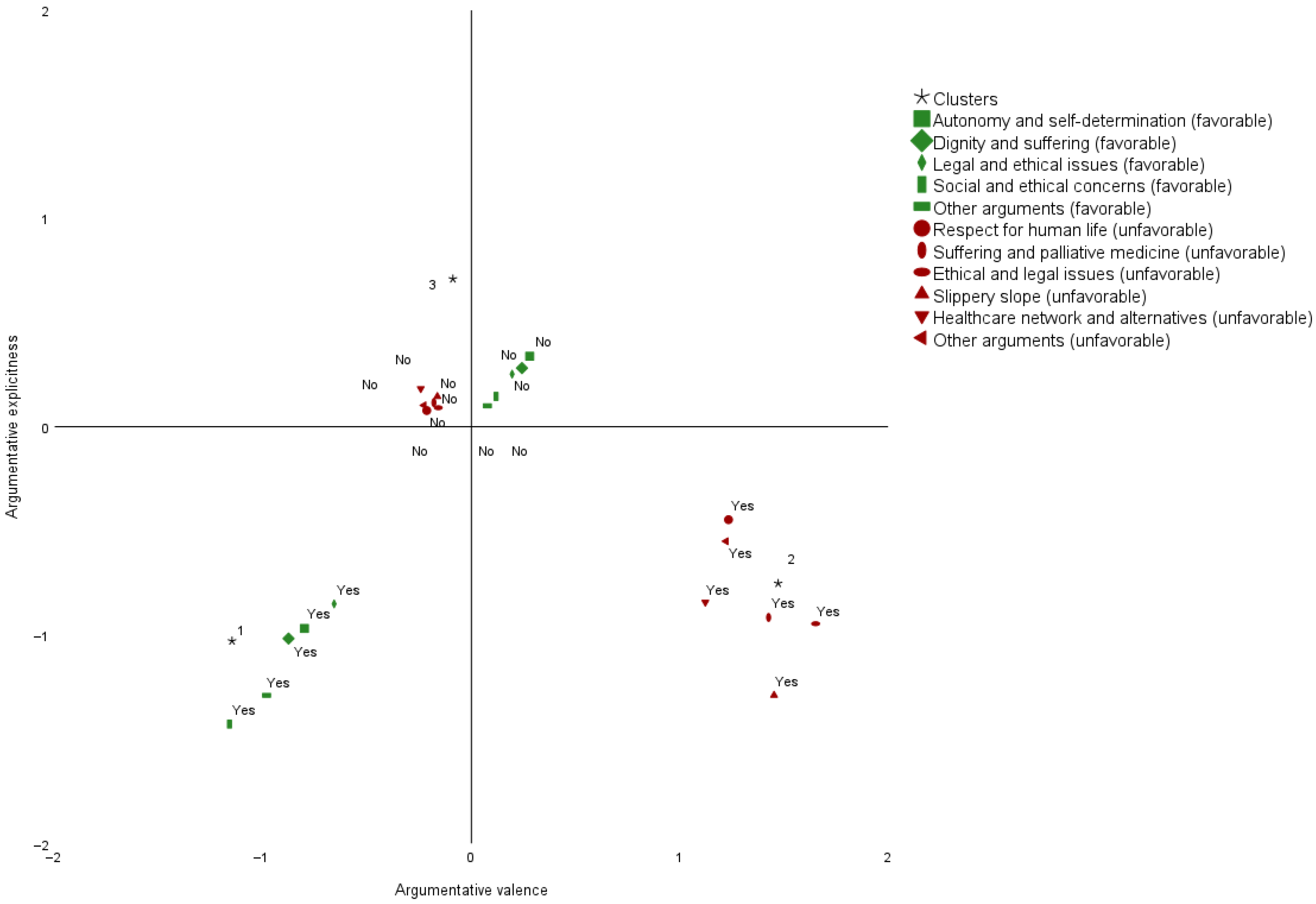
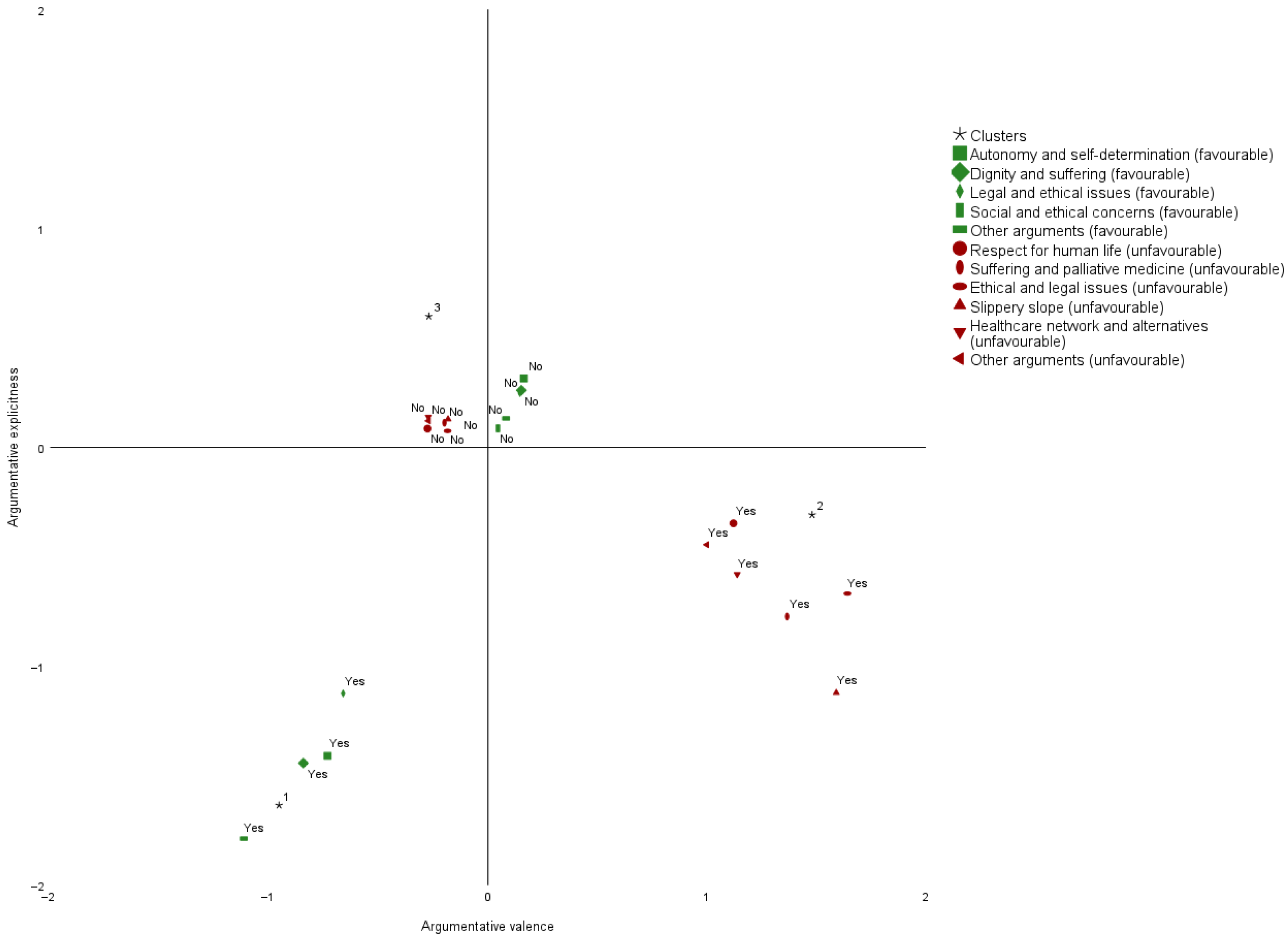
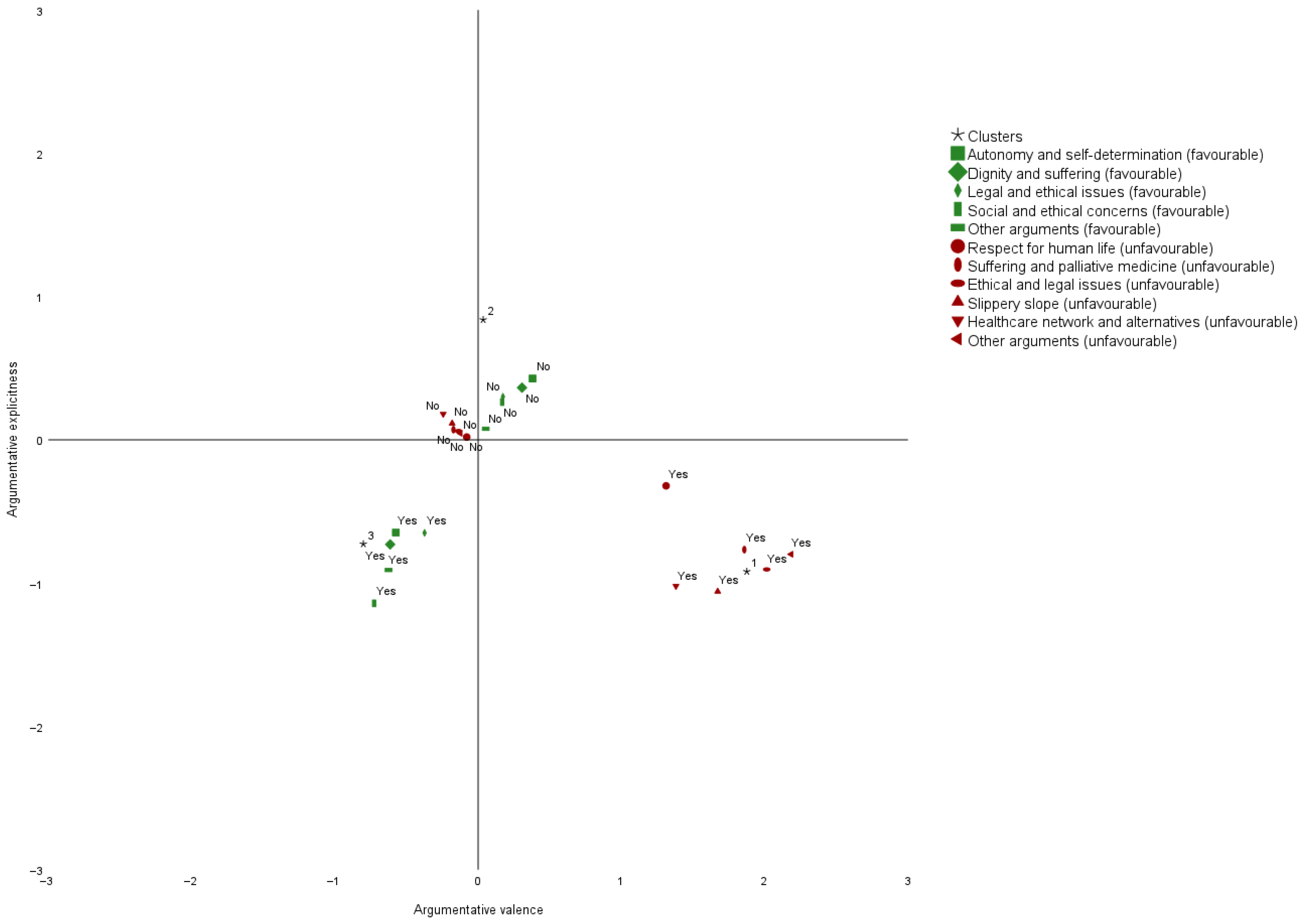
The Multiple Correspondence Analysis (MCA) depicted in Figure 1 identified two primary dimensions that organize the argumentative space related to news coverage of assisted death. In the first dimension (argumentative valence), a clear divide was observed between arguments for and against assisted death, highlighting the polarization of news coverage. This dimension reflects the semantic opposition between justifications based on autonomy and dignity, on the one hand, and values linked to the sanctity of life and concerns about social consequences, on the other. Dimension 2 (argumentative explicitness) distinguished between stories that exhibited argumentative structures and those that featured neutral positions or an absence of argumentation. This distinction enabled the isolation of a discursive profile characterized by the absence of explicit valuation. This second dimension, therefore, elucidates the placement of discourses that are more descriptive or merely informative in nature. The intersection of these two dimensions enabled the identification of three distinct argumentative profiles per country and in the combined sample.
In the Portuguese news coverage, there was greater dispersion among the arguments in favor (marked in green), with different types of fragmented justifications. Conversely, the arguments that were presented in opposition (in red) exhibited a higher degree of argumentative density (Figure 2). A closer look at British news coverage reveals a more concentrated presentation of arguments in favor of assisted death, suggesting a higher degree of internal homogeneity and rhetorical cohesion among sources expressing support for the practice (Figure 3). Arguments against assisted death evidenced greater dispersion, suggesting lower internal homogeneity and rhetorical cohesion among sources expressing disfavor. The combined sample of Portuguese and British newspapers confirmed the presence of substantial argumentative polarization, exhibiting a distinct divergence between favorable and unfavorable clusters. Consequently, a notable diversity was observed among pro-assisted death discourses, while a greater convergence was evident among anti-assisted death discourses.
In the combined sample, the results suggest the centrality of political actors, public officials, and unidentified sources in the clusters against assisted death (Table 9). The preponderance of citizens and unidentified sources in the clusters that expressed support suggests a more direct involvement of social actors in advocating for legalization. In Portugal, the first profile (3rd quadrant) was predominantly associated with politicians, public officials, and unidentified sources, with a preponderance of arguments in favor of assisted death (Table 10). The second profile (fourth quadrant) included a greater number of politicians, public officials, and unidentified sources, which characterized an unfavorable cluster. The third profile (1st and 2nd quadrants) was predominantly characterized by politicians, public officials, and heads of state, who advocated for neutral argumentative stances. In the UK, the first profile (4th quadrant) referred to a group composed primarily of politicians, public officials, and citizens, predominantly reflecting unfavorable arguments (Table 11). The second profile (1st and 2nd quadrants) was associated with citizens and unidentified sources, indicating argumentative neutrality. The third profile (3rd quadrant) primarily included citizens, politicians, and public officials who tended to advocate for assisted death.

5. Discussion

The findings of the initial research question indicate discrepancies between the two nations regarding the way arguments for and against assisted death are presented within the context of news frames. A comparative analysis of Expresso, Público, The Guardian, and The Telegraph reveals a divergent approach to presenting arguments about assisted death. Portuguese news media exhibited a tendency to accentuate unfavorable positions and arguments, while British coverage demonstrated a stronger inclination to highlight favorable positions and arguments. These patterns reveal a distinct editorial orientation, as well as divergent forms of argumentative articulation around assisted death. This data provides evidence consistent with news media system models as reflected in these quality newspapers (Hallin & Mancini, 2004), which postulate that the liberal model (UK) fosters enhanced argumentative diversity and editorial autonomy. Furthermore, the analysis unveils unanticipated intricacies, thereby expanding the existing body of knowledge in this domain. Specifically, Portuguese coverage exhibited a tendency to present more unfavorable positions and to concentrate these positions within a more homogeneous argumentative structure, emphasizing dimensions such as respect for human life, health network and alternatives, and other arguments. This news frame focuses on arguments of religious, moral, and institutional nature. This phenomenon aligns with the polarized pluralist model, in which the press becomes more permeable to ideological discourse and less guided by principles of professional neutrality (Hallin & Mancini, 2016). The Guardian and The Telegraph demonstrated a noteworthy capacity to articulate a more diverse array of favorable arguments in their coverage, including the dimensions of autonomy and self-determination, dignity and suffering, legal and ethical issues, and social and ethical concerns. This dispersion reinforces the characteristics attributed to Anglo-American journalistic culture, which favors a plurality of voices and rational news frameworks focused on civil rights and individual agency (Hanitzsch, 2007; Hanitzsch & Vos, 2017). This element can also be interpreted as a reflection of a political environment more open to public deliberation, where legislative debate is ongoing, in contrast to the situation in Portugal, where legalization has already been consolidated (Costa et al., 2026b).
The analysis of the arguments in these newspapers also highlights structural tensions in how these publications present different arguments about assisted death. Arguments in favor of this position center on the dimensions of individual autonomy and self-determination and the limits of suffering and dignity in both countries, thereby reinforcing a frame of rights and dignity (Booth & Blake, 2022; McInerney, 2006, 2007). Unfavorable arguments in Portugal reflect a moralizing normative frame, with the most prominent dimensions being health network and alternatives, respect for human life, and other arguments, reflecting strong religious and institutional influence (Weicht & Forchtner, 2023). This frame seeks to preserve the existing order and avoid structural changes in the bioethical paradigm (Sarmiento-Medina et al., 2019; Usanos et al., 2025). In the UK, unfavorable arguments were characterized by greater emphasis on health networks and alternatives and concerns about the process and consequences, reflecting a more pragmatic and regulatory concern rather than explicitly moralizing grounds. These results suggest that argumentative profiles in these quality newspapers reflect the sociocultural, religious, and political contexts of each country (Burlone & Richmond, 2018; Lauffer & Baker, 2020). In Portugal, where the Catholic Church maintains considerable influence and access to palliative care is limited (Marques et al., 2023), resistance to assisted death is frequently supported by arguments pertaining to protection, prudence, and democratic legitimacy. In the UK, where a liberal and secularized culture is more prevalent and the end-of-life care system is more developed (Saunders, 2008), arguments tend to emphasize freedom of choice and legislative progress.
The second research question explored the structuring and presentation of arguments in the news media, examining four central dimensions of journalistic rhetoric: degree of manifestation, origin, level, and evaluation of arguments. These indicators offer a more detailed reading of news frames (Entman, 1993), allowing for a comprehensive understanding of the content of arguments and the mechanisms by which they are mediated, legitimized, contested, or silenced in journalistic frames (Costa et al., 2025). The prevalence of overtly expressed arguments in both countries was observed, with a slight predominance of latent arguments in the British press. This significant presence of latent arguments may be indicative of the use of implications and innuendo, suggesting editorial caution around a morally controversial topic. This editorial caution appears to align with the logic of rhetorical ambivalence characteristic of societies with greater pluralism of values (Aakhus & Lewiński, 2011; Weiss, 1992). However, the distinguishing factor that sets these two types of reporting apart is the presence of what can be characterized as “offensive fallacies,” particularly within the Portuguese press. These fallacies, both overt and latent, correspond to attempts to delegitimize others through ad hominem arguments or disproportionate emotional appeals. The elevated prevalence of such content in Portugal may signify a less stringent editorial oversight of extreme or polarized rhetoric, a phenomenon often observed in news media environments characterized by diminished journalistic professionalism and heightened discursive politicization (Hallin & Mancini, 2004; Hanitzsch, 2007).
The overwhelming majority of the arguments were coded as direct opinion, particularly in British newspapers. The practice of quoting third parties was residual, but it was primarily observed in Portugal. This pattern indicates that the news media places nearly complete emphasis on the source of information, acting primarily as a platform for individual viewpoints. There is little effort from journalists to mediate these perspectives or to utilize discursive triangulation. This phenomenon raises questions about the role of journalism in forming collective interpretations of bioethical issues (Aakhus et al., 2016; Graber, 1989). The data indicates a noticeable inclination toward first-level arguments, which are expressed directly by the source. Subsequent levels were practically nonexistent, especially the third level, which did not appear in any story. This absence of complex chains implies a simplified argumentative structure, characterized by minimal dialog and a pronounced emphasis on the individual voice. While the liberal model advocates for greater plurality in theory, empirical evidence indicates that discourse dynamics are predominantly unipolar and direct. There is minimal replication of complex argumentative structures (Aakhus & Lewiński, 2011). A salient piece of evidence in this regard is the near absence of external evaluation of arguments. The failure of alternative sources to either validate or refute these claims suggests that arguments are disseminated within the news media without undergoing the requisite public scrutiny. This phenomenon directly contradicts the esteemed tradition of journalism as a forum for rational discourse among varying viewpoints (Costa et al., 2026a). The near-complete absence of argument evaluation—where alternative sources neither validate nor refute the claims presented—creates what Aakhus et al. (2016) term “asymmetric polylogue”: a journalistic space where multiple voices exist but remain fundamentally disconnected, with contradictions unaddressed and claims uncontested. These newspapers don’t have journalists act as middlemen who bring together different points of view into a coherent discussion. Instead, they present arguments as separate monologs. This structural absence of argumentative engagement compromises both the quality of democratic discourse and the informed decision-making capacity of citizens on bioethical issues. When people come across conflicting claims about assisted death without journalists questioning or examining them, they’re left with opposing views that don’t invite thoughtful discussion. Such coverage risks undermining the epistemic foundations on which citizens base their judgments about morally contested policies (Costa, 2021). This finding holds implication given the life-and-death stakes of bioethical deliberation, where argumentative rigor directly affects public confidence in policy legitimacy. The collective findings of RQ2 indicate a predominance of coverage models that prioritize exposure over argumentative interaction. Despite the evident disparities between nations, both contexts exhibit a deficiency in dialogic articulation. This pattern is especially salient considering the concept of argumentative structures, which involves not only the content of arguments but also how they articulate with other voices, are validated or refuted, and build social consensus or dissent (Weiss, 1992).
The third research question sought to identify whether the position taken by information sources on assisted death (pro, con, or neutral) varies depending on the newspaper publishing the story. This intermediate analysis introduces an additional layer between the news media system and news frames. This dimension is particularly relevant to news media systems theory (Hallin & Mancini, 2004), insofar as it posits that editorial routines and journalistic values are shaped by structural factors such as professional autonomy, political parallelism, and market organization. The results indicated that Expresso differed significantly from British newspapers on opposing positions. However, the comparison between the two Portuguese newspapers did not achieve statistical significance. The Guardian and The Telegraph showed lower mean counts of opposing positions compared to Expresso. A subsequent analysis revealed statistically significant discrepancies among the newspapers. Specifically, Expresso manifested divergent statistical characteristics compared to both The Guardian and The Telegraph, though these differences were not observed in Público. In the Portuguese case, the correlation between the number of sources and the number of opposing positions was stronger, reinforcing the fact that these newspapers tend to offer greater visibility to discourses opposing assisted death. This variation may be associated with the influence of the Catholic Church, the polarized nature of legislative discourse, and a news media tradition that is more reactive and dependent on institutions (Papathanassopoulos & Miconi, 2023).
In contrast, The Guardian displayed the highest mean count of sources with favorable positions, followed by The Telegraph, Público, and Expresso. A more significant correlation between the number of sources and favorable and neutral positions was revealed by British newspapers in comparison to Portuguese newspapers, indicating a more deliberative and balanced approach to story construction (Brüggemann et al., 2014; Esser & Umbricht, 2013). These findings partially align with expectations of the British liberal model, particularly regarding The Guardian’s greater representation of favorable positions. However, the lack of significant difference between Expresso and Público suggests that this model distinction is not uniformly applied across all Portuguese outlets, indicating that editorial positioning may be influenced by ideological factors beyond structural news media system characteristics (Hanitzsch, 2007; Hallin & Mancini, 2004). In consideration of neutral positions, The Telegraph emerged as the publication most frequently adopting this stance, followed by The Guardian, Expresso, and Público. Despite the observed differences, comparative tests revealed no statistically significant variations between Portuguese and British newspapers on an individual basis. Because post hoc tests revealed no significant pairwise differences, it cannot be concluded that newspapers systematically differ in their adoption of neutral positions. Instead, neutral positioning appears to vary at the story level rather than representing consistent newspaper patterns. This variation may be influenced by internal variables such as editorial line, story type, and source characteristics, though further analysis would be needed to confirm these specific factors. One potential explanation for this phenomenon is the ideological disparity between The Guardian, which is characterized by a center-left political orientation, and The Telegraph, which is positioned in the center-right (Costa & Antunes, 2024; Garcia-Blanco & Bennett, 2021). In this sense, these indicators point to distinctive argumentative and editorial patterns, thereby partially confirming the assumptions of systemic models. However, the lack of significant within-country differences suggests that the country-level variable (Portugal vs. UK) remains more systematically predictive than individual newspapers. While editorial ideologies (as reflected in The Guardian vs. The Telegraph) introduce some secondary variation, the news media system model appears more influential in determining argumentative framing patterns than organizational factors.
The fourth research question enabled the mapping of the argumentative configuration of news frames on assisted death, leading to the identification of two main axes of argumentative variation. The first component (argumentative valence) highlighted the polarization between argumentative structures that are favorable and those that are contrary to assisted death. The second differentiation (argumentative explicitness) focused on distinguishing stories with explicit argumentative structures from those with neutral or non-evaluative structures. Through this methodological approach, empirical operationalization of the concept of argumentative profiles was enabled. These profiles are defined as clusters of journalistic discourses that are organized according to patterns of positioning, justification, and the actors involved. Contrary to the approach of preceding studies, which examined arguments in isolation (e.g., Sarmiento-Medina et al., 2019; Usanos et al., 2025), this research offers an integrated perspective on the relational logic between arguments and the actors who mobilize them. As such, it contributes to a more profound understanding of how the news media structure complex moral debates (Aakhus & Lewiński, 2011; Weiss, 1992).
The analysis yielded a discernible distinction between favorable and unfavorable clusters, accompanied by substantial variations between the two countries. In Portugal, the pro-argumentation positions exhibited a greater diversification, reflecting a heterogeneity of argumentative structures without the presence of a predominant frame. The counterarguments exhibited a higher degree of rhetorical complexity, indicating a more consolidated argumentative trend. This phenomenon may be associated with the influence of Catholic tradition and the presence of moral and institutional authority discourses (Papathanassopoulos & Miconi, 2023). In this scenario, the Portuguese news media’s apparent defensive posture aligns with the polarized pluralist model (Hallin & Mancini, 2004). In contrast, in the UK, the arguments in favor formed denser and more cohesive clusters, indicating greater internal homogeneity and rhetorical alignment among sources advocating the legalization of assisted death. Opposing discourses, on the other hand, were more fragmented, which may reflect a lower institutional presence of these actors or their ideological heterogeneity. This pattern appears to align with the dynamics of the liberal model, which prioritizes the autonomy of sources and the pluralism of discourses, even in the context of controversial issues (Esser & Umbricht, 2013; Hanitzsch, 2007).
The results also demonstrated that political actors, public officials, and unidentified sources predominated in clusters that expressed opposition to assisted death, while citizens and unidentified sources were more prevalent in clusters that expressed support for assisted death. This finding indicates a divide between institutional discourses, which are opposed to assisted death, and social discourses that support it. This divide has potential implications for democratic deliberation, especially considering how news media recognition of citizens’ voices can legitimize the causes they advocate for (Aakhus et al., 2016; Weicht & Forchtner, 2023). In this sense, argumentative profiles serve a dual function: they represent empirical groupings and reveal distinct ways of morally framing assisted death in news frames. These profiles function as indicators of how public legitimacy on the issue is constructed.

Limitations and Contributions

A consideration of the study’s limitations is necessary for a comprehensive interpretation of the results. The sample was restricted to four quality newspapers, excluding tabloid publications or native digital platforms. This restriction may limit the generalization of the results to other segments of the news media ecosystem. The employment of broad terms in the data collection strategy (e.g., “pain and agony” or “suicide tourism”) may have included some stories peripheral to the topic, despite the implementation of a thorough manual check to ensure the relevance of the content. In terms of inter-coder reliability, although Krippendorff’s coefficient was robust for most variables, the dimension of “arguments against assisted death” was slightly below the recommended value (α = 0.78), which may reflect the greater semantic and inferential complexity of these categories.
This study employs content analysis to identify patterns in published argumentative structures across newspapers. While the analysis reveals significant variation in how newspapers present assisted death arguments, content analysis cannot determine the causal mechanisms producing these differences. Questions of editorial policy influence, journalist decision-making processes, or deliberate source selection strategies would require complementary qualitative methods such as journalist interviews, analysis of editorial guidelines, or newsroom ethnography. These approaches represent avenues for future research.
Despite these limitations, the study proffers relevant theoretical and methodological contributions. The proposed approach is innovative in its integration of frame and argumentative structure analysis based on empirical indicators, effectively reinforcing the dialog between theories of journalism and public argumentation. The identification of argumentative profiles provides an original lens for understanding how news frames shape polarized discourses on bioethical issues such as assisted death, revealing relevant variations between two distinct news media systems. The analytical model developed in this study could be applied to future comparative studies in other areas of news coverage.


6. Conclusions

This study aimed to understand how assisted death is framed in four quality newspapers (Expresso, Público, The Guardian, and The Telegraph) through argumentative structures. To that end, it comparatively analyzed news coverage in Portugal and the UK between 2016 and 2024. The findings offer partial validation of the assumptions inherent in news media system models and journalistic cultures. The Portuguese press demonstrated a propensity to adopt a more defensive and convergent stance in their coverage of assisted death. Meanwhile, the British press was characterized by greater diversity and fragmentation in their favorable discourses, reflecting a higher degree of pluralism and professionalism. The analysis of argumentative profiles offers a significant theoretical contribution: quality newspapers organize arguments in patterns that correspond to news media system models, revealing how institutional structures and journalistic cultures shape the framing of bioethical debates. Within these discourses, the structure of arguments, the types of sources used, and the rhetorical distance between them were crucial for the moral legitimization of social practices. Theoretically, this study lends further support to the integration of framing theory with approaches to public argumentation. Indeed, frames have been demonstrated to operate both through the selection of topics and through the structural organization of arguments in news media discourse (Entman, 1993). In practice, these findings demonstrate that news media structure how ethical and legal debates are publicly articulated through selective presentation of argumentative profiles, emphasizing the need for journalistic practices that ensure balance, transparency, and diversity of voices.
This analytical framework—integrating frame analysis with argumentative structure coding—provides a replicable methodology for comparative news media analysis of bioethical discourse. Future research must engage in three complementary directions. First, applying this model to other topics (such as abortion, reproductive technologies, or organ transplantation) would clarify whether news media system effects on argumentative framing are topic-specific or represent systematic patterns across moral debates. Second, companion qualitative studies—including in-depth interviews with journalists, editors, and news directors—would address the causal limitations of content analysis, explaining why argumentative patterns differ between Portugal and the UK beyond mere description. Third, audience reception studies could examine whether and how different argumentative profiles influence public opinion formation, testing whether news media system differences in coverage correlate with divergent public attitudes toward assisted death legalization. Such integrated approaches would advance understanding of how quality newspapers contribute to or constrain democratic deliberation on bioethical issues.

Funding

This research was funded by the Portuguese Foundation for Science and Technology (FCT–Fundação para a Ciência e a Tecnologia) grant number 2023.04877.BD (https://doi.org/10.54499/2023.04877.BD) and R&D Unit UIDB/03126/2020. And the APC was funded by the Portuguese Foundation for Science and Technology.

Institutional Review Board Statement

Not applicable.

Informed Consent Statement

Not applicable.

Data Availability Statement

The original data presented in the study are openly available at: https://osf.io/2pzaj/overview (accessed on 20 January 2026).

Acknowledgments

I would like to thank Helena Carvalho, Director of the University Institute of Lisbon’s School of Sociology and Public Policy, for her guidance in the selection and application of the statistical methods used in this study. I am also grateful to researcher Ricardo Martins for coding 10% of the randomly selected sample, which enabled the calculation of Krippendorff’s alpha and the assessment of intercoder reliability. Finally, thanks go to researcher Rui Bruno Santos for developing an application for the automatic extraction of stories from journalistic websites, as well as to the PhD advisors Joana Azevedo, Sónia F. Bernardes, and Iñaki Garcia-Blanco for their guidance in the early stages of this manuscript.

Conflicts of Interest

The author declares no conflict of interest.

References

  1. Aakhus, M., & Lewiński, M. (2011). Argument analysis in large scale deliberation. In E. Feteris, B. Garssen, & F. Henkemans (Eds.), Keeping in touch with pragma-dialectics: In honor of Frans H. van Eemeren (pp. 165–184). John Benjamins Publishing Company. [Google Scholar]
  2. Aakhus, M., Ziek, P., & Dadlani, P. (2016). Argumentation in large, complex practices. In P. Bondy, & L. Benacquista (Eds.), Proceedings of the 11th international conference of the Ontario society for the study of argumentation (pp. 1–15). OSSA. [Google Scholar]
  3. Araújo, R., Pinto-Coelho, Z., & Lopes, F. (2016). Representações do suicídio na imprensa generalista portuguesa. Revista Portuguesa de Saúde Pública, 34(2), 173–185. [Google Scholar] [CrossRef][Green Version]
  4. Banerjee, A., & Birenbaum-Carmeli, D. (2007). Ordering suicide: Media reporting of family assisted suicide in Britain. Journal of Medical Ethics, 33(11), 639–642. [Google Scholar] [CrossRef]
  5. BBC. (2025, June 20). How could assisted dying laws change? BBC. Available online: https://www.bbc.com/news/articles/c5y5d2g3wgxo (accessed on 16 September 2025).
  6. Bingley, A., McDermott, E., Thomas, C., Payne, S., Seymour, J., & Clark, D. (2006). Making sense of dying: A review of narratives written since 1950 by people facing death from cancer and other diseases. Palliative Medicine, 20(3), 183–195. [Google Scholar] [CrossRef]
  7. Booth, A., & Blake, D. (2022). Assisted dying in the Aotearoa New Zealand media: A critical discourse analysis. Mortality, 27(1), 107–123. [Google Scholar] [CrossRef]
  8. Brassolotto, J., Manduca-Barone, A., & Zurbrigg, P. (2023). Medical assistance in dying: A review of related Canadian news media texts. Journal of Medical Humanities, 44, 167–186. [Google Scholar] [CrossRef]
  9. Brekhus, W. H. (2015). Culture and cognition: Patterns in the social construction of reality. Polity Press. [Google Scholar]
  10. Brüggemann, M., Engesser, S., Büchel, F., Humprecht, E., & Castro, L. (2014). Hallin and Mancini revisited: Four empirical types of western media systems. Journal of Communication, 64(6), 1037–1065. [Google Scholar] [CrossRef]
  11. Burlone, N., & Richmond, R. G. (2018). Between morality and rationality: Framing end-of-life care policy through narratives. Policy Sciences, 51, 313–334. [Google Scholar] [CrossRef]
  12. Capellan, J. A., Lautenschlager, R., & Silva, J. R. (2020). Deconstructing the Ferguson effect: A multilevel mediation analysis of public scrutiny, de-policing, and crime. Journal of Crime and Justice, 43(2), 125–144. [Google Scholar] [CrossRef]
  13. Chen, X., Liu, T., Li, P., Wei, W., & Chao, M. (2022). The relationship between media involvement and death anxiety of self-quarantined people in the COVID-19 outbreak in China: The mediating roles of empathy and sympathy. OMEGA Journal of Death and Dying, 85(4), 974–989. [Google Scholar] [CrossRef]
  14. Clement, S., Lassman, F., Barley, E., Evans-Lacko, S., Williams, P., Yamaguchi, S., Slade, M., Rüsch, N., & Thornicroft, G. (2013). Mass media interventions for reducing mental health-related stigma. The Cochrane Database of Systematic Reviews, 2013(7), CD009453. [Google Scholar] [CrossRef] [PubMed]
  15. Costa, B. F. (2021). Liberdade de expressão e discurso de ódio: Consequências para o campo jornalístico. Media XXI. [Google Scholar]
  16. Costa, B. F. (2025). A eutanásia em Portugal e no Reino Unido: Uma análise comparativa de atitudes | Euthanasia in Portugal and the United Kingdom: A comparative analysis of attitudes. Sociologia Problemas e Práticas, 107, 149–173. [Google Scholar] [CrossRef]
  17. Costa, B. F., & Antunes, E. (2024). Dinâmicas sociais no Facebook: Análise de comentários em conteúdos jornalísticos sobre a suposta tentativa de ataque terrorista à FCUL. Observatorio (OBS*), 18(1), 126–150. [Google Scholar] [CrossRef]
  18. Costa, B. F., Azevedo, J., Bernardes, S. F., & Garcia-Blanco, I. (2025). Journalism and euthanasia: A scoping review of the literature. OMEGA Journal of Death and Dying, 1–28. [Google Scholar] [CrossRef]
  19. Costa, B. F., Azevedo, J., Bernardes, S. F., & Garcia-Blanco, I. (2026a). Mediation and mediatisation of death and dying: A scoping review of the literature based on a decolonial perspective. In P. Pentaris, S. Pitsillides, & H. Ghorbani (Eds.), Decolonising of death studies (pp. 88–103). Routledge. [Google Scholar] [CrossRef]
  20. Costa, B. F., Bernardes, S. F., & Azevedo, J. (2026b). Comparative exploration of media models and euthanasia coverage in Portugal and the United Kingdom. Revista Mediterránea de Comunicación, 16(2), e30678. Available online: https://doaj.org/article/71ab310ec1f04060beb4ea56fa35db86 (accessed on 16 September 2025).
  21. Crumley, E. T., Sheppard, C., Bowden, C., & Nelson, G. (2019). Canadian French and English newspapers’ portrayals of physicians’ role and medical assistance in dying (MAiD) from 1972 to 2016: A qualitative textual analysis. BMJ Open, 9(4), 1–20. [Google Scholar] [CrossRef] [PubMed]
  22. D’Angelo, P. (2002). News framing as a multiparadigmatic research program: A response to Entman. Journal of Communication, 52(4), 870–888. [Google Scholar] [CrossRef]
  23. Entman, R. M. (1993). Framing: Toward clarification of a fractured paradigm. Journal of Communication, 43(4), 51–58. [Google Scholar] [CrossRef]
  24. Esser, F., & Umbricht, A. (2013). Competing models of journalism? Political affairs coverage in US, British, German, Swiss, French and Italian newspapers. Journalism, 14(8), 989–1007. [Google Scholar] [CrossRef]
  25. Fernández-Viso, A., & Fernández-Alonso, I. (2024). The evolution of government intervention in the mediterranean media system: Spain, France, and Portugal. Media and Communication, 12, 1–16. [Google Scholar] [CrossRef]
  26. Garcia-Blanco, I., & Bennett, L. (2021). Between a ‘media circus’ and ‘seeing justice being done’: Metajournalistic discourse and the transparency of justice in the debate on filming trials in British newspapers. Journalism, 22(1), 176–195. [Google Scholar] [CrossRef]
  27. Goffman, E. (1974). Frame analysis: An essay on the organization of experience. Harvard University Press. [Google Scholar]
  28. Gould, M., Jamieson, P., & Romer, D. (2003). Media contagion and suicide among the young. American Behavioral Scientist, 46(9), 1269–1284. [Google Scholar] [CrossRef]
  29. Graber, D. A. (1989). Content and meaning: What’s it all about. American Behavioral Scientist, 33(2), 144–152. [Google Scholar] [CrossRef]
  30. Grilli, R., Ramsay, C., & Minozzi, S. (2002). Mass media interventions: Effects on health services utilisation. The Cochrane Database of Systematic Reviews, (1), CD000389. [Google Scholar] [CrossRef]
  31. Hallin, D. C., & Mancini, P. (2004). Comparing media systems: Three models of media and politics. Cambridge University Press. [Google Scholar]
  32. Hallin, D. C., & Mancini, P. (2016). Ten years after comparing media systems: What have we learned? Political Communication, 34(2), 155–171. [Google Scholar] [CrossRef]
  33. Hanitzsch, T. (2007). Deconstructing journalism culture: Toward a universal theory. Communication Theory, 17(4), 367–385. [Google Scholar] [CrossRef]
  34. Hanitzsch, T., & Vos, T. P. (2017). Journalistic roles and the struggle over institutional identity: The discursive constitution of journalism. Communication Theory, 27(2), 115–135. [Google Scholar] [CrossRef]
  35. Harcup, T., & O’Neill, D. (2001). What is news? Galtung and Ruge revisited. Journalism Studies, 2(2), 261–280. [Google Scholar] [CrossRef]
  36. Hayes, A. F., & Krippendorff, K. (2007). Answering the call for a standard reliability measure for coding data. Communication Methods and Measures, 1(1), 77–89. [Google Scholar] [CrossRef]
  37. Holody, K. J. (2011). Constructing the end: Framing and agenda-setting of physician-assisted suicide [Doctoral dissertation, Bowling Green State University]. ProQuest Dissertations and Theses Global. Available online: https://etd.ohiolink.edu/acprod/odb_etd/ws/send_file/send?accession=bgsu1305663580&disposition=inline (accessed on 16 September 2025).
  38. Khoo, G. S. (2018). From terror to transcendence: Death reflection promotes preferences for human drama. Media Psychology, 21(4), 719–749. [Google Scholar] [CrossRef]
  39. Krippendorff, K. (2019). Content analysis: An introduction to its methodology. Sage. [Google Scholar]
  40. Lauffer, K., & Baker, S. (2020). U.S. media coverage of Brittany Maynard’s choice to die: How ideology and framing converged. Atlantic Journal of Communication, 28(3), 180–193. [Google Scholar] [CrossRef]
  41. Lei n. º 22/2023. (2023, May 25). Diário da República n.º 101/2023. I Série. Available online: https://files.dre.pt/1s/2023/05/10100/0001000020.pdf (accessed on 17 September 2025).
  42. Lewiński, M. (2014). Argumentative polylogues: Beyond dialectical understanding of fallacies. Studies in Logic Grammar and Rhetoric, 36(49), 193–218. [Google Scholar] [CrossRef]
  43. Marques, P., Rêgo, F., & Nunes, R. (2023). Palliative care in Portugal—From intention to reality, what is yet to be accomplished. Nursing Reports, 13(4), 1477–1485. [Google Scholar] [CrossRef]
  44. Marzi, G., Balzano, M., & Marchiori, D. (2024). K-alpha calculator—Krippendorff’s alpha calculator: A user-friendly tool for computing Krippendorff’s alpha Inter-Rater reliability coefficient. MethodsX, 12, 102545. [Google Scholar] [CrossRef]
  45. Matthes, J., & Kohring, M. (2008). The content analysis of media frames: Toward improving reliability and validity. Journal of Communication, 58(2), 258–279. [Google Scholar] [CrossRef]
  46. McInerney, F. (2006). Heroic frames: Discursive constructions around the requested death movement in Australia in the late-1990s. Social Science & Medicine, 62(3), 654–667. [Google Scholar] [CrossRef]
  47. McInerney, F. (2007). Death and the body beautiful: Aesthetics and embodiment in press portrayals of requested death in Australia on the edge of the 21st century. Health Sociology Review, 16(5), 384–396. [Google Scholar] [CrossRef]
  48. Menezes, J. (2023). Human dignity and autonomy in euthanasia: A sociological perspective on life and death. International Scholars Journals, 13(3), 1–2. [Google Scholar]
  49. Mo Jang, S. (2019). Mass shootings backfire: The boomerang effects of death concerns on policy attitudes. Media Psychology, 22(2), 298–322. [Google Scholar] [CrossRef]
  50. Monteiro, C. (2020, February 21). Eutanásia: A favor ou contra? Um debate em direto para todo o país. News@fmul. Available online: https://www.medicina.ulisboa.pt/newsfmul-artigo/98/eutanasia-favor-ou-contra (accessed on 15 September 2025).
  51. Newman, N., Arguedas, A. R., Robertson, C. T., Nielsen, R. K., & Fletcher, R. (2025). Reuters institute digital news report 2025. Reuters Institute for the Study of Journalism. [Google Scholar]
  52. Niu, C., Jiang, Z., Liu, H., Yang, K., Song, X., & Li, Z. (2020). The influence of media consumption on public risk perception: A meta-analysis. Journal of Risk Research, 25(1), 21–47. [Google Scholar] [CrossRef]
  53. Nunes, L., Madeira, L. D., & Silva, S. H. (2020). Suicídio ajudado e eutanásia [morte provocada a pedido]: Terminologia e sistemática de argumentos. Conselho Nacional de Ética para as Ciências da Vida. [Google Scholar]
  54. Pan, Y. (2024). The linguistic and cultural differences behind the English-Chinese news media. Media and Communication Research, 5(2), 100–105. [Google Scholar] [CrossRef]
  55. Papathanassopoulos, S., & Miconi, A. (2023). Introduction. In S. Papathanassopoulos, & A. Miconi (Eds.), The media systems in Europe (pp. 1–13). Springer. [Google Scholar] [CrossRef]
  56. Petersen, T. S., & Dige, M. (2023). Critique of autonomy-based arguments against legalising assisted dying. Bioethics, 37(2), 165–170. [Google Scholar] [CrossRef]
  57. Resolução do Conselho de Ministros n.º 129/2001. (2001, August 7). Diário da república. I série B. Available online: https://data.diariodarepublica.pt/dr/detalhe/resolucao-conselho-ministros/129-2001-516551 (accessed on 18 September 2025).
  58. Richards, T. (2025). The morality of assisted dying. The Journal of Medicine and Philosophy, 50(4), 262–284. [Google Scholar] [CrossRef]
  59. Rietjens, J. A., Raijmakers, N. J., Kouwenhoven, P. S., Seale, C., van Thiel, G. J., Trappenburg, M., van Delden, J. J., & van der Heide, A. (2013). News media coverage of euthanasia: A content analysis of Dutch national newspapers. BMC Medical Ethics, 14(11), 1–7. [Google Scholar] [CrossRef]
  60. Santos, B. R. (2024). The guardian researchers. An application for automated data retrieval on the journal. Available online: https://github.com/DKZPT/TheGuardian-script-for-researchers (accessed on 17 September 2025).
  61. Sarmiento-Medina, P. J., García-Medina, D. P., Garzón-González, C. J., Castillo-Merchán, L. J., Correal-Neira, K., & Celis-Pedraza, D. A. (2019). Medios de comunicación y eutanasia en Colombia: Análisis de contenido y categorización argumentativa. Revista de la Facultad de Medicina, 67(2), 209–215. [Google Scholar] [CrossRef]
  62. Saunders, D. C. (2008). End of life care strategy: Promoting high quality care for all adults at the end of life. National Health Care. [Google Scholar]
  63. Sinelnik, A., & Hovy, D. (2024). Narratives at conflict: Computational analysis of news framing in multilingual disinformation campaigns. In X. Fu, & E. Fleisig (Eds.), Proceedings of the 62nd Annual Meeting of the Association for Computational Linguistics (pp. 131–143). Association for Computational Linguistics. [Google Scholar] [CrossRef]
  64. Smer. (2024). Assisted dying: An international survey. Swedish National Council on Medical Ethics. [Google Scholar]
  65. Thomas, J. A. (2023). ‘Noticias no son noticias, ¿no?’: Mexican perspectives on violence in the media and the war on drugs. Discourse & Society, 34(2), 213–235. [Google Scholar] [CrossRef]
  66. Tsiakiri, L. (2022). Euthanasia: Promoter of autonomy or supporter of biopower? Conatus Journal of Philosophy, 7(1), 123–133. [Google Scholar] [CrossRef]
  67. Usanos, R. A., García, M. C., Izquierdo, D. L., & Aresté, M. E. (2025). Euthanasia and the media in Spain (2019–2021). Cuadernos de Bioética, 36(116), 59–68. [Google Scholar] [CrossRef]
  68. Van Brussel, L. (2018). The right to die: A Belgian case study combining reception studies and discourse theory. Media, Culture & Society, 40(3), 381–396. [Google Scholar] [CrossRef]
  69. Weicht, B., & Forchtner, B. (2023). Negotiating euthanasia: Civil society contesting ‘the completed life’. Current Sociology, 71(3), 432–449. [Google Scholar] [CrossRef]
  70. Weiss, H. (1992). Public issues and argumentation structures: An approach to the study of the contents of media agenda-setting. Annals of the International Communication Association, 15(1), 374–396. [Google Scholar] [CrossRef]
  71. Woodthorpe, K. (2014). Public dying. In M. Brennan (Ed.), The A–Z of death and dying: Social, cultural and medical aspects. Greenwood. [Google Scholar]
  72. Young, M. E., King, N., Harper, S., & Humphreys, K. R. (2013). The influence of popular media on perceptions of personal and population risk in possible disease outbreaks. Health, Risk & Society, 15(1), 103–114. [Google Scholar] [CrossRef]
Figure 1. Assisted death argumentative profiles in the combined sample.
Journalmedia 07 00016 g001
Figure 2. Assisted death argumentative profiles in Portugal.
Journalmedia 07 00016 g002
Figure 3. Assisted death argumentative profiles in the UK.
Journalmedia 07 00016 g003
Table 1. Classification dimensions of arguments on assisted death.
Argument TypeDimensionDescription
FavorableAutonomy and self-determinationThe individual’s right to make autonomous decisions about their life and death without interference from third parties. Arguments in this dimension emphasize personal freedom, agency, and the primacy of individual conscience in end-of-life decisions.
FavorableDignity and sufferingIntolerable physical suffering and loss of dignity justify assisted death. Arguments in this dimension emphasize the need to end life with dignity when medical interventions become futile or prolong suffering.
FavorableLegal and ethical issuesThe need for clear legal frameworks and ethical safeguards to regulate assisted death. This dimension’s arguments emphasize the importance of establishing clear criteria, ensuring accountability, and maintaining responsible medical practice.
FavorableSocial and ethical concernsTensions between individual freedom and state paternalism. Arguments in this dimension emphasize inconsistencies in criminalizing assisted death and highlight inequalities in access to dignified end-of-life options.
FavorableOther argumentsThe compatibility between assisted death and palliative care in cases where pain relief is insufficient. Arguments in this dimension emphasize the informed and compassionate integration of both practices.
UnfavorableRespect for human lifeThe sanctity and inviolability of human life as an ethical, religious, or constitutional principle. Arguments in this dimension emphasize moral opposition to any form of legalizing assisted death.
UnfavorablePalliative medicine and redemptive sufferingThe belief that palliative care offers ethical and effective alternatives to assisted death. Arguments in this dimension emphasize the spiritual or existential value of suffering and the need for compassionate care.
UnfavorableEthical and legal issuesDoubts about patients’ autonomy when facing psychological or physical vulnerability. Arguments in this dimension emphasize the risks of involving healthcare professionals in ending life.
UnfavorableConcerns about process and consequencesPotential social and institutional risks related to assisted death legalization. Arguments in this dimension emphasize slippery slopes, state overreach, and pressures on vulnerable populations.
UnfavorableHealth network and alternativesThe insufficient development of palliative, continued, and home-based care. Arguments in this dimension emphasize that assisted death should not be debated until dignified alternatives are guaranteed.
UnfavorableOther argumentsPositions that fall outside dominant categories. Arguments in this dimension emphasize distrust in the political process, critiques of pro-death ideology, and the need for public consultation through referenda.
Table 9. Characterization of the clusters in terms of occupation of the information sources in the combined sample.
Argumentative Typology
Cluster 1Cluster 2Cluster 3Total
n%n%n%n%
Head of stateNo35288.727374.264266.5126773.2
Yes4511.39525.832433.546426.8
Total397100.0368100.0966100.01731100.0
Politicians and public officialsNo22255.918851.147649.388651.2
Yes17544.118048.949050.784548.8
Total397100.0368100.0966100.01731100.0
SpecialistsNo29073.028276.674276.8131475.9
Yes10727.08623.422423.241724.1
Total397100.0368100.0966100.01731100.0
Religious figuresNo37494.231986.792195.3161493.2
Yes235.84913.3454.71176.8
Total397100.0368100.0966100.01731100.0
Health and social workersNo27870.026872.878180.8132776.7
Yes11930.010027.218519.240423.3
Total397100.0368100.0966100.01731100.0
Other professionalsNo28170.832387.881184.0141581.7
Yes11629.24512.215516.031618.3
Total397100.0368100.0966100.01731100.0
CitizensNo17644.328076.170773.2116367.2
Yes22155.78823.925926.856832.8
Total397100.0368100.0966100.01731100.0
UnidentifiedNo21955.222059.870072.5113965.8
Yes17844.814840.226627.559234.2
Total397100.0368100.096610.01731100.0
Table 10. Characterization of the clusters in terms of occupation of the information sources in Portugal.
Argumentative Typology
Cluster 1Cluster 2Cluster 3Total
n%n%n%n%
Head of stateNo14271.717369.236053.767560.4
Yes5628.37730.831046.344339.6
Total198100.0250100.0670100.01118100.0
Politicians and public officialsNo10151.014658.429443.954148.4
Yes9749.010441.637656.157751.6
Total198100.0250100.0670100.01118100.0
SpecialistsNo14573.220080.055983.490480.9
Yes5326.85020.011116.621419.1
Total198100.0250100.0670100.01118100.0
Religious figuresNo18794.421887.264396.0104893.7
Yes115.63212.8274.0706.3
Total198100.0250100.0670100.01118100.0
Health and social workersNo13668.718774.857485.789780.2
Yes6231.36325.29614.322119.8
Total198100.0250100.0670100.01118100.0
Other professionalsNo17487.922891.261792.1101991.1
Yes2412.1228.8537.9998.9
Total198100.0250100.0670100.01118100.0
CitizensNo14673.721385.259989.495885.7
Yes5226.33714.87110.616014.3
Total198100.0250100.0670100.01118100.0
UnidentifiedNo11658.615762.853980.481272.6
Yes8241.49337.213119.630627.4
Total198100.0250100.0670100.01118100.0
Table 11. Characterization of the clusters in terms of occupation of the information sources in the UK.
Argumentative Typology
Cluster 1Cluster 2Cluster 3Total
n%n%n%n%
Head of stateNo8997.828295.322197.859296.6
Yes22.2144.752.2213.4
Total91100.0296100.0226100.0613100.0
Politicians and public officialsNo3538.518261.512856.634556.3
Yes5661.511438.59843.426843.7
Total91100.0296100.0226100.0613100.0
SpecialistsNo6571.418361.816271.741066.9
Yes2628.611338.26428.320333.1
Total91100.0296100.0226100.0613100.0
Religious figuresNo7582.427893.921394.256692.3
Yes1617.6186.1135.8477.7
Total91100.0296100.0226100.0613100.0
Health and social workersNo6268.120769.916171.243070.1
Yes2931.98930.16528.818329.9
Total91100.0296100.0226100.0613100.0
Other professionalsNo6571.419465.513760.639664.6
Yes2628.610234.58939.421735.4
Total91100.0296100.0226100.0613100.0
CitizensNo4044.010836.55725.220533.4
Yes5156.018863.516974.840866.6
Total91100.0296100.0226100.0613100.0
UnidentifiedNo4852.716154.411852.232753.3
Yes4347.313545.610847.828646.7
Total91100.0296100.0226100.0613100.0
Disclaimer/Publisher’s Note: The statements, opinions and data contained in all publications are solely those of the individual author(s) and contributor(s) and not of MDPI and/or the editor(s). MDPI and/or the editor(s) disclaim responsibility for any injury to people or property resulting from any ideas, methods, instructions or products referred to in the content.