


Abstract
This article examines how the role of digital platforms is reshaping political communication and consensus-building in contemporary societies. It questions how algorithmic architectures are transforming the relationship between leadership, audiences, and power. Drawing on an empirical analysis of online interaction data, the study analyses Donald Trump’s political communication during the August 2025 summit with Putin in Alaska, presenting it as a paradigmatic example of networked leadership. The study focuses on the dynamics of mobilisation, polarisation, and identity construction within digital ecologies. The findings show that the leader’s centrality derives not only from traditional party structures, but also from the ability to coordinate heterogeneous communication flows as well as activate processes of affective and symbolic resonance. The article proposes a theoretical model that conceptualises Trump’s audience as a cognitive and emotional power device, highlighting the convergence of post-organisational populism, algorithmic mediatisation, and communicative governance. This leadership expresses forms of “algorithmic charisma” that redefine the modalities of political legitimacy. Methodologically, the study highlights the value of data-driven interpretive approaches, while also addressing their limitations related to algorithmic transparency and replicability. In conclusion, the article offers a critical reflection on emerging ecologies of consensus and the democratic implications of the ongoing “platformisation” of the public sphere.
1. Introduction
Today, the world is facing the challenge of governing increasingly datafied and digitalised societies. Within these societies, we can witness the almost hegemonic presence of platforms—a polysemic term encompassing every aspect of daily life, ranging from the social and cultural to the economic and political. In the latter case, platforms can serve as infrastructures for digital participation in open government procedures and support deliberative processes as well as enable new forms of political organisation, such as digital movements. Furthermore, platforms could represent a meeting point between research on “digital activism as a specific mode of opposition to the establishment” (De Blasio & Sorice, 2019, p. 5723) and e-democracy studies.
The crucial role of new digital and communication technologies in the emergence and development of new forms of politics and activism is now undeniable. These technologies have often become the only means of denouncing human rights violations and advocating for democracy and social justice, as evidenced by movements such as Occupy in the USA, 15-M in Spain and V-Day in Italy. Digital ecosystems and platforms have thus enabled greater social participation and engagement, strengthening e-democracy. This is characterised by various theoretical perspectives, such as, for example, “Liberal-individualist digital democracy”, “Deliberative digital democracy”, “Counter-public digital democracy”, and “Autonomist Marxist digital democracy”, proposed by Dahlberg (2011, pp. 857–863). One perspective considers the aggregation of demands in representative and decision-making processes, such as petitions, civic initiatives and electronic voting. A second perspective recalls Habermas’s concept of the public sphere, referring to the conscious use of digital media to build deliberative consensus. Conversely, a third perspective views digital ecosystems as tools for empowering minorities and creating a critical and informed public sphere within sociopolitical systems characterised by exclusionary and antagonistic structural dynamics. Finally, a fourth perspective considers the network as a counter-power for social democratisation, which could achieve an alternative to capitalist hegemony and promote different forms of sharing and digital commons. As previously mentioned, this requires critical reflection on the democratisation of public and social spaces brought about by the internet and digital ecosystems, as well as on the protection of common welfare and fundamental rights. Classical theories of the public sphere are based on the idea of a functional separation between public and private matters. According to these theories, in a social context, the notion of the public sphere is defined by the integration and participation of citizens, whereas in a political context, it is defined by the autonomy of self-legislation. Communication, specifically in the form of Habermas’s deliberation (Habermas, 1981/1984, 1981/1987), acts as a bridge between these two dimensions, enabling coordination and mutual understanding among all those involved.
Referring to Althusser’s concept of ideological state apparatuses (Althusser, 2024) makes it possible to interpret digital platforms as devices that mediate and reorganise processes of ideological production. From this perspective, the distinction between the public and private spheres is profoundly reconfigured, as communicative practices that appear individual are incorporated into systemic structures of consensus formation. This, in turn, allows us to understand how platforms today operate as new spaces of political interpellation. However, digitalisation and platformisation distort and undermine the separation between the public and private realms. These realms expand, fragment, and overlap, and the centrifugal and fluid logic of technological ecosystems transforms the public sphere from a space of communication and dialogue into a fragmented, contradictory, and polarising space. It is therefore necessary to reinterpret communication processes in light of the challenges posed by the digital transformation at every level and in every dimension. The platformisation of contemporary societies, and particularly through the widespread use of social networks such as Twitter (now X), Facebook, and Instagram, have erased the spatial–temporal dimension, enabling rapid access to and instant virality of information, images, and content (Klinger & Svensson, 2015). In recent decades, the rapid evolution of digitalisation and information technologies has brought about significant changes to communication processes and, more broadly, to the ways in which information can be accessed. These changes are undeniable in terms of their scope and sociopolitical influence, yet this transformation calls for critical reflection on the shadows it casts across all the dimensions of democracy. In more strictly sociocultural terms, platformisation makes informational processes fluid and unfiltered. It is characterised by the massive overexposure and dissemination of information and fake news, as well as by the difficulty of recognising the reliability and authority of sources (Tsfati et al., 2020). All this clearly erodes the democratic process. This can also be interpreted considering Guy Debord’s reflections in The Society of the Spectacle (Debord, 2012), in which he identifies the generalised mediation of images as a profound transformation of social and political relations. From this perspective, politics tends to be reduced to representation, while participation is progressively replaced by the passive consumption of content. This dynamic, originally associated with advanced capitalism, anticipates forms of spectacularisation that are systematically intensified in digital ecosystems.
It is precisely within this context of spectacularisation that the current dynamics of the fragmentation and polarisation of public debate are situated. These dynamics further undermine democracy, emptying it of meaning and transforming it into a form of demagogy based on the deliberate construction of ideological and polarised “filter bubbles” (Pariser, 2011). Within societies, polarisation manifests itself at different levels, ranging from the extremist positions adopted by political leaders (elite polarisation (Hetherington, 2001)) to mass polarisation, through which citizens adopt increasingly extreme positions (Abramowitz & Saunders, 2008), and finally to affective polarisation, in which hostility and animosity towards the opposing political camp develop (Iyengar et al., 2019).
This phenomenon sparks controversy within scientific debate, with some arguing that the media has little influence since “the impact of partisan media on those who follow them depends in complex ways on their preexisting attitudes and political sophistication” (Prior, 2013, p. 109), while others highlight the social, economic, and demographic variables underlying the development of polarisation. In our view, the polarisation of communicative processes that characterises contemporary fragmented societies distracts attention from structural, systemic, and contextual issues by focusing on specific topics such as gender, migration and political candidates. It transcends historical, cultural, and sociopolitical differences and similarities, focusing on how social problems are communicated. The polarisation of communication within digital ecosystems accelerates fragmentation and extremisation through the radicalisation of language and emotionally charged, irrational, and uncritically messages. This creates ideological narrative dynamics that reshape the social structure and negatively affect social interactions as well as the proper functioning of democratic debate and dialogue, ultimately leading to hate and limitations on personal rights and freedoms “immediate virality, the possibility of anonymity, and the creation of fake or fictitious accounts have all amplified the risks of restricting individual freedoms and rights” (Cubeddu & Picarella, 2024, p. 14). This achieves the main goal of establishing and consolidating a new hegemonic status quo. Historically and socioculturally, removing alternative possibilities has always formed the basis for establishing ‘order’ and legitimising ‘power’, which is built on a nihilism that obscures the understanding of a fundamental paradox in the case of polarisation and its influence on democratic systems: democracies must defend themselves from the very essence of democracy. The strong influence of social media and other platforms on sociocultural and collective decision-making processes has led to the notion of ‘disrupting democracy’ (Sorensen, 2020), highlighting the negative impact that digital ecosystems can have on democratic systems. Against this backdrop, this article aims to analyse the various communicative strategies employed by Donald Trump across different digital platforms. On the one hand, it explores how the targeted creation of influence networks enables the shaping of public opinion and the mobilisation of specific audience segments. On the other hand, it discusses the impact of such practices on democratic processes. The objective is to provide a critical understanding of the interplay between politics, digital platforms and audiences in the contemporary era.
2. The Digitisation of Politics
Analysing the influence of digital media on the public and political spheres requires some general preliminary considerations. In today’s digital democracies, it is crucial to understand the relationship between political parties and movements, or more specifically, their leaders, and how citizens use the internet and new communication technologies. Digital ecosystems and the web offer opportunities to foster participation, disseminate information and strengthen mechanisms of political representation and citizen oversight over public and political action. However, the dark side of digitalised and platformised societies must prompt reflection on the possible controversial effects that can arise from the distortion of the representative/represented relationship. Norris (2001) expresses this opposition with the terms “Cyber-optimists” and “Cyber-pessimists,” observing that the former view the emerging forms of direct democracy in the digital realm as a remedy for the crisis of representative governance, while the latter argue that the internet merely mirrors the logic of traditional offline politics in a digital context. According to Norris, digital ecosystems can play an important role in strengthening institutions and encouraging grassroots participation in democracies undergoing transition or democratic consolidation. The debate surrounding the effects of the internet on democracy and the political public sphere is quite complex. In short, Rheingold (1993) suggests that group chats and multi-user domains can be considered an interesting tool for mobilising public opinion and discussion. This represents a new, or at least parallel, public sphere to the traditional one. Similarly, Barber (1984) argues that the digital environment can foster the development of a ‘strong’ democracy centred on the potential of virtual communities (Schwartz, 1996) to revitalise civic networks and give a voice to marginalised groups (Tsagarousianou et al., 1998). However, more sceptical scholars argue that the internet and digitalisation in general may widen the gap between active and passive citizens. According to Putnam (2000), digital sociopolitical communication processes can complement, but not replace, traditional forms of communication, since virtual reality lacks the face-to-face contact that underpins the construction of social trust. Davis (2023) argues that online debate is often dominated by ideologically homogeneous groups that reinforce their own ideological positions rather than fostering critical deliberation. Similarly, Margolis and Resnick (2000) highlight disillusionment surrounding the prospect of a democratic revival through the internet, given that major media outlets and political interest groups have managed to penetrate the virtual world. Thus, while proponents of the internet argue that it enables citizens to reconnect with political processes and increases the responsiveness of political figures, critics warn of the risk of significant forms of polarisation and centrifugal forces fuelling hostility and extremism between opposing sides being triggered across the internet and major social networks (often managed by opinion makers). This contaminates the democratic space for discussion and debate, which becomes dominated by what Manin (1998) terms ‘audience democracy’. This can lead to two controversial effects. On the one hand, political parties and traditional public political action become caught up in a media spiral played out on the web and social platforms centred on permanent conflict. On the other hand, it highlights the dissolution of the citizen into what Marcuse (1964) termed the ‘one-dimensional man’, that is, fragmented interests, individualism, and a crisis of ideologies and collective values. These effects combined result in the unravelling of the political and social fabric, which traditional parties are no longer able to mend. This increasingly demonstrates their inability to perform one of their fundamental functions: the aggregation of interests. The complex decision-making processes of traditional parties clash with the logic of the internet and digital media, the focal point of major global economic forces through which ideas and needs are born, spread and expressed. The unravelling of the sociopolitical fabric and the growing disconnection between traditional parties and civil society create the space for processes of personalisation, leaderisation, and the mediatisation of politics (Campus, 2010). In this framework, leaderisation can be understood as the progressive concentration of representation, decision-making authority, and symbolic visibility in the figure of the leader. The leader then assumes the role of direct mediator between institutions, audiences, and communicative arenas, thereby reducing the role of collective and organizational structures. As shown by articles proposing an initial operationalisation of this concept (Aggestam & Hedling, 2020), this process is characterised by the increasing performative centrality of the leader and the personalisation of decision-making processes—dynamics that are further amplified by digital environments. It is therefore crucial to examine not only the institutional transformations of digital politics, but also the affective and symbolic mechanisms that structure the relationship between leaders and their audiences. In this regard, the concept of social bonds in digital politics can be further developed considering Freud’s analysis of identification (Freud, 2025). This provides a structural framework for understanding the relationship between leaders and followers that goes beyond institutional mediation. From this perspective, the leader becomes the symbolic pole around which the group’s affective identification is organised, fostering a direct and personalised relationship that is particularly intensified in digital environments. Subsequent developments in critical theory, especially in Adorno’s reflections (Adorno, 1991), show how these mechanisms can translate into forms of mobilisation grounded in affective subordination and the construction of rigid symbolic boundaries. In the context of contemporary mediatisation, these dynamics help to clarify populist logics by offering an interpretive key to understanding the personalisation and identity-based dimension of digital leadership.
Obviously, the evolution of new communication technologies, together with the processes of digitalisation and platformisation of societies, have further fuelled the crisis of mechanisms typical of traditional democratic practice, prompting reflection on the complex relationships and interrelations underlying a discourse and a process, such as that of technology, that is far from linear. These dynamics, alongside the broader crisis of representative democracy, have facilitated the rise in outsider movements and parties that increasingly overshadow traditional ones, as they emerge, deliberate, and make decisions increasingly frequently within digital and platformised spaces. The internet and new digital media foster a direct and loyal relationship between the leader and the citizen/follower. The main consequence of this is a transformation in the organisation and functioning of parties, with intermediate party structures being cut out, and a dynamic being emphasised that may be further strengthened by mechanisms for selecting leaders and candidates through digital platforms. This should not come as a surprise, as the defining feature of digitalised politics appears to be a blend of direct democracy and citizen empowerment, combined with highly centralised leadership. This leadership is based on the mediatisation of political opinions through influencers, who produce content that is then organised and personalised for users by the platform’s algorithms. According to Bolter (2019), this process creates communities anchored in personalisation techniques, navigation choices, and identity politics which are used as a discursive strategy to exploit the sense-making dynamics of platforms and construct politically relevant communities. Understanding politics as a space of interrelations between individuals and communities compels reflection on two of its fundamental dimensions: the institutional and the communicative. With the advent of new digital technologies, these two dimensions intertwine and seem to overlap. However, a critical analysis must avoid both apocalyptic and superficially enthusiastic attitudes. The focus should be on subtle connections and influences. Digitalisation and platformisation have revolutionised the public sphere and the mechanisms of participation and information. Nevertheless, political parties continue to play a crucial role as institutional intermediaries. The crisis of this role with the rise in the internet should not, however, prevent us from understanding how centres of informational and economic power operate behind new intermediaries such as social networks and platforms. Furthermore, while digital ecosystems may foster a quantitative increase in political pluralism, the personalised informational experience offered by algorithms and echo chambers may lead to a qualitative decrease, resulting in a sort of atomisation of the public sphere.
3. Materials and Methods
This study examines the relational fabric of the Trump Audience. It uses the tools of Social Network Analysis (SNA) to outline the grid of connections among accounts, nodal points of influence, and amplification strategies. The core dataset comprises the primary accounts associated with the Trump media universe, identified on platforms such as X, Truth, Facebook, Instagram, Rumble, Spotify, and YouTube. The analysis primarily focuses on the interactions that took place between 15 and 17 August 2025. This time period was taken as a reference since it coincides with the day of the meeting between Donald Trump and Vladimir Putin held in Alaska on 15 August 2025, which was organised in an attempt to reach an agreement leading to a long-term peaceful solution to the conflict in Ukraine, and the two following days. This period is therefore highly representative of a phase of intense communicative activity, providing valuable insights into behaviour under conditions of high visibility. This method aims to combine the structural analysis of digital networks with an interpretative reading of the contents transmitted. It arises from the awareness that in today’s systems of political communication the incisiveness of a single message is often linked not only to the merely textual element but also to the various relational configurations that preside over its dissemination and reception (Chadwick, 2017). Data was collected through social listening platforms and authorised data scraping devices, making it possible to retrieve data relating to several aspects, such as the primary and secondary accounts involved in the communication cycle, their number of followers, likes, shares and comments, their connections, and reciprocal mentions. The research methodology used Fanpage Karma as an instrument, which is based on the analysis of quantitative data collected from social media, such as the number of followers, the reach and engagement of published contents, as well as user interactions with brands on social media. Considering these characteristics, it can be stated that the use of this tool falls mainly within a quantitative research methodology. However, a qualitative interpretation of the quantitative data made it possible to understand the data within the three circles of influence that emerged (direct, opinion and family/government). This type of analysis does not obviously constitute a complete qualitative research methodology. Therefore, we cannot claim that we are dealing with a mixed-methods research, but it allowed us to add elements for the understanding of the digital dynamics of Donald Trump’s audience. The information was normalised and systematised in an archive organised by platform and category (institutional, opinion leader, family/government), according to a criterion of network stratification (Jalali et al., 2023). At the quantitative level, particular attention was paid to measures of centrality (Freeman, 1978), which are useful for identifying the most influential nodes within the network and assess a node’s capacity to act as a bridge between different communities. The analysis outlined a visual representation of the network developed into three concentric circles of influence. The first circle is a direct circle or “core network,” consisting of Trump’s official accounts. The second is the “opinion circle”, composed of opinion leaders, influencers and media personalities. The third is the family/government circle, which integrates the family dimension with the institutional one. The mapping made it possible to highlight a multi-nodal and cross-platform logic, in which the centrality of the political actor combines with the capacity of platforms to act as infrastructures of communicative power (Klinger & Svensson, 2018). The interpretation was based on the theoretical frameworks of the Affective Publics Theory (Papacharissi, 2015) to detect the underlying discursive, emotional, and symbolic characteristics of Trump’s rhetoric. Three macro-categories of themes at the centre of the debate and political discussion were identified: authenticity and political identity with close references to the nation, the family, and the people; conflict and polarisation containing rhetoric against media, elites, and the establishment; and emotional mobilization with the use of affective, ironic, or belligerent language. A structural analysis of the phenomenon makes it possible to understand how the above-mentioned synergies contribute to strengthening the Trumpism brand by converting political communication into a hybrid ecosystem characterised by hyper-mediation and affective mobilisation (Marwick & Boyd, 2011; Mazzoleni & Schulz, 1999). This work gives a multi-dimensional perspective capable of overcoming the dichotomy between structural and interpretative approaches (Borgatti et al., 2009). However, the methodological design has some limitations linked to the variability of data due to platform access policies, a lack of transparency regarding visibility algorithms and the difficulty of isolating extra-digital factors that influence the dissemination of content. Nevertheless, the adopted approach provides a reliable and structured overview of Trumpian communication, highlighting the pivotal role of digital platforms as co-protagonist actors in shaping political consensus and the collective imagination.
4. Results
The empirical analysis of Trump’s audience confirms the existence, within his communication, of a multi-level architecture constructed according to a configuration of concentric networks of influence. This structure, resulting from an integrated elaboration of the qualitative and quantitative analyses of the social channels, reveals an organisational mode and a transmissive attitude that goes beyond the top-down paradigm of traditional political propaganda. It prefigures a kind of relational and participatory populist environment within the network (Gerbaudo, 2018).
4.1. The Direct Circle: The Primary Level of Message Production and Coordination
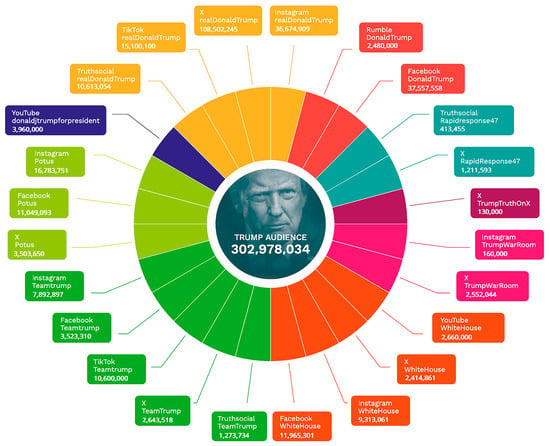
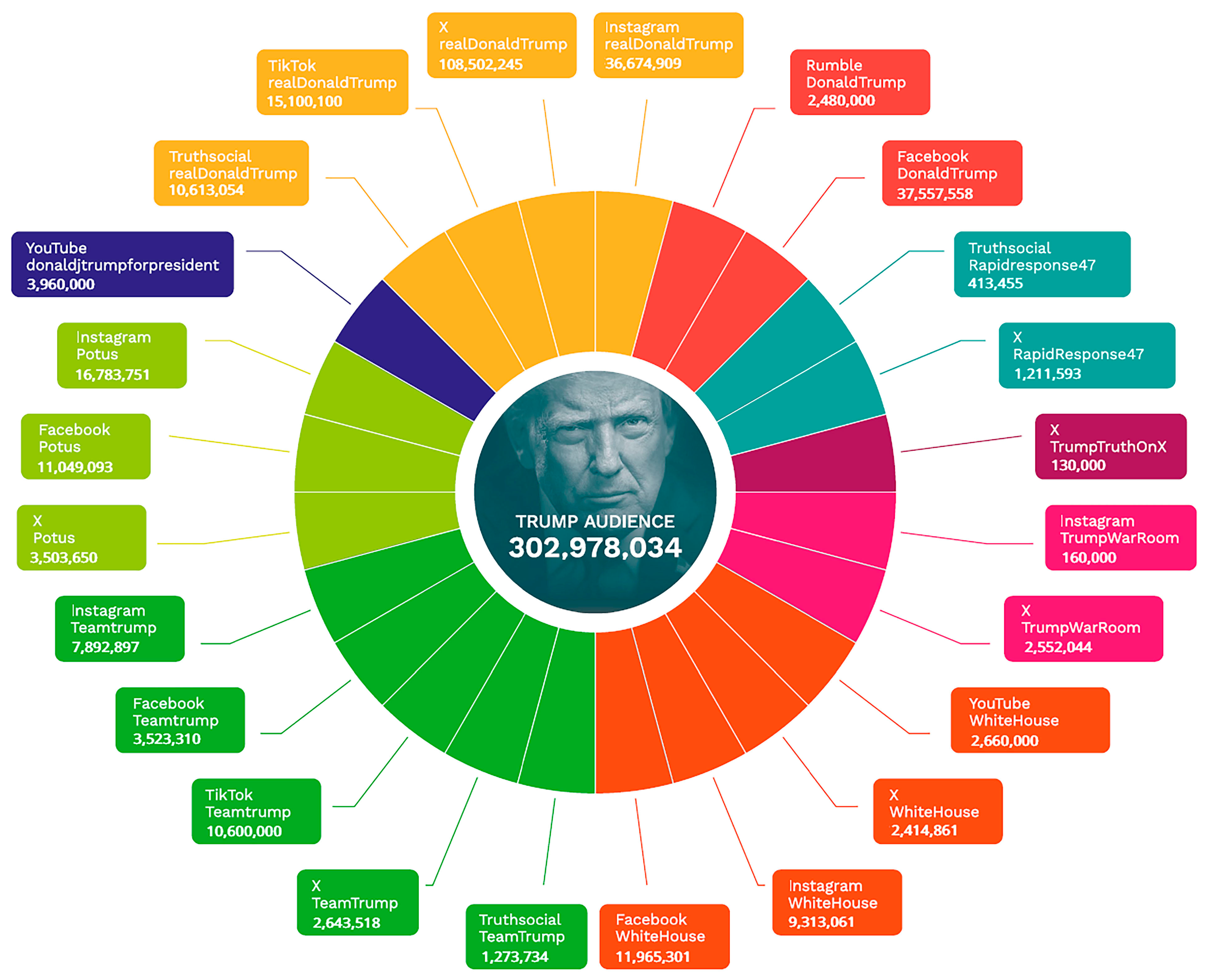
The direct circle (Figure 1) corresponds to the main level of message production and coordination. It consists of the official accounts directly associated with Donald Trump—such as @RealDonaldTrump, @POTUS, @WhiteHouse, @TeamTrump, and @TrumpWarRoom. They function as the central hubs of his organisational network. A centrality analysis shows how these accounts exhibit high centrality values across multiple vectors, confirming their privileged position in disseminating content and maintaining the narrative coherence of the political message. During the analysed period, these accounts generated over 4.9 million interactions (likes, reposts, comments), engaging a cumulative audience of 302 million followers. While this scale should be understood exclusively in quantitative terms, the interaction patterns reveal a form of digital mobilisation (Bennett & Segerberg, 2012) oriented towards constructing digital proximity with the electoral base. From a qualitative perspective, the content produced by the inner circle reveals a systematic reliance on three main narrative frames: salvational leadership, national identity, and moral conflict between “patriots” and “internal enemies.” The consistent appearance of these three themes reflects the deliberate construction of a political narrative that combines elements of charismatic personalisation, affective nationalism, and the moralisation of political conflict. In the first case, salvational leadership manifests through the persistent representation of Trump as the sole authentic interpreter of the popular will and as a messianic figure capable of “saving America” from political and moral decline.
Figure 1.
Trump audience—Direct Circle.
According to Taggart (2002), this frame is rooted in the tradition of the populist saviour complex, whereby the leader positions themselves as a direct mediator between the ‘pure people’ and a corrupt system. This discourse is reinforced in official posts and messages by an epic lexicon (“fight”, “save”, “Make America Great Again”) and rhetoric that emphasises individual strength and the leader’s historical mission. The second frame, that of national identity, functions as a mechanism of inclusion and exclusion, constituting the ideological core of Trumpism. The nation is portrayed as a community under threat from external forces, such as immigration, globalism and international elites, and in need of regeneration. This corresponds to a process of the moralisation of nationalism (Bonikowski, 2017), in which patriotism is presented not as a sense of civic belonging, but as an emotional and moral sentiment. Images of the flag, family life and ordinary heroism symbolise purity, unity and authenticity, evoking an aesthetic and performative form of nationalism (Mookherjee, 2011). Ultimately, the moral conflict between ‘patriots’ and ‘internal enemies’ defines the antagonistic logic underlying the entire Trumpian discourse. This dichotomous representation of the world as “us” versus “them” translates political competition into a moral struggle between good and evil. Described by Laclau (2005) and Wodak (2015) as the discursive essence of populism, this mechanism enables the leader to polarise the public arena and create a community of meaning based on emotional loyalty rather than rational argument. These strictly emotional dynamics can be further interpreted considering Massumi’s (1995) concept of the autonomy of affect. According to this concept, affects operate as pre-discursive intensities that transcend the rational dimension of language. Within this framework, digital environments amplify affective circulation, fostering forms of political mobilisation based on emotional resonance rather than reasoned deliberation. In the messages disseminated by the inner circle, the figure of the ‘enemy’ takes various forms—from the mainstream media and Washington bureaucrats to global corporations and migrants—but its function remains constant: to generate identity cohesion through moral opposition. Taken together, these three frames constitute Trump’s narrative grammar—that is, a discourse that is more grounded in emotion than ideology and is reinforced precisely through network logic. The coordinated repetition of these frames across the inner circle’s channels produces an effect of symbolic homogeneity, facilitating the message’s immediate recognisability and subsequent amplification within opinion and family/government circles. In this sense, communicative power resides not only in the political content, but also in the capacity to construct a shared moral narrative that transforms politics into an emotional, collective experience. This expressive mode ensures a compelling outcome in terms of affective convergence (Papacharissi, 2015) by binding the cohesion of the political community to the leader’s figure.
4.2. The Opinion Circle: Amplification and Differentiation of Trump’s Message
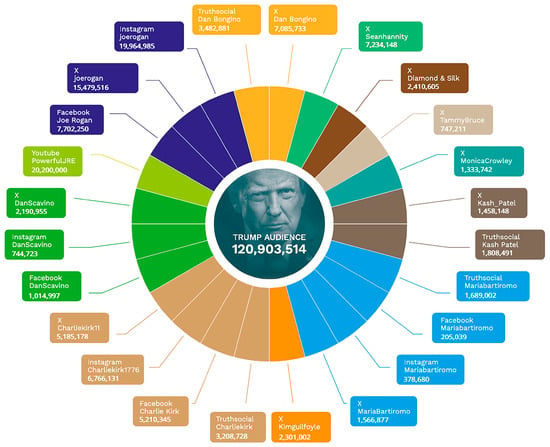
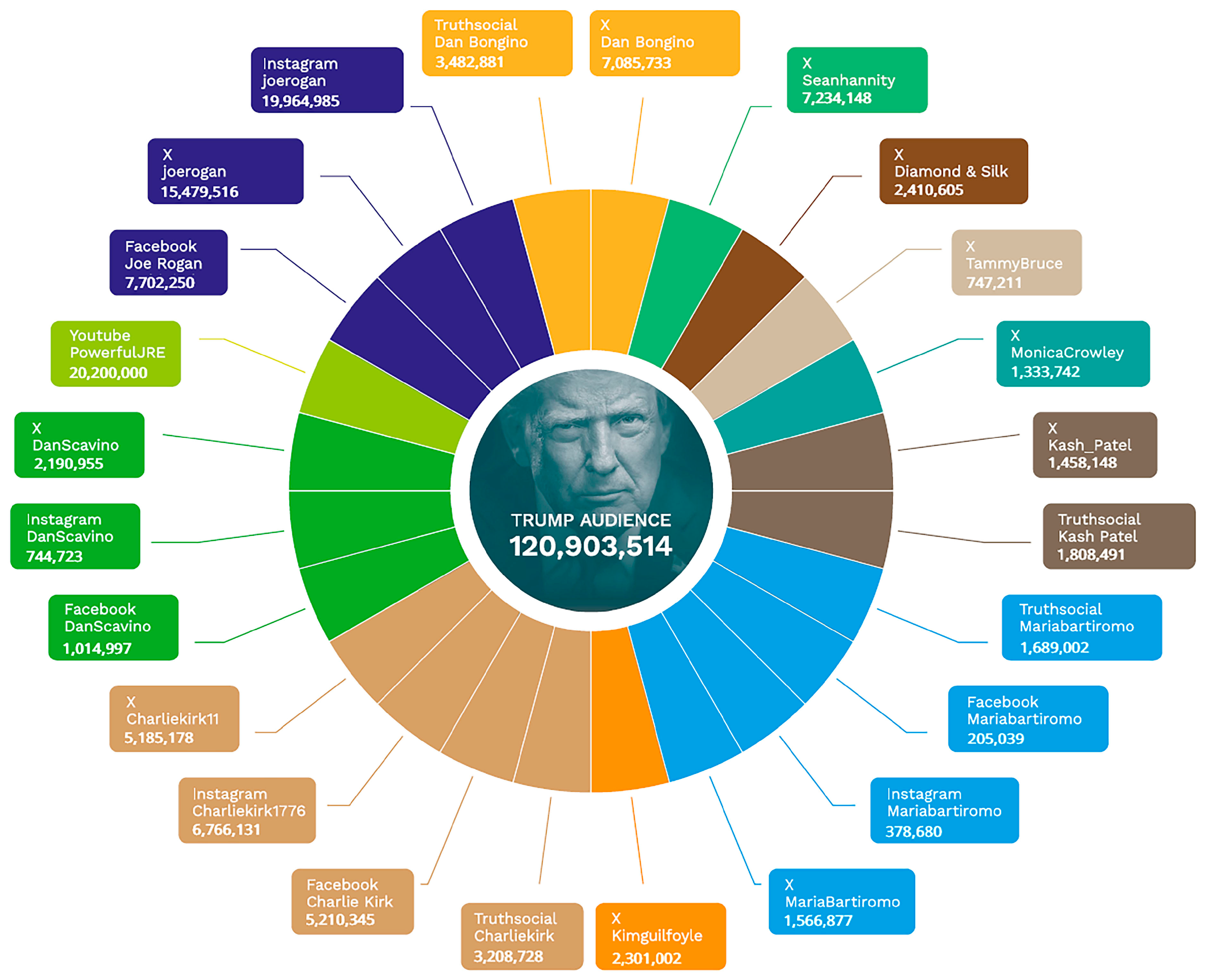
The second layer of the network, the opinion circle (Figure 2), functions as the engine that amplifies and differentiates Trump’s message. Consisting of opinion leaders, influencers, presenters and conservative journalists, it operates across multiple platforms, including X, Rumble, Spotify and YouTube. This web does not appear to have been significantly affected by the departure of Elon Musk’s account, which was long considered one of the most prominent amplifiers of presidential discourse. Although the second ring may initially appear to play a marginal role, it is of considerable importance. For example, within this perimeter there is Dan Bongino, who has around 7 million followers on X and previously hosted a programme on Fox News. He later hosted The Dan Bongino Show on Rumble and, since February last year, has served as Deputy Director of the FBI under President Donald Trump. Another notable figure is Joe Rogan, who has around 20 million followers on Instagram and a further 18 million on X. He hosts one of the most widely followed podcasts on Spotify and YouTube.
Figure 2.
Trump audience—Opinion Circle.
Another key figure is Charlie Kirk, who has 5 million followers on X and is the co-founder, alongside Bill Montgomery, of the conservative organisation Turning Point USA. It is worth taking a brief digression here, as Kirk was assassinated on 10 September 2025 during a public event—an incident that sparked extensive debate on freedom of expression. Over 90,000 people attended his funeral, and on 14 October 2025, President Donald Trump posthumously awarded him the Presidential Medal of Freedom. Returning to the network, the list also includes Maria Bartiromo, Dan Scavino, Monica Crowley, Diamond and Silk, and Kash Patel. These figures can be seen as embodying a form of populist influencer communication (Enli, 2017), where the explicitly political model intersects with entertainment and popular culture. Network analysis shows that this group acts as an intermediary zone where material originally produced within the inner circle is reinterpreted and reshaped for different digital audiences. The key nodes in this network display high levels of betweenness centrality, attesting to their role as connectors between the institutional sphere and popular participation. Qualitative analysis of the content produced by these individuals reveals a widespread use of emotional, humorous or polemical rhetorical elements, often accompanied by appeals to authenticity and freedom of expression. In this way, an alternative vision to mainstream media is constructed, thus consolidating the notion of a digital counter public sphere (Jackson & Kreiss, 2023).
4.3. The Family/Government Circle: Distinctive and Original Element
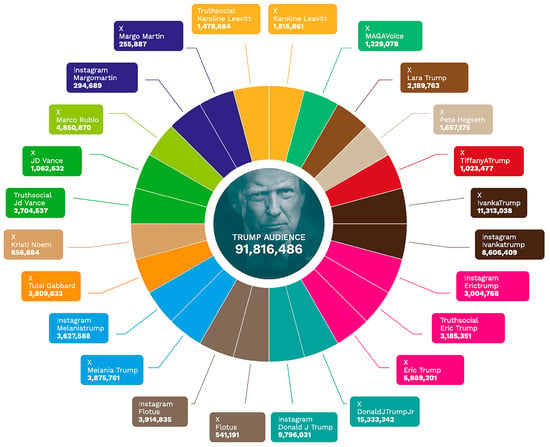
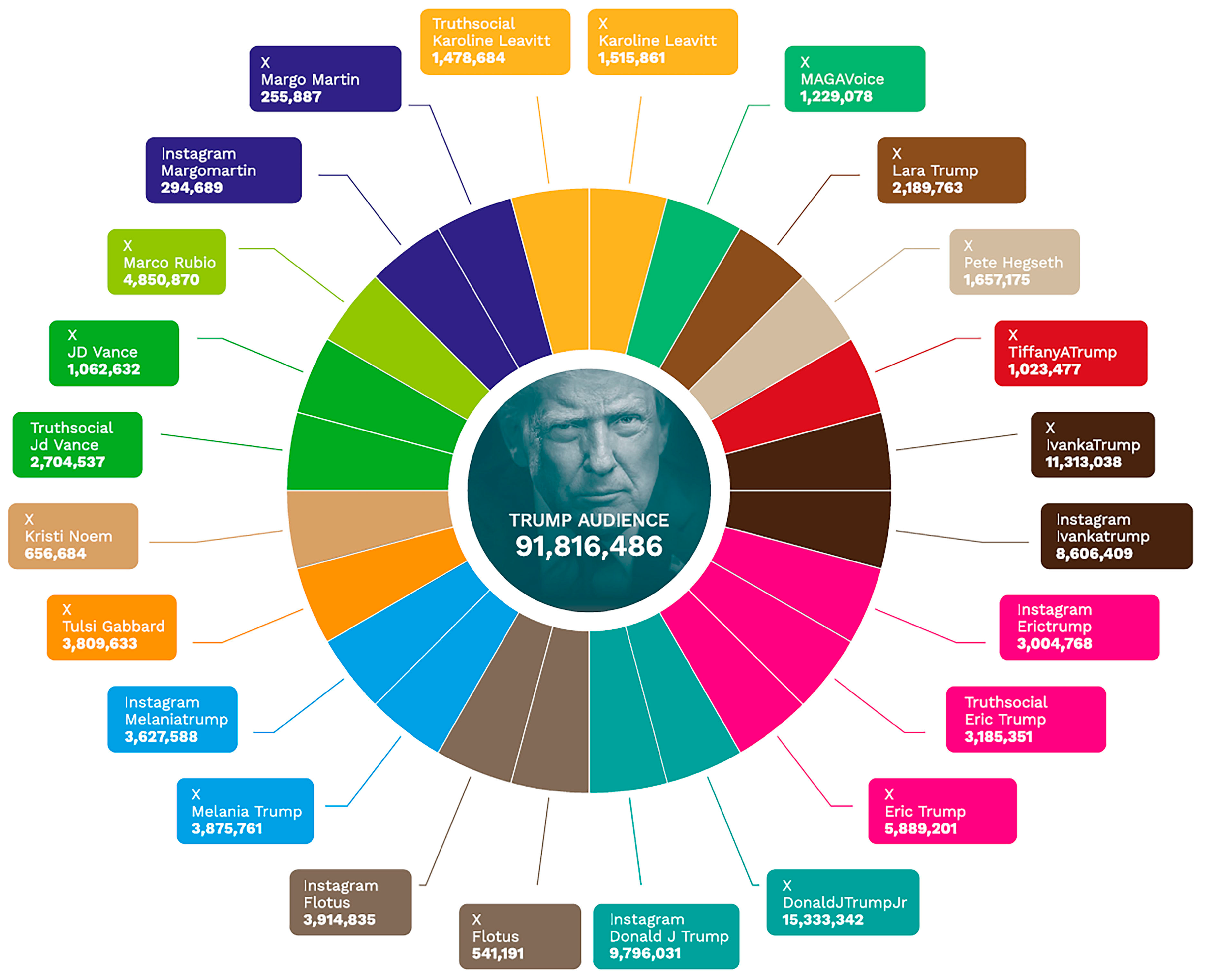
The third level (Figure 3), referred to as the family/government circle, represents the most distinctive and original element of the Trump Audience.
Figure 3.
Trump audience—Family and Government Circle.
It includes members of the Trump family, such as Melania, Donald Jr., Eric, Ivanka, Lara and Tiffany, as well as highly visible institutional figures, including Secretary of State Marco Rubio, White House spokesperson Karoline Leavitt, Margo Martin (Special Assistant to the President and Communications Advisor), Tulsi Gabbard (Director of National Intelligence) and the Maga Voice account. This intersection of the private and public spheres represents an unprecedented form of communicative hybridisation in the global political landscape. From a relational perspective, the family/government orbit has a lower average density than the other two circles, but it has a high degree of narrative coherence and a clear tendency towards symbolic legitimisation. Emphasis is placed on affective, familial and patriotic components, converting Trump’s leadership into an identity-driven, intergenerational endeavour. Consequently, this axis serves to authenticate the political message, legitimise the leader’s positions, reinforce the sense of belonging and ensure the continuity of the ‘Trump’ brand as a form of political branding (Battista, 2024b).
5. Discussion
Together, the three circles elevate the Trump Audience from a simple network of supporters to a real, stratified communicative ecosystem based on a dynamic balance of centralised and decentralised messaging. The direct circle ensures narrative control and symbolic coherence of discourse, while the opinion circle guarantees cross-platform virality and the family/government circle provides emotional and institutional legitimisation. Theoretically, the model aligns with the Hybrid Media System perspective (Chadwick, 2017), whereby political authority is exercised through the synergy of traditional media, digital platforms and personal networks. Furthermore, the concentrically organised structure of the Trump audience represents a form of centralised, networked populism capable of combining top-down logics (strong leadership and centralised messaging) with bottom-up logics (widespread participation and emotional interaction) (Caiani et al., 2022). Finally, the results suggest that the Trump audience functions as a complete political brand. In this brand, the boundaries between the personal, institutional and media spheres dissolve in favour of a shared identity that is co-constructed and maintained through constant interaction between platforms and digital communities. From this perspective, Trumpian communication is not only configured as a strategy for building consensus, but also as a form of symbolic governance of the network. The presented architecture shows that Trumpian political communication is not merely a strategy for disseminating messages, but rather a systemic model of communicative governance in which the network is the primary instrument for building consensus, legitimacy and political identity. Moreover, its influence corresponds entirely with Castells’ (2006) description of networked communicative power, whereby power is exercised not only through the transmission of information, but also through the ability to organise, connect and highlight certain nodes of the network at the expense of others. In this sense, Trumpism’s concentric organisational model can be interpreted as a device of relational power, in which the leader maintains narrative centrality (the direct circle), while delegating diffusion and legitimisation to secondary and tertiary circles of influence. This arrangement reflects a form in which the leader’s charismatic dimension is embedded in a complex digital infrastructure that “is increasingly central to national politics and global geopolitical power struggles” (Hesmondhalgh et al., 2023, p. 296). In this context, the network acts as an arena of political performativity (Papacharissi, 2022), where the boundaries between leadership, fandom, and citizenship become porous. The constant activation of the community through engagement and interactions produces an affective proximity that replaces traditional ideological ties with forms of emotional and identity-based belonging (Turner-Zwinkels et al., 2025). The results suggest that the Trump Audience represents one of the most complete manifestations of algorithmic populism, a communicative strategy in which digital platforms are not simply tools of dissemination but co-constitutive actors of political discourse because “Digital media are not just new media that populists use, their algorithms and affordances reshape populism. In times of digitalisation, we cannot understand populism by only looking at ‘the input’, the frame that actors prepare for uptake, it is about the uptake as well” (Maly, 2018, p. 4). The ability to orchestrate a coordinated flow of messages across different platforms (X, Rumble, YouTube and Spotify) demonstrates an understanding of the logics of algorithmic visibility, whereby each node in the network contributes to optimising the circulation of messages. In this scenario, Donald Trump’s leadership style is a type of hyper-mediation of personal power (Moffitt, 2016), where authenticity, communicative spontaneity and the dramatization of conflict are key political tools. The extreme personalisation of the message, supported by both the family and institutional circles, transforms the leader into a “political brand” capable of generating loyalty and identification, rather than mere ideological adherence. This has meant that “The notion of a political brand and the rhetoric of branding have been widely adopted by many political parties as they seek to differentiate themselves, and this has led to an emerging interest in the idea of the political brand” (Pich & Dean, 2015, p. 1353). The emergence of this unprecedented, self-organising communicative infrastructure requires us to consider the processes by which politics is becoming platformised (Van Dijck et al., 2018). The convergence of network and platform logics means that political communication is now natively digital rather than mediated, where visibility and legitimacy depend on metrics, algorithms and technological capabilities (Helmond, 2015). The Trump Audience shows that contemporary politics is increasingly subject to a regime of computational visibility, where popularity and virality criteria acquire political value and redefine the boundaries of the public sphere (Couldry & Hepp, 2018). From a theoretical standpoint, this transformation signifies a shift from the mediatisation of politics (Mazzoleni & Schulz, 1999) to its algorithmisation. In this process, platforms do not merely transmit political messages, but also shape, distribute and reinterpret them according to engagement and profit logic. From this perspective, it is necessary to acknowledge the role of algorithmisation and artificial intelligence as infrastructures of power that shape content visibility and differential access to information, with significant implications for democratic pluralism. Algorithmic systems, despite presenting themselves as neutral, tend to produce forms of selection, hierarchisation, and concentration of attention that can limit the diversity of viewpoints and reinforce informational asymmetries within the digital public sphere (Battista, 2024a). In this context, Trump’s leadership can be seen as an evolutionary adaptation to digital environments, exploiting the technical infrastructure of platforms to create consensus and a sense of collective identity. From a socio-political perspective, this also suggests a new way of making digital populism institutional, where the difference between a party, a movement and a personal brand tends to disappear. The presence of family members and government figures within the third circle indicates a progressive fusion of the private and public dimensions of power. This is consistent with theories of political personalisation and celebrity populism (Street, 2019). It should also be noted that analysing Donald Trump’s use of social media is further strengthened by engaging with primary sources that clarify its operational modalities, organisational constraints and evolution over time. Numerous accounts by aides, officials and journalists demonstrate that Trump’s digital communications stem from an unstable equilibrium between the leader’s direct involvement and staff mediation. This is characterised by periods of intense centralisation interspersed with more decentralised practices (Schreckinger, 2018; Margaritoff, 2024). Further analysis suggests that platforms have evolved as tools for managing attention, polarising debate, and mobilising emotions, rather than merely as informational channels (Bickart et al., 2017). From this perspective, Trump’s digital communication appears to be an adaptive strategic practice shaped by the interaction between algorithmic logics, media dynamics and the idiosyncratic features of his leadership style (Gambini, 2024). Including these elements enables networks and content to be analysed within a broader socio-political framework, thereby strengthening the interpretation of the communicative ecologies through which consent is produced and maintained. Interpreted in this way, the composition of the Trump Audience is not merely a description of an exceptional communicative case, but rather an analytical model that sheds light on broader changes in contemporary political leadership. This model could set a significant precedent for future post-populist leaders in the United States, Europe and Latin America, where similar media and affective hybridisation dynamics can be observed (Moffitt & Tormey, 2014). Looking ahead, research into the Trump Audience opens up new avenues of enquiry into the increasingly prevalent algorithmic governance of consent, the emotional dynamics of digital movements and the profound transformation of the online public sphere, which is now seen as a hybrid space between participation and spectacularisation. Therefore, understanding these processes is crucial for analysing how political power is being restructured in the post-media era, where leaders are not just communicators, but algorithmic nodes capable of activating, modulating and monetising visibility through the network.
6. Conclusions
Analysing the Trump Audience enables us to outline a new perspective on the relationship between political leadership, digital architecture and the production of consent. It is not just the effectiveness of a communication strategy that emerges, but also the configuration of a symbolic and relational ecosystem that reshapes power dynamics in the digital age.
The outlined structure represents not just an operational taxonomy, but also a theoretical model for understanding how digital networks evolve into instruments of affective and cognitive power (Couldry & Mejias, 2019). This audience constitutes a paradigmatic case of networked leadership (Battista, 2024c) in which the leader’s centrality does not depend on a party or traditional organisational structure, but rather on their ability to activate and coordinate diverse communication channels. In this sense, Trumpism emerges as a form of post-organisational populism (Gerbaudo, 2021), where political strength lies in digital infrastructure rather than party structures. From a theoretical standpoint, this analysis helps to overcome the rigid distinction between mediated political communication and digital politics, demonstrating how the two domains merge into a continuum of hybrid communicative practices (Vaccari & Valeriani, 2021). The affective and identity-laden nature of the American president’s communication further suggests that consent is no longer constructed solely on a rational or ideological basis, but through processes of emotional contagion and symbolic resonance (Ahmed, 2013; Wetherell, 2015). From this perspective, the observed phenomena should not merely be interpreted as a product of digital populism, but as a laboratory of communicative governance in which power is exercised through the ability to orchestrate attention, emotion and a sense of belonging. The leader’s role evolves into an algorithmic hub that integrates representative, charismatic, and performative functions, revealing the evolution of contemporary politics towards forms of ‘algorithmic charisma’ (McGuire & De Cremer, 2023). Methodologically, the research highlights the usefulness of data-driven and interpretative approaches. However, certain challenges remain, such as algorithmic transparency, opaque platform dynamics, and data replicability. While these limitations do not undermine the study’s validity, they emphasise the need for a more integrated research agenda across the social sciences, media studies and data science. Ultimately, these findings signal broader transformations in global political communication. The convergence of populist rhetoric, algorithmic mediation, and digital identity construction suggests a future where power is legitimised not only through electoral success, but also through the capacity to capture attention and influence public sentiment (Crilley & Gillespie, 2019). Understanding these new ecologies of consent requires critical reflection on the democratisation of public and social spaces by network and digital ecosystems, and on the protection of fundamental rights.
Author Contributions
Conceptualization, D.B. and E.M.; methodology, D.G.; software, D.G.; formal analysis, D.G.; data curation, D.G.; writing—original draft preparation, D.B. and E.M.; writing—review and editing, D.B. and E.M. All authors have read and agreed to the published version of the manuscript.
Funding
This research received no external funding.
Institutional Review Board Statement
Not applicable.
Informed Consent Statement
Not applicable.
Data Availability Statement
The original contributions presented in this study are included in the article. Further inquiries can be directed to the corresponding author.
Acknowledgments
We would like to thank Arcadia srl, Communications Agency (Italy) for granting permission to use the data presented in this article.
Conflicts of Interest
The authors declare no conflicts of interest.
References
- Abramowitz, A. I., & Saunders, K. L. (2008). Is polarisation a myth? Journal of Politics, 70(2), 542–555. [Google Scholar] [CrossRef] [Scilit]
- Adorno, T. W. (1991). Freudian theory and the pattern of fascist propaganda. In J. Bernstein (Ed.), The culture industry: Selected essays on mass culture (pp. 114–135). London; Routledge. [Google Scholar]
- Aggestam, L., & Hedling, E. (2020). Leaderisation in foreign policy: Performing the role of EU high representative. European Security, 29(3), 301–319. [Google Scholar] [CrossRef] [Scilit]
- Ahmed, S. (2013). The cultural politics of emotion. Routledge. [Google Scholar]
- Althusser, L. (2024). Ideology and ideological state apparatuses: Notes towards an investigation. In New critical writings in political sociology (pp. 299–340). Routledge. [Google Scholar]
- Barber, B. R. (1984). Strong democracy. University of California Press. [Google Scholar]
- Battista, D. (2024a). Comunicazione politica e intelligenza artificiale: Un bilancio tra manipolazione e partecipazione. Rivista di Digital Politics, 4(1), 71–90. [Google Scholar]
- Battista, D. (2024b). Fashionable politics: How Italian leaders transform into successful brands in contemporary communication. Journal of Liberty and International Affairs, 10(1), 111–126. [Google Scholar] [CrossRef] [Scilit]
- Battista, D. (2024c). Political reconfiguration in the social space: Data analysis and future perspective. Frontiers in Sociology, 8, 1226509. [Google Scholar] [CrossRef] [Scilit]
- Bennett, W. L., & Segerberg, A. (2012). The logic of connective action: Digital media and the personalization of contentious politics. Information, Communication & Society, 15(5), 739–768. [Google Scholar]
- Bickart, B., Fournier, S., & Nisenhol, N. (2017, March 1). What trump understands about using social media to drive attention. Available online: https://hbr.org/2017/03/what-trump-understands-about-using-social-media-to-drive-attention (accessed on 23 December 2025).
- Bolter, J. D. (2019). The digital plenitude. The decline of the elite culture and the rise of new media. Massachusetts Institute of Technology. [Google Scholar]
- Bonikowski, B. (2017). Ethno-nationalist populism and the mobilization of collective resentment. The British Journal of Sociology, 68, S181–S213. [Google Scholar] [CrossRef] [Scilit] [PubMed]
- Borgatti, S. P., Mehra, A., Brass, D. J., & Labianca, G. (2009). Network analysis in the social sciences. Science, 323(5916), 892–895. [Google Scholar] [CrossRef] [Scilit] [PubMed]
- Caiani, M., Padoan, E., & Marino, B. (2022). Candidate selection, personalization and different logics of centralization in new Southern European populism: The cases of Podemos and the M5S. Government and Opposition, 57(3), 404–427. [Google Scholar] [CrossRef] [Scilit]
- Campus, D. (2010). Mediatization and personalization of politics in Italy and France: The cases of Berlusconi and Sarkozy. The International Journal of Press/Politics, 15(2), 219–235. [Google Scholar] [CrossRef] [Scilit]
- Castells, M. (2006). Galassia internet. Feltrinelli Editore. [Google Scholar]
- Chadwick, A. (2017). The hybrid media system: Politics and power. Oxford University Press. [Google Scholar]
- Couldry, N., & Hepp, A. (2018). The mediated construction of reality. John Wiley & Sons. [Google Scholar]
- Couldry, N., & Mejias, U. A. (2019). Data colonialism: Rethinking big data’s relation to the contemporary subject. Television & New Media, 20(4), 336–349. [Google Scholar]
- Crilley, R., & Gillespie, M. (2019). What to do about social media? Politics, populism and journalism. Journalism, 20(1), 173–176. [Google Scholar] [CrossRef] [Scilit]
- Cubeddu, F., & Picarella, L. (2024). Different countries, but the same? The polarisation of communication on migratory flows in Colombia and Italy. Society Register, 8(2), 25–44. [Google Scholar] [CrossRef] [Scilit]
- Dahlberg, L. (2011). Re-constructing digital democracy: An outline of four positions. New Media & Society, 13(6), 855–872. [Google Scholar] [CrossRef] [Scilit]
- Davis, R. (2023). The web of politics: The internet’s impact on the American political system. Oxford Academic. [Google Scholar] [CrossRef] [Scilit]
- De Blasio, E., & Sorice, M. (2019). E-democracy and digital activism: From divergent paths toward a new frame. International Journal of Communication, 13, 5715–5733. [Google Scholar]
- Debord, G. (2012). Society of the spectacle. Bread and Circuses Publishing. [Google Scholar]
- Enli, G. (2017). Twitter as arena for the authentic outsider: Exploring the social media campaigns of Trump and Clinton in the 2016 US presidential election. European Journal of Communication, 32(1), 50–61. [Google Scholar] [CrossRef] [Scilit]
- Freeman, L. C. (1978). Centrality in social networks conceptual clarification. Social Networks, 1(3), 215–239. [Google Scholar] [CrossRef] [Scilit]
- Freud, S. (2025). Massenpsychologie und Ich-Analyse: Freud, Sigmund–Klassiker der Psychologie. Reclam Verlag. [Google Scholar]
- Gambini, B. (2024, May 6). Study shows tale of two social media platforms for Donald Trump. Available online: https://www.buffalo.edu/ubnow/stories/2024/05/trump-social-media.html (accessed on 23 December 2025).
- Gerbaudo, P. (2018). Social media and populism: An elective affinity? Media, Culture & Society, 40(5), 745–753. [Google Scholar] [CrossRef] [Scilit]
- Gerbaudo, P. (2021). Digital parties and their organizational challenges. Ephemera: Theory & Politics in Organization, 21(2), 177–186. [Google Scholar]
- Habermas, J. (1984). Theory of communication action. Reason and the rationalization of society (T. McCharty, Trans.; Vol. 1). Beacon Press. (Original work published 1981). [Google Scholar]
- Habermas, J. (1987). Theory of communication action. Lifeworld and system (T. McCharty, Trans.; Vol. 2). Beacon Press. (Original work published 1981). [Google Scholar]
- Helmond, A. (2015). The platformisation of the web: Making web data platform ready. Social Media + Society, 1(2), 2056305115603080. [Google Scholar] [CrossRef] [Scilit]
- Hesmondhalgh, D., Campos Valverde, R., Kaye, D. B. V., & Li, Z. (2023). Digital platforms and infrastructure in the realm of culture. Media and Communication, 11(2), 296–306. [Google Scholar] [CrossRef] [Scilit]
- Hetherington, M. J. (2001). Resurgent mass partisanship: The role of elite polarisation. American Political Science Review, 95(3), 619–631. [Google Scholar] [CrossRef] [Scilit]
- Iyengar, S., Lelkes, Y., Levendusky, M., Malhotra, N., & Westwood, S. J. (2019). The origins and consequences of affective polarisation in the United States. Annual Review of Political Science, 22, 129–146. [Google Scholar] [CrossRef] [Scilit]
- Jackson, S. J., & Kreiss, D. (2023). Recentering power: Conceptualizing counterpublics and defensive publics. Communication Theory, 33(2–3), 102–111. [Google Scholar] [CrossRef] [Scilit]
- Jalali, Z. S., Introne, J., & Soundarajan, S. (2023). Social stratification in networks: Insights from co-authorship networks. Journal of the Royal Society Interface, 20(198), 20220555. [Google Scholar] [CrossRef] [Scilit]
- Klinger, U., & Svensson, J. (2015). The emergence of network media logic in political communication: A theoretical approach. New Media & Society, 17(8), 1241–1257. [Google Scholar]
- Klinger, U., & Svensson, J. (2018). The end of media logics? On algorithms and agency. New Media & Society, 20(12), 4653–4670. [Google Scholar] [CrossRef] [Scilit]
- Laclau, E. (2005). Populism: What’s in a name? Populism and the Mirror of Democracy, 48, 103–114. [Google Scholar]
- Maly, I. (2018). Populism as a mediatized communicative relation: The birth of algorithmic populism (Tilburg Papers in Culture Studies No. 213). Available online: https://research.tilburguniversity.edu/en/publications/populism-as-a-mediatized-communicative-relation-the-birth-of-algo (accessed on 1 September 2025).
- Manin, B. (1998). Los principios del gobierno representativo. Alianza. [Google Scholar]
- Marcuse, H. (1964). One dimensional men: Studies in the ideology of advanced industrial society. Beacon Press. [Google Scholar]
- Margaritoff, M. (2024, November 26). Trump aide reportedly wrote him adoring letters: ‘You are all that matters to me’. Available online: https://www.huffingtonpost.co.uk/entry/trump-aide-reportedly-wrote-him-adoring-letters_uk_6745eeace4b0afc05313bc24 (accessed on 23 December 2025).
- Margolis, M., & Resnick, D. (2000). Politics as usual: The cyberspace ‘revolution’. Sage. [Google Scholar]
- Marwick, A. E., & Boyd, D. (2011). I tweet honestly, I tweet passionately: Twitter users, context collapse, and the imagined audience. New Media & Society, 13(1), 114–133. [Google Scholar]
- Massumi, B. (1995). The autonomy of affect. Cultural Critique, (31), 83–109. [Google Scholar] [CrossRef] [Scilit]
- Mazzoleni, G., & Schulz, W. (1999). “Mediatization” of politics: A challenge for democracy? Political Communication, 16(3), 247–261. [Google Scholar] [CrossRef] [Scilit]
- McGuire, J., & De Cremer, D. (2023). Algorithms, leadership, and morality: Why a mere human effect drives the preference for human over algorithmic leadership. AI and Ethics, 3(2), 601–618. [Google Scholar] [CrossRef] [Scilit]
- Moffitt, B. (2016). The global rise of populism: Performance, political style, and representation. Stanford University Press. [Google Scholar]
- Moffitt, B., & Tormey, S. (2014). Rethinking populism: Politics, mediatisation and political style. Political Studies, 62(2), 381–397. [Google Scholar] [CrossRef] [Scilit]
- Mookherjee, N. (2011). The aesthetics of nations: Anthropological and historical approaches. Journal of the Royal Anthropological Institute, 17, S1–S20. [Google Scholar] [CrossRef] [Scilit]
- Norris, P. (2001). Democratic divide? Civic engagement, information poverty and the internet worldwide. Cambridge University Press. [Google Scholar]
- Papacharissi, Z. (2015). Affective publics: Sentiment, technology, and politics. Oxford University Press. [Google Scholar]
- Papacharissi, Z. (2022). Affective publics: Solidarity and distance. In D. A. Rohlinger, & S. Sobieraj (Eds.), The Oxford handbook of digital media sociology. Oxford University Press. [Google Scholar] [CrossRef] [Scilit]
- Pariser, E. (2011). The filter bubble: What the internet is hiding from you. Penguin. [Google Scholar]
- Pich, C., & Dean, D. (2015). Political branding: Sense of identity or identity crisis? An investigation of the transfer potential of the brand identity prism to the UK conservative party. Journal of Marketing Management, 31(11–12), 1353–1378. [Google Scholar] [CrossRef] [Scilit]
- Prior, M. (2013). Media and political polarisation. Annual Review of Political Science, 16, 101–127. [Google Scholar] [CrossRef] [Scilit]
- Putnam, R. (2000). Bowling alone: The collapse and revival of American community. Simon & Schuster. [Google Scholar]
- Rheingold, H. (1993). The virtual community: Homesteading on the electronic frontier. Addison-Wesley. [Google Scholar]
- Schreckinger, B. (2018, December 20). ‘Oh, no’: The day Trump learned to tweet. Available online: https://www.politico.com/story/2018/12/20/oh-no-the-day-trump-learned-to-tweet-1070789 (accessed on 23 December 2025).
- Schwartz, E. (1996). Netactivism: How citizens use the internet. Songline Studios. [Google Scholar]
- Sorensen, L. (2020). Disrupting democracy: Democratization conflicts as performative struggles. Media, War & Conflict, 13(1), 8–26. [Google Scholar] [CrossRef] [Scilit]
- Street, J. (2019). What is Donald trump? Forms of ‘celebrity’ in celebrity politics. Political Studies Review, 17(1), 3–13. [Google Scholar] [CrossRef] [Scilit]
- Taggart, P. (2002). Populism and the pathology of representative politics. In Democracies and the populist challenge (pp. 62–80). Palgrave Macmillan UK. [Google Scholar]
- Tsagarousianou, R., Tambini, D., & Bryan, C. (1998). Cyberdemocracy. Routledge. [Google Scholar]
- Tsfati, Y., Boomgaarden, H. G., Strömbäck, J., Vliegenthart, R., Damstra, A., & Lindgren, E. (2020). Causes and consequences of mainstream media dissemination of fake news: Literature review and synthesis. Annals of the International Communication Association, 44(2), 157–173. [Google Scholar] [CrossRef] [Scilit]
- Turner-Zwinkels, F. M., van Noord, J., Kesberg, R., García-Sánchez, E., Brandt, M. J., Kuppens, T., Easterbrook, M. J., Smets, L., Gorska, P., Marchlewska, M., & Turner-Zwinkels, T. (2025). Affective polarisation and political belief systems: The role of political identity and the content and structure of political beliefs. Personality and Social Psychology Bulletin, 51(2), 222–238. [Google Scholar] [CrossRef] [Scilit]
- Vaccari, C., & Valeriani, A. (2021). Outside the bubble: Social media and political participation in Western democracies. Oxford University Press. [Google Scholar]
- Van Dijck, J., Poell, T., & De Waal, M. (2018). The platform society: Public values in a connective world. Oxford University Press. [Google Scholar]
- Wetherell, M. (2015). Trends in the turn to affect: A social psychological critique. Body & Society, 21(2), 139–166. [Google Scholar]
- Wodak, R. (2015). The politics of fear: What right-wing populist discourses mean. Sage. [Google Scholar]
Disclaimer/Publisher’s Note: The statements, opinions and data contained in all publications are solely those of the individual author(s) and contributor(s) and not of MDPI and/or the editor(s). MDPI and/or the editor(s) disclaim responsibility for any injury to people or property resulting from any ideas, methods, instructions or products referred to in the content. |
© 2026 by the authors. Licensee MDPI, Basel, Switzerland. This article is an open access article distributed under the terms and conditions of the Creative Commons Attribution (CC BY) license.