


Aláròyé Newspaper on Digital Platforms: A Study of Audience Experience and Reception

Abstract
1. Introduction
2. Brief on Aláròyé Newspaper
3. Impact of ICT on Indigenous Language Journalism Practice
4. Impact of the Transition to Digital Platforms on Indigenous Language Newspapers
5. Indigenous Language Newspapers and the Challenges of Digitisation
6. Theoretical Underpinning
7. Methodology
8. Results
8.1. Implications of Digital Presence of Aláròyé Newspaper for Circulation, Readership and Advertisement Revenue
The account has not been optimally used; it is just for making friends and receiving comments, not posting stories or other content.
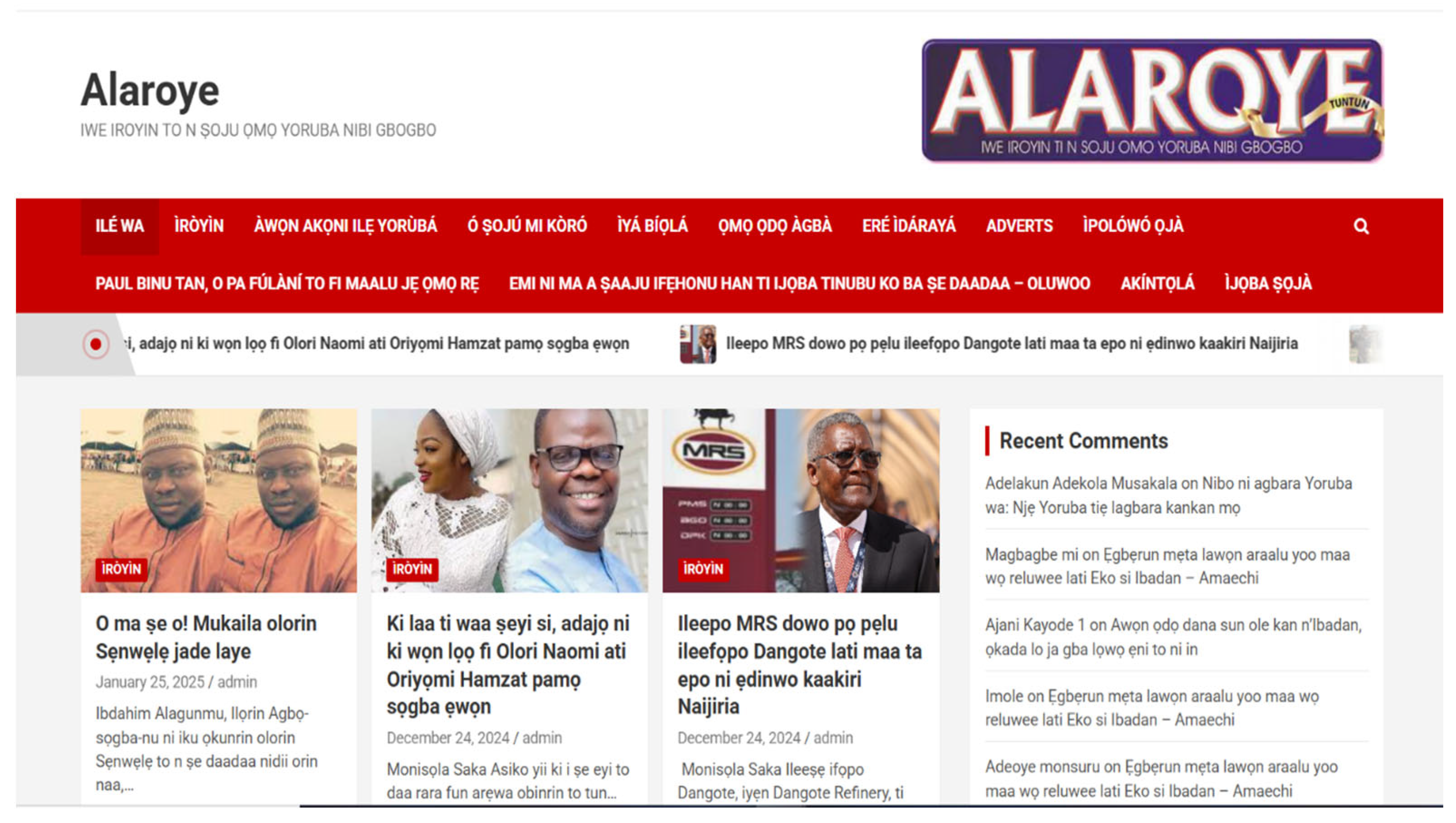
We first started the Aláròyé website and discovered that the hard copy was not affected, and people were visiting our webpage and reading online. We built the page gradually, and now the hits on our webpage are about 800,000 viewers. Our sales in copies have never gone beyond 150,000 copies (hardcopy), but when you put something there now, about 800,000 people and above view stories posted on the page and even more, like 1 million.
8.2. Challenges for Aláròyé Newspaper with Its Digital Operations
Social media has a few challenges since we have not joined it.
The fear that this might affect our physical sales makes us wary of going entirely into social media because we depend mainly on our sales. After all, Nigerian advertisers hate what they call “Local Newspapers.” They prefer to go for an English-language newspaper even when such a newspaper does not print up to 500 copies. For this, we ban broadcasters from page-by-page reviews of our newspapers because we knew it contributed to the lack of sales of the so-called national newspapers.
8.3. Projections of the Aláròyé Newspaper in Terms of the Digital Operations
We believe that in five years, we will have gone to the level that if anybody wants to do anything for the Yoruba people anywhere in the world, (they) would want to have something to do with Aláròyé. We are not talking of Nigeria alone, but when you mention Yoruba, you are going to mention Aláròyé, even in the media or on any platform
- https://www.YouTube.com/watch?v=EvsQIhgN7_I (accessed on 18 November 2025).
- https://alaroye.org/ (accessed on 18 November 2025).
- https://web.Facebook.com/groups/487877131392424 (accessed on 18 November 2025).
- https://www.YouTube.com/c/Aláròyéonlinetv (accessed on 18 November 2025).
8.4. Audience Reception of Aláròyé Newspaper on Digital Platforms Vis-à-Vis the Experience of Reading the Hard Copies
I do not search for Aláròyé on Facebook. However, I read or watch its video clip whenever it comes to its own volition, which it certainly does regularly.
8.5. Audience Assessment of Aláròyé Newspaper’s Digital Platforms in Terms of Access to News and Their Experiences Reading the News Texts on the Digital Platforms
9. Discussion of Findings
10. Conclusions
Author Contributions
Funding
Institutional Review Board Statement
Informed Consent Statement
Data Availability Statement
Conflicts of Interest
References
- Adesile, T. (2021). Digital transformation and journalism in nigeria. Journal of Innovative Communication and Media Studies, 3, 138. [Google Scholar]
- Adesina, E., Odiboh, O., Oyero, O., Adeyeye, B., Yartey, D., & Ekanem, T. (2018, April 25–26). Publishing African communication researches in open access outlets: An interrogation of Scopus between 1996–2016. 31st IBIMA Conference (pp. 6340–6345), Milan, Italy. [Google Scholar]
- Adesina, E., Oyero, O., Okorie, N., Amodu, L., Adeyeye, B., & Yartey, D. (2020). Data on information sources, knowledge and practice on hepatitis B virus in Southwest Nigeria. Data in Brief, 30, 105507. [Google Scholar] [CrossRef] [PubMed]
- Adeyemi, A., Afolabi, I. O., & Adefemi, V. O. (2023). Influence of digital news media on the circulation of printed newspapers in Nigeria. African Communication Research, 11(1), 82. [Google Scholar]
- Adeyeye, B., & Salawu, A. (2024). Sustainability of select indigenous-language newspapers through advertising in Nigeria: Appraising the success of alaroye and aminiya newspapers. African Journalism Studies, 45(2), 156–170. [Google Scholar] [CrossRef]
- Agbaka, J. (2025). The role of digital media in transforming communication: A historical perspective on Nigeria’s socio-political landscape. Perspektif, 14(1), 255–264. [Google Scholar] [CrossRef]
- Aiolfi, S., Bellini, S., & Pellegrini, D. (2021). Data-driven digital advertising: Benefits and risks of online behavioral advertising. International Journal of Retail & Distribution Management, 49(7), 1089–1110. [Google Scholar] [CrossRef]
- Ajani, Y. A., Oladokun, B. D., Olarongbe, S. A., Amaechi, M. N., Rabiu, N., & Bashorun, M. T. (2024). Revitalizing indigenous knowledge systems via digital media technologies for sustainability of indigenous languages. Preservation, Digital Technology & Culture, 53(1), 35–44. [Google Scholar] [CrossRef]
- Akinwalere, I. (2023). Indigenous language as a factor for sustainable development. In Indigenous African language media: Practices and processes (pp. 321–337). Springer. [Google Scholar]
- Alzub, A. M. (2023). Navigating the disruption of digital and conventional media in changing media consumption landscape in digital era. Journal of Engineering, Technology, and Applied Science (JETAS), 5(1), 38–48. [Google Scholar] [CrossRef]
- Amenaghawon, F. O., & Olawole, O. T. (2024). The influence of digital migration on the production of alaroye newspaper. MCC Journal, 8(2), 92–114. [Google Scholar]
- Asunbiaro, S., Ogundoju, B., & Lawal, M. (2024). Open source software: Development through information and communication technology (ICT) in developing countries. In Exploring STEM frontiers: A festschrift in honour of Dr. FO Balogun. SustainE. Available online: https://sustaine.org/open-source-software-development-through-information-and-communication-technology-ict (accessed on 13 June 2025).
- Ayobolu, Y. O. (2024). An assessment of online newspaper readership among residents of Apata, Ibadan, Nigeria. Àgídìgbo: ABUAD Journal of the Humanities, 12(2), 661–680. [Google Scholar] [CrossRef]
- Barrett, J., & Cocq, C. (2019). Indigenous storytelling and language learning: Digital media as a vehicle for cultural transmission and language acquisition. In Perspectives on indigenous writing and literacies (pp. 89–112). Brill. [Google Scholar]
- Blumler, J. G., & Katz, E. (Eds.). (1974). The uses of mass communications: Current perspectives on gratifications research. Sage. [Google Scholar]
- Bober, S., & Willis, C. (2021). The digitalization of minority language newspapers: Between long-term trend and pandemic-induced adaptation. European Yearbook of Minority Issues Online, 20(1), 66–92. [Google Scholar] [CrossRef]
- Boczkowski, P. J., & Mitchelstein, E. (2021). The digital environment: How we live, learn, work, and play now. MIT Press. [Google Scholar]
- Buckingham, D. (2015). Defining digital literacy-What do young people need to know about digital media? Nordic Journal of Digital Literacy, 10(Jubileumsnummer), 21–35. [Google Scholar] [CrossRef]
- Chakravartty, P., & Roy, S. (2013). Media pluralism redux: Towards new frameworks of comparative media studies “beyond the west”. Political Communication, 30(3), 349–370. [Google Scholar] [CrossRef]
- Cheruiyot, D. (2024). Comparing risks to journalism: Media criticism in the digital hate. Digital Journalism, 12(3), 294–313. [Google Scholar] [CrossRef]
- Danca, L., & Blose, M. (2024). Exploring the social responsibility of journalists in the era of social media: Misinformation, disinformation and fake news in the case of 2024 elections [Doctoral dissertation, University of Johannesburg]. [Google Scholar]
- Danos, D., & Turin, M. (2021). Living language, resurgent radio: A survey of indigenous language broadcasting initiatives. Language Documentation and Conservation, 15, 75–152. [Google Scholar]
- Daramola, A., & Tejumaiye, J. (Eds.). (2014). Mass media, social emancipation and the ICT AGE. Department of Sociology, University of Lagos, Concept Publications. [Google Scholar]
- Dontre, A. J. (2021). The influence of technology on academic distraction: A review. Human Behavior and Emerging Technologies, 3(3), 379–390. [Google Scholar] [CrossRef]
- Elike, I., & Anorue, L. I. (2023). Influence of digital surveillance on the use of information and communication technologies in Nigeria. Nsukka Journal of the Humanities, 31(1), 16–39. [Google Scholar] [CrossRef]
- Gbasha, C. T., John Tagwai, R., & Apev, H. E. (2024, May 9). Financing opportunities for conventional media organizations in the digital age: An assessment of nigerian media landscape. Available online: https://papers.ssrn.com/sol3/papers.cfm?abstract_id=4822506 (accessed on 29 June 2025).
- Hirst, M. (2020). News 2.0: Can journalism survive the internet? Routledge. [Google Scholar]
- Ifeduba, E., & Olatunji, T. (2019). How nigerian print publishers explore web-based income streams for survival. Covenant Journal of Communication, 6, 89–107. [Google Scholar]
- Irielle, C. (2024). An exploration of the experiences of nigerian adult learners utilizing smartphones and associated apps to access learning [Doctoral dissertation, Capella University]. [Google Scholar]
- Izuogu, K. C., Okpara, O., & Omeonu, D. U. (2025). The paradox of the internet in journalism in Nigeria: Between flexibility and accuracy challenges. Baileo: Jurnal Sosial Humaniora, 2(2), 256–267. [Google Scholar] [CrossRef]
- Ju, A., Jeong, S. H., & Chyi, H. I. (2014). Will social media save newspapers? Examining the effectiveness of Facebook and Twitter as news platforms. Journalism Practice, 8(1), 1–17. [Google Scholar] [CrossRef]
- Late, E., & Kumpulainen, S. (2022). Interacting with digitised historical newspapers: Understanding the use of digital surrogates as primary sources. Journal of Documentation, 78(7), 106–124. [Google Scholar] [CrossRef]
- Lim, W. M. (2025). What is qualitative research? An overview and guidelines. Australasian Marketing Journal, 33(2), 199–229. [Google Scholar] [CrossRef]
- Mbadiwe, A. M., & Udeze, S. E. (2025). Opinion of practising journalists in enugu on impact of citizen journalism on mainstream media practice in Nigeria. Caritas International Journal of Public Administration and Business Management, 2(1), 23–37. [Google Scholar]
- McLuhan, M. (1964). Understanding media: The extensions of man. Signet Books. [Google Scholar]
- Meighan, P. J. (2021). Decolonizing the digital landscape: The role of technology in Indigenous language revitalization. AlterNative: An International Journal of Indigenous Peoples, 17(3), 397–405. [Google Scholar] [CrossRef]
- Motsaathebe, G. (2023). Prospects and challenges for indigenous African language media in the digital age. In T. Matsilele, S. Mpofu, & D. Moyo (Eds.), New journalism ecologies in East and Southern Africa (pp. 225–249). Palgrave Studies in Journalism and the Global South. Palgrave Macmillan. [Google Scholar] [CrossRef]
- Mpofu, P., & Salawu, A. (2018a). Culture of sensationalism and indigenous language press in Zimbabwe: Implications on language development. African Identities, 16(3), 333–348. [Google Scholar] [CrossRef]
- Mpofu, P., & Salawu, A. (2018b). Re-examining the indigenous language press in Zimbabwe: Towards developmental communication and language empowerment. South African Journal of African Languages, 38(3), 293–302. [Google Scholar] [CrossRef]
- Mwita, K. M. (2022). Strengths and weaknesses of qualitative research in social science studies. International Journal of Research in Business and Social Science, 11(6), 618–625. [Google Scholar] [CrossRef]
- NBS. (2024). Telecoms data: Active voice and internet, porting and tariff information. NBS. [Google Scholar]
- Ngoc, N. M. (2022). Journalism and social media: The transformation of journalism in the age of social media and online news. European Journal of Social Sciences Studies, 7(6), 54–64. [Google Scholar] [CrossRef]
- Nikou, S., De Reuver, M., & Mahboob Kanafi, M. (2022). Workplace literacy skills—How information and digital literacy affect adoption of digital technology. Journal of Documentation, 78(7), 371–391. [Google Scholar] [CrossRef]
- Odebiyi, S. D., & Olawuyi, E. A. (2023). Coverage of development issues, and identity formation in alaroye newspapers. In Indigenous African language media: Practices and processes (pp. 359–379). Springer. [Google Scholar]
- Odiboh, O., Adeyeye, B., & Ekanem, T. (2018, May 25–27). Awareness of e-transaction among consumers of indigenous herbal remedies in Ota, Nigeria: A case for e-herbals. 2018 4th International Conference on Information Management (ICIM), Oxford, UK. [Google Scholar]
- Odunlami, O. A., & Bankole, T. O. (2024). Empirical analysis of intersection of digital media and indigenous language journalism in Lagos State, Nigeria. International Journal of Sub-Saharan African Research, 2(4), 336–349. [Google Scholar]
- Ogbu, S., Ariyo, I., Oluwole, A., Ndukwe, N., & Oyediran, O. (2021). Trends, challenges and prospects of newsmagazines publishing in Nigeria. Library and Information Perspectives and Research, 3(1), 17–25. [Google Scholar]
- Okon, P. E., Obukoadata, P. R., & Ekwok, L. (2022). Mediamorphosis: Assessing the influence of digital media on traditional newspapers in Nigeria from the audience and media managers’ perspectives. World of Media. Journal of Russian Media and Journalism Studies, 1, 45–64. [Google Scholar]
- Onoja, I. B., Bebenimibo, P., & Onoja, N. M. (2022). Critical discourse analysis of online audiences’ comments: Insights from the channels TV’s facebook audiences’ comments on farmers-herders conflicts news stories in Nigeria. SAGE Open, 12(3), 21582440221119470. [Google Scholar] [CrossRef]
- Onyenankeya, K. (2022). Indigenous language newspapers and the digital media conundrum in Africa. Information Development, 38(1), 83–96. [Google Scholar] [CrossRef]
- Owolabi, T. O. S. (2020). The political economy of indigenous language media in Nigeria and the challenge of survival in the digital age. In African language media (pp. 15–34). Routledge. [Google Scholar]
- Oyero, O., Oyesomi, K., Abioye, T., Ajiboye, E., & Kayode-Adedeji, T. (2018). Strategic communication for climate change awareness and behavioural change in Ota Local Government of Ogun State. African Population Studies, 32(1), 4057–4067. [Google Scholar]
- Oyesomi, K., Onyenankeya, K., & Onyenankeya, O. M. (2020). Reimagining the future of indigenous language press in the digital era. In African language media (pp. 137–155). Routledge. [Google Scholar]
- Oyesomi, K., Salawu, A., & Olorunyomi, B. (2017). Indigenous communication: Socio-economic characteristics influencing contemporary female political participation. Journal of International Women’s Studies, 18(4), 164–181. [Google Scholar]
- Paulussen, S., & Harder, R. A. (2014). Social media references in newspapers: Facebook, Twitter and YouTube as sources in newspaper journalism. Journalism Practice, 8(5), 542–551. [Google Scholar] [CrossRef]
- Pekkala, K., & van Zoonen, W. (2022). Work-related social media use: The mediating role of social media communication self-efficacy. European Management Journal, 40(1), 67–76. [Google Scholar] [CrossRef]
- Phillips, M. J. (2023). Towards a social constructionist, criticalist, Foucauldian-informed qualitative research approach: Opportunities and challenges. SN Social Sciences, 3(10), 175. [Google Scholar] [CrossRef]
- Ruggiero, T. E. (2000). Uses and gratifications theory in the 21st century. Mass Communication & Society, 3(1), 3–37. [Google Scholar]
- Salawu, A. (2006). Indigenous language media: A veritable tool for African language learning. Journal of Multicultural Discourses, 1(1), 86–95. [Google Scholar] [CrossRef]
- Salawu, A. (2019a). Alaroye, Isolezwe, and the adoption of digital technologies. In African language digital media and communication (pp. 33–45). Routledge. [Google Scholar]
- Salawu, A. (2019b). Introduction: Not to be left behind—African languages, media and the digital sphere. In A. Salawu (Ed.), African language digital media and communication. Routledge. [Google Scholar]
- Sanusi, B. O., Ifedolapo, A. S., & Ayinde, L. O. (2025). The role of social media in development communication: Opportunities and challenges. Lead City International Journal of Library, Information & Communication Sciences, 2(1), 217–231. [Google Scholar]
- Sharara, K., Simuka, J., & Zimucha, T. (2023). Digital transformation strategy for print newspapers: A Conceptual Framework. Journal of Research & Innovation for Sustainable Society (JRISS), 5(2), 155–168. [Google Scholar]
- Singh, D. P. (2025). Emergence of the influence of YouTube journalism & citizen journalism across the mass media platforms. Available online: https://papers.ssrn.com/sol3/papers.cfm?abstract_id=5083339 (accessed on 2 June 2025).
- Sundar, S. S., & Limperos, A. M. (2013). Uses and grats 2.0: New gratifications for new media. Journal of Broadcasting & Electronic Media, 57(4), 504–525. [Google Scholar] [CrossRef]
- Tshabangu, T., Fadipe, I. A., & Salawu, A. (2024). Digital journalism practices at indigenous African language newspapers in Nigeria, South Africa and Zimbabwe: A cultural discourse studies approach. In Digital inequality (pp. 184–202). Routledge. [Google Scholar]
- Tshabangu, T., & Salawu, A. (2022). Indigenous-language media research in Africa: Gains, losses, towards a new research agenda. African Journalism Studies, 43(1), 1–16. [Google Scholar] [CrossRef]
- Ugo, S. U., Odey, B. E., Odey, H. O., & Abu, P. E. (2023). Impact of digital communication technologies on the Nigerian mass media: Implications and insights into disruptions. LWATI: A Journal of Contemporary Research, 20(4), 39–55. [Google Scholar]
- Umoh, E. (2025, February 12). Exploring the influence of internet advertising on mobile phone purchase behavior in Nigeria. Available online: https://papers.ssrn.com/sol3/papers.cfm?abstract_id=5140631 (accessed on 13 June 2025).
- Waiswa, E. (2024). Exploring the challenges and opportunities of digital transformation in media organizations: A case of nation media group Uganda [Unpublished Master’s dissertation, Aga Khan University, East Africa]. [Google Scholar]
- Westlund, O., Boyles, J. L., Guo, L., Saldaña, M., Salaverría, R., Thomson, T., & Wu, S. (2025). Digital journalism (studies): An agenda for the future. Digital Journalism, 13(2), 179–194. [Google Scholar] [CrossRef]
- Wilding, D., Fray, P., Molitorisz, S., & McKewon, E. (2018). The impact of digital platforms on news and journalistic content. In Digital platforms inquiry. Centre for Media Transition. [Google Scholar]
- Williams, A., McLinden, A., Riabko, C., Napier, K., Robertson, K., & Team, M. I. (2024). Theories of technology (by Amber McLinden). In Insights into communication studies: Understanding foundational theories for media literacy. Available online: https://pressbooks.openeducationalberta.ca/insightsintocommstudies/chapter/chapter-9-theories-of-technology/ (accessed on 24 June 2025).
- Wirtz, B. W. (2024). Digital business and electronic commerce: Strategy, business models and technology. Springer Nature. [Google Scholar]
- Zayani, M. (2021). Digital journalism, social media platforms, and audience engagement: The case of AJ+. Digital Journalism, 9(1), 24–41. [Google Scholar] [CrossRef]
Disclaimer/Publisher’s Note: The statements, opinions and data contained in all publications are solely those of the individual author(s) and contributor(s) and not of MDPI and/or the editor(s). MDPI and/or the editor(s) disclaim responsibility for any injury to people or property resulting from any ideas, methods, instructions or products referred to in the content. |
© 2025 by the authors. Licensee MDPI, Basel, Switzerland. This article is an open access article distributed under the terms and conditions of the Creative Commons Attribution (CC BY) license (https://creativecommons.org/licenses/by/4.0/).
Share and Cite
Salawu, A.; Adeyeye, B. Aláròyé Newspaper on Digital Platforms: A Study of Audience Experience and Reception. Journal. Media 2025, 6, 200. https://doi.org/10.3390/journalmedia6040200
Salawu A, Adeyeye B. Aláròyé Newspaper on Digital Platforms: A Study of Audience Experience and Reception. Journalism and Media. 2025; 6(4):200. https://doi.org/10.3390/journalmedia6040200
Chicago/Turabian StyleSalawu, Abiodun, and Babatunde Adeyeye. 2025. "Aláròyé Newspaper on Digital Platforms: A Study of Audience Experience and Reception" Journalism and Media 6, no. 4: 200. https://doi.org/10.3390/journalmedia6040200
APA StyleSalawu, A., & Adeyeye, B. (2025). Aláròyé Newspaper on Digital Platforms: A Study of Audience Experience and Reception. Journalism and Media, 6(4), 200. https://doi.org/10.3390/journalmedia6040200

