1. Introduction
Reconciling carbon mitigation with air-quality improvement has become a central challenge for regional sustainability. China’s commitment to peak carbon emissions before 2030 and achieve carbon neutrality before 2060 has further intensified the need to coordinate pollution control with low-carbon transition [
1,
2]. This need arises in part because carbon dioxide and major air pollutants are often generated by the same sources, especially energy use, industrial production, and transport, and therefore tend to share common abatement pathways [
3,
4,
5,
6,
7]. In this study, the integrated relationship between carbon mitigation and air-pollution control is referred to as carbon–pollution synergy (CPS). Examining these linkages from a CPS perspective, rather than treating carbon mitigation and air-pollution control as separate policy agendas, provides a clearer basis for understanding the combined climate and environmental benefits of regional low-carbon transition.
Urban agglomerations are particularly important in this context. They concentrate population, industry, transport activity, and energy consumption, and thus represent the spatial scale at which interactions between carbon emissions and air pollutants are often most pronounced. Compared with national or provincial analyses, the urban-agglomeration scale is also better suited to capturing variation in economic development, industrial structure, resource endowment, energy use, and governance capacity across cities. Such variation often gives rise to substantial spatial heterogeneity in both carbon emissions and air pollution. The Middle Reaches of the Yangtze River Urban Agglomeration, which spans Hubei, Hunan, and Jiangxi provinces and includes the Wuhan Metropolitan Area, the Changsha–Zhuzhou–Xiangtan urban cluster, and the Poyang Lake urban cluster, is one of the most important economic and demographic concentration areas in central China [
8]. Its strong industrial base, large energy demand, and pronounced intercity differences in industrial specialization and environmental constraints make it a particularly relevant case for examining carbon–pollution synergy at the urban-agglomeration scale.
Existing research has examined the relationship between carbon emissions and air pollutants from several perspectives, including synergistic control, spatial differentiation, and driving mechanisms. A broad body of literature has shown that carbon dioxide and major pollutants such as sulfur dioxide (SO
2), nitrogen oxides (NO
x), and fine particulate matter (PM
2.5) are closely aligned in both emission sources and mitigation pathways, so that coordinated abatement can generate simultaneous environmental and climate benefits [
9,
10,
11,
12,
13,
14,
15,
16,
17]. Related studies have covered major sectors such as power generation, transportation, steel, transport, and construction, with particular attention to co-reduction potential, technological options, and policy effects [
14,
15,
16,
17,
18,
19,
20,
21,
22,
23,
24,
25]. Methodologically, linear regression studies have generally shown that economic scale, energy intensity, industrial structure, and environmental regulation significantly affect both carbon emissions and conventional pollutants; input–output studies have traced indirect carbon–pollution transfers along industrial supply chains and found that upstream energy-intensive sectors often dominate embodied emissions; difference-in-differences studies have evaluated policy shocks such as environmental information disclosure or environmental regulation and have reported measurable emission-reduction effects; and LMDI studies have consistently identified economic growth and population expansion as upward drivers, while energy-efficiency improvement and structural adjustment act as mitigating forces [
26,
27,
28,
29,
30,
31,
32,
33,
34,
35].
A further strand of research has explicitly examined pollution-reduction effects under carbon-target constraints. These studies suggest that carbon targets can reduce conventional pollutants through energy-intensity reduction, cleaner energy substitution, industrial upgrading, and transport electrification, thereby generating health and air-quality co-benefits [
36]. However, the magnitude and stability of these co-benefits depend on pollutant type, dominant emission source, regional industrial structure, and pollutant formation mechanism. In particular, primary combustion-related pollutants often respond more directly to carbon-oriented measures, whereas secondary pollutants may show delayed or nonlinear responses because their concentrations are affected by precursor chemistry and meteorological conditions [
37].
Despite these advances, three gaps remain. First, most existing studies focus on the national, provincial, sectoral, or single-city scale, while systematic evidence on intra-agglomeration heterogeneity within major urban agglomerations remains limited. Second, many studies examine either carbon emissions or individual pollutants in isolation, with less attention paid to comparing the spatial evolution and driver heterogeneity of carbon emissions and multiple representative pollutants within a unified analytical framework. Third, spatial patterns, driver decomposition, and synergy assessment are often analyzed separately, making it difficult to understand how these dimensions interact. These limitations are particularly salient in the Middle Reaches of the Yangtze River Urban Agglomeration, where energy use, emissions intensity, and regional heterogeneity are all pronounced [
18,
19,
20,
26,
27,
28,
29,
30,
31,
32,
33,
34,
35].
To address these gaps, this study examines 31 prefecture-level cities in the Middle Reaches of the Yangtze River Urban Agglomeration and brings CO2 and representative air pollutants into a unified analytical framework. By combining spatial autocorrelation analysis, the Logarithmic Mean Divisia Index (LMDI) decomposition model, and synergy assessment, the analysis investigates the spatial dynamics, major drivers, and CPS relationships between carbon emissions and air-pollutant emissions over 2013–2023. This study contributes in three ways. First, it identifies the spatial heterogeneity and temporal evolution of carbon emissions and representative pollutants from the perspective of intra-agglomeration differences. Second, it compares the drivers of CO2 and multiple pollutants within a common analytical framework. Third, it links spatial patterns, driving mechanisms, and synergy relationships to provide a more integrated understanding of CPS governance at the urban-agglomeration scale.
2. Materials and Methods
2.1. Study Area and Research Objects
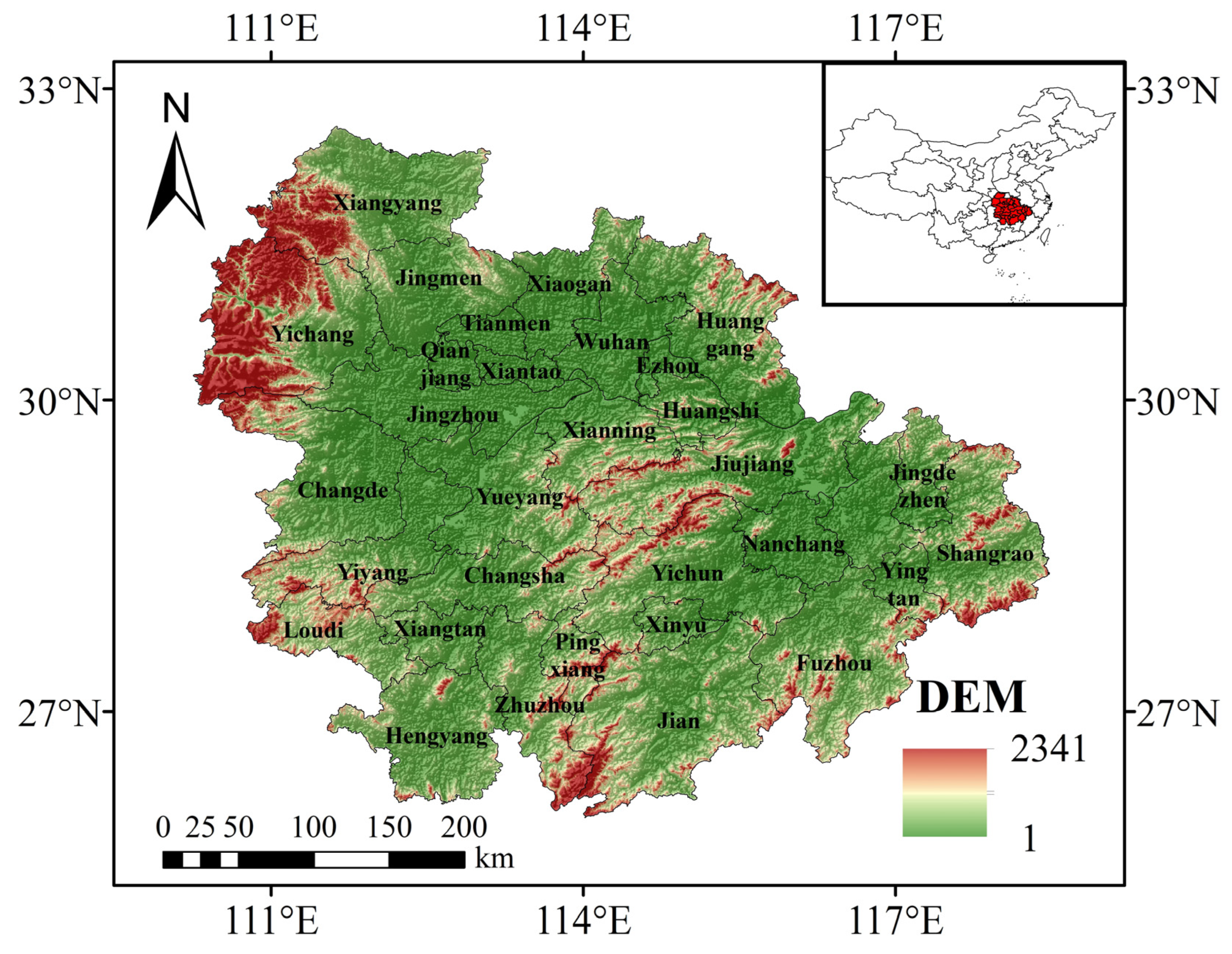
The analysis covers 31 prefecture-level cities in the Middle Reaches of the Yangtze River Urban Agglomeration, which spans Hubei, Hunan, and Jiangxi provinces and comprises the Wuhan Metropolitan Area, the Changsha–Zhuzhou–Xiangtan urban cluster, and the Poyang Lake urban cluster (
Figure 1). As one of the major urban agglomerations in central China, the region is characterized by pronounced intercity differences in economic development, industrial structure, energy use, and environmental governance. These differences make it well suited to examining spatial heterogeneity, driving forces, and carbon–pollution synergy at the urban-agglomeration scale.
CO2 was treated as the core variable of interest. Five air pollutants—carbon monoxide (CO), nitrogen dioxide (NO2), ozone (O3), fine particulate matter (PM2.5), and sulfur dioxide (SO2)—were selected for the spatial analysis to reflect different pollutant sources and formation processes. Among them, SO2, CO, and NO2 are treated as primary-emission indicators in the LMDI decomposition and CPS assessment because their formation is more directly linked to fossil-fuel combustion, industrial production, and transport activity. O3 is retained in the spatial analysis and discussion as a representative secondary pollutant, but is excluded from the LMDI decomposition and factor-based CPS assessment because its formation depends on nonlinear photochemical reactions involving NOx, volatile organic compounds, solar radiation, and meteorological conditions.
PM2.5 and O3 are treated differently from the primary-emission indicators in the empirical design. PM2.5 is retained in the spatial analysis because it reflects compound particulate pollution and regional transport, while O3 is retained in the spatial analysis and discussion because it represents secondary photochemical pollution. However, neither PM2.5 nor O3 is included in the revised LMDI decomposition or factor-based CPS assessment. This distinction avoids treating concentration outcomes as scale factors in an emissions-accounting identity and keeps the decomposition focused on indicators with more direct links to primary emissions.
The study period is 2013–2023. Spatial analysis was conducted for the full period, whereas the decomposition and synergy analyses focus on year-to-year changes over 2014–2023.
2.2. Data Sources and Preprocessing
The dataset includes socioeconomic indicators, energy-use data, CO2 emissions data, air-pollutant data, and spatial geographic data for the 31 cities over 2013–2023. Socioeconomic variables include gross domestic product (GDP), resident population, and industrial-structure indicators. These data were compiled primarily from the China Statistical Yearbook, the statistical yearbooks of Hubei, Hunan, and Jiangxi provinces, city-level statistical yearbooks, and official statistical bulletins.
Energy data include total city-level energy consumption and related indicators, which were converted into standard coal equivalents. These data were drawn mainly from provincial and municipal statistical yearbooks, energy statistical materials, and official bulletins. Where inconsistencies in statistical caliber or gaps in reporting occurred, the original sources were cross-checked and harmonized to improve continuity and comparability across cities and years.
The CO2 emissions series was compiled from city-level fossil-fuel energy-consumption data using a unified accounting framework. The calculation followed the standard fuel-combustion accounting logic in which CO2 emissions are estimated by multiplying energy consumption by standard coal conversion coefficients, fuel-specific carbon emission factors, oxidation rates, and the molecular weight conversion coefficient from carbon to CO2 (44/12). The accounting in this study focuses on fossil-fuel combustion-related CO2 emissions; industrial process emissions were not included because consistent city-level process-emission activity data were not available for all 31 cities over the full study period. City-level CO2 emissions were derived primarily from municipal energy-consumption statistics where available and were cross-checked with provincial energy balance information and official statistical bulletins to improve consistency. This clarification was added to strengthen reproducibility.
To improve data transparency, the temporal resolution, coverage, and preprocessing rules were further clarified. Socioeconomic and energy variables were compiled at annual frequency for 31 prefecture-level cities over 2013–2023 from national, provincial, and municipal statistical yearbooks and official statistical bulletins. Pollutant concentration data were harmonized to an annual city-level panel from publicly available environmental raster or monitoring-based datasets, including datasets hosted by the National Tibetan Plateau/Third Pole Environment Data Center [
38]. Before integration, all data series were checked for temporal coverage, unit consistency, abnormal year-to-year jumps, and spatial matching. Missing single-year observations were interpolated only when adjacent-year values were available and did not show structural breaks; otherwise, source documents were rechecked and the series was harmonized using official statistical bulletins.
Data for representative air pollutants and spatial geographic information were obtained mainly from publicly available environmental data platforms and relevant datasets from the National Tibetan Plateau/Third Pole Environment Data Center [
38]. These data were used to identify spatiotemporal patterns in pollutant distributions and to support spatial statistical analysis.
Several preprocessing steps were applied before formal analysis. First, all variables were aligned to a common study period of 2013–2023. Series with inconsistent temporal coverage were truncated, linked, and checked against adjacent years. Second, missing observations for individual years were filled by linear interpolation, and the resulting values were evaluated against neighboring-year trends. Third, all variables were standardized to ensure comparability in units and statistical caliber: GDP was expressed in CNY 100 million, resident population in 10,000 persons, and energy consumption in 10,000 tons of standard coal equivalent. Where changes in statistical systems led to inconsistencies, priority was given to continuous series with consistent definitions, and further adjustments were made by cross-checking official bulletins and adjacent-year records. Fourth, potentially abnormal observations were identified and verified against source documents and historical trends. Finally, all spatial datasets were transformed to a consistent projection and resampled where necessary to ensure spatial matching and analytical consistency.
2.3. Spatial Autocorrelation Analysis
Spatial autocorrelation analysis was used to identify the spatial dependence of CO
2 and representative air pollutants across the urban agglomeration. This approach is well suited to the present study because carbon emissions and air pollution are shaped not only by local socioeconomic conditions, but also by geographic proximity, industrial linkages, and atmospheric transport [
39]. Following Tobler’s First Law of Geography [
40], Moran’s
I was used to assess the degree of spatial clustering and heterogeneity [
41].
Global Moran’s
I was first calculated for six indicators—CO
2, CO, NO
2, O
3, PM
2.5, and SO
2—to determine whether their spatial distributions were clustered, dispersed, or random at the scale of the full urban agglomeration. The statistic is defined as:
In the formula, n denotes the number of cities within the study area, and represents the mean value of attribute x across the n spatial units. xi and xj denote the observed values of attribute x for city i and city j, respectively. wij represents the row-standardized spatial weight matrix. In this study, wij is constructed from the spatial distance matrix between city units, so that the index captures distance-related spatial dependence across the urban agglomeration.
Local Moran’s
I, or Local Indicators of Spatial Association (LISA), was then used to identify local clusters and outliers. The statistic is given by:
The meanings of the variables in the formula are consistent with those in the Global Moran’s
I. For both the global and local Moran’s
I statistics, the significance of the index is tested using the
Z-statistic. The calculation formula for
Z is as follows:
where
E(
I) and
Var(
I) denote the expected value and variance of
I, respectively.
The Local Moran’s I is essentially the product of the standardized value of a local attribute and its spatial lag term (i.e., the weighted average of the standardized attribute values of neighboring regions). When the Local Moran’s I is negative, it indicates the presence of spatial outliers, such as a high value surrounded by low values or a low value surrounded by high values.
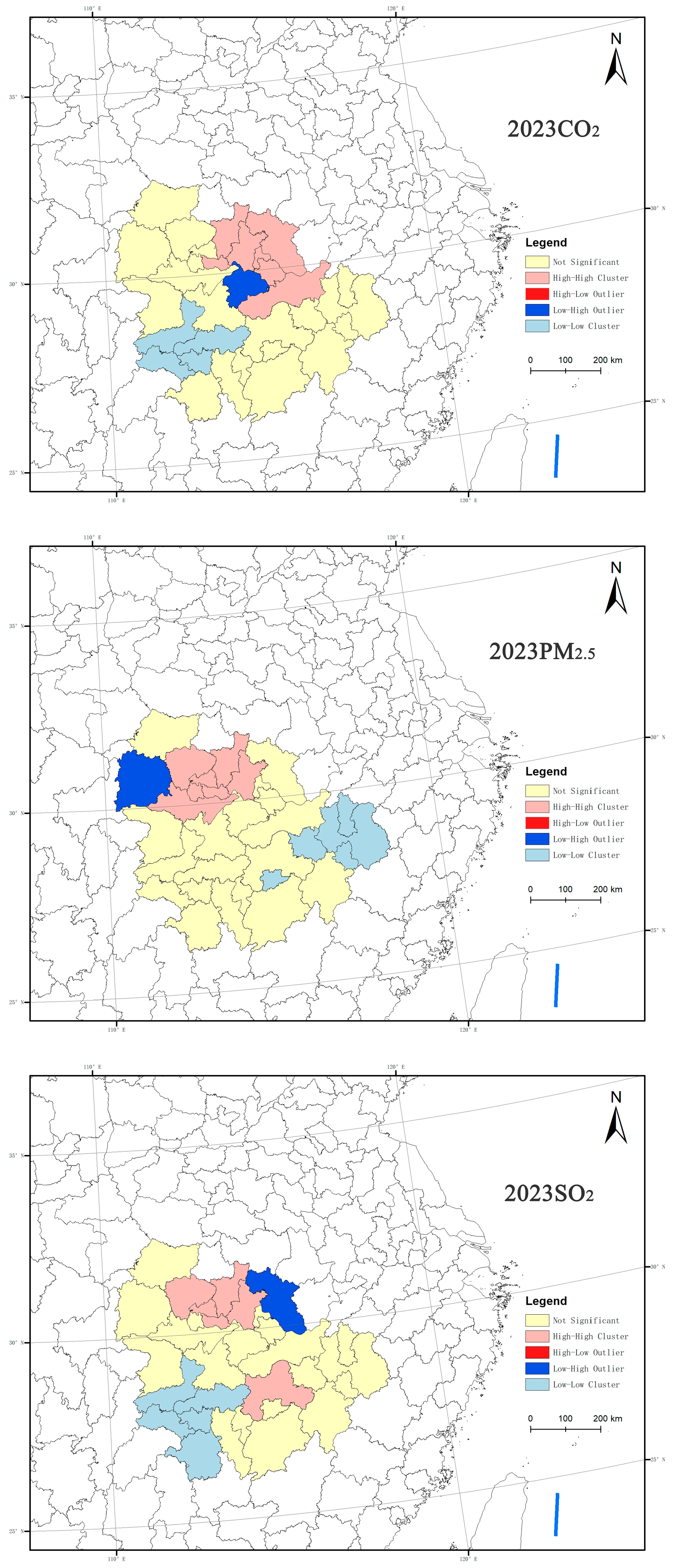
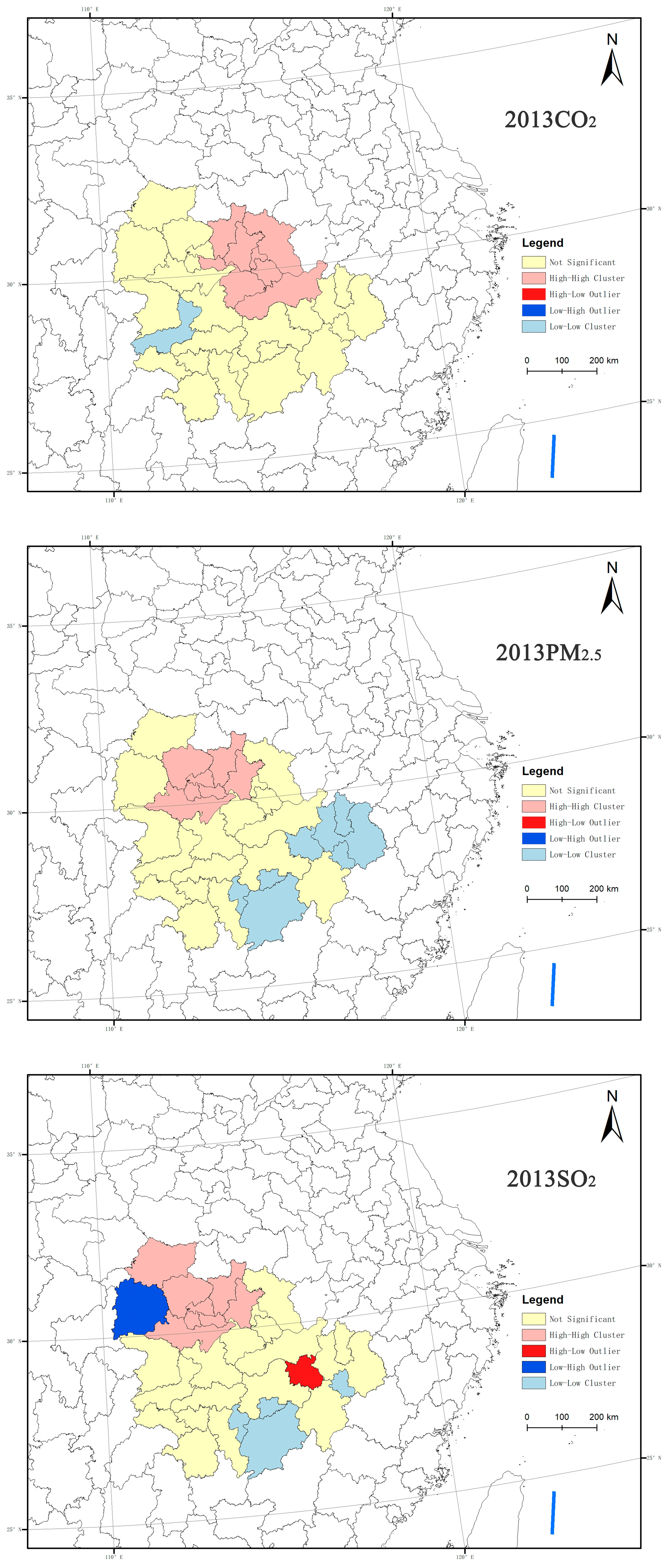
According to the relationship between each local standardized value and its spatial lag, LISA classifies local spatial association into four categories: High–High (H–H), where a high-value city is surrounded by high-value neighbors; Low–Low (L–L), where a low-value city is surrounded by low-value neighbors; High–Low (H–L), where a high-value city is surrounded by low-value neighbors; and Low–High (L–H), where a low-value city is surrounded by high-value neighbors. Areas that do not pass the significance test are classified as non-significant.
2.4. LMDI Decomposition Model
The Logarithmic Mean Divisia Index (LMDI) method was used to identify the main drivers of changes in carbon emissions and primary air-pollutant emissions. LMDI is widely used in studies of carbon and pollutant emissions because it yields exact decomposition without residual terms, handles zero values effectively, and provides results with clear economic interpretation [
32,
33,
42]. It is particularly useful here because it allows total changes in emissions to be decomposed into the relative contributions of demographic, economic, energy-related, and emission-intensity factors, making it possible to compare CO
2 and primary pollutants within a single analytical framework. O
3 is not decomposed using LMDI because it is a secondary pollutant and its concentration is not directly determined by a single emission-accounting identity.
To maintain theoretical consistency and factor interpretability, the revised LMDI framework focuses on CO
2 and primary-emission pollutants only and decomposes annual changes into four interpretable dimensions: emission-intensity/energy-structure effect, energy-consumption effect, economic-development effect, and population-scale effect. The multiplicative identity is written as:
In the revised formula,
C denotes the CO
2 emission amount or the primary-pollutant indicator;
ENERGY denotes total energy consumption;
GDP denotes gross domestic product; and
POP denotes resident population. The term
/
is interpreted as an emission-intensity or energy-structure-related effect,
/
GDP as the energy-consumption effect,
GDP/
as the economic-development effect, and
as the population-scale effect. This formulation is used to interpret relative year-to-year changes rather than to claim that pollutant concentrations are identical to physical emissions. The correspondence between the four driving factors and their notation used in the LMDI decomposition is summarized in
Table 1.
Substantively, the population-scale factor captures demographic expansion; the economic-development factor reflects the scale effect associated with economic growth; the energy-consumption factor captures changes in energy consumption per unit of GDP; and the emission/energy-structure factor reflects changes in emissions per unit of energy consumption.
The decomposition was performed for CO2 and three primary pollutants, namely SO2, CO, and NO2. PM2.5 is retained in the spatial analysis as an indicator of compound particulate pollution, and O3 is retained in the spatial analysis and discussion as a secondary pollutant; neither PM2.5 nor O3 is included in the LMDI decomposition or factor-based CPS assessment.
2.5. Carbon–Pollution Synergy Assessment
The CPS assessment builds on the factor-specific LMDI results and evaluates whether the same driver affects CO
2 and primary pollutant emissions in the same direction. This approach is used to distinguish synergistic reduction, synergistic increase, and divergence in CPS relationships [
43,
44].
In Equation (5), denotes the degree of carbon–pollution synergy in region r during period ΔT. represents the contribution rate of driving factor X to CO2 emissions over period ΔT. represents the contribution rate of driving factor X to pollutant P over period ΔT, where P denotes a primary pollutant, namely SO2, CO, or NO2. The driving factor X includes the emission/energy-structure factor, energy-consumption factor, economic-development factor, and population-scale factor. The numerator measures the deviation of the CO2 factor index from the neutral value of 1, whereas the denominator measures the corresponding deviation of pollutant P. When both the CO2 and pollutant factor indices are greater than 1, the factor is classified as producing a synergistic increase (SI), indicating that it promotes both carbon emissions and pollutant emissions. When both indices are below 1, the factor is classified as producing a synergistic reduction (SR), indicating that it suppresses both. When one index is greater than 1 and the other is below 1, the factor is classified as divergence (Div), indicating opposite directional effects. Large CPS values may occur when the pollutant-specific deviation term in the denominator is close to zero; therefore, these values should be interpreted mainly by their direction and classification rather than as proportional effect sizes.
This classification makes it possible to distinguish relatively stable sources of CPS from factors that are more likely to generate carbon–pollution mismatch. PM2.5 and O3 are not included in the CPS assessment because their concentration dynamics are strongly affected by secondary formation, atmospheric transport, and meteorological conditions and are therefore not directly comparable with primary-emission indicators in a factor-based framework.
2.6. Research Framework
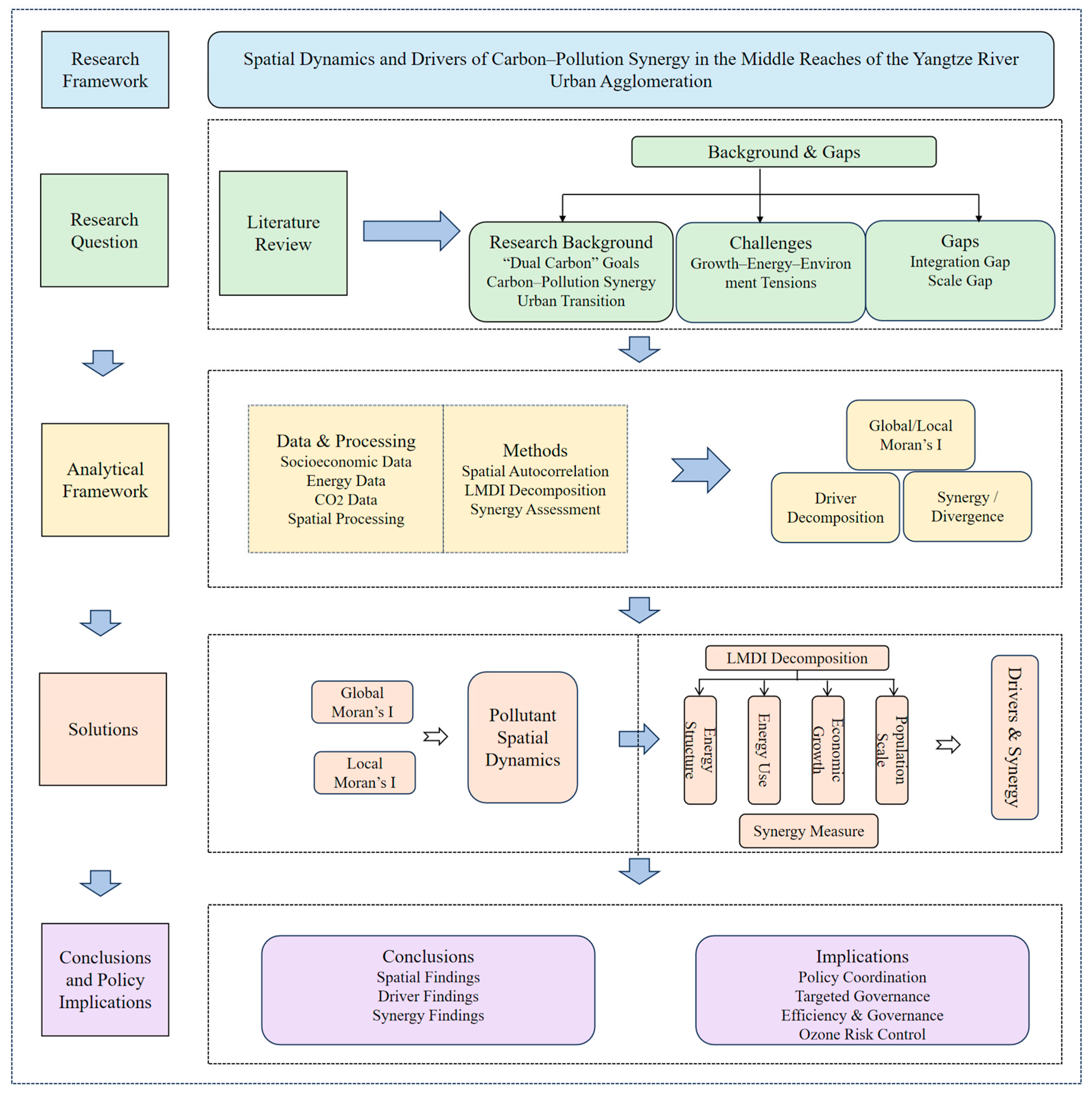
Based on the above description of the research methods, the research framework of this study is illustrated as follows (
Figure 2):
4. Discussion
4.1. Spatial Differentiation of Carbon–Pollution Dynamics and Its Underlying Causes
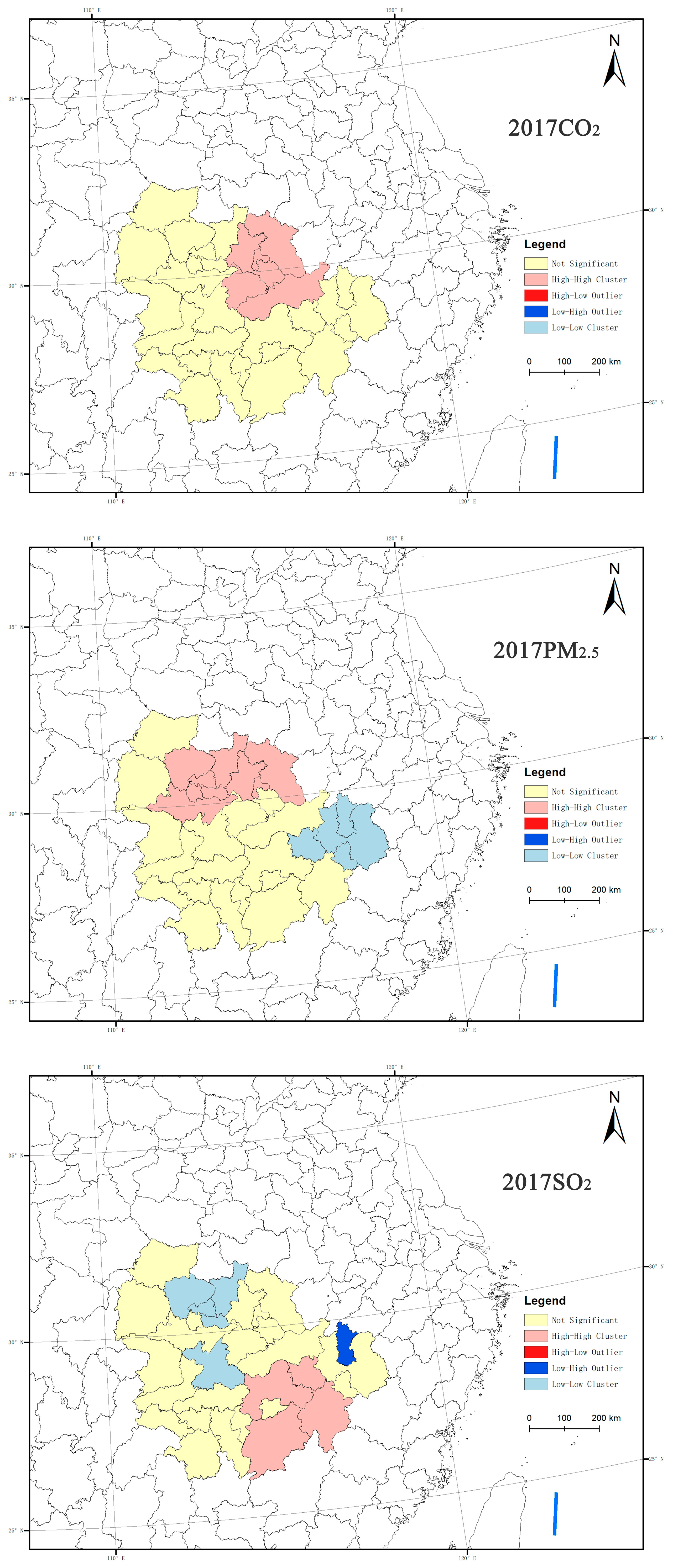
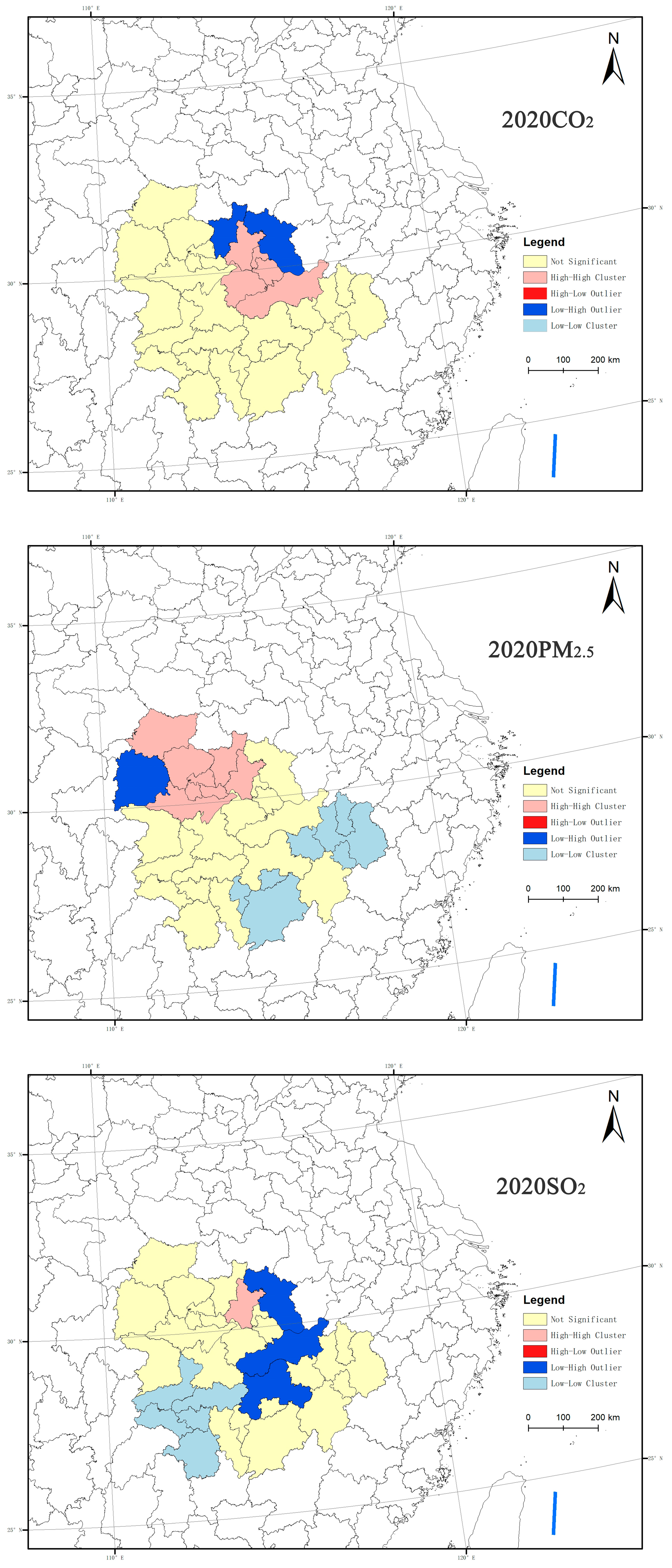
The spatial patterns reported above show that carbon emissions and air pollutants are linked, but not spatially interchangeable. Their clustering is governed by overlapping yet distinct processes, including urban hierarchy, industrial organization, energy use, and atmospheric transport. This distinction is important because it suggests that carbon–pollution coordination at the urban-agglomeration scale cannot be inferred from a single indicator or a single spatial logic.
This finding also places the Middle Reaches of the Yangtze River Urban Agglomeration in a broader international context. Evidence from global and developed-economy studies shows that greenhouse-gas mitigation often brings air-quality and health co-benefits by reducing co-emitted pollutants [
36]. In many European and North American urban regions, conventional pollutants such as SO
2 declined substantially during deindustrialization, fuel switching, and end-of-pipe regulation, while carbon emissions became more closely associated with metropolitan energy demand, transport systems, and consumption-related activities. The pattern identified here is similar in that conventional industrial pollutants have weakened in some traditional cores, but it differs because industrial relocation is still occurring within the same urban agglomeration, producing new peripheral pollution pressures rather than a simple regional-wide decline.
The CO
2 pattern is closely aligned with the hierarchical structure of the urban agglomeration. Persistent high–high clusters around Wuhan, Changsha, and Nanchang point to the role of provincial capitals as concentrations of economic activity, population, infrastructure, and energy demand. At this scale, carbon emissions are not simply a function of local industrial activity; they also reflect the broader regional organization of core cities and their surrounding hinterlands. Peripheral cities are therefore shaped not only by their own development trajectories, but also by spillovers from nearby metropolitan centers, including industrial relocation and functional specialization. The resulting pattern is one of strong concentration around major urban cores and a clear core–periphery gradient. This interpretation is broadly consistent with earlier studies showing that urban agglomerations tend to concentrate carbon emissions in cities occupying dominant positions in regional economic networks [
18,
19,
20].
PM2.5 follows a different spatial logic. Its persistent north–south gradient and strong local continuity point to the regional character of compound particulate pollution. Unlike CO2, PM2.5 cannot be understood mainly through local activity intensity or city hierarchy. Its distribution is more clearly shaped by the interaction between local emissions, topography, and regional transport. This helps explain why PM2.5 displays stronger and more stable clustering than most other indicators. It also suggests that control of compound particulate pollution is inherently regional in nature: even where local emissions decline, unfavorable transport conditions or upwind pollution can sustain elevated concentrations. In this sense, the PM2.5 pattern reinforces a point widely emphasized in regional air-pollution research—namely, that compound air pollution is governed by processes that extend well beyond administrative boundaries.
SO
2 presents yet another pattern, one that is more clearly tied to industrial restructuring and policy intervention. The weakening of high-value clusters in traditional industrial cores, combined with the emergence of new clusters in peripheral industrial transfer areas, points to a spatial redistribution of pollution pressure rather than a uniform regional decline. This does not negate the effectiveness of pollution control in established industrial centers. Instead, it suggests that conventional pollution-control policies can alter the geography of emissions, especially where industrial relocation occurs within the same urban agglomeration. Similar spatial shifts have been reported in studies of industrial transfer and regional environmental inequality, where the burden of conventional pollutants moves from older industrial bases to emerging production locations [
14,
15,
16,
17,
18,
19,
20,
21,
22,
23,
24,
25]. The SO
2 pattern identified here therefore reflects both real governance gains and a reconfiguration of the regional geography of emissions.
Taken together, these findings underline the need to distinguish among environmental indicators when interpreting carbon–pollution coordination. CO2 mainly reflects urban hierarchy and regional centrality, PM2.5 captures the regionality of compound air pollution, and SO2 responds more directly to industrial geography and regulatory intensity. A unified governance framework is therefore necessary, but it cannot be uniform in content. Different pollutants embed different forms of spatial dependence and require correspondingly differentiated interpretation.
4.2. Common and Divergent Drivers
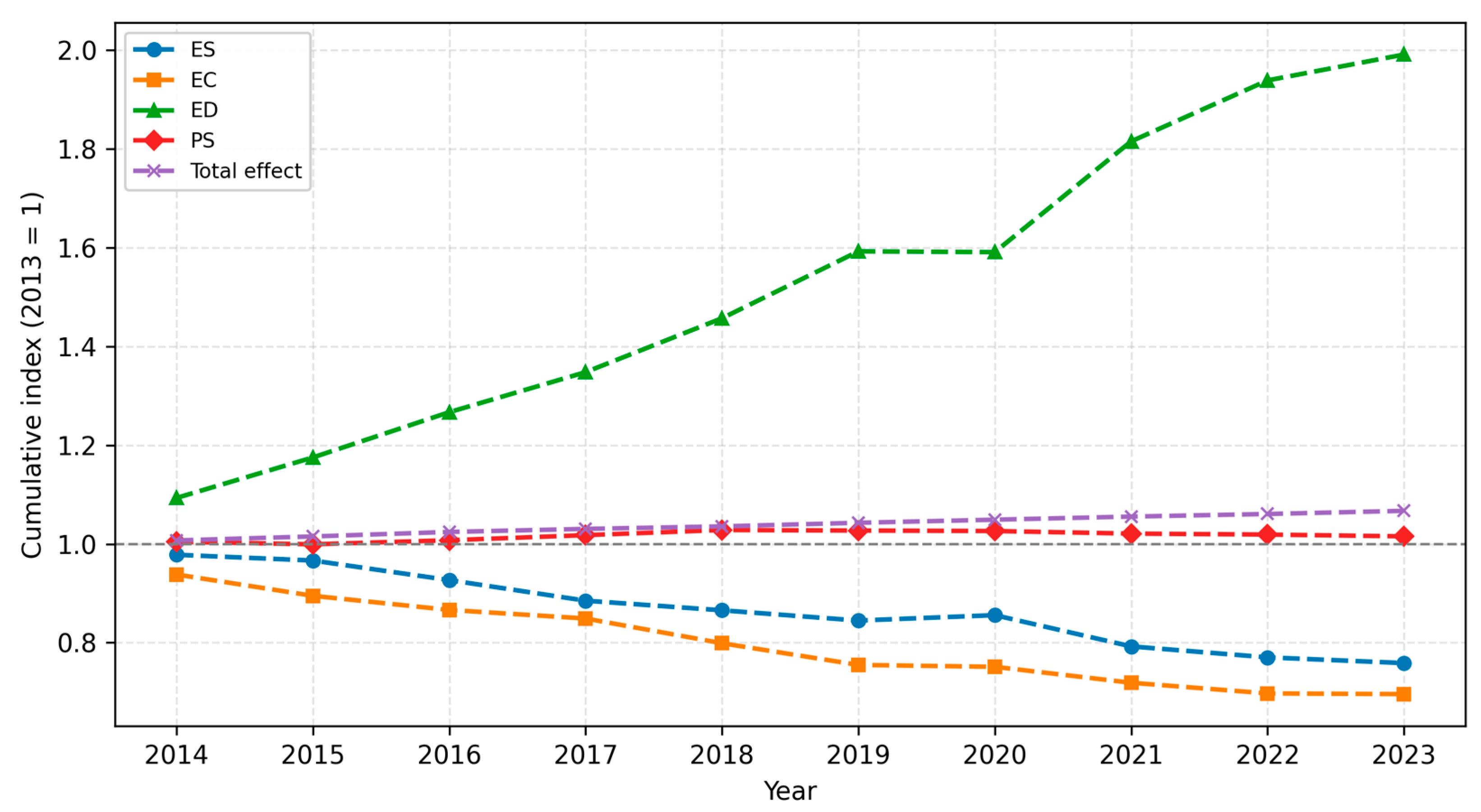
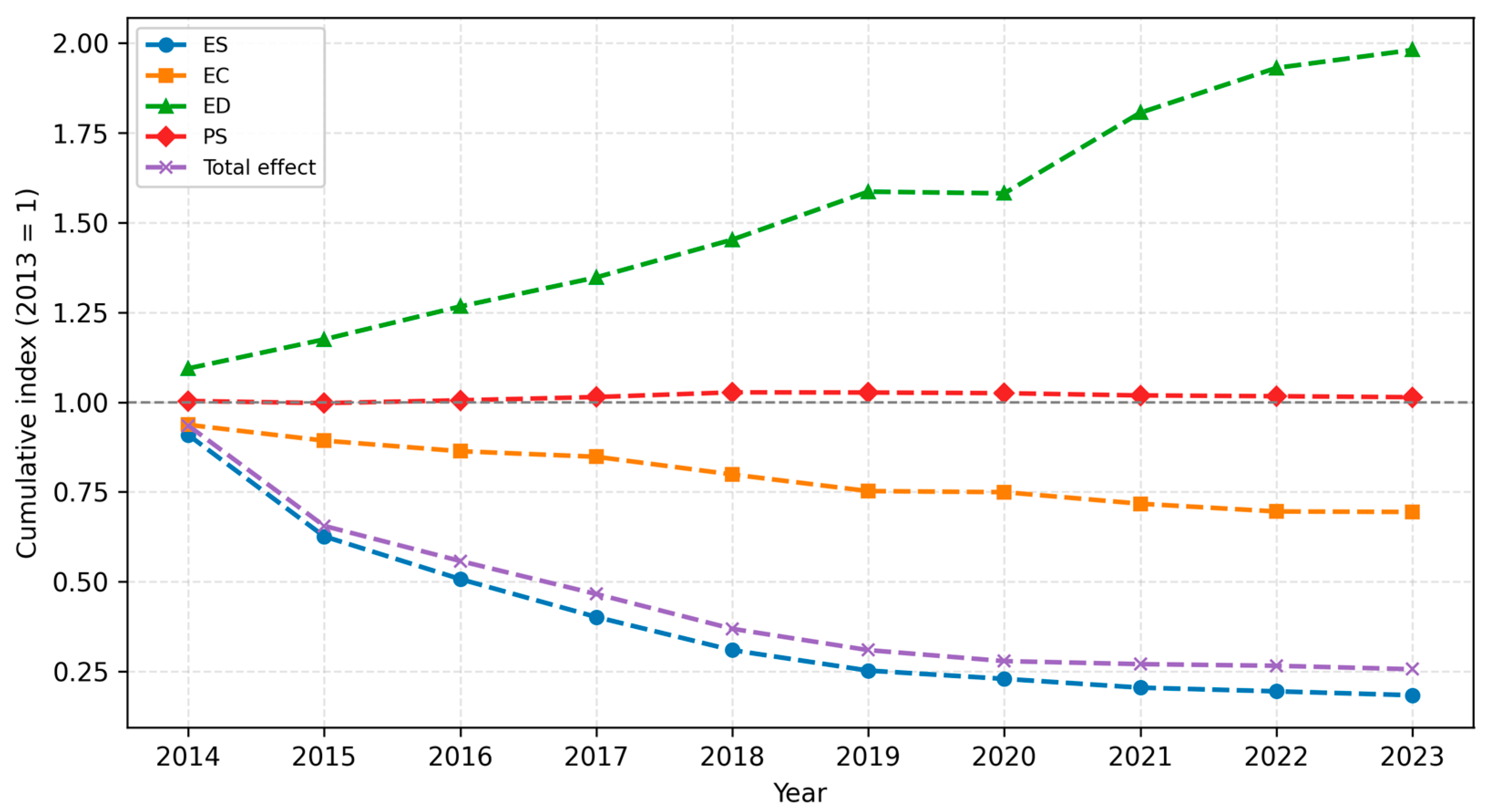
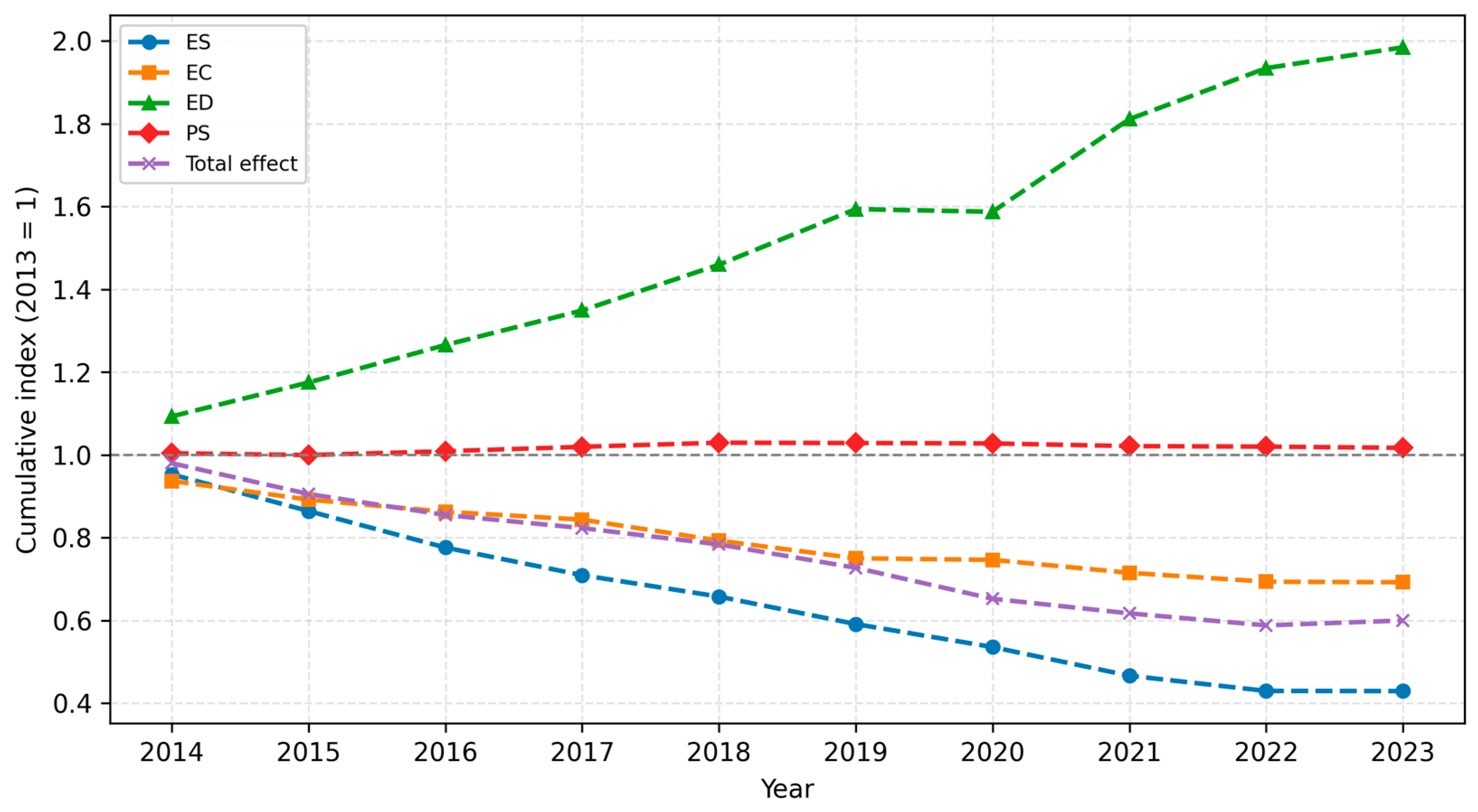
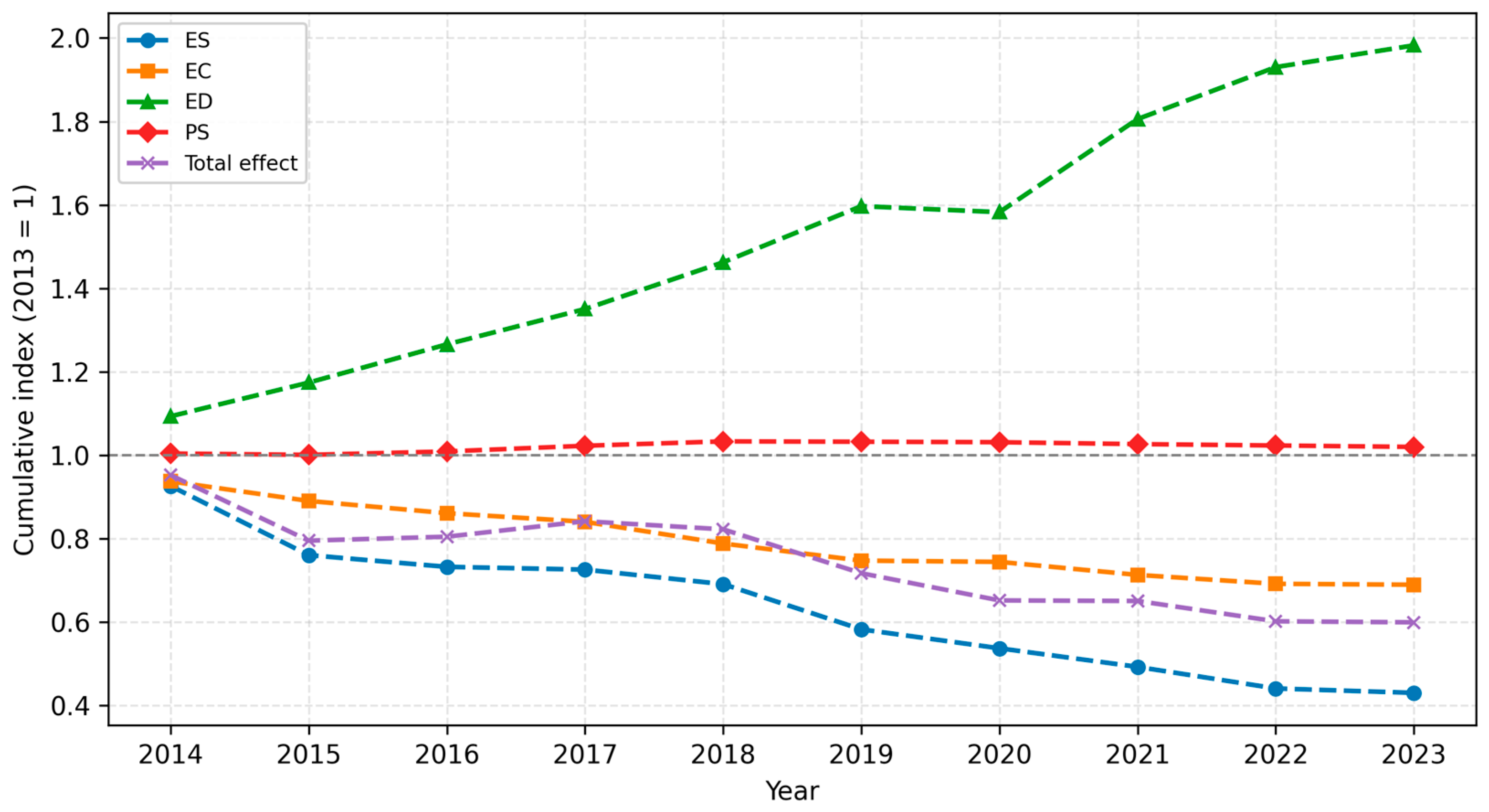
The decomposition results point to a clear asymmetry between shared drivers and pollutant-specific responses. Economic development acts as the main upward pressure across both CO2 and the primary pollutants, whereas the energy-consumption factor and, in many years, the emission/energy-structure factor work in the opposite direction. The recalculated population-scale factor remains much closer to 1, indicating that its independent contribution is comparatively weak once the other drivers are controlled for.
The positive role of economic development is structurally understandable. In a rapidly transforming urban agglomeration, economic growth brings rising industrial output, more intensive infrastructure construction, denser service provision, and stronger final energy demand. Population change still matters because it affects housing demand, transport activity, and urban operating needs, but the recalculated results show that its net effect is smaller and less stable than the economic-development effect. This interpretation is consistent with previous work identifying scale expansion as a key force behind regional carbon and pollution growth, while the role of population often depends on the stage of urbanization and the way other drivers are specified [
26,
27,
28,
29,
30,
31,
32,
33,
34,
35].
Compared with urban agglomerations in Europe and the United States that have already passed through most heavy-industrial restructuring, the Middle Reaches of the Yangtze River Urban Agglomeration remains in a transitional stage in which economic expansion, industrial upgrading, and pollution control occur simultaneously. This helps explain why scale-related factors still exert upward pressure, while energy-efficiency improvements and structural changes already generate partial CPS benefits.
These patterns are also consistent with broader evidence from international institutions. The IEA identifies energy efficiency as one of the quickest and most cost-effective options for reducing CO
2 emissions, which is consistent with the suppressing effect of the energy-consumption factor observed here [
45]. The differentiated response of O
3 is likewise plausible in light of IPCC assessments, which emphasize the nonlinear response of ozone to changes in precursor emissions and the possibility that reductions in NO
x may produce mixed effects depending on the chemical regime [
46].
By contrast, the energy-consumption factor is the most stable source of suppression across CO2 and primary pollutants. It mainly reflects declining energy consumption per unit of output and therefore captures the effect of energy-efficiency improvement. The emission/energy-structure factor also suppresses CO2 and SO2 relatively consistently, but its effects on CO and NO2 are weaker and less stable. These results indicate that the region already possesses a meaningful basis for CPS governance, but that this basis is stronger for conventional combustion-related pollutants than for pollutants with more diverse sources.
The clearest source of divergence lies in the emission/energy-structure factor. For CO
2 and SO
2, structural adjustment behaves largely as expected, producing a relatively stable suppressive effect. For CO and NO
2, the same factor is weaker and less stable, indicating more diverse source structures and more variable responses to structural adjustment. For O
3, which is discussed as a secondary pollutant rather than decomposed through LMDI, the spatial results suggest that low-carbon adjustment does not automatically deliver ozone improvement. This interpretation is consistent with atmospheric chemistry studies showing that tropospheric ozone is not directly emitted, but is formed through nonlinear interactions among NO
x, volatile organic compounds, solar radiation, and meteorological conditions [
37].
This divergence has direct implications for how CPS should be interpreted. Shared drivers do not necessarily imply uniform responses across all pollutants. For traditional combustion-related primary pollutants, such as SO
2, CO, and partly NO
2, emission reductions are more directly associated with reductions in fossil-fuel combustion, energy-efficiency improvement, cleaner energy substitution, and industrial upgrading. Energy-efficiency improvement is widely recognized as an important pathway for reducing CO
2 emissions [
45], and greenhouse-gas mitigation can also generate air-quality and health co-benefits by reducing co-emitted pollutants [
36]. However, these co-benefits are not necessarily uniform across pollutant types. Secondary or compound pollutants may respond in a more conditional and unstable manner because their concentrations are also affected by atmospheric transformation, regional transport, precursor chemistry, and meteorological conditions. This is particularly evident for O3, which is formed through nonlinear photochemical reactions involving NOx, volatile organic compounds, solar radiation, and meteorological factors [
37,
46]. Therefore, low-carbon measures may not automatically lead to proportional or immediate improvements in all pollutant concentrations. In this respect, the energy-structure factor is not merely one among several drivers; it provides an important indication of where CPS is relatively stable and where it remains contingent on pollutant-specific formation mechanisms.
4.3. The Basis and Limits of Carbon–Pollution Synergy (CPS)
The CPS assessment confirms that the region already has a substantial basis for carbon–pollution synergy, but that this basis is uneven across pollutants and policy dimensions. Economic development mostly produces synergistic increases, while improvements in energy consumption mostly produce synergistic reductions. Carbon emissions and primary pollutant emissions are therefore still closely linked in both their sources of growth and their main channels of mitigation. By contrast, the population-scale factor shows only weak and unstable CPS because its recalculated values remain close to 1.
This linkage matters because it shows that CPS governance is not just a policy aspiration; it is rooted in the structure of the regional emission system itself. Where carbon emissions and pollutant emissions are driven by the same underlying factors, integrated interventions can generate simultaneous gains. The relative stability of synergistic reduction under the energy-consumption factor suggests that energy-efficiency improvement remains one of the most reliable levers for joint carbon and primary-pollutant control. Structural adjustment is also important, but its effect is more pollutant-specific and therefore requires differentiated policy interpretation.
The limits of CPS become more visible once the analysis shifts from aggregate linkage to pollutant-specific response. The emission/energy-structure factor does not generate the same kind of synergy for all pollutants. SO
2 shows the strongest alignment with CO
2, whereas CO and NO
2 exhibit weaker and less stable responses. The recalculated population-scale factor adds relatively little systematic explanatory power to the CPS pattern because it fluctuates around 1. For O
3, which is not included in the LMDI or CPS tables because it is a secondary pollutant, the spatial results and international literature both suggest that low-carbon transition cannot be assumed to produce immediate or linear ozone improvement [
37].
Carbon–pollution synergy (CPS) should therefore be understood as differentiated rather than universal. The region has a solid basis for CPS governance, but that basis is strongest where efficiency gains and primary-emission reductions dominate, and weaker where pollutant formation is more chemically complex. This is especially relevant for urban agglomerations, where cross-boundary transport, intercity specialization, and industrial relocation can intensify these differences. A governance strategy designed mainly around conventional pollutant control would therefore miss precisely those dimensions of heterogeneity that matter most for compound pollution.
4.4. Implications and Limitations
Several broader implications follow from these findings. At the urban-agglomeration scale, coordinated governance needs to move beyond uniform total-control strategies and pay closer attention to spatial and pollutant-specific differentiation. Core cities require stronger attention to carbon lock-in associated with concentrated economic activity and energy demand, while peripheral industrial-transfer areas require closer monitoring of relocated primary-pollution pressure. More fundamentally, control strategies developed for conventional combustion-related pollutants cannot simply be extended to compound pollutants such as O3. The latter require more targeted precursor control and greater attention to regional atmospheric processes.
Region-specific CPS policy design is therefore necessary. For Wuhan, Changsha, Nanchang, and their surrounding metropolitan areas, the priority should be to reduce carbon lock-in through industrial upgrading, low-carbon transport, building energy-efficiency improvement, and cleaner electricity consumption. For northern corridor cities with persistent PM2.5 clustering, joint prevention and control should emphasize cross-boundary transport channels, coordinated emergency response, and integrated control of primary particles and secondary precursors. For peripheral industrial-transfer cities where SO2 hotspots have emerged or persisted, industrial admission standards, cleaner production audits, and intercity responsibility-sharing mechanisms should be strengthened to prevent the spatial relocation of conventional pollution. For ecologically sensitive low-emission areas, policy should focus on maintaining ecological functions while preventing the transfer of high-emission industries from core cities.
At the same time, several limitations should be acknowledged. First, the decomposition framework focuses on macro-level drivers such as economy, population, energy consumption, and emission intensity, but does not explicitly incorporate finer-scale variables such as VOC emissions, transport intensity, or detailed intra-sectoral restructuring. The interpretation of O3 therefore remains incomplete, and this is why O3 was excluded from the revised LMDI and CPS assessment. Second, PM2.5 is used as a spatial indicator of compound particulate pollution, but it is not included in the factor-based CPS assessment. This improves methodological consistency, but limits direct identification of PM2.5-specific synergy mechanisms. Third, the analysis is conducted at the urban-agglomeration scale and does not explicitly model cross-boundary atmospheric transport or city-type heterogeneity beyond the spatial-statistical framework. Future research should integrate higher-resolution emissions inventories, VOC and NOx precursor data, and chemical transport modeling to further explain compound-pollution responses under low-carbon transition.
Even with these limitations, the analysis provides an integrated account of how carbon emissions and representative air pollutants evolve, what drives them, and where their relationships align or diverge within a major urban agglomeration. The broader message is that CPS governance is both possible and conditional: possible because several core drivers already generate CPS benefits, and conditional because those CPS benefits are not shared equally across pollutants. That distinction is likely to become increasingly important as urban agglomerations move from conventional pollution control toward more complex multi-objective environmental governance.
5. Conclusions
This study examined the spatial dynamics, driving factors, and carbon–pollution synergy (CPS) relationships of CO2 and representative air pollutants across 31 prefecture-level cities in the Middle Reaches of the Yangtze River Urban Agglomeration from 2013 to 2023 within a unified analytical framework.
Several conclusions emerge. First, both CO2 and the selected pollutants exhibit clear spatial clustering, but their spatial organization differs substantially by pollutant type. High CO2 values remain concentrated in core cities such as Wuhan, Changsha, and Nanchang, reflecting a strong urban-hierarchy effect. PM2.5 shows a more stable regional pattern, with persistently higher levels in the north than in the south, highlighting the importance of compound pollution and regional transport. SO2, by contrast, reveals a spatial shift from traditional industrial cores toward peripheral areas receiving industrial relocation, pointing to a marked restructuring of conventional combustion-related pollution under strengthened environmental governance.
Second, carbon emissions and primary air pollutants share several broad drivers, but the strength and direction of these effects are not uniform across pollutants. Economic development is the main positive force behind changes in CO2 and the primary pollutants, indicating that regional expansion remains the common background to both carbon and pollution growth. By contrast, the energy-consumption factor generally suppresses emissions and therefore provides the most stable basis for CPS. The recalculated population-scale factor remains close to 1 and thus has a comparatively limited independent effect. The emission/energy-structure factor is more differentiated: it consistently suppresses CO2 and SO2, but has weaker and less stable effects on CO and NO2. Structural adjustment in the energy system therefore does not translate into uniform environmental gains across all pollutants.
Third, the region shows a substantial basis for CPS, but that synergy is uneven across both drivers and pollutants. Economic development mostly produces synergistic increases, while improvements in energy consumption mostly produce synergistic reductions. The population-scale factor is comparatively weak and unstable because its recalculated values fluctuate around 1. The clearest source of instability is the emission/energy-structure factor, which shows pollutant-specific differences even among primary pollutants and helps explain why secondary pollutants such as O3 require separate interpretation.
Taken together, these findings suggest that the Middle Reaches of the Yangtze River Urban Agglomeration has already developed an important foundation for CPS governance, but that this foundation is strongest for conventional primary pollutants, especially SO2, and more conditional for compound pollutants such as O3. Future low-carbon transition at the urban-agglomeration scale will therefore depend not only on continuing common pathways such as energy-efficiency improvement, structural adjustment, and stronger governance, but also on developing more differentiated strategies for pollutants that do not respond in the same way to decarbonization.
Overall, carbon emissions and air pollutants in the region do not evolve independently. Rather, they are jointly shaped by regional development, energy consumption, structural adjustment, and governance conditions in ways that generate both CPS benefits and points of tension. By linking spatial patterns, driver decomposition, and synergy assessment from the perspective of intra-agglomeration heterogeneity, this study adds empirical evidence to the literature on CPS governance in major urban agglomerations and contributes to a more differentiated understanding of multi-objective environmental governance under low-carbon transition.