Article

Modeling Flood Susceptibility in Rwanda Using an AI-Enabled Risk Mapping Tool

1
Earth Observation Department, Rwanda Space Agency (RSA), Telecom House, Kacyiru, Kigali BP 6205, Rwanda
2
Centre for GIS and Remote Sensing, College of Science and Technology, University of Rwanda, Kigali BP 3900, Rwanda
3
Regional ICT Center of Excellence, Kigali Innovation City, Carnegie Mellon University Africa, Bumbogo, Kigali BP 6150, Rwanda
*
Author to whom correspondence should be addressed.
Earth 2026, 7(2), 53; https://doi.org/10.3390/earth7020053
Submission received: 30 January 2026 / Revised: 6 March 2026 / Accepted: 8 March 2026 / Published: 21 March 2026
(This article belongs to the Special Issue Feature Papers for AI and Big Data in Earth Science)

Abstract

This study presents the development of a Python-based flood-susceptibility risk-mapping tool, implemented in Jupyter Notebook, applied to Rwanda. A Flood Susceptibility Index (FSI) was developed by integrating 20 causal factors associated with flood occurrences, including topographic, hydrological, geological, and anthropogenic variables. Logistic regression, and Variance Inflation Factor were implemented in Python using libraries such as Numpy, Arcpy, traceback, scipy, Pandas, Seaborn, and statsmodel to assign weights to each factor, and to address multicollinearity. The model was validated against flood extent data derived from Sentinel-1 satellite imagery for the major historical flood event that occurred from 2014 to 2024, ensuring spatial consistency and predictive reliability. To project future flood susceptibility for 2030, precipitation data from the Institut Pierre Simon Laplace Coupled Model, version 5A, Medium Resolution (IPSL-CM5A-MR) climate model under the Representative Concentration Pathway 8.5 (RCP 8.5) scenario were utilized. The resulting FSI was classified into five susceptibility levels, from very low to very high, and visualized using Python’s geospatial and plotting tools within Jupyter Notebook in ArcGIS Pro 3.5. It indicates that areas with high amounts of rainfall, and proximity to wetlands and rivers reveal the highest flood risk. The automated and reproducible approach offered by Python enhances transparency and scalability, providing a decision-support tool for disaster risk reduction and climate adaptation planning in Rwanda.

1. Introduction

Floods are among the most frequent and devastating natural hazards, posing a serious threat to human life and causing substantial economic losses worldwide [1]. It is estimated that more than one-third of the global land area is susceptible to flooding [2,3]. The intensity and frequency of flood events have been exacerbated by anthropogenic factors, including land-use changes and climate change, which have altered hydrological cycles and increased runoff [4,5]. Floods and landslides are particularly unavoidable and are expected to become more dangerous in the future, impacting numerous regions around the world. In Africa, floods are a major natural hazard, having caused over 27,000 fatalities between 1950 and 2019, and affecting millions of people through displacement, infrastructure damage, and widespread economic losses [6,7]. Unlike other continents, floods in Africa are predominantly triggered by intense rainfall events. Consequently, countries experiencing extreme precipitation are especially vulnerable to frequent and severe flood incidents [8,9].
According to the Ministry in Charge of Emergency Management (MINEMA) of Rwanda, floods are ranked as the second most severe disaster in the country after landslides. In 2021 alone, floods resulted in numerous fatalities and were the leading cause of crop damage across large areas [10]. Given the current trends and projected future flood scenarios, there is a growing need for comprehensive spatial and temporal information on flood-prone areas. In particular, regions characterized by flat riverine topography, combined with rapid and unplanned urbanization and inadequate drainage infrastructure, face exacerbated flood risks in river basins and deltaic areas [11,12].
Flood susceptibility mapping (FSM) plays a vital role in disaster risk management by identifying areas with different levels of flood likelihood based on environmental and geological factors. While traditional FSM relied on empirical and deterministic methods, modern approaches increasingly favor data-driven and statistical models such as logistic regression [13,14]. These models are preferred for their objectivity, simplicity in interpretation, and ability to efficiently analyze multiple contributing factors simultaneously. Logistic regression model, in particular, estimates the probability of flood occurrence using independent variables such as slope, rainfall, land cover, and soil characteristics [15,16].
Recent advancements in open-source programming and geospatial technologies, particularly in Python have enabled the development of automated and scalable flood susceptibility mapping (FSM) workflows. Python offers a flexible and robust platform for geospatial data processing, statistical modeling, and visualization through powerful libraries [17,18].
This integration is particularly relevant in resource-constrained contexts like Rwanda, where accessible and reproducible tools can support national agencies in proactive hazard monitoring and planning.
Most previous studies on Flood Susceptibility Index (FSI) mapping have relied on traditional statistical or multi-criteria decision-making methods such as the Analytical Hierarchy Process (AHP), Frequency Ratio (FR), and Weight of Evidence, which often depend heavily on expert judgment, linear assumptions, or predefined weighting schemes [19,20]. While these approaches have provided valuable baseline assessments, they may not fully capture the complex, nonlinear interactions among hydrological, geomorphological, climatic, and anthropogenic factors that drive flood occurrence. The key knowledge gap this study intends to address lies in the limited ability of conventional methods to model high-dimensional, nonlinear relationships and dynamically learn from large, multi-source datasets. By applying a Machine Learning Based Logistic Regression approach, this study aims to enhance predictive accuracy, reduce subjectivity in parameter weighting, improve generalization capability across diverse landscapes, and provide a more robust, data-driven flood susceptibility framework that better supports risk management and decision-making under changing climate conditions.
Rwanda Space Agency [21] developed a Python-based logistic regression model to produce a Flood Susceptibility Index (FSI) map to select the high-risk regions in Rwanda. The objectives are to (1) demonstrate a replicable, open-source methodology for Flood Susceptibility mapping, (2) assess the model’s predictive performance using standard statistical metrics, including Pearson correlation and the Receiver operating characteristic (ROC) curve and the Area under the Receiver Operating Curve (AUC) or c-statistic to assess how well a Logistic Regression Model predicts flood susceptibility, (3) provide an actionable FSI map to aid national disaster management and land-use planning, and (4) predict the flood susceptibility using precipitation projections dataset from the IPSL-CM5A General Circulation Model (GCM) under the Representative Concentration Pathway (RCP) 8.5 scenario, as part of the Coupled Model Intercomparison Project Phase 5 (CMIP5).

2. Study Area and Materials

2.1. Description of the Study Area

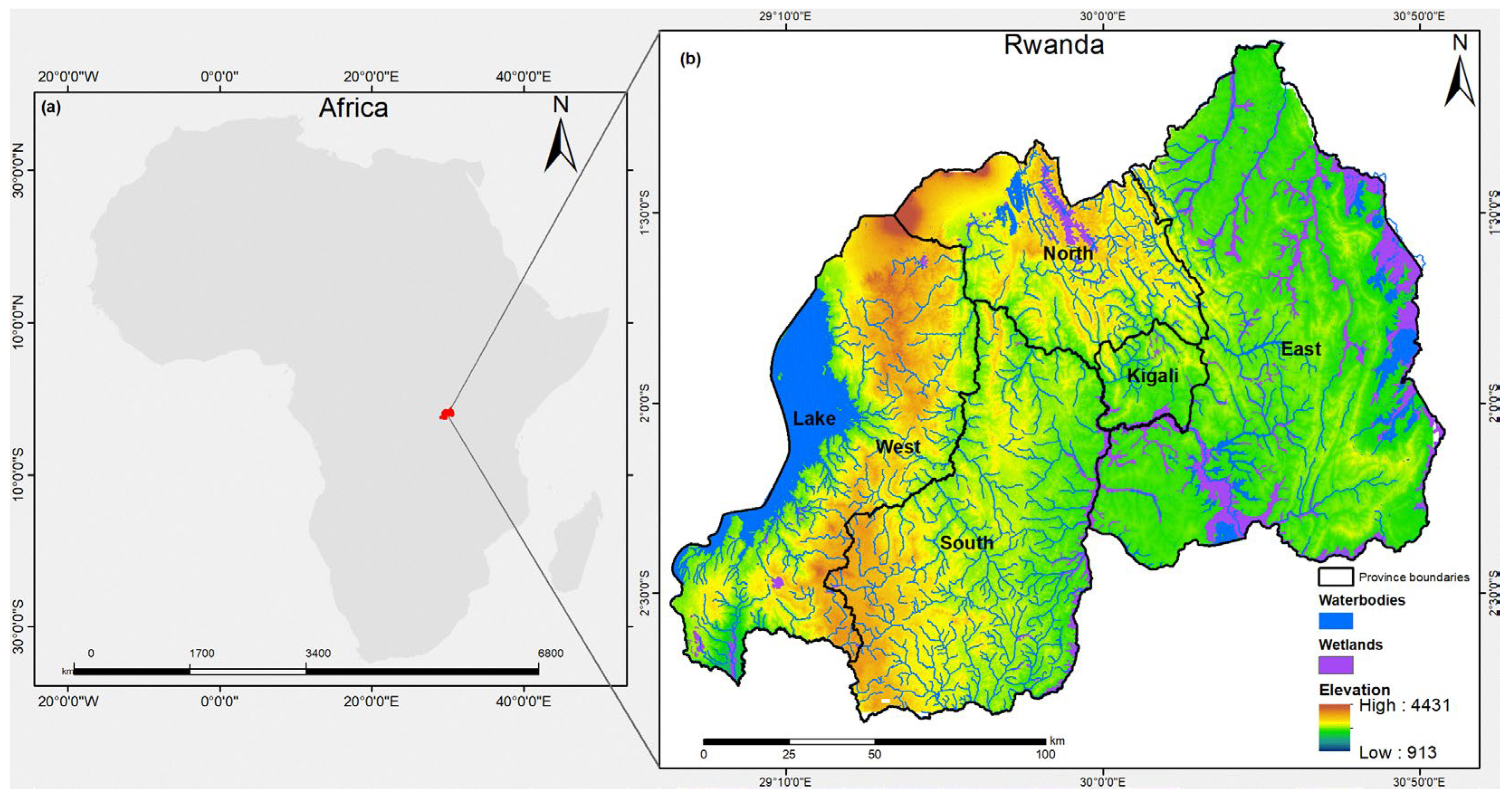
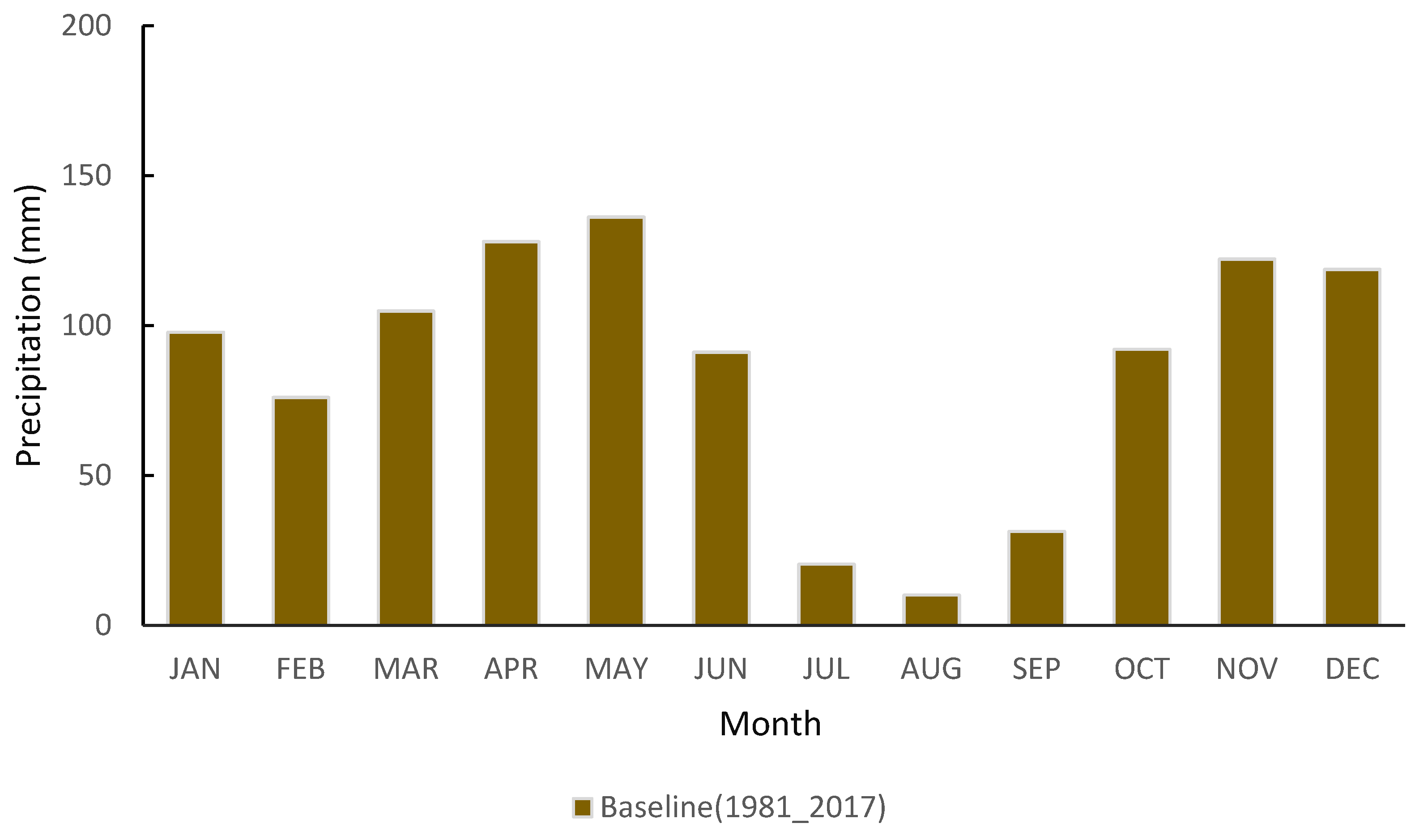
Rwanda is a hilly and mountainous country, with elevations ranging from 913 m to 4431 m above sea level (Figure 1b), and it enjoys a tropical temperate climate largely influenced by its high altitude [22,23]. The country covers a surface area of approximately 26,338 km2 and is situated on the eastern flank of the Kivu-Tanganyika Rift in the East African Rift System (Figure 1a) [24]. Although landlocked, Rwanda possesses abundant water resources (Figure 1b), including lakes that cover about 128,190 hectares, wetlands spanning 77,000 hectares, and an estimated 7260 hectares of watercourses. The country experiences two main rainy seasons: the first extends from March to May, and the second occurs from October to November, with average monthly rainfall ranging between 110 mm and 200 mm [25,26]. In contrast, the dry seasons are divided into a short period from December to February and a longer period from June to early September [27].
Administratively, Rwanda is divided into five provinces: The Northern, Southern, Eastern, and Western Provinces, along with Kigali City, the capital. Each province is further subdivided into five to eight districts, forming the second level of local government [28].

2.2. Factors Influencing Floods in Rwanda

A wide range of environmental and anthropogenic factors influences floods. However, identifying a universally accepted set of parameters for flood susceptibility mapping remains a challenge due to the complexity and variability of flood dynamics. Understanding the underlying factors that contribute to flooding in a specific region is crucial for selecting the most relevant parameters in predicting and managing future flood occurrences [29,30]. In this study, a total of 20 flood causative factors were selected based on logistic regression model analysis [31]
These factors were grouped into topographic, climatic, and Others, as described below:

2.2.1. Topographic Features

Digital Elevation Model (DEM)
Topographic parameters were derived from a 10 m spatial resolution DEM obtained from the Rwanda Housing Authority (RHA) [32]
Topographic Ruggedness Index (TRI)
The topographic ruggedness (Roughness) index (Equation (1)) was developed by Riley et al. (1999), which measures the elevation difference between a center cell and its eight surrounding cells, providing an estimate of terrain variability [33,34].
T R I = A b s ( E m a x 2 E m i n 2 )
where Emax and Emin represent the largest and smallest values of cells in nine rectangular neighborhoods of altitude values.
Topographic Wetness Index (TWI)
TWI (Equation (2)) reflects the influence of topography on surface runoff and potential water accumulation at any given point in a watershed [34,35].
T W I = l n A s t a n β
where As is the catchment area or flow accumulation (m2/m) and β is the local slope gradient measured in degrees.
Slope Percent (%)
Slope affects runoff speed and infiltration rates. Flooding tends to occur more readily in low-slope areas due to slower runoff velocities, while steep slopes encourage rapid drainage and reduced flood accumulation [36,37]. Therefore, the slope percent was generated using the ArcGIS focal statistics tool [38].

2.2.2. Climate Features

Climate data layers, including precipitation, surface temperature, and the Antecedent Precipitation Index (API) were derived from the Enhancing National Climate Services (ENACTS) initiative by Columbia University’s International Research Institute for Climate and Society (IRI). These datasets, developed at ~4 km resolution (0.0375°), combine ground station data from the Rwanda Meteorology Agency (Meteo Rwanda) with satellite data from Tropical Applications of Meteorology using SATellite and ground-based observations (TAMSAT). Temperature estimates incorporate JRA-55 reanalysis data and national observations [39].
Precipitation
The precipitation is the most critical factor influencing flooding in Rwanda, with flood frequency increasing in areas of lower elevation and higher rainfall [3,29].
Observed Precipitation Data
Observed monthly precipitation data (Figure 2) were obtained from the Rwanda Meteorology Agency, which covers over 36 years (1981–2017). Based on experiences, research, and reports on flood incidences in Rwanda [40], heavy precipitation/rainfall is the most causal factor of floods in Rwanda. Nevertheless, the precipitation was taken into account in the production of the Flood Susceptibility Index.
Predicted Annual Precipitation Data
The projected precipitation data from Institut Pierre Simon Laplace (IPSL) originated from the Coupled Model Intercomparison Project—Phase 5 (CMIP5) and was chosen based on Pearson correlation with in situ data from Meteo Rwanda and RCP 8.5 using 60 weather stations. This present study used ipsl_cm5a_mr_rcp8_5_2030s_prec_2_5min_r1i1p1_an as the best RCP with a correlation of 0.627 (Appendix A, Table A2). Global General Circulation model IPSL-CM5a was developed to study the long-term response of the climate system to natural and anthropogenic forcing as part of the 5th Phase of the Coupled Model Intercomparison Project (CMIP5) [41]
Antecedent Precipitation Index (API)
The API was computed based on the empirical (Equation (3)) [42]. The total five-day API was calculated by summing the daily API [43], estimated from gridded daily ENACT precipitation (~4 km resolution). Note that this parameter is used because reliable data on soil moisture is unavailable.
I t = k   I t 1 + P t
where it is the API estimated at the end of each day t; Pt is the precipitation amount during day t; and k is a decay (recession) factor representing a logarithmic decrease in soil moisture with time during periods of no precipitation. This study used a recommended k-factor value of 0.9 [44,45].
Surface Temperature
Surface temperature, particularly Land Surface Temperature (LST), plays a significant role in influencing flood occurrences by affecting evapotranspiration, soil moisture retention, and rainfall patterns [46]. High surface temperatures often caused by urbanization, deforestation, and climate change, can lead to the drying and hardening of soil surfaces, reducing their capacity to absorb rainfall [47].
When intense precipitation occurs after prolonged periods of heat, reduced infiltration leads to increased surface runoff, thereby elevating the risk of flooding [48]. Thus, incorporating surface temperature data into flood susceptibility modeling helps capture the indirect yet critical pathways through which thermal characteristics of the land influence hydrological extremes.

2.2.3. Others (Land Use and Geological Features)

Land Use/Land Cover (LULC)
LULC data were obtained from a 10 m resolution ESA World Cover dataset (2021), derived from Sentinel-2 imagery [49].
Lithology
Lithological soil data at 250 m resolution were sourced from the Soil and Terrain Database for Central Africa (SOTERCAF) [50].
Soil Texture
The soil layers of clay, silt, and sand fractions for Rwanda from the Africa Soil Information Service (AfSIS) at 250 m spatial resolution [50] were used to derive the soil texture map of Rwanda based on the soil texture triangle classification system developed by the United States Department of Agriculture (USDA). It is built considering its percentage of clay, silt, and sand, ranging from the fine textures (clay) to the intermediate textures (loam) and the coarser textures (sand) [51].
Roads
The road network layer was generated from 2021 vector datasets provided by the World Food Programme (WFP) using Euclidean distance analysis in ArcGIS at 10 m resolution.
Faults and Earthquake Hotspots (1950–2022)
Data on fault lines and seismic activity from 1950 to 2022 were acquired from the Rwanda Mines, Petroleum, and Gas Board (RMB) [52]. A proximity layer to faults was created using Euclidean distance analysis.
Drainage Density
Drainage density, an indicator of how water drains across the surface (Equation (4)), was calculated in ArcGIS Pro using the Spatial Analyst toolbox [53,54].
D d = L A b a s i n
where Dd is the drainage density, ∑L: total length of draining channels in a basin, A is the surface area of a basin.

2.3. Source of Data

The study used both raster and vector datasets derived from open and institutional sources, covering the main physical and environmental factors known to influence flood occurrence according to the literature review (Table 1).

2.4. Data Processing

All spatial data were first projected to a common coordinate system (WGS 84/UTM Zone 35S) and resampled to a unified 10 m spatial resolution, the original spatial resolution of RHA DEM. The preprocessing steps included: Raster layers were converted to Geodatabases, Euclidean distance tool was used to generate raster layers of the distance from faults, rivers and roads at 10 m resolution and converted them into Geodatabases and a layer of flood incidents Inventory in points was converted in Geodatabase.
Classified layers (i.e., land cover classification, soil texture, soil lithology and depths) were converted into Geodatabases after converting them into raster layers with continuous values based on the distribution or percentage (%) of total flood incidences in their different classes (Table 2).

3. Methodology

3.1. Methodology Overview and Workflow

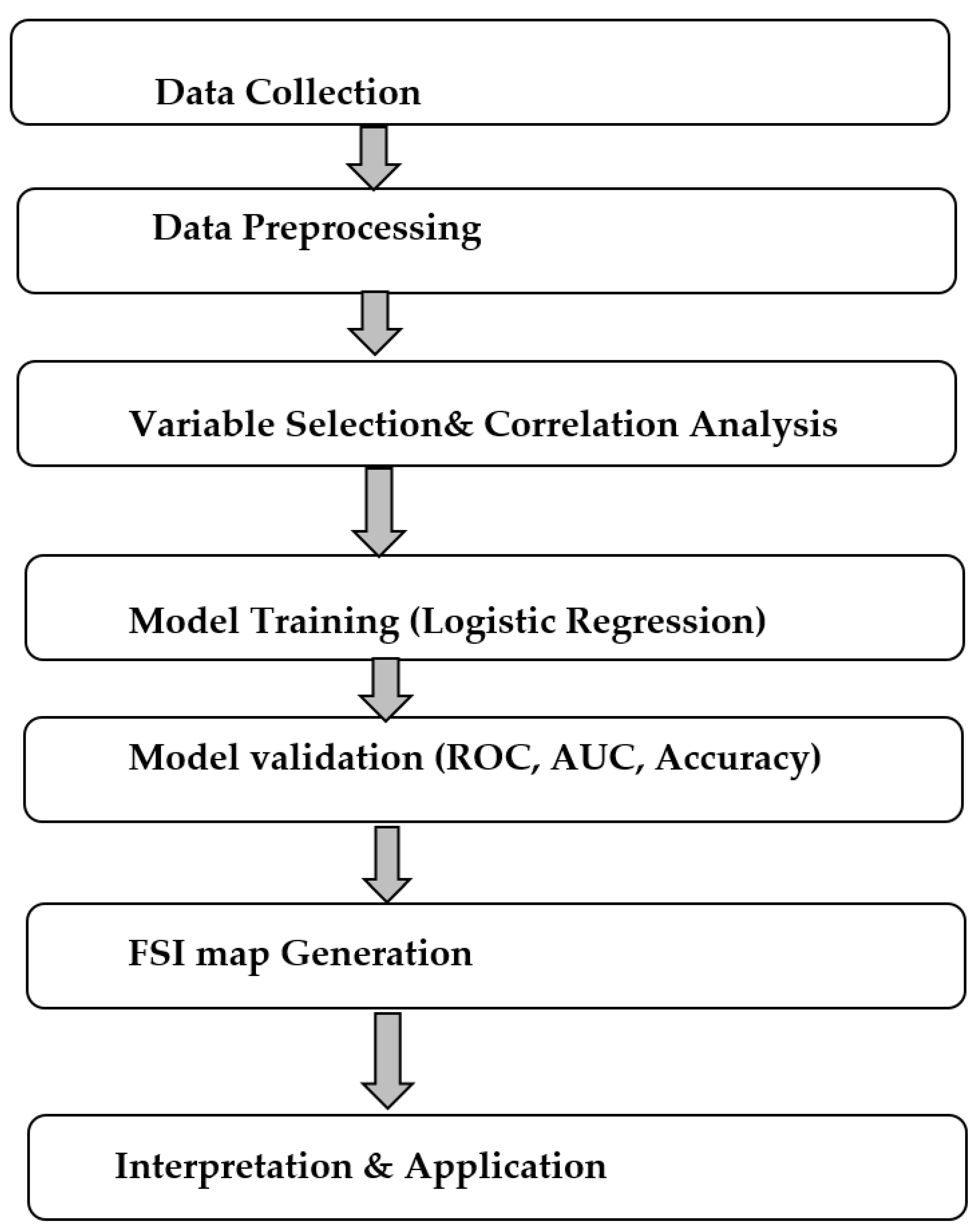
This study applies a logistic regression model within a Python 3.9 environment to generate a Flood Susceptibility Index (FSI) map using a combination of flood-triggering factors. The methodology includes five main stages: data collection, preprocessing, variable selection, model development, and FSI map generation (Figure 3). The entire process was implemented using open-source Python libraries, enabling reproducibility and scalability. The Flood Susceptibility Index (FSI) map of Rwanda was developed using a data-driven logistic function model adapted from the logistic function model used to develop the map of flood Susceptibility Index of Africa and Flood Prediction in Africa [56,57]. The regression coefficients between flood incidence triggering factors were calculated following the study on runoff prediction over the African continent [58]. The logistic model is a statistical model that models the log-odds of an event as a linear combination of one or more independent variables. In regression modeling, logistic regression estimates the coefficients in the linear or nonlinear combinations. In binary logistic regression, there is a single binary dependent variable, coded by an indicator variable, where the two values are labeled “0” and “1”, while the independent variables can each be a binary variable (two classes, coded by an indicator variable or a continuous variable [59].
The flexibility of field samples integration in logistic model make it robust than other methods such as the Analytical Hierarchy Process (AHP) that is widely used for FSI and FSI modeling [60,61,62,63]. AHP relies heavily on expert judgments for pairwise comparisons, which can introduce subjective biases. Different experts might have different opinions, leading to inconsistency in results. AHP can be sensitive to the scaling method used for judgments. Differences in interpretation of scales (e.g., 1 to 9 scale) can significantly impact outcomes. AHP is time-intensive for large-scale problems. The process requires time and commitment to complete all pairwise comparisons, making it less practical for large, time-sensitive decisions [64,65].

3.2. Collinearity Analysis of Influencing Variables

To ensure the statistical robustness of the flood susceptibility model, a collinearity assessment was conducted on the selected topographic predictor variables. Collinearity, or multicollinearity, occurs when two or more independent variables in a model are strongly correlated with one another, which can inflate standard errors, reduce coefficient stability, and ultimately compromise the reliability and interpretability of model predictions [66,67]. Topographic variables were carefully assessed for redundancy and were either excluded or substituted to improve model parsimony. This step was essential to enhance the stability and interpretability of the model used in the subsequent analysis. To further address potential multicollinearity, the Variance Inflation Factor (VIF) was calculated for the topographic features (Appendix A, Table A5). A VIF value greater than 10 indicates a high level of multicollinearity, which may compromise the model’s predictive performance and reliability [68]
Figure 3 illustrates the workflow used for modeling the Flood susceptibility index (FSI) for Rwanda.

3.3. Workflow of Development of the Flood Susceptibility Index

Code available on: https://github.com/Valentinemu/flood-susceptibility-index.git (accessed on 13 February 2026).

3.4. Logistic Regression Model Development

3.4.1. Logistic Regression Theory (Brief Overview)

Logistic regression is a statistical classification method used to model the probability of a binary outcome based on one or more independent variables. In the context of flood susceptibility, it is used to predict the likelihood that a flood will occur (1) or not occur (0) based on factors such as slope, rainfall, soil type, and land cover, etc.
Unlike linear regression, which predicts continuous values, logistic regression models the log-odds of the dependent variable as a linear combination of the input variables (Equation (5)):
log P 1 P = β 0 + β 1 X 1 + β 2 X 2 + + β n X n
where:
P is the probability of a flood occurrence;
X1, X2, …, Xn are the independent (triggering) variables;
β1, …, βn are the coefficients (weights) associated with each variable.
This can be rewritten to express the probability as:
P = 1 1 + e ( β 0 + β 1 X 1 + + β n X n )
After training the model using a known dataset of flood and non-flood locations, the coefficients β are estimated using maximum likelihood estimation (Equation (6)). The resulting model can then be applied to new spatial data to generate a flood Susceptibility Index (FSI) map, where each location is assigned a probability of flood occurrence. This method was summarized based on the GIS-based logistic regression for Flood susceptibility mapping [69,70,71,72].

3.4.2. Logistic Regression Implementation in This Study

Variable Selection
The 31 flood triggering factors were evaluated using 39,998 flood points and 17,461 points of non-flood locations. The Pearson correlation (r) and p-values were used to test the statistical significance of each variable. Only features with a highly significant p-value < 0.00 [73] were selected for FSI modeling.
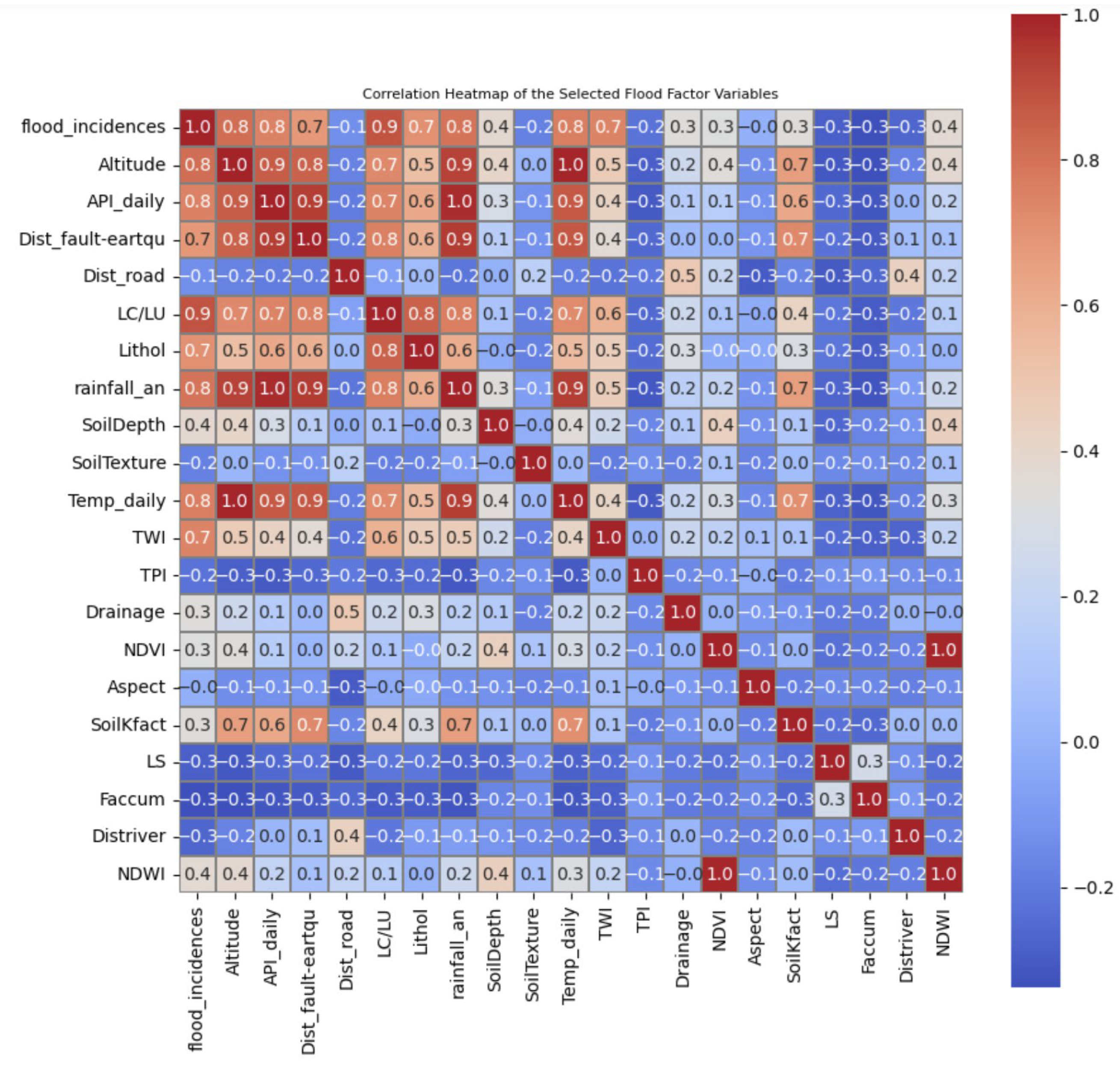
To avoid multicollinearity among predictor variables, a correlation matrix and p-value analysis were performed using the statsmodel 0.14.0 library. Variables with a high correlation p-value > 0.001 were excluded to improve model stability [73]. This analysis indicated that 20 features are major flood triggering factors (p-value < 0.00) (Table 3). Figure 4 illustrates the correlation heat map of the influencing factors of flood.
The present study implemented the logistic regression model using scikit-learn, referring to the published study on FSI assessment in Africa [56]. The regression coefficients c3, c2, c1, and b were calculated with the python’s linregress function. In the present study, the regression coefficients c3, c2, c1, and b were calculated based on the training samples of 39,998 flood points and 17,461 non-flood points (stable locations) and their corresponding values of significant flood features.
The response variable was binary:1 for locations with known flood occurrence, and 0 for randomly sampled non-flood locations.
Model Equation:
F S I F = 1 1 + E x p c 3 x 3 + c 2 x 2 + c 1 x + b
F i = c 3 F S I F i 3 + c 2 F S I F i 2 + c 1 F S I F i + b
c 3 = I N D E X ( L I N E S T ( F i , F S I F i ^ { 1 , 2 , 3 } ) , 1 ) c 2 = I N D E X ( L I N E S T ( F i , F S I F i ^ { 1 , 2 } ) , 1 , 2 ) c 1 = I N D E X ( L I N E S T ( F i , F S I F i ^ { 1 , 2 } ) , 1 , 3 ) b = I N D E X ( L I N E S T ( F i , F S I F i ^ { 1 , 2 } ) , 1 , 4 )
where FSIF is a significant flood feature or factor adjusted or fitted with observed flood incidences and non-flood incidences (Equation (7)), x3, x2, and x are the dependent variables (unadjusted flood factors) and c3, c2, c1, and b are the regression coefficients obtained based on training samples of flood points and non-flood (stable locations); Fi: samples of flood incidences (points) (1) and non-flood points (0) (Equation (7)), FSI: Values of each significant flood factor at the location of flood incidences and non-flood points.
For those who are not familiar with programming, can calculate the regression coefficients using other tools such as Microsoft (MS) Excel’s built-in LINEST array function [58]. In addition, the symbol * in equations represents multiplication.
Data split into training (70%) and testing (30%) sets. Model fitted using logistic regression from sklearn linear model. Model evaluated using Accuracy, Confusion Matrix, Receiver Operating Characteristic (ROC) curve, and Area Under the Curve (AUC).
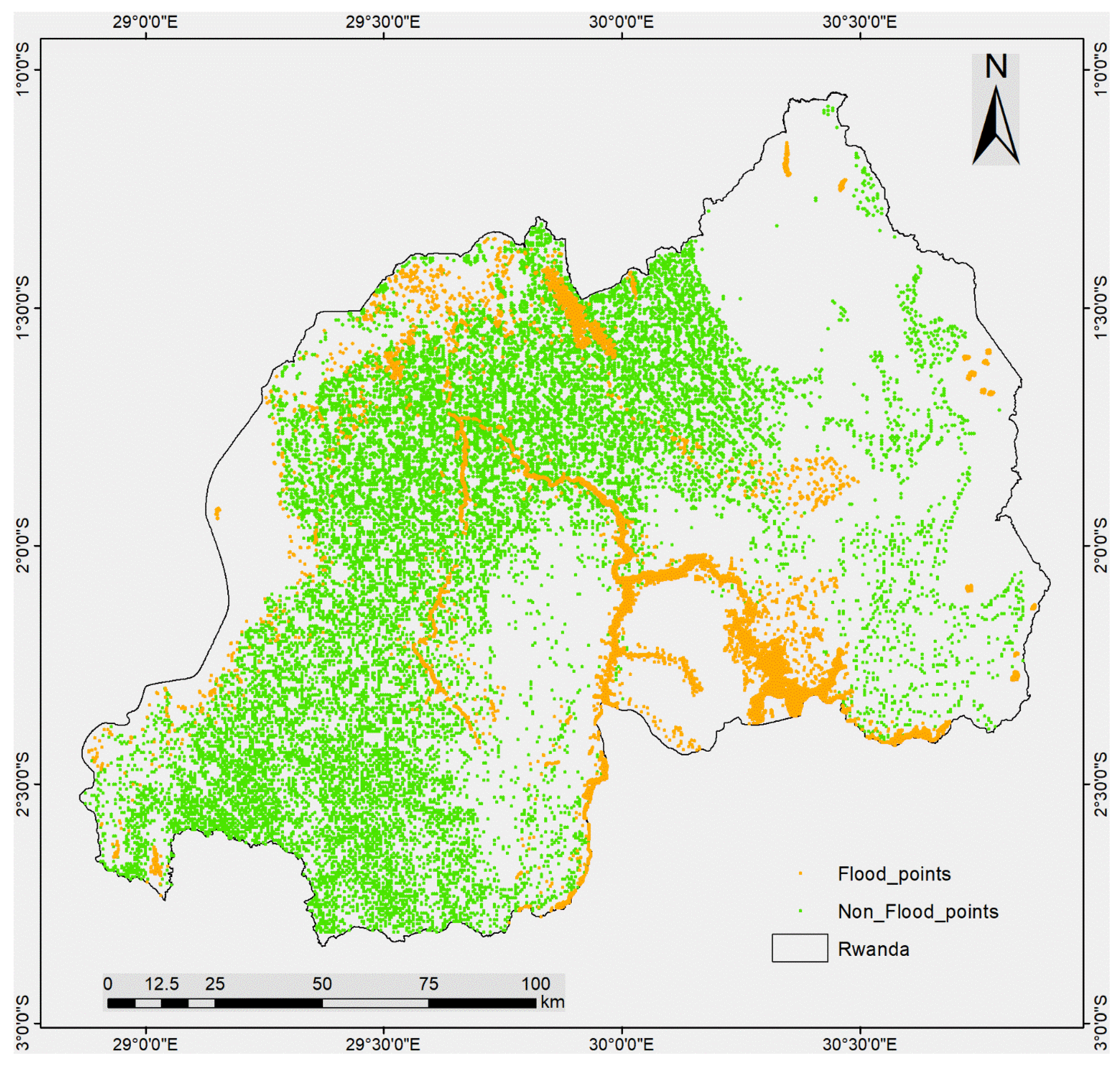
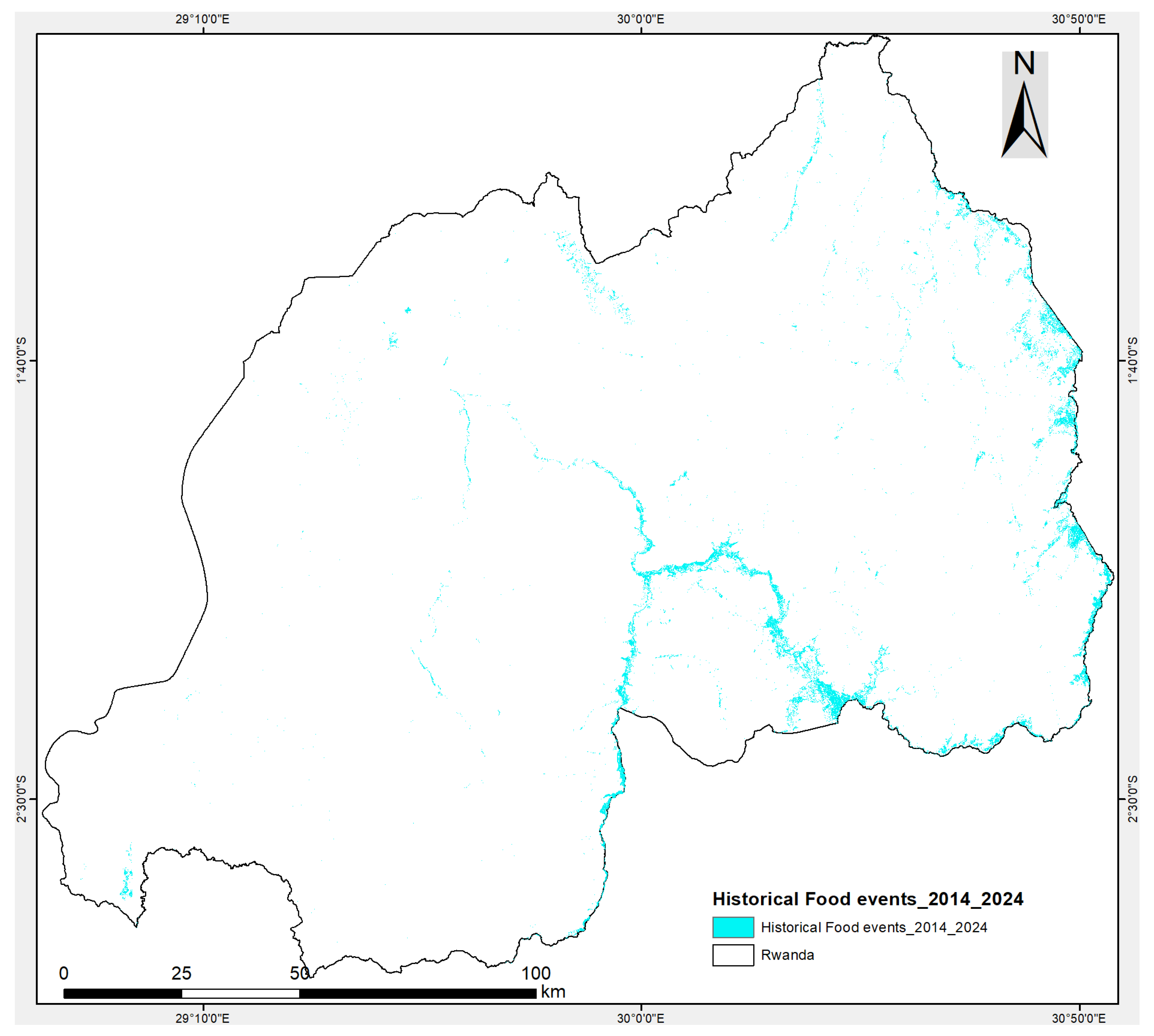
Sentinel-1 satellite imagery was used to detect historical flood events that occurred across Rwanda between 2014 and 2024, as illustrated in Figure 5. The analysis identified all flooded areas nationwide during this period, capturing both the extent and spatial distribution of events.
Flood occurrences were mapped using consistent radar-based detection to ensure accuracy and comparability over time. Each flood event was georeferenced to its precise location to support spatial indexing. Locations that experienced multiple floods were assigned higher event counts. This indexing approach highlights areas with repeated flood exposure. It provides a clear understanding of Rwanda’s flood-prone zones over the past decade.

3.5. FSI Map Generation

Generation of the National Flood Susceptibility Index (FSI) map of Rwanda: Using Equation (9), the FSI map of Rwanda was obtained through a combination of all 20 layers of significant flood factors derived with a logistic model and multiplication of their correlation (weight) to each factor layer (Pearson correlation).
F S I = [ ( F S I F t o p 1 r 1 ) + ( F S I F t o p n r n ) ] F t o p n + [ ( F S I F c l i m 1 r 1 ) + ( f S I F c l i m n r n ) ] F c l i m n + F S I F o t h e r 1 r 1 + F S I F o t h e r n r n
where FSI is the Flood Susceptibility Index; r is the Pearson correlation between Flood incidences and significant flood factors considered as weights (Table 3). FSIFtop: Topographic features. FSIFclim: Long-term daily Antecedent, Precipitation Index (API), Long-term annual precipitation, Long-term daily and annual mean surface temperature; FSIFother: Inverted Distance from Faults and earthquake hotspots (1950–2022), Inverted distance from road, Land cover factor based on the number of flood incidences per land cover type, Lithology factor based on the number of flood incidences per lithology type, Soil texture factor based on the number of flood incidences per soil texture type, Topographic wetness index (TWI) or compound topographic index (CTI); Ftopn: Number (6) of topographic feature; Fclimn: Number (3) of climate factors (the results of this equation is a number ranging from 0 to 1, which express the absence (0) and presence (1) probability of flood, FSI is the flood susceptibility index (FSI) with a probability value ranging from 0 (flood) to 1 non flood). In addition, the current and future flood Susceptibility Index were classified into five classes: No Flood (FSI < 0.60), Low (0.60 < FSI ≤ 0.65), Moderate (0.65 < FSI ≤ 0.657), High (0.7 < FSI ≤ 0.87), and Very High (FSI > 0.87) based on validation with the satellite-based flood map of May 03, 2023, using Sentinel-1 data.
FSI layer was normalized by using Equation (10) to generate a well-scaled FSI layer with values ranging from 0 to 1.
F S I n = F S I F S I m i n F S I m a x F S I m i n
where FSIn is a normalized FSI with values ranging from 0 to 1, which expresses the absence of low (0) and presence of high (1) probability of flood risk, respectively; FSImax is the FSI maximum value; FSImin is the FSI minimum value.
The FSIn layer was classified into 5 flood classes below for easy identification of the flood hotspot areas that require much attention: Very Low FSI = 0–0.55, Low FSI = 0.55–0.6, Moderate FSI = 0.6–0.7, High FSI = 0.7–0.85, and Very High FSI = 0.85–1. The fitted logistic regression model was applied to the entire study area by passing raster values (predictor variables) into the model using a pixel-wise operation. The resulting output was a probability map (ranging from 0 to 1. Therefore, the classified map was exported in GeoTIFF format and then classified using ArcGIS Pro 3.5 software.

4. Model Validation

Ground truth points of the flood were identified from Sentinel-1 Synthetic Aperture Radar (SAR) imagery of 10 m resolution for the peak flood period from 2014 to 2024 across the country. The total collected points of flood and non-flood were 57,459 as shown in Figure 6 therefore 17,238 (30%) of all sampling data were used to validate logistic regression modeling.
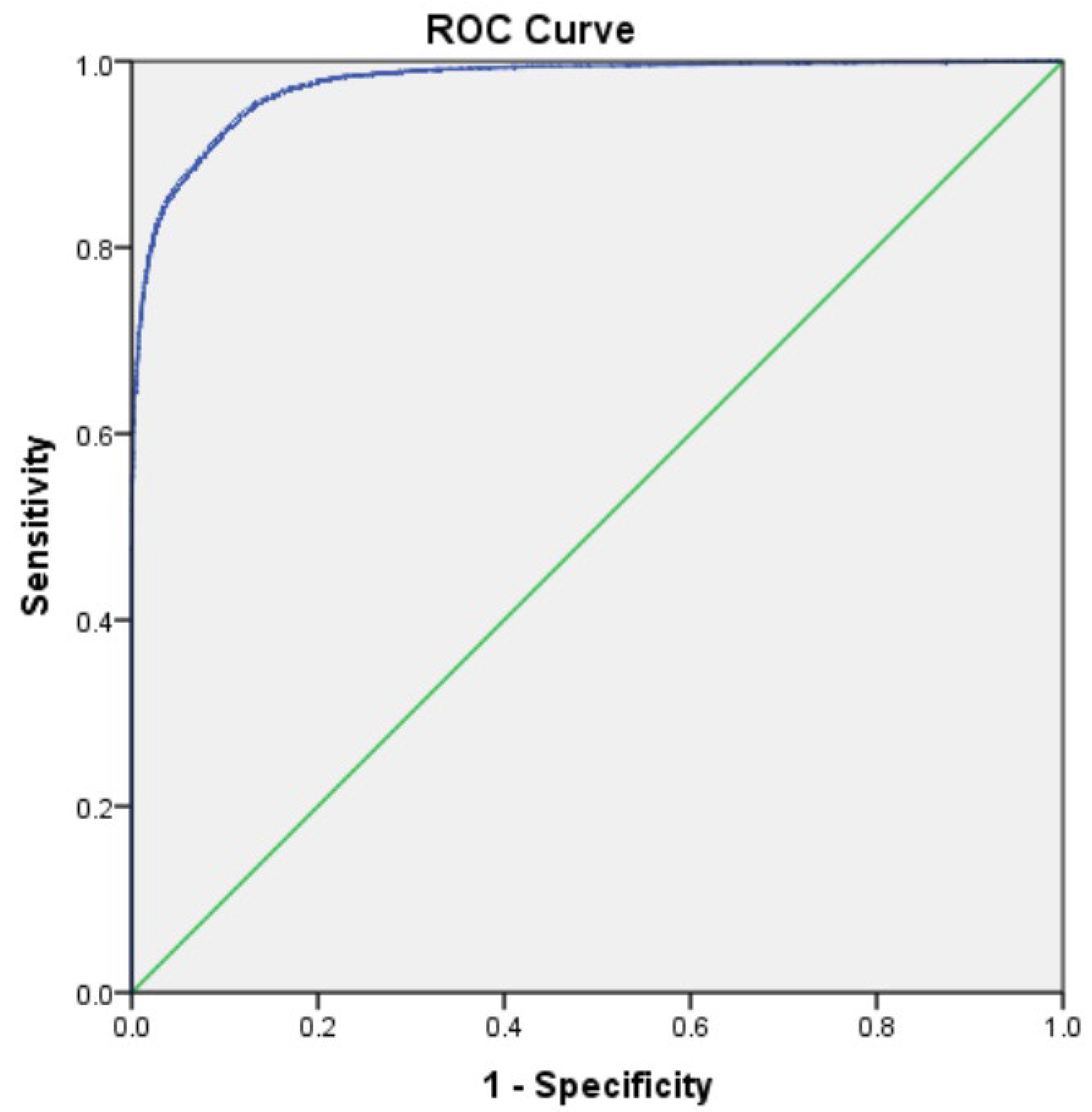
The Receiver Operating Characteristic (ROC) curve (Figure 7) and the Area under the ROC Curve (AUC) validation results indicate that the present developed Python-based Logistic Regression Model categorizes areas susceptible to flood and stable areas with an AUC of 0.976, as illustrated in Table 4.
The validation assessment based on Pearson correlation also indicated that this flood incidence-driven logistic regression model predicted well the FSI of Rwanda with a high r value of 0.0.976 (Table 4) and a p-value of 0.000.
As shown in Figure 7, the blue ROC curve represents the actual performance of the model, while the green diagonal line indicates the performance of a random classifier.

5. Results and Discussion

5.1. Flood Susceptibility Map of Rwanda

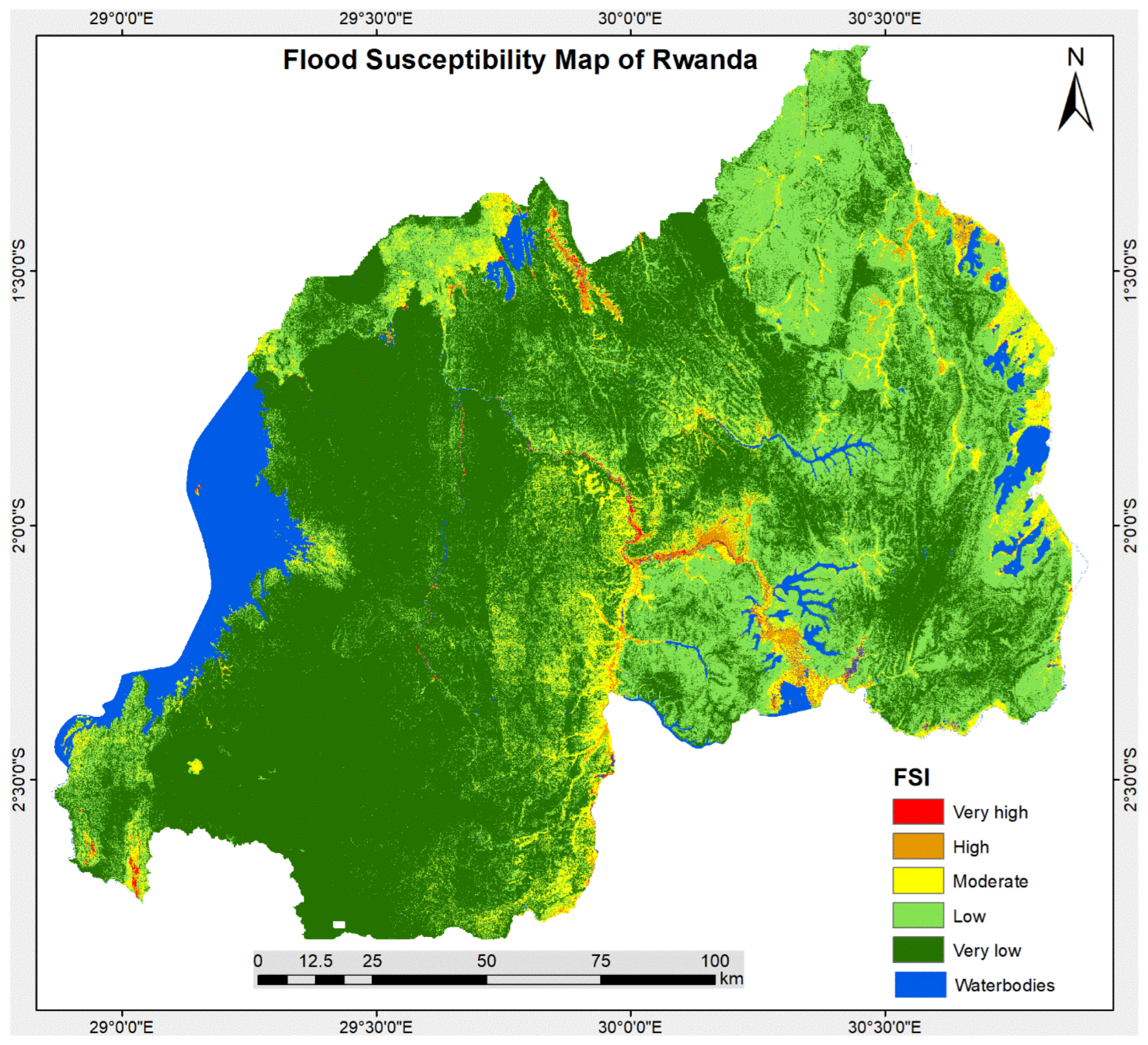
Figure 8 illustrates the spatial distribution of the flood susceptibility index across Rwanda, generated using the logical regression model that was performed in a Jupyter notebook using Python language for the baseline period of 1981 to 2017. The FSI was developed using a comprehensive multi-criteria analysis approach that incorporated twenty-two influential factors, including both hydrological and geo-environmental parameters.
One of the dominant drivers of flood susceptibility identified in this model is precipitation. The results clearly show a strong correlation between areas of high rainfall intensity and zones with elevated flood susceptibility scores. As visualized in the map (Figure 8), regions experiencing higher precipitation tend to have significantly higher FSI values. This trend is especially pronounced in the Western and Northern Provinces of Rwanda, where orographic rainfall is common due to the hilly terrain. Conversely, regions with relatively low rainfall, such as parts of the Eastern Province, exhibit lower susceptibility indices. This emphasizes the critical role that precipitation plays in surface runoff generation and potential inundation.
Slope is another important factor influencing the spatial distribution of flood-prone areas. Areas characterized by low slopes, particularly where the slope gradient is less than 5%, are found to be significantly more vulnerable to flooding. This is because flatter terrains hinder rapid water drainage and encourage the accumulation and ponding of runoff water, which leads to surface flooding. The highest susceptibility zones are, in fact, those where the slope percent approaches zero, such as wetlands, floodplains, and valley bottoms. This relationship between slope and flood risk is consistent with hydrological theory and observed patterns of flood damage in Rwanda. High slope areas, on the other hand, tend to facilitate rapid runoff and generally exhibit lower susceptibility scores unless they are accompanied by fragile soils and limited vegetative cover.
Land use and land cover (LULC) also emerged as critical parameters in flood susceptibility modeling. Among the different land cover types, wetlands were found to be the most vulnerable to flooding, contributing 75.3% of the highest susceptibility scores. Wetlands act as natural buffers that absorb excess water during rainfall events, but they are also the first to overflow when inundated. Moreover, wetlands in Rwanda are often under pressure from anthropogenic activities such as agriculture, settlement expansion, and infrastructure development. These activities reduce the water retention capacity of wetlands and increase the risk of flooding. In contrast, forested areas tend to have lower flood susceptibility due to better canopy interception, root absorption, and soil stabilization functions.
Another critical determinant of flood risk highlighted in the FSI model is proximity to rivers. The analysis shows that areas located closer to rivers exhibit significantly higher flood susceptibility scores. This is especially true in regions where rivers traverse low-lying areas, valleys, or floodplains. Water from higher elevations flows downstream toward these river valleys, and during periods of intense rainfall, the rivers often exceed their capacity, resulting in overbank flooding. Major rivers such as Nyabarongo, Nyabugogo, and Sebeya have been repeatedly identified as hotspots for flooding, particularly during the long rainy seasons. This observation is supported by reports from the Ministry in Charge of Emergency Management (MINEMA) and previous research. For instance MINEMA (2021) [74] documented recurring flood events along these river systems, often accompanied by loss of life and property. Studies by Benjamin (2015) [75] and Bizimana and Schilling (2009) [76] also corroborate these findings, pointing to the need for integrated river basin management to mitigate flood risks in downstream communities.
The FSI model further reveals that areas with zero percent slope and those situated within floodplains are at the highest risk of flooding. These areas are typically found in regions such as Bugesera, Rusizi, and the Nyabugogo floodplain, where topography is flat and drainage is poor. The high-risk zone is defined by slopes of less than 5%, while moderate-risk areas fall within the 5–15% slope category. This classification helps prioritize mitigation measures and resource allocation by national and local authorities. From a spatial planning perspective, the FSI map serves as a crucial decision-making tool.
It allows policymakers and emergency managers to identify zones where preventive measures such as improved drainage infrastructure, flood-resilient housing, and land use regulation should be implemented. The map also offers valuable insights for future urban development, especially in rapidly growing cities like Kigali, Rubavu, and Musanze, where urban sprawl is encroaching into flood-prone zones.
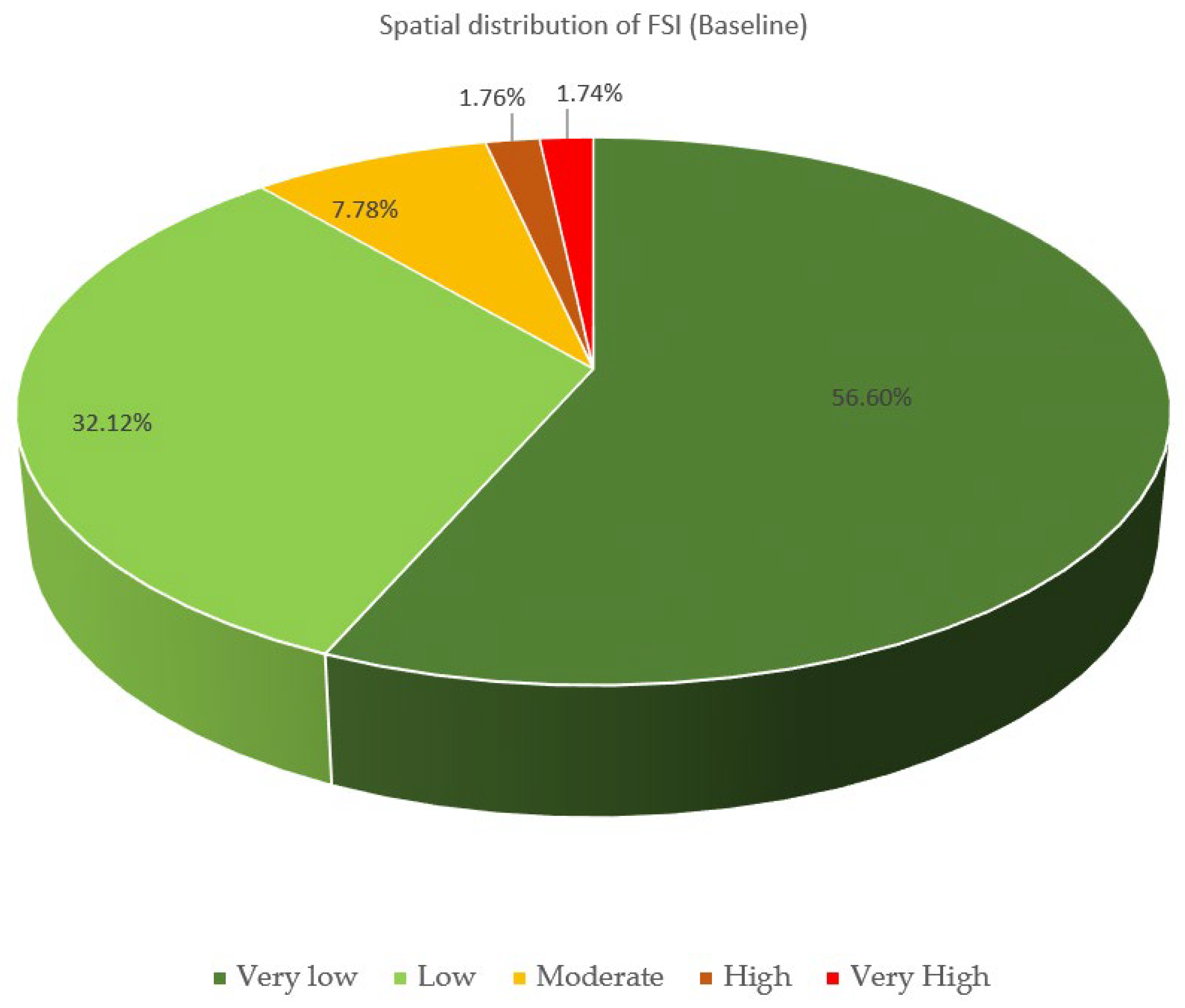
Figure 9 illustrates the spatial distribution of the Flood Susceptibility Index (FSI) across the surface of Rwanda during the baseline assessment period. The results reveal a dominant pattern where most of the country exhibits limited susceptibility to flooding, consistent with Rwanda’s diverse and predominantly rugged topography. According to the classification outputs, approximately 56.60% of the national territory falls within the very low susceptibility class, while 32.12% lies within the low susceptibility class. Together, these categories indicate that nearly 89% of the country is characterized by terrain that minimally supports flood occurrence.
This distribution is strongly influenced by Rwanda’s geomorphic characteristics. As shown in Figure 1, Rwanda is largely composed of mountainous and hilly landscapes, with steep slopes dominating much of the western and northern regions. These areas are less prone to flooding due to rapid surface runoff, limited water accumulation zones, and well-drained slopes. Flooding is therefore more likely to occur in areas where topographic conditions allow water to accumulate, such as flat terrain, valleys, and wetland systems. This explains why the majority of high-risk flood zones appear in lower-lying landscapes rather than in upland areas. Despite the predominance of low-susceptibility zones, the analysis also highlights the presence of critical flood-prone environments. Approximately 1.76% of the country’s surface is classified as high flood susceptibility, while 1.74% falls into the very high susceptibility class. Although these proportions are relatively small, they represent areas of significant environmental and socio-economic concern.
These highly susceptible zones are primarily concentrated in wetlands, floodplains, and lower slope gradient’s locations where hydrological conditions favor water retention and overflow during peak rainfall periods. One of the most important examples is the Nyabarongo wetland system, identified as the largest and most hydrologically active wetland in Rwanda. This wetland forms a major floodplain of low elevation, acting as a natural drainage basin for several major river systems. The rivers Nyabugogo, Mbirurume, Rukarara, and Mwogo converge toward or influence this basin, contributing to substantial surface water accumulation, especially during intense rainfall seasons. According to REMA (2014) [77], the Nyabarongo wetland plays a critical role in Rwanda’s hydrology but is also one of the areas most exposed to recurrent flooding because of its low-lying position and the extent of its drainage network.
These findings confirm that flood susceptibility in Rwanda is closely controlled by topographic and hydrological factors. Mountainous and steep regions generally remain safe from flooding, while wetlands, valleys, and gentle slopes form the key exposure zones. The results further underscore the need for targeted flood management interventions, particularly in the identified high-risk areas. Strengthening wetland protection, improving urban drainage, especially in zones influenced by the Nyabugogo river system and monitoring land-use changes in floodplains are essential measures for reducing long-term flood vulnerability. Overall, the FSI map presented in Figure 8 provides a comprehensive understanding of spatial flood patterns in Rwanda, offering a useful baseline for planners, policymakers, and disaster-risk managers. By clearly identifying both secure and highly exposed zones, the analysis supports evidence-based decision-making aimed at enhancing resilience and minimizing the impacts of future flood events.

5.2. Predicted Flood Susceptibility Map of Rwanda in 2030

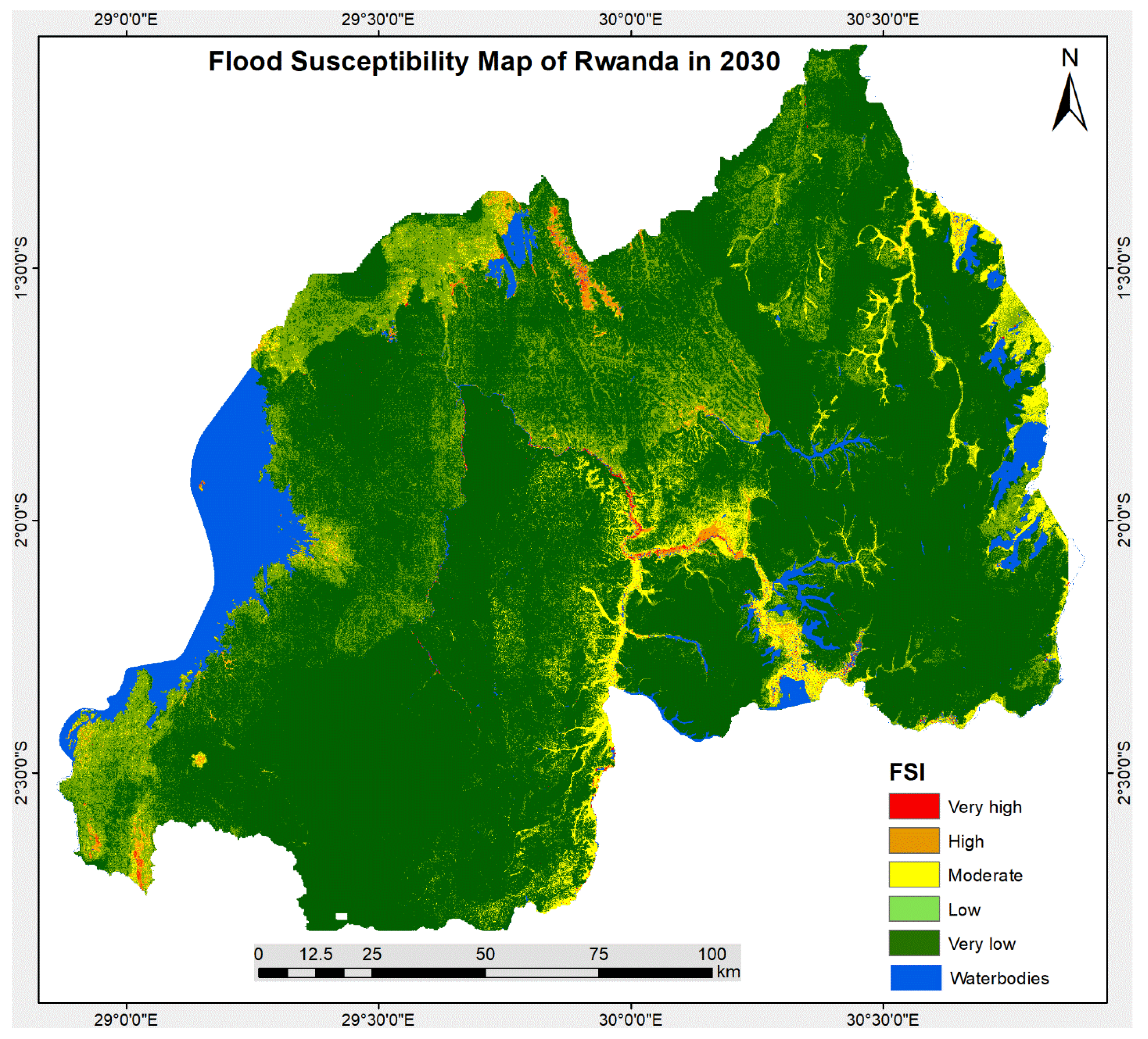
Figure 10 presents the projected Flood Susceptibility Index (FSI) for the year 2030, derived from the annual precipitation forecasts of the Global General Circulation Model IPSL-CM5A-Medium Resolution (MR). This model is widely used in climate-impact assessments due to its robust representation of rainfall patterns and hydrological processes over East Africa. By integrating the model’s anticipated precipitation changes into the flood susceptibility framework, the spatial distribution of flood-prone areas reveals significant shifts compared to the baseline FSI shown in Figure 7. In contrast to current flood susceptibility conditions, the 2030 projections suggest that a considerable portion of Rwanda will experience an increase in susceptibility to flooding. The most notable changes appear in the Northern Province and specific high-risk environments of the Western Province, particularly around the Bugarama wetland. These shifts correspond with the model’s prediction of increased precipitation intensity and frequency in these regions by 2030. The North-West and South-West parts of the country are expected to receive higher rainfall compared to historical averages, thereby elevating the likelihood of surface runoff, riverine overflow, and localized flooding.
The North-Western region already characterized by steep topography, high elevation, and numerous streams, becomes especially vulnerable when overlaid with increased precipitation. The enhanced rainfall projected in 2030 is likely to generate rapid runoff into valley bottoms, intensifying the probability of flash floods and erosion-related flooding. Similarly, the South-Western areas, including wetlands adjoining the Bugarama lowlands, show a marked rise in susceptibility. The Bugarama wetland, located in one of Rwanda’s lowest elevation zones, becomes particularly exposed because it serves as a natural water-collecting basin. The model indicates that with increased precipitation expected in this region, the wetland will face higher inundation pressure, resulting in both a higher frequency and greater spatial extent of flood events.
Interestingly, while several regions show elevated susceptibility, the model also reveals areas where susceptibility decreases by 2030. The most significant reduction is observed in the Nyabarongo wetland system, especially in its central and downstream sections. This change is partly attributed to the projected decline in precipitation across parts of the Eastern Province, which impacts the overall hydrological inflow into the Nyabarongo basin. As the Eastern Province is projected to receive below-average rainfall, surface runoff and upstream contributions that feed the Nyabarongo wetland will be reduced. Consequently, the flood susceptibility in this wetland decreases relative to the baseline period.
In regions where rainfall is projected to increase, the model shows a corresponding amplification of flood susceptibility. Conversely, areas expecting reduced precipitation demonstrate a decline in susceptibility. These dynamics highlight the direct influence of climate-induced hydrological changes on future flood hazards in Rwanda. Overall, the 2030 FSI map provides critical insight into the evolving flood risk landscape under changing climatic conditions. The contrast between increased susceptibility in the North-West and South-West and reduced susceptibility in the Nyabarongo wetland and Eastern Province highlights the need for region-specific adaptation strategies. Decision-makers, urban planners, and disaster-risk managers should prioritize interventions in regions projected to experience heightened flood exposure. These may include strengthening early warning systems, implementing watershed management programs, reinforcing drainage infrastructure, and enhancing wetland conservation, especially in the Bugarama and volcanic highland catchments.
The findings presented in Figure 7 highlight the importance of integrating climate projections into national flood-risk planning. By anticipating where flood hazards are likely to intensify or diminish, Rwanda can better allocate resources and design adaptive strategies that safeguard vulnerable communities, ecosystems, and infrastructure by 2030 and beyond.

6. Conclusions

Flood susceptibility mapping is essential to delineate flood-prone areas and assess mitigation measures.
Rwanda is mostly dominated by ridges and plateaus including the Congo Nile with a topographic feature that is entirely hilly. The rainwater originating from the ridges flows towards the valleys which cannot effectively absorb and accommodate all the water owing to the increase in solid wastes from anthropogenic activities that clog culverts, and water drainage systems within the area. It showed that the Northern province is the part of the country with low flood susceptibility, which can be justified by the topographic nature and the geomorphological aspect of the country. The areas with an abundance of rainfall fell into highly susceptible classes. After modeling the Flood Susceptibility Index, we perceived that the areas with low distances to rivers, low elevation, and abundance of precipitation revealed a big influence on flood occurrences.
The government of Rwanda has launched the Ministry in Charge of Emergency Management (MINEMA), a practice of monitoring and managing disasters in Rwanda. Nonetheless, for the policy to be productive and sustainable, there is a great need to manage the increase in floods. Therefore, the following are suggested for the flood susceptible management in Rwanda:
  • Rwanda’s growing population is expected to intensify pressure on land resources, potentially accelerating land degradation. It is therefore recommended that MINEMA collaborate closely with key institutions such as the National Land Authority (NLA), Rwanda Water Resources Board, the city of Kigali, and the Rwanda Housing Authority to develop a national urban master plan that fully integrates disaster risk considerations. Furthermore, strict regulations and penalties should be enforced for individuals who settle in high-risk flood zones, particularly in wetlands and riverine areas, in line with national urban planning guidelines.
  • Rwanda receives abundant rainfall, particularly during the rainy seasons. Maximizing rainwater harvesting would help reduce pressure on underground water resources while also limiting the transport of sediments from high-elevation and steep-sloped areas to low-lying zones. This practice would contribute to better watershed management and reduce environmental degradation.
  • It is recommended that Rwanda strengthen environmental education from primary school through undergraduate studies. Therefore, building ecological and hazard-awareness skills at an early age can improve community understanding of disaster risks.
  • Integrate AI-driven flood susceptibility mapping into climate policy and adaptation planning: The government should use evidence-based AI approaches to identify high-risk flood zones, prioritize interventions, and strengthen national climate resilience frameworks. This integration will also help align local adaptation measures with international commitments, including the Paris Agreement and the Sustainable Development Goals.
  • Strengthen disaster risk reduction and community preparedness: The government should utilize precise identification of flood-prone areas to implement proactive strategies, including early-warning systems, resilient infrastructure planning, and effective land-use regulation. These measures will reduce vulnerability and enhance preparedness, especially in rapidly urbanizing and environmentally sensitive regions.

Author Contributions

Y.H. and G.K. contributed to the conception and design of the study. Material, preparation, and analysis and paper drafting were performed by V.M. and F.K. Historical floods data were detected by E.N., modeling FSI Python code was developed by F.M., the draft manuscript was read and reviewed by G.R. and M.B. All authors have read and agreed to the published version of the manuscript.

Funding

This research received no external funding.

Data Availability Statement

The original data presented in the study are openly available at https://github.com/Valentinemu/flood-susceptibility-index.git (accessed on 12 February 2026).

Acknowledgments

We would like to express our sincere gratitude to the reviewers for their constructive comments and valuable suggestions. We also thank Gaspard TWAGIRAYEZU, Rwanda Space Agency, for his support and encouragement in promoting the research.

Conflicts of Interest

The authors declare no conflicts of interest.

Abbreviations

The following abbreviations are used in this manuscript:
FSIFlood Susceptibility Index
MINEMAMinistry in Charge of Emergency Management
IPSLInstitut Pierre Simon Laplace
NLANational Land Authority
RSARwanda Space Agency
MRMedium Resolution
GGCMGlobal General Circulation Model
CM5A5th generation Coupled Model (version A)
REMARwanda Environmental Authority
LULCLand Use, Land Cover
ROCReceiver Operating Characteristic
AUCArea Under the Curve
SARSynthetic Aperture Radar
TWITopographic Wetness Index
APIAntecedent Precipitation Index
TRITopographic Ruggedness Index
MSMicrosoft
ENACTSEnhancing National Climate Services
CTICompound topographic Index
NDVINormalized Difference Vegetation Index
DEMDigital Elevation Model
LSSlope Length
NDWINormalized Difference Water Index
RABRwanda Agriculture and Animal Resources Development Board
AfsisAfrican Soil Information Service
GPWGridded Population of the World
RCPRepresentative Concentration Pathway
CMIPCoupled Model Intercomparison Project
ALOSAdvanced Land Observing Satellite
RMBRwanda Mining Board
WFPWorld Food Program
USDAUnited States Department of Agriculture
SOTERCAFSoil and Terrain Database for Central Africa
ESAEuropean Space Agency
TAMSATTropical Applications of Meteorology using SATellite
JRA-55Japanese 55-years Reanalysis
GISGeographic Information System
ICTInformation and Communications Technology
RHARwanda Housing Authority

Appendix A

Table A1. Features before applying a logistic regression model that assigns scores to factors.
1Mean Altitude
2Altitude_max within 4 × 4 matrix
3Antecedent Precipitation Index (API)_mm_daily_ENACTS1991_2020
4Distance from Faults and earthquake hotspots (1950–2022)
5Distance_from_road
6Landcover_factor_from_flood_incidences_count_per_landcover_type
7Lithology_factor_from_flood_incidences_count_per_lithology_type
8Precipitation_mm_annual_ENACTS1983_2017
9Precipitation_mm_daily_ENACTS1991_2020
10Mean Slope %
11Maximum Slope within 4 × 4 matrix
12Soil_depth_factor_from_flood_incidences_count_per_soildepth_range
13Soil texture_factor_from_flood_incidences_count_per_soiltexture_type
14Surface_temperature_oC_mean_annual_ENACTS1983_2017
15Surface_temperature_oC_mean_daily_ENACTS1991_2020
16Topographic ruggedness index (TRI)
17Topographic wetness index (TWI) or compound topographic index (CTI)
18TPI (Topographic Position Index)
19Drainage density
20NDVI
21SPI (Standardized Precipitation Index)
22Aspect
23TNDVI (Transformed Normal Difference vegetation index)
24Soil_permeability_erodibirity_K_factor
25Slope length (LS)
26Topographic Profile curvature
27Flow accumulation
28Topographic Curvature
29Distance from the river
30Topographic plan curvature
31Normalized Difference Water Index (NDWI)
Table A2. The top 10 best-performing RCP models using Pearson correlation with in situ data from 60 stations of Meteo Rwanda.
RCP DataPearson CorrelationID
ipsl_cm5a_mr_rcp8_5_2030s_prec_2_5min_r1i1p1_an0.6267p131
ipsl_cm5a_mr_rcp2_6_2030s_prec_2_5min_r1i1p1_an0.6243p127
ipsl_cm5a_lr_rcp8_5_2030s_prec_2_5min_r1i1p1_an0.6239p125
ipsl_cm5a_mr_rcp4_5_2030s_prec_2_5min_r1i1p1_an0.6236p129
ipsl_cm5a_lr_rcp4_5_2030s_prec_2_5min_r1i1p1_an0.6222p121
gfdl_esm2m_rcp4_5_2030s_prec_2_5min_r1i1p1_an0.6203p091
ipsl_cm5a_lr_rcp6_0_2030s_prec_2_5min_r1i1p1_an0.6193p123
ncar_ccsm4_rcp8_5_2030s_prec_2_5min_r1i1p1_an0.6186p201
csiro_access1_3_rcp8_5_2030s_prec_2_5min_r1i1p1_an0.6182p053
cesm1_cam5_rcp4_5_2030s_prec_2_5min_r1i1p1_an0.6174p035
Table A3. Regression coefficients of a 3rd Order Polynomial obtained based on flood points and non-flood (stable locations) training samples.
Factorsc3: = INDEX(LINEST(y,x^{1,2,3}),1)c2: = INDEX(LINEST(y,x^{1,2,3}),1,2)C1: = INDEX(LINEST(y,x^{1,2,3}),1,3)b: = INDEX(LINEST(y,x^{1,2,3}),1,4)
Altitude−0.000000000605801770.00000495401048283−0.0129263151746854010.82041692129340000
API_mm0.00020685794732004−0.022651924915963900.76165102493821200−7.17712249627881000
Fault-Earquake−0.000000000000001630.00000000037781263−0.000015620108783580.24362736355371100
Distance_road0.00000000001599631−0.000000154165485790.000438271358095370.53519172806917000
Land_Cover−0.000147854345275730.01260277108019110−0.101090292206010000.27980678947933800
Lithology0.000001827085669050.01821380161941160−0.552230945678971000.93680693142573500
Rainfall0.00000001033325645−0.000031873660149500.03033721792993710−8.23855281563294000
Slope%−0.000000634644063650.00027462323819364−0.032398326749024301.09652121176231000
Soil_Dept−0.000008632074949160.000700472337531090.000000000000000000.21070765722536400
Soil_Texture−0.00000003113159460−0.000309014139176620.022656155273660800.51678563334227000
TRI0.00000012498661767−0.000056143006740960.001726040442088651.02348609992921000
TWI0.00229460764223585−0.075185367196589100.81575209095036900−1.96221445760880000
TPI3.68358515823077000−0.50073549166035500−2.456508127077660001.50866276752797000
Drainage0.02191359888749090−0.543332868251677004.00284756800213000−8.27887607798757000
NDVI−2.06843044326271000−0.299757480342540001.634367344331950000.53025319266525500
Aspect−0.000000028753685530.00001748201287060−0.003234428087933270.79629823460286900
Soil_erodibirity_K_fact0.000002728927258580.00000000000000000−272.838103206060000001.08899999528444000
Slope length −0.000000001090332480.00000909049337279−0.016023790402764900.72641512756395900
F_Accumulation0.00000000000000000−0.000000000000000690.000000038202679460.69521185793891200
Distance_river−0.000000000000877800.00000001987767917−0.000101671690300570.75932142153392600
NDWI1.94743038424783000−0.91861034595208800−1.049838725508460000.83124924499547000
Table A4. Considered features for flood modelling due to their significance after applying a logistic model.
FSI Factor (Features Before Applying Regression Model)Pearson Correlation (Flood Incidence and FSI Factor)p ValueNumber of Samples (Flood and Non-Flood Points)Inverted and Non-Inverted
1. Altitude−0.657 **0.00057,459Inverted
2. Altitude4_4−0.665 **0.00057,459Inverted
3. API_daily−0.549 **0.00057,459Inverted
4. Distance_fault-eartquake0.495 **0.00057,459non-inverted
5. Distance to road0.045 **0.00057,459non-inverted
6. Land cover0.701 **0.00057,459non-inverted
7. Lithology−0.499 **0.00057,459Inverted
8. rainfall_annual−0.627 **0.00057,459Inverted
9. rainfall_daily−0.574 **0.00057,459Inverted
10. slope−0.944 **0.00057,459Inverted
11. Slope4-4−0.943 **0.00057,459Inverted
12. Soil Depth−0.355 **0.00057,459Inverted
13. Soil Texture−0.050 **0.00057,459Inverted
14. Temperature_annual0.564 **0.00057,459non-inverted
15. Temperature_daily0.571 **0.00057,459non-inverted
16. TRI−0.906 **0.00057,459Inverted
17. TWI0.576 **0.00057,459non-inverted
18. TPI−0.069 **0.00057,459inverted
19. Drainage Density0.317 **0.00057,459non-inverted
20. NDVI−0.360 **0.00057,459inverted
21. SPI−0.0040.34857,459inverted
22. Aspect−0.160 **0.00057,459inverted
23. TNDVI0.011 **0.00857,459non-inverted
24. Soil_erodibirity_K_fact−0.233 **0.00057,459inverted
25. Slope Length−0.046 **0.00057,459inverted
26. Top_profile0.011 *0.01157,459non-inverted
27. Flow accumulation0.031 **0.00057,459non-inverted
28. Topcurv−0.010 *0.01857,459inverted
29. Distance to river−0.018 **0.00057,459inverted
30. Topographic plan curvature−0.0020.63657,459inverted
31. NDWI0.385 **0.00057,459non-inverted
**: strong correlation; *: weak correlation.
Table A5. The selected topographic factors based on multicollinearity and VIF.
DEM FactorsVIF
Altitude3.162016
TWI3.010847
Drainage1.645533
Aspect1.162369
TPI1.129553
Faccum1.005082

References

  1. Allafta, H.; Opp, C. GIS-based multi-criteria analysis for flood prone areas mapping in the trans-boundary Shatt Al-Arab basin, Iraq-Iran. Geomat. Nat. Hazards Risk 2021, 12, 2087–2116. [Google Scholar] [CrossRef]
  2. Paul, P.; Sarkar, R. Flood Susceptibility Assessment Using Geospatial Multi-Criteria Framework: A Study in Lower Mahananda Basin, India. Res. Sq. 2022. [Google Scholar] [CrossRef]
  3. Pradhan, B. Flood susceptible mapping and risk area delineation using logistic regression, GIS and remote sensing. J. Spat. Hydrol. 2010, 9. [Google Scholar]
  4. Mind’je, R.; Li, L.; Amanambu, A.C.; Nahayo, L.; Nsengiyumva, J.B.; Gasirabo, A.; Mindje, M. Flood susceptibility modeling and hazard perception in Rwanda. Int. J. Disaster Risk Reduct. 2019, 38, 101211. [Google Scholar] [CrossRef]
  5. Mamo, S.; Berhanu, B.; Melesse, A.M. Historical flood events and hydrological extremes in Ethiopia. In Extreme Hydrology and Climate Variability; Elsevier: Amsterdam, The Netherland, 2019; pp. 379–384. [Google Scholar]
  6. Trenberth, K.E. Climate change caused by human activities is happening and it already has major consequences. J. Energy Nat. Resour. Law 2018, 36, 463–481. [Google Scholar] [CrossRef]
  7. Tramblay, Y.; Villarini, G.; Zhang, W. Observed changes in flood hazard in Africa. Environ. Res. Lett. 2020, 15, 1040b5. [Google Scholar] [CrossRef]
  8. Wisner, B.; Blaikie, P.; Cannon, T.; Davis, I. At Risk: Natural Hazards, People’s Vulnerability and Disasters; Routledge: New York, NY, USA, 2014. [Google Scholar]
  9. Li, C.J.; Chai, Y.Q.; Yang, L.S.; Li, H.R. Spatio-temporal distribution of flood disasters and analysis of influencing factors in Africa. Nat. Hazards 2016, 82, 721–731. [Google Scholar] [CrossRef]
  10. MINEMA. Floods—Final Report—DREF n° MDRRW018; MINEMA: Kigali, Rwanda, 2020.
  11. Douglas, I. Flooding in African cities, scales of causes, teleconnections, risks, vulnerability and impacts. Int. J. Disaster Risk Reduct. 2017, 26, 34–42. [Google Scholar] [CrossRef]
  12. Ologunorisa, T.; Obioma, O.; Eludoyin, A.O. Urban flood event and associated damage in the Benue valley, Nigeria. Nat. Hazards 2022, 111, 261–282. [Google Scholar] [CrossRef]
  13. Jati, M.I.H.; Santoso, P.B. Prediction of flood areas using the logistic regression method (case study of the provinces Banten, DKI Jakarta, and West Java). J. Phys. Conf. Ser. 2019, 1367, 012087. [Google Scholar]
  14. Lee, J.; Kim, B. Scenario-based real-time flood prediction with logistic regression. Water 2021, 13, 1191. [Google Scholar] [CrossRef]
  15. Fustos, I.; Abarca-del-Rio, R.; Ávila, A.; Orrego, R. A simple logistic model to understand the occurrence of flood events into the Biobío River Basin in central Chile. J. Flood Risk Manag. 2017, 10, 17–29. [Google Scholar] [CrossRef]
  16. Viteri López, A.S.; Morales Rodriguez, C.A. Flash flood forecasting in São Paulo using a binary logistic regression model. Atmosphere 2020, 11, 473. [Google Scholar] [CrossRef]
  17. Vaz, E. Innovations in Spatial Analysis: The Impact of GIS and Python in Knowledge Societies. In Regional Knowledge Economies: Exploring the Intersection of Technology, Geography, and Innovation in the Digital Era; Springer: Berlin/Heidelberg, Germany, 2024; pp. 73–85. [Google Scholar]
  18. Thakuri, S.; Parajuli, B.P.; Shakya, P.; Baskota, P.; Pradhan, D.; Chauhan, R. Open-source data alternatives and models for flood risk management in Nepal. Remote Sens. 2022, 14, 5660. [Google Scholar] [CrossRef]
  19. Yilmaz, O.S. Flood hazard susceptibility areas mapping using Analytical Hierarchical Process (AHP), Frequency Ratio (FR) and AHP-FR ensemble based on Geographic Information Systems (GIS): A case study for Kastamonu, Türkiye. Acta Geophys. 2022, 70, 2747–2769. [Google Scholar] [CrossRef]
  20. Mugabe, A.; Majoro, F.; Mbereyaho, L.; Kabera, T. Flood Susceptibility Assessment in the Sebeya Catchment Using GIS and the Analytical Hierarchy Process (AHP). Water Sci. Technol. 2025. [Google Scholar] [CrossRef]
  21. RSA. Python Tool to Develop Flood Susceptibility Index. 2025. Available online: https://space.gov.rw/ (accessed on 7 March 2026).
  22. Nsengiyumva, J.B.; Luo, G.; Amanambu, A.C.; Mind’je, R.; Habiyaremye, G.; Karamage, F.; Ochege, F.U.; Mupenzi, C. Comparing probabilistic and statistical methods in landslide susceptibility modeling in Rwanda/Centre-Eastern Africa. Sci. Total. Environ. 2019, 659, 1457–1472. [Google Scholar] [CrossRef]
  23. Ndayisaba, F.; Guo, H.; Bao, A.; Guo, H.; Karamage, F.; Kayiranga, A. Understanding the spatial temporal vegetation dynamics in Rwanda. Remote Sens. 2016, 8, 129. [Google Scholar] [CrossRef]
  24. Rwema, M.; Safari, B.; Laine, M.; Sylla, M.B.; Roininen, L. Trends and variability of temperatures in the Eastern Province of Rwanda. Int. J. Climatol. 2025, 45, e8793. [Google Scholar] [CrossRef]
  25. Mukanyandwi, V.; Kurban, A.; Hakorimana, E.; Nahayo, L.; Habiyaremye, G.; Gasirabo, A.; Sindikubwabo, T. Seasonal assessment of drinking water sources in Rwanda using GIS, contamination degree (Cd), and metal index (MI). Environ. Monit. Assess. 2019, 191, 734. [Google Scholar] [CrossRef]
  26. Nahayo, L.; Nsengiyumva, J.B.; Mupenzi, C.; Mind’je, R.; Nyesheja, E.M. Climate change vulnerability in Rwanda, east Africa. Int. J. Geogr. Geol. 2019, 8, 1–9. [Google Scholar] [CrossRef]
  27. Jonah, K.; Wen, W.; Shahid, S.; Ali, M.A.; Bilal, M.; Habtemicheal, B.A.; Iyakaremye, V.; Qiu, Z.; Almazroui, M.; Wang, Y.; et al. Spatiotemporal variability of rainfall trends and influencing factors in Rwanda. J. Atmos. Sol.-Terr. Phys. 2021, 219, 105631. [Google Scholar] [CrossRef]
  28. Rwanda Cival Registration and Vital. Republic of Rwanda. Kigali, Novemver, 2016. Available online: http://alpha.statistics.gov.rw/sites/default/files/documents/2025-04/CRVS-Final-Report-2016.pdf (accessed on 20 June 2025).
  29. Ramesh, V.; Iqbal, S.S. Urban flood susceptibility zonation mapping using evidential belief function, frequency ratio and fuzzy gamma operator models in GIS: A case study of Greater Mumbai, Maharashtra, India. Geocarto Int. 2022, 37, 581–606. [Google Scholar] [CrossRef]
  30. Ahmad, D.; Afzal, M.J.E.S.; Research, P. Flood hazards and factors influencing household flood perception and mitigation strategies in Pakistan. Environ. Sci. Pollut. Res. 2020, 27, 15375–15387. [Google Scholar] [CrossRef]
  31. Al-Juaidi, A.E.; Nassar, A.M.; Al-Juaidi, O.E. Evaluation of flood susceptibility mapping using logistic regression and GIS conditioning factors. Arab. J. Geosci. 2018, 11, 765. [Google Scholar] [CrossRef]
  32. Authority, R.H. Available online: https://www.rha.gov.rw/ (accessed on 20 June 2025).
  33. Riley, S.J.; DeGloria, S.D.; Elliot, R. Index that quantifies topographic heterogeneity. Intermt. J. Sci. 1999, 5, 23–27. [Google Scholar]
  34. Rizeei, H.M.; Pradhan, B.; Saharkhiz, M.A.; Lee, S. Groundwater aquifer potential modeling using an ensemble multi-adoptive boosting logistic regression technique. J. Hydrol. 2019, 579, 124172. [Google Scholar] [CrossRef]
  35. Gokceoglu, C.; Sonmez, H.; Nefeslioglu, H.A.; Duman, T.Y.; Can, T. The 17 March 2005 Kuzulu landslide (Sivas, Turkey) and landslide-susceptibility map of its near vicinity. Eng. Geol. 2005, 81, 65–83. [Google Scholar] [CrossRef]
  36. Hammami, S.; Zouhri, L.; Souissi, D.; Souei, A.; Zghibi, A.; Marzougui, A.; Dlala, M. Application of the GIS based multi-criteria decision analysis and analytical hierarchy process (AHP) in the flood susceptibility mapping (Tunisia). Arab. J. Geosci. 2019, 12, 653. [Google Scholar] [CrossRef]
  37. Cheng, T.; Xu, Z.; Hong, S.; Song, S. Flood risk zoning by using 2D hydrodynamic modeling: A case study in Jinan City. Math. Probl. Eng. 2017, 2017, 5659197. [Google Scholar] [CrossRef]
  38. Villalta Echeverria, M.D.P.; Viña Ortega, A.G.; Larreta, E.; Romero Crespo, P.; Mulas, M. Lineament extraction from digital terrain derivate model: A case study in the Girón–Santa Isabel basin, South Ecuador. Remote Sens. 2022, 14, 5400. [Google Scholar] [CrossRef]
  39. Siebert, A.; Dinku, T.; Vuguziga, F.; Twahirwa, A.; Kagabo, D.M.; delCorral, J.; Robertson, A.W. Evaluation of ENACTS-Rwanda: A new multi-decade, high-resolution rainfall and temperature data set—Climatology. Int. J. Clim. 2019, 39, 3104–3120. [Google Scholar] [CrossRef]
  40. Icyimpaye, G.; Abdelbaki, C.; Mourad, K.A. Hydrological and hydraulic model for flood forecasting in Rwanda. Model. Earth Syst. Environ. 2022, 8, 1179–1189. [Google Scholar] [CrossRef]
  41. Dufresne, J.-L.; Foujols, M.-A.; Denvil, S.; Caubel, A.; Marti, O.; Aumont, O.; Balkanski, Y.; Bekki, S.; Bellenger, H.; Benshila, R.; et al. Climate change projections using the IPSL-CM5 Earth System Model: From CMIP3 to CMIP5. Clim. Dyn. 2013, 40, 2123–2165. [Google Scholar] [CrossRef]
  42. Tarboton, D.G. Rainfall-runoff processes. Utah State Univ. 2003, 1. [Google Scholar]
  43. Li, X.; Wei, Y.; Li, F. Optimality of antecedent precipitation index and its application. J. Hydrol. 2021, 595, 126027. [Google Scholar] [CrossRef]
  44. Abdi, A.M.; Boke-Olén, N.; Tenenbaum, D.E.; Tagesson, T.; Cappelaere, B.; Ardö, J. Evaluating water controls on vegetation growth in the semi-arid Sahel using field and Earth observation data. Remote Sens. 2017, 9, 294. [Google Scholar] [CrossRef]
  45. Heggen, R.J. Normalized antecedent precipitation index. J. Hydrol. Eng. 2001, 6, 377–381. [Google Scholar] [CrossRef]
  46. Rahaman, S.N.; Shermin, N. Identifying the effect of monsoon floods on vegetation and land surface temperature by using Google Earth Engine. Urban Clim. 2022, 43, 101162. [Google Scholar] [CrossRef]
  47. Naskar, J.; Kumar Jha, A.; Singh, T.N.; Aeron, S. Climate change and soil resilience: A critical appraisal on innovative techniques for sustainable ground improvement and ecosystem protection. J. Hazard. Toxic Radioact. Waste 2025, 29, 03125002. [Google Scholar] [CrossRef]
  48. Depietri, Y.; Renaud, F.G.; Kallis, G. Heat waves and floods in urban areas: A policy-oriented review of ecosystem services. Sustain. Sci. 2012, 7, 95–107. [Google Scholar] [CrossRef]
  49. ESA. 10m Resolution of the World Land Cover. Available online: https://viewer.esa-worldcover.org/worldcover/ (accessed on 21 September 2023).
  50. Van Engelen, V.; Verdoodt, A.; Dijkshoorn, J.; Van Ranst, E. Soil and Terrain Database of Central Africa (DR Congo, Burundi, Rwanda) Rwanda (SOTERCAF, Version 1.0); ISRIC-World Soil Information: Wageningen, The Netherlands, 2006. [Google Scholar]
  51. Karamage, F.; Zhang, C.; Fang, X.; Liu, T.; Ndayisaba, F.; Nahayo, L.; Kayiranga, A.; Nsengiyumva, J. Modeling rainfall-runoff response to land use and land cover change in Rwanda (1990–2016). Water 2017, 9, 147. [Google Scholar] [CrossRef]
  52. RMB. Ground Fractures. 1950 to 2022. Available online: https://www.rmb.gov.rw/ (accessed on 21 September 2025).
  53. Odoh, B.I.; Nwokeabia, C.N. Impact of drainage density and geological factors on flood risk: A comprehensive study of Abia State. Res. J. Sci. Technol. 2024, 4, 1–21. [Google Scholar]
  54. Quaicoe, J.; Sapah, M.S. A novel approach of the application of drainage morphometry and analytical hierarchy process to the flood susceptibility assessment of the ungauged Kakum River basin, using remote sensing data. Model. Earth Syst. Environ. 2025, 11, 48. [Google Scholar] [CrossRef]
  55. Batjes, N. SOTER-Based Soil Parameter Estimates for Central Africa-DR of Congo, Burundi and Rwanda (SOTWIScaf, Version 1.0); ISRIC: Wageningen, The Netherlands, 2007. [Google Scholar]
  56. Broeckx, J.; Vanmaercke, M.; Duchateau, R.; Poesen, J. A data-based landslide susceptibility map of Africa. Earth-Sci. Rev. 2018, 185, 102–121. [Google Scholar] [CrossRef]
  57. Otoosaky, D.; Taiwo, E.; Adinya, I. Flood Prediction in Africa: A Machine Learning Approach. 2022. Available online: https://www.researchgate.net/profile/David-Otoosakyi/publication/358736342_Flood_Prediction_in_Africa_A_Machine_Learning_Approach/links/63c6689ee922c50e99a01d16/Flood-Prediction-in-Africa-A-Machine-Learning-Approach.pdf (accessed on 11 February 2024).
  58. Karamage, F.; Liu, Y.; Liu, Y. Data construction and spatiotemporal trend attribution of runoff over the African continent (1981–2016). J. Hydrometeorol. 2021, 22, 1949–1971. [Google Scholar] [CrossRef]
  59. Wikipedia. Logistic Regression. Available online: https://en.wikipedia.org/wiki/Logistic_regression (accessed on 16 October 2024).
  60. Tariq, A.; Yan, J.; Ghaffar, B.; Qin, S.; Mousa, B.; Sharifi, A.; Huq, M.E.; Aslam, M. Flash flood susceptibility assessment and zonation by integrating analytic hierarchy process and frequency ratio model with diverse spatial data. Water 2022, 14, 3069. [Google Scholar] [CrossRef]
  61. Fakana, S.T.; Falta, F.F.; Feleha, D.D. Flood Susceptibility Mapping by Integrating GIS-Based Approach and Analytical Hierarchy Process (AHP): Wolaita Zone, Ethiopia. J. Flood Risk Manag. 2025, 18, e70166. [Google Scholar] [CrossRef]
  62. Bahavira, J.M. Analytic Hierarchy Process with GIS and Remote Sensing for Natural-Hazard Susceptibility Assessment: Applications, Trends, and Lessons for Kinshasa. Rev. Int. Rech. Sci. (Rev.-IRS) 2025, 3, 4441–4457. [Google Scholar]
  63. Panelli, C.; Marsala, V.; Paglia, G.; Galli, A.; Colasante, P.; Miccadei, E. Landslide susceptibility of Rwanda (Central Africa). J. Maps 2024, 20, 2428654. [Google Scholar] [CrossRef]
  64. Karthikeyan, R.; Venkatesan, K.; Chandrasekar, A. A comparison of strengths and weaknesses for analytical hierarchy process. J. Chem. Pharm. Sci. 2016, 9, 12–15. [Google Scholar]
  65. Munier, N. Uses and Limitations of the Ahp Method: A Non-Mathematical and Rational Analysis; Springer: Berlin/Heidelberg, Germany, 2022. [Google Scholar]
  66. Angelique, N.; Xiaoping, R.; Ouyang, N.; Ferreira, V.; Aimable, D.; Hyacinthe, N. Flood Susceptibility Mapping and Climate Change Impact Prediction Using Probabilistic Machine Learning and Statistical Analysis: A Case Study of Kigali, Rwanda. J. Flood Risk Manag. 2026, 19, e70191. [Google Scholar] [CrossRef]
  67. Ullah, K.; Zhang, J. GIS-based flood hazard mapping using relative frequency ratio method: A case study of Panjkora River Basin, eastern Hindu Kush, Pakistan. PLoS ONE 2020, 15, e0229153. [Google Scholar] [CrossRef]
  68. Jari, A.; Khaddari, A.; Hajaj, S.; Bachaoui, E.M.; Mohammedi, S.; Jellouli, A.; Mosaid, H.; El Harti, A.; Barakat, A. Landslide susceptibility mapping using multi-criteria decision-making (MCDM), statistical, and machine learning models in the Aube Department, France. Earth 2023, 4, 698–713. [Google Scholar] [CrossRef]
  69. Ayalew, L.; Yamagishi, H. The application of GIS-based logistic regression for landslide susceptibility mapping in the Kakuda-Yahiko Mountains, Central Japan. Geomorphology 2005, 65, 15–31. [Google Scholar] [CrossRef]
  70. Pradhan, B. Application of an advanced fuzzy logic model for landslide susceptibility analysis. Int. J. Comput. Intell. Syst. 2010, 3, 370–381. [Google Scholar] [PubMed]
  71. Chung, C.-J.F.; Fabbri, A.G. Validation of spatial prediction models for landslide hazard mapping. Nat. Hazards 2003, 30, 451–472. [Google Scholar] [CrossRef]
  72. Pedregosa, F.; Varoquaux, G.; Gramfort, A.; Michel, V.; Thirion, B.; Grisel, O.; Blondel, M.; Prettenhofer, P.; Weiss, R.; Dubourg, V. Scikit-learn: Machine learning in Python. J. Mach. Learn. Res. 2011, 12, 2825–2830. [Google Scholar]
  73. Davis, C. Statistical Testing in Practice with StatsDirect; Llumina Press: Tamarac, FL, USA, 2010. [Google Scholar]
  74. MINEMA. Floods and Landslides Impact Assessment and Description of at-Risk Areas in Four Urban Sub-catchments in Rwanda. October 2021. p. 53. Available online: https://www.rema.gov.rw/fileadmin/user_upload/REMA/Publications/Reports/Report_5_-_Impact_Assessment_and_Valuation_Report__TBD_-2__1_.pdf (accessed on 11 February 2026).
  75. Benjamin, G. Assessment of Micro to Small Hydropower Potential Sites of Nyabarongo River Basin of Rwanda. Master’s Thesis, Arba Minch University, Arba Minch, Ethiopia, 2015. [Google Scholar]
  76. Bizimana, J.P.; Schilling, M. Geo-Information Technology for Infrastructural Flood Risk Analysis in Unplanned Settlements: A case study of informal settlement flood risk in the Nyabugogo flood plain, Kigali City, Rwanda. In Geospatial Techniques in Urban Hazard and Disaster Analysis; Springer: Berlin/Heidelberg, Germany, 2009; pp. 99–124. [Google Scholar]
  77. Assessment, S. Rwanda Environmental Management Authority (REMA). 2014. Available online: https://documents1.worldbank.org/curated/en/680601468308373959/pdf/E45790V10AFR0E00Box385240B00PUBLIC0.pdf (accessed on 7 March 2026).
Figure 1. (a) Location of Area of Interest (AoI) in Africa, and (b) AoI within Elevation, waterbodies, and Wetlands.
Earth 07 00053 g001
Figure 2. Observed monthly precipitation data.
Earth 07 00053 g002
Figure 3. Workflow of development of the flood susceptibility index.
Earth 07 00053 g003
Figure 4. Correlation heat map of flood influencing factors after applying the VIF.
Earth 07 00053 g004
Figure 5. Historical flood events from 2014 to 2024.
Earth 07 00053 g005
Figure 6. Ground sampling flood and non-flood points across the country.
Earth 07 00053 g006
Figure 7. ROC Curve for Flood Susceptibility Index based on Logistic Regression Model.
Earth 07 00053 g007
Figure 8. The Flood Susceptibility Index map of Rwanda (baseline period).
Earth 07 00053 g008
Figure 9. The extent of FSI exposed to the surface of Rwanda.
Earth 07 00053 g009
Figure 10. Flood Susceptibility Index in 2030 Under Projected Annual Precipitation (IPSL-CM5A-MR).
Earth 07 00053 g010
Table 1. Data sources of the data used in this study.
Factor TypeDatasetResolutionSource
TopographyMean elevation, Max. altitude within 4 × 4 matrix, Mean slope %, Max. slope % within 4 × 4 matrix, Slope aspect, Topographic ruggedness index (TRI), Topographic wetness index (TWI) or compound topographic index (CTI), Slope length (LS), Flow accumulation, Stream power index (SPI), Topographic curvature, Topographic plan curvature, Topographic profile curvature, Drainage density.10 mRwanda Housing Authority
ClimateLong-term daily antecedent precipitation index (API), Long-term daily precipitation, Long-term annual precipitation, Long-term daily and annual mean surface temperature~4 kmENACTS products from
Meteo Rwanda [39]
SoilSoil texture, Soil permeability/erodibirity (K-factor)250 mAfSIS’s Soil properties V1 [50]
For soil lithology & texture, their parameters were used: CFRAG: coarse fragments (>2 mm); SDTO: sand (mass %); STPC: silt (mass %); CLPC: clay (mass %); BULK: Single bulk density (kg dm−3); TAWC: available water capacity (cm3 cm−3 102, −33 kPa to −1.5 MPa conform to USDA standards); CECs: Single cation exchange capacity (cmol c kg−1) for fine earth fraction; BSAT: base saturation as percentage of CECsoil; CECc: Single CECclay, corrected for contribution of organic matter (cmol c kg−1); PHAQ Single pH measured in water; TOTC Single organic carbon content (g C kg−1); TOTN: Single total nitrogen (g N kg−1); CNrt: Single C/N ratio; ECEC Single effective CEC (cmol c kg−1).-SOTERCAF v.1.0 [55],
https://files.isric.org/public/sotwis/SOTWIS_CAF.zip (accessed on 17 May 2024)
Soil depth3 classesMINEMA-RAB
Land coverLand cover classification10 mESA Sentinel-2
(https://viewer.esa-worldcover.org/worldcover/, accessed on 21 September 2023)
Normalized Difference Vegetation Index (NDVI)
Normalized Difference Water Index (NDWI), Transformed Normalized Difference Vegetation Index (TNDVI)
10 mESA Sentinel-2
(https://dataspace.copernicus.eu/ accessed on 21 September 2025)
FaultsDistance from faults and earthquake hotspots (1950–2022)Lines(https://www.rmb.gov.rw/ accessed on 21 September 2025)
RoadsDistance from road, Roads and streetsLinesWorld Food Programme (WFP)
RiversDistance from rivers and streamsLinesRwanda Housing Authority
Table 2. Scores for classifiable layers (Land Cover, Lithology, Soil texture, and Soil Depth).
Land CoverFlood Sample (FSI)_TruthFS_Factor (%)
Wetland30,12775.3
Forest34838.7
Shrubs1980.5
Grassland16144
Cropland39019.8
Urban1770.4
Bare land2030.5
Waterbodies2950.7
LithologyFS_truthFS_factor
Volcanic ash6371.6
Colluvial5181.3
Schist11,62529.1
Granite1500.4
Quartzite370.1
Fluvial11,10927.8
Basic igneous rock8222.1
Organic14,43136.1
Water5521.4
Acid metamorphic rock00
Basalt980.2
Lacustrine00
Gneiss, migmatite00
Soil textureFS_truthFS_scores (%)
Loam1410.4
Silty loam00
Sandy clay loam624615.6
Clay loam26,36466
Silty clay loam180
Sandy clay11993
Silty clay70
Clay598915
Soil DepthFS_truthFS_scores (%)
<0.5 m13,23333.1
0.5–1 m24,03160.1
>1 m27346.8
Table 3. The selected factors after applying the Pearson correlation and VIF.
FactorsPearson Correlation (Flood Incidence and FSI Factor)p ValueNumber of Samples (Flood and Non-Flood Points)
Mean Altitude0.6570.0057,459
Antecedent Precipitation Index (API)_mm_daily_ENACTS1991_20200.5490.0057,459
Distance from Faults and earthquake hotspots (1950–2022)0.4950.0057,459
Distance_from_road0.0450.0057,459
Landcover_factor_from_flood_incidences_count_per_landcover_type0.7010.0057,459
Lithology_factor_from_flood_incidences_count_per_lithology_type0.4990.0057,459
Precipitation_mm_annual_ENACTS1983_20170.6270.0057,459
Soil_depth_factor_from_flood_incidences_count_per_soildepth_range0.3550.0057,459
Soil texture_factor_from_flood_incidences_count_per_soiltexture_type0.0500.0057,459
Surface_temperature_oC_mean_daily_ENACTS1991_20200.5710.0057,459
Topographic wetness index (TWI) or compound topographic index (CTI)0.5760.0057,459
TPI (Topographic Position Index)0.0690.0057,459
Drainage density0.3170.0057,459
NDVI0.3600.0057,459
Aspect0.1600.0057,459
Soil_permeability_erodibirity_K_factor0.2330.0057,459
Slope length (LS)0.0460.0057,459
Flow accumulation0.0310.0057,459
Distance from the river0.0180.0057,459
Normalized Difference Water Index (NDWI)0.3850.0057,459
Table 4. Pearson correlation of Flood Susceptibility Index in Rwanda based on Logistic Regression Model.
Area Under the Curve
Table Result Variable(s): FSI
AreaStd. ErrorAsymptotic
Sig.
Asymptotic 95% Confidence Interval
Lower BoundUpper Bound
0.9760.0010.0000.9740.978
Disclaimer/Publisher’s Note: The statements, opinions and data contained in all publications are solely those of the individual author(s) and contributor(s) and not of MDPI and/or the editor(s). MDPI and/or the editor(s) disclaim responsibility for any injury to people or property resulting from any ideas, methods, instructions or products referred to in the content.