
Spatiotemporal Imbalance of Carbon Balance Pressure in Sichuan–Chongqing: Anthropogenic Emissions vs. Vegetation Sinks and Their Explanatory Factors


Abstract
1. Introduction
2. Materials and Methods
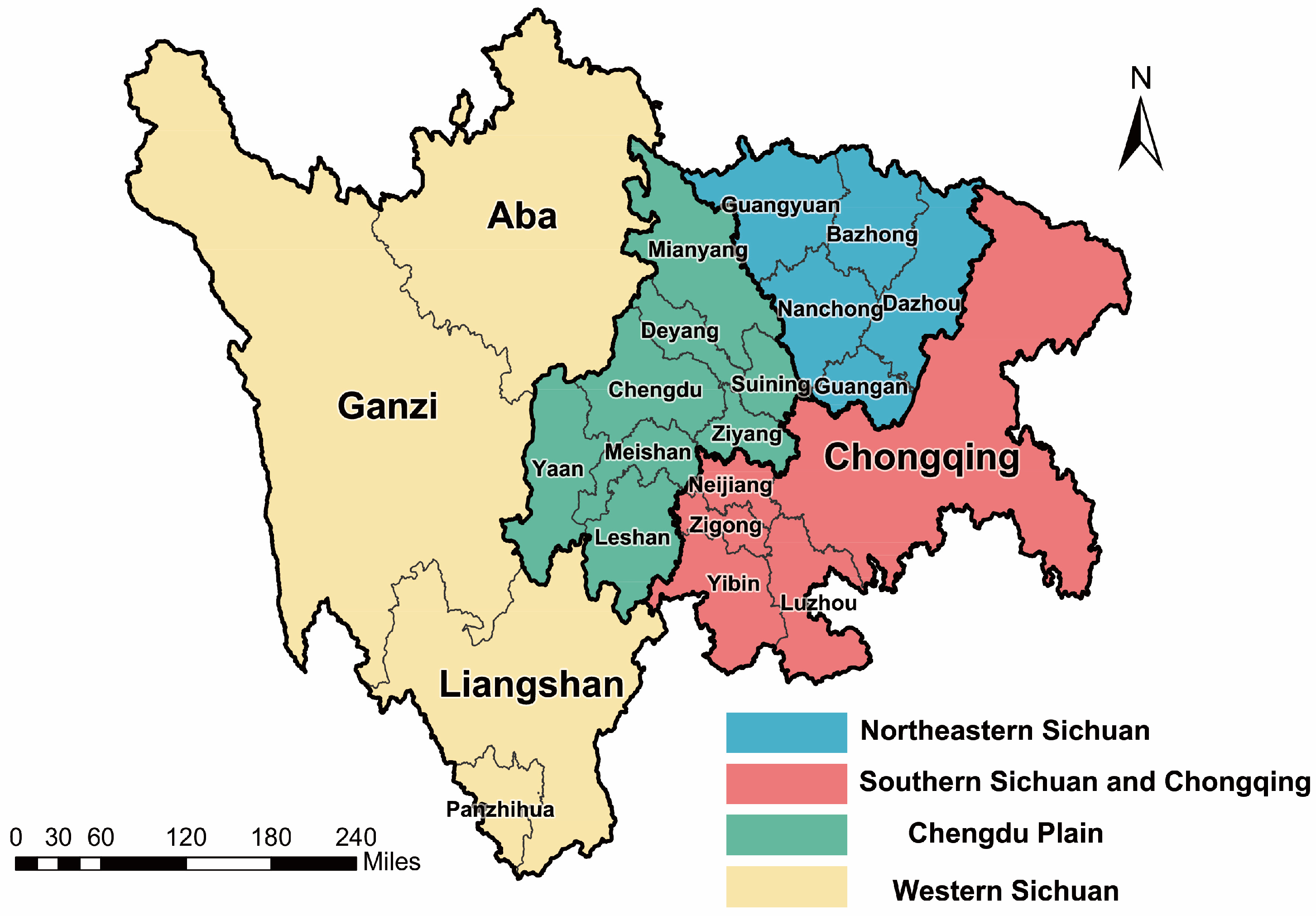
2.1. Overview of the Study Area
2.2. Data
2.2.1. Carbon Emission Data
2.2.2. Vegetation Carbon Sequestration Data
2.2.3. Statistical Data
2.2.4. Meteorological Data
2.3. Research Method
2.3.1. Carbon Balance Pressure Index
2.3.2. Geodetector
2.3.3. Generalized Additive Models
3. Results
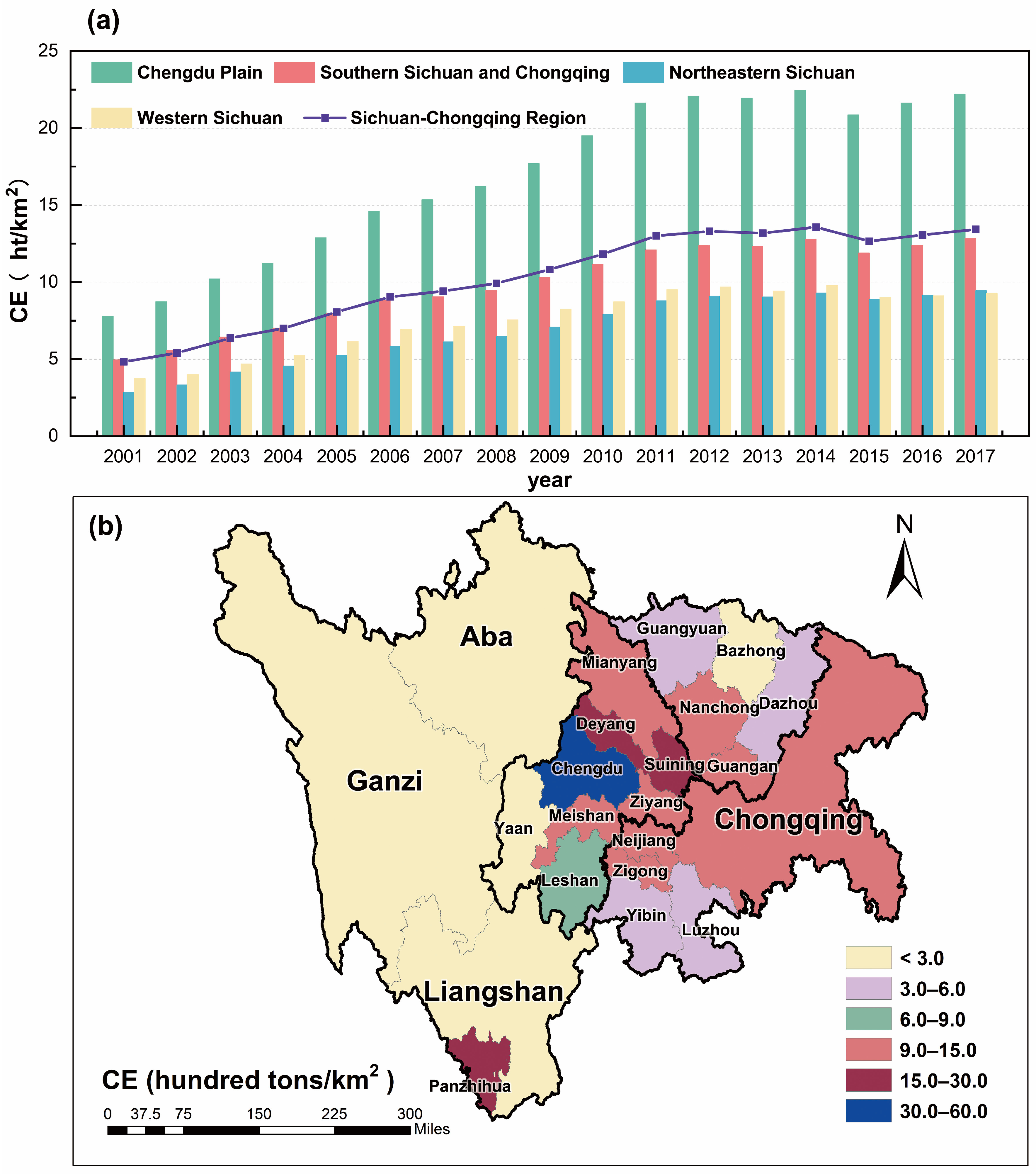
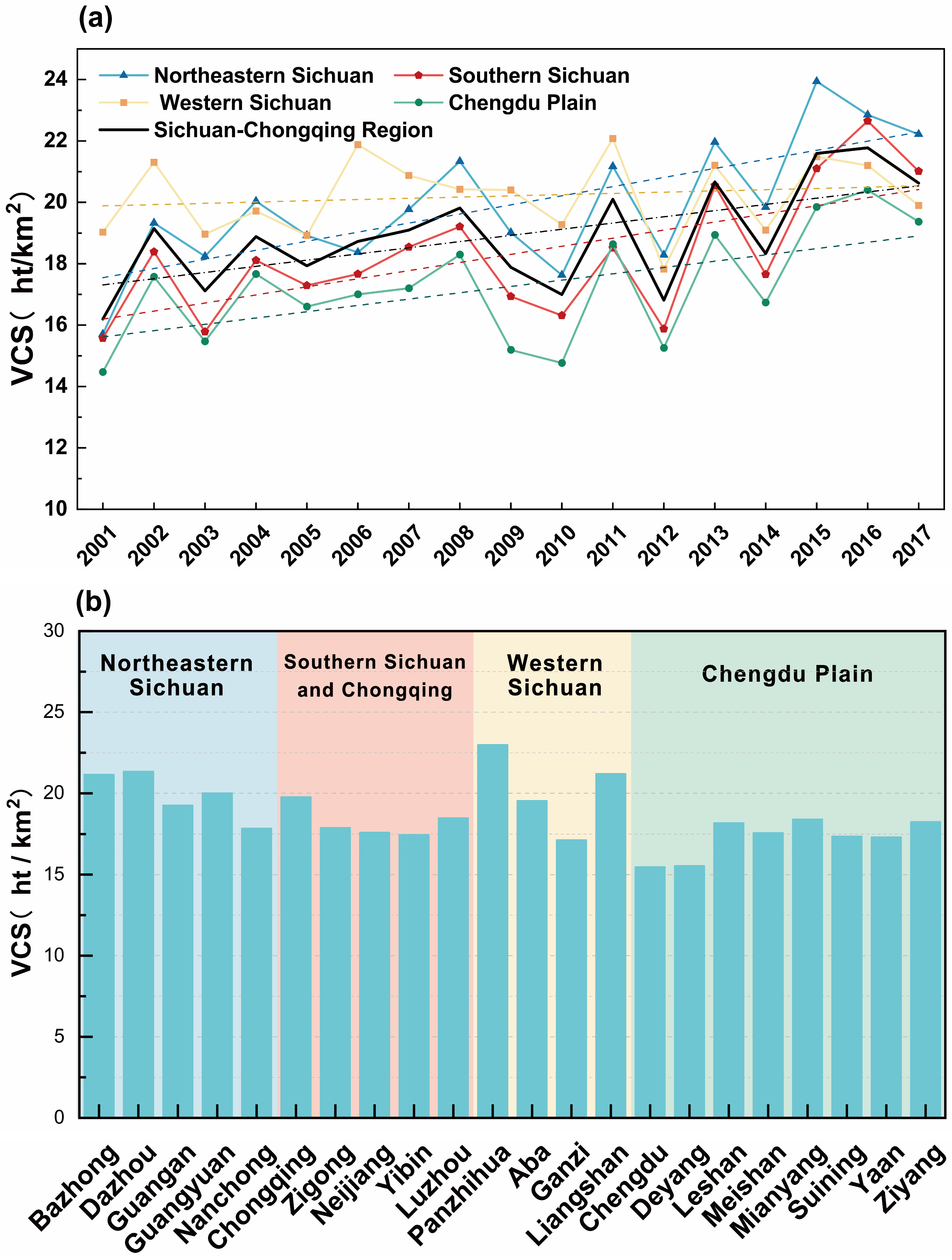
3.1. Spatiotemporal Variation Characteristics of the Carbon Source and Carbon Sink in the Sichuan–Chongqing Region
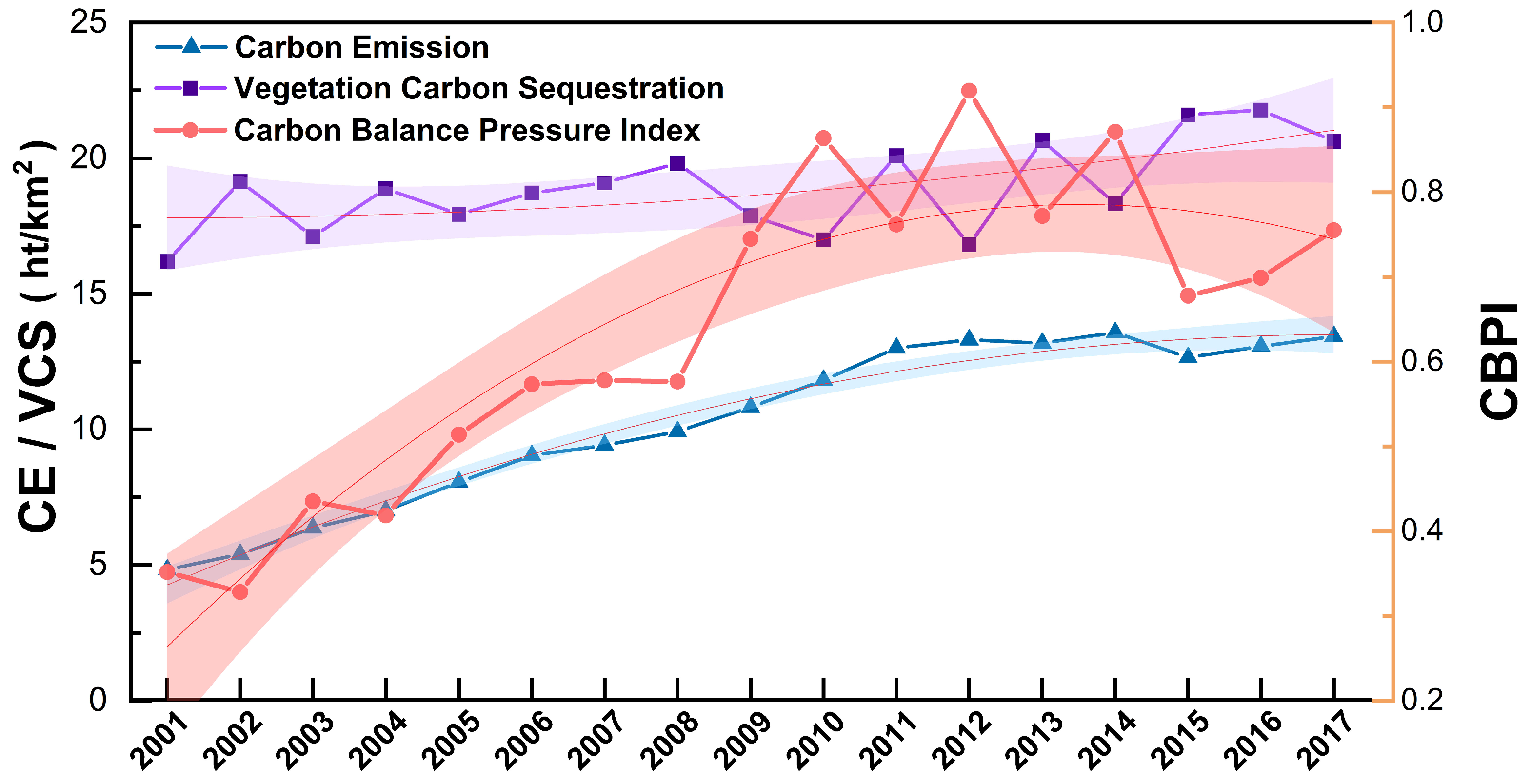
3.2. Temporal Variation Characteristics of the Carbon Balance Pressure Index (CBPI) in the Sichuan–Chongqing Region
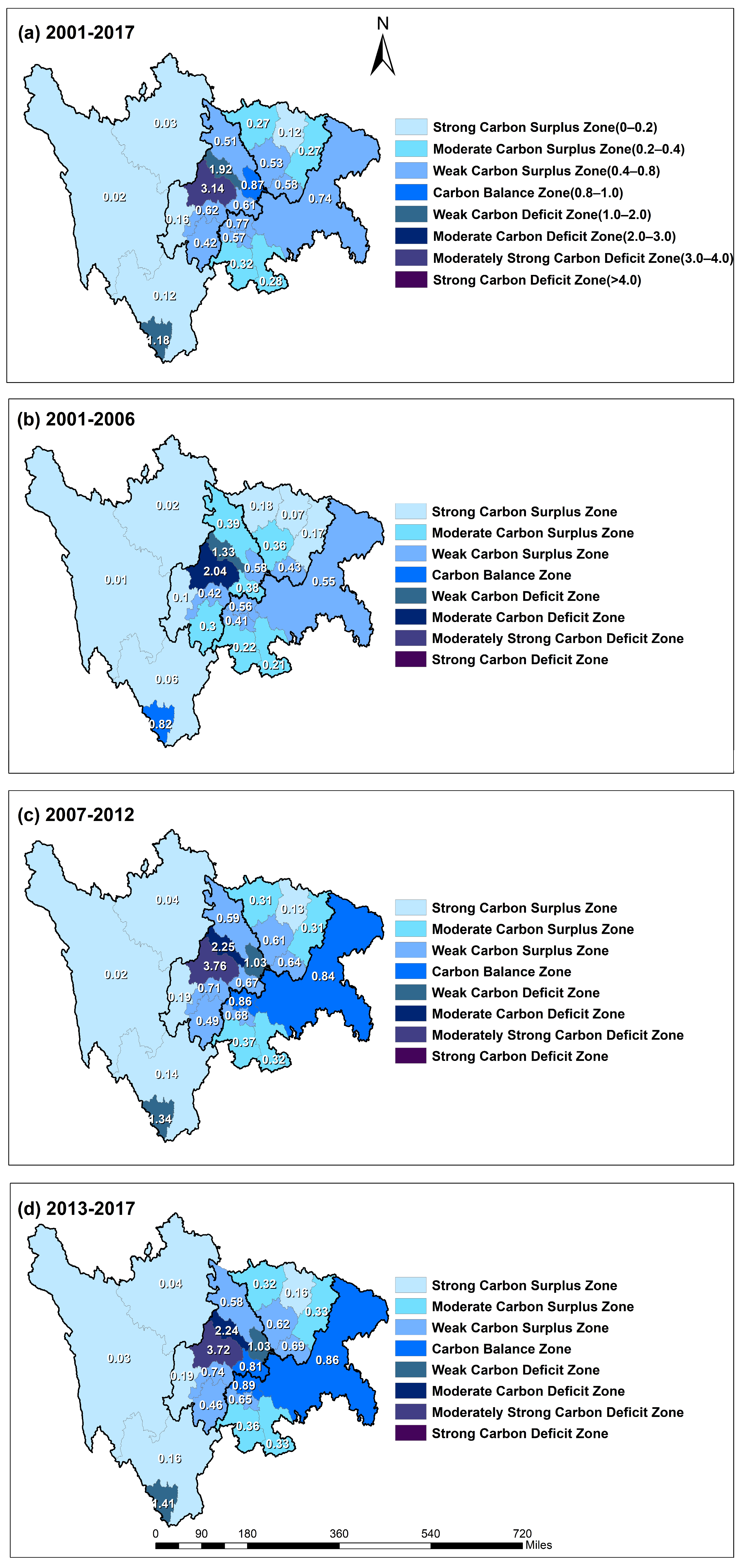
3.3. Spatial Variation Characteristics of the Carbon Balance Pressure Index (CBPI) in the Sichuan–Chongqing Region
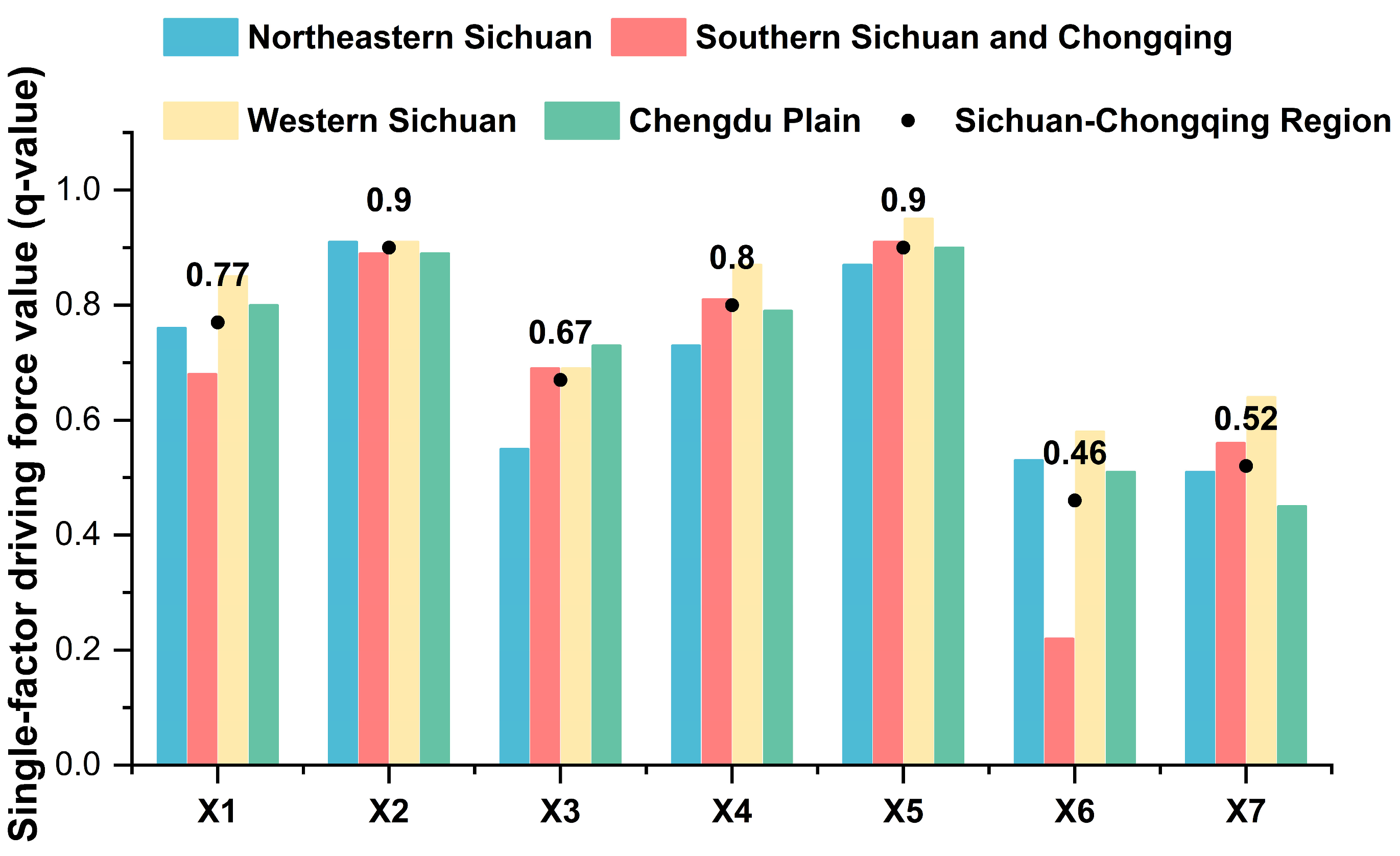
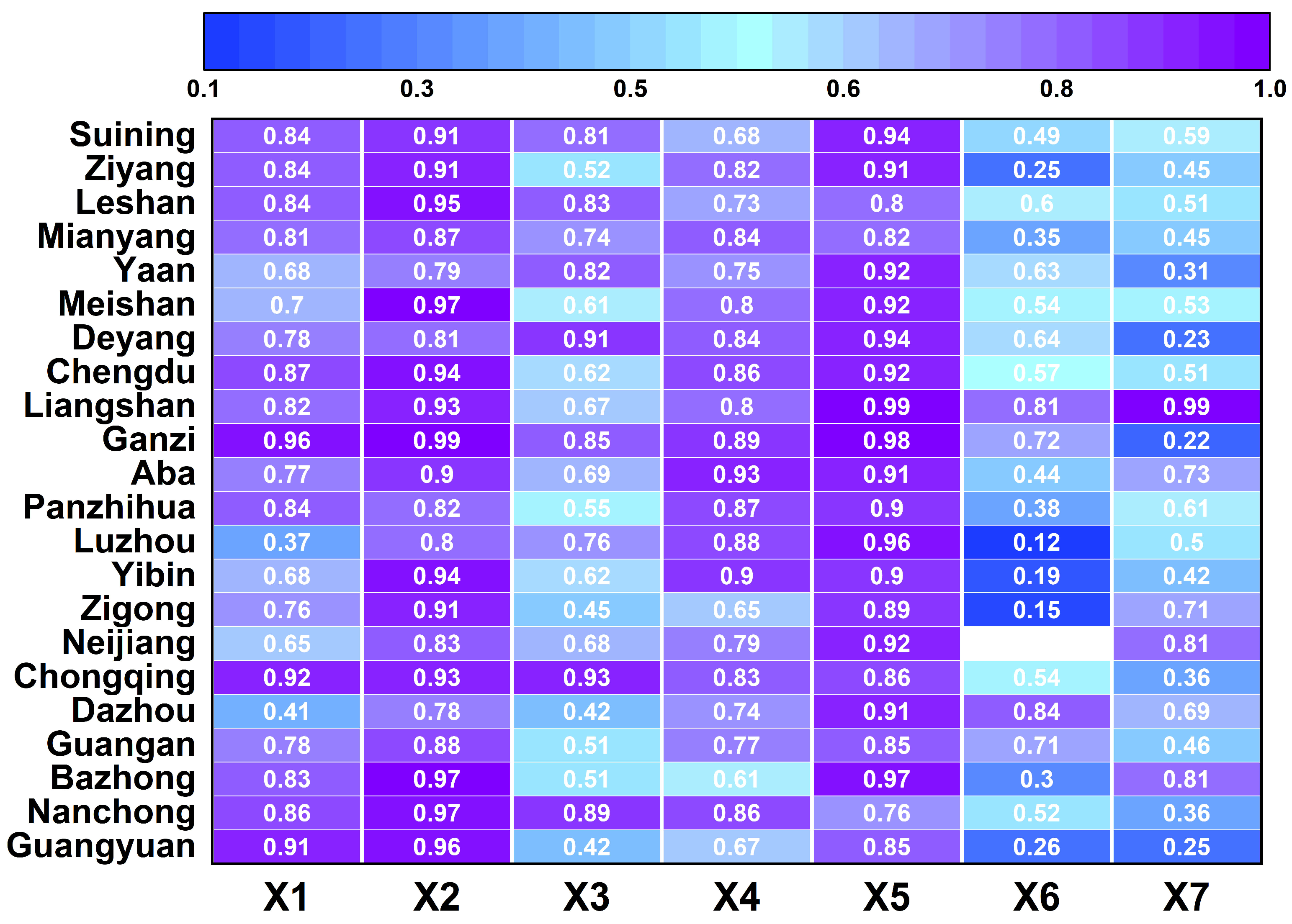
3.4. Detection of Influencing Factors on the Spatial Stratified Heterogeneity of the Carbon Balance Pressure Index (CBPI)
3.5. Suggestions for Alleviating Ecological Carbon Pressure in the City Unit Based on Geodetector’s Explanatory Factors
4. Discussion
5. Conclusions
- (1)
- Carbon Emission (CE) increased by 178%, while Vegetation Carbon Storage (VCS) rose by 27%. The Chengdu Plain, a high-carbon-emission core, saw its CE surge by 185% and VCS grow by 35%.
- (2)
- The Carbon Balance Pressure Index (CBPI) in the Sichuan–Chongqing region generally exhibited an annual trend of rapid growth and high-level fluctuation during 2001–2017. The CBPI increased from 0.35 in 2001 to 0.76 in 2017, reaching a peak value of 0.92 in 2012. CBPI evolution reflected an intensifying imbalance between carbon emissions and vegetation carbon sequestration.
- (3)
- Between 2001 and 2017, the Sichuan–Chongqing CBPI showed a “light-west, heavy-center, moderate-east” belt, with the Chengdu Plain as the persistent high-value zone and Chengdu City at the core of carbon pressure accumulation (CBPI = 3.14), indicating the long-term accumulation of carbon pressure in highly urbanized and industrialized areas. In contrast, underdeveloped regions experienced worsening carbon imbalances due to rapid urbanization, expanded construction land, and energy demand. Developed districts should accelerate green, low-carbon industrial transformation, while less-developed ones must avoid high-carbon path dependence and pursue intensive, eco-friendly urban growth.
- (4)
- The carbon pressure in the Sichuan–Chongqing region was shaped by three pathways during the study period: industrial structure, land-use change associated with urban expansion, and fossil-fuel-based energy consumption, particularly in the transportation sector. Their effects are often reinforced through interactions with other factors. Low-CBPI cities should balance growth with green transformation; high-CBPI cities must adjust structures and upgrade technology, supported by inter-regional green cooperation. The relative importance of these pathways varied across regions, reinforcing the necessity of differentiated approaches to carbon governance that align with local development characteristics and ecological conditions.
Supplementary Materials
Author Contributions
Funding
Data Availability Statement
Acknowledgments
Conflicts of Interest
Abbreviations
| MODIS | Moderate Resolution Imaging Spectroradiometer |
| NDVI | Normalized difference vegetation index |
| NPP | Net primary productivity |
| CE | Carbon emission |
| VCS | Vegetation carbon sequestration |
| CBPI | Carbon balance pressure index |
| CEADs | Carbon Emission Accounts and Datasets |
| IPCC | Intergovernmental Panel on Climate Change |
| CASA | Carnegie–Ames–Stanford Approach |
| APAR | Absorption of photosynthetically active radiation |
| GDP | Gross Domestic Product |
| GAMs | Generalized additive models |
References
- Chen, J.; Fan, W.; Li, D.; Liu, X.; Song, M. Driving factors of global carbon footprint pressure: Based on vegetation carbon sequestration. Appl. Energy 2020, 267, 114914. [Google Scholar] [CrossRef] [Scilit]
- Zheng, X.; Lu, Y.; Yuan, J. Drivers of change in China’s energy-related CO2 emissions. Proc. Natl. Acad. Sci. USA 2019, 117, 29–36. [Google Scholar] [CrossRef] [Scilit] [PubMed]
- Yin, J.; Zheng, M.; Chen, J. The effects of environmental regulation and technical progress on CO2 Kuznets curve: An evidence from China. Energy Policy 2015, 77, 97–108. [Google Scholar] [CrossRef] [Scilit]
- Muryshev, K.E.; Eliseev, A.V.; Mokhov, I.I.; Timazhev, A.V. Lead-lag relationships between global mean temperature and the atmospheric CO2 content in dependence of the type and time scale of the forcing. Glob. Planet. Change 2017, 148, 29–41. [Google Scholar] [CrossRef] [Scilit]
- Li, M.; Wu, J.; Deng, X. Land use change and soil carbon sequestration in China: Where does it pay to conserve? Reg. Environ. Change 2016, 16, 2429–2441. [Google Scholar] [CrossRef] [Scilit]
- Bai, Y.; Deng, X.; Gibson, J.; Zhao, Z.; Xu, H. How does urbanization affect residential CO2 emissions? An analysis on urban agglomerations of China. J. Clean. Prod. 2019, 209, 876–885. [Google Scholar] [CrossRef] [Scilit]
- Liu, Q.; Zhang, W.; Yao, M.; Yuan, J. Carbon emissions performance regulation for China’s top generation groups by 2020: Too challenging to realize? Resour. Conserv. Recycl. 2017, 122, 326–334. [Google Scholar] [CrossRef] [Scilit]
- Lian, L.; Lin, J.; Yao, R.; Tian, W. The CO2 emission changes in China’s transportation sector during 1992–2015: A structural decomposition analysis. Environ. Sci. Pollut. Res. 2020, 27, 9085–9098. [Google Scholar] [CrossRef] [Scilit]
- Liu, Z.; Guan, D.; Wei, W.; Davis, S.J.; Ciais, P.; Bai, J.; Peng, S.; Zhang, Q.; Hubacek, K.; Marland, G.; et al. Reduced carbon emission estimates from fossil fuel combustion and cement production in China. Nature 2015, 524, 335–338. [Google Scholar] [CrossRef] [Scilit]
- Fang, J.; Yu, G.; Liu, L.; Hu, S.; Chapin, F.S., III. Climate change, human impacts, and carbon sequestration in China. Proc. Natl. Acad. Sci. USA 2018, 115, 4015–4020. [Google Scholar] [CrossRef] [Scilit]
- Yang, W.; Pan, J. The role of vegetation carbon sequestration in offsetting energy carbon emissions in the Yangtze River Basin, China. Environ. Dev. Sustain. 2024, 26, 22689–22714. [Google Scholar] [CrossRef] [Scilit]
- Liu, X.; Pei, F.; Wen, Y.; Li, X.; Wang, S.; Wu, C.; Cai, Y.; Wu, J.; Chen, J.; Feng, K.; et al. Global urban expansion offsets climate-driven increases in terrestrial net primary productivity. Nat. Commun. 2019, 10, 5558. [Google Scholar] [CrossRef] [Scilit] [PubMed]
- Piao, S.; Fang, J.; Ciais, P.; Peylin, P.; Huang, Y.; Sitch, S.; Wang, T. The carbon balance of terrestrial ecosystems in China. Nature 2009, 458, 1009–1013. [Google Scholar] [CrossRef] [Scilit] [PubMed]
- Tang, X.; Zhao, X.; Bai, Y.; Tang, Z.; Wang, W.; Zhao, Y.; Wan, H.; Xie, Z.; Shi, X.; Wu, B.; et al. Carbon pools in China’s terrestrial ecosystems: New estimates based on an intensive field survey. Proc. Natl. Acad. Sci. USA 2018, 115, 4021–4026. [Google Scholar] [CrossRef] [Scilit]
- Dossa, K.F.; Miassi, Y.E. Remote sensing methods and GIS approaches for carbon sequestration measurement: A general review. Int. J. Environ. Clim. Change 2024, 14, 222–233. [Google Scholar] [CrossRef] [Scilit]
- Dong, L.; Wang, Y.; Ai, L.; Cheng, X.; Luo, Y. A review of research methods for accounting urban green space carbon sinks and exploration of new approaches. Front. Environ. Sci. 2024, 12, 1350185. [Google Scholar] [CrossRef] [Scilit]
- Zhu, W.; Pan, Y.; He, H.; Yu, D.; Hu, H. Simulation of maximum light use efficiency for some typical vegetation types in China. Chin. Sci. Bull. 2006, 51, 457–463. [Google Scholar] [CrossRef] [Scilit]
- Wang, J.; Du, G. Spatial differentiation and driving factors of urban green development efficiency in China. Res. Econ. Manag. (Jingji Yu Guanli Yanjiu) 2020, 41, 11–27. (In Chinese) [Google Scholar]
- Hu, D.; Ding, S. Research on evaluation index system of low-carbon economy. Sci. Technol. Prog. Policy (Kejin Jinbu Yu Duice) 2010, 27, 160–164. (In Chinese) [Google Scholar]
- Feng, Z. Construction of evaluation index system for regional low-carbon development capacity. Stat. Decis. (Tongji Yu Juece) 2012, 28, 63–65. (In Chinese) [Google Scholar]
- Churchill, S.A.; Inekwe, J.; Ivanovski, K. Conditional convergence in per capita carbon emissions since 1900. Appl. Energy 2018, 228, 916–927. [Google Scholar] [CrossRef] [Scilit]
- Zhang, F.; Deng, X.; Phillips, F.; Fang, C.; Wang, C. Impacts of industrial structure and technical progress on carbon emission intensity: Evidence from 281 cities in China. Technol. Forecast. Soc. Change 2020, 154, 119949. [Google Scholar] [CrossRef] [Scilit]
- Zhao, Y.; Chen, R.; Zang, P.; Huang, L.; Ma, S.; Wang, S. Spatiotemporal patterns of global carbon intensities and their driving forces. Sci. Total Environ. 2022, 818, 151690. [Google Scholar] [CrossRef] [Scilit] [PubMed]
- Feng, Y.; Zhai, L.; Sang, H.; Cheng, S. Carbon budget accounting and change classification method based on fine. J. Geoinf. Sci. (Diqiu Xinxi Kexue Xuebao) 2023, 25, 468–478. (In Chinese) [Google Scholar]
- Liang, D.; Lu, H.; Guan, Y.; Feng, L.; He, L.; Qiu, L.; Lu, J. Population density regulation may mitigate the imbalance between anthropogenic carbon emissions and vegetation carbon sequestration. Sustain. Cities Soc. 2023, 92, 104502. [Google Scholar] [CrossRef] [Scilit]
- Zhao, R.; Huang, X.; Liu, Y.; Zhong, T.; Ding, M.; Chuai, X. Urban carbon footprint and carbon cycle pressure: The case study of Nanjing. J. Geogr. Sci. 2014, 24, 159–176. [Google Scholar] [CrossRef] [Scilit]
- Guo, P.; Liang, D. Has the low-carbon pilot policy improved urban carbon emission efficiency? A quasi-natural experiment based on low-carbon pilot cities. J. Nat. Resour. (Ziran Ziyuan Xuebao) 2022, 37, 1876–1892. (In Chinese) [Google Scholar]
- Chen, J.; Li, Z.; Song, M.; Dong, Y. Decomposing the global carbon balance pressure index: Evidence from 77 countries. Environ. Sci. Pollut. Res. 2021, 28, 7016–7031. [Google Scholar] [CrossRef] [Scilit]
- Liu, Q.; Wu, S.; Lei, Y.; Li, S.; Li, L. Exploring spatial characteristics of city-level CO2 emissions in China and their influencing factors from global and local perspectives. Sci. Total Environ. 2021, 754, 142206. [Google Scholar] [CrossRef] [Scilit]
- Sodiq, A.; Baloch, A.A.B.; Khan, S.A.; Sezer, N.; Mahmoud, S.; Jama, M.; Abdelaal, A. Towards modern sustainable cities: Review of sustainability principles and trends. J. Clean. Prod. 2019, 227, 972–1001. [Google Scholar] [CrossRef] [Scilit]
- United Nations. Cities and Climate Change. 2020. Available online: https://www.unep.org/explore-topics/resource-efficiency/what-we-do/cities-and-climate-change (accessed on 15 March 2024).
- Song, C.; Zhao, T.; Wang, J. Spatial-temporal analysis of China’s regional carbon intensity based on ST-IDA from 2000 to 2015. J. Clean. Prod. 2019, 238, 117874. [Google Scholar] [CrossRef] [Scilit]
- Chen, J.; Gao, M.; Cheng, S.; Hou, W.; Song, M.; Liu, X.; Liu, Y.; Shan, Y. County-level CO2 emissions and sequestration in China during 1997–2017. Sci. Data 2020, 7, 391. [Google Scholar] [CrossRef] [Scilit]
- Potter, C.S.; Randerson, J.T.; Field, C.B.; Matson, P.A.; Vitousek, P.M.; Mooney, H.A.; Klooster, S.A. Terrestrial ecosystem production: A process model based on global satellite and surface data. Glob. Biogeochem. Cycles 1993, 7, 811–841. [Google Scholar] [CrossRef] [Scilit]
- Wang, X.; Tan, K.; Chen, B.; Du, P. Assessing the spatiotemporal variation and impact factors of net primary productivity in China. Sci. Rep. 2017, 7, 44415. [Google Scholar] [CrossRef] [Scilit] [PubMed]
- Feng, H.; Kang, P.; Deng, Z.; Zhao, W.; Hua, M.; Zhu, X.; Wang, Z. The impact of climate change and human activities to vegetation carbon sequestration variation in Sichuan and Chongqing. Environ. Res. 2023, 238, 117138. [Google Scholar] [CrossRef] [Scilit]
- Wang, Y.; Yang, M.; Pan, Y.; Zhu, W.; Long, Z.; Liu, X.; Gu, X. Remote sensing estimation of the value of organic matter produced by terrestrial vegetation ecosystems in China. Ecol. Environ. 2005, 14, 5. (In Chinese) [Google Scholar] [CrossRef]
- Wang, S.; Huang, Y. Spatial spillover effect and driving forces of carbon emission intensity at city level in China. Acta Geogr. Sin. (Dili Xuebao) 2019, 74, 1131–1148. Available online: https://www.geog.com.cn/CN/10.11821/dlxb201906005 (accessed on 15 March 2024). (In Chinese)
- Li, Y.; Zhang, S. Spatiotemporal evolution of carbon emission intensity and spatiotemporal heterogeneity of influencing factors in Chinese cities. China Environ. Sci. 2023, 43, 3244–3254. (In Chinese) [Google Scholar] [CrossRef]
- Azam, M.; Uddin, I.; Khan, S.; Tariq, M. Are globalization, urbanization, and energy consumption cause carbon emissions in SAARC region? New evidence from CS-ARDL approach. Environ. Sci. Pollut. Res. 2022, 29, 87746–87763. [Google Scholar] [CrossRef] [Scilit]
- Yu, Y.H.; Zheng, X.Y.; Zhang, L. Carbon dioxide emission and economic development: A panel data analysis. Econ. Theory Bus. Manag. (Jingji Lilun Yu Shangye Guanli) 2011, 6, 72–81. [Google Scholar]
- Sheng, P.; Guo, X. The Long-run and Short-run Impacts of Urbanization on Carbon Dioxide Emissions. Econ. Model. 2016, 53, 208–215. [Google Scholar] [CrossRef] [Scilit]
- Yu, J.; Da, Y.; Yang, O. Analysis of carbon emission changes in China’s transportation industry based on LMDI decomposition method. China J. Highw. Transp. (Zhongguo Gonglu Xuebao) 2015, 28, 112–119. (In Chinese) [Google Scholar]
- Solaymani, S. CO2 emissions patterns in 7 top carbon emitter economies: The case of transport sector. Energy 2019, 168, 989–1001. [Google Scholar] [CrossRef] [Scilit]
- Peng, S. 1-km Monthly Mean Temperature Dataset for China (1901–2022); National Tibetan Plateau/Third Pole Environment Data Center: Beijing, China, 2019. [Google Scholar] [CrossRef]
- Zhou, R.; Zhang, Y.; Peng, M.; Jin, Y.; Song, Q. Effects of climate change on the carbon sequestration potential of forest vegetation in Yunnan Province, Southwest China. Forests 2022, 13, 306. [Google Scholar] [CrossRef] [Scilit]
- Li, H.; Zhang, H.; Feng, Z.; Zhao, J.; Chen, H.; Guo, X.; Wang, T.; Liu, Y. Climate change influences on vegetation photosynthesis in the Northern Hemisphere. J. Environ. Manag. 2025, 380, 124976. [Google Scholar] [CrossRef] [Scilit]
- Wu, Y.Y.; Wang, P.; Liu, X.; Chen, J.D.; Song, M.L. Analysis of regional carbon allocation and carbon trading based on net primary productivity in China. China Econ. Rev. 2020, 60, 101401. [Google Scholar] [CrossRef] [Scilit]
- Law, B.E.; Waring, R.H.; Anthoni, P.M.; Aber, J.D. Measurements of gross and net ecosystem productivity and water vapour exchange of a Pinus ponderosa ecosystem, and an evaluation of two generalized models. Glob. Change Biol. 2000, 6, 155–168. [Google Scholar] [CrossRef] [Scilit]
- Wang, J.F.; Zhang, T.L.; Fu, B.J. A measure of spatial stratified heterogeneity. Ecol. Indic. 2016, 67, 250–256. [Google Scholar] [CrossRef] [Scilit]
- Hu, Y.; Ma, G.; Wang, J.; Ye, Y.; Zhang, J. Contribution analysis of the 12th Five-Year Plan energy conservation target to carbon emission intensity in Sichuan Province. Water Resour. Power (Shuidian Nengyuan Kexue) 2012, 30, 205–207, 216. (In Chinese) [Google Scholar]
- Jiang, F.; Huang, W.; Ma, G. Decomposition study on influencing factors of carbon emissions from energy consumption in Sichuan Province. China Popul. Resour. Environ. (Zhongguo Renkou Ziyuan Yu Huanjing) 2016, 26, 45–48. (In Chinese) [Google Scholar]
- Zhang, Z.; Zhang, T.; Feng, D. Regional differences, dynamic evolution and convergence of carbon emission intensity in China. J. Quant. Tech. Econ. (Shuliang Jingji Jishu Jingji Yanjiu) 2022, 39, 67–87. (In Chinese) [Google Scholar]
- Mahbub, R.B.; Ahmed, N.; Rahman, S.; Hossain, M.M.; Sujauddin, M. Human appropriation of net primary production in Bangladesh, 1700–2100. Land Use Policy 2019, 87, 104067. [Google Scholar] [CrossRef] [Scilit]
- Hu, J.; Huang, F.; Tie, L.; Liu, X.; Wei, S.; Huang, C. Economic value dynamics of carbon sequestration in forest vegetation of Sichuan Province. Acta Ecol. Sin. (Shengtai Xuebao) 2019, 39, 158–163. (In Chinese) [Google Scholar]
- Zhu, J.; Song, L. A review of ecological mechanisms for management practices of protective forests. J. For. Res. 2021, 32, 435–448. [Google Scholar] [CrossRef] [Scilit]
- Cheng, C.; Yang, X.; Cai, H. Analysis of Spatial and Temporal Changes and Expansion Patterns in Mainland Chinese Urban Land between 1995 and 2015. Remote Sens. 2021, 13, 2090. [Google Scholar] [CrossRef] [Scilit]
- Lu, Q.; Duan, H.; Shi, H.; Peng, B.; Liu, Y.; Wu, T.; Du, H.; Wang, S. Decarbonization scenarios and carbon reduction potential for China’s road transportation by 2060. Npj Urban Sustain. 2022, 2, 34. [Google Scholar] [CrossRef] [Scilit]
- Jaiswal, D.; Siddique, K.; Jayalekshmi, T.; Sajitha, A.; Kushwaha, A.; Surendran, S. Land-based climate mitigation strategies for achieving net zero emissions in India. Front. Clim. 2025. [Google Scholar] [CrossRef] [Scilit]
- Mackey, B.; Moomaw, W.; Lindenmayer, D.; Keith, H. Net carbon accounting and reporting are a barrier to understanding the mitigation value of forest protection in developed countries. Environ. Res. Lett. 2022, 17, 054028. [Google Scholar] [CrossRef] [Scilit]
- Mehmood, S.; Zaman, K.; Khan, S.; Ali, Z.; Khan, H.U.R. The role of green industrial transformation in mitigating carbon emissions: Exploring the channels of technological innovation and environmental regulation. Energy Built Environ. 2024, 5, 464–479. [Google Scholar] [CrossRef] [Scilit]
- Montoya-Torres, J.; Akizu-Gardoki, O.; Iturrondobeitia, A.M. Towards sustainable passenger transport: Carbon emission reduction scenarios for a medium-sized city. J. Clean. Prod. 2023, 418, 138149.1–138149.12. [Google Scholar] [CrossRef] [Scilit]
- Thanatrakolsri, P.; Sirithian, D. Toward Low-Carbon Mobility: Greenhouse Gas Emissions and Reduction Opportunities in Thailand’s Road Transport Sector. Clean Technol. 2025, 7, 60. [Google Scholar] [CrossRef] [Scilit]
- Dong, F.; Zhu, J.; Li, Y.; Chen, Y.; Gao, Y.; Hu, M.; Qin, C.; Sun, J. How green technology innovation affects carbon emission efficiency: Evidence from developed countries proposing carbon neutrality targets. Environ. Sci. Pollut. Res. 2022, 29, 35780–35799. [Google Scholar] [CrossRef] [Scilit] [PubMed]
- O’Mahony, T. Decomposition of Ireland’s carbon emissions from 1990 to 2010: An extended Kaya identity. Energy Policy 2013, 59, 573–581. [Google Scholar] [CrossRef] [Scilit]
- Asensio, O.I.; Apablaza, C.Z.; Lawson, M.C.; Chen, E.W.; Horner, S.J. Impacts of micromobility on car displacement with evidence from a natural experiment and geofencing policy. Nat. Energy 2022, 7, 1100–1108. [Google Scholar] [CrossRef] [Scilit]
- Li, T.; Chen, H.; Ma, C. China’s urbanization evolution and metropolitan area expansion, based on the Prolonged Artificial Nighttime-light Dataset (PANDA, 1984–2020). Int. J. Digit. Earth 2024, 17, 2347448. [Google Scholar] [CrossRef] [Scilit]
- Wang, Y.; Wang, R.; Tanaka, K.; Ciais, P.; Peñuelas, J.; Balkanski, Y.; Sardans, J.; Hauglustaine, D.; Liu, W.; Xing, X.; et al. Accelerating the energy transition towards photovoltaic and wind in China. Nature 2023, 619, 761–767. [Google Scholar] [CrossRef] [Scilit]
- Zhang, S.; Liu, J.; Ran, L.; Zhang, X.; Shao, J. Cross-county horizontal ecological compensation and supply-demand docking to increase forest coverage: A case study of Chongqing. Acta Ecol. Sin. 2023, 43, 4651–4663. [Google Scholar] [CrossRef] [Scilit]
- Wei, X.; Liu, R.; Liu, Y.; He, J.; Chen, J.; Qi, L.; Zhou, Y.; Qin, Y.; Wu, C.; Dong, J.; et al. Forest Areas in China Are Recovering Since the 21st Century. Geophys. Res. Lett. 2024, 51, e2024GL110312. [Google Scholar] [CrossRef] [Scilit]
- Li, C. China’s strategies and initiatives to foster high-quality leaping development of renewable energy. iEnergy 2022, 1, 149–150. [Google Scholar] [CrossRef] [Scilit]






| Criterion | Interaction |
|---|---|
| Weaken, nonlinear | |
| Weaken, uni- | |
| Enhance, bi- | |
| Independent | |
| Enhance, nonlinear |
Disclaimer/Publisher’s Note: The statements, opinions and data contained in all publications are solely those of the individual author(s) and contributor(s) and not of MDPI and/or the editor(s). MDPI and/or the editor(s) disclaim responsibility for any injury to people or property resulting from any ideas, methods, instructions or products referred to in the content. |
© 2026 by the authors. Licensee MDPI, Basel, Switzerland. This article is an open access article distributed under the terms and conditions of the Creative Commons Attribution (CC BY) license.
Share and Cite
Jian, J.; Kang, P.; Feng, H.; Li, J.; Li, L.; Shen, Y.; Wang, Y. Spatiotemporal Imbalance of Carbon Balance Pressure in Sichuan–Chongqing: Anthropogenic Emissions vs. Vegetation Sinks and Their Explanatory Factors. Earth 2026, 7, 9. https://doi.org/10.3390/earth7010009
Jian J, Kang P, Feng H, Li J, Li L, Shen Y, Wang Y. Spatiotemporal Imbalance of Carbon Balance Pressure in Sichuan–Chongqing: Anthropogenic Emissions vs. Vegetation Sinks and Their Explanatory Factors. Earth. 2026; 7(1):9. https://doi.org/10.3390/earth7010009
Chicago/Turabian StyleJian, Jialing, Ping Kang, Haopeng Feng, Jia Li, Ludan Li, Yuan Shen, and Yang Wang. 2026. "Spatiotemporal Imbalance of Carbon Balance Pressure in Sichuan–Chongqing: Anthropogenic Emissions vs. Vegetation Sinks and Their Explanatory Factors" Earth 7, no. 1: 9. https://doi.org/10.3390/earth7010009
APA StyleJian, J., Kang, P., Feng, H., Li, J., Li, L., Shen, Y., & Wang, Y. (2026). Spatiotemporal Imbalance of Carbon Balance Pressure in Sichuan–Chongqing: Anthropogenic Emissions vs. Vegetation Sinks and Their Explanatory Factors. Earth, 7(1), 9. https://doi.org/10.3390/earth7010009