


Abstract
Many rural communities are struggling to understand the changing climate and how to mitigate and adapt to its negative effects. “Climate literacy” (i.e., an understanding of the climate system, how human actions influence it, and how it affects society and the Earth) may be a necessary precursor to climate action (i.e., steps that help to mitigate or adapt to climate change). For rural communities in the Brazilian Amazon, where access to formal education is limited, grasping abstract concepts like greenhouse gas emissions can be particularly challenging. We asked: Is climate literacy a necessary precursor to climate action? We conducted 22 semi-structured interviews with forest extractivists living within the Chico Mendes Extractive Reserve in the state of Acre, Brazil. We found that forest extractivists are experiencing the impacts of climate change but lack an understanding of its causes and forms of mitigation and are unaware of ways to adapt to it. Improved educational opportunities could support both climate literacy and, in turn, climate action.
1. Introduction
The effects of climate change are felt worldwide [1]. Extreme weather events related to climate change, such as forest fires, drought, and floods are some examples of what are becoming increasingly regular events that humankind faces globally e.g., [2,3,4,5,6,7]. Furthermore, such extreme weather events often involve not only economic effects and material losses but also lead to social fragmentation [8].
This is starkly evident in particular places. Brazil, for example, increasingly faces climate mitigation and adaptation challenges due to severe weather events on a country-wide scale—from 1990 to 2020 climate-related disasters increased more than 460% [9]. Furthermore, in the economically poorest regions of Brazil, such as the Amazon, the impacts of climate change on people’s lives can be profound. The North region of Brazil, where the Amazon is located, accounts for 8.8% of the total Brazilian population and is the second poorest region in the country. Here, 12% of the population lives in extreme poverty and 12.4% live in poverty (the Northeast region leads this ranking, representing 26.9% of the total population, with 55.5% living in extreme poverty and 46.4% living in poverty [10]). While the Amazon forest is renowned for its rich biodiversity and traditional populations that have been practicing sustainable livelihoods for centuries [11], these populations are now facing several complex and intertwined challenges and social transformations as they struggle to cope with extreme events [12,13,14].
These populations are particularly vulnerable due to the lack of adaptation measures in place, a phenomenon which manifests in multiple ways. First, many rural Amazonian populations heavily rely on natural resources, for both subsistence and to earn a modest income [15]. Some of these resources (e.g., rubber, Brazil nuts) are markedly declining due to climate change e.g., [16,17]. Thus, resource decline affects not only people’s subsistence practices but also their natural resource-related income generation options.
Formal education across the Amazon is also limited in many places. Primary education in the Brazilian Amazon has a 97% net attendance rate (both in urban and rural areas of the Amazon), which is equal to the national average. However, this trend is not observed in secondary education. While the national average for secondary education is 84%, the attendance rate drops to 80% in the Amazon and 76% in rural Amazon [18]. This includes education on the presence, causes and impacts of climate change. Improved “climate literacy” (i.e., an understanding of the climate system, how human actions influence it, and how it affects society and the Earth) could help rural Amazonian communities who are struggling to not only cope with the effects of climate change in their daily lives but, on a deeper level, to understand both what is happening with the changing climate as well as how to mitigate and adapt to the negative effects of this reality.
Climate literacy is increasingly indicated as a central element for engaging people in climate action [19,20]. This phenomenon becomes even more important in relation to people living on “the frontlines of climate change,” such as in rural, forested regions of the Amazon, including in extractive reserves that aim to balance both conservation and sustainable development objectives. Traditional forest extractivists are people who have long forged a way of life in harmony with forest ecosystems—they adapt their daily lives and culture to the realities of the environment surrounding them. However, if the environment surrounding them is both changing and these changes are also hard to comprehend, this could have significant implications for the future of these communities.
This paper asks: Is climate literacy a necessary precursor to climate action? Guided by this question, we examine the climate literacy of people living in one of Brazil’s most iconic extractive reserves, the Chico Mendes Extractive Reserve (CMER) in the state of Acre, Brazil. Our research begins to illuminate the challenges and opportunities pertaining to how extractivist populations understand climate change. Our case-study approach—examining how climate change is affecting a particular community of forest extractivists—can offer insights into local perceptions of climate change and can help researchers and decision-makers to think about ways to integrate forest-based communities into discussions about climate change and, over time, into specific strategies for climate action.
2. Materials and Methods
2.1. Case-Study: Chico Mendes Extractive Reserve, Acre, Brazil
Acre, Brazil, with a territorial size of 164,083 km2 and an estimated population of 884,372 is known as a relatively “far-off” Brazilian state [21]. In fact, when mentioned in Brazil’s metropoles, it is frequently met with the joke: “Does Acre exist?” [22]. Yet Acre, located in the extreme west of Brazil and sharing a border with Peru and Bolivia, is experiencing a pronounced impact from extreme weather events, especially from severe droughts and floods e.g., [23,24,25]. These events may be caused by phenomena such as El Niño, La Niña, and/or changes in the South Atlantic Convergence Zone [13].
At the same time, Acre is known for its rich cultural history which is based on individual and collective ways of life in the forest. For example, rubber tappers, or seringueiros, have long played an important historical role in forest conservation [26,27]. These extractivists are internationally recognized as some of Brazil’s initial grassroots environmental leaders who advocated for sustainable development in tropical forest regions [28]. Seringueiros have a rich history of living in and of the forest. In fact, this rich relationship between sustainable extraction from the forest served as an impetus for what is the Brazilian environmental movement today. Seringueiros collect and produce rubber, which flows from rubber trees located in estradas de seringa (“rubber roads” or groves in the forest of rubber trees). Typically, each seringueiro is responsible for a colocação (i.e., an area that usually consists of three estradas de seringa, routes where they collect rubber from the forest). In the 1980s, large landowners worked to drive out the seringueiros, “the people inside the forest” who depended upon and sustainably managed the forest for their extractive livelihoods [29] and attempted to take over the seringueiros’ properties for timber extraction. Western Acre was the epicenter of this land conflict, where the seringueiros, guided by an iconic union leader named Chico Mendes, fought to maintain their communities, land, and way of life [30].
This advocacy for the rights of forest-based communities to remain in the forest could become violent. Though seringueiros relied on unarmed confrontations–known as empates—the Brazilian agricultural elite sometimes reacted violently to the organization and unity of the seringueiros to protect the forests where they lived [31]. This resistance culminated with the murder of Chico Mendes in his home in the town of Xapuri in 1988. But with Chico’s martyrdom, other activists rose up, and today Chico Mendes is widely known as the founder of the Brazilian environmental movement [32]. Extractive Reserves—officially designated areas with forest, homes, trails, and shifting cultivation, where people can earn a living from standing forests—came into being two years after Chico’s murder [33,34]. Today Extractive Reserves are formal conservation units within the Brazilian Federal Forest Code, that aim to promote the sustainable use of forest resources by safeguarding extractivists’ culture and livelihood practices [35]. Extractive Reserves are also dynamic places. Many residents want to keep their tradition of extractivism, but also improve their quality of life. But the ideals that first guided their creation have changed and the extractive reserves of today are places under threat for a variety of reasons. Many people from these communities can no longer earn a sufficient living from extractivism alone and, in turn, often turn to raising cattle, which is often associated with deforestation to create pasture land. Furthermore, the children of extractivists increasingly want access to consumer goods. A generational conflict between the seringueiro movement and the youth living on Extractive Reserves today is sometimes expressed in comments like: “I never saw a seringueiro become a rich person” (for more details see [27,36]).
At the same time, forest extractivists living on Extractive Reserves today also face extreme climate-related events, including droughts and varied rainfall patterns, which can have severe socio-economic impacts on the communities in these places. For example, the distribution of economically important species, which are sources of both food and income for extractivists, is in flux. Key non-timber forest species that have viable markets both nationally and internationally, such as Brazil nuts (Bertholletia excelsa Bonpl.), acai berry (Euterpe precatoria Mart., an Amazonian palm), and patauá (Oenocarpus bataua Mart., another Amazonian palm), can vary widely in their production capacity in the context of climate change. It is estimated that acai and patauá will have a dramatic reduction of 51–99% in their distribution range in the Southwestern Amazon by 2050, while Brazil nuts may be completely eradicated in the same region [37]. Climate-related shifts in nontimber forest production cultivation, such as this, will likely severely impact the livelihood opportunities of extractivist families who harvest these products within extractive reserves.
Considering these dynamics in non-timber forest product production, and connecting these changes with the question of climate literacy among communities on the frontlines of climate change, we conducted a field study with forest extractivist communities in Acre’s iconic Chico Mendes Extractive Reserve (CMER). CMER has a territory of 970,570 ha.
2.2. Data Collection
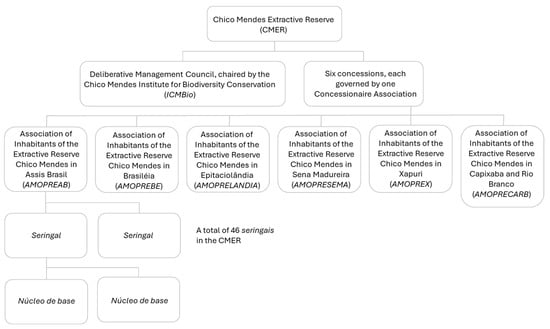
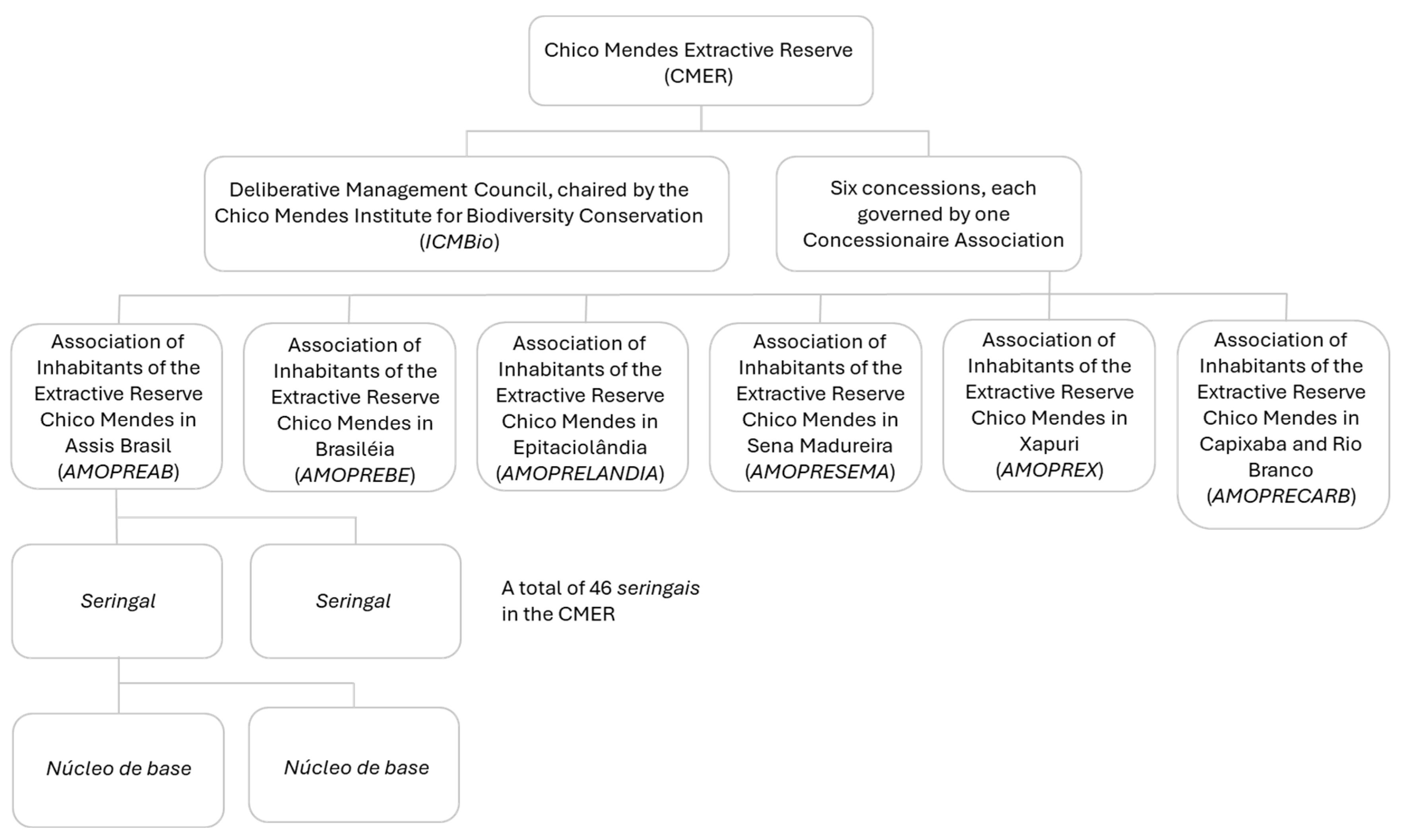
The governance and demographic structure of the CMER is highly nested (Figure 1). The CMER is governed by two main entities. First, there is a Deliberative Management Council chaired by the Chico Mendes Institute for Biodiversity Conservation (ICMBio) and constituted by various stakeholders (e.g., representatives from municipalities, concessionaire associations, labor unions, and academics). Its purpose is to contribute to the CMER Management Plan and the fulfillment of the conservation unit objectives [38]. Second, within the CMER, there are six different concessions, each governed by their own concessionaire association. The concessionaire associations are comprised of CMER residents and have significant influence in the day-to-day management of the CMER. Each concession is composed of multiple seringal, or seringais (former rubber estates) in the plural, with a total of 46 seringais in the entire CMER [38,39]. Each seringal is composed of multiple núcleos de base (clusters of houses, similar to a very small community). Each núcleo de base is, in turn, composed of multiple households (usually between 12 and 17 families per núcleo de base). These smaller units of organization work to manage and optimize the planning, execution, monitoring, and evaluation of the activities defined by CMER’s Deliberative Management Council. Our objective was to randomly sample households for this study, but that process was necessarily constrained and shaped in a few ways.
Figure 1.
Governance structure of the Chico Mendes Extractive Reserve, Acre, Brazil. Portuguese acronyms and terms are in italics.
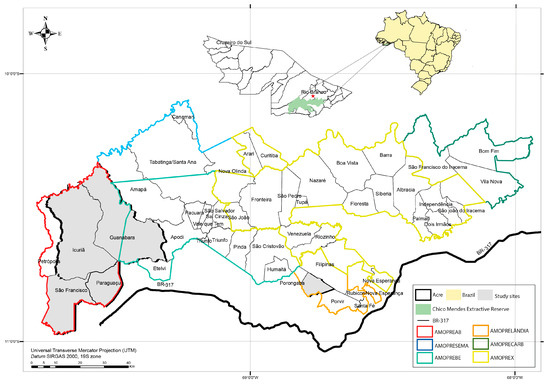
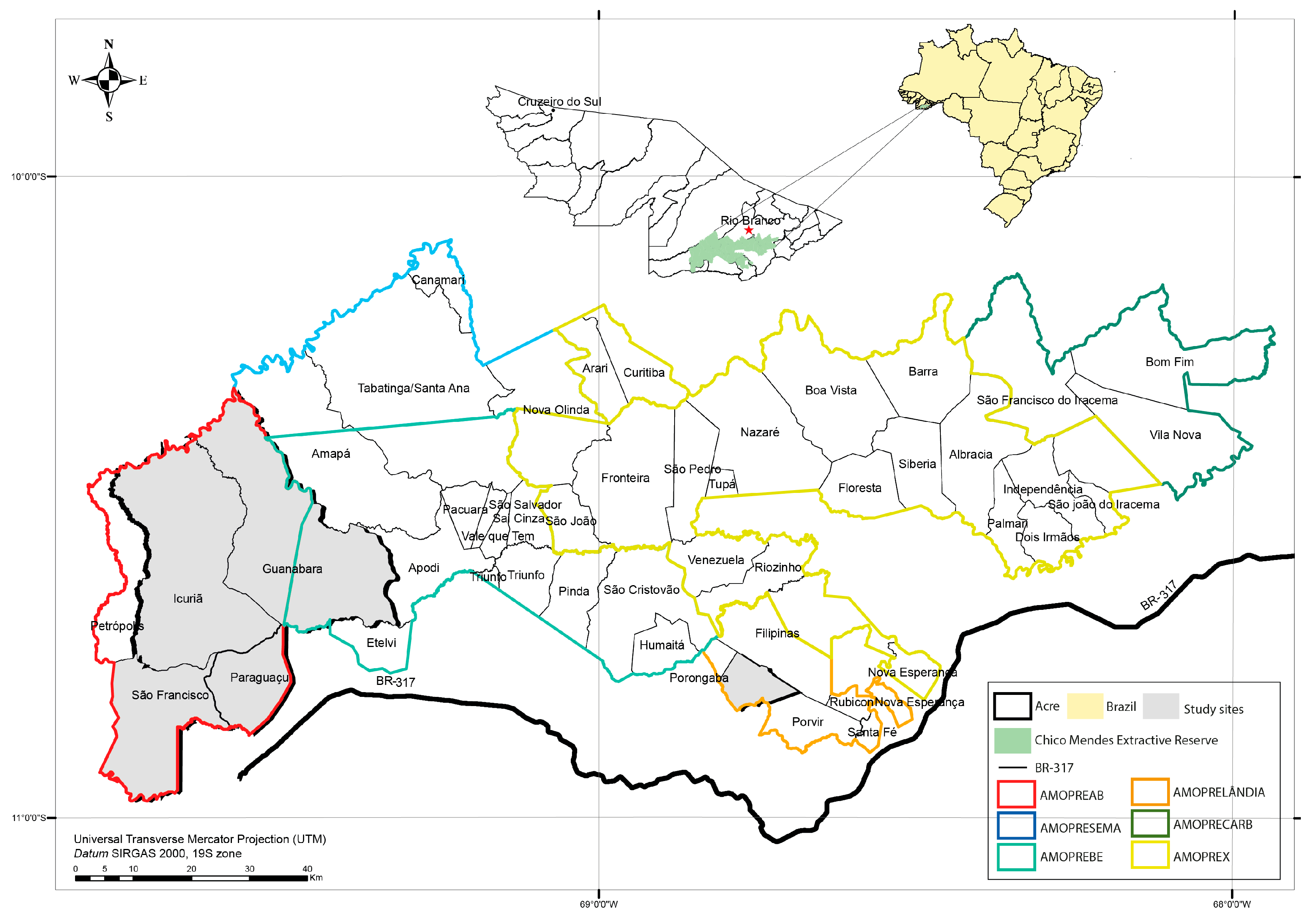
We worked with two of the six concessionaire associations within the CMER: the Associations of Inhabitants of the Extractive Reserve Chico Mendes in Assis Brasil (AMOPREAB) and the Brasileia-Epitaciolândia (AMOPREBE; the sixth concessionaire association, AMOPRELANDIA, was created in May 2023, but at the time of data collection (August–September 2023) was not fully operational in practice). In the AMOPREAB and AMOPREBE regions, our research team was stationed at the headquarters of the associations. The headquarters were situated at one núcleo de base, called Divisão and another núcleo de base, called Porongaba. These two locations were selected for two main reasons. First, the two communities had been engaged in past research projects and the local-level leadership was supportive of ongoing research—thus we had important access for conducting this research on climate literacy. In AMOPREAB, for example, we drew on our strong relationship with the President of the association who granted permission for us to sample in four of the five seringais that compose the association: Icuriã, Guanabara, São Francisco and Paraguaçú (Figure 2; Seringal Petrópolis was not included because there are no núcleo de base there, according to the president of AMOPREAB). Second, there were also logistical considerations for choosing these two sites, which were significant when working with remote Extractive Reserve communities. The communities of Divisão and Porongaba, where the associations of AMOPREAB and AMOPREBE are, respectively, located, were relatively accessible in terms of road infrastructure and also both had limited internet access, which is not common among many extractivist reserve communities.
Figure 2.
Study sites in the Chico Mendes Extractive Reserve, Acre, Brazil.
As such, we worked in a total of five seringais: four within the AMOPREAB concession and one within the AMOPREBE concession. We then had to identify the various additional núcleos de base within each seringal. Despite núcleo de base being considered part of CMER’s governance structure, there was no formal registration of it. This meant the association did not have a formal registration of names of the members of each núcleo de base. Rather, knowledge of the members of each núcleo de base existed solely in the memory of each núcleo de base president. In addition, it was not possible to communicate with all the presidents of all núcleos de base due to the lack of communication (as there was no mobile phone signal or consistent, reliable internet in the region).
Given this research organization challenge, in the case of AMOPREAB we began by listing the names of the núcleo de base that existed in each seringal. With the help of the president of AMOPREAB, we were able to identify a total of 15 núcleos de base. We initially randomly selected at least 50% of the total number of núcleos de base from each seringal to serve as sample sites, resulting in a total of nine sites (Table 1). However, due to logistical challenges such as heavy rain and inaccessible roads, we were only able to visit six of these nine selected núcleos de base (the núcleo de base Mulungu, Centro Feliz and Samaúma had to be excluded from the sampling process). At each núcleo de base (n = 6) we visited, we conducted interviews with the adults from one randomly selected household.
Table 1.
Interviews conducted within the Chico Mendes Extractive Reserve, Acre, Brazil.
In AMOPREBE, we restricted our sampling to the núcleo de base Porongaba (Figure 1), which is located within a seringal with the same name. This decision was made because we had only recently begun working with AMOPREBE and in Porongaba we had established longstanding research projects and partnerships. The President of Porongaba hosted our research party and, as with the other núcleo de base, listed by memory the name of the members of his núcleo de base (n = 28 people). We randomly selected five names from the list to compose our sampling.
In each selected household, we conducted informal conversations and semi-structured interviews. Each adult (defined as >20 yrs) was interviewed separately from the other family members. After being informed about the project goals (i.e., how extractivist populations understand and adapt to climate change) and verbally asking the person if they consented to participate in this study, we initiated a guided conversation. The conversation was developed based on ten semi-structured interview questions, which covered the themes of people’s perceptions of climate change and forms of climate change mitigation and adaptation (Table 2). In total, we interviewed 17 residents in the region of AMOPREAB and 5 residents in AMOPREBE totaling 22 people (seven women and 15 men). All interviews were conducted in person and in Brazilian Portuguese. All interviewees appeared to easily understand the interview questions. Interviews lasted approximately 40 min.
Table 2.
Main topics addressed in semi-structured interviews of CMER residents.
3. Results
The age of the CMER residents interviewed ranged from 20 to 76 years, with a mean of 48 (Coefficient of variation, CV = 29.2%). Most residents had been living in CMER since they were born (65%), while 35% have been living there for, on average, 26.6 years (CV = 40.8%).
3.1. Perceptions of Climate Change
When questioned about the presence of climate change, all 22 interviewees noted that climate change was happening, and highlighted some evidence (Table 3) in the regions where they lived. All 22 interviewees also noted that they understood climate change to be happening everywhere on Earth. However, interviewees diverged in what they believed to be the causes of climate change (Table 3). They also noted that climate change affects their community’s daily life (Table 3).
Table 3.
Perceptions of climate change among community members in the Chico Mendes Extractive Reserve, Acre, Brazil.
3.2. Mitigating Climate Change
Regarding the mitigation of climate change, most interviewees thought it was possible to reduce or avoid climate change (86.4%). However, the interviewees were not sure about how best to do this. Reducing burning (40.9%) and deforestation (36.4%) were most frequently mentioned as mechanisms for mitigating climate change. Other options, such as the reduction in industrial activities and the use of electric cars, were noted but less frequently (22.7%). Nearly a quarter of those surveyed (22.7%) did not know how to mitigate climate change or did not believe it was possible to mitigate climate change.
When asked if educating the population about climate change would be a way to reduce or avoid climate change, most respondents (95.5%) agreed that education could be a strategy for climate change mitigation.
3.3. Adapting to Climate Change on the CMER
Most interviewees did not know how to adapt to climate change (72.7%). We explained the meaning of adaptation in simple terms during the interview, defining it as “solutions or actions that have been adopted by the community to respond to current and future climate change impacts” [40]. However, despite perceiving climate change, as previously noted, only few respondents pointed out actions that they or others had taken specifically to adapt to climate change. These strategies include reforestation (9.1%) and changes in their crop planting period (4.5%). One interviewee also responded that enhancing one’s exposure to sun would be a way to adapt a person to get used to the high temperatures; a response that clearly highlighted the importance of increasing climate literacy within the CMER community.
Two respondents also mentioned that an increase in government investment in the community could be an adaptation measure (9.1%). This statement overlaps with the perception among interviewees that the government (27.3%), whether at the federal or state level, has a responsibility to implement the changes that were necessary for helping communities like those within the CMER adapt to climate change. Most respondents (59.1%) believed that the responsibility for climate adaptation was shared across communities, including those within the CMER, though other respondents (13.6%) were unable to indicate who exactly should make the adaptation changes.
4. Discussion
4.1. Summary of the Results
We interviewed 22 rural extractivists living within the Chico Mendes Extractive Reserve (CMER) in the state of Acre, Brazil. These interviewees all lived within seringais within the Amazon forest and were heavily dependent upon the forest for subsistence and income generation. Interviewees expressed a strong perception of climate change as affecting their daily livelihoods and an understanding of climate change as a global phenomenon. Respondents reported mixed impressions about whether or how climate change could be mitigated. And these interviewees expressed a limited understanding of whether and how they could adapt to climate change.
4.2. Perceptions of Climate Change
Our study adds to a large and growing literature on the perceptions of climate change by farmers, smallholders, and forest extractivists (e.g., [41,42,43]). Our finding that the majority of the forest extractivists that we interviewed were cognizant of climate change is consistent with previous work that Amazonian communities often perceive changes in annual climate cycles and changes in rainfall patterns [44].
4.3. Mitigating Climate Change
Mitigation of climate change can be difficult in areas highly threatened by deforestation. Community members were correct when they pointed out that reducing both deforestation and the use of fire are effective ways to curb climate change. However, smallholders (<100 ha) are responsible for a small fraction of all deforestation in the Brazilian Amazon [45]. Further, under current conditions, extractivists may not be able to thrive without deforesting. Rubber and Brazil nuts vary in their productive capacity and, over the past decade, have not consistently guaranteed an income to CMER communities. This is primarily due to two factors: (i) the prices of these forest products are not determined by markets that adhere to the same logic applied for standard, non-forest-based products; and (ii) the desire for goods such as home appliances, motorcycles and mobile phones has increased over time among community members, initially due to access to television and more recently due to the internet (a broader perspective on this is available at [46]). The consequence has been an increase in deforested areas within the CMER. For example, from 2005 to 2015 pasture areas increased 123% in the CMER, with cattle production being the alternative chosen by communities to diversify their livelihoods [26]. The high opportunity costs of keeping standing forests can make it difficult to compete with pasture-raised cattle, which offer higher monetary benefits and liquidity to community members [47]. In this case, providing alternative income sources, such as Payment for Environmental Services programs and fostering bioeconomy strategies may help to provide financial benefits that can equal or exceed the forest conservation opportunity costs [48,49].
Climate Literacy
Education has been cited as a mechanism for fostering climate literacy, which is important for enhancing climate adaptation efforts [50]. Nonetheless, education alone may not be enough to drive climate action if there are no livelihood and adaptation measures in place. The fear of losing income without alternatives can discourage local communities’ participation in initiatives to reduce deforestation [51], as a climate change mitigation action. Therefore, considering social costs in strategies to curb deforestation, instead of focusing only on end targets, may be helpful for motivating climate action [52].
4.4. Adapting to Climate Change
Previous research has found that for many Amazonian small farmers, memory of prior climate events can fade over time, which may inhibit adaptation responses [53]. In other places, forest-dependent people have adopted adaptative behaviors. For example, in the Medio Jurua region of Amazonas (Acre’s neighboring state), agro-extractivists have adapted their crop planting schedule and have established agricultural plots on higher ground in response to changes in seasonal flood events [54].
Interviewees in our study held a range of views about whether the responsibility for climate adaptation fell with them and their communities, or with governments. Governments can play an important role in recognizing and scaling climate adaptation initiatives developed on the ground by local communities [40]. At the same time, local communities can be valuable partners in developing appropriate adaptive responses to climate change [55].
4.5. Limitations
Our study was subject to several limitations, which should be considered when interpreting our findings. First, our sample size (n = 22 interviews) was modest. Resources and access were limiting factors. We believe our data reveal valuable insights, but nonetheless a larger, more comprehensive data-collection effort in the future could usefully extend our initial findings. Second, the spatial distribution of our study was limited. The CMER is very large and many parts of it are very remote. Nonetheless, we were only able to sample two of the six associations within the CMER. The CMER itself also represents a particular context, relatively close to Acre’s capital city of Rio Branco, while Acre represents a particular context within the Brazilian Amazonia. Future research could extend our methodology across the CMER and into other parts of the Brazilian Amazon. Finally, we could have adopted a methodology that would have enabled us to quantify our data or to understand finer nuances in climate literacy. For example, using Likert scale responses to evaluate perceptions of climate change might have revealed interesting patterns.
5. Conclusions and Future Recommendations
Our case study sheds light on a situation that may be common in sustainable use tropical forest areas well beyond the CMER and other Extractive Reserves: local communities are experiencing the impacts of climate change and facing pressure to replace deforestation with forest restoration and sustainable production based on standing forests, but may lack a proper understanding of why climate change impacts are occurring. Highly vulnerable to climate change, these forest communities may lack climate literacy, or a well-versed understanding of why climate change is happening.
Climate illiteracy can hinder a community’s ability to engage in discussions and advocacy at various levels—from local to international—regarding what is happening to them as well as to access opportunities for climate mitigation and adaptation. In this way, climate illiteracy can prevent climate action. One of the first steps in working toward climate action is to diagnose whether and at what level climate literacy exists. Our study took a people-centered approach by using interviews to conduct a rapid assessment of climate literacy among communities in the CMER. Our results showed that communities in the CMER are experiencing climate change but are unsure about its causes and forms of mitigation and are largely unaware of ways to adapt to it.
Based on these findings, we suggest that climate education may be an important form of intervention in this region, reinforced by tangible actions toward climate change mitigation and adaptation. These actions may be more effective and durable if they are co-created with and for local communities. One example of nurturing this sustainable mindset is a nascent platform called Eco-conexão (https://www.instagram.com/eco_conexao/), which arose out of the results of this study. Eco-conexão uses social media, content on climate change, and other environmental topics that are explicitly generated for extractivist communities. Citizen science could also be a path to empower communities to take charge of their own environmental futures. Developing projects that involve local communities as protagonists, both in the inception as well as in the implementation, that work to promote climate literacy and, in turn, climate action, may also be a way to actively involve communities in finding solutions for their territories. In this way, climate literacy and climate action among forest-dependent extractivist communities in the Brazilian Amazon could help to make incremental progress towards several of the UN’s Sustainable Development Goals, including SDG 13 Climate Action and SDG 15 Life On Land.
Author Contributions
Conceptualization, S.C.R., P.N. and C.M.S.L.; methodology, S.C.R.; investigation, S.C.R.; formal analysis, S.C.R.; writing—original draft preparation, S.C.R. and C.M.S.L.; writing—review and editing, S.C.R., P.N. and C.M.S.L.; funding acquisition, S.C.R. All authors have read and agreed to the published version of the manuscript.
Funding
S.C.R. acknowledges the Fulbright Amazonia Program for providing financial support for this study. The Fulbright Amazonia Program is sponsored by the U.S. Department of State, Bureau of Educational and Cultural Affairs, with funding provided by the U.S. Government and the Fulbright Commission in Brazil, with the additional support of other binational Fulbright Commissions and U.S. Embassies in the Amazon region. The opinions expressed in this study are the responsibility of the authors and do not necessarily represent the official views of the Fulbright Program, the Government of the United States, or Fulbright Commission in Brazil. The Environment and Society Group at University of Colorado’s Institute of Behavioral Science also provided support for S.C.R. to further develop this paper by sponsoring her Fulbright Amazonia Program.
Data Availability Statement
Data are contained within the article.
Acknowledgments
We acknowledge the Associação dos Moradores e Produtores da Reserva Extrativista Chico Mendes in the regions of Assis Brasil, Brasileia and Epitaciolândia, in particular Wendel Araújo and Francisco Melo. We also thanks Larisse Cruz, co-creator of Eco-conexão, for preparing the map presented in this study.
Conflicts of Interest
The authors declare no conflicts of interest. The funders had no role in the design of the study; in the collection, analyses, or interpretation of data; in the writing of the manuscript; or in the decision to publish the results.
Abbreviations
The following abbreviations are used in this manuscript:
| CMER | Chico Mendes Extractive Reserve |
| ICMBio | Chico Mendes Institute for Biodiversity Conservation |
| AMOPREAB | Associations of Inhabitants of the Extractive Reserve Chico Mendes in Assis Brasil |
| AMOPREBE | Associations of Inhabitants of the Extractive Reserve Chico Mendes in Brasiléia and Epitaciolândia |
References
- IPCC. Summary for Policymakers. In Climate Change 2023: Synthesis Report. Contribution of Working Groups I, II and III to the Sixth Assessment Report of the Intergovernmental Panel on Climate Change; Lee, H., Romero, J., Eds.; IPCC: Geneva, Switzerland, 2023; pp. 1–34. [Google Scholar] [CrossRef] [Scilit]
- Mataveli, G.; Jones, M.W.; Carmenta, R.; Sanchez, A.; Dutra, D.J.; Chaves, M.; de Oliveira, G.; Anderson, L.O.; Aragao, L. Deforestation falls but rise of wildfires continues degrading Brazilian Amazon forests. Glob. Change Biol. 2024, 30, e17202. [Google Scholar] [CrossRef] [Scilit]
- Boer, M.M.; Resco de Dios, V.; Bradstock, R.A. Unprecedented burn area of Australian mega forest fires. Nat. Clim. Change 2020, 10, 171–172. [Google Scholar] [CrossRef] [Scilit]
- Espinoza, J.C.; Jimenez, J.C.; Marengo, J.A.; Schongart, J.; Ronchail, J.; Lavado-Casimiro, W.; Ribeiro, J.V.M. The new record of drought and warmth in the Amazon in 2023 related to regional and global climatic features. Sci. Rep. 2024, 14, 8107. [Google Scholar] [CrossRef] [Scilit]
- Toreti, A.; Bavera, D.; Acosta Navarro, J.; Acquafresca, L.; Barbosa, P.; De, J.A.; Ficchì, A.; Fioravanti, G.; Grimaldi, S.; Hrast, E.A.; et al. Drought in Europe, April 2025; Publications Office of the European Union: Luxembourg, 2025; p. JRC142141. Available online: https://data.europa.eu/doi/10.2760/7964287 (accessed on 7 July 2025).
- Espinoza, J.C.; Marengo, J.A.; Jimenez, J.C. The new historical flood of 2021 in the Amazon River compared to major floods of the 21st century: Atmospheric features in the context of the intensification of floods. Weather Clim. Extrem. 2022, 35, 100406. [Google Scholar] [CrossRef] [Scilit]
- Chu, L.; Warren, J.L.; Spatz, E.S.; Lowe, S.; Lu, Y.; Ma, X.; Ross, J.S.; Krumholz, H.M.; Chen, K. Floods and cause-specific mortality in the United States applying a triply robust approach. Nat. Commun. 2025, 16, 2853. [Google Scholar] [CrossRef] [Scilit]
- Elsner, M.; Atkinson, G.; Zahidi, S. Global Risks Report 2025. World Economic Forum. 2025. Available online: https://reports.weforum.org/docs/WEF_Global_Risks_Report_2025.pdf (accessed on 10 August 2025).
- Martinez, A.S.; Christofoletti, R.A. 2024: O Ano Mais Quente da História. Série Brasil em Transformação: O Impacto da Crise Climática. Caderno Técnico I. Available online: https://maredeciencia.eco.br/wp-content/uploads/2024/12/Brasil-em-transformacao-1-2024-o-ano-mais-quente-da-historia.pdf (accessed on 1 April 2025).
- IBGE. Síntese de Indicadores Sociais: Uma Análise das Condições de Vida da População Brasileira; IBGE: Rio de Janeiro, Brazil, 2024. Available online: https://biblioteca.ibge.gov.br/visualizacao/livros/liv102144.pdf (accessed on 3 July 2025).
- Freitas, C.E.C.; Kahn, J.R.; Rivas, A.A.F. Indigenous people and sustainable development in Amazonas. Int. J. Sustain. Dev. World Ecol. 2004, 11, 312–325. [Google Scholar] [CrossRef] [Scilit]
- Gozales, J. Green Alert: How Indigenous People Are Experiencing Climate Change in the Amazon. Available online: https://news.mongabay.com/2020/05/green-alert-how-indigenous-have-been-experiencing-climate-change-in-the-amazon/ (accessed on 27 May 2020).
- Silva, S.S.; Brown, F.; Sampaio, A.O.; Silva, A.L.C.; dos Santos, N.C.R.S.; Lima, A.C.; de Souza Aquino, A.M.; da Costa Silva, P.H.; do Vale Moreira, J.G.; Oliveira, I.; et al. Amazon climate extremes: Increasing droughts and floods in Brazil’s state of Acre. Perspect. Ecol. Conserv. 2023, 21, 311–317. [Google Scholar] [CrossRef] [Scilit]
- Lima, L.S.; Silva, F.E.O.; Anastácio, P.R.D.; Kolanski, M.M.d.P.; Pereira, A.C.P.; Menezes, M.S.R.; Cunha, E.L.T.P.; Macedo, M.N. Severe droughts reduce river navigability and isolate communities in the Brazilian Amazon. Commun. Earth Environ. 2024, 5, 370. [Google Scholar] [CrossRef] [Scilit]
- Estevo, M.O.; Junqueira, A.B.; Reyes-García, V.; Campos-Silva, J.V. Understanding multidirectional climate change impacts on local livelihoods through the lens of local ecological knowledge: A study in western Amazonia. Soc. Nat. Resour. 2023, 36, 232–249. [Google Scholar] [CrossRef] [Scilit]
- Anjos, L.J.S.; Gonçalves, G.S.R.; Dutra, V.A.B.; Rosa, A.G.; Santos, L.B.; Barros, M.N.R.; de Souza, E.B.; de Toledo, P.M. Brazil nut journey under future climate change in Amazon. PLoS ONE 2024, 19, e0312308. [Google Scholar] [CrossRef] [Scilit]
- Nery, I.R.A.M.; Vergilio, P.C.B.; Viégas, L.B.; da Silva, M.R.; Resende, R.T.; Chagas, M.P.; Pace, M.R.; Marcati, C.R. Water availability influences both wood anatomy and laticifer density in rubber tree saplings. Flora 2023, 304, 152301. [Google Scholar] [CrossRef] [Scilit]
- Giambruno, C.; Cardozo, J.C.H.; Cossi, J.; Gonsalves, M.B.; Alfaro, M.P. Education in the Amazon Region. 2024. Available online: https://publications.iadb.org/en/education-amazon-region (accessed on 5 April 2025).
- Goldwert, D.; Patel, Y.; Nielsen, K.S.; Goldberg, M.H.; Vlasceanu, M. Climate action literacy interventions increase commitments to more effective mitigation behaviors. PNAS Nexus 2025, 4, 191. [Google Scholar] [CrossRef] [Scilit]
- Kolenatý, M.; Kroufek, R.; Činčera, J. What triggers climate action: The impact of a climate change education program on students’ climate literacy and their willingness to act. Sustainability 2022, 14, 10365. [Google Scholar] [CrossRef] [Scilit]
- IBGE. Cidades e Estados. Acre. 2025. Available online: https://www.ibge.gov.br/cidades-e-estados/ac.html (accessed on 7 September 2025).
- Monteiro, H. ‘O Acre Existe?’ g1 Explica Surgimento de Piada Sobre a Existência do Estado. Available online: https://g1.globo.com/ac/acre/noticia/2024/06/23/o-acre-existe-g1-explica-surgimento-de-piada-sobre-a-existencia-do-estado.ghtml (accessed on 4 June 2025).
- Muniz, T. Enchente Atinge Mais de 120 Mil Pessoas no Acre e Já é Considerada, Proporcionalmente, o Maior Desastre Ambiental do Estado. Agência de Notícias do Acre, 5 March 2024. Available online: https://agencia.ac.gov.br/enchente-atinge-mais-de-120-mil-pessoas-no-acre-e-ja-e-considerada-proporcionalmente-o-maior-desastre-ambiental-do-estado/ (accessed on 27 September 2025).
- Nascimento, A. Seca Histórica: Rio Acre Chega a 1,23 Metro e Seca de 2024 se Torna a Maior em Mais de Meio Século na Capital. G1 AC, 21 September 2024. Available online: https://g1.globo.com/ac/acre/noticia/2024/09/21/seca-historica-rio-acre-chega-a-123-metro-e-seca-de-2024-se-torna-a-maior-em-mais-de-meio-de-seculo-no-estado.ghtml (accessed on 29 May 2025).
- Menezes, R. Acre Decreta Emergência por Conta da Seca dos Rios e Falta de Chuvas. G1 AC, 7 August 2025. Available online: https://g1.globo.com/ac/acre/noticia/2025/08/07/acre-decreta-emergencia-por-conta-da-seca-dos-rios-e-falta-de-chuvas.ghtml (accessed on 27 September 2025).
- Maciel, R.C.G.; Cavalcanti, F.C.S.; Souza, E.F.; de Oliveira, O.F.; Filho, P.G.C. The “Chico Mendes” extractive reserve and land governance in the Amazon: Some lessons from the two last decades. J. Environ. Manag. 2018, 223, 403–408. [Google Scholar] [CrossRef] [Scilit]
- Hoelle, J. Caubóis da Floresta: O Crescimento da Pecuária e a Cultura de Gado na Amazônia Brasileira; Edufac: Rio Branco, Brazil, 2021; p. 242. [Google Scholar]
- Wallace, R.H.; Gomes, C.V.A.; Cooper, N.A. The Chico Mendes Extractive Reserve: Trajectories of agro-extractive development in Amazonia. Desenvolv. Meio Ambiente 2018, 48, 184–213. [Google Scholar] [CrossRef] [Scilit]
- Bakx, K. From proletarian to peasant: Rural transformation in the state of Acre, 1870–1986. J. Dev. Stud. 1988, 24, 141–160. [Google Scholar] [CrossRef] [Scilit]
- Pacheco, L.M.; Gomes, C.V.A. The trajectory of Amazonia forest extractivists social movement: Shifting political struggles, strategies, demands and achievements. Ambiente Soc. 2023, 26, e0048. [Google Scholar]
- Allegretti, M.H. Extractive Reserves: An alternative for reconciling development and environmental conservation in Amazonia. In Alternatives to Deforestation: Steps Toward Sustainable Use of the Amazon Rain Forest; Anderson, A.B., Ed.; Columbia University Press: New York, NY, USA, 1990; pp. 253–264. [Google Scholar]
- Brasil. Lei n◦ 12.892, de 13 de Dezembro de 2013. Declara o Ambientalista Chico Mendes Patrono do Meio Ambiente Brasileiro. Available online: https://www.planalto.gov.br/ccivil_03/_ato2011-2014/2013/lei/l12892.htm (accessed on 9 July 2025).
- Fearnside, P.M. Extractive Reserves in Brazilian Amazonia: An opportunity to maintain tropical rain forest under sustainable use. BioScience 1989, 39, 387–393. [Google Scholar] [CrossRef] [Scilit]
- Schwartzman, S. Extractive Reserves: The rubber tappers’ strategy for sustainable use of the Amazon rain forest. In Fragile Lands in Latin America: Strategies for Sustainable Development; Browder, J.O., Ed.; Westview Press: Boulder, CO, USA, 1989; pp. 150–165. [Google Scholar]
- Euler, A.M.C.; Silva, J.E.C.; Almeida, H.S. Reservas Extrativistas. In Espaços Especialmente Protegidos e o Direito Ambiental; Crestana, S., Castellano, E.G., Rossi, A., Eds.; Embrapa: Brasília, Brazil, 2021; pp. 756–770. [Google Scholar]
- Kröger, M. Deforestation, cattle capitalism and neodevelopmentalism in the Chico Mendes Extractive Reserve, Brazil. J. Peasant. Stud. 2019, 47, 464–482. [Google Scholar] [CrossRef] [Scilit]
- Evangelista-Vale, J.C.; Weihs, M.; José-Silva, L.; Arruda, R.; Sander, N.L.; Gomides, S.C.; Machado, T.M.; Pires-Oliveira, J.C.; Barros-Rosa, L.; Castuera-Oliveira, L.; et al. Climate change may affect the future of extractivism in the Brazilian Amazon. Biol. Conserv. 2021, 257, 109093. [Google Scholar] [CrossRef] [Scilit]
- Acre. Plano de Manejo—Reserva Extrativista Chico Mendes. 2006. Available online: https://www.gov.br/icmbio/pt-br/assuntos/biodiversidade/unidade-de-conservacao/unidades-de-biomas/amazonia/lista-de-ucs/resex-chico-mendes/arquivos/plano_de_manejo_reserva_extrativista_chico_mendes.pdf (accessed on 8 June 2025).
- WWF. Guia Informativo da Gestão Participativa na Reserva Extrativista Chico Mendes. Acre: WWF, 2015. 44p. Available online: https://wwfbrnew.awsassets.panda.org/downloads/guia_resex_chicomendes.pdf (accessed on 10 September 2025).
- UNFCCC. Introduction to Adaptation and Resilience/Loss and Damage. 2024. Available online: https://unfccc.int/topics/adaptation-and-resilience/the-big-picture/introduction (accessed on 11 July 2024).
- Madhuri; Sharma, U. How do farmers perceive climate change? A systematic review. Clim. Change 2020, 162, 991–1010. [Google Scholar] [CrossRef] [Scilit]
- Troncarelli, L.T.; de Ataide, M.T.; Morsello, C. Existing evidence of conceptual differences in research on climate change perceptions among smallholders? A systematic map. Environ. Evid. 2023, 12, 28. [Google Scholar] [CrossRef] [Scilit]
- Bauer, T.N.; De Jong, W.; Ingram, V. Perception matters: An Indigenous perspective on climate change and its effects on forest-based livelihoods in the Amazon. Ecol. Soc. 2022, 27, 17. [Google Scholar] [CrossRef] [Scilit]
- Funatsu, B.M.; Dubreuil, V.; Racapé, A.; Debortoli, N.S.; Nasuti, S.; Le Tourneau, F.-M. Perceptions of climate and climate change by Amazonian communities. Glob. Environ. Change 2019, 57, 101923. [Google Scholar] [CrossRef] [Scilit]
- Godar, J.; Gardner, T.A.; Tizado, E.J.; Pacheco, P. Actor-specific contributions to the deforestation slowdown in the Brazilian Amazon. Proc. Natl. Acad. Sci. USA 2014, 111, 15591–15596. [Google Scholar] [CrossRef] [Scilit]
- Maciel, R.C.G.; Mangabeira, J.A.C.; Lima, L.F.; Romeiro, A.R.; de Oliveira, O.F.; Silva, V.F.; Filho, F.N.; Thomazi, G. Valuation and payment for socio-environmental services in the Chico Mendes Extractive Reserve, Amazon, Brazil. J. Environ. Prot. 2024, 15, 1087–1106. [Google Scholar] [CrossRef]
- Maciel, M.D.A.; Maciel, R.C.G.; Lima, L.F.; Mangabeira, J.A.d.C.; Romeiro, A.R.; Oliveira, O.F. From rural family production to climate mitigation: An ecological-economic approach to measuring CO2 emissions in the Chico Mendes Extractive Reserve. J. Environ. Prot. 2025, 16, 292–314. [Google Scholar] [CrossRef]
- Dutra, D.J.; Silveira, M.V.S.; Mataveli, G.; Ferro, P.D.; Magalhães, D.S.; Medeiros, T.P.; Anderson, L.O.; Aragão, L.E.O.C. Challenges for reducing carbon emissions from Land-Use and Land Cover Change in Brazil. Perspect. Ecol. Conserv. 2024, 22, 213–218. [Google Scholar] [CrossRef] [Scilit]
- Wunder, S.; Börner, J.; Ezzine-de-Blas, D.; Feder, S.; Pagiola, S. Payments for Environmental Services: Past Performance and Pending Potentials. Annu. Rev. Resour. Econ. 2020, 12, 209–234. [Google Scholar] [CrossRef] [Scilit]
- GCA—Global Center on Adaptation and Climate and Development Knowledge Network. State and Trends in Adaptation Reports 2021 and 2022: Executive Summaries and Syntheses. 2022. Available online: https://gca.org/wp-content/uploads/2023/01/GCA_State-and-Trends-in-Adaptation-2022_Front-Matter.pdf (accessed on 3 April 2025).
- Gebara, M.F.; Sills, E.; May, P.; Forsyth, T. Deconstructing the policyscape for reducing deforestation in the Eastern Amazon: Practical insights for a landscape approach. Environ. Policy Gov. 2019, 29, 185–197. [Google Scholar] [CrossRef] [Scilit]
- McDermott, C.L.; Montana, J.; Bennett, A.; Gueiros, C.; Hamilton, R.; Hirons, M.; Maguire-Rajpaul, V.A.; Parry, E.; Picot, L. Transforming land use governance: Global targets without equity miss the mark. Environ. Policy Gov. 2022, 33, 245–257. [Google Scholar] [CrossRef] [Scilit]
- Brondizio, E.S.; Moran, E.F. Human dimensions of climate change: The vulnerability of small farmers in the Amazon. Phil. Trans. R. Soc. B Biol. Sci. 2008, 363, 1803–1809. [Google Scholar] [CrossRef] [Scilit] [PubMed]
- de Vasconcelos, M.A.; Veiga, J.A.P.; Silva, J.L.G.; Guimarães, D.F.; Brito, A.L.; dos Santos, Y.L.F.; Lopes, M.; Lima, A.L.; de Oliveira, E.T. Climate change and its impact on the agricultural calendar of riverine farmers in Médio Juruá, Amazonas State, Brazil. Atmosphere 2022, 13, 2018. [Google Scholar] [CrossRef] [Scilit]
- GCA—Global Center on Adaptation and Climate and Development Knowledge Network. 2024 Stories of Resilience: Lessons from Local Adaptation Practice. Available online: https://gca.org/reports/2024-stories-of-resilience-lessons-from-local-adaptation-practice/ (accessed on 2 February 2025).



Disclaimer/Publisher’s Note: The statements, opinions and data contained in all publications are solely those of the individual author(s) and contributor(s) and not of MDPI and/or the editor(s). MDPI and/or the editor(s) disclaim responsibility for any injury to people or property resulting from any ideas, methods, instructions or products referred to in the content. |
© 2026 by the authors. Licensee MDPI, Basel, Switzerland. This article is an open access article distributed under the terms and conditions of the Creative Commons Attribution (CC BY) license.