

Climate-Related Extreme Weather and Urban Mental Health: A Traditional and Bayesian Meta-Analysis


Abstract
1. Introduction
2. Materials and Methods
2.1. PECO
2.2. Search Strategies
2.3. Study Selection
2.4. Outcome Measures
2.5. Data Extraction and Quality Assessment
2.6. Bayesian Meta-Analytic Model
2.7. Statistical Analysis
2.8. Ethical Considerations
3. Results
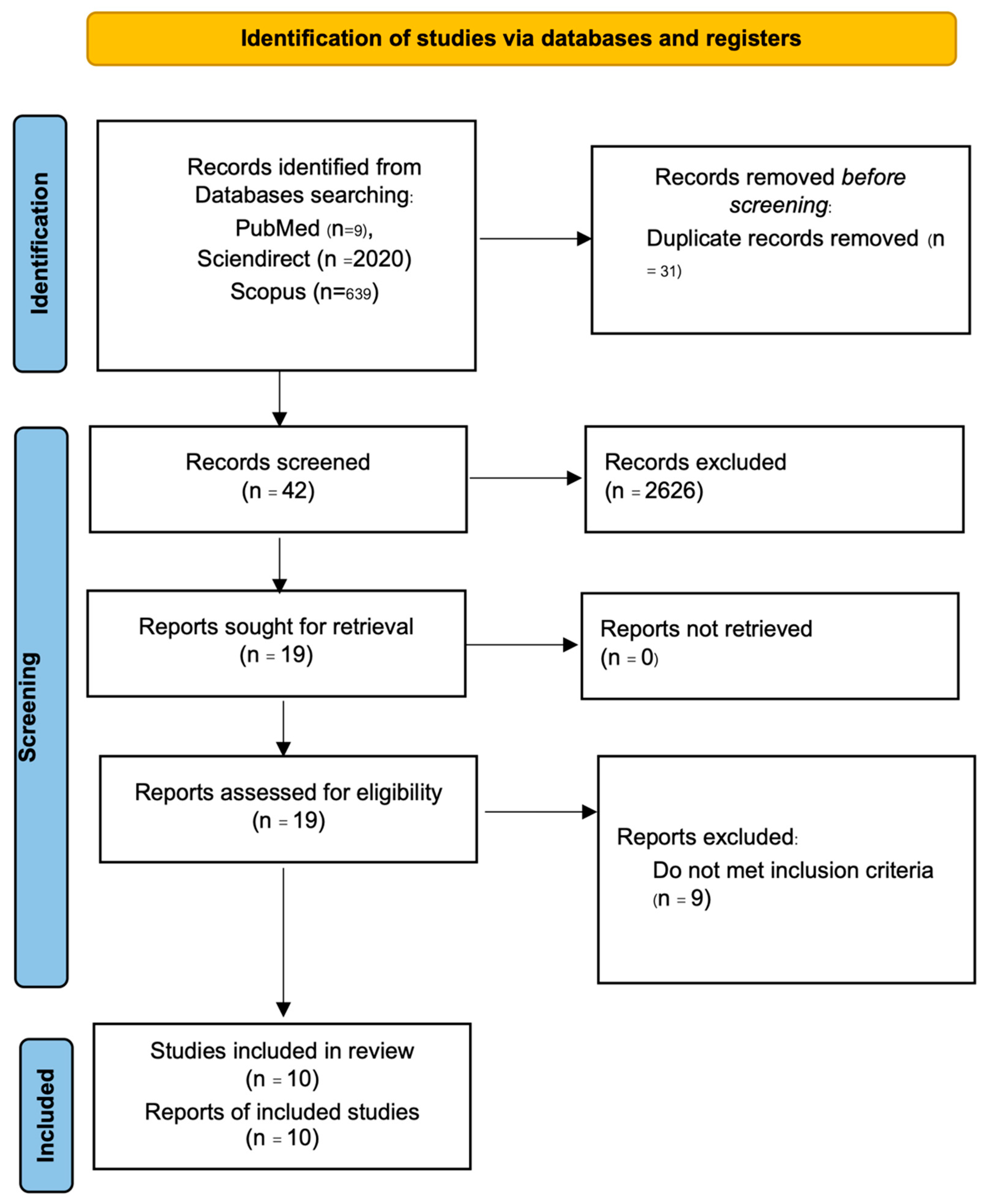
3.1. Study Selection and Characteristics
3.2. Climate Change Impact and Mental Health Assessment
3.3. Quality Assessment
3.4. Meta-Analysis Results
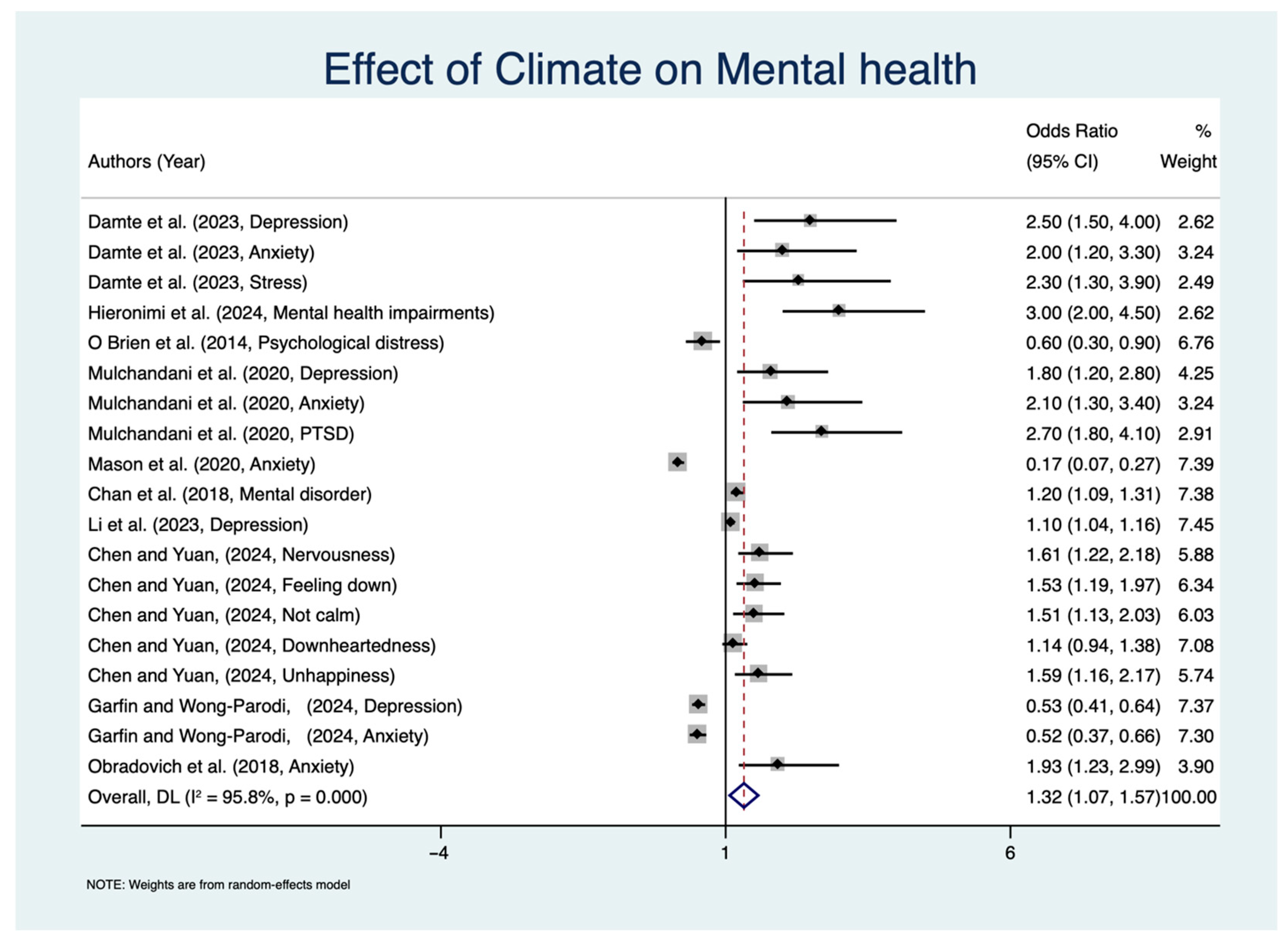
3.4.1. Impact of Climate Change on Mental Health
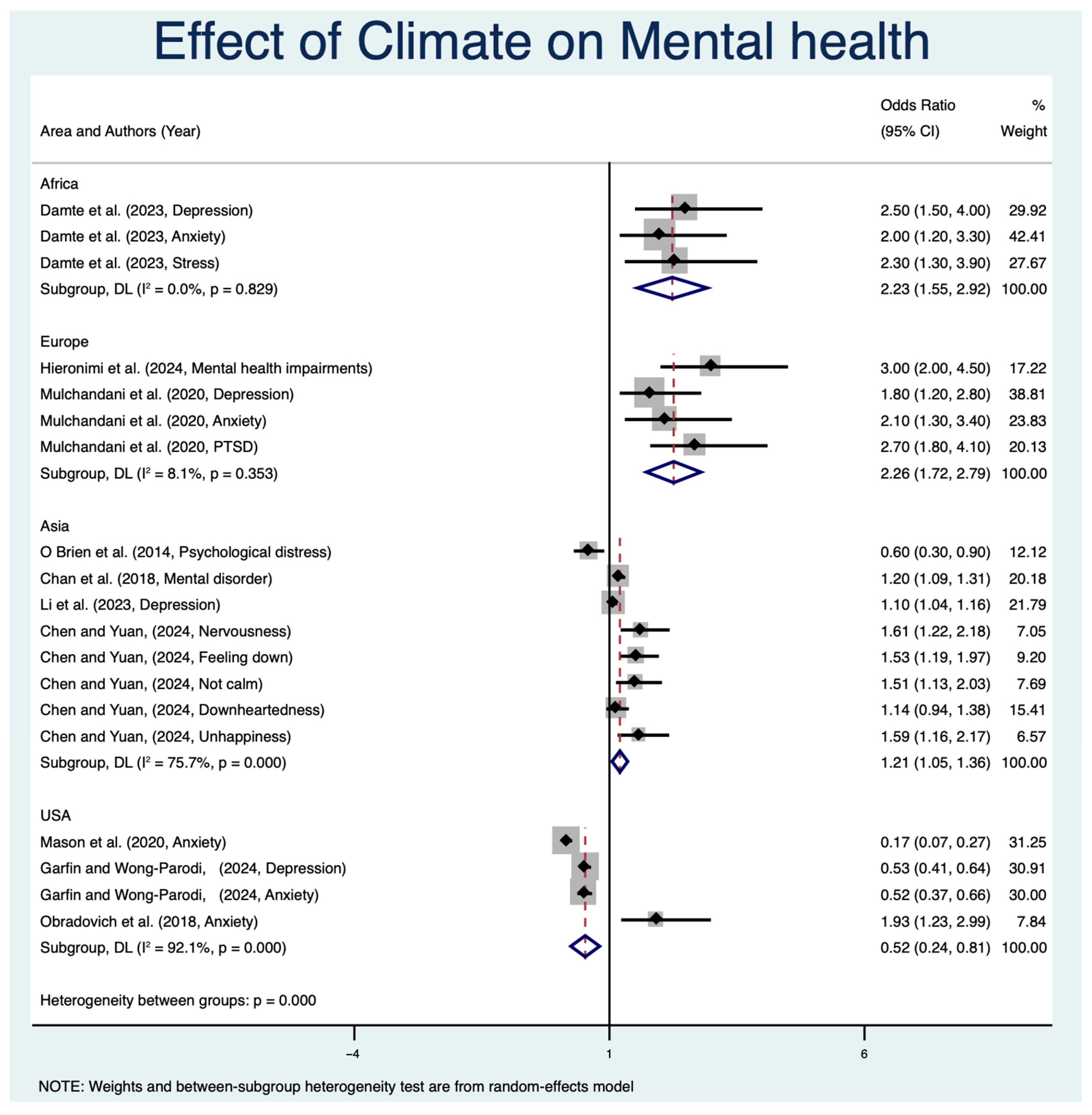
3.4.2. Subgroup Analysis
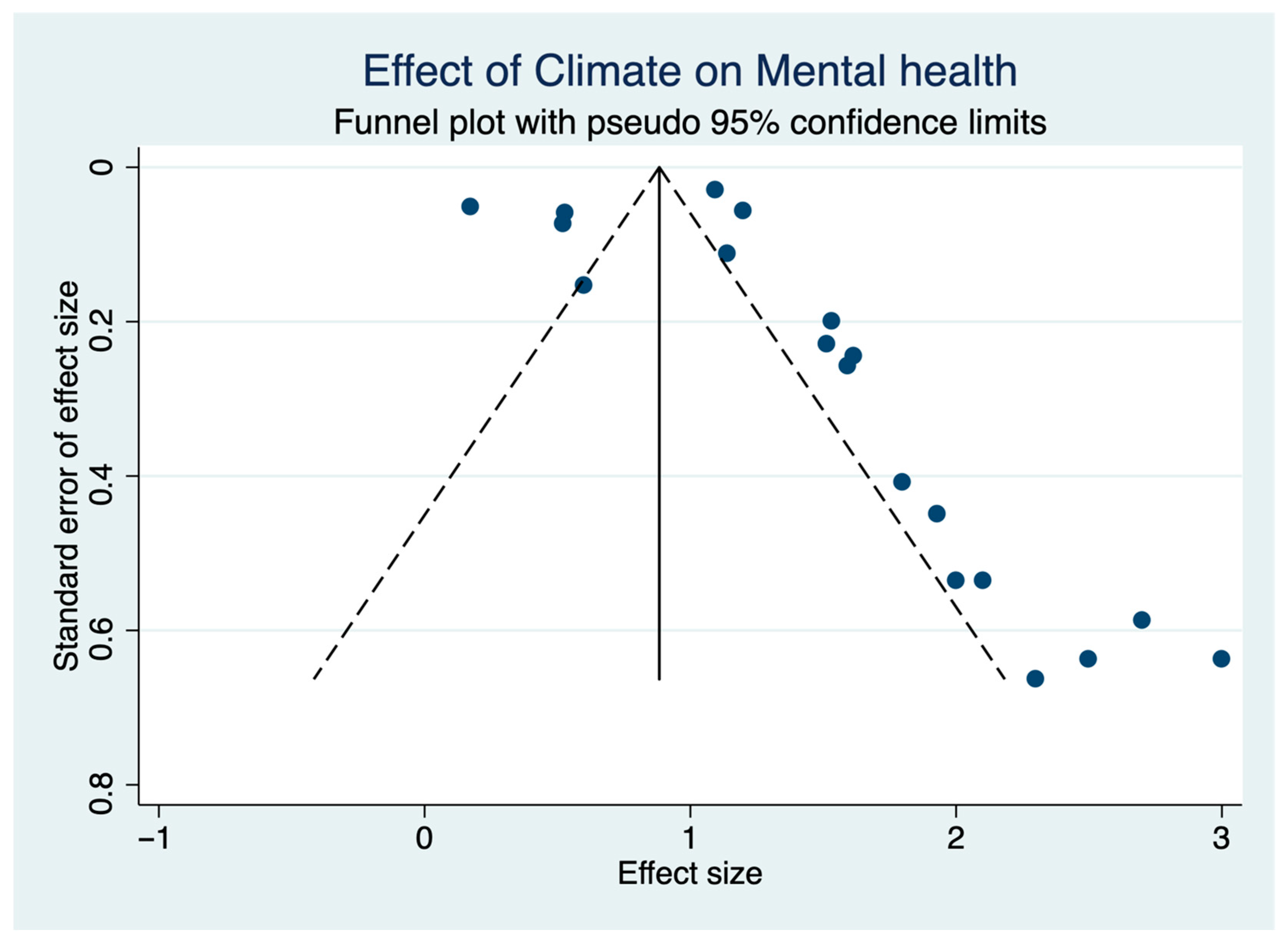
3.4.3. Meta-Regression, Sensitivity, and Bias Assessment
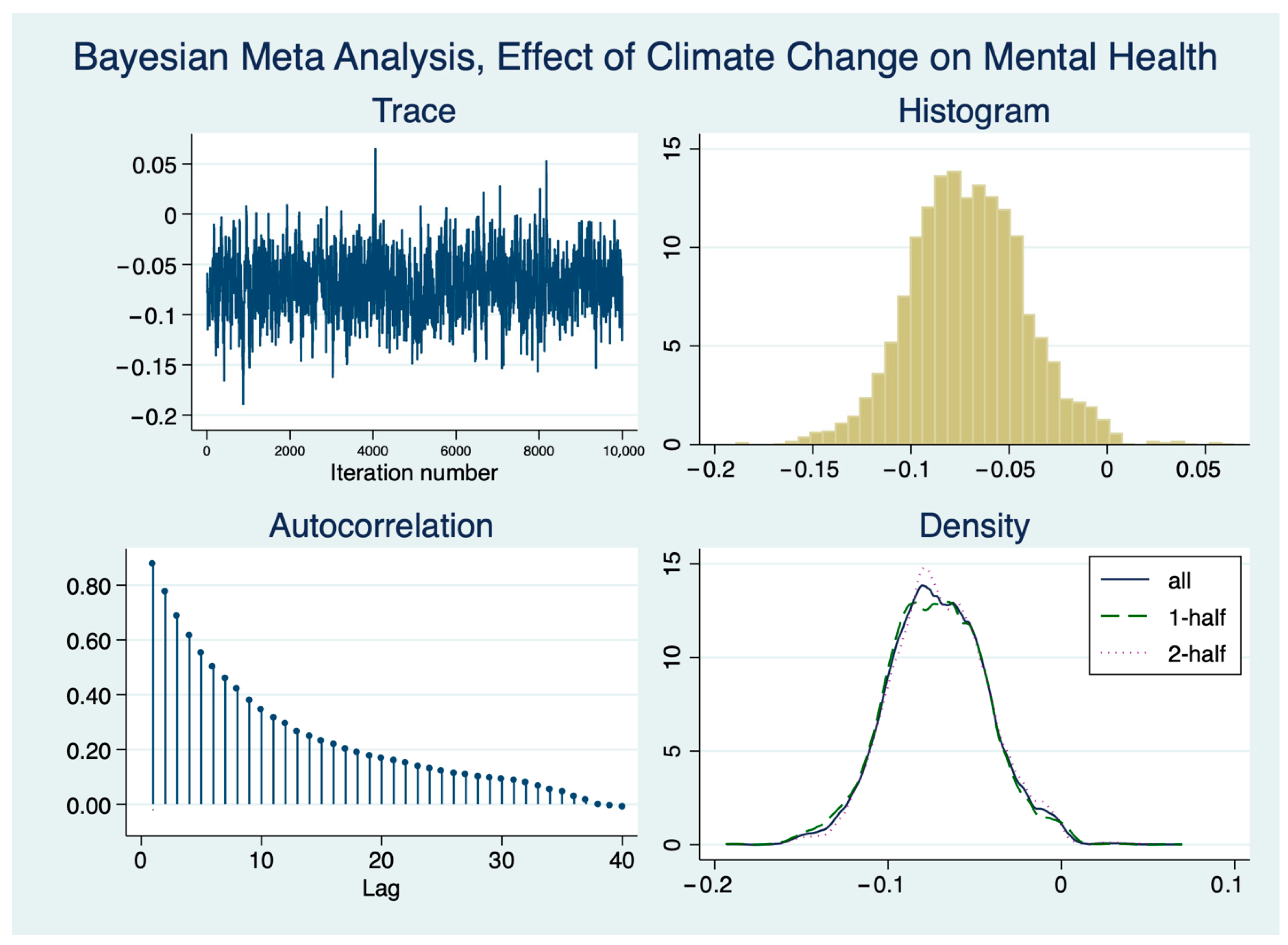
3.4.4. Bayesian-Meta Analysis
3.4.5. Narrative Synthesis of the Selected Studies
4. Discussion
5. Conclusions
Author Contributions
Funding
Data Availability Statement
Acknowledgments
Conflicts of Interest
References
- Amnuaylojaroen, T.; Parasin, N. A Machine Learning Perspective on the Climatic and Socioeconomic Determinants of Mental Health in Southeast Asia. World 2025, 6, 48. [Google Scholar] [CrossRef]
- Amnuaylojaroen, T. Perspective on the Era of Global Boiling: A Future beyond Global Warming. Adv. Meteorol. 2023, 2023, 5580606. [Google Scholar] [CrossRef]
- Amnuaylojaroen, T.; Parasin, N.; Limsakul, A. Projections and Patterns of Heat-Related Mortality Impacts from Climate Change in Southeast Asia. Environ. Res. Commun. 2024, 6, 035019. [Google Scholar] [CrossRef]
- Berry, H.L.; Waite, T.D.; Dear, K.B.; Capon, A.G.; Murray, V. The Case for Systems Thinking about Climate Change and Mental Health. Nat. Clim. Change 2018, 8, 282–290. [Google Scholar] [CrossRef]
- Palinkas, L.A.; Wong, M. Global Climate Change and Mental Health. Curr. Opin. Psychol. 2020, 32, 12–16. [Google Scholar] [CrossRef] [PubMed]
- Amnuaylojaroen, T. Projection of the Precipitation Extremes in Thailand under Climate Change Scenario RCP8.5. Front. Environ. Sci. 2021, 9, 657810. [Google Scholar] [CrossRef]
- IPCC. Climate Change 2022: Impacts, Adaptation and Vulnerability; Contribution of Working Group II to the Sixth Assessment Report of the Intergovernmental Panel on Climate Change; Pörtner, H.-O., Roberts, D.C., Tignor, M., et al., Eds.; Cambridge University Press: Cambridge, UK; New York, NY, USA, 2022. [Google Scholar]
- Hayes, K.; Blashki, G.; Wiseman, J.; Burke, S.; Reifels, L. Climate Change and Mental Health: Risks, Impacts and Priority Actions. Int. J. Ment. Health Syst. 2018, 12, 28. [Google Scholar] [CrossRef]
- Clayton, S. Climate Anxiety: Psychological Responses to Climate Change. J. Anxiety Disord. 2020, 74, 102263. [Google Scholar] [CrossRef]
- McMichael, C.; Dasgupta, S.; Ayeb-Karlsson, S.; Kelman, I. A Review of Estimating Population Exposure to Sea-Level Rise and the Relevance for Migration. Environ. Res. Lett. 2020, 15, 123005. [Google Scholar] [CrossRef]
- Obradovich, N.; Migliorini, R.; Paulus, M.P.; Rahwan, I. Empirical Evidence of Mental Health Risks Posed by Climate Change. Proc. Natl. Acad. Sci. USA 2018, 115, 10953–10958. [Google Scholar] [CrossRef]
- Charlson, F.; van Ommeren, M.; Flaxman, A.; Cornett, J.; Whiteford, H.; Saxena, S. New WHO Prevalence Estimates of Mental Disorders in Conflict Settings: A Systematic Review and Meta-Analysis. Lancet 2019, 394, 240–248. [Google Scholar] [CrossRef] [PubMed]
- Tan, J.; Zheng, Y.; Tang, X.; Guo, C.; Li, L.; Song, G.; Zhen, X.; Yuan, D.; Kalkstein, A.J.; Li, F.; et al. The Urban Heat Island and Its Impact on Heat Waves and Human Health in Shanghai. Int. J. Biometeorol. 2010, 54, 75–84. [Google Scholar] [CrossRef]
- Parasin, N.; Amnuaylojaroen, T. Development of a Heat Index Related to Air Quality and Meteorology for an Assessment of Work Performance in Thailand’s Urban Areas. Urban Sci. 2023, 7, 124. [Google Scholar] [CrossRef]
- Galea, S.; Rockers, P.C.; Saydee, G.; Macauley, R.; Varpilah, S.T.; Kruk, M.E. Persistent Psychopathology in the Wake of Civil War: Long-Term Posttraumatic Stress Disorder in Nimba County, Liberia. Am. J. Public Health 2010, 100, 1745–1751. [Google Scholar] [CrossRef]
- Krayenhoff, E.S.; Broadbent, A.M.; Zhao, L.; Georgescu, M.; Middel, A.; Voogt, J.A.; Martilli, A.; Sailor, D.J.; Erell, E. Cooling Hot Cities: A Systematic and Critical Review of the Numerical Modelling Literature. Environ. Res. Lett. 2021, 16, 053007. [Google Scholar] [CrossRef]
- Murphy, L.; Markey, K.; O’Donnell, C.; Moloney, M.; Doody, O. The Impact of the COVID-19 Pandemic and Its Related Restrictions on People with Pre-Existent Mental Health Conditions: A Scoping Review. Arch. Psychiatr. Nurs. 2021, 35, 375–394. [Google Scholar] [CrossRef]
- Ebi, K.L.; Vanos, J.; Baldwin, J.W.; Bell, J.E.; Hondula, D.M.; Errett, N.A.; Hayes, K.; Reid, C.E.; Saha, S. Extreme Weather and Climate Change: Population Health and Health System Implications. Annu. Rev. Public Health 2021, 42, 293–315. [Google Scholar] [CrossRef] [PubMed]
- Islam, S.N.; Winkel, J. Climate Change and Social Inequality; DESA Working Paper No. 152; United Nations Department of Economic and Social Affairs: New York, NY, USA, 2017. [Google Scholar]
- Grigorieva, E.A.; Revich, B.A. Health Risks to the Russian Population from Temperature Extremes at the Beginning of the XXI Century. Atmosphere 2021, 12, 1331. [Google Scholar] [CrossRef]
- Lowe, S.R.; Bonumwezi, J.L.; Valdespino-Hayden, Z.; Galea, S. Posttraumatic Stress and Depression in the Aftermath of Environmental Disasters: A Review of Quantitative Studies Published in 2018. Curr. Environ. Health Rep. 2019, 6, 344–360. [Google Scholar] [CrossRef]
- Kondo, M.C.; Fluehr, J.M.; McKeon, T.; Branas, C.C. Urban Green Space and Its Impact on Human Health. Int. J. Environ. Res. Public Health 2018, 15, 445. [Google Scholar] [CrossRef]
- Watts, N.; Amann, M.; Arnell, N.; Ayeb-Karlsson, S.; Beagley, J.; Belesova, K.; Boykoff, M.; Byass, P.; Cai, W.; Campbell-Lendrum, D.; et al. The 2020 Report of The Lancet Countdown on Health and Climate Change: Responding to Converging Crises. Lancet 2021, 397, 129–170. [Google Scholar] [CrossRef]
- Goldmann, E.; Galea, S. Mental Health Consequences of Disasters. Annu. Rev. Public Health 2014, 35, 169–183. [Google Scholar] [CrossRef]
- Burke, M.; González, F.; Baylis, P.; Heft-Neal, S.; Baysan, C.; Basu, S.; Hsiang, S. Higher Temperatures Increase Suicide Rates in the United States and Mexico. Nat. Clim. Change 2018, 8, 723–729. [Google Scholar] [CrossRef]
- Zscheischler, J.; Westra, S.; Van Den Hurk, B.J.; Seneviratne, S.I.; Ward, P.J.; Pitman, A.; AghaKouchak, A.; Bresch, D.N.; Leonard, M.; Wahl, T. Future Climate Risk from Compound Events. Nat. Clim. Change 2018, 8, 469–477. [Google Scholar] [CrossRef]
- Page, M.J.; McKenzie, J.E.; Bossuyt, P.M.; Boutron, I.; Hoffmann, T.C.; Mulrow, C.D.; Shamseer, L.; Tetzlaff, J.M.; Akl, E.A.; Brennan, S.E.; et al. The PRISMA 2020 Statement: An Updated Guideline for Reporting Systematic Reviews. BMJ 2021, 372, n71. [Google Scholar] [CrossRef]
- Zhang, J.; Yu, K.F. What’s the Relative Risk? A Method of Correcting the Odds Ratio in Cohort Studies of Common Outcomes. JAMA 1998, 280, 1690–1691. [Google Scholar] [CrossRef]
- Chinn, S. A simple method for converting an odds ratio to effect size for use in meta-analysis. Stat. Med. 2000, 19, 3127–3131. [Google Scholar] [CrossRef]
- Wells, G.A.; Shea, B.; O’Connell, D.; Peterson, J.; Welch, V.; Losos, M.; Tugwell, P. The Newcastle-Ottawa Scale (NOS) for Assessing the Quality of Nonrandomised Studies in Meta-Analyses; The Ottawa Hospital Research Institute: Ottawa, ON, Canada, 2000. [Google Scholar]
- Gelman, A.; Carlin, J.B.; Stern, H.S.; Dunson, D.B.; Vehtari, A.; Rubin, D.B. Bayesian Data Analysis; CRC Press: Boca Raton, FL, USA, 1995. [Google Scholar]
- Higgins, J.P.; Thompson, S.G.; Spiegelhalter, D.J. A Re-Evaluation of Random-Effects Meta-Analysis. J. R. Stat. Soc. Ser. A Stat. Soc. 2009, 172, 137–159. [Google Scholar] [CrossRef] [PubMed]
- Damte, E.; Manteaw, B.O.; Wrigley-Asante, C. Urbanization, Climate Change and Health Vulnerabilities in Slum Communities in Ghana. J. Clim. Change Health 2023, 10, 100189. [Google Scholar] [CrossRef]
- Hieronimi, A.; O’Reilly, F.; Schneider, M.; Wermuth, I.; Schulte-Körne, G.; Lagally, L.; Bose-O’Reilly, S.; Danay, E. A Germany-Wide Survey of Caregiving Professionals on Climate Change and Mental Health of Children and Adolescents—Factors Influencing Their Relevance Rating of Extreme Weather Event Associated Mental Health Impairments. BMC Public Health 2024, 24, 345. [Google Scholar] [CrossRef] [PubMed]
- O’Brien, L.V.; Berry, H.L.; Coleman, C.; Hanigan, I.C. Drought as a Mental Health Exposure. Environ. Res. 2014, 131, 181–187. [Google Scholar] [CrossRef] [PubMed]
- Mulchandani, R.; Armstrong, B.; Beck, C.R.; Waite, T.D.; Amlôt, R.; Kovats, S.; Leonardi, G.; Rubin, G.J.; Oliver, I. The English National Cohort Study of Flooding & Health: Psychological Morbidity at Three Years of Follow-Up. BMC Public Health 2020, 20, 311. [Google Scholar] [CrossRef]
- Chen, Y.; Yuan, Y. Examining the Non-Linear Association between Ambient Temperature and Mental Health of Elderly Adults in the Community: Evidence from Guangzhou, China. BMC Public Health 2024, 24, 2064. [Google Scholar] [CrossRef]
- Mason, L.R.; Sharma, B.B.; Walters, J.E.; Ekenga, C.C. Mental Health and Weather Extremes in a Southeastern US City: Exploring Group Differences by Race. Int. J. Environ. Res. Public Health 2020, 17, 3411. [Google Scholar] [CrossRef]
- Chan, E.Y.Y.; Ho, J.Y.; Hung, H.H.Y.; Liu, S.; Lam, H.C.Y. Health Impact of Climate Change in Cities of Middle-Income Countries: The Case of China. Br. Med. Bull. 2019, 130, 5–24. [Google Scholar] [CrossRef] [PubMed]
- Li, X.; Ye, Z.; Lang, H.; Fang, Y. Climate Change and Depressive Disorders in Middle-Aged and Older People in China: A Quasi-Experimental Study. J. Environ. Psychol. 2023, 92, 102162. [Google Scholar] [CrossRef]
- Garfin, D.R.; Wong-Parodi, G. Climate Change Anxiety, Hurricane Exposure, and Climate Change Actions and Attitudes: Results from a Representative, Probability-Based Survey of US Gulf Coast Residents. Lancet Planet. Health 2024, 8, e378–e390. [Google Scholar] [CrossRef]
- Kroenke, K.; Spitzer, R.L.; Williams, J.B.; Löwe, B. An Ultra-Brief Screening Scale for Anxiety and Depression: The PHQ–4. Psychosomatics 2009, 50, 613–621. [Google Scholar] [CrossRef]
- Lang, A.J.; Stein, M.B. An Abbreviated PTSD Checklist for Use as a Screening Instrument in Primary Care. Behav. Res. Ther. 2005, 43, 585–594. [Google Scholar] [CrossRef]
- Kessler, R.C.; Barker, P.R.; Colpe, L.J.; Epstein, J.F.; Gfroerer, J.C.; Hiripi, E.; Howes, M.J.; Normand, S.L.; Manderscheid, R.W.; Walters, E.E.; et al. Screening for Serious Mental Illness in the General Population. Arch. Gen. Psychiatry 2003, 60, 184–189. [Google Scholar] [CrossRef]
- Clayton, S.; Manning, C.M.; Hodge, C. Beyond Storms & Droughts: The Psychological Impacts of Climate Change; American Psychological Association: Washington, DC, USA; ecoAmerica: Washington, DC, USA, 2014. [Google Scholar]
- Dodgen, D.; Donato, D.; Kelly, N.; La Greca, A.; Morganstein, J.; Reser, J.; Ruzek, J.; Schweitzer, S.; Shimamoto, M.M.; Tart, K.; et al. Mental Health and Well-Being. In The Impacts of Climate Change on Human Health in the United States: A Scientific Assessment; Crimmins, A., Balbus, J., Gamble, J.L., Beard, C.B., Bell, J.E., Dodgen, D., Eisen, R.J., Fann, N., Hawkins, M.D., Herring, S.C., et al., Eds.; U.S. Global Change Research Program: Washington, DC, USA, 2016; pp. 239–262. [Google Scholar]
- Berry, H.L.; Bowen, K.; Kjellstrom, T. Climate Change and Mental Health: A Causal Pathways Framework. Int. J. Public Health 2010, 55, 123–132. [Google Scholar] [CrossRef] [PubMed]
- Klinenberg, E.; Araos, M.; Koslov, L. Sociology and the Climate Crisis. Annu. Rev. Sociol. 2020, 46, 649–669. [Google Scholar] [CrossRef]
- Keim, M.E. Building Human Resilience: The Role of Public Health Preparedness and Response as an Adaptation to Climate Change. Am. J. Prev. Med. 2008, 35, 508–516. [Google Scholar] [CrossRef]
- Norris, F.H.; Stevens, S.P.; Pfefferbaum, B.; Wyche, K.F.; Pfefferbaum, R.L. Community Resilience as a Metaphor, Theory, Set of Capacities, and Strategy for Disaster Readiness. Am. J. Community Psychol. 2008, 41, 127–150. [Google Scholar] [CrossRef] [PubMed]
- Brewer, L.C.; Fortuna, K.L.; Jones, C.; Walker, R.; Hayes, S.N.; Patten, C.A.; Cooper, L.A. Back to the Future: Achieving Health Equity through Health Informatics and Digital Health. JMIR mHealth uHealth 2020, 8, e14512. [Google Scholar] [CrossRef]
- Kirmayer, L.J. Cultural Competence and Evidence-Based Practice in Mental Health: Epistemic Communities and the Politics of Pluralism. Soc. Sci. Med. 2012, 75, 249–256. [Google Scholar] [CrossRef]
- Schreiber, M.D.; Yin, R.; Omaish, M.; Broderick, J.E. Snapshot from Superstorm Sandy: American Red Cross Mental Health Risk Surveillance in Lower New York State. Ann. Emerg. Med. 2014, 64, 59–65. [Google Scholar] [CrossRef]
- Gronlund, C.J.; Zanobetti, A.; Schwartz, J.D.; Wellenius, G.A.; O’Neill, M.S. Heat, Heat Waves, and Hospital Admissions among the Elderly in the United States, 1992–2006. Environ. Health Perspect. 2014, 122, 1187–1192. [Google Scholar] [CrossRef] [PubMed]
- Noelke, C.; McGovern, M.; Corsi, D.J.; Jimenez, M.P.; Stern, A.; Wing, I.S.; Berkman, L. Increasing Ambient Temperature Reduces Emotional Well-Being. Environ. Res. 2016, 151, 124–129. [Google Scholar] [CrossRef]
- Kjellstrom, T.; Freyberg, C.; Lemke, B.; Otto, M.; Briggs, D. Estimating Population Heat Exposure and Impacts on Working People in Conjunction with Climate Change. Int. J. Biometeorol. 2018, 62, 291–306. [Google Scholar] [CrossRef]
- Lilford, R.J.; Oyebode, O.; Satterthwaite, D.; Melendez-Torres, G.J.; Chen, Y.F.; Mberu, B.; Watson, S.I.; Sartori, J.; Ndugwa, R.; Caiaffa, W.; et al. Improving the Health and Welfare of People Who Live in Slums. Lancet 2017, 389, 559–570. [Google Scholar] [CrossRef] [PubMed]
- Satterthwaite, D.; Archer, D.; Colenbrander, S.; Dodman, D.; Hardoy, J.; Mitlin, D.; Patel, S. Building Resilience to Climate Change in Informal Settlements. One Earth 2020, 2, 143–156. [Google Scholar] [CrossRef]
- Rahman, M.; Ningsheng, C.; Islam, M.M.; Dewan, A.; Iqbal, J.; Washakh, R.M.; Shufeng, T. Flood Susceptibility Assessment in Bangladesh Using Machine Learning and Multi-Criteria Decision Analysis. Earth Syst. Environ. 2019, 3, 585–601. [Google Scholar] [CrossRef]
- Stanke, C.; Murray, V.; Amlôt, R.; Nurse, J.; Williams, R. The Effects of Flooding on Mental Health: Outcomes and Recommendations from a Review of the Literature. PLoS Curr. 2012, 4, e4f9f1fa9c3cae. [Google Scholar] [CrossRef]
- Miller, J.D.; Hutchins, M. The Impacts of Urbanisation and Climate Change on Urban Flooding and Urban Water Quality: A Review of the Evidence Concerning the United Kingdom. J. Hydrol. Reg. Stud. 2017, 12, 345–362. [Google Scholar] [CrossRef]
- Fernandez, A.; Black, J.; Jones, M.; Wilson, L.; Salvador-Carulla, L.; Astell-Burt, T.; Black, D. Flooding and Mental Health: A Systematic Mapping Review. PLoS ONE 2015, 10, e0119929. [Google Scholar] [CrossRef] [PubMed]
- South, E.C.; Hohl, B.C.; Kondo, M.C.; MacDonald, J.M.; Branas, C.C. Effect of Greening Vacant Land on Mental Health of Community-Dwelling Adults: A Cluster Randomized Trial. JAMA Netw. Open 2018, 1, e180298. [Google Scholar] [CrossRef]
- Carrus, G.; Scopelliti, M.; Lafortezza, R.; Colangelo, G.; Ferrini, F.; Salbitano, F.; Agrimi, M.; Portoghesi, L.; Semenzato, P.; Sanesi, G. Go Greener, Feel Better? The Positive Effects of Biodiversity on the Well-Being of Individuals Visiting Urban and Peri-Urban Green Areas. Landsc. Urban Plan. 2015, 134, 221–228. [Google Scholar] [CrossRef]
- Tzoulas, K.; Korpela, K.; Venn, S.; Yli-Pelkonen, V.; Kaźmierczak, A.; Niemela, J.; James, P. Promoting Ecosystem and Human Health in Urban Areas Using Green Infrastructure: A Literature Review. Landsc. Urban Plan. 2007, 81, 167–178. [Google Scholar] [CrossRef]
- Sarkar, C.; Webster, C.; Gallacher, J. Residential Greenness and Prevalence of Major Depressive Disorders: A Cross-Sectional, Observational, Associational Study of 94,879 Adult UK Biobank Participants. Lancet Planet. Health 2018, 2, e162–e173. [Google Scholar] [CrossRef]
- Wolch, J.R.; Byrne, J.; Newell, J.P. Urban Green Space, Public Health, and Environmental Justice: The Challenge of Making Cities “Just Green Enough”. Landsc. Urban Plan. 2014, 125, 234–244. [Google Scholar] [CrossRef]
- Schlosberg, D.; Collins, L.B.; Niemeyer, S. Adaptation Policy and Community Discourse: Risk, Vulnerability, and Just Transformation. Environ. Polit. 2017, 26, 413–437. [Google Scholar] [CrossRef]
- Kamel Boulos, M.N.; Wilson, J.P. Geospatial Techniques for Monitoring and Mitigating Climate Change and Its Effects on Human Health. Int. J. Health Geogr. 2023, 22, 2. [Google Scholar] [CrossRef] [PubMed]
- Röver, C. Bayesian Random-Effects Meta-Analysis Using the bayesmeta R Package. J. Stat. Softw. 2020, 93, 1–51. [Google Scholar] [CrossRef]
- Pappalardo, P.; Ogle, K.; Hamman, E.A.; Bence, J.R.; Hungate, B.A.; Osenberg, C.W. Comparing Traditional and Bayesian Approaches to Ecological Meta-Analysis. Methods Ecol. Evol. 2020, 11, 1286–1295. [Google Scholar] [CrossRef]
- Seide, S.E.; Jensen, K.; Kieser, M. A Comparison of Bayesian and Frequentist Methods in Random-Effects Network Meta-Analysis of Binary Data. Res. Synth. Methods 2020, 11, 363–378. [Google Scholar] [CrossRef]
- Mao, W.; Agyapong, V.I. The Role of Social Determinants in Mental Health and Resilience After Disasters: Implications for Public Health Policy and Practice. Front. Public Health 2021, 9, 658528. [Google Scholar] [CrossRef]
- Makwana, N. Disaster and Its Impact on Mental Health: A Narrative Review. J. Fam. Med. Prim. Care 2019, 8, 3090–3095. [Google Scholar] [CrossRef]
- Gur, S.; Weizman, S.; Hermesh, H.; Matalon, A.; Meyerovitch, J.; Krivoy, A. Adherence of Patients with Schizophrenia to Hypothyroidism Treatment. Camb. Prism. Glob. Ment. Health 2023, 10, e91. [Google Scholar] [CrossRef]
- Luong, T.T.; Handley, T.; Austin, E.K.; Kiem, A.S.; Rich, J.L.; Kelly, B. New Insights into the Relationship Between Drought and Mental Health Emerging from the Australian Rural Mental Health Study. Front. Psychiatry 2021, 12, 719786. [Google Scholar] [CrossRef]
- Mellor, C.; Botchway, S.; Barnes, N.; Gandy, S. Seeding Hope: Restoring Nature to Restore Ourselves. Nature Restoration as an Essential Mental Health Intervention. Int. Rev. Psychiatry 2022, 34, 541–545. [Google Scholar] [CrossRef] [PubMed]
- Raymond, C.; Horton, R.M.; Zscheischler, J.; Martius, O.; AghaKouchak, A.; Balch, J.; Bowen, S.G.; Camargo, S.J.; Hess, J.; Kornhuber, K.; et al. Understanding and Managing Connected Extreme Events. Nat. Clim. Change 2020, 10, 611–621. [Google Scholar] [CrossRef]
- Vanos, J.K.; Baldwin, J.W.; Jay, O.; Ebi, K.L. Simplicity Lacks Robustness When Projecting Heat-Health Outcomes in a Changing Climate. Nat. Commun. 2020, 11, 6079. [Google Scholar] [CrossRef] [PubMed]



| Authors (Year) | Study Location | Sample Size (N) | Study Design | Measurement Tool | Climate Hazard | Climate Data Source | Mental Health Outcomes | Effect Size/Cases Controls | Key Findings |
|---|---|---|---|---|---|---|---|---|---|
| Damte et al. [33] | Africa | Adult (120) | Mixed method approach | Structured questionnaires, In-depth interviews, Focus group discussions (FGDs) | Flooding, Droughts, Dry spell | Field data | Depression, Stress, Anxiety | OR/Not reported | Extreme weather events in Accra, Ghana, significantly increased mental health issues in slum communities, emphasizing the need for better urban planning and health infrastructure. |
| Hieronimi et al. [34] | Europe | Adult (648) | Cross-sectional study | Online questionnaire via LimeSurvey | Heat, storms, heavy precipitation, floods/flooding, and avalanches/mudflows | Field data | Mental health impairments, specifically focusing on the perceived relevance of these impairments due to EWE | β coefficients/Not reported | Caregiving professionals in Europe highlight the significant mental health impacts of extreme weather events on children and adolescents, stressing the need for improved risk communication. |
| O’Brien et al. [35] | Australia | Adult (5012) | Cohort study | Kessler Psychological Distress Scale–10 (K10) | Drought | Field data | Psychological distress | OR/Not reported | Severe droughts in rural Australia lead to increased psychological distress, underscoring the importance of targeted mental health support in affected communities. |
| Mulchandani et al. [36] | Europe | Adult (2126) | Cohort study | Patient Health Questionnaire–2 (PHQ-2) for depression, Generalized Anxiety Disorder–2 (GAD-2) for anxiety, PTSD Checklist–6 (PCL-6) for PTSD | Flooding | Field data | Depression, Anxiety, Post-Traumatic Stress Disorder (PTSD) | RR/Not reported | Flooding significantly increases long-term mental health issues, such as depression and PTSD, particularly in those with persistent home damage, highlighting the need for early intervention. |
| Chen and Yuan [37] | China | Eldelry (966) | Cross-sectional study | Mental Health was measured using the 36-Item Short-Form Health Survey (SF-36), focusing on five items related to emotional well-being (nervousness, feeling down, calmness, downheartedness, happiness) | Extreme temperature | Field data | Nervousness, feeling down, not calm, downheartedness, unhappiness. | β coefficients/Not reported | A U-shaped relationship between temperature and mental health was found, with elderly males and low-income groups being most sensitive to high temperatures, worsening their mental health. |
| Mason et al. [38] | USA | Adult (442) | Cross-sectional study | Self-reported mental health impacts assessed through a 56-item questionnaire, focusing on responses to weather extremes. | Heatwave | Field data | mental disorder | OR/Not reported | Weather extremes, particularly summer heatwaves, had a stronger negative impact on mental health in White participants, indicating racial differences in responses to climate impacts. |
| Chan et al. [39] | China | Adult and elderly (4460) | Cross-sectional study | Mental disorder hospitalizations were identified using ICD-9 codes from hospital records. | High temperature | Field data | mental disorders, | RR/Cases available (hospitalizations), controls not reported | Higher temperatures were linked to increased hospitalizations for mental disorders, especially among the elderly, with a 1.20 relative risk at 28 °C compared to 19.4 °C. |
| Li et al. [40] | China | Adult and elderly (8225) | Cohort study | Center for Epidemiologic Studies Depression Scale–10 (CES-D-10). | Temperature variability, heat waves, cold spells, hot nights. | Climate model data | Depressive disorders | HR/ Not reported | Cold spells and hot nights significantly increased depressive disorder risks among middle-aged and older adults, with a 9.60% excess risk associated with hot nights. |
| Garfin and Wong-Parodi [41] | USA | Adult (1479) | Cohort study | Subscales for cognitive-emotional impairment and perceived climate change experience | Hurricane | Data on exposure to catastrophic hurricanes rated category 3 | Mental disorder. | β coefficients/Not reported | Hurricane-related post-traumatic stress symptoms were highly correlated with general functional impairment. The perceived experience of climate change was associated with climate change actions and attitudes, while cognitive-emotional impairment did not significantly predict actions or attitudes. |
| Obradovich et al. [11] | USA | Adult (2 million) | Cross-sectional study | a self-reported metric from the Center for Disease Control and Prevention’s (CDC) Behavioral Risk Factor Surveillance System (BRFSS) | Higher temperature | Field data | Anxiety | proportion differences/Not reported | A 1 °C increase in average maximum temperatures over five years was associated with a 2% point increase in the prevalence of mental health issues. |
| Author (Year) | Selection (Max 4) | Comparability (Max 2) | Outcome (Max 3) | Total Score (Max 9) |
|---|---|---|---|---|
| Damte et al. [33] | 3 | 1 | 2 | 6 |
| Hieronimi et al. [34] | 4 | 2 | 3 | 9 |
| O’Brien et al. [35] | 4 | 1 | 3 | 8 |
| Mulchandani et al. [36] | 4 | 2 | 3 | 9 |
| Chen and Yuan [37] | 3 | 1 | 2 | 6 |
| Mason et al. [38] | 3 | 1 | 2 | 6 |
| Chan et al. [39] | 4 | 2 | 3 | 9 |
| Li et al. [40] | 4 | 2 | 3 | 9 |
| Garfin and Wong-Parodi [41] | 2 | 2 | 3 | 7 |
| Obradovich et al. [11] | 4 | 2 | 3 | 9 |
| Parameter | Mean | Standard Deviation | MCSE | Median | 95% Credible Interval |
|---|---|---|---|---|---|
| Odds Ratio (OR) for Study Effect | −0.08 | 0.02 | 0.001 | −0.09 | [−0.14, −0.02] |
| Intercept for Odds Ratio | 0.92 | 0.028 | 0.0015 | 0.92 | [0.87, 0.98] |
| Standard Error for Study Effect | −0.01 | 0.007 | 0.0004 | −0.01 | [−0.03, −0.001] |
| Intercept for Standard Error | 0.37 | 0.08 | 0.0037 | 0.38 | [0.20, 0.52] |
| Variance Components | |||||
| - Between-study variance | 0.41 | 0.17 | 0.003 | 0.37 | [0.18, 0.86] |
| - Covariance | 0.05 | 0.03 | 0.0007 | 0.05 | [0.007, 0.14] |
| - Within-study variance | 0.02 | 0.01 | 0.0002 | 0.02 | [0.012, 0.05] |
| Model | Prior Specification | Posterior Mean OR | 95% Credible Interval | Interpretation |
|---|---|---|---|---|
| A. Baseline | Effect: Normal (0, 100) τ: IG (0.001, 0.001) | 0.92 | 0.87–0.98 | Slight protective effect |
| B. Shrink prior (more informative) | Effect: Normal (0, 1) τ: IG (0.001, 0.001) | 0.94 | 0.89–1.00 | Pulls toward no effect; prior has modest influence |
| C. Widen prior (very diffuse) | Effect: Normal (0,1000) τ: IG (0.001, 0.001) | 0.91 | 0.86–0.98 | Nearly identical to baseline; data-dominant |
| D. Half-Normal prior for τ | Effect: Normal (0,100) τ: HalfNormal (0, 1) | 0.93 | 0.88–0.99 | Slightly narrower CrI; lower heterogeneity |
| E. Weakly-informative priors | Effect: Normal (0, 10) τ: HalfNormal (0, 0.5) | 0.92 | 0.88–0.97 | Very similar; regularization shrinks CrI |
| F. Very diffuse priors | Effect: Normal (0, 10,000) τ: IG | 0.91 | 0.85–0.99 | Fully data-driven; wider CrI |
Disclaimer/Publisher’s Note: The statements, opinions and data contained in all publications are solely those of the individual author(s) and contributor(s) and not of MDPI and/or the editor(s). MDPI and/or the editor(s) disclaim responsibility for any injury to people or property resulting from any ideas, methods, instructions or products referred to in the content. |
© 2026 by the authors. Licensee MDPI, Basel, Switzerland. This article is an open access article distributed under the terms and conditions of the Creative Commons Attribution (CC BY) license.
Share and Cite
Amnuaylojaroen, T.; Parasin, N.; Saokaew, S. Climate-Related Extreme Weather and Urban Mental Health: A Traditional and Bayesian Meta-Analysis. Earth 2026, 7, 14. https://doi.org/10.3390/earth7010014
Amnuaylojaroen T, Parasin N, Saokaew S. Climate-Related Extreme Weather and Urban Mental Health: A Traditional and Bayesian Meta-Analysis. Earth. 2026; 7(1):14. https://doi.org/10.3390/earth7010014
Chicago/Turabian StyleAmnuaylojaroen, Teerachai, Nichapa Parasin, and Surasak Saokaew. 2026. "Climate-Related Extreme Weather and Urban Mental Health: A Traditional and Bayesian Meta-Analysis" Earth 7, no. 1: 14. https://doi.org/10.3390/earth7010014
APA StyleAmnuaylojaroen, T., Parasin, N., & Saokaew, S. (2026). Climate-Related Extreme Weather and Urban Mental Health: A Traditional and Bayesian Meta-Analysis. Earth, 7(1), 14. https://doi.org/10.3390/earth7010014