Article

Climate Oscillations, Aerosol Variability, and Land Use Change: Assessment of Drivers of Flood Risk in Monsoon-Dependent Kerala


by
Sowmiya Velmurugan
1,
Brema Jayanarayanan
2,*,
Srinithisathian Sathian
2 and
Komali Kantamaneni
3,4,*
1
Department of Agricultural Engineering, Hindusthan College of Engineering and Technology, Coimbatore 641032, India
2
Division of Civil Engineering, Karunya Institute of Technology and Sciences, Coimbatore 641114, India
3
School of Engineering and Computing, University of Lancashire, Preston PR1 2HE, UK
4
United Nations-SPIDER, UK Regional Support Office, University of Lancashire, Preston PR1 2HE, UK
*
Authors to whom correspondence should be addressed.
Earth 2026, 7(1), 15; https://doi.org/10.3390/earth7010015
Submission received: 15 December 2025 / Revised: 22 January 2026 / Accepted: 23 January 2026 / Published: 25 January 2026

Abstract

Aerosol microphysical and optical properties play a crucial role in cloud microphysics, precipitation physics, and flood formation over areas characterized by complex monsoon regimes. This research presents a multi-source data integration approach to analyzing the spatio-temporal interaction between precipitation, aerosols, and flooding in the state of Kerala, incorporating an air mass trajectory analysis to examine its potential contribution to flooding. The results show that the Aerosol Optical Depth (AOD) values were high in the coastal districts (>0.8) in the La Niña year (2021) but low in the El Niño year (2015). On the precipitation side, 2018 and 2021 were both years with a high degree of anomalies, resulting in heavy rainfall that led to widespread flooding in the Thrissur district, among others. The trajectory analysis revealed that the Indian Ocean controls the precipitation during the southwest monsoon and the pre-monsoon. The post-monsoon precipitation is mainly sourced from the Arabian Peninsula and Arabian Sea, transferring marine aerosols along with desert aerosols. The overall study shows that the variability in aerosols and precipitation is more subject to change by the meteorological dynamics, as well as influenced by the regional changes in land use and land cover, causing fluxes in the land–atmosphere interactions. In conclusion, the present study highlights the possible interactive functions of atmospheric dynamics and anthropogenic land use modifications in generating a flood hazard. It provides essential information for land management policies and disaster risk reduction.

1. Introduction

The Earth’s surface plays a crucial role in the Earth’s climate system as a source of atmospheric moisture and energy; disturbances in the Earth’s surface properties lead to significant changes in the boundary layer dynamics. One of India’s most destructive natural catastrophes is flooding, and, as the earth warms, it is predicted that more floods and other extreme precipitation events will occur more frequently. Flooding has become a significant global issue as climate change, increased rainfall, sea-level rise, population growth, and urbanization collectively contribute to a major flood risk and ecohydrological challenges in coastal communities [1,2,3].
Every year, flooding affects nearly 40 million hectares of land in India [4]. The Indian Summer Monsoon tends to affect one-sixth of the sub-continent’s population. The regional water and food security is significantly impacted by the changes in the monsoon patterns [5]. The recent evidence highlights that monsoon variability is closely linked to aerosol–cloud interactions and large-scale climatic oscillations such as the El Niño—Southern Oscillation (ENSO). Polluted aerosols can invigorate deep convection during the pre-monsoon season, while excess aerosol loading may alter precipitation trends through aerosol–cloud microphysical feedbacks [6,7]. The ENSO further modulates the transport of dust and marine aerosols from the Arabian Sea into the Indian subcontinent, intensifying precipitation anomalies [8,9]. It is worth noting that the world’s largest monsoon systems are located over regions experiencing significant aerosol occurrences [10]. Polluted aerosols can increase precipitation during the Indian pre-monsoon and summer monsoon [11]. Greater aerosol loading may raise the level of convective precipitation as well as the severity and frequency of severe precipitation events during the Indian monsoon season, as per the aerosol–cloud microphysical feedback. The El Nino—Southern Oscillation (ENSO) is just one of the various factors that affect the Indian summer monsoon [12] and has a relationship between air-, sea-, and aerosol-particle-induced cloud changes and temperature values at the surface of the sea, atmospheric heating, sea surface heating, atmospheric circulation, moisture advection, and atmospheric circulation [13]. Various recent research studies have demonstrated that the Arabian Sea’s debris loading seems to have a massive effect on India’s monsoon season [14]. The transportation of dust particles from the source regions to the Arabian Sea is affected by the ENSO, which is associated with changes in the precipitation trend [9]. Moreover, variations in the ENSO may modify the intensity of the aerosols in the Arabian Sea during the monsoon. The aerosols have an indirect impact on cloud formation by altering the volume and shape of cloud droplets [15]. As a result of the velocity of the wind, the oceans are the foremost and the most significant source of mineral aerosols [16]. Since the region’s primary source of aerosols is sea salt created by wave action, the marine ecosystem is considered to be fairly pristine [17].
The submicron aerosols from industrial exhaust can serve as industrial condensation nuclei to generate cloud droplets that operate as albedos and the cloud cover over nearby marine regions, having an impact on radiation and visibility as well as cloud characteristics [18]. Land use change, increased anthropogenic emissions, changes in droplet sources due to climate change, and land surface changes can all affect the decadal and long-term variability in AOD [19]. Utilizing remote sensing technologies is crucial for comprehending the spatial variation in columnar aerosol properties [20]. The LULC pattern is closely associated with variations in population density, sources of pollution, and climatological parameters, which lead to changes in the AOD trend. Remote sensing technology supports the investigation of the relationship between parameters like AOD, LULC, and precipitation and the occurrence of floods. Research on the effect of aerosols on the monsoon events over India has thus increased in recent years. In light of the current climate change scenario, a comprehensive investigation into the interaction between aerosols and monsoons over the state of Kerala is planned. Due to significant changes in the atmosphere and ocean over the Indo-Pacific region, the onset of the monsoon over southern India (Kerala) has been recognized as the origin of the country’s main rainy season [21]. The Kerala flood of 2018 could have been more severe due to some factors, including the variations in historical hydrologic conditions, land use and land cover, and storage conditions and operations, as well as encroachment of flood plains [22]. The Seasonality Index (SI) is frequently used to describe the seasonal variability of precipitation for a region, which has a big impact on resource management [23]. An analysis of precipitation trends is utilized to comprehend the relationship between flooding and precipitation trends. In the age of cutting-edge technology, combining data from Remote Sensing (RS) and Geographical Information Systems (GISs) with other data sources has enormous potential for recognizing, monitoring, and assessing flood disasters [24]. Hydrological fluxes such as precipitation, evapotranspiration, river stages, and discharges can also be quantified using remote sensing [25].
The combination of GIS technology with GPS and satellite remote-sensing-based spatial-flood-modelling methods enables researchers to perform spatio-temporal flood analysis, which scientists could not have predicted before. The Moderate Resolution Imaging Spectroradiometer (MODIS) aerosol optical depth (AOD) and NOAA HYSPLIT back trajectories and CHRS rainfall data serve as established tools for studying the precipitation trends and aerosol transport at regional scales [20]. The tools can be integrated with high-resolution DEMs that have been developed. The combination of aerosol data with LULC and flood hazard multi-criteria modelling enables researchers to perform a detailed assessment of atmospheric–land interactions and their effects on flood events. The research investigates the aerosol patterns and precipitation patterns, and the flood risk through multiple scenarios under different ENSO stages (El Niño 2015, moderate El Niño 2018, and La Niña 2021). This research employs an analytical method to assess the impact of climate factors and human activities on flood vulnerability. This research combines AOD trend analysis with trajectory tracking and precipitation anomaly detection and LULC transformation to create a new scientific understanding about disaster reduction policies for future climates and aerosol–precipitation–flood linkages.
Understanding flood hazard and the necessary mitigation steps is vital due to the increased frequency of floods induced by climate change and catastrophic events. In meteorological research, three-dimensional trajectories that started from or extended across a particular region during a specific time period are determined using trajectory analysis. Therefore, flood hazard maps are developed in regions that are near floodplains to create awareness about floods in urban sprawls like Kerala. In order to assist policy and decision makers in identifying risk areas and prioritizing mitigation/response actions, flood hazard maps are indispensable.
This research explores the role of LULC, aerosol optical depth (AOD), and air-mass movement (Trajectory) in relation to flooding in Kerala, India. The specific objectives of the study are to identify the spatial variations in land use and land cover (LULC) and aerosol optical depth (AOD) values in the state of Kerala, and quantitatively investigate the correlations between AOD, precipitation, trajectories, and LULC. Additionally, the study will discuss the implications of the results concerning human-induced changes. The findings will provide valuable data for land use management and disaster mitigation efforts.

2. Materials and Methods

2.1. Study Area

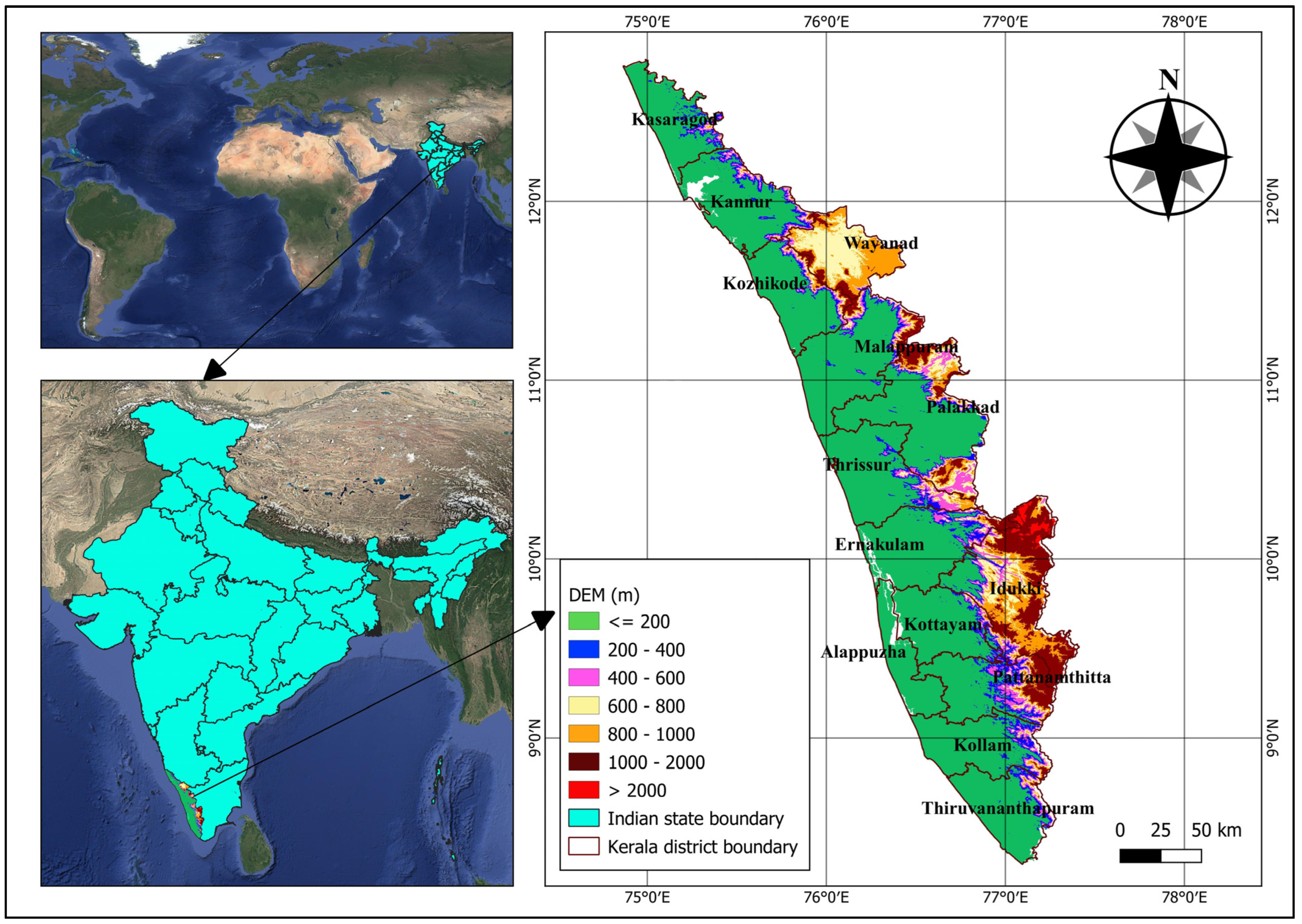
The state of Kerala has a land area of 38,863 sq km and is located between the latitudes of 8°17′30″ N and 12°47′40″ N and the longitudes of 74°27′47″ E and 77°37′12″ E. The states such as Karnataka, Tamil Nadu, and Lakshadweep border it from the northeast, east, and south, respectively. The topography, land use, and land cover of Kerala are diverse in nature.
Figure 1 depicts the state of Kerala, which has tropical and humid weather. The southwest monsoon precipitation accounts for a major part of the annual precipitation. Kerala has a tropical monsoon climate with four seasons: summer (March–May), southwest monsoon (June, July, August, and September) northeast monsoon (October, November, and December), and winter (January and February). The western slopes of the Western Ghats receive about 3000 mm of precipitation annually. The state recorded an average precipitation of 2341 mm during 2018, and the state continues to show high inter-annual precipitation variability, strongly linked to climate change indicators [26]. In 2018, 14 districts were severely affected by intense precipitation events, underscoring the need for spatio-temporal flood risk assessments. In 2018, 14 districts of Kerala state, namely, Alappuzha, Kasaragod, Wayanad, Kannur, Kozhikode, Malappuram, Palakkad, Ernakulam, Thrissur, Idukki, Kottayam, Pathanamthitta, Kollam, and Thiruvananthapuram, were severely affected by high-intensity precipitation.

2.2. Data and Methods

The datasets used in this study are listed in Table 1, including resolution, source, and their description.
The study required the following data: AOD, Trajectory, Precipitation, Elevation, Slope, Drainage density, LULC (Land use and Land cover), and Soil maps. The AOD (550 nm) data were collected from NASA Earth observations, and precipitation data were obtained from the CHRS data portal. The MODIS Aerosol Product measures the optical thickness of the atmosphere’s aerosols across continents and oceans. The study includes a heterogeneous dataset of spatial and temporal resolutions; an appropriate synchronization procedure was implemented to ensure reliability. All datasets were resampled to a common resolution equal to the coarsest spatial resolution. The datasets such as MODIS AOD and PERSIANN were resampled using bilinear interpolation, while LULC datasets were resampled using the nearest-neighbor approach to maintain the class categorization. The PERSIANN (precipitation) dataset available in the daily resolution were converted to monthly precipitation to be comparable with the AOD dataset. The LULC data which remains as a static surface condition was treated as invariant for the particular year of the study. While this methodology enables integration of multiple dataset analysis, it smoothens the spatial features and occurrence of extreme events. The Trajectory analysis has been carried out using the NOAA HYSPLIT Trajectory Model. Using available online meteorological data, the HYSPLIT model calculates an air parcel. The 0.5-degree GDAS collection comprises weather data from 2015 to 2021 for high-intensity precipitation in seven-day periods.
Two coastal districts of Kerala, Kasaragod in the northern part of Kerala and Alappuzha in the southern part, were selected for this research to represent the north–south rainfall variability across the state. This selection was based on the finding from the Kozhikode-based Centre for Water Resources Development and Management (CWRDM) [27]. The analysis was carried out one week ahead of the period corresponding to the highest precipitation recorded by IMD (Indian Meteorological Department), to understand the effect of flooding in the study locations. This analysis was carried out corresponding to the years 2015, 2018, and 2021, i.e., the years during which floods occurred in Kerala. Precipitation Estimation from Remotely Sensed Information using Artificial Neural Networks (PERSIANN) datasets are available as gridded data with quasi-global spatial coverage. The Seasonality Index has been computed to understand the seasonal precipitation trends during the study period. The Seasonality Index, which is a function of mean monthly and annual precipitation, is calculated as follows [28]:
SI   =   1 R ¯ n = 1 12 | x ¯ n     R ¯ 12 |  
where x ¯ n is the mean precipitation of month n; and R ¯ is the mean annual precipitation.
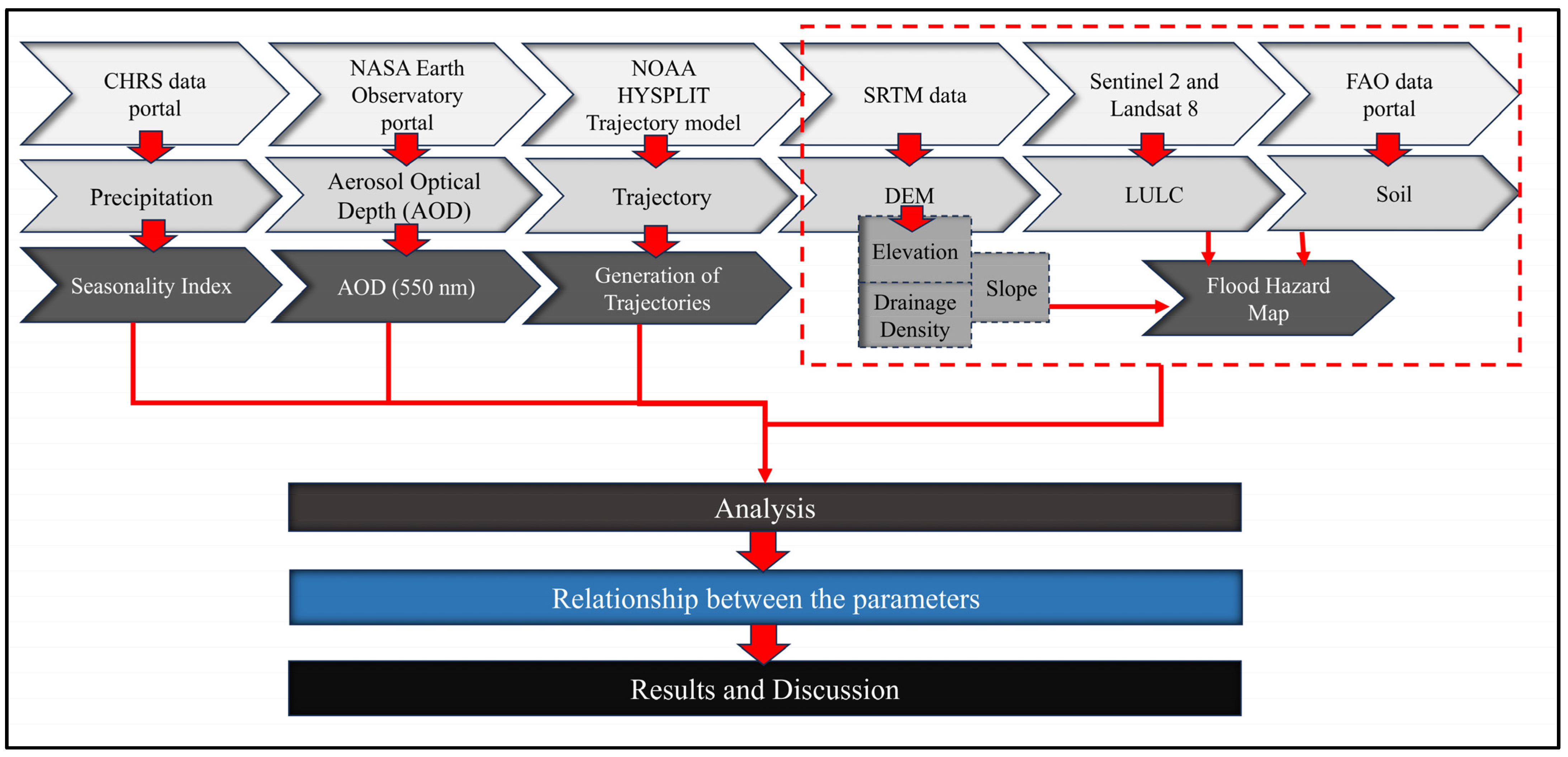
The methodology followed in this study is shown in Figure 2. Five conditioning factors were used: slope, drainage density, soil, LULC, and elevation. Each factor was reclassified into 5 flood susceptibility classes, where class 1 denotes high flood susceptibility. Since elevation is a primary determinant of flood risk, it has been given more weight (30%), followed by slope (20%), drainage density (20%), LULC (15%), and soil type (15%). The factors considered for flood hazard zonation were selected based on their frequent use and established relevance in previous GIS-based flood hazard and susceptibility studies [29,30], data availability, and suitability for integration within a weighted overlay (MCDA) framework.
A Multi-Criteria Decision Analysis (MCDA) approach was implemented in the GIS environment using the weighted overlay analysis (WOA). The weighted factors were then integrated in QGIS 3.16, generating a composite flood risk map, as shown within the red dashed box (Figure 2), that categories the flooding zones in Kerala with very low, low, moderate, high, and very high susceptibility to flooding [31].

3. Results and Discussion

3.1. Land Use/Land Cover Changes

The LULC map corresponding to the study area was generated using Landsat 8 satellite images. The classes considered for classification are forest, built-up area, barren land, water bodies, and mangroves. Built-up areas are more prone to floods, and regions with mangroves are less prone to floods. The land use changes have been assessed corresponding to the years 2015 and 2021. The major Land Use and Land Cover (LULC) categories were considered as per [32] in Kerala, which has recorded the following information: Plantation (22255 km2, 58.23%), Deciduous and Evergreen Broad Leaf Forest (7849 km2, 20.5%), Cropland/Shrubland/Grassland (4307 km2, 11.27%), and Waterbody/Urban/Others (3806.5 km2, 9.95%). The critical analysis of LULC shows that the low-lying areas of the southeast and north of Vembanad Lake have been used for cultivation and for settlements. Considering 2015 as the baseline, the evergreen forest area decreased slightly in 2021 by 1.7%. The built-up area, i.e., the impervious area, has increased within six years (2015–2021) as per the LULC studies, while forest and native cover decreased substantially. An increase in impervious area tends to reduce the travel time and increase the magnitude of the flood waves, thus producing severe impacts.
The conversion of permeable land to impervious surfaces has critical hydrological implications, reduced infiltration, shortened lag time, and increased surface runoff, all of which contribute to higher flood peaks. These findings align with [33], which reported that Kerala’s Western Ghats region is particularly sensitive to land use conversion. The increased settlement around Vembanad Lake and coastal low-lying areas has exacerbated the inundation risks. Moreover, the agricultural intensification in floodplain zones has reduced the buffering capacity of wetlands, further heightening their vulnerability. When compared with global literature, Kerala’s 1.7% forest loss over six years appears alarming, given that even a 1% reduction in vegetative cover can elevate the flood magnitude by 3–5% in tropical basins [19]. The findings from the study, therefore, reflect international concerns regarding rapid urbanization in flood-sensitive ecosystems.

3.2. AOD (550 nm) Trend in Kerala

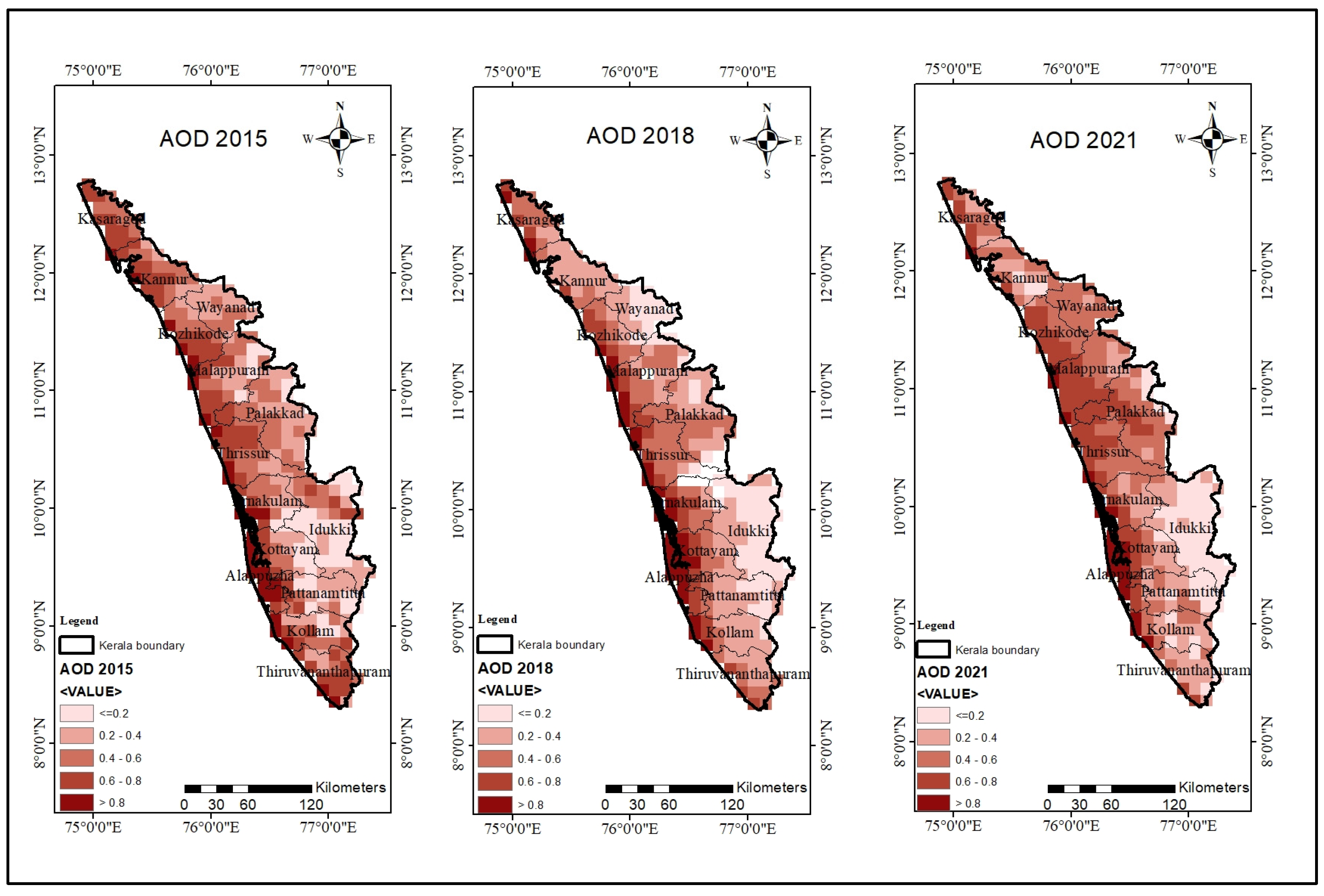
Figure 3 depicts the variations in the AOD (550 nm) parameter across the state of Kerala. It can be inferred from Figure 3 that the coastal regions of Kerala experience higher AOD (550 nm) values, i.e., greater than 0.8. The eastern part of the state had the lowest concentration of AOD (550 nm) compared to the coastal part of the state. In Kerala’s Idukki district, it appears that there is a lower concentration of AOD (550 nm) during all the study periods, i.e., 2015, 2018, and 2021. In contrast to previous years, the year 2021 appeared to have a distribution of AOD (550 nm) concentration between 0.6 and 0.8 in the majority of the districts.
The AOD concentration in different districts varied as follows during 2015 and 2021: Kasaragod (0.4–0.6 and 0.6–0.8); Wayanad (0.2–0.4 and 0.4–0.6); Palakkad (0.2–0.4 and 0.6–0.8); Malappuram (0.4–0.6 and 0.6–0.8); and Thrissur (0.2–0.4 and 0.4–0.6). The ENSO phase had a strong modulation of AOD patterns. The observations show that the distribution of the concentration of AOD in the La Niña year 2021 is higher compared to the El Niño year 2015. During the El Niño year 2015, the AOD values were relatively less (0.2–0.4 in the inland region and 0.4–0.6 in the coastal region). The interaction between moisture availability in the atmosphere and aerosol concentration is nonlinear and remains complex. The nonlinear precipitation nucleation effect of AOD remains complicated. Generally, the formation of cloud droplets from the available moisture in the atmosphere depends on the presence of aerosol particles, which serve as the condensation nuclei. Aerosol-loading-enhanced convective systems act as cloud condensation nuclei (CCN), but, at a higher aerosol loading, convective systems are suppressed by the decreased droplet coalescence [34]. The precipitation formation can be altered by atmospheric aerosols based on the number and size of cloud drops, cloud lifetime, and cloud microphysics [34,35]. This paradox is supported by our results: the high AOD in 2021 has been associated with abnormal precipitation, whereas the quite good loading in 2015 has been associated with relatively stable precipitation. Hence, the aerosol–precipitation interactions in Kerala cannot be explained by using linear models alone and need ENSO-mediated interpretations.

3.3. Generation of Trajectories

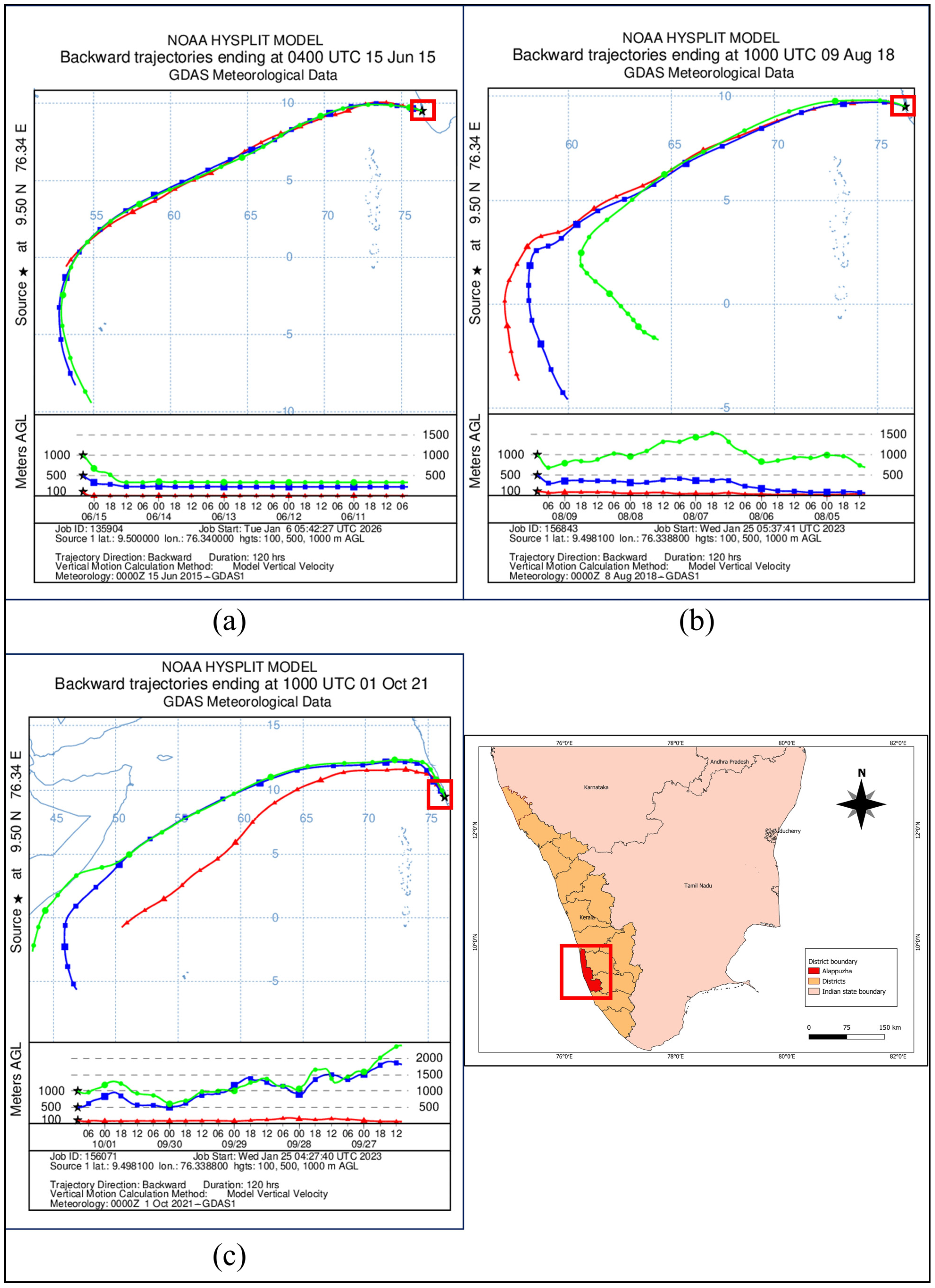
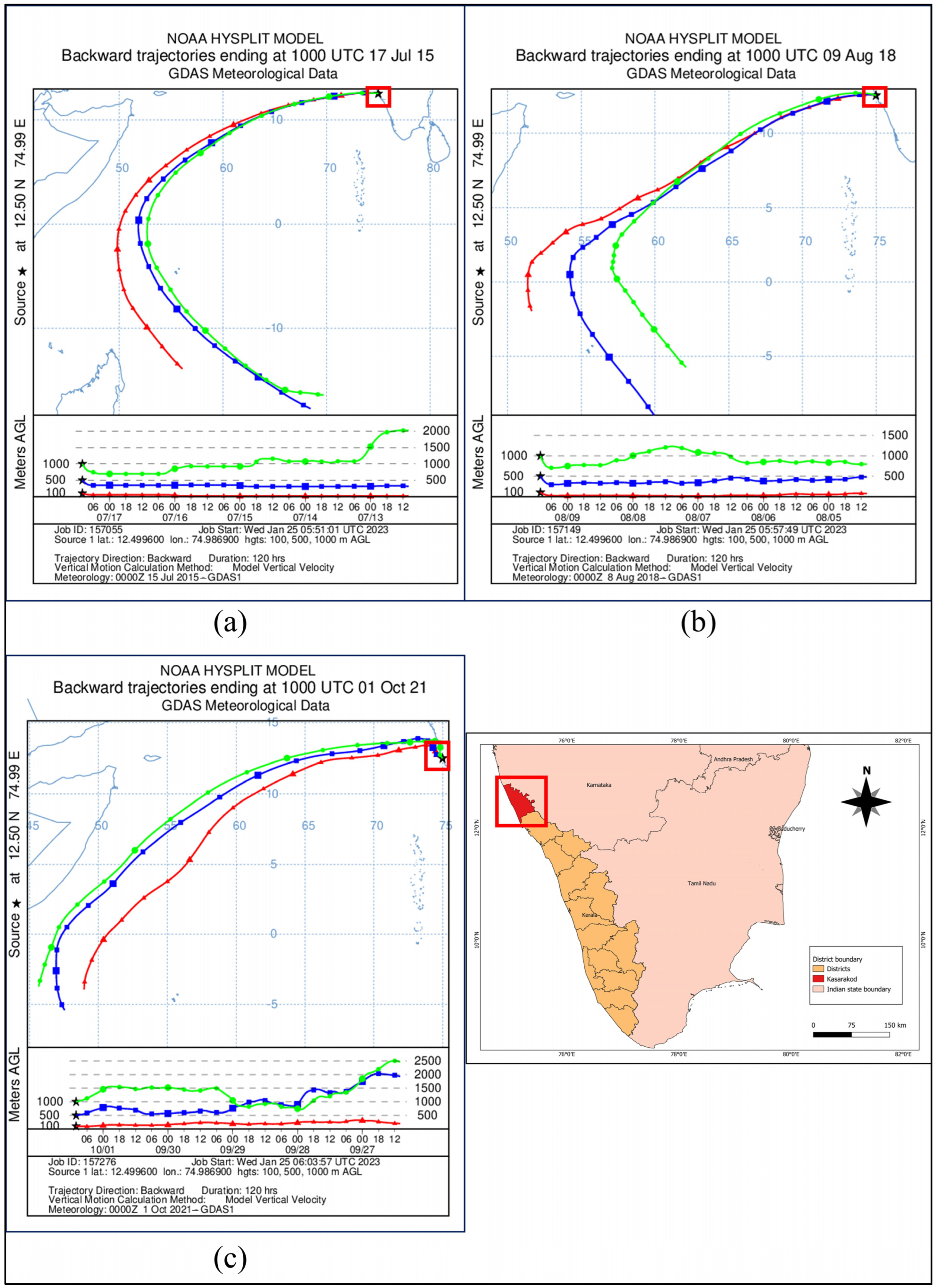
The air parcel trajectories were determined using a computer model (Potential route of pollutants from the source over time) and the Hybrid Single-Particle Lagrangian Integrated Trajectory (HYSPLIT). The trajectories in Alappuzha and Kasaragod were computed based on the origin point. Each line shows the path of the air pollutants in the atmosphere, and the trajectories were computed every 10 h. Figure 4 and Figure 5 show the results of trajectories that were obtained corresponding to the years 2015, 2018, and 2021. While Figure 4 and Figure 5 depict the trajectories corresponding Alappuzha and Kasaragod, as shown within the red box in the images. During the monsoon season (June, July, and August), air masses typically originate over the Indian Ocean and travel through the Arabian Sea before reaching the state of Kerala. From the trajectories generated during August 2018, it is inferred that the transport of aerosols from the Arabian Sea, Indian Ocean, and Arabian Peninsula imply the effect of dust, aerosols, and sea-salt occurrences in the region.
The air mass originates from the Arabian Sea, closer to the West Asian countries, during May, September, and October. During the pre-monsoon and monsoon seasons, the height of the blockade is frequently observed to cause monsoon droughts, heat waves, and floods. According to a previous study, moist and cold air masses brought from the maritime area could be referred to as a LLJ (Low-Level Jet), while another dry and cold air mass brought from the Middle East desert could be referred to as a continental tropical air mass [36]. The SI values corresponding to 2015 remained relatively low (<0.8), placing it in the “Seasonal” category. However, values pertaining to 2018 (1.17) and 2021 (1.23) were classified as “Most rain in 3 months or less,” confirming the extreme concentration. The monthly analysis showed SI peaks in June, July, and August, with values > 3.0, underscoring the dominance of the southwest monsoon. Such a sharp seasonal concentration explains the reasons for the occurrence of floods in Kerala within short windows of extreme rainfall.
In general, the trajectory clusters specify that periods of higher AOD concentration are frequently associated with air masses initiating from neighboring source locations, contributing to the potential load of transported aerosols during extreme rainfall events. This coincidence provisions a qualitative stochastic linkage between air-mass transport, aerosol loading, and precipitation intensity. A study conducted by Jasmine et al. [37] reveals that, during 14–17 August 2018, there is an aerosol loading near Kerala region, supported by the dust transport from West Asia, which enhanced the cloud formation, and led to heavy rainfall in Kerala, indicating the involvement of aerosol–cloud–precipitation interactions.
This trend agrees with [38]’s rising seasonality indices across southern India in the last two decades. Importantly, our study extends this by correlating SI anomalies with LULC changes and AOD variability, showing that both anthropogenic and climatic drivers collectively intensify Kerala’s flood vulnerability. By linking the precipitation concentration with the ENSO-driven aerosol transport, this work contributes new insights into the aerosol–hydrology–climate interactions in monsoon-dominated ecosystems.

3.4. Precipitation Trends in Kerala

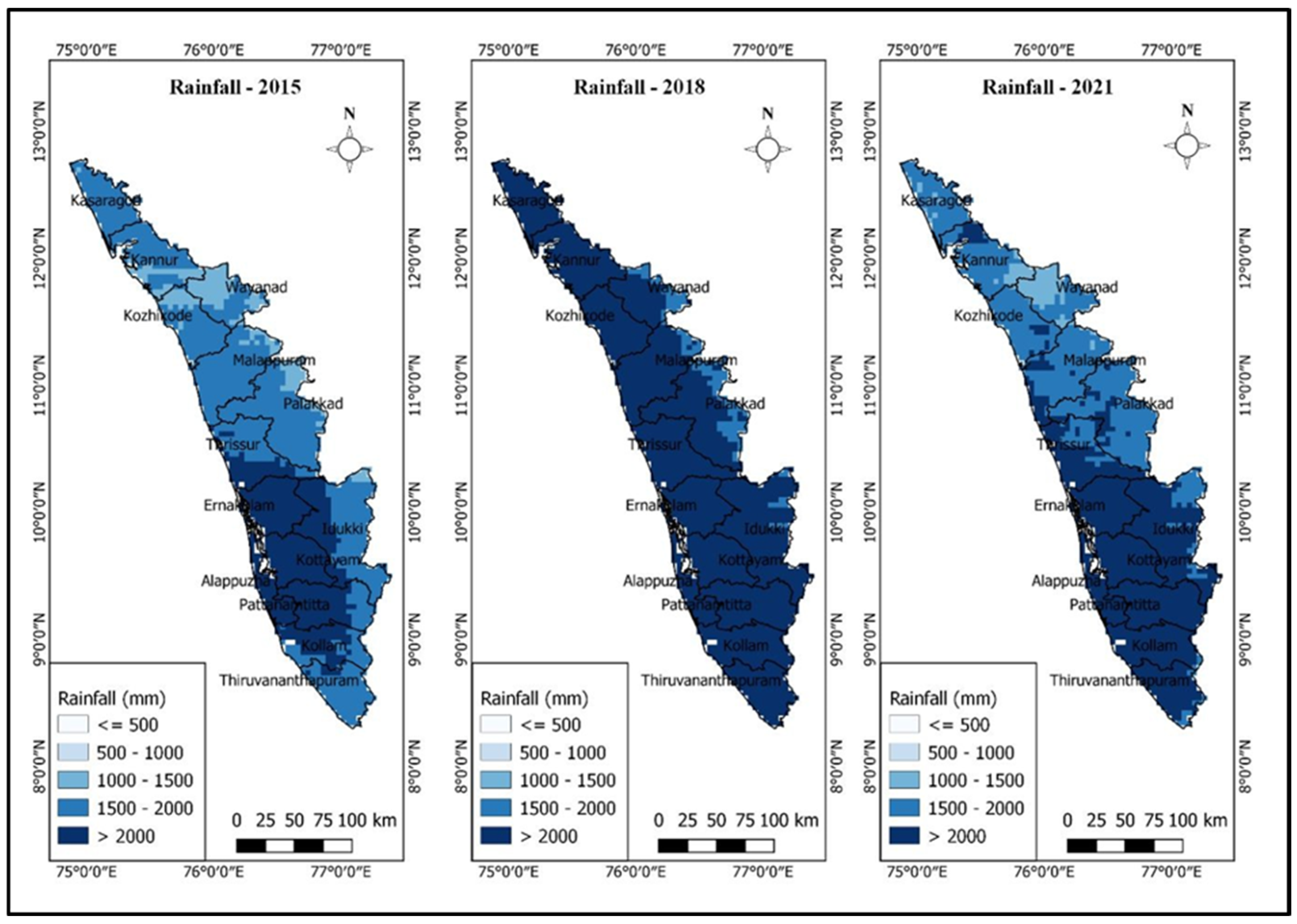
Figure 6 shows the annual precipitation trends in Kerala state. Between 1980 and 2015, the average annual precipitation in Kerala was 2830 mm, with a minimum of 1880 mm and a maximum of 4034 mm [38]. The rainy seasons, i.e., southwest monsoon (June–September) and northeast monsoon (October–December), account for approximately 68% and 17.3% of the annual precipitation, respectively. From Figure 6, it can be observed that, during the years 2015 and 2021, the southern part of Kerala has experienced a higher amount of precipitation compared to the northern part of the state. During the year 2018, except for some parts of Wayanad, Malappuram, and Palakkad, all other districts experienced precipitation of more than 2000 mm. The districts that are subjected to precipitation of more than 2000 mm in the year 2015 are as follows: Ernakulam, Alappuzha, Thrissur, Kollam, Idukki, Kottayam, Pathanamthitta, and Thiruvananthapuram. Districts such as Kannur and Kozhikode have experienced an increase in precipitation from 1000–1500 mm to 1500–2000 mm. Major parts of Idukki, Pathanamthitta, Kollam, and Thiruvananthapuram have moved from 1500–2000 to >2000 mm of the precipitation range. Idukki district experienced a high precipitation (2666 mm) in the year 2018, where the AOD level of the district was 0.457 [39]. Some parts of Malappuram, Palakkad, Kannur, and Thrissur have moved from 1500–2000 to >2000 mm of precipitation.

3.4.1. Seasonality Index (SI)

The SI assesses the range of possible monthly precipitation throughout a year. The index recognizes precipitation regimes every month. Kanellopoulou, 2002 [40], discusses the range of seasonality index, which relates to the precipitation as follows: ≤0.19—Very Equable; 0.20–0.39—Equable but with a definite wetter season; 0.40–0.59—Rather seasonal with a short drier season; 0.60–0.79—Seasonal; 0.80–0.99—Markedly seasonal with a long drier season; 1.00–1.19—Most rain occurring in 3 months or less; and ≥1.20—Extreme maximum rainfall occurring in 1–3 months.
The Seasonality Index has been calculated for the annual precipitation data from 2015 to 2021. Kerala’s seasons can be classified as pre-monsoon, post-monsoon, summer, and monsoon. The monsoon period extends over June, July, August, September, October, and November; the post-monsoon period spreads over December, January, and February.
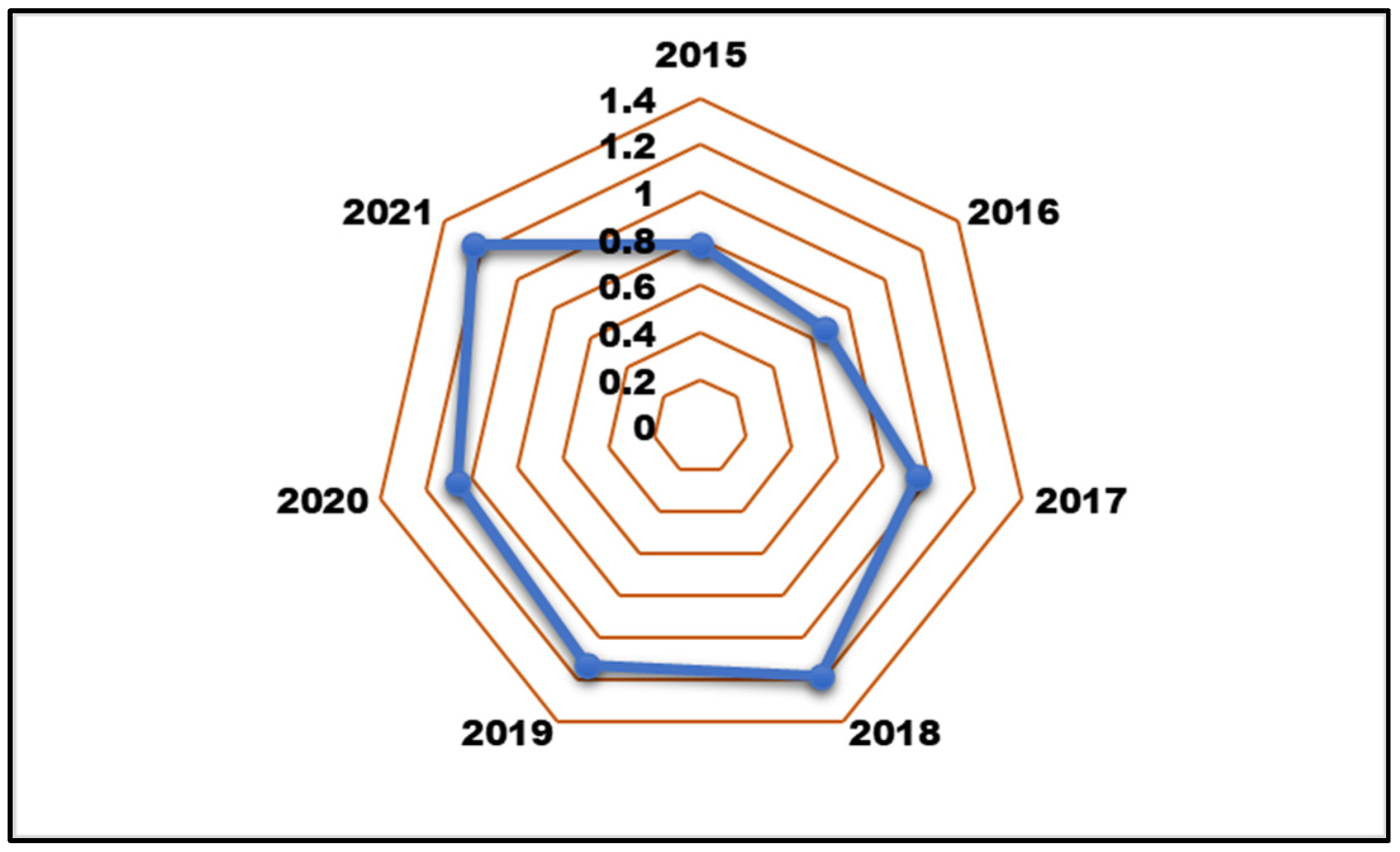
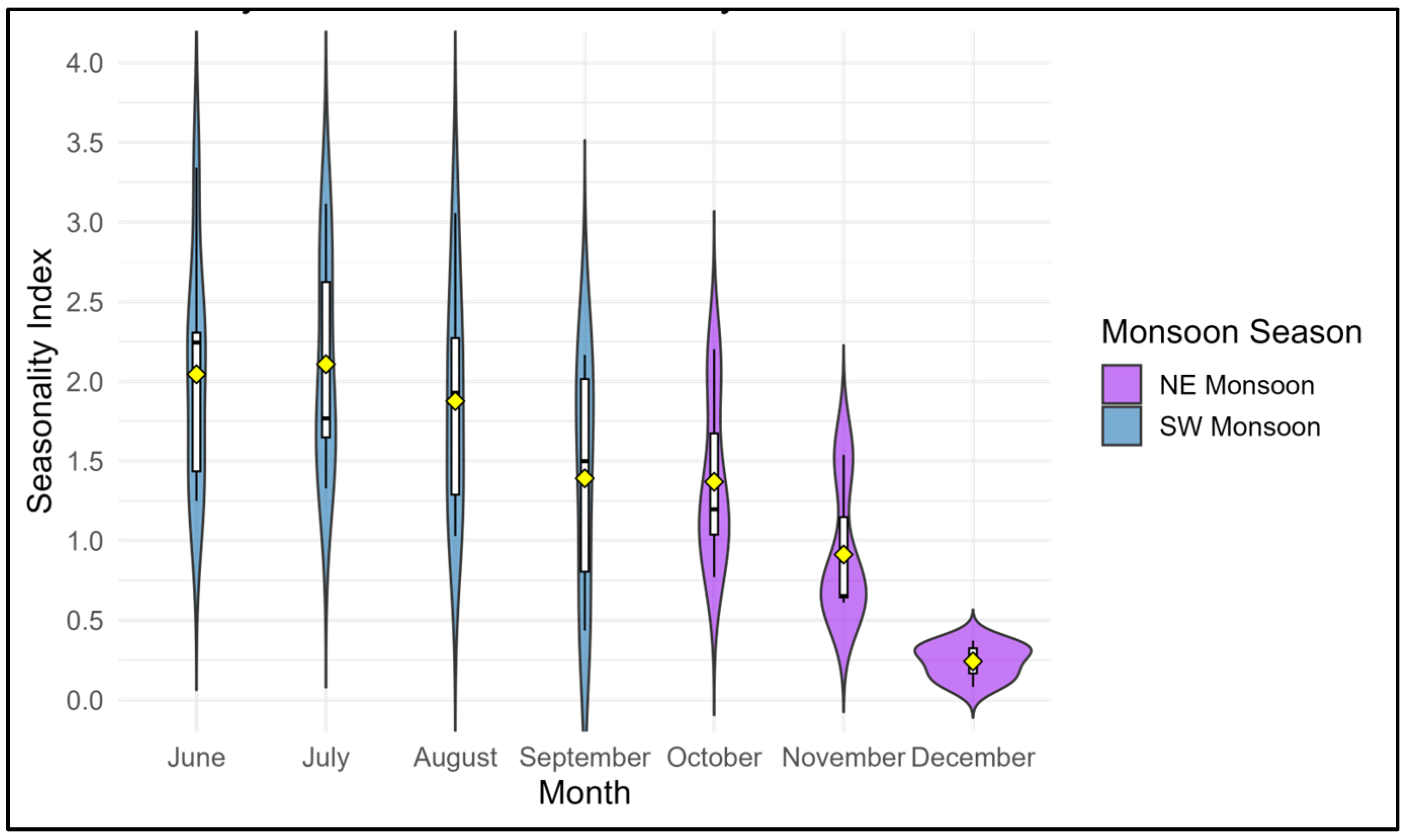
The seasonality index was high during 2018 and had a value of about 1.17, as shown in Figure 7, and it has been shown in Table 1 that, when the value is around 1.00–1.19, the precipitation regime falls under the category in which most of the precipitation occurs in 3 months or less. This is observed in the graph consecutively during all the years from 2018 onwards (Figure 7). This is implied to be the reason for floods in the state of Kerala during the southwest monsoon season in most years. According to the data corresponding to the monthly seasonality index, the seasonality indices are very high (i.e., more than 3) for June, July, and August during the study period. The graph also shows that the seasonality index rises during October. The observations show that there is an increase in the seasonality index in the case of annual precipitation; this may be due to the irregularity in precipitation during the monsoon months. Figure 8 illustrates the violin plot for the monthly seasonality index of the study region. From Figure 8, we can see that the months June–September (southwest monsoon) show higher mean and median values compared to other months, indicating a strong seasonality during southwest monsoon. The seasonality reduces during September, making it a transition month. The seasonality index shows a clear reduction during October–December (northeast monsoon), especially in December, reflecting weak seasonal behavior.

3.4.2. Precipitation Analysis in Thrissur

A detailed precipitation analysis was carried out in Thrissur district to understand the precipitation trend in the districts of Kerala. The study was carried out in Thrissur, which has been facing floods during the monsoon period. The results of the annual precipitation trend analysis in Thrissur district show that, in the last two decades, especially during the years 2006, 2007, 2010, 2018, and 2021, annual precipitation exceeded 2500 mm. On average, precipitation has increased by 450 mm in Thrissur district. The departure analysis of Thrissur district reveals excess rainfall (≥+20% departure from the 1981–2021 normal) during 2018 and 2021. The seasonality index analysis shows that extreme trends of precipitation have occurred during the years 1981, 1997, 2007, 2018, and 2021 when the index value is >1.20. Precipitation Concentration Index (PCI) analysis reveals that, during 2018, Thrissur experienced irregular precipitation. A Consecutive Dry Days (CDD) analysis shows a decreasing trend with a reduction of 12 days in 2022. Extreme changes in the trends of precipitation have also been observed with reference to the seasonality index. CWD (Consecutive Wet Days) analysis shows an increasing trend in this district.

3.5. Weighted Overlay Analysis

As discussed in the methodology section, five conditioning factors were used in the WOA analysis, which include the slope, drainage density, soil, LULC and, elevation. Each factor was reclassified into five flood susceptibility classes, where class 1 denotes high flood susceptibility and 5 denotes low flood susceptibility. For elevation, weight is 30%, followed by slope (20%), drainage density (20%), LULC (15%), and soil type (15%).
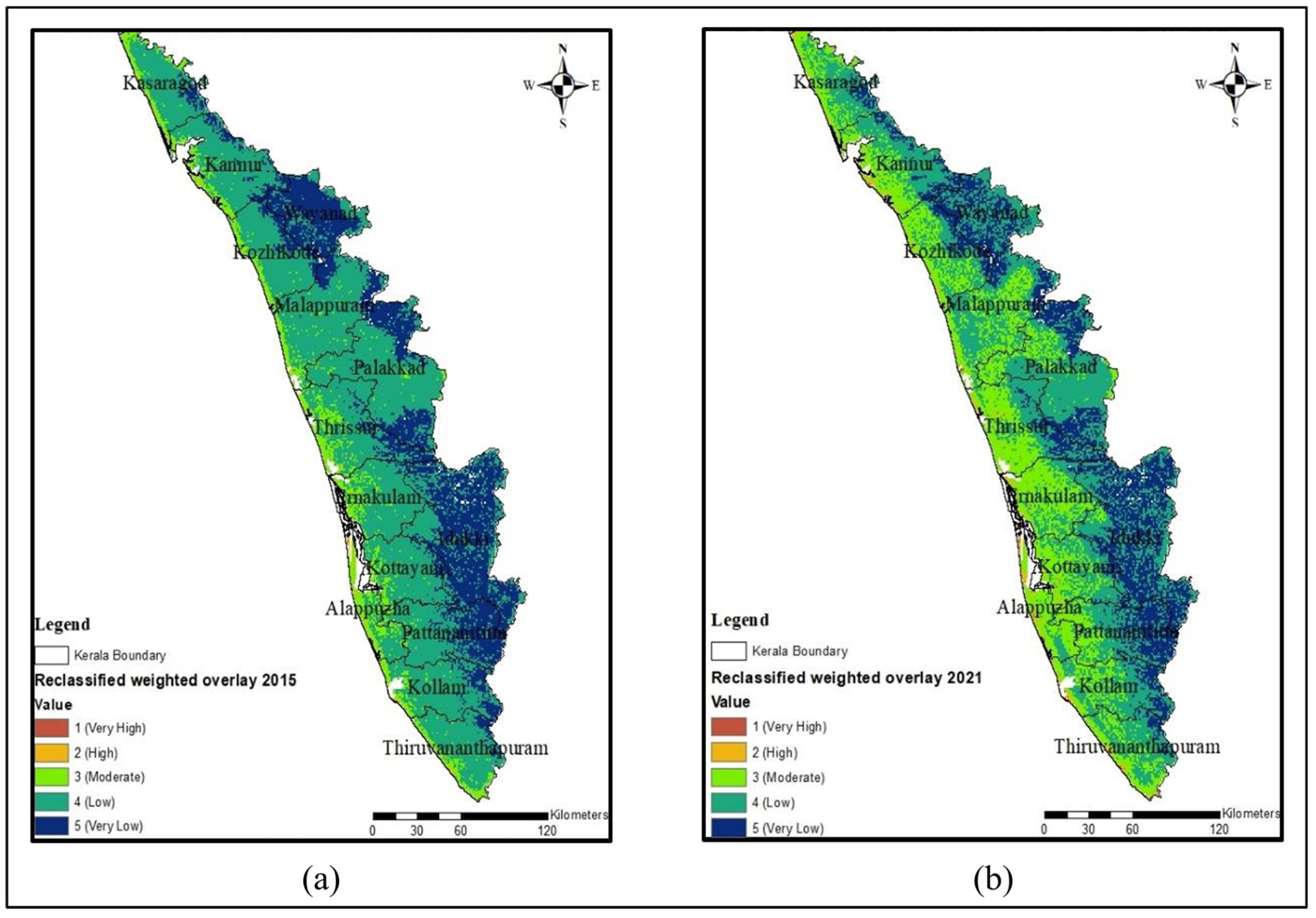
As per the study, the most affected districts in Kerala were Alappuzha, Thrissur, Ernakulam, and parts of Kottayam, and Kollam, which are susceptible to floods. The least affected districts in Kerala are Idukki and Wayanad. In 2021, the districts that were affected by floods were Malampuzha, Palakkad, Kasaragod, Kannur, Thrissur, Kottayam, and Thiruvananthapuram. The flood analysis results show that the area under the very high flood category has increased from 6.05 sq.km to 32.67 sq.km. Though there is an increase in the area under the very high flood category during 2021, the area under the moderate flood category has decreased from 1343.1 to 433.18 sq.km in 2021. The area under the very high flood category has increased in locations such as Thuravoor Thekku, Thiruvananthapuram, Kollam, Kovalam, Thalassery, Azhikode, Poova, Alappuzha and Ponnani during 2021. These locations have been notified in the reports produced by RMSI (Flood Advisory) and Kerala State Disaster Management Authority’s Event report on Extreme Rainfall over Kerala, 2021 [41,42].
The assessment conceptual model included three main phases: identifying and evaluating the flood contributing factors (indicators); using the weighted sum to allocate ranks and weights in the overlay analysis; and combining these six indicators in GIS using a weighted analysis to generate a flood risk zonation map for the state of Kerala. Although, in the years 2015 and 2021, the southern part of Kerala state seemed to have high precipitation, the year 2018 showed that the distribution of precipitation (>2000 mm) was observed in all the districts. The AOD (550 nm) concentration was higher (>0.8) in the coastal regions throughout the study period, except in Idukki district, which showed a lower AOD (550 nm) concentration.
From 2015 to 2021, the seasonality index has been noted to be high in 2018, and, as a result, the significant flood that occurred in 2018 has been highlighted. Based on the trajectory analysis, it is inferred that the air mass originates in the Indian Ocean during the southwest monsoon, whereas, before (May) and after the southwest monsoon (September, October), air masses originate from the Arabian Sea near the Middle Eastern countries. An annual precipitation trend analysis was conducted to understand the relationship between precipitation and flood vulnerability during the years 2015, 2018, and 2021, which showed that most of the districts have precipitation above 2000 mm and are more prone to flooding. In addition to this, studies showed that a high to moderate impact of flood inundation was observed in Idukki, Ernakulam, Kollam, and Pathanamthitta districts. Over the past two decades, the considerable increase in anthropogenic activities in the Western Ghats might also have exacerbated the flood hazard in Kerala [33]. It is revealed in the LULC analysis that the forest area has been reduced by 1.7% from 2015 to 2021, and it was also observed that there is a considerable increase in the area of settlement in the state. As mentioned earlier, an increase in the impervious area increases the magnitude of the flood, as the infiltration reduces and runoff increases. The potential use of freely available high-resolution spatio-temporal Landsat 8 OLI satellite imagery has been depicted in this study for flood hazard monitoring.
Kerala was selected for study as the precipitation trends show that there is an active temporal variation in precipitation in recent decades. In the case of El Niño circumstances during the year 2015, a transitional level of precipitation was observed against a background of some high-intensity concentrations in the southern districts. In contrast, during 2018 and 2021, there occurred pronounced heavy precipitation that spread over a relatively large area. Further, it is observed that the increased Aerosol Optical depth (AOD) during the La Niña phases is also associated with anomalous events, suggesting a coupling between aerosol transport, monsoon convection, and flood intensity.
During 2018, the state of Kerala received precipitation significantly more than the long-term average precipitation during the monsoon season, and some districts of the state registered precipitation exceeding 2000 mm. The excess precipitation thus caused direct disastrous floods in more than 14 districts. There were some significant exceptions, particularly in the districts of Thrissur, Kottayam, and Ernakulam. The combination of high-intensity precipitation and relatively low forest cover contributed to the increasing flows in surface runoff in such districts, resulting in flooding in major parts of the districts. The flood event is caused by a precipitation anomaly in Kerala, with reference to the earlier findings from the study of Mishra and Shah [22], that both hydrometeorological and LULC factors contribute to the augmentation of floods in Kerala state.
The weather in Kerala in 2021, a La Niña year, showed a significant north–south variation. While the southern part of Kerala had significantly higher values, such as high rainfall or increased humidity, the northern parts had only slightly higher values than average. Another spatial redistribution mechanism with considerable change is atmospheric circulation, which seems to be quite important. From the results of the trajectory analysis, it is inferred that the source of air masses is from the Indian Ocean during the Southwest Monsoon. Moreover, there is a similar relationship between the intensity of La Niña episodes and El Niño in global regions (like Vietnam and Bangladesh), which connects a high flood frequency [13] to the monsoon rain periods (La Niña phases).
It is observed that, during heavy cloud cover, the evaporation potential is reduced, leading to floods. Thus, the anomalies detected in Kerala during the years 2018 and 2021 schematically represent a two-stage process that is the combination of the compounding effect due to excess rainfall, an amplifying force, and drying winds, a suppressing force at the surface. While other interactive processes have been well-documented in the tropical regions, there is a lack of datasets of AOD and its integration with precipitation, statistical metadata, and land use/land cover (LULC). Our study, therefore, demonstrates that such an integrative analysis can offer rich information on flood genesis processes more unquestionably.
Aerosol levels and ENSO have impacted these precipitation trends, therefore influencing the trend and locations where precipitation falls. Hence, land-surface conditions and rainfall predictions must be linked in future flood prediction models so that early warning systems may more accurately forecast and analyze flood hazards.
The analysis at the district level showed that Alappuzha, Thrissur, Ernakulam, and Kollam were consistently showing high hazard values, whereas Idukki and Wayanad were the least affected due to factors such as their high altitudes and lower imperviousness. However, within the state of Idukki, pockets of flood-prone zones could be found along the riverine corridors and valleys, which proves the accuracy of the weighted overlay method. Figure 9 depicts the flood hazard map for the year 2015 and 2021.
In addition, the process of flood susceptibility dynamics has been strengthened using the method of the weighted overlay. For instance, even though the southern districts of Kerala had more rainfall in 2015, the flood risk was still low due to the limited urban exposure. On the contrary, in 2021, as a result of the high precipitation, high AOD concentrations, and increased rate of urbanization, the intensity of flood hazard was high. This suggests that hazard mapping should not be a static entity, but should continue to be updated to represent changing land use transitions and changing climate oscillations.
Summing up, the weighted overlay analysis carried out by the GIS model proved that the flood hazard profile of the state of Kerala has deteriorated over the last few years, mostly in the central and southern districts. By using climatic variables along with LULC and topography, the study adds empirical information on urban planning, watershed management, and the prioritization of mitigation strategies. Such strategies can have a direct impact on decision-making for the states to increase disaster preparedness strategies, and they are aligned with global frameworks such as the Sendai Framework on Disaster Risk Reduction.

3.6. Trajectory Analysis of Air Mass Origins

From the backward trajectory analysis, it was found that, during the southwest monsoon (June–September), the moisture responsible for intense rainfall in Kerala mostly originates from the Indian Ocean, carried by moist, aerosol-rich air currents. Additional inputs were observed between May and September, during the pre- and post-monsoon seasons, originating from the dust moving from the Arabian Desert, as well as from the Arabian Sea and Peninsula.
Indian Ocean fluxes were suppressed during 2015 (El Niño), as expected, based on the low precipitation and moderate AOD concentrations. However, the results corresponding to the year 2018 showed increasing inflows from both the Arabian Peninsula and Arabian Sea, which can be related to the unusual precipitation and widespread flooding in that year. This implies that the feedback mechanisms of dust and marine aerosols on the cloud microphysics are simulated, and, thus, the precipitation efficiency is higher. The backward trajectory analysis indicated that air masses from the Indian Ocean had higher and more sustained inflows in 2021, a year of La Niña, especially over the elevated northern coastal regions. These inputs consisted of high volumes of aerosols and moisture. Moreover, the data indicated a higher Aerosol Optical Depth (AOD > 0.8), which implies more aerosols (tiny particles such as dust or pollutants) suspended in the air. This combination of high aerosol loading and the efficient transmission of moisture led to heavy rainstorms, especially in Kerala’s southern regions.
The findings agreed with the results of Vinoj et al. [14], which showed that the aerosol loading in the Arabian Sea can make changes in the pattern of convective circulation during the monsoon period. This was also consistent with the results from [13], which inferred that air masses and moisture move from one region to another and contribute to extremes that can be modulated by different ENSO phases during precipitation over South Africa. This study considered a similar region-focused approach and applied HYSPLIT for the region of Kerala, considering the effect of precipitation anomalies in the flood vulnerability information, as well as their associated transport mechanisms.
Another important observation is that trajectories have an altitudinal difference. On one side, the cold, moist air coming from the maritime sources is transported to the region by surface and deep-layer lower-level jets (LLJs), whereas, on the other hand, the warm, dry continental tropical air from the Middle East transports dust. The coalition of air masses may be the cause of the occurrence of intense precipitation and the inhibition over Kerala. The development of various cloud microphysical processes, such as condensation and collision–coalescence, signals cloud development. As clouds interact and develop, aerosol–cloud interactions act as a second feedback mechanism for cloud processes and properties, acting either to enhance them or reduce their effectiveness depending on the local conditions. The cloud-modelling attempts to model two interactive systems together (the aerosols with their effects upon weather, and the clouds interacting with the aerosol system on the other side).
The trajectory analysis supports the interpretation that the instances of flooding in Kerala are not controlled by the precipitation occurring in the area, and are influenced by the long-range advection of remote aerosol and moisture. Therefore, the introduction of the trajectory models in the flood prediction system can improve its predictability in the ENSO-modulated condition. This shows the need for integrated meteorological and hydrological models to represent the depiction of the regional and transboundary drivers of extreme precipitation.

3.7. Limitations

Flood hazard zonation may include more factors in addition to the slope, drainage density, soil, LULC, and elevation. Although WOA is a widely used method, this study did not conduct a formal sensitivity or uncertainty analysis to assess the influence of individual factor weights on the flood hazard map. Future studies including cloud microphysical observations along with a trajectory analysis will lead to the development of a high-resolution model to quantitatively assess the deterministic relationship between aerosol loading, extreme precipitation, and flood generation. This is one of the limitations of the study, and, in future, the authors are ready to incorporate sensitivity to better quantify the robustness of the results.

4. Conclusions

In this study, utilizing multi-source datasets and state-of-the-art analysis techniques, an in-depth spatio-temporal analysis of aerosols, precipitation, and flood hazard interactions along with air mass trajectories is conducted for the state of Kerala, India. The results indicate that the aerosol variability is strongly controlled by large-scale climatic forcing, such as ENSO, with the higher AOD concentration in the La Niña year of 2021 rather than in the El Niño year of 2015. In addition, the trajectories indicate that the southwest monsoon preferentially carries Indian Ocean air masses, while the pre-monsoon and post-monsoon seasons receive further South Arabian Sea and Peninsula inputs, which, in turn, contribute to the weight of the congregate influence of marine and desert aerosols from the contributing regions. The precipitation analysis consisted of large anomalies in the years 2018 and 2021; extreme precipitation events were concentrated into three months, as can be observed from the high values of the Seasonality Index (>1.2). These results suggest that precipitation regimes under fluctuations represent a higher vulnerability to floods. This note was well-supported by a case study of Thrissur district, which was a spinoff of the surplus precipitation and its trend resulting in recurring floods. Anthropogenic acts were further confirmed through a decrease in the forest cover by 1.7% and a significant increase in the built-up area land proportion from 2015 to 2021, as per the land use/land cover analysis, which would further worsen the effects of the surface runoff and floods. The role played by AOD, the spatial variability of precipitation, and land use change in enhancing the flood hazard intensity also implies that the flood hazard in Kerala is not singularly a result of the climatic variability, but it is further intensified by the anthropogenic changes in the land surface characteristics. The results point to the need for the better control of land use, sustainable watershed management, and the better resolution monitoring of the atmospheric indicators. In future, daily or monthly AOD, precipitation, and Sea Surface Temperature (SST) correlation would be of use in enhancing flood forecasting. The findings of the study indicate that strengthening land use regulations and watershed conservation measures is highly inevitable. Establishing a routine data analysis related to flood hazard assessment by the disaster management authorities can enhance the decision-support systems; this will improve the climate-resilient planning by policymakers. In conclusion, the paper depicts the advances in scientific understanding related to climate, aerosols, flood interactions, and aids in disaster mitigation strategies for the UN Sustainable Development Goals 13 (Climate Action) and 15 (Life on Land).

Author Contributions

S.V. contributed to the conceptualization of and developed the research methodology for the study. S.V. and S.S. were accountable for writing the original draft, formal analysis, investigation, and data curation. B.J. contributed to the conceptualization of the research, validated the results, and supervised the research. B.J. and K.K. contributed to the review and editing of the manuscript. B.J., S.S. and K.K. participated in the review, editing, and visualization of the final manuscript. B.J. contributed to the funding acquisition. All authors have read and agreed to the published version of the manuscript.

Funding

A part of this research work is funded by the RRC-EA—Ramsar Regional Center—East Asia [WF-2023-T1-1].

Data Availability Statement

All the data underlying the results are available as part of the article, and no additional source data are required.

Acknowledgments

The authors thank and acknowledge the Ramsar Regional Center—East Asia (RRC-EA) for providing funding for part of this research work.

Conflicts of Interest

The authors have declared that they have no known competing financial interests or personal relationships that could have appeared to influence the work reported in this paper.

References

  1. Museru, M.L.; Nazari, R.; Nikoo, M.R.; Karimi, M. Improving Disaster Resilience with Causal Machine Learning for Flood Damage Estimation. Sci. Total Environ. 2025, 995, 180121. [Google Scholar] [CrossRef]
  2. Fahad, M.G.R.; Nazari, R.; Motamedi, M.H.; Karimi, M. A Decision-Making Framework Integrating Fluid and Solid Systems to Assess Resilience of Coastal Communities Experiencing Extreme Storm Events. Reliab. Eng. Syst. Saf. 2022, 221, 108388. [Google Scholar] [CrossRef]
  3. Zarei, E.; Nikoo, M.R.; Al-Rawas, G.; Nazari, R.; Chen, M.; Al Jahwari, B.; Al-Wardy, M. Hybrid Deep Learning Downscaling of GCMs for Climate Impact Assessment and Future Projections in Oman. J. Environ. Manage. 2025, 376, 124522. [Google Scholar] [CrossRef]
  4. Pramanick, N.; Acharyya, R.; Mukherjee, S.; Mukherjee, S.; Pal, I.; Mitra, D.; Mukhopadhyay, A. SAR Based Flood Risk Analysis: A Case Study Kerala Flood 2018. Adv. Space Res. 2022, 69, 1915–1929. [Google Scholar] [CrossRef]
  5. Gadgil, S.; Gadgil, S. The Indian Monsoon, GDP and Agriculture. Econ. Polit. Wkly. 2006, 41, 4887–4895. [Google Scholar]
  6. Lau, W.K.M.; Yuan, C.; Li, Z. Origin, Maintenance and Variability of the Asian Tropopause Aerosol Layer (ATAL): The Roles of Monsoon Dynamics. Sci. Rep. 2018, 8, 3960. [Google Scholar] [CrossRef]
  7. Wang, N.; Zhang, K.; Shen, X.; Wang, Y.; Li, J.; Li, C.; Mao, J.; Malinka, A.; Zhao, C.; Russell, L.M.; et al. Dual-Field-of-View High-Spectral-Resolution Lidar: Simultaneous Profiling of Aerosol and Water Cloud to Study Aerosol–Cloud Interaction. Proc. Natl. Acad. Sci. USA 2022, 119, e2110756119. [Google Scholar] [CrossRef]
  8. Jin, Y.; Hao, Z.; Chen, J.; He, D.; Tian, Q.; Mao, Z.; Pan, D. Retrieval of Urban Aerosol Optical Depth from Landsat 8 OLI in Nanjing, China. Remote Sens. 2021, 13, 415. [Google Scholar] [CrossRef]
  9. Nandini, G.; Vinoj, V.; Pandey, S.K. Arabian Sea Aerosol-Indian Summer Monsoon Rainfall Relationship and Its Modulation by El-Nino Southern Oscillation. NPJ Clim. Atmos. Sci. 2022, 5, 25. [Google Scholar] [CrossRef]
  10. Li, Z.; Lau, W.K.-M.; Ramanathan, V.; Wu, G.; Ding, Y.; Manoj, M.G.; Liu, J.; Qian, Y.; Li, J.; Zhou, T.; et al. Aerosol and Monsoon Climate Interactions over Asia. Rev. Geophys. 2016, 54, 866–929. [Google Scholar] [CrossRef]
  11. Lau, K.-M.; Kim, K.-M. Observational Relationships between Aerosol and Asian Monsoon Rainfall, and Circulation. Geophys. Res. Lett. 2006, 33, L21810. [Google Scholar] [CrossRef]
  12. Mishra, V.; Smoliak, B.V.; Lettenmaier, D.P.; Wallace, J.M. A Prominent Pattern of Year-to-Year Variability in Indian Summer Monsoon Rainfall. Proc. Natl. Acad. Sci. USA 2012, 109, 7213–7217. [Google Scholar] [CrossRef]
  13. Jin, Y.; Liu, Z. A Theory of the Spring Persistence Barrier on ENSO. Part I: The Role of ENSO Period. J. Clim. 2021, 34, 2145–2155. [Google Scholar] [CrossRef]
  14. Vinoj, V.; Rasch, P.J.; Wang, H.; Yoon, J.-H.; Ma, P.-L.; Landu, K.; Singh, B. Short-Term Modulation of Indian Summer Monsoon Rainfall by West Asian Dust. Nat. Geosci. 2014, 7, 308–313. [Google Scholar] [CrossRef]
  15. Gopal, K.R.; Obul Reddy, K.R.; Balakrishnaiah, G.; Arafath, S.M.D.; Kumar Reddy, N.S.; Rao, T.C.; Reddy, T.L.; Reddy, R.R. Regional Trends of Aerosol Optical Depth and Their Impact on Cloud Properties over Southern India Using MODIS Data. J. Atmos. Sol. Terr. Phys. 2016, 146, 38–48. [Google Scholar] [CrossRef]
  16. Sateesh, M.; Soni, V.K.; Raju, P.V.S. Effect of Diwali Firecrackers on Air Quality and Aerosol Optical Properties over Mega City (Delhi) in India. Earth Syst. Environ. 2018, 2, 293–304. [Google Scholar] [CrossRef]
  17. Midhuna, T.M.; Gharai, B.; Jose, S.; N Rao, P.V. Study on Regional Variations of Aerosol Loading Using Long Term Satellite Data Over Indian Region. J. Indian Soc. Remote Sens. 2017, 45, 685–697. [Google Scholar] [CrossRef]
  18. Satheesh, S.K.; Moorthy, K.K. Aerosol Characteristics over Coastal Regions of the Arabian Sea. Tellus B Chem. Phys. Meteorol. 1997, 49, 417. [Google Scholar] [CrossRef]
  19. Zhang, J.; Reid, J.S. A Decadal Regional and Global Trend Analysis of the Aerosol Optical Depth Using a Data-Assimilation Grade over-Water MODIS and Level 2 MISR Aerosol Products. Atmos. Chem. Phys. 2010, 10, 10949–10963. [Google Scholar] [CrossRef]
  20. Chu, D.A.; Kaufman, Y.J.; Zibordi, G.; Chern, J.D.; Mao, J.; Li, C.; Holben, B.N. Global Monitoring of Air Pollution over Land from the Earth Observing System-Terra Moderate Resolution Imaging Spectroradiometer (MODIS). J. Geophys. Res. Atmos. 2003, 108, 4661. [Google Scholar] [CrossRef]
  21. Joseph, P.V.; Sooraj, K.P.; RAJAN, C.K. The Summer Monsoon Onset Process over South Asia and an Objective Method for the Date of Monsoon Onset over Kerala. Int. J. Climatol. 2006, 26, 1871–1893. [Google Scholar] [CrossRef]
  22. Mishra, V.; Shah, H.L. Hydroclimatological Perspective of the Kerala Flood of 2018. J. Geol. Soc. India 2018, 92, 645–650. [Google Scholar] [CrossRef]
  23. Imteaz, M.A.; Hossain, I. Climate Change Impacts on ‘Seasonality Index’ and Its Potential Implications on Rainwater Savings. Water Resour. Manag. 2023, 37, 2593–2606. [Google Scholar] [CrossRef]
  24. Haq, M.; Akhtar, M.; Muhammad, S.; Paras, S.; Rahmatullah, J. Techniques of Remote Sensing and GIS for Flood Monitoring and Damage Assessment: A Case Study of Sindh Province, Pakistan. Egypt. J. Remote Sens. Space Sci. 2012, 15, 135–141. [Google Scholar] [CrossRef]
  25. Wang, X.; Xie, H. A Review on Applications of Remote Sensing and Geographic Information Systems (GIS) in Water Resources and Flood Risk Management. Water 2018, 10, 608. [Google Scholar] [CrossRef]
  26. Kantamaneni, K.; Panneer, S.; Krishnan, A.; Shekhar, S.; Bhat, L.; R, A.K.; Rice, L. Appraisal of Climate Change and Cyclone Trends in Indian Coastal States: A Systematic Approach towards Climate Action. Arab. J. Geosci. 2022, 15, 814. [Google Scholar] [CrossRef]
  27. Samuel, M.P.; Naga Kumar, K.C.V.; Naveena, K.; Sharannya, T.M.; Raicy, M.C.; Renjith, K.R. (Eds.) Kerala Water Resources Assessment 2024: Rainfall, Rivers, Groundwater and Wetlands (KWRA-2024); Centre for Water Resources Development and Management (CWRDM): Kerala, India, 2024. [Google Scholar]
  28. Walsh, R.P.D.; Lawler, D.M. Rainfall Seasonality: Description, Spatial Patterns and Change through Time. Weather 1981, 36, 201–208. [Google Scholar] [CrossRef]
  29. Narasayya, K. A Study on Flood Hazard Zonation Mapping Based on GIS-Driven Approach Using Remote Sensing Data and Weighted Overlay Analysis (WOA) Model. Int. J. Multidiscip. Res. (IJFMR) 2021, 6, 1–15. [Google Scholar]
  30. Ahmed, I.; Das, N.; Debnath, J.; Bhowmik, M.; Bhattacharjee, S. Flood Hazard Zonation Using GIS-Based Multi-Parametric Analytical Hierarchy Process. Geosyst. Geoenviron. 2024, 3, 100250. [Google Scholar] [CrossRef]
  31. Alharbi, T. A Weighted Overlay Analysis for Assessing Urban Flood Risks in Arid Lands: A Case Study of Riyadh, Saudi Arabia. Water 2024, 16, 397. [Google Scholar] [CrossRef]
  32. Roy, P.; Roy, A.; Joshi, P.; Kale, M.; Srivastava, V.; Srivastava, S.; Dwevidi, R.; Joshi, C.; Behera, M.; Meiyappan, P.; et al. Development of Decadal (1985–1995–2005) Land Use and Land Cover Database for India. Remote Sens. 2015, 7, 2401–2430. [Google Scholar] [CrossRef]
  33. Paul, S.; Ghosh, S.; Rajendran, K.; Murtugudde, R. Moisture Supply From the Western Ghats Forests to Water Deficit East Coast of India. Geophys. Res. Lett. 2018, 45, 4337–4344. [Google Scholar] [CrossRef]
  34. Kaufman, Y.J.; Tanré, D.; Boucher, O. A Satellite View of Aerosols in the Climate System. Nature 2002, 419, 215–223. [Google Scholar] [CrossRef]
  35. Ramanathan, V.; Crutzen, P.J.; Kiehl, J.T.; Rosenfeld, D. Aerosols, Climate, and the Hydrological Cycle. Science 2001, 294, 2119–2124. [Google Scholar] [CrossRef] [PubMed]
  36. Saha, K. Zonal Anomaly of Sea Surface Temperature in Equatorial Indian Ocean and Its Possible Effect upon Monsoon Circulation. Tellus 1970, 22, 403–409. [Google Scholar] [CrossRef]
  37. Jasmine, M.K.; Aloysius, M.; Jayaprakash, R.; Fathima, C.P.; Prijith, S.S.; Mohan, M. Investigation on the Role of Aerosols on Precipitation Enhancement over Kerala during August 2018. Atmos. Environ. 2022, 279, 119101. [Google Scholar] [CrossRef]
  38. Thomas, J.; Prasannakumar, V. Temporal Analysis of Rainfall (1871–2012) and Drought Characteristics over a Tropical Monsoon-Dominated State (Kerala) of India. J. Hydrol. 2016, 534, 266–280. [Google Scholar] [CrossRef]
  39. Sathian, S.; Brema, J. Assessment of Vegetative Cover Dynamics During Pre and Post Covid-19 Period Using Sentinel-2A Imageries in the Western Ghats, South India. MAPAN 2024, 39, 229–242. [Google Scholar] [CrossRef]
  40. Kanellopoulou, E.A. Spatial Distribution of Rainfall Seasonality in Greece. Weather 2002, 57, 215–219. [Google Scholar] [CrossRef]
  41. RMSI. Kerala and Uttarakhand Flooding and Landslides, October 2021: Post Event Analysis; RMSI: Noida, India, 2021. [Google Scholar]
  42. Kerala State Disaster Management Authority. Event Report on “Extreme Rainfall Over Kerala”; Kerala State Disaster Management Authority: Thiruvananthapuram, India, 2022. [Google Scholar]
Figure 1. Map of the Kerala state.
Earth 07 00015 g001
Figure 2. Methodology of the study.
Earth 07 00015 g002
Figure 3. AOD (550 nm) distribution in Kerala during the years 2015, 2018, and 2021.
Earth 07 00015 g003
Figure 4. Outcome of the Trajectories reaching Alappuzha during (a) 15 June 2015, (b) 9 August 2018, and (c) 1 October 2021.
Earth 07 00015 g004
Figure 5. Outcome of the Trajectories reaching Kasaragod during (a) 17 July 2015, (b) 9 August 2018, and (c) 1 October 2021.
Earth 07 00015 g005
Figure 6. Annual precipitation trends in Kerala corresponding to the years 2015, 2018, and 2021.
Earth 07 00015 g006
Figure 7. Estimated Seasonality Index corresponding to annual precipitation for Kerala state during the study period.
Earth 07 00015 g007
Figure 8. Variations in Seasonality Index during Southwest and Northeast monsoon periods during the study period (2015–2021).
Earth 07 00015 g008
Figure 9. Categorized flood hazard zonation map corresponding to (a) 2015 and (b) 2021.
Earth 07 00015 g009
Table 1. Data sources.
S.NoData TypeSourceDescription
1DEMhttps://earthexplorer.usgs.gov/ accessed on 21 July 2022SRTM 1 Arc-second Global
2Soilhttps://www.fao.org/soils-portal/data-hub/soil-maps-and-databases/faounesco-soil-map-of-the-world/en/ accessed on 25 July 2022Soil map 5 × 5 arc minutes
3Rainfallhttps://chrsdata.eng.uci.edu/ accessed on 30 July 2022PERSIANN CSS 0.04 × 0.04-degree resolution
4Aerosol Optical Depth (550 nm)https://neo.gsfc.nasa.gov/view.php?datasetId=MODAL2_M_AER_OD&year=2021 accessed on 16 August 2022TERRA/MODIS 0.1-degree resolution
5HYSPLIT Trajectory Modelhttps://www.ready.noaa.gov/HYSPLIT.php/ accessed on 25 January 2023GDAS_0.5-degree resolution
Disclaimer/Publisher’s Note: The statements, opinions and data contained in all publications are solely those of the individual author(s) and contributor(s) and not of MDPI and/or the editor(s). MDPI and/or the editor(s) disclaim responsibility for any injury to people or property resulting from any ideas, methods, instructions or products referred to in the content.