Systematic Review

Climate-Related Extreme Weather and Urban Mental Health: A Traditional and Bayesian Meta-Analysis


by
Teerachai Amnuaylojaroen
1,2,*,
Nichapa Parasin
3,* and
Surasak Saokaew
4,5,6
1
School of Energy and Environment, University of Phayao, Phayao 56000, Thailand
2
Atmospheric Pollution and Climate Change Research Units, School of Energy and Environment, University of Phayao, Phayao 56000, Thailand
3
School of Allied Health Science, University of Phayao, Phayao 56000, Thailand
4
Division of Social and Administrative Pharmacy (SAP), Department of Pharmaceutical Care, School of Pharmaceutical Sciences, University of Phayao, Phayao 56000, Thailand
5
Unit of Excellence on Clinical Outcomes Research and IntegratioN (UNICORN), School of Pharmaceutical Sciences, University of Phayao, Phayao 56000, Thailand
6
Faculty of Pharmacy, Silpakorn University, Nakhon Pathom 73000, Thailand
*
Authors to whom correspondence should be addressed.
Earth 2026, 7(1), 14; https://doi.org/10.3390/earth7010014
Submission received: 28 October 2025 / Revised: 12 January 2026 / Accepted: 23 January 2026 / Published: 25 January 2026

Abstract

Climate change-induced extreme weather events increasingly threaten public health, with a particularly acute impact on the mental well-being of urban populations. This study evaluates regional disparities in mental health outcomes associated with climate-induced extreme weather in urban environments, where social and infrastructural vulnerabilities exacerbate environmental stressors. We synthesized data from cohort and cross-sectional studies using both traditional frequentist and Bayesian meta-analytic frameworks to assess the mental health sequelae of extreme weather events (e.g., heatwaves, floods, droughts, and storms). The traditional meta-analysis indicated a significant increase in the odds of adverse mental health outcomes (OR = 1.32, 95% CI: 1.07–1.57). However, this global estimate was characterized by extreme heterogeneity (I2 = 95.8%), indicating that the risk is not uniform but highly context-dependent. Subgroup analyses revealed that this risk is concentrated in specific regions; the strongest associations were observed in Africa (OR = 2.23) and Europe (OR = 2.26). Conversely, the Bayesian analysis yielded a conservative estimate, suggesting a slight reduction in odds (mean OR = 0.92, 95% CrI: 0.87–0.98). This divergence is driven by the Bayesian model’s shrinkage of high-magnitude outliers toward the high-precision data observed in resilient, high-income settings (e.g., USA). Given the extreme heterogeneity observed (I2 = 95.8%), we caution against interpreting either pooled estimate as a universal effect size. Instead, the regional subgroup findings—particularly the consistently elevated risks in Africa and Europe—offer more stable and policy-relevant conclusions. These findings emphasize urgent, context-specific interventions in urban areas facing compounded climate social risks.

1. Introduction

Anthropogenic climate change represents an escalating threat to global public health, with profound implications for both physical and mental well-being [1,2,3,4]. These burdens, however, are not spatially uniform. Urban areas, characterized by high population density and complex infrastructural dependencies, face a unique, synergistic convergence of environmental and social stressors that exacerbate the psychological sequelae of climate-induced extreme weather events [5]. While the Intergovernmental Panel on Climate Change (IPCC) has urgently called for mitigation and adaptation to address these rising health risks, the relationship between climate change and mental health remains complex and multifaceted [6,7]. Extreme weather events—including heatwaves, floods, and storms—precipitate acute stress, anxiety, depression, and PTSD in affected communities [8]. For instance, in 2018, the Kerala floods in India, which displaced millions, resulted in significant psychological distress; post-disaster assessments indicated elevated rates of depression and anxiety, particularly among vulnerable subgroups such as children and the elderly [5]. Similarly, the 2003 European heatwave, associated with over 70,000 deaths, demonstrated a clear link between thermal stress and psychiatric morbidity. Urban residents, particularly those residing in high-density housing with inadequate thermal regulation, reported heightened irritability, aggression, and anxiety. Consequently, elucidating the geospatial heterogeneity of these mental health impacts is critical for the design of equitable and effective public health interventions. Furthermore, gradual environmental shifts such as rising temperatures and sea levels contribute to chronic psychological distress and eco-anxiety, disproportionately affecting youth and marginalized populations [9]. In Pacific Island nations, for example, the existential threat of rising sea levels has engendered widespread feelings of helplessness and despair, particularly among younger generations facing an uncertain future [10]. Emerging evidence underscores the regional variability of these impacts. Obradovich et al. [11], analyzing data from 263 cities across 28 countries, demonstrated that the association between temperature and mental health varied significantly by location, with specific regions exhibiting heightened vulnerability to heat-related psychiatric outcomes. Charlson et al. [12] further corroborated these distinct patterns, emphasizing the necessity for spatially tailored therapeutic and policy interventions.
Urban environments present distinct challenges at the intersection of climate change and mental health. Characterized by high population density, the urban heat island (UHI) effect, and pronounced socioeconomic disparities, cities create a milieu that amplifies the psychological sequelae of climate-related events [13,14]. For instance, the aftermath of Hurricane Katrina in 2005 exposed New Orleans residents to immediate trauma, prolonged displacement and the disintegration of community cohesion. Longitudinal studies conducted years post-disaster demonstrated persistent rates of PTSD and depression among displaced populations, with disproportionate burdens observed in low-income and minority communities [15]. Furthermore, urban infrastructure and social support systems are frequently overwhelmed during extreme weather events, compounding psychological distress among residents [16]. During Hurricane Sandy in New York City in 2012, the failure of critical infrastructure, manifesting as widespread power outages and the interruption of medical services, significantly heightened resident stress and anxiety. Elderly residents and individuals with pre-existing psychiatric conditions faced substantial barriers to accessing necessary care, thereby exacerbating adverse mental health outcomes [17]. These events underscore that vulnerable urban demographics, including low-income households, the elderly, children, and those with pre-existing mental health conditions, are disproportionately affected by the mental health consequences of climate change [18]. Socioeconomic determinants such as poverty and limited healthcare access exacerbate these vulnerabilities, engendering a cycle of increased risk and diminished resilience [19]. This was evident following the 2010 Russian heatwave, which caused over 55,000 excess deaths; low-income families reported significantly higher levels of psychological distress, a disparity largely attributable to inadequate access to cooling resources and health services [20].
Despite evident regional disparities in climate impacts, a critical lacuna remains regarding urban populations, a demographic encountering distinct challenges during extreme weather events. Furthermore, there is a paucity of longitudinal research assessing the long-term persistence of mental health sequelae following such exposure [21]. Methodological heterogeneity regarding the quantification of both climate variables and mental health outcomes further hampers the synthesis of consistent evidence across studies [22,23]. Moreover, susceptible subpopulations—including the elderly, children, and individuals with pre-existing psychiatric conditions—remain underrepresented in the current literature, despite their heightened susceptibility to severe outcomes [24]. Finally, a pronounced geographical bias persists, with research disproportionately concentrated in high-income nations. This focus obscures the magnitude of the crisis in low- and middle-income countries (LMICs), where climate impacts are often most severe and mental health resources most constrained [25,26].
Despite the growing recognition of climate change’s psychological burden, few studies systematically analyze the regional and spatial variation in mental health outcomes. To address these gaps, this study aims to systematically assess the mental health impacts of climate-induced extreme weather events on urban environments. Specifically, we examine regional disparities to understand how place-specific vulnerabilities—ranging from governance structures to built environment features—influence psychological resilience and distress. By synthesizing evidence using both traditional and Bayesian methods, this study seeks to provide robust insights for place-based public health strategies and policy-making.

2. Materials and Methods

2.1. PECO

All statistical analyses were performed using Stata SE version 14.2 (StataCorp LLC, College Station, TX, USA). This study employs the PECO (Population, Exposure, Comparator, Outcome) framework, systematically evaluating urban populations subject to climate-induced extreme weather events. The study population comprises urban residents, particularly those inhabiting regions frequently impacted by extreme weather events induced by climate change. This demographic encompasses diverse subgroups, including the elderly, individuals with pre-existing psychiatric comorbidities, and socioeconomically disadvantaged communities. Exposure is operationally defined as the experience of climate-induced extreme weather events, such as heatwaves, floods, droughts, and storms. Correspondingly, mental health outcomes, including depression, anxiety, PTSD, and general psychological distress, were systematically reviewed using standardized diagnostic tools. These outcomes are measured using validated scales and diagnostic criteria as reported in the studies selected for this analysis. To ensure reproducibility across diverse study designs, “experience” was operationalized through three distinct measurement frameworks: meteorological thresholds, geospatial proximity, and self-reported impact. Meteorological thresholds relied on objective climate data where exposure was defined by specific intensity or duration criteria, such as temperatures exceeding the 90th percentile for three or more consecutive days. Geospatial proximity was determined by residential location within officially declared disaster zones (e.g., flood maps or drought-declared districts) verified through geocoding or administrative boundaries. Self-reported impact was assessed using validated survey instruments capturing direct personal adversity, such as property damage, displacement, or perceived threat during an event. For the purpose of this meta-analysis, “High-Exposure” areas were uniformly defined as those meeting the primary study’s criteria for “exposed” or “severely affected” cohorts. Conversely, “Low-Exposure” or Comparator groups were defined as populations in geographically distinct non-affected areas, individuals assessed during baseline or pre-event periods, or those experiencing conditions within standard meteorological ranges (e.g., non-heatwave days). This binary classification allowed for the harmonization of exposure variables across cohort and cross-sectional studies to isolate the specific impact of extreme weather events on mental health outcomes. This study follows the PRISMA (Preferred Reporting Items for Systematic Reviews and Meta-Analyses) guidelines [27], which provide a framework for conducting systematic reviews. The systematic review is registered with the International Prospective Register of Systematic Reviews (PROSPERO) under registration number CRD42024576549.

2.2. Search Strategies

A systematic search strategy was executed to identify studies examining the regional heterogeneity in mental health impacts of climate change-induced extreme weather events within urban populations. We queried three primary electronic databases—PubMed, Scopus, and ScienceDirect—encompassing publications from January 2000 to August 2024. To ensure comprehensive coverage, we manually reviewed reference lists of eligible articles and incorporated gray literature, including conference abstracts, theses, and reports from health organizations. A Boolean search strategy was employed to optimize the retrieval of relevant records, integrating keywords related to exposure, outcome, urban setting, and spatial context. The search string used across all databases was: (“extreme weather events” OR “climate change” OR “natural disasters”) AND (“anxiety” OR “depression” OR “PTSD” OR “mental health” OR “psychological impact”) AND (“urban” OR “city” OR “metropolitan”) AND (“regional variation” OR “geographical disparities” OR “spatial analysis” OR “cross-country comparison” OR “location-specific effects” OR “regional differences”). To mitigate selection bias and prevent the exclusion of relevant data, a two-tiered approach was adopted. Initially, the full search string was deployed to identify studies explicitly addressing regional variations; subsequently, a broader search was performed, excluding the specific regional variation terms. The dual approach facilitated the inclusion of studies containing implicit regional data that might have been overlooked by an overly restrictive search string. Following the electronic search, a manual screening process was implemented to identify studies from the broader search that contained extractable regional data. All included publications were restricted to the English language.

2.3. Study Selection

The study selection process encompassed the screening of cohort and cross-sectional studies investigating the mental health sequelae of climate-induced extreme weather events across diverse demographic groups. Mixed-methods studies were also eligible for inclusion, provided they contained a distinct quantitative component (cross-sectional or cohort) that reported extractable effect estimates. In such instances, qualitative findings (e.g., from focus groups or interviews) were utilized exclusively to inform the narrative synthesis and contextual interpretation, while only the quantitative data contributed to the statistical meta-analysis. The primary objective was to assess outcomes associated with specific exposures, including floods, droughts, and extreme heat. Eligible studies quantified mental health outcomes, such as depression, anxiety, stress, PTSD, and general psychological distress, using standardized diagnostic tools to ensure consistency and reliability across studies. Inclusion was restricted to English-language articles that utilized objective methodologies for assessing climate impacts, such as field measurements, meteorological monitoring data, or climate simulation models. To ensure statistical robustness, studies were required to report quantitative effect estimates (e.g., Odds Ratios, Relative Risks, or Hazard Ratios) accompanied by confidence intervals. Studies were excluded if they lacked a relevant exposure group or failed to directly measure mental health outcomes. Furthermore, to maintain methodological rigor, non-peer-reviewed literature—including letters, commentaries, case reports, editorials, unpublished theses, and conference abstracts—was excluded. Discrepancies regarding study eligibility were resolved through discussion or adjudication by a third reviewer to ensure objectivity.

2.4. Outcome Measures

The primary outcome for this meta-analysis was defined as adverse mental health outcomes, a composite measure encompassing symptoms or diagnoses of depression, anxiety, stress, post-traumatic stress disorder (PTSD), and general psychological distress. These outcomes were ascertained using a diverse array of standardized psychometric instruments to ensure diagnostic validity. Specifically, depression was assessed using tools such as the Patient Health Questionnaire (PHQ-2), while anxiety was evaluated using the Generalized Anxiety Disorder Scale (GAD-2). PTSD symptoms were measured using the PTSD Checklist (PCL-6), and general psychological distress was quantified using the Kessler-10 (K10) scale or comparable multi-item inventories. Additional data sources included mental disorder hospitalizations identified via International Classification of Diseases (ICD-9) codes and self-reported impacts captured through event-specific surveys. To facilitate quantitative synthesis across heterogeneous measurement frameworks, all effect sizes were harmonized into Odds Ratios (ORs) and their corresponding standard errors. Relative Risks (RRs) and Hazard Ratios (HRs) were converted to ORs where applicable, predicated on the rare outcome assumption, or extracted directly if reported. The resulting log-transformed ORs and their standard errors served as the input for the meta-analytic models. To facilitate quantitative synthesis across heterogeneous measurement frameworks, all effect sizes were harmonized into Odds Ratios (ORs) and their corresponding standard errors. This approach allowed for the aggregation of effects from studies that reported different measures of association (e.g., relative risks (RRs) or hazard ratios (HRs) were converted to ORs under the rare outcome assumption, which posits that the odds ratio approximates the relative risk when the outcome prevalence in the reference group is low (typically < 10%). For studies where baseline risk (P0) was reported, conversions were performed using the formula O R = R R ( 1 P 0 ) 1 P 0 × R R , as described by Zhang and Yu [28]. In the absence of baseline risk data for rare outcomes, RRs and HRs were treated as direct approximations of ORs. The resulting log-transformed ORs and their standard errors served as the input for the meta-analytic models. For studies reporting standardized beta coefficients (β), ORs were derived using the exponential transformation (OR = eβ) for logistic models, while linear regression coefficients representing continuous distress scores were first converted to Standardized Mean Differences (SMD) and subsequently transformed to log-odds ratios using the method described by Chinn [29]. Finally, for studies reporting percentage point changes or raw prevalence rates, ORs were calculated directly from the implied 2 × 2 contingency tables. The resulting log-transformed ORs and their standard errors served as the uniform input for all meta-analytic models.

2.5. Data Extraction and Quality Assessment

To ensure rigor and reproducibility, a systematic data extraction protocol was executed. Two authors independently extracted data using a standardized form, capturing key variables including study design, demographic characteristics, climate impact assessments, and mental health outcomes. Discrepancies were resolved through consensus discussion or, where necessary, adjudication by a third reviewer. The methodological quality of the included studies was appraised using the Newcastle–Ottawa Scale (NOS) [30], which stratifies risk of bias across three domains: Selection (0–4 stars), assessing the representativeness of the exposed cohort and the ascertainment of exposure; Comparability (0–2 stars), evaluating the control for confounders such as age, socioeconomic status, and baseline mental health; and Outcome (0–3 stars), examining the validity of assessment methods and the adequacy of follow-up. Studies were assigned a cumulative score ranging from 0 to 9 stars, with higher scores indicative of superior methodological rigor. This standardized appraisal provided a robust foundation for the subsequent meta-analysis a robust foundation for the subsequent meta-analysis.

2.6. Bayesian Meta-Analytic Model

We employed a Bayesian meta-analysis with non-informative priors to accommodate the diverse data and inherent variability among studies. This approach allows for more flexible and robust effect size estimates, crucial in synthesizing the impact of climate-induced extreme weather events on mental health [31,32]. The analysis was computed using Stata/SE version 14.2 using the Bayesian modeling commands to specify the hierarchical framework. The Bayesian model was specified with non-informative prior distributions to ensure that the posterior estimates were primarily driven by the observed data rather than subjective prior beliefs. For the overall mean effect size (μ), we assigned a normal prior with a mean of 0 and a large standard deviation (σ = 10). Prior predictive checks indicated that this scale is weakly informative for the outcome measures; a standard deviation of 10 on the log-scale implies a 95% prior interval covering Odds Ratios from essentially zero (e−19.6) to astronomical values (e19.6), ensuring the prior exerts negligible influence within any biologically plausible range of effect sizes. For the between-study standard deviation τ), we utilized a Half-Cauchy prior with a scale parameter (β = 1). The selection of non-informative priors was justified by the exploratory nature of this specific intersection—urban mental health and climate change—and the high heterogeneity observed in the traditional analysis. By using wide priors, we minimized the risk of over-shrinking effect sizes based on assumptions derived from different contexts, allowing the distinct signals from regional subgroups (e.g., the protective effects in high-income regions) to emerge naturally from the data. To address the directional divergence between the traditional (OR = 1.32) and Bayesian (OR = 0.92) results, we conducted a sensitivity analysis to assess the robustness of our prior selection. We re-estimated the model using weakly informative priors (e.g., μ∼Normal (0, 1)) to test the stability of the posterior estimates. This analysis confirmed that the Bayesian findings were robust to prior specification and that the observed reduction in odds was a genuine reflection of the data structure, particularly the high-precision studies from the USA and Australia, rather than an artifact of the prior distribution width.
To execute this framework, we utilized key concepts such as non-informative priors and Markov Chain Monte Carlo (MCMC) sampling to ensure reliable estimates. This method iteratively samples from the posterior distribution, allowing us to obtain robust estimates. We ran ten chains in parallel, each with 10,000 iterations, including a burn-in period of 2500 iterations to ensure convergence. A thinning interval of 1 was used, and a random seed was set to 12345 for reproducibility. Convergence was assessed using trace plots and the Gelman-Rubin statistic (R), with all parameters showing R 1.01 , indicating successful convergence. Effective Sample Sizes (ESS) for all parameters exceeded 1000, ensuring sufficient precision in the posterior estimates. These Bayesian methods provided a flexible and robust analysis framework, accommodating complex models and high heterogeneity across studies. The posterior distributions obtained through MCMC sampling enabled us to handle the inherent variability and uncertainty in the data effectively, resulting in reliable and transparent findings. This hierarchical Bayesian formulation was explicitly adopted as a partial-pooling approach to stabilize estimation under extreme between-study heterogeneity.

2.7. Statistical Analysis

To explore sources of heterogeneity across studies, we conducted a meta-regression using weighted least squares (WLS), incorporating study-level covariates such as geographic region and climate event type (e.g., flooding, heatwave, drought). These variables were modeled as categorical predictors to examine their potential moderating effects on the reported log odds ratios. Given the presence of extreme between-study heterogeneity anticipated in climate–mental health research, we prespecified a heterogeneity-management strategy. When heterogeneity exceeded conventional thresholds (I2 > 75%), the global pooled random-effects estimate was not treated as the primary inferential outcome. Instead, 95% prediction intervals were calculated to quantify the expected dispersion of true effects across comparable settings. In addition, region-specific random-effects subgroup models were designated as the primary quantitative estimates, as they permit statistically stable inference within relatively homogeneous strata. Finally, a Bayesian hierarchical model was implemented as a partial-pooling framework to formally manage heterogeneity through shrinkage of extreme study-level estimates toward region-level posterior means.
To assess the robustness of our pooled effect estimate, we performed a leave-one-out (LOO) sensitivity analysis. This approach involved sequentially omitting each study and recalculating the pooled effect to determine whether any single study exerted a disproportionate influence on the overall result. Finally, we assessed the possibility of publication bias using Egger’s regression test, which regresses standardized effect sizes (Z-scores) on the inverse of their standard errors (1/SE). A statistically significant intercept in this model indicates asymmetry in the funnel plot, which may reflect small-study effects or selective reporting bias.

2.8. Ethical Considerations

As this study involves a systematic review and meta-analysis based on publicly available data, there was no direct involvement of human participants. The procedures for conducting the systematic review and meta-analysis strictly adhered to the guidelines outlined in the PRISMA (Preferred Reporting Items for Systematic Reviews and Meta-Analyses) statement, ensuring transparency and rigor throughout the research process.

3. Results

3.1. Study Selection and Characteristics

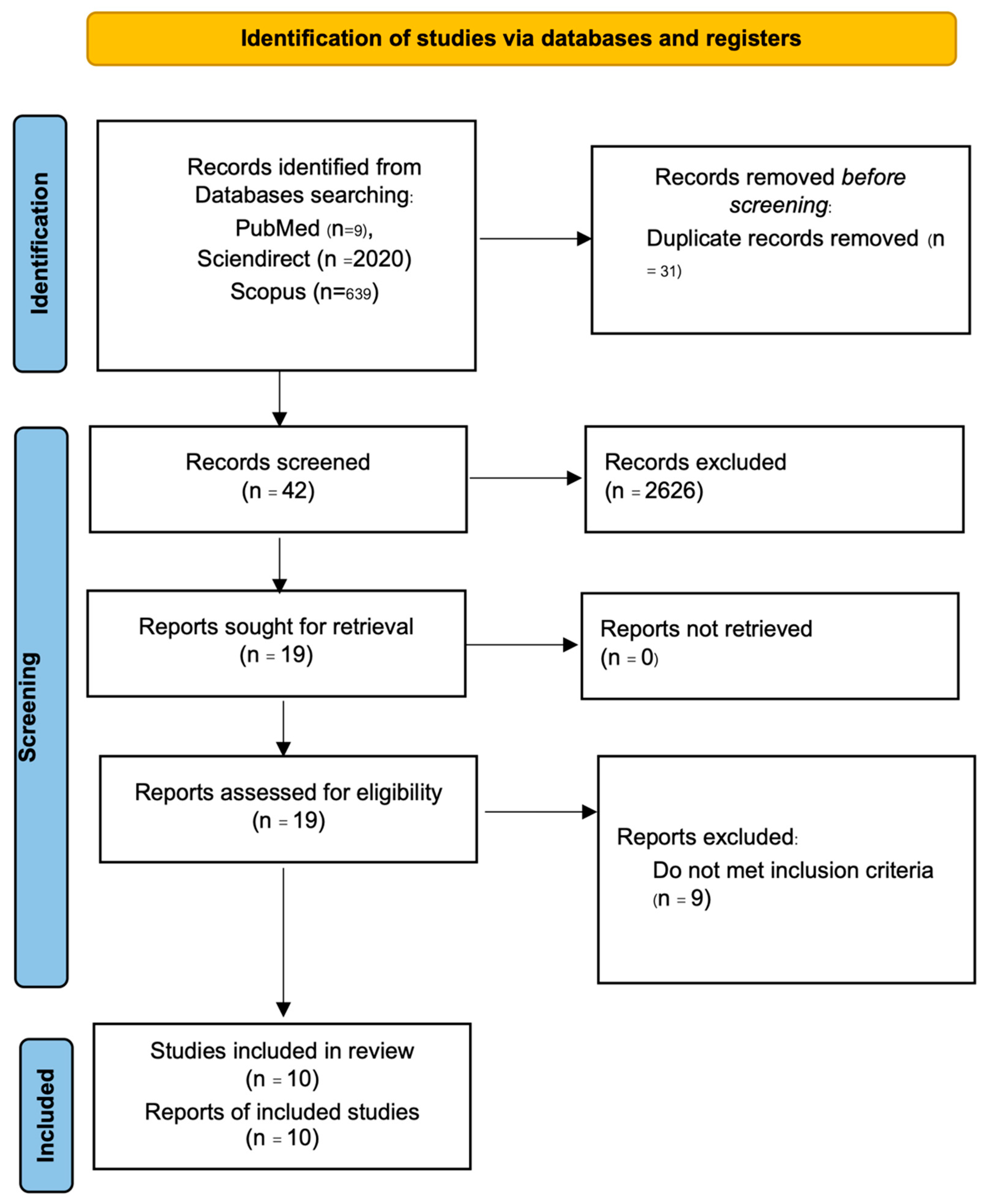
The initial electronic database search yielded 2668 records (ScienceDirect: 2020; Scopus: 639; PubMed: 9). Following the removal of 31 duplicate entries, 2637 unique records remained for title and abstract screening. The screening process resulted in the exclusion of 2626 records deemed irrelevant to the study objectives. Subsequently, 19 reports were identified for full-text retrieval, all of which were successfully acquired. Upon detailed eligibility assessment, 9 studies were excluded due to the absence of standardized measurement tools or incomplete data. Consequently, 10 studies satisfied all inclusion criteria and were incorporated into the final systematic review and meta-analysis (Table 1). The detailed study selection process is illustrated in the PRISMA flow diagram in Figure 1.

3.2. Climate Change Impact and Mental Health Assessment

This systematic review synthesizes evidence from a diverse array of cohort and cross-sectional studies exploring the relationship between climate change-induced extreme weather events and mental health outcomes. The analysis incorporates data from heterogeneous geographic regions, including Africa, Europe, and Australia. The study populations ranged from small, localized cohorts to extensive longitudinal samples, with a specific focus on vulnerable urban communities.
Across the selected literature, mental health outcomes are quantified using validated psychometric instruments. Depression and anxiety were frequently assessed using standardized tools such as the Patient Health Questionnaire (PHQ-2) and the Generalized Anxiety Disorder Scale (GAD-2) [42], while Post-Traumatic Stress Disorder (PTSD) was evaluated using the PTSD Checklist (PCL-6) [43]. General psychological distress was commonly measured using the Kessler-10 (K10) scale [44]. Climate exposure assessment focused on specific extreme events, including flooding, droughts, and heatwaves, with data predominantly derived from in situ field observations.
Analysis of the included studies reveals several potential sources of confounding and bias that may influence the synthesis of results. First, socioeconomic status acted as a significant effect modifier; lower-income individuals frequently exhibited elevated stress and anxiety levels, likely attributable to diminished resource availability for coping with environmental extremes. Second, the presence of pre-existing psychiatric comorbidities may heighten susceptibility to adverse effects, potentially inflating observed associations. Third, regional heterogeneity—driven by disparities in infrastructure, governance, and baseline climate conditions—contributed to variability in impact magnitude. Fourth, cultural variations in the perception of mental health and coping mechanisms may affect the validity of self-reported measures. Notably, standardized Western tools (e.g., PHQ-2, GAD-2) may possess limited cross-cultural validity, potentially leading to the misinterpretation or underreporting of symptoms in diverse populations. Finally, the potential for publication bias—specifically the preferential publication of significant positive associations over null results—suggests a possible overestimation of the aggregate impact of climate-induced extreme weather events on mental health.

3.3. Quality Assessment

The methodological quality of the included studies was appraised using the Newcastle–Ottawa Scale (NOS), yielding aggregate scores ranging from 6 to 9 stars (Table 2). The majority of studies exhibited high methodological fidelity within the Selection and Outcome Assessment domains. However, recurrent limitations were identified in the Comparability domain, primarily attributable to inadequate adjustment for confounding variables or the intrinsic constraints of cross-sectional designs lacking distinct non-exposed cohorts. Studies achieving maximal or near-maximal scores, such as Hieronimi et al. [34], Mulchandani et al. [36], Chan et al. [39], Li et al. [40], and Obradovich et al. [11], demonstrated superior rigor across all domains, thereby offering high reliability and generalizability. Conversely, studies receiving lower cumulative scores, such as Damte et al. [33], Chen and Yuan [37], and Mason et al. [38], exhibited methodological vulnerabilities that warrant a more cautious interpretation of their specific findings.

3.4. Meta-Analysis Results

3.4.1. Impact of Climate Change on Mental Health

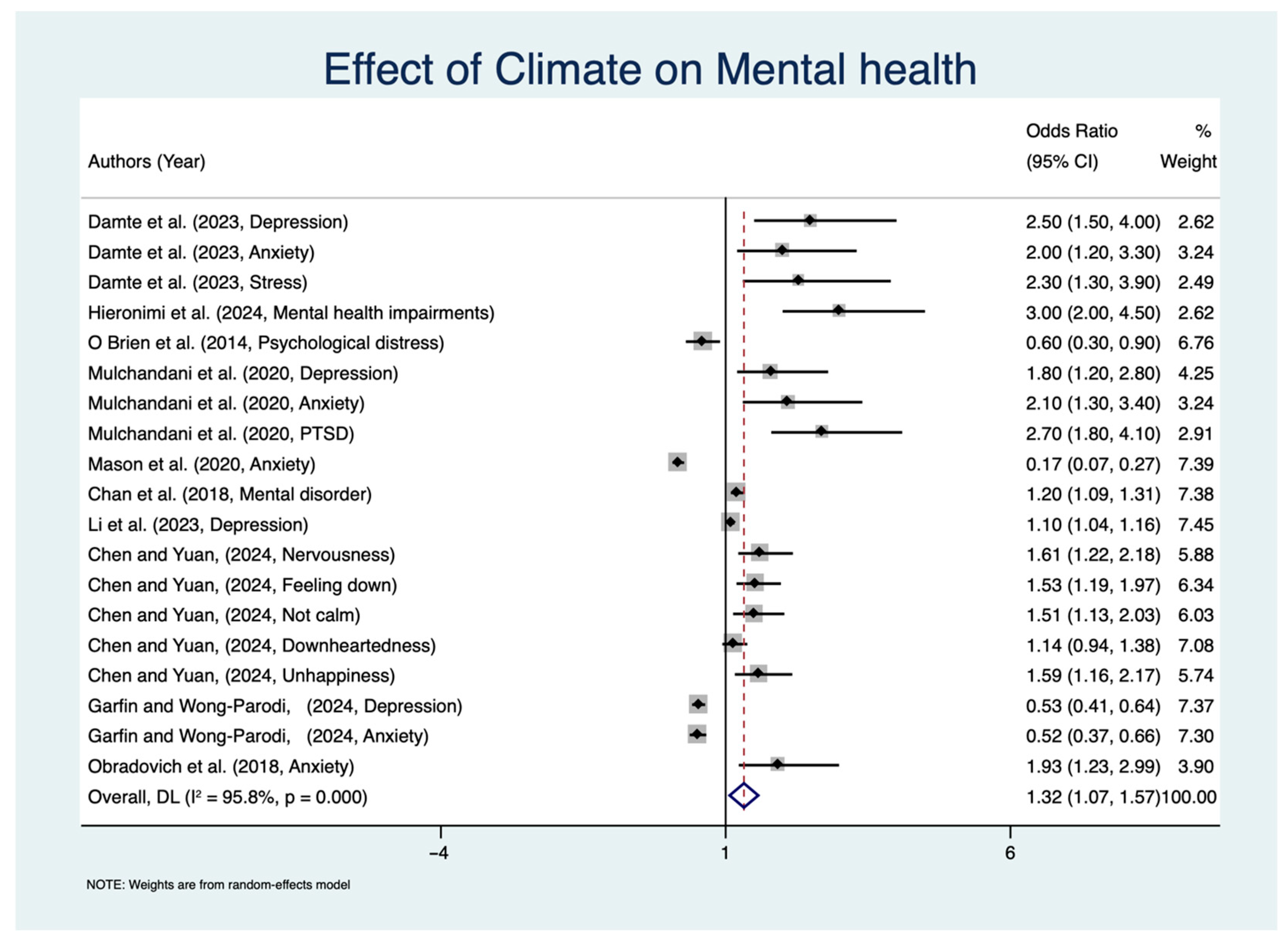
Figure 2 presents the results of the traditional meta-analysis assessing the impact of climate change-induced extreme weather events on mental health. The pooled analysis demonstrated a statistically significant association between exposure and adverse mental health outcomes, yielding a pooled odds ratio of 1.32 (95% CI: 1.07 to 1.57, p < 0.001). This estimate indicates that individuals exposed to extreme weather events exhibit 32% higher odds of experiencing the composite endpoint—comprising depression, anxiety, PTSD, and general distress—compared to non-exposed populations. Individual studies displayed a range of effect estimates (Figure 2). The majority of included studies reported positive associations (increased risk), although the magnitude varied substantially. Notably, studies conducted in Africa and Europe demonstrated the most pronounced adverse associations. In contrast, a single cohort study examining drought-related distress in Australia reported a protective effect. However, the statistical assessment of heterogeneity revealed substantial between-study variability (I2 = 95.8%, p < 0.001), which fundamentally limits the interpretability of this global estimate. This extreme heterogeneity indicates that effect sizes differ significantly across diverse mental health phenotypes and geographic contexts, violating the assumption that included studies estimate a common underlying effect. The calculated 95% prediction interval (PI: 0.62–2.84) quantifies this dispersion: the true effect in a new, comparable study could plausibly range from a 58% reduction to a 215% increase in odds—spanning both protective and harmful directions. This wide interval reflects genuine between-study differences rather than sampling error alone, demonstrating that no single point estimate can adequately characterize the climate–mental health relationship across diverse contexts. Therefore, while the global pooled OR is reported for completeness, it is not interpreted as a universal effect size. Instead, the region-specific subgroup estimates and prediction intervals constitute the primary quantitative conclusions of this meta-analysis.
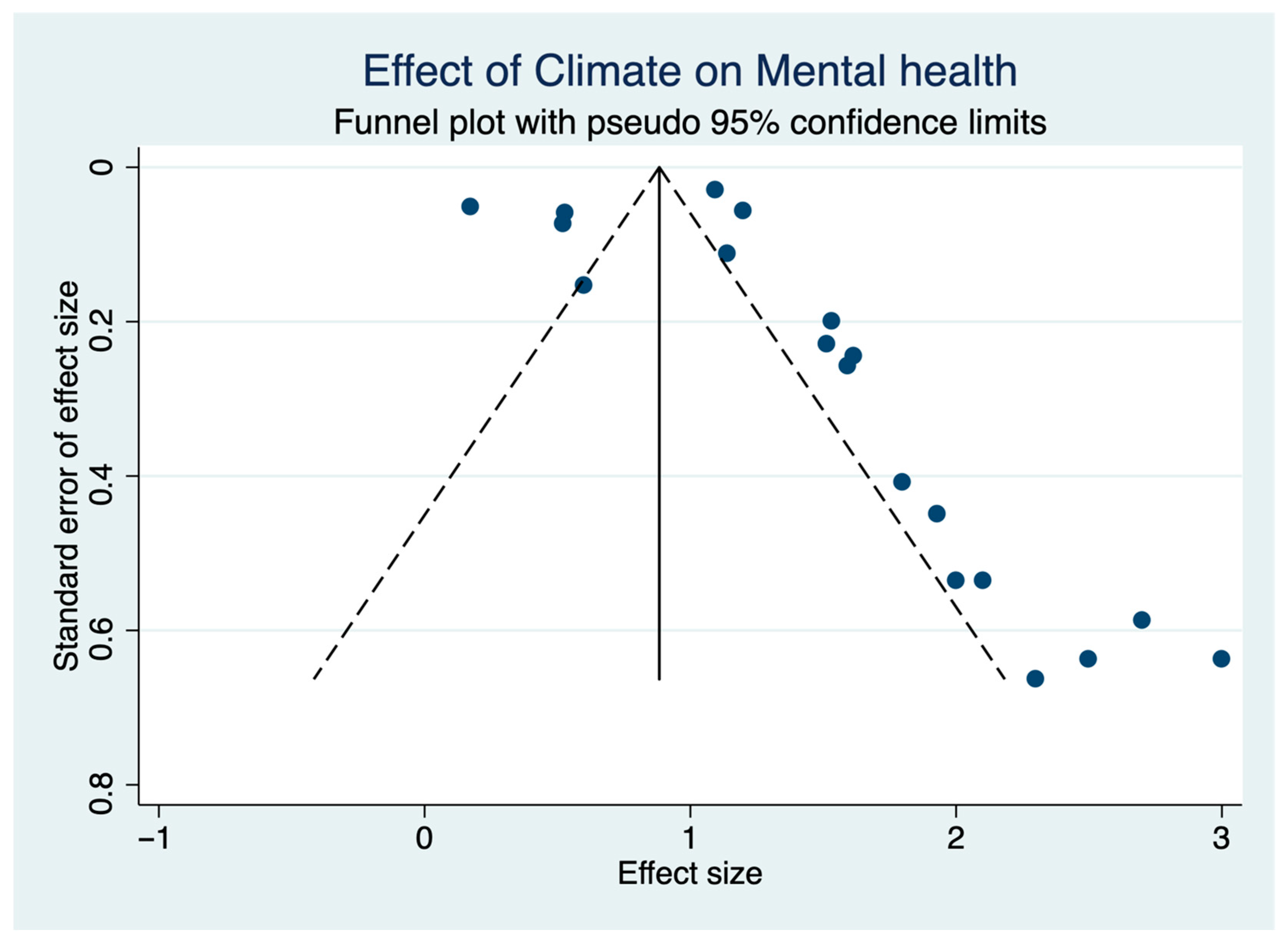
The funnel plot displayed in Figure 3 demonstrates significant asymmetry, with a higher density of studies on the right side of the funnel, indicating the possible existence of publication bias. This pattern is indicative of potential publication bias, suggesting that studies reporting larger effect sizes—reflecting stronger adverse associations between climate impacts and mental health—are differentially selected for publication. The distribution demonstrates that studies with higher standard errors (typically smaller sample sizes) are widely scattered and skewed toward the lower right quadrant, whereas studies with lower standard errors (higher precision) cluster more tightly near the apex. This pronounced asymmetry, particularly evident among lower-precision studies, suggests that the overall pooled estimate may be influenced by small-study effects or selective reporting bias.

3.4.2. Subgroup Analysis

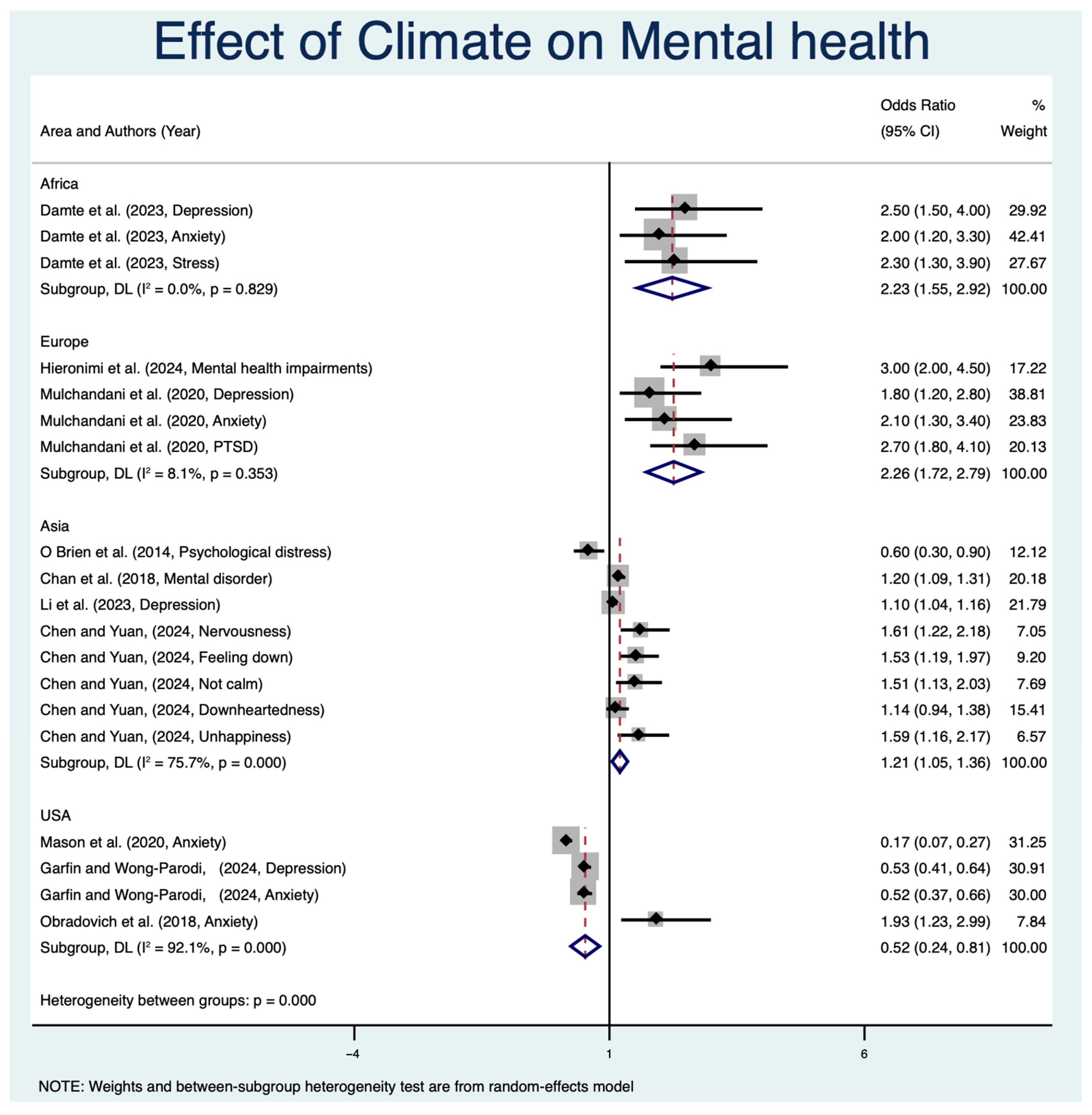
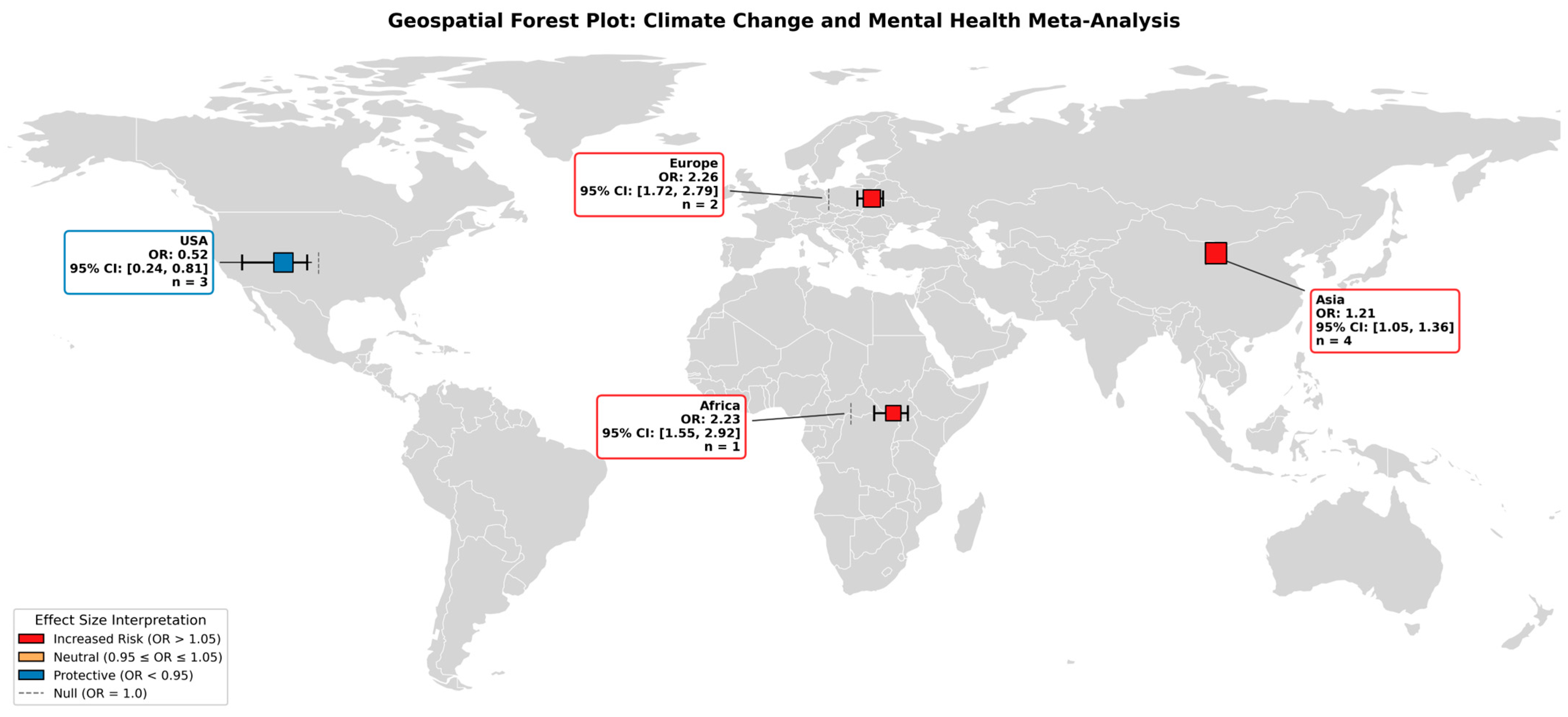
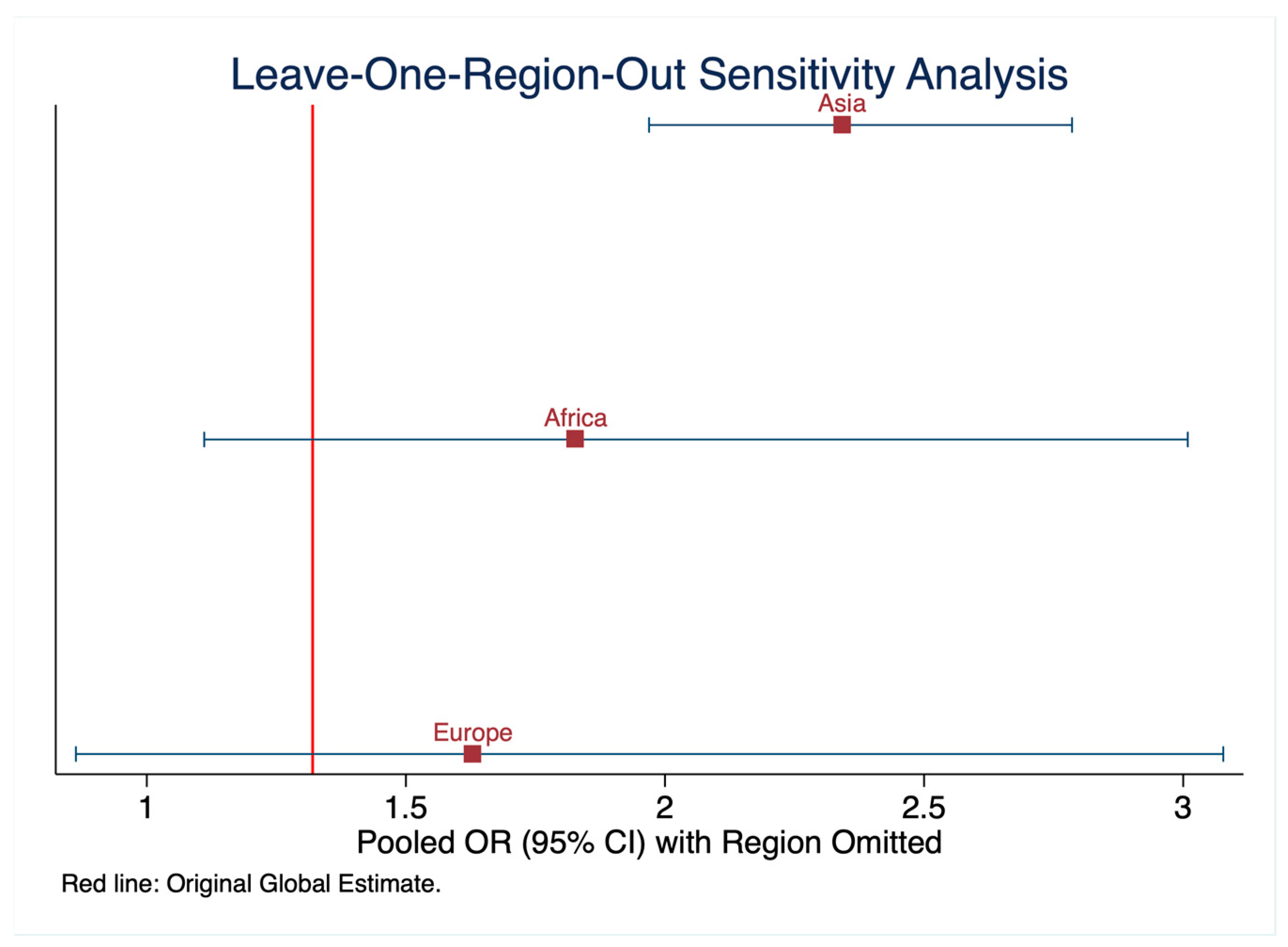
In accordance with the prespecified heterogeneity-management strategy, region-specific subgroup models were treated as the primary inferential estimates of mental health risk associated with climate-induced extreme weather. To quantify the full extent of this variability, we calculated the 95% prediction interval, which estimates the range within which the true effect of a future similar study would likely fall. This extreme heterogeneity underscores that the pooled OR of 1.32 should not be interpreted as a universal effect size applicable to all settings. To elucidate sources of heterogeneity, subgroup analysis was conducted by geographical region (Figure 4). The African subgroup demonstrated a pronounced adverse association (OR = 2.23; 95% CI: 1.55–2.92) with negligible heterogeneity (I2 = 0.0%). Similarly, the European subgroup exhibited a strong association (OR = 2.26; 95% CI: 1.72–2.79) with low heterogeneity (I2 = 8.1%). These consistent regional effects provide more stable and policy-relevant estimates than the global pooled effect. In contrast, the Asian subgroup yielded a modest estimate (OR = 1.21; 95% CI: 1.05–1.36) but with substantial heterogeneity (I2 = 75.7%). Notably, the USA subgroup diverged from global trends (OR = 0.52; 95% CI: 0.24–0.81) with considerable heterogeneity (I2 = 92.1%). This protective trend was primarily driven by Mason et al. [36] (OR = 0.17) and Garfin and Wong-Parodi [39] (OR = 0.52), while Obradovich et al. [11] reported increased risk (OR = 1.93) but held lower weight (7.84%) due to variance structure. Figure 5 presents a geospatial forest plot mapping pooled effect sizes, visually reinforcing the divergence: red markers (Africa, Europe, Asia) indicate increased risk, while the blue marker (USA) indicates reduced risk. A leave-one-region-out sensitivity analysis (Figure 6) confirmed that excluding the USA increased the global pooled OR from 1.32 to 1.58, demonstrating that USA data significantly moderates the overall risk signal. These findings underscore the imperative for region-specific public health strategies to address the psychological sequelae of climate change.

3.4.3. Meta-Regression, Sensitivity, and Bias Assessment

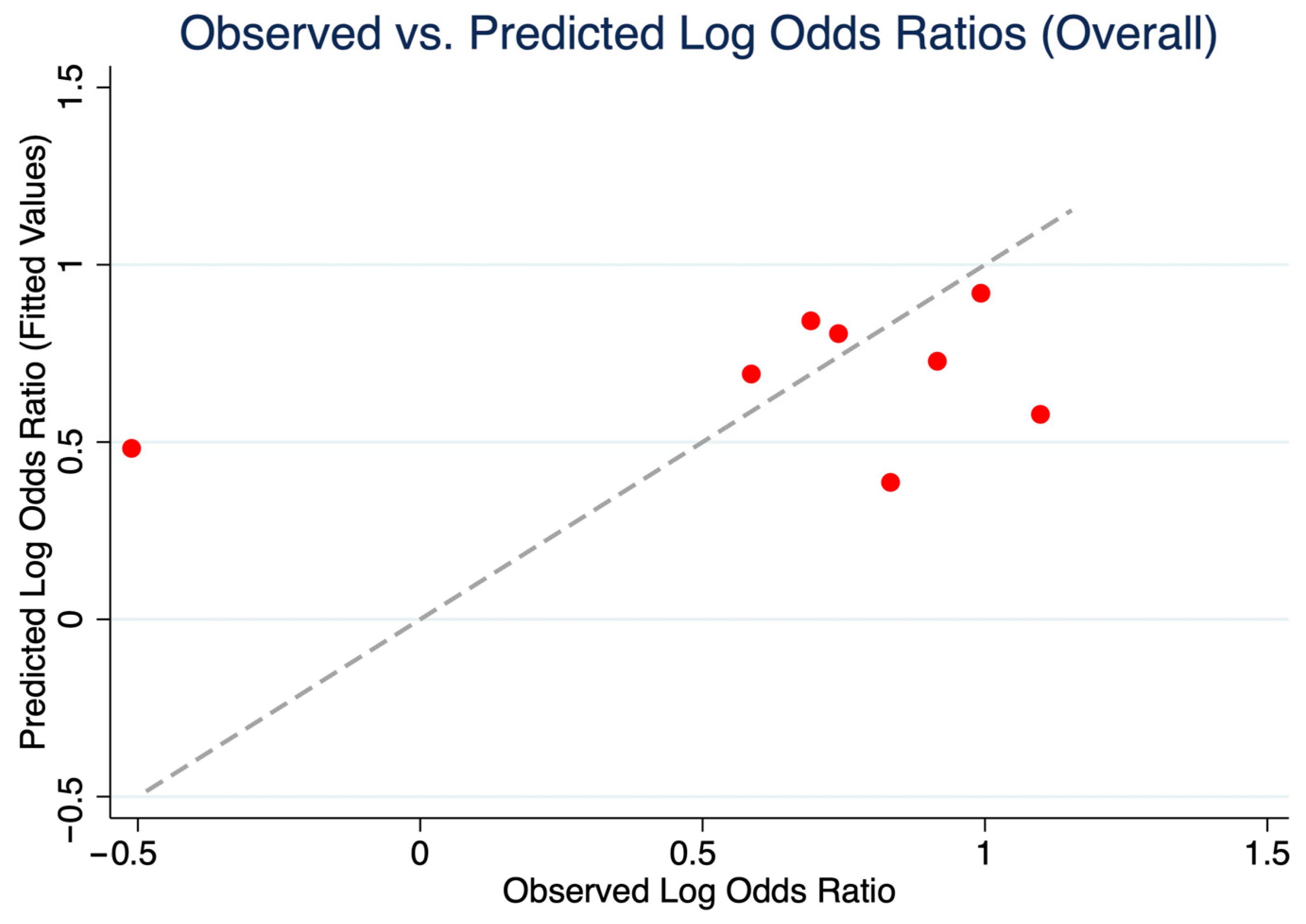
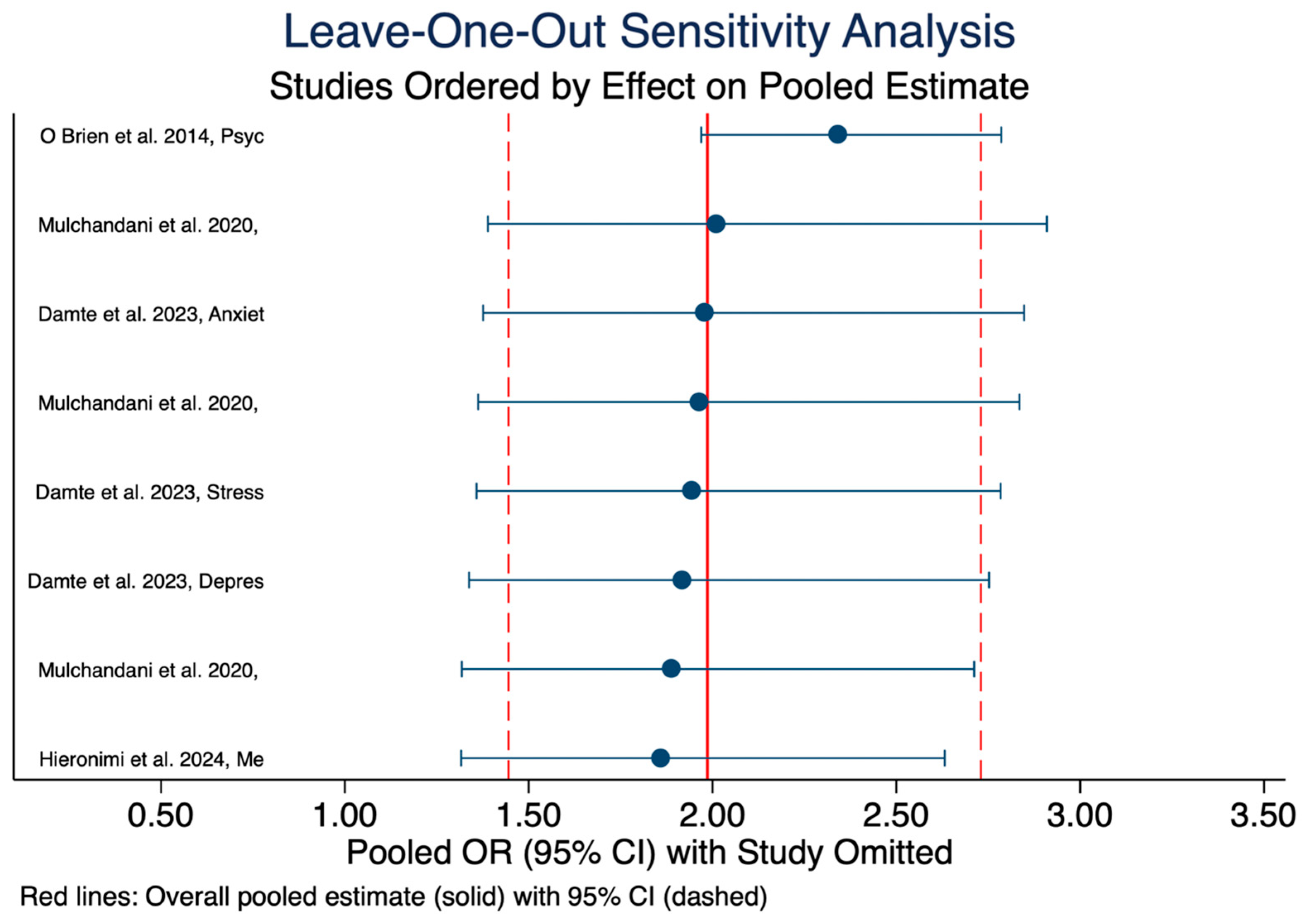
To elucidate potential sources of between-study heterogeneity, a meta-regression analysis was conducted incorporating study-level covariates, specifically geographic region and climate event typology. The model demonstrated that these contextual variables partially explained the observed variance in effect sizes. As illustrated in Figure 7, the predicted log odds ratios derived from the meta-regression model exhibited strong concordance with the observed log odds ratios, indicating a satisfactory model fit. This suggests that the inclusion of regional and event-specific covariates effectively accounts for a portion of the variability in mental health outcomes reported across diverse study contexts. To evaluate the robustness of the aggregate effect estimate, a leave-one-out (LOO) sensitivity analysis was performed (Figure 8). The analysis confirmed the stability of the pooled Odds Ratio (OR); the re-calculated point estimates and their 95% confidence intervals (CI) remained consistent regardless of the exclusion of any single study. All sensitivity estimates fell within the 95% confidence interval of the overall pooled estimate (OR = 1.32; 95% CI: 1.07–1.57). This consistency indicates that no individual study exerted a disproportionate influence on the summary result, thereby reinforcing the reliability of the pooled estimate. However, quantitative assessment of publication bias via Egger’s regression test revealed significant funnel plot asymmetry (intercept = 1.74, p < 0.001). This finding suggests the presence of small-study effects or selective reporting bias. Consequently, while the sensitivity analysis supports the robustness of the calculated mean, the evidence of asymmetry warrants a cautious interpretation of the magnitude of the pooled effect, particularly given the variability in reporting standards and sample sizes across the extant literature.

3.4.4. Bayesian-Meta Analysis

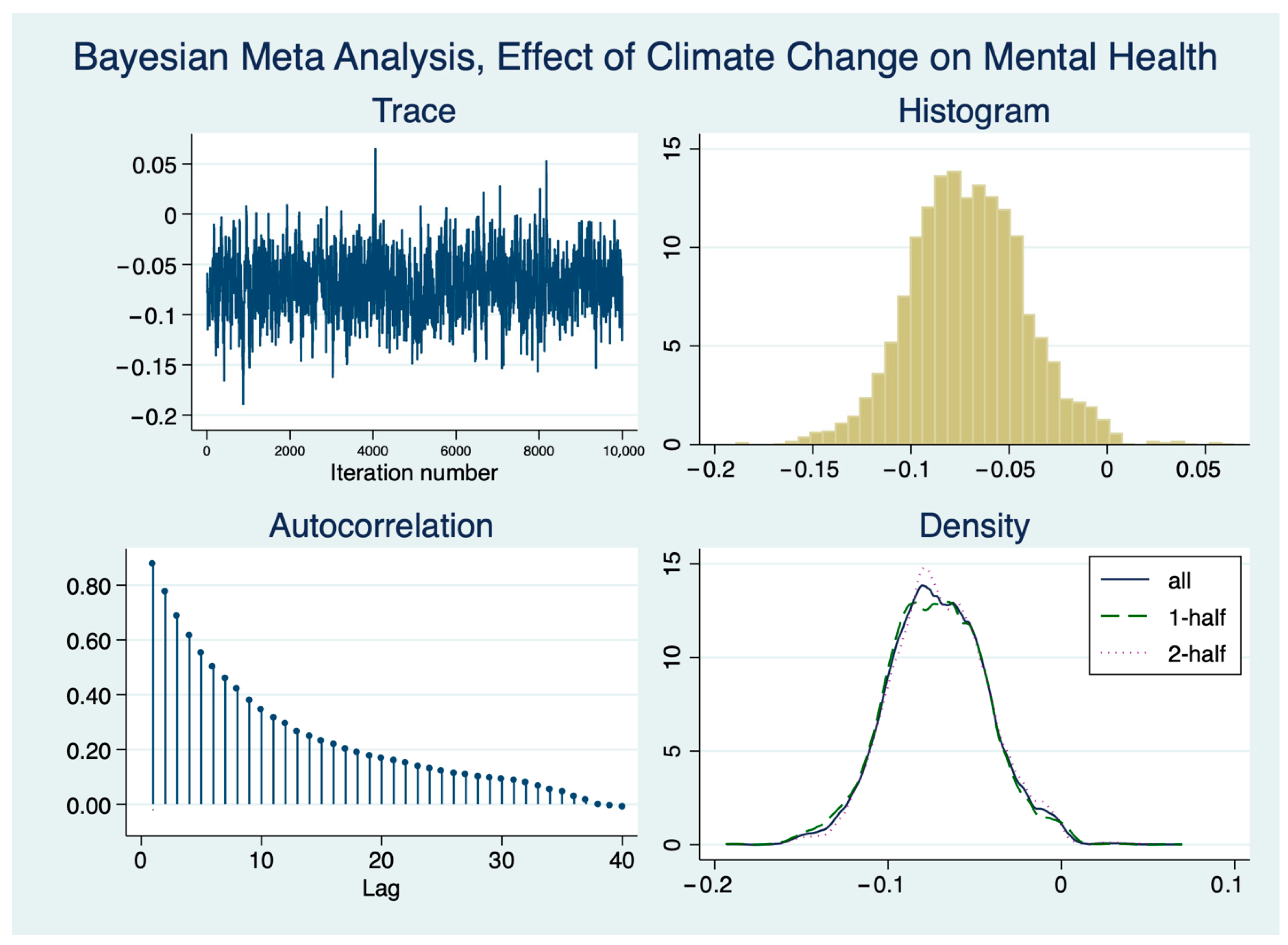
To complement the traditional frequentist analysis, a Bayesian meta-analysis was performed utilizing Markov Chain Monte Carlo (MCMC) simulations to estimate the posterior distributions of effect sizes. This approach provides a probabilistic framework for synthesizing evidence, offering distinct advantages in the handling of parameter uncertainty and the explicit incorporation of prior information. Model convergence was verified through rigorous diagnostic checks (Figure 9). Trace plots demonstrated stationarity with stable parameter oscillation across 10,000 iterations, while autocorrelation plots indicated efficient chain mixing with rapid decay. Furthermore, density plots exhibited smooth, unimodal posterior distributions, confirming the consistency of parameter estimation. Visual inspection of the posterior histogram for the pooled effect size (log-odds scale) revealed a distribution centered slightly below zero, suggesting a potential null or marginally protective overall effect, albeit with considerable uncertainty.
In contrast to the traditional frequentist findings, the Bayesian meta-analysis indicated a slight reduction in the odds of adverse mental health outcomes associated with climate-induced extreme weather. As detailed in Table 3, the overall effect on the log-odds scale was estimated at a mean of −0.08 (95% Credible Interval: −0.14 to −0.02). Upon transformation to the odds ratio scale, the posterior mean effect size was 0.92 (95% Credible Interval: 0.87 to 0.98). Since the 95% Credible Interval excludes the null value of 1.0, this result indicates a statistically credible, albeit modest, protective effect or reduction in the odds of adverse outcomes. Analysis of variance components revealed moderate between-study heterogeneity (mean = 0.41, 95% CrI: 0.18–0.86) and minimal within-study variance (mean = 0.02, 95% CrI: 0.012–0.05).
To validate the stability of this estimate, a comprehensive prior sensitivity analysis was conducted (Table 4). The posterior mean OR remained robust across varying prior specifications, ranging from 0.91 under very diffuse priors to 0.94 under informative priors. Alternative specifications for the heterogeneity parameter, such as using a Half-Normal prior, similarly yielded consistent results (OR = 0.93). This stability confirms that the Bayesian estimate is primarily data-driven—reflecting the high-precision studies from resilient regions—rather than an artifact of prior selection.
A distinct divergence was observed between the two methodological approaches. While the traditional random-effects model estimated a significant 32% increase in risk (OR = 1.32; 95% CI: 1.07 to 1.57), the Bayesian framework yielded a conservative estimate suggesting a reduced risk (OR = 0.92). This discrepancy likely stems from the fundamental methodologies differences; the Bayesian analysis explicitly incorporates prior distributions and handles parameters through partial pooling, which tends to shrink extreme estimates from smaller studies toward the overall mean.
The contrasting findings—increased risk in the traditional model versus a slight reduction in the Bayesian model—underscore the influence of statistical assumptions when synthesizing highly heterogeneous data. The Bayesian analysis corroborated the substantial between-study variability identified in the traditional model (particularly within the Asian subgroup), suggesting that this heterogeneity is intrinsic to the data rather than a methodological artifact. By utilizing non-informative priors, the Bayesian ensured the results remained data-driven while providing a robust counterbalance to the frequentist estimate. Ultimately, the integration of both these complementary analyses offers a comprehensive perspective: the traditional approach highlights potential high-risk scenarios, whereas the Bayesian perspective suggests that, on average, the global risk may be moderated by adaptive factors in specific urban contexts.

3.4.5. Narrative Synthesis of the Selected Studies

The narrative synthesis integrates quantitative effect estimates with qualitative contextual data to elucidate how study design, population demographics, and regional infrastructure modulate the mental health sequelae of climate-induced extreme weather. While the traditional meta-analysis established a significant global association between exposure and adverse outcomes (OR = 1.32), the strength and direction of this relationship were heavily stratified by regional context.
Asia and the USA: Substantial heterogeneity characterized the findings in Asia (I2 = 75.7%) and the USA (I2 = 92.1%), attributed to diverse environmental exposures and methodological disparities. In Asia, variability arose from the wide spectrum of climate events assessed—ranging from heatwaves and cold spells to temperature variability—across heterogeneous urban and rural settings. Furthermore, the diversity in measurement tools, spanning hospital admission records to self-reported scales, likely compounded this variance. Similarly, in the USA, outcomes were influenced by complex interactions between climate stressors (e.g., hurricanes, heatwaves) and social determinants. Mason et al. [38] reported that racial and socioeconomic disparities significantly shaped vulnerability, noting a stronger negative impact of heatwaves on White participants compared to other racial groups in their specific study context. These findings underscore that in large, diverse regions, local social modifiers often outweigh broad climate signals.
Africa and Europe: Conversely, studies in Africa and Europe exhibited consistent, high-magnitude associations (OR > 2.20), reflecting severe regional impacts. In Africa, the elevated risk (OR = 2.23) was driven by the compounded effects of frequent flooding and drought in slum communities, where infrastructural deficits and limited healthcare access exacerbate psychological distress. Similarly, European studies (OR = 2.26) highlighted the long-term mental health burden of flooding and heatwaves. Mulchandani et al. linked persistent home damage and inadequate post-disaster support to sustained depression, anxiety, and PTSD, emphasizing the role of recovery infrastructure in mitigating long-term harm.
Differences in study design also influenced results. Longitudinal studies, such as O’Brien et al. [35]’s assessment of drought in Australia, revealed potential protective effects (OR = 0.60) over time, possibly reflecting adaptation or resilience. In contrast, cross-sectional designs, such as Mason et al. [38], captured acute distress responses (OR = 0.17), offering a snapshot of immediate rather than chronic impacts. Finally, the divergence between the traditional (OR = 1.32) and Bayesian (OR = 0.92) estimates highlights the influence of analytical priors. While the traditional model captures the severe risks observed in highly vulnerable populations, the Bayesian framework, by incorporating prior information, suggests that adaptive capacity in resilient urban centers may moderate the global average risk.

4. Discussion

Our findings align with recent studies underscoring the significant mental health risks posed by climate-induced extreme weather events [45,46,47]. This study uniquely highlights disparities across urban regions, emphasizing the need for region-specific mental health interventions. The traditional meta-analysis indicates an increased risk of adverse mental health outcomes due to extreme weather events (OR = 1.32). However, the Bayesian meta-analysis, while rigorously assessing the data, suggests a slightly different perspective, indicating a slight reduction in this risk (OR = 0.92). The extreme heterogeneity observed (I2 = 95.8%) has critical implications for interpreting these pooled effects. Under I2 > 90%, the assumption that included studies estimate a common “true effect” is untenable; instead, the data reflect a distribution of context-dependent effects. Consequently, the global OR of 1.32 should be interpreted not as a valid estimate of universal risk, but as a weighted average of fundamentally different phenomena—useful for indicating that risk exists somewhere in the literature, but unreliable for quantifying that risk in any specific setting. For policy and clinical applications, the region-specific estimates provide more valid and actionable effect sizes. The African (OR = 2.23, I2 = 0%) and European (OR = 2.26, I2 = 8.1%) subgroups represent relatively homogeneous populations where the pooling assumption holds, yielding stable estimates suitable for intervention planning. We therefore recommend that readers prioritize these subgroup estimates over the global pooled effect when making inferences about climate-related mental health risks. This high variance reflects the complex interplay of three primary drivers: measurement diversity, exposure typology, and population characteristics. First, the variation in measurement tools contributes significantly to between-study heterogeneity. The included studies utilized a spectrum of instruments ranging from specific diagnostic screeners like the PHQ-2 and PCL-6 to broader, non-specific distress scales like the K10 or self-reported questionnaires. These tools measure fundamentally different psychological constructs—acute pathology versus general distress—which naturally yield varying effect sizes. Second, the nature of the climate exposure itself introduces distinct psychological pathways. Acute, traumatic events such as floods and storms often result in immediate, high-intensity outcomes like PTSD, whereas chronic, slow-onset stressors like drought or rising temperatures are more likely to manifest as cumulative psychological distress or anxiety. Pooling these distinct exposure types inevitably increases statistical heterogeneity but accurately reflects the multifaceted nature of climate risk. Third, population characteristics and study designs play a crucial role. Our subgroup analysis demonstrated that regional vulnerability is a major source of variance, with studies in Africa and Europe showing high consistency in adverse outcomes, while studies in the USA and Asia displayed greater internal variability. This suggests that “place” acts as a proxy for unmeasured moderators, such as infrastructure quality, social safety nets, and cultural resilience. Consequently, the high I2 value is not merely statistical noise but a meaningful finding in itself: it underscores that the mental health impact of climate change is highly context-dependent, necessitating local rather than global policy solutions.
Our study’s focus on urban populations adds a unique dimension to the literature, confirming their vulnerability due to determinants such as high population density, social inequalities, and limited healthcare access [48]. The strong association observed in urban settings aligns with previous research highlighting the critical need for targeted mental health interventions and community-based resilience programs in these areas [49,50].
The substantial heterogeneity observed within the Asian (I2 = 75.7%) and USA (I2 = 92.1%) subgroups underscores the non-uniform mental health impacts across these regions. This variability stems from diverse climate conditions (e.g., monsoons, heatwaves), socioeconomic disparities (e.g., healthcare access, recovery resources), and entrenched social inequalities, including racial and ethnic disparities that affect community susceptibility and response capacity [46,51]. Cultural differences in mental health perception and reporting [52], as well as the impact of urbanization on environmental stressors, further contribute to this heterogeneity. The psychological toll is also mediated by social support networks and community resilience [50] and exacerbated by pre-existing mental health conditions [53].
The physical configuration of urban environments significantly shapes mental health risks. Factors such as inadequate drainage, proximity to flood-prone zones, insufficient green space, and the urban heat island effect amplify physical and psychological stress [54,55,56]. Slum communities, for instance, frequently lack basic infrastructure, resulting in chronic exposure and diminished recovery capacity [57,58]. Similarly, high-rise residential structures with inadequate ventilation exacerbate thermal discomfort, adversely affecting well-being. Dense road networks and impermeable surfaces compound flood severity, precipitating trauma and displacement [59,60,61,62]. While urban green spaces can serve as protective factors [63,64,65,66], access remains unequally distributed, compounding social disadvantage with environmental risk [67]. Consequently, recognizing urban infrastructure as a critical mediator is essential for designing effective, equitable health and climate adaptation strategies that embed mental health into resilience planning [68].
A critical finding of this study is the divergence between the traditional meta-analysis (OR = 1.32, 95% CI: 1.07–1.57) and the Bayesian analysis (OR = 0.92, 95% CrI: 0.87–0.98). While this reversal might appear to suggest analytical instability, it instead reflects the distinct influence of high-precision data within the two statistical frameworks [69]. The directional divergence can be traced to the differential treatment of study weights under extreme heterogeneity. In the traditional DerSimonian–Laird random-effects model, each study’s contribution is weighted by the inverse of its total variance (within-study variance plus τ2). When τ2 is large (as indicated by I2 = 95.8%), weights become more equalized, allowing high-effect studies from Africa (OR = 2.23) and Europe (OR = 2.26) to substantially influence the pooled estimate [70,71]. In contrast, the Bayesian hierarchical model applies partial pooling through shrinkage, where study-specific estimates are pulled toward the grand mean in proportion to their precision. Critically, the three USA studies—comprising the largest sample sizes—contributed disproportionately to the likelihood function due to their narrow standard errors. Because these studies reported ORs below 1.0, the Bayesian posterior was anchored toward the protective range [72]. This mechanism was confirmed by our leave-one-region-out sensitivity analysis: excluding USA data shifted the traditional pooled OR from 1.32 to 1.58 (Figure 6), demonstrating that the USA subgroup exerts a strong moderating effect on the global estimate. This divergence does not represent analytical instability. Instability would manifest as sensitivity to minor analytical choices, yet our sensitivity analyses demonstrated robustness: the Bayesian estimate remained stable across six prior specifications (OR range: 0.91–0.94; Table 4), and the traditional estimate was consistent across leave-one-out iterations (Figure 8). The divergence is therefore a deterministic consequence of how each framework handles the inverse correlation between study precision and effect magnitude in our dataset—not stochastic noise. This statistical divergence mirrors the geospatial heterogeneity observed in subgroup analysis. The traditional model captures severe risks in high-vulnerability regions like Africa and Europe, where infrastructural deficits likely overwhelm coping mechanisms [73]. The Bayesian estimate reflects the resilience found in high-income urban centers that dominated the high-precision data [74]. Therefore, the divergence is informative rather than invalidating: the “universal” risk of climate change is spatially conditional. To guide interpretation, we recognize that the two approaches serve complementary functions rather than competing to identify a single “true” effect. The traditional model is better suited for detecting maximum potential risk in vulnerable populations—critical for worst-case scenario planning and resource allocation in high-risk regions. The Bayesian model is better suited for estimating central tendency when accounting for adaptive capacity in resilient settings, while also serving as a check on potential publication bias inflation. For policy applications targeting specific regions, the subgroup estimates (Africa OR = 2.23; Europe OR = 2.26) provide the most valid and actionable effect sizes. Readers should interpret the traditional OR as a signal of risk in vulnerable contexts, while the Bayesian OR highlights the capacity for infrastructural resilience to mitigate distress [75]. Neither estimate is universally “more reliable”—reliability is conditional on the inferential goal.
However, this study is subject to several limitations. The included studies frequently relied on small sample sizes, which can influence Bayesian posterior estimates, potentially resulting in broader credible intervals even when using non-informative priors. Furthermore, the predominance of cross-sectional designs precludes definitive causal inferences, underscoring the necessity for longitudinal inquiry. Our specific focus on urban populations limits the generalizability of findings to rural or peri-urban contexts, and the underrepresentation of specific extreme weather events (e.g., droughts [44], heatwaves [54], or compound events [76,77,78] constrains the comprehensiveness of the analysis. Finally, while Bayesian methods offer robust analytical advantages, their computational complexity and interpretive challenges for non-specialists warrant careful consideration regarding their broader application [79]. Despite these limitations, we acknowledge that extreme heterogeneity (I2 = 95.8%) and the divergence between traditional and Bayesian estimates complicate the interpretation of a single global effect size. However, we contend that this complexity does not preclude actionable conclusions. Rather, it necessitates a stratified interpretation framework. First, the global pooled OR of 1.32 should not be interpreted as a universal effect but as evidence that climate-induced extreme weather is associated with adverse mental health outcomes somewhere in the literature—a finding that justifies continued research and policy attention. Second, the region-specific estimates for Africa (OR = 2.23, I2 = 0%) and Europe (OR = 2.26, I2 = 8.1%) represent stable, homogeneous subgroups where the meta-analytic pooling assumption holds; these estimates are directly actionable for regional policy planning. Third, the Bayesian estimate (OR = 0.92) provides a complementary perspective, indicating that adaptive infrastructure in high-income settings may buffer mental health impacts—information relevant for understanding resilience mechanisms. Finally, the 95% prediction interval (0.62–2.84) transparently communicates the expected range of effects in future studies, enabling appropriate uncertainty quantification. Collectively, these outputs constitute a comprehensive, if nuanced, evidence synthesis that advances understanding beyond what any single point estimate could provide.
Given the extreme heterogeneity and model divergence observed, we explicitly delineate what this analysis can and cannot conclude. This analysis can conclude that climate-induced extreme weather is associated with adverse mental health outcomes, though the magnitude varies substantially by region, and that the substantial heterogeneity is itself a finding demonstrating that impacts are fundamentally place-based. However, this analysis cannot conclude a single, universally applicable global effect size, nor determine which model more accurately reflects “true” risk—both are valid under different assumptions. Additionally, causal directionality cannot be established given the predominance of cross-sectional designs, and whether protective effects in high-income regions reflect true resilience or methodological artifacts remains uncertain. Despite these limitations, this study highlights the critical imperative for mental health interventions and support systems in urban areas impacted by climate-induced extreme weather. Given the observed regional disparities and the divergent methodological findings, public health policies must remain adaptive, accounting for a spectrum of potential outcomes. Interventions should be tailored to specific geographical contexts, targeting the prevalent mental health burdens observed therein. Addressing the spatial patterning of vulnerabilities requires the integration of urban planning and health geography. City-level policies should prioritize infrastructure enhancements that mitigate environmental exposure and psychological stress—such as improving drainage systems, expanding urban green space, and ameliorating the urban heat island effect. Targeted investments in community cooling centers and decentralized mental health services can ensure equitable access for vulnerable populations. By embedding mental health into climate-resilient urban infrastructure, policymakers can reduce chronic stress, enhance psychological coping, and protect at-risk populations from compounding environmental harms.

5. Conclusions

This systematic review and meta-analysis examined the mental health impacts of climate-induced extreme weather events on urban populations. Our principal finding is not a single effect size, but rather the demonstration that climate-related mental health risk is fundamentally heterogeneous and context-dependent. The traditional meta-analysis estimated a 32% increase in odds (OR = 1.32, 95% CI: 1.07–1.57), while the Bayesian analysis yielded a contrasting estimate suggesting slight risk reduction (OR = 0.92, 95% CrI: 0.87–0.98). This divergence, combined with extreme heterogeneity (I2 = 95.8%), indicates that no single pooled estimate can adequately characterize the global relationship. Rather than representing methodological failure, this instability reflects the genuine complexity of climate-mental health dynamics across diverse socioeconomic and infrastructural contexts. Key conclusions include the following. First, regional disparities constitute the primary actionable finding. Populations in Africa (OR = 2.23) and Europe (OR = 2.26) face substantially elevated and consistent risks, while data from high-income regions suggest these risks can be moderated by adaptive infrastructure. Second, the model divergence is informative, not invalidating. The traditional estimate captures the severe risk signal from vulnerable regions; the Bayesian estimate reflects the moderating influence of resilience in high-precision, high-income settings. Together, they bracket the range of plausible effects. Third, policy must be regionally tailored. Global averages obscure the concentration of risk in specific locales. Resources should be prioritized for regions identified here as most vulnerable (urban Africa and Europe). Under extreme heterogeneity, the statistically valid quantitative conclusion is the identification of structured regional variation in effect estimates rather than a single universal pooled effect size.

Author Contributions

T.A. and N.P.; methodology, T.A.; software, T.A., N.P., and S.S.; validation, T.A. and N.P.; formal analysis, T.A.; investigation, T.A.; resources, T.A., N.P., and S.S.; data curation, T.A. and N.P.; writing—original draft preparation, T.A., N.P., and S.S.; writing—review and editing, T.A.; visualization, S.S.; supervision, T.A.; funding acquisition. All authors have read and agreed to the published version of the manuscript.

Funding

This study was funded by the University of Phayao and the Thailand Science Research and Innovation Fund for financial support.

Data Availability Statement

All data generated or analyzed during this study are included in this article.

Acknowledgments

We are grateful to the librarians at the University of Phayao for their assistance with database searches and document retrieval.

Conflicts of Interest

The authors declare no conflicts of interest.

References

  1. Amnuaylojaroen, T.; Parasin, N. A Machine Learning Perspective on the Climatic and Socioeconomic Determinants of Mental Health in Southeast Asia. World 2025, 6, 48. [Google Scholar] [CrossRef]
  2. Amnuaylojaroen, T. Perspective on the Era of Global Boiling: A Future beyond Global Warming. Adv. Meteorol. 2023, 2023, 5580606. [Google Scholar] [CrossRef]
  3. Amnuaylojaroen, T.; Parasin, N.; Limsakul, A. Projections and Patterns of Heat-Related Mortality Impacts from Climate Change in Southeast Asia. Environ. Res. Commun. 2024, 6, 035019. [Google Scholar] [CrossRef]
  4. Berry, H.L.; Waite, T.D.; Dear, K.B.; Capon, A.G.; Murray, V. The Case for Systems Thinking about Climate Change and Mental Health. Nat. Clim. Change 2018, 8, 282–290. [Google Scholar] [CrossRef]
  5. Palinkas, L.A.; Wong, M. Global Climate Change and Mental Health. Curr. Opin. Psychol. 2020, 32, 12–16. [Google Scholar] [CrossRef] [PubMed]
  6. Amnuaylojaroen, T. Projection of the Precipitation Extremes in Thailand under Climate Change Scenario RCP8.5. Front. Environ. Sci. 2021, 9, 657810. [Google Scholar] [CrossRef]
  7. IPCC. Climate Change 2022: Impacts, Adaptation and Vulnerability; Contribution of Working Group II to the Sixth Assessment Report of the Intergovernmental Panel on Climate Change; Pörtner, H.-O., Roberts, D.C., Tignor, M., et al., Eds.; Cambridge University Press: Cambridge, UK; New York, NY, USA, 2022. [Google Scholar]
  8. Hayes, K.; Blashki, G.; Wiseman, J.; Burke, S.; Reifels, L. Climate Change and Mental Health: Risks, Impacts and Priority Actions. Int. J. Ment. Health Syst. 2018, 12, 28. [Google Scholar] [CrossRef]
  9. Clayton, S. Climate Anxiety: Psychological Responses to Climate Change. J. Anxiety Disord. 2020, 74, 102263. [Google Scholar] [CrossRef]
  10. McMichael, C.; Dasgupta, S.; Ayeb-Karlsson, S.; Kelman, I. A Review of Estimating Population Exposure to Sea-Level Rise and the Relevance for Migration. Environ. Res. Lett. 2020, 15, 123005. [Google Scholar] [CrossRef]
  11. Obradovich, N.; Migliorini, R.; Paulus, M.P.; Rahwan, I. Empirical Evidence of Mental Health Risks Posed by Climate Change. Proc. Natl. Acad. Sci. USA 2018, 115, 10953–10958. [Google Scholar] [CrossRef]
  12. Charlson, F.; van Ommeren, M.; Flaxman, A.; Cornett, J.; Whiteford, H.; Saxena, S. New WHO Prevalence Estimates of Mental Disorders in Conflict Settings: A Systematic Review and Meta-Analysis. Lancet 2019, 394, 240–248. [Google Scholar] [CrossRef] [PubMed]
  13. Tan, J.; Zheng, Y.; Tang, X.; Guo, C.; Li, L.; Song, G.; Zhen, X.; Yuan, D.; Kalkstein, A.J.; Li, F.; et al. The Urban Heat Island and Its Impact on Heat Waves and Human Health in Shanghai. Int. J. Biometeorol. 2010, 54, 75–84. [Google Scholar] [CrossRef]
  14. Parasin, N.; Amnuaylojaroen, T. Development of a Heat Index Related to Air Quality and Meteorology for an Assessment of Work Performance in Thailand’s Urban Areas. Urban Sci. 2023, 7, 124. [Google Scholar] [CrossRef]
  15. Galea, S.; Rockers, P.C.; Saydee, G.; Macauley, R.; Varpilah, S.T.; Kruk, M.E. Persistent Psychopathology in the Wake of Civil War: Long-Term Posttraumatic Stress Disorder in Nimba County, Liberia. Am. J. Public Health 2010, 100, 1745–1751. [Google Scholar] [CrossRef]
  16. Krayenhoff, E.S.; Broadbent, A.M.; Zhao, L.; Georgescu, M.; Middel, A.; Voogt, J.A.; Martilli, A.; Sailor, D.J.; Erell, E. Cooling Hot Cities: A Systematic and Critical Review of the Numerical Modelling Literature. Environ. Res. Lett. 2021, 16, 053007. [Google Scholar] [CrossRef]
  17. Murphy, L.; Markey, K.; O’Donnell, C.; Moloney, M.; Doody, O. The Impact of the COVID-19 Pandemic and Its Related Restrictions on People with Pre-Existent Mental Health Conditions: A Scoping Review. Arch. Psychiatr. Nurs. 2021, 35, 375–394. [Google Scholar] [CrossRef]
  18. Ebi, K.L.; Vanos, J.; Baldwin, J.W.; Bell, J.E.; Hondula, D.M.; Errett, N.A.; Hayes, K.; Reid, C.E.; Saha, S. Extreme Weather and Climate Change: Population Health and Health System Implications. Annu. Rev. Public Health 2021, 42, 293–315. [Google Scholar] [CrossRef] [PubMed]
  19. Islam, S.N.; Winkel, J. Climate Change and Social Inequality; DESA Working Paper No. 152; United Nations Department of Economic and Social Affairs: New York, NY, USA, 2017. [Google Scholar]
  20. Grigorieva, E.A.; Revich, B.A. Health Risks to the Russian Population from Temperature Extremes at the Beginning of the XXI Century. Atmosphere 2021, 12, 1331. [Google Scholar] [CrossRef]
  21. Lowe, S.R.; Bonumwezi, J.L.; Valdespino-Hayden, Z.; Galea, S. Posttraumatic Stress and Depression in the Aftermath of Environmental Disasters: A Review of Quantitative Studies Published in 2018. Curr. Environ. Health Rep. 2019, 6, 344–360. [Google Scholar] [CrossRef]
  22. Kondo, M.C.; Fluehr, J.M.; McKeon, T.; Branas, C.C. Urban Green Space and Its Impact on Human Health. Int. J. Environ. Res. Public Health 2018, 15, 445. [Google Scholar] [CrossRef]
  23. Watts, N.; Amann, M.; Arnell, N.; Ayeb-Karlsson, S.; Beagley, J.; Belesova, K.; Boykoff, M.; Byass, P.; Cai, W.; Campbell-Lendrum, D.; et al. The 2020 Report of The Lancet Countdown on Health and Climate Change: Responding to Converging Crises. Lancet 2021, 397, 129–170. [Google Scholar] [CrossRef]
  24. Goldmann, E.; Galea, S. Mental Health Consequences of Disasters. Annu. Rev. Public Health 2014, 35, 169–183. [Google Scholar] [CrossRef]
  25. Burke, M.; González, F.; Baylis, P.; Heft-Neal, S.; Baysan, C.; Basu, S.; Hsiang, S. Higher Temperatures Increase Suicide Rates in the United States and Mexico. Nat. Clim. Change 2018, 8, 723–729. [Google Scholar] [CrossRef]
  26. Zscheischler, J.; Westra, S.; Van Den Hurk, B.J.; Seneviratne, S.I.; Ward, P.J.; Pitman, A.; AghaKouchak, A.; Bresch, D.N.; Leonard, M.; Wahl, T. Future Climate Risk from Compound Events. Nat. Clim. Change 2018, 8, 469–477. [Google Scholar] [CrossRef]
  27. Page, M.J.; McKenzie, J.E.; Bossuyt, P.M.; Boutron, I.; Hoffmann, T.C.; Mulrow, C.D.; Shamseer, L.; Tetzlaff, J.M.; Akl, E.A.; Brennan, S.E.; et al. The PRISMA 2020 Statement: An Updated Guideline for Reporting Systematic Reviews. BMJ 2021, 372, n71. [Google Scholar] [CrossRef]
  28. Zhang, J.; Yu, K.F. What’s the Relative Risk? A Method of Correcting the Odds Ratio in Cohort Studies of Common Outcomes. JAMA 1998, 280, 1690–1691. [Google Scholar] [CrossRef]
  29. Chinn, S. A simple method for converting an odds ratio to effect size for use in meta-analysis. Stat. Med. 2000, 19, 3127–3131. [Google Scholar] [CrossRef]
  30. Wells, G.A.; Shea, B.; O’Connell, D.; Peterson, J.; Welch, V.; Losos, M.; Tugwell, P. The Newcastle-Ottawa Scale (NOS) for Assessing the Quality of Nonrandomised Studies in Meta-Analyses; The Ottawa Hospital Research Institute: Ottawa, ON, Canada, 2000. [Google Scholar]
  31. Gelman, A.; Carlin, J.B.; Stern, H.S.; Dunson, D.B.; Vehtari, A.; Rubin, D.B. Bayesian Data Analysis; CRC Press: Boca Raton, FL, USA, 1995. [Google Scholar]
  32. Higgins, J.P.; Thompson, S.G.; Spiegelhalter, D.J. A Re-Evaluation of Random-Effects Meta-Analysis. J. R. Stat. Soc. Ser. A Stat. Soc. 2009, 172, 137–159. [Google Scholar] [CrossRef] [PubMed]
  33. Damte, E.; Manteaw, B.O.; Wrigley-Asante, C. Urbanization, Climate Change and Health Vulnerabilities in Slum Communities in Ghana. J. Clim. Change Health 2023, 10, 100189. [Google Scholar] [CrossRef]
  34. Hieronimi, A.; O’Reilly, F.; Schneider, M.; Wermuth, I.; Schulte-Körne, G.; Lagally, L.; Bose-O’Reilly, S.; Danay, E. A Germany-Wide Survey of Caregiving Professionals on Climate Change and Mental Health of Children and Adolescents—Factors Influencing Their Relevance Rating of Extreme Weather Event Associated Mental Health Impairments. BMC Public Health 2024, 24, 345. [Google Scholar] [CrossRef] [PubMed]
  35. O’Brien, L.V.; Berry, H.L.; Coleman, C.; Hanigan, I.C. Drought as a Mental Health Exposure. Environ. Res. 2014, 131, 181–187. [Google Scholar] [CrossRef] [PubMed]
  36. Mulchandani, R.; Armstrong, B.; Beck, C.R.; Waite, T.D.; Amlôt, R.; Kovats, S.; Leonardi, G.; Rubin, G.J.; Oliver, I. The English National Cohort Study of Flooding & Health: Psychological Morbidity at Three Years of Follow-Up. BMC Public Health 2020, 20, 311. [Google Scholar] [CrossRef]
  37. Chen, Y.; Yuan, Y. Examining the Non-Linear Association between Ambient Temperature and Mental Health of Elderly Adults in the Community: Evidence from Guangzhou, China. BMC Public Health 2024, 24, 2064. [Google Scholar] [CrossRef]
  38. Mason, L.R.; Sharma, B.B.; Walters, J.E.; Ekenga, C.C. Mental Health and Weather Extremes in a Southeastern US City: Exploring Group Differences by Race. Int. J. Environ. Res. Public Health 2020, 17, 3411. [Google Scholar] [CrossRef]
  39. Chan, E.Y.Y.; Ho, J.Y.; Hung, H.H.Y.; Liu, S.; Lam, H.C.Y. Health Impact of Climate Change in Cities of Middle-Income Countries: The Case of China. Br. Med. Bull. 2019, 130, 5–24. [Google Scholar] [CrossRef] [PubMed]
  40. Li, X.; Ye, Z.; Lang, H.; Fang, Y. Climate Change and Depressive Disorders in Middle-Aged and Older People in China: A Quasi-Experimental Study. J. Environ. Psychol. 2023, 92, 102162. [Google Scholar] [CrossRef]
  41. Garfin, D.R.; Wong-Parodi, G. Climate Change Anxiety, Hurricane Exposure, and Climate Change Actions and Attitudes: Results from a Representative, Probability-Based Survey of US Gulf Coast Residents. Lancet Planet. Health 2024, 8, e378–e390. [Google Scholar] [CrossRef]
  42. Kroenke, K.; Spitzer, R.L.; Williams, J.B.; Löwe, B. An Ultra-Brief Screening Scale for Anxiety and Depression: The PHQ–4. Psychosomatics 2009, 50, 613–621. [Google Scholar] [CrossRef]
  43. Lang, A.J.; Stein, M.B. An Abbreviated PTSD Checklist for Use as a Screening Instrument in Primary Care. Behav. Res. Ther. 2005, 43, 585–594. [Google Scholar] [CrossRef]
  44. Kessler, R.C.; Barker, P.R.; Colpe, L.J.; Epstein, J.F.; Gfroerer, J.C.; Hiripi, E.; Howes, M.J.; Normand, S.L.; Manderscheid, R.W.; Walters, E.E.; et al. Screening for Serious Mental Illness in the General Population. Arch. Gen. Psychiatry 2003, 60, 184–189. [Google Scholar] [CrossRef]
  45. Clayton, S.; Manning, C.M.; Hodge, C. Beyond Storms & Droughts: The Psychological Impacts of Climate Change; American Psychological Association: Washington, DC, USA; ecoAmerica: Washington, DC, USA, 2014. [Google Scholar]
  46. Dodgen, D.; Donato, D.; Kelly, N.; La Greca, A.; Morganstein, J.; Reser, J.; Ruzek, J.; Schweitzer, S.; Shimamoto, M.M.; Tart, K.; et al. Mental Health and Well-Being. In The Impacts of Climate Change on Human Health in the United States: A Scientific Assessment; Crimmins, A., Balbus, J., Gamble, J.L., Beard, C.B., Bell, J.E., Dodgen, D., Eisen, R.J., Fann, N., Hawkins, M.D., Herring, S.C., et al., Eds.; U.S. Global Change Research Program: Washington, DC, USA, 2016; pp. 239–262. [Google Scholar]
  47. Berry, H.L.; Bowen, K.; Kjellstrom, T. Climate Change and Mental Health: A Causal Pathways Framework. Int. J. Public Health 2010, 55, 123–132. [Google Scholar] [CrossRef] [PubMed]
  48. Klinenberg, E.; Araos, M.; Koslov, L. Sociology and the Climate Crisis. Annu. Rev. Sociol. 2020, 46, 649–669. [Google Scholar] [CrossRef]
  49. Keim, M.E. Building Human Resilience: The Role of Public Health Preparedness and Response as an Adaptation to Climate Change. Am. J. Prev. Med. 2008, 35, 508–516. [Google Scholar] [CrossRef]
  50. Norris, F.H.; Stevens, S.P.; Pfefferbaum, B.; Wyche, K.F.; Pfefferbaum, R.L. Community Resilience as a Metaphor, Theory, Set of Capacities, and Strategy for Disaster Readiness. Am. J. Community Psychol. 2008, 41, 127–150. [Google Scholar] [CrossRef] [PubMed]
  51. Brewer, L.C.; Fortuna, K.L.; Jones, C.; Walker, R.; Hayes, S.N.; Patten, C.A.; Cooper, L.A. Back to the Future: Achieving Health Equity through Health Informatics and Digital Health. JMIR mHealth uHealth 2020, 8, e14512. [Google Scholar] [CrossRef]
  52. Kirmayer, L.J. Cultural Competence and Evidence-Based Practice in Mental Health: Epistemic Communities and the Politics of Pluralism. Soc. Sci. Med. 2012, 75, 249–256. [Google Scholar] [CrossRef]
  53. Schreiber, M.D.; Yin, R.; Omaish, M.; Broderick, J.E. Snapshot from Superstorm Sandy: American Red Cross Mental Health Risk Surveillance in Lower New York State. Ann. Emerg. Med. 2014, 64, 59–65. [Google Scholar] [CrossRef]
  54. Gronlund, C.J.; Zanobetti, A.; Schwartz, J.D.; Wellenius, G.A.; O’Neill, M.S. Heat, Heat Waves, and Hospital Admissions among the Elderly in the United States, 1992–2006. Environ. Health Perspect. 2014, 122, 1187–1192. [Google Scholar] [CrossRef] [PubMed]
  55. Noelke, C.; McGovern, M.; Corsi, D.J.; Jimenez, M.P.; Stern, A.; Wing, I.S.; Berkman, L. Increasing Ambient Temperature Reduces Emotional Well-Being. Environ. Res. 2016, 151, 124–129. [Google Scholar] [CrossRef]
  56. Kjellstrom, T.; Freyberg, C.; Lemke, B.; Otto, M.; Briggs, D. Estimating Population Heat Exposure and Impacts on Working People in Conjunction with Climate Change. Int. J. Biometeorol. 2018, 62, 291–306. [Google Scholar] [CrossRef]
  57. Lilford, R.J.; Oyebode, O.; Satterthwaite, D.; Melendez-Torres, G.J.; Chen, Y.F.; Mberu, B.; Watson, S.I.; Sartori, J.; Ndugwa, R.; Caiaffa, W.; et al. Improving the Health and Welfare of People Who Live in Slums. Lancet 2017, 389, 559–570. [Google Scholar] [CrossRef] [PubMed]
  58. Satterthwaite, D.; Archer, D.; Colenbrander, S.; Dodman, D.; Hardoy, J.; Mitlin, D.; Patel, S. Building Resilience to Climate Change in Informal Settlements. One Earth 2020, 2, 143–156. [Google Scholar] [CrossRef]
  59. Rahman, M.; Ningsheng, C.; Islam, M.M.; Dewan, A.; Iqbal, J.; Washakh, R.M.; Shufeng, T. Flood Susceptibility Assessment in Bangladesh Using Machine Learning and Multi-Criteria Decision Analysis. Earth Syst. Environ. 2019, 3, 585–601. [Google Scholar] [CrossRef]
  60. Stanke, C.; Murray, V.; Amlôt, R.; Nurse, J.; Williams, R. The Effects of Flooding on Mental Health: Outcomes and Recommendations from a Review of the Literature. PLoS Curr. 2012, 4, e4f9f1fa9c3cae. [Google Scholar] [CrossRef]
  61. Miller, J.D.; Hutchins, M. The Impacts of Urbanisation and Climate Change on Urban Flooding and Urban Water Quality: A Review of the Evidence Concerning the United Kingdom. J. Hydrol. Reg. Stud. 2017, 12, 345–362. [Google Scholar] [CrossRef]
  62. Fernandez, A.; Black, J.; Jones, M.; Wilson, L.; Salvador-Carulla, L.; Astell-Burt, T.; Black, D. Flooding and Mental Health: A Systematic Mapping Review. PLoS ONE 2015, 10, e0119929. [Google Scholar] [CrossRef] [PubMed]
  63. South, E.C.; Hohl, B.C.; Kondo, M.C.; MacDonald, J.M.; Branas, C.C. Effect of Greening Vacant Land on Mental Health of Community-Dwelling Adults: A Cluster Randomized Trial. JAMA Netw. Open 2018, 1, e180298. [Google Scholar] [CrossRef]
  64. Carrus, G.; Scopelliti, M.; Lafortezza, R.; Colangelo, G.; Ferrini, F.; Salbitano, F.; Agrimi, M.; Portoghesi, L.; Semenzato, P.; Sanesi, G. Go Greener, Feel Better? The Positive Effects of Biodiversity on the Well-Being of Individuals Visiting Urban and Peri-Urban Green Areas. Landsc. Urban Plan. 2015, 134, 221–228. [Google Scholar] [CrossRef]
  65. Tzoulas, K.; Korpela, K.; Venn, S.; Yli-Pelkonen, V.; Kaźmierczak, A.; Niemela, J.; James, P. Promoting Ecosystem and Human Health in Urban Areas Using Green Infrastructure: A Literature Review. Landsc. Urban Plan. 2007, 81, 167–178. [Google Scholar] [CrossRef]
  66. Sarkar, C.; Webster, C.; Gallacher, J. Residential Greenness and Prevalence of Major Depressive Disorders: A Cross-Sectional, Observational, Associational Study of 94,879 Adult UK Biobank Participants. Lancet Planet. Health 2018, 2, e162–e173. [Google Scholar] [CrossRef]
  67. Wolch, J.R.; Byrne, J.; Newell, J.P. Urban Green Space, Public Health, and Environmental Justice: The Challenge of Making Cities “Just Green Enough”. Landsc. Urban Plan. 2014, 125, 234–244. [Google Scholar] [CrossRef]
  68. Schlosberg, D.; Collins, L.B.; Niemeyer, S. Adaptation Policy and Community Discourse: Risk, Vulnerability, and Just Transformation. Environ. Polit. 2017, 26, 413–437. [Google Scholar] [CrossRef]
  69. Kamel Boulos, M.N.; Wilson, J.P. Geospatial Techniques for Monitoring and Mitigating Climate Change and Its Effects on Human Health. Int. J. Health Geogr. 2023, 22, 2. [Google Scholar] [CrossRef] [PubMed]
  70. Röver, C. Bayesian Random-Effects Meta-Analysis Using the bayesmeta R Package. J. Stat. Softw. 2020, 93, 1–51. [Google Scholar] [CrossRef]
  71. Pappalardo, P.; Ogle, K.; Hamman, E.A.; Bence, J.R.; Hungate, B.A.; Osenberg, C.W. Comparing Traditional and Bayesian Approaches to Ecological Meta-Analysis. Methods Ecol. Evol. 2020, 11, 1286–1295. [Google Scholar] [CrossRef]
  72. Seide, S.E.; Jensen, K.; Kieser, M. A Comparison of Bayesian and Frequentist Methods in Random-Effects Network Meta-Analysis of Binary Data. Res. Synth. Methods 2020, 11, 363–378. [Google Scholar] [CrossRef]
  73. Mao, W.; Agyapong, V.I. The Role of Social Determinants in Mental Health and Resilience After Disasters: Implications for Public Health Policy and Practice. Front. Public Health 2021, 9, 658528. [Google Scholar] [CrossRef]
  74. Makwana, N. Disaster and Its Impact on Mental Health: A Narrative Review. J. Fam. Med. Prim. Care 2019, 8, 3090–3095. [Google Scholar] [CrossRef]
  75. Gur, S.; Weizman, S.; Hermesh, H.; Matalon, A.; Meyerovitch, J.; Krivoy, A. Adherence of Patients with Schizophrenia to Hypothyroidism Treatment. Camb. Prism. Glob. Ment. Health 2023, 10, e91. [Google Scholar] [CrossRef]
  76. Luong, T.T.; Handley, T.; Austin, E.K.; Kiem, A.S.; Rich, J.L.; Kelly, B. New Insights into the Relationship Between Drought and Mental Health Emerging from the Australian Rural Mental Health Study. Front. Psychiatry 2021, 12, 719786. [Google Scholar] [CrossRef]
  77. Mellor, C.; Botchway, S.; Barnes, N.; Gandy, S. Seeding Hope: Restoring Nature to Restore Ourselves. Nature Restoration as an Essential Mental Health Intervention. Int. Rev. Psychiatry 2022, 34, 541–545. [Google Scholar] [CrossRef] [PubMed]
  78. Raymond, C.; Horton, R.M.; Zscheischler, J.; Martius, O.; AghaKouchak, A.; Balch, J.; Bowen, S.G.; Camargo, S.J.; Hess, J.; Kornhuber, K.; et al. Understanding and Managing Connected Extreme Events. Nat. Clim. Change 2020, 10, 611–621. [Google Scholar] [CrossRef]
  79. Vanos, J.K.; Baldwin, J.W.; Jay, O.; Ebi, K.L. Simplicity Lacks Robustness When Projecting Heat-Health Outcomes in a Changing Climate. Nat. Commun. 2020, 11, 6079. [Google Scholar] [CrossRef] [PubMed]
Figure 1. Prisma flow diagram of this study.
Earth 07 00014 g001
Figure 2. Forest plot of the traditional meta-analysis examining the effect of climate change-induced extreme weather events on various mental health outcomes. Squares represent individual study odds ratios (size proportional to study weight); horizontal lines indicate 95% confidence intervals (CIs); the vertical dashed line denotes the null effect (OR = 1); and the diamond represents the pooled effect estimate with its 95% CI [11,33,34,35,36,37,38,39,40,41].
Earth 07 00014 g002
Figure 3. Funnel plot assessing potential publication bias. Each dot represents an individual study plotted by effect size (x-axis) against standard error (y-axis). The vertical solid line indicates the pooled effect estimate, and the dashed diagonal lines represent the pseudo 95% confidence limits. Symmetrical distribution of studies around the vertical line suggests the absence of publication bias.
Earth 07 00014 g003
Figure 4. Subgroup analysis performed from the meta-analysis of the effect of climate change on mental health. Squares represent individual study odds ratios (size proportional to study weight); horizontal lines indicate 95% confidence intervals (CIs); the vertical dashed line denotes the null effect (OR = 1); and the diamond represents the pooled effect estimate with its 95% CI [11,33,34,35,36,37,38,39,40,41].
Earth 07 00014 g004
Figure 5. Geospatial forest plot illustrating regional variations in the mental health impact of climate-induced extreme weather. The dashed vertical line within each plot represents the null value (OR = 1.0), indicating no effect; confidence intervals crossing this line would imply non-significance. Red markers indicate a statistically significant increased risk (OR > 1.05), reflecting high regional vulnerability. The blue marker (USA) indicates a reduced risk or protective effect (OR < 0.95), likely reflecting infrastructural resilience. Orange markers (defined in the legend as 0.95 ≤ OR ≤ 1.05) represent neutral effects, though no regions in this specific analysis fell into this category. Horizontal lines indicate the 95% Confidence Interval (CI).
Earth 07 00014 g005
Figure 6. Leave-one-region-out sensitivity analysis. Each point represents the global pooled Odds Ratio (OR) when the labeled region is excluded, with horizontal blue lines indicating 95% confidence intervals (CIs). The vertical red line represents the original global estimate (OR = 1.32). Notably, excluding the USA subgroup results in a significant increase in the pooled OR (to approx. 1.60).
Earth 07 00014 g006
Figure 7. Meta-regression plot showing observed vs. predicted effect sizes by region and event type. Red dots indicate fitted values from the weighted least squares model. Red dots indicate fitted values from the weighted least squares model. The dashed gray line represents the line of perfect agreement (observed = predicted); proximity of points to this line indicates the goodness of fit of the meta-regression model.
Earth 07 00014 g007
Figure 8. Leave-one-out sensitivity analysis with studies ordered by effect on the pooled estimate. Blue dots represent the pooled odds ratio (OR) when each study is removed; horizontal blue lines indicate corresponding 95% confidence intervals (CIs). The vertical solid red line represents the overall pooled estimate, and the vertical dashed red lines indicate its 95% CI. Studies causing substantial shifts in the pooled OR when omitted are considered influential [33,34,35,36].
Earth 07 00014 g008
Figure 9. Bayesian meta-analysis diagnostic plots for the effect of climate change on mental health.
Earth 07 00014 g009
Table 1. Selected study effect of climate change on mental health.
Authors (Year)Study LocationSample Size (N)Study DesignMeasurement ToolClimate HazardClimate Data Source Mental Health OutcomesEffect Size/Cases ControlsKey Findings
Damte et al. [33]AfricaAdult (120)Mixed
method approach
Structured questionnaires, In-depth interviews, Focus group discussions (FGDs)Flooding, Droughts, Dry spellField dataDepression, Stress, AnxietyOR/Not reportedExtreme weather events in Accra, Ghana, significantly increased mental health issues in slum communities, emphasizing the need for better urban planning and health infrastructure.
Hieronimi et al. [34]EuropeAdult (648)Cross-sectional studyOnline questionnaire via LimeSurveyHeat, storms, heavy precipitation, floods/flooding, and avalanches/mudflowsField dataMental health impairments, specifically focusing on the perceived relevance of these impairments due to EWEβ coefficients/Not reportedCaregiving professionals in Europe highlight the significant mental health impacts of extreme weather events on children and adolescents, stressing the need for improved risk communication.
O’Brien et al. [35]AustraliaAdult (5012)Cohort studyKessler Psychological Distress Scale–10 (K10) DroughtField dataPsychological distressOR/Not reportedSevere droughts in rural Australia lead to increased psychological distress, underscoring the importance of targeted mental health support in affected communities.
Mulchandani et al. [36]EuropeAdult (2126)Cohort studyPatient Health Questionnaire–2 (PHQ-2) for depression, Generalized Anxiety Disorder–2 (GAD-2) for anxiety, PTSD Checklist–6 (PCL-6) for PTSDFloodingField dataDepression, Anxiety, Post-Traumatic Stress Disorder (PTSD)RR/Not reportedFlooding significantly increases long-term mental health issues, such as depression and PTSD, particularly in those with persistent home damage, highlighting the need for early intervention.
Chen and Yuan [37]ChinaEldelry (966)Cross-sectional studyMental Health was measured using the 36-Item Short-Form Health Survey (SF-36), focusing on five items related to emotional well-being (nervousness, feeling down, calmness, downheartedness, happiness)Extreme temperatureField dataNervousness, feeling down, not calm, downheartedness, unhappiness.β coefficients/Not reportedA U-shaped relationship between temperature and mental health was found, with elderly males and low-income groups being most sensitive to high temperatures, worsening their mental health.
Mason et al. [38]USAAdult (442)Cross-sectional studySelf-reported mental health impacts assessed through a 56-item questionnaire, focusing on responses to weather extremes.HeatwaveField datamental disorderOR/Not reportedWeather extremes, particularly summer heatwaves, had a stronger negative impact on mental health in White participants, indicating racial differences in responses to climate impacts.
Chan et al. [39]ChinaAdult and elderly (4460)Cross-sectional studyMental disorder hospitalizations were identified using ICD-9 codes from hospital records.High temperatureField datamental disorders, RR/Cases available (hospitalizations), controls not reportedHigher temperatures were linked to increased hospitalizations for mental disorders, especially among the elderly, with a 1.20 relative risk at 28 °C compared to 19.4 °C.
Li et al. [40]ChinaAdult and elderly (8225)Cohort studyCenter for Epidemiologic Studies Depression Scale–10 (CES-D-10).Temperature variability,
heat waves,
cold spells,
hot nights.
Climate model dataDepressive disordersHR/ Not reportedCold spells and hot nights significantly increased depressive disorder risks among middle-aged and older adults, with a 9.60% excess risk associated with hot nights.
Garfin and Wong-Parodi [41]USAAdult (1479)Cohort studySubscales for cognitive-emotional impairment and perceived climate change experienceHurricaneData on exposure to catastrophic hurricanes rated category 3Mental disorder.β coefficients/Not reportedHurricane-related post-traumatic stress symptoms were highly correlated with general functional impairment. The perceived experience of climate change was associated with climate change actions and attitudes, while cognitive-emotional impairment did not significantly predict actions or attitudes.
Obradovich et al. [11]USAAdult (2 million)Cross-sectional studya self-reported metric from the Center for Disease Control and Prevention’s (CDC) Behavioral Risk Factor Surveillance System (BRFSS)Higher temperatureField dataAnxietyproportion differences/Not reportedA 1 °C increase in average maximum temperatures over five years was associated with a 2% point increase in the prevalence of mental health issues.
Table 2. Quality assessment of the selected study using the Newcastle–Ottawa quality rating scale.
Author (Year)Selection
(Max 4)
Comparability
(Max 2)
Outcome
(Max 3)
Total Score
(Max 9)
Damte et al. [33]3126
Hieronimi et al. [34]4239
O’Brien et al. [35]4138
Mulchandani et al. [36]4239
Chen and Yuan [37]3126
Mason et al. [38]3126
Chan et al. [39]4239
Li et al. [40]4239
Garfin and Wong-Parodi [41]2237
Obradovich et al. [11]4239
Table 3. Summary from Bayesian Meta-Analysis.
ParameterMeanStandard DeviationMCSEMedian95% Credible Interval
Odds Ratio (OR) for Study Effect−0.080.020.001−0.09[−0.14, −0.02]
Intercept for Odds Ratio0.920.0280.00150.92[0.87, 0.98]
Standard Error for Study Effect−0.010.0070.0004−0.01[−0.03, −0.001]
Intercept for Standard Error0.370.080.00370.38[0.20, 0.52]
Variance Components
- Between-study variance0.410.170.0030.37[0.18, 0.86]
- Covariance0.050.030.00070.05[0.007, 0.14]
- Within-study variance0.020.010.00020.02[0.012, 0.05]
Table 4. Prior Sensitivity Analysis for Bayesian Pooled Odds Ratio.
ModelPrior SpecificationPosterior Mean OR95% Credible IntervalInterpretation
A. BaselineEffect: Normal (0, 100) τ: IG (0.001, 0.001)0.920.87–0.98Slight protective effect
B. Shrink prior (more informative)Effect: Normal (0, 1) τ: IG (0.001, 0.001)0.940.89–1.00Pulls toward no effect; prior has modest influence
C. Widen prior (very diffuse)Effect: Normal (0,1000) τ: IG (0.001, 0.001)0.910.86–0.98Nearly identical to baseline; data-dominant
D. Half-Normal prior for τEffect: Normal (0,100) τ: HalfNormal (0, 1)0.930.88–0.99Slightly narrower CrI; lower heterogeneity
E. Weakly-informative priorsEffect: Normal (0, 10) τ: HalfNormal (0, 0.5)0.920.88–0.97Very similar; regularization shrinks CrI
F. Very diffuse priorsEffect: Normal (0, 10,000) τ: IG0.910.85–0.99Fully data-driven; wider CrI
Disclaimer/Publisher’s Note: The statements, opinions and data contained in all publications are solely those of the individual author(s) and contributor(s) and not of MDPI and/or the editor(s). MDPI and/or the editor(s) disclaim responsibility for any injury to people or property resulting from any ideas, methods, instructions or products referred to in the content.