
Natural and Anthropogenic Controls on Chromium Distribution in Surface Waters and Sediments of the Iron Quadrangle, Brazil

 ,
, 
 , ,
, ,  and
and 
Abstract
1. Introduction
2. Materials and Methods
2.1. Study Area
- (i)
- (ii)
- Above this basement complex, the Rio das Velhas Supergroup consists of a sequence of metavolcanic and metasedimentary units, subdivided into the Nova Lima and Maquiné Groups. The former consists of volcano–sedimentary suites, notably carbonaceous schists, banded iron formations (BIFs), phyllites, and metacherts. Conversely, the Maquiné Group is defined by basal metaconglomerates that grade upward into extensive packages of sericitic quartzites, phyllites, and quartz schists, indicating a transition in sedimentary facies and depositional dynamics [36,37].
- (iii)
- The Minas Supergroup overlies the Rio das Velhas Supergroup unconformably and is dominated by pelitic and quartz-rich metasedimentary rocks. It is subdivided into four major stratigraphic units reflecting distinct depositional settings. The Caraça Group forms the basal unit, consisting of metaconglomerates and metarenites indicative of fluvial to shallow marine conditions. The Itabira Group overlies it and is primarily composed of chemical sediments, including itabirites, representing a major phase of iron deposition. The Piracicaba Group follows, characterised by metapelites interbedded with chemical layers. The uppermost Sabará Group consists mainly of terrigenous sediments, including conglomeratic phyllites, and is interpreted as the result of more dynamic depositional conditions associated with tectonic activity during the later stages of basin evolution [38,39].
- (iv)
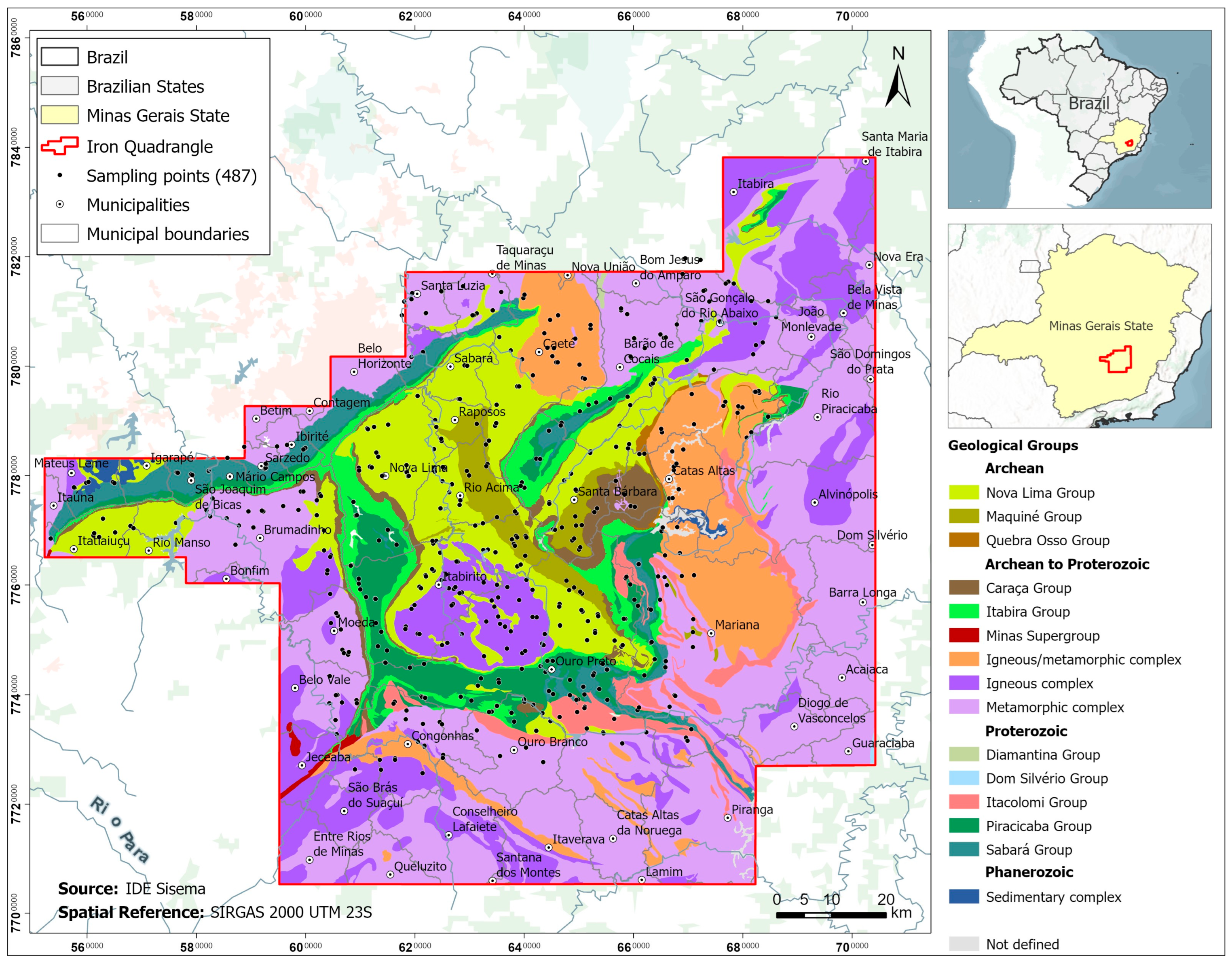
- At the top of this sequence, the Itacolomi Group consists mainly of quartzites and metaconglomerates formed in fluvial–deltaic to shallow-marine depositional settings [38,39]. Also assigned to the Paleoproterozoic, this unit represents a transitional stage in the stratigraphic evolution of the region. Overlying these units, Tertiary and Quaternary deposits consist of unconsolidated sediments related to modern fluvial processes and prolonged weathering, contributing to the present-day geomorphological configuration [38,39]. Figure 1 presents a simplified geological map of the IQ, highlighting the principal lithostratigraphic units described above.
2.2. Sampling
2.3. Chemical Analyses and Quality Control
2.4. Data Analysis
2.5. Pollution Quantification Indices
2.5.1. Contamination Factor Calculation (CF)
2.5.2. Enrichment Factor Calculation (EF)
- -
- Ci is the concentration value of each element in the stream sediment sample;
- -
- CAl represents the concentration of the normalising element, aluminium (Al), in the same sediment sample;
- -
- Bi is the reference geochemical background value of each element (Cr = 131.5 mg·kg−1);
- -
- BAl is the reference geochemical background value of the reference element (Al) [24].
2.6. Geochemical Maps
3. Results
3.1. Elemental Concentrations and Comparative Data
3.2. Sediment Quality Assessment by Pollution Indexes
3.2.1. Contamination Factor (CF)
3.2.2. Enrichment Factor (EF)
4. Discussion
5. Conclusions
Author Contributions
Funding
Data Availability Statement
Conflicts of Interest
References
- An, Y.; Yan, T.; Gong, Q.; Wang, X.; Huang, Y.; Zhang, B.; Yin, Z.; Zhao, X.; Liu, N. Chromium (Cr) geochemical mapping based on fixed-values’ method: Case studies in China. Appl. Geochem. 2022, 136, 105168. [Google Scholar] [CrossRef] [Scilit]
- Zhao, Y.; Kumul, C.; Wang, T.; Mosusu, N.; Yao, Z.; Zhu, Y.; Zhang, B.; Wang, X. National-Scale Geochemical Baseline and Anomalies of Chromium in Papua New Guinea. Minerals 2023, 13, 205. [Google Scholar] [CrossRef] [Scilit]
- Kabata-Pendias, A. Trace Elements in Soils and Plants, 4th ed.; CRC Press: Boca Raton, FL, USA, 2010; p. 548. [Google Scholar] [CrossRef] [Scilit]
- Prasad, S.; Yadav, K.K.; Kumar, S.; Gupta, N.; Cabral-Pinto, M.M.; Rezania, S.; Radwan, N.; Alam, J. Chromium contamination and effect on environmental health and its remediation: A sustainable approaches. J. Environ. Manag. 2021, 285, 112174. [Google Scholar] [CrossRef] [Scilit] [PubMed]
- Kotaś, J.; Stasicka, Z. Chromium occurrence in the environment and methods of its speciation. Environ. Pollut. 2000, 107, 263–283. [Google Scholar] [CrossRef] [Scilit] [PubMed]
- Shahid, M.; Dumat, C.; Khalid, S.; Schreck, E.; Xiong, T.; Niazi, N.K. Foliar heavy metal uptake, toxicity and detoxification in plants: A comparison of foliar and root metal uptake. J. Hazard. Mater. 2017, 325, 36–58. [Google Scholar] [CrossRef] [Scilit] [PubMed]
- Rai, D.; Eary, L.E.; Zachara, J.M. Environmental chemistry of chromium. Sci. Total Environ. 1989, 86, 15–23. [Google Scholar] [CrossRef] [Scilit] [PubMed]
- Richard, F.C.; Bourg, A.C. Aqueous geochemistry of chromium: A review. Water Res. 1991, 25, 807–816. [Google Scholar] [CrossRef] [Scilit]
- Rasool, A.; Pertile, E.; Brožová, K.; Halfar, J.; Čabanová, K.; Malíková, P.; Chromíková, J.; Motyka, O.; Drabinová, S.; Heviánková, S. Mechanistic insights and environmental ramifications of Cr (III) oxidation to Cr (VI) in soil and groundwater systems: Bridging geochemical mechanisms and emerging remediation strategies. Environ. Geochem. Health 2026, 48, 12. [Google Scholar] [CrossRef] [Scilit] [PubMed]
- Ao, M.; Zhou, R.; Meng, R.; Bonaventure, L.A.; Luo, B.; Qian, X.; Xu, X.; Wang, S.; Wu, P. Chromium transformations and biological impacts in aquatic systems: From sediment-water interfaces to food web complexity. Ecotoxicol. Environ. Saf. 2025, 303, 118850. [Google Scholar] [CrossRef] [Scilit] [PubMed]
- U.S. Environmental Protection Agency (USEPA). IRIS Toxicological Review of Hexavalent Chromium (Cr(VI)) (Final Report). 2024. Available online: https://iris.epa.gov/document/&deid=361833 (accessed on 7 February 2026).
- Zhitkovich, A. Chromium in drinking water: Sources, metabolism, and cancer risks. Chem. Res. Toxicol. 2011, 24, 1617–1629. [Google Scholar] [CrossRef] [Scilit] [PubMed]
- ANZECC. Australian and New Zealand Guidelines for Fresh and Marine Water Quality; Australian and New Zealand Environment and Conservation Council and Agriculture and Resource Management Council of Australia and New Zealand: Canberra, Australia, 2000; Volume 1, pp. 1–314. Available online: https://www.waterquality.gov.au/anz-guidelines/guideline-values/default/water-quality-toxicants/toxicants/chromium-2000 (accessed on 4 January 2026). [CrossRef] [Scilit]
- Wang, Z.; Feng, W.; Zhang, J.; Chang, M.; Ma, Y.; Li, H. Integrated effects of water conditions and aging on chromium speciation and availability in two paddy soils spiked with hexavalent chromium. Environ. Pollut. Bioavailab. 2024, 36, 2407382. [Google Scholar] [CrossRef] [Scilit]
- Matschullat, J.; Ottenstein, R.; Reimann, C. Geochemical background—Can we calculate it? Environ. Geol. 2000, 39, 990–1000. [Google Scholar] [CrossRef] [Scilit]
- Pettine, M.; Capri, S. Digestion treatments and risks of Cr (III)–Cr (VI) interconversions during Cr (VI) determination in soils and sediments—A review. Anal. Chim. Acta 2005, 540, 231–238. [Google Scholar] [CrossRef] [Scilit]
- Rakhunde, R.; Deshpande, L.; Juneja, H.D. Chemical speciation of chromium in water: A review. Crit. Rev. Environ. Sci. Technol. 2012, 42, 776–810. [Google Scholar] [CrossRef] [Scilit]
- Zhu, X.; Hu, B.; Jiang, Z.; Wu, Y.; Xiong, S. Speciation of chromium (III) and chromium (VI) by in situ separation and sequential determination with electrothermal vaporization inductively coupled plasma atomic emission spectrometry. Anal. Chim. Acta 2002, 471, 121–126. [Google Scholar] [CrossRef] [Scilit]
- Sricharoenvech, P.; Siebecker, M.G.; Tappero, R.; Landrot, G.; Fischel, M.H.; Sparks, D.L. Chromium speciation and mobility in contaminated coastal urban soils affected by water salinity and redox conditions. J. Hazard. Mater. 2024, 462, 132661. [Google Scholar] [CrossRef] [Scilit] [PubMed]
- Vicq, R.; Leite, M.G.; Leão, L.P.; Nallini Júnior, H.A.; Gomes, P.; Fonseca, R.; Valente, T. Advancing the understanding of sediment contamination dynamics in the Iron Quadrangle (Brazil): A comparative analysis of pollution indices for PTE assessment. Minerals 2025, 15, 199. [Google Scholar] [CrossRef] [Scilit]
- Matschullat, J.; Borba, R.P.; Deschamps, E.; Figueiredo, B.F.; Gabrio, T.; Schwenk, M. Human and environmental contamination in the Iron Quadrangle, Brazil. Appl. Geochem. 2000, 15, 181–190. [Google Scholar] [CrossRef] [Scilit]
- Costa, A.T.; Nalini, H.A., Jr.; Castro, P.D.T.A.; Tatumi, S.H. Análise estratigráfica e distribuição do arsênio em depósitos sedimentares quaternários da porção sudeste do Quadrilátero Ferrífero, bacia do Ribeirão do Carmo, MG. REM Rev. Esc. Minas 2010, 63, 703–714. [Google Scholar] [CrossRef] [Scilit]
- Deschamps, E.; Matschullat, J. Arsenic: Natural and anthropogenic. In Arsenic in the Environment; CRC Press: Boca Raton, FL, USA, 2011; Volume 4, 209p, ISBN 978-0-203-09322-1. [Google Scholar]
- Vicq, R.; Matschullat, J.; Leite, M.G.P.; Nalini Junior, H.A.; Mendonça, F.P.C. Iron Quadrangle stream sediments, Brazil: Geochemical maps and reference values. Environ. Earth Sci. 2015, 74, 4407–4417. [Google Scholar] [CrossRef] [Scilit]
- Costa, R.V.F.; Valente, T.; Leão, L.; Leite, M.; Nalini, H., Jr. O chumbo na Província Mineira do Quadrilátero Ferrífero, Brasil: Mapeamento geoquímico e valores de referência. Comun. Geológicas 2025, 112, 323–327. [Google Scholar] [CrossRef]
- Larizzatti, J.H.; Marques, E.D.; Silveira, F.V. Geochemical Mapping of the Quadrilátero Ferrífero, Brazil and Surroundings; CPRM, 2014; p. 208. ISBN 978-85-7499-153-5. Available online: https://www.researchgate.net/publication/304580521_MAPEAMENTO_GEOQUIMICO_DO_QUADRILATERO_FERRIFERO_E_SEU_ENTORNO_Geochemical_Mapping_of_Iron_Quadrangle_and_Surroundings (accessed on 16 January 2026).
- Instituto Brasileiro de Geografia e Estatística (IBGE). Censo Demográfico do Brasil. 2021. Available online: https://www.ibge.gov.br/cidades-e-estados/mg./ (accessed on 12 January 2026).
- Marques, E.D.; Castro, C.C.; de Assis Barros, R.; Lombello, J.C.; de Souza Marinho, M.; Araújo, J.C.S.; Santos, E.A. Geochemical mapping by stream sediments of the North West portion of Quadrilátero Ferrífero, Brazil: Application of the exploratory data analysis (EDA) and a proposal for generation of new gold targets in Pitangui gold district. J. Geochem. Explor. 2023, 250, 107232. [Google Scholar] [CrossRef] [Scilit]
- Leão, L.P.; Vicq, R.; Nalini, H.A., Jr.; Leite, M.G.P. Mapeamento Geoquímico do Manganês e Avaliação da Qualidade de Sedimentos Fluviais e Águas Superficiais do Quadrilátero Ferrífero, Brasil. In Anuário do Instituto de Geociências; Universidade Federal do Rio de Janeiro: Rio de Janeiro, Brazil, 2019; Volume 42, pp. 444–455. [Google Scholar] [CrossRef] [Scilit]
- Pereira, J.C.; Guimarães-Silva, A.K.; Nalini, H.A., Jr.; Pacheco-Silva, E.; De Lena, J.C. Distribuição, fracionamento e mobilidade de elementos traço em sedimentos superficiais. Quim. Nova 2007, 30, 1249–1255. [Google Scholar] [CrossRef] [Scilit]
- Mendonça, F.P.C. Influência da Mineração na Geoquímica das Águas Superficiais e nos Sedimentos no Alto Curso da Bacia do Ribeirão Mata Porcos, Quadrilátero Ferrífero, Minas Gerais. Master’s Thesis, Federal University of Ouro Preto, Ouro Preto, Brazil, 2012. Available online: https://www.repositorio.ufop.br/items/e50f6cb9-78c9-4ee9-bf9f-4d84b4878e41 (accessed on 18 January 2026).
- Varejão, E.V.; Bellato, C.R.; Fontes, M.P.F.; Mello, J.W.V. Arsenic and trace metals in river water and sediments from southeast portion of Quadrilátero Ferrífero, Brazil. Environ. Monit. Assess. 2010, 172, 631–642. [Google Scholar] [CrossRef] [Scilit] [PubMed]
- Parra, R.R.; Roeser, H.M.P.; Leite, M.G.P.; Nalini, H.A., Jr.; Guimarães, A.T.A.; Pereira, J.C.; Friese, K. Influência antrópica na geoquímica de água e sedimentos do Rio Conceição, Quadrilátero Ferrífero, Minas Gerais—Brasil. Geochim. Bras. 2007, 21, 36–49. [Google Scholar]
- Alkmim, F.F.; Teixeira, W. The Paleoproterozoic Mineiro Belt and the Quadrilátero Ferrífero. In São Francisco Craton, Eastern Brazil. Regional Geology Reviews; Heilbron, M., Cordani, U., Alkmim, F., Eds.; Springer: Cham, Switzerland, 2017. [Google Scholar] [CrossRef] [Scilit]
- Teixeira, W.; Sabate, P.; Barbosa, J.; Noce, C.M.; Carneiro, M.A. Archean and paleoproterozoic tectonic evolution of the São Francisco craton, Brazil. In Tectonic Evolution of South America; Instituto de Geociências, Universidade de São Paulo: Rio de Janeiro, Brazil, 2000; Available online: https://www.researchgate.net/publication/236348451_Archean_and_Paleoproterozoic_tectonic_evolution_of_the_Sao_Francisco_Craton_Brazil (accessed on 15 January 2026).
- Baltazar, O.F.; Zucchetti, M. Lithofacies associations and structural evolution of the Archean Rio das Velhas greenstone belt, Quadrilátero Ferrífero, Brazil: A review of the setting of gold deposits. Ore Geol. Rev. 2007, 32, 471–499. [Google Scholar] [CrossRef] [Scilit]
- Lobato, L.M.; Ribeiro-Rodrigues, L.C.; Zucchetti, M.; Noce, C.M.; Baltazar, O.F.; da Silva, L.C.; Pinto, C.P. Brazil’s premier gold province. Part I: The tectonic, magmatic, and structural setting of the Archean Rio das Velhas greenstone belt, Quadrilátero Ferrífero. Miner. Depos. 2001, 36, 228–248. [Google Scholar] [CrossRef] [Scilit]
- Alkmim, F.F.; Marshak, S. Transamazonian orogeny in the southern São Francisco craton region, Minas Gerais, Brazil: Evidence for Paleoproterozoic collision and collapse in the Quadrilátero Ferrífero. Precambrian Res. 1998, 90, 29–58. [Google Scholar] [CrossRef] [Scilit]
- Endo, I.; Galbiatti, H.F.; Delgado, C.E.R.; Oliveira, M.M.F.; Zapparoli, A.C.; Moura, L.G.B.; Peres, G.G.; Oliveira, A.H.; Zavaglia, G.; Danderfer Filho, A.; et al. Mapa Geológico do Quadrilátero Ferrífero, Minas Gerais, Brasil. Escala 1:150.000: Uma Celebração do Cinquentenário da Obra de Dorr (1969); Departamento de Geologia da Escola de Minas/UFOP—Centro de Estudos Avançados do Quadrilátero Ferrífero: Ouro Preto, Brazil, 2020; Available online: https://qfe2050.ufop.br/sites/default/files/qfe2050/files/quadrilatero_ferrifero_web_5.pdf?m=1724969074 (accessed on 2 February 2026).
- Salminen, R.; Tarvainen, T.; Demetriades, A.; Duris, M.; Fordyce, F.M.; Gregorauskiene, V.; Kahelin, H.; Kivisilla, J.; Klaver, G.; Klein, H.; et al. FOREGS Geochemical Mapping Field Manual; Guide 47; Geological Survey of Finland: Espoo, Finland, 2005; 36p, Available online: https://nora.nerc.ac.uk/id/eprint/19017/1/FOREGSmanual.pdf (accessed on 7 February 2026).
- OHIO Environmental Protection Agency. Sediment Sampling Guide and Methodologies; Ohio—EPA Division of Surface Water: Columbus, OH, USA, 2001; Volume 2, pp. 1–35. Available online: https://clu-in.org/download/contaminantfocus/sediments/sampling-guide-ohio-sedman2001.pdf (accessed on 10 January 2026).
- Albanese, S.; Vivo, B.; Lima, A.; Cicchella, D. Geochemical background and baseline values of toxic elements in stream sediments of Campania region (Italy). J. Geochem. Explor. 2006, 93, 21–34. [Google Scholar] [CrossRef] [Scilit]
- Reimann, C.; de Caritat, P.; GEMAS Project Team; NGSA Project Team. New soil composition data for Europe and Australia: Demonstrating comparability, identifying continental-scale processes and learning lessons for global geochemical mapping. Sci. Total Environ. 2012, 416, 239–252. [Google Scholar] [CrossRef] [Scilit] [PubMed]
- Larizzatti, J.H.; Duarte Marques, E.; Valdir Silveira, F. Geochemical Mapping of Iron Quadrangle region by active stream sediments, State of Minas Gerais, Brazil. Geochim. Bras. 2018, 32, 268–292. [Google Scholar] [CrossRef] [Scilit]
- Carranza, E.J.M. Geochemical anomaly and mineral prospectivity mapping in GIS. In Handbook of Exploration and Environmental Geochemistry; Elsevier: Enschede, The Netherlands, 2009; pp. 3–351. Available online: https://researchonline.jcu.edu.au/40323/ (accessed on 15 January 2026).
- Caritat, P.; Cooper, M. National Geochemical Survey of Australia: The Geochemical Atlas of Australia; Geoscience Australia Record; 2011; Volume 2, 557p, Available online: https://www.researchgate.net/deref/http%3A%2F%2Fdx.doi.org%2F10.11636%2FRecord.2011.020?_tp=eyJjb250ZXh0Ijp7ImZpcnN0UGFnZSI6InB1YmxpY2F0aW9uIiwicGFnZSI6InB1YmxpY2F0aW9uIiwicG9zaXRpb24iOiJwYWdlQ29udGVudCJ9fQ (accessed on 18 January 2026).
- Hakanson, L. An ecological risk index for aquatic pollution control. A sedimentological approach. Water Res. 1980, 14, 975–1001. [Google Scholar] [CrossRef] [Scilit]
- Reimann, C.; de Caritat, P. Distinguishing between natural and anthropogenic sources for elements in the environment: Regional geochemical surveys versus enrichment factors. Sci. Total Environ. 2005, 337, 91–107. [Google Scholar] [CrossRef] [Scilit] [PubMed]
- Wedepohl, K.H. The composition of the continental crust. Geochim. Cosmochim. Acta 1995, 59, 1217–1232. [Google Scholar] [CrossRef] [Scilit]
- Reimann, C.; de Caritat, P. Chemical elements in the environment. In Factsheets for the Geochemist and Environmental Scientist; Springer: Berlin/Heidelberg, Germany, 1998; 398p. [Google Scholar] [CrossRef] [Scilit]
- Birch, G. An assessment of aluminum and iron in normalisation and enrichment procedures for environmental assessment of marine sediment. Sci. Total Environ. 2020, 727, 138123. [Google Scholar] [CrossRef] [Scilit] [PubMed]
- Birch, G. A review and critical assessment of sedimentary metal indices used in determining the magnitude of anthropogenic change in coastal environments. Sci. Total Environ. 2023, 854, 158129. [Google Scholar] [CrossRef] [Scilit] [PubMed]
- Balls, P.; Hull, S.; Miller, B.; Pirie, J.; Proctor, W. Trace metal in Scottish estuarine and coastal sediments. Mar. Pollut. Bull. 1997, 34, 42–50. [Google Scholar] [CrossRef] [Scilit]
- Munoz-Barbosa, A.; Huerta-Diaz, M.A. Trace metal enrichments in nearshore sediments and accumulation in mussels (Modiolus capax) along the eastern coast of Baja California, Mexico: Environmental status in 1995. Mar. Pollut. Bull. 2013, 77, 71–81. [Google Scholar] [CrossRef] [Scilit] [PubMed]
- Rubio, B.; Nombella, M.A.; Vilas, F. Geochemistry of major and trace elements in sediments of the Ria de Vigo (NW Spain): An assessment of metal pollution. Mar. Pollut. Bull. 2000, 40, 968–980. [Google Scholar] [CrossRef] [Scilit]
- Liao, Y.; Li, D.; Zhang, N. Comparison of interpolation models for estimating heavy metals in soils under various spatial characteristics and sampling methods. Trans. GIS 2018, 22, 409–434. [Google Scholar] [CrossRef] [Scilit]
- Ersoy, A. Critical review of the environmental investigation on soil heavy metal contamination. Appl. Ecol. Environ. Res. 2021, 19, 3853–3878. [Google Scholar] [CrossRef] [Scilit]
- Ouabo, R.E.; Sangodoyin, A.Y.; Ogundiran, M.B. Assessment of ordinary Kriging and inverse distance weighting methods for modeling chromium and cadmium soil pollution in E-waste sites in Douala, Cameroon. J. Health Pollut. 2020, 10, 200605. [Google Scholar] [CrossRef] [Scilit] [PubMed]
- Zhang, Y.; Zhang, L.; Lei, Z.; Xiao, F.; Zhou, Y.; Zhao, J.; Qian, X. Analysis of spatial structure and singularity of microbial biogeochemical anomalies in the Taiwan Strait Basin. Front. Mar. Sci. 2024, 11, 1450243. [Google Scholar] [CrossRef] [Scilit]
- Gonçalves, G.H.T. Avaliação Geoambiental de Bacias Contíguas Situadas na Área de Proteção Ambiental Cachoeira das Andorinhas e Floresta Estadual do Uaimii, Ouro Preto-Minas Gerais: Diagnóstico e Percepção Ambiental. Master’s Thesis, Federal University of Ouro Preto, Ouro Preto, Brazil, 2010. Available online: https://www.repositorio.ufop.br/items/219547c6-060e-4a18-9081-009a3f48a4e6 (accessed on 12 December 2025).
- FOREGS. EuroGeoSurveys: Geochemical Baseline Database, Geochemical Atlas of Europe. 2005. Available online: http://weppi.gtk.fi/publ/foregsatlas/ (accessed on 3 March 2026).
- Caritat, P.D. The national geochemical survey of Australia: Review and impact. Geochem. Explor. Environ. Anal. 2022, 22, geochem2022-032. Available online: https://www.lyellcollection.org/doi/full/10.1144/geochem2022-032 (accessed on 27 December 2025). [CrossRef] [Scilit]
- Ferreira, A.; Inácio, M.; Morgado, P.; Batista, M.; Ferreira, L.; Pereira, V.; Pinto, M. Low-density geochemical mapping in Portugal. Appl. Geochem. 2001, 16, 1323–1331. [Google Scholar] [CrossRef] [Scilit]
- Cevik, F.; Goksu, M.Z.L.; Derici, O.B.; Fındık, O. An assessment of metal pollution in surface sediments of Seyhan dam by using enrichment factor, geoaccumulation index and statistical analyses. Environ. Monit. Assess. 2009, 152, 309–317. [Google Scholar] [PubMed]
- Duodu, G.O.; Goonetilleke, A.; Ayoko, G.A. Comparison of pollution indices for the assessment of heavy metal in Brisbane River sediment. Environ. Pollut. 2016, 219, 1077–1091. [Google Scholar] [CrossRef] [Scilit] [PubMed]
- Brady, J.P.; Ayoko, G.A.; Martens, W.N.; Goonetilleke, A. Development of a hybrid pollution index for heavy metals in marine and estuarine sediments. Environ. Monit. Assess. 2015, 187, 306. [Google Scholar] [CrossRef] [Scilit] [PubMed]
- APA Sul RMBH. Projeto Apa Sul RMBH: Estudos do meio físico: Mapas Geoquímicos escala 1:225.000. Belo Horizonte: 2005. Fernanda G. da Cunha, Gilberto J. Machado—Belo Horizonte: SEMAD/CPRM, 2005. 80p, v.7:17 Mapas (Série Programa Informações Básicas Para a Gestão Territorial—GATE). 2005. Available online: https://rigeo.sgb.gov.br/items/6a3d5208-c6c5-4084-8f99-e63cb67451d6/full (accessed on 2 December 2025).
- Silva, D.D.C.; Bellato, C.R.; Marques, J.D.O.; Fontes, M.P. Arsenic and trace metals in water and sediment of the Velhas river, Southeastern Iron Quadrangle region, Minas Gerais, Brazil. Quím. Nova 2018, 41, 1011–1018. [Google Scholar] [CrossRef] [Scilit]
- Paraguassú, L.; Leite, M.G.; Moreira, F.W.; Mendonça, F.P.; Eskinazi-Sant’Anna, E.M. Impacts of mining in artificial lake of Iron Quadrangle-MG: Past marks and changes of the present. Environ. Earth Sci. 2019, 78, 167. [Google Scholar] [CrossRef] [Scilit]
- Gorny, J.; Billon, G.; Noiriel, C.; Dumoulin, D.; Lesven, L.; Madé, B. Chromium behavior in aquatic environments: A review. Environ. Rev. 2016, 24, 503–516. [Google Scholar] [CrossRef] [Scilit]
- Li, Z.; Li, X.; Wang, S.; Che, F.; Zhang, Y.; Yang, P.; Zhang, J.; Liu, Y.; Guo, H.; Fu, Z. Adsorption and desorption of heavy metals at water sediment interface based on bayesian model. J. Environ. Manag. 2023, 329, 117035. [Google Scholar] [CrossRef] [Scilit]
- Carneiro, M.A.; Carvalho Júnior, I.M.; Teixeira, W. Petrologia, geoquímica e geocronologia dos diques máficos do complexo metamórfico Bonfim Setentrional (Quadrilátero Ferrífero) e suas implicações na evolução crustaL do Cráton do São Francisco Meridional. Rev. Bras. Geociências 1998, 28, 29–44. [Google Scholar] [CrossRef] [Scilit]
- Georgaki, M.N.; Charalambous, M.; Kazakis, N.; Talias, M.A.; Georgakis, C.; Papamitsou, T.; Mytiglaki, C. Chromium in water and carcinogenic human health risk. Environments 2023, 10, 33. [Google Scholar] [CrossRef] [Scilit]



| Class | Value | Description |
|---|---|---|
| 1 | EF < 2 | No enrichment |
| 2 | 2 < EF < 5 | Moderate enrichment |
| 3 | 5 < EF < 20 | Severe enrichment |
| 4 | 20 < EF < 40 | Very Severe enrichment |
| 5 | EF ≥ 40 | Extremely severe enrichment |
| Min | Q1 | Median | Q3 (Reference Value) | Max | Mean | Pereira et al. (2007) [30] Min–Max | Gonçalves (2010) [60] Min–Max | Mendonça (2012) [31] Min–Max | |
|---|---|---|---|---|---|---|---|---|---|
| Cr (mg·kg−1) Sediments | <0.22 | 34.90 | 74.30 | 131.50 | 2.581 | 134.41 | 30–510 | 197–632 | 8–198 |
| Cr (µg·L−1) Surface Waters | <5.30 | 8.50 | 8.50 | 55.70 | 384.7 | 43.78 | ----- | 7–12.1 | <LLD |
| Sediments (mg·kg−1) | Surface Waters (µg·L−1) | Classification of Reference Values | |
|---|---|---|---|
| Cr | >0.20–131.50 | >5.30–55.70 | Reference Values (Min–Q3) |
| >131.50–276.40 | >55.70–126.50 | High Reference Values (Q3–UIF) | |
| >276.40 | >126.50 | Anomalies (>UIF) |
| Cr | |
|---|---|
| Minimum | 0.02 |
| Maximum | 19.63 |
| Percentage of Element Samples by Class | |
| Absence of contamination | 74.9 |
| Moderate contamination | 20.9 |
| Considerable contamination | 2.1 |
| High contamination | 2.1 |
| Cr | |
|---|---|
| Minimum | 0.02 |
| Maximum | 85.98 |
| Percentage of Element Samples by Class | |
| No enrichment | 68.2 |
| Moderate enrichment | 23.4 |
| Severe enrichment | 6.8 |
| Very severe enrichment | 1.4 |
| Extremely severe enrichment | 0.2 |
Disclaimer/Publisher’s Note: The statements, opinions and data contained in all publications are solely those of the individual author(s) and contributor(s) and not of MDPI and/or the editor(s). MDPI and/or the editor(s) disclaim responsibility for any injury to people or property resulting from any ideas, methods, instructions or products referred to in the content. |
© 2026 by the authors. Licensee MDPI, Basel, Switzerland. This article is an open access article distributed under the terms and conditions of the Creative Commons Attribution (CC BY) license.
Share and Cite
Vicq, R.; Leite, M.G.P.; Leão, L.P.; Nalini Júnior, H.A.; da Cunha e Silva, D.C.; de Paula Nicomedes, N.; Fonseca, R.; Valente, T. Natural and Anthropogenic Controls on Chromium Distribution in Surface Waters and Sediments of the Iron Quadrangle, Brazil. Pollutants 2026, 6, 38. https://doi.org/10.3390/pollutants6030038
Vicq R, Leite MGP, Leão LP, Nalini Júnior HA, da Cunha e Silva DC, de Paula Nicomedes N, Fonseca R, Valente T. Natural and Anthropogenic Controls on Chromium Distribution in Surface Waters and Sediments of the Iron Quadrangle, Brazil. Pollutants. 2026; 6(3):38. https://doi.org/10.3390/pollutants6030038
Chicago/Turabian StyleVicq, Raphael, Mariangela G. P. Leite, Lucas P. Leão, Herminio A. Nalini Júnior, Darllan Collins da Cunha e Silva, Nícholas de Paula Nicomedes, Rita Fonseca, and Teresa Valente. 2026. "Natural and Anthropogenic Controls on Chromium Distribution in Surface Waters and Sediments of the Iron Quadrangle, Brazil" Pollutants 6, no. 3: 38. https://doi.org/10.3390/pollutants6030038
APA StyleVicq, R., Leite, M. G. P., Leão, L. P., Nalini Júnior, H. A., da Cunha e Silva, D. C., de Paula Nicomedes, N., Fonseca, R., & Valente, T. (2026). Natural and Anthropogenic Controls on Chromium Distribution in Surface Waters and Sediments of the Iron Quadrangle, Brazil. Pollutants, 6(3), 38. https://doi.org/10.3390/pollutants6030038