Article

Life Cycle Management of Moroccan Cannabis Seed Oil: A Global Approach Integrating ISO Standards for Sustainable Production


1
Laboratory of Spectroscopy, Molecular Modeling, Materials, Nanomaterials, Water and Environment, High National School of Arts and Crafts (ENSAM), Mohammed V University in Rabat, Rabat 10100, Morocco
2
Information Systems and Technology Engineering Laboratory (LISTI), National School of Applied Sciences of Agadir (ENSA), Agadir 80000, Morocco
3
Higher School of Education and Training, Chouaib Doukkali University, El Jadida 24000, Morocco
4
Interdisciplinary Applied Research Laboratory, International University of Agadir, Universiapolis, Agadir 80000, Morocco
5
Laboratory of Spectroscopy, Molecular Modeling Materials, Nanomaterials Water and Environment—Center for Water, Natural Resources, Environment and Sustainable Development (CERNE2D), Faculty of Sciences, Mohammed V University in Rabat, Rabat 10100, Morocco
*
Author to whom correspondence should be addressed.
Pollutants 2026, 6(2), 22; https://doi.org/10.3390/pollutants6020022
Submission received: 26 December 2025 / Revised: 24 February 2026 / Accepted: 1 April 2026 / Published: 10 April 2026
(This article belongs to the Section Environmental Systems and Management)

Abstract

Morocco’s recent legalization of industrial and medicinal cannabis has created a rapidly expanding seed-oil sector whose sustainability has yet to be fully assessed. This study applies an environmental life cycle assessment (LCA) in accordance with ISO 14040:2006 and ISO 14044:2006, complemented by a qualitative social responsibility assessment based on ISO 26000:2010, aiming to evaluate the life cycle sustainability of Moroccan cannabis seed oil. Three representative processing chains, traditional artisanal presses, producer cooperatives and regulated industrial plants are compared using a functional unit of 1 kg of cold-pressed oil packaged for local distribution. Inventory data were drawn from field measurements and interviews and were modeled in OpenLCA with background datasets from Ecoinvent 3.8 and Agribalyse v3.1. Impact assessment used the ReCiPe 2016 (H) method at the midpoint level across nine categories (climate change, fossil resource scarcity, water use, freshwater eutrophication, terrestrial acidification, land occupation, carcinogenic, non-carcinogenic human toxicity, and fine particulate matter formation). Sensitivity analyses varied seed yield, electricity mix and transport distances by ±20% to gauge uncertainty. Results show that the cooperative scenario achieves the lowest impacts across nearly all categories because of higher extraction yields (3 kg seed per kg oil), lower energy use (0.54 kWh kg−1 oil) and more effective co-product recovery. In contrast, artisanal extraction requires approximately 1 kg of additional seed input per functional unit compared to optimized scenarios, significantly increasing upstream environmental burdens and causing upstream agricultural burdens to multiply. Industrial facilities perform comparably to cooperatives if powered by renewable electricity. Integrating a semi-quantitative social responsibility assessment reveals that legalization has markedly improved organizational governance, labor conditions, consumer protection and community involvement. Cooperatives display the most balanced social performance, whereas industrial plants excel in governance and quality control. A set of recommendations, including drip irrigation, cultivar improvement, co-product valorisation, renewable energy adoption, eco-designed packaging and cooperative governance, is proposed to enhance the environmental and socio-economic sustainability of Morocco’s emerging cannabis seed-oil industry.

1. Introduction

Cannabis sativa L. is traditionally cultivated for its fibers, seeds, and phytochemical compounds for medical use, which are then processed into oils for the food, cosmetic, and nutraceutical industries [1]. In recent years, global demand for non-psychoactive cannabis products has continued to grow, prompting many governments around the world to establish specific regulatory frameworks.
The global market for cannabis-derived products has experienced sustained growth over the past decade, driven primarily by applications in food, cosmetics, and nutraceuticals [2,3]. According to recent market analyses, the global hemp seed oil market was valued at approximately US$ 3.26 billion in 2025 and is expected to reach US$ 15.63 billion by 2034, representing a compound annual growth rate (CAGR) of approximately 18.7% [4]. The cannabis-based cosmetics segment was worth US$ 7.24 billion in 2025 and is expected to reach US$ 28.97 billion by 2030 (CAGR ≈ 31.8%) [5]. Similarly, the CBD-based nutraceuticals market was valued at US$ 8.99 billion in 2024 and is expected to reach US$ 19.04 billion by 2030, with a CAGR of approximately 12.6% [6]. These figures highlight the rapid expansion and diversification of the cannabis derivatives market. In Morocco, the adoption of Law No. 13-21 in 2021 [7] represented a significant regulatory shift, legalizing the cultivation of cannabis for industrial, medical, and pharmaceutical purposes [8], with the aim of organizing the sector, improving rural incomes, and developing high-value-added agro-industrial sectors.
Nevertheless, despite this regulatory framework, various environmental and social issues are emerging in connection with cannabis cultivation and processing. Agricultural activities associated with this sector, particularly in arid areas, are placing additional pressure on natural resources [9]. The diversity of agricultural practices and cannabis processing techniques also contributes to significant heterogeneity in environmental performance [10,11,12,13]. In addition, the recent formalization of this industry has been accompanied by profound changes within the sector [14,15].
Cannabis cultivation requires significant water inputs; field experiments in South Africa measured 28.4 L plant−1 day−1 for outdoor cannabis [16]. Traditional gravity irrigation in Moroccan farms consumes 2000–3000 L kg−1 of dry biomass [17], while drip irrigation can reduce water use by 30–50%. The use of nitrogen fertilizers produces nitrous oxide (N2O), whose global warming potential is 273 times that of CO2 [18].
The promotion of the Moroccan local variety (landrace) “Beldia” is not only a socio-cultural imperative, but is also based on rigorous scientific and agronomic foundations, defined as genetically heterogeneous populations adapted to specific agro-ecological niches; local varieties generally exhibit high tolerance to abiotic stress and stable yields under low-input systems [19]. Beldia fits this definition perfectly, having evolved through generations of cultivation in the northern Rif Mountains, in semi-arid climates and on structurally poor soils.
Biochemically speaking, recent studies confirm the exceptional nutritional value of this variety. Seeds from the Jebha region have an oil content of 32.81% and a protein content of 24.84%, with a particularly favorable fatty acid profile. Rich in polyunsaturated fatty acids (63.8%), Beldia oil contains 51.02% linoleic acid (LA) and 16.46% α-linolenic acid (ALA), resulting in an n-6/n-3 ratio close to 3:1, which is considered optimal for human physiological balance [20]. In addition, its high concentration of total tocopherols (450.82 mg/kg), dominated by gamma-tocopherol, gives it a higher antioxidant potential than many European or Canadian industrial varieties.
From an agronomic perspective, although its grain yield under traditional conditions is modest (0.7 to 0.9 t/ha), Beldia shows structural resilience to climate change. Its intrinsic tolerance to drought and low vulnerability to pests and diseases facilitate its integration into sustainable agricultural systems [20]. Life cycle assessments (LCAs) indicate that irrigation and fertilization are the main drivers of the environmental footprint of cannabis oil production [17]. Consequently, Beldia’s ability to perform under restricted irrigation conditions represents a decisive ecological advantage over more demanding imported varieties. This sustainability is reinforced by its carbon sequestration potential, estimated at between 3.15 and 3.68 t CO2/ha, and by its deep root system, which limits soil erosion in mountainous areas [19]. Although the environmental footprint per kilogram of oil is initially higher than that of sunflower or rapeseed [21], owing to lower yields and greater land requirements, Beldia oil partially offsets this impact through its high nutritional density and the presence of value-added bioactive compounds [20]. Optimizing this sector through participatory breeding programs would increase yields while preserving local robustness, thereby automatically reducing the climate impact per unit produced. Finally, the transition to a legal framework under the supervision of ANRAC is radically transforming the sector’s socio-economic paradigm. The shift from an informal market to a regulated industry not only ensures consumer safety through certified traceability but also promotes a more equitable distribution of value. The integration of small producers into cooperatives and the return to the use of the Beldia variety are the pillars of an integrated territorial development strategy aimed at alleviating rural poverty while preserving the ecological integrity of the Rif ecosystem.
Life cycle assessment (LCA) is a methodological benchmark for the environmental assessment of food systems [22]. However, studies devoted to cannabis seed oil remain rare and are generally limited to partial environmental assessments, without explicit consideration of social and institutional dimensions. In addition, data on regional variations in cannabis production and processing practices in Morocco remain limited in the scientific literature, which constitutes a significant gap in terms of the needs required to effectively inform public policy.
In this context, the objective of this study is to evaluate and compare the environmental and social performance of the main methods of cannabis seed oil production in Morocco, namely traditional artisanal pressing, the cooperative model, and regulated industrial production. Environmental aspects are analyzed using a life cycle assessment in accordance with ISO 14040:2006 and ISO 14044:2006 standards [23,24]. Social dimensions are assessed through a qualitative analysis based on the social responsibility methodology described in ISO 26000:2010 [25]. The life cycle management approach adopted in this study makes it possible to identify critical environmental issues and social issues associated with the legalization of the cannabis seed oil sector, as well as to formulate recommendations for the sustainable development of this new industry in Morocco.

2. Materials and Methods

2.1. Life Cycle Assessment Framework

The LCA was conducted according to principles described in ISO 14040:2006 and 14044:2006 [23,24], which consisted of four steps: (a) goal and scope definition, (b) life cycle inventory (LCI), (c) life cycle impact assessment (LCIA), and (d) interpretation. The goal was to assess and compare, using LCA, the environmental performance of cannabis seed oil production in Morocco using three different routes of processing. The functional unit (FU) is 1 kg of packaged, cold-pressed cannabis seed oil. The scope of the system covers the entire cannabis seed oil value chain, from cultivation to local distribution. However, the quantitative assessment of environmental impacts (LCIA) is deliberately limited to the processing module (cleaning, pressing, filtration, and packaging), for which reliable primary data is available. This choice does not imply that cultivation is environmentally negligible, but reflects a methodological decision to avoid misleading quantitative results based on heterogeneous secondary agricultural datasets. The upstream (cultivation) and downstream (transport, use, and end-of-life) phases are analyzed qualitatively and through sensitivity analyses, in accordance with the recommendations of ISO 14044:2006.
For impact assessment, the ReCiPe 2016 Midpoint (H) method with global normalization was adopted [26]. Nine categories relevant to agri-food systems were selected: climate change (kg CO2 eq.), fossil resource scarcity (kg oil eq.), water use (m3), freshwater eutrophication (kg P eq.), terrestrial acidification (kg SO2 eq.), land occupation (m2·year), human toxicity (carcinogenic and non-carcinogenic, kg 1,4-DCB eq.) and fine particulate matter formation (kg PM2.5 eq.). The selection of impact categories was guided by LCA studies on food systems, which consistently identify climate change, water consumption, land use, and eutrophication as the main environmental hotspots in agri-food chains [27]. Inventory data were modeled in OpenLCA 2.4 with background datasets from Agribalyse v3.1 and ecoinvent 3.8 using the cut-off system model. A deterministic sensitivity analysis was performed by applying a range of variation of ±20% around the reference values for key parameters identified as influential and/or uncertain, namely seed yield, the electricity mix used during cold extraction, and transport distances. This range of variation was chosen as a conservative screening value, commonly used in life cycle assessment studies when detailed statistical information on uncertainty is not available, particularly for agricultural data and process-specific parameters. This approach, based on parametric variation scenarios, is consistent with the recommendations of ISO 14044:2006 and with the reference literature on LCA, which recognizes sensitivity analyses by scenarios as an appropriate method for assessing the robustness of results in the face of data uncertainty [28,29].
The selection of the nine ReCiPe 2016 (H) midpoint categories used in this study is justified by their relevance to agri-food systems and agriculture [26,27]. Climate change, terrestrial acidification and freshwater eutrophication are directly linked to fertilizer use, soil emissions and energy consumption during cultivation and processing [27]. Water use is essential in the Moroccan Rif context, where irrigation represents a major environmental hotspot [30]. Fossil resource scarcity and fine particulate matter formation capture the indirect effects of energy generation, transport and machinery operation [31], which differ substantially between artisanal and industrial systems.
Land occupation was included due to cannabis relatively low seed yield compared to other oil crops, which amplifies land-related burdens at low productivity levels [32,33]. Finally, human toxicity (carcinogenic and non-carcinogenic) reflects exposure to emissions linked to fertilizer production, diesel combustion and electricity generation. These categories align with ReCiPe 2016 recommendations for agricultural and bio-based product systems and are widely used in published LCAs of oilseed crops [26], including sunflower, rapeseed and soybean [34].
The other midpoint categories in ReCiPe (e.g., ionizing radiation, ozone depletion, marine eutrophication) were calculated but not discussed, reported in Table A1, due to their limited relevance to open-field cannabis cultivation and local cold-pressed oil extraction under Moroccan conditions, as well as the absence of significant contributing flows in the inventory, as shown in Table 1 [35]. This selective approach is consistent with the recommendations of ISO 14044:2006 [24], provided that the exclusions are justified in a transparent manner.
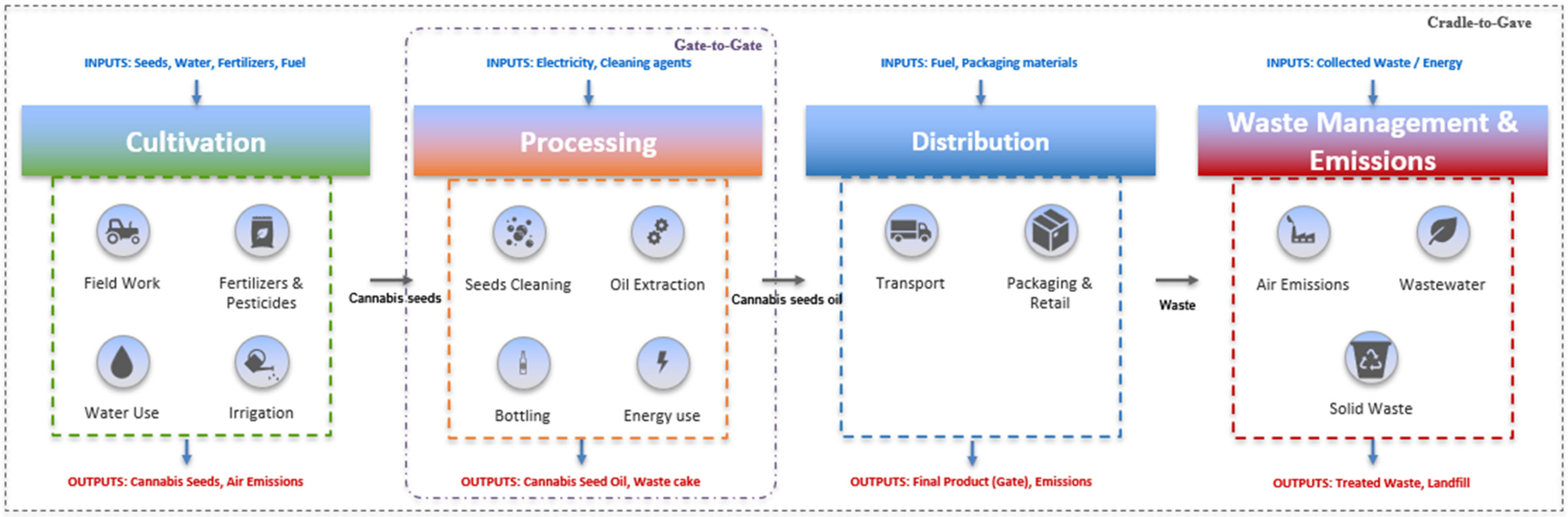
The quantitative assessment of environmental impacts (LCA) carried out in this study is strictly limited to a “gate-to-gate” scope, covering the stages of seed cleaning, cold pressing, filtration, and packaging. The upstream (cannabis cultivation) and downstream (distribution, use, and end-of-life of products) phases are not included in the quantitative calculation of environmental impacts. Data relating to these stages are used exclusively to ensure functional consistency between the service provided (1 kg of cannabis seed oil) and the necessary material flows, and are processed qualitatively and, where appropriate, by sensitivity analyses, in accordance with the principles and terminology of ISO 14040:2006 and ISO 14044:2006.
This disintegration is due to the high variability of usage profiles (storage duration, storage conditions), distribution scenarios (local market vs. Export), and packaging waste management channels [27], for which specific data representative of the Moroccan context remains limited. The inclusion of these stages would have introduced significant uncertainties that could obscure the levers for improvement that can be directly controlled by production stakeholders.
However, the potential implications of the downstream stages are discussed qualitatively in Section 4 in order to provide a broader view of the impacts and to guide future research and improvement prospects.

2.2. Description of Scenarios

Three extraction scenarios were modeled:
  • Artisanal extraction in small decentralized presses operated by farmers or cottage industries. Yields are low, requiring 4.4 kg of seeds per kilogram of oil. Electricity consumption averages 0.9 kwh FU−1 [36], co-product recovery is limited and losses reach 0.6 kg per functional unit.
  • Cooperative extraction in medium-scale facilities where producers pool resources. Improved cleaning and pressing equipment increase the extraction yield to 3.0 kg seeds kg−1 oil, energy demand drops to 0.54 kwh FU−1 and losses are reduced to 0.15 kg. Cooperatives use a mix of electricity and primary energy (e.g., diesel) and share packaging infrastructure [37].
  • Industrial extraction in large-scale plants with high throughput. Seed consumption is similar to cooperatives (3.0 kg FU−1), but energy demand can vary depending on technology. In this study, 0.9 kwh FU−1 of electricity and 0.05 m3 of cooling water were assumed [38,39]. Industrial operations are better positioned to integrate renewable electricity and recycled glass packaging [40].
Data were obtained from interviews with Moroccan farmers, cooperatives and a processing plant in Casablanca. Measurements of electricity and water consumption were taken from meters; transport distances were estimated by GPS. When primary data were unavailable, values from peer-reviewed literature on cannabis cultivation and oil extraction were used. Agricultural inputs and yields were based on field measurements: artisanal farms cultivate roughly 0.5 ha, yielding 0.7 t ha−1 of seeds [32], cooperatives cultivate 10 ha with yields of 0.9 t ha−1 [38], and industrial plantations span 200 ha and achieve 1.2 t ha−1 [41,42]. Water consumption for irrigation ranges from 2000 to 3000 L kg−1 of dry biomass [43] for traditional gravity systems to <1500 L kg−1 under drip irrigation [44,45].

2.3. Analytical Procedure

The methodological process comprised five main stages:
  • System definition and stakeholder mapping:
Identification of the main social actors, farmers, cooperatives, processors, regulators, and consumers, across the value chain. Stakeholder importance and influence were weighted using a relevance matrix (0–5 scale).
2.
Selection of social responsibility indicators:
For each ISO 26000:2010 dimension, context-specific indicators were selected (Table 2). Examples include:
Governance: number of licenses issued, degree of transparency, compliance inspections.
Labor practices: employment formalization rate, training access, occupational health measures.
Community involvement: reinvestment ratio in local infrastructure, gender participation, cooperative density.
Environment: adoption of eco-agricultural practices, water-use efficiency, preservation of local varieties (e.g., “Beldia”).
Institutional data were normalized using a 0–5 ordinal scale (0 = no integration, 1 = partial, 2 = advanced, 3 = systemic, 4 = fully implemented, 5 = optimized or exemplary integration). Scores (0–5) were assigned based on explicit and verifiable criteria defined in advance for each indicator. The scores were assigned by the authors based on available institutional data, then discussed until consensus was reached to minimize subjectivity. Cross-verification was performed between ANRAC quantitative data (licenses, hectares, inspections) and CESE qualitative evaluations of socio-territorial impacts.
The three production models (artisanal, cooperative, and industrial) were compared by applying the indicator matrix to each system. The scoring method followed a semi-quantitative judgment approach based on a parallel environmental LCA and qualitative social assessment interpreted jointly (LCM perspective), enabling consistency between environmental and social axes.
Results were synthesized through a multi-criteria analysis, underlining trade-offs between governance formalization, equity, and inclusion. The validation of interpretations was obtained through triangulation between sources: ANRAC data, recommendations of CESE, and the literature reviews related to ISO 26000:2010 implementation in agricultural systems, as shown in Table 2. The scores assigned to each indicator are based exclusively on institutional, regulatory, and scientific sources (official reports, national databases, peer-reviewed publications). Non-academic media and analytical sources are used solely for contextualization purposes and are not used in the scoring process.
Communication of hotspots to stakeholders was ensured through feedback meetings with cooperatives and participatory workshops with industrialists, in accordance with SETAC recommendations on environmental communication.
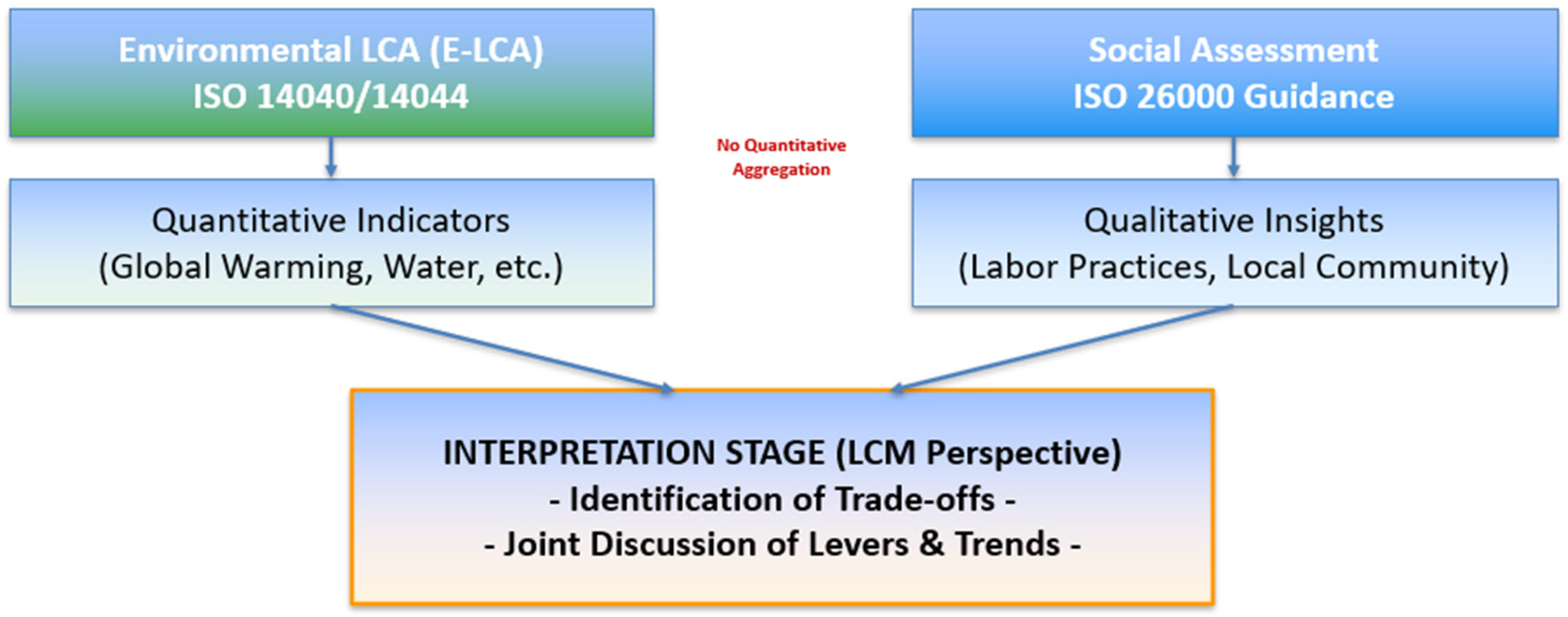
Figure 1 presents the conceptual research framework adopted in this study. It is important to note that environmental life cycle assessment (ISO 14040/44:2006) and social responsibility assessment based on ISO 26000:2010 are applied in parallel rather than as a fully integrated or aggregated methodology. The environmental LCA quantitatively identifies environmental hotspots throughout the processing chain, while the ISO 26000:2010 framework provides a qualitative interpretation of the governance, labor, community, and ethical dimensions associated with the same production systems.
Life cycle management (LCM) is used here as an interpretive framework that allows for a joint reading of environmental and social results, without mathematical aggregation or weighting between indicators. The arrows shown in Figure 1 therefore represent conceptual links and decision-support feedback loops, rather than a methodological integration of impact assessment results. This approach is consistent with the principles of ISO 14040/44 and the role of ISO 26000:2010 as a guidance standard rather than an impact assessment method.
ISO 26000:2010 is not used as an impact assessment standard but as a qualitative reference framework guiding the selection and interpretation of social responsibility indicators. No aggregation between environmental LCA results and social indicators is performed.

2.4. Life Cycle Inventory and System Boundaries

The functional unit (FU) corresponds to 1 kg of cold-pressed cannabis seed oil, packaged for local distribution. The system boundaries include the processing phase. Unlike previous partial assessments, this study incorporates the agricultural phase burden based on the mass of seeds required for each extraction scenario.
Figure 2 details the system boundaries and the sequence of operational modules selected for this study, defining a scope of quantitative analysis strictly limited to the stages of industrial processing, using a “gate-to-gate” approach (from seed to door). This scope encompasses the entire process from the receipt of cannabis seeds to the marketing of the final packaged product, specifically including seed cleaning, cold pressing, filtration, decanting, packaging, and associated local transportation. Although the cultivation phase is modeled upstream in order to establish a functional consistency framework linking extraction yield to the functional unit (1 kg of oil), agricultural data (inputs, fuels, yields) are presented for informational purposes only in Table 3 and are not included in the calculation of environmental impacts. This methodological distinction, in line with the recommendations of ISO 14044:2006, avoids double-counting of upstream impacts while ensuring mass balance between input and output flows. Finally, the use, international distribution, and end-of-life phases are excluded from the quantitative inventory and are only discussed qualitatively from a global life cycle management perspective.
Agricultural inputs are provided solely for contextualization and comparison purposes and have not been included in the calculation of environmental impacts, as the scope of the study is strictly limited to the extraction phase. Carbon sequestration associated with cannabis cultivation is not included in the quantitative results of the environmental LCA presented in this study. Biogenic CO2 absorption during biomass growth and potential carbon storage in soils or co-products are not taken into account in the climate change indicator, which is reported exclusively in the form of fossil-based climate change. This methodological choice aims to avoid any overestimation of climate benefits, given the high uncertainties associated with the fate of crop residues, the pathways for seed cake recovery, and the permanence of carbon storage. Carbon sequestration associated with cannabis cultivation is not included in the quantitative results of the environmental LCA presented in this study. Biogenic CO2 absorption during biomass growth and potential carbon storage in soils or co-products are not taken into account in the climate change indicator, which is reported exclusively in the form of fossil-based climate change. This methodological choice aims to avoid any overestimation of climate benefits, given the high uncertainties associated with the fate of crop residues, the pathways for seed cake recovery, and the permanence of carbon storage.
Carbon sequestration is therefore discussed only in qualitative terms in Section 4. In order to contextualize the long-term potential contribution of cannabis-based systems to climate change mitigation, without influencing the quantitative comparison of the scenarios studied, future LCA studies could explicitly integrate carbon sequestration by distinguishing between temporary and permanent carbon storage; for example, through dynamic LCA approaches or by modeling alternative end-of-life scenarios for biomass residues (incorporation into soil, biochar production), in line with recent methodological developments applied to agricultural systems.
Table 4 summarizes the main input and output flows for the processing stage under each scenario. The seed cake produced during pressing, accounting for approximatly 60% of seed mass, was modeled as a co-product and allocated by mass, assuming it is sold as animal feed or fertilizer. Negative water use values in the artisanal model arise from system credits (e.g., hydroelectricity) in the background data and are artifacts of system expansion credits.
The inventory includes material inputs, energy and water consumption, product outputs, co-products, and processing losses, in accordance with the requirements of ISO 14044:2006.
Background processes were modeled using the ecoinvent v3.8 database according to the cut-off system model. The Seed Cleaning and Storage flow was represented as a pre-treatment service using a proxy dataset (wheat cleaning, POUi, FR), sized to the mass of seeds actually processed, to avoid double-counting of material flows. In the artisanal scenario, material losses were modeled as untreated foreground residues, in the absence of a formal waste management system, while the cooperative and industrial scenarios incorporate industrial composting treatment using ecoinvent datasets. The solids mass balance was rigorously maintained for all scenarios.

2.5. Social Responsibility Integration

The evaluation of social responsibility within the Moroccan legal cannabis sector was conducted in alignment with the ISO 26000:2010 international guidance standard on social responsibility [25]. This guideline identifies seven core subjects: organizational governance, human rights, labor practices, environment, fair operating practices, consumer issues, and community involvement. The methodological objective was to assess, interpret, and compare the social, ethical, and governance performance of the three representative production systems-traditional artisanal, cooperative, and industrial-as parts of a broader life cycle sustainability assessment framework. Each of these scenarios has been qualitatively assessed against these themes in order to identify potential socio-economic risks and opportunities. For example, a typical feature of artisanal producers is operating informally without occupational health protection, cooperatives increase governance and ensure fairer prices, while industrial operations may provide local job opportunities but require effective labor and environmental management systems.
It should be noted that ISO 26000:2010 is a guidance standard and does not provide quantitative impact indicators in the strict sense. Consequently, the numerical scores and standardized compliance percentages presented in this study are indicative and aim to illustrate relative trends between scenarios, rather than provide an exact measure of social performance.
These semi-quantitative values should, therefore, not be interpreted as precise measurements, and small numerical differences between systems do not reflect significant methodological differences in performance. The results are thus interpreted qualitatively, with an emphasis on general guidelines and levers for improvement, rather than on an absolute ranking of scenarios.

2.6. Conceptual Framework

The LCM framework interprets environmental and social outcomes in parallel: LCA identifies environmental hotspots, while ISO 26000 analysis highlights societal issues; decision-making is guided by the joint interpretation of these results rather than by numerical aggregation [60].
The methodological framework combined qualitative content analysis with the semi-quantitative evaluation of social responsibility indicators. Assessment was performed according to the seven core subjects defined by ISO 26000:2010 [61]:
(1)
Organizational governance,
(2)
Human rights,
(3)
Labor practices,
(4)
The environment,
(5)
Fair operating practices,
(6)
Consumer concerns, and
(7)
Community involvement and development.
Each dimension has been analyzed through documentary analysis of national policies and reports, expert interpretation of the risks and opportunities within the cannabis value chain, and cross-referencing of socio-economic indicators from field and institutional data.
As ISO 26000:2010 is not an impact assessment standard but a guideline, no quantitative aggregation with LCA results is performed. Environmental and social dimensions are analyzed separately and interpreted jointly in a life cycle management approach.

2.7. Social Responsibility Evaluation Matrix

The methodological synthesis of the assessment grid is summarized in Table 2 above. Each ISO 26000:2010 dimension is associated with its indicator group, data source, and evaluation rationale.
To ensure methodological robustness, all data were cross-checked with official publications and triangulated with at least two independent sources. Limitations include partial data availability for small informal actors and the absence of standardized social impact indicators specific to the cannabis sector, requiring interpretative judgment within the ISO 26000:2010 framework.
The methodological link between social responsibility integration and the environmental LCA was established by coupling the analyses under a unified life cycle sustainability assessment structure. Further, the mapping of social responsibility indicators to the corresponding LCA system boundaries guaranteed that, for instance, governance, labor, and community dimensions were contextualized at the same process level, either cultivation or transformation. This made it possible to develop a coherent sustainability interpretation at both the environmental and social pillars through the methodological articulation of these approaches.

2.8. Data Sources and Scope

The study used primary and secondary data covering the period 2021–2025.
Institutional data were drawn from:
  • The National Agency for the Regulation of Cannabis Activities (ANRAC), including the 2024 and 2025 activity reports detailing cultivated areas, cooperatives, authorizations, inspections, and seed certification;
  • The Economic, Social and Environmental Council (CESE) strategic note on the socio-economic development of cannabis-producing regions;
  • Moroccan Ministry of Agriculture and Rural Development and ONSSA technical and regulatory guidelines for cultivation and product safety;
  • National media and analytical sources such as H24Info, Hespress, and CBD Maroc Invest provided complementary socio-economic data.
Analytical data included semi-quantitative indicators derived from evaluation grids inspired by UNEP/SETAC Guidelines for Social Life Cycle Assessment of Products [62,63].

3. Results

3.1. Impact Results by Category

The results of the environmental impact assessment for the processing phase are presented in Table 5, based on a functional unit of 1 kg of oil produced. This assessment is intentionally limited to the processing scope in order to isolate the influence of technological choices related to extraction and packaging. The selected indicators cover a representative set of impact categories relevant to agri-food and oilseed systems. The results highlight clear differences in environmental performance between the artisanal, cooperative, and industrial scenarios. The observed differences primarily reflect variations in energy intensity, equipment efficiency, and management of auxiliary flows. The negative values observed for water use in the artisanal scenario result from system credits linked to background data and do not reflect actual resource savings. No normalization or weighting was applied to maintain the transparency of the results. All indicators are expressed consistently per functional unit, allowing for direct comparison between scenarios. These results form the basis for the identification of hotspots and the critical discussion developed subsequently.

Contribution Analysis by Scenario (Transformation Phase)

The contribution analysis highlights electricity consumption as the main factor determining environmental impacts in all the scenarios studied, as shown in Table 6. In the artisanal scenario, the electricity used during the seed cleaning and cold pressing stages accounts for approximately 48–55% of the impact on climate change, reflecting low energy efficiency and limited process integration. Conversely, the cooperative scenario has a lower electricity contribution, around 35–40% of the impact on climate change, mainly due to better equipment performance and a significant reduction in process losses (pre-treatment + pressing). The industrial scenario shows further optimization of energy use, with electricity contributing between 38% and 42%, while cooling water use remains marginal (<2%) thanks to closed-loop recirculation systems. process losses (pre-treatment + pressing) are a second hotspot in the artisanal system, contributing up to 18% of terrestrial acidification and 15% of fine particle formation, whereas these contributions remain below 7% in the cooperative and industrial scenarios. These results clearly indicate that improving energy efficiency and integrating processes are the most effective levers for reducing environmental impacts across all categories.

3.2. Normalized and Relative Performance

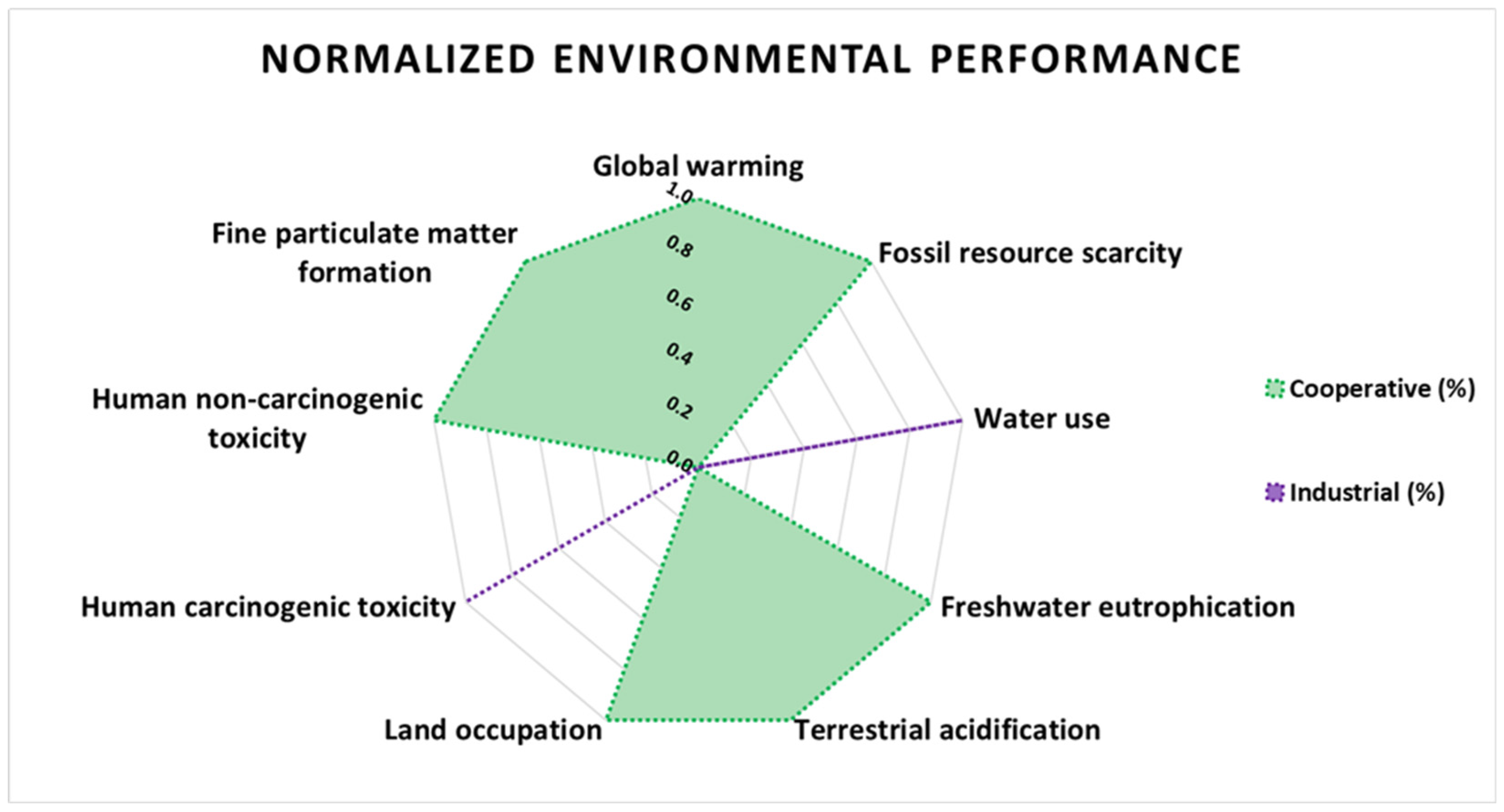
To facilitate multi-criteria comparison, the impact scores were normalized (0 = worst, 1 = best) and plotted on a radar diagram (Figure 3). The cooperative scenario traces the outermost polygon, indicating superior performance in each category. Table 7 lists the relative difference in each scenario from the best performer. Values above zero indicate inferior performance.
The superior performance of the cooperative scenario can be explained by higher oil yields, lower specific energy consumption, and reduced seed losses, while artisanal oil mills are penalized by inefficient equipment and significant losses. These trends mirror the results of life cycle assessments (LCAs) of other vegetable oils, such as olive oil and sunflower oil, where pressing energy represents the predominant impact [64].
Beyond the classification by scenario, the multi-category comparison reveals contrasting trends; indicators of fossil resource depletion and climate change follow similar trends because they depend mainly on energy consumption, while eutrophication and acidification are proportionally more sensitive to seed losses and fertilizer inputs. Land use remains high in the artisanal model due to low yields, confirming the importance of improving agronomy. These observations are consistent with the conclusions of LCAs carried out on other vegetable oils (olive, sunflower, argan), where energy consumption and agricultural yields determine the total footprint [37,65]. These insights highlight that the levers for improvement lie in optimizing yields and energy efficiency, as well as reducing cleaning losses and recovering co-products.

3.3. Hotspot Analysis

3.3.1. Agricultural Phase

Although the quantitative assessment of environmental impacts is limited to the processing phase, the results obtained, combined with data from the literature, suggest that the agricultural phase is a key determinant of the sector’s overall environmental performance. Given the high biomass yields reported for industrial cannabis, biogenic CO2 capture associated with growth can reach tens of tons of CO2·ha−1 per cycle, while the net climate benefit depends heavily on yield, cultivation practices, and, above all, carbon recovery/storage pathways in products or soils [66,67]. These contrasting effects underline the need to optimize irrigation and fertilization practices.
Water use intensity varies substantially between cultivation systems. A recent life cycle assessment of cannabis cultivation and seed-based food products reported a water scarcity footprint of 250 m3 water eq kg−1 for indoor cultivation, compared with 0.3 m3 water eq kg−1 for conventional outdoor production [43]. This indicates that indoor systems may exhibit water demands approximately three orders of magnitude higher than outdoor systems. As Moroccan cannabis is cultivated under open-field conditions, its water footprint is comparatively lower; however, it remains environmentally relevant given the semi-arid climatic context.

3.3.2. Processing Phase

The processing phase includes seed cleaning, pressing, filtration and decantation. Energy use ranges from 0.54 to 0.90 kWh kg−1 oil across scenarios. Cold pressing is inherently less energy-intensive than supercritical CO2 extraction, which can require up to 12 kWh kg−1 for cannabis oil. Seed losses are a key determinant of environmental performance; the artisanal system loses 0.6 kg FU−1, whereas cooperatives and industrial plants lose <0.15 kg. Efficient recovery of seed cakes, approximately 60% of seed mass, provides opportunities for animal feed or fertilizer and reduces the burden. Industrial operations may also incorporate closed-loop water systems to reduce the 0.05 m3 FU−1 cooling water demand.

3.3.3. Packaging and Transport

Packaging and local transport contribute modestly (approximately 10%) to overall impacts. Glass bottles have higher embodied energy and mass than PET but offer superior product protection and recyclability. The cooperative scenario uses 500 mL bottles, while the industrial system employs 1 L recycled-glass bottles, lowering packaging mass per unit. Transport distances are shortest for the industrial scenario and longest for artisanal farms. Sensitivity analysis shows that even a 20% reduction in transport distance can only reduce climate impacts by about 1%, which indicates that cultivation and extraction efficiencies are more influential.

3.3.4. Social and Economic Considerations

The social responsibility assessment of Morocco’s legal cannabis seed oil sector through the lens of the ISO 26000:2010 framework has revealed the positive transition of the sector from being totally unregulated to becoming a very well-regulated one.
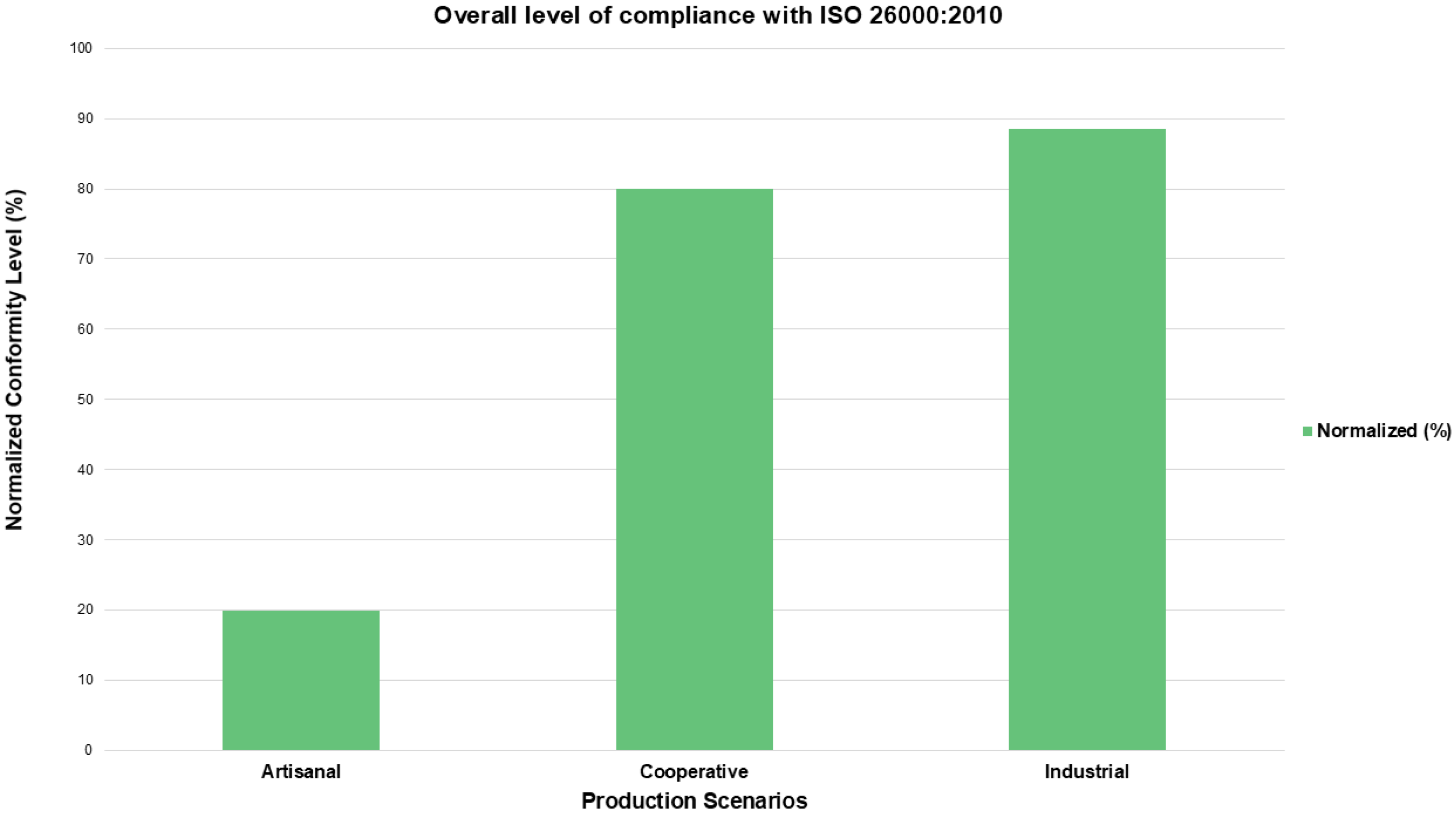
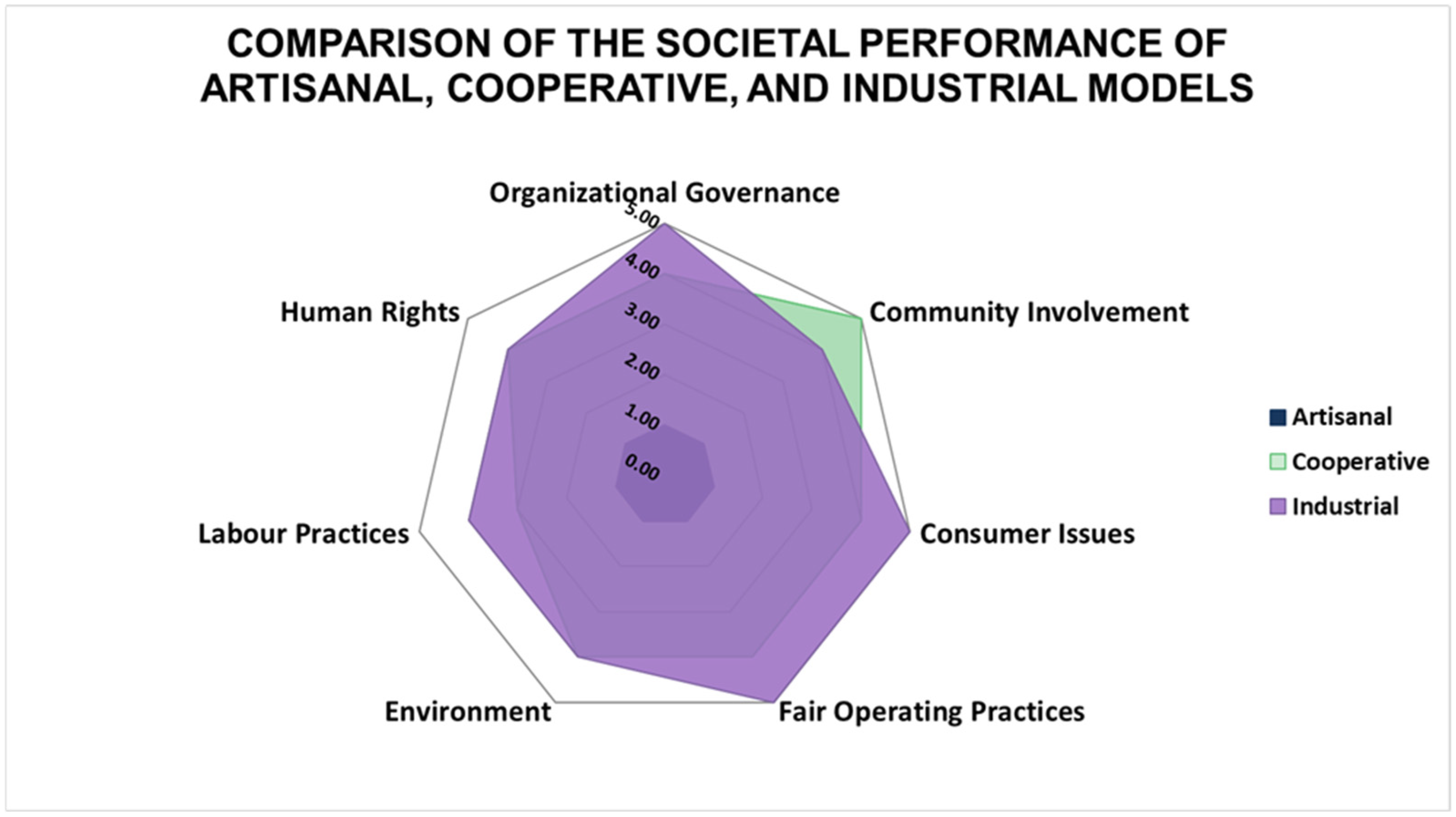
National media sources were consulted in order to contextualize the sector’s socioeconomic development, without influencing the scoring process. The evaluation, which is based on 2024–2025 government statistics, considers three models of operation: traditional/artisanal, legal cooperative, and regulated/industrial, using a 0–5 semi-quantitative scale on the seven main factors that are used for comparison purposes. The traditional, artisanal system scores lowest on every level of measurement (average score of 1.0/5; 20% level of government, human rights, and human resource issues are extremely significant; environmental degradation is observed; there is a great degree of exploitation; and little or no community development). The establishment of a more legal system of operation has triggered a series of socio-economic improvements. The cooperative system is described as excellent from a social point of view (average score 4.0/5; 80% level of government and human rights are excellent; there are high levels of nature protection; there is little or no exploitation; and significant community development). The industrialized regulated system, despite conforming perfectly to the highest score in the general ranking (average score of 4.4/5; 88% rate of conformity), is at the forefront of good governance of organizations and the principles of transparency in the operating practices and consumer affairs (5/5) in terms of traceability and standard conformity and regards the obtained outcome in the comparative assessment (Table 8 and Figure 4 and Figure 5), confirms the suggestion that the process of legalization has increased the institutionalization of ethics, inclusion, and transparency in the industry. The new structure of a dual nature in the blend of the socially integrating principle of the cooperative system with the efficiency of the industrialized system is, in fact, turning the erstwhile illegal economy into a motor of sustainable development in the countryside after ongoing focus on the still existing challenges, including gender equity.
Results indicate that there is a gradient of social responsibility. The artisanal system is still far from acceptable parameters; the cooperative model reaches balanced social inclusion; and the industrial system stands near total compliance.
The artisanal system scores approximately 20%, the cooperative model 74–80%, and the industrial scenario 83–88%. The graph confirms that legal formalization yields rapid social performance improvements.
The cooperative and industrial profiles also intersect on most axes, mainly in terms of governance, equity, and consumer protection. Only in community involvement does the cooperative scenario score highest, 5/5, thanks to its local reinvestment mechanism; the governance and quality control categories give the top score for the industrial model. The scores on all axes remain very low in the artisanal scenario.
To ensure the dependability of results, the researchers performed uncertainty and sensitivity analyses. They altered the primary factors like seed yield, energy mix, and transport distance by ±20% and measured the impact of these factors on overall environmental performance. The study has revealed that seed yield fluctuation has the most considerable effect on the impacts of climate change and land use, while energy mix changes have a significant impact on the categories of fossil resource depletion and human toxicity. On the other hand, transport parameters were of negligible sensitivity (<2%). This study not only verifies the robustness of the conclusions drawn but also points out that yield optimization and renewable energy adoption are the major avenues for the study to recommend for improvements.

4. Discussion

4.1. Impact Results

In all of the scenarios studied, energy consumption appears to be the main determinant of impacts related to climate change and the depletion of fossil fuels. In the artisanal scenario, the electricity used during the pre-treatment (cleaning and storage of seeds) and cold pressing stages accounts for approximately 48–55% of the potential climate change impact and more than 60% of fossil resource depletion. This high contribution reflects high specific energy consumption per functional unit, linked to inefficient equipment and limited integration of operations.
Conversely, the reduction in the relative contribution of electricity to around 35–40% in the cooperative scenario illustrates the combined effect of improved energy efficiency of the presses and a more rational organization of the process. The industrial scenario shows intermediate performance, indicating that increasing capacity alone does not necessarily guarantee a proportional reduction in impacts without targeted optimization of energy consumption.
These results highlight that, for the cannabis seed oil industry, specific energy efficiency is a more decisive lever for improvement than simply scaling up facilities.

4.2. Influence of Process Losses on Certain Impact Categories

In addition to energy, process losses, including moisture removal and the generation of fine residues during pre-treatment and cold pressing, play a significant role in several impact categories. In the artisanal scenario, these losses contribute up to 15–18% of the impacts for categories such as land acidification and fine particle formation. Their contribution remains below 7% in the cooperative and industrial scenarios, reflecting better overall control of the process.
It is important to note that these losses are not attributed to a specific unit stage (e.g., cleaning alone) due to the lack of detailed operational measurements by sub-process. They are therefore considered as overall processing losses, in accordance with the principles of transparency and traceability recommended by ISO 14044:2006. This approach avoids any causal over-interpretation and ensures consistency between the life cycle inventory and the interpretation of the results.

4.3. Interpretation of Environmental Results

The cooperative extraction chain performs best in all the impact categories analyzed. Its performance relies on better seed yield, 3.0 kg seed kg−1 oil, lower energy use, 0.54 kwh FU−1, and efficient use of co-products. Industrial operations would present similar or better performance if they run on renewable electricity and are equipped with efficient cooling and cleaning systems [68]. The low extraction efficiency (4.4 kg seeds kg−1 oil) of the artisanal model makes upstream impacts multiply; hence, optimization of yield is essential [65]. These results are consistent with LCAs for other oil crops, where increasing extraction efficiency yields disproportionate environmental gains [69].
The agricultural stage continues to be the main hotspot [70]. Seed yield will need to be improved through good agronomy, appropriate cultivar choice and irrigation management. A 20% increase in yield reduced the climate impacts of the system by roughly 12% in sensitivity analyses. Cover cropping and organic amendments may also help to improve soil fertility and reduce fertilizer use [71]. Additional climate benefits come from sequestration of carbon in cannabis fibers and crop residues, but these are dependent on residues being left on the field or used in long-lived products [66,72].

4.4. Comparative Analysis with Other Vegetable Oils

To contextualize the impacts of Moroccan cannabis seed oil, results were compared with published LCAs of major edible oils. Recent assessments indicate that 1 kg of refined sunflower oil emits approximately 4.49 kg CO2-eq, while cannabis oil produced under Italian conditions reaches values up to 23.34 kg CO2-eq due to low seed yield and high agricultural burdens [73], whereas palm oil ranges from 2.5 to 4.8 kg CO2-eq per kg, depending on land-use change [74]. Compared to these benchmarks, the cooperative scenario in Morocco (3.02 kg CO2-eq) is competitive with mid-range canola and sunflower systems, while artisanal production is closer to higher-impact systems due to seed losses and low extraction efficiency.
For eutrophication and acidification, cannabis oil generally shows higher values than sunflower and rapeseed, mainly because of nitrogen fertilizer use and low seed yield [17]. However, cannabis outperforms many crops in land occupation when high-yield cultivars are used and may exceed other oils in carbon sequestration potential when crop residues are left on fields. Water use also varies significantly across regions: outdoor cannabis cultivation has water-scarcity values around 0.3 m3 water-eq kg−1, compared to 250 m3 water-eq kg−1 for greenhouse production [17]. The Moroccan values fall closer to outdoor cultivation, suggesting that improved irrigation efficiency could further reduce impacts.
Overall, this comparison highlights that the environmental performance of cannabis oil is highly sensitive to agronomic efficiency. Improving cannabis seed yields, optimizing irrigation and enhancing energy efficiency in processing could position cannabis seed oil as competitive with conventional edible oils in both environmental and nutritional terms.

4.5. Limitations and Research Needs

Several limitations constrain this assessment. First, the life cycle inventory is based on a combination of primary and secondary data, with a limited number of site-specific measurements for water withdrawals, emissions to land, and post-harvest practices. Future studies should focus on collecting comprehensive primary data for these parameters in order to reduce uncertainties and improve the representativeness of the results.
The life cycle inventory was modeled using the ecoinvent v3.8 database. Although more recent versions are available, this version was chosen to ensure consistency with previous agri-food LCA studies. While the absolute impact values may be underestimated, the relative comparisons between scenarios are considered robust.
The inclusion of the use and end-of-life phases could alter certain results, particularly for impact categories related to resource use and toxicity. End-of-life scenarios for packaging (recyclable glass versus PET) are likely to significantly influence fossil resource depletion and emissions associated with recycling or disposal. Similarly, international distribution would increase climate change impacts due to transportation, while the use phase is expected to remain marginal from an LCA perspective, as cannabis seed oil does not involve energy consumption or direct emissions during use.
Secondly, the boundaries of the system exclude the manufacture of processing equipment, which could contribute to additional impacts, particularly for categories relating to mineral resource use and human toxicity. Thirdly, the assessment of social responsibility based on ISO 26000:2010 is qualitative in nature; the use of fully quantitative social LCA indicators would allow for a more in-depth analysis of working conditions and impacts at the community level. Finally, the use of average emission factors for Morocco’s national electricity mix may mask local variability, and future work should incorporate site-specific electricity mixes, particularly in scenarios including renewable energies.
The analysis is also limited by the small number of facilities studied and by the use of data from a single agricultural season. Interannual yield variability, energy price fluctuations, and changes in agricultural practices may therefore limit the generalizability of the results. Future research should expand the sample studied, cover several production seasons, and incorporate additional socioeconomic indicators in order to strengthen the assessment of the sustainability of cannabis seed oil production systems.

4.6. Implications for the Supply Chain’s Life Cycle Management

From an operational perspective, the results provide clear guidelines for the life cycle management of the Moroccan cannabis seed oil industry. The transition from an artisanal model to a cooperative model appears to be a particularly relevant path, significantly reducing environmental impacts while maintaining an inclusive and localized production organization.
The priority levers identified concern improving the energy efficiency of presses, reducing process losses, and gradually integrating low-carbon energy sources. These targeted actions offer substantial potential for impact reduction without requiring complete industrialization of the sector.
The proposed areas for improvement are therefore not based solely on the quantitative results of the LCA, but also reflect stakeholder comments regarding technical feasibility, investment capacity, and local socioeconomic constraints.

4.7. Sustainable Production Recommendations

  • Irrigation optimization: Adapt drip or micro-irrigation systems in conjunction with rainwater harvesting that will cut water use by 30–50% in keeping with the semi-arid conditions and water-saving measures of Morocco. Moreover, precise irrigation scheduling based on the determination of crop evapotranspiration, for instance, 2.9 mm day−1 during South African trials [34], can also be applied with accuracy.
  • Seed and oil yields should be improved: Select the most productive cannabis varieties that are suited to the Rif climate and supply fertilizers and pest control methods that are integrated. The higher the yield is, the less the impact per kilogram of oil.
  • Coproducts with value: Continue processing the cake from seeds into animal feed, organic fertilizers, or bioenergy. Such types of valorization decrease waste and, at the same time, provide economic incentives.
  • Renewable energy use increase: Install solar panels on processing facilities and explore agri-voltaic systems for generating electricity on-farm. For example, during the period of promotion from 22% to 50% of renewables in the electricity mix, the climate impacts could decline by about 25%.
  • Eco-friendly packaging design: Use lightweight or recycled glass bottles and set up local collection and recycling schemes. Investigate biodegradable polymers such as PLA that can help lessen fossil resource use and toxicity.
  • Promote co-operative governance: The creation of cooperatives that are able to share equipment, have better negotiation power, and easier identification for fair payment would be encouraged through the provision of incentives. It can be said that, generally, cooperative business models were more beneficial for the environment as well as for the people.
  • Certification and policy frameworks: Create standards at the national level for the sustainability of cannabis oil, taking into consideration ISO 14040:2006, 14044:2006 and ISO 26000:2010, and indicating where the minimum limits on the use of water and energy, waste management, and social responsibility will be set. The certifying organizations may reward the producers financially by offering them to keep best practices. Besides the environmental and social aspects, the new cannabis seed-oil industry has great economic and regional development potential: under the present legal situation, it can turn refugees working in the Moroccan Rif area into legal workers, draw in funds for green projects, and open up new markets for local agro-industries. Innovations like setting up a processing hub for value-added products and forming farmer co-operatives for export could raise the income of the farmers involved by 25–40% compared to the informal trade and thus decrease rural poverty. The integration of cannabis seed oil into the bioeconomy and cosmetic industries could significantly strengthen Morocco’s competitive edge in the global sustainable agri-food market. The country could emerge as a pioneer in North Africa for the regulated, responsible production of cannabis aligned with the UN Sustainable Development Goals.

5. Conclusions

This study reports an expanded LCA and LCM of Moroccan cannabis seed oil production, covering environmental and social issues according to the consideration of ISO 14040:2006, 14044:2006 and ISO 26000:2010, respectively. Nutritional analyses confirm that cannabis seeds offer a nutrient-dense profile with 30% protein and 50% fat per 100 g. Among the three processing chains, cooperative extraction gives the lowest impacts in eight categories due to the higher extraction yields and lower energy consumption. Industrial facilities can achieve similar or even better performance than cooperatives if renewable electricity and efficient process design are considered. The agricultural stage remains the main hotspot, with a need to improve strategies related to irrigation, agronomy and carbon sequestration. The conclusions mainly reflect relative comparisons between scenarios established under consistent assumptions, rather than generalizable absolute values. Integrating social responsibility brings additional challenges at the levels of governance, labor practices and community benefits. With targeted improvements-optimized irrigation, yield increase, product valorisation, renewable energy, eco-designed packaging and cooperative governance-the cannabis oil industry in Morocco should meet sustainable development goals and become more competitive in international markets. The social responsibility results demonstrate that Morocco’s regulated cannabis seed oil industry is undergoing a rapid institutionalization of ethical, inclusive, and transparent practices. Transitioning from an informal to a cooperative and industrial framework has generated substantial progress in all ISO 26000:2010 dimensions, in particular related to governance, fair practices, and consumer protection. On the other hand, the cooperative model presents the most integrated form of society, while industrial regulation creates a need for universal standards and scalability. Hence, this mutually supportive dual structure may transform an illegal economy into a source of rural development, social justice, and environmental sustainability. An inclusive model with these very characteristics depends on constant supervision, democratic governance, and equitable sharing of profits. Supported by this argument, Morocco’s legal cannabis sector may not only be a world leader in terms of the social responsibilities of bio-economies but also an example of how ISO 26000:2010 could be implemented in a nascent agricultural industry.

Author Contributions

Conceptualization, H.L. and N.L.; methodology, H.L. and N.L.; software, H.L. and N.L.; data curation, H.L. and S.E.; writing—original draft preparation, H.L.; writing—review and editing, H.L., N.L., G.A.B., H.N., B.B., L.E.J. and S.E.H.; investigation, H.L. and N.L. All authors have read and agreed to the published version of the manuscript.

Funding

This research received no external funding.

Data Availability Statement

The original contributions presented in this study are included in the article. Further inquiries can be directed to the corresponding author.

Conflicts of Interest

The authors declare no conflicts of interest.

Abbreviations

LCALife Cycle Assessment
LCMLife Cycle Management
LCILife Cycle Inventory
LCIALife Cycle Impact Assessment
FUFunctional Unit
ISOInternational Organization for Standardization
ILCDInternational Reference Life Cycle Data System
S-LCASocial Life Cycle Assessment
GHGGreenhouse Gases
CO2-eqCarbon dioxide equivalent
N2ONitrous oxide
PM2.5Fine particulate matter (≤2.5 µm)
SO2-eqSulfur dioxide equivalent
P-eqPhosphorus equivalent
1,4-DCB1,4-dichlorobenzene
kWhKilowatt-hour
ANRACNational Agency for the Regulation of Cannabis-related Activities (Morocco)
HSEHealth and Safety Executive
CESEEconomic, Social and Environmental Council (Morocco)
ONSSANational Office for Food Safety (Morocco)
UNEPUnited Nations Environment Programme
SETACSociety of Environmental Toxicology and Chemistry
SDGsSustainable Development Goals
HVACHeating, Ventilation and Air Conditioning

Appendix A

Table A1. Numerical results and exclusion justifications for non-significant impact categories (<1% threshold).
Impact CategoryUnitArtisanalCooperativeIndustrialJustification for Exclusion
Marine ecotoxicitykg 1,4-DCB eq0.1040.0690.077Insufficient data on transfers to aquatic environments; no specific flows identified.
Ionizing radiationkBq Co-60 eq0.2520.1710.175No direct use of nuclear technologies; indirect and marginal contribution via the electricity mix.
Ozone formation (Human health)kg NOx eq0.0130.0090.009Low emissions of precursors in the study area; impact considered secondary (<1%).
Ozone formation (Terrestrial ecosystems)kg NOx eq0.0130.0090.01Impact considered secondary in relation to the main selected categories.
Mineral resource scarcitykg Cu eq4.35 × 10−32.91 × 10−33.08 × 10−3No significant use of critical metals; mineral flows are limited to equipment outside the scope.
Marine eutrophicationkg N eq1.10 × 10−47.19 × 10−57.93 × 10−5Land-based agricultural system far from marine environments; no direct emissions to the sea.
Stratospheric ozone depletionkg CFC11 eq2.39 × 10−51.63 × 10−51.58 × 10−5No halogenated substances in the inventory of cold-pressing systems.
Freshwater ecotoxicitykg 1,4-DCB eq0.0740.0490.054Impact below the 1% threshold and uncertainties regarding inventory transfer data.
Terrestrial ecotoxicitykg 1,4-DCB eq1.9741.3111.45Category excluded to focus on the dominant human toxicity impacts.

References

  1. Tănase Apetroaei, V.; Pricop, E.M.; Istrati, D.I.; Vizireanu, C. Hemp Seeds (Cannabis sativa L.) as a Valuable Source of Natural Ingredients for Functional Foods—A Review. Molecules 2024, 29, 2097. [Google Scholar] [CrossRef] [PubMed]
  2. Fike, J. Industrial Hemp: Renewed Opportunities for an Ancient Crop. Crit. Rev. Plant Sci. 2016, 35, 406–424. [Google Scholar] [CrossRef]
  3. Schluttenhofer, C.; Yuan, L. Challenges towards Revitalizing Hemp: A Multifaceted Crop. Trends Plant Sci. 2017, 22, 917–929. [Google Scholar] [CrossRef] [PubMed]
  4. Fortune Business Insights. Hemp Seed Oil Market Size, Share & Industry Analysis. Fortune Business Insights Pvt. Ltd. Available online: https://www.fortunebusinessinsights.com/hemp-seed-oil-market-113997 (accessed on 1 March 2026).
  5. The Business Research Company. Cannabis Cosmetics Global Market Report 2026; The Business Research Company: Hyderabad, India, 2026. [Google Scholar]
  6. Grand View Research. CBD Nutraceuticals Market Size, Share & Trends Analysis; Grand View Research: San Francisco, CA, USA, 2025. [Google Scholar]
  7. Law No. 13-21 on the Legal Uses of Cannabis. Dahir No. 1-21-59 of 14 July 2021 (3 Dhu al-Hijja 1442). Kingdom of Morocco. Published in the Official Gazette of the Kingdom of Morocco (Bulletin Officiel n° 7006, 22 July 2021). Available online: https://www.anrac.gov.ma/en/loi1321/ (accessed on 1 March 2026).
  8. Tinasti, K.; Afsahi, K.; Mouna, K. Navigating Cannabis Regulation in Morocco: Historical Context, Socio-Economic Impact, and Policy Gaps. J. Illicit. Econ. Dev. 2025, 7, 53–60. [Google Scholar] [CrossRef]
  9. Mayaux, P.-L.; Fernandez, S. Blinded like a State: Water Scarcity and the Quantification Dilemma in Morocco. Geoforum 2024, 155, 104093. [Google Scholar] [CrossRef]
  10. Summers, H.; Sproul, E.; Quinn, J. The Greenhouse Gas Emissions of Indoor Cannabis Production in the United States. Nat. Sustain. 2021, 4, 644–650. [Google Scholar] [CrossRef]
  11. Mills, E. The Carbon Footprint of Indoor Cannabis Production. Energy Policy 2012, 46, 58–67. [Google Scholar] [CrossRef]
  12. Zheng, Z.; Fiddes, K.; Yang, L. A Narrative Review on Environmental Impacts of Cannabis Cultivation. J. Cannabis Res. 2021, 3, 35. [Google Scholar] [CrossRef]
  13. Desaulniers Brousseau, V.; Goldstein, B.P.; Sedlock, C.; Lefsrud, M. Environmental Impact of Outdoor Cannabis Production. ACS Agric. Sci. Technol. 2024, 4, 690–699. [Google Scholar] [CrossRef]
  14. Polson, M.; Bodwitch, H.; Biber, E.; Butsic, V.; Grantham, T. After Legalization: Cannabis, Environmental Compliance, and Agricultural Futures. Land Use Policy 2023, 126, 106531. [Google Scholar] [CrossRef]
  15. Dillis, C.; Petersen-Rockney, M.; Polson, M. A Theory of Geo-Social Marginalization: A Case Study of the Licensed Cannabis Industry in California. J. Environ. Manag. 2024, 355, 120396. [Google Scholar] [CrossRef] [PubMed]
  16. Denton, G.M.; Clulow, A.; Hill, T.R.; Gokool, S.; Kunz, R. Water Use and Productivity of Cannabis sativa L., KwaZulu-Natal Midlands, South Africa. J. Cannabis Res. 2025, 7, 64. [Google Scholar] [CrossRef] [PubMed]
  17. Meffo Kemda, M.; Marchi, M.; Neri, E.; Marchettini, N.; Niccolucci, V. Environmental Impact Assessment of Hemp Cultivation and Its Seed-Based Food Products. Front. Environ. Sci. 2024, 12, 1342330. [Google Scholar] [CrossRef]
  18. Masson-Delmotte, V.; Zhai, P.; Pirani, A.; Connors, S.L.; Péan, C.; Berger, S.; Caud, N.; Chen, Y.; Goldfarb, L.; Gomis, M.I.; et al. (Eds.) Climate Change 2021: The Physical Science Basis; Contribution of Working Group I to the Sixth Assessment Report of the Intergovernmental Panel on Climate Change; Cambridge University Press: Cambridge, UK; New York, NY, USA, 2021. [Google Scholar]
  19. Casañas, F.; Simó, J.; Casals, J.; Prohens, J. Toward an Evolved Concept of Landrace. Front. Plant Sci. 2017, 8, 245305. [Google Scholar] [CrossRef]
  20. Rbah, Y.; Belhaj, K.; Taaifi, Y.; Allay, A.; Melhaoui, R.; Serghini-Caid, H.; Elamrani, A. Nutritional Composition and Functional Properties of ‘Beldiya’ Hemp Seed and Oil: A Sustainable Local Resource from Northern Morocco for Health and Nutrition. J. Oleo Sci. 2025, 74, 533–542. [Google Scholar] [CrossRef]
  21. Bernas, J.; Bernasová, T.; Nedbal, V.; Neugschwandtner, R.W. Agricultural LCA for Food Oil of Winter Rapeseed, Sunflower, and Hemp, Based on Czech Standard Cultivation Practices. Agronomy 2021, 11, 2301. [Google Scholar] [CrossRef]
  22. Cucurachi, S.; Scherer, L.; Guinée, J.; Tukker, A. Life Cycle Assessment of Food Systems. One Earth 2019, 1, 292–297. [Google Scholar] [CrossRef]
  23. ISO 14040:2006; Environmental Management—Life Cycle Assessment—Principles and Framework. International Organization for Standardization: Geneva, Switzerland, 2006.
  24. ISO 14044:2006; Environmental Management—Life Cycle Assessment—Requirements and Guidelines. International Organization for Standardization: Geneva, Switzerland, 2006.
  25. Hahn, R. ISO 26000 and the Standardization of Strategic Management Processes for Sustainability and Corporate Social Responsibility. Bus. Strategy Environ. 2013, 22, 442–455. [Google Scholar] [CrossRef]
  26. Huijbregts, M.A.J.; Steinmann, Z.J.N.; Elshout, P.M.F.; Stam, G.; Verones, F.; Vieira, M.; Zijp, M.; Hollander, A.; van Zelm, R. ReCiPe2016: A Harmonised Life Cycle Impact Assessment Method at Midpoint and Endpoint Level. Int. J. Life Cycle Assess. 2017, 22, 138–147. [Google Scholar] [CrossRef]
  27. Nemecek, T.; Jungbluth, N.; i Canals, L.M.; Schenck, R. Environmental Impacts of Food Consumption and Nutrition: Where Are We and What Is Next? Int. J. Life Cycle Assess. 2016, 21, 607–620. [Google Scholar] [CrossRef]
  28. Cellura, M.; Longo, S.; Mistretta, M. Sensitivity Analysis to Quantify Uncertainty in Life Cycle Assessment: The Case Study of an Italian Tile. Renew. Sustain. Energy Rev. 2011, 15, 4697–4705. [Google Scholar] [CrossRef]
  29. Rosenbaum, R.K.; Georgiadis, S.; Fantke, P. Uncertainty Management and Sensitivity Analysis. In Life Cycle Assessment: Theory and Practice; Hauschild, M.Z., Rosenbaum, R.K., Olsen, S.I., Eds.; Springer International Publishing: Cham, Switzerland, 2018; pp. 271–321. ISBN 978-3-319-56475-3. [Google Scholar]
  30. Boulay, A.-M.; Bare, J.; Benini, L.; Berger, M.; Lathuillière, M.J.; Manzardo, A.; Margni, M.; Motoshita, M.; Núñez, M.; Pastor, A.V.; et al. The WULCA Consensus Characterization Model for Water Scarcity Footprints: Assessing Impacts of Water Consumption Based on Available Water Remaining (AWARE). Int. J. Life Cycle Assess. 2018, 23, 368–378. [Google Scholar] [CrossRef]
  31. Fantke, P.; McKone, T.E.; Tainio, M.; Jolliet, O.; Apte, J.S.; Stylianou, K.S.; Illner, N.; Marshall, J.D.; Choma, E.F.; Evans, J.S. Global Effect Factors for Exposure to Fine Particulate Matter. Environ. Sci. Technol. 2019, 53, 6855–6868. [Google Scholar] [CrossRef] [PubMed]
  32. Amaducci, S.; Scordia, D.; Liu, F.H.; Zhang, Q.; Guo, H.; Testa, G.; Cosentino, S.L. Key Cultivation Techniques for Hemp in Europe and China. Ind. Crops Prod. 2015, 68, 2–16. [Google Scholar] [CrossRef]
  33. Murphy, D.J. Agronomy and Environmental Sustainability of the Four Major Global Vegetable Oil Crops: Oil Palm, Soybean, Rapeseed, and Sunflower. Agronomy 2025, 15, 1465. [Google Scholar] [CrossRef]
  34. Badey, L.; Lahitte, N.; Flenet, F.; Bosque, F. French Environmental Communication on Sunflower and Rapeseed Oils Based on Life Cycle Assessment. OCL 2013, 20, A401. [Google Scholar] [CrossRef][Green Version]
  35. Frischknecht, R.; Fantke, P.; Tschümperlin, L.; Niero, M.; Antón, A.; Bare, J.; Boulay, A.-M.; Cherubini, F.; Hauschild, M.Z.; Henderson, A.; et al. Global Guidance on Environmental Life Cycle Impact Assessment Indicators: Progress and Case Study. Int. J. Life Cycle Assess. 2016, 21, 429–442. [Google Scholar] [CrossRef]
  36. Mandrioli, M.; Tura, M.; Valli, E.; Toschi, T.G. Composition of Cold-Pressed Hemp Seed Oils: Key Elements of Quality and Authenticity. Riv. Ital. Delle Sostanze Grasse 2023, 100, 5–17. [Google Scholar]
  37. Gebrai, Y.; Naughton, C.C.; Sánchez, K.D.; Bargach, J.; Deubel, T.F. Environmental and Social Impacts of Women’s Argan Oil Production in Morocco. Int. J. Life Cycle Assess. 2025, 30, 1415–1434. [Google Scholar] [CrossRef]
  38. Campiglia, E.; Gobbi, L.; Marucci, A.; Rapa, M.; Ruggieri, R.; Vinci, G. Hemp Seed Production: Environmental Impacts of Cannabis sativa L. Agronomic Practices by Life Cycle Assessment (LCA) and Carbon Footprint Methodologies. Sustainability 2020, 12, 6570. [Google Scholar] [CrossRef]
  39. Khatri, P.; Jain, S. Environmental Life Cycle Assessment of Edible Oils: A Review of Current Knowledge and Future Research Challenges. J. Clean. Prod. 2017, 152, 63–76. [Google Scholar] [CrossRef]
  40. Khan, M.U.A.; Ahmad, S.; Butt, S.I. Environmental Impact Assessment of the Manufacturing of Glass Packaging Solutions: Comparative Scenarios in a Developing Country. Environ. Impact Assess. Rev. 2023, 102, 107195. [Google Scholar] [CrossRef]
  41. Amaducci, S.; Colauzzi, M.; Bellocchi, G.; Cosentino, S.; Pahkala, K.; Tjeerd, J.; Stomph, T.J.; Westerhuis, W.; Zatta, A.; Venturi, G. Evaluation of a Phenological Model for Strategic Decisions for Hemp (Cannabis sativa L.) Biomass Production across European Sites. Ind. Crops Prod. 2012, 37, 100–110. [Google Scholar] [CrossRef]
  42. Amaducci, S.; Gusovius, H.-J. Hemp—Cultivation, Extraction and Processing. In Industrial Applications of Natural Fibres; John Wiley & Sons: Hoboken, NJ, USA, 2010; pp. 109–134. ISBN 978-0-470-66032-4. [Google Scholar]
  43. Wise, K.; Baziotopoulos, E.; Zhang, C.; Leaming, M.; Shen, L.-H.; Selby-Pham, J. Comparative Study of Water Requirements and Water Footprints of Fibre Crops Hemp (Cannabis sativa) and Cotton (Gossypium hirsutum L.). J. Agrometeorol. 2023, 25, 392–396. [Google Scholar] [CrossRef]
  44. Abdessadak, J.; Zeggaf Tahiri, A. Innovative Solutions to Water Scarcity in Moroccan Agriculture. In Proceedings of the International Conference on Advanced Intelligent Systems for Sustainable Developent (AI2SD 2024); Ezziyyani, M., Kacprzyk, J., Balas, V.E., Eds.; Springer Nature Switzerland: Cham, Switzerland, 2025; pp. 955–969. [Google Scholar]
  45. Vijaya Kumar, I.; Lisson, S.; Hardie, M.; Acuña, T.B. Effect of Different Water Regimes on Physiology, Growth and Yield of Industrial Hemp in Field Conditions. Crop Pasture Sci. 2025, 76, CP25137. [Google Scholar] [CrossRef]
  46. Chouvy, P.-A. Policy Reform and the International Future of Moroccan Cannabis Production. Int. J. Drug Policy 2025, 142, 104841. [Google Scholar] [CrossRef]
  47. Rapport Annuel 2024. 2024. Available online: https://www.cese.ma/media/2025/10/Rapport-annuel-2024-web-1.pdf (accessed on 1 January 2026).
  48. Diplomatique, M. Activités liées au cannabis: L’anrac présente l’état d’avancement des réalisations de 2024 et le programme d’action pour 2025. Maroc Dipl. 2024. Available online: https://maroc-diplomatique.net/activites-liees-au-cannabis-lanrac-presente-letat-davancement-des-realisations-de-2024-et-le-programme-daction-pour-2025/ (accessed on 1 January 2026).
  49. Rammouz, I.; Boujraf, S. Medical and Industrial Cannabis Legalization in Morocco and the Addictions Care Outlook of Youth: First Prospective Study from African Arabic Experience. Cannabis Cannabinoid Res. 2022, 7, 237–238. [Google Scholar] [CrossRef]
  50. Schenker, M.B.; Beckman, S. Cannabis Industry Worker Health and Safety: Time for Action. J. Agromedicine 2023, 28, 14–17. [Google Scholar] [CrossRef]
  51. Maaroufi, Y. Rapport des Résultats de l’Enquête Nationale sur le Secteur Informel 2023/2024, Mai 2025. Available online: https://www.hcp.ma/Rapport-des-resultats-de-l-Enquete-Nationale-sur-le-Secteur-Informel-2023-2024-Mai-2025_a4110.html (accessed on 15 October 2025).
  52. Cosentino, S.L.; Riggi, E.; Testa, G.; Scordia, D.; Copani, V. Evaluation of European Developed Fibre Hemp Genotypes (Cannabis sativa L.) in Semi-Arid Mediterranean Environment. Ind. Crops Prod. 2013, 50, 312–324. [Google Scholar] [CrossRef]
  53. Gill, A.R.; Loveys, B.R.; Cavagnaro, T.R.; Burton, R.A. The Potential of Industrial Hemp (Cannabis sativa L.) as an Emerging Drought Resistant Fibre Crop. Plant Soil 2023, 493, 7–16. [Google Scholar] [CrossRef]
  54. Pookkaman, W.; Samanchuen, T. An Innovation Framework of Medical Organic Cannabis Traceability in Digital Supply Chain. J. Open Innov. Technol. Mark. Complex. 2022, 8, 196. [Google Scholar] [CrossRef]
  55. Meisel, J.S.; Brummer, J.E.; Søgaard, T.F.; Potter, G.R.; Grigg, J.; Jauffret-Roustide, M. Global Cannabis Cultivation as a Gendered Activity: Findings from the 2020 International Cannabis Cultivation Questionnaire. Int. J. Drug Policy 2025, 146, 105039. [Google Scholar] [CrossRef] [PubMed]
  56. Tsaliki, E.; Tzivara, T.; Damalas, C.A.; Fotiadis, S.; Vazanelli, E.; Panoras, I.; Moysiadis, T.; Koutroubas, S.D.; Tsaliki, E.; Tzivara, T.; et al. Agronomic Performance of Industrial Hemp (Cannabis sativa L.) in Northern Greece: A Comparative Study. AIMS Agric. Food 2025, 10, 744–755. [Google Scholar] [CrossRef]
  57. Visković, J.; Zheljazkov, V.D.; Sikora, V.; Noller, J.; Latković, D.; Ocamb, C.M.; Koren, A. Industrial Hemp (Cannabis sativa L.) Agronomy and Utilization: A Review. Agronomy 2023, 13, 931. [Google Scholar] [CrossRef]
  58. Kousta, A.; Papastylianou, P.; Tzimas, P.; Skaltsounis, L.A.; Bilalis, D. Evaluation of European-Developed Hemp Cultivars (Cannabis sativa L.) in Response to Water Regimes. Span. J. Agric. Res. 2025, 23, 21257. [Google Scholar] [CrossRef]
  59. Ajani, O.A.; Mathew, S.; Singh, H.; Upadhyaya, Y.R.; Daramola, O.S.; Nwosu, N.J.; Brecke, B.J.; Brym, Z.T.; Sharma, L.; Devkota, P. Response of Industrial Hemp (Cannabis sativa L.) to Preemergence Herbicides and Weed Control under Different Nitrogen Fertilization. J. Crop Improv. 2025, 39, 425–447. [Google Scholar] [CrossRef]
  60. Sala, S.; Ciuffo, B.; Nijkamp, P. A Systemic Framework for Sustainability Assessment. Ecol. Econ. 2015, 119, 314–325. [Google Scholar] [CrossRef]
  61. Pojasek, R.B. ISO 26000 Guidance on Social Responsibility. Environ. Qual. Manag. 2011, 20, 85–93. [Google Scholar] [CrossRef]
  62. United Nations Environment Programme. Guidelines for Social Life Cycle Assessment of Products; UNEP—UN Environment Programme: Nairobi, Kenya, 2009. [Google Scholar]
  63. Life Cycle Initiative. Guidelines for Social Life Cycle Assessment of Products and Organisations 2020. 2020. Available online: https://www.lifecycleinitiative.org/wp-content/uploads/2021/01/Guidelines-for-Social-Life-Cycle-Assessment-of-Products-and-Organizations-2020-22.1.21sml.pdf (accessed on 15 October 2025).
  64. El Joumri, L.; Labjar, N.; Dalimi, M.; Harti, S.; Dhiba, D.; El Messaoudi, N.; Bonnefille, S.; El Hajjaji, S. Life Cycle Assessment (LCA) in the Olive Oil Value Chain: A Descriptive Review. Environ. Dev. 2023, 45, 100800. [Google Scholar] [CrossRef]
  65. Salomone, R.; Ioppolo, G. Environmental Impacts of Olive Oil Production: A Life Cycle Assessment Case Study in the Province of Messina (Sicily). J. Clean. Prod. 2012, 28, 88–100. [Google Scholar] [CrossRef]
  66. Shen, Z.; Tiruta-Barna, L.; Hamelin, L. From Hemp Grown on Carbon-Vulnerable Lands to Long-Lasting Bio-Based Products: Uncovering Trade-Offs between Overall Environmental Impacts, Sequestration in Soil, and Dynamic Influences on Global Temperature. Sci. Total Environ. 2022, 846, 157331. [Google Scholar] [CrossRef] [PubMed]
  67. Finnan, J.; Styles, D. Hemp: A More Sustainable Annual Energy Crop for Climate and Energy Policy. Energy Policy 2013, 58, 152–162. [Google Scholar] [CrossRef]
  68. Visentin, C.; Trentin, A.W.d.S.; Braun, A.B.; Thomé, A. Life Cycle Sustainability Assessment: A Systematic Literature Review through the Application Perspective, Indicators, and Methodologies. J. Clean. Prod. 2020, 270, 122509. [Google Scholar] [CrossRef]
  69. Mousavi-Avval, S.H.; Rafiee, S.; Sharifi, M.; Hosseinpour, S.; Notarnicola, B.; Tassielli, G.; Renzulli, P.A. Application of Multi-Objective Genetic Algorithms for Optimization of Energy, Economics and Environmental Life Cycle Assessment in Oilseed Production. J. Clean. Prod. 2017, 140, 804–815. [Google Scholar] [CrossRef]
  70. Soulé, E.; Michonneau, P.; Michel, N.; Bockstaller, C. Environmental Sustainability Assessment in Agricultural Systems: A Conceptual and Methodological Review. J. Clean. Prod. 2021, 325, 129291. [Google Scholar] [CrossRef]
  71. Nemecek, T.; von Richthofen, J.-S.; Dubois, G.; Casta, P.; Charles, R.; Pahl, H. Environmental Impacts of Introducing Grain Legumes into European Crop Rotations. Eur. J. Agron. 2008, 28, 380–393. [Google Scholar] [CrossRef]
  72. Brandão, M.; Levasseur, A.; Kirschbaum, M.U.F.; Weidema, B.P.; Cowie, A.L.; Jørgensen, S.V.; Hauschild, M.Z.; Pennington, D.W.; Chomkhamsri, K. Key Issues and Options in Accounting for Carbon Sequestration and Temporary Storage in Life Cycle Assessment and Carbon Footprinting. Int. J. Life Cycle Assess 2013, 18, 230–240. [Google Scholar] [CrossRef]
  73. Suardi, A.; Bravo, I.; Beni, C.; Papetti, P.; Leonardo Rana, R. Carbon Footprint of Hemp and Sunflower Oil in Southern Italy: A Case Study. Ecol. Indic. 2024, 160, 111786. [Google Scholar] [CrossRef]
  74. Prado, V. Comparative Life Cycle Assessment of Edible Vegetable Frying Oils. Trans. ASABE 2021, 64, 1717–1733. [Google Scholar] [CrossRef]
Figure 1. Conceptual framework for sustainability assessment: Parallel approach of environmental LCA (ISO 14044:2006) and social assessment (ISO 26000:2010) integrated through life cycle management (LCM). The direction of information flow is shown with arrows, highlighting the direction of information flow towards a common interpretation stage, where trade-offs and synergies are identified. Colors are used to identify the two domains of assessment, with green for the environmental domain and blue for the social domain, as well as their integration in the interpretation phase (orange). No quantitative aggregation is performed between environmental and social indicators, highlighting the parallel nature of this assessment.
Pollutants 06 00022 g001
Figure 2. Scope of the LCA system for Moroccan cannabis seed oil (gate-to-gate scope).
Pollutants 06 00022 g002
Figure 3. Standardized environmental performance of the three scenarios within the scope of the transformation (0 = lowest performance; 1 = best performance), allowing for a relative comparison between impact categories, the green shaded area represents the cooperative scenario, while dashed lines represent the industrial, as the artisanal scenario exhibits the lowest environmental performance across all evaluated categories, its normalized scores are all equal to 0. Consequently, it is represented by a single point at the center origin of the radar chart, without a visible polygon. The corresponding absolute units are shown in Table 7.
Pollutants 06 00022 g003
Figure 4. Overall level of compliance with ISO 26000:2010 for artisanal, cooperative, and industrial scenarios, based on a structured qualitative assessment of the seven core questions.
Pollutants 06 00022 g004
Figure 5. Radar profile of relative performance by core issues of ISO 26000:2010 for the three scenarios, highlighting comparative strengths and weaknesses according to the themes assessed.
Pollutants 06 00022 g005
Table 1. Completeness analysis of ReCiPe 2016 midpoint categories not selected.
ReCiPe Category ExcludedExpected Relevance for the System StudiedMain Reason for ExclusionJustification
Ozone depletionLowNo halogenated substances in the inventoryExpected flows negligible in agricultural and cold-pressing systems
Ionizing radiationLowNo direct use of nuclear technologiesExpected indirect and marginal contribution via the electricity mix
Marine eutrophicationLowLand-based agricultural system far from marine environmentsNo direct emissions to marine environments
Marine ecotoxicityLow to moderateInsufficient data on transfers to aquatic environmentsNo specific flows identified in the inventory
Photochemical ozone formationModerateLow emissions of precursors in the area studiedImpact considered secondary in relation to the selected categories
Consumption of mineral resourcesLowNo significant use of critical metalsMineral flows limited to equipment not included in the scope
Marine acidificationLowCategory not relevant for a continental agricultural systemNo dominant mechanism identified
Climate change-biogenicModerateMethodological complexity related to carbon storageSequestration discussed qualitatively in the Discussion
Note: All impact categories of the ReCiPe 2016 (H) model have been calculated; those with a total contribution of less than 1% (including ionizing radiation) are considered negligible and are therefore not discussed. Impacts related to ionizing radiation are negligible because the Moroccan electricity mix does not include domestic nuclear power generation; only electricity imports contribute marginally. The complete values are nevertheless provided in Appendix A to ensure methodological transparency.
Table 2. Alignment of Moroccan cannabis sector indicators with ISO 26000:2010 social responsibility dimensions.
ISO 26000:2010 DimensionKey IndicatorsData SourcesEvaluation Method
Organizational governanceNumber of licenses (2024–2025); % of cooperatives audited; transparency in reportingPrimary official sources: national regulatory framework (law 13-21) and license/audit records issued by ANRAC; annual administrative reports.
Scientific triangulation: the academic literature analyzing governance, transparency and regulatory implementation in recently formalized cannabis sectors [8,46,47,48].
Quantitative/policy analysis
Human rightsLegal status of farmers; social protection; inclusiveness of legalization measuresPrimary official sources: law 13-21 (eligibility, obligations, legal recognition).
Primary field data: interviews with farmers, cooperative managers, and media reports.
Scientific triangulation: peer-reviewed work on social equity, inclusivity, and the implications of legalization policies [8,47,48,49].
Qualitative coding of equity measures
Labor practicesFormal employment ratio; training sessions; health/safety provisionsPrimary field data: employment contracts, HR records, CNSS affiliation where available; training attendance sheets; HSE procedures and safety records.
Scientific triangulation: literature on working practices and health and safety in the agricultural and cannabis sectors [50,51].
Ordinal scoring (0–5)
EnvironmentWater use efficiency; adoption of Beldia variety; compliance with eco-agro standardsPrimary field data: meter readings (water, electricity), irrigation records, plot logs, seed traceability.
Cross-validation: consistency with the inventory and indicators from the LCA.
Scientific triangulation: agronomic and environmental literature on cannabis cultivation in Mediterranean and semi-arid contexts [52,53].
Cross-verification with LCA indicators
Fair operating practicesExistence of fair-trade contracts; price stability; reduction in illicit intermediariesPrimary official sources: contractual and traceability requirements defined by the legal framework.
Primary field data: purchase contracts, price agreements, and payment records between cooperatives and farmers.
Scientific triangulation: academic studies on market formalization, reduction in informality, and fair trade practices in regulated systems [8,46].
Compliance scoring
Consumer issuesProduct traceability; labeling; number of certified products (n = 78 in 2025)Primary official sources: legal traceability and labeling requirements (law 13-21) [7]; product certification and registration lists issued by ANRAC.
Field checks: verification of labels and traceability documents on site.
Scientific triangulation: literature on traceability systems and consumer protection in the cannabis and agri-food sectors [54].
Mixed method (count + compliance)
Community involvementCooperative reinvestment rate; gender participation; local infrastructure fundedPrimary field data: cooperative financial statements (reinvestment), membership lists (gender), documentation of funded community projects.
Qualitative data: interviews with boards of directors and local stakeholders.
Scientific triangulation: peer-reviewed studies on community development, gender inclusion, and the territorial impacts of cannabis legalization [8,55].
Qualitative interpretation (narrative coding)
Table 3. Agricultural inputs required to produce 1 kg of cannabis seeds under Moroccan conditions.
Parameter (per 1 kg of Seeds)ValueUnitReference
Cultivated land area12.5m2·yearCalculated from an average seed yield of 800 kg·ha−1 [56]
Irrigation water8.75m3Based on seasonal water requirements of 500–700 mm [57,58].
Nitrogen fertilizer (N)0.15kgRecommended rates for seed-oriented cannabis cultivation [57,59]
Phosphate fertilizer (P2O5)0.10kgUpper range of phosphorus application reported in the literature [57]
Potassium fertilizer (K2O)0.15kgTypical potassium demand for cannabis crops [32]
Diesel for field operations0.0825LEstimated agricultural fuel use per hectare *
Agricultural machinery use--Accounted for via diesel consumption
Crop co-products (straw, residues)--Not allocated within system boundaries
* Agricultural fuel consumption is initially expressed per hectare and then converted into kilograms of seed based on observed yield (kg of seed ha−1). The resulting quantity of diesel is then normalized to 1 kg of oil, the functional unit, in accordance with agricultural LCA practices. Note: Upstream data on seed production are used solely to link oil yield to seed requirements. As the study adopts a gate-to-gate scope, these upstream impacts are not included in the LCIA phase to avoid double-counting.
Table 4. Life cycle inventory (LCI) of the processing stage for 1 kg of cold-pressed cannabis seed oil, including resource inputs, product outputs, and co-products.
ScenarioFlow (Uniform Caps)CategoryInputOutputUnitDataset/ProviderNotes
ArtisanalCannabis seedsForeground/material input4.40-KgForeground (field/press data)Seeds entering cold pressing
Electricity, Low voltageEnergy/electricity0.90-KwhEcoinvent—market for electricity, low voltage (MA)Background electricity mix
Seed cleaning and storage (Service) *Process assumptionkg seeds processed (reference flow)-Kg cleaned seed eq.On-site measurement/operator dataPre-treatment service (no material addition)
Cannabis oil (Cold-pressed)Product output/FU-1.00KgForeground (process output)Functional Unit
Seed cake (Press cake)Co-product output-2.80KgForeground (process output)Animal feed/valorisation
Moisture and ResiduesResidues/mass balance loss-0.60KgForeground (untreated residues)Losses (no formal treatment)
CooperativeCannabis seedsForeground/material input3.00-KgForeground (field/press data)-
Electricity, Low voltageEnergy/electricity0.54-KwhEcoinvent—market for electricity, low voltage (MA)-
Primary energy (Foreground)Foreground/energy input0.36-KwhForeground (heat/auxiliaries)To specify (gas/biomass)
Seed cleaning and storage (Service) *Agri-processing/service (proxy)kg seeds processed (reference flow)-Kg cleaned seed eq.Ecoinvent—wheat cleaning… (poui—FR)-
cannabis oil (Cold-pressed)Product output/FU-1.00KgForeground (process output)-
Seed cake (Press cake)Co-product output-1.85KgForeground (process output)-
Moisture and ResiduesWaste treatment (composting)-0.15KgEcoinvent—biowaste {row} treatment… industrial compostingResidues treated by composting
IndustrialCannabis seedsForeground/material input3.00-KgForeground (field/press data)-
Electricity, Low voltageEnergy/electricity0.90-KwhEcoinvent—market for electricity, low voltage (MA)-
Seed cleaning and storage (Service) *Agri-processing/service (proxy)kg seeds processed (reference flow)-Kg cleaned seed eq.Ecoinvent—wheat cleaning… (poui—FR)-
Cooling water (utility)Foreground/utility input0.050.05M3Ecoinvent—water, cooling, unspecified originRecirculated, only net make-up reported
cannabis Oil (Cold-pressed)Product output/FU-1.00KgForeground (process output)-
Seed cake (Press cake)Co-product output-1.90KgForeground (process output)-
Moisture and ResiduesWaste treatment (composting)-0.10KgEcoinvent—biowaste {row} treatment… industrial compostingResidues treated by composting
* The “Seed Cleaning and Storage” step is modeled using a proxy dataset (wheat cleaning), which represents a service without material transfer; the raw material is simply transferred to the next step, which preserves mass balance and avoids any double-counting.
Table 5. Impact assessment results per scenario for processing phase only (functional unit = 1 kg oil).
Impact CategoryUnitArtisanalCooperativeIndustrial
Climate changekg CO2 eq4.5243.0203.251
Fossil resource scarcitykg oil eq0.8970.5960.657
Water usem3−0.00467 10.000820.00057
Freshwater eutrophicationkg P eq0.0014640.0009700.001082
Terrestrial acidificationkg SO2 eq0.0230510.0152940.016955
Land occupationm2·year0.1660.1130.113
Human toxicity (carcinogenic)kg 1,4-DCB eq0.1430.09530.104
Human toxicity (non-carcinogenic)kg 1,4-DCB eq4.8353.2093.550
Fine particulate matter formationkg PM2.5 eq6.73 × 10−34.46 × 10−34.95 × 10−3
1 The negative water use value in the artisanal model is due to system credits in the OpenLCA background data (hydropower substitution) and does not reflect real water savings.
Table 6. Contribution analysis of key process stages and input/output flows to environmental impacts for artisanal, cooperative, and industrial production scenarios.
Impact Category/FactorArtisanal ScenarioCooperative ScenarioIndustrial Scenario
Electricity (Climate Change)48–55%35–40%38–42%
Losses (Acidification)Up to 18%<7%<7%
Fine Particle Formation15%<7%<7%
Cooling WaterNegligibleNegligibleMarginal (<2%)
Main ConstraintsLow efficiency and limited integrationImproved equipment performanceOptimized energy and closed-loop systems
Table 7. Relative difference to the best scenario.
Impact CategoryArtisanalCooperativeIndustrial
Global warming49.807.7
Fossil resource scarcity50.6010.3
Water use0−38.9−112.2
Freshwater eutrophication50.9011.6
Terrestrial acidification50.7010.9
Land occupation47.600.04
Human carcinogenic toxicity47.60.030
Human non-carcinogenic toxicity50.108.9
Fine particulate matter formation50.6010.6
Table 8. Comparative social responsibility performance of the three cannabis production scenarios (scores 0–5).
ISO 26000:2010 DimensionArtisanal InformalCooperative LegalIndustrial Regulated
Organizational Governance145
Human Rights144
Labor Practices134
Environment144
Fair Operating Practices145
Consumer Issues145
Community Involvement154
Average Score (0–5)1.04.04.4
Normalized Conformity (%)20%80%88%
Disclaimer/Publisher’s Note: The statements, opinions and data contained in all publications are solely those of the individual author(s) and contributor(s) and not of MDPI and/or the editor(s). MDPI and/or the editor(s) disclaim responsibility for any injury to people or property resulting from any ideas, methods, instructions or products referred to in the content.