1. Introduction
There is a growing complexity in riverine microplastic (MP) transport, and it highlights the need for more research in this area. On a global scale, Strokal et al. [
1] estimated that rivers export approximately 0.5 million tons of plastics annually, which suggests that MPs dominate basins impacted by sewage effluents. Also, Xia et al. [
2] demonstrated that artificial damming significantly reorganized MP transport, which created sedimentary hotspots in low-velocity zones. Moreover, Barrantes et al. [
3] utilized a model to show that the sediment bed acts as a dynamic storage sink for non-buoyant plastics. This high deposition rate not only retains contaminants near the source but can also alter flow dynamics. That could lead to bank erosion and channel deepening. Also, it is observed that rural water bodies such as lakes, streams, rivers, and groundwater are significant sinks for MPs, and key sources include agricultural runoff, atmospheric deposition, and inadequate wastewater treatment or septic systems [
4].
Recently, Bhowmik and Saha [
5] presented a comprehensive review on the presence of MP in water systems such as lakes, rivers, and seas, as well as drinking water. In this study, a total of 130 cases were considered during the period from 2014 to 2024. It was found that 54% of studies were conducted on MPs pollution in lakes and rivers, and 28% of studies were conducted on drinking water. Their review revealed that MP shapes such as fibers and fragments are the most common shapes observed in the water system. Additionally, the analysis revealed the presence of various polymer types within aquatic systems, specifically polyethylene (PE), polypropylene (PP), polystyrene (PS), polyethersulfone (PES), polyethylene terephthalate (PET), and other polymers. Moreover, different colors of MPs were observed, and the most common colors are transparent, blue, and black. Based on the size of MPs, MPs of size less than 1 mm were the dominant ones in the water system.
Recent research from 2025 and 2026 further clarifies the spatial distribution, transport pathways, and environmental factors influencing MP dynamics:
Qin et al. [
6] investigated the distribution of MP in the surface of the seawater across three coastal areas of Hainan Island: Xin Cun (XC), Qing Lan Gang (QLG), Ying Ge Hai (YGH), and highlighted significant variation in MP concentrations of seawater among regions with average abundances of 3.36 items/L in XC, 4.65 items/L in QLG, and 2.71 items/L in YGH. Their study showed that black and fibrous types of materials were abundant in XC and QLG, whereas YGH was dominated by polystyrene. Jeylaputheen et al. [
7] investigated the role of urbanization in beach sediments along the Chennai Coast of India. The authors collected sediment samples from 15 places to examine the presence, distribution, risk factors in the environment, and characteristics of MPs. Their investigation on risk indices including the Polymer Hazard Index (PHI), Pollution Load Index (PLI), and Potential Ecological Risk Index (PERI) revealed that PLI was responsible for low to minor risk while the others two were responsible for high to hazardous risk, mainly, due to the dominant nature of nylon (91.2%), over polystyrene (4.4%), polyethylene (3.98%), and polypropylene (0.6%). Lu and Mokarram [
8] focused on analyzing novel indices like Spectral Water Quality Index (SWQI), Turbidity, Spectral Total Suspended Solids (STSS), and Spectral Secchi Disc Depth (SSDD), rather than conventional metrics like WQI, TSS, and SDD for observing the quality of lake water like Urmia and Aral. This particular study highlights the need for specific strategies like strict monitoring and vegetation rotation to reduce the disturbance on the lake ecosystem. Li et al. [
9] highlighted the importance of the presence of micro- and nano-plastics (MNPs) in the surface water of Taihu Lake because of their potential negative impact on aquatic ecosystems. Their investigation found six kinds of MNPs in Taihu Lake, namely PE, PP, PET, PS, polyvinyl chloride (PVC), and poly methyl methacrylate (PMMA). Their assessment revealed that, according to the Pollution Load Index, lake bays and inflow areas are at higher risk of MNPs pollution compared to those in the central lake. Ryan et al. [
10] explored the impact of MPs on aquatic environments, especially on freshwater lakes in remote high-latitude regions, and reported that in lake sediments, most MPs particles were between 2 and 10 μm in size. They also concluded that among the identified polymers, PVC and polyurethane were the most common. Their work highlights that atmospheric transportation and deposition, like rain, snow, or wind, can be responsible for the pollution of lake-bottom sediments with tiny MPs having minimum pollutant at the local sources.
In Manik et al. [
11], they examined the occurrence and distribution of MP contaminants in aquatic ecosystems. For this, they collected samples from eight locations of Mohamaya Lake, Bangladesh. Their study found that 20–95 MP particles/L were present in water, and 550–1900 particles/kg were present in sediment. Their findings also indicate that blue fibers were the most dominant MPs, with HDPE, PET, and LDPE being the most common polymers. An analysis by Mutlu et al. [
12] aimed at assessing the status and characteristics of MP pollution in sediment and surface water samples collected from seven distinct lakes in Turkey. Their study revealed variations in MPs concentrations among the lakes: in surface water, the highest concentration was observed in Borçka Dam Lake, while in sediments, the highest concentration was found in Karagöl Lake. Arcadio et al. [
13] reported significant findings on the distribution of MPs in the surface water of Lake Mainit, Philippines. An average of 313.33 ± 252.11 particles/m
3 MPs concentrations was observed with a relatively high concentration in the northern part of the lake, possibly as a result of the surrounding industrial and agricultural activities. The study suggests that the sources of MPs were textiles and household waste, as fibers were the predominant MPs, followed by polyamide. Li et al. [
14] conducted a comparative study on the distribution of MPs in the surface waters of the Zhang River and Fuyang River. Their analysis suggested that MPs were present in large amounts in the surface water of the Zhang River during the dry season, while the Fuyang River exhibits MP abundance in the wet season. It is also observed that the abundance of MPs increased gradually from upstream to downstream. Among MPs particles, PE and PP were dominant.
Fu et al. [
15] investigated the effects of tidal intensity and sediment concentrations on the distribution of MP pollution in the Pearl River Estuary. By collecting samples from 16 sites during both spring and neap tides, they showed that spring tides enhanced MP dispersion due to stronger tidal forces, while neap tides led to more localized accumulation. A positive correlation was also observed between suspended sediment concentrations and MP abundance during the spring tide. Based on their findings, they concluded that tidal dynamics play a crucial role in MP distribution. In Wu et al. [
16], the distribution of MP pollution in Plateau Lake was investigated. This study offers valuable information on MP pollution, urban influences on lake dynamics, and targeted mitigation strategies. Their findings indicated that urban influences were largely responsible for MPs pollution in Plateau Lake. Upon thorough analysis, they identified that among the MPs, MP particles, PET, PA, and PE were the most common. Their findings also indicated that lake inlets and wetland areas were more vulnerable to severe pollution. The results further revealed that MPs assemble in lake sediments more frequently. A study conducted by Suresh et al. [
17] investigated the spread of MPs and their effect in an urbanized estuarine lake in Kerala, India. They found MPs in every sample collected from distinct locations. They also found a correlation between the presence of MPs in the lake. In another study, Ervik et al. [
18] examined the presence of various MP particles in freshwater lakes of a Norwegian coastal archipelago due to marine plastic contamination. According to their study, perfluorooctanoic acid (PFOA) and perfluorooctane sulfonate (PFOS) were lower in sediments than in plastic debris, possibly due to the absorption of PFAS onto the surfaces of the debris. Thus, marine plastic debris acts as a source of freshwater pond and lake contamination. Kumar et al. [
19] presented a systematic review of MPs pollution and its ecotoxicological impact on rivers and lakes in India. The study revealed adverse effects on aquatic organisms, including bioaccumulation, oxidative stress, histopathological damage, reduced growth, and altered behavior in fish and other aquatic invertebrates. This study emphasizes taking necessary steps in regulating MP pollution in the water system and also incorporating better waste management strategies.
The research by Hassan et al. [
20] emphasized assessing the presence, composition, and source of MP at three renowned tourist sites in Bangladesh: Tanguar Haor, Kaptai Lake, and the Sundarbans. Their study highlights the effect of tourism and related activities on MP contamination in those areas. Analyzing 60 samples, 20 from each site, it was observed that 23.25 ± 2.55 particles/L were present in the Sundarbans, followed by 12.00 ± 1.22 particles/L in Kaptai Lake and 9.42 ± 1.10 particles/L in Tanguar Haor. Also, another comprehensive review by Pulikkoden et al. [
21] demonstrated that waste management of plastic is a major issue in Saudi Arabia, especially due to extreme weather. Their review revealed that polyethylene was the most detected polymer. By comparing inland samples with seawater samples, they showed that fibers were more common in inland samples, whereas fragments and films dominated the seawater samples.
Novelty and Aim of the Study
Based on the above literature review, it can be seen that research on MP presence and distribution in water and sediments has grown significantly. Yet, understanding MP flow dynamics within the water body remains critical. To address this, mathematical modeling offers a powerful tool. While Arbeloa and Marzadri [
22] introduced an advection–dispersion equation (ADE) as a simple modeling approach, existing literature often relies on numerical methods or standard solutions for continuous, conservative solutes. In this study, we advance this framework by deriving exact, closed-form analytical solutions for two distinct modeling paradigms: a modified ADE and a multi-phase model.
It is important to understand the hydrodynamic flow behavior of microplastics, as it is a fundamental requirement for effective environmental management. Rivers serve as the critical arteries connecting terrestrial plastic sources to marine ecosystems. Thus, the contribution of this hydrodynamic study lies in its ability to predict the fate and residence time of MPs within the water column. In order to understand how MPs interact with flow dynamics through advection, dispersion, and settling, this research enables us to distinguish between transient pollution and persistent pollution. It directly informs mitigation strategies by identifying ‘hotspots’ of accumulation where high sinking rates lead to significant sediment storage, posing long-term risks to benthic biodiversity. Therefore, isolating the effects of dense polymer settling versus long-term fragmentation, our models provide a theoretical benchmark necessary for translating concentration data into actionable ecological risk assessments.
Our modified ADE explicitly incorporates simultaneous sinking and removal as first-order loss terms. We provide a novel analytical solution for a finite pulse input (e.g., pollution spill events), enabling the prediction of MP concentrations across spatial and temporal scales without the need for intensive numerical computation. This extension allows us to isolate and compare the specific effects of dense polymer settling (e.g., PVC, PET) versus long-term fragmentation, offering a theoretical benchmark for risk assessment that basic solute transport models cannot provide.
Furthermore, we introduce a novel multi-phase model to address scenarios where the assumption of MPs as passive constituents breaks down. In this formulation, water flow is modeled by a forced wave equation, where MPs explicitly change the water’s momentum. This creates a coupled, linear system that captures the two-way interaction between the flow and MP particles—a theoretical advancement rarely discussed in standard transport literature. This approach is specifically suitable for dense MP suspensions where the feedback from the particles to the fluid flow cannot be ignored, thereby extending the applicability of transport modeling to more complex, particle-dense environments.
3. Results and Discussion
3.1. Physical Behavior of the Modified Transport Model
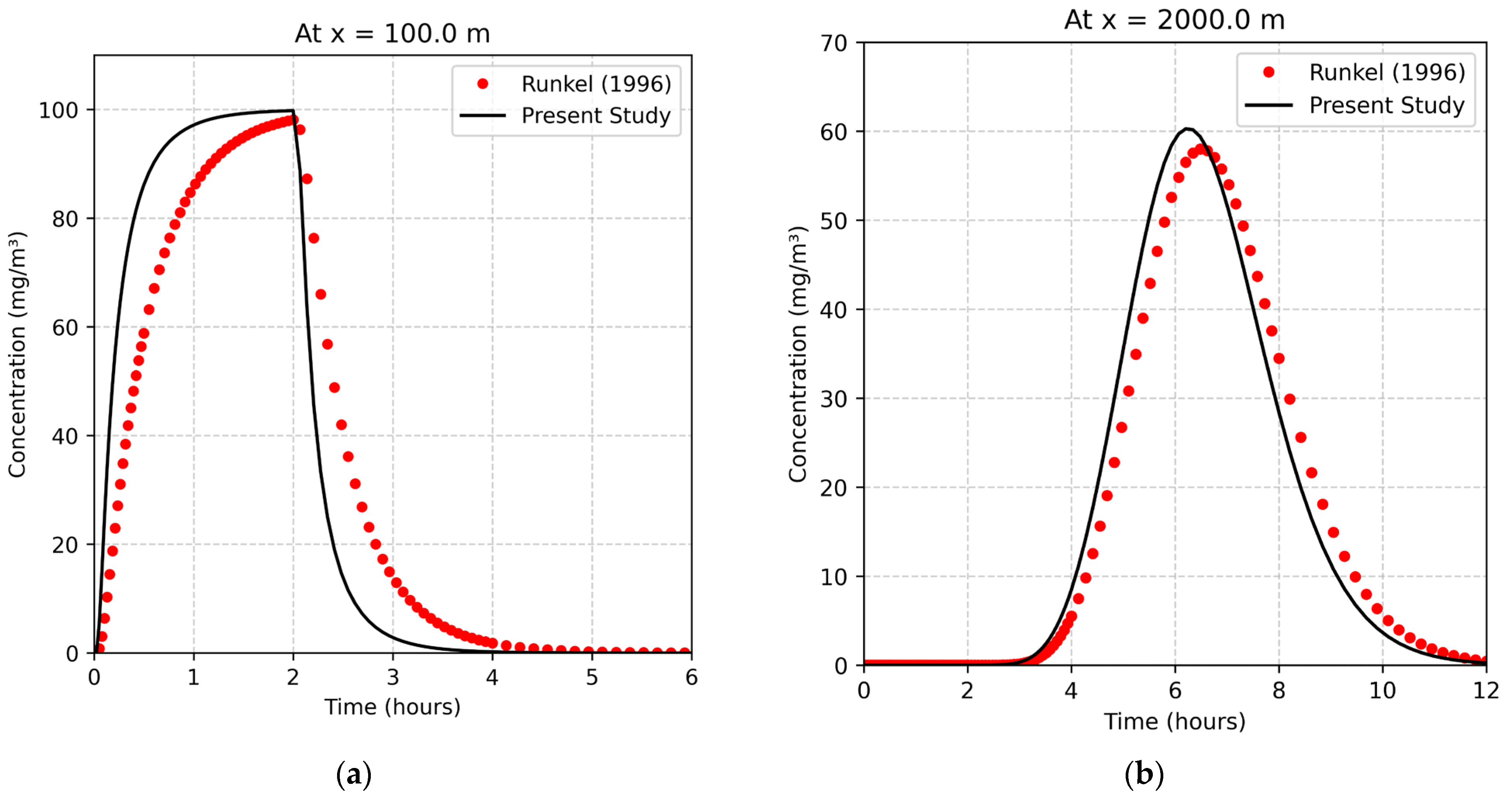
The solution (30a,b) describes the concentration of MPs in a river system over time and space, accounting for advection (transport by flow) and dispersion (spreading due to turbulence), sinking to sediment, and removal processes. It tells a story of how plastic pollution spreads, moves, and eventually disappears from the river water.
Case 1: This part of the solution describes what happens while plastic is actively being dumped or washed into the river from a specific point. As we know, the plastic does not just stay in one spot. The river’s current pushes it downstream, creating a moving plume of pollution. The front edge of this plume travels at the same speed as the river’s flow. As this plume moves, it does not stay neat and tight. The turbulence and swirling motions in the river cause the plastic to spread both forward and backward, making the polluted plume longer and more diluted as it travels. While the plume is moving and spreading, it is also shrinking. This is because some plastic particles are heavy and slowly sink to the riverbed, like sand. Other particles are gradually broken down by sunlight, water, and tiny microbes, though this is often a very slow process for plastics. So, during an active spill, we have a moving, stretching, and shrinking plume of plastic pollution traveling down the river.
Case 2: This part of the solution describes what happens after the source of the pollution is turned off. Even after new plastic stops entering the river, the plume that was already in the water keeps moving downstream. With no new plastic being added, the entire plume continues to stretch and shrink. The plastic particles keep sinking to the bottom and breaking down. This means the overall amount of plastic in the water steadily decreases. The solution (Equation (31)) shows that plastic does not just vanish the moment the pollution stops. It can travel a very long way, continuing to affect the river environment for miles downstream. The “tail” of the polluted plume can be very long, meaning a river can show signs of contamination long after the original source has been dealt with.
3.2. Comparative Analysis of Transport Paradigms
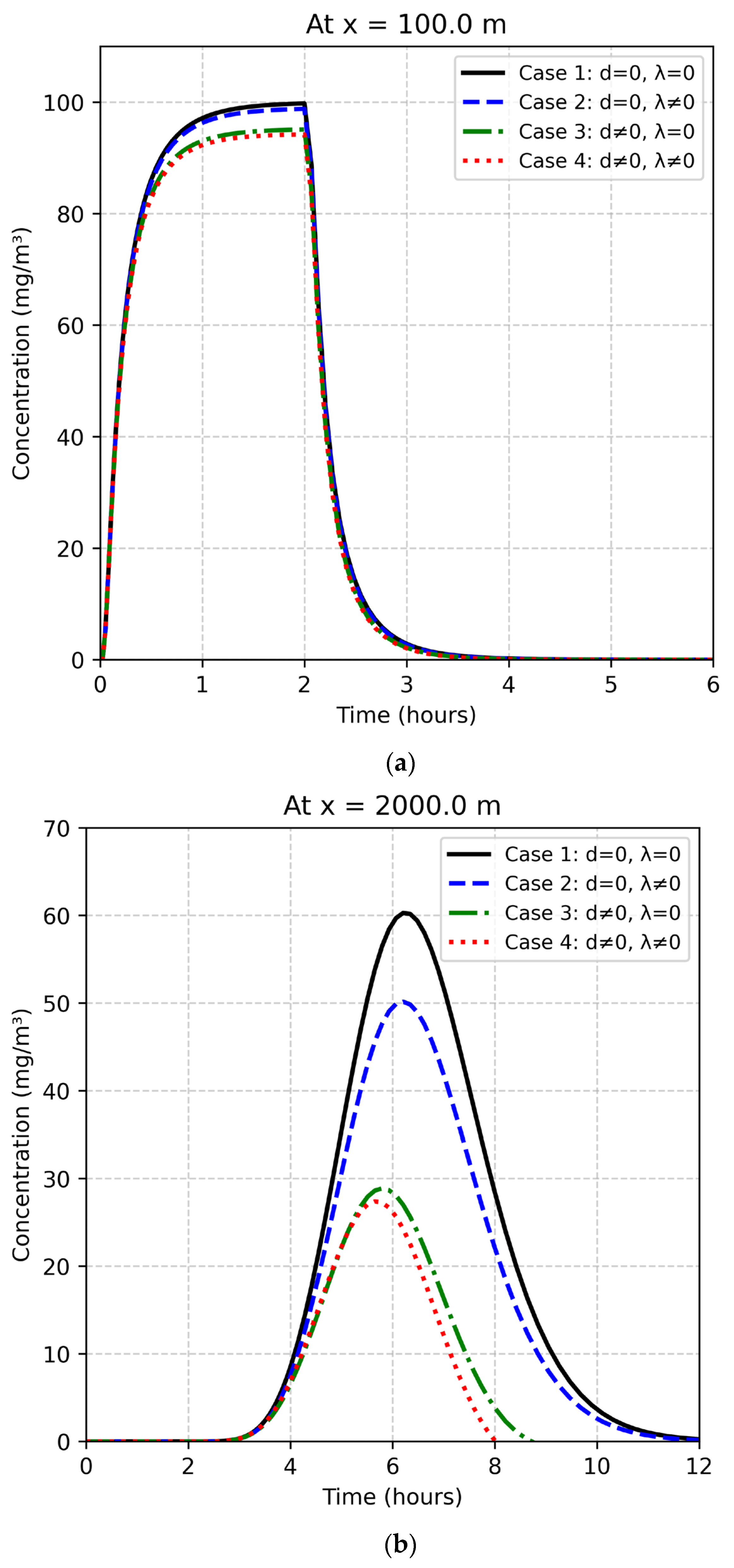
Figure 2a,b provides a direct graphical comparison of MP transport behavior under two distinct paradigms: the conventional solute model versus the modified plastic-specific model. We consider four cases to isolate the effects of the modified terms:
Case 1. (Indicates no sinking or removal of MPs).
Case 2. (Indicates removal but no sinking of MPs).
Case 3. (Indicates sinking but no removal of MPs).
Case 4. (Indicates both sinking and removal of MPs).
Figure 2a illustrates that while the conventional model (Case 1) maintains high peak concentrations, the modified models (Cases 3 and 4) show a clear reduction in peak height due to the sink terms. It is observed that a rapid increase in concentration starting at
and concentrations peak around
h (when the pollution pulse ends). After the peak, concentrations gradually decrease over time, and such variation in decrease is found almost the same for all the cases when
h. However, the peak rate varies among cases, with Cases 1 and 2 showing the highest peak rate and Cases 3 and 4 showing the lowest peak rate between the time frame 0 and 2 h.
Also,
Figure 2b shows the concentration profiles for all cases at x = 2000 m. It can be seen that concentration profiles show delayed behavior compared to
Figure 2a, with concentrations starting to rise around
h. This delay indicates the travel time of the MPs from
. It is also seen that peak concentrations occur around
h for all cases. However, all peaks are broader and lower than at
, and this is due to the dispersion during transport of MPs. Also, Case 1 shows the highest level of concentration (~60 mg/m
3) when we consider the sinking (d) and removal (λ) of MPs are absent. Next, Case 2 shows the second-highest level of concentration (~50 mg/m
3) when we only consider the removal (λ) of MPs. Additionally, case 3 shows the third-highest level of concentration (~29 mg/m
3) when we only consider the sinking (d) of MPs. Finally, case 4 shows the lowest pick of concentration (~28 mg/m
3) when we introduced both sinking (d) and removal (λ) of MPs. Finally, all these findings suggest that, at the farthest points, the effects of sinking and removal are more pronounced due to the longer travel time. Also, sinking has a higher impact on concentration than removal.
3.3. Sensitivity of Transport Dynamics to Removal and Sinking
3.3.1. Impact of Removal Rates
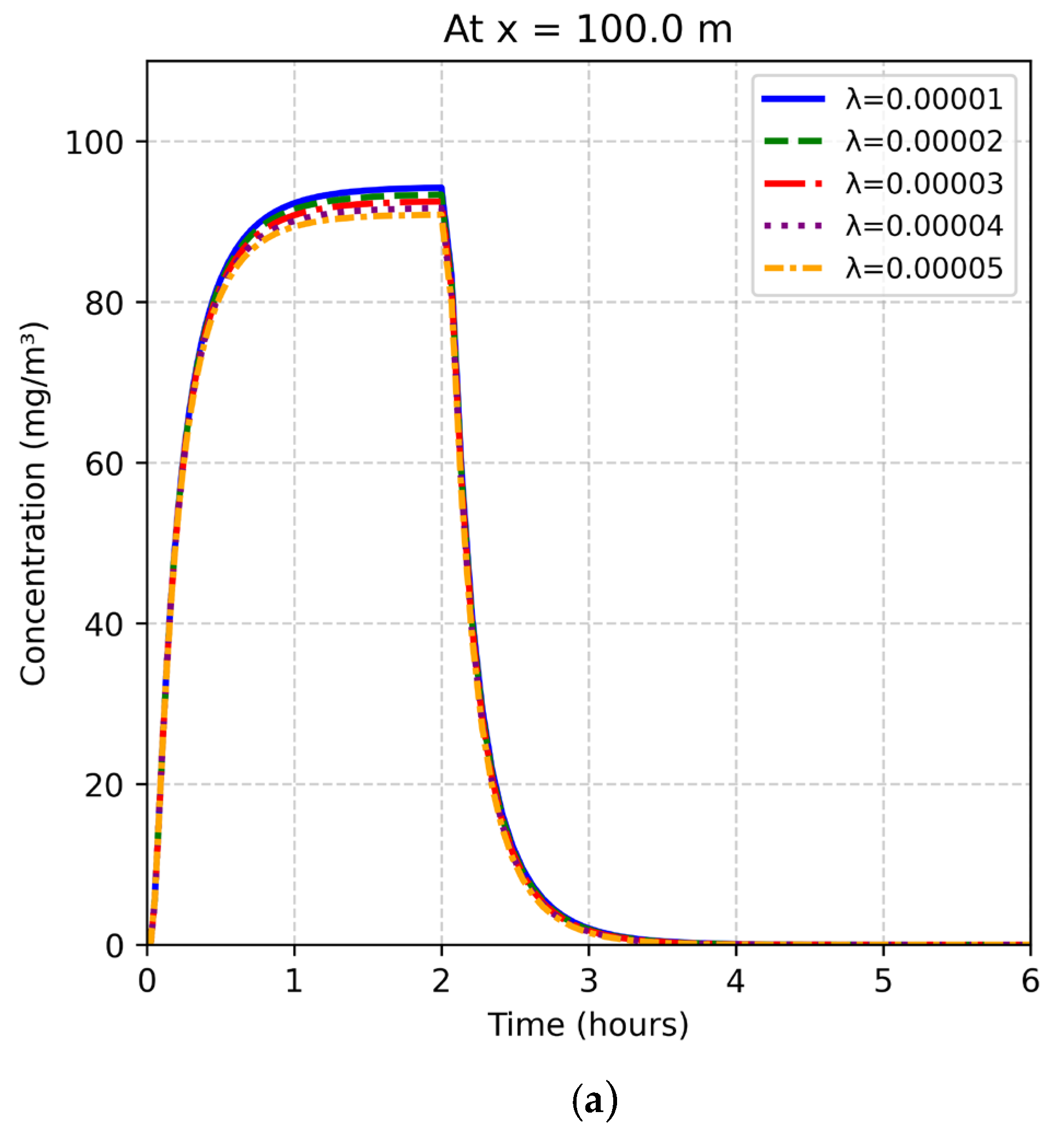
Figure 3a shows the variation in concentration profiles with different removal rates (λ) for a fixed sinking rate (d = 0.00005) at x = 100 m. The result shows that all cases have nearly identical peak concentrations because removal has minimal time to act during the initial pulse. Also, all cases show nearly identical peak concentrations (~95
) that indicate that removal has minimal effect during the initial pulse phase, and then all cases show a gradual decline after the peak.
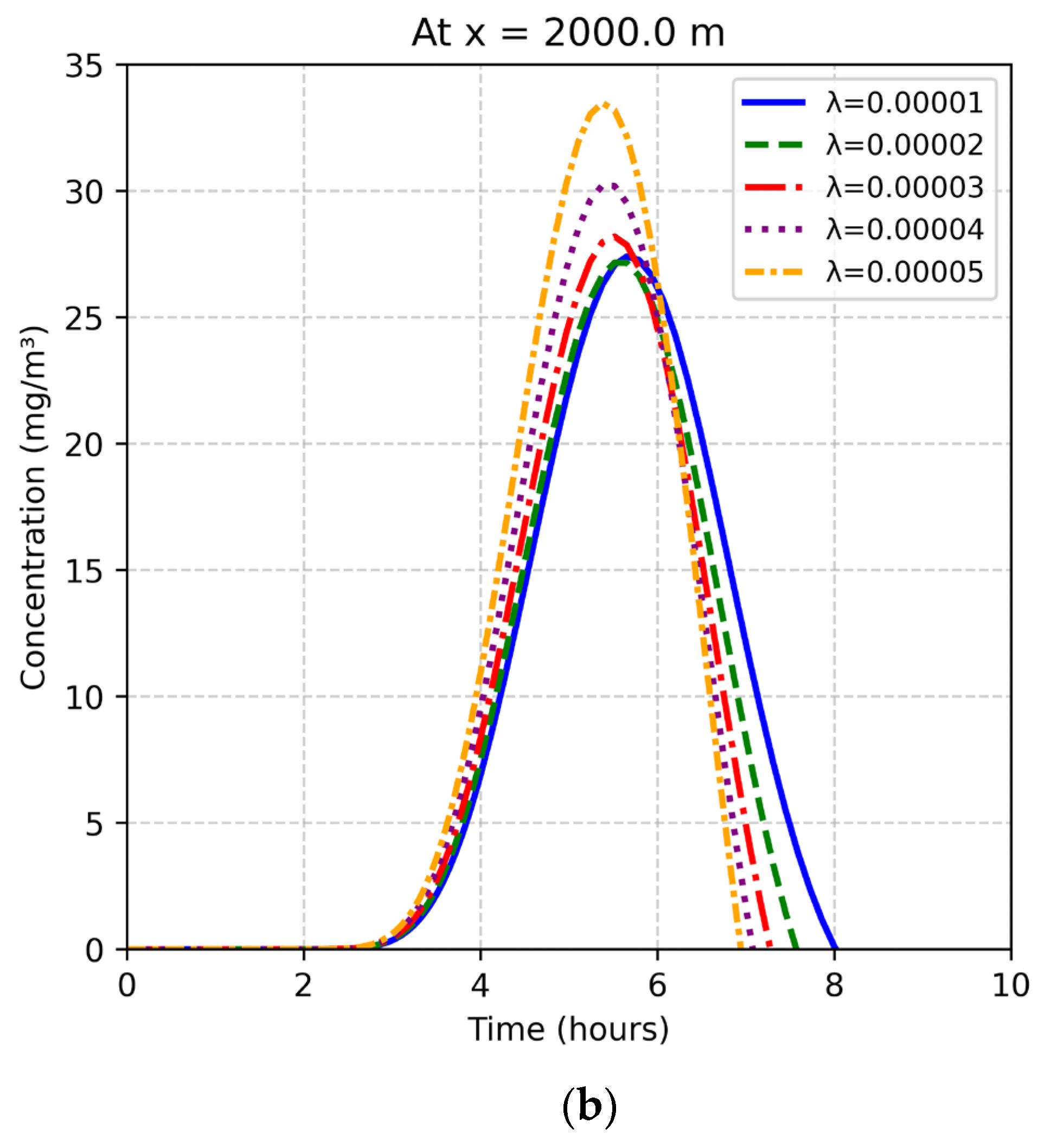
Figure 3b shows a delayed arrival compared to x = 100 m, with concentrations starting to rise around t = 4–5 h and peak concentrations occurring around t = 6 h, which is later than at x = 100 m. Also, λ = 0.00005 shows the highest peak concentration (~35
) and λ = 0.00001 shows the lowest peak concentration (~27
). The lowest removal rates (λ = 0.00001) show the most dramatic reduction in concentration, indicating that removal has a cumulative effect over distance and time. It happens because a higher removal rate breaks down more MPs over time through chemical processes.
3.3.2. Impact of Sinking Rates
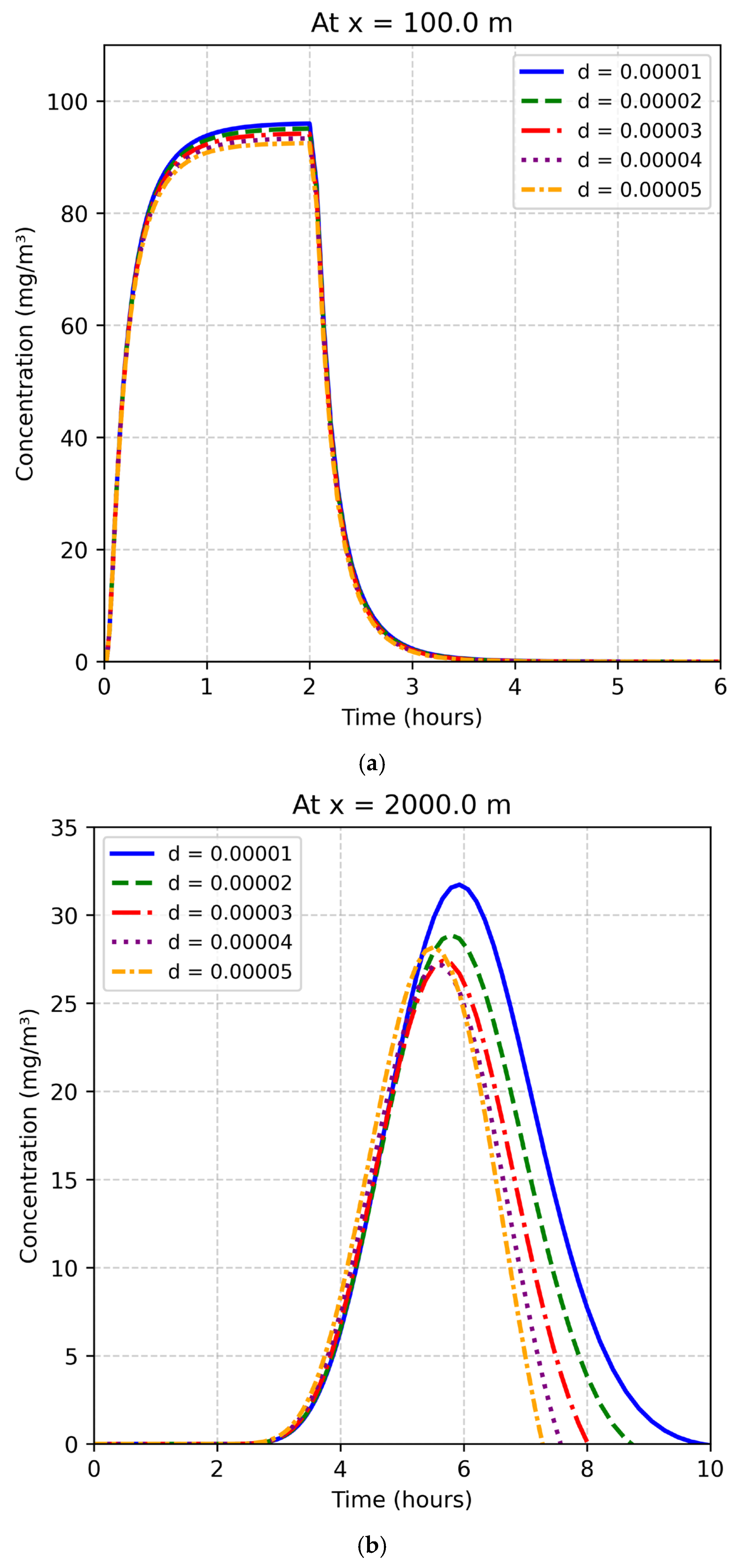
Figure 4a shows MP transport through a river system under five different scenarios, comparing the effects of varying sinking rates (d) while keeping the removal rate (λ) fixed at x = 100 m. We observe that all the cases show a rapid increase in concentration starting at t = 0 and concentrations peak around t = 2 h (when the pollution pulse ends). After the peak, concentrations gradually decrease over time. Results reveal that d = 0.00001 shows the highest peak concentration and d = 0.00005 shows the lowest peak concentration. Overall, differences between cases are relatively small because the travel time is short, limiting the time available for sinking to remove MPs from the river.
Figure 4b shows a delayed arrival compared to x = 100 m, with concentrations starting to rise around t = 4–5 h and peak concentrations occurring around t = 6 h, which is later than at x = 100 m. Also, d = 0.00001 shows the highest peak concentration (~32
) and d = 0.00005 shows the lowest peak concentration (~27
). The highest sinking rate (d = 0.00005) shows the most dramatic reduction in concentration, indicating that sinking has a cumulative effect over distance and time. It happens because a higher sinking rate removes more MPs from the water over time through settling on the riverbed. It suggests that sinking is an effective mechanism for reducing the long-term presence of MPs in the water. In addition, lower sinking rates allow MPs to remain suspended in the water for longer periods and travel greater distances.
3.4. Environmental Implications and Mechanism Dominance
A direct comparison of Cases 2 (removal only) and 3 (sinking only) in
Figure 2 reveals a distinct grading in removal effectiveness. Although removal (λ) acts uniformly over time to reduce the total mass of MPs, it does not alter the physical residence time of the remaining particles in the water column as drastically as sinking (d). Our analysis indicates that sinking is the dominant mechanism for reducing aqueous concentration, particularly at higher rates (d > 0.00005). This suggests that for dense polymers (e.g., PVC, PET), the primary risk shifts from downstream transport (where plastics enter the ocean) to local sediment accumulation, where they pose long-term threats to benthic organisms. However, removal acts as a global mass reducer but is too slow to prevent significant downstream transport during the initial pulse phase.
A significant finding from the comparative analysis is the “stretching” of the concentration plume in the modified ADE compared to the conventional model. As shown in
Figure 2b, the conventional model predicts a sharp, high-amplitude pulse. However, when sinking is introduced, the peak concentration is dampened, and the tail of the curve extends over a longer duration. This implies that conventional pollutant models significantly underestimate the exposure time of aquatic ecosystems to MPs.
Comparative Analysis
The modified ADE model is most suitable for “dilute” suspensions where the presence of MPs does not significantly alter the flow dynamics of the river. It is computationally efficient and ideal for risk assessment of standard pollution levels where transport is primarily driven by fluid velocity. The multi-phase model is essential for scenarios involving high-density plastic spills or wastewater effluent discharges with high particulate loads. In these scenarios, the momentum transfer from the particles to the fluid can potentially alter flow velocity and wave propagation. This model captures the complex, non-linear feedback that is neglected in standard advection-dispersion frameworks.
We have obtained a closed-form inverse Laplace transform for the coupled system (Equations (35) and (43)), which is analytically challenging, but the structure of the solution in the Laplace domain provides critical physical insight. In Equation (43), the influence of the particle concentration on the water level is driven by the integral term involving the coupling coefficient ω. This implies that as the density of the MP suspension increases, the effective momentum of the fluid is modified, which leads to a suppression of wave amplitudes compared to a clean water flow. This confirms that for ‘dense’ spills, the flow dynamics cannot be decoupled from the particle phase. The analytical solution provided here allows for the direct calculation of this feedback that serves as a theoretical tool to determine the maximum safe particle loading before hydraulic effects become significant.
3.5. Reconciliation with Field Observations and Broader Implications
The mathematical framework presented in this study offers a theoretical bridge between hydrodynamic transport and the empirical observations of MP distribution reported in recent field studies. Our findings, particularly regarding the dominance of the sinking mechanism, reconcile effectively with existing estimates of riverine MP transport. First, our modified ADE model highlights that sinking (d) is the primary driver for reducing aqueous concentrations (
Figure 2,
Figure 3 and
Figure 4). This theoretical prediction aligns perfectly with the disparity often observed between surface water and sediment concentrations in field surveys. For example, studies have reported significantly higher MP abundances in sediments compared to surface water [
11,
12]. Our model attributes this discrepancy directly to the sink term (d) and suggests that as MPs move downstream, dense polymers settle out of the water column. This validates our model’s foundation that rivers act not just as transport pathways, but as critical accumulation zones for benthic ecosystems. Second, our results demonstrate the “long-tail” effect of MP plumes (
Figure 2b), where concentrations persist long after the pollution pulse has ceased. This finding contextualizes the permeating presence of MPs in remote or downstream ecosystems. Also, researchers detected MPs in remote high-latitude lakes and in the guts of fish far from direct sources [
6,
10]. Our model supports the hypothesis that short-term urban discharge events can lead to prolonged downstream exposure due to the coupled advection–dispersion dynamics. Finally, the differentiation between removal (λ) and sinking (d) in our model provides a mechanistic explanation for polymer-specific distribution. Our analysis shows that removal has a negligible effect during the initial pulse phase but acts cumulatively over distance. This helps explain why durable polymers like Polyethylene (PE) and Polypropylene (PP) are frequently found in water samples [
13,
14], which remain dominant in the water column, whereas denser polymers like PVC and PET [
17] are more likely to settle rapidly. Therefore, if we can adjust the sinking rate parameter, then our model can be used to predict the distinct transport fates of different polymer types.
Our results confirm that for persistent microplastics, the transport dynamics characterized by first-order sinking mirror the long-established behavior of suspended sediments and particle-bound reactive chemicals in rivers. As observed in chemical transport modeling, the ‘loss’ term d acts as a permanent sink, leading to the exponential decay of aqueous concentration and the accumulation of mass in the bed sediment.