Review

Nano- and Microplastics in Single-Use Plastic Water Bottles: A Review of Occurrence, Health Risks, and Regulatory Needs


by
Bonface O. Manono
1,*,
Zipporah Gichana
2,
Alice Theuri
3 and
Kelvin Mutugi Kithaka
4
1
Colorado State University Extension, Fort Collins, CO 80523, USA
2
Department of Environment, Natural Resources and Aquatic Sciences, School of Agriculture and Natural Resources Management, Kisii University, Kisii P.O. Box 408-40200, Kenya
3
Department of Human Nutrition Sciences, Jomo Kenyatta University of Agriculture and Technology, Nairobi P.O. Box 62000-00200, Kenya
4
National Environment Management Authority, Nairobi P.O. Box 6739-00200, Kenya
*
Author to whom correspondence should be addressed.
Pollutants 2026, 6(1), 15; https://doi.org/10.3390/pollutants6010015

Submission received: 24 November 2025 / Revised: 17 February 2026 / Accepted: 26 February 2026 / Published: 2 March 2026

Abstract

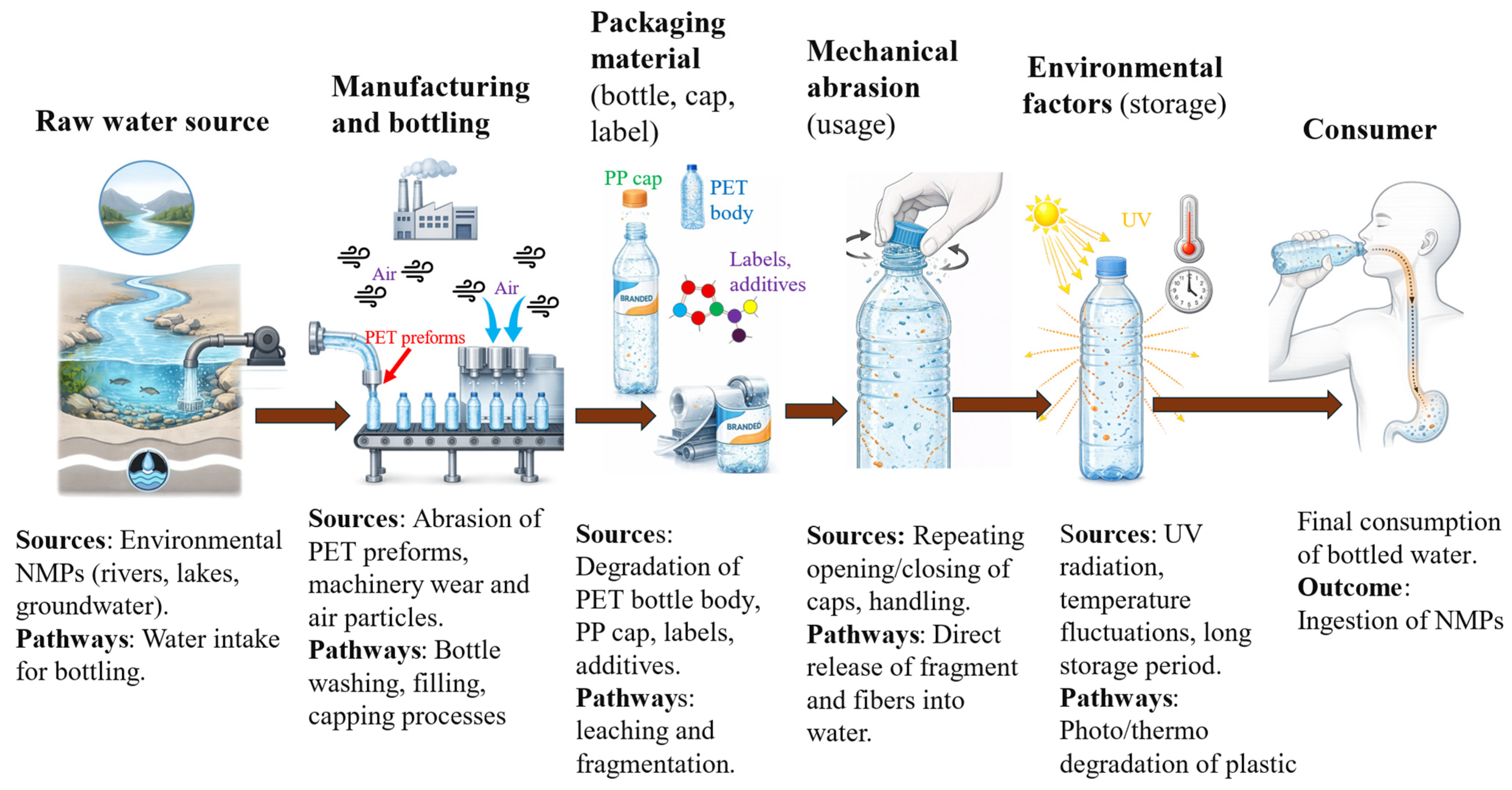
Nano- and microplastics (NMPs), which are ubiquitous environmental pollutants, are commonly found in single-use plastic water bottles. They originate primarily from the bottle material itself with the amount increasing through mechanical wear. This review synthesizes current scientific knowledge on the occurrence, health risks, and regulatory considerations concerning NMPs in single-use plastic water bottles. The review revealed that concentrations vary widely, leading to potential human exposure risks. Ingested NMPs can induce oxidative stress, inflammation, disruption of gut microbiota and potential bioaccumulation. Current health risk assessments are challenged by inconsistent methods and lack of standardized reference materials. While regulatory frameworks addressing NMP contamination are developing globally, they lack consistency and legally enforceable limits. Standardized detection and monitoring are emerging priorities, but legally enforceable limits and comprehensive policies are underdeveloped. This review highlights an urgent need for consistent regulations, standardized analysis methods, and research that examines realistic human exposure and toxicological impacts. To safeguard consumer health amidst escalating plastic utilization, it is essential for policymakers, researchers, industry, and public health stakeholders to coordinate their efforts to mitigate NMP contamination in single-use plastic water bottles.
Keywords: nanoplastics; microplastics; plastic water bottles; health risks; environmental contamination; toxicology; policy; regulatory needs; drinking water nanoplastics; microplastics; plastic water bottles; health risks; environmental contamination; toxicology; policy; regulatory needs; drinking water