1. Introduction
The African continent is rich in natural resources and has significant potential for economic growth. Many issues, such as poverty, social inequality, climate change, and energy insecurity, hinder Africa’s progress and prosperity. Access to energy is a key element of social and economic progress, in addition to being a necessity for achieving the Sustainable Development Goals (SDGs) [
1]. More than 600 million people in Africa do not have access to electricity, particularly in rural areas, where less than 10% of the population has access to electricity. Approximately 900 million people rely on conventional biomass for heating and cooking. Rural electrification is a major challenge for African countries, requiring significant financial investment, specialized expertise, administrative support, and regulatory capacity [
2,
3]. These issues affect the educational systems, health, income, and environment of the African population.
Africa’s energy needs can be met by using renewable energy (RE) sources like solar, biomass, and wind energy. In addition to mitigating greenhouse gas (GHG) emissions, these RE sources could improve energy security and self-sufficiency, stimulate innovation and entrepreneurship, improve living standards and social welfare, and create jobs [
4,
5,
6]. Together, the SDGs and the African Union (AU) Vision 2063 can be achieved with the exploitation of RE, which provides a common framework and vision for the continent [
7].
The South African government is finding it challenging to adapt to the changing energy needs of the country. Moreover, facilities used for power generation currently account for a significant share of the GHG emissions nationally. South Africa is trying to minimize its CO
2 emissions and ensure the security of its people by gradually increasing its RE sector [
8]. The primary causes of electricity blackouts in South Africa are growing power consumption and the decline of coal power stations. The national power capacity had to be considerably increased to meet the increased demand for energy caused by the rapid increase in the human population, especially in metropolitan areas. This binding effect has enhanced interest in RE sources, including distributed generation. Renewable energy has many advantages, such as boosting financial prospects, building up energy security, energy savings, and benefits to the environment [
9,
10].
This review discusses South African energy generation, examining how electricity is currently being generated. It also focuses on the potential, challenges, and limitations of RE, such as solar, wind, hydro, and biomass energy, to promote their integration into the country’s present energy infrastructure. This review aims to summarize the current status and future potential of RE in South Africa. The focus is on solar, wind, hydropower, and biomass resources. The review examines installed capacities, resource availability, and reported projections while highlighting key technical, infrastructural, and policy challenges. The analysis is limited to South Africa and covers the literature and data published. Data were drawn from peer-reviewed open-access journal articles, government reports, and industry publications between 2015 and 2025.
2. Current Energy Landscape
The primary energy source in South Africa is coal, which produces more than 80% of the nation’s electricity. Eskom, the primary energy provider in the country, operates coal-fired power stations which are older than their projected 40-year lifetime. This severely hinders initiatives to secure energy security and decarbonize, making the country’s current over-reliance on coal inefficient [
2]. The current five-year nationally determined contribution (NDC) from the Paris Agreement is aimed at reducing South Africa’s GHG emissions by 10–25% from current levels. The target is to reduce its emissions to 350–420 million tons of CO2-eq. by 2030. Rystad states that South Africa’s antiquated coal infrastructure will make it difficult to meet its decarbonization goals [
11].
Although coal remains the backbone of South Africa’s electricity system, quantitative comparisons highlight growing advantages of renewable alternatives. Recent studies show that the levelized cost of electricity from coal-fired power typically exceeds USD 80–120/MWh, especially when ageing infrastructure and maintenance costs are considered, whereas utility-scale solar PV and onshore wind projects are frequently delivered at costs below USD 50/MWh [
12,
13,
14]. From an environmental perspective, coal-based generation produces approximately 900–1000 gCO
2/kWh, while life-cycle emissions from wind and solar technologies are generally below 50 gCO
2/kWh [
12]. In terms of reliability, coal has historically provided baseload power, but declining plant availability and frequent unplanned outages have undermined its operational performance in recent years. Renewable generation is variable by nature; however, several studies indicate that reliability can be enhanced through geographic diversification, grid flexibility, and energy storage. These position renewables as an increasingly competitive option for new capacity additions [
13].
Despite domestic coal reserves and investments in coal-fired power generation, this legacy has led to serious reliability problems, including blackouts and environmental pollution. The integrated resource plan proposes a gradual transition in accordance with the mandate. By 2030, around 29.5 GW of new capacity will be built, mainly from wind (14.4 GW) and solar (6 GW), replacing some 12 GW of obsolete coal-fired plants [
2]. The Renewable Energy Investment Partnership Programme (REIPP), to entice private investment in RE and the unbundling of Eskom’s generation, transmission, and distribution, are two major policy initiatives. More than 6 GW of wind and solar projects have been allocated under REIPPPP. The programmes reflect the objective of diversifying the energy mix and minimizing reliance on coal.
The government has established a blueprint to stimulate investment in low-carbon projects [
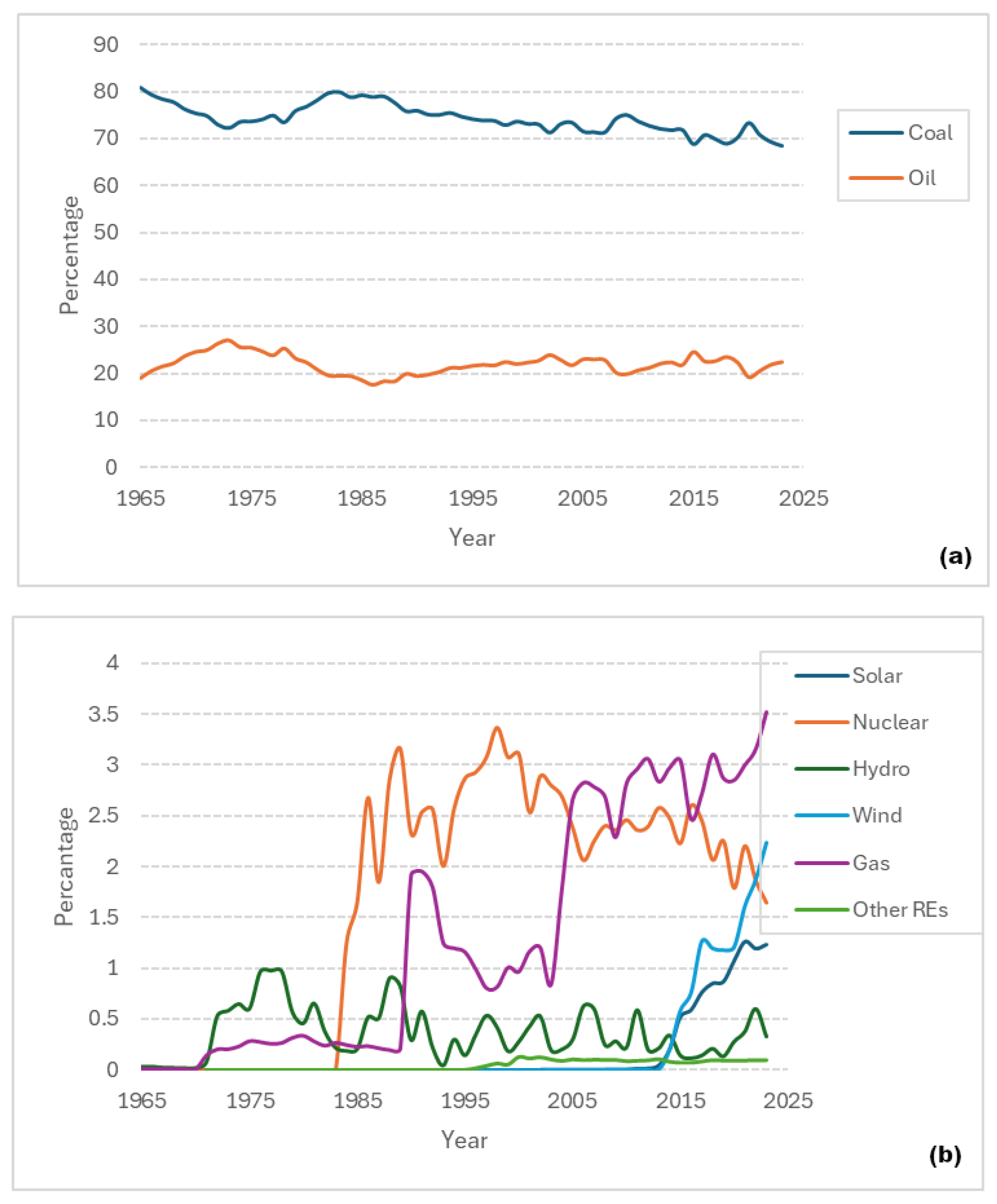
2]. The 2019 carbon pricing system aims to internalize the environmental costs of coal, and a significant tax incentive is being used to encourage small-scale solar installations. According to the updated IRP targets, the Renewable Energy Master Plan (SEMP), approved in April 2025, requires an increase of around 5 GW of RE capacity per year. In response to the increase in the maximum production licence to 100 MW in 2021, numerous large companies and local governments have built wind and solar projects with a combined capacity of hundreds of megawatts. Remarkable companies that have taken part in these programmes include Ford, Shoprite, and Primitive, a leading retailer [
15]. South Africa’s share of electric power generation by source is displayed in
Figure 1 [
16].
South Africa’s REIPPPP and the IRP have both supported renewable energy growth. REIPPPP has successfully attracted private investment and reduced wind and solar PV costs through competitive bidding [
17]. However, high transaction costs, complex procurement processes, and grid connection delays have slowed project delivery. Irregular bidding rounds have further reduced momentum. The IRP provides a long-term planning framework and formally recognizes the role of renewables. Its effectiveness has been limited by slow updates and weak alignment between planning outcomes and actual procurement, which has reduced policy certainty for investors [
18]. While these instruments have delivered clear gains, sustained renewable deployment will require faster implementation, improved grid planning, and clearer policy signals [
13].
South Africa has built numerous large-scale power stations to support its growing electricity sector. In the North Cape alone, there are more than 20 power stations and over 100 independent producers with a combined capacity of 900 MW. In the first quarter of 2023, installed PV capacity in South Africa stood at 6164 MW and is expected to reach 12 GW by the end of the decade. Of the installed capacity, 3964 MW was generated by private investments and 2200 MW was purchased by the government, mostly through the Renewable Energy Producer Program (REDP).
3. Renewable Energy Potential
The utilization of RE as an alternative energy source can greatly reduce South Africa’s excessive dependence on coal, an exhaustible and detrimental resource to the environment [
2]. Furthermore, the expansion of the South African RE industry will help to create new jobs and thereby strengthen the economy of the nation. South Africa is a significant location for a variety of RE sources, like biomass, wind, and solar energy, due to its population and geographic location.
3.1. Biomass Energy
Biomass can be used to generate heat energy, liquid hydrocarbons, or electricity [
3]. South Africa has facilities to produce biofuel, with forty-two million hectares of natural forest and 1.35 million hectares of plantations, and the country is well-positioned to employ biomass for energy generation. In 2022, South Africa installed 63 MW of biomass energy and has the potential to upgrade it to 313 MW by 2030 [
19]. The need to diversify the energy mix and reduce GHG emissions is driving the expansion of the biomass sector in South Africa.
The anaerobic digestion of wheat straw has been identified as a promising biogas production method, with an approximate energy capacity of 11 PJ per year [
20]. South Africa is the continent’s biggest producer of sugarcane, with a yearly capacity of more than 18 million tons. More than 1 ton of sugarcane waste that is left over is commonly burned in the field, while there is inefficient burning of the 2.5 tons of other bagasse generated in the nation. With the right processing, this underutilized biomass may produce one ton of bioethanol or more than 400 MW of energy [
2]. Every year, South Africa generates about 12 million tons of corn in addition to sugar cane in the Free State and Mpumalanga region, contributing the most to this worldwide output [
21].
3.2. Hydropower
South Africa receives only 500 mm of rainfall per year, severely limiting its ability to produce hydroelectric energy. The problems faced by the South African hydroelectric sector include frequent droughts and unpredictable seasonal flows. The largest hydroelectric potential in the country is recognized to be in the Eastern Cape [
22]. Currently, the installed hydropower capacity in the country is 1545 MW, which is expected to reach 2545 MW. Although large-scale hydropower plants can generate up to 5091 MW of electricity, they can likewise have negative effects on the environment [
19,
22].
3.3. Wind Energy
In South Africa, wind energy has a long history, stretching back decades. By the early 1990s, around 30,000 windmills were installed in the rural and agricultural areas of South Africa to meet domestic and agricultural needs [
8]. To identify the best locations for wind farms, the Atlas Wind exercise was completed in 2008, focusing on the analysis of wind speeds at altitude. A more cautious view suggests that South Africa could produce around 6 GW of wind energy [
8]. In the last decade, turbine technology has improved significantly, and many new companies have entered the market. Wind turbines are becoming increasingly available and efficient, and their size is increasing [
19]. The coastal areas of the Western and Eastern Cape, 10 m above sea level, are known for their strong winds, with an average yearly wind speed greater than 4 m/s [
2]. The KwaZulu-Natal region, the Drakensberg mountains, and the Bushveld were recognized as having modest wind potential [
2,
19].
3.4. Solar Energy
Like many African countries, South Africa has abundant solar power resources. The Northern Cape province has a direct normal irradiation (DNI) of more than 3200 kWh per square metre, being an exceptional area, compared to KwaZulu-Natal, which has a moderate DNI of around 1400 kWh per square metre. In recent years, South Africa has experienced a boom in direct and indirect solar electricity. Photovoltaics and concentrated solar power are the two primary energy sources in South Africa [
2]. Together with heat recovery, photovoltaic technology is becoming more efficient [
19]. The successful installation of several large-scale solar power plants in recent years has contributed to the rapid growth of the electricity sector in South Africa. It is estimated that 3000 square kilometres of solar-installed area could satisfy the energy needs of South Africa, with the sun shining for 2500 h a year [
19].
South Africa’s RE potential is diverse, but prioritization should reflect cost, water scarcity, grid readiness, and social impact. Solar PV and onshore wind should be prioritized in the short-to-medium term. Recent South African bid windows show costs for both technologies below USD 50/MWh, making them cheaper than new coal capacity [
17]. These technologies require little to no water, an important advantage in a water-stressed country, and can be deployed rapidly at scale. Biomass can support rural employment and waste management, but its role is limited by feedstock availability and sustainability concerns [
12]. Hydropower potential is constrained by climate variability and ecological impacts, which limit large-scale expansion [
13]. A practical pathway, therefore, prioritizes solar and wind for rapid capacity growth, supported by targeted biomass and small-scale hydropower where local conditions are favourable.
Renewable energy deployment is linked to clear employment gains. Recent global assessments report 16.6 million jobs in the RE sector in 2024, with solar PV and wind accounting for the largest shares [
23]. Review evidence further indicates that investment in renewables and energy efficiency generally delivers higher gross job creation than continued reliance on fossil fuels [
24]. While many jobs arise during project development, long-term employment is sustained through operation, maintenance, and expanding supply chains. These findings suggest that large-scale renewable deployment can support meaningful employment growth if skills training and transition policies are aligned.
4. Challenges and Limitations
Although the potential of RE in South Africa is being realized, the sector still needs to overcome several technical and environmental barriers in order to continue to grow. The upgrading of South Africa’s transmission infrastructure aims to facilitate the use of RE sources. To minimize dependence on Eskom and encourage private sector involvement, the government has established laws to enhance the trading of electricity and private generation projects [
25].
4.1. Biomass Energy
The availability of food and the generation of biofuel are now competitive due to the current push towards the usage of biofuel; in 2013, it was estimated that the crops employed to generate biofuel could adequately feed 280 million people [
26]. Given South Africa’s water shortage problems, using this finite resource to produce fresh crops for the manufacture of biofuel could aggravate the shortage or affect the production of food crops. The owners of land in rural regions who depend entirely on their farmland for their sustenance are likely to be very opposed to the conversion of traditional lands to produce biofuel on a large scale. Before major progress can be achieved, concerns, particularly those relating to the use of land, must be properly addressed [
2].
4.2. Wind Energy
The evolution of wind energy has been associated with bird deaths because the rotation of wind turbines produces zones of low pressure that can be lethal to bats and birds as they fly near the rotating blades of the turbine [
27]. Environmentalists around the world are concerned about the loss of these habitats caused by the emergence of wind energy installations. Additionally, those in the immediate vicinity may become extremely irritated due to the noise generated either mechanically or aerodynamically by the wind turbines, which has compelled some people to abandon their homes [
28]. Wind turbine syndrome is the term used to describe the range of harmful effects on the health of people who are associated with being close to wind farms. Problems that are related to the vestibule and auditory system are possible symptoms [
29].
Since many wind turbine stations must be placed in specific areas, these locations are usually found in remote areas that are challenging to connect to the grid. Most of the power generated will be lost if there are no adequate electricity grids [
2]. To compensate for this, expensive transmission lines are usually used to connect wind power plants to communities, thereby increasing the cost of installing a wind farm. Even with a robust power system, wind energy’s reliance on the speed of the wind can lead to other technical issues, such as voltage alterations. Changes in the speed of the wind have a direct effect on the electric power generated by wind power plants; this could be costly, since it causes either an excess or a shortfall of electricity, which ultimately interferes with the power supply [
2].
4.3. Solar Energy
Solar systems are expensive to install, and rural communities in South Africa have low incomes; this has made installing solar systems on a broad scale a difficult task [
30]. Solar systems offer a significantly larger initial expenditure but lower running costs than fossil fuel power plants. This means that those who do not have a substantial amount of money will be hindered from getting involved in the use of solar power systems [
2]. Because of ESKOM’s subsidy scheme, which provided financial support for solar power, the technology expanded rapidly until it was truncated in 2015. The industry has grown slowly because of this cessation, which possibly might have been prevented had more subsidies or similar programmes been created. While the South African solar system industry is growing, albeit slowly, the government could consider doing more to provide opportunities to both investors and consumers so that the company can reach its full capacity [
2].
RE expansion in South Africa is constrained by a combination of technical, social, and environmental barriers.
Table 1 summarizes the main challenges, their impacts on deployment, and commonly proposed mitigation measures reported in the literature.
5. Energy Storage Systems and Smart Grid Technologies
Energy storage systems and smart grid technologies play a central role in enabling reliable RE integration in South Africa. Their functions span load shifting, system reliability, grid stability, and the coordination of distributed energy resources.
Table 2 summarizes the key roles, quantitative evidence, benefits, and remaining challenges associated with these technologies.
6. Conclusions
This review shows that South Africa has strong RE potential. Solar and wind offer the fastest and lowest-cost options for decarbonising the power sector. Biomass and hydropower can support this transition in specific locations. Resource availability alone, however, is not enough. Grid limits, storage gaps, policy delays, and social acceptance remain critical barriers.
Future research should focus on turning potential into a reliable supply. More work is needed to quantify energy storage and flexibility requirements under realistic operating conditions. Transmission congestion must be analyzed in detail, especially in high-resource regions far from demand centres. Research on market design is also important. Pricing mechanisms for flexibility and ancillary services remain unclear.
Cost assessments should be refined to include grid upgrades, environmental mitigation, and land-use constraints. Employment impacts also need closer attention. Studies should examine the scale, quality, and location of jobs created across renewable value chains. Skills and training needs are equally important for a just transition. Finally, more applied research is required on community engagement, benefit-sharing models, and environmentally sensitive project siting. Addressing these areas will help ensure that South Africa’s RE transition is reliable, inclusive, and sustainable.
Author Contributions
Conceptualization, O.J.O.; methodology, O.J.O. and P.O.; software, O.J.O.; validation, O.J.O., C.M. and P.O.; formal analysis, O.J.O. and P.O.; investigation, O.J.O., S.C. and H.P.; resources, C.M.; data curation, O.J.O.; writing—original draft preparation, O.J.O.; writing—review and editing, O.J.O., C.M. and P.O.; visualization, S.C. and H.P.; supervision, C.M., P.O. and S.C.; project administration, H.P.; funding acquisition, C.M. All authors have read and agreed to the published version of the manuscript.
Funding
This research received no external funding.
Institutional Review Board Statement
Not applicable.
Informed Consent Statement
Not applicable.
Data Availability Statement
Sources of data have been included in the references.
Conflicts of Interest
The authors declare no conflicts of interest.
References
- Minas, A.M.; García-Freites, S.; Walsh, C.; Mukoro, V.; Aberilla, J.M.; April, A.; Kuriakose, J.; Gaete-Morales, C.; Gallego-Schmid, A.; Mander, S. Advancing Sustainable Development Goals through Energy Access: Lessons from the Global South. Renew. Sustain. Energy Rev. 2024, 199, 114457. [Google Scholar] [CrossRef]
- Akinbami, O.M.; Oke, S.R.; Bodunrin, M.O. The State of Renewable Energy Development in South Africa: An Overview. Alex. Eng. J. 2021, 60, 5077–5093. [Google Scholar] [CrossRef]
- Ogunniyi, O.J.; Oni, T.O.; Ikubanni, P.P.; Aliyu, S.J.; Ajisegiri, E.A.; Ibikunle, R.A.; Adekanye, T.A.; Adeleke, A.A.; Ajewole, J.B.; Ogundipe, O.L.; et al. Prospects for Nigerian Electricity Production from Renewable Energy. In Proceedings of the 2023 International Conference on Science, Engineering and Business for Sustainable Development Goals (SEB-SDG), Omu-Aran, Nigeria, 5–7 April 2023; pp. 1–6. [Google Scholar]
- Ogunniyi, O.J.; Ade-Omowaye, J.A.; Oni, T.O.; Ikubanni, P.P.; Ajisegiri, E.A.; Ibikunle, R.A.; Adekanye, T.A.; Bello, K.A. A Review of Wind Energy and Its Potential in Nigeria. In Proceedings of the 2024 International Conference on Science, Engineering and Business for Driving Sustainable Development Goals (SEB4SDG), Omu-Aran, Nigeria, 2–4 April 2024; IEEE: Piscataway, NJ, USA, 2024; pp. 1–6. [Google Scholar]
- Oni, T.O.; Ayodeji, S.O.; Aliyu, S.J.; Ajisegiri, E.S.; Ibikunle, R.A.; Ogunniyi, O.J. Transformation of Waste to Wealth: Acquisition of Fuel from Polymers. In Proceedings of the 2023 International Conference on Science, Engineering and Business for Sustainable Development Goals, SEB-SDG 2023, Omu-Aran, Nigeria, 5–7 April 2023. [Google Scholar]
- Olorunmaiye, J.A.; Adegun, I.K.; Ogunniyi, O.J.; Aweda, J.O.; Ajiboye, T.K.; Abdulkareem, S. Effects of Mixing Ratios of Cow Dung, Cassava Peel and Rice Husk on Thermodynamic Properties of Biogas in an Anaerobic Digester. In Proceedings of the International Science, Technology, Education, Arts, Management & Social Sciences (iSTEAMS), Accra, Ghana, 21–23 March 2016; pp. 527–534. [Google Scholar]
- Royo, M.G.; Diep, L.; Mulligan, J.; Mukanga, P.; Parikh, P. Linking the UN Sustainable Development Goals and African Agenda 2063: Understanding Overlaps and Gaps between the Global Goals and Continental Priorities for Africa. World Dev. Sustain. 2022, 1, 100010. [Google Scholar] [CrossRef]
- Adebiyi, A.A.; Moloi, K. Renewable Energy Source Utilization Progress in South Africa: A Review. Energies 2024, 17, 3487. [Google Scholar] [CrossRef]
- Mbungu, N.T.; Naidoo, R.M.; Bansal, R.C.; Siti, M.W.; Tungadio, D.H. An Overview of Renewable Energy Resources and Grid Integration for Commercial Building Applications. J. Energy Storage 2020, 29, 101385. [Google Scholar] [CrossRef]
- Ibikunle, R.A.; Ogunniyi, O.J.; Onu, P.; Ade-Omowaye, J.A.; God’Sfavour, O.O.; Priase, N.C.; Great, G.O.; Matthew, O.C. CO2 Generation from Biogas: A Comprehensive Study on Rate Determination, Upgrading Techniques, and Environmental Implications. In Proceedings of the 2024 International Conference on Science, Engineering and Business for Driving Sustainable Development Goals (SEB4SDG), Omu-Aran, Nigeria, 2–4 April 2024; pp. 1–6. [Google Scholar]
- Rystad Energy Challenges Ahead for South Africa’s Decarbonization as Renewable Power Capacity to Fall Short of 2030 Target. Available online: https://www.rystadenergy.com/news/challenges-ahead-for-south-africa-s-decarbonization-as-renewable-power-capacity-t (accessed on 16 May 2025).
- Osman, A.I.; Chen, L.; Yang, M.; Msigwa, G.; Farghali, M.; Fawzy, S.; Rooney, D.W.; Yap, P.-S. Cost, Environmental Impact, and Resilience of Renewable Energy under a Changing Climate: A Review. Environ. Chem. Lett. 2023, 21, 741–764. [Google Scholar] [CrossRef]
- Mathibedi, G.S.; Mokgohloa, K.; Seadira, T.; Ramdass, K. Renewable Energy Integration in South Africa: A System Dynamics Comparison with Global Trends. Renew. Energ. 2025, 3. [Google Scholar] [CrossRef]
- Hartley, F.; Merven, B.; Arndt, C.; Ireland, G.; Turhan, E.; Baptista, B.V.; Doukas, H. Quantifying the Macro- and Socioeconomic Benefits of a Transition to Renewable Energy in South Africa; International Food Policy Research Institute: Washington, DC, USA, 2019. [Google Scholar]
- Jowett, P. South Africa Targeting Up to 5 GW of New Renewables per Year. PV Magazine, 7 April 2025.
- Ritchie, H.; Roser, M.; Rosado, P. South Africa: Energy Country Profile. Our World in Data. 2022. Available online: https://ourworldindata.org/energy/country/south-africa#citation (accessed on 22 May 2025).
- Eberhard, A.; Naude, R. The South African Renewable Energy Independent Power Producer Procurement Programme: A Review and Lessons Learned. J. Energy S. Afr. 2016, 27, 1–14. [Google Scholar] [CrossRef]
- Baker, L.H.; Burton, J.; Trollip, H.; Godinho, C. The Political Economy of Decarbonisation: Exploring the Dynamics of South Africa’s Electricity Sector; Energy Research Centre: Cape Town, South Africa, 2015. [Google Scholar]
- Skosana, B.; Siti, M.W.; Mbungu, N.T.; Kumar, S.; Mulumba, W. An Evaluation of Potential Strategies in Renewable Energy Systems and Their Importance for South Africa—A Review. Energies 2023, 16, 7622. [Google Scholar] [CrossRef]
- Kamusoko, R.; Mukumba, P. Potential of Wheat Straw for Biogas Production by Anaerobic Digestion in South Africa: A Review. Energies 2024, 17, 4662. [Google Scholar] [CrossRef]
- Wettstein, S.; Scharfy, D.; von Blottnitz, H.; Berli, C.; Stucki, M. Mitigating Environmental Impacts from Agriculture in Emerging Economies: A Case Study of Solar Powered Irrigation in the South African Maize Production. In Proceedings of the 5th International EcoSummit Congress, EcoSummit 2016, Montpellier, France, 29 August–1 September 2016. [Google Scholar]
- Srivastava, R.K.; Shetti, N.P.; Reddy, K.R.; Kwon, E.E.; Nadagouda, M.N.; Aminabhavi, T.M. Biomass Utilization and Production of Biofuels from Carbon Neutral Materials. Environ. Pollut. 2021, 276, 116731. [Google Scholar] [CrossRef]
- IRENA; ILO. Renewable Energy and Jobs: Annual Review 2025; International Renewable Energy Agency: Abu Dhabi, United Arab Emirates; International Labour Organization: Geneva, Switzerland, 2025. [Google Scholar]
- Hanna, R.; Heptonstall, P.; Gross, R. Job Creation in a Low Carbon Transition to Renewables and Energy Efficiency: A Review of International Evidence. Sustain. Sci. 2024, 19, 125–150. [Google Scholar] [CrossRef]
- Mirzania, P.; Gordon, J.A.; Balta-Ozkan, N.; Sayan, R.C.; Marais, L. Barriers to Powering Past Coal: Implications for a Just Energy Transition in South Africa. Energy Res. Soc. Sci. 2023, 101, 103122. [Google Scholar] [CrossRef]
- Subramaniam, Y.; Masron, T.A.; Azman, N.H.N. The Impact of Biofuels on Food Security. Int. Econ. 2019, 160, 72–83. [Google Scholar] [CrossRef]
- Tesfahunegny, W.; Datiko, D.; Wale, M.; Hailay, G.E.; Hunduma, T. Impact of Wind Energy Development on Birds and Bats: The Case of Adama Wind Farm, Central Ethiopia. J. Basic Appl. Zool. 2020, 81, 41. [Google Scholar] [CrossRef]
- Bošnjaković, M.; Hrkać, F.; Stoić, M.; Hradovi, I. Environmental Impact of Wind Farms. Environments 2024, 11, 257. [Google Scholar] [CrossRef]
- Flemmer, C.; Flemmer, R. Wind Turbine Infrasound: Phenomenology and Effect on People. Sustain. Cities Soc. 2023, 89, 104308. [Google Scholar] [CrossRef]
- Moosa, B. Sustainable Energy Sources: The Impact of Solar PV Installation in Ethekwini, Kwazulu-Natal. J. Incl. Cities Built Environ. 2025, 5, 59–85. [Google Scholar]
- Denholm, P.; Sun, Y.; Mai, T. An Introduction to Grid Services: Concepts, Technical Requirements, and Provision from Wind; National Renewable Energy Laboratory (NREL): Golden, CO, USA, 2019. [Google Scholar]
- Brown, T.; Schlachtberger, D.; Kies, A.; Schramm, S.; Greiner, M. Synergies of Sector Coupling and Transmission Reinforcement in a Cost-Optimised, Highly Renewable European Energy System. Energy 2018, 160, 720–739. [Google Scholar] [CrossRef]
- Virah-Sawmy, D.; Sturmberg, B. Socio-Economic and Environmental Impacts of Renewable Energy Deployments: A Review. Renew. Sustain. Energy Rev. 2025, 207, 114956. [Google Scholar] [CrossRef]
- Ellis, G.; Schneider, N.; Wüstenhagen, R. Dynamics of Social Acceptance of Renewable Energy: An Introduction to the Concept. Energy Policy 2023, 181, 113706. [Google Scholar] [CrossRef]
- van der Horst, D.; Grant, R.; Montero, A.M.; Garneviciene, A. Energy Justice and Social Acceptance of Renewable Energy Projects in the Global South. In A Critical Approach to the Social Acceptance of Renewable Energy Infrastructures; Springer International Publishing: Cham, Switzerland, 2021; pp. 217–234. [Google Scholar]
- Apoorva, M.S.; Nayak, S.H.; Dinesh, S. Environmental Impacts of Renewable Energy Systems and Strategies for Mitigation. Pharma Innov. J. 2025, 14, 42–47. [Google Scholar]
- Areola, R.I.; Adebiyi, A.A.; Moloi, K. Integrated Energy Storage Systems for Enhanced Grid Efficiency: A Comprehensive Review of Technologies and Applications. Energies 2025, 18, 1848. [Google Scholar] [CrossRef]
- Thango, B.A.; Bokoro, P.N. Battery Energy Storage for Photovoltaic Application in South Africa: A Review. Energies 2022, 15, 5962. [Google Scholar] [CrossRef]
- Koroma, M.; Kamara, G.S.; Mansaray, A.; Kamara, I.D.; Conteh, M. Technological Advancements of Energy Storage Systems Technologies in Africa: A Review. Open J. Energy Effic. 2025, 14, 43–61. [Google Scholar] [CrossRef]
- Masembe, A. Reliability Benefit of Smart Grid Technologies: A Case for South Africa. J. Energy S. Afr. 2015, 26, 2–9. [Google Scholar] [CrossRef]
- Diab, R. Recommendations for the Energy Efficiency Technology Landscape in South Africa. J. Energy S. Afr. 2018, 29, 84–86. [Google Scholar] [CrossRef]
| Disclaimer/Publisher’s Note: The statements, opinions and data contained in all publications are solely those of the individual author(s) and contributor(s) and not of MDPI and/or the editor(s). MDPI and/or the editor(s) disclaim responsibility for any injury to people or property resulting from any ideas, methods, instructions or products referred to in the content. |
© 2026 by the authors. Licensee MDPI, Basel, Switzerland. This article is an open access article distributed under the terms and conditions of the Creative Commons Attribution (CC BY) license (https://creativecommons.org/licenses/by/4.0/).