1. Introduction
Additive manufacturing (AM) has rapidly gained attention as a versatile approach for producing complex components from metals, ceramics, and polymers [
1,
2]. Among the various AM techniques, selective laser melting (SLM) stands out as an advanced process in which components are fabricated layer by layer through the precise scanning of a high-powered laser, guided by a computer-aided design (CAD) model [
3]. Corrosion resistance is a critical factor for alloys produced by such methods, most importantly in demanding environments like marine applications. Hence, the impact of microstructural characteristics, including porosity, dislocation networks, grain morphology, solute segregation, residual stresses, and surface roughness, should be taken into account when assessing the corrosion behavior of additively manufactured alloys [
3,
4].
Silicon-containing aluminum (Al) alloys have received huge acceptance and applicability. This can be credited to their outstanding castability, low shrinkage, and comparatively modest melting temperature [
4,
5]. These alloys stand out for their combination of low density, low thermal diffusivity, and cost-effective recyclability. These characteristics, in combination with its elevated mechanical strength and strong corrosion resistance under service conditions, have led to its extensive use in demanding fields such as aerospace, marine, and automotive industries [
6,
7]. The microstructure of these alloys typically exhibits a multiphase nature, in which the primary α-Al phase exists with eutectic Si particles and secondary constituents, including Mg
2Si (commonly referred to as the β-phase) [
8]. However, if the microstructures are not refined and controlled, enabling the uniform dispersal of eutectic Si particles, these could consequently degrade the mechanical properties of the components [
9].
Unlike in neutral or chloride-based media, aluminum exposed to strong alkaline conditions (pH ≥ 12) experiences a dynamic corrosion process, where its naturally protective oxide and hydroxide films can disintegrate, releasing aluminate ions into the solution [
10]. This mechanism establishes the competition between oxide film development, breakdown, and subsequent repassivation, which eventually dictates the material’s corrosion behavior. In additively manufactured aluminum alloys, variations in microstructure, residual stresses, and inherent defects can compromise the integrity of the passive oxide layer, promoting localized corrosion and modifying electrochemical behavior [
11,
12,
13]. Surface roughness and post-processing conditions further modulate these effects, influencing pit initiation and propagation in alkaline solutions. In spite of the increasing research on AM aluminum corrosion in chloride media, few studies focus on alkaline conditions, particularly regarding the interactions between AM-specific features, alloy composition, and passive film behavior. Key questions remain regarding how process parameters, microstructure, and residual stresses influence corrosion kinetics and localized degradation in high-pH environments [
14].
This study addresses these gaps by investigating the corrosion behavior of additively manufactured Al alloys (AlSi10Mg and AlSi7Mg) in alkaline media. Using electrochemical techniques, including open-circuit potential (OCP), potentiodynamic polarization (PDP), electrochemical impedance spectroscopy (EIS), and cyclic potentiodynamic polarization (CPP), alongside detailed microstructural analyses, we aim to correlate processing-induced microstructural features with corrosion performance, providing insights for the design of durable AM aluminum components in alkaline applications.
2. Methodology
The present study investigates the corrosion behavior of additively manufactured Al alloys (AlSi10Mg and AlSi7Mg) in alkaline environments. In establishing the correlations between processing-induced features and corrosion performance, an experimental approach combining electrochemical testing with detailed microstructural characterization was applied.
2.1. Sample Preparation
AlSi10Mg and AlSi7Mg specimens, having a chemical composition as stated in
Table 1, were produced by selective laser melting (SLM) using a fixed set of parameters (laser power: 370 W; scan speed: 1538 mm/s; hatch spacing: 0.13 mm; layer thickness: 30 µm). These optimized conditions, ensured dense builds with refined microstructures. After fabrication, the samples were carefully sectioned and polished following standard metallographic procedures to provide a uniform surface for electrochemical testing. Prior to electrochemical testing, all specimens were subjected to identical mechanical grinding and polishing procedures to standardize surface condition; no quantitative surface roughness measurements were performed, as roughness was controlled as a constant rather than treated as an independent variable.
2.2. Electrochemical Measurements
The corrosion behavior of the specimens was assessed using several electrochemical techniques. Open-circuit potential (OCP) measurements were conducted over 3 h to monitor the natural passivation and stability of the alloy surfaces, allowing the system to reach steady-state conditions. Potentiodynamic polarization (PDP) tests were carried out to determine corrosion potential (Eₒ), corrosion current density (Iₒᵣᵣ), and susceptibility to anodic and cathodic reactions. The scans were performed over a ±250 mV range relative to the OCP at a scan rate of 1 mV/s. Electrochemical Impedance Spectroscopy (EIS) was employed to characterize the passive film and assess charge transfer resistance. Measurements were conducted using a sinusoidal potential perturbation of 10 mV over a frequency range from 100 kHz to 0.01 Hz. Finally, cyclic potentiodynamic polarization (CPP) tests were performed to evaluate the pitting tendency and reversibility of localized corrosion processes, providing insights into the stability of passive films under applied potentials. All electrochemical tests were conducted using a three-electrode cell setup, with a reference electrode, counter electrode, and working electrode, under controlled temperature and solution conditions.
2.3. Microstructural Analysis
After electrochemical testing, the samples were examined using scanning electron microscopy (SEM) to characterize the microstructure, identify surface defects, and assess corrosion-induced changes. Observations were performed using a JEOL JSM 7610F SEM (Tokyo, Japan) operated at an accelerating voltage of 15 kV, a working distance of 10 mm, and a magnification range of 100× to 2000×. Secondary electron imaging was employed to reveal surface topography and localized corrosion features.
3. Result and Discussion
3.1. Open-Circuit Potential
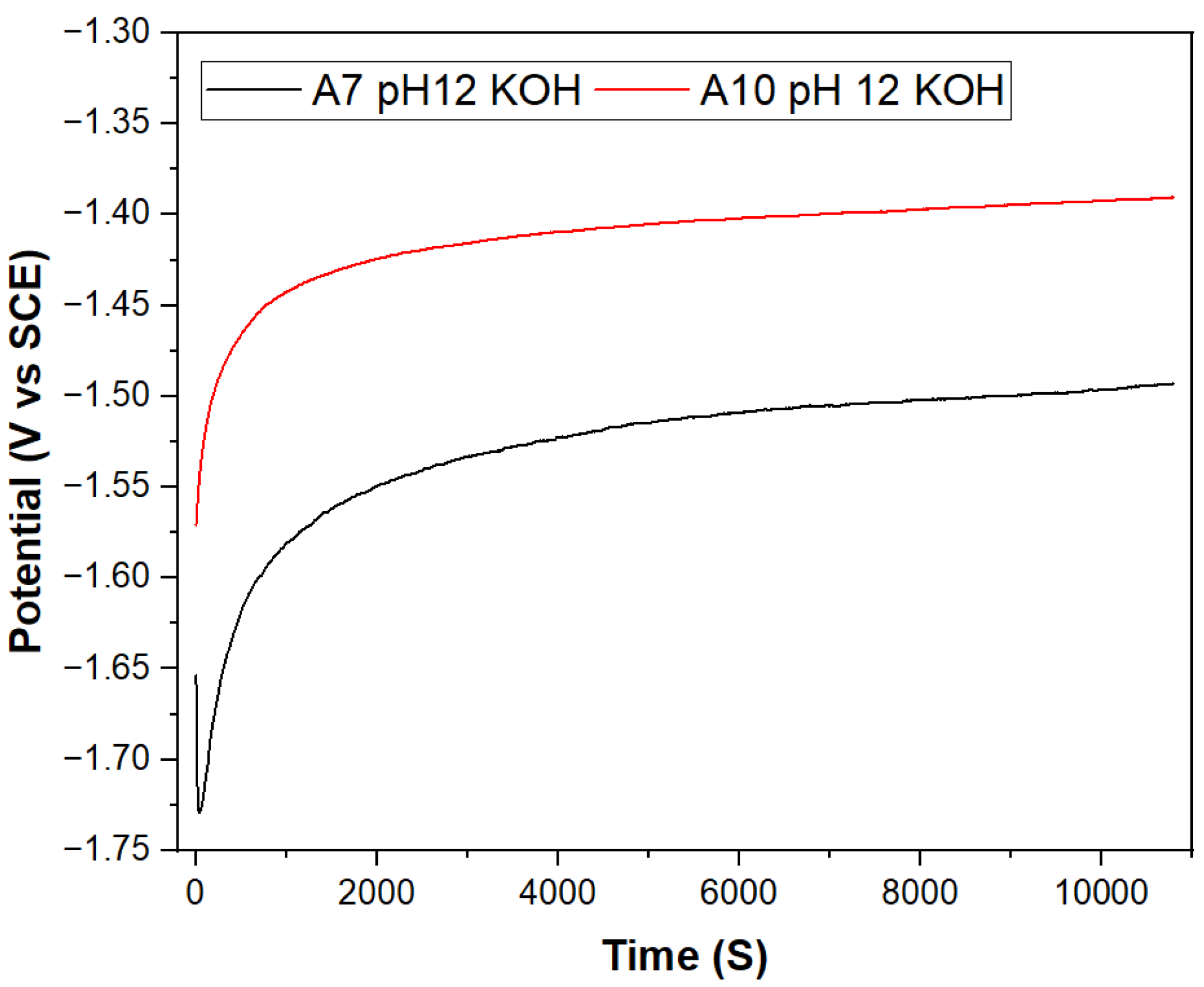
As illustrated in
Figure 1, the open-circuit potential performance of the two alloys in alkaline media provides an essential understanding of their passive layer stability and the impact of microstructural characteristics on corrosion resistance. As revealed in
Figure 1, AlSi10Mg achieved a more noble steady-state potential in contrast to AlSi7Mg. This can be directly connected to its refined cellular–dendritic microstructure and more continuous eutectic Si distribution [
15].
The elevated Si content contributes to the establishment of stable Si networks with cathodic activity, thereby promoting homogeneous oxide formation and improving the durability of passivation [
16,
17]. Contrastingly, AlSi7Mg, characterized by more discontinuous and coarser Si particles, showed more negative OCP values, demonstrating elevated electrochemical performance and slow development of passivation [
10]. This performance can be ascribed to localized galvanic cells established between the coarse, isolated Si phases and the Al matrix, thus initiating anodic dissolution and inhibiting protective oxide development [
4]. Corrosion resistance in Al–Si–Mg alloys is strongly affected by the presence of precipitates and intermetallics. Specifically, Mg
2Si and Al–Fe–Si phases provide preferential electrochemical sites that disrupt the integrity of the passive Al
2O
3/SiO
2 layers when exposed to alkaline solutions [
18]. The presence of finely dispersed Mg
2Si precipitates contributes to passive film integrity by suppressing local alkalinity gradients, in contrast to coarse or clustered phases that accelerate localized dissolution and passive layer breakdown [
19]. Further compounding this effect is the microstructural heterogeneity emanating from the solidification route, because solute separation and non-uniform cooling develop compositional differences that translate to local variations in electrochemical potential, thus enlarging the active-to-passive transition range [
20]. Further playing a major role in the microstructure is the electrolyte environment. In highly alkaline environments—for instance, 1 M KOH at pH 12—aluminum dissolution occurs via the generation of soluble Al(OH)
4− species [
21]. As the passive Al
2O
3 film becomes less effective under these conditions, the role of Si in slowing down localized attack becomes increasingly important [
22]. Hence, the noble drift in OCP detected for AlSi10Mg can be attributed to its capacity to sustain a denser and more stable mixed oxide layer, although the AlSi7Mg alloy suffered from premature oxide disintegration initiated by coarse Si–matrix interfaces [
21].
Finally, it is important to recognize the influence of residual stresses, both mechanical and thermal, which often remain hidden but play a significant role in material behavior. Due to the nature of additive manufacturing, alloys typically carry residual stress fields and scattered porosity, along with dense dislocation networks, which together create vulnerable spots for oxide film failure and hydrogen evolution [
23]. These microstructural flaws change the electrochemical double layer and sometimes show as an inclination to more negative OCP values, although the compositional effects are advantageous.
3.2. Electrochemical Impedance Spectroscopy (EIS)
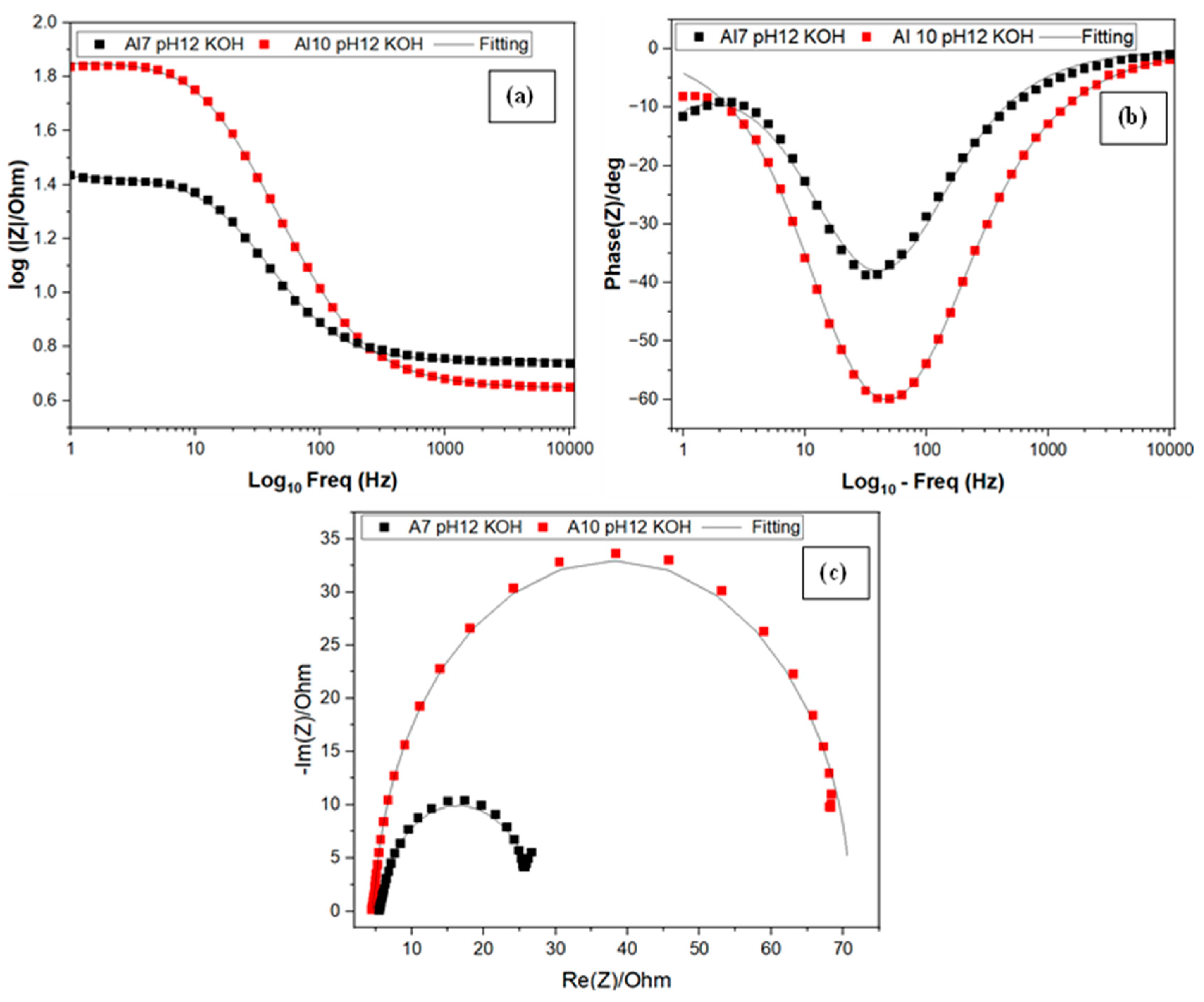
Figure 2a–c illustrate the electrochemical impedance response of AlSi7Mg (A7) and AlSi10Mg (A10) alloys in alkaline solution (1 M KOH, pH 12), as demonstrated in the Bode and Nyquist plots. A distinct variation in impedance and capacitive performance was experienced by the two alloys, which is an indication of the immense effect of composition and microstructure on passive film integrity, charge-transfer resistance, and susceptibility to localized degradation.
It should be noted that the EIS analysis in this study was intentionally interpreted using model-independent features of the impedance spectra, including low-frequency impedance magnitude, phase angle behavior, and Nyquist semicircle size. No equivalent electrical circuit modeling was applied, as the dynamically evolving oxide and hydroxide films formed on aluminum in strongly alkaline media introduce interfacial heterogeneity that complicates the selection of a unique and physically representative circuit. The corrosion resistance trends discussed are therefore based on comparative electrochemical responses rather than circuit-derived fitting parameters.
Based on the compositional level, the higher Si content in A10 proves to be a defining influence.
Figure 2a shows the Bode magnitude plots, and A10 constantly displays higher low-frequency impedance than A7, which is a reflection of a more stable and protective oxide layer [
24,
25]. This enhancement is highly associated with microstructural refinement; the finer cellular–dendritic structure and continuous Si network in A10 encourage the formation of a compact, adherent passive layer. By comparison, the A7 sample, containing relatively coarser Si particles, demonstrated reduced impedance values, suggesting that its passive film offered diminished protection against the aggressive alkaline environment [
26].
The phase angle response (
Figure 2b) additionally reflects these variations. A10 showed a broader and deeper phase angle of about -60
o. This is a feature of high-capacity and uniform passive layer activity. Meanwhile, in the other alloy (A7), a narrower and shallower response was displayed, which indicates non-uniform passivation and early signs of localized film breakdown [
27]. This performance has often been reported in the literature when coarse Si particles act as preferential cathodic sites, thus initiating the development of micro-galvanic cells. Such localized electrochemical behavior quickens the disintegration of the nearby Al matrix and destabilizes the protectiveness and continuity of the passive layer [
28].
With the Nyquist plots shown in
Figure 2c, the trends were further corroborated. A7 has a smaller semicircle diameter, which is ascribed to a low charge-transfer resistance and a higher corrosion process [
27]. Contrastingly, a larger semicircle diameter was depicted by A10. The presence of a refined Si network in the alloy promoted dense and stable oxide film development that effectively restricted charge transport at the metal–electrolyte boundary. The larger semicircle of A10 is symptomatic of delayed passive layer breakdown and slow anodic dissolution. The SEM examination from similar studies confirms that A7 tends to develop localized pits and Si particle detachment, while A10 exhibits a more uniform surface morphology after alkaline exposure [
21]. This interpretation is consistent with broader material studies showing that microstructural stability, phase continuity, and interfacial integrity critically influence degradation resistance when materials are exposed to aggressive chemical or thermal environments [
29].
3.3. Cyclic Polarization Potential
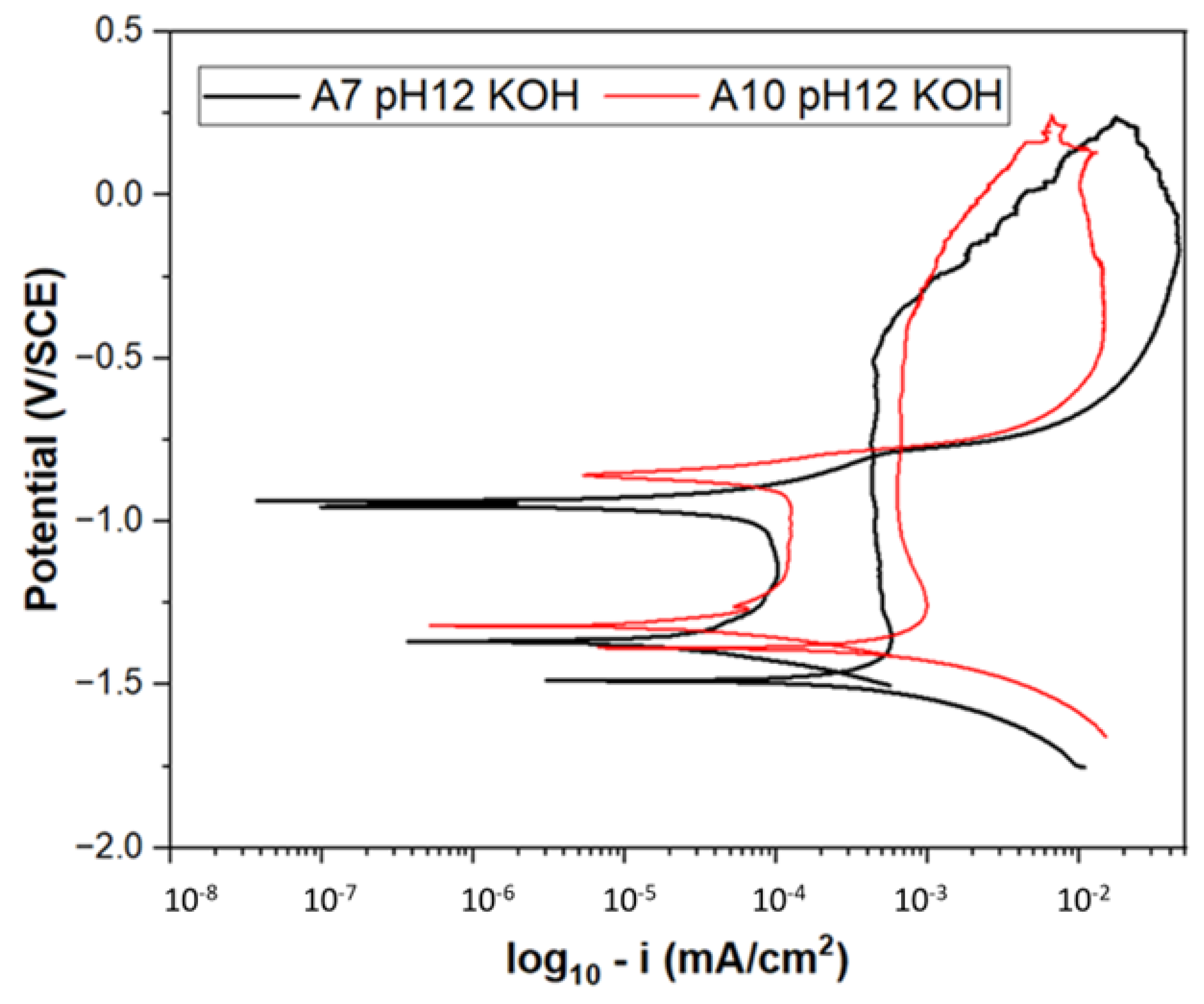
The cyclic potentiodynamic polarization (CPP) behavior of AlSi7Mg (A7) and AlSi10Mg (A10) alloys in 1 M KOH (pH 12) is illustrated in
Figure 3. Analysis of these curves provides valuable insights into the alloys’ passive film characteristics, their breakdown tendencies, and overall resistance to pitting corrosion.
The extended passive behavior experienced for both alloys indicates the formation of a robust and stable surface film under highly alkaline conditions. But vital variations were observed in the integrity and breakdown of the passive layers. Compared with A10, A7 displayed a lower passive current density and a more positive critical pitting potential (Epit). The refined Si network in A10 appears to facilitate uniform oxide layer formation, thus suspending the promotion of localized corrosion [
21]. This observation aligns with reports in the literature associating interconnected, fine Si morphologies with improved passivation and delayed pitting. On the other hand, the A7 alloy showed an earlier passive layer breakdown, evidenced by a lesser Epit and the appearance of larger hysteresis loops during the reverse scan [
15].
The large positive hysteresis in A7 highlights increased metastable and stable pitting, associated with its coarse Si particles, promoting local cathodic activity and micro-galvanic corrosion coupling with the aluminum matrix. A10 showed a narrower hysteresis, reflecting enhanced repassivation capability and slower kinetics of pit growth [
30].
In general, the CPP results indicate that the two alloys (A7 and A10) are capable of sustaining passivity in alkaline environments; however, A10 demonstrates superior resistance to passive film breakdown and pitting. This enhanced performance is linked to its higher Si content, which promotes a refined microstructure and the formation of a denser, more adherent oxide layer. Comparatively, the coarser Si distribution in A7 favors localized film failure and reduces the self-healing ability of its passive layer [
16]. These observations align well with the EIS data, where A10 exhibited higher charge-transfer resistance and a more stable capacitive response compared to A7.
The pronounced positive hysteresis observed for AlSi7Mg is characteristic of stable pitting, as confirmed by post-corrosion SEM showing deep pit formation and extensive matrix dissolution, whereas the narrower hysteresis loop of AlSi10Mg is indicative of predominantly metastable pitting, supported by the presence of shallow pits and a more uniform corroded surface morphology.
3.4. Surface and Phase Characterization of the Samples After Corrosion
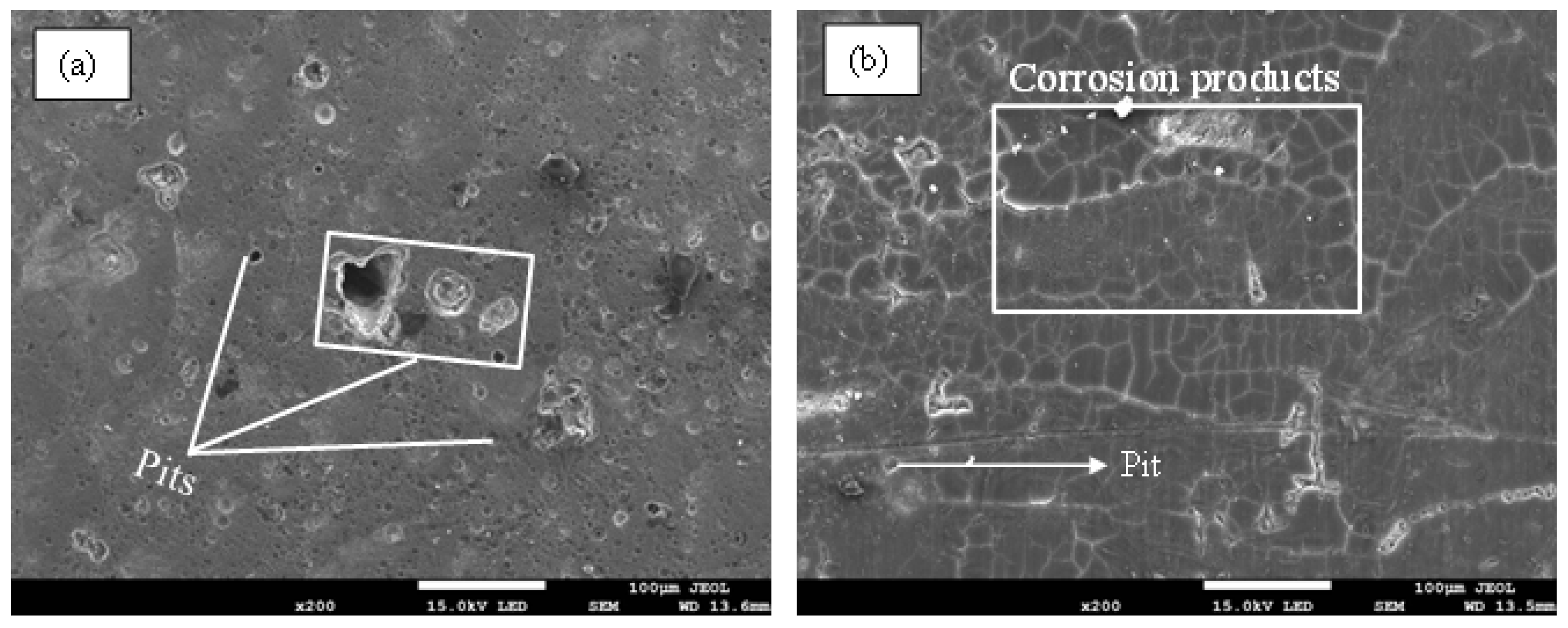
Surface examinations with SEM after alkaline exposure (1 M KOH, pH 12) showed that the AlSi7Mg and AlSi10Mg alloys experienced noticeably different corrosion-induced degradation. For the A7 alloy, severe localized corrosion was observed, with deep pit development, matrix dissolution, and particle detachment of coarse Si. Acting as galvanic sites, these Si-rich regions enhanced electrochemical heterogeneity, driving preferential matrix attack and producing irregular cavity morphologies with evident undermining [
31]. Comparatively, the A10 sample displayed a smoother surface, with shallower pits and decreased Si particle detachment. In A10, the refined and interconnected Si network facilitated a more homogeneous distribution of cathodic regions, promoting the formation of a stable and continuous oxide layer as seen in the SEM image (
Figure 4b). As a result, localized corrosion was less pronounced compared to in A7 (
Figure 4a). No EDS elemental mapping was performed on the corroded regions, as the selective dissolution and Si particle detachment were inferred from characteristic SEM morphological features and corroborated by electrochemical trends and XRD-identified corrosion products, which together provide a reliable basis for interpreting the degradation mechanism in strongly alkaline media.
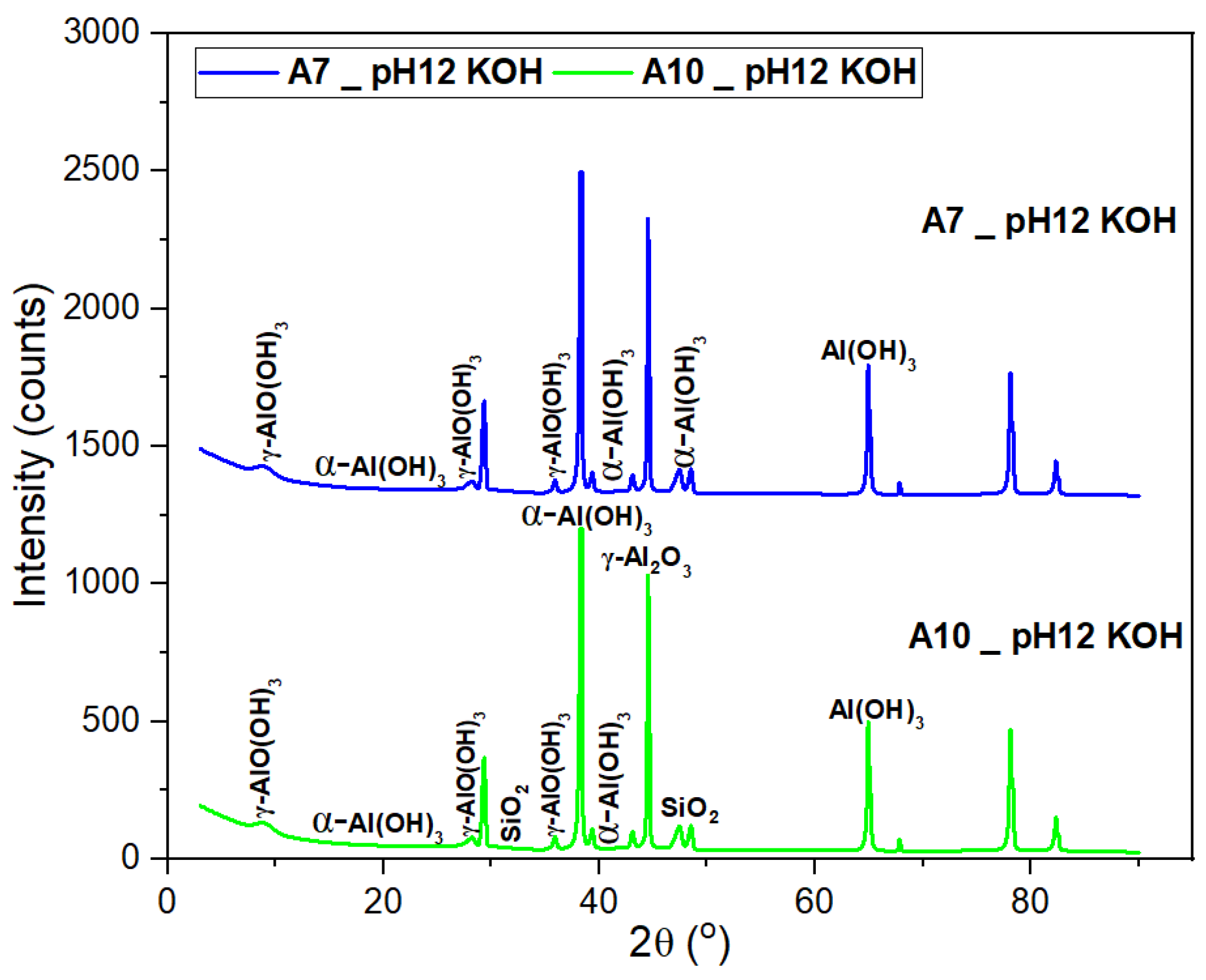
From the XRD results (
Figure 5), it is evident that the corrosion layers on both alloys consist mainly of aluminum hydroxide and oxyhydroxide compounds. Reflections assigned to bayerite (α-Al(OH)
3) and boehmite (γ-AlOOH) were present in both Al7 and Al10, accompanied by weaker peaks of γ-Al
2O
3, phases that are typically reported for aluminum exposed to alkaline environments. For Al10, additional SiO
2 peaks were identified, suggesting that some of the silicon network oxidized during corrosion, whereas no crystalline Si phases appeared in Al7 [
32]. The oxide and hydroxide signals in Al10 were also sharper and more intense, pointing to the development of a robust protective layer. On the other hand, the weaker reflections in Al7 indicate a comparatively fragile film, which offers weaker resistance and is more susceptible to localized attack [
33].
These outcomes are supported by past studies in the literature. For example, Gbenga et al. reported that in Al–Si alloys, coarse and discontinuous silicon particles tend to promote localized corrosion via micro-galvanic interactions, whereas a finer, more continuous Si network enhances corrosion resistance by supporting the formation of stable passive films. Synonymously, Revilla, R. I. and I. De Graeve (2018) highlighted that the morphology of Si plays a critical role in directing corrosion behavior in Al–Si–Mg alloys, especially when exposed to alkaline or chloride-rich environments [
34]. Similar structure–property relationships have been reported in other composite systems, where engineered phase connectivity and interfacial network refinement were shown to enhance durability and resistance to environmental degradation, underscoring the broader relevance of microstructural control in governing material performance [
35]. Related studies on polymer composite systems have similarly shown that prolonged environmental exposure, including moisture- and temperature-driven aging, degrades interfacial integrity and functional performance, reinforcing the importance of microstructural stability when materials are subjected to aggressive service environments [
36]. Comparable durability enhancements have been reported in multifunctional hybrid composite systems, where interpenetrating and well-connected phase networks were shown to improve resistance against environmental degradation, highlighting the universal importance of interfacial continuity and microstructural stability across material classes [
37]. The findings of this study support these observations, showing that the finer Si distribution in A10 contributes to a more robust passive film, which in turn reduces susceptibility to localized corrosion relative to A7. Similar degradation pathways have been reported across composite material systems, where interfacial debonding, particle clustering, and microstructural discontinuities arising from environmental or thermal exposure were shown to accelerate long-term performance deterioration, highlighting the universal role of interfacial integrity in durability-controlled failure [
38]. Furthermore, comparable structure–durability relationships have been reported in hybrid composite systems, where enhanced phase connectivity and interfacial integrity significantly delayed degradation, while particle debonding and microstructural discontinuities accelerated long-term performance loss, underscoring the universal role of microstructural stability in environmentally driven degradation [
39,
40,
41].
4. Limitations and Future Direction
This study is subject to certain limitations that should be considered when interpreting the findings. The corrosion behavior was assessed over short-term electrochemical exposure, which does not fully capture long-term degradation, cumulative damage, or time-dependent evolution of corrosion products.
Moreover, the experiments were conducted in a constant alkaline environment (1 M KOH, pH 12) under static conditions; real service environments may involve cyclic wet–dry exposure, fluctuating pH, or combined mechanical and chemical stresses.
Mixed alkaline–chloride environments, which are highly relevant to marine, industrial, and concrete-related applications, were not investigated and may significantly influence passive film stability and pitting behavior.
Furthermore, the study focused on as-built SLM samples with standardized surface preparation, without isolating the effects of residual stresses, surface roughness variations, or post-processing treatments.
Future work will therefore focus on long-term immersion testing, cyclic exposure conditions, alkaline–chloride synergy, and the role of post-processing and residual stress evolution on corrosion performance.
5. Conclusions
Drawing from the electrochemical evaluations together with microstructural insights, it is evident that the corrosion performance of the hybrid Al–Si–Mg materials is governed to a great degree by intrinsic microstructural features, with Si distribution emerging as a critical factor. The OCP profiles indicated that A10 settled at a more noble and steady potential over time, which implies a more effective initiation of passivation than was observed in A7. Complementary EIS data strengthened this conclusion, revealing that A10 possessed greater charge transfer resistance and a stronger capacitive response, signaling the development of a more robust and protective passive layer. The electrochemical data from CPP showed that A10 withstands localized attack more effectively than A7, with reduced corrosion currents and an extended passive range. This trend was clearly mirrored in the SEM images, where A10’s refined Si structure exhibited fewer pits and more even surface degradation. XRD results added another layer of confirmation, revealing a stable oxide/hydroxide film that plays a central role in maintaining passivation. Generally, the outcomes reveal that when the Si phase is refined and the alloy’s microstructure is more evenly distributed, Al–Si–Mg alloys are better able to withstand corrosion, even under aggressive conditions.
It should be noted that the corrosion behavior reported in this study corresponds to the as-built SLM condition. Post-processing treatments such as heat treatment or surface finishing may modify absolute corrosion response by altering Si morphology, residual stress state, and surface roughness; however, the comparative trends identified between AlSi7Mg and AlSi10Mg are expected to remain governed by alloy composition and microstructural characteristics. Future work will systematically evaluate the influence of such post-processing routes on corrosion performance.
Author Contributions
Conceptualization, T.R., F.J.A., P.A.O., and C.O.U.; methodology, E.O.; software, B.M.; validation, C.O.U., E.O., and P.A.O.; formal analysis, S.D.O.; investigation, T.R.; resources, P.A.O.; data curation, C.O.U.; writing—original draft preparation, S.D.O.; writing—review and editing, F.J.A.; visualization, P.A.O.; supervision, C.O.U. and E.O.; project administration, P.A.O.; funding acquisition, P.A.O. All authors have read and agreed to the published version of the manuscript.
Funding
The research received no funding.
Institutional Review Board Statement
Not applicable.
Informed Consent Statement
Not applicable.
Data Availability Statement
Data should be made available upon request.
Acknowledgments
The authors appreciate the financial support of the Center for Nanoengineering and Advanced Materials (CeNAM), University of Johannesburg, South Africa, during this study.
Conflicts of Interest
The authors declare no conflicts of interest.
References
- Bandyopadhyay, A.; Gualtieri, T.; Bose, S. Global engineering and additive manufacturing. Addit. Manuf. 2015, 1, 9–11. [Google Scholar]
- Bouabbou, A.; Vaudreuil, S. Understanding laser-metal interaction in selective laser melting additive manufacturing through numerical modelling and simulation: A review. Virtual Phys. Prototyp. 2022, 17, 543–562. [Google Scholar] [CrossRef] [Scilit]
- Gardan, J. Additive manufacturing technologies: State of the art and trends. Addit. Manuf. Handb. 2017, 149–168. [Google Scholar] [CrossRef] [Scilit]
- Eckermann, F.; Suter, T.; Uggowitzer, P.J.; Afseth, A.; Schmutz, P. The influence of MgSi particle reactivity and dissolution processes on corrosion in Al–Mg–Si alloys. Electrochim. Acta 2008, 54, 844–855. [Google Scholar] [CrossRef] [Scilit]
- Jain, S. Corrosion and Protection of Heterogeneous Cast Al-Si (356) and Al-Si-Cu-Fe (380) Alloys by Chromate adn Cerium Inhibitors; The Ohio State University: Columbus, OH, USA, 2006. [Google Scholar]
- Rambabu, P.; Prasad, N.E.; Kutumbarao, V.V.; Wanhill, R.J.H. Aluminium alloys for aerospace applications. In Aerospace Materials and Material Technologies: Volume 1: Aerospace Materials; Springer: Berlin/Heidelberg, Germany, 2016; pp. 29–52. [Google Scholar]
- Hoeppner, D.W.; Arriscorreta, C.A. Exfoliation Corrosion and Pitting Corrosion and Their Role in Fatigue Predictive Modeling: State-of-the-Art Review. Int. J. Aerosp. Eng. 2012, 2012, 191879. [Google Scholar] [CrossRef] [Scilit]
- Birbilis, N.; Buchheit, R.G. Electrochemical characteristics of intermetallic phases in aluminum alloys: An experimental survey and discussion. J. Electrochem. Soc. 2005, 152, B140. [Google Scholar] [CrossRef] [Scilit]
- Strobel, K.; Sweet, E.; Easton, M.; Nie, J.F.; Couper, M. Dispersoid Phases in 6xxx Series Aluminium Alloys. Mater. Sci. Forum 2010, 654–656, 926–929. [Google Scholar] [CrossRef] [Scilit]
- Aballe, A.; Bethencourt, M.; Botana, F.J.; Cano, M.J.; Marcos, M. Localized alkaline corrosion of alloy AA5083 in neutral 3.5% NaCl solution. Corros. Sci. 2001, 43, 1657–1674. [Google Scholar] [CrossRef] [Scilit]
- Jin, Z.; Cai, C.; Hashimoto, T.; Yuan, Y.; Kang, D.; Hunter, J.; Zhou, X. The behaviour of iron-containing intermetallic particles in aluminium alloys in alkaline solution. Corros. Sci. 2021, 179, 109134. [Google Scholar] [CrossRef] [Scilit]
- Ujah, C.O.; Kallon, D.V.; Aigbodion, V.S. Corrosion characteristics of high-entropy alloys prepared by spark plasma sintering. Int. J. Adv. Manuf. Technol. 2024, 132, 63–82. [Google Scholar] [CrossRef] [Scilit]
- Gugua, E.C.; Ujah, C.O.; Asadu, C.O.; Von Kallon, D.V.; Ekwueme, B.N. Electroplating in the modern era, improvements and challenges: A review. Hybrid. Adv. 2024, 7, 100286. [Google Scholar] [CrossRef] [Scilit]
- Raza, S.A.; Karim, M.R.A.; Shehbaz, T.; Taimoor, A.A.; Ali, R.; Khan, M.I. Effect of pH and concentration on electrochemical corrosion behavior of aluminum Al-7075 T6 alloy in NaCl aqueous environment. J. Electrochem. Sci. Technol. 2022, 13, 213–226. [Google Scholar] [CrossRef] [Scilit]
- Wu, Y.; Shen, Y.; Wang, Q.; Liu, Y.; Shi, D.; Liu, Y.; Su, X. Effect of Si content on microstructures and electrochemical properties of Al-xSi-3.5 Fe coating alloy. Materials 2023, 16, 7407. [Google Scholar] [CrossRef] [Scilit] [PubMed]
- Metikoš-Huković, M.; Grubač, Z.; Babić, R.; Radić, N. Corrosion resistance of amorphous aluminium–molybdenum alloys in an acidic chloride environment. Corros. Sci. 2010, 52, 352–359. [Google Scholar] [CrossRef] [Scilit]
- Osório, W.R.; Freire, C.M.; Garcia, A. The role of macrostructural morphology and grain size on the corrosion resistance of Zn and Al castings. Mater. Sci. Eng. A 2005, 402, 22–32. [Google Scholar] [CrossRef] [Scilit]
- Jiang, Z.; Dai, X.; Middleton, H. Effect of silicon on corrosion resistance of Ti–Si alloys. Mater. Sci. Eng. B 2011, 176, 79–86. [Google Scholar] [CrossRef] [Scilit]
- Li, Z.; Li, C.; Gao, Z.; Liu, Y.; Liu, X.; Guo, Q.; Yu, L.; Li, H. Corrosion behavior of Al–Mg2Si alloys with/without addition of Al–P master alloy. Mater. Charact. 2015, 110, 170–174. [Google Scholar] [CrossRef] [Scilit]
- Jin, K.-H.; Oh, M.-S. Effects of the Mg content on microstructural and corrosion characteristics of hot-Dip Al–Si–Mg alloy-coated steel sheets. Materials 2023, 16, 5827. [Google Scholar] [CrossRef] [Scilit]
- Boukerche, I.; Djerad, S.; Benmansour, L.; Tifouti, L.; Saleh, K. Degradability of aluminum in acidic and alkaline solutions. Corros. Sci. 2014, 78, 343–352. [Google Scholar] [CrossRef] [Scilit]
- Huang, P.M.; Wang, M.K.; Kämpf, N.; Schulze, D.G. Aluminum hydroxides. Soil. Mineral. Environ. Appl. 2002, 7, 261–289. [Google Scholar]
- Liu, Y.; Shi, J.; Wang, Y. Evolution, control, and mitigation of residual stresses in additively manufactured metallic materials: A review. Adv. Eng. Mater. 2023, 25, 2300489. [Google Scholar] [CrossRef] [Scilit]
- Sukiman, N.L.; Zhou, X.; Birbilis, N.; Hughes, A.E.; Mol, J.M.C.; Garcia, S.J.; Zhou, X.; Thompson, G.E. Durability and corrosion of aluminium and its alloys: Overview, property space, techniques and developments. Alum. Alloys-New Trends Fabr. Appl. 2012, 5, 47–97. [Google Scholar]
- Hughes, A.E.; Birbilis, N.; Mol, J.M.C.; Garcia, S.J.; Zhou, X.; Thompson, G.E. High strength Al-alloys: Microstructure, corrosion and principles of protection. Recent Trends Process. Degrad. Alum. Alloys 2011, 1, 223–262. [Google Scholar]
- Fu, H.J.; Buabthong, P.; Ifkovits, Z.P.; Yu, W.; Brunschwig, B.S.; Lewis, N.S. Catalytic open-circuit passivation by thin metal oxide films of p-Si anodes in aqueous alkaline electrolytes. Energy Environ. Sci. 2022, 15, 334–345. [Google Scholar] [CrossRef] [Scilit]
- Xu, L.; Wu, P.; Zhu, X.; Zhao, G.; Ren, X.; Wei, Q.; Xie, L. Structural characteristics and chloride intrusion mechanism of passive film. Corros. Sci. 2022, 207, 110563. [Google Scholar] [CrossRef] [Scilit]
- Silva Campos, M.d.R.; Blawert, C.; Scharnagl, N.; Störmer, M.; Zheludkevich, M.L. Cathodic protection of mild steel using aluminium-based alloys. Materials 2022, 15, 1301. [Google Scholar] [CrossRef] [Scilit]
- Kumar, A.; Kumar, K.V.; Suresh, G.; Vezhavendhan, R.; Chandramohan, P.; Saranya, R.; Rathinasabapathi, G. A comprehensive study on the influence of polyurethane blending in melamine-urea–formaldehyde-based plywood composites: An interpenetrating polymer network (IPN) approach. J. Indian Acad. Wood Sci. 2025, 22, 293–306. [Google Scholar] [CrossRef] [Scilit]
- Wang, D.B.; Zhang, S.D.; Wang, Q.; Zhang, L.M.; Wang, J.Q. Underlying mechanism for the effects of composition and microstructure on the corrosion resistance of Al-based amorphous alloys: A review. Crit. Rev. Solid State Mater. Sci. 2024, 49, 1120–1152. [Google Scholar] [CrossRef] [Scilit]
- Revilla, R.I.; Liang, J.; Godet, S.; De Graeve, I. Local corrosion behavior of additive manufactured AlSiMg alloy assessed by SEM and SKPFM. J. Electrochem. Soc. 2016, 164, C27. [Google Scholar] [CrossRef] [Scilit]
- Revilla, R.I.; Terryn, H.; De Graeve, I. Role of Si in the anodizing behavior of Al-Si alloys: Additive manufactured and cast Al-Si10-Mg. J. Electrochem. Soc. 2018, 165, C532. [Google Scholar] [CrossRef] [Scilit]
- Azar, A.S.; Lekatou, A.; Sunding, M.F.; Graff, J.S.; Tzima, N.; Diplas, S. Corrosion performance and degradation mechanism of a bi-metallic aluminum structure processed by wire-arc additive manufacturing. NPJ Mater. Degrad. 2021, 5, 26. [Google Scholar] [CrossRef] [Scilit]
- Revilla, R.I.; De Graeve, I. Influence of Si content on the microstructure and corrosion behavior of additive manufactured Al-Si alloys. J. Electrochem. Soc. 2018, 165, C926. [Google Scholar] [CrossRef] [Scilit]
- Kumar, A.; Vijaya Kumar, K.R.; Suresh, G.; Vezhavendhan, R.; Chandramohan, P.; Saranya, R.; Rathinasabapathi, G. Synergistic Toughening of Plywood Using Carbon Fiber and Waste Rubber: An Interpenetrating Polymer Networks Approach. J. Korean Wood Sci. Technol. 2025, 53, 585–598. [Google Scholar] [CrossRef] [Scilit]
- Naveen Kumar, M.; Vijaya Kumar, K.; Suresh, G.; Chinnathambi Muthukaruppan, M.; Vezhavendhan, R.; Chandramohan, P.; Rathinasabapathi, G. An inclusive study on hygrothermal aging effects on tribological and physical properties of E-glass fiber reinforced interpenetrating polymer networks (IPNs) composites. Polym. Compos. 2025, 46, S226–S244. [Google Scholar] [CrossRef] [Scilit]
- Prakash, J.D.; Suresh, G.; Vezhavendhan, R.; Saranya, R. Sustainable Multifunctional Hybrid Interpenetrating Polymer Network Composites: Evaluating Mechanical and Acoustic Performance of Sisal–E-Glass–Cenosphere Systems. Polym. Compos. 2026, 1–14. [Google Scholar] [CrossRef] [Scilit]
- Ganesamoorthy, R.; Suresh, G.; Padmavathi, K.; Rajaparthiban, J.; Vezhavendhan, R.; Bharathiraja, G. Experimental analysis and mechanical properties of fly-ash loaded E-glass fiber reinforced IPN (vinylester/polyurethane) composite. Fibers Polym. 2022, 23, 2916–2926. [Google Scholar] [CrossRef] [Scilit]
- Naveen Kumar, M.; Vijaya Kumar, K.; Suresh, G.; Chinnathambi Muthukaruppan, M.; Vezhavendhan, R.; Chandramohan, P.; Rathinasabapathi, G. A study on: Impact on novel clay dispersion on mechanical, thermal and vibration properties of glass fiber-reinforced interpenetrating polymer networks (IPNs) hybrid composites. Polym. Compos. 2024, 45, 16882–16897. [Google Scholar] [CrossRef] [Scilit]
- Srinivasan, T.; Suresh, G.; Ramu, P.; Vignesh, R.; Harshan, A.V.; Vignesh, K. Effect of hygrothermal ageing on the compressive behavior of glass fiber reinforced IPN composite pipes. Mater. Today Proc. 2021, 45, 1354–1359. [Google Scholar] [CrossRef] [Scilit]
- Rajaparthiban, J.; Suresh, G.; Ganesamoorthy, R.; Padmavathi, K.R.; Abbas, S.H.M.; Meenakshi, C.M. Effect of polyurethane ratio on mechanical behavior of banana fiber/polyurethane-vinylester matrix composites. Matéria 2022, 27, e13182. [Google Scholar] [CrossRef] [Scilit]
| Disclaimer/Publisher’s Note: The statements, opinions and data contained in all publications are solely those of the individual author(s) and contributor(s) and not of MDPI and/or the editor(s). MDPI and/or the editor(s) disclaim responsibility for any injury to people or property resulting from any ideas, methods, instructions or products referred to in the content. |



 and
and