1. Introduction
Energy-absorbing lattice structures are widely employed in systems requiring controlled deformation, lightweight design and mitigation of mechanical loads. Their mechanical performance is strongly governed by topology, relative density and deformation mechanisms. Classical studies on cellular solids distinguish between stretch-dominated and bending-dominated architectures, showing that deformation mode plays a central role in determining stiffness, strength and energy absorption efficiency [
1,
2,
3].
Conventional honeycomb lattices are typically characterised by high stiffness and load-bearing capability, but they often exhibit limited energy dissipation capacity under compressive and dynamic loading. In contrast, auxetic and chiral lattices, characterised by rotational and bending-dominated mechanisms, have attracted increasing attention due to their enhanced ability to distribute deformation and delay densification [
4,
5,
6,
7,
8,
9]. Several studies have reported that auxetic configurations, including anti-tetrachiral lattices, can outperform traditional honeycomb structures in terms of impact mitigation and energy dissipation, particularly under in-plane compression and dynamic loading conditions [
9,
10].
Recent advances in numerical simulation and manufacturing technologies have significantly expanded the design space of lattice structures. Additive manufacturing enables the fabrication of complex geometries that were previously impractical to produce, allowing systematic exploration of topology-driven mechanical behaviour [
11,
12,
13].
This work aims to fill this gap by proposing a unified workflow that integrates lattice design, mechanical simulation and manufacturing evaluation. Five two-dimensional lattice geometries were selected or adapted from the literature and remodelled to a common external size to enable direct comparison. Static and explicit dynamic finite element simulations were performed to assess deformation behaviour, reaction forces and energy dissipation. In parallel, manufacturing feasibility was investigated through process simulations for Selective Laser Melting. The combined analysis provides a comprehensive framework for identifying lattice families that offer a favourable balance between mechanical efficiency and manufacturability.
Recent studies published after 2020 further confirm the relevance of topology-driven energy absorption and dynamic crushing behaviour in lattice structures, highlighting the role of manufacturing routes and graded architectures in impact mitigation applications [
8,
14].
Accordingly, the main question addressed in this work is whether different two-dimensional lattice topologies exhibit measurably different energy absorption and load mitigation performance when evaluated under identical mechanical and numerical conditions.
2. Methods
2.1. Lattice Modelling
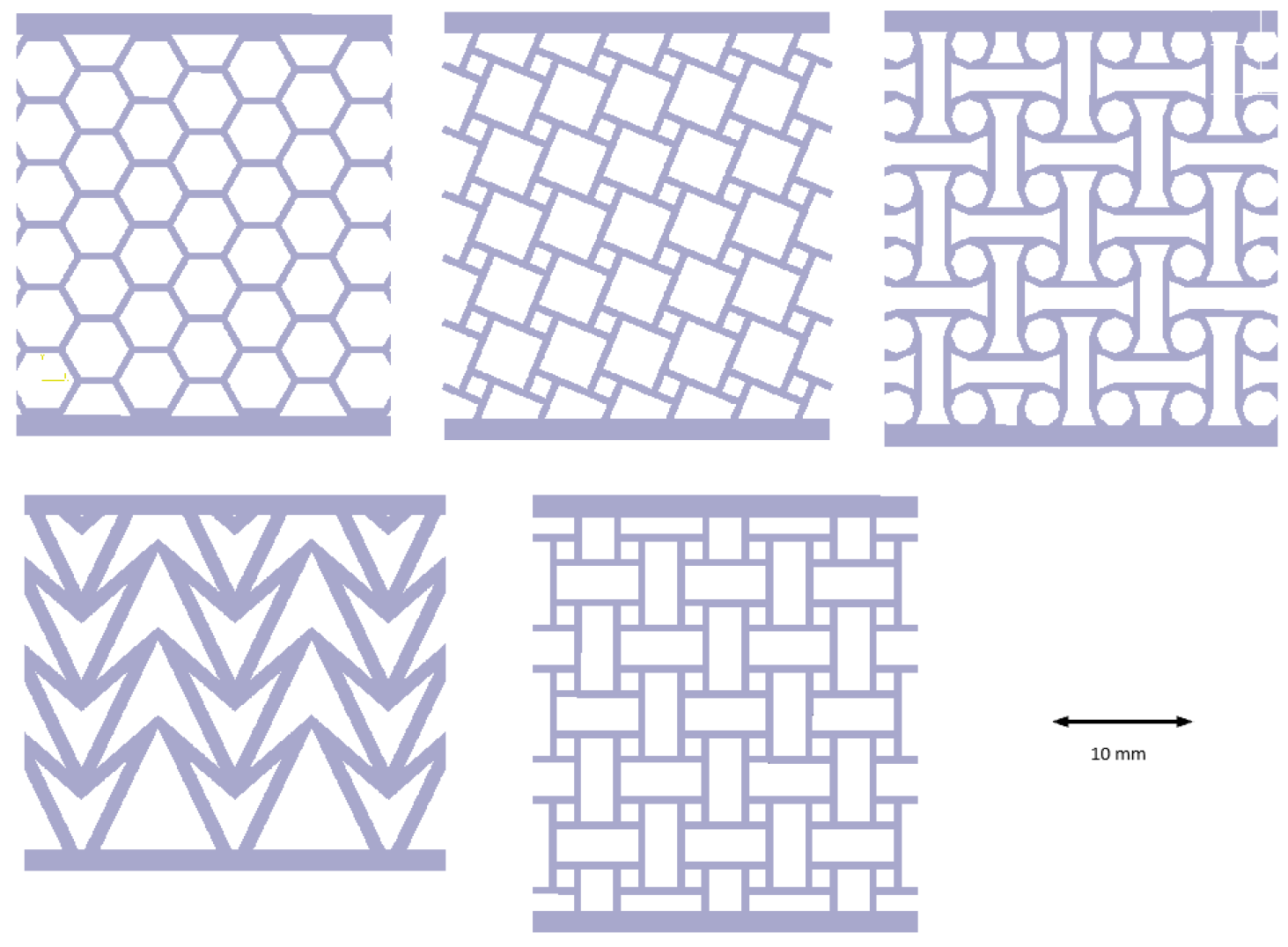
Five representative two-dimensional lattice geometries were modelled using CATIA V5 (
Figure 1). The selected configurations include a conventional honeycomb lattice, an anti-tetrachiral lattice, a double-arrow-headed lattice and two square-based variants derived from auxetic designs reported in the literature [
9,
10]. All geometries were remodelled to fit within an approximately cubic envelope of 27 × 27 × 27 mm.
2.2. Static Mechanical Simulations
Static compression simulations were carried out using software Ansys Mechanical 2025 R1. All lattice models were assigned isotropic material properties corresponding to AlSi10Mg, a widely adopted aluminium alloy in studies on additively manufactured lattice structures [
13,
15,
16]. A compressive load of 10 kN was applied through rigid plates to ensure uniform load transfer.
Mesh sizes ranged from 0.5 to 1 mm depending on geometric complexity. This range represents a compromise between numerical accuracy and the limitations imposed by computational resources. Output quantities included von Mises stress, equivalent strain and total deformation, allowing detailed comparison of elastic–plastic behaviour among lattice families [
1,
2,
3].
A limited mesh sensitivity check was conducted on the reference honeycomb topology to verify that further mesh refinement produced negligible variations in global reaction force and deformation trends. Based on this check, the adopted mesh sizes were considered adequate for comparative purposes across all lattice configurations.
2.3. Explicit Dynamic Simulations
Dynamic response was investigated using Ansys Explicit Dynamics. A compressive load equivalent to 10 kN was applied over a short time interval, with an analysis end time of 10
−5 s. This loading condition is consistent with time scales in numerical studies of impact and high rate compression of cellular structures [
10,
11].
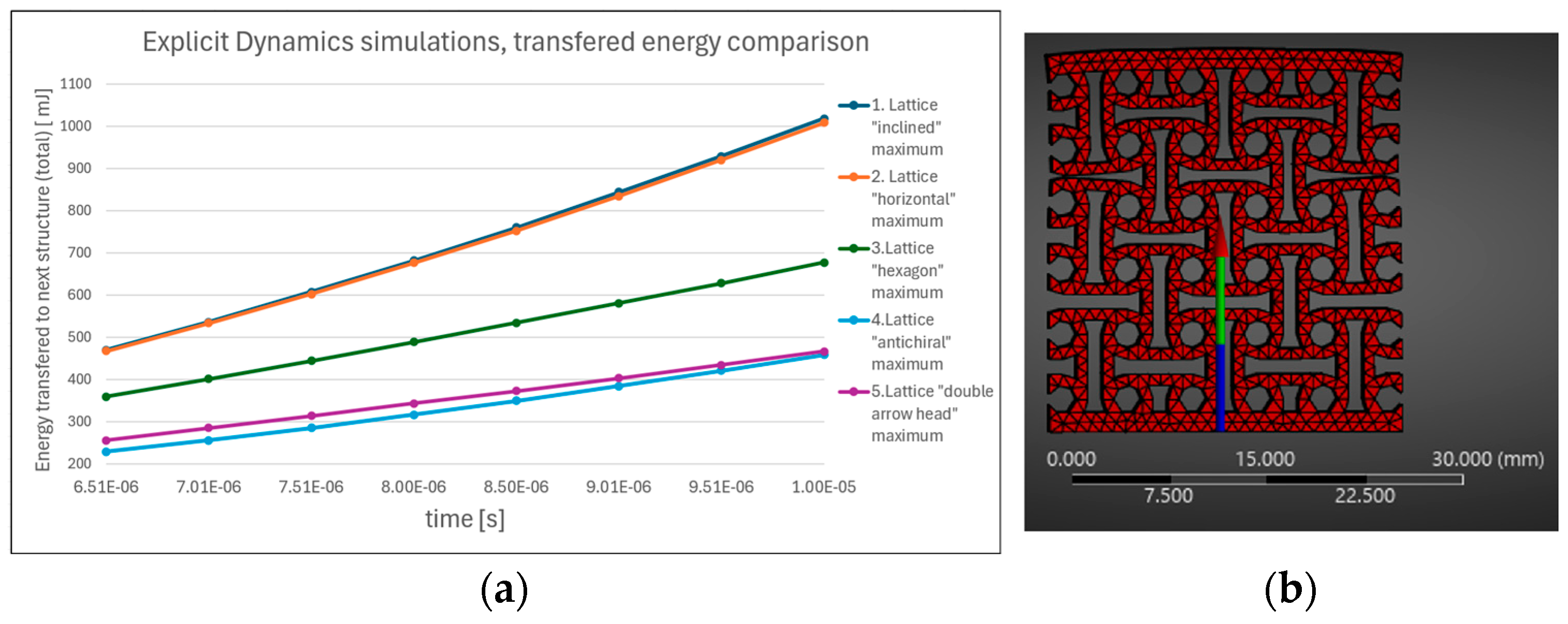
Time histories of deformation, reaction force and residual energy transmitted to the support were extracted. These metrics provide insight into the energy dissipation capability of each lattice topology and allow evaluation of dynamic load mitigation performance beyond static stiffness considerations.
2.4. Additive Manufacturing Simulations
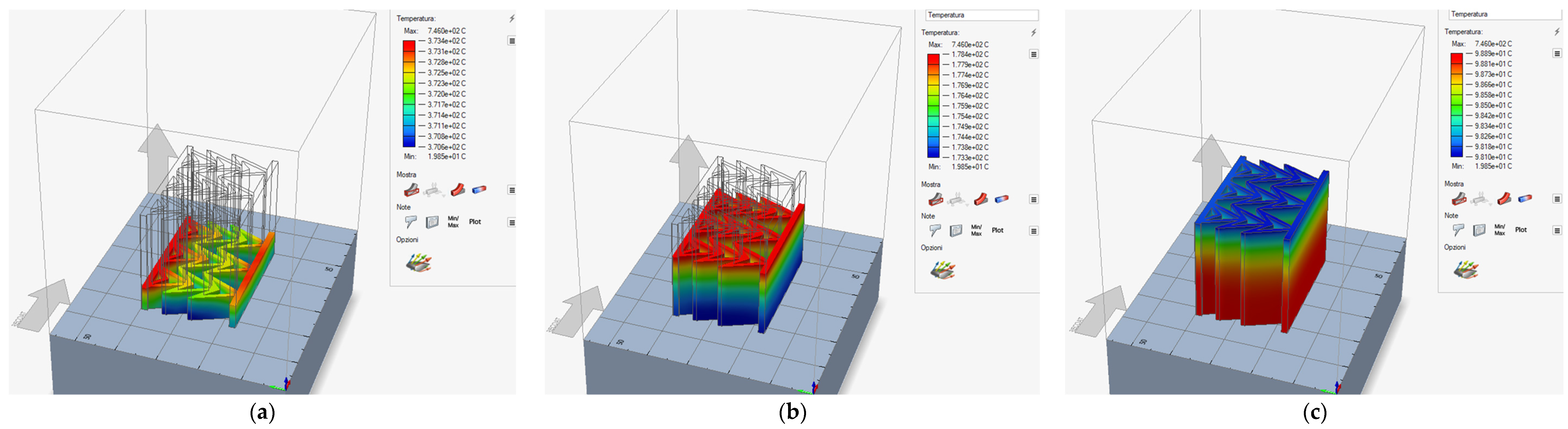
Selective Laser Melting (SLM) of AlSi10Mg lattices was simulated using software Altair Inspire 2024.1. The simulations focused on building orientation, support requirements, thermal evolution and predicted distortion. Attention was paid to thin ligaments, overhang regions and thermal gradients, which are known to influence dimensional accuracy and defect formation in additively manufactured lattice structures [
12,
13,
15,
16].
Thermal distributions were analysed at different stages of the simulated build process to identify regions prone to heat accumulation and distortion. This analysis supports assessment of manufacturability and provides additional criteria for topology selection.
3. Results and Discussion
3.1. Static Mechanical Response
Static compression simulations reveal clear and systematic differences among the investigated lattice topologies. The honeycomb lattice exhibits a predominantly stretch-dominated response, characterised by high initial stiffness and limited plastic deformation prior to rapid stress increase. This behaviour is consistent with classical descriptions of cellular solids, where honeycomb structures prioritise load bearing capacity over energy dissipation [
1,
2,
3].
The square-based lattices show a partial transition towards bending-dominated behaviour. Compared with honeycomb, these configurations display a broader plastic regime and a more gradual stress–strain evolution. However, stress localisation at node intersections remains evident, limiting the extent of progressive collapse. Similar trends have been reported in numerical studies on modified square lattices, where improvements over honeycomb are observed but remain topology dependent [
9,
11].
The double-arrow-headed lattice exhibits early yielding concentrated at geometric discontinuities, particularly at the arrow junctions. While this geometry promotes localised plastic deformation, stress concentrations accelerate damage initiation and reduce overall energy absorption efficiency. This finding aligns with previous studies showing that increased geometric complexity does not necessarily translate into improved mechanical performance [
11,
17].
In contrast, the anti-tetrachiral lattice demonstrates a deformation mechanism dominated by rotational and bending modes. Plastic deformation initiates at relatively low stress levels and propagates progressively throughout the lattice. The absence of abrupt stress localisation enables stable collapse, a key requirement for efficient energy absorption [
7,
10].
A way to interpret these trends is through the cellular solids framework, where stretch-dominated topologies are typically stiffer but less tolerant to stable progressive collapse, while bending-dominated mechanisms promote extended plastic regimes and improved energy absorption efficiency [
1,
2]. In this sense, the honeycomb response observed here is consistent with a stiffness-oriented behaviour, while the anti-tetrachiral lattice activates rotation and bending modes that distribute deformation over the structure. Similar qualitative differences between conventional and auxetic chiral lattices under in-plane compression have been reported in recent comparative studies, where auxetic families show broader plastic regimes and delayed densification compared with reference honeycombs [
9,
10]. Therefore, topology alone already introduces a high-level effect on the static response, which justifies the unified benchmarking approach adopted in this work.
3.2. Explicit Dynamic Response and Energy Dissipation
The explicit dynamic simulations provide deeper insight into the energy absorbing mechanisms of the investigated lattice topologies. While static analyses highlight stiffness and yielding behaviour, dynamic simulations capture inertia effects and time-dependent load transmission, which are critical for assessing impact mitigation performance.
Comparable reductions in peak reaction force and improved crashworthiness have been reported for additively manufactured and functionally graded lattice-based systems under dynamic loading [
14,
18]. In the context of dynamic crushing, peak reaction force and transmitted residual energy are commonly adopted as primary performance indicators, as they directly quantify the severity of load transfer to the protected structure and the efficiency of energy dissipation during collapse [
14,
18].
Under identical loading conditions, the honeycomb lattice exhibits the highest peak reaction force transmitted to the support. The force–time history is characterised by a sharp initial peak occurring shortly after load application, followed by limited force smoothing. This response indicates a predominantly stiffness controlled behaviour, where deformation develops rapidly but with limited capability to delay or redistribute the applied load. Such behaviour is consistent with the stretch dominated nature of honeycomb architectures, which prioritises load carrying rather than energy dissipation [
1,
3].
Square-based lattices show a moderate reduction in peak reaction force compared with honeycomb configurations. However, their force–time curves still display relatively abrupt force transmission, indicating that partial geometric modification is insufficient to fundamentally alter the dominant deformation mechanism. Although bending contributions increase, the dynamic response remains sensitive to local stiffness variations and node constraints, as also reported in previous numerical studies on modified square lattices [
9,
11,
17].
The double-arrow-headed lattice presents a more complex dynamic behaviour. Peak reaction forces are lower than those of the honeycomb lattice, but pronounced oscillations are observed in the force–time history. These oscillations reflect an unstable collapse mechanism driven by stress concentrations at geometric discontinuities. While localised plastic deformation contributes to energy absorption, the lack of a smooth and progressive collapse limits the effectiveness of this topology under dynamic loading conditions. Similar instability phenomena have been reported for lattices with sharp node transitions and complex ligament intersections [
1,
11].
In contrast, the anti-tetrachiral lattice demonstrates the most favourable dynamic response among the investigated configurations. It consistently exhibits the lowest peak reaction force and the smallest residual energy transmitted to the support. The deformation mechanism is governed by progressive ligament rotation and bending, resulting in a smoother force–time evolution and delayed force transmission. This behaviour confirms the advantages of auxetic and chiral architectures for impact mitigation, as previously observed in both numerical and experimental investigations [
9,
10].
While static analyses identify trends in stiffness and yielding, explicit dynamics clearly discriminate between topologies based on their ability to control load transmission over time. These results highlight that lattice topology plays a dominant role in dynamic energy dissipation and that performance ranking under static loading cannot be directly extrapolated to dynamic conditions [
9,
10].
Dynamic loading provides a more stringent comparison than static compression because inertia and rate-dependent collapse paths amplify topology-driven differences. For impact mitigation, peak reaction force is often a more actionable indicator than local stress maps, since it quantifies the load transmitted to the protected support in time. In this study, the anti-tetrachiral lattice shows the lowest transmitted force and the lowest residual transmitted energy, indicating a smoother collapse process and more effective dissipation. This interpretation is coherent with the literature reporting that auxetic and chiral lattices can reduce transmitted loads under dynamic crushing compared with conventional cellular cores, provided that collapse remains progressive and does not localise prematurely [
9,
10]. Accordingly, the coupled reading of reaction force and transmitted energy (
Figure 2,
Table 1) is retained as the primary dynamic ranking criterion emphasise in the present workflow. In this study, the reaction force refers to the instantaneous force measured at the constrained support during compression, representing the load transmitted to the protected boundary. The transmitted energy corresponds to the cumulative mechanical energy transferred through the lattice to the support over time. While local stress fields describe internal material response, reaction force and transmitted energy provide global metrics directly relevant to impact mitigation and crashworthiness assessment.
3.3. Manufacturing Feasibility and Numerical–Process Interaction
SLM simulations highlight the strong influence of lattice topology on thermal behaviour and predicted distortion (
Figure 3). Honeycomb lattices, despite their geometric simplicity, exhibit regions of heat accumulation associated with thin unsupported walls, consistent with observations reported for additively manufactured cellular structures [
13,
15,
16].
Square-based and anti-tetrachiral lattices show more uniform thermal distributions and reduced predicted distortion. The smoother load paths and reduced overhang severity contribute to improved process robustness. These findings indicate that favourable mechanical performance does not necessarily imply increased manufacturing complexity [
12,
15].
3.4. Comparison with the Literature and Design Implications
The results obtained in this study show strong qualitative agreement with established theoretical frameworks and recent numerical investigations. Gibson and Ashby’s classification predicts that bending-dominated lattices offer superior energy absorption compared with stretch-dominated architectures [
1,
2], a trend confirmed here under both static and dynamic conditions.
Studies on auxetic and anti-tetrachiral lattices consistently report enhanced energy dissipation relative to honeycomb structures [
9,
10]. The present work extends these findings by providing a unified comparison across multiple topologies under identical modelling assumptions, while also incorporating manufacturing considerations. Experimental and numerical evidence on auxetic and chiral lattice composites under compressive and dynamic conditions further supports the trends observed in this study, confirming enhanced deformation stability and energy dissipation mechanisms [
9].
From a design perspective, the results suggest that anti-tetrachiral lattices represent a favourable compromise between mechanical efficiency and manufacturability. While honeycomb structures remain attractive for load-bearing applications, auxetic lattices are better suited for systems prioritising energy absorption and impact mitigation.
3.5. Limitations and Scope
The present study is numerical and intended as a comparative benchmark. Isotropic material data were adopted to keep modelling assumptions consistent across geometries, while in practice additively manufactured alloys may show process dependent anisotropy and defect sensitivity [
1,
13]. In addition, mesh size was constrained by the student version limitations and differed slightly across models; although this does not invalidate the qualitative ranking, future work will include a mesh sensitivity check on the selected best-performing topologies to quantify numerical stability. Boundary conditions were kept uniform to enable direct comparison; nevertheless, local contact effects and friction may influence absolute values and will be refined during experimental correlation. The dynamic simulations were performed using a force-controlled loading scheme in order to enable a direct comparison among different lattice topologies under identical nominal conditions. While velocity- or mass-controlled impact formulations are often adopted in full crash simulations, the present approach is consistent with comparative benchmarking studies, where relative performance ranking rather than absolute impact response is the primary objective. Extension to velocity-controlled impact scenarios will be considered in future work to further assess rate sensitivity and inertia-driven effects. Finally, scaling effects related to unit-cell size, wall thickness and relative density will be explored in a parametric campaign once the reference manufacturing routes are fixed [
1,
17].
4. Conclusions
This study presents an integrated design, simulation and manufacturing evaluation of two-dimensional energy-absorbing lattice structures. Simulations demonstrate that auxetic and anti-tetrachiral lattices outperform conventional honeycomb configurations by transmitting lower reaction forces and exhibiting more progressive plastic deformation. Manufacturing simulations confirm that these topologies can be produced via Selective Laser Melting with manageable thermal behaviour and distortion.
The main contribution of this work lies in the integrated evaluation framework rather than in the identification of a single optimal geometry. By combining static and dynamic mechanical simulations with manufacturing process analyses, the proposed approach enables topology-driven design decisions to be supported by quantitative evidence. This methodology can be readily extended to other lattice families, materials and loading conditions, providing a scalable tool for the systematic development of energy absorbing cellular structures.
Beyond the specific ranking of the investigated geometries, the results demonstrate that lattice topology alone can act as a first-order design parameter for controlling energy absorption and load mitigation, even when material properties and boundary conditions are kept constant. The combined static–dynamic evaluation highlights that performance trends observed under quasi-static compression cannot be directly extrapolated to impact-like conditions, where inertia and progressive collapse mechanisms play a dominant role. From a design perspective, this underlines the importance of early stage numerical benchmarking to guide topology selection prior to experimental validation and detailed process optimisation.
The proposed workflow provides a robust basis for selecting lattice families for future experimental validation and further development. Future work will focus on the fabrication of metallic lattice coupons and mechanical testing under static and dynamic conditions to validate the numerical trends identified in this study.
Author Contributions
Conceptualization, C.A. and D.A.; methodology, C.A.; software, C.A.; validation, C.A., D.A., and N.U.; writing—original draft preparation, C.A.; writing—review and editing, D.A.; supervision, N.U. All authors have read and agreed to the published version of the manuscript.
Funding
This research received no external funding.
Institutional Review Board Statement
Not applicable.
Informed Consent Statement
Not applicable.
Data Availability Statement
The raw data supporting the conclusions of this article will be made available by the authors on request.
Conflicts of Interest
The authors declare no conflicts of interest.
Abbreviations
The following abbreviations are used in this manuscript:
| CAD | Computer-Aided Design |
| SLM | Selective Laser Melting |
References
- El Elmi, A.; Melancon, D.; Asgari, M.; Liu, L.; Pasini, D. Experimental and numerical investigation of selective laser melting–induced defects in Ti–6Al–4V octet truss lattice material: The role of material microstructure and morphological variations. J. Mater. Res. 2020, 35, 1900–1912. [Google Scholar] [CrossRef]
- Ashby, M.F. The properties of foams and lattices. Philos. Trans. R. Soc. A Math. Phys. Eng. Sci. 2006, 364, 15–30. [Google Scholar] [CrossRef] [PubMed]
- Deshpande, V.S.; Fleck, N.A.; Ashby, M.F. Effective properties of the octet-truss lattice material. J. Mech. Phys. Solids 2001, 49, 1747–1769. [Google Scholar] [CrossRef]
- Lakes, R. Foam Structures with a Negative Poisson’s Ratio. Science 1987, 235, 1038–1040. [Google Scholar] [CrossRef] [PubMed]
- Evans, K.E.; Alderson, A. Auxetic materials: Functional materials and structures from lateral thinking! Adv. Mater. 2000, 12, 617–628. [Google Scholar] [CrossRef]
- Grima, J.N.; Evans, K.E. Auxetic behavior from rotating squares. J. Mater. Sci. Lett. 2000, 19, 1563–1565. [Google Scholar] [CrossRef]
- Zadpoor, A.A. Mechanical meta-materials. Mater. Horiz. 2016, 3, 371–381. [Google Scholar] [CrossRef]
- Zhang, X.G.; Ren, X.; Jiang, W.; Zhang, X.Y.; Luo, C.; Zhang, Y.; Xie, Y.M. A novel auxetic chiral lattice composite: Experimental and numerical study. Compos. Struct. 2022, 282, 115043. [Google Scholar] [CrossRef]
- Roth, A.; Ganzenmüller, G.; Gutmann, F.; Jakkula, P.; Hild, F.; Pfaff, A.; Yin, K.; Eberl, C.; Hiermaier, S. 2D Numerical Simulation of Auxetic Metamaterials Based on Force and Deformation Consistency. Materials 2022, 15, 4490. [Google Scholar] [CrossRef] [PubMed]
- Eren, Z.; Gokcekaya, O.; Balkan, D.; Nakano, T.; Mecitoğlu, Z. Comparison of in-plane compression of additively manufactured Ti6Al4V 2D auxetic structures: Lattice design, manufacturing speed, and failure mode. Mater. Des. 2024, 241, 112885. [Google Scholar] [CrossRef]
- Yin, H.; Zhang, W.; Zhu, L.; Meng, F.; Liu, J.; Wen, G. Review on lattice structures for energy absorption properties. Compos. Struct. 2023, 304, 116397. [Google Scholar] [CrossRef]
- Thompson, M.K.; Moroni, G.; Vaneker, T.; Fadel, G.; Campbell, R.I.; Gibson, I.; Bernard, A.; Schulz, J.; Graf, P.; Ahuja, B.; et al. Design for additive manufacturing: Trends, opportunities, considerations, and constraints. CIRP Ann. 2016, 65, 737–760. [Google Scholar] [CrossRef]
- DebRoy, T.; Wei, H.L.; Zuback, J.S.; Mukherjee, T.; Elmer, J.W.; Milewski, J.O.; Beese, A.M.; Wilson-Heid, A.; De, A.; Zhang, W. Additive manufacturing of metallic components–Process, structure and properties. Prog. Mater. Sci. 2018, 92, 112–224. [Google Scholar] [CrossRef]
- Wei, Y.-P.; Yang, H.; Cheng, J.-C.; Gao, P.; Shi, J.; Lin, F.; Yu, B. Compression behavior of 316L lattice structures produced by indirect additive manufacturing. China Foundry 2023, 20, 83–88. [Google Scholar] [CrossRef]
- Sing, S.L.; Wiria, F.E.; Yeong, W.Y. Selective laser melting of lattice structures: A statistical approach to manufacturability and mechanical behavior. Robot. Comput. Manuf. 2018, 49, 170–180. [Google Scholar] [CrossRef]
- Qiu, C.; Yue, S.; Adkins, N.J.; Ward, M.; Hassanin, H.; Lee, P.D.; Withers, P.J.; Attallah, M.M. Influence of processing conditions on strut structure and compressive properties of cellular lattice structures fabricated by selective laser melting. Mater. Sci. Eng. A 2015, 628, 188–197. [Google Scholar] [CrossRef]
- Pan, C.; Han, Y.; Lu, J. Design and Optimization of Lattice Structures: A Review. Appl. Sci. 2020, 10, 6374. [Google Scholar] [CrossRef]
- Liu, Z.; Wang, Y.; Liang, X.; Yu, W. Crashworthiness Study of Functional Gradient Lattice-Reinforced Thin-Walled Tubes Under Impact Loading. Materials 2024, 17, 2264. [Google Scholar] [CrossRef] [PubMed]
| Disclaimer/Publisher’s Note: The statements, opinions and data contained in all publications are solely those of the individual author(s) and contributor(s) and not of MDPI and/or the editor(s). MDPI and/or the editor(s) disclaim responsibility for any injury to people or property resulting from any ideas, methods, instructions or products referred to in the content. |
© 2026 by the authors. Licensee MDPI, Basel, Switzerland. This article is an open access article distributed under the terms and conditions of the Creative Commons Attribution (CC BY) license (https://creativecommons.org/licenses/by/4.0/).