
Proceeding Paper

Nanostructured Semiconductors for Enhanced Waste Heat-to-Electricity Conversion †

by
Pabina Rani Boro
1,
Rupam Deka
1,
Pranjal Sarmah
1,
Partha Protim Borthakur
1,* and
Nayan Medhi
2
1
Department of Mechanical Engineering, Dibrugarh University, Dibrugarh 786004, India
2
Department of Petroleum Engineering, Dibrugarh University, Dibrugarh 786004, India
*
Author to whom correspondence should be addressed.
Presented at the 5th International Online Conference on Nanomaterials, 22–24 September 2025; Available online: https://sciforum.net/event/IOCN2025.
Mater. Proc. 2025, 25(1), 21; https://doi.org/10.3390/materproc2025025021

Published: 20 January 2026
(This article belongs to the Proceedings of The 5th International Online Conference on Nanomaterials)

Abstract

Nanostructured semiconductors have emerged as transformative materials for enhancing the efficiency of waste heat-to-electricity conversion through thermoelectric (TE) processes. By altering structural features at the nanoscale, these materials can simultaneously reduce lattice thermal conductivity and optimize electronic transport properties, thereby significantly improving the thermoelectric figure of merit (ZT). Recent studies have demonstrated that introducing periodic twin planes in III–V semiconductor nanowires can achieve a tenfold reduction in thermal conductivity while maintaining excellent electrical performance. Similarly, Pb1−xGexTe alloys, through controlled spinodal decomposition, form stable nanostructures that maintain low thermal conductivity even after thermal cycling, crucial for high-temperature applications. Enhancing electrical properties is another key advantage of nanostructuring. PbTe-based materials, when heavily doped and engineered with nanoscale inclusions, have achieved a ZT of approximately 1.9 and a thermoelectric efficiency of around 12% over a 590 K temperature difference. Single-walled carbon nanotubes (SWCNTs) also show strong correlations between their electronic structure and thermoelectric conductivity, highlighting their potential for next-generation devices. Two-dimensional silicon–germanium (SixGeγ) compounds offer ultra-low lattice thermal conductivity and high Seebeck coefficients, providing a promising pathway for future TE applications. Despite these advancements, challenges remain, particularly regarding scalability and integration into existing energy recovery systems. Techniques such as focused ion beam milling and solution-based synthesis of porous nanostructures are being developed to fabricate high-performance materials on a commercial scale. Moreover, integrating nanostructured semiconductors into real-world systems, such as automotive exhaust heat recovery units, requires improvements in material durability, fabrication efficiency, and device compatibility. In conclusion, nanostructured semiconductors offer a powerful route for enhancing waste heat-to-electricity conversion. Their ability to decouple electrical and thermal transport at the nanoscale opens new opportunities for high-efficiency, sustainable energy harvesting technologies. Continued research into scalable manufacturing techniques, material stability, and system integration is essential to fully unlock their potential for commercial thermoelectric applications.

1. Introduction

Nanostructured semiconductors are one of the most exciting areas in materials science today. They are changing how we think about energy, electronics, lighting, and even medicine. These materials are very small—on the nanoscale—and that makes them behave differently from larger, bulk materials. Because of their size, they show unique electrical, chemical, and optical properties. This includes tunable band gaps, high surface area, and better charge movement, which make them great for advanced technologies [1]. There are many types of nanostructured semiconductors. These include 2D materials, quantum dots, and nanowires. For example, MoS2 and WS2 are 2D materials known for their fast charge movement and strong light interactions. They are ideal for future electronic and optoelectronic devices [1]. Quantum dots—tiny particles made from materials like CdSe or ZnS—can change their color or energy based on their size. This makes them useful in LEDs, solar cells, and even medical imaging [2,3]. Nanowires, especially when combined with quantum dots, help improve how light and electricity move through a device, leading to better performance in sensors and lasers [4]. These materials have many uses. In solar energy, they help improve the performance of dye-sensitized and quantum dot-sensitized solar cells. Materials like TiO2 and ZnO allow more light to be absorbed and reduce energy loss, which boosts power output [5,6]. In electronics, nanostructures are used in things like high-speed lasers, signal processors, and optical amplifiers [3]. Environmental monitoring is another area where they shine. They can detect small changes in water quality—such as pH levels, metal ions, or oxygen content—which is useful for pollution tracking [1,7]. In medicine, their small size and reactive surface make them excellent for biosensors and imaging tools. They can even help with targeted drug delivery and cell-level tracking [8,9,10]. Making these nanostructures requires special techniques. Some common methods include lithography, etching, and self-assembly. Newer methods like core–shell engineering and hybrid materials are also becoming popular. For instance, ZnO–carbon quantum dot combinations improve energy transfer in optoelectronic devices [11]. Similarly, core–shell structures like CdSe@Au and ZnS@Pt are being used for solar energy and catalysis. These pair different materials together to obtain the best performance from both [12].

2. Nanostructured Semiconductors in Energy Harvesting

Nanostructured semiconductors have unique physical and electronic properties. These come from their tiny size and large surface-to-volume ratio. This makes them ideal for energy storage and conversion technologies. By adjusting their bandgaps and using quantum effects, these materials can be engineered for better performance. That is why they are at the heart of many sustainable energy solutions [13]. One major way to improve thermoelectric materials is by lowering their lattice thermal conductivity. Nanostructuring helps with this. It includes creating nanowires, nanocomposites, and superlattices. These features block the flow of heat without affecting electricity. For example, PbTe thermoelectrics with Ge nanostructures reached a high ZT of 1.9 at 805 K. This was possible because nanoscale precipitates scattered heat-carrying phonons without harming electrical mobility [14]. Other materials like III–V semiconductor nanowires, with crystal twin planes, showed a 10× drop in thermal conductivity. This was thanks to better phonon scattering [15]. Embedding semiconducting particles inside PbTe further improved both electrical performance and reduced thermal vibrations [16]. Researchers also boost thermoelectric performance by tweaking the material’s makeup. Adding extra sodium (Na) to PbTe raised the charge carrier count and improved power output at high temperatures [14]. Doping with bismuth and mixing in SiC nanoparticles helped fine-tune the Seebeck coefficient and increased electrical conductivity [17]. Quantum confinement also helps. For example, arranging Si nanowires in chains modified how electrons and phonons moved. This lowered thermal conductivity and raised ZT scores [18]. Long-term stability is another concern. But alloys like PbTe-GeTe hold up well during repeated heating. Their nanoscale phase separation remains stable, helping retain low thermal conductivity over time [19]. Similarly, Ba–Cu–Si clathrates with SiC particles show good thermoelectric performance even under operating conditions [20]. These improvements make nanostructured thermoelectrics ready for real-world use. For instance, combining Bi2Te3 with nanostructured PbTe has led to modules reaching up to 12% efficiency at a 590 K temperature difference [14]. Other compositions, like PbSe0.5Te0.5, offer stable ZT values at room temperature—perfect for wearable, low-power electronics [21]. In solar energy, nanostructures also shine. Quantum dots, nanowires, and porous films improve light capture and carrier movement. GaAs solar cells with built-in nanostructures lose less light and move electrons more efficiently. This helps lower costs and raise power output [22,23]. New materials like perovskite nanostructures are flexible, light, and cheaper, offering great potential for solar power [24]. These semiconductors are also excellent for turning heat into electricity. When engineered with small grains and special interfaces, they block heat flow while keeping electrical pathways open. This helps develop solid-state devices that can recover waste heat from factories or electronics [25]. Energy storage is another area where nanostructures help. In lithium-ion batteries, nanostructured electrodes with neat layouts speed up ion flow and improve charging cycles [26]. Metal nanosponges with pores boost conductivity and durability in both batteries and supercapacitors [27]. Oriented nanostructures push energy performance even further [28]. For flexible and wearable tech, these materials are game-changers. When used in piezoelectric and triboelectric devices, they convert body movement or vibration into electricity. ZnO-based nanocomposites are often used in these applications to power sensors and small gadgets [29,30]. Finally, in solar-to-chemical systems, nanostructured semiconductors like TiO2, ZnO, and CdS drive photocatalysis. They help with hydrogen production and breaking down pollutants [25]. These materials solve energy problems while also helping the environment. Still, there are challenges. Making these materials at scale, ensuring they stay stable over time, and lowering production costs are key to bringing them to market [13,22,30].
Silicon (Si) and germanium (Ge) are among the most widely studied semiconductors for thermoelectric applications due to their favorable electronic properties and high-temperature stability. Numerous reviews have explored their thermoelectric behavior, particularly when used as silicon–germanium (Si-Ge) alloys. These alloys are well-suited for energy harvesting in extreme environments such as outer space, as demonstrated by their successful application in NASA’s radioisotope thermoelectric generators [31]. One of the most critical indicators of thermoelectric performance, the ZT, has reached impressive values in Si-Ge systems. For example, superlattice-structured Si-Ge nanowires have achieved ZT values up to 4.7 for n-type and 2.74 for p-type configurations [32]. The thermoelectric efficiency of these materials is also driven by high Seebeck coefficients, with Si50Ge50 alloys reporting values as high as 588 µV/K at 50 °C [33]. In addition to high electrical conductivity, nanostructuring plays a vital role in reducing thermal conductivity through enhanced phonon scattering. Strategies such as thin films, nanowires, and superlattices have been employed to enhance thermoelectric behavior [34]. Pressure-induced phase transitions offer another method to tune electrical transport properties and optimize performance [35]. Despite their potential, challenges remain in the form of complex fabrication processes and limited geometric flexibility. Advances in manufacturing techniques, such as laser powder bed fusion, are currently being explored to enable more adaptable device designs [33]. Recent research also focuses on doping, microstructural tuning, and exploring new Ge-based alloys to further boost thermoelectric efficiency [36,37].
Nanostructured semiconductors have greatly advanced the thermoelectric field. By using quantum confinement, interface engineering, and phonon scattering, they significantly boost energy conversion efficiency. One of the most important effects at the nanoscale is quantum confinement. This changes the electronic density of states near the Fermi level. As a result, the Seebeck coefficient and electrical conductivity are both enhanced-especially in one-dimensional materials like nanowires and nanotubes [38,39]. In these tiny systems, electrons are confined in narrow spaces, creating discrete energy levels. This helps charge carriers move more efficiently, which improves thermoelectric performance [38]. Similarly, quantum dots and layered heterostructures show better power factors because of this confinement effect [39]. Interface engineering is another key technique. Interfaces within nanomaterials scatter phonons effectively, which reduces thermal conductivity without hurting electrical performance [40,41,42,43,44]. Using hierarchical nanostructures, which include scattering centers of different sizes, targets phonons with a range of mean free paths. This strategy further improves thermal insulation [41,42]. Another useful method is isotope doping, especially in silicon-based nanomaterials. It slows down heat transfer by scattering phonons while maintaining electronic properties [45]. This kind of tuning—lowering heat flow without reducing electrical current—is crucial to improving the ZT, a key measure of thermoelectric efficiency. Phonon scattering remains central to controlling thermal transport in nanostructures. Researchers have designed materials with tiny boundaries and embedded heterostructures to cut down lattice thermal conductivity [43]. For instance, modulated-width silicon nanowires and nanoparticle chains show impressive reductions in thermal conductivity, yet they still support good electrical conduction [46]. This balance—stopping heat while letting electricity flow—is essential for high-performance thermoelectrics. In addition, phonon confinement in materials like ZnO nanowires and silicon nanocrystals reduces vibrational energy transfer across the material, further lowering thermal conductivity [42]. Innovations in material design have introduced new hybrid and composite architectures. Embedding nanoparticles or metals into semiconductors helps scatter phonons and raise the Seebeck coefficient [44,47]. Core–shell designs, such as Ge-coated Si nanoparticles, use mismatched lattices to reduce heat flow even more. Other materials, like Fe2O3-dispersed Cu12Sb4S13, use earth-abundant elements to achieve strong thermoelectric performance in a sustainable way [43]. These strategies have improved both the ZT value and power factor. In many cases, hierarchical and interface-engineered materials reach ZT values above 1.0, which is more than double what traditional bulk materials offer [41,43,48,49]. Even more impressively, researchers have found ways to decouple electrical conductivity from the Seebeck coefficient, allowing both to be optimized for better power output [40,41].
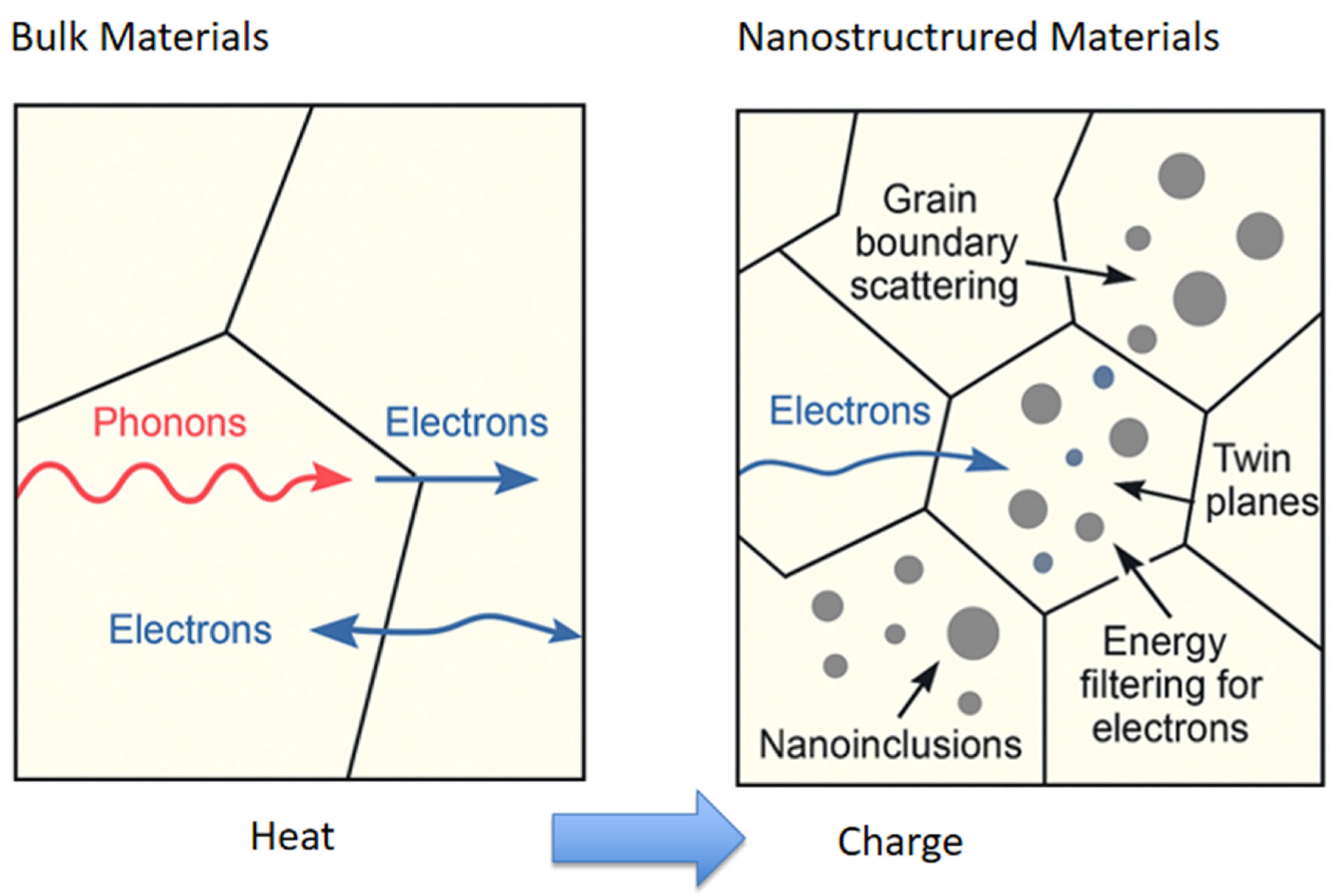
Figure 1 illustrates how thermoelectric performance is enhanced through nanostructuring by decoupling thermal and electrical transport mechanisms. Figure 1 visually emphasized the differences in transport behavior between bulk and nanostructured materials. In bulk materials, phonons and electrons are allowed to travel relatively unimpeded due to the limited presence of scattering interfaces. As a result, thermal conductivity remains high, and any attempt to increase electrical conductivity often leads to a corresponding rise in heat transport, limiting the ZT. In nanostructured materials, significant phonon scattering is introduced through the inclusion of grain boundaries, twin planes, nanoinclusions, and other interface features [50,51]. These structures are strategically engineered to disrupt phonon transport while allowing electron pathways to remain largely unaffected or even enhanced [52,53]. Through this process, lattice thermal conductivity is suppressed by multiscale scattering mechanisms, as has been observed in nanostructured systems such as PbSe and ultrathin silicon membranes [50,52]. Simultaneously, electronic conductivity is preserved or improved via mechanisms such as quantum confinement, energy filtering, and semi-coherent interfaces ([54,55]). As a result, the intrinsic coupling between electrical and thermal transport properties is mitigated, allowing a higher ZT to be achieved [56,57]. Table 1 presents the properties of nanostructured semiconductors and their influence on waste heat-to-electricity conversion efficiency.

3. Thermoelectric Efficiency and ZT Evolution of Representative Materials Across Temperature Ranges

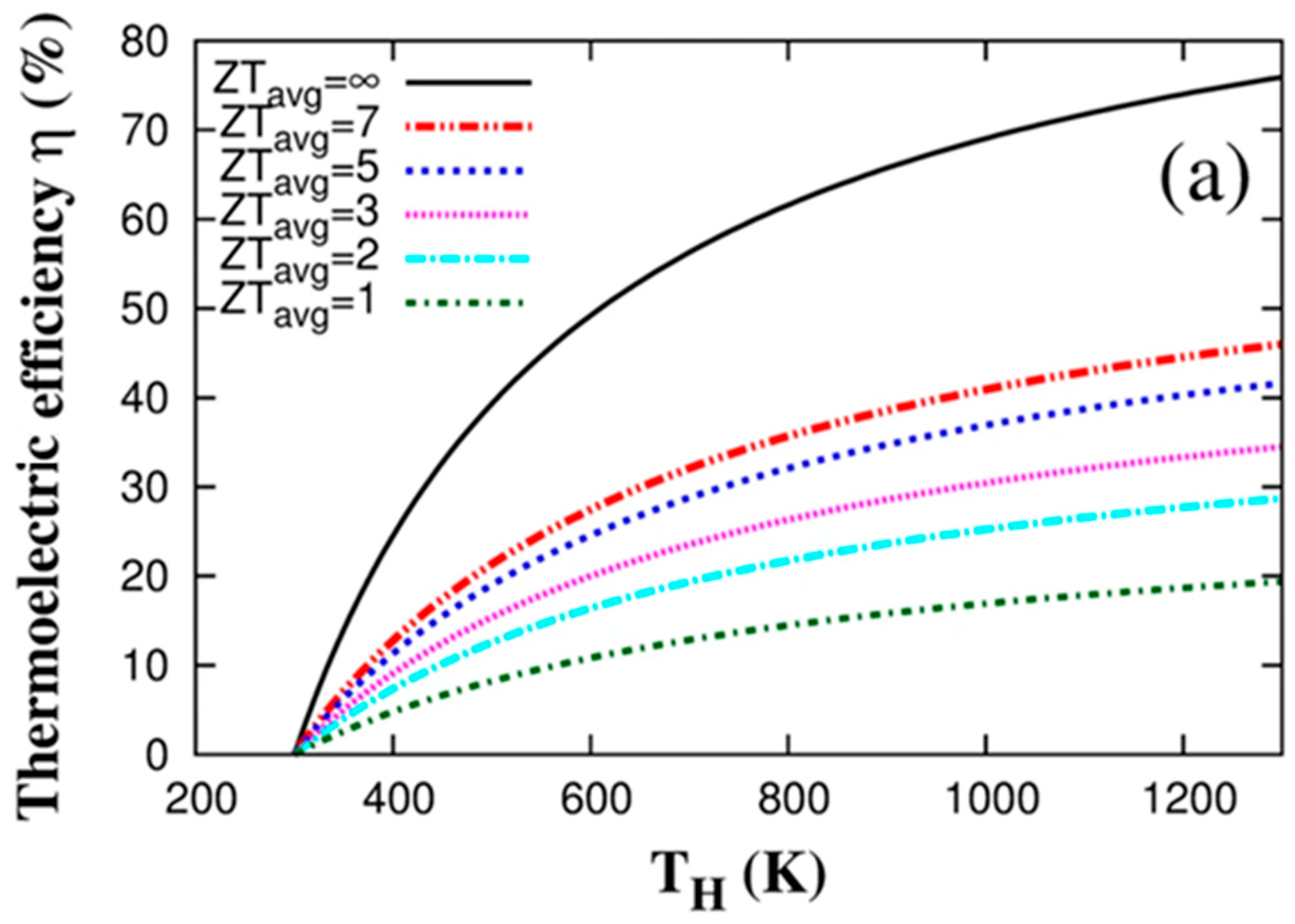
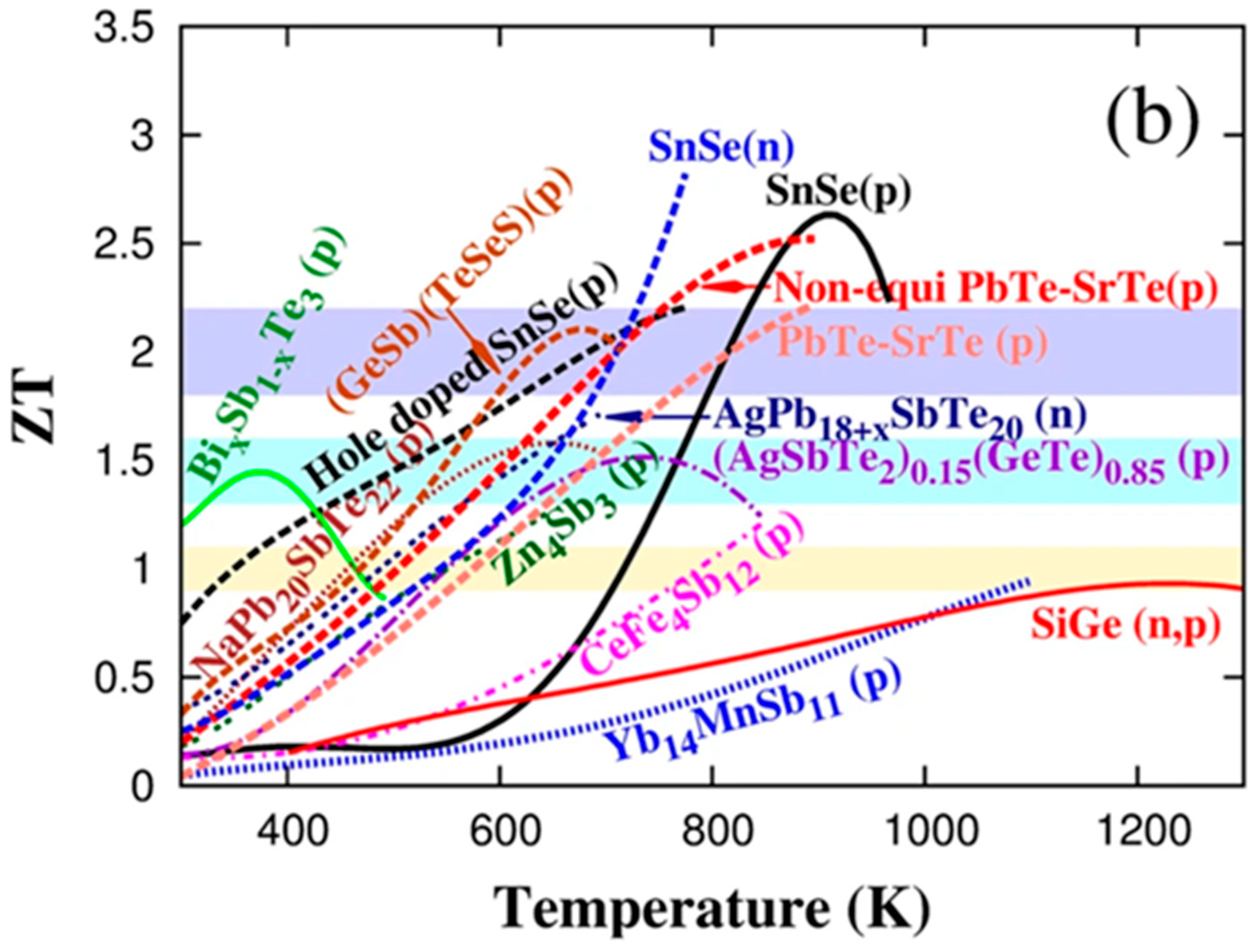
Figure 2 provides a comprehensive overview of thermoelectric material performance and efficiency trends. In panel (a), the graph illustrates thermoelectric conversion efficiency ( η ) as a function of the hot side temperature ( T H ) while keeping the cold side temperature ( T C ) constant at 300 K. The efficiency curves are plotted for different average ZT values ( Z T a v g ), demonstrating that as Z T a v g increases, the efficiency improves significantly. At Z T a v g = 1 , the maximum achievable efficiency remains below 15% even at 1000 K. To reach the practical efficiency threshold of 20–30%—considered necessary for thermoelectrics to be competitive with fossil fuels—a material must achieve a Z T a v g of at least 2 to 3. This emphasizes how important it is to develop materials with higher ZT values for real, practical thermoelectric applications. Panel (b) of the figure shows how the ZT value changes with temperature for various high-performance thermoelectric materials. These materials are grouped by generations of technological advancement. First-generation materials—like bismuth telluride (Bi2Te3) and silicon–germanium (SiGe) alloys—have ZT values around 1. They are still widely used in commercial thermoelectric modules for low- and high-temperature applications. Second-generation materials, such as AgPb18SbTe20 and those based on GeTe, achieve ZT values close to 1.5. These improvements are mainly due to nanostructuring and doping techniques, which help optimize thermal and electrical transport. Third-generation materials have made even more impressive gains. One of the standout examples is p-type SnSe, which reaches ZT values above 3 at high temperatures (~800–900 K). This puts it among the most promising materials currently being studied for thermoelectric power generation. In the figure, colored bands clearly show the different generations. These bands serve as visual benchmarks to highlight how far the technology has come. Despite this progress, the comparison shows that more work is needed. To truly enable widespread adoption of thermoelectrics for energy harvesting and power generation, we must keep developing materials that deliver high and stable ZT values across a broad range of temperatures [63].

4. Comparative Analysis of Thermoelectric Performance in Representative Nanostructured Materials

Thermoelectric performance is governed by the dimensionless figure of merit ZT = S2σT/κ, where S is the Seebeck coefficient, σ is electrical conductivity, and κ is total thermal conductivity. Advancements in nano-engineering have enabled significant enhancements in ZT by simultaneously reducing thermal conductivity and optimizing electronic transport properties. Table 2 summarizes recent data on high-performance nanostructured thermoelectric materials, focusing on their ZT values, Seebeck coefficients, and thermal conductivities. This comparison highlights the role of nano-structural design in elevating thermoelectric efficiency.

5. Microstructural Analysis of Nanostructured BCFZY (BaCo0.4Fe0.4Zr0.1Y0.1O3-δ)

Lowering the operating temperature of solid oxide fuel cells (SOFCs) is essential for advancing their commercial viability. In this context, enhancing electrode performance at reduced temperatures can be effectively achieved through nanoscale microstructural engineering. This study presents alternative microstructural strategies to improve the electrochemical efficiency of the BaCo0.4Fe0.4Zr0.1Y0.1O3-δ (BCFZY) cathode. A cost-effective and scalable spray-pyrolysis deposition technique is employed to fabricate various electrode architectures in a single processing step. The resulting microstructures and electrochemical properties are systematically compared with those of electrodes produced from ceramic powders using conventional screen-printing methods. Comprehensive structural, morphological, and electrochemical characterizations are conducted. Notably, nanostructured cathodes exhibit significantly reduced area-specific resistance (ASR), achieving values as low as 0.067 Ω·cm2 at 600 °C, in contrast to 0.520 Ω·cm2 for screen-printed counterparts. Furthermore, an anode-supported SOFC incorporating the nanostructured BCFZY cathode delivers a peak power density of 1 W·cm−2 at 600 °C, underscoring the potential of nanoscale microstructural design to enable high-performance SOFC operation at intermediate temperatures [71].
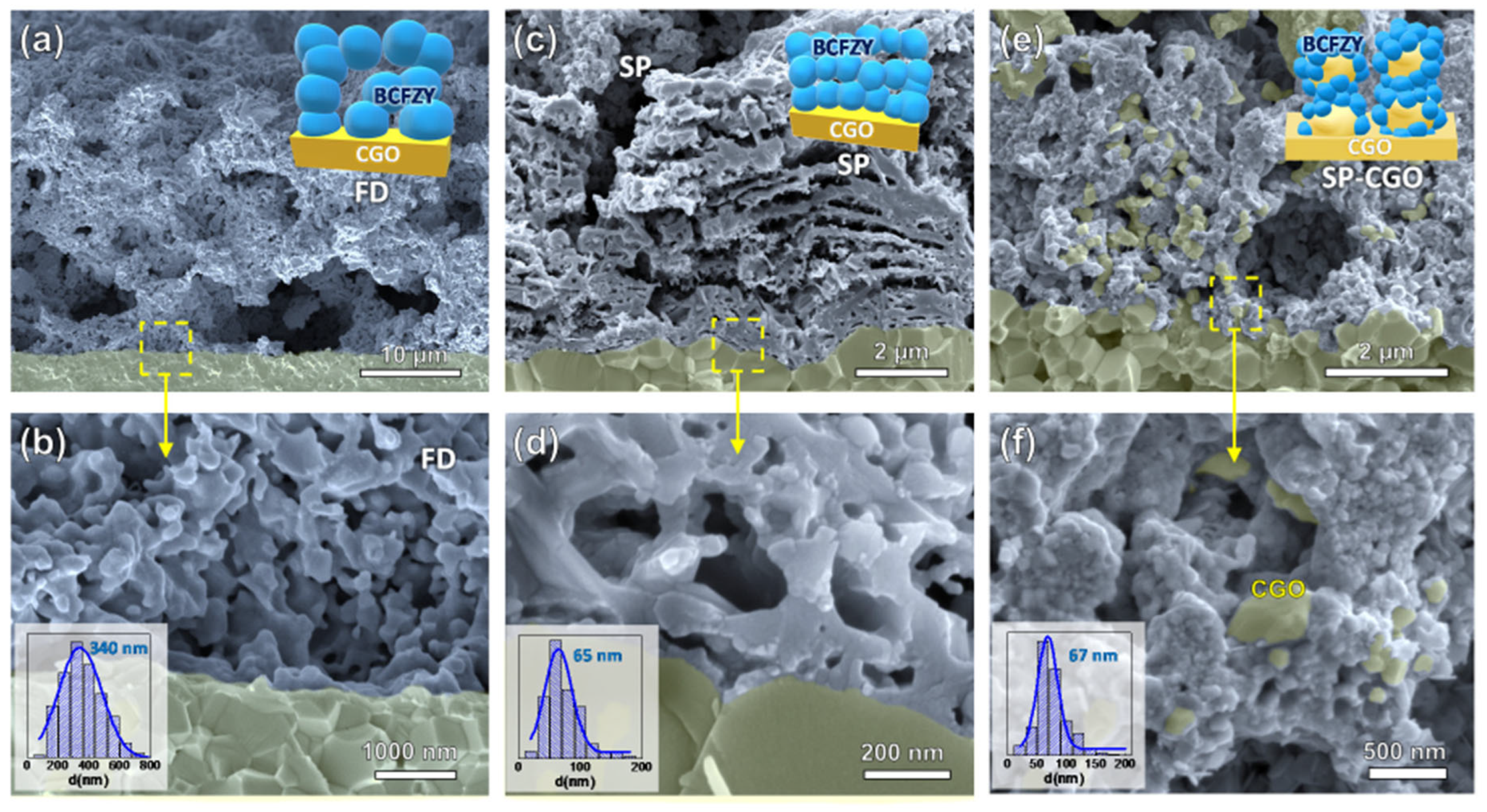
Figure 3 presents scanning electron microscopy (SEM) images of three distinct BCFZY cathode architectures fabricated using freeze-drying and spray-pyrolysis deposition methods on different CGO (Ce0.9Gd0.1O2-δ) substrates. Panels (a) and (b) show the cathode prepared by freeze-drying (FD) followed by spray pyrolysis onto a dense CGO substrate, resulting in a porous microstructure with loosely packed grains and an average particle size of approximately 340 nm, as shown in the inset. In contrast, panels (c) and (d) depict a cathode formed by direct spray pyrolysis (SP) on a polished CGO surface, yielding a highly porous nanostructure with well-connected grains and a significantly smaller average particle size of around 65 nm. Panels (e) and (f) demonstrate a more integrated architecture, where spray pyrolysis is applied onto a porous CGO backbone (SP-CGO), enabling BCFZY nanoparticles to infiltrate deeply and uniformly into the porous scaffold. This configuration shows similar nanoscale grain size (~67 nm) while ensuring strong adhesion and enhanced triple-phase boundary connectivity due to the intimate contact with the CGO framework. Overall, the figure highlights how substrate morphology and deposition technique critically influence the resulting microstructure, with nanostructured electrodes offering superior electrochemical characteristics through reduced particle size and improved interfacial integration.

6. Recent Advances in Key Nanostructured Materials

Turning waste heat into electricity through thermoelectric processes is a big step toward sustainable energy recovery. Thanks to recent advances in nanostructured semiconductors, this process has become much more efficient. Scientists have been able to improve key properties like the Seebeck coefficient, electrical conductivity, and thermal transport. Together, these improvements boost the thermoelectric figure of merit (ZT)—a number that shows how well a material can convert heat into electricity [15,72]. Bismuth telluride (Bi2Te3) is one of the most popular thermoelectric materials, especially near room temperature. When mixed with antimony, it forms (Bi,Sb)2Te3, which performs even better. Using electrodeposition techniques, researchers can now create nanowires and thin films of this material with precise control. These nanostructures move electrical charges more easily and scatter less heat, leading to better energy conversion and the ability to scale up for real devices [73,74]. In III–V semiconductors like InAsSb nanowires, engineers have added special patterns called twinning superlattices. These patterns drastically cut down heat flow while keeping electrical performance strong. As a result, ZT has improved nearly tenfold, showing how powerful lattice engineering can be in nano-sized materials [15]. PbTe–GeTe alloys are another exciting option. These materials naturally form tiny separate phases, thanks to spinodal decomposition. This helps scatter heat more effectively and lowers thermal conductivity. Even after repeated heating and cooling, they remain stable—making them perfect for high-temperature waste heat recovery [19]. Although bulk silicon is not great for thermoelectrics, nanostructured silicon is a different story. It is cheap, safe, and readily available. New designs—like vertical nanowire forests and paper-like nanotube sheets—have boosted its power factor while cutting heat flow. These silicon-based nanostructures now perform similarly to traditional telluride-based materials, showing real promise for future applications [59,72,75]. The current status of thermoelectric modules (TEMs) reflects a field advancing rapidly due to growing interest in energy efficiency and sustainability. TEMs are solid-state devices that utilize the Seebeck and Peltier effects to convert temperature differences directly into electrical energy or provide localized cooling. They are already employed in diverse applications, including industrial waste heat recovery, automotive energy harvesting, cooling in consumer electronics, and powering space missions [76,77,78]. Recent research also highlights their integration in hybrid systems with photovoltaics to boost overall system efficiency by utilizing solar heat [79,80]. Material development has been a critical driver of improved performance, with advances such as nanostructured and quantum well materials achieving figures of merit (ZT) above 3, translating to conversion efficiencies exceeding 20% [81]. Simultaneously, efforts to enhance thermal management and geometric designs have led to better module performance and reliability [82,83]. Despite these advances, widespread commercial adoption is constrained by persistent challenges, including low overall efficiency, high material and manufacturing costs, and stability under high temperatures [84]. Solutions include the development of robust materials like Mg3(Bi,Sb)2 for operation up to 750 K ([77]), and environmentally friendly materials like flexible, transparent CuI-based films for wearable and IoT applications [85,86]. Emerging trends also focus on integrating TEMs into self-powered IoT devices and using advanced modeling tools for better design optimization [87]. As research continues, thermoelectric modules are poised to play a crucial role in future energy systems through improved materials, innovative applications, and scalable, sustainable technologies.

7. Scalability and Fabrication of Nanostructured Semiconductors

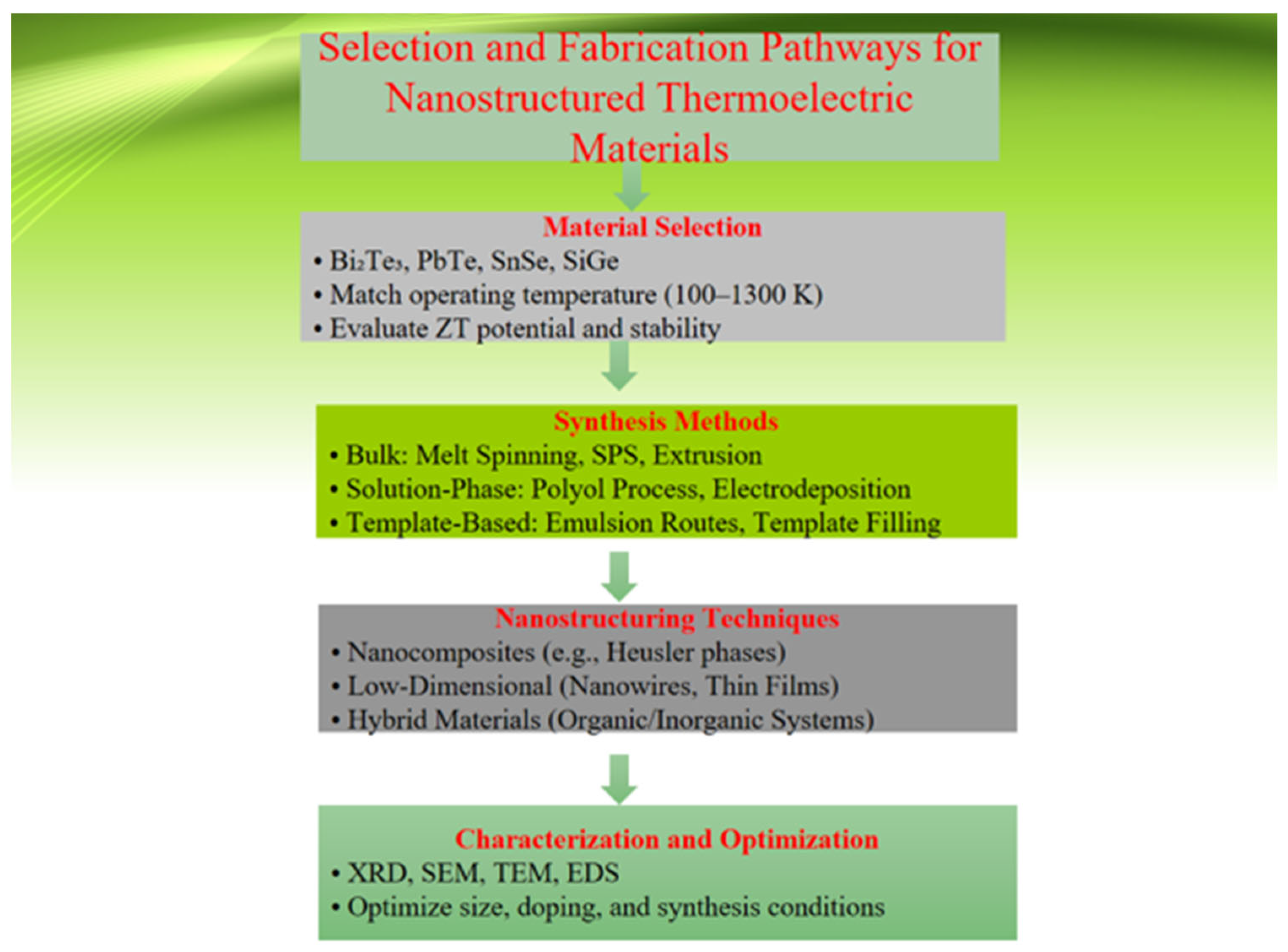
The design and production of nanostructured thermoelectric materials require a multistage process (as shown in Figure 4) involving material selection, synthesis route determination, nanostructuring, and property optimization. This integrated approach aims to enhance the figure of merit (ZT) by optimizing both electrical transport and thermal resistance.
The development of high-performance nanostructured thermoelectric materials begins with careful material selection. Base compounds must exhibit inherent thermoelectric potential and match the desired operational temperature range, which typically ranges from 100 to 1300 K. Commonly used materials include bismuth telluride (Bi2Te3) for near-room-temperature applications, lead telluride (PbTe) and tin selenide (SnSe) for mid-temperature ranges, and SiGe alloys for high-temperature conditions [88,89]. Selection also hinges on electronic band structure favorability and low intrinsic thermal conductivity to optimize ZT values [90,91]. Following material selection, the synthesis method defines the fabrication route. Bulk synthesis techniques include melt spinning, which enables rapid solidification and microstructural refinement; spark plasma sintering (SPS), which densifies materials with minimal grain growth; and extrusion, which allows directional texturing of thermoelectric pellets [88]. In contrast, solution-phase synthesis offers greater control at the nanoscale and cost efficiency. Notably, the modified polyol process facilitates metal precursor reduction at low temperatures, enabling size-controlled nanoparticle production [90]. Similarly, electrodeposition supports thin-film deposition and template-based nanostructure growth, offering scalability and precise control [92]. Template-based synthesis further diversifies the possibilities. Emulsion-based techniques use surfactant systems to form uniform nanostructures, while template-filling methods, such as anodic alumina membrane deposition, yield well-defined nanowires and porous structures [93]. To improve thermoelectric efficiency, materials undergo nanostructuring using advanced engineering techniques. Nanocomposites are formed by embedding nanoparticles or secondary phases into a host matrix, enhancing phonon scattering while maintaining carrier mobility—especially effective in PbTe systems and Heusler phases [94,95]. Low-dimensional materials, such as nanowires and nanotubes, exploit quantum confinement effects to increase power factors [96], while thin films serve in device-level integration, allowing for precise control of heat and electron flow [97]. Additionally, hybrid nanostructures—including organic/inorganic composites—strike a balance between thermal insulation and electronic conductivity by leveraging interfacial phenomena and enhancing compatibility [89,98]. Finally, comprehensive characterization and optimization ensure material viability and performance tuning. Structural and compositional analyses are conducted using X-ray diffraction (XRD) for crystallographic information, scanning and transmission electron microscopy (SEM/TEM) for microstructural imaging, and energy-dispersive X-ray spectroscopy (EDS) for elemental profiling [90]. Optimization involves adjusting synthesis parameters—such as temperature, processing time, and precursor ratios—as well as controlling the dimensions of nanostructures to simultaneously maximize phonon scattering and carrier mobility [91]. Scaling up the fabrication of nanostructured semiconductors is not easy. It involves balancing precision, material compatibility, and cost. Even though nanoscience has made big advances, scalability remains a major hurdle. Many of the best fabrication methods are still expensive and slow. This makes it hard to move from lab research to real-world production [99,100]. Some of the most accurate techniques, like physical and chemical nanolithography, can create very fine patterns. But they struggle when it comes to making multilayer nanostructures that need precise alignment and pattern transfer [101]. Methods like electron-beam lithography (EBL) give excellent resolution. However, they are too time-consuming and costly for large-scale manufacturing [102,103]. To tackle these issues, researchers have explored different strategies. Top–down methods—including photolithography, focused ion beams, and EBL—are still widely used. These approaches are vital for making nanodevices like transistors and diodes, where precision and uniformity are critical [104,105]. On the other hand, bottom–up methods offer promising alternatives. Techniques like molecular beam epitaxy and self-assembled masked growth can build nanostructures directly on various surfaces. These methods are more scalable, flexible, and cost-efficient, especially for hybrid devices where perfect crystal alignment is not always necessary [103,104]. Among the many new tools being explored, nanoimprint lithography (NIL) is gaining popularity. It can quickly and accurately create features smaller than 100 nm, making it a strong option for semiconductor patterning [105]. Another promising method is displacement Talbot lithography (DTL). It helps create regular nanopatterns fast and reliably, which improves the performance of optoelectronic materials. At the same time, micro/nano additive manufacturing (AM) is making progress. It offers design freedom and can handle multiple materials at once. However, it still faces problems with scaling up and maintaining structural consistency [100]. Innovative techniques are also changing how semiconductors are made. For example, nanostenciling enables the local growth of nanostructures in a single step. It avoids complex processes and does not require resist layers [105]. A combination of adhesion lithography and hydrothermal growth has been used to make nano-in-nano Schottky diodes on a large scale. These show great performance for future electronics [103]. Microtomy, paired with vapor–liquid–solid growth, allows for large-area transfer of nanocrystal arrays. It gives precise control and works well on different surfaces, supporting integration with many types of devices [106]. These new fabrication methods have a wide range of uses. In optoelectronics, nano-engineering of III-nitride semiconductors with DTL has improved light extraction, making it useful for LEDs and lasers at industrial scales [107]. In energy devices, metal-oxide semiconductor nanostructures built through scalable methods help improve piezoelectric nanogenerators and photodetectors, leading to better energy conversion [108]. A breakthrough is also being seen in bioelectronics. DNA-directed self-assembly offers atomic-level precision and works well with semiconductor processes. This makes it ideal for biosensors and molecular circuits [109]. Altogether, the use of NIL, DTL, nanostenciling, microtomy, and similar techniques helps make high-performance energy, optoelectronic, and bioelectronic devices more practical. These methods mark a major shift in how semiconductors can be produced on a large scale [100,103,105,106,107,109].

8. Challenges of Nanostructured Semiconductors

Nanostructured semiconductors have gained considerable attention due to their exceptional physical, chemical, and electronic properties, which enable applications in photovoltaics, photocatalysis, sensing, and nanoelectronics. However, despite their immense potential, several challenges hinder their large-scale implementation and long-term reliability. One of the major hurdles lies in manufacturing and fabrication. The agglomeration of nanopowders remains a persistent issue, as nanoparticles tend to cluster due to high surface energies, leading to poor flowability and non-uniform dispersion. Achieving high solids loading in suspensions without significantly increasing viscosity is difficult, limiting the ability to form dense nanostructured films. Techniques such as microwave processing have shown promise in transforming unfired nanopowder compacts into dense, sintered forms while maintaining nanoscale features. Traditional top–down fabrication techniques, including photolithography and etching, struggle to pattern nanoscale features on irregular or non-planar surfaces, thereby restricting the structural complexity of nanomaterials. To overcome this, alternative methods like nanoimprint lithography and nanostenciling have been explored to enhance precision and reproducibility in nanoscale structuring [105]. Another fabrication-related challenge involves cost reduction: producing nanostructured semiconductors with low-cost yet high-efficiency processes remains difficult. Researchers are investigating black silicon and transparent conductive oxides to lower manufacturing costs in photovoltaic devices while retaining high performance [110,111]. In terms of material properties and stability, efficient charge separation and transport are crucial for functional performance, especially in photocatalytic and optoelectronic applications. However, achieving balanced charge mobility while minimizing recombination losses at the nanoscale remains difficult. Ensuring photoelectrochemical stability under illumination and thermal stress is another challenge, as nanostructured semiconductors often degrade faster than their bulk counterparts due to surface defects and oxidation [112]. Additionally, controlling defects and grain boundaries with atomic precision is essential, since even minimal structural irregularities can significantly alter conductivity and carrier lifetimes. This requires advanced synthesis techniques capable of producing near-perfect crystalline nanostructures. Integrating these materials into functional devices introduces additional complexities. For example, in gas sensing, achieving reliable and repeatable responses demands precise control over nanostructure morphology and surface chemistry. Beyond device performance, the environmental impact of nanostructured semiconductor production must also be carefully evaluated. While such materials can contribute to clean technologies, their synthesis and disposal may introduce ecological concerns, particularly regarding heavy metal quantum dots such as CdSe [7]. On the technological and theoretical front, effective doping strategies at the nanoscale remain a key challenge. Quantum confinement alters electronic band structures, complicating conventional doping approaches used for bulk semiconductors. Developing controlled doping for materials such as GaN, ZnO, and TiO2 is critical for optimizing electrical conductivity and carrier concentration [113]. Furthermore, advancements in characterization techniques are required to better understand nanoscale properties. Electron beam-based microscopy and cathodoluminescence have proven useful for probing semiconductor nanowires, yet further improvements are needed to bridge the gap between material characterization and device-scale engineering [114]. Recent progress offers potential solutions to these long-standing issues. Methods like microwave sintering can retain nanostructural integrity during consolidation, while atomic layer deposition (ALD) has emerged as a precise tool for depositing ultrathin, conformal films with atomic-level control, useful for high-k dielectrics in integrated circuits. The development of freestanding photoelectrochemical nanodevices presents a pathway toward stable and efficient light-driven systems [112].

9. Future Scope of Nanostructured Semiconductors in Energy Harvesting

The future of nanostructured semiconductors in energy harvesting is poised for remarkable advancement, owing to their exceptional optical, electrical, and mechanical properties that enable efficient energy conversion and storage. These materials have emerged as essential components for sustainable and renewable energy technologies, particularly in solar energy conversion, hydrogen production, and thermoelectric applications.
In solar energy conversion, nanostructured semiconductors have already demonstrated outstanding potential through applications in dye-sensitized solar cells (DSSCs) and hybrid nanocomposite photovoltaics. Titanium dioxide (TiO2) and related nanostructures have been effectively employed in DSSCs due to their high photoactivity, stability, and cost-efficiency [5,115,116]. Moreover, semiconductor nanowires (NWs) and quantum dots (QDs) have significantly enhanced photovoltaic efficiency by increasing light absorption and optimizing charge carrier separation [117,118]. These innovations are not limited to traditional solar cells but extend to photocatalytic systems that convert solar energy into chemical energy, such as in solar-driven hydrogen production and environmental remediation [112,119].
Hydrogen production and storage represent another crucial frontier for nanostructured semiconductors. In photoelectrochemical (PEC) water-splitting systems, nanostructured materials facilitate efficient photon absorption and charge separation, enabling sustainable hydrogen generation [117,119]. Simultaneously, their potential in solid-state hydrogen storage systems is being extensively investigated to enhance storage capacity, reversibility, and safety, key factors for the global hydrogen economy [119]. In the domain of energy storage, nanostructured semiconductors play a transformative role in developing next-generation batteries and supercapacitors. Silicon nanowires, graphene, and other nanoscale architectures have shown superior electrochemical performance, providing higher energy densities, improved cycling stability, and faster charge–discharge rates [26,120]. These materials optimize both the thermodynamic and kinetic aspects of energy storage reactions, making them indispensable for high-performance lithium-ion and post-lithium-ion batteries [26]. Likewise, nanostructured materials integrated into fuel cells, especially those utilizing carbon nanotubes and other conductive nanostructures, promise greater energy conversion efficiency and longer operational lifetimes [121]. Thermoelectric and piezoelectric energy harvesting systems also stand to benefit substantially from advances in nanostructured semiconductor technology. Nanowires and other nanoscale semiconductor materials are capable of converting waste heat into electrical energy with enhanced efficiency due to their tunable thermal and electronic conductivities [117,122,123]. Similarly, piezoelectric nanogenerators (PENGs), based on materials such as zinc sulfide (ZnS) and polyvinylidene fluoride (PVDF), can harvest mechanical energy from vibrations, body movements, or ambient mechanical stress. Recent developments in multicomponent nanostructured materials have achieved higher piezoelectric conversion efficiencies, expanding potential applications in self-powered Internet of Things (IoT) devices [124,125,126]. Emerging technologies such as quantum dots coupled with nanocavities are opening new research avenues in quantum electrodynamics, nanoscale lasers, and optical energy manipulation, potentially creating novel pathways for energy harvesting at the quantum level [127,128,129]. Furthermore, flexible and wearable nanostructured semiconductors are gaining momentum for powering portable electronics, medical sensors, and smart textiles. These devices leverage flexibility, transparency, and stretchability to create efficient, lightweight, and portable energy harvesting systems [30].
A strategic roadmap for advancing nanostructured thermoelectric technology spans three key phases over a ten-year timeline. Phase 1 (Years 1–3) begins with foundational research focused on identifying and synthesizing promising thermoelectric materials such as Bi2Te3, PbTe, SnSe, and SiGe, tailored to specific temperature ranges. Detailed characterization follows, including measurement of Seebeck coefficients, electrical and thermal conductivities, and microstructural analysis using tools like XRD, SEM, and TEM. Lab-scale prototypes are fabricated to evaluate initial device performance. In Phase 2 (Years 4–6), the focus shifts toward scaling and optimization. Scalable fabrication methods such as melt spinning, spark plasma sintering, roll-to-roll processing, and spray coating are developed and refined. Pilot-scale production is initiated, and performance testing is conducted under real-world conditions. Market analysis and feasibility studies help identify target applications, such as waste heat recovery or portable power devices. Phase 3 (Years 7–10) involves full commercialization. Final products are developed based on pilot feedback, regulatory compliance is pursued, and commercial products are launched. Expansion into diverse applications and global markets follows, positioning the technology for widespread adoption. This phased roadmap ensures a systematic transition from laboratory innovation to practical, scalable, and economically viable thermoelectric solutions.

10. Conclusions

Nanostructured semiconductors have emerged as transformative materials in thermoelectric energy conversion, particularly for the efficient transformation of waste heat into usable electricity. Their superior performance is rooted in nanoscale phenomena such as quantum confinement, interface engineering, and enhanced phonon scattering. These mechanisms decouple electrical and thermal transport properties, enabling the simultaneous optimization of the Seebeck coefficient, electrical conductivity, and reduced lattice thermal conductivity—critical factors in maximizing the thermoelectric figure of merit (ZT). Significant breakthroughs have been achieved in improving ZT values. A standout example is the development of PbTe-based thermoelectrics embedded with Ge nanoprecipitates, which achieved a ZT of 1.9 at 805 K, representing a major advancement for mid- to high-temperature applications. Likewise, nanostructured bulk silicon, historically considered a poor thermoelectric material, showed a 3.5-fold improvement in ZT due to enhanced phonon boundary scattering. III–V semiconductor nanowires, engineered with periodic twin planes, achieved a tenfold reduction in thermal conductivity without degrading electrical properties, highlighting the importance of crystalline structure manipulation. Low-dimensional systems such as quantum dots, single-walled carbon nanotubes (SWCNTs), and 2D materials like MoS2 and WS2 exhibit remarkable improvements in carrier mobility and tunable band gaps. These properties are vital for achieving Seebeck coefficients in the range of 200–500 µV/K, as demonstrated in PbTe and SnSe systems. Bi2SbxTe3 nanolayers and PbSe-based composites have maintained consistently high ZT values over wide temperature ranges, making them attractive for both wearable electronics and industrial-scale waste heat recovery systems.
Advances extend beyond materials to include device-level improvements. For instance, integrating periodic dielectric gratings in GaAs solar cells has reduced optical losses and improved photovoltaic efficiency, indicating that the synergy between photonic and thermoelectric nanostructures can be exploited for multifunctional energy harvesting platforms. Figure 2 in this study emphasizes the need for ZT values exceeding 2.0–3.0 to achieve conversion efficiencies of 20–30%, a threshold necessary for viable replacement of fossil fuels in power generation. This goal has been approached in third-generation thermoelectric materials like SnSe and PbTe–PbSe–PbS quaternary alloys, the latter reaching ZT values of approximately 2.3. These hybrid systems benefit from both band convergence and nanoinclusion engineering, which effectively suppress thermal conductivity while preserving high power factors. Despite these impressive results, several critical challenges remain. Chief among them are issues of scalability, environmental sustainability, and long-term material stability. Current fabrication methods such as electron-beam lithography and molecular beam epitaxy are precise but cost-prohibitive for large-scale deployment. Promising alternatives like spray pyrolysis, displacement Talbot lithography, and nanoimprint lithography offer lower-cost, scalable solutions. Additional techniques, including isotope doping and hierarchical nanostructuring, provide further avenues to reduce thermal conductivity without impairing electrical performance.

Author Contributions

Conceptualization, P.R.B. and P.P.B.; methodology, R.D. and P.S.; software, R.D.; validation, P.R.B., R.D. and P.P.B.; formal analysis, P.R.B.; investigation, R.D. and P.S.; resources, P.P.B.; data curation, P.R.B.; writing—original draft preparation, writing—review and editing, P.P.B. and N.M.; visualization, P.P.B.; supervision, project administration, P.P.B. All authors have read and agreed to the published version of the manuscript.

Funding

This research received no external funding.

Institutional Review Board Statement

Not applicable.

Informed Consent Statement

Not applicable.

Data Availability Statement

No new data were created or analyzed in this study. Data sharing is not applicable to this article.

Conflicts of Interest

The authors declare no conflicts of interest.

References

  1. Zhuiykov, S. Nanostructured Semiconductors, 2nd ed.; Elsevier: Amsterdam, The Netherlands, 2018. [Google Scholar] [CrossRef]
  2. Al-Douri, Y.; Khan, M.M.; Jennings, J.R. Synthesis and optical properties of II–VI semiconductor quantum dots: A review. J. Mater. Sci. Mater. Electron. 2023, 34, 993. [Google Scholar] [CrossRef]
  3. Wada, O. Quantum dots and semiconductor nanostructures for photonic signal processing devices. In Proceedings of the Optics InfoBase Conference Papers, San Jose, CA, USA, 16–20 September 2007. [Google Scholar] [CrossRef]
  4. Yan, X.; Li, Y.; Zhang, X. Semiconductor nanowire heterodimensional structures toward advanced optoelectronic devices. Nanoscale Horiz. 2024, 10, 56–77. [Google Scholar] [CrossRef] [PubMed]
  5. Prakash, T. Review on nanostructured semiconductors for dye sensitized solar cells. Electron. Mater. Lett. 2012, 8, 231–243. [Google Scholar] [CrossRef]
  6. Concina, I.; Vomiero, A. Metal oxide semiconductors for dye- and quantum-dot-sensitized solar cells. Small 2015, 11, 1744–1774. [Google Scholar] [CrossRef]
  7. Sengül, H.; Theis, T.L. Life cycle inventory of semiconductor cadmium selenide quantum dots for environmental applications. In Nanotechnology Applications for Clean Water: Solutions for Improving Water Quality, 2nd ed.; William Andrew: Norwich, NY, USA, 2014; pp. 623–644. [Google Scholar] [CrossRef]
  8. Pathak, K.; Ahmad, M.Z.; Sahariah, J.J.; Sahariah, M.; Konwar, S.; Talukdar, B.; Das, A.; Borthakur, P.P.; Gogoi, A. Bioinspired nanocarriers for advanced drug delivery. Nano Express 2025, 6, 032001. [Google Scholar] [CrossRef]
  9. Chen, L.; Xiong, Z.; Liu, R.; Zhang, W. Bulk nanocomposites of thermoelectric materials. In Thermoelectrics and its Energy Harvesting: Materials, Preparation, and Characterization in Thermoelectrics; CRC Press: Boca Raton, FL, USA, 2018; pp. 3–1–3–18. [Google Scholar] [CrossRef]
  10. Chen, J.B.; Yousefi, H.; Nemr, C.R.; Gomis, S.; Atwal, R.; Labib, M.; Sargent, E.; Kelley, S.O. Nanostructured architectures for biomolecular detection inside and outside the cell. Adv. Funct. Mater. 2020, 30, 1907701. [Google Scholar] [CrossRef]
  11. Mishra, R.K.; Chianella, I.; Sarkar, J.; Yazdani Nezhad, H.; Goel, S. Nanostructured ZnO–CQD hybrid heterostructure nanocomposites: Synergistic engineering for sustainable design, functional properties, and high-performance applications. ChemNanoMat 2024, 10, e202400020. [Google Scholar] [CrossRef]
  12. Kim, M.R.; Xu, Z.; Chen, G.; Ma, D. Semiconductor and metallic core–shell nanostructures: Synthesis and applications in solar cells and catalysis. Chem.—Eur. J. 2014, 20, 11256–11275. [Google Scholar] [CrossRef] [PubMed]
  13. Queen, M.A.J.; Julit, Y.; Bright, K.C.; Dasan, A. An art of nanostructures in energy-efficient solar cell applications. In Green Technology and Smart Materials for Engineering Applications; Taylor & Francis: Abingdon, UK, 2025; pp. 174–187. [Google Scholar] [CrossRef]
  14. Jood, P.; Ohta, M.; Yamamoto, A.; Kanatzidis, M.G. Excessively doped PbTe with Ge-induced nanostructures enables high-efficiency thermoelectric modules. Joule 2018, 2, 1339–1355. [Google Scholar] [CrossRef]
  15. Peri, L.; Prete, D.; Demontis, V.; Zannier, V.; Rossi, F.; Sorba, L.; Beltram, F.; Rossella, F. Giant reduction of thermal conductivity and enhancement of thermoelectric performance in twinning superlattice InAsSb nanowires. Nano Energy 2022, 103, 107700. [Google Scholar] [CrossRef]
  16. Liu, M.; Ma, W. Enhanced thermoelectric performance of PbTe by embedding semiconducting nanoinclusions. Phys. Status Solidi (A) Appl. Mater. Sci. 2025, 222, 2500075. [Google Scholar] [CrossRef]
  17. Sharma, P.K.; Senguttuvan, T.D.; Sharma, V.K.; Patro, P.; Chaudhary, S. Effect of bismuth doping and SiCnanodispersion on the thermoelectric properties of solution-processed PbTe. J. Alloys Compd. 2022, 915, 165390. [Google Scholar] [CrossRef]
  18. Henadeera, P.; Samaraweera, N.; Ranasinghe, C.; Wijewardane, A. Notable thermoelectric performance of laterally arranged Si nanowires: Constriction engineering as a promising pathway. Silicon 2025, 17, 1717–1727. [Google Scholar] [CrossRef]
  19. Lian, H.; Kumar, A.; Ocelík, V.; Baas, J.; Momand, J.; Kooi, B.J.; Blake, G.R. Controlling phase separation in thermoelectric Pb1−xGexTe to minimize thermal conductivity. J. Mater. Chem. A 2021, 9, 12340–12349. [Google Scholar] [CrossRef]
  20. Yan, X.; Bauer, E.; Rogl, P.; Bernardi, J.; Prokofiev, A.; Paschen, S. Thermoelectric properties and stability of nanocomposites type I clathrate Ba–Cu–Si with SiC. Z. Für Anorg. Und Allg. Chem. 2020, 646, 1055–1061. [Google Scholar] [CrossRef]
  21. Nandihalli, N.; Wijethunge, D.; Kim, K.; Kim, J.; Gayner, C. High efficient nanostructured PbSe0.5Te0.5 exhibiting broad figure-of-merit plateau. J. Alloys Compd. 2019, 785, 862–870. [Google Scholar] [CrossRef]
  22. Nikolaidou, K.; Sarang, S.; Ghosh, S. Nanostructured photovoltaics. Nano Futures 2019, 3, 012002. [Google Scholar] [CrossRef]
  23. Lee, S.-M.; Kwong, A.; Jung, D.; Faucher, J.; Biswas, R.; Shen, L.; Kang, D.; Lee, M.L.; Yoon, J. High performance ultrathin GaAs solar cells enabled with heterogeneously integrated dielectric periodic nanostructures. ACS Nano 2015, 9, 10356–10365. [Google Scholar] [CrossRef]
  24. Chauhan, S.K.; Chauhan, V. Innovative materials for solar cells, photocatalysis, and hydrogen storage in renewable energy systems. In Innovations in Next-Generation Energy Storage Solutions; IGI Global Scientific Publishing: Hershey, PA, USA, 2025; pp. 289–316. [Google Scholar] [CrossRef]
  25. Hogan, T.P.; Downey, A.; Short, J.; D’Angelo, J.; Wu, C.-I.; Quarez, E.; Androulakis, J.; Poudeu, P.F.P.; Sootsman, J.R.; Chung, D.-Y.; et al. Nanostructured thermoelectric materials and high-efficiency power-generation modules. J. Electron. Mater. 2007, 36, 704–710. [Google Scholar] [CrossRef]
  26. Wang, F.; Wu, X.; Li, C.; Zhu, Y.; Fu, L.; Wu, Y.; Liu, X. Nanostructured positive electrode materials for post-lithium ion batteries. Energy Environ. Sci. 2016, 9, 3570–3611. [Google Scholar] [CrossRef]
  27. Hemanth, N.R.; Mohili, R.D.; Patel, M.; Jadhav, A.H.; Lee, K.; Chaudhari, N.K. Metallic nanosponges for energy storage and conversion applications. J. Mater. Chem. A 2022, 10, 14221–14246. [Google Scholar] [CrossRef]
  28. Liu, J.; Cao, G.; Yang, Z.; Wang, D.; Dubois, D.; Zhou, X.; Graff, G.L.; Pederson, L.R.; Zhang, J.-G. Oriented nanostructures for energy conversion and storage. ChemSusChem 2008, 1, 676–697. [Google Scholar] [CrossRef]
  29. Beigh, N.T.; Mallick, D. Optimization of ZnO/Su-8 based photopatternable, piezoelectric nano-composites for mechanical energy harvesting applications. In Proceedings of the 21st International Conference on Solid-State Sensors, Actuators and Microsystems (TRANSDUCERS 2021), Orlando, FL, USA, 20–24 June 2021; pp. 875–879. [Google Scholar] [CrossRef]
  30. Adhikari, C. High-efficiency nanostructured materials for flexible and wearable energy harvesting technologies. EPJ Web Conf. 2025, 325, 01002. [Google Scholar] [CrossRef]
  31. Cook, B. Silicon–Germanium: The legacy lives on. Energies 2022, 15, 2957. [Google Scholar] [CrossRef]
  32. Shi, L.; Jiang, J.; Zhang, G.; Li, B. High thermoelectric figure of merit in silicon-germanium superlattice structured nanowires. Appl. Phys. Lett. 2012, 101, 233114. [Google Scholar] [CrossRef]
  33. Welch, R.; Gubisch, S.; LeBlanc, S. Nano/microstructures and thermoelectric properties of silicon germanium manufactured using laser powder bed fusion. J. Mater. Process. Technol. 2025, 337, 118749. [Google Scholar] [CrossRef]
  34. Gadea, G.; Pacios, M.; Morata, Á.; Tarancón, A. Silicon-based nanostructures for integrated thermoelectric generators. J. Phys. D Appl. Phys. 2018, 51, 423001. [Google Scholar] [CrossRef]
  35. Morozova, N.V.; Korobeinikov, I.V.; Abrosimov, N.V.; Ovsyannikov, S.V. Controlling the thermoelectric power of silicon-germanium alloys in different crystalline phases by applying high pressure. CrystEngComm 2020, 22, 5416–5435. [Google Scholar] [CrossRef]
  36. Gupta, S.; Batra, Y. Advancements in Ge-based thermoelectric materials for efficient waste heat energy conversion: A comprehensive review. Phys. Scr. 2025, 100, 012004. [Google Scholar] [CrossRef]
  37. Gupta, S.; Sharma, M.; Batra, Y. Advancement of germanium-based thermoelectric materials: A bibliometric and network analysis. Phys. Scr. 2024, 99, 105051. [Google Scholar] [CrossRef]
  38. Latronico, G.; Asnaashari Eivari, H.; Mele, P.; Assadi, M.H.N. Insights into one-dimensional thermoelectric materials: A concise review of nanowires and nanotubes. Nanomaterials 2024, 14, 1272. [Google Scholar] [CrossRef]
  39. Dong, J.; Suwardi, A.; Tan, X.Y.; Jia, N.; Saglik, K.; Ji, R.; Wang, X.; Zhu, Q.; Xu, J.; Yan, Q. Challenges and opportunities in low-dimensional thermoelectric nanomaterials. Mater. Today 2023, 66, 137–157. [Google Scholar] [CrossRef]
  40. Xu, B.; Feng, T.; Li, Z.; Pantelides, S.T.; Wu, Y. Constructing highly porous thermoelectric monoliths with high-performance and improved portability from solution-synthesized shape-controlled nanocrystals. Nano Lett. 2018, 18, 4034–4039. [Google Scholar] [CrossRef] [PubMed]
  41. Neophytou, N.; Vargiamidis, V.; Foster, S.; Graziosi, P.; de Sousa Oliveira, L.; Chakraborty, D.; Li, Z.; Thesberg, M.; Kosina, H.; Bennett, N.; et al. Hierarchically nanostructured thermoelectric materials: Challenges and opportunities for improved power factors. Eur. Phys. J. B 2020, 93, 213. [Google Scholar] [CrossRef]
  42. Nakamura, Y.; Ishibe, T.; Taniguchi, T.; Terada, T.; Hosoda, R.; Sakane, S. Semiconductor nanostructure design for thermoelectric property control. Int. J. Nanosci. 2019, 18, 1940036. [Google Scholar] [CrossRef]
  43. Hu, H.; Sun, F.-H.; Dong, J.; Zhuang, H.-L.; Cai, B.; Pei, J.; Li, J.-F. Nanostructure engineering and performance enhancement in Fe2O3-dispersed Cu12Sb4S13 thermoelectric composites with earth-abundant elements. ACS Appl. Mater. Interfaces 2020, 12, 17852–17860. [Google Scholar] [CrossRef]
  44. Zhang, Y.; Wang, H.; Kräemer, S.; Shi, Y.; Zhang, F.; Snedaker, M.; Ding, K.; Moskovits, M.; Snyder, G.J.; Stucky, G.D. Surfactant-free synthesis of Bi2Te3–Te micro-nano heterostructure with enhanced thermoelectric figure of merit. ACS Nano 2011, 5, 3158–3165. [Google Scholar] [CrossRef]
  45. Bracht, H.; Eon, S.; Frieling, R.; Plech, A.; Issenmann, D.; Wolf, D.; Lundsgaard Hansen, J.; Nylandsted Larsen, A.; Ager, J.W., III; Haller, E.E. Thermal conductivity of isotopically controlled silicon nanostructures. New J. Phys. 2014, 16, 015021. [Google Scholar] [CrossRef]
  46. Zianni, X. Thermal conductivity engineering in width-modulated silicon nanowires and thermoelectric efficiency enhancement. J. Phys. D Appl. Phys. 2018, 51, 114003. [Google Scholar] [CrossRef]
  47. Kim, H.-J.; King, G.C.; Park, Y.; Lee, K.; Choi, S.H. Thermoelectric performance enhancement by surrounding crystalline semiconductors with metallic nanoparticles. In Proceedings of the 9th Annual International Energy Conversion Engineering Conference (IECEC 2011); AIAA: Reston, VA, USA, 2011. [Google Scholar] [CrossRef]
  48. Peng, Y.; Miao, L.; Li, C.; Huang, R.; Urushihara, D.; Asaka, T.; Nakatsuka, O.; Tanemura, S. Improved thermoelectric property of B-doped Si/Ge multilayered quantum dot films prepared by RF magnetron sputtering. Jpn. J. Appl. Phys. 2018, 57, 01AF03. [Google Scholar] [CrossRef]
  49. Khan, A.U.; Kobayashi, K.; Tang, D.-M.; Yamauchi, Y.; Hasegawa, K.; Mitome, M.; Xue, Y.; Jiang, B.; Tsuchiya, K.; Golberg, D.; et al. Nano-micro-porous skutterudites with 100% enhancement in ZT for high performance thermoelectricity. Nano Energy 2017, 31, 152–159. [Google Scholar] [CrossRef]
  50. Deng, Q.; Zhang, F.; Nan, P.; Zhang, Z.; Gan, L.; Chen, Z.; Ge, B.; Dong, H.; Mao, H.; Ang, R. Unique semi-coherent nanostructure advancing thermoelectrics of n-type PbSe. Adv. Funct. Mater. 2024, 34, 2310073. [Google Scholar] [CrossRef]
  51. Huo, L.-H.; Xie, G.-F. Mechanism of phonon scattering by under-coordinated atoms on surface. WuliXuebao/Acta Phys. Sin. 2019, 68, 086501. [Google Scholar] [CrossRef]
  52. Neogi, S.; Reparaz, J.S.; Pereira, L.F.C.; Graczykowski, B.; Wagner, M.R.; Sledzinska, M.; Shchepetov, A.; Prunnila, M.; Ahopelto, J.; Sotomayor-Torres, C.M.; et al. Tuning thermal transport in ultrathin silicon membranes by surface nanoscale engineering. ACS Nano 2015, 9, 3820–3828. [Google Scholar] [CrossRef]
  53. Aksamija, Z.; Knezevic, I. Thermoelectric properties of silicon nanostructures. In Proceedings of the 2010 10th IEEE Conference on Nanotechnology (NANO 2010), Ilsan, Republic of Korea, 17–20 August 2010; pp. 806–810. [Google Scholar] [CrossRef]
  54. Oxandale, S.W.; Reinke, C.; Das, S.R.; El-Kady, I. Enhanced thermoelectric performance via quantum confinement in a metal oxide semiconductor field effect transistor for thermal management. Commun. Mater. 2023, 4, 85. [Google Scholar] [CrossRef]
  55. Hong, S.; Park, J.; Jeon, S.G.; Kim, K.; Park, S.H.; Shin, H.S.; Kim, B.; Jeon, S.; Song, J.Y. Monolithic Bi1.5Sb0.5Te3 ternary alloys with a periodic 3D nanostructure for enhancing thermoelectric performance. J. Mater. Chem. C 2017, 5, 8974–8980. [Google Scholar] [CrossRef]
  56. Mohamadi, M.; Mehrabian, M.A.; Raisi, A. Numerical study of thermal conductivity reduction in nanolayered Si-Ge structures by solving the equation of phonon radiative transfer. J. Serbian Soc. Comput. Mech. 2017, 11, 29–45. [Google Scholar] [CrossRef]
  57. Li, S.; Xin, C.; Liu, X.; Feng, Y.; Liu, Y.; Zheng, J.; Liu, F.; Huang, Q.; Qiu, Y.; He, J.; et al. 2D hetero-nanosheets to enable ultralow thermal conductivity by all scale phonon scattering for highly thermoelectric performance. Nano Energy 2016, 30, 780–789. [Google Scholar] [CrossRef]
  58. Lee, H.; Vashaee, D.; Wang, X.; Wang, D.; Joshi, G.; Ren, Z.; Zhu, G.; Bux, S.; Gogna, P.; Fleurial, J.-P.; et al. Thermoelectric Transport In Silicon Germanium Nanocomposite. In International Mechanical Engineering Congress and Exposition; ASME International Mechanical Engineering Congress and Exposition, Proceedings: New York, NY, USA, 2009; Volume 13, pp. 1151–1156. [Google Scholar] [CrossRef]
  59. Bux, S.K.; Blair, R.G.; Gogna, P.K.; Lee, H.; Chen, G.; Dresselhaus, M.S.; Kaner, R.B.; Fleurial, J.-P. Nanostructured bulk silicon as an effective thermoelectric material. Adv. Funct. Mater. 2009, 19, 2445–2452. [Google Scholar] [CrossRef]
  60. Kovalenko, M.V.; Spokoyny, B.; Lee, J.-S.; Scheele, M.; Weber, A.; Perera, S.; Landry, D.; Talapin, D.V. Semiconductor nanocrystals functionalized with antimony telluride Zintl ions for nanostructured thermoelectrics. J. Am. Chem. Soc. 2010, 132, 6686–6695. [Google Scholar] [CrossRef]
  61. Tayebi, L.; Zamanipour, Z.; Mozafari, M.; Norouzzadeh, P.; Krasinski, J.S.; Ede, K.F.; Vashaee, D. Thermal and thermoelectric properties of nanostructured versus crystalline SiGe. In Proceedings of the 2012 IEEE Green Technologies Conference, Tulsa, OK, USA, 19–20 April 2012. [Google Scholar] [CrossRef]
  62. Channegowda, M.; Mulla, R.; Nagaraj, Y.; Lokesh, S.; Nayak, S.; Mudhulu, S.; Rastogi, C.K.; Dunnill, C.W.; Rajan, H.K.; Khosla, A. Comprehensive insights into synthesis, structural features, and thermoelectric properties of high-performance inorganic chalcogenide nanomaterials for conversion of waste heat to electricity. ACS Appl. Energy Mater. 2022, 5, 7913–7943. [Google Scholar] [CrossRef]
  63. Hao, S.; Dravid, V.P.; Kanatzidis, M.G.; Wolverton, C. Computational strategies for design and discovery of nanostructured thermoelectrics. npj Comput. Mater. 2019, 5, 58. [Google Scholar] [CrossRef]
  64. Singh, R.; Dogra, S.; Dixit, S.; Vatin, N.I.; Bhardwaj, R.; Sundramoorthy, A.K.; Perera, H.C.S.; Patole, S.P.; Mishra, R.K.; Arya, S. Advancements in thermoelectric materials for efficient waste heat recovery and renewable energy generation. Hybrid Adv. 2024, 5, 100176. [Google Scholar] [CrossRef]
  65. Ginting, D.; Lin, C.-C.; Rhyee, J.-S. Synergetic approach for superior thermoelectric performance in PbTe-PbSe-PbS quaternary alloys and composites. Energies 2019, 13, 72. [Google Scholar] [CrossRef]
  66. Hendricks, T.; Caillat, T.; Mori, T. Keynote review of latest advances in thermoelectric generation materials, devices, and technologies 2022. Energies 2022, 15, 7307. [Google Scholar] [CrossRef]
  67. Tan, G.; Zhao, L.-D.; Kanatzidis, M.G. Rationally designing high-performance bulk thermoelectric materials. Chem. Rev. 2016, 116, 12123–12149. [Google Scholar] [CrossRef]
  68. Sinnarasa, I.; Thimont, Y.; Presmanes, L.; Barnabé, A.; Tailhades, P. Determination of modified figure of merit validity for thermoelectric thin films with heat transfer model: Case of CuCrO2:Mg deposited on fused silica. J. Appl. Phys. 2018, 124, 165306. [Google Scholar] [CrossRef]
  69. Ren, G.; Lan, J.; Zeng, C.; Liu, Y.; Zhan, B.; Butt, S.; Lin, Y.-H.; Nan, C.-W. High performance oxides-based thermoelectric materials. JOM 2015, 67, 211–221. [Google Scholar] [CrossRef]
  70. Gruen, D.M. The potential of nano structured carbons as high efficiency, high temperature thermoelectric materials for power generation. In Proceedings of the 2006 6th IEEE Conference on Nanotechnology, IEEE-NANO 2006, Cincinnati, OH, USA, 17–20 July 2006; Volume 1, p. 206. [Google Scholar] [CrossRef]
  71. dos Santos-Gómez, L.; Zamudio-García, J.; Porras-Vázquez, J.M.; Losilla, E.R.; Marrero-López, D. Nanostructured BaCo0.4Fe0.4Zr0.1Y0.1O3-δ Cathodes with Different Microstructural Architectures. Nanomaterials 2020, 10, 1055. [Google Scholar] [CrossRef]
  72. Sojo-Gordillo, J.M.; Kaur, Y.; Pacios-Pujadó, M.; de Vito, G.; Tachikawa, S.; Morata, A.; Zardo, I. Thermoelectric properties of stressed p-doped polycrystalline silicon hollow nanotubes. In Proceedings of the ASME 2024 7th International Conference on Micro/Nanoscale Heat and Mass Transfer (MNHMT 2024), Nottingham, UK, 5–7 August 2024. [Google Scholar] [CrossRef]
  73. Rowe, M.P.; Zhou, L.Q.; Banerjee, D.; Zhang, M. Improvement of the thermoelectric figure-of-merit of a doped telluride nanocomposite by combining phonon scattering with grain boundary-modifying Zn-containing nanostructures. J. Electron. Mater. 2015, 44, 425–430. [Google Scholar] [CrossRef]
  74. Lee, D.; Kim, I.H.; Jeong, Y.J. Stirring-assisted hydrothermal synthesis on Sb2Te3 nanostructures for thermoelectric energy conversion. J. Electron. Mater. 2025, 54, 4478–4484. [Google Scholar] [CrossRef]
  75. Capello, C.R.; Masci, A.; Dimaggio, E.; Pennelli, G. Nanostructured silicon for high-efficient and cost-effective heat recovery through thermoelectric conversion. In Proceedings of the IEEE Conference on Nanotechnology, Gijon, Spain, 8–11 July 2024; pp. 175–179. [Google Scholar] [CrossRef]
  76. Wu, Y.; Chen, Z.; Zhang, P.; Liu, W.; Liu, D.; Ming, T. Multi-factor design of radioisotope thermoelectric generators: An extensive review. Appl. Therm. Eng. 2025, 280, 128045. [Google Scholar] [CrossRef]
  77. Fu, Y.; Zhang, Q.; Hu, Z.; Jiang, M.; Huang, A.; Ai, X.; Wan, S.; Reith, H.; Wang, L.; Nielsch, K.; et al. Mg3(Bi,Sb)2-based thermoelectric modules for efficient and reliable waste-heat utilization up to 750 K. Energy Environ. Sci. 2022, 15, 3265–3274. [Google Scholar] [CrossRef]
  78. Lesage, F.J.; Sempels, É.V.; Lalande-Bertrand, N. A study on heat transfer enhancement using flow channel inserts for thermoelectric power generation. Energy Convers. Manag. 2013, 75, 532–541. [Google Scholar] [CrossRef]
  79. Chandel, R.; Singh Chandel, S.; Prasad, D.; Prakash Dwivedi, R. Review on thermoelectric systems for enhancing photovoltaic power generation. Sustain. Energy Technol. Assess. 2022, 53, 102585. [Google Scholar] [CrossRef]
  80. Dallan, B.S.; Schumann, J.; Lesage, F.J. Performance evaluation of a photoelectric-thermoelectric cogeneration hybrid system. Sol. Energy 2015, 118, 276–285. [Google Scholar] [CrossRef]
  81. Jovanovic, V.; Ghamaty, S.; Bass, J.C.; Krommenhoek, D. Novel nano-structured high-performance thermoelectric materials and devices. In ASME 2011 International Mechanical Engineering Congress and Exposition, IMECE 2011; ASME: New York, NY, USA, 2011; Volume 11, pp. 375–384. [Google Scholar] [CrossRef]
  82. Mahajan, S.B.; Pierce, R.D.; Stevens, R.J. Characterizing high temperature thermoelectric modules. In ASME International Mechanical Engineering Congress and Exposition, Proceedings (IMECE); ASME: New York, NY, USA, 2013; Volume 6A. [Google Scholar] [CrossRef]
  83. Sandoz-Rosado, E.; Stevens, R. Robust finite element model for the design of thermoelectric modules. J. Electron. Mater. 2010, 39, 1848–1855. [Google Scholar] [CrossRef]
  84. Lv, S.; Qian, Z.; Hu, D.; Li, X.; He, W. A comprehensive review of strategies and approaches for enhancing the performance of thermoelectric module. Energies 2020, 13, 3142. [Google Scholar] [CrossRef]
  85. Lemine, A.S.; Bhadra, J.; Al-Thani, N.J.; Ahmad, Z. Promising transparent and flexible thermoelectric modules based on p-type CuI thin films-A review. Energy Rep. 2022, 8, 11607–11637. [Google Scholar] [CrossRef]
  86. Murmu, P.P.; Kennedy, J. Energy harvesting from ambient heat sources using thermoelectric generator—A modelling study. Mater. Today Proc. 2023, in press. [Google Scholar] [CrossRef]
  87. Sanin-Villa, D. Recent developments in thermoelectric generation: A review. Sustainability 2022, 14, 16821. [Google Scholar] [CrossRef]
  88. Ivanova, L.D. Thermoelectric materials for different temperature levels. Semiconductors 2017, 51, 909–912. [Google Scholar] [CrossRef]
  89. Ramadan, R.; Martín-Palma, R.J. The impact of nanostructured silicon and hybrid materials on the thermoelectric performance of thermoelectric devices: Review. Energies 2022, 15, 5363. [Google Scholar] [CrossRef]
  90. Holder, C.F.; Rugen, E.E.; Anderson, M.E. Comparative growth mechanism study for two thermoelectric compounds. Nanomater. Energy 2014, 3, 206–214. [Google Scholar] [CrossRef]
  91. Ikeda, T.; Ravi, V.; Collins, L.A.; Haile, S.M.; Snyder, G.J. Development of nanostructures in thermoelectric Pb-Te-Sb alloys. In Proceedings of the International Conference on Thermoelectrics (ICT), Vienna, Austria, 6–10 August 2006; pp. 172–175. [Google Scholar] [CrossRef]
  92. Xiao, F.; Hangarter, C.; Yoo, B.; Rheem, Y.; Lee, K.-H.; Myung, N.V. Recent progress in electrodeposition of thermoelectric thin films and nanostructures. Electrochim. Acta 2008, 53, 8103–8117. [Google Scholar] [CrossRef]
  93. Pérez-Page, M.; Yu, E.; Li, J.; Rahman, M.; Dryden, D.M.; Vidu, R.; Stroeve, P. Template-based syntheses for shape controlled nanostructures. Adv. Colloid Interface Sci. 2016, 234, 51–79. [Google Scholar] [CrossRef] [PubMed]
  94. Chen, L.; Xiong, Z.; Liu, R.; Zhang, W. Bulk nanocomposites of thermoelectric materials. In Modules, Systems, and Applications in Thermoelectrics; CRC Press: Boca Raton, FL, USA, 2012; pp. 3–1–3–18. [Google Scholar] [CrossRef]
  95. Kocevski, V.; Wolverton, C. Designing high-efficiency nanostructured two-phase Heusler thermoelectrics. Chem. Mater. 2017, 29, 9386–9398. [Google Scholar] [CrossRef]
  96. Zhang, G.; Yu, Q.; Li, X. Wet chemical synthesis and thermoelectric properties of V–VI one- and two-dimensional nanostructures. Dalton Trans. 2010, 39, 993–1004. [Google Scholar] [CrossRef]
  97. Sojo Gordillo, J.M.; Morata, A.; Duque Sierra, C.; Salleras, M.; Fonseca, L.; Tarancón, A. Recent advances in silicon-based nanostructures for thermoelectric applications. APL Mater. 2023, 11, 040702. [Google Scholar] [CrossRef]
  98. Lan, Y.; Wang, X.; Wang, C.; Zebarjadi, M. Organic/inorganic hybrid nanostructured materials for thermoelectric energy conversion. In Functional Organic and Hybrid Nanostructured Materials: Fabrication, Properties, and Applications; Wiley: Hoboken, NJ, USA, 2018; pp. 445–484. [Google Scholar] [CrossRef]
  99. Chryssikos, D.; Heigl, M.; Kounoupioti, E.; Neumeier, K.; Wieland, R.; Tornow, M. Scalable fabrication of metallic nanogaps using CMOS-based 10 nm spacer lithography. In Proceedings of the IEEE Conference on Nanotechnology, Palma de Mallorca, Spain, 4–8 July 2022; Volume 2022, pp. 234–237. [Google Scholar] [CrossRef]
  100. Zhou, Z.; Li, Z.; Zhang, W.; Bian, Y.; Qiu, X.; Huang, L.; Chen, M. Micro-nano additive manufacturing for advanced electronic packaging of singulated chips. Mater. Today Electron. 2025, 13, 100168. [Google Scholar] [CrossRef]
  101. Wei, J.; Wong, C.K. Physical and chemical nanolithography techniques: Challenges and prospects. Int. J. Nanosci. 2005, 4, 575–585. [Google Scholar] [CrossRef]
  102. Cakirlar, C.; Galderisi, G.; Beyer, C.; Simon, M.; Mikolajick, T.; Trommer, J. Challenges in electron beam lithography of silicon nanostructures. In Proceedings of the IEEE Conference on Nanotechnology, Palma de Mallorca, Spain, 4–8 July 2022; Volume 2022, pp. 207–210. [Google Scholar] [CrossRef]
  103. Ahmed, U.F.; Wyatt-Moon, G.S.; Flewitt, A.J. “Nano-in-nano” Schottky diodes fabricated by combining self-aligned nanogap patterning with bottom-up ZnO nanowire growth. ACS Appl. Electron. Mater. 2025, 7, 143–149. [Google Scholar] [CrossRef]
  104. Awan, T.I.; Irfan, M.; Ijaz, M.; Bashir, A.; Tehseen, A.; Afsheen, S. Fabricating Nanostructures. Chem. Nanomater. Fundam. Appl. 2020, 2020, 153–175. [Google Scholar] [CrossRef]
  105. Nakamura, Y. Nanostructure design for drastic reduction of thermal conductivity while preserving high electrical conductivity. Sci. Technol. Adv. Mater. 2018, 19, 31–43. [Google Scholar] [CrossRef]
  106. Sestoft, J.E.; Gejl, A.N.; Kanne, T.; Schlosser, R.D.; Ross, D.; Kjær, D.; Grove-Rasmussen, K.; Nygård, J. Scalable platform for nanocrystal-based quantum electronics. Adv. Funct. Mater. 2022, 32, 2112941. [Google Scholar] [CrossRef]
  107. Coulon, P.-M.; Damilano, B.; Alloing, B.; Chausse, P.; Walde, S.; Enslin, J.; Armstrong, R.; Vézian, S.; Hagedorn, S.; Wernicke, T.; et al. Displacement Talbot lithography for nano-engineering of III-nitride materials. Microsyst. Nanoeng. 2019, 5, 52. [Google Scholar] [CrossRef] [PubMed]
  108. Yu, J.S.; Ko, Y.H. Metal-oxide semiconductor nanostructures for energy and sensing applications. In Proceedings of SPIE-The International Society for Optical Engineering; SPIE: San Francisco, CA, USA, 2014; Volume 8987. [Google Scholar] [CrossRef]
  109. Park, Y.; Tikhomirov, G. Nanometer-precise DSA with DNA. In Proceedings of SPIE-The International Society for Optical Engineering; SPIE: San Francisco, CA, USA, 2025; Volume 13427. [Google Scholar] [CrossRef]
  110. Füchsel, K.; Kroll, M.; Käsebier, T.; Otto, M.; Pertsch, T.; Kley, E.-B.; Wehrspohn, R.B.; Kaiser, N.; Tünnermann, A. Black silicon photovoltaics. In Proceedings of SPIE-The International Society for Optical Engineering; SPIE: San Francisco, CA, USA, 2012; Volume 8438. [Google Scholar] [CrossRef]
  111. Honsberg, C.B.; Barnett, A.M.; Kirkpatrick, D. Nanostructured solar cells for high efficiency photovoltaics. In Conference Record of the 2006 IEEE 4th World Conference on Photovoltaic Energy Conversion (WCPEC-4); IEEE: Piscataway, NJ, USA, 2006; Volume 2, pp. 2565–2568. [Google Scholar] [CrossRef]
  112. Zhou, H.; Qu, Y.; Zeid, T.; Duan, X. Towards highly efficient photocatalysts using semiconductor nanoarchitectures. Energy Environ. Sci. 2012, 5, 6732–6743. [Google Scholar] [CrossRef]
  113. Li, J.; Gai, Y.; Kang, J.; Li, S.-S.; Xia, J.-B. Doping mechanism in novel semiconductor materials. KexueTongbao/Chin. Sci. Bull. 2018, 63, 365–370. [Google Scholar] [CrossRef][Green Version]
  114. Tchernycheva, M.; Jacopin, G.; Piazza, V. Characterisation of semiconductor nanowires by electron beam induced microscopy and cathodoluminescence. In Fundamental Properties of Semiconductor Nanowires; Springer: Berlin/Heidelberg, Germany, 2020; pp. 251–288. [Google Scholar] [CrossRef]
  115. Ye, M.; Lv, M.; Chen, C.; Iocozzia, J.; Lin, C.; Lin, Z. Design, fabrication, and modification of cost-effective nanostructured TiO2 for solar energy applications. In Green Energy and Technology; Springer: Berlin/Heidelberg, Germany, 2014; pp. 9–54. [Google Scholar] [CrossRef]
  116. Rao, C.S.; Kumar, G.V.; Babu, V.A.; Chaitanya, G. Advances in hybrid nanocomposites for solar applications and photo catalysis: A comprehensive review. SSRG Int. J. Electr. Electron. Eng. 2025, 12, 143–154. [Google Scholar] [CrossRef]
  117. Yu, Y.; Wang, X. Semiconductor nanowires for energy harvesting. Semicond. Semimet. 2016, 94, 297–368. [Google Scholar] [CrossRef]
  118. Camargo, F.V.A.; Nagahara, T.; Ben-Shahar, Y.; Russo, M.; Banin, U.; Cerullo, G. Exciton relaxation pathways in CdSe nanorods revealed by two-dimensional electronic spectroscopy. In Proceedings of the 2019 Conference on Lasers and Electro-Optics Europe and European Quantum Electronics Conference (CLEO/Europe–EQEC), Munich, Germany, 23–27 June 2019. [Google Scholar] [CrossRef]
  119. Mao, S.S.; Shen, S.; Guo, L. Nanomaterials for renewable hydrogen production, storage and utilization. Prog. Nat. Sci. Mater. Int. 2012, 22, 522–534. [Google Scholar] [CrossRef]
  120. Mangaiyarkkarasi, J.; Shanthalakshmi Revathy, J. Nanostructural innovations: Powering the future of energy storage. In Design, Fabrication, and Significance of Advanced Nanostructured Materials; IGI Global Scientific Publishing: Hershey, PA, USA, 2024; pp. 51–74. [Google Scholar] [CrossRef]
  121. Elezz, M.A.; Aboeleneen, N.M.; Abd-ElMonem, N.M.; Sorour, F.H. A comprehensive review: Functional nanomaterials for renewable energy, Innovations, applications, and sustainable strategies. Next Mater. 2025, 9, 101001. [Google Scholar] [CrossRef]
  122. Mausam, K.; Nagabhooshanam, N.; Madhu, B.; Banoth, R.; Lavanya, V.U.P.; Rajendran, A.; Rajaram, A. Enhancing energy harvesting efficiency from ambient sources through advanced materials and nanotechnology. Glob. Nest J. 2025, 27, 1–12. [Google Scholar] [CrossRef]
  123. Bai, J.; Hao, M.; Han, X.; Zhou, P.; Yao, H.; Bian, L.; Yang, G.; Liang, J.; Laine, R.M.; Wang, F. Halloysite-derived hierarchical cobalt silicate hydroxide hollow nanorods assembled by nanosheets for highly efficient electrocatalytic oxygen evolution reaction. J. Mater. Sci. Technol. 2025, 216, 139–149. [Google Scholar] [CrossRef]
  124. Chowdhury, A.R.; Jaksik, J.; Hussain, I.; Longoria, R.; Faruque, O.; Cesano, F.; Scarano, D.; Parsons, J.; Uddin, M.J. Multicomponent nanostructured materials and interfaces for efficient piezoelectricity. Nano-Struct. Nano-Objects 2019, 17, 148–184. [Google Scholar] [CrossRef]
  125. Corrado, A.; Polini, W. Measurement of high flexibility components in composite material by touch probe and force sensing resistors. J. Manuf. Process. 2019, 45, 520–531. [Google Scholar] [CrossRef]
  126. Mishra, S.; Rajaboina, R.K.; Jho, Y.-D. Review on the hierarchical improvement of zinc sulfide-based nanogenerator systems and their various IoT applications. ACS Appl. Energy Mater. 2025, 8, 1918–1941. [Google Scholar] [CrossRef]
  127. Briscoe, J.; Dunn, S. Piezoelectric nanogenerators—A review of nanostructured piezoelectric energy harvesters. Nano Energy 2014, 14, 15–29. [Google Scholar] [CrossRef]
  128. Hao, M.; Li, H.; Cui, L.; Liu, W.; Fang, B.; Liang, J.; Xie, X.; Wang, D. Higher photocatalytic removal of organic pollutants using pangolin-like composites made of 3–4 atomic layers of MoS2 nanosheets deposited on tourmaline. Environ. Chem. Lett 2021, 19, 3573–3582. [Google Scholar] [CrossRef]
  129. Tahir, M.B.; Abrar, M.; Tehseen, A.; Awan, T.I.; Bashir, A.; Nabi, G. Nanotechnology: The road ahead. In Chemistry of Nanomaterials: Fundamentals and Applications; Elsevier: Amsterdam, The Netherlands, 2020; pp. 289–308. [Google Scholar] [CrossRef]
Figure 1. Decoupling mechanism of phonon engineering and electron transport in nanostructures.
Materproc 25 00021 g001
Figure 2. (a): Thermoelectric efficiency as a function of the hot temperature with a fixed low temperature TC = 300 K and fixed ZTavg values. It is worth mentioning that the efficiency range of 20–30% is a threshold band to replace fossil fuel for that level of energy gain. (b) ZT performance for several representative materials as a function of temperature. The color bars at approximately 1, 1.5, and 2 represent the first-, second-, and third-generation thermoelectric achievements. (Figure reprinted from Ref. [63].
Materproc 25 00021 g002aMaterproc 25 00021 g002b
Figure 3. Scanning electron microscopy (SEM) of the different electrode architectures obtained by (a,b) freeze-drying and spray-pyrolysis deposition onto (c,d) polished CGO and (e,f) porous CGO backbone. The grain size distributions are included in the insets (Reprinted from Ref. [71]).
Materproc 25 00021 g003
Figure 4. Selection and fabrication pathways for nanostructured thermoelectric materials.
Materproc 25 00021 g004
Table 1. Properties of nanostructured semiconductors on waste heat-to-electricity conversion efficiency.
PropertyMaterialThermal ConductivityElectrical ConductivitySeebeck CoefficientFigure of Merit (ZT)
Low Thermal ConductivityIII–V Semiconductor NanowiresDrastically reduced due to twinning superlattice [15]UnalteredUnalteredTenfold enhancement
High ZTPbTe-based ThermoelectricsReduced by Ge nanoprecipitates [14]Enhanced by Na dopingHigh1.9 at 805 K
Low Thermal ConductivitySiGe NanocompositesReduced due to phonon scattering [58]Comparable to bulkEnhancedHigh
Low Thermal ConductivityPbTe-GeTe AlloysReduced by spinodal decomposition [19]Comparable to bulkEnhancedHigh
High ZTPbTe0.5Se0.5Low due to nanostructures [21]LowHigh0.7 (400–600 K)
Low Thermal ConductivityNanostructured Bulk SiReduced by nanostructuring [59]Limited degradationEnhanced3.5× higher
High ZTBi2SbxTe3 AlloysReduced by nanostructuring [60]Enhanced by Zintl ionsHighHigh
Low Thermal ConductivityNanostructured SiGeReduced due to grain boundary scattering [61]LowerHigherHigh
High ZTMetal Selenides and TelluridesReduced by nanostructuring [62]Enhanced by doping/alloyingHighHigh
Low Thermal ConductivityNanostructured CeramicsReduced by grain growth prevention [19]Comparable to bulkEnhancedHigh
Table 2. Key thermoelectric parameters (ZT, Seebeck coefficient, and thermal conductivity) of various material systems.
Material SystemZT ValueSeebeck Coefficient (µV/K)Thermal Conductivity (W/m·K)Remarks
PbTe-based materials~1.9~200~2Mid-temperature performance; nanostructuring and band convergence [64,65]
GeTe~2.0~220~1.5Used in thermoelectric modules; phase tuning and doping [66]
Mg3(Sb,Bi)2~2.0~250~1.2High ZT via electron filtering and alloy scattering [66]
SnSe (single crystal)>2.0~500~0.4Record-low κ due to anharmonic bonding [67]
SiGe-based nanocomposites~1.3~150~2Interface and alloy scattering reduce thermal transport [58]
CuCrO2:Mg thin films~0.02~60>5Demonstrates limitations in oxide thin films [68]
PbTe–PbSe–PbS quaternary~2.3~250~1.5Band convergence with nanoscale inclusions [65]
Oxide-based thermoelectrics0.1–0.4~1005–10Electrically resistive but thermally stable [69]
UNCD nanomaterials~10 (theoretical)~1000~0.1 Theoretical high ZT via extreme boundary scattering [70]
Disclaimer/Publisher’s Note: The statements, opinions and data contained in all publications are solely those of the individual author(s) and contributor(s) and not of MDPI and/or the editor(s). MDPI and/or the editor(s) disclaim responsibility for any injury to people or property resulting from any ideas, methods, instructions or products referred to in the content.