
Proceeding Paper

Strategic Co-Doping of LiNiO2 for High-Performance Li-Ion Batteries: Structural and Transport Enhancements †

by
Sarva Shakti Singh
1,
Ankit Singh
2,
Avdhesh Kumar
2,
Sujeet Kumar Chaurasia
3 and
Manish Pratap Singh
1,*
1
Department of Physics, Chaudhary Mahadeo Prasad Degree College, University of Allahabad, Prayagraj 211002, UP, India
2
Ionic Liquid and Nano Materials Laboratory, Department of Physics, Faculty of Engineering and Technology, Veer Bahadur Singh Purvanchal University, Jaunpur 222003, UP, India
3
Centre for Nano Science and Technology, Rajju Bhaiya Institute of Physical Sciences for Study and Research, Veer Bahadur Singh Purvanchal University, Jaunpur 222003, UP, India
*
Author to whom correspondence should be addressed.
Presented at the 4th International Online Conference on Materials, 3–6 November 2025; Available online: https://sciforum.net/event/IOCM2025.
Mater. Proc. 2025, 26(1), 17; https://doi.org/10.3390/materproc2025026017
Published: 11 March 2026
(This article belongs to the Proceedings of The 4th International Online Conference on Materials)

Abstract

The pursuit of high-energy-density cathode materials has positioned LiNiO2 as a promising candidate due to its high theoretical capacity. However, its practical application is hindered by structural instability, cation mixing, and sluggish Li-ion mobility. This study presents a strategic co-doping approach to enhance the electrochemical performance of R3m-structured LiNiO2 by introducing Na at the Li site and Nb/Al/W at the Ni site. First-principles calculations based on density functional theory (DFT), combined with the bond valence sum energy (BVSE) method, were employed to evaluate the structural, electronic, and transport properties of the doped systems. The optimized lattice parameters reveal that co-doping induces lattice expansion and suppresses cation disorder, thereby improving structural integrity. Formation energy validates the thermodynamics of the modified structures. Furthermore, BVSE-based ion migration mapping shows that Na/Nb and Na/Al co-doping significantly broadens Li-ion diffusion pathways and lowers migration barriers compared to pristine LiNiO2. These results demonstrate that dual-site doping is an effective strategy to overcome intrinsic limitations of Ni-rich layered oxides, offering a rational design route cathode for next-generation Li-ion battery.

1. Introduction

Transition metals play a crucial role in modern electrochemical energy storage due to their partially filled d-orbitals and multiple accessible oxidation states. These characteristics enable reversible redox reactions, allowing efficient storage and release of electrons during charge–discharge processes. The tunable electronic conductivity and structural adaptability of transition metal–based compounds contributes to high energy density and stable cycling performance. Owing to these advantages, transition metal oxides have become the backbone of cathode materials in lithium-ion (Li-ion) batteries (LIBs). Lithium-ion (Li-ion) batteries (LIBs) have gained extensive use as energy-storage components across several sectors in recent decades, owing to their compact size, elevated voltage, excellent reliability, long lifespan, and minimal self-discharge [1,2,3]. Among the various components of LIBs, the cathode material significantly governs the overall electrochemical performance of the battery) [4]. Nickel is recognized for its significant role in augmenting the capacity of lithium-ion batteries, utilized in electric vehicles and other energy-storage systems, whereas layered oxides abundant in nickel are being investigated as potential cathode materials [5]. Thus, it is widely acknowledged that a higher Ni content in NCM (nickel, cobalt, and manganese oxide) leads to enhanced capacity, superior rate capability from Co, and improved thermal stability from Mn+ [6,7,8]. Consequently, numerous studies have documented oxides containing over 80% Ni, achieving impressive storage capacities of up to 200 mAh/g [9,10]. Despite the material’s high capacity, its practical use is limited by the different degradation behaviors that arise from the increasing Ni concentration in the oxide as cycling progresses. Numerous studies have indicated that the instability of LiNiO2 (LNO) arises from the formation of the Ni2+ ion, which possesses a larger ionic size than the Ni3+ ion and is more comparable in size to the Li ion. The instability of this condition in LNO is attributed to the 2+ oxidation state of the Ni ions. To maintain charge neutrality, two Ni2+ ions replace a Li ion alongside a Ni3+ ion. The octahedral positions within the Li layer are favored by the Ni2+ ion, as the low barrier to migration facilitates the incorporation of Ni ions into Li sites. The primary causes of the deterioration in the performance of LiNiO2-based materials have been identified as these issues. The surface reactivity impacting the electrode–electrolyte interface results in the formation of NiO on the surface of the LNO material, which in turn affects the overall electrochemical performance of the battery, leading to capacity loss and diminished cycling stability [11,12].
To improve the electrochemical performance of lithium-ion batteries, various strategies such as element doping and surface modification have been widely adopted [13]. Among these, trace element doping has attracted considerable attention for enhancing operating voltage and energy density. Previous studies report that LiNixMyO2 (M = Zn, Al, Ti) synthesized via solid-state reactions exhibits improved electrochemical behavior, with Ti-doped samples showing the highest initial discharge capacity and Al-doped samples demonstrating superior cycling stability [14]. Zn doping in LiNiO2 increases the nickel content and contributes to charge compensation, while tetravalent dopants such as Zr reduce Jahn–Teller distortion by stabilizing Ni2+ ions. Zr incorporation also causes slight lattice expansion due to its larger ionic radius, leading to improved electrical conductivity, lithium-ion diffusion, cycling stability, and intercalation potential [15,16]. Additionally, niobium (Nb) doping has been shown to enhance structural stability, promote faster Li+ diffusion, and reduce mechanical degradation [17]. Sodium (Na) incorporation further improves electrical conductivity, stabilizes the layered structure, and enhances the voltage performance of LiNiO2 cathode materials [18].
Despite numerous reports on the enhanced electrochemical performance of LNO, the atomic-scale understanding of Nb/Al/W co-doping in the presence of Na+ remains largely unexplored. In this study, the impact of Na+ co-doping with Nb, Al, and W was systematically analyzed through density functional theory (DFT) and bond valence sum energy (BVSE) calculations. The findings reveal that Na+–X (X = Nb, Al, W) co-substitution leads to notable modifications in the electronic band structure and has a pronounced effect on Li+ diffusion characteristics.

2. Methodology

Density functional theory (DFT) calculations were performed with the Quantum ESPRESSO code. The exchange correlation effects were accounted for using the Perdew–Becke–Ernzerhof (PBE) functional within the generalized gradient approximation (GGA) [19]. By utilizing a kinetic energy cutoff of 500 eV, the crystal structure was optimized. The convergence criteria for total energy and atomic forces were set to 10.4 eV. Li(1s22s1), Na(2s22p63s1), Ni(3d84s2), Nb(4d45S1), W(6S24f145d4), Al(3S23p1), and O(2s22p4) were treated as valence electrons. The calculation of Brillouin zone (BZ) integrations was conducted using the k-point sampling method of the Monkhorst–Pack scheme, with a grid size of 5 × 5 × 5. The calculations were conducted in a 2 × 2 × 1 supercell with rhombohedral symmetry (R3m space group). For the ion diffusion behavior study, all diffusion characteristics were computed on a bond valence sum energy (BVSE) approach implemented in softBV. All the visualizations were carried out using VESTA.

3. Results and Discussion

3.1. Structural Analysis

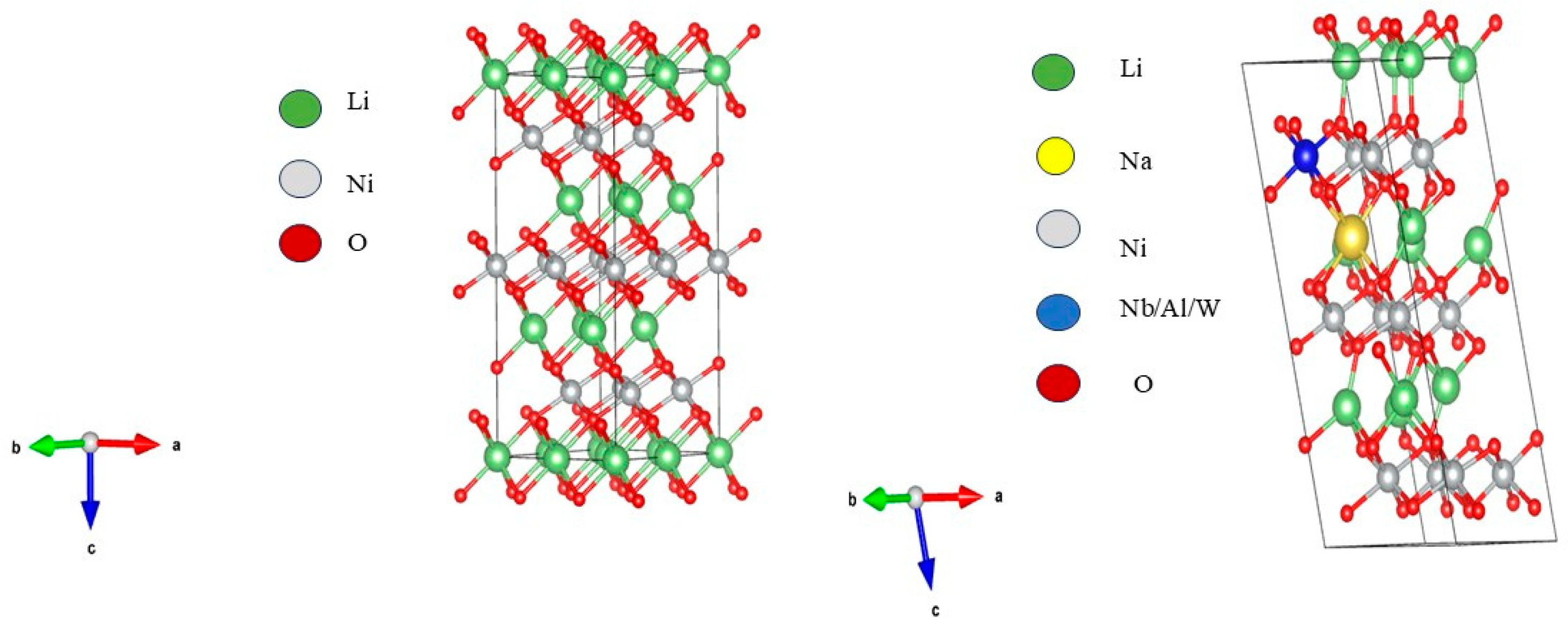
Lithium nickel oxide, or LiNiO2, operates as a cathode material in lithium-ion batteries. The layered structure is distinguished throughout the charge and discharge cycles, and lithium ions can migrate between and within the layers of this configuration. LiNiO2 exhibits the ability to store and release energy reversibly, making it a highly suitable option for the cathode material in lithium-ion batteries. The lattice parameters and unit cell volume of the relaxed structures’ estimated functional are listed in Table 1. The estimated lattices of LiNiO2 reported in our previous work are aligned with experimental findings [20]. The lattices of doped structures expand as the ionic radii of substituents increase, resulting in a change in cell volume. The c/a ratio plays a crucial role in influencing the layered characteristics of the cathode material. Table 1 clearly shows that the Na-W substituted structure exhibits a larger c/a ratio in comparison to other dopants, suggesting fast ion diffusion. Figure 1 illustrates the crystal structure model of Na-X-doped LiNiO2.

3.2. Formation Energy

The formation energy of a molecule stands as a critical property that directly influences its stability. The stability of a compound tends to increase when its formation energy is low. The formation energy is intrinsically linked to the structural stability of the material. A significant positive value of formation energy suggests thermal instability. The heat of formation (Ef), which is the enthalpy change when one mole of a compound is formed, is estimated by the following relation:
F E = E L i 1 x N a x N i 1 x X x O 2 x · E ( L i N i O 2 1 x · E ( M O 2 ) 48
Here, E ( L i 1 x N a x N i 1 x X x O 2 ) denotes the total energy of the Na–X co-doped LiNiO2 supercell, E ( L i N i O 2 ) is the total energy of pristine LiNiO2, and E ( N a X O 2 ) represents the reference energy for simultaneous Na and X substitution at the Li and Ni sites, respectively. The factor 48 corresponds to the total number of atoms in the supercell used for normalization. Among the studied doped systems, the Na–Nb-doped structure shows the lowest formation energy of −12.2 eV, confirming its highest stability, whereas the Na–Al- and Na–W-doped structures have formation energies of 6.82 eV and 3.52 eV, respectively, indicating comparatively lower stability.

3.3. Electronic Structure

The density of states (DOS) describes how electronic states are distributed across the energy bands of a material. This offers insights into the quantity of electronic states present at various energy levels. In brief, the DOS reflects the density or concentration of electrons at various energy levels within the material’s band structure. The density of states is an essential factor in comprehending the electronic properties of materials, especially in the context of semiconductors and insulators. In the realm of lithium-ion battery cathode materials such as LiNiO2, density of states analysis is crucial for evaluating the accessibility of electronic states that facilitate charge transport, redox reactions, and various electrochemical processes.
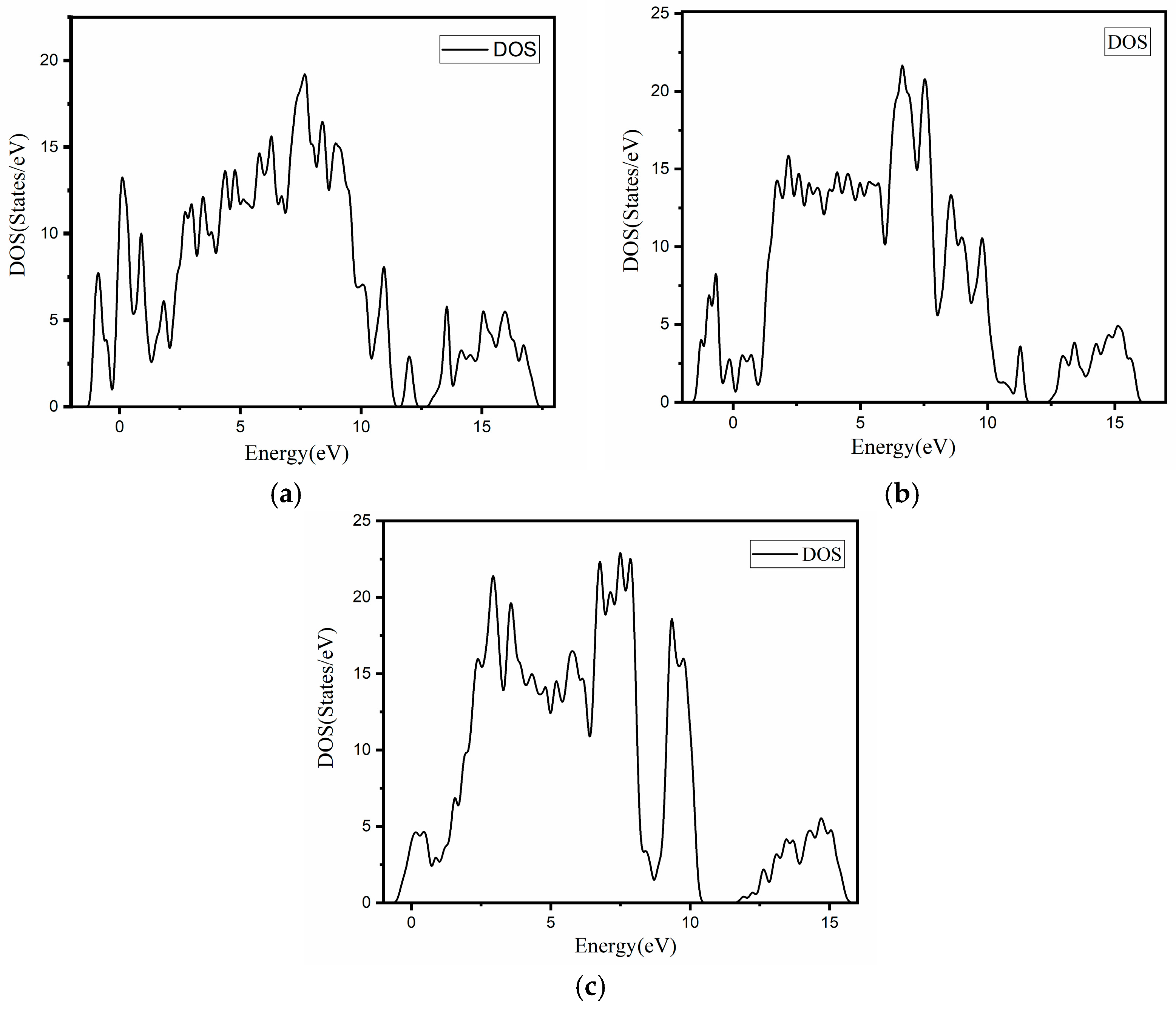
To evaluate the electronic conductivity of the designed material, the band gap was computed from DOS spectra. Figure 2 displays the DOS of doped LiNiO2. The band gaps for LNO and the newly designed materials were also computed. Among the studied systems, the Na–W co-doped structure exhibits the smallest band gap (0.38 eV), indicating enhanced electronic conductivity compared to Na–Nb (0.52 eV), Na–Al (0.65 eV), and pristine LiNiO2 (0.54 eV). The reduced band gap in the Na–W-doped system is expected to facilitate faster charge transport, which can improve electrochemical performance.
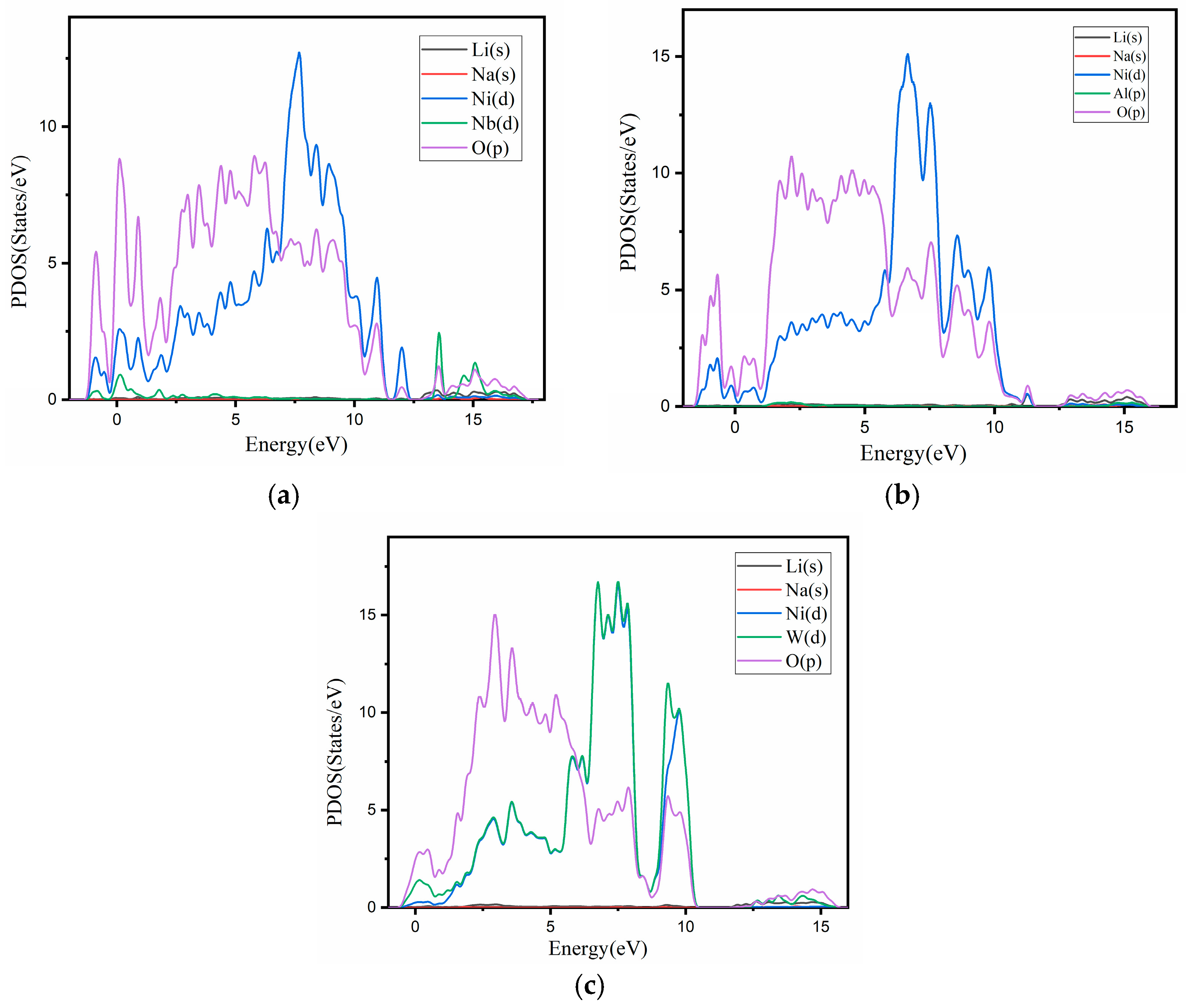
Figure 3 illustrates the atomic density of states across different structures. The projected density of states (PDOS) indicates how particular atomic orbitals contribute to the overall density of states (DOS) of a material. This analysis reveals the role of individual atomic orbitals, including s, p, d, and f orbitals, in shaping the overall electronic structure of the material. PDOS analysis enables a deeper understanding of the orbital character of electronic states across various energy bands. For instance, PDOS can illustrate the roles of transition metal (e.g., Ni) and oxygen (O) orbitals in the valence and conduction bands of LiNiO2. Through the decomposition of the total density of states into contributions from specific atomic orbitals, partial density of states analysis offers intricate insights into the bonding interactions and electronic transitions taking place within the material. This comprehension is crucial for clarifying the processes involved in charge storage, transport, and redox reactions within battery electrode materials.

4. Diffusion Coefficient and Ionic Conductivity

Figure 1 illustrates the crystal structure model of Na-X-doped LiNiO2. This model was developed by substituting one Li atom with Na and one Ni atom within a 2 × 2 × 1 LiNiO2 supercell, consisting of 11 Li atoms, 1 Na atom, 11 Ni atoms, 1 atom of Nb/Al/W, and 24 O atoms. The corresponding lattice characteristics are summarized in Table 1. The lattice constants increase due to Na doping due to the larger ionic radius of the Na+ dopant compared to Li+, leading to an expansion of the Li slab thickness from 2.15 Å to 2.655 Å, which is expected to facilitate Li+ diffusion.
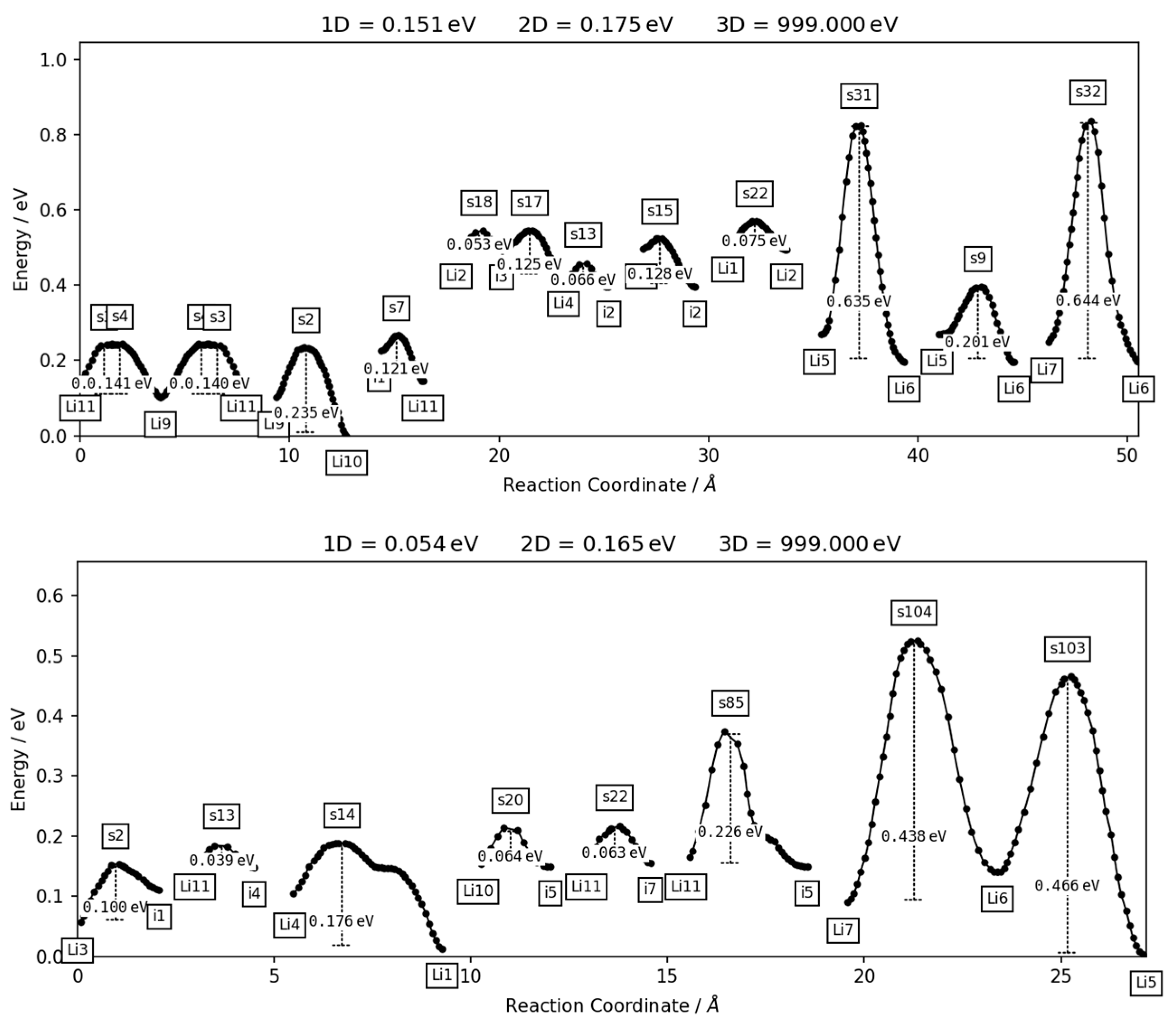
LiNiO2 has been discussed in detail in previous studies and is therefore taken as a reference in the present work given in Table 2. Pristine LiNiO2 exhibits an ionic conductivity of 5.13 × 10⁻⁴ S cm−1 and a Li+ migration barrier of 0.279 eV. Figure 4 presents the Li+ migration energy profiles for pristine and Na–X (X = Nb, Al, W) co-doped LiNiO2 systems, automatically generated using the SoftBV bond-valence method. The energy landscapes clearly demonstrate a significant reduction in migration barriers upon co-doping. The Na–Nb co-doped LiNiO2 system demonstrates the most balanced improvement, with ionic conductivity increased by nearly two orders of magnitude to 1.99 × 10⁻² S cm−1 and the migration barrier reduced by approximately 48% to 0.146 eV, resulting in an increase in the diffusion coefficient from 1.46 × 10⁻⁹ to 1.78 × 10⁻⁷ cm2 s−1. In the Na–Al co-doped system, the migration barrier is further reduced to 0.053 eV, corresponding to an ~81% decrease relative to pristine LiNiO2, and the diffusion coefficient increases to 3.12 × 10⁻⁷ cm2 s−1, indicating highly favorable Li+ migration kinetics. The Na–W co-doped LiNiO2 system exhibits a significantly enhanced ionic conductivity of 1.77 × 10⁻² S cm−1 and a reduced migration barrier of 0.10 eV with an increase in diffusion coefficient value 8.73 × 10⁻⁷ cm2 s−1, which lies within the experimentally reported range for layered LiNiO2 systems. Experimental vacancy-diffusion measurements report diffusion coefficients of the order of ~2.0 × 10⁻⁷ cm2 s−1 for Li1−xNiO2 [21], indicating good agreement in order of magnitude between the present theoretical results and experimental observations. The remaining differences can be attributed to the idealized nature of theoretical calculations compared to experimental measurements, which include temperature, defect, and microstructural effects.
Overall, Nb and Al co-doping provide the most significant enhancement in Li+ diffusion kinetics, while W co-doping contributes to improved ionic conductivity and maintains diffusion coefficients within experimentally relevant limits. The calculated trends in migration barrier, diffusion coefficient, and ionic conductivity are thus physically consistent and supported by available experimental data.

5. Conclusions

In summary, Na–Nb/Al/W co-doping in layered LiNiO2 induces notable modifications in lattice parameters and significantly influences the structural stability and Li+ transport properties compared to pristine LiNiO2. Among the investigated systems, Na–Nb-doped LiNiO2 exhibits the most balanced overall improvement, combining the lowest formation energy (−12.2 eV) with high ionic conductivity (1.99 × 10⁻² S cm−1) and a substantially reduced migration barrier (0.146 eV). Na–Al co-doping results in the lowest migration barrier (0.053 eV) and the highest diffusion coefficient (3.12 × 10⁻⁷ cm2 s−1), indicating highly favorable Li+ migration kinetics. The Na–W co-doped system shows a reduced electronic band gap (0.38 eV) and enhanced ionic conductivity (1.77 × 10⁻² S cm−1), along with a diffusion coefficient of 8.73 × 10⁻⁷ cm2 s−1, which lies within the experimentally reported range for layered LiNiO2-based cathode materials. Overall, within the scope of the present theoretical models, Nb and Al emerge as the most effective co-dopants for enhancing Li+ diffusion, while W co-doping primarily contributes to improved electronic conductivity and maintains Li+ transport within experimentally relevant limits. These findings demonstrate that dual-site co-doping is an effective strategy for overcoming intrinsic transport limitations in Ni-rich layered oxides and provides a rational pathway for the design of high-performance LiNiO2 cathode materials.

Author Contributions

Conceptualization, S.S.S., A.S. and A.K.; methodology, S.S.S., A.S. and A.K.; software, S.S.S.; validation, S.S.S., A.S. and A.K.; formal analysis, S.S.S.; investigation, S.S.S.; resources, M.P.S. and S.K.C.; data curation, S.S.S.; writing—original draft preparation, S.S.S. and A.S.; writing—review and editing, A.S., A.K. and M.P.S.; visualization, A.S., A.K. and M.P.S.; supervision, M.P.S.; project administration, M.P.S.; funding acquisition, M.P.S. All authors have read and agreed to the published version of the manuscript.

Funding

This research was funded by the Council of Science & Technology, U.P. (Letter No. CST/E&T/D-1235, dated 23 August 2025), and Science and Engineering Research Board (SERB), New Delhi, India, for Teaching Associateship for Research Excellence (TARE), grant no. TAR/2022/000617.

Institutional Review Board Statement

Not applicable.

Informed Consent Statement

Not applicable.

Data Availability Statement

Data is contained within the article.

Acknowledgments

M.P.S. is thankful to the Department of Higher Education, Government of Uttar Pradesh, India, for the Centre of Excellence Grant.

Conflicts of Interest

The authors declare no conflicts of interest.

References

  1. Assat, G.; Tarascon, J.M. Fundamental Understanding and Practical Challenges of Anionic Redox Activity in Li-Ion Batteries. Nat. Energy 2018, 3, 373–386. [Google Scholar] [CrossRef]
  2. Singh, A.; Kumar, A.; Chaurasiya, N.; Rani, A.; Gupta, M.; Yadav, B.C.; Singh, M.P. Highly Sensitive and Fast Responsive Room Temperature LPG Sensor Based on Hydrothermally Synthesized MoTe2. Front. Nanotechnol. 2025, 7, 1623625. [Google Scholar] [CrossRef]
  3. Sun, L.; Xie, J.; Jin, Z. Different Dimensional Nanostructured Silicon Materials: From Synthesis Methodology to Application in High-Energy Lithium-Ion Batteries. Energy Technol. 2019, 7, 1900962. [Google Scholar] [CrossRef]
  4. Goodenough, J.B.; Park, K.S. The Li-Ion Rechargeable Battery: A Perspective. J. Am. Chem. Soc. 2013, 135, 1167–1176. [Google Scholar] [CrossRef]
  5. Manthiram, A. A Reflection on Lithium-Ion Battery Cathode Chemistry. Nat. Commun. 2020, 11, 1550. [Google Scholar] [CrossRef]
  6. Liu, W.; Oh, P.; Liu, X.; Lee, M.J.; Cho, W.; Chae, S.; Kim, Y.; Cho, J. Nickel-Rich Layered Lithium Transition-Metal Oxide for High-Energy Lithium-Ion Batteries. Angew. Chem. Int. Ed. 2015, 54, 4440–4457. [Google Scholar] [CrossRef]
  7. Liang, C.; Kong, F.; Longo, R.C.; Santosh, K.C.; Kim, J.S.; Jeon, S.H.; Choi, S.A.; Cho, K. Unraveling the Origin of Instability in Ni-Rich LiNi1-2xCoxMnxO2 (NCM) Cathode Materials. J. Phys. Chem. C 2016, 120, 6383–6393. [Google Scholar] [CrossRef]
  8. Noh, H.J.; Youn, S.; Yoon, C.S.; Sun, Y.K. Comparison of the Structural and Electrochemical Properties of Layered Li[NixCoyMnz]O2 (x = 1/3, 0.5, 0.6, 0.7, 0.8 and 0.85) Cathode Material for Lithium-Ion Batteries. J. Power Sources 2013, 233, 121–130. [Google Scholar] [CrossRef]
  9. Zheng, J.; Kan, W.H.; Manthiram, A. Role of Mn Content on the Electrochemical Properties of Nickel-Rich Layered LiNi0.8–XCo0.1Mn0.1+xO2 (0.0 ≤ x ≤ 0.08) Cathodes for Lithium-Ion Batteries. ACS Appl. Mater. Interfaces 2015, 7, 6926–6934. [Google Scholar] [CrossRef]
  10. Bak, S.M.; Hu, E.; Zhou, Y.; Yu, X.; Senanayake, S.D.; Cho, S.J.; Kim, K.B.; Chung, K.Y.; Yang, X.Q.; Nam, K.W. Structural Changes and Thermal Stability of Charged LiNixMnyCozO2 Cathode Materials Studied by Combined in Situ Time-Resolved XRD and Mass Spectroscopy. ACS Appl. Mater. Interfaces 2014, 6, 22594–22601. [Google Scholar] [CrossRef]
  11. Li, J.; Downie, L.E.; Ma, L.; Qiu, W.; Dahn, J.R. Study of the Failure Mechanisms of LiNi0.8Mn0.1Co0.1O2 Cathode Material for Lithium Ion Batteries. J. Electrochem. Soc. 2015, 162, A1401. [Google Scholar] [CrossRef]
  12. Schipper, F.; Erickson, E.M.; Erk, C.; Shin, J.-Y.; Chesneau, F.F.; Aurbach, D. Review—Recent Advances and Remaining Challenges for Lithium Ion Battery Cathodes. J. Electrochem. Soc. 2016, 164, A6220. [Google Scholar] [CrossRef]
  13. Sun, Y.; Wu, Q.; Zhao, L. A New Doping Element to Improve the Electrochemical Performance of Li1.2Mn0.54Ni0.13Co0.13O2 Materials for Li-Ion Batteries. Ceram. Int. 2019, 45, 1339–1347. [Google Scholar] [CrossRef]
  14. Song, M.Y.; Lee, D.S.; Park, H.R. Electrochemical Properties of LiNi1-yTiyO2 and LiNi0.975M0.025O2 (M = Zn, Al, and Ti) Synthesized by the Solid-State Reaction Method. Mater. Res. Bull. 2012, 47, 1021–1027. [Google Scholar] [CrossRef]
  15. Dreyer, S.L.; Kurzhals, P.; Seiffert, S.B.; Müller, P.; Kondrakov, A.; Brezesinski, T.; Janek, J. The Effect of Doping Process Route on LiNiO2 Cathode Material Properties. J. Electrochem. Soc. 2023, 170, 060530. [Google Scholar] [CrossRef]
  16. Quan, J.; Lin, H.; Li, H. Zn Doping Strategy to Suppress the Jahn–Teller Effect to Stabilize Mn-Based Layered Oxide Cathode toward High-Performance Potassium Ion Batteries. Small 2024, 20, 2403065. [Google Scholar] [CrossRef]
  17. Kim, Y.R.; Yoo, Y.W.; Hwang, D.Y.; Shim, T.Y.; Kang, C.Y.; Park, H.J.; Kim, H.S.; Lee, S.H. Effect of Niobium Doping to Enhance Electrochemical Performances of LiNi0.8Co0.1Mn0.1O2 Cathode Material. Solid State Ion. 2023, 389, 116108. [Google Scholar] [CrossRef]
  18. Hashem, A.M.; Abdel-Ghany, A.E.; El-Tawil, R.S.; Mauger, A.; Julien, C.M.; Hashem, A.M.; Abdel-Ghany, A.E.; El-Tawil, R.S.; Mauger, A.; Julien, C.M. Effect of Na Doping on the Electrochemical Performance of Li1.2Ni0.13Co0.13Mn0.54O2 Cathode for Lithium-Ion Batteries. Sustain. Chem. 2022, 3, 131–148. [Google Scholar] [CrossRef]
  19. Perdew, J.P.; Burke, K.; Ernzerhof, M. Generalized Gradient Approximation Made Simple. Phys. Rev. Lett. 1996, 77, 3865. [Google Scholar] [CrossRef]
  20. Singh, S.S.; Shriwastav, M.; Agarwal, S.; Lohia, P.; Dwivedi, D.K. Cation/Anion Codoped Ni-Rich Layered Cathode for High- Performance Lithium- Ion Battery. Comput. Condens. Matter 2024, 41, e00961. [Google Scholar] [CrossRef]
  21. Bruce, P.G.; Lisowska-Oleksiak, A.; Saidi, M.Y.; Vincent, C.A. Vacancy Diffusion in the Intercalation Electrode Li1−xNiO2. Solid State Ion. 1992, 57, 353–358. [Google Scholar] [CrossRef]
Figure 1. Ball and stick model of Li12Ni12O24 (left)- and Na-Nb/Al/W (right)-doped LiNiO2.
Materproc 26 00017 g001
Figure 2. Density of states (DOS) of (a) Na-Nb-doped LNO, (b) Na-Al-doped LNO, and (c) Na-W-doped LNO.
Materproc 26 00017 g002
Figure 3. Atom density of states. (a) DOS for Na-Nb-doped LNO, (b) DOS for Na-Al-doped LNO, and (c) DOS for Na-W-doped LNO.
Materproc 26 00017 g003
Figure 4. Recommended pathway with migration energy.
Materproc 26 00017 g004
Table 1. Lattice parameters and cell volume of LNO and substituted LNO using GGA.
Materialsa (Å)c (Å)c/aVolume (Å)
LiNiO22.8015.285.45475.57
Na-Nb-Doped2.8215.235.40514.61
Na-Al-Doped2.8115.725.59499.79
Na-W-Doped2.8616.905.90516.08
Table 2. Diffusion coefficient and migration energy for various structures.
MaterialConductivity at 300 K (S/cm)Migration Barrier at 300 K (eV)Diffusion Coefficient at 300 K (cm2/s)
LiNiO25.13 × 10−40.2791.46 × 10−9
Na-Nb-doped LNO1.99 × 10−20.1461.78 × 10−7
Na-Al-doped LNO1.09 × 10−30.0533.12 × 10−7
Na-W-doped LNO1.77 × 10−20.108.73 × 10−7
Disclaimer/Publisher’s Note: The statements, opinions and data contained in all publications are solely those of the individual author(s) and contributor(s) and not of MDPI and/or the editor(s). MDPI and/or the editor(s) disclaim responsibility for any injury to people or property resulting from any ideas, methods, instructions or products referred to in the content.