
Proceeding Paper

Solar Thermal Energy Storage Using La0.2Sr2.8MnO3 Perovskite Oxide Redox Chemistry †

by
Rahul R. Bhosale
Department of Civil and Chemical Engineering, University of Tennessee at Chattanooga, 615 McCallie Ave, Chattanooga, TN 37403, USA
Presented at the 23rd International Conference on Advanced Nanomaterials, ANM 2025, Aveiro, Portugal, 23–25 July 2025.
Mater. Proc. 2026, 30(1), 4; https://doi.org/10.3390/materproc2026030004
Published: 12 March 2026
(This article belongs to the Proceedings of The International Conference on Advanced Nano Materials)

Abstract

The potential of La0.2Sr0.8MnO3 (LSM28) perovskite oxide for thermochemical energy storage (TCES) is assessed by analyzing its thermochemical performance. The TCES capacity of LSM28 was measured using a non-stoichiometric and van’t Hoff analysis at various reduction temperatures ( T r e d ) and oxygen partial pressures ( P O 2 ). O2 release and the associated non-stoichiometry (δ) increase with T r e d and decrease with P O 2 , according to the results, reaching a maximum δ of 0.101 at 1473 K and 0.0001 atm. The van’t Hoff research also showed that LSM28’s TCES capacity fluctuates greatly with δ, peaking at 37.1 kJ/kg under ideal circumstances.

1. Introduction

As global energy demand rises amid growing climate concerns [1,2], renewable technologies are increasingly developed to ensure sustainable power generation [3,4,5,6]. Among them, Concentrated Solar Power (CSP) utilizes reflective surfaces to focus sunlight onto a receiver, producing heat to generate steam and drive turbines for electricity [7]. However, the intermittent nature of solar radiation, especially during nighttime or cloudy conditions, limits continuous operation [8]. Integrating thermochemical energy storage (TCES) systems offers a practical solution, enabling CSP plants to store excess heat during sunny periods and release it when sunlight is unavailable, thereby ensuring reliable power generation and improving economic feasibility [9].
TCES has emerged as a promising high-temperature storage method for CSP applications [10]. It relies on reversible redox reactions of metal oxides (MOs) [11], where solar energy drives endothermic reduction, and the subsequent exothermic oxidation regenerates heat during discharge. TCES provides higher energy density and longer storage duration [12], improving both efficiency and sustainability of CSP systems.
Perovskite oxides (ABO3) have gained attention for TCES due to their high oxygen mobility and excellent redox cyclability [13,14,15]. Their reversible reaction can be expressed as per Equation (1), where δ i and δ f represent initial and final O2 non-stoichiometries during reduction and oxidation, respectively. The compositional flexibility of perovskites allows tailoring of O2 non-stoichiometry and ionic/electronic conductivity [16], enhancing cyclability and TCES capacity. This study presents a detailed non-stoichiometric and van’t Hoff analysis of La0.2Sr0.8MnO3 (LSM28) to estimate its maximum TECS potential under varying thermodynamic conditions.
A B O 3 δ i A B O 3 δ f + δ f δ i 2   O 2

2. LSM28-TCES: Non-Stoichiometric Analysis

The reversible redox reaction for the LSC28-driven TCES is presented below:
L a 0.2 S r 0.8 M n O 3 +   Δ H L a 0.2 S r 0.8 M n O 3 δ + δ 2 O 2
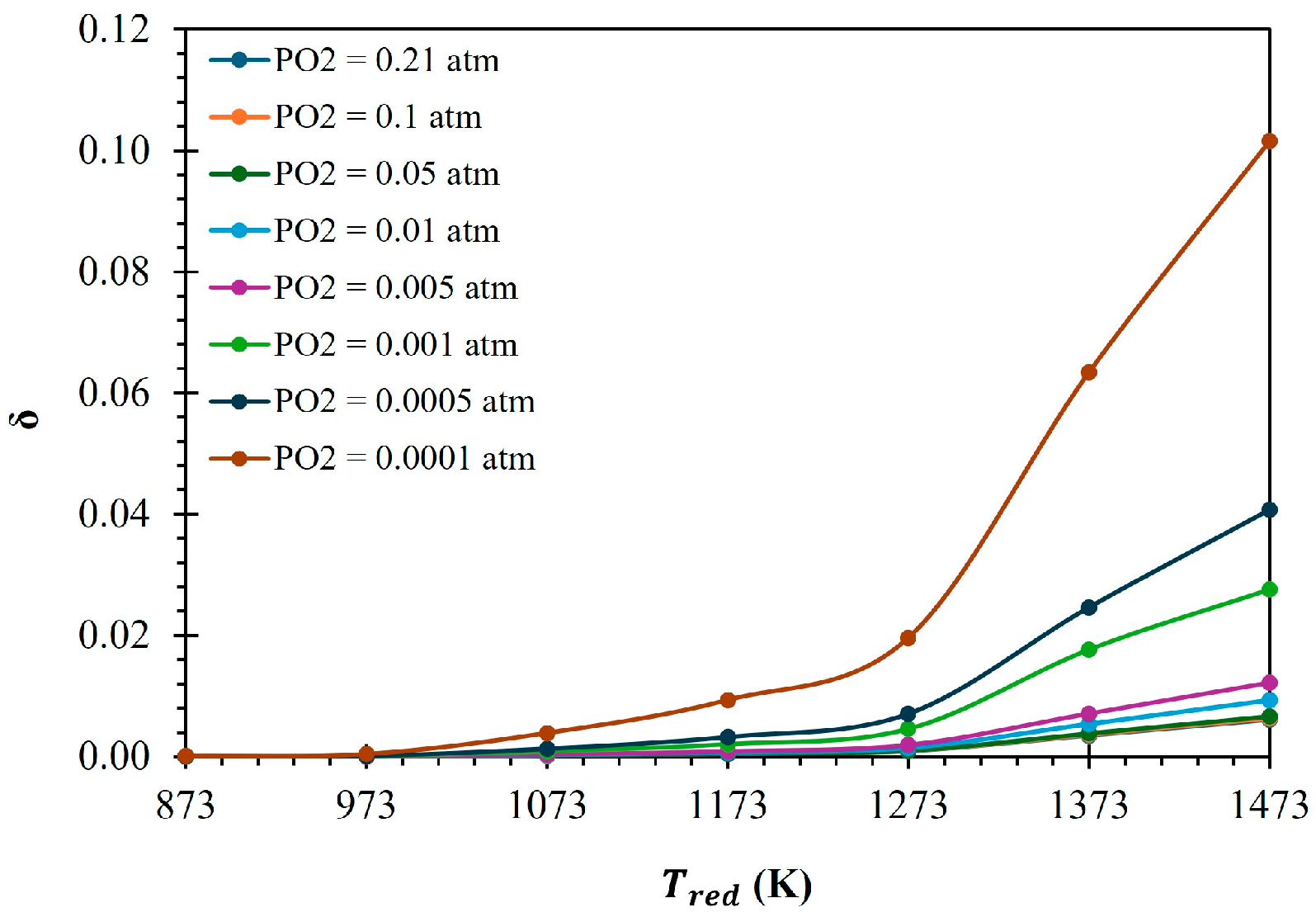
The amount of O2 released is calculated in response to the changes in P O 2 and T r e d to assess the TCES capacity of LSM28. As T r e d rose, the amount of O2 emitted steadily increased. For example, the amount of O2 released during the reduction step, often referred to as the energy storage phase, increased dramatically from 0.00001 mol at 873 K to 0.01377 mol at 1473 K at a P O 2 of 0.001 atm. The maximum O2 emission across all assessed P O 2 was placed at 1473 K.
As shown in Figure 1, the non-stoichiometry (δ) associated with the reduction reaction by looking at the quantity of O2 released by LSM28 was estimated. It was found that δ exhibited a commensurate increase at all P O 2 as the O2 release rose with growing T r e d . For example, δ rose dramatically from 0.00002 to 0.02755 at a P O 2 of 0.001 atm. Notably, at a temperature of 1473 K, the highest δ values were observed across all P O 2 values.

3. LSM28-TCES: Van’t Hoff Analysis

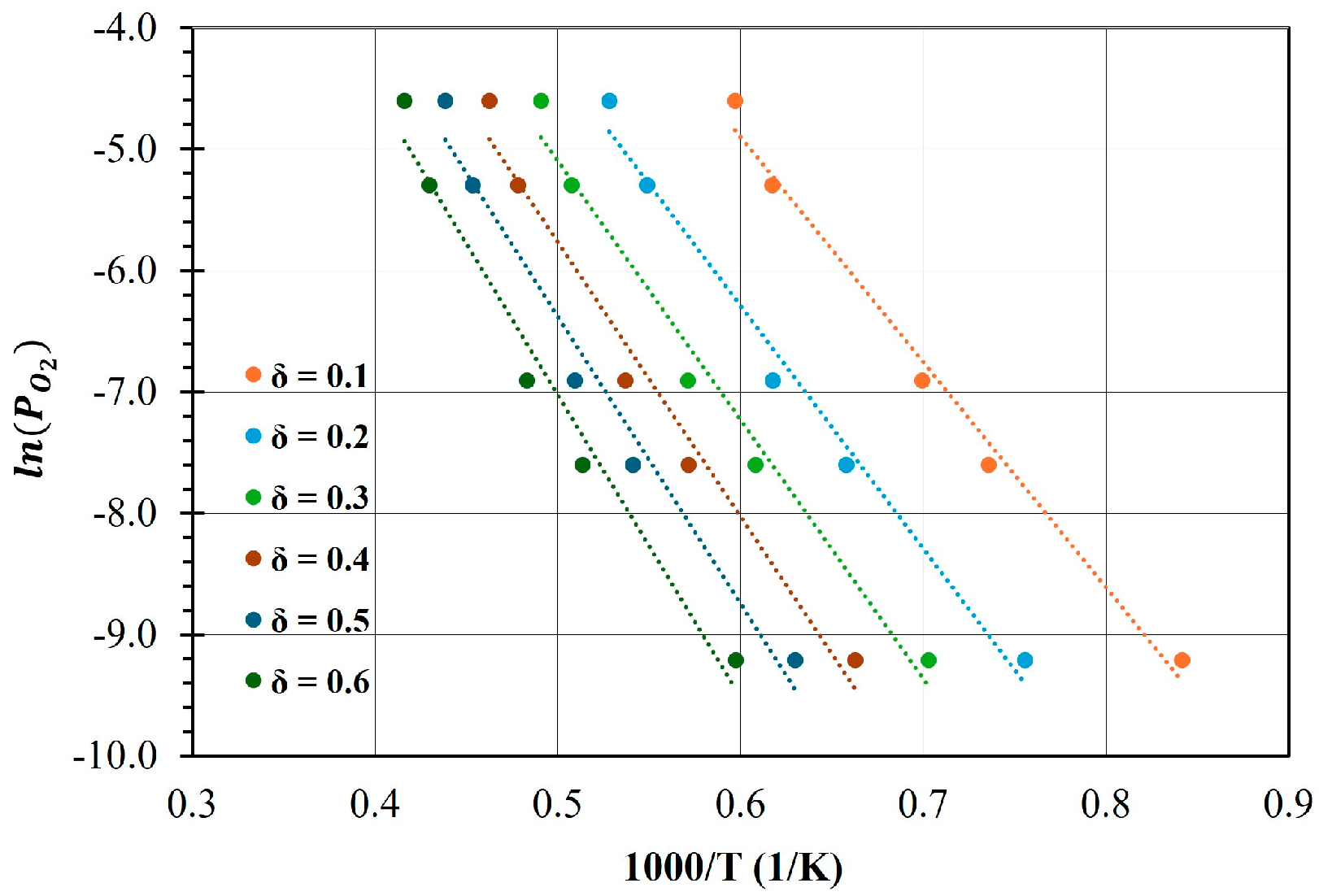
The ΔH study is performed after examining the equilibrium non-stoichiometry associated with the thermal reduction of LSM28. The TCES capacity of LSM28, specifically for the maximum δ (δmax), is calculated in kJ/kmol and kJ/kg. It is important to note that the δmax values obtained for P O 2 between 0.21 and 0.01 atm are deemed to be too low and are thus not included in this analysis. To conduct the Van’t Hoff analysis, for δ values of 0.1, 0.2, 0.3, 0.4, 0.5, and 0.6, we have approximated T r e d values for different P O 2 ranging from 0.01 atm to 0.0001 atm. The results show that the necessary T r e d decreased as the P O 2 lowered for every δ. For example, T r e d dropped from 1675 K to 1182 K at δ = 0.1, as P O 2 dropped from 0.01 atm to 0.0001 atm. As expected, at a P O 2 of 0.0001 atm, the lowest T r e d required to reach the predefined δ was found.
Linear fits are applied to transform the data into van’t Hoff form after estimating T r e d to reach the predefined δ values. This allowed us to provide iso-stoichiometry curves in the P O 2 T -specified plane (Figure 2). We estimated the ΔH (slope) and ΔS (intercept) related to the reduction reaction by conducting a linear regression of the van’t Hoff plot. For the maximum δ attained at T r e d of 1473 K, the ΔH values obtained—represented in kJ/mol of O2—were further converted into the corresponding values in kJ/mol and kJ/kg of LSM28.
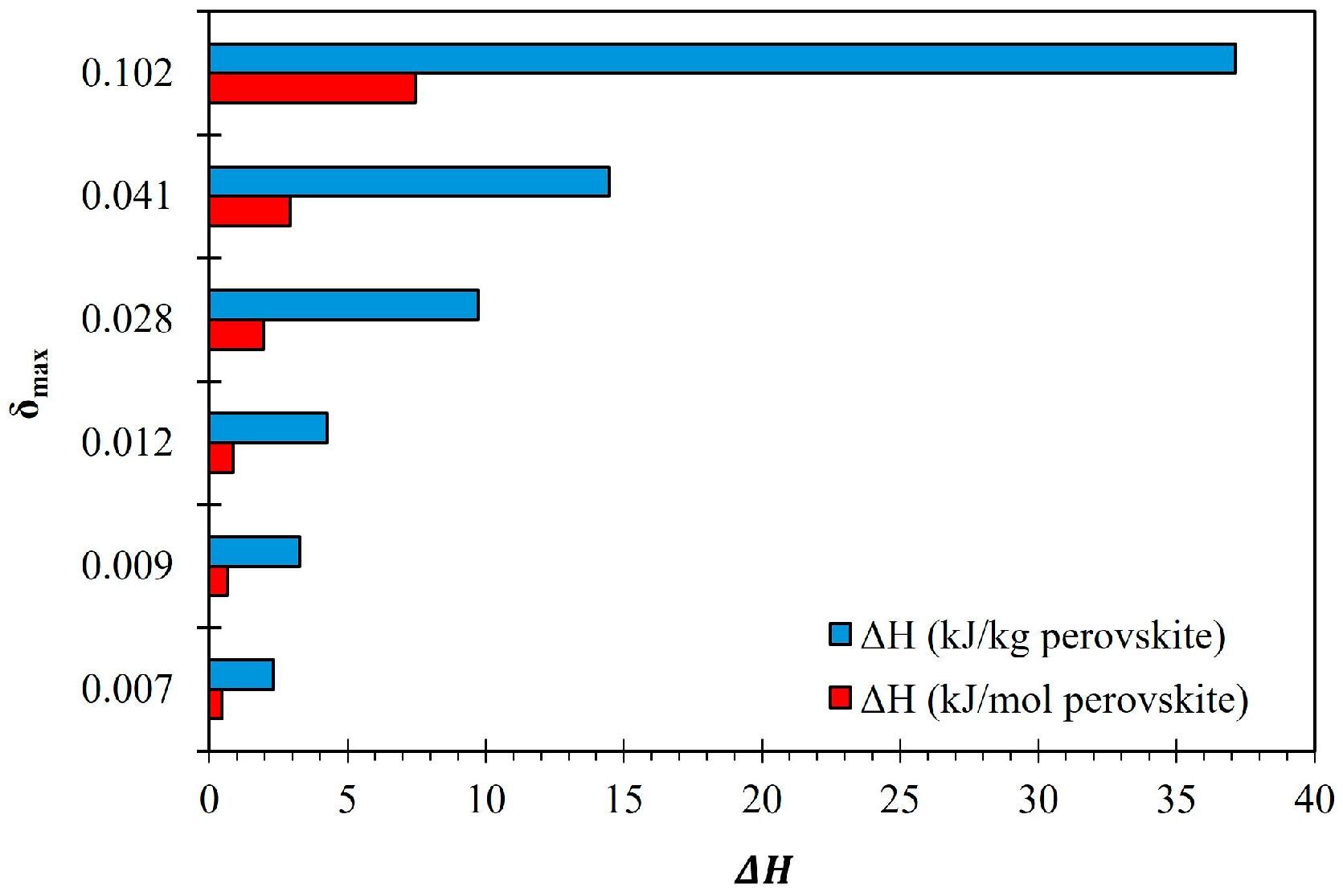
The integrated values for each δmax are shown in Figure 3. When P O 2 was placed at 0.01 atm (with δmax at 0.009), the TCES capacity of LSM28, which equates to 3.30 kJ/kg, excluding sensible heat storage, was at its lowest. The maximum TCES capacity, on the other hand, was recorded at a P O 2 of 0.0001 atm (where δmax reached 0.102), which corresponds to 37.1 kJ/kg of LSM28.

4. Summary and Conclusions

This work used thorough non-stoichiometric and van’t Hoff investigations to evaluate the TCES potential of La0.2Sr0.8MnO3 (LSM28). As T r e d increased, the non-stoichiometry (δ) rose as well, peaking at 0.102 at 1473 K and P O 2 = 0.0001 atm. The TCES capacity increased significantly as a result of this increase in δ. TCES capacity of LSM28 ranged from 3.3 kJ/kg (δ = 0.009 at 0.01 atm) to a maximum of 37.1 kJ/kg (δ = 0.102 at 0.0001 atm), according to van’t Hoff study. To evaluate the LSM28’s practical viability, more research is presently being performed to examine its long-term cyclability and real-world performance.

Funding

This research was funded by the National Science Foundation (NSF), Award CBET#2501431.

Institutional Review Board Statement

Not applicable.

Informed Consent Statement

Not applicable.

Data Availability Statement

All data are available upon request from the corresponding author.

Conflicts of Interest

The author declares no conflicts of interest.

References

  1. Bhosale, R.R.; Mahajani, V.V. Kinetics of Thermal Degradation of Renewably Prepared Amines Useful for Flue Gas Treatment. J. Renew. Sustain. Energy 2013, 5, 063110. [Google Scholar] [CrossRef] [Scilit]
  2. Checchetto, R.; De Angelis, M.G.; Minelli, M. Exploring the Membrane-Based Separation of CO2/CO Mixtures for CO2 Capture and Utilisation Processes: Challenges and Opportunities. Sep. Purif. Technol. 2024, 346, 127401. [Google Scholar] [CrossRef] [Scilit]
  3. Baldelli, M.; Bartolucci, L.; Cordiner, S.; De Maina, E.; Mulone, V. Toward Carbon Neutral Fuels: Process Analysis of Integrated Biomass Conversion Routes for Sustainable Biofuels Production. Energy 2025, 324, 136077. [Google Scholar] [CrossRef] [Scilit]
  4. Almomani, F.; Bhosale, R.R. Nickel/Cobalt Nanoparticles for Electrochemical Production of Hydrogen. Int. J. Hydrogen Energy 2021, 46, 11369–11377. [Google Scholar] [CrossRef] [Scilit]
  5. Viswanathan, V.; Epstein, A.H.; Chiang, Y.-M.; Takeuchi, E.; Bradley, M.; Langford, J.; Winter, M. The Challenges and Opportunities of Battery-Powered Flight. Nature 2022, 601, 519–525. [Google Scholar] [CrossRef] [Scilit] [PubMed]
  6. Ashok, A.; Kumar, A.; Bhosale, R.R.; Almomani, F.; Saleh Saad, M.A.H.; Suslov, S.; Tarlochan, F. Influence of Fuel Ratio on the Performance of Combustion Synthesized Bifunctional Cobalt Oxide Catalysts for Fuel Cell Application. Int. J. Hydrogen Energy 2019, 44, 436–445. [Google Scholar] [CrossRef] [Scilit]
  7. Khan, M.I.; Gutiérrez-Alvarez, R.; Asfand, F.; Bicer, Y.; Sgouridis, S.; Al-Ghamdi, S.G.; Jouhara, H.; Asif, M.; Kurniawan, T.A.; Abid, M.; et al. The Economics of Concentrating Solar Power (CSP): Assessing Cost Competitiveness and Deployment Potential. Renew. Sustain. Energy Rev. 2024, 200, 114551. [Google Scholar] [CrossRef] [Scilit]
  8. McCormick, P.G.; Suehrcke, H. The Effect of Intermittent Solar Radiation on the Performance of PV Systems. Sol. Energy 2018, 171, 667–674. [Google Scholar] [CrossRef] [Scilit]
  9. Pelay, U.; Luo, L.; Fan, Y.; Stitou, D.; Rood, M. Thermal Energy Storage Systems for Concentrated Solar Power Plants. Renew. Sustain. Energy Rev. 2017, 79, 82–100. [Google Scholar] [CrossRef] [Scilit]
  10. Carrillo, A.J.; González-Aguilar, J.; Romero, M.; Coronado, J.M. Solar Energy on Demand: A Review on High Temperature Thermochemical Heat Storage Systems and Materials. Chem. Rev. 2019, 119, 4777–4816. [Google Scholar] [CrossRef] [Scilit] [PubMed]
  11. André, L.; Abanades, S.; Cassayre, L. Mixed Metal Oxide Systems Applied to Thermochemical Storage of Solar Energy: Benefits of Secondary Metal Addition in Co and Mn Oxides and Contribution of Thermodynamics. Appl. Sci. 2018, 8, 2618. [Google Scholar] [CrossRef] [Scilit]
  12. Chen, X.; Zhang, Z.; Qi, C.; Ling, X.; Peng, H. State of the Art on the High-Temperature Thermochemical Energy Storage Systems. Energy Convers. Manag. 2018, 177, 792–815. [Google Scholar] [CrossRef] [Scilit]
  13. Babiniec, S.M.; Coker, E.N.; Miller, J.E.; Ambrosini, A. Investigation of La Sr1−Co M1−O3− (M = Mn, Fe) Perovskite Materials as Thermochemical Energy Storage Media. Sol. Energy 2015, 118, 451–459. [Google Scholar] [CrossRef] [Scilit]
  14. Albrecht, K.J.; Jackson, G.S.; Braun, R.J. Thermodynamically Consistent Modeling of Redox-Stable Perovskite Oxides for Thermochemical Energy Conversion and Storage. Appl. Energy 2016, 165, 285–296. [Google Scholar] [CrossRef] [Scilit]
  15. Imponenti, L.; Albrecht, K.J.; Wands, J.W.; Sanders, M.D.; Jackson, G.S. Thermochemical Energy Storage in Strontium-Doped Calcium Manganites for Concentrating Solar Power Applications. Sol. Energy 2017, 151, 1–13. [Google Scholar] [CrossRef] [Scilit]
  16. Peña, M.A.; Fierro, J.L.G. Chemical Structures and Performance of Perovskite Oxides. Chem. Rev. 2001, 101, 1981–2018. [Google Scholar] [CrossRef] [Scilit] [PubMed]
Figure 1. Effect of P O 2 and T r e d on δ associated with the reduction in LSM28.
Materproc 30 00004 g001
Figure 2. Iso-stoichiometry curves of LSM28 in the P O 2 / T plane (presented in Arrhenius form).
Materproc 30 00004 g002
Figure 3. TCES capacity of LSM28 at δmax achieved at each P O 2 (0.01 atm to 0.0001 atm) at 1473 K.
Materproc 30 00004 g003
Disclaimer/Publisher’s Note: The statements, opinions and data contained in all publications are solely those of the individual author(s) and contributor(s) and not of MDPI and/or the editor(s). MDPI and/or the editor(s) disclaim responsibility for any injury to people or property resulting from any ideas, methods, instructions or products referred to in the content.