
Proceeding Paper

Coffee Waste-Based Nanostructures: A Cost-Effective Fluorescent Material for Ni2+ Detection in Water †

by
Sepideh Dadashi
1,*,
Gabriele Giancane
2 and
Giuseppe Mele
1
1
Department of Engineering for Innovation, University of Salento, 73100 Lecce, Italy
2
Department of Cultural Heritage, University of Salento, 73100 Lecce, Italy
*
Author to whom correspondence should be addressed.
Presented at the 5th International Online Conference on Nanomaterials, 22–24 September 2025; Available online: https://sciforum.net/event/IOCN2025.
Mater. Proc. 2025, 25(1), 9; https://doi.org/10.3390/materproc2025025009
Published: 1 December 2025
(This article belongs to the Proceedings of The 5th International Online Conference on Nanomaterials)

Abstract

Nickel ions (Ni2+) are persistent heavy metal pollutants that pose significant risks to human health due to their toxicity. Conventional treatment technologies, while effective, are often costly, energy-intensive, and limited in removing emerging pollutants. In this study, we report an eco-friendly, fluorescence-based sensing platform using carbon nanostructures (CNs) synthesized from coffee waste via pyrolysis at 600 °C. The CNs were characterized by Fourier transform infrared (FTIR) spectroscopy and evaluated for their fluorescence response toward Ni2+, Co2+, Cu2+, and Cd2+ ions. Distinct ion-specific behaviors were observed, with Ni2+ inducing the strongest fluorescence quenching. Sensitivity studies revealed reliable detection across 10−8–10−3 M, with a detection limit of 10−4 M (≈5.9 mg/L). Fluorescence stability was maintained for up to six hours, with one hour identified as the optimal detection window. Performance in real water samples highlighted consistent responses in mineral water, reflecting reliable sensing capability in a realistic aqueous matrix. While the current detection limit is above the World Health Organization guideline for drinking water, the CNs show promise for monitoring Ni2+ in contaminated or industrial effluents. Overall, this work demonstrates that coffee waste-derived CNs provide a cost-effective, sustainable approach to heavy metal sensing, linking waste valorization with environmental monitoring.

1. Introduction

Heavy metal pollution in aquatic systems has become a global concern due to the persistence and toxicity of ions such as nickel (Ni2+), even at trace concentrations [1]. To ensure public health, the World Health Organization (WHO) has set strict limits of 0.07 mg/L [2], underscoring the need for rapid, inexpensive, and selective sensing platforms for Ni2+ detection. A wide range of techniques has been developed for Ni2+ detection, including fluorescence [3,4], colorimetry [5], optical detection [6], potentiometric detection [7], electrochemical detection [8], and resonance light scattering [9]. Among these, fluorescence-based sensors stand out for their simplicity, high sensitivity, and fast response [10].
In parallel, a variety of carbon-based nanomaterials have been explored for Ni2+ detection, owing to their tunable photoluminescence, high stability, and selective ion recognition [11,12,13]. Polyurethane-derived, label-free carbon dots have also been developed as simple and selective Ni2+ sensors, combining fluorescence quenching with high adsorption capacity [14], while imidazole-modified nanostructures enhanced sensitivity via photoinduced electron transfer [15]. Green and sustainable approaches have also emerged, such as amino-functionalized CNs synthesized from tryptone and yeast extracts, which offer good biocompatibility and promising sensing performance [16]. Nevertheless, many of these nanosystems still depend on multi-step functionalization, involve hazardous precursors, or face limitations for large-scale and practical applications [17].
To address these challenges, cost-effective, one-step synthesized nanostructures derived from renewable or waste resources are highly desirable. Waste valorization provides not only a cost reduction but also environmental benefits, thereby supporting circular economy principles [18], such as the use of spent coffee grounds as a sustainable feedstock [19]. Spent coffee grounds, a carbon-rich biomass, were first used by Chang et al. to synthesize carbon nanodots for cell imaging [20] and were later extended to antibacterial activity and active packaging [21,22]. Subsequently, several studies have reported the synthesis of nanocomposites from coffee grounds for water remediation, highlighting their potential as an attractive feedstock for sustainable nanomaterial production [23,24,25]. In this study, we report the synthesis of carbon nanostructures from coffee waste and demonstrate their application as a selective, eco-friendly, and cost-effective fluorescent probe for Ni2+ detection in aqueous environments. The main objective of this study is to develop a sustainable, coffee waste-derived sensing platform capable of sensitive and selective detection of Ni2+ ions in water for environmental monitoring applications.

2. Materials and Methods

2.1. Materials

Waste coffee grounds were obtained from Quarta S.r.l. (Lecce, Italy). Hydrogen peroxide (≥30%, Honeywell Fluka, Cologno Monzese, Italy) and metal salts (CoCl2, CuCl2, CdCl2, NiCl2; Merck, Darmstadt, Germany) were used as received, without further purification. Ultrapure Milli-Q water was used in all syntheses.

2.2. Synthesis of CNs

CNs were synthesized via a green pyrolysis–oxidation process based on a reported method [23]. Coffee grounds were carbonized at 600 °C for 1 h in a muffle furnace (FR 502). The carbonized product was dispersed in water, treated with hydrogen peroxide, and sonicated to yield a yellowish CN solution (0.5 g L−1). The supernatant containing well-dispersed CNs was stored at 5 °C for further analysis without additional treatment.

2.3. Characterization of CNs

The surface functional groups of CNs were characterized by ATR-FTIR (Perkin Elmer Spectrum ONE, Waltham, MA, USA), and their optical properties and heavy metal detection potential were studied using fluorescence spectroscopy (Horiba Fluorolog, Kyoto, Japan).

2.4. Fluorescence Detection and Selectivity Study of Heavy Metal Ions

Initially, 0.5 mM stock solutions of Ni2+, Cu2+, Co2+, and Cd2+ were prepared in Milli-Q water. For each test, 1 mL of CN solution (0.5 g L−1) was mixed with 1 mL of the respective metal ion solution in a quartz cuvette and gently stirred for 5 min. Fluorescence spectra were immediately recorded using a Horiba Fluorolog spectrofluorometer (excitation: 470 nm; emission: 480–750 nm) with Milli-Q water as the blank. The selectivity of the CNs was examined by comparing fluorescence responses toward different ions and by adding known concentrations of potential interferents under identical conditions. Ni2+ detection was also evaluated in mineral water to assess practical applicability, and fluorescence stability was monitored for 6 h using 10−4 M Ni2+.

3. Results

3.1. Characterizations by FT-IR Spectroscopy

The FTIR spectrum of CNs (Figure 1) displays characteristic peaks at 3457 and 3260 cm−1, assigned to O–H/N–H stretching and C–N bending vibrations, respectively. Bands at 1637, 1371, and 1023 cm−1 correspond to C=O/C=C, CH2, and C–N/C–O–C groups. Additional peaks near 2930 and 2917 cm−1 indicate C–H stretching of methylene, while signals at 1745 and 1610 cm−1 confirm carbonyl and C=C bonds. These findings indicate the presence of hydroxyl, carbonyl, and amine functionalities, consistent with earlier studies [21,23].

3.2. Investigation of Interference of Different Metal Ions with CNs Using Fluorescence Spectroscopy

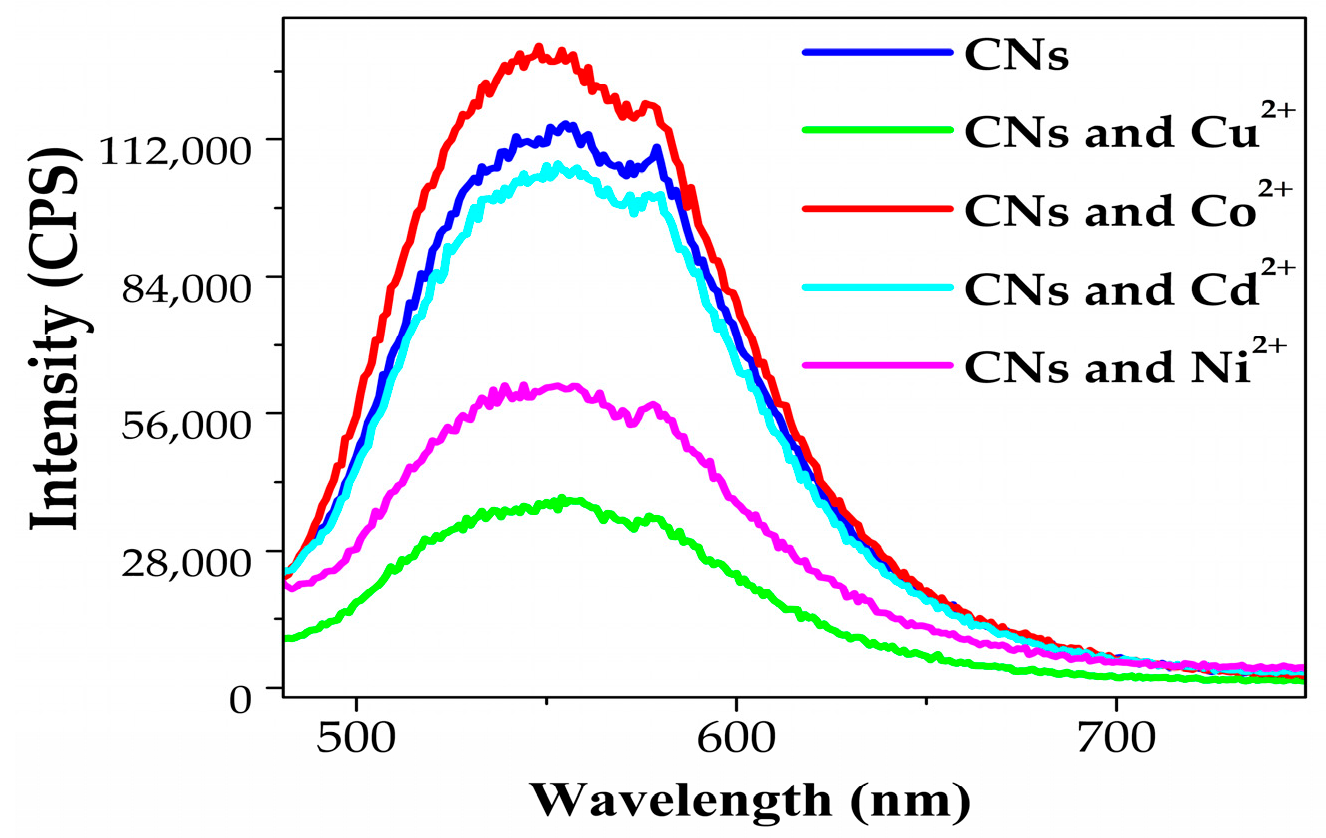
The selectivity of the CN fluorescence probe was evaluated by measuring its emission in the presence of various metal ions (Ni2+, Cu2+, Co2+, and Cd2+), with combined spectra shown in Figure 2. Ni2+ and Cu2+ caused significant quenching, Co2+ enhanced fluorescence, and Cd2+-induced minimal quenching with spectra closely resembling that of CNs alone. Ni2+ was selected for further study due to its strong quenching effect, enabling sensitive detection in subsequent experiments.

3.3. Fluorescence Quenching Behavior of CNs in the Presence of Ni2+ Ions

3.3.1. In Ultrapure Water

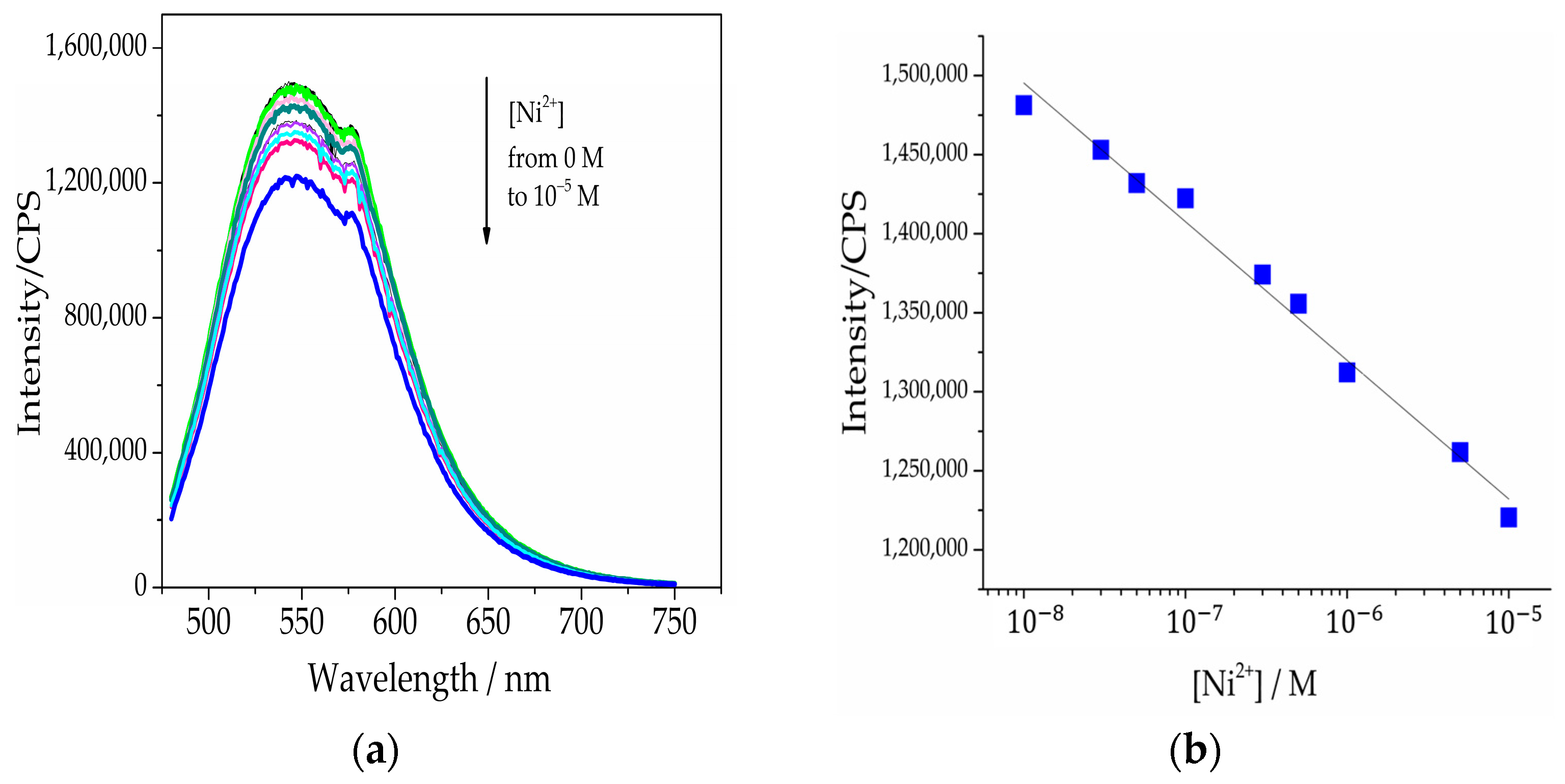
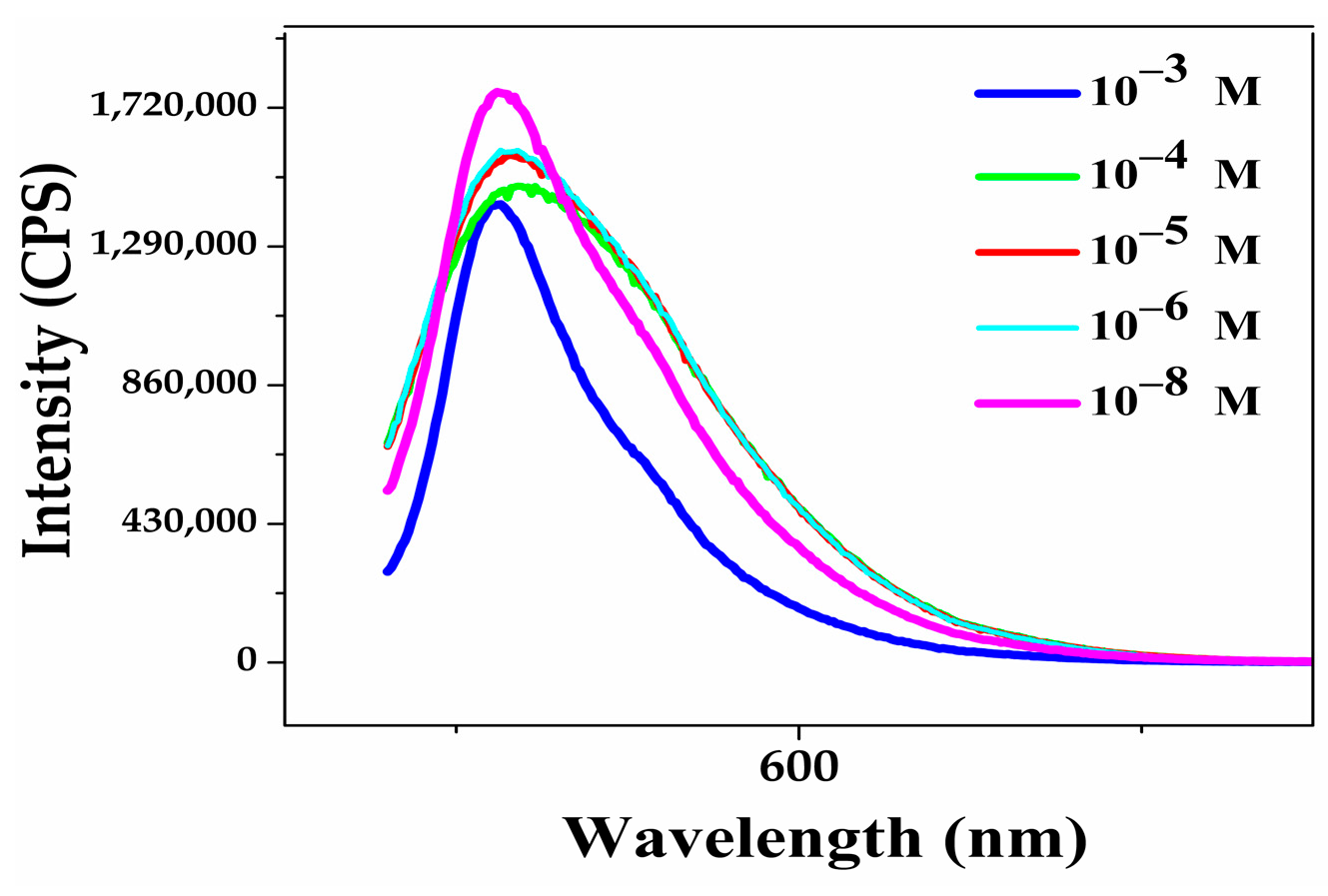
Fluorescence quenching of CNs by Ni2+ was evaluated in ultrapure water across concentrations from 10−3 M to 10−8 M. A consistent decrease in fluorescence with increasing Ni2+ indicates strong binding and confirms CNs as reliable probes for Ni2+ detection. Quenching was further analyzed over the concentration ranges of 10−3–10−8 M and 0–10−5 M (Figure 3 and Figure 4a). When plotted on a logarithmic scale (Figure 4b), the fluorescence intensity shows a clear trend with increasing Ni2+ concentration, allowing for a well-defined relationship suitable for quantifying Ni2+ in the range of 10−8 M to 10−5 M.

3.3.2. In Mineral Water

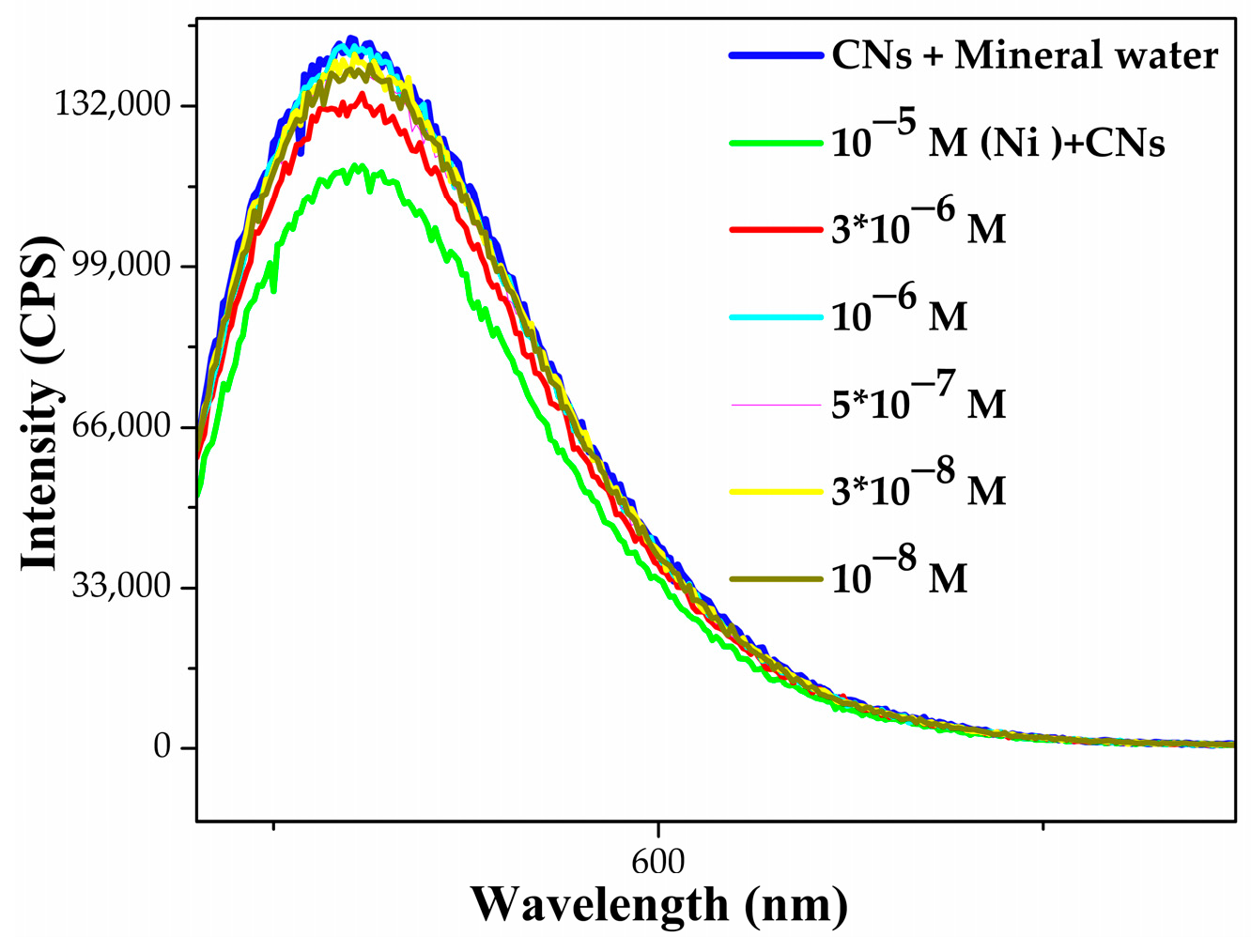
Fluorescence experiments were conducted using commercially available mineral water with low ionic content to evaluate the CNs’ sensing performance in a realistic aqueous matrix. The water contained mainly Ca2+ (3.3 mg L−1), Mg2+ (0.42 mg L−1), Na+ (1.5 mg L−1), K+ (0.2 mg L−1), SiO2 (7.8 mg L−1), HCO3 (11 mg L−1), and SO42− (3.3 mg L−1), with trace Cl (0.25 mg L−1), NO3 (0.88 mg L−1), NH4+ (<0.05 mg L−1), NO2 (<0.002 mg L−1), and F (<0.10 mg L−1). NiCl2-spiked samples (10−5–10−8 M) were mixed with CNs (0.5 g L−1), and fluorescence spectra were recorded (Figure 5). The quenching trend was consistent with that observed in ultrapure water, confirming the CNs’ reliable Ni2+ sensing capability and suitability for use in low-interference, environmentally relevant water matrices.

3.4. Investigation of CN Fluorescence Stability in Ultrapure Water

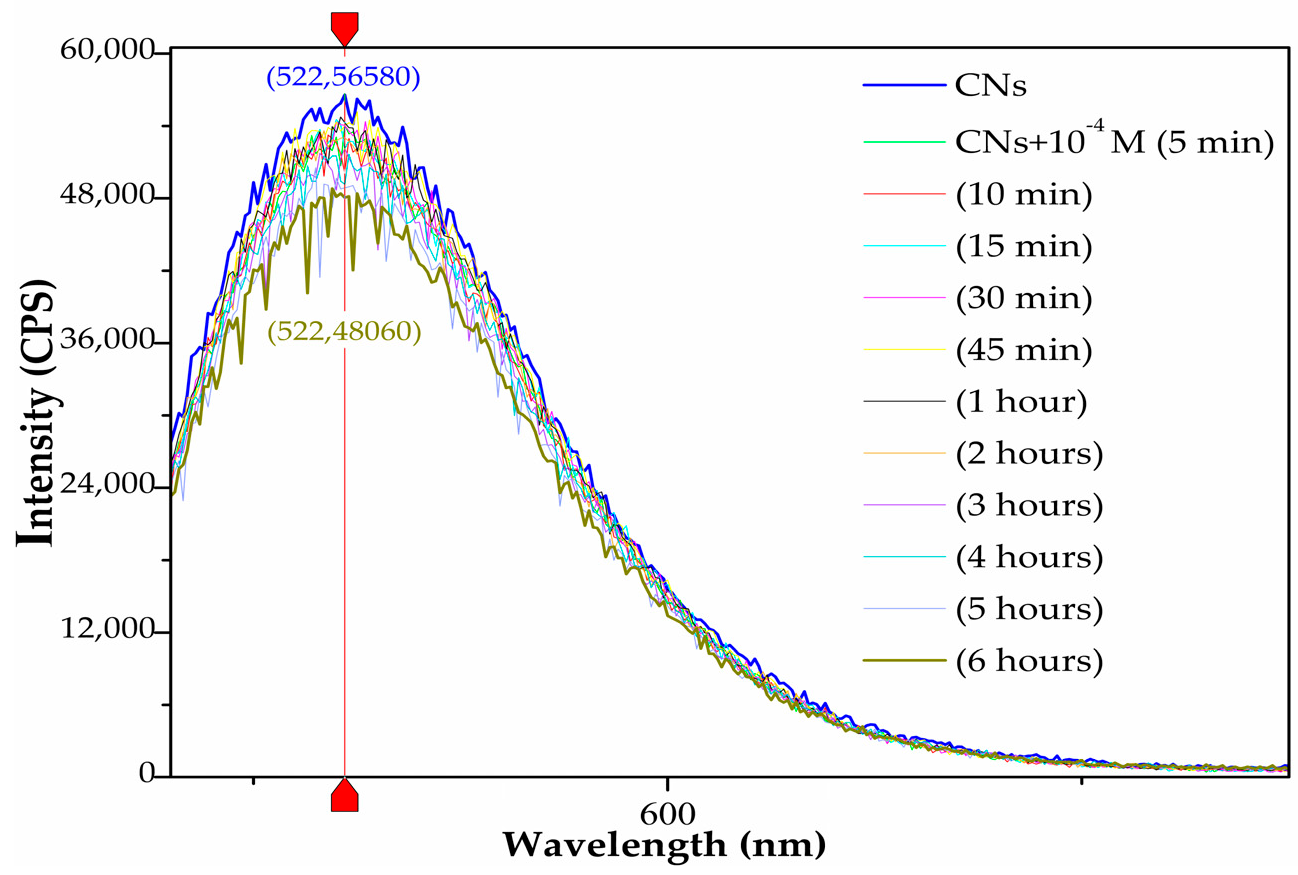
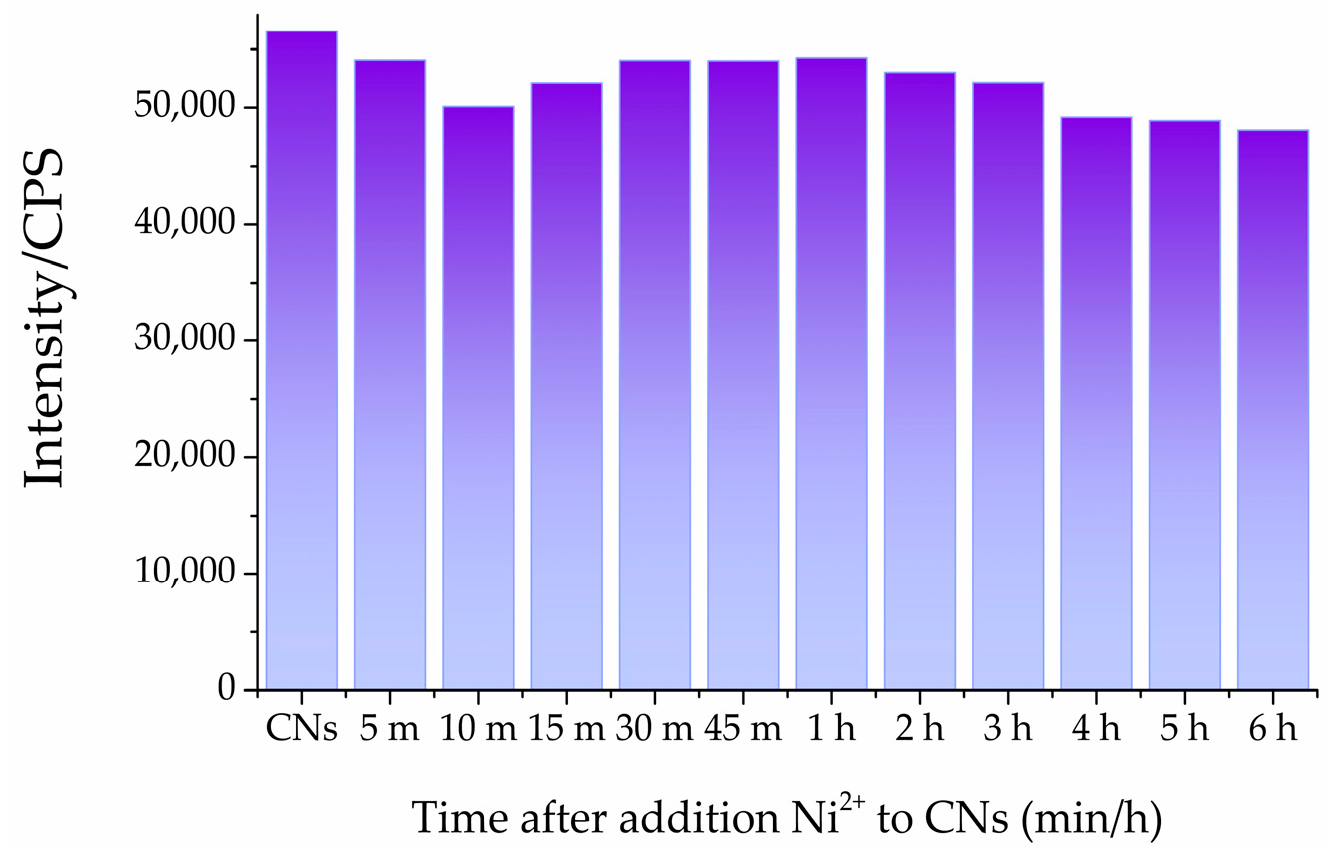
The maximum fluorescence of CNs was observed at 522 nm (Figure 6). Time-dependent measurements show an initial quenching within the first 10 min upon Ni2+ interaction, followed by partial recovery, with fluorescence peaking around 1 h before gradually declining. These dynamic changes likely result from alterations in CN surface properties, molecular reorganization, or prolonged metal ion interactions, highlighting the complex temporal response of CNs to Ni2+. The bar graph in Figure 7 illustrates this trend in detail: the column labeled ‘CNs’ represents fluorescence at 0 min, while subsequent columns show intensity changes at the indicated time points, capturing the progressive quenching and partial recovery over time.

4. Discussion

Coffee-derived CNs prepared by green pyrolysis exhibited strong aqueous dispersibility, attributable to abundant hydroxyl, carbonyl, and amine surface groups—consistent with earlier findings for biomass-derived nanostructures [13]. These surface functionalities, confirmed by FTIR analysis, contribute not only to water solubility but also to the coordination of metal ions, enabling effective fluorescence modulation. Similarly to other nanomaterial-based optical sensors such as metal nanoparticles (MNPs) and quantum dots (QDs) [17], the CNs demonstrated distinct ion-specific fluorescence behavior, confirming their potential as selective probes for metal ion detection. Among the tested cations, Ni2+ induced the most pronounced fluorescence quenching, whereas Cu2+ caused moderate quenching, Co2+ produced emission enhancement, and Cd2+ had negligible influence. These results highlight the relatively high affinity of the CNs toward Ni2+ compared with other common divalent cations [14,15,26]. This selectivity can be attributed to the strong coordination of Ni2+ with oxygen- and nitrogen-containing groups on the CN surface, resulting in efficient non-radiative electron or energy transfer and subsequent fluorescence quenching.
The fluorescence of CNs at 522 nm exhibited a time-dependent response to Ni2+ as follows: (i) rapid initial quenching (0–10 min) via static interactions; (ii) partial recovery (15–60 min) from surface rearrangement; and (iii) gradual long-term quenching (2–6 h) due to Ni2+ accumulation and CN aggregation [11,12,14,15,27]. This behavior suggests a combination of static complexation and inner filter effects, with dynamic surface processes accounting for transient recovery. Such multi-stage behavior indicates that Ni2+ binding induces structural rearrangements at the CN surface, leading to a temporary restoration of fluorescence before eventual quenching due to the aggregation or saturation of binding sites. Matrix-dependent performance was evident, as both ultrapure and mineral water showed consistent fluorescence quenching, confirming the stability and reliability of the CNs for Ni2+ detection under different aqueous conditions.
Although the detection limit of the current CN system (10−4 M, ≈5.9 mg/L) exceeds the World Health Organization guideline for drinking water (0.07 mg/L, ≈1.2 µM), it falls within the concentration range typical of industrial effluents. This positions the material as a practical platform for monitoring high-level Ni2+ contamination rather than trace-level drinking water compliance. These findings confirm coffee–CNs as sustainable, low-cost sensors for rapid Ni2+ detection in contaminated water, linking waste valorization with environmental monitoring. Importantly, the green synthesis route from coffee waste provides a sustainable and low-cost pathway for sensor development, aligning with circular economy principles.
To further enhance the analytical performance, future studies should focus on improving sensitivity through targeted surface functionalization with chelating groups, the development of ratiometric sensing systems, or integration into hybrid nanocomposites. Such approaches could lower the detection limit to environmentally relevant levels and expand applicability across different water systems.

5. Conclusions

This study demonstrates that carbon nanostructures (CNs) derived from coffee waste serve as a sustainable and low-cost fluorescent material for Ni2+ detection in water. The CNs exhibited strong selectivity toward Ni2+ among the tested metal ions, stable fluorescence performance, and reproducible responses in different aqueous matrices. These findings highlight the potential of coffee-derived CNs as eco-friendly materials for water quality monitoring and contribute to the development of circular, waste-to-resource technologies.

Author Contributions

Conceptualization, G.M. and G.G.; methodology, S.D., G.G. and G.M.; software, S.D. and G.G.; validation, S.D., G.G. and G.M.; formal analysis, S.D. and G.G.; investigation, S.D., G.G. and G.M.; resources, G.G. and G.M.; data curation, S.D. and G.G.; writing—original draft preparation, S.D.; writing—review and editing, S.D., G.G. and G.M.; visualization, S.D.; supervision, G.M.; project administration, G.M.; funding acquisition, G.M. All authors have read and agreed to the published version of the manuscript.

Funding

This research was funded by the National Operational Programme Research and Innovation 2014–2020 (grant number CCI2014IT16M2OP005). No APC was charged for this publication as it was accepted as a conference paper.

Institutional Review Board Statement

Not applicable.

Informed Consent Statement

Not applicable.

Data Availability Statement

Not applicable.

Acknowledgments

S.D. thanks the Laboratory for Chemical Technology of the Department of Engineering for Innovation and the Department of Cultural Heritage at the University of Salento for support.

Conflicts of Interest

The authors declare no conflict of interest.

Abbreviations

CNsCarbon nanostructures
WHOWorld Health Organization
EPAU.S. Environmental Protection Agency

References

  1. Aziz, K.H.H.; Mustafa, F.S.; Omer, K.M.; Hama, S.; Hamarawf, R.F.; Rahman, K.O. Heavy metal pollution in the aquatic environment: Efficient and low-cost removal approaches to eliminate their toxicity: A review. RSC Adv. 2023, 13, 17595–17610. [Google Scholar] [CrossRef] [PubMed]
  2. World Health Organization. Nickel in Drinking-Water. Background Document for Development of WHO Guidelines for Drinking-Water Quality; WHO/HEP/ECH/WSH/2021.6; World Health Organization: Geneva, Switzerland, 2021. [Google Scholar]
  3. Abebe, F.A.; Eribal, C.S.; Ramakrishna, G.; Sinn, E. A ‘turn-on’ fluorescent sensor for the selective detection of cobalt and nickel ions in aqueous media. Tetrahedron Lett. 2011, 52, 5554–5558. [Google Scholar] [CrossRef]
  4. Song, Y.; Tao, J.; Wang, Y.; Cai, Z.; Fang, X.; Wang, S.; Xu, H. A novel dual-responsive fluorescent probe for the detection of copper(II) and nickel(II) based on BODIPY derivatives. Inorganica Chim. Acta 2021, 516, 120099. [Google Scholar] [CrossRef]
  5. Almaquer, F.E.P.; Ricacho, J.S.Y.; Ronquillo, R.L.G. Simple and rapid colorimetric sensing of Ni(II) ions in tap water based on aggregation of citrate-stabilized silver nanoparticles. Sustain. Environ. Res. 2019, 29, 23. [Google Scholar] [CrossRef]
  6. Daniyal, W.M.E.M.M.; Fen, Y.W.; Abdullah, J.; Sadrolhosseini, A.R.; Saleviter, S.; Omar, N.A.S. Label-free optical spectroscopy for characterizing binding properties of highly sensitive nanocrystalline cellulose-graphene oxide based nanocomposite towards nickel ion. Spectrochim. Acta Part. A Mol. Biomol. Spectrosc. 2019, 212, 25–31. [Google Scholar] [CrossRef] [PubMed]
  7. Hamidi, N.; Alizadeh, T.; Madani, M. A novel potentiometric Ni2+-sensor based on a Ni2+ ion-imprinted polymer. Anal. Bioanal. Electrochem. 2018, 10, 281–291. [Google Scholar]
  8. Bodkhe, G.A.; Khandagale, D.D.; More, M.S.; Deshmukh, M.A.; Ingle, N.N.; Sayyad, P.W.; Mahadik, M.M.; Shirsat, S.M.; Al-Buriahi, M.S.; Tsai, M.-L.; et al. Ag@MOF-199 metal organic framework for selective detection of nickel ions in aqueous media. Ceram. Int. 2023, 49, 6772–6779. [Google Scholar] [CrossRef]
  9. Pimsin, N.; Kongsanan, N.; Keawprom, C.; Sricharoen, P.; Nuengmatcha, P.; Oh, W.-C.; Areerob, Y.; Chanthai, S.; Limchoowong, N. Ultratrace Detection of Nickel(II) Ions in Water Samples Using Dimethylglyoxime-Doped GQDs as the Induced Metal Complex Nanoparticles by a Resonance Light Scattering Sensor. ACS Omega 2021, 6, 14796–14805. [Google Scholar] [CrossRef]
  10. De Acha, N.; Elosúa, C.; Corres, J.M.; Arregui, F.J. Fluorescent Sensors for the Detection of Heavy Metal Ions in Aqueous Media. Sensors 2019, 19, 599. [Google Scholar] [CrossRef]
  11. Silva, E.C.; Gomes, C.G.; Pina, J.; Pereira, R.F.P.; Murtinho, D.; Fajardo, A.R.; Valente, A.J.M. Carbon quantum dots-containing poly(β-cyclodextrin) for simultaneous removal and detection of metal ions from water. Carbohydr. Polym. 2024, 323, 121464. [Google Scholar] [CrossRef]
  12. Vyas, T.; Joshi, A. Chemical sensor thin film-based carbon quantum dots (CQDs) for the detection of heavy metal count in various water matrices. Analyst 2024, 149, 1297–1309. [Google Scholar] [CrossRef]
  13. Hu, G.; Pei, Z.; Shen, B.; Li, Y.; Wei, W.; Zhang, J.; Li, J. Correlation between surface structure of carbon dots and selective detection of heavy metal ions. Appl. Phys. A Mater. Sci. Process 2024, 130, 122. [Google Scholar] [CrossRef]
  14. Phetcharee, K.; Sirisit, N.; Manyam, J.; Paoprasert, P. Highly sensitive Ni2+ sensors based on polyurethane-derived, label-free carbon dots with high adsorption capacity. ChemistrySelect 2021, 6, 7964–7971. [Google Scholar] [CrossRef]
  15. Gong, Y.; Liang, H. Nickel Ion Detection by Imidazole Modified Carbon Dots. Spectrochim. Acta A Mol. Biomol. Spectrosc. 2019, 211, 342–347. [Google Scholar] [CrossRef]
  16. Qin, K.; Zhang, D.; Ding, Y.; Zheng, X.; Tan, W.; Xiang, Y.; Hua, J.; Ji, X.; Li, B.; Wei, Y. Application of carbon dots synthesized from tryptone and yeast extract in bioimaging and highly selective detection of p-nitrophenol and nickel(II). Anal. Methods 2019, 11, 5724–5729. [Google Scholar] [CrossRef]
  17. Naithani, S.; Heena; Sharma, P.; Layek, S.; Thetiot, F.; Goswami, T.; Kumar, S. Nanoparticles and quantum dots as emerging optical sensing platforms for Ni(II) detection: Recent approaches and perspectives. Coord. Chem. Rev. 2025, 524, 216331. [Google Scholar] [CrossRef]
  18. Sheldon, R.A. Biocatalysis and Biomass Conversion: Enabling a Circular Economy. Philos. Trans. R. Soc. A Math. Phys. Eng. Sci. 2020, 378, 2176. [Google Scholar] [CrossRef]
  19. Schmidt Rivera, X.C.; Gallego-Schmid, A.; Najdanovic-Visak, V.; Azapagic, A. Life Cycle Environmental Sustainability of Valorisation Routes for Spent Coffee Grounds: From Waste to Resources. Resour. Conserv. Recycl. 2020, 157, 104751. [Google Scholar] [CrossRef]
  20. Hsu, P.C.; Shih, Z.Y.; Lee, C.H.; Chang, H.T. Synthesis and Analytical Applications of Photoluminescent Carbon Nanodots. Green. Chem. 2012, 14, 917–920. [Google Scholar] [CrossRef]
  21. Andrade, P.F.; Nakazato, G.; Durán, N. Additive interaction of carbon dots extracted from soluble coffee and biogenic silver nanoparticles against bacteria. J. Phys. Conf. Ser. 2017, 838, 012028. [Google Scholar] [CrossRef]
  22. Kang, J.W.; Kim, J.Y.; Kang, D.H. Synthesis of Carbon Quantum Dots Using Spent Coffee Ground as Biomass Exhibiting Visible-Light-Driven Antimicrobial Activity against Foodborne Pathogens. J. Food Eng. 2024, 365, 111820. [Google Scholar] [CrossRef]
  23. Bettini, S.; Ottolini, M.; Pagano, R.; Pal, S.; Licciulli, A.; Valli, L.; Giancane, G. Coffee grounds-derived cnps for efficient cr(Vi) water remediation. Nanomaterials 2021, 11, 1064. [Google Scholar] [CrossRef] [PubMed]
  24. Jin, Y.; Tang, W.; Wang, J.; Ren, F.; Chen, Z.; Sun, Z.; Ren, P.-G. Construction of Biomass Derived Carbon Quantum Dots Modified TiO2 Photocatalysts with Superior Photocatalytic Activity for Methylene Blue Degradation. J. Alloys Compd. 2023, 932, 167627. [Google Scholar] [CrossRef]
  25. Maddu, A.; Meliafatmah, R.; Rustami, E. Enhancing Photocatalytic Degradation of Methylene Blue Using ZnO/Carbon Dots Nanocomposite Derived from Coffee Grounds. Pol. J. Environ. Stud. 2021, 30, 273–282. [Google Scholar] [CrossRef] [PubMed]
  26. Das, D.; Dutta, R.K. Photoluminescence lifetime based nickel ion detection by glutathione capped CdTe/CdS core-shell quantum dots. J. Photochem. Photobiol. A Chem. 2021, 416, 113323. [Google Scholar] [CrossRef]
  27. Zare, H.; Ghalkhani, M.; Akhavan, O.; Taghavinia, N.; Marandi, M. Highly sensitive selective sensing of nickel ions using repeatable fluorescence quenching-emerging of the CdTe quantum dots. Mater. Res. Bull. 2017, 95, 532–538. [Google Scholar] [CrossRef]
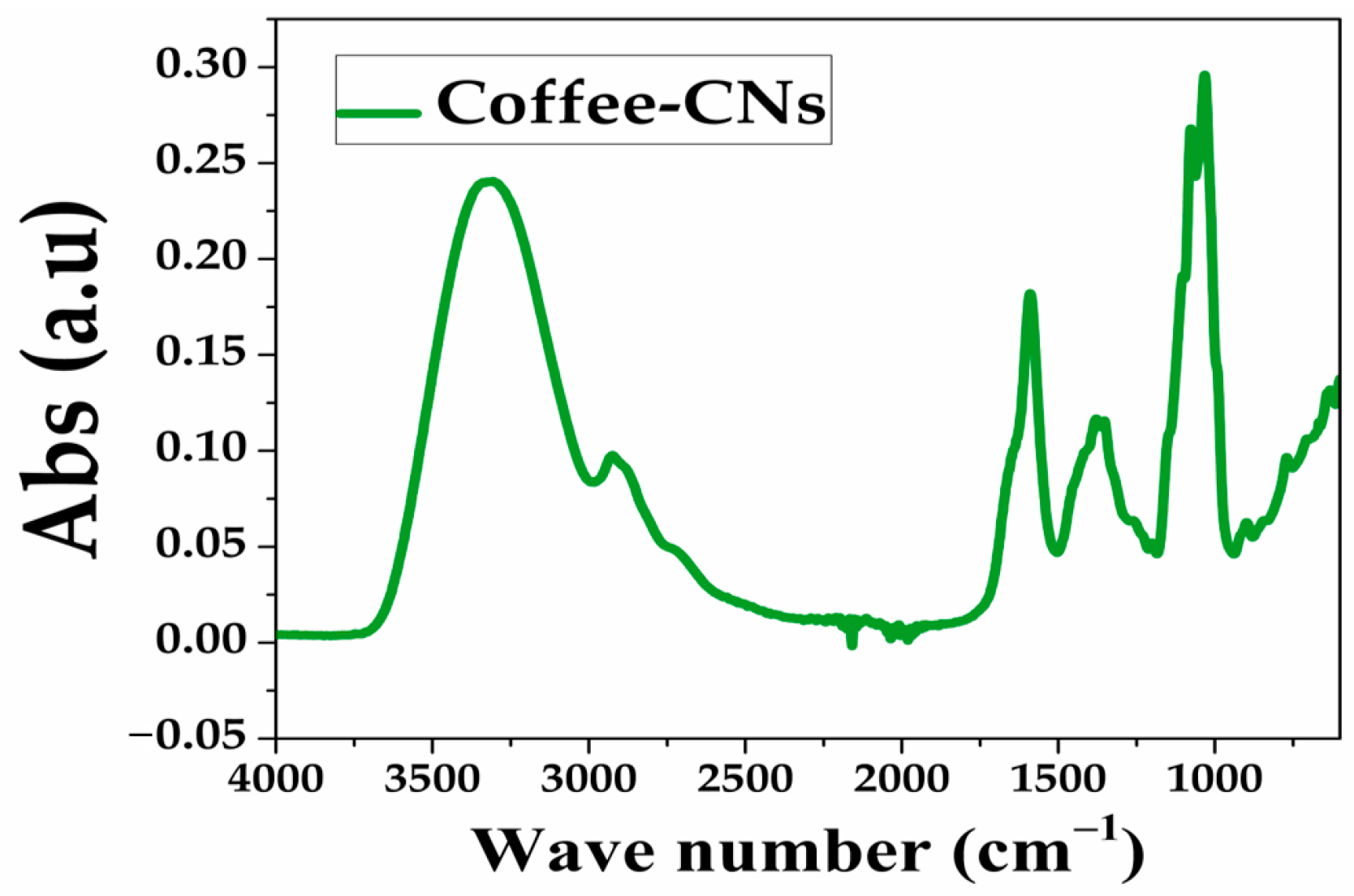
Figure 1. FTIR spectrum of CNs showing key bands: 3457 and 3260 cm−1 (O–H/N–H; C–N), 2930–2917 cm−1 (–CH2– stretching), 1745 cm−1 (C=O), 1637/1610 cm−1 (C=O/C=C), 1371 cm−1 (CH2), and 1023 cm−1 (C–N/C–O–C).cm−1.
Materproc 25 00009 g001
Figure 2. Fluorescence emission spectra of coffee–CNs in the presence of different metal ions (Ni2+, Cu2+, Co2+, Cd2+). Conditions: CN concentration 0.5 g L−1; metal ion concentration 0.5 mM; pH ≈ 7 (ultrapure water); excitation wavelength 470 nm; emission range 480–750 nm.
Materproc 25 00009 g002
Figure 3. Fluorescence spectra of CNs at varying Ni2+ concentrations upon the addition of Ni2+ ions (10−3 M–10−8 M) in ultrapure water. Conditions: CN concentration 0.5 g L−1; pH ≈ 7; excitation wavelength 470 nm; emission range 480–750 nm.
Materproc 25 00009 g003
Figure 4. (a) Fluorescence spectra of CNs at varying Ni2+ ion concentrations (0 to 10−5 M) in ultrapure water and (b) linear fit of fluorescence intensity as a function of Ni2+ concentration. Experimental conditions: CN concentration 0.5 g L−1; pH ≈ 7; excitation wavelength 470 nm; emission range 480–750 nm.
Materproc 25 00009 g004
Figure 5. Emission spectra of CNs at varying Ni2+ concentrations (10−5–10−8 M) in mineral water.
Materproc 25 00009 g005
Figure 6. Fluorescence spectra of mixture 10 −4 M (Ni2+) CNs in one specific wave number (522 nm).
Materproc 25 00009 g006
Figure 7. Time-dependent variation in fluorescence intensity of CNs in the presence of 10−4 M (Ni2+) ions recorded at 522 nm.
Materproc 25 00009 g007
Disclaimer/Publisher’s Note: The statements, opinions and data contained in all publications are solely those of the individual author(s) and contributor(s) and not of MDPI and/or the editor(s). MDPI and/or the editor(s) disclaim responsibility for any injury to people or property resulting from any ideas, methods, instructions or products referred to in the content.