Abstract
This study aimed to investigate the kinetic properties of methylene blue adsorption on carbon cryogel samples and nitrogen-doped and nitrogen-and-sulfur-co-doped carbon cryogel. Nitrogen and sulfur were incorporated into the carbon structure to enhance surface, electronic and textural properties. Methylene blue, a widely utilized dye in the textile industry, has become one of the most commonly detected substances in water systems. Experimental data were fitted with four kinetic models and showed excellent fits with the linear pseudo-second-order model. The results indicated that doping with nitrogen and sulfur did not significantly affect the adsorption of methylene blue.
1. Introduction
Over the last decade, the growing pace of industrialization and human activity has significantly contributed to the emergence of organic and textile dyes as key pollutants in aquatic ecosystems [1]. Among these dyes, methylene blue, widely used in the textile industry, has become one of the most commonly detected substances in water systems. Its presence raises serious environmental concerns due to the potential harm it can inflict on both plant and animal life in these ecosystems. Several techniques have been developed to remove different types of organic dyes from water, including ozonization, photolysis, and electrochemical degradation. However, adsorption has been recognized as a promising solution among these methods. It is highly efficient and economical, making it an ideal approach for removing dyes at trace concentrations [2,3]. Over time, researchers have experimented with various materials as sorbents for adsorption. These include activated walnut shell biochar, magnetic biochar derived from different types of waste, and polymeric resin. Each material brings its unique characteristics to the adsorption process. In recent years, carbon-based materials such as aerogels, xerogels, and cryogels have gained attention as innovative options for adsorbing various organic compounds. These carbonaceous materials possess several advantageous properties, including low density, extensive porosity, and a large surface area, making them particularly effective [4]. Techniques like chemical functionalization and heteroatom doping are often employed to enhance the performance of these materials further. These modifications aim to improve the carbon materials’ surface, electronic, and textural properties, thereby increasing their efficiency in adsorption processes.
This study specifically investigates using carbon cryogels—in their pristine form and as nitrogen-doped and nitrogen-and-sulfur-co-doped variants—to remove methylene blue from an aqueous solution. These cryogels were synthesized in previous research [5], and their application in this study focuses on evaluating their effectiveness as adsorbents through kinetic research. The selection of cryogels for this study is based on their superior textural and surface properties, as demonstrated in previous studies. This approach aims to identify the samples that exhibit the most promising characteristics for removing methylene blue from aquatic environments.
2. Materials and Methods
Synthesis of carbon cryogels was described in the previous research [5]. Melamine was used for nitrogen doping, which was added in a nominal concentration of 6 wt%. Thiourea was used for nitrogen and sulfur co-doping, in a nominal concentration of 10 wt%. These samples were marked as CC, CCN2 and CCNS3. All kinetics experiments were performed using batch adsorption kinetics. For the contamination of water with textile dyes, methylene blue was used as a model analyte. The kinetics experiments were performed in the 5–1440 time interval, at 25 °C in duplicate and in the same adsorption vessel.
The initial methylene blue (MB) solution concentration was 20 mg/L. Quantification of MB after adsorption was performed by the LLG-uniSPEC 2 Spectrophotometer (LLG Labware, Meckenheim, Germany) at 668 nm wavelength. The experimental data obtained during this study were processed and analyzed utilizing several kinetic models. These included the pseudo-first-order and pseudo-second-order models and the Elovich and intraparticle diffusion models. According to the literature, these models are widely used and commonly applied to examine and describe the adsorption kinetics of organic compounds. They provide valuable insights into the mechanisms and rates of adsorption processes, enabling a better understanding of the interaction between adsorbates and adsorbents.
3. Results and Discussion
Figure 1.
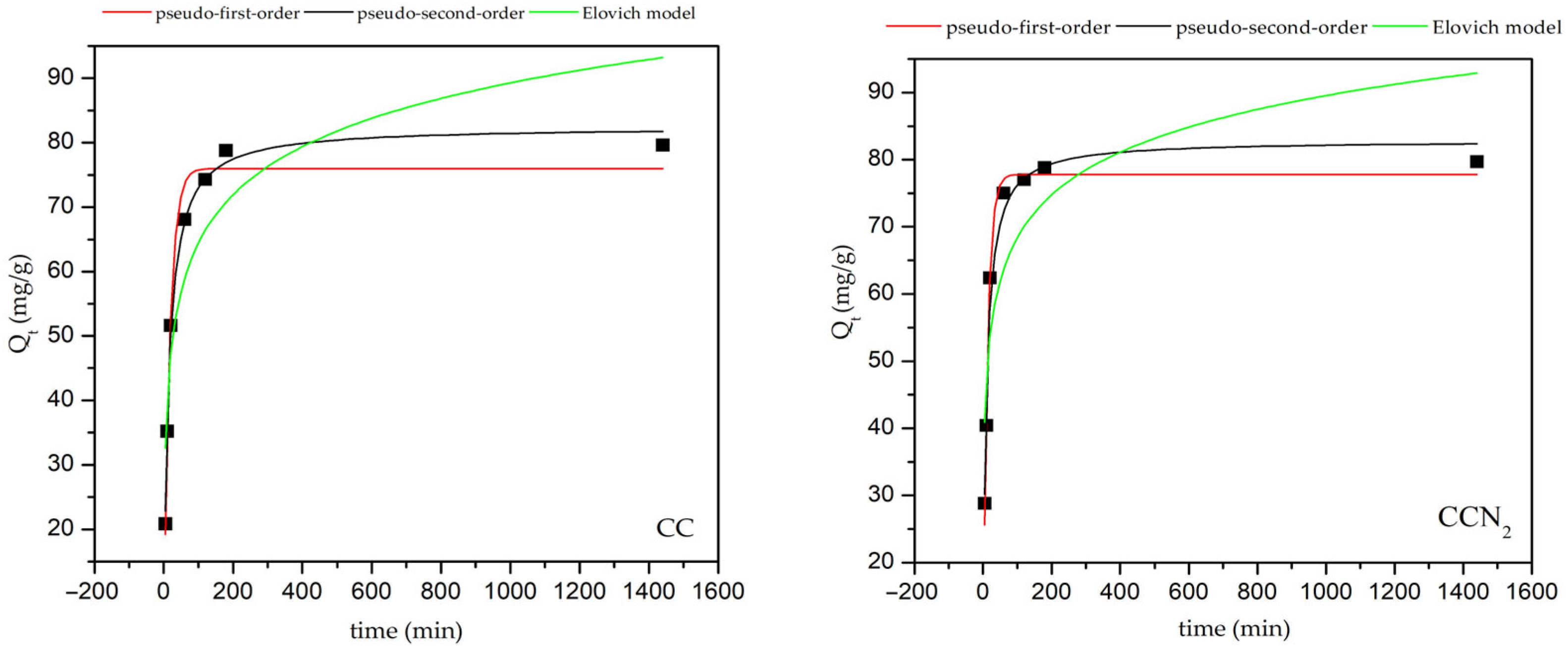
Fitted kinetic models for methylene blue adsorption onto CC and CCN2 samples.
Figure 2.
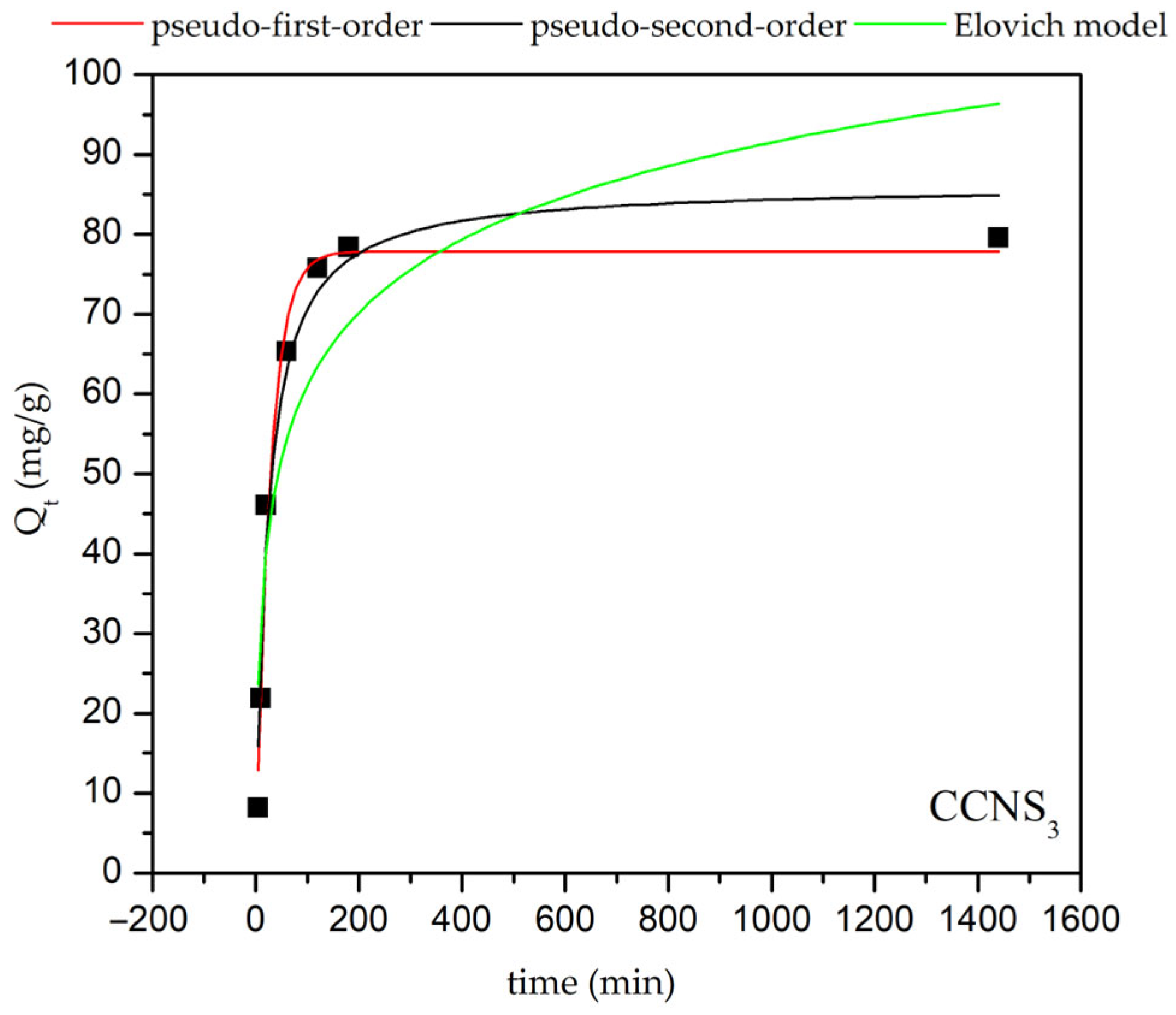
Fitted kinetic models for methylene blue adsorption onto CCNS3 sample.
In the first hour, adsorption was fastest for all samples; after two hours, adsorption slowed down and an equilibrium state was reached for all three samples. After three hours of adsorption, the methylene blue is adsorbed almost completely, for all samples, and the percent of adsorption is >98.5%. The calculated kinetic parameters are presented in Table 1 and Table 2. For the linear pseudo-first-order model, the constant rate was calculated from the slope and intercept ln (qe-qt) versus t graphs, while for the linear pseudo-second-order model, the constant rate was calculated from t/qt versus t graphs. Based on the calculated correlation coefficient, it can be concluded that the linear pseudo-second-order model fits excellently for all samples. In addition, the non-linear pseudo-second-order and both pseudo-first models, linear and non-linear, fit well for all samples (R2 > 0.97). The lower correlation coefficient for the Elovich model (R2 < 0.80) indicates that this model does not fit well for these samples. Calculated from the pseudo-second-order model, the constant rate k2 is the highest for the CCN2 sample, which means that methylene blue is first adsorbed on the CCN2 sample surface. On the other hand, the k2 constant rate is lowest for the CCNS3 sample, which can be explained by the higher microporosity of this sample and the more difficult adsorption of the methylene blue molecule. The higher value of the Elovich constant α, compared to the pristine and CCNS3 samples, also indicates and confirms the higher adsorption rate and fastest adsorption of methylene blue for the CCN2 sample. Equations of the used kinetic models are presented in Table 1 [4,6,7].
Table 1.
The equations of the kinetics models used in this study.
Table 2.
Kinetic parameters for applied models.
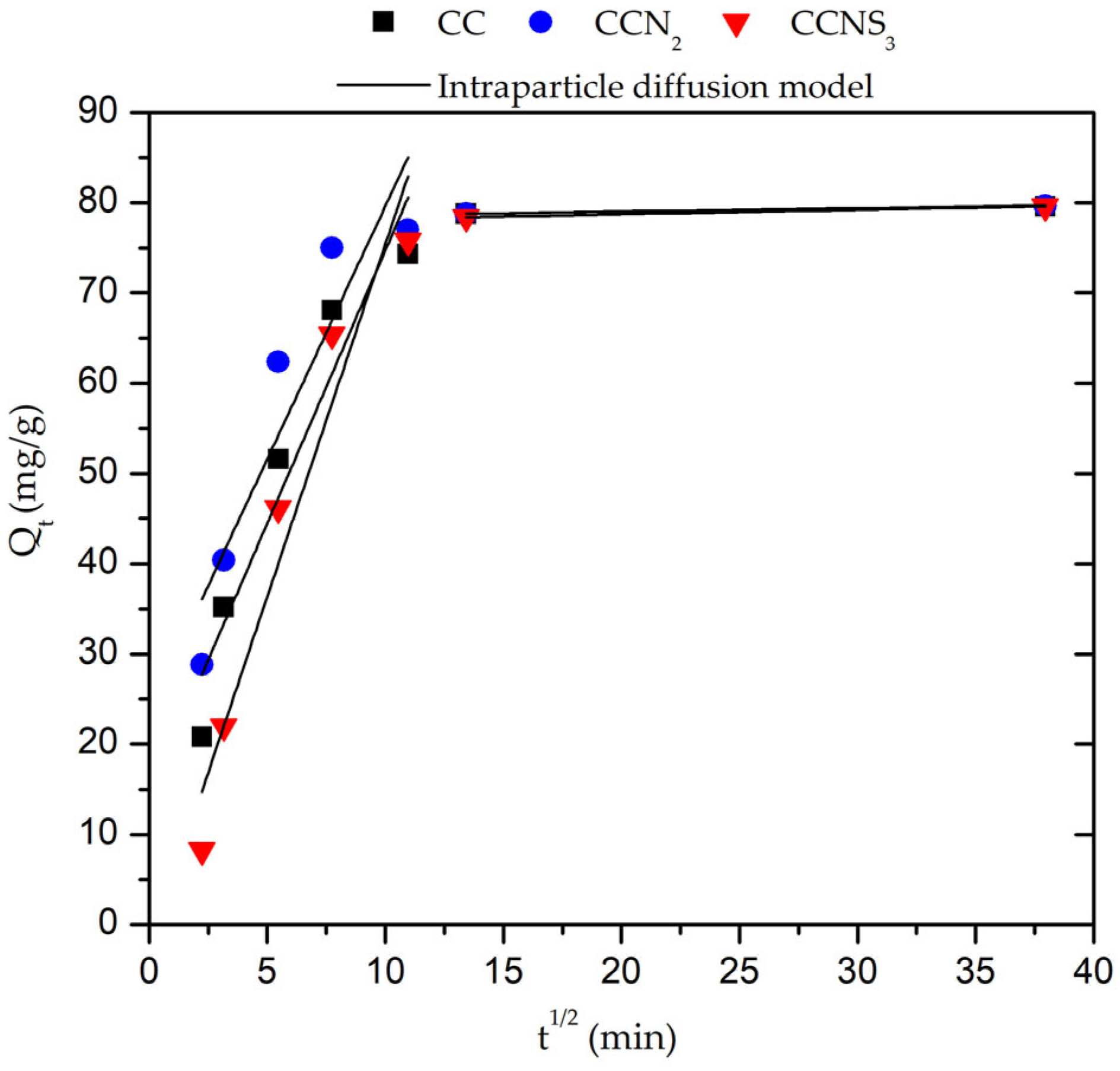
According to the data presented in Table 3, the adsorption process can be described in two stages as shown in Figure 3. The first stage is characterized by a rapid initial adsorption phase, where methylene blue molecules are quickly adsorbed onto the external surfaces of the cryogel samples. This is external surface adsorption. The second stage is a slower process involving intraparticle diffusion, where methylene blue molecules slowly diffuse into the pores of the samples and become adsorbed at the interior active sites. This phase is intraparticle diffusion adsorption. The higher ki1 values in the initial stage indicate a very fast adsorption rate, while the lower ki2 values in the second stage indicate a slower intraparticle diffusion rate [7,8]. The difference in these values can be attributed to the extremely low concentration of methylene blue in the solution, which initially allows for rapid adsorption on the surface but slows down as the molecules diffuse through into the adsorbent pores. The fact that the obtained curves do not pass through the origin is significant. This observation indicates that intraparticle diffusion is not the only rate-controlling step in adsorption. Other factors influence the adsorption rate. One such factor is external mass transport, which refers to the diffusion of methylene blue molecules from the bulk solution to the external surface of the adsorbent [7,9]. External mass transport is faster than intraparticle diffusion, meaning that once the methylene blue molecules reach the surface, the rate at which they are diffused to the interior active sites becomes the limiting step. Therefore, the overall adsorption of methylene blue depends on both the diffusion through the pores of the adsorbent and the subsequent adsorption at the interior active sites. Considering that, the adsorption process of methylene blue involves a combination of rapid initial external surface adsorption followed by a slower intraparticle diffusion adsorption [7]. The interaction between these two stages and the influence of external mass transport determines the overall adsorption efficiency.
Table 3.
Kinetic parameters for intraparticle diffusion model.
Figure 3.
Intraparticle diffusion model for methylene blue adsorption.
4. Conclusions
This study investigated the adsorption performance and kinetic properties of pristine carbon, and nitrogen-doped and nitrogen-and-sulfur-co-doped carbon cryogel, for adsorption of methylene blue textile dyes from aqueous solutions. The experimental results confirmed satisfactory adsorption performance for all tested samples. The experimental data fit excellently with the linear pseudo-second-order kinetic model and also fit well with the non-linear and linear pseudo-first-order kinetic model. The calculated rate constants, k2, show that the methylene blue is first adsorbed onto CCN2 surface. The intraparticle diffusion model confirms that the adsorption process of methylene blue involves a rapid initial external surface adsorption followed by a slower intraparticle diffusion adsorption. This study also shows that the incorporation of nitrogen, and nitrogen and sulfur, into the carbon surface does not influence methylene blue adsorption from an aqueous solution. Regarding the results of this study, future investigations will provide additional experimental information about the capacities of adsorption of carbon cryogel samples and their interference in methylene blue adsorption.
Author Contributions
Conceptualization, A.K. (Ana Kalijadis) and I.B.; methodology, I.B.; software, M.S.; validation, M.S. and I.B. formal analysis, A.K. (Aleksandar Krstić); investigation, A.K. (Aleksandar Krstić); resources, M.S.; data curation, I.B.; writing—original draft preparation, A.K. (Aleksandar Krstić); writing—review and editing, I.B.; visualization, M.S.; supervision, A.K. (Aleksandar Krstić); project administration, A.K. (Ana Kalijadis); funding acquisition, A.K. (Ana Kalijadis). All authors have read and agreed to the published version of the manuscript.
Funding
This research was funded by Ministry of Education, Science and Technological Development of the Republic of Serbia, grant number grant no 451-03-136/2025-03/200017, topic number 1702507.
Institutional Review Board Statement
Not applicable.
Informed Consent Statement
Not applicable.
Data Availability Statement
Data are contained within the article.
Conflicts of Interest
The authors declare no conflicts of interest.
References
- Osman, A.I.; Ayati, A.; Farghali, M.; Krivoshapkin, P.; Tanhaei, B.; Karimi-Maleh, H.; Krivoshapkina, E.; Taheri, P.; Tracey, C.; Al-Fatesh, A.; et al. Advanced Adsorbents for Ibuprofen Removal from Aquatic Environments: A Review. Environ. Chem. Lett. 2024, 22, 373–418. [Google Scholar] [CrossRef]
- De Lima, A.F.; Fagnani, H.M.C.; Santos, W.L.F.; De Barros, M.A.S.D. Methylene Blue Adsorption in Hydrocarbons Textile Waste. Rev. Mater. 2020, 25, e-12885. [Google Scholar] [CrossRef]
- Joshi, S.; Shrestha, R.G.; Pradhananga, R.R.; Ariga, K.; Shrestha, L.K. High Surface Area Nanoporous Activated Carbons Materials from Areca Catechu Nut with Excellent Iodine and Methylene Blue Adsorption. C 2022, 8, 2. [Google Scholar] [CrossRef]
- Krstić, A.; Lolić, A.; Mirković, M.; Kovač, J.; Arsić, T.M.; Babić, B.; Kalijadis, A. Synthesis of Nitrogen Doped and Nitrogen and Sulfur Co-Doped Carbon Cryogels and Their Application for Pharmaceuticals Removal from Water. J. Environ. Chem. Eng. 2022, 10, 108998. [Google Scholar] [CrossRef]
- Babić, B.; Kaluderović, B.; Vračar, L.; Krstajić, N. Characterization of Carbon Cryogel Synthesized by Sol-Gel Polycondensation and Freeze-Drying. Carbon N. Y. 2004, 42, 2617–2624. [Google Scholar] [CrossRef]
- Tarantino, S.; Occhipinti, R.; Maraschi, F.; Zema, M.; Riccardi Pia, M.; Profumo, A.; Sturini, M. Porous metakaolin-based geopolymers for adsorption of Contaminants of Emerging Concern from wastewaters. Appl. Clay Sci. 2024, 259, 107502. [Google Scholar] [CrossRef]
- Alves de Castro, L.; Vilar-Yanez, S.; Gomez-Gonzales, M.; Acevedo-Garcia, P.; Prieto-Arnosa, A.; Redondo-Pineiro, Y.; Rivas, J. Understanding adsorption mechanisms and metal ion selectivity of superparamagnetic beads with mesoporous CMK-3 carbon and commercial activated carbon. Microporous Mesoporous Mater. 2024, 374, 113159. [Google Scholar] [CrossRef]
- Mihajlović, S.; Vukčević, M.; Pejić, B.; Grujić, A.P.; Ristić, M. Application of Waste Cotton Yarn as Adsorbent of Heavy Metal Ions from Single and Mixed Solutions. Environ. Sci. Pollut. Res. 2020, 27, 35769–35781. [Google Scholar] [CrossRef] [PubMed]
- Pathania, D.; Sharma, S.; Singh, P. Removal of methylene blue by adsorption onto activated carbon developed from Ficus carica bast. Arab. J. Chem. 2017, 10, S1445–S1451. [Google Scholar] [CrossRef]
Disclaimer/Publisher’s Note: The statements, opinions and data contained in all publications are solely those of the individual author(s) and contributor(s) and not of MDPI and/or the editor(s). MDPI and/or the editor(s) disclaim responsibility for any injury to people or property resulting from any ideas, methods, instructions or products referred to in the content. |
© 2025 by the authors. Licensee MDPI, Basel, Switzerland. This article is an open access article distributed under the terms and conditions of the Creative Commons Attribution (CC BY) license (https://creativecommons.org/licenses/by/4.0/).