Abstract
Among perovskite solar cells (PSCs), carbon-based perovskite solar cells (C-PSCs) are regarded as one of the best advantageous designs centered on a number of desirable characteristics, such as outstanding scalability, long-term stability, and cost-effectiveness. In these C-PSCs, titanium oxide (TiO2) has usually been utilized as the electron transport layer (ETL) because of its simplicity in preparation and low cost. In these hole transport layer-free C-PSCs, the quality of ETLs is essential for the high performance of PSCs. In this paper, we used TiCl4 post-treatment for the passivation of the titania layer (TiO2) to improve the quality of ETL. Consequently, after passivation, the charge recombination has been reduced, the efficiency increased from 3.15% to 4.16%, and resulted in a 32.06% improvement in power conversion efficiency (PCE).
1. Introduction
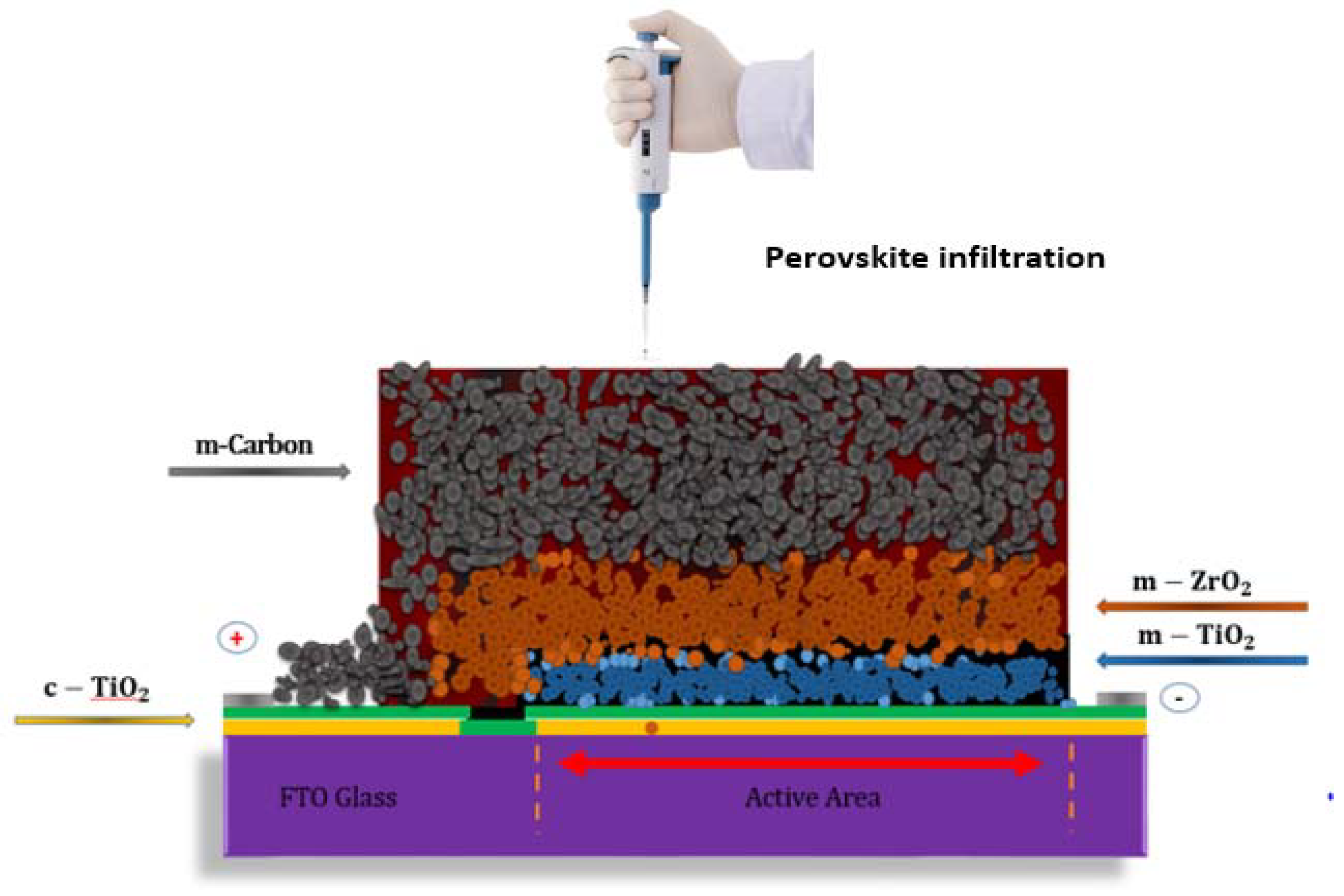
The interesting properties of perovskite materials have attracted the interest of numerous scholars in recent years, leading to the development of PSCs [1]. Among them, PSCs with carbon-based back electrodes have generated considerable concentration due to their exceptional durability, low cost, and resistance to a variety of environmental and operational circumstances [2]. Ku et al. initially demonstrated printable hole-transport layer (HTL)-free carbon-based perovskite solar cells (C-PSCs) in 2013 [3]. The quality of the ETL is critical in HTL-free C-PSCs, with TiO2 being the most commonly used material. However, due to the presence of structural defects and surface inhomogeneity of TiO2 ETL, charge recombination can occur at the TiO2/perovskite contact quite easily, limiting the device’s photovoltaic efficiency significantly [4]. The lack of expensive noble metals and expensive hole transport materials (HTMs) greatly lowers the cost of the device. In addition, the use of hydrophobic carbon electrodes in place of precious metals improves the device’s overall stability while preventing moisture from penetrating the perovskite [5]. It has been discussed in many papers that this device’s functional layers, the electron transporting layer, the insulating layer, and the carbon can be optimized to increase efficiency [6]. The fabricated device in this work, as shown in Figure 1, consists of a fluorine-doped tin dioxide (FTO) conductive glass substrate, a layer of compact titania, a mesoporous titania layer, a mesoporous insulating layer of ZrO2, and a porous conductive carbon contact. By infiltrating liquid through the stack, the perovskite precursor solution is deposited [7].
Figure 1.
Schematic representation of standard carbon-based perovskite solar cells.
In this work, we applied TiCl4 post-treatment for TiO2 ETL to increase C-PSCs performance. We dipped the samples in an aqueous TiCl4 solution for 30 min, 40 min, and 60 min at 70 °C. The optimum results were obtained at 40 min of dipping time. The TiCl4 post-treatment was first used in dye-sensitized solar cells (DSCs) and then carried over to PSCs [8]. TiO2 with a small surface area frequently shows severe J-V characteristic hysteresis [9]. It has been shown that the TiCl4 treatment can increase the surface area of TiO2 while improving connectivity and passivating surface defect levels [10]. As a result, the surface roughness decreases with TiCl4 passivation, and advancements in the photovoltaic characteristics of C-PSCs were seen.
2. Experimental Section
Device Fabrication
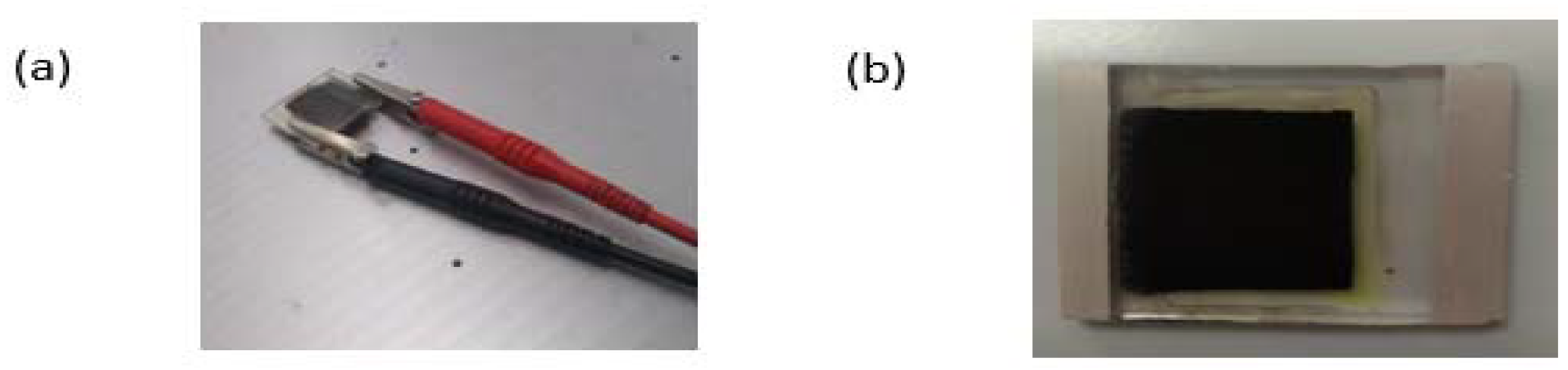
First, for device fabrication, we take fluorine-doped tin oxide conductive glass substrate (FTO-coated). In an ultrasonic cleaner, distilled water, ethanol, and acetone were used to clean the FTO substrates. After cleaning, the compact titania layer was printed using the screen on the FTO glass substrates and the samples were annealed at 500 °C for 30 min. After that, we dipped some samples for passivation in TiCI4 aqueous solution at 70 °C for 40 min; then, we rinsed them with distilled water followed by 30 min of annealing at 450 °C. A mesoporous titania layer was then applied to the samples, both passivated and non-passivated, and they were both annealed for 30 min at 500 °C. A mesoporous titania layer was then applied to the samples, both passivated and non-passivated, and they were both annealed for 30 min at 500 °C. Then, zirconia layer was deposited through screen printings and annealed at 500 °C for 30 min. Then, we deposited the carbon layer and hardened it at for 30 min at 400 °C using a hotplate. Next to carbon layer deposition, we infiltrated perovskite (MAPbI3) into the stack through a micropipette, and waited for 40 min. After 40 min, we heated the samples at 70 °C for 20 min and waited for them to cool to room temperature [11]. Then, we checked the efficiencies of devices with and without passivation using a solar simulator as shown in Figure 2.
Figure 2.
(a) The device under solar simulator. (b) Fabricated device.
3. Results and Discussion
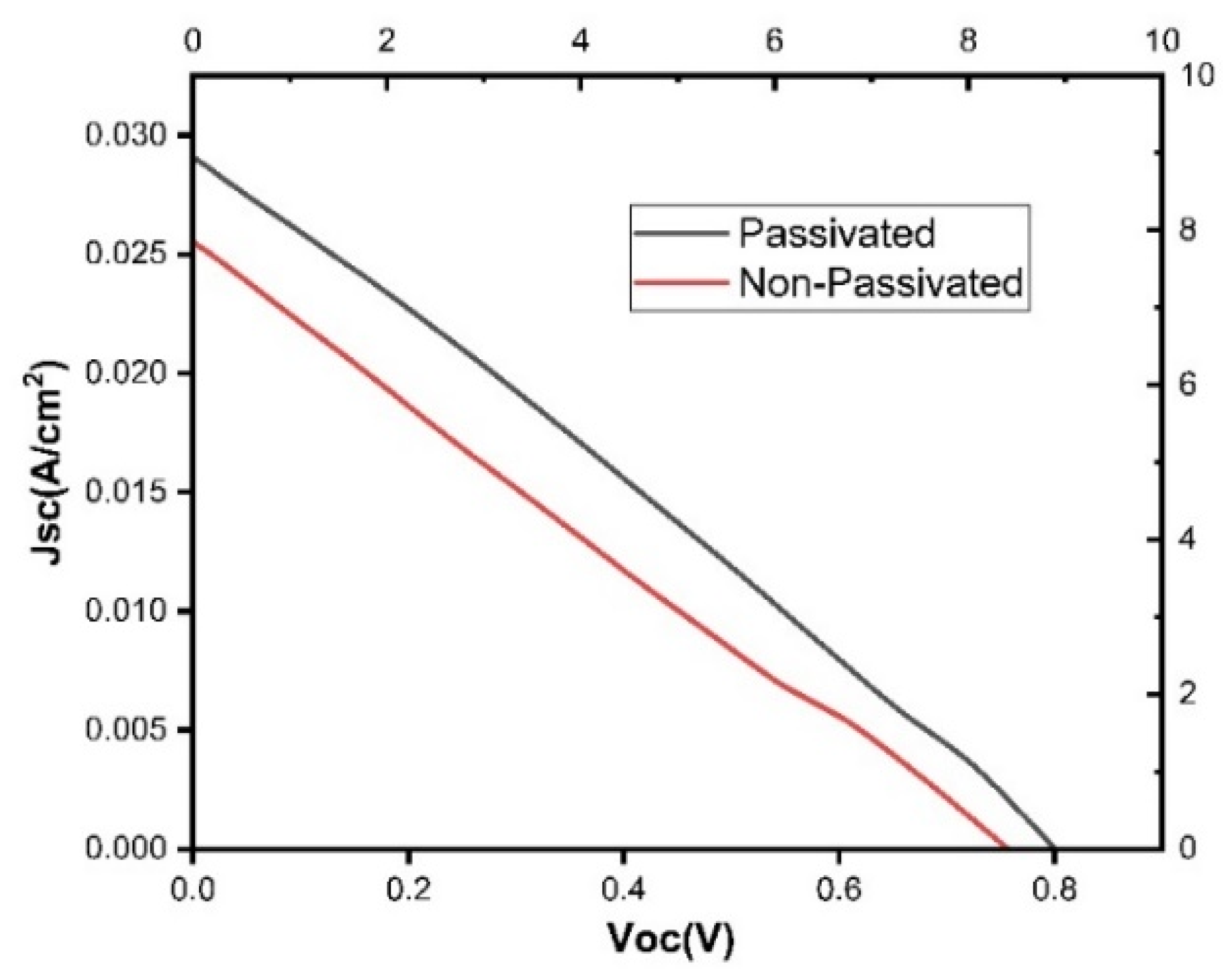
The J-V curves were noted and placed into Table 1 to compare the performance of passivated and non-passivated devices in Figure 3. The non-passivated device exhibits low efficiency with an open-circuit voltage (Voc) of 756.9 mV, a short-circuit current density (Jsc) of 17.03 mA cm−2, short circuit current (Isc) of 25.55 mA, a fill factor (FF) of 24.41%, and a power conversion efficiency (PCE) of 3.15%; which are improved to 802.0 mV, 19.38 mA cm−2, 29.08 mA, 26.74% and a PCE of 4.16%, respectively, for the passivated device. This improvement in performance is due to the enhanced quality of TiO2 ETL.
Table 1.
Average values of photovoltaic parameters for passivated and non-passivated samples.
Figure 3.
J-V curve of passivated and non-passivated sample.
4. Conclusions
In conclusion, it was possible to produce an efficient ETL to obtain proficient PSCs by modifying the compact TiO2 surface with the TiCl4 solution, which resulted in a 32.06% improvement in efficiency. The TiCl4 treatment improves charge extraction and reduces charge recombination in the ETL layer, due to which efficiency increases. According to our findings, complex interface engineering offers a potentially effective means of obtaining high-performance PSCs.
Author Contributions
Conceptualization, M.N. and A.D.K.; methodology, M.N.; validation, M.N. and A.D.K.; formal analysis, M.N.; investigation, A.D.K.; resources, A.D.K.; data curation, M.N.; writing—original draft preparation, S.K.; writing—review and editing, S.K.; visualization, S.K.; supervision, M.N.; project administration, A.D.K.; funding acquisition, A.D.K. All authors have read and agreed to the published version of the manuscript.
Funding
This research received funding from the National Research Program for Universities (NRPU) Research Project No. 16011 “Third Generation Photovoltaics for Building Integration: A Smart and Sustainable Energy Solution”, higher Education Commission (HEC), Pakistan.
Institutional Review Board Statement
Not applicable.
Data Availability Statement
Not applicable.
Acknowledgments
We really appreciate the financial assistance provided by the NRPU Research Project, Muhammad Noman, and Adnan Daud Khan for their invaluable guidance, support and mentorship throughout the course of this research.
Conflicts of Interest
The authors declare no conflict of interest.
References
- Rong, Y.; Hu, Y.; Mei, A.; Tan, H.; Saidaminov, M.I.; Seok, S.I.; McGehee, M.D.; Sargent, E.H.; Han, H. Challenges for commercializing perovskite solar cells. Science 2018, 361, eaat8235. [Google Scholar] [CrossRef] [PubMed]
- Bogachuk, D.; Saddedine, K.; Martineau, D.; Narbey, S.; Verma, A.; Gebhardt, P.; Herterich, J.P.; Glissmann, N.; Zouhair, S.; Markert, J. Perovskite Photovoltaic Devices with Carbon-Based Electrodes Withstanding Reverse-Bias Voltages up to −9 V and Surpassing IEC 61215: 2016 International Standard. Sol. RRL 2022, 6, 2100527. [Google Scholar] [CrossRef]
- Ku, Z.; Rong, Y.; Xu, M.; Liu, T.; Han, H. Full Printable Processed Mesoscopic CH3NH3PbI3/TiO2 Heterojunction Solar Cells with Carbon Counter Electrode. Sci. Rep. 2013, 3, 3132. [Google Scholar] [CrossRef] [PubMed]
- Bai, J.; Zhou, B. Titanium dioxide nanomaterials for sensor applications. Chem. Rev. 2014, 114, 10131–10176. [Google Scholar] [CrossRef] [PubMed]
- Grancini, G.; Roldán-Carmona, C.; Zimmermann, I.; Mosconi, E.; Lee, X.; Martineau, D.; Narbey, S.; Oswald, F.; De Angelis, F.; Graetzel, M.; et al. One-Year stable perovskite solar cells by 2D/3D interface engineering. Nat. Commun. 2017, 8, 15684. [Google Scholar] [CrossRef] [PubMed]
- Tian, C.; Mei, A.; Zhang, S.; Tian, H.; Liu, S.; Qin, F.; Xiong, Y.; Rong, Y.; Hu, Y.; Zhou, Y.; et al. Oxygen management in carbon electrode for high-performance printable perovskite solar cells. Nano Energy 2018, 53, 160–167. [Google Scholar] [CrossRef]
- Mei, A.; Li, X.; Liu, L.; Ku, Z.; Liu, T.; Rong, Y.; Xu, M.; Hu, M.; Chen, J.; Yang, Y. A hole-conductor–free, fully printable mesoscopic perovskite solar cell with high stability. Science 2014, 345, 295–298. [Google Scholar] [CrossRef] [PubMed]
- Sommeling, P.; O’Regan, B.C.; Haswell, R.; Smit, H.; Bakker, N.; Smits, J.; Kroon, J.M.; Van Roosmalen, J. Influence of a TiCl4 post-treatment on nanocrystalline TiO2 films in dye-sensitized solar cells. J. Phys. Chem. B 2006, 110, 19191–19197. [Google Scholar] [CrossRef] [PubMed]
- Wang, Q.; Phung, N.; Di Girolamo, D.; Vivo, P.; Abate, A. Enhancement in lifespan of halide perovskite solar cells. Energy Environ. Sci. 2019, 12, 865–886. [Google Scholar] [CrossRef]
- Roose, B.; Pathak, S.; Steiner, U. Doping of TiO2 for sensitized solar cells. Chem. Soc. Rev. 2015, 44, 8326–8349. [Google Scholar] [CrossRef] [PubMed]
- Adli, H.K.; Harada, T.; Nakanishi, S.; Ikeda, S. Effects of TiCl4 treatment on the structural and electrochemical properties of a porous TiO2 layer in CH3NH3PbI3 perovskite solar cells. Phys. Chem. Chem. Phys. 2017, 19, 26898–26905. [Google Scholar] [CrossRef] [PubMed]
Disclaimer/Publisher’s Note: The statements, opinions and data contained in all publications are solely those of the individual author(s) and contributor(s) and not of MDPI and/or the editor(s). MDPI and/or the editor(s) disclaim responsibility for any injury to people or property resulting from any ideas, methods, instructions or products referred to in the content. |
© 2023 by the authors. Licensee MDPI, Basel, Switzerland. This article is an open access article distributed under the terms and conditions of the Creative Commons Attribution (CC BY) license (https://creativecommons.org/licenses/by/4.0/).