1. Introduction
The industrial production of polymer materials is associated with significant energy consumption, primarily due to the thermomechanical nature of the main processing operations [
1]. Among these, extrusion and subsequent converting processes require continuous energy input for heating, melting, shaping, and mechanical handling of the material, which makes polymer processing one of the energy-intensive sectors in manufacturing [
2]. In recent years, increasing energy costs and stricter environmental regulations have intensified the need for improved energy utilization in industrial systems [
3]. The reduction in energy consumption is directly linked to lower operational costs and decreased greenhouse gas emissions, positioning energy performance as a key parameter in sustainable industrial development [
4].
Polyethylene film production represents a typical example of an energy-intensive industrial activity. The process is dominated by extrusion, where polymer granules are heated above their melting point and formed into thin films under controlled thermal and mechanical conditions [
5]. This stage accounts for a substantial share of total energy consumption due to the combined influence of electrical heating systems, electric drives, and continuous operation [
6].
Following extrusion, the material undergoes additional processing steps such as cutting, sealing, and packaging. Although these operations are less energy-intensive individually, their cumulative contribution to the overall energy demand is considerable, particularly in facilities with high production volumes. Therefore, the evaluation of energy performance requires a system-level approach that considers both primary and auxiliary processes [
7]. A widely used indicator for assessing energy efficiency in industrial systems is the specific energy consumption, defined as the ratio between total energy input and production output. This parameter enables comparison between different operating conditions and provides a basis for identifying inefficiencies in the production process [
8].
One of the main challenges in existing industrial facilities is the operation of outdated equipment. Such systems are typically characterized by lower efficiency, higher energy losses, and increased material waste. In polymer processing, material losses lead to additional energy consumption due to the need for reprocessing, which further reduces overall system efficiency [
9]. Operational factors also play a significant role in energy performance. Deviations from steady-state conditions, including start-up phases and load variations, introduce additional energy demand without contributing to useful output. These effects are particularly relevant in continuous processes such as extrusion, where thermal stabilization requires significant energy input [
10].
Modern technological solutions provide opportunities for improving energy performance through enhanced process control, optimized equipment design, and increased automation. Advanced extrusion systems allow better temperature regulation and material flow control, leading to reduced energy consumption and improved product quality [
11].
Automation also contributes to minimizing variability and reducing material losses, particularly in downstream processes such as cutting and sealing. Improved process stability leads to more efficient energy use and higher overall productivity [
12].
From an engineering perspective, the analysis of energy performance should be based on a systematic evaluation of energy flows within the production system. This includes quantifying energy inputs, identifying major consumers, and assessing the relationship between energy use and production output. Such an approach enables the identification of subsystems with the highest improvement potential [
13].
The present study focuses on the evaluation of energy performance in an industrial polyethylene film production system based on real operational data. The analysis aims to identify the main factors influencing energy consumption and to assess the potential for improving efficiency at subsystem level. A system-oriented methodology is applied to examine the interaction between production output, energy consumption, and equipment performance, with particular attention given to extrusion and converting processes as dominant energy consumers. The results of this study provide a quantitative basis for evaluating energy performance in polymer processing systems and demonstrate the impact of technological improvements on reducing energy consumption and environmental impact.
The novelty of this study lies in the application of a subsystem-level energy performance analysis based on real industrial data, enabling a detailed quantification of the contribution of extrusion and converting processes to total energy consumption. In contrast to conventional system-level assessments, the present work evaluates the interaction between production load, material losses, and specific energy consumption. This approach allows for a more accurate identification of inefficiencies and provides a basis for benchmarking against European best practices in polymer processing.
2. Methodology
The evaluation of energy performance in the investigated industrial system is based on the analysis of energy consumption and production output under real operating conditions. The study considers the total energy input to the system, including electrical energy and fuel consumption associated with production and auxiliary activities.
A representative operating period is selected in order to ensure comparability between different production conditions. The selection is based on the analysis of production volume, energy consumption, and specific energy indicators over multiple years. This approach allows for the identification of deviations in system performance and ensures that the results reflect the current state of the production system. The applied energy performance indicators and relationships are based on widely used methodologies in industrial energy analysis and thermodynamic evaluation. Specific energy consumption, energy balance equations, and emission factor methods are commonly employed for assessing energy efficiency and environmental impact in manufacturing systems [
1,
2,
3,
4,
5,
6].
2.1. Energy Performance Indicators
The primary indicator used for evaluating energy performance is the specific energy consumption (SEC), which expresses the amount of energy required to produce a unit mass of output.
where SEC—specific energy consumption, kWh/kg;
—total energy consumption, kWh; and
—produced output, kg.
The specific energy consumption provides a normalized measure of system efficiency and enables comparison between different operating conditions and production levels. Lower values of SEC indicate improved energy performance.
The total energy consumption of the system is defined as the sum of electrical energy and the energy equivalent of fuel consumption:
where E
el—electrical energy consumption, kWh; and E
fuel—energy equivalent of fuel consumption, kWh.
This formulation allows all energy inputs to be expressed in a unified unit, enabling consistent evaluation of the overall system energy demand.
For liquid fuels, the conversion from mass to energy units is performed using the lower heating value:
where m—fuel consumption, t; and LHV—lower heating value, kWh/t.
This conversion ensures accurate quantification of the energy contribution of fuel consumption to the total system energy balance.
2.2. Evaluation of Energy Performance Improvement
The analysis is based on the comparison of initial and improved operating conditions. To quantify the improvement in energy performance, the energy saving ratio (ESR) is introduced as a relative indicator of efficiency enhancement:
where
—initial specific energy consumption, kWh/kg; and
—final specific energy consumption, kWh/kg.
The energy saving ratio represents the percentage reduction in specific energy consumption after the implementation of technological improvements. It provides a dimensionless indicator that enables comparison between different systems and operating regimes. Higher ESR values correspond to greater improvement in energy efficiency.
In addition to relative indicators, the absolute energy savings are evaluated in order to assess the overall impact on system performance:
where E
save—annual energy savings, kWh/year; E
l —initial energy consumption, kWh/year; E
f —final energy consumption, kWh/year.
This indicator quantifies the total reduction in energy use and reflects the real impact of technological improvements at system level.
The reduction in energy consumption directly contributes to a decrease in carbon dioxide emissions. The relationship between energy savings and emissions reduction can be expressed as
where CO
2,save—reduction in CO
2 emissions, kg/year; and EF—emission factor, kg CO
2/kWh.
This relationship assumes a proportional dependence between energy consumption and associated emissions and is widely used for evaluating environmental impact in industrial systems.
2.3. Data Collection and Processing
The analysis is based on operational data obtained from the industrial system, including annual production volumes and energy consumption by type of energy carrier. Electricity represents the dominant energy source, while diesel fuel is used primarily for logistics and auxiliary activities.
The collected data are processed to determine total energy consumption and specific energy indicators for each analyzed period. Special attention is given to the main energy-intensive subsystems, including extrusion and converting processes, which account for the majority of electricity consumption.
2.4. System-Level Evaluation
The energy performance of the system is evaluated using a system-oriented approach, where total energy consumption is analyzed in relation to production output and subsystem behavior. This approach allows for the identification of inefficiencies associated with individual production stages.
The analysis considers both direct effects, such as reduction in energy consumption, and indirect effects, including decreased material losses and improved process stability. The combined evaluation of these factors provides a comprehensive assessment of system performance and improvement potential.
3. Results and Discussion
The results of the study are obtained through the application of the methodology described in
Section 2, based on operational data from the industrial system. The analysis focuses on the relationship between production output, energy consumption, and system efficiency, as well as the impact of technological improvements on overall energy performance.
3.1. Analysis of Energy Consumption
The variation in total energy consumption and production output for the analyzed period is presented in
Table 1.
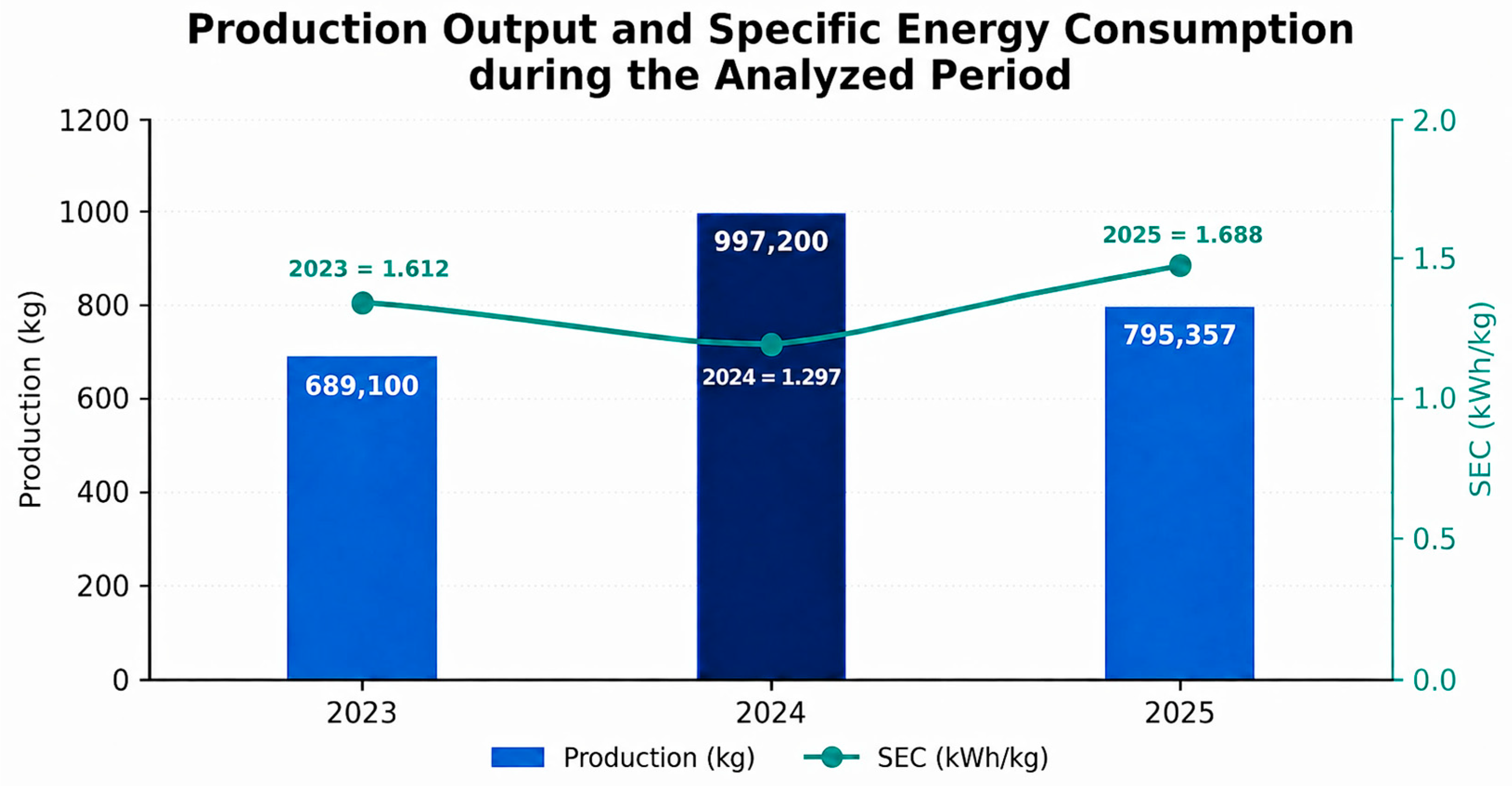
The results show that the production output reaches its maximum value in 2024, while the corresponding specific energy consumption is the lowest (1.297 kWh/kg). This indicates improved energy performance under higher production load, which can be explained by more efficient utilization of installed capacity and reduced relative losses. In contrast, the increase in specific energy consumption to 1.688 kWh/kg in 2025 is associated with reduced production output, despite higher total energy consumption.
The relationship between production output and specific energy consumption during the analyzed period is illustrated in
Figure 1.
The graphical interpretation confirms that higher production load contributes to lower specific energy consumption, whereas operation under reduced load conditions leads to increased relative energy losses and deterioration of overall system efficiency.
Based on these observations, 2025 is selected as a representative year, as it reflects the current operational condition of the system.
3.2. Subsystem-Level Performance Analysis
The subsystem-level analysis reveals that extrusion and converting processes are the primary contributors to total energy consumption. Their performance directly determines the overall energy efficiency of the system.
3.2.1. Extrusion Process
The comparison between the existing and improved extrusion systems is presented in
Table 2.
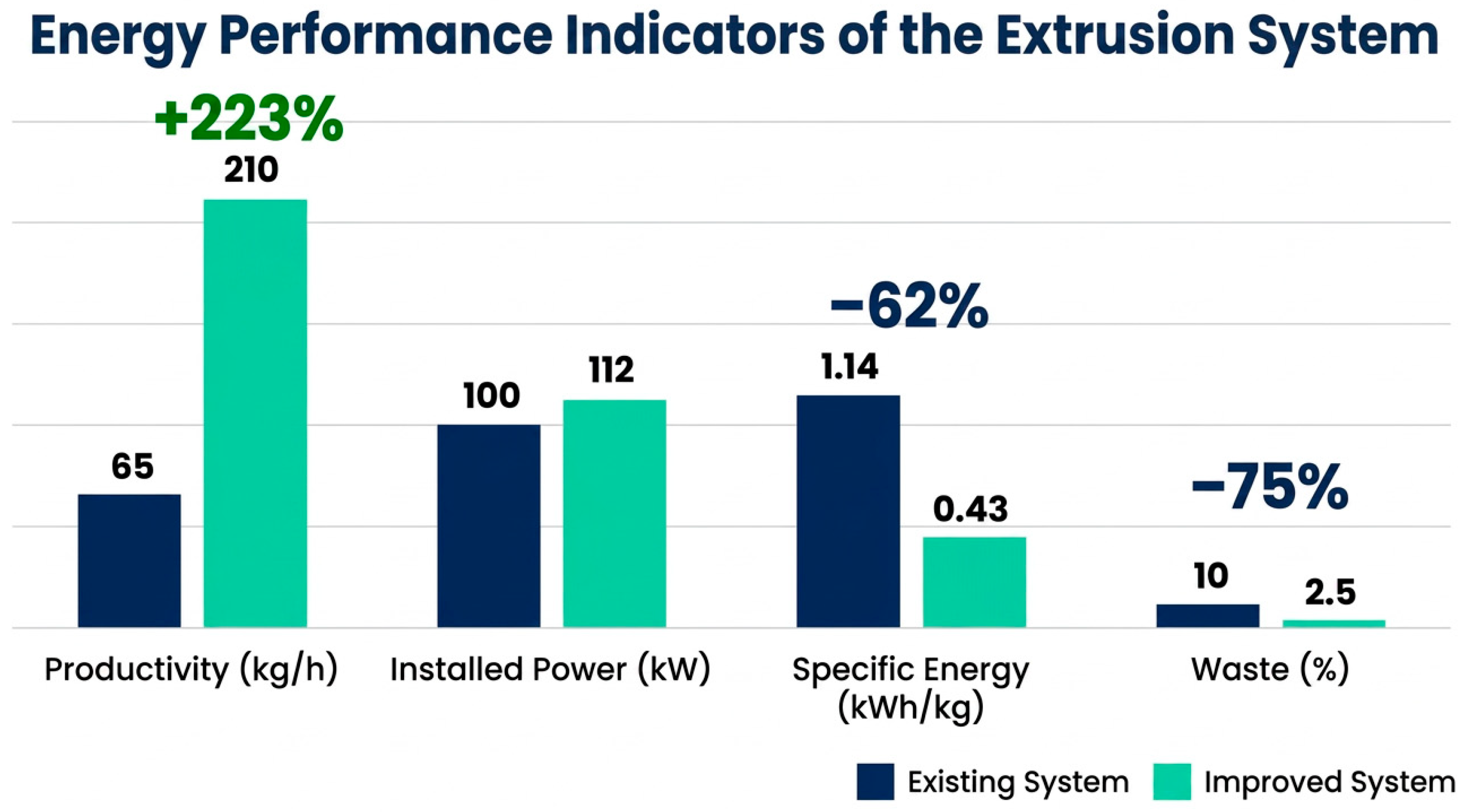
The results indicate a substantial improvement in energy performance following the implementation of modern extrusion technology. The specific energy consumption is reduced by more than 60%, which is consistent with the calculated energy saving ratio. At the same time, productivity increases more than threefold, leading to significantly improved utilization of the installed power. An important factor contributing to this improvement is the reduction in material losses. The decrease in waste from approximately 10% to 2.5% reduces the need for reprocessing, which in turn lowers the overall energy demand. In addition, improved process control and thermal stability contribute to more efficient operation.
Figure 2 presents a comparative graphical interpretation of the key energy performance indicators of the extrusion subsystem before and after technological modernization. The results demonstrate a substantial increase in productivity accompanied by significant reductions in specific energy consumption and material waste, confirming the effectiveness of the implemented energy efficiency measures.
3.2.2. Converting Process
The performance of the conversion subsystem is presented in
Table 3.
The results show a significant reduction in specific energy consumption, reaching 0.09 kWh/kg in the improved system. This corresponds to an improvement of over 65%. The reduction in installed power and improved automation lead to more stable operation and reduced process variability. Similarly to the extrusion process, the decrease in material losses plays a key role in improving energy performance. Lower waste levels reduce the need for additional processing, thereby decreasing total energy consumption.
3.3. Evaluation of Energy Saving Potential
The overall impact of technological improvements on system performance is evaluated using the indicators defined in
Section 2, and the resulting energy savings and performance improvements are summarized in
Table 4.
The obtained results indicate that the implementation of improved technologies leads to a substantial reduction in total energy consumption. The calculated annual energy savings amount to 906 MWh, which represents a reduction of approximately 39% under comparable production conditions. It should be noted that the reduction in energy consumption is achieved simultaneously with an increase in production capacity. This confirms that the observed improvement is not solely due to reduced production but is a result of enhanced system efficiency.
3.4. Environmental Impact Assessment
Based on the achieved energy savings, the reduction in carbon dioxide emissions is evaluated using Equation (6). The emission reduction is directly proportional to the energy savings and depends on the emission factor of the electricity mix. For the calculated energy savings of 906 MWh/year, a substantial decrease in CO2 emissions is expected, confirming the direct link between energy efficiency and environmental performance. These results demonstrate that improvements in energy performance contribute not only to reduced energy consumption but also to lower environmental impact. This is particularly relevant in the context of increasing regulatory requirements and sustainability targets in industrial production.
4. Discussion
4.1. Interpretation of Results
The results demonstrate that the energy performance of polyethylene film production is strongly dependent on production load, equipment condition, and process stability. A clear relationship is observed between production output and specific energy consumption (SEC), where higher production levels correspond to lower SEC values. This behavior is consistent with previous studies, which indicate that increased capacity utilization leads to improved energy efficiency due to reduced relative losses, as reported by Gao et al. [
2]. Conversely, operation under reduced load conditions results in higher SEC values, reflecting inefficient use of installed power and increased influence of fixed energy consumption components. This confirms that production planning and load management are critical factors in achieving optimal energy performance, in agreement with findings reported in industrial energy system analyses such as that by Costantini et al. [
3].
The analysis further shows that improvements in energy efficiency are not solely associated with reduced energy consumption, but also with enhanced production performance. The observed decrease in SEC is accompanied by increased productivity, indicating that technological modernization leads to both energy and operational benefits, as also emphasized in recent studies on sustainable manufacturing such as that by Khalfallah et al. [
12].
4.2. Subsystem-Level Analysis
The subsystem-level evaluation reveals that extrusion and converting processes are the dominant contributors to total energy consumption and therefore represent the main potential for energy efficiency improvements. Among these, the extrusion process shows the highest impact on overall system performance, which is consistent with the thermomechanical nature of polymer processing operations as shown by Osara [
6].
The significant reduction in SEC for extrusion, from 1.14 to 0.43 kWh/kg, is the result of a combined effect of increased throughput, improved thermal control, and enhanced process stability. This observation aligns with previous research highlighting the importance of process optimization and throughput on energy efficiency in manufacturing systems by Pascoschi et al. [
8].
Similarly, the converting process shows a substantial improvement, with SEC reduced to 0.09 kWh/kg. This is primarily due to improved automation and reduced variability, which lead to more stable operation and lower energy demand, as also reported in studies on advanced manufacturing technologies such as that by Jung et al. [
11].
An important finding of this study is the strong influence of material losses on energy performance. The reduction in waste significantly decreases the need for reprocessing, thereby lowering both direct and indirect energy consumption. This confirms the conclusions of Costa et al. [
9], who emphasize that waste reduction is a key factor in improving eco-efficiency in polymer processing industries.
4.3. Comparison with European Best Practices
To assess the significance of the obtained results, the specific energy consumption values are compared with typical ranges reported for polyethylene film production systems in Europe. According to industrial benchmarks and the literature data, the SEC for extrusion processes typically ranges between 0.3 and 0.6 kWh/kg, while converting processes operate within 0.05 to 0.15 kWh/kg [
3,
8].
The initial system analyzed in this study exhibits significantly higher SEC values, indicating substantial inefficiencies in both extrusion and converting processes. Following technological improvements, the SEC values decrease to 0.43 kWh/kg for extrusion and 0.09 kWh/kg for converting.
These results position the improved system within the range of European best practices, particularly for the converting process, where performance approaches optimal levels. The extrusion process also achieves competitive performance, although further optimization may still be possible.
Despite these improvements, the overall system SEC remains relatively high, suggesting that additional energy savings can be achieved through optimization of auxiliary systems, reduction in start-up losses, and improved load management strategies. This observation is consistent with broader analyses of industrial energy efficiency, which emphasize the importance of system-level optimization beyond individual processes [
2,
3].
4.4. Limitations and Future Research
Despite the valuable insights provided by the present study, several limitations should be acknowledged. The analysis is based on aggregated annual data, which limits the ability to evaluate transient operating conditions such as start-up phases, load fluctuations, and short-term process variations. These factors may have a significant impact on energy performance but are not captured in the current approach.
In addition, the evaluation assumes constant emission factors and does not consider variations in the energy mix, which may influence the accuracy of the environmental impact assessment. Similar limitations have been discussed in studies focusing on industrial energy systems and environmental performance such as that by Stavropoulos et al. [
4].
Future research should focus on the implementation of high-resolution energy monitoring systems and the application of data-driven methods for real-time analysis and optimization. The integration of advanced control strategies and machine learning techniques could further improve process stability and reduce energy consumption, as demonstrated in recent studies on smart manufacturing systems [
10,
11].
Moreover, extending the analysis to include auxiliary systems and life-cycle considerations would provide a more comprehensive assessment of energy performance in industrial polymer production systems.
5. Conclusions
This study presents a system-level evaluation of energy performance in an industrial polyethylene film production system based on real operational data. The analysis shows that energy consumption is strongly influenced by production load, equipment condition, and process stability. Higher production output is associated with lower specific energy consumption, while reduced production levels lead to increased relative energy losses and decreased system efficiency.
The subsystem-level analysis identifies extrusion and converting processes as the main contributors to total energy consumption. The implementation of improved technologies in these subsystems results in a significant reduction in specific energy consumption, accompanied by increased productivity and reduced material losses. The total energy saving potential is estimated at approximately 906 MWh per year, corresponding to a reduction of about 39% in overall energy consumption, achieved without compromising production capacity.
The reduction in energy consumption leads to a corresponding decrease in carbon dioxide emissions, highlighting the environmental benefits of improved energy performance. The results indicate that targeted modernization of energy-intensive subsystems represents an effective approach for reducing both energy use and environmental impact.
From an engineering perspective, the study confirms that a system-oriented approach, based on specific energy consumption and subsystem analysis, provides a reliable framework for identifying inefficiencies and evaluating improvement potential. Prioritizing the modernization of high-energy subsystems enables substantial energy savings while significantly improving overall system efficiency, which is particularly important for industrial systems with limited energy capacity.