1. Introduction
Preeclampsia is one of the most serious hypertensive complications of pregnancy, affecting 2–8% of pregnancies worldwide and contributing to approximately 76,000 maternal deaths annually [
1,
2]. The condition is defined by new-onset hypertension after the 20th gestational week, accompanied by end-organ manifestations including proteinuria, thrombocytopenia, impaired liver or renal function, pulmonary oedema, or central nervous system disturbances [
3]. The global burden increased by 10.92% between 1990 and 2019 [
4], and in resource-constrained settings such as Bulgaria and Eastern Europe, structural barriers—limited diagnostic infrastructure, uneven access to specialised obstetric care, and socioeconomic disparities—further limit the effectiveness of existing prevention strategies [
5].
Early identification of high-risk patients during the first trimester enables aspirin prophylaxis to be initiated before 16 gestational weeks, which significantly reduces the incidence of preterm PE [
6]. The Fetal Medicine Foundation (FMF) combined screening algorithm, incorporating maternal characteristics, mean arterial pressure (MAP), uterine artery pulsatility index (UtA-PI), and biochemical markers (PAPP-A, PlGF), achieves detection rates of 75–90% for early-onset PE at a 10% false-positive rate in large Western European cohorts [
7]. Conventional risk stratification based on individual risk factors achieves detection of only 34–41% [
8], highlighting the clinical value of multiparametric first-trimester screening.
Recent advances in machine learning have demonstrated further potential to improve predictive performance and adapt algorithms to local population characteristics. A 2025 systematic review of 11 studies encompassing 116,253 pregnancies showed that ML algorithms consistently outperform traditional statistical approaches [
9]. Extreme Gradient Boosting (XGBoost) achieves an AUC of 0.955 for PE prediction. ML models have also demonstrated improved prediction of PE-associated adverse outcomes such as HELLP syndrome and maternal ICU admission [
10]. At the same time, deep neural networks applied in the PREVAL study (
n = 10,110) reached AUC 0.920 with an 84.4% detection rate and a 10% false-positive rate [
11,
12]. However, the majority of these models were trained on large, ethnically diverse cohorts and have not been validated in Eastern European populations. The deployment of such models in clinical practice also requires transparency and interpretability, particularly under the European AI Act (Regulation EU 2024/1689), which classifies AI systems for maternal and foetal health monitoring as high-risk [
13].
Parallel developments in wearable sensor technologies are enabling continuous, non-invasive monitoring of physiological parameters throughout pregnancy. ECG-based AI models have demonstrated 85% AUC for PE prediction up to 90 days before clinical diagnosis [
14], and multi-parameter wearable sensor platforms have been validated across both high-resource and low-resource settings [
15,
16]. The integration of real-time sensor data with ML-based risk stratification through Internet of Things (IoT) architectures creates an opportunity for continuous, adaptive monitoring that can compensate for the limitations of single-point first-trimester screening [
17,
18].
This paper presents a machine learning analysis of two complementary clinical datasets from the “Fetal Medicine” outpatient clinic in Plovdiv, Bulgaria: a first-trimester screening cohort (n = 1383; 2018–2020) and a non-screened control cohort (n = 533). Three classifier families are compared—Logistic Regression (LR), Extra Trees Classifier (ETC), and Voting Classifier (VC)—across binary and multiclass prediction targets, with systematic evaluation of SMOTE-based oversampling strategies. The study provides locally validated prediction models as a foundation for an AI-powered clinical decision support system targeting high-risk patients, geographically isolated communities, and socioeconomically disadvantaged groups within the Bulgarian healthcare system.
2. Materials and Methods
2.1. Study Population
This retrospective observational study analysed clinical data collected at the “Fetal Medicine” outpatient clinic in Plovdiv, Bulgaria. The dataset includes pregnant women examined between 30 January 2018 and 30 November 2020 as part of routine first-trimester screening for preeclampsia [
19]. The study protocol was conducted in accordance with the Declaration of Helsinki and approved by the Ethics Committee of the Medical University of Plovdiv.
Two complementary cohorts were analysed:
The screening cohort consisted of 1383 pregnant women who underwent combined first-trimester screening between 11 + 0 and 13 + 6 weeks of gestation. Screening included maternal characteristics, mean arterial pressure measurements, uterine artery Doppler assessment, and biochemical markers.
A comparison cohort of 533 pregnant women who had not undergone first-trimester screening and presented later in pregnancy (approximately 22 weeks of gestation) was analysed separately. This cohort allowed for evaluation of predictive performance when only maternal characteristics were available.
Inclusion criteria for the study were:
Pregnancies with major foetal anomalies or incomplete clinical data were excluded.
Table 1 summarises the cohort characteristics.
The lower PE rate in the screened cohort (2.46% vs. 3.19%) is consistent with a protective effect of aspirin prophylaxis following high-risk classification.
2.2. Feature Sets and Prediction Targets
Features were organised into five incremental groups to assess the marginal contribution of each biomarker category (
Table 2). Post-screening treatment variables (aspirin intake, antihypertensive medication, dosage) and post-delivery outcomes (birthweight, delivery mode) were excluded to prevent data leakage.
Three binary prediction targets were defined: pe_all (any PE, n = 34, prevalence 2.46%), preterm_pe (PE with delivery < 37 weeks, n = 19, 1.37%), and term_pe (PE with delivery ≥ 37 weeks, n = 15, 1.08%). A three-class target (pe_pih_multiclass: None/PE/PIH) was also evaluated (8.82% combined prevalence).
2.3. Machine Learning Models
Three classifiers were selected for their complementary strengths: Logistic Regression (LR, balanced class weights, linear, interpretable); Extra Trees Classifier (ETC, balanced class weights, ensemble of 100 randomised trees, captures nonlinear patterns); and Voting Classifier (VC, soft voting ensemble of Random Forest and Extra Trees). All models used balanced weight class (class_weight = “balanced”) to penalise minority-class misclassification proportionally to class imbalance.
2.4. Oversampling Strategies
Given the extreme class imbalance (2.46% PE), three SMOTE-based strategies were evaluated, applied exclusively within training folds: standard SMOTE (synthetic minority interpolation between k-nearest neighbours); BorderlineSMOTE (synthetic samples generated only near the decision boundary); and ADASYN (adaptive generation weighted toward harder-to-classify instances). Test data was never augmented, ensuring unbiased evaluation.
2.5. Validation Protocol
The 5 × 5-fold stratified cross-validation (25 evaluation folds) was used throughout, with stratification preserving class ratios in all folds. The primary metric was AUC-ROC (threshold-independent, appropriate for imbalanced data). Preprocessing used MinMaxScaler normalisation. All analyses were performed in Python 3.14 with scikit-learn 1.8.0 and imbalanced-learn 0.14.1. Because of the limited number of positive cases, model evaluation was performed using repeated stratified cross-validation to reduce variance in performance estimates and minimise overfitting.
3. Results
3.1. Model Comparison Without Oversampling
Table 3 presents the 5 × 5-fold cross-validated AUC-ROC for the three classifiers using full-screening features.
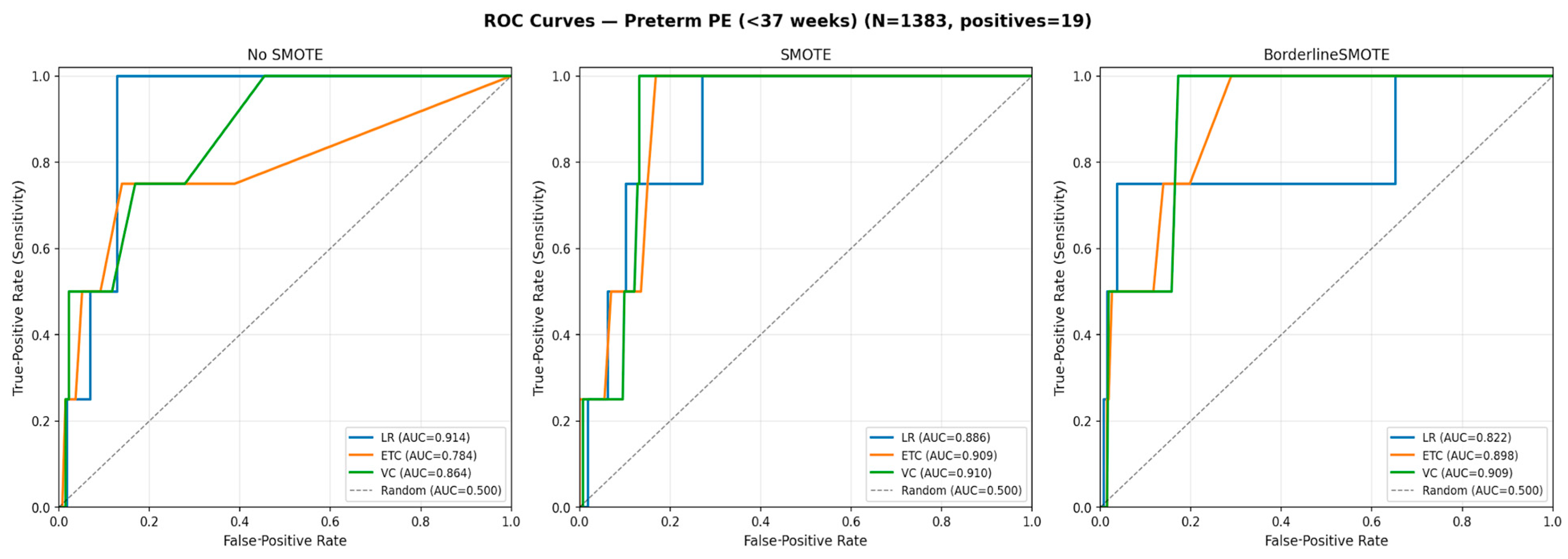
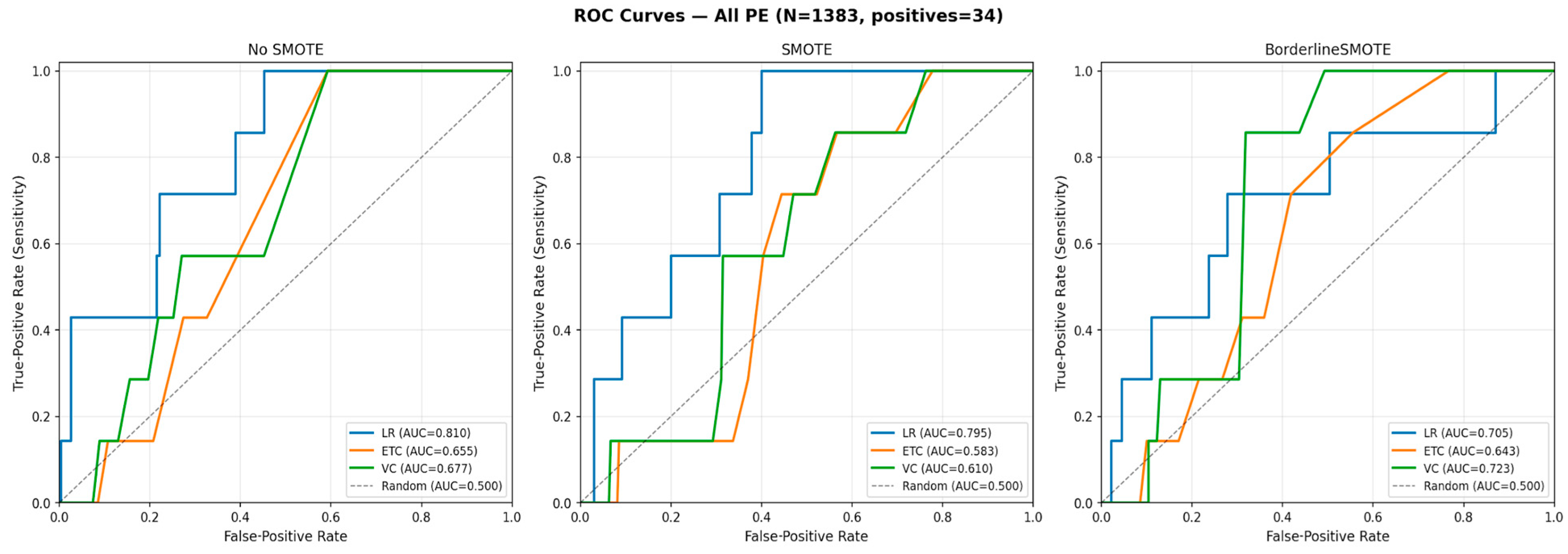
Logistic Regression significantly outperforms tree-based models on both prediction targets. Preterm PE is more predictable than all PE (AUC 0.853 vs. 0.766), which is consistent with the literature indicating that early-onset PE exhibits stronger first-trimester biomarker signatures. The limited number of positive cases (n = 34) is insufficient for tree-based models to learn robust nonlinear patterns without overfitting. This finding aligns with the general machine learning principle that simpler models generalise better when data is scarce.
3.2. Impact of SMOTE Oversampling
Standard SMOTE significantly improves tree-based models: ETC gains +0.058 AUC on preterm PE, nearly matching LR (0.842 vs. 0.853). However, SMOTE slightly degrades LR performance because LR’s balanced class weighting already handles imbalance internally, making oversampling redundant. BorderlineSMOTE underperforms standard SMOTE because accurate boundary estimation requires more positive samples than are available with only 19–34 cases. With standard SMOTE, all three models converge to AUCs of 0.84–0.85 for preterm PE.
3.3. Multiclass Classification (PE/PIH/None)
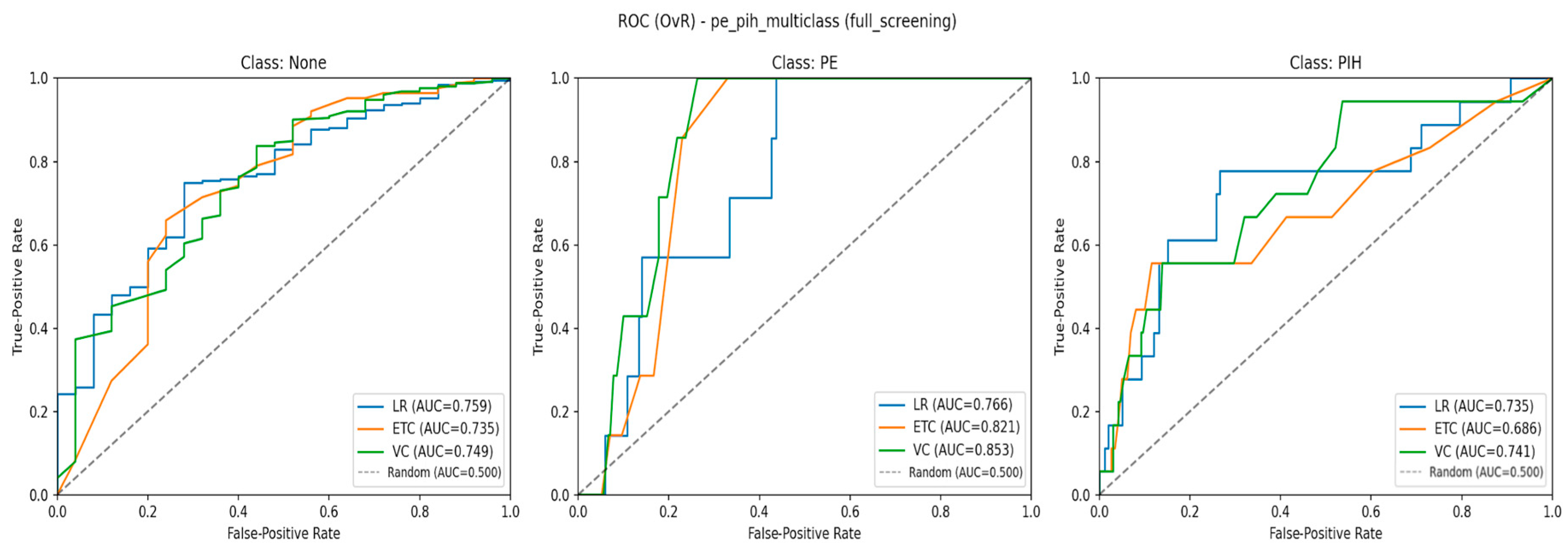
The results for the three-class prediction target are shown in
Table 5 and
Figure 3.
SMOTE degrades all models in the multiclass setting, unlike in binary PE prediction. With three classes and 122 total positive cases (34 PE and 88 PIH), class weighting alone is sufficient. BorderlineSMOTE slightly improves PIH detection (0.010 to 0.016 AUC) at the cost of significantly worse PE detection (−0.021 to −0.054 AUC)—a trade-off given that PE is the more clinically critical outcome. PE is consistently harder to predict than PIH across all models (AUC ~0.68–0.73 vs. ~0.71–0.77), reflecting its smaller sample size and greater clinical heterogeneity.
3.4. Control Group Results
The non-screened control cohort (
n = 533) was evaluated using maternal characteristics alone (
Table 6), as biochemical and full biophysical markers were not available at the mid-pregnancy visit.
Without biochemical and full biophysical biomarkers, prediction from maternal characteristics alone achieves AUC 0.710–0.751, approximately 0.05–0.10 lower than the screening group’s full model. Mean UtA-PI measured at ~22 weeks added negligible predictive value in this context. Preterm PE prediction was not feasible in the control group (only seven cases; AUC ~0.5), underscoring the need for first-trimester biomarkers for high-performance prediction. This is consistent with externally validated models using routine maternal characteristics alone, which achieve AUC 0.84 in large-scale temporal validation studies [
20], though these were trained on substantially larger cohorts.
3.5. Comparison with FMF Screening Algorithm
The performance of the Logistic Regression model for predicting preterm PE (AUC 0.853) is within the range reported for first-trimester screening models in the literature. Although direct comparison with the FMF algorithm is limited by differences in model structure and operating thresholds, the results (
Table 7) suggest that locally trained machine learning models may achieve clinically meaningful discrimination in regional populations.
Further studies using direct head-to-head comparisons with established screening algorithms are required to determine the potential role of machine learning models in clinical risk stratification.
Crucially, the LR model’s logistic coefficients are directly interpretable, fulfilling transparency requirements under the European AI Act for high-risk AI systems in maternal health monitoring [
13].
4. Discussion
4.1. Clinical Relevance
The result of an AUC of 0.853 for preterm PE is a strong indicator of the discriminatory power of the model in the most severe forms of the condition. With a detection rate of 70–75% with 10% false positives, our algorithm is fully comparable to that of the Fetal Medicine Foundation (FMF). The key advantage here is that these indicators were achieved with data from only one Bulgarian centre, relying on routine measurements in the first trimester and without the need for closed commercial software.
The comparison between the two groups confirms the effectiveness of systematic screening and aspirin prophylaxis: the cases of premature PE decreased from 3.0% to 1.95%. However, the analysis also revealed two critical gaps: 24.1% of women at risk did not start aspirin therapy, and the detection of pregnancy-induced hypertension (PIH) remained low (nearly 45% of cases fell into the low-risk group). These data outline a clear need for AI systems to support decision-making. The integration of continuous monitoring through wearables and IoT architectures can compensate for the limitations of one-time screening, especially in remote regions of Bulgaria with difficult access to specialised help.
4.2. Model Selection and Oversampling
The dominance of Logistic Regression (LR) in this study confirms a basic statistical principle: with a small number of positive cases (only 34 in PE), simpler models are more robust. Complex ensemble methods (such as Extra Trees) are prone to overfitting when data are limited. The built-in weight balancing in LR proved to be more effective than the artificial generation of synthetic examples (SMOTE), which, in our case, introduced more noise than precision.
The observation that first-trimester biomarkers add about +0.05 AUC over maternal characteristics alone to the baseline model (0.766 vs. 0.71) is of direct relevance for health resource management. In hospitals where biochemical tests (PAPP-A, PlGF) are expensive or unavailable, the model relying only on maternal characteristics still offers meaningful risk stratification. This supports the idea of “stepped screening”: mass pre-selection based on history, followed by full testing only for patients at intermediate and high risk.
4.3. Strengths and Limitations
This study has several strengths. First, it uses real-world clinical data from a well-characterised first-trimester screening cohort. Second, it systematically evaluates multiple machine learning models and oversampling strategies under conditions of extreme class imbalance. Third, the use of repeated cross-validation provides a more stable estimate of model performance than a single train–test split.
Nevertheless, several limitations should be acknowledged. The number of preeclampsia cases was relatively small, which may limit the stability of performance estimates and increases the risk of optimistic bias. The study was conducted in a single centre, and external validation in independent populations is necessary before clinical implementation. In addition, the comparison cohort differed in timing of clinical assessment and available biomarkers, which limits direct comparisons between groups.
4.4. Future Research
Future research should focus on validating these models in larger multi-centre datasets and evaluating their performance in prospective clinical settings. Combining datasets from multiple centres could substantially increase the number of positive cases and allow for more robust evaluation of complex machine learning algorithms.
Integration of continuous physiological monitoring data—such as blood pressure measurements or wearable sensor data—may further improve predictive accuracy and enable dynamic risk stratification throughout pregnancy.
5. Conclusions
In this Bulgarian screening cohort, ML models demonstrated a promising ability to predict preterm preeclampsia using first-trimester clinical and biomarker data. Logistic Regression provided the most robust performance in the presence of severe class imbalance, while SMOTE oversampling improved the performance of tree-based models. These results support further development and external validation of interpretable ML approaches as potential complements to existing preeclampsia screening strategies.
This study presents an analysis of machine learning for predicting preeclampsia (PE) in a Bulgarian clinical setting. Based on data from 1383 screened women and a control group of 533 patients, we draw the following key conclusions:
The Logistic Regression model is the most effective for this dataset (for preterm PE). It outperforms more complex ensemble models that are prone to overfitting with a small number of positive cases.
SMOTE oversampling only helps tree models. While standard SMOTE improves the results of Extra Trees Classifier by up to +0.038–0.058 AUC, it is redundant and even slightly detrimental for LR, which performs better by internally balancing the weights.
First-trimester biomarkers are critical. Adding data from MAP, PlGF, PAPP-A, and UtA-PI increases accuracy by about +0.05 AUC compared to models relying only on maternal characteristics. This justifies their inclusion in the standard protocol.
ML models are a real alternative to the FMF algorithm. The achieved detection of 70–75% with 10% false positives is comparable to commercial software, but offers full transparency according to the EU AI Act requirements.
Prevention gap: Despite the effectiveness of aspirin prophylaxis, 24.1% of high-risk patients do not adhere to therapy. This is a serious niche for future monitoring and reminder systems.
Future work will focus on integration of continuous wearable sensor data (blood pressure, ECG, PPG) into a real-time AI clinical decision support prototype; threshold optimisation for clinical deployment; and a cost-effectiveness analysis comparing ML-based screening with the FMF algorithm in the Bulgarian healthcare context.