1. Introduction
The development of renewable energy sources is among the leading directions in modern energy systems, with wind energy occupying a key position due to its significant resource potential and opportunities for large-scale application. A fundamental scientific and engineering question in wind turbines is how efficiently the kinetic energy of the air flow can be converted into mechanical and subsequently electrical energy. The classical foundation of this problem was established by the theory of Albert Betz, according to which the maximum theoretical efficiency of an idealized free-standing wind turbine is 59.3% [
1]. This result was derived under several assumptions, including an ideal fluid, one-dimensional flow, the absence of geometric constraints, and modeling of the rotor as an infinitely thin actuator disk.
Historically, the aerodynamic formulation of this problem is closely related to the development of propeller theory and axial energy converters. Hermann Glauert examined the fundamental relationship between the classical studies of William John Macquorn Rankine and William Froude and the later development of air propeller theory, emphasizing that there is no fundamental difference between the basic theory of a propeller operating in water and one operating in air [
2]. In this context, the modern analysis of wind turbines is based on a broader aerodynamic tradition that includes momentum theory, propeller theory, and later extensions of the actuator-disk approach. Such an engineering and scientific framework is comprehensively presented in the established monographs by Tony Burton et al. [
3] and James F. Manwell et al. [
4], where the physical principles of airflow energy conversion, rotor aerodynamics, loading, control, and methods for evaluating the energy efficiency of wind turbines are discussed.
Alongside classical theory, recent decades have seen the development of modern theoretical approaches aimed at increasing the Betz limit or reconsidering the conditions under which it is valid. For example, V. F. Molchanov proposed an approach in which the use of a rotor with crescent-shaped blades could theoretically achieve an efficiency of up to 83%, thus formulating a concept that allows values exceeding the classical limit. Walter Just examined a system of two rotors arranged in tandem and showed that the energy conversion efficiency of such a configuration could reach about 64%, although his analysis was mainly based on variations in axial velocity and did not account for the energy contained in the tangential velocity component. In a similar direction, Strauss developed a theory in which the limitation of a single infinitely thin rotor is overcome by introducing tandem-arranged infinitely thin rotors, leading to a theoretical upper limit of the power coefficient of about 67% [
5]. These studies demonstrate that the classical Betz limit strongly depends on the idealization of the system and on the boundary conditions of the problem.
Despite these theoretical extensions, in practice, many single-rotor wind turbines, due to various aerodynamic, structural, and operational factors, do not achieve even 40% of the available energy conversion efficiency. This has directed research interest toward methods for increasing the mass flow rate through the rotor, enhancing the local flow velocity in the operating region, and developing geometric solutions capable of favorably influencing the velocity and pressure fields around the turbine.
One of the most widely discussed approaches in this direction is the use of diffuser-augmented or ducted wind turbine configurations, in which the rotor is placed within a confuser–diffuser system. An early and particularly important contribution in this field is the study by K. M. Foreman, B. L. Gilbert, and R. A. Oman [
6], who demonstrated that a diffuser can control the expansion of the wake flow and create a region of reduced static pressure behind the turbine. As a result, a larger mass flow rate passes through the rotor compared with a conventional open turbine of the same diameter. Their wind tunnel experiments showed a nearly twofold increase in energy extraction for certain configurations, laying the foundation for the subsequent development of diffuser-augmented wind turbines (DAWTs).
Later studies significantly expanded the understanding of the role of channel geometry. Søren Hjort and Henrik Larsen [
7] developed a multi-element diffuser configuration based on aerodynamic principles used in high-lift aircraft airfoils and showed that properly designed compact DAWT systems can achieve a substantial increase in energy output. Shinya Watanabe, Takahiro Takahashi, and Yuji Ohya [
8] investigated the application of a diffuser structure to vertical-axis wind turbines and demonstrated that wind-lens configurations with suitable angles and geometric parameters can lead to an approximately twofold increase in power compared with an open turbine. These results confirm that geometric flow shaping through channel elements plays a crucial role in the local acceleration of the airflow and in the overall efficiency of the system.
With the growing interest in diffuser-augmented wind turbines, review and critical analyses of theoretical models have also emerged. Rodolfo Bontempo and Marcello Manna [
9] presented a comprehensive review and comparison of the main theoretical formulations for DAWT systems, highlighting both their advantages and the limitations arising from simplifying assumptions. The authors emphasized that the maximum attainable power coefficient depends not only on the rotor but also on how the characteristic area of the system is defined and on the geometry of the channel. Furthermore, Rodolfo Bontempo, Marco Carandente, and Marcello Manna [
10] applied a design-of-experiments approach to the analysis of ducted wind turbines and showed that certain geometric parameters, such as the chord and setting angle of the duct, make a dominant contribution to improving system performance. This directs attention to the need for targeted investigations of the role of the ratio between the characteristic cross-sections of confuser–diffuser systems.
Modern analytical and numerical studies further reinforce the importance of geometric parameters in ducted wind turbine systems. Víctor Quispe-Abad and Gerrit Müller [
11] examined the question of the absolute maximum theoretical power coefficient for ducted wind turbines and showed that the correct choice of reference area is essential for interpreting efficiency. S. Shambira et al. [
12] developed a model for velocity amplification in a concentrator–diffuser system and, by combining CFD with response surface methodology, identified nearly a twofold increase in velocity at the throat under optimal geometric parameters. T. A. Jauhar et al. [
13] numerically investigated the influence of the expansion angle in a flanged diffuser and demonstrated that flow separation and the local position of the rotor within the channel are critical for achieving maximum velocity enhancement. K. Aravindhan et al. [
14] confirmed through a review analysis that ducted wind turbine concepts represent a sustained research direction in which power enhancement is achieved through the guidance and acceleration of the flow by geometrically shaped ducts. In a similar vein, S. Kumar and S. Selvaraj [
15] investigated an integrated configuration including an inlet funnel, a natural fan effect, a straight diffuser, a splitter, and an outlet flange. Using MATLAB/Simulink and ANSYS Fluent, they showed that such combined duct solutions can significantly increase the local velocity in the rotor region. Their study confirms that not only the diffuser itself but also the overall geometric organization of the inlet and outlet flow determines the level of aerodynamic amplification and the potential for increasing energy yield.
In recent years, the topic has continued to evolve both in terms of aerodynamic theory and optimization and application studies. H. Ding et al. [
16], using high-order large eddy simulations, demonstrated that ducted configurations consistently deliver higher power than open-rotor designs across various tip-speed ratios and yaw angles. J. Park et al. [
17], although working in the field of hydrokinetic turbines, showed through CFD-based optimization that ducted configurations can significantly improve energy extraction, further supporting the general principle that a geometrically shaped duct can accelerate and condition the flow upstream of the rotor. A. Nobre et al. [
18] demonstrated that in DAWT systems with swept rotors, diffuser efficiency and thrust characteristics strongly influence energy production. B. Kassa et al. [
19] studied the multi-objective optimization of wind-lens system parameters and showed that even moderate variations in expansion ratio, diffuser length, and rim height lead to noticeable increases in the power coefficient. Additional review papers [
20,
21] likewise confirm the relevance of the topic and the need for models that more clearly relate duct geometry to energy efficiency.
From this review, it follows that, although numerous studies have investigated DAWTs, wind-lens, and other ducted configurations, a fundamental question remains: how exactly does the introduction of geometric constraints in the flow modify the conditions under which the maximum theoretical efficiency is formulated? In other words, it cannot be automatically assumed that the conclusions derived for a free-standing turbine in the classical Betz formulation are fully equivalent to those for a system in which the flow is pre-shaped by a confuser–diffuser channel.
Despite the significant progress achieved through experimental and numerical studies, a general analytical relationship that explicitly links the geometry of a confuser–diffuser channel to the maximum theoretical efficiency of a wind turbine remains insufficiently defined. Most existing approaches rely on case-specific optimization, which does not provide a universal framework for interpreting the role of geometric constraints in the energy conversion process.
In this context, the present study adopts an analytical approach aimed at extending the classical Betz formulation. By introducing geometric constraints into the control volume, the efficiency of the system is no longer treated as a fixed theoretical limit, but as a function of a dimensionless parameter characterizing the ratio between characteristic channel cross-sections.
This approach allows for the identification of a critical configuration corresponding to maximum energy conversion efficiency, expressed through the parameter n. This result provides a theoretical reference for the design, optimization, and interpretation of diffuser-augmented wind turbine systems, as well as for guiding future numerical and experimental investigations.
2. Theoretical Formulation
To analyze the process of converting the kinetic energy of the airflow into mechanical work, the classical model proposed by Albert Betz is employed. This model provides an idealized description of the interaction between the fluid flow and the rotor of a horizontal-axis wind turbine and allows for an analytical estimation of the maximum possible energy conversion efficiency.
In Betz’s formulation, the turbine rotor is represented as an infinitely thin actuator disk that extracts a portion of the kinetic energy from the flow. The analysis is based on the conservation laws of mass, momentum, and energy, which are applied to a control volume surrounding the turbine.
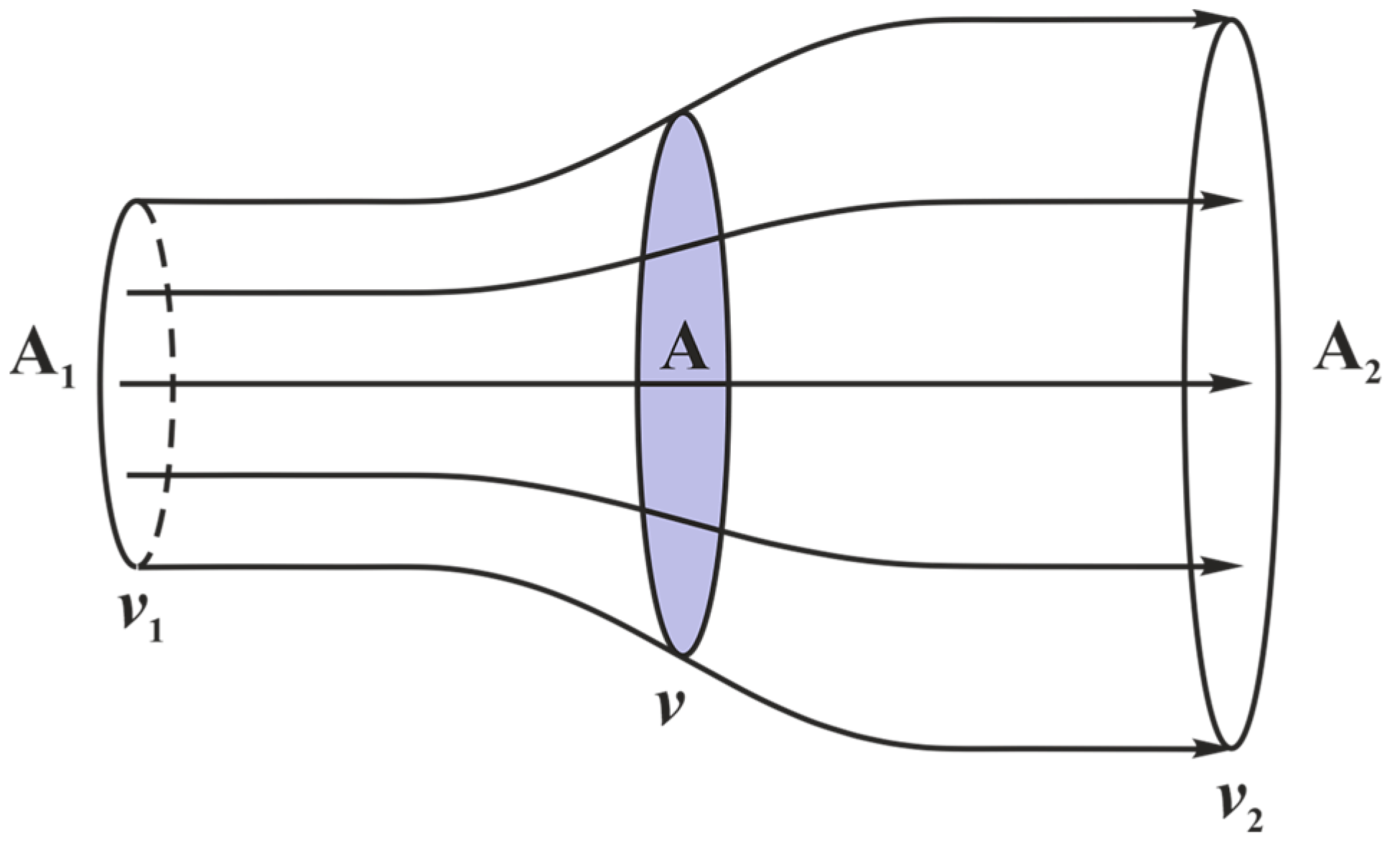
Figure 1 illustrates the streamlines of an ideal fluid passing through an idealized horizontal-axis wind turbine.
For the Betz formulation to be valid, the following principal assumptions must be satisfied:
The fluid is considered ideal;
The flow in the analyzed region is laminar;
The fluid density remains constant;
The process is assumed to be adiabatic;
The process is considered per unit time;
No geometric constraints are present within the analyzed volume;
The wind turbine rotor is replaced by an infinitely thin actuator disk;
The mean streamline is horizontal.
The rotor of a horizontal-axis wind turbine is modeled as an infinitely thin actuator disk with cross-sectional area A, which converts part of the kinetic energy of the airflow into mechanical work. The fluid moves from the upstream section A1 to the downstream section A2, with corresponding velocities v1, v, and v2.
According to the continuity equation, the mass flow rate remains constant:
where ρ is the fluid density.
The power extracted by the turbine can be expressed as the difference between the incoming and outgoing kinetic energy flux:
Alternatively, the power can be written in terms of the force acting on the actuator disk:
Using the conservation of momentum, the force can be expressed as:
By combining Equations (2)–(4), the following relationship is obtained:
Substituting this result into Equation (2), the power can be expressed as a function of the velocity ratio x = v
2/v
1:
Defining the available power of the flow as:
The power can be expressed in dimensionless form by introducing the power coefficient:
To determine the maximum value of the extracted power, the function C
p(x) is maximized:
Solving this equation yields:
Substituting this value into Equation (8), the maximum theoretical efficiency is obtained:
Accordingly, the maximum power extracted from the flow can be written as:
where
P—turbine power;
Pp—power of the flow.
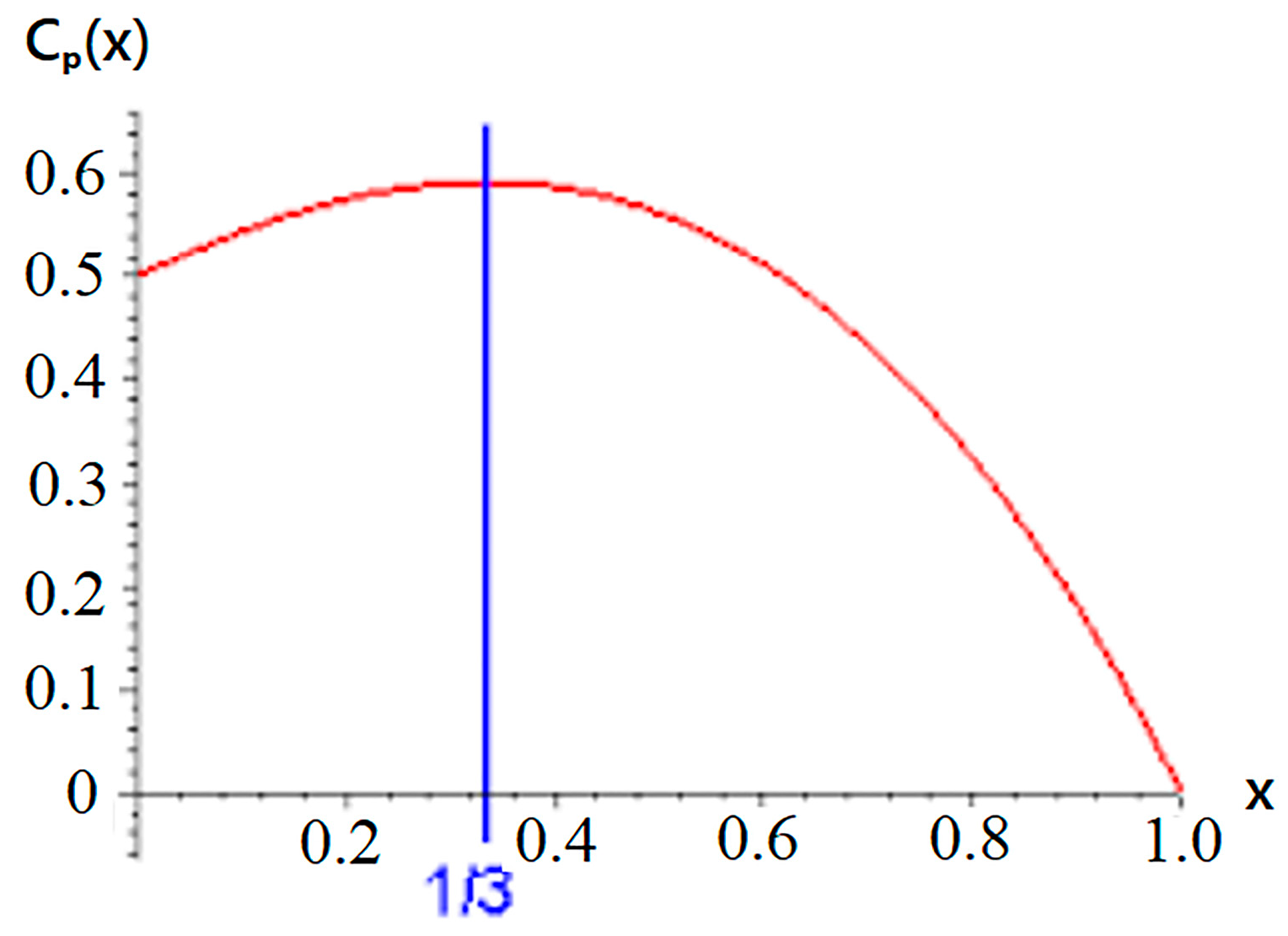
Figure 2 illustrates the variation in the power coefficient C
p as a function of the velocity ratio x.
The obtained result shows that the maximum theoretical efficiency of a horizontal-axis wind turbine is 59.3%, which implies that the efficiency of any real turbine operating under practical conditions will always be lower than this value due to aerodynamic, mechanical, and other losses.
The Betz theory also provides characteristic relationships for the flow velocities at the different sections of the control volume. Under conditions corresponding to maximum efficiency, the velocity at the rotor plane and the downstream velocity can be expressed as:
These relationships indicate that the actuator disk acts as a local resistance to the flow, reducing the fluid velocity at the rotor plane to two-thirds of the free-stream velocity. Downstream of the turbine, the velocity further decreases to one-third of the upstream value.
The considered process may be interpreted in terms of an energy balance. The incoming flow carries kinetic energy associated with the upstream velocity v1. As the fluid passes through the actuator disk, part of this energy is converted into mechanical work extracted by the turbine, while the remaining portion is carried away by the flow at a reduced velocity v2.
Accordingly, the energy balance of the process can be expressed as:
where E
k1 is the kinetic energy of the incoming flow, E
m is the mechanical energy extracted by the turbine, and E
k2 is the kinetic energy of the flow downstream of the actuator disk.
Energy-based approaches are widely used in various fields of engineering to describe transformation processes. In particular, in fatigue and fracture mechanics, the evolution of material damage is often analyzed using energy-based criteria and stress intensity concepts, such as those formulated in Paris’ law and linear elastic fracture mechanics (LEFM) [
22,
23].
In a similar conceptual framework, the present model interprets the interaction between the fluid flow and the turbine through an energy balance, where the kinetic energy of the flow is partially converted into mechanical work and partially transported downstream.
Equation (15) shows that the kinetic energy of the incoming flow is partitioned into useful mechanical work and residual kinetic energy carried away by the wake.
This energy-based interpretation provides a foundation for extending the classical analysis by introducing additional parameters that account for geometric constraints in the flow field.
3. Theoretical Model of the Efficiency of an Idealized Horizontal-Axis Wind Turbine Operating with a Profiled Channel
Of the eight main assumptions adopted in the classical model of Albert Betz, the present study places particular emphasis on the assumption that no geometric constraints exist within the considered control volume. This assumption allows the flow around the turbine to be treated as free and unconfined.
However, an important question arises: if this condition is removed, does the final conclusion regarding the maximum energy conversion efficiency remain valid?
In solid mechanics, it is well known that the introduction of additional geometric elements can significantly modify the local distribution of stresses and energy parameters within a system [
24,
25]. Geometric modifications often lead to changes in stress concentration and, consequently, to variations in the efficiency of load transfer.
By analogy, a similar principle can be applied to the analysis of a fluid flow, where geometric constraints may alter the velocity field and thus the distribution of kinetic energy within the flow.
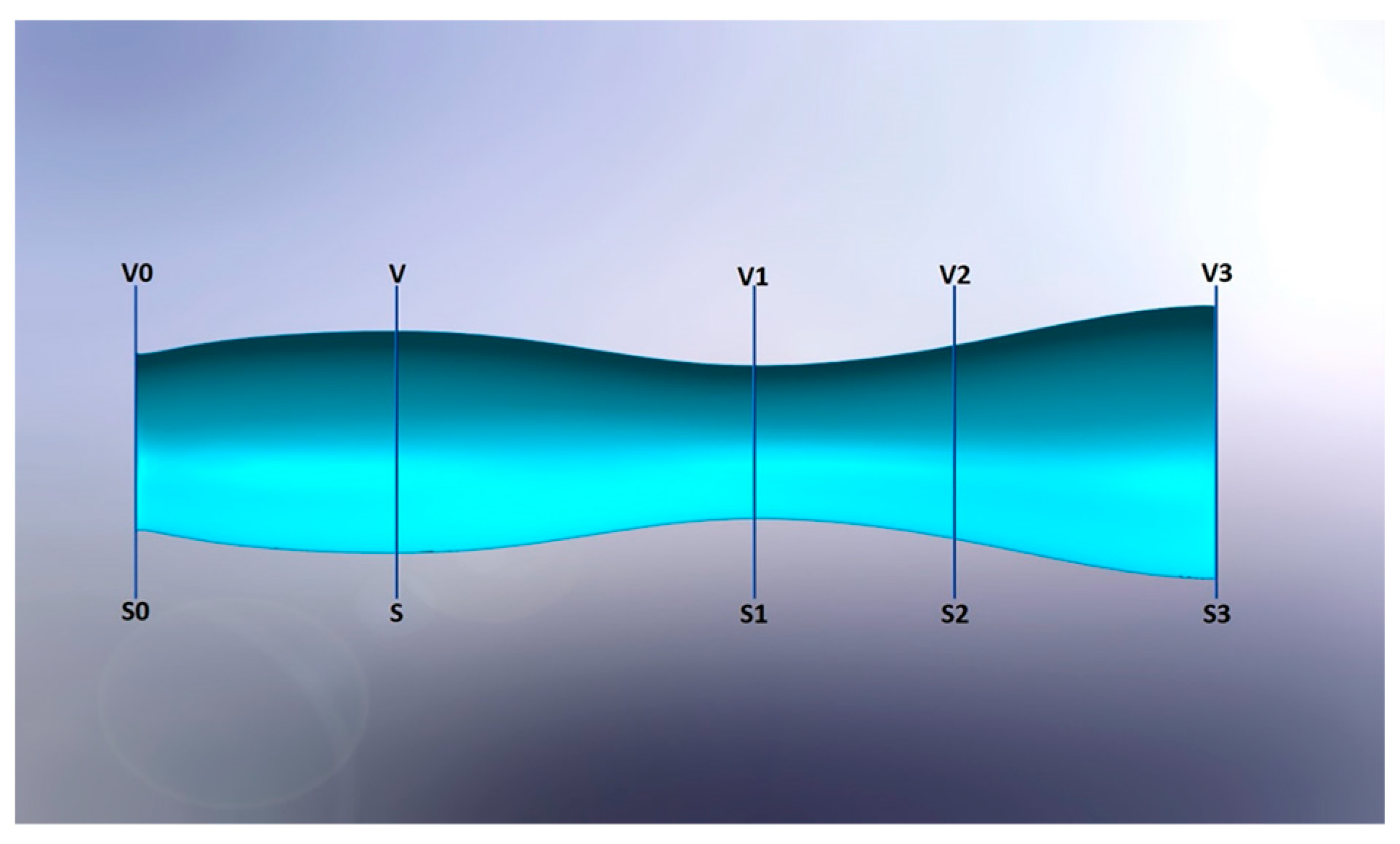
To investigate the influence of geometric constraints on the efficiency of energy conversion, the present work considers a model of a flow passing through a confuser–diffuser channel. The fluid enters the confuser horizontally, and in its narrowed section a turbine with cross-sectional area S
2 is assumed to be located, as shown in
Figure 3. At this section, part of the kinetic energy of the flow is converted into mechanical work, analogously to the process occurring at section A in the model presented in
Figure 1.
The channel is designed such that the flow velocities at the characteristic sections satisfy the conditions for maximum energy extraction, analogous to the classical Betz model. Under these conditions, the interaction between the flow and the turbine is assumed to occur at optimal energy exchange.
The section between cross-sections S and S1 represents a confuser, in which the flow accelerates from velocity v to v1. Upstream of the confuser, between sections S0 and S, the flow follows its natural profile, with velocity decreasing from v0 to v.
At cross-section S2, where the turbine is located, part of the kinetic energy of the flow is converted into mechanical work. This process is accompanied by a reduction in velocity, analogous to the actuator disk model.
Under conditions corresponding to maximum efficiency, the same relationships between velocities as in the Betz model are assumed to apply locally:
From the continuity equation, the velocity at the inlet of the confuser can be expressed as:
To describe the influence of the channel geometry, a dimensionless parameter n is introduced:
which represents the ratio between the cross-sectional area at the inlet of the confuser and the cross-section where the turbine is located.
Using the continuity equation, this parameter can also be expressed in terms of velocities:
Analytical Derivation of the Efficiency Function
The efficiency of the system is defined as the ratio between the mechanical power extracted by the turbine and the power of the undisturbed flow:
where
η—efficiency (power coefficient);
Pm—mechanical power per unit time obtained at cross-section S2;
Pp—power per unit time of the undisturbed flow passing through the cross-sectional area S.
The available power of the undisturbed flow is:
The mechanical power extracted at section S
2 can be expressed, by analogy with the Betz result, as:
Substituting Equations (22) and (23) into Equation (21) yields:
Using the relationships between velocities and the parameter n, the efficiency can be expressed as:
Equation (25) shows that, in contrast to the classical Betz limit, the efficiency is no longer a constant, but a function of the geometric parameter n.
Of particular interest is the case in which η = 1. Substituting this condition into Equation (25) yields:
from which:
This result indicates that, under the adopted assumptions, the maximum efficiency is achieved at a specific ratio between the characteristic cross-sections of the channel, demonstrating that geometric confinement fundamentally alters the classical efficiency limit.
4. Discussion
The obtained result shows that the efficiency of the considered model is not a constant quantity, but depends on the geometric parameter n, which characterizes the ratio between the cross-sectional area at the inlet of the confuser and the cross-section where the conversion of the kinetic energy of the flow into mechanical work takes place. The analytical model indicates that there exists a critical value of this parameter at which the maximum transformation of the kinetic energy of the flow is achieved. Under the adopted assumptions, this value is n = 1.299.
This result demonstrates that the geometry of the channel has a significant influence on the velocity field of the flow and on the efficiency of energy exchange between the flow and the turbine. In the classical formulation of the Betz model, the flow is considered unbounded, and no geometric elements affect the velocity distribution. In the present model, however, the confuser–diffuser system introduces a geometric constraint that modifies the local acceleration of the flow and consequently the conditions of the energy balance.
The obtained value n may be interpreted as a critical geometric condition governing the energy conversion process in a profiled channel. In the classical Betz model, maximum energy extraction is achieved when the flow velocity at the rotor plane is reduced to two-thirds of the free-stream velocity. In the present formulation, the geometric constraint introduced through the parameter n plays an analogous role, effectively controlling the balance between flow acceleration in the confuser and deceleration in the turbine region.
The value n = 1.299 represents a specific ratio between the characteristic cross-sections at which this balance is achieved, leading to a theoretical maximum in energy conversion efficiency. This result suggests that the performance of channel-based wind turbine systems is fundamentally linked to the global geometric configuration, rather than solely to local design parameters.
The obtained result is consistent with the general trend observed in diffuser-augmented wind turbine (DAWT) systems. Numerous experimental and numerical studies have shown that geometrically shaped ducts can increase the mass flow rate through the rotor and enhance the local flow velocity in the operating region. In such configurations, the diffuser creates a region of reduced pressure downstream of the turbine, which leads to an increased flow through the rotor and more efficient energy extraction.
In many contemporary studies, the optimization of ducted wind turbine systems is carried out using numerical approaches, such as CFD simulations or evolutionary algorithms. While these methods provide valuable insights into specific configurations, they often focus on local geometric features, such as diffuser expansion angles or wall characteristics. In contrast, the present analytical result identifies a global parameter that governs the theoretical efficiency limit of the system.
It should be emphasized that deviations from the critical value n = 1.299 lead to a reduction in the theoretically attainable efficiency under the adopted assumptions. This highlights the role of the parameter n as a fundamental design criterion, which may serve as a reference point in the development and optimization of profiled channel systems.
Nevertheless, it should be noted that the proposed model is based on several idealizing assumptions, including an ideal fluid, the absence of turbulence, and no energy losses along the channel walls. Under real conditions, these factors may significantly affect the actual efficiency of the system. For this reason, the obtained result should be regarded as a theoretical upper limit valid under the adopted idealizations.
At the same time, the use of an idealized analytical model allows for the identification of the fundamental structure of the governing physical relationships, without the influence of dissipative effects. In this sense, the obtained result may be interpreted as an ideal reference, analogous to limiting cases commonly used in fluid mechanics and thermodynamics.
The present study thus provides a theoretical framework that can serve as a basis for further refinement, including the introduction of correction factors accounting for viscous effects, turbulence, and real flow behavior. Future research can focus on the experimental and numerical verification of the obtained result. Of particular interest is the use of CFD simulations to analyze the velocity and pressure fields for different values of the parameter n, as well as experimental investigations of confuser–diffuser channels with an integrated turbine.
Such studies would make it possible to assess whether the theoretically obtained optimal value of the parameter n is preserved under realistic aerodynamic conditions and to what extent it can be used as a practical design guideline for high-efficiency wind energy systems.
5. Conclusions
In the present work, a theoretical model has been developed for analyzing the efficiency of a horizontal-axis wind turbine operating within a profiled confuser–diffuser channel. The results demonstrate that one of the fundamental assumptions of the classical Betz momentum theory—the absence of geometric constraints in the control volume—has a decisive influence on the formulation of the maximum energy conversion efficiency. Consequently, a direct equivalence between a free-standing turbine operating in an open flow and a turbine integrated within a geometrically constrained channel cannot be assumed.
A dimensionless geometric parameter n has been introduced, representing the ratio between the characteristic cross-sections of the confuser–diffuser system. The analysis shows that the efficiency is no longer a constant limit, but a function of this parameter. A critical value n = 1.299 has been identified, corresponding to the maximum theoretical conversion of the kinetic energy of the flow into mechanical work under the adopted assumptions.
This result reveals that the geometry of the channel fundamentally governs the velocity field and the energy exchange process between the flow and the turbine. In this sense, the classical Betz limit may be interpreted as a special case of a more general framework, which is valid for unconfined flows, while the present formulation extends this framework to geometrically constrained systems.
The proposed analytical model provides a theoretical reference for the design and optimization of diffuser-augmented wind turbine systems. In particular, the parameter n may serve as a guiding criterion for the selection of channel geometry prior to detailed numerical or experimental optimization.
The results obtained in this study establish a foundation for further investigations, including the incorporation of real-flow effects such as viscosity, turbulence, and energy losses. Future work can focus on validating the theoretical predictions through CFD simulations and experimental studies, as well as exploring the applicability of the model to practical Venturi-type configurations.