


About the SCORPiò-NIDI PROJECT †


Abstract
1. Introduction
- (i)
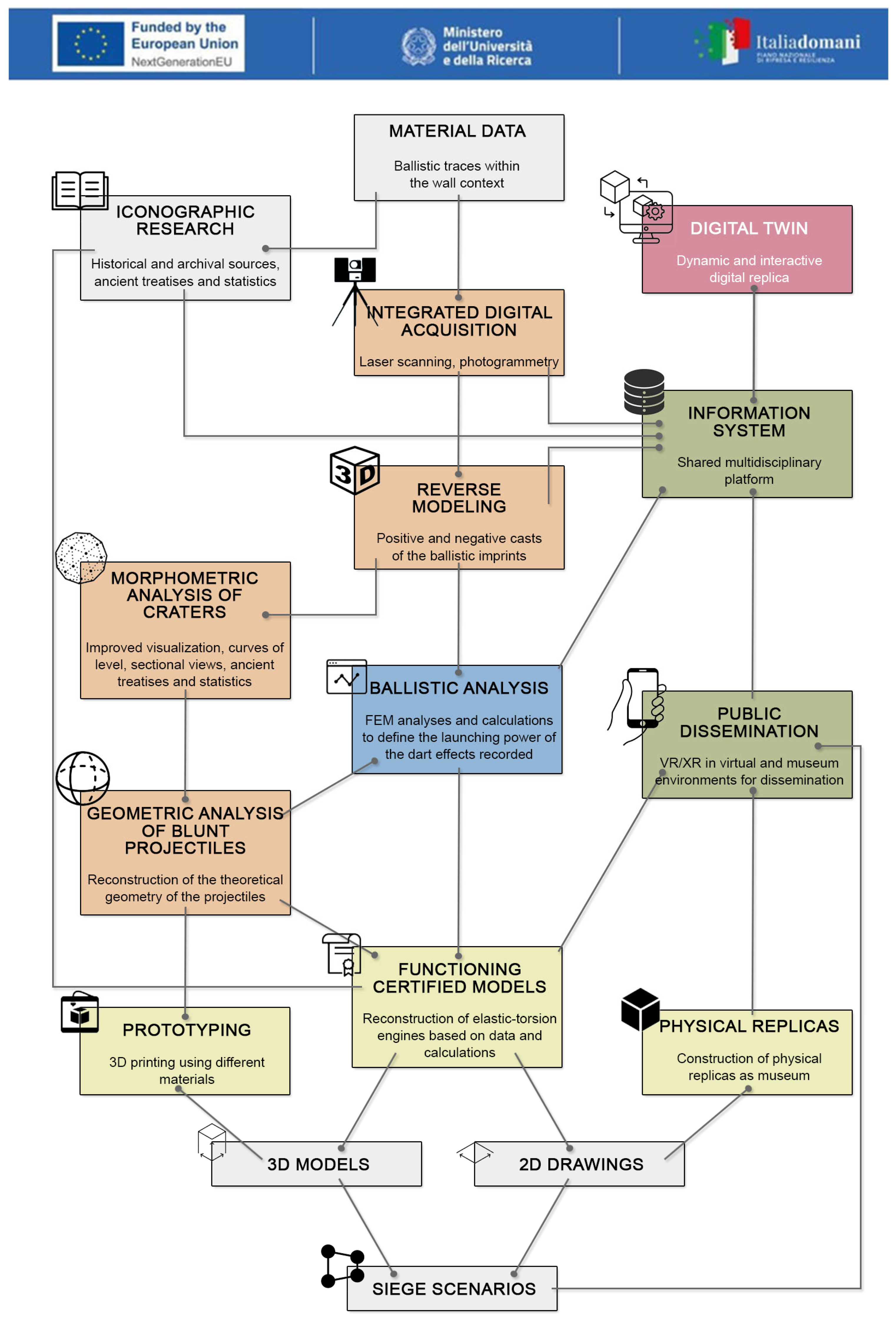
- Document archaeological evidence unequivocally attributable to elastic torsion-powered machines, made possible by the exceptional preservation of ancient Pompeii;
- (ii)
- Verify the functioning of ballistae and scorpiones, optimized by the Romans on the basis of principles developed by Greek scientists to increase lethality over greater distances;
- (iii)
- Reinterpret the history of sieges through experimentally verified data and calculations, assessing the compatibility of proposed hypotheses.
2. Surveying and Modeling: Conceptual and Methodological Challenges
2.1. Operational Research Field (SH5_12)
2.2. Tools, Methods, and Materials
2.3. Objectives, Activities, and Results
3. From Projectile Imprints to the Design of Roman War Machines: A Multidisciplinary Study of the Siege of Pompeii
3.1. Operational Research Field (PE8_10)
3.2. Tools, Methods, and Materials
3.3. Objectives, Activities, and Results
4. Authoring and Delivering Digital Cultural Heritage: The SCORPiò-NIDI Experience
4.1. Operational Research Field (PE6_9)
4.2. Tools, Methods, and Materials
4.3. Objectives, Activities, and Results
5. Conclusions
- “in situ”, by exhibiting, in front of the northern circuit of the Roman city, full-scale prototypes that clearly demonstrate the relationship between elastic weapons and the lethality of the damage produced;
- “on-site”, by setting up exhibition spaces featuring real and virtual models. To increase visitor engagement, experimentation with innovative materials is envisaged—materials that, within our project, are also useful for the production of artefacts—in order to ensure comparable performance while reducing costs in the reproduction of multiple copies;
- “off-site”, through virtual galleries of 3D models accessible via the internet, interactive, compatible with mobile devices, and designed to be simple and intuitive.
Author Contributions
Funding
Institutional Review Board Statement
Informed Consent Statement
Data Availability Statement
Conflicts of Interest
Abbreviations
| CH | Cultural Heritage |
| DH | Digital Humanities |
| HCI | Human–Computer Interaction |
| DL | Digital Library |
References
- Rossi, A. (Ed.) Discovering Pompeii: From Effects to Causes—From Surveying to the Reconstructions of Ballistae and Scorpiones; Engineering Proceedings; MDPI: Basel, Switzerland, 2025; Volume 96, pp. 1–150. [Google Scholar] [CrossRef] [Scilit]
- Russo, F. Ballistic imprints and bullets from Pompeii (Le impronte balistiche e le palle di Pompei). In L’artiglieria delle Legioni Romane Libreria dello Stato; Istituto Poligrafico e Zecca dello Stato: Roma, Italy, 2004; pp. 186–190. (In Italian) [Google Scholar]
- Maiuri, A. Studi e Ricerche sulla Fortificazione di Pompei; Hoepli: Milano, Italy, 1930; Volume 33. [Google Scholar]
- Wilkins, A. Artillery of the later Roman Republic. In Roman Republican Sieges; Dobson, M., Ed.; Archaeopress: Bicester, UK, 2024; Chapter 2. [Google Scholar]
- Burns, M. Pompeii under siege: A missile assemblage from the Social War. J. Rom. Mil. Equip. Stud. 2003, 14/15, 1–9. [Google Scholar]
- Marsden, E.W. The artillery manual of Philon. In Greek and Roman Artillery. Technical Treatises; Clarendon Press (Oxford University Press): Oxford, UK, 1971; Chapter IV; pp. 105–184. [Google Scholar]
- Apollonio, F.I.; Gaiani, M.; Garagnani, S. Beyond the frame: A multifaceted approach to cultural heritage 3D models through levels of iconicity and user-centric visualization tools. Disegnarecon 2024, 17, 32. [Google Scholar] [CrossRef]
- Van Buren, A.W. Further Studies in Pompeian Archaeology. Mem. Am. Acad. Rome 1925, 5, 103–113. [Google Scholar] [CrossRef] [Scilit]
- Piranesi, F.; Piranesi, G.B.; Guattani, G.A. Pompeia Antiquities. In Antiquity of the Grande Grece, from the Royaume de Naples; Beaux-Arts de Paris: Paris, France, 1804; pp. XXXVI–LXXII. [Google Scholar]
- Nastri, E.; Tenore, M.; Todisco, P. Calibration of concrete damaged plasticity materials parameters for tuff masonry types of the Campania area. Eng. Struct. 2023, 283, 115927. [Google Scholar] [CrossRef] [Scilit]
- Langella, A.; Bish, D.; Calcaterra, D.; Cappelletti, P.; Cerri, G.; Colella, A.; Gennaro, R.; Graziano, S.; Perrotta, A.; Scarpati, C.; et al. The Campanian Ignimbrite (CI) (L’Ignimbrite Campana (IC)). In Le Pietre Storiche della Campania; de Gennaro, M., Calcaterra, D., Langella, A., Eds.; Luciano Editore: Napoli, Italy, 2013; pp. 155–178. (In Italian) [Google Scholar]
- Piovesan, R.; Maritan, L.; Meneghin, G.; Previato, C.; Baklouti, S.; Sassi, R.; Mazzoli, C. Stones of the facade of the Sarno Baths, Pompeii: A mindful construction choice. J. Cult. Herit. 2019, 40, 255–264. [Google Scholar] [CrossRef] [Scilit]
- Maiuri, A. Introduction to the study of Pompeii (Introduzione allo studio di Pompei). In Course on Pompeian and Herculanean Antiquities (Corso di Antichità Pompeiane ed Ercolanesi 1942–43); Onorato, G.O., Ed.; G.U.F. “Mussolini”: Napoli, Italy, 1943. (In Italian) [Google Scholar]
- Rossi, A.; Bertacchi, S. Tracing Metal Dart Impacts Through 3D Reverse Modeling on the Northern Walls of Pompeii. Eng. Proc. 2025, 96, 4. [Google Scholar] [CrossRef] [Scilit]
- Jackson, M.D.; Landis, E.N.; Brune, P.F.; Vitti, M.; Chen, H.; Li, Q.; Kunz, M.; Wenk, H.R.; Monteiro, P.J.M.; Ingraffea, A.R. Mechanical resilience and cementitious processing Imperial Roman architectural mortar. Proc. Natl. Acad. Sci. USA 2014, 111, 18484–18489. [Google Scholar] [CrossRef] [Scilit] [PubMed]
- Annibaletti, L. The phases of the fortifications of Pompeii. State of knowledge (Le fasi delle fortificazioni di Pompei. Stato della conoscenza). SIRIS 2015, 15, 29–48. (In Italian) [Google Scholar]
- Fabbri, M. The City-wall in the Roman Age: The case study of Pompeii. Constr. Hist. 2021, 36, 1–20. [Google Scholar]
- Fabbri, M.; Ducatelli, V.; Zabotti, F. The fortifications of Pompeii. New investigations near Tower XI, known as the Tower of Mercury (Le fortificazioni di Pompei. Nuove indagini in prossimità della Torre XI detta di Mercurio). In Ricerche e Scoperte a Pompei: In Ricordo di Enzo Lippolis; Osanna, M., Ed.; L’Erma di Bretschneider: Roma, Italy, 2021; Volume 45, pp. 73–92. (In Italian) [Google Scholar]
- De Luca, R.; Miriello, D.; Pecci, A.; Dominguez-Bella, S.; Bernal-Casasola, D.; Cottica, D.; Bloise, A.; Crisci, G.M. Archaeometric Study of Mortars from the Garum Shop at Pompeii, Campania, Italy. Geoarchaeology 2015, 30, 330–351. [Google Scholar] [CrossRef] [Scilit]
- Heap, M.J.; Farquharson, J.I.; Kushnir, A.R.L.; Lavalle, Y.; Baud, P.; Gilg, H.A.; Reuschl, T. The influence of water on the strength of Neapolitan Yellow Tuff, the most widely used building stone in Naples (Italy). Bull. Volcanol. 2018, 80, 51. [Google Scholar] [CrossRef] [Scilit]
- Russo, F.; Rossi, A. Ancient Science: From Effects to Ballistics Parameters. Eng. Proc. 2025, 96, 2. [Google Scholar] [CrossRef] [Scilit]
- Schreibman, S.; Siemens, R.; Unsworth, J. (Eds.) A Companion to Digital Humanities; Wiley: Hoboken, NJ, USA, 2008. [Google Scholar]
- Burdick, A.; Drucker, J.; Lunenfeld, P.; Presner, T.; Schnapp, J. Digital_Humanities; MIT Press: Cambridge, MA, USA, 2012. [Google Scholar]
- Drucker, J. Graphesis: Visual Forms of Knowledge Production; Harvard University Press: Cambridge, MA, USA, 2014. [Google Scholar]
- Falk, J.H.; Dierking, L.D. The Museum Experience Revisited; Taylor & Francis: Abingdon, UK, 2013. [Google Scholar]
- Mortara, M.; Catalano, C.E.; Bellotti, F.; Fiucci, G.; Houry-Panchetti, M.; Petridis, P. Learning cultural heritage by serious games. J. Cult. Herit. 2014, 15, 318–325. [Google Scholar] [CrossRef] [Scilit]
- The ATON Framework. Available online: https://osiris.itabc.cnr.it/aton/ (accessed on 1 August 2026).
Disclaimer/Publisher’s Note: The statements, opinions and data contained in all publications are solely those of the individual author(s) and contributor(s) and not of MDPI and/or the editor(s). MDPI and/or the editor(s) disclaim responsibility for any injury to people or property resulting from any ideas, methods, instructions or products referred to in the content. |
© 2026 by the authors. Licensee MDPI, Basel, Switzerland. This article is an open access article distributed under the terms and conditions of the Creative Commons Attribution (CC BY) license.
Share and Cite
Rossi, A.; Guagliano, M.; Di Modica, G. About the SCORPiò-NIDI PROJECT. Eng. Proc. 2026, 149, 9. https://doi.org/10.3390/engproc2026149009
Rossi A, Guagliano M, Di Modica G. About the SCORPiò-NIDI PROJECT. Engineering Proceedings. 2026; 149(1):9. https://doi.org/10.3390/engproc2026149009
Chicago/Turabian StyleRossi, Adriana, Mario Guagliano, and Giuseppe Di Modica. 2026. "About the SCORPiò-NIDI PROJECT" Engineering Proceedings 149, no. 1: 9. https://doi.org/10.3390/engproc2026149009
APA StyleRossi, A., Guagliano, M., & Di Modica, G. (2026). About the SCORPiò-NIDI PROJECT. Engineering Proceedings, 149(1), 9. https://doi.org/10.3390/engproc2026149009

