1. Introduction
The energy crisis has continued to be a major issue and setback in Nigeria, where close to 43% of its population remains without electricity access and lives in chronic energy poverty. Low generation capacity, an unstable power grid, and high losses in transmission and distribution systematically degrade Nigeria’s energy sector. A high reliance and dependency on fossil fuels also worsen environmental challenges and economic instability. Addressing these structural challenges requires a planned and strategic energy scenario, with the utmost priority placed on renewable energy (RE) integration and stakeholder coordination. This work aims to develop an effective energy infrastructure model tailored to Nigeria’s unique socioeconomic and environmental conditions. By applying renewable energy technologies such as solar, wind, hydro, and biomass, the proposed model aims to enhance energy access, reliability, and sustainability [
1].
Important drivers of economic growth are energy, industrialization, and social progress, particularly for developing nations [
2]. Currently, Nigeria’s energy demand is likely to grow at a 5% rate every year, placing huge pressure on its already frail electricity grid [
3]. The fluctuating power supply has led to massive economic losses, reduced industrial productivity, and a heavy reliance on alternative sources of energy, such as diesel generators, which are responsible for environmental pollution and additional operating expenses. Achieving energy security, cutting greenhouse gas emissions, and controlling climate concerns all depend on the shift to a sustainable energy economy.
In addition, Nigeria’s urbanization rate is increasing and creating a new challenge for the country’s energy supply. Nigeria’s urban population has been steadily increasing due to rural–urban migration and natural population growth. By 2023, approximately 52% of the population resided in urban areas [
4,
5], a trend that is projected to continue.
This population movement creates a huge burden on the existing energy infrastructure, causing frequent power cuts, voltage instability, and power rationing. To counter these difficulties, Nigeria must change its direction toward decentralized energy platforms, including mini-grids, off-grid solar facilities, and distributed generation grids [
1].
This study makes a significant contribution to energy infrastructure planning in Nigeria by developing an integrated strategic framework derived from an integrated approach to incorporating evidence from regulatory, institutional, technical, and financial perspectives. This study integrates these dimensions in one comprehensive roadmap—for the strengthening of policy implementation, deployment of renewable energy, prioritization of investments, and institutional coordination—and thus offers concrete guidance for policy makers and other developing economies that need to manage the energy transition.
2. Methodology
A Thematic Analysis of Regulatory Practice, international reports, and peer-reviewed sources were used in this study. This was achieved using keywords, including “Nigeria”, “energy infrastructure”, “renewable energy”, “energy transition”, and “mini-grids”, while searching for relevant publications on the aforementioned databases, namely: Scopus, Web of Science, IEEE Xplore, ScienceDirect, Google Scholar, NERC, REA, IEA, World Bank, and IRENA. Relevant publications in the English language covering energy policy and infrastructure were included, and non-relevant, duplicate, and unrelated publications were excluded. Overall, 48 documents were analyzed. An inductive thematic analysis approach with open coding, categorization, and theme development was used to code the data, informing the identification of institutional, technical, financial, and policy challenges and opportunities.
Analytical Framework
The analytical approach used in this work is based on the thematic analysis but also integrates the evidence into four inter-related dimensions: (i) institutional and regulatory frameworks; (ii) renewable energy resources and technology options; (iii) financing mechanisms and investment strategies; and (iv) implementation, capacity building, and monitoring. These dimensions were carefully captured to identify existing issues, assess strategic interventions, and create a comprehensive energy scenario to build Nigeria’s sustainable energy infrastructure. This integrated approach is different from a descriptive policy review because it provides a framework for the evidence synthesis and the development of the policy.
This research does not provide a new forecasting model or primary data. Rather, its novelty stems from the fact that it is a systematic synthesis of evidence from several authoritative sources along a single analytical framework that puts together institutional, regulatory, technical, and financial aspects to inform strategic energy infrastructure planning and policy development in Nigeria.
3. Grid Capacity Constraints and Institutional Barriers
Though the total installed power generation capacity is around 13,000 MW, the actual electricity generation remains stubbornly low at somewhere between 4000 MW and 5000 MW because of factors like poor gas supply, maintenance gaps, poor management of available resources, and transmission constraints [
6]. This structural shortfall compels industry and households to depend upon supplementary power capabilities, with well over 40% of Nigeria’s power grid being self-generated, utilizing localized diesel and petrol generators [
3].
3.1. Transmission Inefficiencies and Resource Mismanagement
Inefficiency in Nigeria’s power transmission and distribution network stands as a significant obstacle to a stable supply of energy [
7]. Losses in the transmission of electricity, due to aging infrastructure and insufficient capacity expansion, can be as high as 25% of the generated electricity. More than 60 percent of transmission lines are over 30 years old and are highly prone to frequent breakdowns and loss of capacity.
This situation is exacerbated by resource mismanagement. Despite possessing 206 trillion cubic feet of proven gas reserves, much of the resources are lost through gas flaring [
8]. Nigeria continues to be one of the world’s largest gas flaring countries, with 8.3 billion cubic feet of gas flared daily. This results in estimated annual lost revenues of
$3.5 billion per annum, perpetuates environmental degradation, and accounts for 400 million tons of CO
2-equivalent emissions per year.
3.2. Institutional Barriers to Energy Development
Delays in power sector changes are further caused by regulatory inefficiencies, bureaucratic overlaps, and inadequate coordination among government agencies. There are systematic delays in project execution due to the overlapping roles of several authorities, such as the Nigerian Electricity Regulatory Commission (NERC), the Ministry of Power, and the Rural Electrification Agency (REA). Despite the introduction of the 2005 Electric Power Sector Reform Act (EPSRA) to drive privatization and efficiency, unclear policies and regulatory disputes stall investment efforts. A key challenge remains the
$16 billion debt owed to gas suppliers by the state-owned Nigerian Bulk Electricity Trading Company (NBET), which deters vital private sector investment in gas-fired generation [
2].
Nigeria has adopted a number of policies and reforms in the renewable energy sector, such as the Electric Power Sector Reform Act (EPSRA), Renewable Energy Master Plan (REMP), National Renewable Energy and Energy Efficiency Policy (NREEEP), and Rural Electrification Strategy and Implementation Plan (RESIP), with some limited results. There is empirical evidence that the failures of policies have been due to weak regulatory enforcement, overlapping roles, a lack of funding support, poor private sector confidence due to uncertainty, and project implementation delays. Moreover, a lack of transmission infrastructure and lack of financial viability of pivotal electricity market institutions have been limiting the integration of renewable energy despite positive policy provisions. These structural weaknesses highlight that while policy development is important, implementation and institutional capacity building are key limitations for Nigeria’s transition to renewables.
4. Forecasting Energy Demand
The energy demand projections in this section were collated from the various recent publications by the International Energy Agency (IEA) and the World Bank; Nigerian government policy documents; and peer-reviewed literature and are not the outcome of any independent forecast modeling. The projections are made with the assumption that population growth, urbanization, industrialization, economic growth, and access to electricity are on the rise in Nigeria, which is widely reported. These sectoral demand estimates, therefore, are not forecasts but are used as scenario planning benchmarks to assess the need for future energy infrastructure. The parameters used for the baseline in this synthesis are the reported population, the urbanization rate, the reported sectoral electricity demand, and economic growth projections, both national and international, as quoted in the sources. No independent forecasting model has been built nor tested against past data, but this study brings together published forecasts to offer a clear evidence-based underpinning for strategic energy scenario planning and policy assessment.
Nigeria’s energy demand is poised for exponential growth over the next two decades, driven by demographic expansion, economic diversification, and climate pressures. Nigeria’s population of 223 million today is set to reach over 400 million by 2040. Urbanization will accelerate, with 65% of Nigerians residing in urban areas by 2050. Lagos, Africa’s largest city, will grow from 15 million to 25 million residents by 2040, needing 10,000 MW of additional power for housing, transport, and cooling alone [
9].
Nigeria’s Economic Sustainability Plan (ESP) aims to industrialize and diversify the economy. As indicated in
Table 1, Nigeria’s population is expected to reach 400 million by 2040, alongside an urbanization rate of 65%, Key mega-projects include the
$19 billion Dangote Refinery, which requires 1200 MW for operation. Consequently, industrial energy use will grow at 10% annually.
Table 2 illustrates the projection of the energy demand in sectors contributing to the energy demand of the nation. In the residential sector, increasing middle-class incomes are driving the consumer appliance demand, pushing household electricity consumption up by 8% annually. In the transport sector, electric vehicles (EVs) could make up 15% of transportation energy demands by 2040.
Therefore, a discussion on the large-scale demand for electricity by industries is not in opposition to but complements the promotion of decentralized mini-grids. Grid-connected generation is aimed at high-demand industries; decentralized renewable mini-grids are the more cost-effective approach to serve underserved and rural communities where grid extension is probably not feasible. The proposed energy scenario takes into consideration both centralized and decentralized systems as part of its framework to include energy supply to support industrial development, increase the provision of electricity, and improve sustainable national energy development.
5. Evaluation of Available Energy Resources and Techno-Economic Feasibility
To combat climate change, resource depletion, and energy insecurity, Nigeria’s energy industry must shift from conventional fossil fuels to renewable energy sources. Renewable energy utilization requires strict techno-economic feasibility studies to determine long-term viability by evaluating the capital expense, operating costs, energy output, return on investment (ROI), and payback periods [
10,
11].
The techno-economic feasibility assessment outlined in this section is based on published location-specific studies and national energy assessments and not on independent techno-economic modeling. The evaluation is based on typical metrics such as the levelized cost of electricity (LCOE), availability of renewables, technology capacity factors, capital and operating costs, and the potential for investments in various regions of Nigeria. These criteria enable the comparison of renewable energy technologies and the selection of technologies with significant potential for sustainable energy infrastructure development.
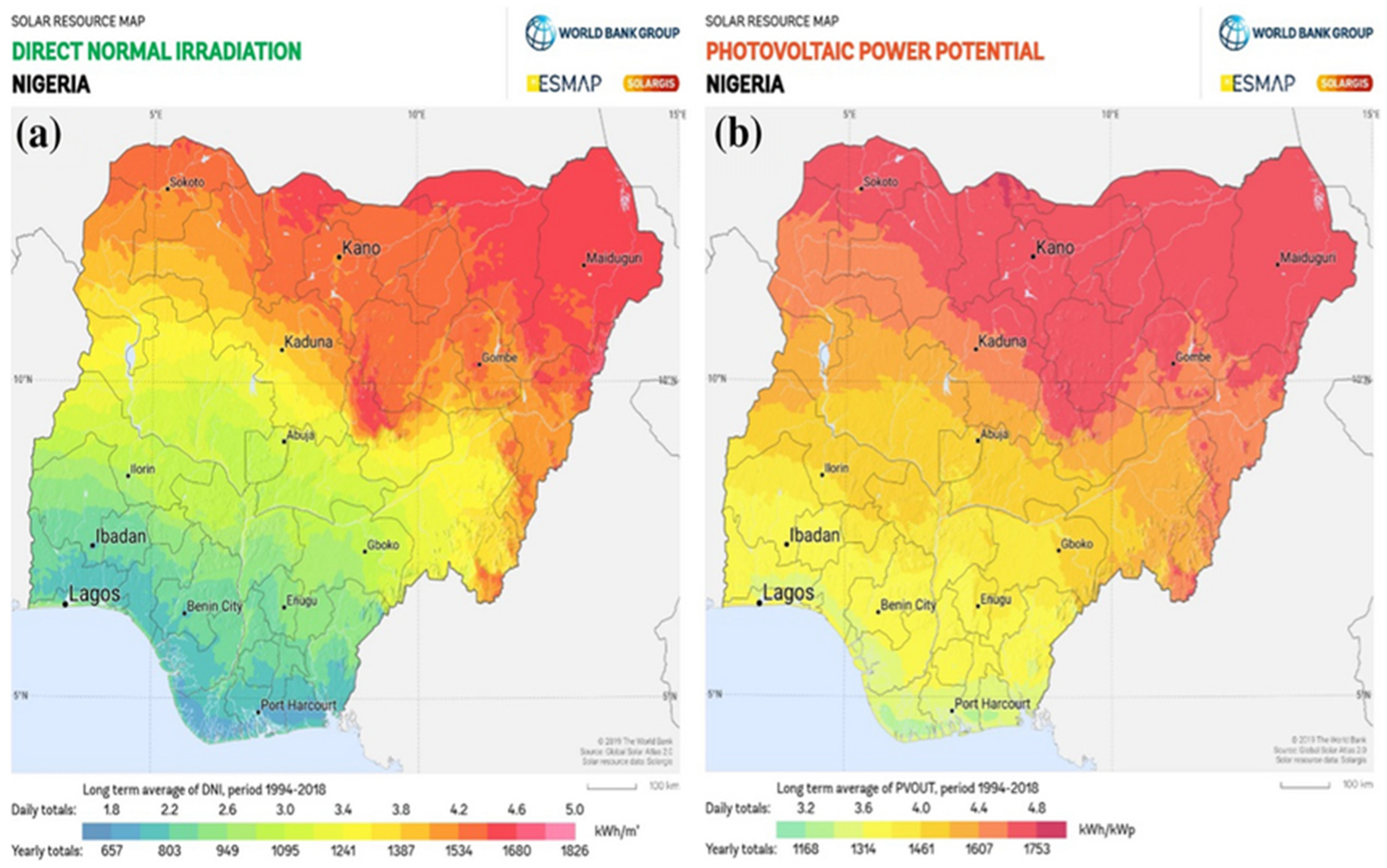
Solar Energy Viability: As a result of governmental incentives and falling PV module prices, the levelized cost of electricity (LCOE) for solar is declining rapidly, which speeds up its adoption [
12]. As illustrated in
Figure 1, the solar resource availability varies across the country, which informs the techno-economic assessment of solar PV projects.
Figure 1.
Solar resources availability. (
a) Solar irradiance chart [
13]. (
b) Photovoltaic power potential.
Figure 1.
Solar resources availability. (
a) Solar irradiance chart [
13]. (
b) Photovoltaic power potential.
As shown in
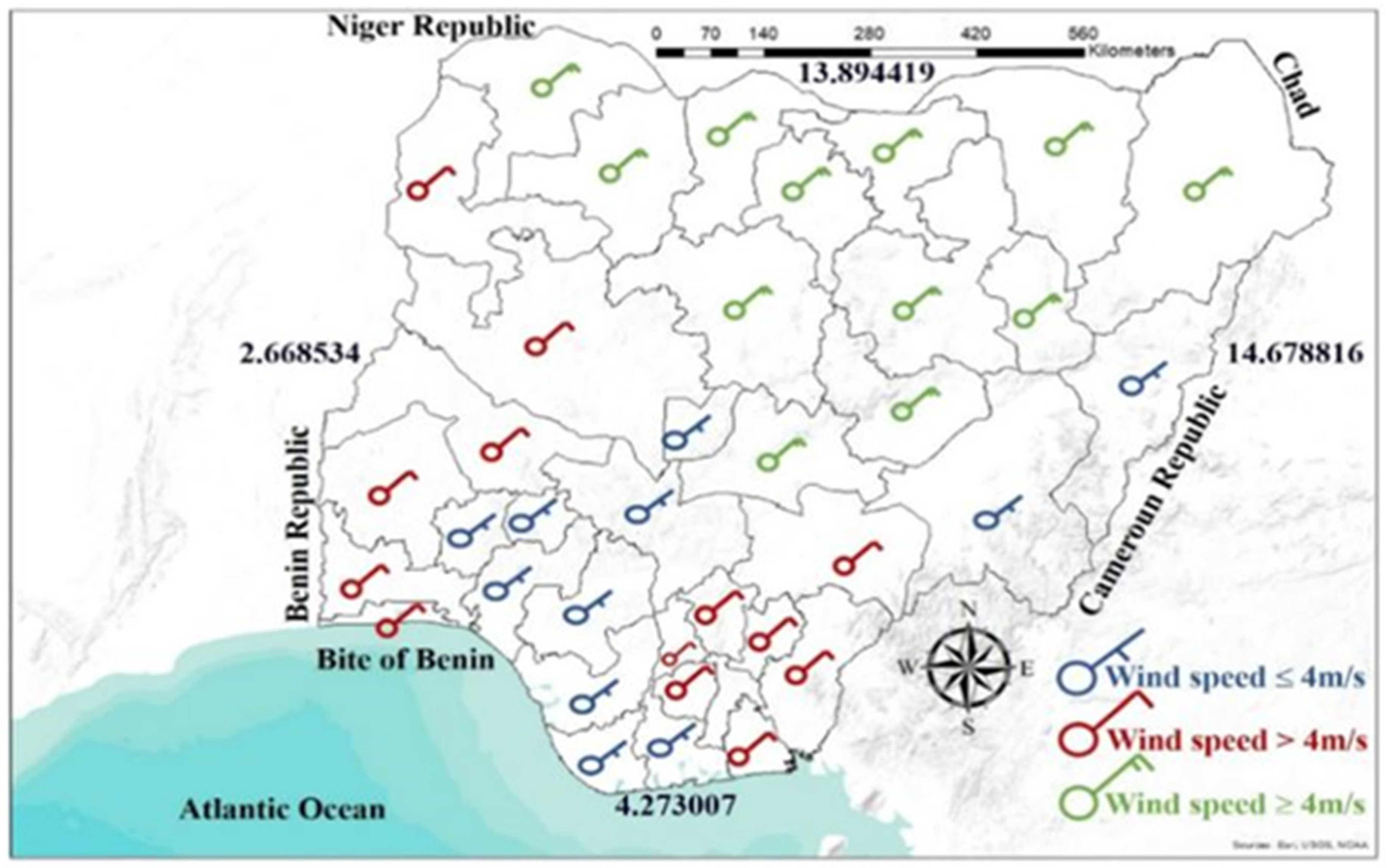
Figure 2, wind velocity varies significantly across Nigeria, with higher wind speeds in the northern regions providing favorable conditions for achieving capacity factors of 25–35%. Site-specific capacity factors have a significant impact on the financial viability of wind energy projects in Nigeria, as they form part of the factors that influence project economics and energy production. The relatively higher mean wind speed in the northern regions of the country, especially Sokoto, Katsina, the Jos plateau, and parts of Borno state, has made it possible to achieve average capacity factors of 25–35% using modern wind utility-scale wind turbines. Many areas in the south however have lower capacity factors than 20%, making the cost of large-scale wind projects less attractive if no policy support or hybrid renewable energy schemes are in place. This means the techno-economic potential of wind energies in Nigeria is site-specific and that investment should be given to high-wind-resource areas where the wind utilization will be optimized to reduce the LCOE and increase the profitability of the wind project over the long term.
Hydropower Feasibility: Although hydropower requires a large initial infrastructure investment [
12,
14], its long lifespan, low maintenance requirements, and ability to supply base load power make it highly cost-effective.
Biomass Energy Viability: Advanced bioenergy technologies like anaerobic digestion, biomass gasification, and pyrolysis enhance the efficiency of biomass plants, making them financially feasible when backed by government subsidies [
15,
16].
6. Developing Multi-Dimensional Energy Scenarios
Planning for sustainable transitions requires multiple energy scenarios shaped by technological developments, regulations, investment patterns, environmental concerns, and social inclusivity [
17,
18]. Technological advancement acts as a primary driver; growing efficiency and falling costs make renewables dependable substitutes for fossil fuels. Intermittency problems are resolved by energy storage options, such as battery systems and hydrogen storage [
19].
Three energy scenarios are taken as the basis for the discussion of alternative development pathways, providing a structured basis for evaluating those alternative pathways. With limited policy measures, the continued reliance on fossil fuels, and the sluggish deployment of renewables, scenario 1 (Business as Usual) is created. For the Moderate Transition (scenario 2), it is assumed that renewable energy will increase gradually, with more coordinated regulation and moderate public–private investment. The key underlying conditions for scenario 3 (Accelerated Sustainable Transition) are a high level of institutional coordination, the fast deployment of decentralized renewable energy systems, effective financing mechanisms, and policy implementation. All scenarios are assessed in the same boundary conditions, such as the future population growth, urbanization, electricity demand, and existing renewable energy resource potential. The comparative assessment is based on (1) renewable energy penetration, (2) electricity access, (3) investment needs, (4) the potential for the reduction in carbon emissions, (5) feasibility of implementation, and (6) institutional readiness.
Concurrently, policy frameworks dictate transition success. Feed-in tariffs, tax credits, and clean energy project subsidies are critical incentives used to promote renewable energy [
20]. Policies that reduce emissions are essential for reducing greenhouse gas emissions, while regulatory frameworks assist underprivileged communities’ access to energy and encourage grid upgrading. Finally, environmental and social equity considerations must underpin scenario planning. Rural electrification programs empower marginalized communities and support regional economic growth. A just transition framework must also provide retraining opportunities and alternative employment in the renewable energy industry [
21,
22,
23].
7. Integrated Energy Planning and Prioritizing Investments
A comprehensive strategy that incorporates supply, demand, and infrastructure planning is necessary for sustainable development. Nigeria must establish a coordinated framework that integrates patterns of energy generation, distribution, and consumption. Achieving sustainable energy access requires the creation of comprehensive energy master plans tailored for both urban and rural regions [
18,
24].
Technological readiness is another crucial determinant. Projects at an advanced stage can be categorized using the Technology Readiness Level (TRL) framework to identify initiatives viable for immediate short-term implementation [
10].
8. Financing and Implementation Strategies
8.1. Exploration of Financing Mechanisms, Including Public–Private Partnerships, International Aid, and Innovative Financing Instruments
Effective financing is crucial for the successful implementation of massive projects, particularly in the energy and infrastructure sectors [
21]. Different financing mechanisms, including Public–Private Partnerships (PPPs), international assistance, and new financing instruments, are at the heart of raising money for sustainable development projects [
20,
25].
8.1.1. Public–Private Partnerships (PPPs)
Public–Private Partnerships (PPPs), which enable the collaboration of private sector investors and government agencies to finance and execute projects, have emerged as a realistic financing alternative. In addition to spreading financial risk, they offer the public goods and benefits from the benefits of private sector management. In Nigeria, where the government cannot meet the growing demand for renewable energy solutions on its own, PPPs have also been essential to financing energy transformation initiatives [
24]. PPPs make the long-term sustainability of projects possible through the ability of private investors to offer capital and expertise while promoting accountability through institutionalized agreements.
8.1.2. International Aid
Foreign assistance from bilateral and multilateral organizations is crucial for funding development initiatives, particularly in countries facing financial difficulties [
19]. Grants, concessional loans, and technical support are offered for energy transition and climate adaptation initiatives by institutions including the World Bank, the African Development Bank, and the International Monetary Fund (IMF). These interventions play a crucial role in capacity building, technology transfer, and infrastructure enhancement; hence, foreign aid is a vital source of funding [
24].
8.2. Strategies for Project Implementation, Capacity Building, and Monitoring and Evaluation
The successful implementation of large-scale projects requires an organized effort involving planning, implementation, and evaluation. Key strategies include capacity building, stakeholder engagement, and effective monitoring and evaluation systems.
8.2.1. Capacity Building
The key to delivering projects successfully and sustainably is capacity development. This includes building the technical ability in host communities, establishing procedures, and training workers [
8,
18,
19]. Research indicates that insufficient infrastructure and technical capabilities have caused Nigerian energy transformation programs to function poorly. Long-term success depends on filling these gaps in terms of specialized training courses and skill development initiatives [
6].
8.2.2. Stakeholder Engagement
Active involvement from stakeholders, such as governmental organizations, commercial enterprises, local communities, and outside partners, is essential for the successful completion of projects. The stakeholders may coordinate their goals, reduce risks, and guarantee smooth project implementation by encouraging cooperation and openness [
6,
24]. According to a case study on the reform of the Nigerian energy industry, well-staged initiatives with high-quality stakeholder participation have a higher chance of success through cooperative resource management and problem-solving [
24].
8.2.3. Monitoring and Evaluation
Monitoring and evaluation are essential for tracking project performance, holding individuals responsible, and achieving the intended outcomes. Key performance indicators (KPIs), regular inspections, and feedback loops are essential components of an effective M&E system in order to monitor progress and make required adjustments [
25].
9. Limitations
The methodology used in this study was a qualitative thematic synthesis of published literature, regulatory documents, and international reports. The proposed strategic framework has therefore not been tested with primary empirical data, stakeholder consultations, or quantitative modeling. Although the evidence synthesis offers a solid foundation for policy analysis and energy scenario development, future studies could benefit from field-based data collection, stakeholder involvement, and quantitative techno-economic assessments to validate and further refine the proposed framework in the real world.
10. Conclusions
Strengthening Nigeria’s institutional, financial, and technical pillars is the vital prerequisite for translating high-level policy commitments into measurable, sustainable development outcomes. The adoption of robust de-risking mechanisms, inter-agency synergy, and decentralized renewable energy platforms presents a scalable roadmap for low-carbon growth. By prioritizing Public–Private Partnerships and strict monitoring frameworks, Nigeria can overcome its systemic grid constraints, offering a blueprint for socioeconomic transformation that is highly relevant for other developing nations pursuing sustainable energy goals.




 ,
,