Proceeding Paper

Finite Element Analysis of Seismic Performance of Shear Walls in Granular Grain Warehouse †
School of Civil Engineering, Henan University of Technology, No. 100 Lianhua Street, High-Tech Zone, Zhengzhou 450001, China
*
Author to whom correspondence should be addressed.
Presented at the 7th International Conference on Civil, Architecture and Disaster Prevention and Control, Dali, China, 30 January–1 February 2026.
Eng. Proc. 2026, 146(1), 20; https://doi.org/10.3390/engproc2026146020 (registering DOI)
Published: 25 August 2026

Abstract

This paper analyzes the influence of different parameters on the seismic performance of reinforced concrete shear walls under granular lateral pressure through numerical simulation. The study focuses on the effects of these parameters on the yield load, peak load, and initial stiffness of the specimens, accompanied by parameter sensitivity analyses. The results indicate that as the grain loading height increases, the ultimate bearing capacity of the shear wall continuously decreases, while increases in concrete strength, axial compression ratio, and wall longitudinal reinforcement ratio lead to continuous improvement in the ultimate bearing capacity. Compared with concrete strength and wall longitudinal reinforcement ratio, increasing the axial compression ratio enhances the bearing capacity more significantly. Moreover, increasing the concrete strength and axial compression ratio effectively improves the initial stiffness of the specimen, whereas the influence of grain loading height and the wall longitudinal reinforcement ratio on the initial stiffness is limited. Within the parameter range considered, the standardized coefficients of concrete strength, axial compression ratio, grain loading height, and wall longitudinal reinforcement ratio on the peak load are 0.463, 0.678, −0.308, and 0.243, respectively. This further confirms that increasing the axial compression ratio can effectively improve the bearing capacity of the specimens.

1. Introduction

As critical grain storage infrastructure, the structural safety of granular grain warehouses affects food security and risks significant economic loss. However, studies on the seismic behavior of such structures remain limited to date. Xu et al. [1,2,3,4,5] investigated the dynamic characteristics of such silos under seismic loading across various storage conditions through shake table tests and proposed a method for calculating the dynamic lateral pressure on granular grain warehouse walls. In the context of shear walls, most existing research has focused on conventional scenarios without grain lateral pressure [6,7,8,9], while its influence on seismic performance has not yet been sufficiently revealed. To systematically investigate the seismic behavior of shear walls in granular grain warehouses under grain lateral pressure, this study builds upon prior experimental research [10] and further employs the finite element software ABAQUS 2020 for numerical simulation and parametric analysis. The primary objectives are to extend the scope of the experimental study through numerical modeling, with a focus on examining the influence patterns of parameters that are difficult to fully capture in physical tests, such as concrete strength, axial compression ratio, grain loading height, and wall longitudinal reinforcement ratio, on the seismic performance of shear walls. This work aims to address the current lack of systematic parametric studies in this field and to provide more detailed references for practical engineering design.

2. Finite Element Model Verification

2.1. Finite Element Modeling

The finite element model of the SW-2 shear wall was studied, as established in ABAQUS and corresponding to the experimental specimen in Ref. [10]. Concrete was modeled using three-dimensional solid elements (C3D8R), while steel reinforcement was modeled with truss elements (T3D2). The boundary conditions and loading scheme in the simulation were consistent with the experimental setup. The concrete was modeled using the CDP constitutive model in ABAQUS to simulate its elastoplastic behavior under multiaxial loading. For the steel reinforcement, a bilinear elastic–plastic model was adopted.

2.2. Comparative Analysis of Finite Element and Test Results

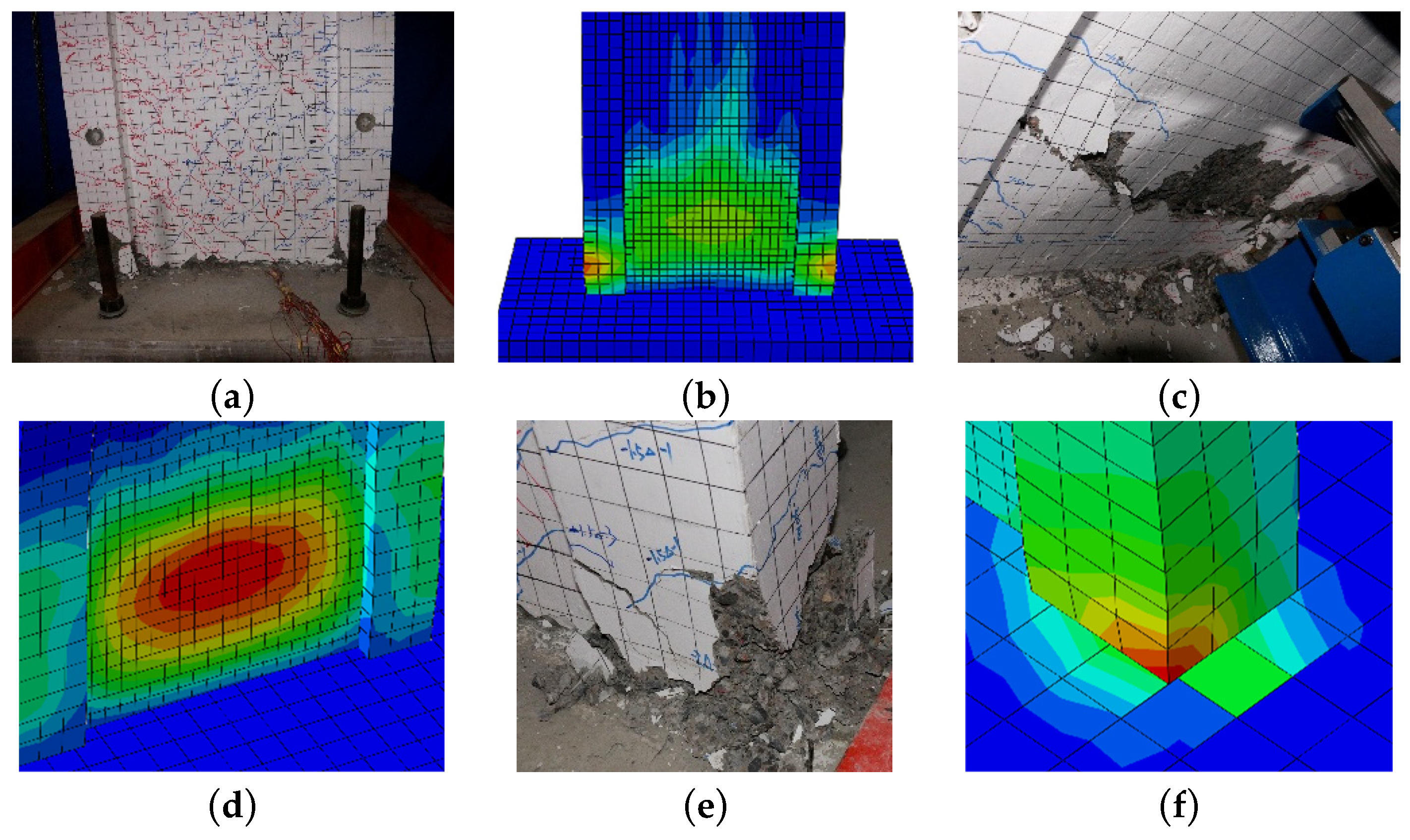
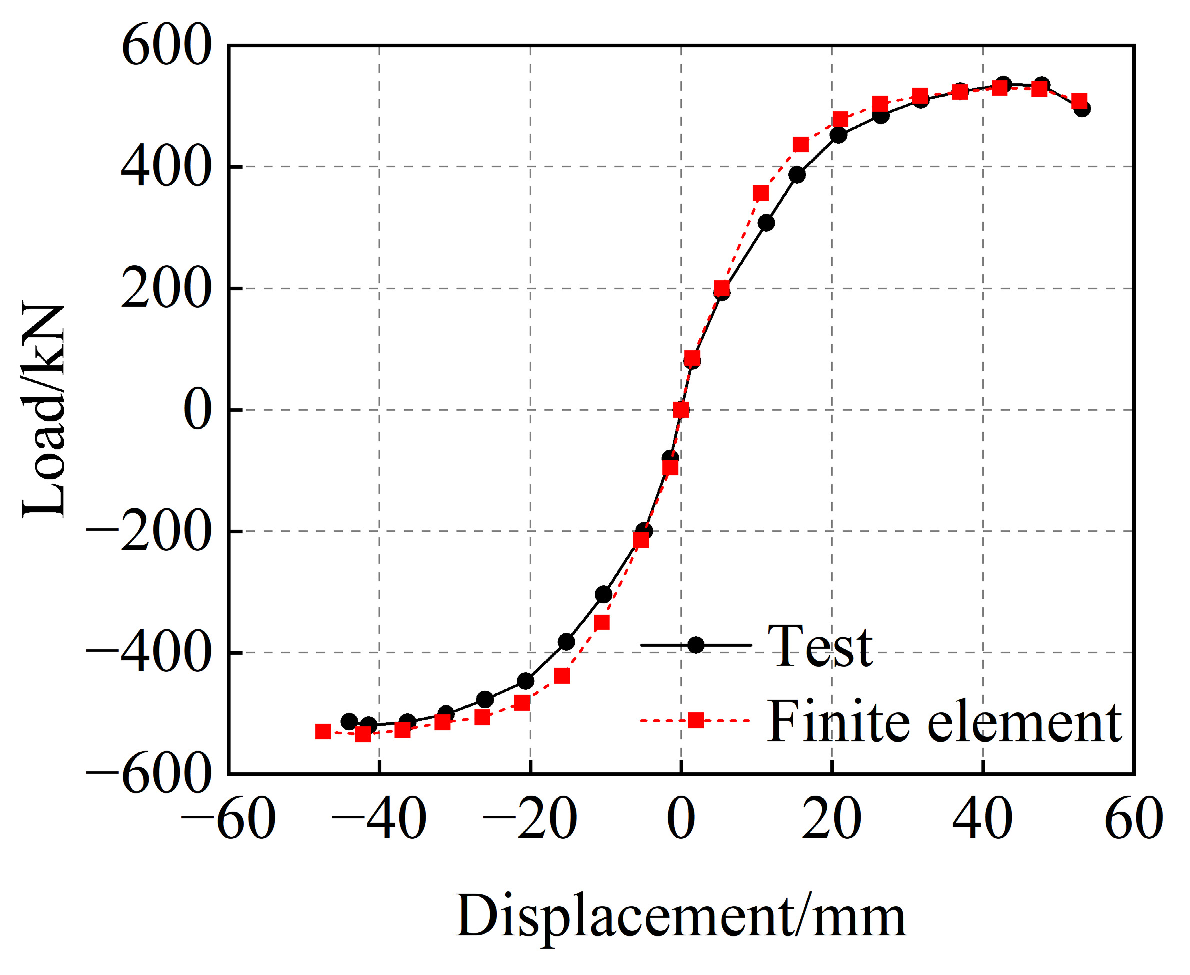
The typical failure mode obtained from the finite element analysis is shown in Figure 1. A comparison between the simulated and experimental skeleton curves is presented in Figure 2, while the corresponding bearing capacities are compared in Table 1. Overall, the finite element results are in good agreement with the experimental data. This indicates that the adopted detailed finite element model can effectively simulate the mechanical behavior of reinforced concrete shear walls under low-cycle loading and grain lateral pressure.

3. Parametric Study

3.1. Concrete Strength

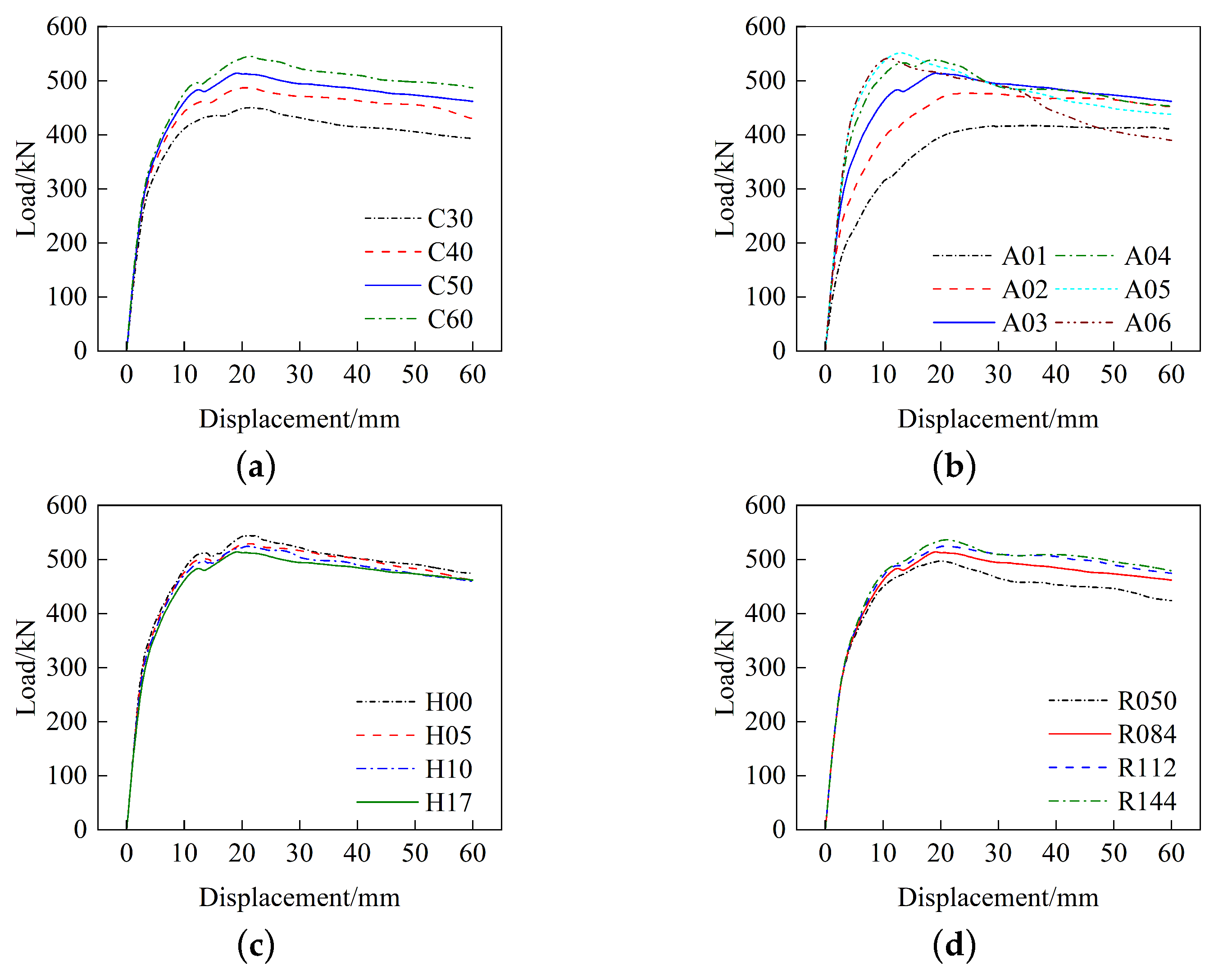
Four finite element models with concrete strength grades ranging from C30 to C60 were established to investigate the influence of concrete strength on seismic performance. As shown in Figure 3a and Table 2, the yield bearing capacity, peak bearing capacity, and initial stiffness of the specimens all increase with concrete strength. This trend occurs because higher concrete strength directly enhances the compressive capacity of the wall section, leading to a marked gain in bearing capacity. The concurrent increase in the modulus of elasticity results in a more modest improvement in initial stiffness.

3.2. Axial Compression Ratio

In this group, six models with design axial compression ratios of 0.1, 0.2, 0.3, 0.4, 0.5, and 0.6 were established. As shown in Figure 3b and Table 3, when the axial compression ratio is below 0.5, the yield bearing capacity, peak bearing capacity, and initial stiffness of the specimens increase with the axial compression ratio. However, a reversal is observed at a ratio of 0.6, where both yield and peak capacities drop slightly below the values at 0.5. This non-monotonic behavior can be attributed to two competing mechanisms: (1) A moderate axial load increases the sectional compressive stress, enhancing the yield resistance of concrete and reinforcement. (2) As the lateral deformation grows near peak load, a higher axial compression ratio exacerbates the secondary moment, ultimately compromising the load-carrying capacity.

3.3. Grain Loading Height

In this group, four models with grain loading heights of 0, 5, 10, and 17 were established. As shown in Figure 3c and Table 4, the bearing capacity and initial stiffness exhibit a clear decreasing trend with increasing grain loading height. This reduction is primarily due to the additional lateral pressure imposed by the stored grain, which acts as a sustained horizontal load on the wall. This pressure increases the shear demand and promotes earlier yielding of the reinforcement. Following the attainment of peak bearing capacity, significant lateral displacement develops at the mid-height of the wall. The interaction between the axial load and this displacement generates a substantial additional bending moment—a geometric nonlinearity known as the second-order effect. This mechanism is further exacerbated by the sustained grain lateral pressure, ultimately leading to a reduction in the load-resisting capacity.

3.4. Wall Longitudinal Reinforcement Ratio

In this group, four models with wall longitudinal reinforcement ratios of 0.50%, 0.84%, 1.12%, and 1.44% were established. As shown in Figure 3d and Table 5, both the yield load and peak load show a marked increase with higher reinforcement ratios, while the improvement in initial stiffness is more moderate. This behavior stems from the distinct roles in load resistance: the longitudinal reinforcement is primarily responsible for flexural tension, so increasing its ratio directly enhances the section’s moment capacity and thus the bearing capacity. In contrast, the initial stiffness is dominated by the elastic properties of concrete and the gross section geometry, to which additional steel contributes less significantly.

3.5. Parameter Sensitivity Analysis

A multiple linear regression analysis was performed with the peak load as the dependent variable and the concrete strength, axial compression ratio, grain loading height, and wall longitudinal reinforcement ratio as independent variables. The results are summarized in Table 6. The standardized coefficients (Beta) were 0.463 for concrete strength, 0.678 for axial compression ratio, −0.308 for grain loading height, and 0.243 for wall longitudinal reinforcement ratio. This indicates that the axial compression ratio has the greatest influence on the shear wall specimens, followed by concrete strength and grain loading height, while the wall longitudinal reinforcement ratio has a relatively minor influence. In terms of significance, concrete strength, axial compression ratio, and grain loading height have significant effects (p < 0.05), whereas the wall longitudinal reinforcement ratio does not (p > 0.05).
This quantitative ranking corroborates the preceding parametric studies. The predominance of the axial compression ratio and concrete strength underscores the critical role of compressive resistance. The significant negative effect of grain loading height quantifies the detrimental impact of sustained lateral pressure. The relatively minor influence of reinforcement ratio suggests that flexural capacity is not the sole governing factor under the combined action of grain pressure and seismic loading.

4. Conclusions

This study conducted a systematic parametric analysis on the seismic performance of shear walls in granular grain warehouses under grain lateral pressure using finite element modeling. The main conclusions are as follows:
(1)
The axial compression ratio is the most influential parameter. It improves seismic capacity up to a threshold (0.5), beyond which the induced second-order effect reduces performance.
(2)
Concrete strength significantly enhances load capacity, more so than the longitudinal reinforcement ratio. Both have limited effects on initial stiffness.
(3)
Increasing the grain loading height consistently degrades all seismic performance metrics due to the additional sustained lateral pressure.
(4)
Sensitivity analysis confirms this parameter hierarchy, with the reinforcement ratio showing a relatively minor influence.
These conclusions highlight the critical need to optimize the axial compression ratio and mitigate the effects of grain pressure on the seismic design of such specialized structures.

Author Contributions

Conceptualization, H.Z. and L.C.; methodology, H.Z. and L.C.; software, S.Z.; validation, H.Z., S.Z. and L.C.; formal analysis, S.Z.; investigation, S.Z.; resources, H.Z. and L.C.; data curation, S.Z.; writing—original draft preparation, S.Z.; writing—review and editing, H.Z., S.Z. and L.C.; visualization, S.Z.; supervision, H.Z. and L.C.; project administration, H.Z. and L.C.; funding acquisition, H.Z. and L.C. All authors have read and agreed to the published version of the manuscript.

Funding

This research received no external funding. The APC was funded by Henan University of Technology.

Institutional Review Board Statement

Not applicable.

Informed Consent Statement

Not applicable.

Data Availability Statement

The finite-element simulation-related data generated in this study can be obtained from the corresponding author upon reasonable request.

Conflicts of Interest

The authors declare no conflict of interest.

References

  1. Xu, Q.K.; Zhang, R.L.; Liu, Q.; Cao, L.; Ding, Y.; Wang, H. Dynamic lateral pressure analysis of granular grain building warehouse walls under seismic effects. Trans. Chin. Soc. Agric. Eng. 2024, 40, 49–58. [Google Scholar] [CrossRef]
  2. Ding, Y.; Li, Z.; Zhao, J.; Guo, C.; Xu, Z.; Ren, G.; Xu, Q.; Xian, Q.; Yang, R. Seismic performance and damage model of prefabricated SRC joints in multi-floored grain warehouse. J. Build. Eng. 2025, 111, 113514. [Google Scholar] [CrossRef] [Scilit]
  3. Wang, H.; Ding, Y.; Wang, G.; Xu, Q.; Zhang, Y. Seismic performance of multi-floor grain warehouse under various storage conditions. Appl. Sci. 2025, 15, 9128. [Google Scholar] [CrossRef] [Scilit]
  4. Wang, G.L.; Xu, Q.K.; Ding, Y.G.; Ding, Y.; Wang, G. Shaking table test on multi-floored grain warehouse under different storage material conditions. Trans. Chin. Soc. Agric. Eng. 2025, 41, 333–342. [Google Scholar] [CrossRef]
  5. Gu, Z.W.; Liu, C.G. Vulnerability analysis of the grain multi-storied warehouse under earthquake load. J. Water Resour. Archit. Eng. 2022, 20, 209–215. [Google Scholar] [CrossRef]
  6. Jin, L.; Miao, L.Y.; Du; L., X. Shear failure of geometrically similar RC shear walls: Mesoscopic modellings and analysis. Structures 2023, 51, 1109–1122. [Google Scholar] [CrossRef] [Scilit]
  7. Miao, L.; Jin, L.; Li, D.; Du, X.; Zhang, B. Effect of shear-span ratio and vertical reinforcement ratio on the failure of geometrical-similar RC shear walls. Eng. Fail. Anal. 2022, 139, 106407. [Google Scholar] [CrossRef] [Scilit]
  8. Nie, X.; Wang, J.-J.; Tao, M.-X.; Fan, J.-S.; Mo, Y.L.; Zhang, Z.-Y. Experimental study of shear-critical reinforced-concrete shear walls under tension-bending shear-combined cyclic load. J. Struct. Eng. 2020, 146, 04020047. [Google Scholar] [CrossRef] [Scilit]
  9. Cheng, Y.; He, H.; Sun, H.; Cheng, S. Experimental study and mechanism analysis of out-of-plane seismic performance of reinforced concrete shear walls. J. Build. Eng. 2023, 80, 108058. [Google Scholar] [CrossRef] [Scilit]
  10. Gao, X. Experimental Study on Seismic Performance of RC Shear Wall of Bulk Grain Building Warehouse. Master’s Thesis, Henan University of Technology, Zhengzhou, China, 2024. [Google Scholar] [CrossRef]
Figure 1. Comparison of finite element simulation and test phenomena. (a) Testing the overall failure mode; (b) simulating overall failure modes; (c) testing out-of-plane failure; (d) simulating out-of-plane failure; (e) testing end column failure; (f) simulating end post failure.
Engproc 146 00020 g001
Figure 2. Comparison of finite element simulation and test skeleton curve.
Engproc 146 00020 g002
Figure 3. Different models. (a) Concrete strengths; (b) axial pressure ratios; (c) grain loading heights; (d) wall longitudinal reinforcement ratio.
Engproc 146 00020 g003
Table 1. Comparison of test peak value and finite element calculation value.
Specimen NumberLoading DirectionFp/kNFc/kNFp/Fc
SW-2Forward direction535.56529.9071.01
Reverse direction519.493534.5010.94
Note: Fp and Fc are the test results and finite element calculation results of bearing capacity, respectively.
Table 2. Bearing capacity and initial stiffness under different concrete strengths.
Concrete StrengthYield Load/kNPeak Load/kNInitial Stiffness/(kN/mm)
C30383.62373.2936.06
C40414.78487.1538.80
C50434.16514.0240.80
C60461.19544.6842.17
Table 3. Bearing capacity and initial stiffness under different axial compression ratios.
Axial Compression RatioYield Load/kNPeak Load/kNInitial Stiffness
/(kN/mm)
0.1340.95417.0727.69
0.2399.70477.3735.11
0.3434.16514.0240.80
0.4462.18538.3544.81
0.5475.88551.4546.53
0.6473.98541.53746.14
Table 4. Bearing capacity and initial stiffness at different grain loading heights.
Grain Loading HeightYield Load/kNPeak Load/kNInitial Stiffness/(kN·mm−1)
0456.23544.2842.98
5448.48529.2442.29
10444.31524.3041.62
17434.16514.0240.80
Table 5. Bearing capacity and initial stiffness at different wall longitudinal reinforcement ratios.
WallYield Load
/kN
Peak Load
/kN
Initial Stiffness
/(kN/mm)
0.50%419.33497.1139.55
0.84%434.16514.0240.80
1.12%446.18524.5441.37
1.44%457.74536.6341.55
Table 6. Results of linear regression analysis.
ItemsCoefficientsStand
Error
Standardization
Coefficient (Beta)
t-StatisticSignificant
Constant293.11442.789-6.8500.000 **
Concrete strength2.8120.6990.4634.0210.001 **
Axial compression ratio230.31039.0340.6785.9000.000 **
Grain loading height−2.2250.834−0.308−2.6690.019 **
Wall longitudinal reinforcement ratio48.35322.9020.2432.1110.055
Note: At the significance level of 0.05, ** indicates significant.
Disclaimer/Publisher’s Note: The statements, opinions and data contained in all publications are solely those of the individual author(s) and contributor(s) and not of MDPI and/or the editor(s). MDPI and/or the editor(s) disclaim responsibility for any injury to people or property resulting from any ideas, methods, instructions or products referred to in the content.