1. Introduction
Local topography is a critical factor influencing seismic hazard, capable of significantly altering the amplitude, acceleration, and spectral characteristics of ground motion in its vicinity [
1,
2]. These modifications directly impact the seismic performance and safety of structures [
3,
4]. With accelerating global urbanisation, populations and critical infrastructure are increasingly concentrated in seismically active regions. Consequently, a major earthquake in such areas carries the potential for catastrophic human and economic losses. It is therefore imperative to deepen our understanding of seismic wave scattering phenomena in complex near-source geological settings.
The loess yuan—a vast, table-like landform characteristic of loess plateau regions—is both a region of strategic socio-economic importance [
5] and one prone to strong seismic activity [
6,
7]. This study investigates the scattering of SH-waves by such a prototypical near-source topography, which is idealized as an asymmetric trapezoidal ridge. We develop a semi-analytical solution based on an extended wave function expansion framework, integrating several key theoretical techniques including the wave field mirror method, multi-region matching, and complex function theory [
8,
9,
10].
The principal advancements of this work are threefold: (i) the incorporation of cylindrical wavefront incidence to model near-source effects; (ii) the development of a multi-region formulation to handle the asymmetric trapezoidal geometry; and (iii) the derivation of an efficient semi-analytical solution that is synthesized into the time domain analysis. The proposed method is rigorously validated and demonstrates a significant computational advantage over conventional numerical approaches.
2. Geometric Model and Analytical Formulation
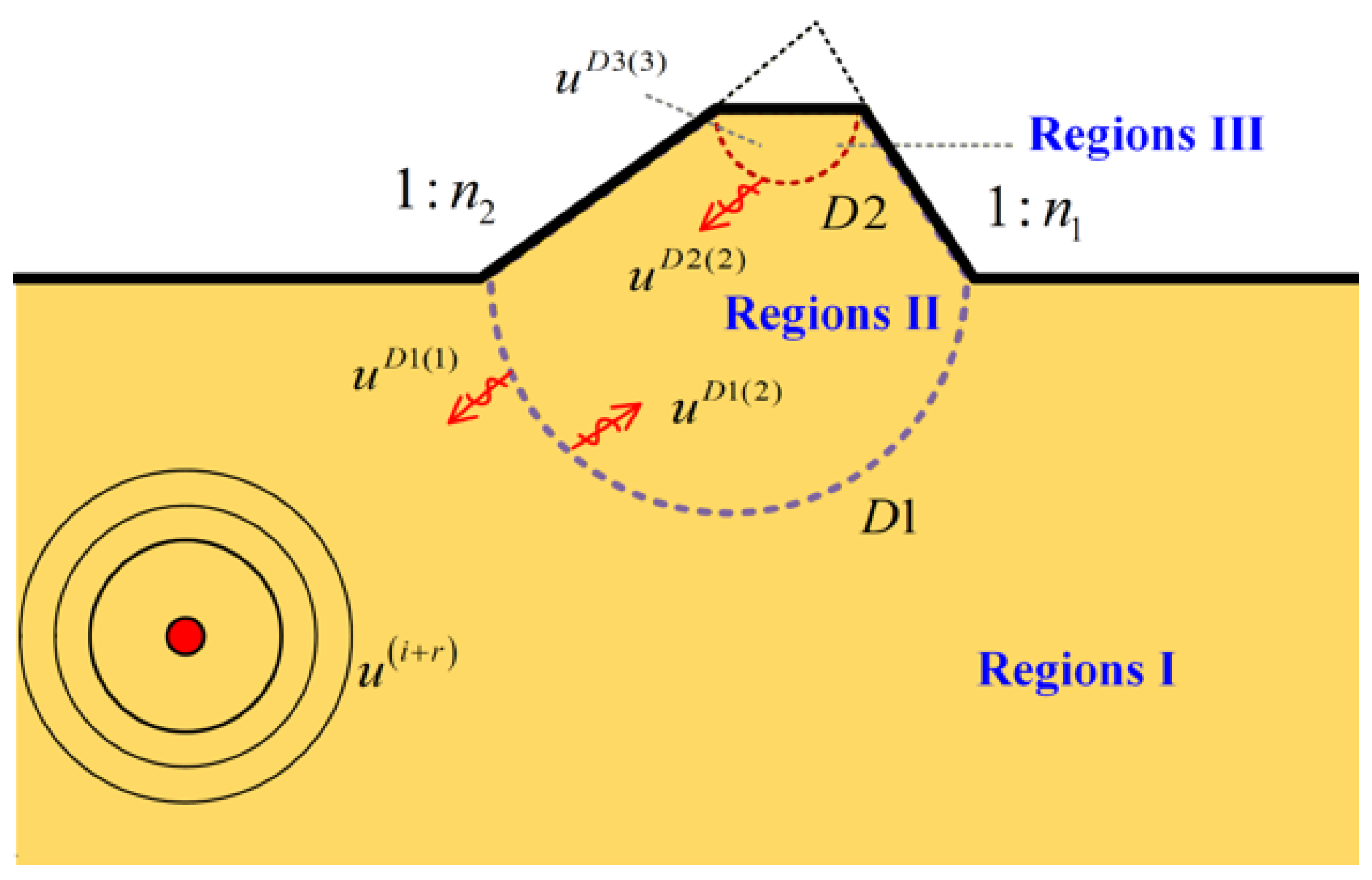
The physical problem is conceptualized within a two-dimensional, infinite, elastic half-space. The loess yuan topography is idealized as a homogeneous, isotropic, linearly elastic trapezoidal protrusion with dissimilar flank slopes, representing a canonical local topographic feature. The incident seismic excitation is modelled as a cylindrical SH-wave emanating from a line source located at coordinates
, simulating near-source conditions. The geometric configuration is depicted in
Figure 1. The trapezoid is defined by a top width
, a base width
, and left- and right-side slopes of
and
, respectively.
The medium is characterized by a constant shear modulus
and shear wave velocity
(with wavenumber
). To facilitate the application of the wave function expansion method, the total domain is partitioned into three sub-regions (Regions I, II, III) by introducing two virtual, circular auxiliary boundaries, D1 and D2 (
Figure 1).
The total wavefield in Region I (the semi-infinite domain exterior to D1) comprises the incident-reflected field,
, and the scattered field
radiating outward from boundary D1:
where
is the
-th order Hankel function of the first kind,
is the complex coordinate in the local system, and
denotes the image of the source about the flat free surface. The form of the series ensures automatic satisfaction of the stress-free condition on the horizontal ground surface.
Region II (the annular domain between D1 and D2) hosts a standing wavefields, constructed using Bessel
and Hankel
functions, respectively:
Region III (the interior domain bounded by D2) contains a standing wavefield:
The unknown complex expansion coefficients
are determined by enforcing continuity of displacement and shear stress across the virtual interfaces D1 and D2. This yields the following system of coupled equations:
Shear stress components are derived from the constitutive relation . The problem is reduced to a system of linear algebraic equations via the collocation and truncation method. The unknown coefficients are subsequently determined through standard matrix operations, yielding the semi-analytical solution.
3. Time-Domain Analysis and Numerical Validation
The semi-analytical solution derived in the frequency domain is transformed into the time domain to elucidate the transient response characteristics of the near-source yuan topography. This is achieved through the application of the Inverse Fourier Transform (IFT). To ensure broad relevance and practical utility for seismic engineering, a Ricker wavelet is selected as the excitation signal.
A total of 100 points from 0.06π Hz to 8π Hz are taken to ensure adequate frequency sampling. The model parameters are set as follows: shear wave velocity
, central frequency
, and shear modulus
. The trapezoidal topography has slopes
(gentle) and
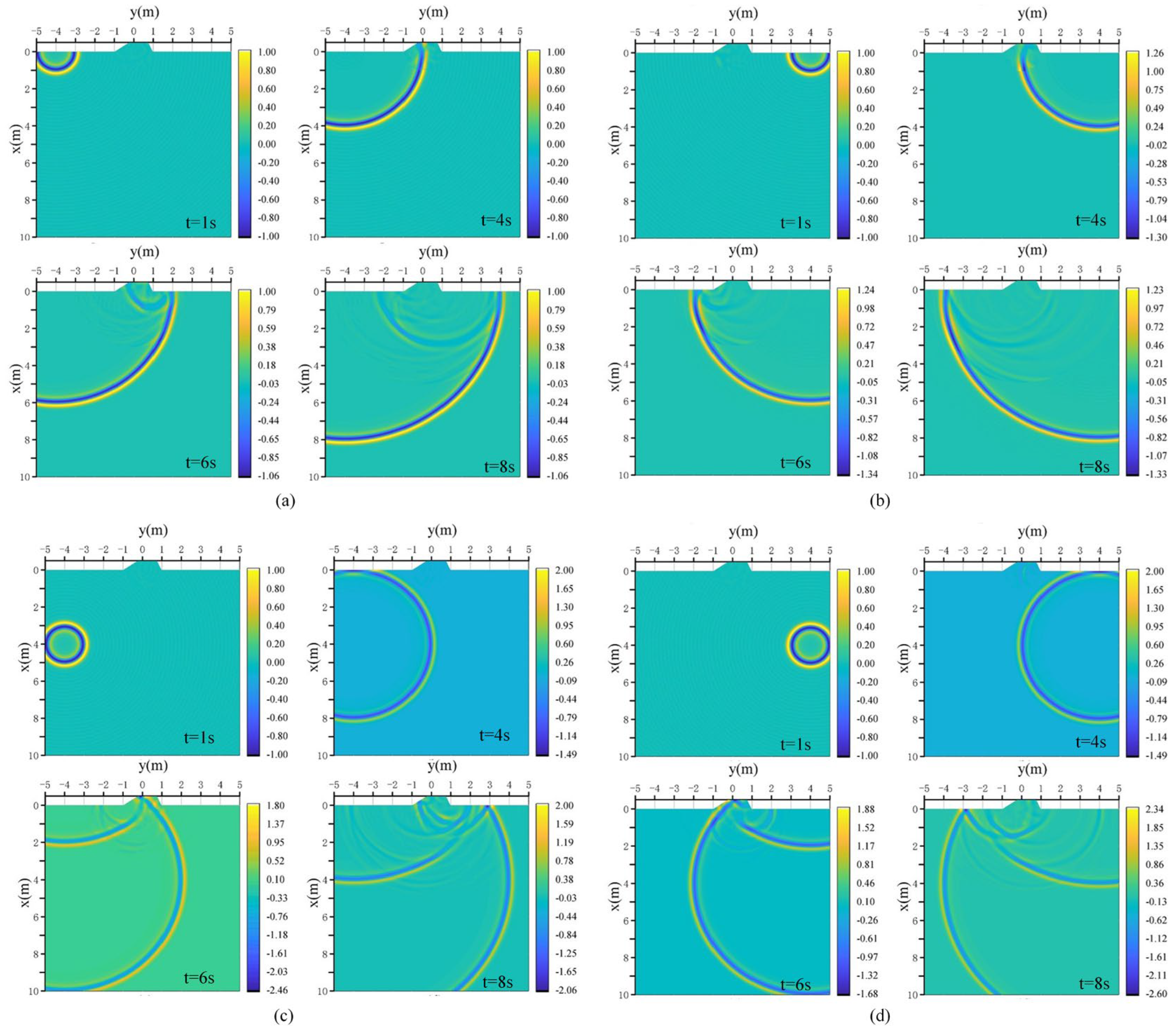
(steep). Four distinct source locations are analyzed: (0, −4a), (0, 4a), (4a, −4a), and (4a, 4a), representing incidence from the gentle-slope side and the steep-slope side, respectively. Snapshots of the resultant out-of-plane displacement field at t = 1, 4, 6, and 8 s are presented in
Figure 2.
The wave propagation exhibits clear cylindrical spreading from the line source, with amplitude decay over distance consistent with geometric spreading. The sequence of snapshots reveals the evolution from a localized disturbance near the source (t = 1 s) to a wavefield encompassing the entire domain (t = 6, 8 s).
The interaction with the trapezoidal topography induces complex scattering phenomena. At t = 4 s, as the wavefront impinges on the protrusion, a pronounced focusing effect is observed, leading to significant amplification of displacement amplitudes within and atop the yuan. Crucially, this amplification persists at later times (t = 6, 8 s), indicating that the topographic feature acts as a sustained secondary source due to multiple internal reflections and scattering, prolonging the duration of shaking.
The asymmetric slope geometry (
) leads to direction-dependent responses. Comparison between gentle-slope incidence (
Figure 2a, source at (0, −4a)) and steep-slope incidence (
Figure 2b, source at (0, 4a)) shows broadly similar wavefront evolution but distinct amplification patterns. Incidence against the steeper flank results in larger positive/negative displacement peaks in the subsurface region directly beneath the slope, highlighting a significant amplification hazard for embedded structures despite the surface screening effect of the steep face. Subsurface sources (
Figure 2c,d) exhibit roughly doubled amplitudes compared to surface sources (
Figure 2a,b), consistent with the constructive interference between incident and surface-reflected waves prior to topographic interaction.
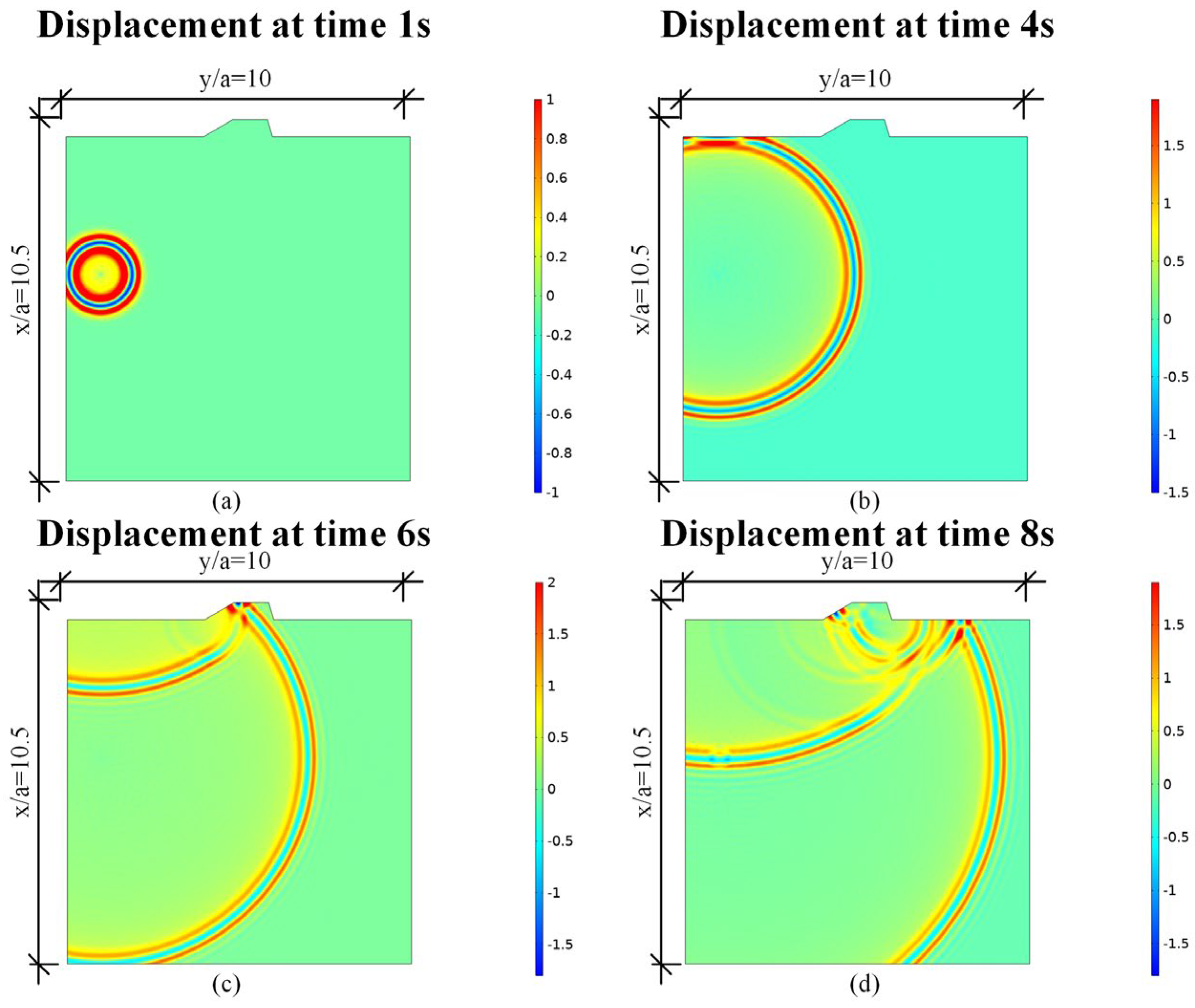
The semi-analytical time-domain solution is validated through finite element (FEM) simulations in COMSOL Multiphysics
® version 6.2, configured with identical parameters and absorbing boundaries. The wavefield patterns and amplification factors show excellent agreement with the semi-analytical results (cf.
Figure 2c and
Figure 3), confirming the method’s accuracy. Minor discrepancies are attributable to numerical approximations in the FEM model versus the theoretical precision of the 2D semi-analytical solution.
A critical advantage of the semi-analytical approach is its computational efficiency. A direct comparison was performed on an identical computing platform (Intel Core i7-12700F, 32GB RAM). For the
model, the time required to compute the wavefield snapshot at t = 8 s was 53.4 s using the semi-analytical/IFFT method, compared to 308 s for the FEM simulation—an acceleration of ~5.8×. Even for an earlier snapshot (t = 1 s), the semi-analytic method was 5.2 times faster (45.3 s vs. 234 s). This efficiency gain, which becomes more pronounced for later times in the simulation.
This gain in efficiency becomes increasingly pronounced during the later stages of the simulation, a direct consequence of the fundamental methodological differences between the two approaches. The Finite Element Method (FEM) requires a spatially fine mesh to accurately resolve the wavefield across the entire frequency spectrum excited by the Ricker wavelet, particularly at higher frequencies. This necessity results in a large system of equations that must be solved at each time step or frequency point. In contrast, the semi-analytical solution, rooted in the wave-function expansion method, is inherently a mesh-free boundary-value technique. Its convergence is primarily governed by the truncation order N of the expansion series. Once an adequate N is determined for the frequency range of interest—which is typically much smaller than the number of degrees of freedom in an FEM model—the solution is obtained by solving a relatively small, dense system of linear equations for the expansion coefficients at each frequency. Subsequent synthesis into the time domain via the Inverse Fast Fourier Transform (IFFT) is computationally inexpensive. This inherent efficiency renders the semi-analytical method particularly well-suited for parametric studies.