Proceeding Paper

Multi-Objective Material Selection Framework for Additively Manufactured Aircraft Wing Ribs †

by
Venkata Aditya Nag Mannepalli
and
Sudhir Sastry Yedla Bala
*
Department of Aerospace Engineering, JAIN (Deemed-to-be University), Kanakapura Road, Bengaluru 562112, India
*
Author to whom correspondence should be addressed.
Presented at The 1st International Online Conference on Aerospace (IOCAE 2026), 16–17 April 2026; Available online: https://sciforum.net/event/IOCAE2026.
Eng. Proc. 2026, 142(1), 10; https://doi.org/10.3390/engproc2026142010
Published: 20 July 2026

Abstract

Aircraft wing ribs form the skeletal backbone of the wing. They maintain the aerodynamic profile and transfer structural loads from the skin to the spars. Conventional manufacturing processes struggle to produce complex geometries, making these components difficult and expensive to manufacture. Recent advances in additive manufacturing (AM) address these limitations. Additive manufacturing enables the production of complex geometries that significantly reduce weight. Most designers use the standard Ashby method to identify the strongest or lightest metal. However, they often overlook whether the material will behave as expected during additive printing. This research focuses on Multi-Objective Material Selection for the design of the additive manufacturability of aircraft wing ribs using aluminium-based alloys. A key innovation in this research is the formulation of hybrid performance indices (HPIs). These indices go beyond the traditional Ashby methodology. They mathematically couple structural efficiency metrics with a weighted Processability Factor. The structural metrics include specific density, stiffness, specific strength, and Embodied-Energy-Strength-to-Embodied-Energy Index. The Processability Factor accounts for local material availability, thermal conductivity, printability, recyclability and material cost. This dual evaluation assesses both structural integrity and manufacturing risk simultaneously. The process produces an Additive Pareto Optimal set of candidate materials. This helps engineers predict and prevent issues like warping and residual stress before printing begins. The framework also emphasises sustainability. It prioritises materials that minimise waste and considers embodied energy in the selection process. The framework identifies high-performance aluminium alloys that are specifically optimised for the additive manufacturing of aircraft wing ribs. It provides a definitive ranking based on their ability to withstand aerodynamic loads while remaining easy to print. This data-driven approach replaces trial and error with a clear selection matrix for the early design stage. It ensures that the chosen alloy is both structurally sound and manufacturable for aerospace applications.

1. Introduction

In recent years, there have been tremendous advances in additive manufacturing, especially in the aerospace sector. Traditional manufacturing struggles with complex geometries, making wing ribs difficult and expensive to produce. Recent advances in additive manufacturing (AM) allow the creation of intricate shapes while significantly reducing weight [1,2,3]. Researchers are either focusing on improving manufacturing processes to enhance the manufacturability of existing products or innovating new products that are easier to produce and improve the quality of life [4,5,6]. In this context, the current research relates to aircraft wing ribs. Aircraft wing ribs are crucial for the overall performance of the aircraft and serve as vital components of the wing. Several researchers have examined the compatibility of additive manufacturing for thin-wall structures such as wing ribs. Among the researchers, Dogea R et al. have conducted extensive research on the additive manufacturability of the wing ribs [7,8,9,10,11,12]. Dogea R et al. performed a static ANSYS R17.1analysis of the Boeing 747-400 wing under OEW conditions, modelling it in CATIA with a rib-to-cap thickness ratio of 2:1 and an NACA 0018 airfoil [7]. Results indicated that a 3 mm thick wing rib performs adequately. In 2022, Dogea extended this research by developing an integrated process planning methodology that combines design for additive manufacturing with process parameter optimisation, including build orientation, support strategies, and post- processing. This approach reduced manufacturing time by 40% and material waste by 35%, highlighting the importance of concurrent design and manufacturing planning for complex geometries [8,9,10]. Dogea, R. et al. conducted Ansys-based bending and torsion analyses using Dogea, R et al.’s derivative model. This is a static simulation. The model was developed using CATIA software and tested in a real-time traction scenario, comparing the wing rib with and without a sensor allowance. The wing rib with sensors was found to perform optimally compared to one without sensors [11]. However, the research done by Dogea, R. et al. was focused on aluminium alloys (such as AA 7050 and Al 7050-T 745) and Polylactic Acid (PLA) [7,8,9,10,11,12]. Although the contributions done by them were focused on aluminium alloys during their initial simulations, Dogea, R. et al. have done experimentation using the PLA material [11,12].
On the other hand, the usage of the Ashby Charts has also been gaining a prominent role in the faster decision-making of the selection of the materials with multiple objectives and constraints [13]. These techniques are also utilised in the selection of materials for additive manufacturing. In real-world scenarios, the computational simulation technique requires minimal infrastructure, typically a workstation, to evaluate material selection for the process. To minimise evaluation costs, the Ashby-prescribed methodology is used to select the additive manufacturing process for aluminium alloys by designing additive manufacturing techniques. However, the selection of materials and the design of manufacturing methodologies prescribed by Gibson et al. may also need to be explored within dimensional similitude constraints, particularly during the additive printing of thin-walled aircraft structures [14].
Although the applicability of additive manufacturing is very high, its efficacy is predominantly determined by the print settings, orientation, material quality, and print orientation [14,15,16,17]. Recent studies also show that print parameters, specifically layer thickness, significantly affect the performance, microstructural integrity, and manufacturability of additively manufactured components, especially in AlSi10Mg alloys [18,19,20,21,22,23,24,25]. Hence, it seems to be essential for early evaluation of the menu of materials using the material properties using the Ashby Methodology and printing parts using additive manufacturing. This research is inspired by the work of Dogea R. et al., with a focus on selecting materials for the manufacturability of wing ribs using additively manufactured, compatible materials [11]. The Multi-Objective Material Selection for design for manufacturability is tested without the use of Computer Aided Engineering (CAE) simulation software and is implemented to enable researchers to make quicker decisions using the Ashby methodology for cost-effectiveness. This paper relates to the detailed exploration of the usage of the Ashby methodology in the design for manufacturability of the NACA 0018 air-profiled aircraft wing ribs and explores the challenges faced during the printing of the thin-walled aircraft structures.

2. Research Methodology

To select materials for any product, we can either use the existing literature to replicate the product through CAE software simulations or use the Ashby Methodology for quicker decision-making. The current research focuses on maximising the use of the Ashby Methodology with Multi-Objective Material Selection techniques, using the material properties of various aluminium alloys and additive manufacturing machine parameters. The structural metrics include specific density, stiffness, specific strength, and the Embodied-Energy-Strength-to-Embodied-Energy Index. The Processability Factor accounts for local material availability, thermal conductivity, printability, recyclability, and material cost. All materials dealt with by Dogea R. et al. are considered, along with locally available aluminium alloys compatible with additive manufacturing, namely, AlSi10Mg and the material properties are outlined in Table 1.
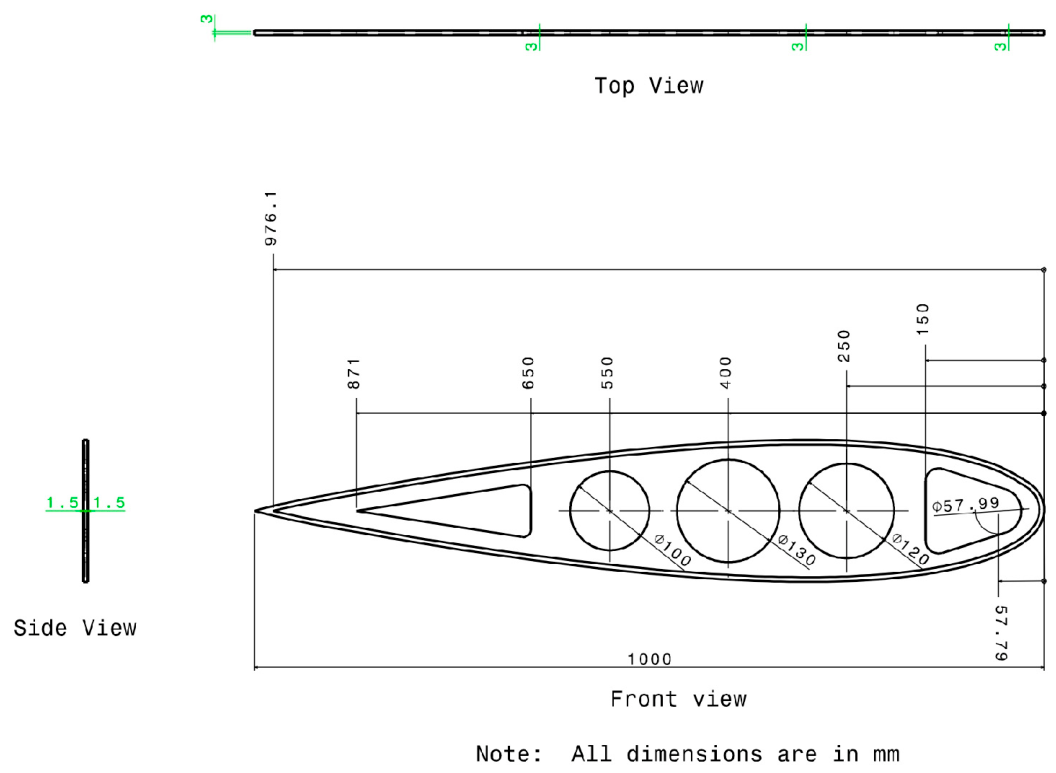
The multi-objective material selection framework for additively manufactured aircraft wing ribs is outlined in Table 2. During the selection of materials, mechanical performance plays a vital role, especially the maximum stiffness, which is taken as the ratio of Young’s modulus to the density. This helps prevent deflection under load and is essential for carrying stress without failure. The sustainability assessment is based on minimising embodied energy and maximising recyclability. Minimise embodied energy is calculated in terms of the Strength-to-Embodied-Energy Index (σy/ρEm). For a static barrier, this index can be crucial, but for an aircraft wing rib, light weighting is the priority for a lower overall life energy. The recyclability, manufacturability, and product manufacturing cost factors were based on qualitative data and the opinions of local manufacturers [7,8,9]. The best materials are selected using Ashby charts and Pareto optimisation, and then manufactured under simulated constraints at 0.3 of the scale used by Dogea R et al., as shown in Figure 1 [10]. CATIA V5 R2021 is used to design the replica model of Dogea R et al.’s design, and the STL file is then shared with the manufacturing industry partner to assess the design for manufacturability of the thin-wall structural components, i.e., the aircraft wing rib, at various web thicknesses and flange thicknesses (comprising the upper and lower caps) simultaneously.

3. Results and Discussion

Based on the application of the proposed multi-objective material selection framework for additively manufactured aircraft wing ribs using Ashby methodology, the results are detailed as follows:

3.1. Multi-Objective Material Selection Framework

The material properties listed in Table 1 are considered and incorporated into the proposed material selection framework. Table 3 presents the observations.

3.1.1. Mechanical Performance

The mechanical performance of the various aluminium alloys is considered. It is observed that aluminium alloys have inherently similar specific stiffness. AM AlSi10Mg is slightly lower than cast alloys due to rapid cooling textures and potential anisotropy. Al 7050-T7451 dominates in pure material strength. AM AlSi10Mg significantly outperforms cast alloys due to its fine cellular microstructure.

3.1.2. Manufacturability, Cost and Sustainability

Table 3 shows that Al 7050 is difficult to weld or print due to hot cracking. AlSi10Mg, a common choice in additive manufacturing (AM), resists cracking thanks to its silicon content. Although AM powders (~$50–100/kg) are more expensive than ingots or plates, the buy-to-fly ratio savings can offset this for complex parts. Despite AM’s high embodied energy (~250+ MJ/kg) from powder atomisation and laser use, its high yield strength offers a relative advantage over casting. Recycled wrought and cast aluminium alloys are straightforward to recycle. AlSi10Mg powder in AM can also be recycled, but oxygen pickup and degradation limit this process.
Overall, AlSi10Mg (AM) is the optimal material for additive manufacturing of the NACA 0018 airfoiled wing rib.

3.2. Simultaneous Constraint and Manufacturing

Dogea (2021) studied the selection of manufacturing processes for different materials, focusing on steel, titanium, and aluminium. They found that for aluminium and its alloys, the recommended process is Selective Laser Melting (SLM), an additive manufacturing method [10]. The same manufacturing processes were utilised to manufacture a miniature model with a scale of 0.3 for Dogea R. et al. (2021). The original Dogea R. et al. (2021) wing rib design is about 1 metre in length, and the current manufactured wing rib is 30 cm. The scaling of the web and flange (comprising upper and lower caps) thickness was done as per Table 4.
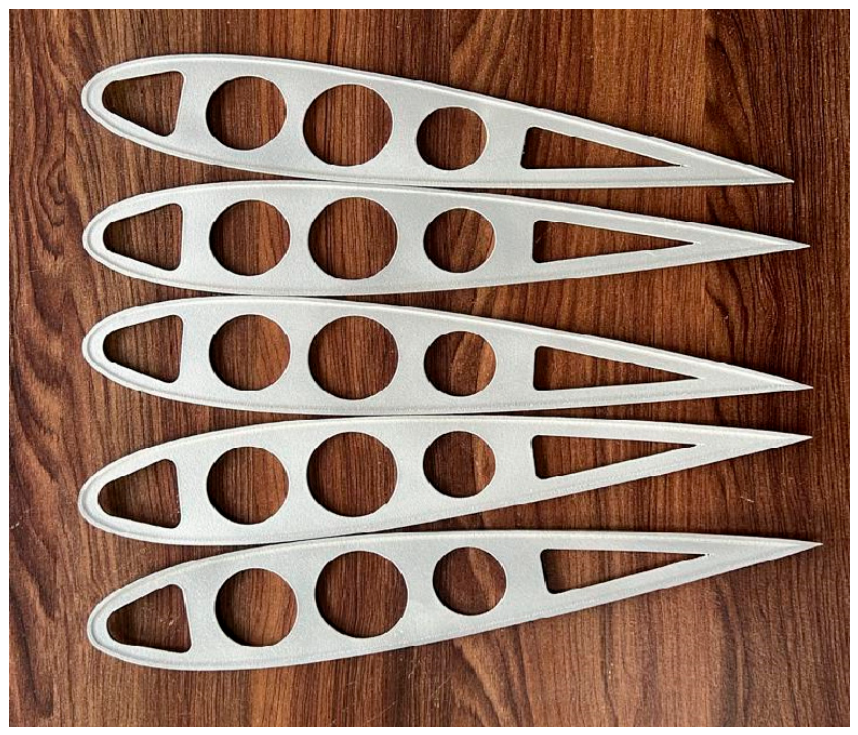
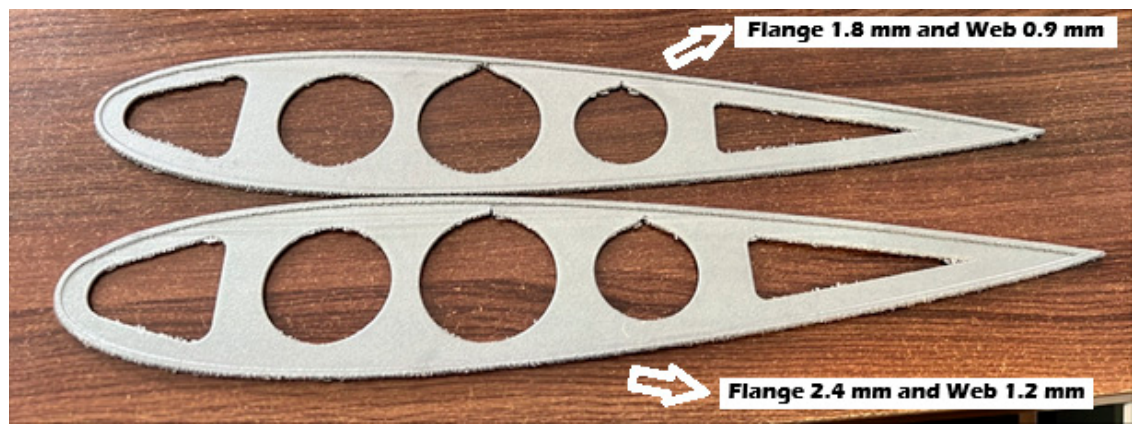
After selecting AlSi10Mg as the manufacturing material, manufacturability was assessed by producing a preliminary prototype. From Figure 2, it is observed that the preliminary web thicknesses of 3 mm and 4 mm are difficult to manufacture at a scale of 0.3 due to limitations of the additive manufacturing machinery. The thin web layers caused thermal distortions, especially where the distance between the boundaries and the upper cap is minimal. In Figure 2, web thicknesses of about 3 mm and 4 mm exhibit distorted surfaces because circular allowances during machining produced shapes affected by the small spacing between the upper caps of the flange. These distortions led to surface imperfections. After observing the distortions and cracks, the base design was modified by increasing the web thickness to 5 mm, and the lower and upper cap thicknesses were maintained at 8 mm. It was found that the aircraft wing rib prototype was successfully manufactured with precise dimensions. However, Figure 3 shows that the component was successfully manufactured with a minimal web thickness of 5 mm and a flange (comprising upper and lower caps) thickness of 8 mm at a scale of 0.3. Since the web thickness was 5 mm and the flange (comprising upper and lower caps) thickness was 8 mm at a scale of 0.3, it is also concluded that the Dogea R. et al.’s (2021) inspired design can be manufactured with a minimum web thickness of 1.5 mm using AlSi10Mg; a web-to-cap thickness ratio of approximately 0.6–0.7 is recommended to ensure proper manufacturability at 0.3 of the original scale.

4. Conclusions

This research presents a multi-objective material selection framework for additively manufactured aircraft wing ribs, based on the Ashby methodology. The study builds on Dogea R et al., focusing on geometric modelling and extending to the additive manufacturability of aluminium alloys [1]. Among the alloys evaluated, AlSi10Mg was identified as the best material due to its compatibility with additive manufacturing and its resistance to hot cracking, unlike alloys such as Al 7050.
Manufacturing trials at a 0.3 scale of Dogea’s design showed that very-thin-web geometries experience thermal distortions and surface imperfections during additive manufacturing. To improve manufacturability, it is recommended that the web thickness and the upper- and lower-cap thickness ratio for AlSi10Mg be around 1:1.6, in contrast with the original 1:2.
The current study did not use computer-aided engineering simulation software. This was done to facilitate faster decision-making. Future work will include comprehensive structural and thermal tests, involving custom fixture manufacturing to evaluate the wing ribs’ workability.
Presently, manufacturing is limited to a miniature model scaled to 0.3 of the original design. Future research should explore full-scale manufacturing and verify whether the optimal web-to-upper- and lower-cap thickness ratios remain valid. The study also aims to expand hybrid performance indices to include new additive manufacturing materials beyond aluminium alloys. This will involve assessing sustainability metrics like recyclability and long-term embodied energy through experimentation.

Author Contributions

Conceptualization, V.A.N.M. and S.S.Y.B.; methodology, S.S.Y.B.; software, V.A.N.M.; vali-dation, V.A.N.M.; formal analysis, V.A.N.M.; investigation, V.A.N.M.; resources, V.A.N.M.; data curation, S.S.Y.B.; writing—original draft preparation, V.A.N.M.; writing—review and editing, V.A.N.M.; visualization, S.S.Y.B.; supervision, S.S.Y.B.; project administration, S.S.Y.B.; funding acquisition, V.A.N.M. All authors have read and agreed to the published version of the manuscript.

Funding

This research was supported by the Institution of Mechanical Engineers (IMechE), UK, through a Student Hardship Grant (Case Reference: 2025-0194).

Data Availability Statement

The original contributions are included in the article. Further inquiries can be directed to the corresponding author.

Acknowledgments

The authors thank the Jain (deemed-to-be University) for providing research facilities and resources. The authors would also like to thank Vexma Technologies, Gujarat, India, for providing manufacturing support.

Conflicts of Interest

The authors declare no conflicts of interest.

References

  1. Gao, W.; Zhang, Y.; Ramanujan, D.; Ramani, K.; Chen, Y.; Williams, C.B.; Wang, C.C.L.; Shin, Y.C.; Zhang, S.; Zavattieri, P.D. The Status, Challenges, and Future of Additive Manufacturing in Engineering. Comput.-Aided Des. 2015, 69, 65–89. [Google Scholar] [CrossRef] [Scilit]
  2. Dobrzańska-Danikiewicz, A.D.; Bączyk, A. A Review of Additive Manufacturing Technologies. Arch. Mater. Sci. Eng. 2024, 128, 68–85. [Google Scholar] [CrossRef] [Scilit]
  3. Frazier, W.E. Metal Additive Manufacturing: A Review. J. Mater. Eng. Perform. 2014, 23, 1917–1928. [Google Scholar] [CrossRef] [Scilit]
  4. Mohanavel, V.; Ali, K.S.A.; Ranganathan, K.; Jeffrey, J.A.; Ravikumar, M.M.; Rajkumar, S. The Roles and Applications of Additive Manufacturing in the Aerospace and Automobile Sector. Mater. Today Proc. 2021, 47, 405–409. [Google Scholar] [CrossRef] [Scilit]
  5. Ngo, T.D.; Kashani, A.; Imbalzano, G.; Nguyen, K.T.Q.; Hui, D. Additive Manufacturing (3D Printing): A Review of Materials, Methods, Applications and Challenges. Compos. Part B Eng. 2018, 143, 172–196. [Google Scholar] [CrossRef] [Scilit]
  6. Goh, C.S.; Gupta, M.; Jarfors, A.E.W.; Tan, M.J.; Wei, J. Magnesium and Aluminium Carbon Nanotube Composites. Key Eng. Mater. 2014, 425, 245–261. [Google Scholar] [CrossRef] [Scilit]
  7. Święch, Ł.; Bendarz, A. Use of 3D Printing Technology in the Aviation Industry on an Example of Numerical Experimental Stress State Analysis of Unmanned Aerial Vehicle Wing. J. KONES Powertrain Transp. 2017, 24, 327–334. [Google Scholar]
  8. Raj, S.A.; Muthukumaran, E.; Jayakrishna, K. A Case Study of 3D Printed PLA and Its Mechanical Properties. Mater. Today Proc. 2018, 5, 11219–11226. [Google Scholar] [CrossRef] [Scilit]
  9. Kopecki, T.; Mazurek, P.; Święch, Ł. The Impact of 3D Printing Parameters on the Post-Buckling Behavior of Thin-Walled Structures. Materials 2020, 13, 4742. [Google Scholar] [CrossRef] [Scilit] [PubMed]
  10. Dogea, R. A Smart Wing Rib Structure Suitable for Design for Additive Manufacturing (DFAM) Process. J. Mater. Sci. Manuf. Res. 2021, 2, 1–21. [Google Scholar] [CrossRef] [Scilit]
  11. Dogea, R.; Yan, X.T.; Millar, R. Additive Manufacturing Process Design for Complex Aircraft Components. Int. J. Adv. Manuf. Technol. 2022, 123, 4195–4211. [Google Scholar] [CrossRef] [Scilit]
  12. Dogea, R.; Yan, X.T.; Millar, R. An Extended Cost Analysis Method for Complex Lightweight Aircraft Components Manufactured with Selective Laser Melting. SN Appl. Sci. 2023, 5, 182. [Google Scholar] [CrossRef] [Scilit]
  13. Dogea, R.; Yan, X.T.; Millar, R. Testing and Evaluation of the Structural Performance of a 3D-Printed Polylactic Acid Aircraft Wing Rib. Discov. Mech. Eng. 2023, 2, 6. [Google Scholar] [CrossRef] [Scilit]
  14. Dogea, R.; Yan, X.T.; Millar, R. Implementation of an Edge-Fog-Cloud Computing IoT Architecture in Aircraft Components. MRS Commun. 2023, 13, 416–424. [Google Scholar] [CrossRef] [Scilit]
  15. Ashby, M.F. Materials Selection in Mechanical Design; Butterworth-Heinemann: Oxford, UK, 2025. [Google Scholar]
  16. Gibson, I.; Rosen, D.; Stucker, B.; Khorasani, M. Additive Manufacturing Technologies; Springer: Cham, Switzerland, 2020. [Google Scholar]
  17. Mandolini, M.; Pradel, P.; Cicconi, P. Design for Additive Manufacturing: Methods and Tools. Appl. Sci. 2022, 12, 6548. [Google Scholar] [CrossRef] [Scilit]
  18. Nguyen, Q.B.; Luu, D.N.; Nai, S.M.L.; Zhu, Z.; Chen, Z.; Wei, J. The Role of Powder Layer Thickness on the Quality of SLM Printed Parts. Arch. Civ. Mech. Eng. 2018, 18, 948–955. [Google Scholar] [CrossRef] [Scilit]
  19. Gullane, A.; Murray, J.W.; Hyde, C.J.; Sankare, S.; Evirgen, A.; Clare, A.T. On the Use of Multiple Layer Thicknesses within Laser Powder Bed Fusion and the Effect on Mechanical Properties. Mater. Des. 2021, 212, 110256. [Google Scholar] [CrossRef] [Scilit]
  20. Liu, M.; Wei, K.; Zeng, X. High Power Laser Powder Bed Fusion of AlSi10Mg Alloy: Effect of Layer Thickness on Defect, Microstructure and Mechanical Property. Mater. Sci. Eng. A 2022, 842, 143107. [Google Scholar] [CrossRef] [Scilit]
  21. Kempen, K.; Thijs, L.; Van Humbeeck, J.; Kruth, J.-P. Mechanical Properties of ALSI10MG Produced by Selective Laser Melting. Phys. Procedia 2012, 39, 439–446. [Google Scholar] [CrossRef] [Scilit]
  22. Giovagnoli, M.; Silvi, G.; Merlin, M.; Di Giovanni, M.T. Optimisation of Process Parameters for an Additively Manufactured AlSi10Mg Alloy: Limitations of the Energy Density-Based Approach on Porosity and Mechanical Properties Estimation. Mater. Sci. Eng. A 2020, 802, 140613. [Google Scholar] [CrossRef] [Scilit]
  23. Defanti, S.; Cappelletti, C.; Gatto, A.; Tognoli, E.; Fabbri, F. Boosting Productivity of Laser Powder Bed Fusion for AlSi10Mg. J. Manuf. Mater. Process. 2022, 6, 112. [Google Scholar] [CrossRef] [Scilit]
  24. Langhe-Industry AlSi10Mg Alloy in Additive Manufacturing & Die Casting. Available online: https://langhe-industry.com/alsi10mg-alloy/ (accessed on 10 December 2025).
  25. AlSi10Mg-Aluminium Material for 3D Printing. Available online: https://www.vexmatech.com/aluminum-material (accessed on 25 August 2025).
Figure 1. NACA 0018 air-profile-related wing rib design with cut-outs (dimensions in mm) inspired by Dogea R et al.’s (2021) design [10].
Engproc 142 00010 g001
Figure 2. Additively Manufactured wing rib with distorted shape (dimensions in mm) with scale of 0.3.
Engproc 142 00010 g002
Figure 3. Additively Manufactured wing rib with perfect shape.
Engproc 142 00010 g003
Table 1. Mechanical properties of the aluminium alloys.
S. No. MaterialDensity (ρ)
[g/cm3]
Young’s Modulus (E)
[GPa]
Yield Strength (σy)
[MPa]
Embodied Energy (Em)
[MJ/kg]
1 Al 7050-T7451 2.83 71.7 469 ~150
2 AA7050 2.83 71.7 145 ~150
3 AlSi10Mg (Cast) 2.68 71.0 170 ~189
4 AlSi10Mg (Additive) 2.67 73.0 270 ~230
Table 2. Multi-objective material selection framework for additively manufactured aircraft wing ribs.
S. No. CriteriaRankingMaterial Index
1Mechanical PerformanceMaximise StiffnessSpecific Stiffness (E/ρ)
2Mechanical PerformanceMaximise StrengthSpecific Strength (σy/ρ)
3SustainabilityMinimise Embodied EnergyStrength-to-Embodied-Energy Index (σy/ρEm)
4SustainabilityMaximise RecyclabilityQualitative
5ManufacturabilityCompatibility with ProcessManufacturers Opinion
6CostMinimise Material CostQuotation
Table 3. Multi-objective material selection for aluminium alloys in additive manufacturing of aircraft wing ribs.
S. No.CriteriaSub-CriteriaAl 7050-T7451AA7050AlSi10Mg (Cast)AlSi10Mg (Additive/LPBF)
1 Mechanical Performance Specific Stiffness
(GPa/g/cm3)
~25.3
(Rank: 3)
~25.0
(Rank: 4)
~27.5
(Rank: 1)
~26.6
(Rank: 2)
2 Mechanical Performance Specific Strength
(MPa/g/cm3)
~162.5
(Rank: 1)
~50.0
(Rank: 4)
~64.1
(Rank: 3)
~101.1
(Rank: 2)
3 Manufacturability Process Compatibility Subtractive Only Subtractive/Forging Casting Only Excellent (AM)
4 Cost Material Cost High Medium Low Very High
5 Sustainability Strength-to-Energy Index
(MPa/MJ)
~0.81
(Rank: 1)
~0.25
(Rank: 4)
~0.38
(Rank: 3)
~0.42
(Rank: 2)
6 Sustainability Recyclability High High High Medium
Table 4. Additive manufacturing opinion based on the Dogea R. et al. (2021) similitude models with scaling factor.
S. No.The Original Dogea (2021) DimensionsScale Factor
(0.3)
Manufacturability Opinion
Length
(mm)
Height
(mm)
Web Thickness
(mm)
Flange (Upper Cap and Lower Cap)
Thickness
(mm)
1 1000 180360.3Distorted
2 1000 180480.3Distorted
3 1000 180580.3 Fine
4 1000 1805100.3 Fine
Disclaimer/Publisher’s Note: The statements, opinions and data contained in all publications are solely those of the individual author(s) and contributor(s) and not of MDPI and/or the editor(s). MDPI and/or the editor(s) disclaim responsibility for any injury to people or property resulting from any ideas, methods, instructions or products referred to in the content.