Proceeding Paper

Adsorption Kinetics of N-Doped Carbon Modified with Magnetite for Hexavalent Chromium †
by
Susanto Susanto
*,
Agus Jalaluddin
,
Rofiq Hamzah
and
Mochammad Agung Indra Iswara
Department of Chemical Engineering, State Polytechnic of Malang, Jl. Soekarno-Hatta No. 9, Malang 65141, Indonesia
*
Author to whom correspondence should be addressed.
Presented at the 9th Mechanical Engineering, Science and Technology International Conference (MEST 2025), Samarinda, Indonesia, 11–12 December 2025.
Eng. Proc. 2026, 137(1), 8; https://doi.org/10.3390/engproc2026137008 (registering DOI)

Published: 20 May 2026

Abstract

Chromium six valence (Cr(VI)) is a hazardous heavy metal that tends to bioaccumulate in aquatic species. Adsorption is preferred used in Cr(VI) treatment due to its operational simplicity, low cost, environmental sustainability, and high efficiency. This research aimed to investigate the kinetics of substantial Cr(VI) adsorption using Magnetite-modified N-doped adsorbent. The research started with the synthesis of adsorbents, proceeded to the test of adsorption under varying contact times, and finished with an analysis of adsorption kinetics. The results indicated that the magnetite-modified N-doped adsorbent successfully adsorbed Cr(VI) at a rate of 0.1336 m i n 1 , with an equilibrium adsorption capacity of 158.73 mg/g. The kinetics of this adsorption follows to a pseudo second-order model.

1. Introduction

Chromium is a heavy metal that tends to bioaccumulate in aquatic creatures. Chromium exists as Cr(III), an essential component for humans, and Cr(VI), which is toxic and causes diarrhea, skin irritation, and liver disease [1]. Cr(VI) consists of several ionic species that are affected by pH, including HCrO4, Cr2O72−, and Cr2O42− [2,3]. At pH 6, the predominant form of Cr(VI) is HCrO4 ion [3]. Technologies for treatment of Cr(VI) metal ions consist of photocatalysis, electrochemistry, adsorption, solvent extraction, membrane separation, and ion exchange. Adsorption is preferred because of its operational simplicity, low cost, environmental sustainability, high efficiency, and its effectiveness in eliminating pollutants in water [1].
Carbon-based materials perform as effective, low-cost, easy to use and environmentally friendly adsorbents for treatment of contaminants in aqueous solutions [4,5]. Furthermore, carbon materials with magnetic modifications are more advantageous for usage as adsorbents, since these modifications facilitate the separation process of adsorbents from remaining adsorbate solutions [6]. In a prior study, Popovic et al. reported the application of magnetite-modified carbon adsorbent for the removal of the heavy metal Cr(VI), given an adsorption capacity of 62.9 mg/g for the magnetite-modified lignin-based carbon adsorbent [7].
Our study reported the preparation of N-doped carbon-based on cellulose from palm empty fruit bunches, modified with magnetite from a Fe(III) precursor solution and treated with pyrolysis at 700 °C. Adsorption kinetics were evaluated by batch system adsorption at pH 6, varying the time of contact between the adsorbent and adsorbate for determining the best appropriate adsorption kinetics model.

2. Experimental Method

2.1. Materials

Materials NaOH, NH3 25%, FeCl3. 6H2O, K2Cr2O7, KHC8H4O4, and CH3CH2OH 99.9% were purchased from Merck (Darmstadt, Germany) with a purity of 99.9%. Palm empty fruit bunches were purchased from PT Polytech Indonesia (South Tangerang, Indonesia) with containing of 49% cellulose. Urea was purchased from PT Petrokimia Gresik. H2O2 (50%) was purchased from CV Hekto Gilang Meraki (Malang, Indonesia). Demineralized water was utilized for the synthesis procedure and the performance adsorption test.

2.2. Synthesis Procedure for Adsorbent Material

The synthesis method for the magnetite-modified N-doped adsorbent was based on prior research [6]. In briefly, 20 g of palm empty fruit bunches was carried out alkaline digestion by reflux at 100 °C for 2 h, utilizing a 17% NaOH solution at a ratio of 1 g for 20 mL. After that, the pulp was taken through to filtration and rinsing. The pulp was dried in an oven at a temperature of 101 °C for 4 h. The dry pulp was bleached using 3% H2O2 at pH 9 and a temperature of 90 °C for 1 h, with a ratio of 1 g for 20 mL. The cellulose pulp was subsequently rinsed with water adjusted to a neutral pH.
1 g of cellulose pulp was mixed with 1 g of NaOH, 4 g of urea, and 7.8 mL of 25% NH3 until a homogenous mixture, followed by a gelation process at −12 °C for 24 h. Subsequently, 15 mL of 96% ethanol was added into the resultant gel for the coagulation phase for 24 h. It was followed by impregnation with 20 mL of FeCl3 solution containing 5% Fe for 24 h. The subsequent step involved solvent exchange. The resulting gel was separated from the solvent and subsequently frozen to −20 °C for 24 h, followed by freeze-drying for 24 h at −40 °C. The cellulose aerogel was generated using a pyrolysis procedure during 2 h to yield magnetite-modified nitrogen-doped carbon. The materials were further characterized using X-ray diffraction (XRD; X’pert Pro, PANalytical, Almelo, The Netherlands) within an angular range of 2θ = 20–80° and analyzed by scanning electron microscopy (SEM; FlexSEM 1000, Hitachi, Tokyo, Japan).

2.3. Procedure for Analyzing Adsorption Performance

10 mg of adsorbent was placed in a 50 mL plastic container. Subsequently, 20 mL of a 200 ppm Cr(VI) solution was prepared using K2Cr2O7 as the precursor. The adsorption process in a batch system was conducted with contact times of 15, 30, 60, 90, and 120 min at a pH of 6. The filtrate was analyzed using an atomic absorption spectrophotometer (AAS, PinAAcle 900T, Perkin Elmer, Shelton, CT, USA) to determine the quantity of adsorbed Cr(VI) ions. The quantity of Cr(VI) adsorbed was evaluated using the following formula [8,9]:
q e = ( C 0   C e ) V m
Adsorption kinetics analysis using the following formula [8,9]:
first - order   pseudo :   ln   ( q e   q t ) = ln q e   k 1 t
sec ond - order   pseudo   t q t = C e k 2 q e 2 + 1 q e t
Furthermore, adsorption kinetics are possible via the diffusion of the adsorbate into the adsorbent’s pores, as described by the Weber and Morris intra-particle diffusion model [8]:
q t = K i   t 1 / 2 + c

3. Result and Discussion

3.1. Characteristics of Magnetite Modified N-Doped Carbon

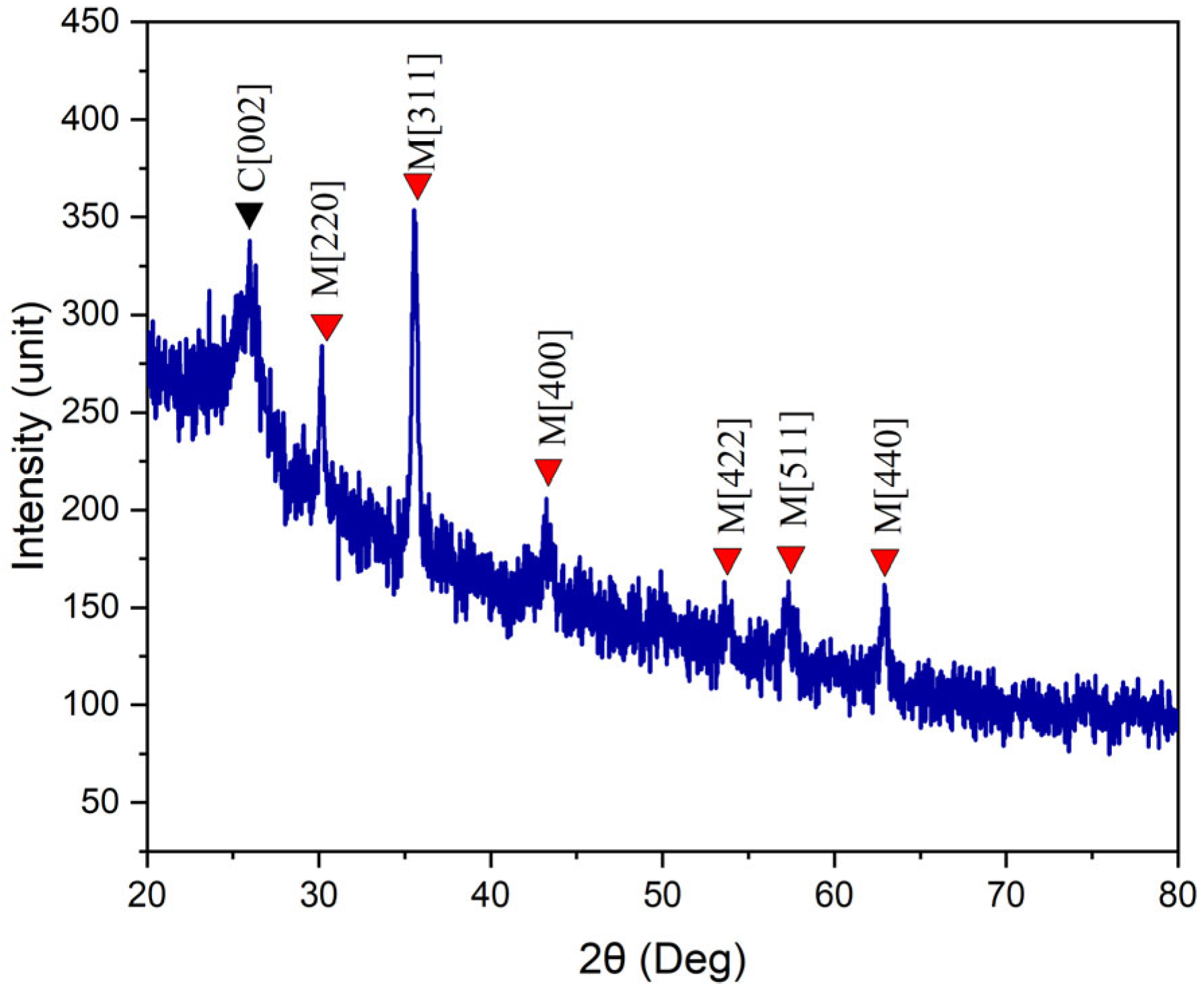
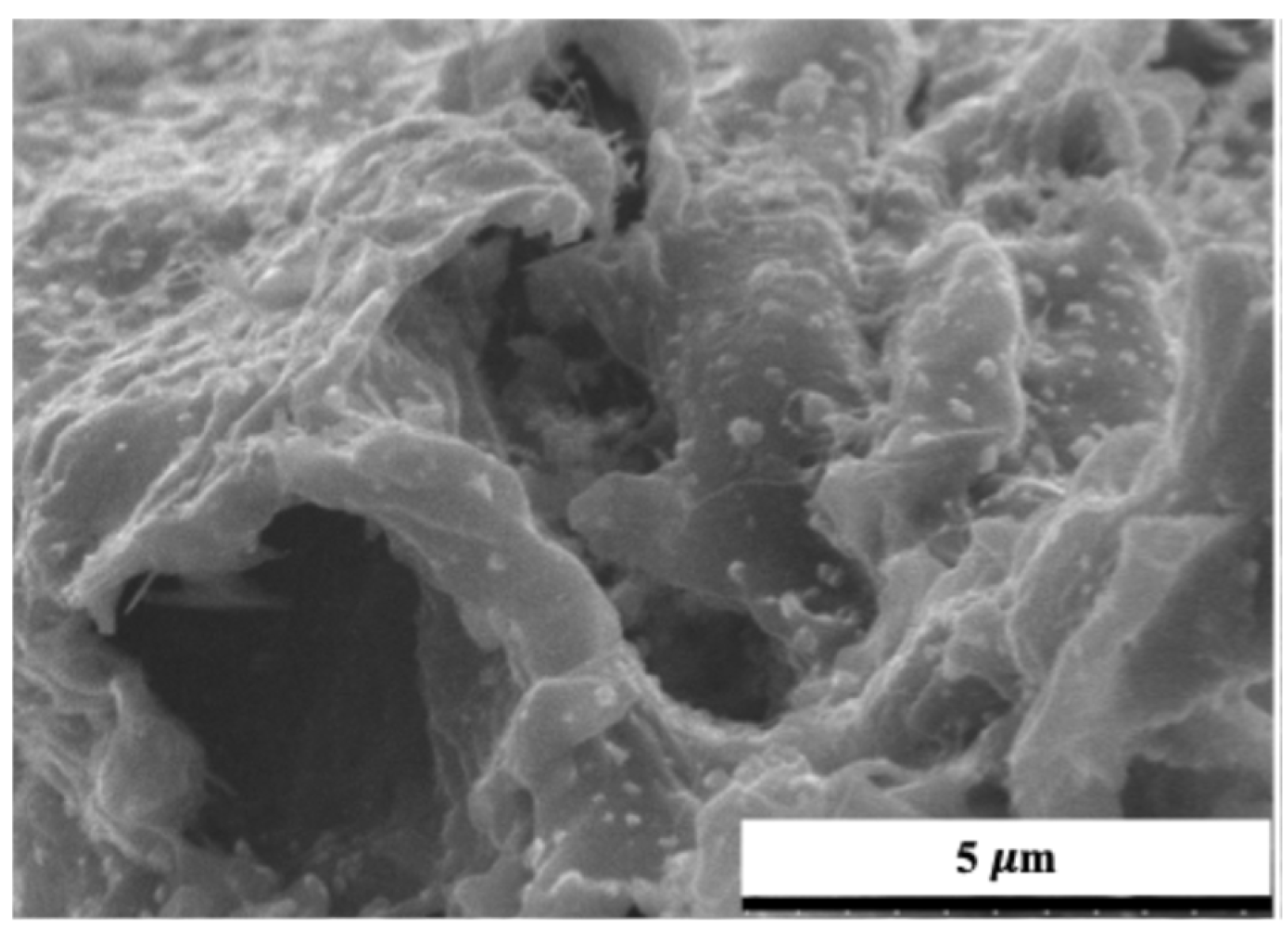
The N-doped carbon material modified with magnetite was characterized by X-ray diffraction (XRD), as illustrated in Figure 1. Symbol C with inverted triangle in black as carbon notation and symbol M with inverted triangle in red as Magnetite notation. N-doped carbon material treated with magnetite has a diffraction peak (0 0 2) at an angle of 26°, corresponding to carbon material, based on JCPDS card 75-1621 [5,6,10]. Furthermore, there is also a characteristic peak of magnetite material (Fe3O4) at the peak of 2 θ = 30°, 36°, 43°, 54°, 57°, and 63° that each of the Crystal plane of (2 2 0), (3 1 1), (4 0 0), (4 2 2), (5 1 1), and (4 4 0) based on JCPDS of Fe3O4 card 19-0629 [6,11]. In addition, the N-doped carbon material modified with synthesized magnetite has a porous structure as shown in Figure 2.

3.2. Kinetics of Cr (VI) Adsorption by Magnetite-Modified N-Doped Carbon

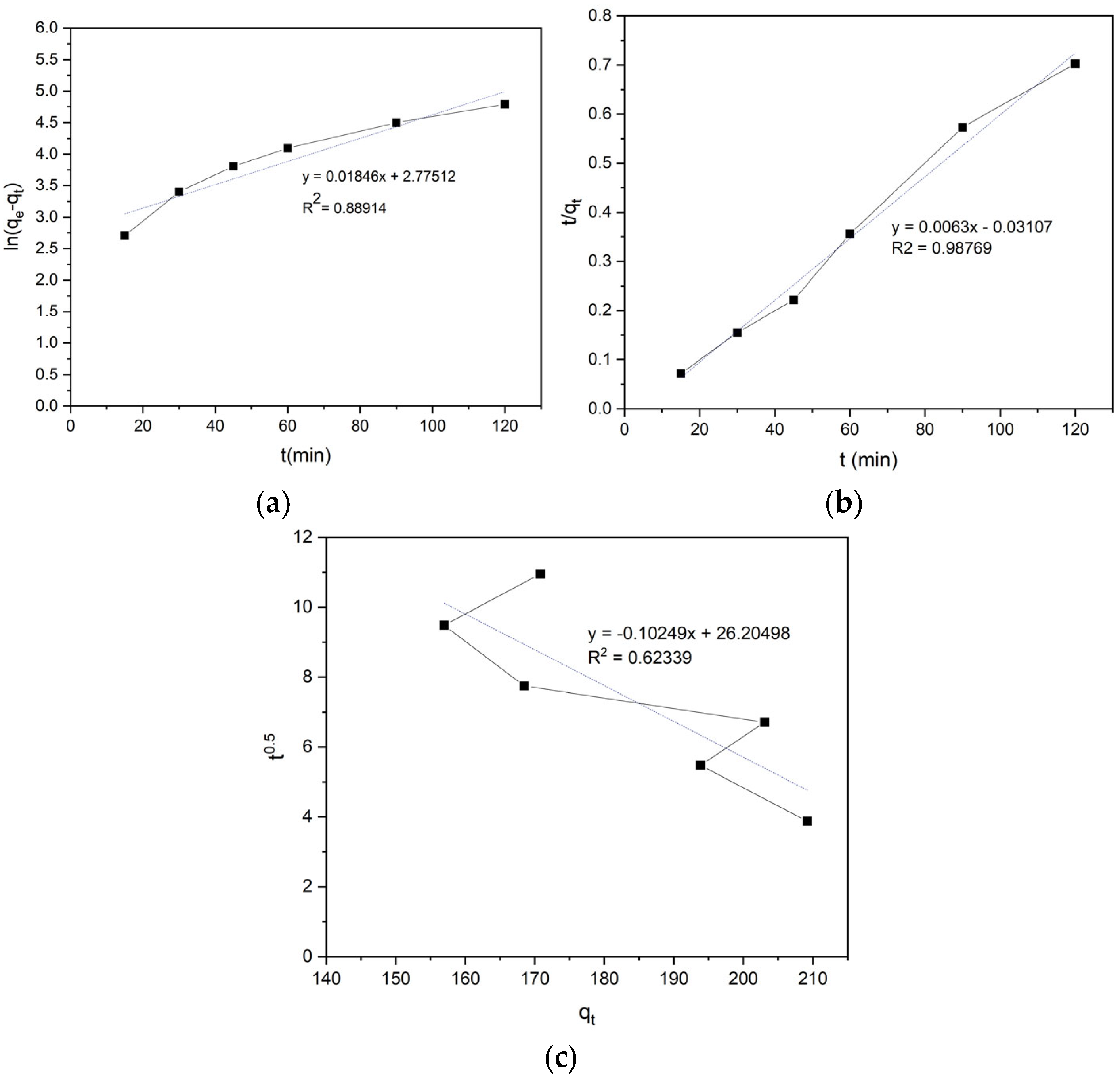
The adsorption of Cr (VI) using a magnetite-modified N-doped carbon adsorbent was conducted at pH 6 and a Cr(VI) concentration of 200 ppm, with contact time varying from 15 to 120 min. The results of the adsorption kinetics analysis of Cr(VI) using magnetite-modified N-doped carbon adsorbent are shown in Figure 3 and Table 1. The results indicated that the adsorption of Cr (VI) using magnetite-modified N-doped carbon adsorbent conformed to pseudo second-order kinetics, with a R2 value of 0.98769, an adsorption rate of 0.13363 m i n 1 ), and an equilibrium adsorption capacity of 158.73 mg/g.
Second-order pseudo adsorption kinetics indicates that the interaction is a chemical adsorption process, potentially involving electrostatic interactions between a magnetite-modified N-doped carbon adsorbent and Cr(VI) ion species as the adsorbate. At pH 6, the amine group ( N-H) on the magnetite-modified N-doped carbon can exist as a positively charged group ( N-H2)+ [12], although the Cr(VI) ion exists as HCrO4 [3]. Therefore, the ammonium group ( N-H2)+, which carries a positive charge from the adsorbent, is capable of participating in electrostatic chemical interactions with negatively charged Cr(VI) ions in the HCrO4 species [12].

4. Conclusions

Magnetite-modified N-doped carbon material has been successfully made from empty oil palm bunches and a Fe(III) precursor derived from FeCl3 through freeze-drying and pyrolysis. The adsorption of Cr (VI) using magnetite-modified N-doped carbon adsorbent adheres to pseudo-second-order reaction kinetics. The R2 value is 0.98769, indicating an adsorption rate of 0.1336 m i n 1 and an equilibrium adsorption capacity of 158.73 mg/g.

Author Contributions

Conceptualization, Methodology, Supervision, Writing—review & editing S.S.; Writing—original draft, Investigation A.J.; Writing—review & editing R.H.; formal analysis, Validation, M.A.I.I. All authors have read and agreed to the published version of the manuscript.

Funding

This work was supported by State Polytechnic of Malang through Applied Research Innovation Fund Research Grant (SP DIPA–139.03.2.693474/2025).

Institutional Review Board Statement

Not applicable.

Informed Consent Statement

Not applicable.

Data Availability Statement

The data supporting the findings of this study are available within the article.

Acknowledgments

The authors would like to express gratitude to Iqbal Lintang Kusuma for completing this research in the Waste Management Laboratory of the Department of Chemical Engineering, State Polytechnic of Malang.

Conflicts of Interest

The authors declare no conflicts of interest.

Abbreviations

The following abbreviations are used in this manuscript:
Cr(VI)Six-valence chromium
Cr(III)Triple valence chromium
VAdsorbate volume (L)
mMass of adsorbent (g)
qeAmount of adsorbate adsorbed at equilibrium (mg/g)
qtAmount of adsorbate adsorbed at a certain time t (mg/g)
kAdsorption rate constant
tTime (min)
Ki Intra - particle   diffusion   rate   constant   ( m g / ( g · m i n 1 / 2 ))
cConstant

References

  1. Chaithra, B.A.; Pooja, D.A.; Priyanka, H.D.; Harshitha, M.H.; kamat, V.; Anush, S.M.; Prashantha, K. Magnetic Chitosan Schiff Base Functionaliized with MoS2 for the Effective Removal of Cu (II) and Cr (VI) Ions from Aqueous Solution. Hybrid Adv. 2025, 11, 100556. [Google Scholar] [CrossRef]
  2. Alyasi, H.; Wahib, S.; Tong, Y.; Gomez, T.; Mahmoud, K.A. Magnetic MXene Chitosan-Lignosulfonate Composite (Fe3O4@ MCLS) for the Reductive Removal of Cr(VI) and Other Heavy Metals from Water. J. Hazard. Mater. Adv. 2025, 17, 100536. [Google Scholar] [CrossRef]
  3. Ni, C.; Liu, S.; Wang, H.; Liu, H.; Chen, R. Studies on Adsorption Characteristics of Al-Free and Al-Substituted Goethite for Heavy Metal Ion Cr(VI). Water Air Soil Pollut. 2016, 228, 40. [Google Scholar] [CrossRef]
  4. El Nemr, A.; Aboughaly, R.M.; El Sikaily, A.; Ragab, S.; Masoud, M.S.; Ramadan, M.S. Microporous nano-activated carbon type I derived from orange peel and its application for Cr(VI) removal from aquatic environment. Biomass-Convers. Biorefin. 2020, 12, 5125–5143. [Google Scholar] [CrossRef]
  5. Susanto, S.; Nurtono, T.; Widiyastuti, W.; Yeh, M.-H.; Setyawan, H. Controlling N-Doping Nature at Carbon Aerogels from Biomass for Enhanced Oxygen Reduction in Seawater Batteries. ACS Omega 2024, 9, 13994–14004. [Google Scholar] [CrossRef] [PubMed]
  6. Susanto, S.; Avabel, N.; Septianingrum, N.; Nurtono, T.; Setyawan, H. N and Fe Doped-Carbon Aerogel for High Performance of Oxygen Reduction Reactions Electrocatalyst in Magnesium-Air Battery. Mater. Sci. Forum 2024, 1142, 63–70. [Google Scholar] [CrossRef]
  7. Popovic, A.L.; Velickovic, Z.; Radovanovic, Z.; Djolic, M.; Pavlovic, V.; Marinkovic, A.D.; Grzetic, J.D. Hybrid Amino-Terminated Lignin Microspheres Loaded with Magnetite and Manganese Oxide Nanoparticles: An Effective Hazardous Oxyanions Adsorbent. J. Environ. Chem. Eng. 2022, 10, 108009. [Google Scholar] [CrossRef]
  8. Debamita, C.; Rampal, N.; Gautham, J.P.; Vairavel, P. Process Optimization, Isotherm, Kinetics, and Thermodynamic Studies for Removal of Remazol Brilliant Blue-R Dye from Contaminated Water Using Adsorption on Guava Leaf Powder. Desalin. Water Treat. 2020, 185, 318–343. [Google Scholar] [CrossRef]
  9. Kurnia, M.; Suprapto, S.; Ni’MAh, Y.L. Bio-adsorbent for Remazol Brilliant Blue R (RBBR) dye. S. Afr. J. Chem. Eng. 2024, 47, 111–122. [Google Scholar] [CrossRef]
  10. Ganash, E.; Al-Jabarti, G.; Altuwirqi, R. The Synthesis of Carbon-Based Nanomaterials by Pulsed Laser Ablation in Water. Mater. Res. Express 2019, 7, 015002. [Google Scholar] [CrossRef]
  11. Karaagac, O.; Hasirci, C.; Köçkar, H. Optimum Saturation Magnetization of Superparamagnetic Iron Oxide Nanoparticles for Versatile Applications. Acta Phys. Pol. A 2024, 146, 154–164. [Google Scholar] [CrossRef]
  12. Jain, D.; Mamtani, K.; Gustin, V.; Gunduz, S.; Celik, G.; Waluyo, I.; Hunt, A.; Co, A.C.; Ozkan, U.S. Enhancement in Oxygen Reduction Reaction Activity of Nitrogen-Doped Carbon Nanostructures in Acidic Media through Chloride-Ion Exposure. ChemElectroChem 2018, 5, 1966–1975. [Google Scholar] [CrossRef]
Figure 1. XRD pattern of N-doped carbon modified magnetite.
Engproc 137 00008 g001
Figure 2. SEM image of N-doped carbon modified magnetite.
Engproc 137 00008 g002
Figure 3. Kinetic profile of Cr(VI) adsorption with magnetite-modified N-doped carbon adsorbent: (a) first-order pseudo; (b) second-order pseudo; and (c) intra-particle diffusion model.
Engproc 137 00008 g003
Table 1. Kinetic parameters of Cr(VI) adsorption with magnetite-modified N-doped carbon adsorbent.
Kinetic AdsorptionParametersValue
first-order pseudo q e   ( m g / g ) 16.04
k 1 ( m i n 1 ) 0.0185
R 2 0.88914
second-order pseudo q e ( m g / g ) 158.73
k 2 ( m i n 1 ) 0.1336
R 2 0.98769
intra-particle diffusion model K 1   ( m g / ( g · m i n 1 / 2 ) 0.1025
R 2 0.62339
Disclaimer/Publisher’s Note: The statements, opinions and data contained in all publications are solely those of the individual author(s) and contributor(s) and not of MDPI and/or the editor(s). MDPI and/or the editor(s) disclaim responsibility for any injury to people or property resulting from any ideas, methods, instructions or products referred to in the content.