Proceeding Paper

Design and Optimization of a Real-Time Monitoring System for Permanent Magnet-Based Archimedes Screw Pico-Hydro Power †
Department of Electrical Engineering, Universitas Muhammadiyah Surakarta, Surakarta City 57169, Indonesia
*
Author to whom correspondence should be addressed.
Presented at the 9th Mechanical Engineering, Science and Technology International Conference (MEST 2025), Samarinda, Indonesia, 11–12 December 2025.
Eng. Proc. 2026, 137(1), 17; https://doi.org/10.3390/engproc2026137017
Published: 4 June 2026

Abstract

This research designs a pico-hydro power system utilizing an Archimedes Screw turbine and an 18S16P Permanent Magnet Synchronous Generator (PMSG) for low-head efficiency. The primary focus is on optimizing real-time IoT-based monitoring via the Blynk application to replace inefficient manual observation. The methodology includes Infolytica MagNet simulations, manufacturing, and testing electrical parameters (voltage, current, power, frequency). Results indicate that power output increases linearly with Revolutions Per Minute (RPM), while the PZEM-004t sensor achieves high accuracy with voltage errors as low as 0.04–0.2%. This system successfully integrates permanent magnet technology and digital monitoring as a sustainable, measurable, renewable energy solution.

1. Introduction

The development of science and technology has led to significant advancements in culture and social change; however, these improvements are invariably followed by an increase in global energy consumption [1]. Currently, the quality of life in a country is highly dependent on its energy consumption levels, where fossil fuels remain the primary choice because progress cannot be achieved without large-scale energy use. Nevertheless, reliance on fossil resources faces major challenges due to their limited reserves, which will eventually be exhausted [2]. In Indonesia, the government has set a renewable energy mix target of 23% by 2025 through the Decree of the Minister of Energy and Mineral Resources No. 1567K/21/MEM/2018 as a strategic step to create clean and environmentally friendly energy [3,4].
As an archipelagic country with supportive topography, Indonesia possesses a vast hydropower potential reaching 75,000 MW, yet its current utilization is only approximately 10% [5]. One of the most promising applications for reaching remote areas is the Pico-Hydro Power Plant (PHPP). Pico-hydro is a small-scale power plant with an output of less than 5 kW that utilizes water head and discharge to rotate a turbine [6]. This technology is highly relevant for application in irrigation flows or small rivers due to its simple construction, lack of environmental harm, and minimal requirement of water flow to generate mechanical energy on the turbine shaft [7,8].
In this PHPP system, the selection of turbine and generator types is a key factor in determining power optimization. The use of an Archimedes Screw turbine offers advantages such as high efficiency at low water heads (0.1–1.5 m), ease of operation, and being fish-friendly for the aquatic ecosystem [9,10]. To convert mechanical energy into electricity, a Permanent Magnet Synchronous Generator (PMSG) is used due to its high efficiency and the advantages of permanent magnet utilization [11]. Nonetheless, PMSG has a drawback in the form of cogging torque, which makes the rotor heavy to move under low initial force [12]. Therefore, an optimal design is required so that the generator can operate at maximum capacity in accordance with the available water flow characteristics [13].
Beyond the generation aspect, system stability and monitoring have become vital necessities in the Industry 4.0 era. The current and voltage produced by the generator must be managed through a rectifier circuit, batteries for energy storage and voltage stabilization, and an inverter to ensure the electrical output meets the 50 Hz frequency standard [14,15]. However, a major constraint in operating PHPP in hard-to-reach locations is the difficulty of monitoring system performance continuously, where the cost of monitoring systems often becomes a barrier [16]. Without a monitoring system, early detection of efficiency decline or technical disturbances is difficult to perform in real-time.
Based on these conditions, this study aims to design a pico-hydro power plant by optimizing a real-time monitoring system based on the Internet of Things (IoT). By utilizing the ESP32 microcontroller (Espressif Systems, Shanghai, China), which features low power consumption and integrated Wi-Fi, along with the PZEM-004T v3 sensor module (Ningbo Peacefair Electronic Technology Co., Ltd., Ningbo, China), electrical parameters can be read and processed accurately. These data are then transmitted so that the current and voltage output of the generator can be monitored via a web-based platform in real-time or remotely. This innovation is expected to provide a smart solution for the development of sustainable, renewable energy

2. Materials and Method

2.1. Research Framework

This study was conducted through several systematic stages to achieve the design and optimization of the Pico-Hydro Power Plant (PHPP) monitoring system.

2.2. Theoretical Analysis

The design of this power plant is based on the fundamental principles of electromagnetic energy conversion and fluid mechanics as follows:
Faraday’s Law of Induction: The induced electromotive force E is proportional to the rate of change in magnetic flux (dΦ/dt).
E = (dΦ/dt)
Magnetic Flux (Φ) The product of the magnetic field (B), surface area (A), and the cosine of the angle of orientation, cos θ
Φ = B·A.cos θ
Ohm’s Law: The electric current (I) is determined by the EMF (E) divided by the circuit resistance (R):
I = E/R
Rotational Speed (RPM): The relationship between frequency (f) and the number of poles (P) in the generator:
RPM = 120·f/P
The water flow, which refers to the volume of water flowing per second, influences the rotational speed of the turbine. Water discharge, which is the volume of water flowing within a specific unit of time and symbolized by Q, can be calculated using the ratio of the water volume in a specific space to the time required to fill that space.
Q = V/t
Hydraulic Power (Ph): The theoretical output power generated depends on the density of water (ρ), the water discharge (Q), the acceleration due to gravity (g), the head (H) in meters, and the efficiency values of both the pulley (ηp) and the generator (ηg)
P h = ρ . Q . g . H . ƞ p . ƞ g

2.3. Hardware Design

2.3.1. Permanent Magnet Synchronous Generator (PMSG)

The generator utilized is a PMSG 18S16P type (18 Slots, 16 Poles), designed using Finite Element Method (FEM) software (https://www.autodesk.com/solutions/simulation/finite-element-analysis, accessed on 1 June 2026). The detailed design parameters are presented in Table 1.

2.3.2. Archimedes Screw Turbine Specifications

The screw turbine was designed to operate at low heads with the following specifications:
  • Dimensions: Length of 1.5 m; Diameter of 0.3 m.
  • Construction: 4-inch steel pipe main shaft with 5 blades (60° blade angle).
  • Housing: 4 × 4 cm hollow frame.

2.4. Electrical and Monitoring System Architecture

2.4.1. Generator Output Schemes

The system provides two types of voltage outputs:
  • DC Output: The 3-phase AC current from the generator is rectified using a bridge rectifier (6 diodes) and an electrolytic capacitor filter.
  • AC Output: Utilizes an energy management system consisting of Maximum Power Point Tracking (MPPT), a 12 V battery as a stabilizer, and an inverter to produce AC voltage at the Indonesian standard frequency (50 Hz).

2.4.2. Electronic Components and Sensors

To support the IoT-based real-time monitoring feature, the following components are integrated: ESP32 Microcontroller: Serves as the primary data processing unit equipped with an integrated Wi-Fi module. PZEM-004T Sensor: Measures electrical parameters (Voltage 80–260 VAC, Current, Frequency, and Power) with 0.5% accuracy. LM2596 Stepdown Module and Adapter (generic manufacturer, Shenzhen, China): Reduces the DC voltage to 5 V to power the ESP32 and sensors.

2.5. IoT System Integration and Monitoring

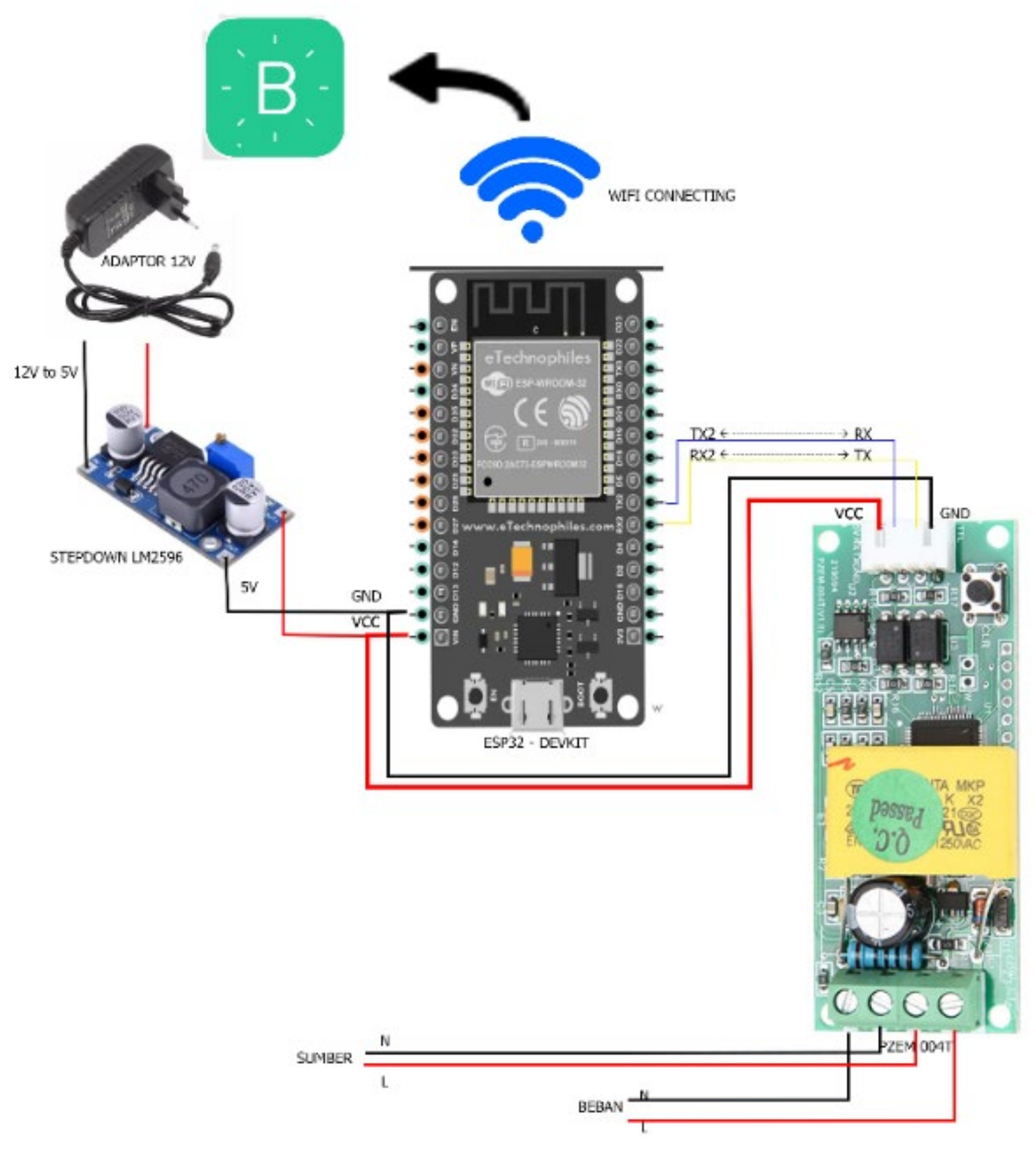
Electrical parameter data is sent from the PZEM-004T sensor to the ESP32 via serial communication (RX/TX). The ESP32 processes this data and transmits it wirelessly via the internet to the Blynk platform. Users can monitor the PHPP performance in real-time through a smartphone application, which displays voltage, current, power, energy, frequency, and power factor. The schematic diagram of the proposed real-time monitoring system is shown in Figure 1.

3. Results and Discussion

This research comprises three primary stages: modeling and simulation of the PMSG 18S16P generator, hardware manufacturing of the generator and turbine, including physical testing, and the implementation of an IoT-based monitoring system for a pico-hydro power plant.

3.1. Magnetic Flux Simulation and Analysis

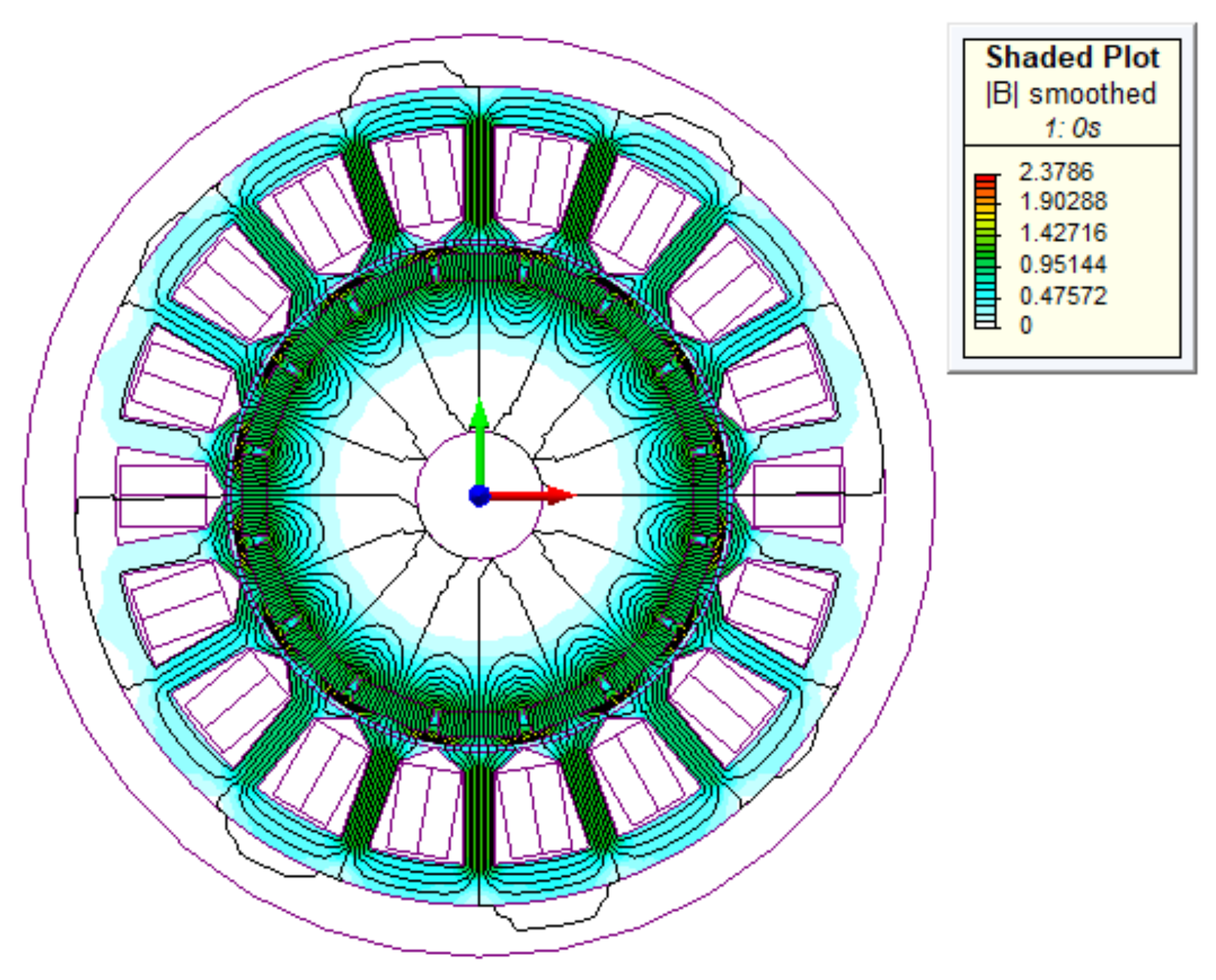
The generator is engineered with an 18-Slot 16-Pole (18S16P) configuration. This specific topology was selected to minimize cogging torque, thereby enabling the turbine to achieve self-starting (start-up) capabilities even at low volumetric flow rates. Initial stages involved numerical simulation of the PMSG 18S16P to observe the magnetic flux distribution. The simulation yielded a magnetic flux density of 1.422 Wb/m2. Based on Figure 2, the color gradients in the simulation visualization indicate that magnet thickness significantly influences flux distribution; darker green regions represent higher flux density. The black flux lines represent the magnetic field paths and concentration within the core.

3.2. Generator Performance Analysis (Simulation vs. Hardware)

Physical testing was conducted across various rotational speeds (RPM) to evaluate the output characteristics of voltage, current, and power. Electrical Characteristics: In accordance with Faraday’s Law of Induction, the data confirms a linear correlation where an increase in RPM directly results in higher induced voltage and current. Efficiency Analysis: Simulation results (Table 2) indicate a downward trend in efficiency as RPM increases (from 64.2% to 62%). This phenomenon is attributed to: Iron Losses, higher RPM increases the frequency of magnetic pole reversals, leading to elevated eddy current and hysteresis losses within the stator core. Copper Losses (I2R), as current (I) increases with load and RPM, thermal dissipation within the stator windings increases quadratically, reducing efficiency at high speeds. Mechanical Losses, friction in the bearings and aerodynamic drag (windage) on the rotor become more pronounced at the 950 RPM threshold.
Physical hardware testing (Table 3) showed that at 900–950 RPM, the maximum voltage reached 16.84 V with a constant current of 1.08 A. Voltage Correlation: The deviation between simulation and hardware was minimal (average ±2 V), validating the accuracy of the predictive model. Magnetic Optimization: The flux density of 1.422 Wb/m2 confirms that the magnet grade and dimensions are optimal for stator core saturation without excessive thermal buildup. However, a narrow air gap—while increasing induction—poses a risk of mechanical interference if manufacturing tolerances are not precise.

3.3. Archimedes Screw Turbine Integration and Field Testing

The generator was integrated with an Archimedes Screw turbine featuring 5 blades, a length of 1.5 m, and a width of 0.3 m. The transmission system utilizes a 10-inch turbine pulley coupled to a 1.5-inch generator pulley via a fan belt, installed in a river with a flow rate of 0.016874 m3/s. Transmission System: The pulley ratio (10:1.5) functions as a speed increaser with a ratio of approximately 1:6.6. This is critical as the native rotational speed of an Archimedes screw is typically only 100–200 RPM; the ratio allows the generator to reach its operational range (>1000 RPM). DC Output Testing: Utilizing a battery bank for energy storage, the generator achieved an average speed of 1094 RPM with an open-circuit voltage of 35.8 Vdc. AC Output Testing: At ±1303 RPM, the generator produced an average phase-to-neutral voltage of 15 Vac at a frequency of 21 Hz. Load Testing: When connected to an inverter with a 12 W AC LED load, the system demonstrated high stability (Voltage: 205 Vac, Frequency: 59 Hz). This stability is maintained by the battery bank acting as a buffer.

3.4. IoT Monitoring System Implementation (Blynk)

Remote performance monitoring was facilitated via a PZEM-004T sensor and the Blynk application. The accuracy of the IoT system was benchmarked against a calibrated Digital KWH Meter. The voltage testing results are presented in Table 4, while the current and frequency testing results are shown in Table 5 and Table 6, respectively.
Voltage and Frequency Accuracy (Error < 1%): The PZEM sensor is highly reliable in reading AC voltage and frequency parameters because its readings are based on the zero-crossing of the sine wave.
Current (8.57%) and Power (7.7%) Error Analysis: Low Current Sensitivity: The current sensor on the PZEM-004T has a lower sensitivity limit. A 12W lamp load generates a current of approximately 0.05–0.06 A. At such low currents, the sensor often encounters noise or significant reading errors. Power Factor (PF): 12W LED lamps often have a poor power factor or act as non-linear loads. The difference in power calculation algorithms between the Digital KWH Meter and the PZEM sensor in handling these non-linear loads contributes to a power difference of 2.3 Watts.

4. Conclusions

The PMSG 18S16P design for the Archimedes turbine is functionally sound and adheres to electromagnetic principles. Despite minor deviations between simulation and physical results, the system successfully provides a stable AC supply via energy storage. The IoT implementation enables effective real-time monitoring.
Technically, the system successfully converts the hydraulic potential energy into stable electrical energy. The primary areas for improvement include the generator’s efficiency (currently below 70%) and the current sensor accuracy at low loads.

Author Contributions

Conceptualization, U. and H.A.; methodology, U.; software, R.R.A.; validation, U., H.A. and R.M.; formal analysis, U. and M.I.E.; investigation, R.R.A.; resources, U.; data curation, R.M.; writing—original draft preparation, U.; writing—review and editing, H.A.; visualization, R.R.A.; supervision, H.A.; project administration, U.; funding acquisition, H.A. All authors have read and agreed to the published version of the manuscript.

Funding

This research was funded by Universitas Muhammadiyah Surakarta through the HIT scheme, grant number 171/A.3-III/FT/III/2023. The APC was funded by Universitas Muhammadiyah Surakarta.

Institutional Review Board Statement

Not applicable.

Informed Consent Statement

Not applicable.

Data Availability Statement

The data presented in this study are available on request from the corresponding author.

Acknowledgments

The author expresses profound praise and gratitude to Allah SWT for his grace and blessings, which have enabled the completion of this research. May this work provide benefits for both the author and its readers. The author acknowledges the immense support, guidance, assistance, motivation, and all prayers received during the preparation of this research, which were instrumental in its successful completion. The researcher extends sincere thanks to Universitas Muhammadiyah Surakarta, and to all parties who have offered invaluable prayers and support, ensuring the smooth progress of this research.

Conflicts of Interest

The authors declare no conflict of interest.

References

  1. Bandri, S.; Premadi, A. Studi Perencanaan Pembangkit Listrik Tenaga Picohydro (Pltph) Rumah Tangga. J. Sains Teknol. J. Keilmuan Apl. Teknol. Ind. 2021, 21, 16. [Google Scholar] [CrossRef]
  2. Sergio Antonio Zarate-Orrego, G.A.; del Risco-Moreno, E.B. Horizontal Vortex Single Chamber Hydroturbine; Revista Facultad de Ingeniería, Universidad de Antioquia, International Energy Agency: Medellín, Colombia, 2016. [Google Scholar]
  3. Sitepu, M.; Amrul; Zulhanif. Experimental Study of the Effect of Blade Shape on the Performance of Helical Turbines for Micro-Hydro Power Systems (PLTMH). FEMA Mech. Eng. Sci. J. 2014, 2, 13–21. [Google Scholar]
  4. Bhuana, Y.S.; Rosyadi, M. Design and Construction of a Micro-Hydro Power Plant Prototype Using a Pelton Turbine. Sinergi Mech. Eng. J. 2022, 20, 110–117. [Google Scholar]
  5. Nugraha, U.; Hasbullah; Yani, A. Application and Analysis of Pico-hydro Power Plants with TC 60 Open Flume Propeller Turbines and 100 VA Single-Phase Synchronous Generators at UPI Bandung. Reka Elkomika 2013, 1, 136–147. [Google Scholar]
  6. Candra, S. Utilization of Low-Speed Permanent Magnet Generators in Micro-Hydro Power Plants (Pltmh) Using Overshot Type Waterwheels. J. Tek. Elektro 2019, 1, 1–7. [Google Scholar]
  7. Amri; Haswani; Safrizal. Design and Construction of Pico-Hydro Power Plants (Pltph) (Analysis of Output Load Power On Generators). TEKTRO J. 2021, 5, 98–104. [Google Scholar]
  8. Wildan, M.; Suroso; Purwanto, E. Study of Blade Slope and Head of Archimedes Screw Turbines on the Output Power of 3 kw 1-Phase Ac Generators. J. Electr. Eng. 2021, 10*, 219–228. [Google Scholar]
  9. Mirzan, M.; Ervianto, E.; Hamzah, A. Pico-Hydro Power Plant Using a Screw Turbine. J. Comput. Inf. Technol. Electr. Eng. 2017, 2, 16–22. [Google Scholar]
  10. YoosefDoost, A.; Lubitz, W.D. Archimedes screw turbines: A sustainable development solution for green and renewable energy generation—A review of potential and design procedures. Sustainability 2020, 12, 7352. [Google Scholar] [CrossRef]
  11. Faqih, M.R.; Sutedjo, S.; Wahjono, E. Design and Fabrication of a Radial Flux Permanent Magnet Synchronous Generator. In Proceedings of the 2019 International Electronics Symposium (IES), Surabaya, Indonesia, 27–28 September 2019; Volume 2, pp. 644–649. [Google Scholar]
  12. Supardi, S.; Purwanto, A. The Influence of Rotational Speed and Load on the Performance of Permanent Magnet Generators. Emit. J. Electr. Eng. 2013, 13, 26–31. [Google Scholar]
  13. Hanselman, D. Brushless Permanent Magnet Motor Design; Magna Physics Publishing: Madison, WI, USA, 2006. [Google Scholar]
  14. Albatriq, M.R.P. Efficiency of the Talang Dikun Micro-Hydro Power System with the Addition of Energy Storage and Adaptive Inverter; University of Lampung Digital Library: Bandar Lampung, Indonesia, 2022. [Google Scholar]
  15. Azizah, N.; Sulistiyowati, I.; Urfa, M. Design and Construction of a 100-Watt Capacity Single-Phase Inverter. J. Eltek 2021, 19, 45–52. [Google Scholar]
  16. Sumiyarso; Setyawan, A.; Sunardi. IoT-Based Monitoring System for Micro-Hydro Power Plants. Proc. Semin. Res. Results Community Serv. 2022, 4, 221–226. [Google Scholar]
Figure 1. Integrated monitoring system wiring diagram.
Engproc 137 00017 g001
Figure 2. Magnetic Flux Flow and Flux Distribution Indicator of 18S16P PMSG.
Engproc 137 00017 g002
Table 1. PSMG 18S16P Design Specifications.
DescriptionDimension
Stator Thickness50 mm
Rotor Thickness50 mm
Stator Inner Diameter (ID)100 mm
Stator Outer Diameter (OD)180 mm
Rotor Diameter98 mm
Magnet Length10 mm
Magnet Thickness50 mm
Magnet Height5 mm
Air Gab2mm
Number of Slots18 slot
Number of Poles16 pole
Slot Angle20 deg
Pole Angle22.5 deg
Table 2. Losses and Efficiency (Simulation).
RPMPowerLosses Efficiency
Input (VA)Output (VA)
35012.259017.873464.3855564.20%
55020.2467312.754847.4918962.90%
75030.0209718.7573811.2635962.40%
95045.2522828.0592617.1930262%
Table 3. Test Data.
Table 3. Test Data.
300–350 RPM500–550 RPM700–750 RPM900–950 RPM
VoltCurrentVoltCurrentVoltCurrentVoltCurrent
8.560.110.790.2613.590.6416.841.08
8.540.110.770.2513.450.6416.821.08
8.550.110.790.2713.540.6416.811.08
8.50.110.80.2613.510.6416.771.08
8.550.110.780.2713.450.6416.751.08
8.560.110.810.2713.440.6416.741.08
8.570.110.790.2613.560.6416.751.08
8.560.110.790.2513.490.6416.841.08
8.550.110.80.2713.470.6416.841.08
8.540.110.790.2713.590.6416.791.08
Table 4. Voltage Reading Test Results.
NoVoltage ReadingDifferenceError (%)
Blynk ApplicationDigital KWH Meter
1204.92050.10.04
220520500
3205.12050.10.04
420520500
Average 0.02
Table 5. Current Reading Test Results.
NoCurrent ReadingDifferenceError (%)
Blynk ApplicationDigital KWH Meter
10.0680.0620.0068.8
20.0650.0590.0069.2
30.0660.060.0069.1
40.0690.0640.0057.2
Average8.57
Table 6. Frequency Reading Test Results.
NoFrequency ReadingDifferenceError (%)
Aplikasi BlynkKWH Meter Digital
158.5590.50.84
258.5590.50.84
358.7590.30.5
458.7590.30.5
Average0.67
Disclaimer/Publisher’s Note: The statements, opinions and data contained in all publications are solely those of the individual author(s) and contributor(s) and not of MDPI and/or the editor(s). MDPI and/or the editor(s) disclaim responsibility for any injury to people or property resulting from any ideas, methods, instructions or products referred to in the content.