1. Introduction
In the seismic design of structures, it is imperative that the design strength of a structure is commensurate with the considered earthquake level. The prevailing methodology for acquiring the dynamic responses and the members’ internal forces of structures involves executing static or response spectrum analysis by a finite element model under seismic force distribution or a design response spectrum. Nonetheless, the behavior of nonlinear elements, such as dampers or isolators, can be observed through nonlinear time history analysis of finite element models, subject to artificial earthquake excitation. Therefore, it is imperative to generate artificial earthquake waveforms corresponding to the design response spectrum in order to validate the strength structure and ascertain its conformity with the stipulated design conditions.
A categorization of methods for generating artificial earthquake waveforms reveals three distinct groups: the time domain approach, the frequency domain approach, and the time–frequency domain approach. The time domain approach entails the implementation of a set of basis functions for the purpose of generating an initial ground accelerogram. Each basis function is assigned to a specific frequency band. Initially, the intensity envelope function was employed to restrict the waveform of basis functions. Subsequently, the basis functions are to be selected according to the target frequency band, with the amplitude then being modified accordingly. In the event that the sin wave is selected as the basis function, the spectrum of responses can be obtained by means of its power spectrum density function [
1,
2,
3,
4].
In the frequency domain, the initial ground accelerogram, the signal measured in response to an earthquake, generated by historical earthquake records or Gaussian white noise is subject to intensity envelope function restriction. The Fourier transform of this accelerogram directly modifies the amplitude in the target frequency band [
5,
6,
7]. In the time–frequency domain, the initial ground accelerogram can be generated by the same procedure as the frequency domain approach. The initial ground accelerogram is decomposed into different sub-spaces by means of a set of high-pass and low-pass filters. The employment of wavelet filters is contingent upon their well-defined mathematical properties, rendering them particularly well-suited to time–frequency analysis. Furthermore, a considerable number of scholars have developed wavelet-based approaches for generating artificial earthquakes. Each wavelet subspace possesses distinct frequency characteristics. The selection of the appropriate wavelet subtype is contingent upon the targeted frequency band. Subsequent modifications to the weighting of constituent components are intended to align with the spectrum of design responses [
8,
9,
10].
Regardless of the approach adopted, iteration calculation is an essential prerequisite. It is not feasible to converge results for each calculation of generating an artificial earthquake. In this study, we detail the procedure of global and local frequency band tuning that was proposed using the frequency domain approach. The approach increases the probability of convergence for each calculation of artificial earthquake generation. We also examined the impact of global frequency tuning, the initial in the context of earthquake engineering and structural dynamics, and the coverage range of the weighted function. PGA stands for peak ground acceleration (PGA) of the ground accelerogram.
2. Methodology
The algorithm for generating artificial earthquakes using the frequency domain approach was created in the following steps.
The initial ground accelerogram is generated.
The restriction of the waveform of the initial ground accelerogram is achieved by means of the intensity envelope function.
The calculation of the response spectrum and its subsequent comparison with the design response spectrum is imperatively performed.
The initial ground accelerogram is transferred to the frequency domain, marking the initial step in the process.
The amplitude of frequency bands that demonstrate a substantial relative error in relation to the design responses spectrum is amenable to modification.
The third step of the process is to repeat the procedure until the response spectrum of the ground accelerogram fit design is achieved.
To define the intensity envelope function and the weighted function, we modified the amplitude in the frequency band.
2.1. Intensity Envelope Function
A given earthquake record
can be repressed by Fourier series as follows.
Subsequently, the Hilbert transform should be applied to the earthquake records obtained.
The combination of Equations (1) and (2) results in the establishment of the Euler formula.
Taking the absolute value of Equation (3), the intensity envelop function of the earthquake record
can be calculated as follows:
In the subsequent stage of the process, the intensity envelop function is to be applied to a Gaussian white noise signal. This will result in the generation of an initial ground accelerogram, which in turn will be used for the calculation of an artificial earthquake.
2.2. Weighted Function for Local Frequency Band
The weighted function is employed to modify the amplitude of the ground accelerogram within the designated frequency band. The definition of a weighted function for a local frequency band is as follows.
Here, denotes the weighted function for the ith frequency band, signifies the central frequency of the ith frequency band, and is the parameter that governs the coverage range of the weighted functions. Furthermore, and represent the target response spectrum and the response spectrum of the kth iteration, respectively, corresponding to the ith frequency band.
2.3. Weighted Function for Global Frequency Band
The manipulation of the amplitude of the ground accelerogram in the
ith frequency band alters the entire frequency range of the responses spectrum. The responses within the target frequency band and its nearby frequencies exert the most significant influence, while the responses within other frequency bands also show a minor influence. A comparison of the degree of influence in the response spectrum between the low-frequency band and the high-frequency band is necessary when the amplitude of the ground accelerogram is modified in a specific frequency band. Therefore, when the responses of the ground accelerogram are larger than the target in the low-frequency band, but the maximum amplitude of the ground accelerogram is close to zero in the same frequency band, and the spectrum of responses is larger than the target. The weighted function for the global frequency band is used to modify the amplitude of the ground accelerogram in the entire frequency range. The definition of a weighted function for the global frequency band is as follows.
In Equation (6), the boundary of 1 Hz is established as the threshold for the amplitude of the ground accelerogram in the frequency domain, indicating its potential for either augmentation or diminution.
3. Results and Discussions
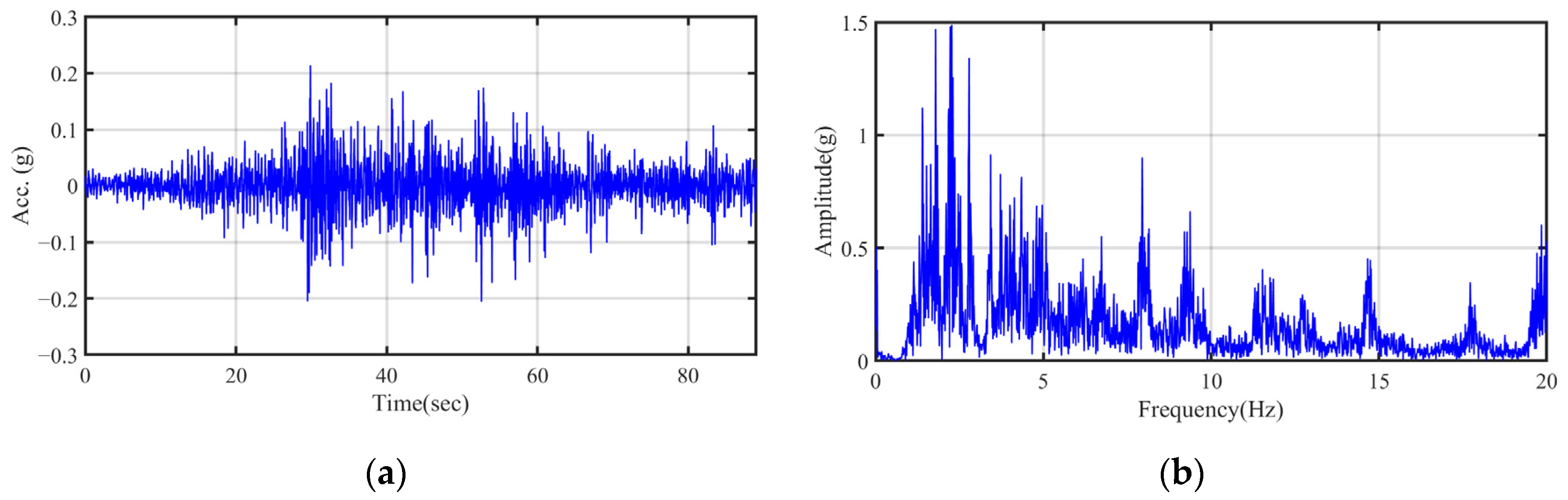
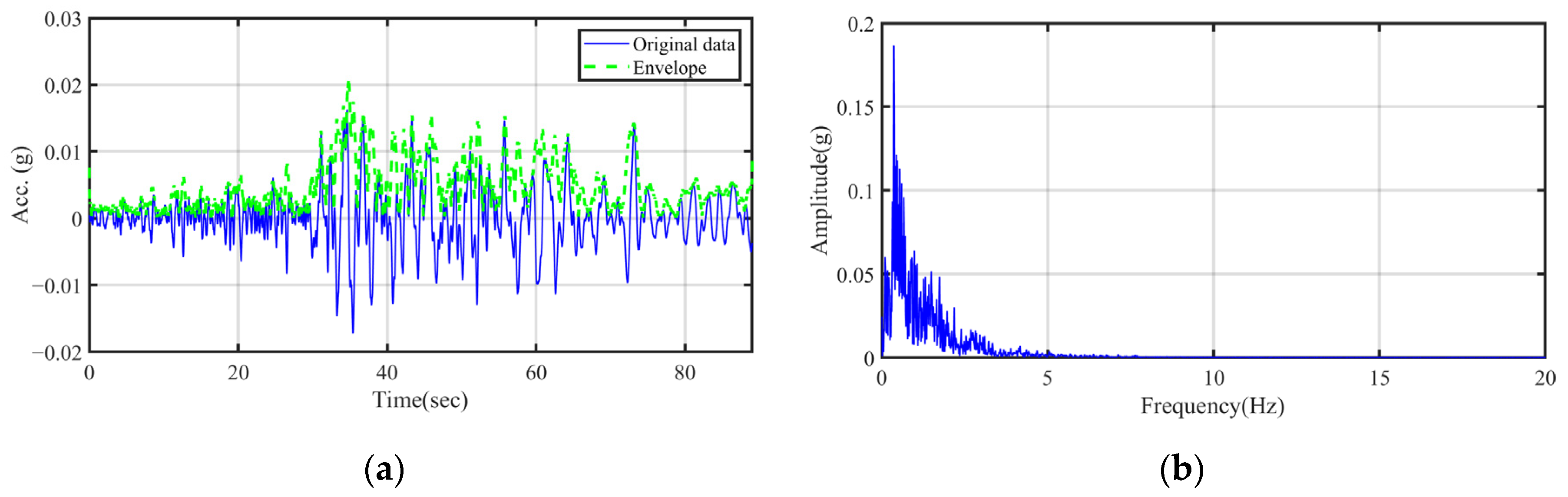
In order to understand the effectiveness and convergence of the proposed procedure, the Chi-Chi earthquake records from the station near the Maanshan Nuclear Power Plant was referenced for generating artificial earthquakes (
Figure 1) that show the waveform, the intensity envelop function, and the Fourier spectrum of the Chi-Chi earthquake. The epicenter of the Chi-Chi earthquake was located in Chi-Chi Town, Nantou County, Taiwan. When the epicenter was shifted to the Maanshan Nuclear Power Plant, only low-frequency characteristics were shown (
Figure 1b).
In order to verify the convergence of the proposed procedure, the initial ground accelerogram was generated using 100 Gaussian white noises. These noises were applied with an intensity envelope function to restrict their waveform. In this study, the frequency domain approach was employed for generating artificial earthquakes with local narrow frequency bands that were weighted only. The maximum number of iterations was set at 200, the initial PGA was set at 0.5 g, and the parameter for controlling the cover range, d, was set at 0.1.
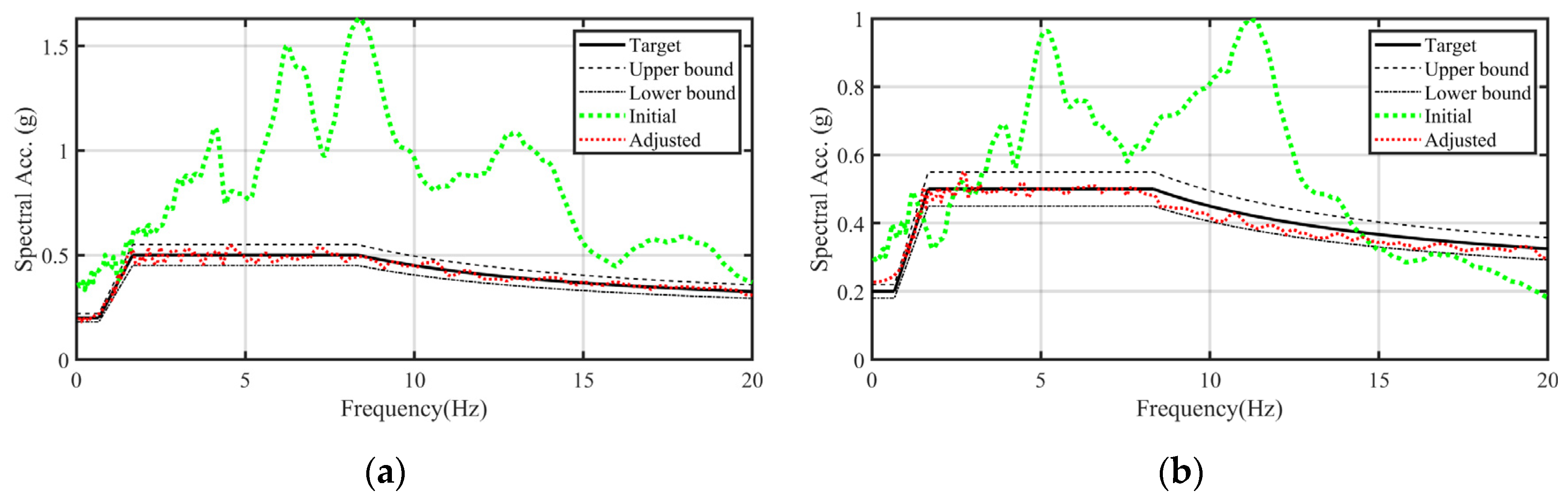
In the particular instance, a total of nine initial ground accelerograms were found to generate convergent results. As illustrated in
Figure 2, the responses of ground accelerograms are depicted, both initial and adjusted.
Figure 2a corresponds to a convergence case, while
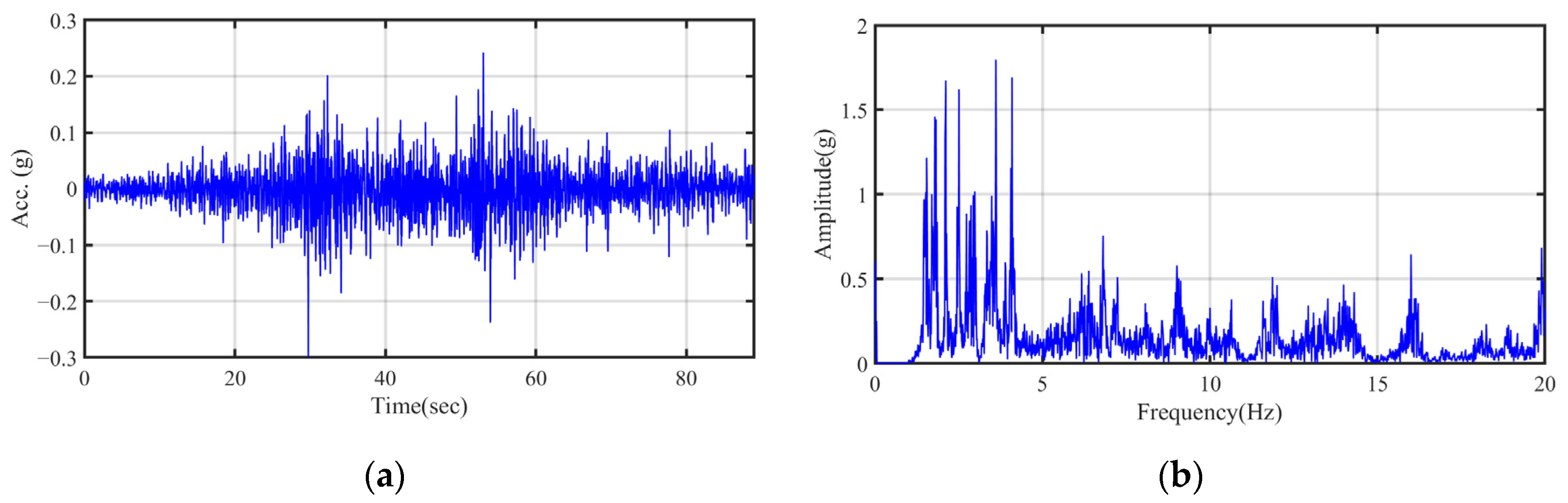
Figure 2b corresponds to a non-convergence case. In addition to the target, the time history and Fourier spectrum of an adjusted ground accelerogram with convergence are presented in
Figure 3.
Figure 4 shows the time history and Fourier spectrum of the adjusted ground accelerogram are presented, with the absence of convergence being highlighted. A comparison of the waveforms reveals a high degree of similarity with those documented in the Chi-Chi earthquake records. The majority of non-convergence results exhibited a response spectrum that is larger than that of the target one in the low-frequency band (
Figure 2). However, a decrease in the energy of the Fourier spectrum of ground accelerograms is observed within the same frequency band (
Figure 4b).
In order to enhance the probability of obtaining convergent results from the initial ground accelerogram, which was generated via Gaussian white noise, weighted functions for local and global frequency bands were employed in the frequency domain approach to generate an artificial earthquake. In this study, an additional 100 initial ground accelerograms were generated based on Gaussian white noise. In the particular instance, a total of 67 initial ground accelerograms were converged. Furthermore, in order to ascertain the impact of the parameters on the outcome, a series of initial PGA values (0.3, 0.5, and 0.7 g) were established, along with a range of parameters for the control of the weighted function d (0.05, 0.1, and 0.2).
The results obtained from the examination of various parameter combinations are presented in
Table 1. The proportion of convergence of generating artificial earthquake waveforms using different parameters in the frequency domain approach for 100 initial ground accelerograms is demonstrated. These initial ground accelerograms were generated based on Gaussian white noise. The initial PGA had a negligible impact on the proportion of convergence of generating artificial earthquakes via Gaussian white noise. Nevertheless, an increase in the cover range of the weighted function resulted in a decrease in the proportion of convergence.
4. Conclusions
A novel methodology was developed in this study for generating artificial earthquakes in the frequency domain. The method involves the utilization of observed earthquakes to fit a designed response spectrum for the creation of artificial earthquakes that closely resemble real-world seismic events. In order to guarantee the randomness of the artificially generated seismic event, the synthesis method of earthquake generation employs an initial ground acceleration based on Gaussian white noise. Nonetheless, the stochastic process is in conflict with convergence during the generation of artificial earthquakes. The utilization of the weighted function for both global and local frequency bands is instrumental in enhancing the probability of convergence during the generation of artificial earthquakes. The results of the parameter analysis indicate that the weighted function for the global frequency band can be adopted for the generation of artificial earthquakes to increase the probability of convergence from 9 to 67%. Moreover, the range of weighted functions for local frequency bands was between 0.05 and 0.1.