Advanced Electricity Use Efficiency Benchmarks for Governmental Office Buildings in Taiwan †


Abstract
1. Introduction
2. Methods
2.1. Building EUI
2.2. Data Source and Analysis
2.3. Setting Energy-Saving Targets
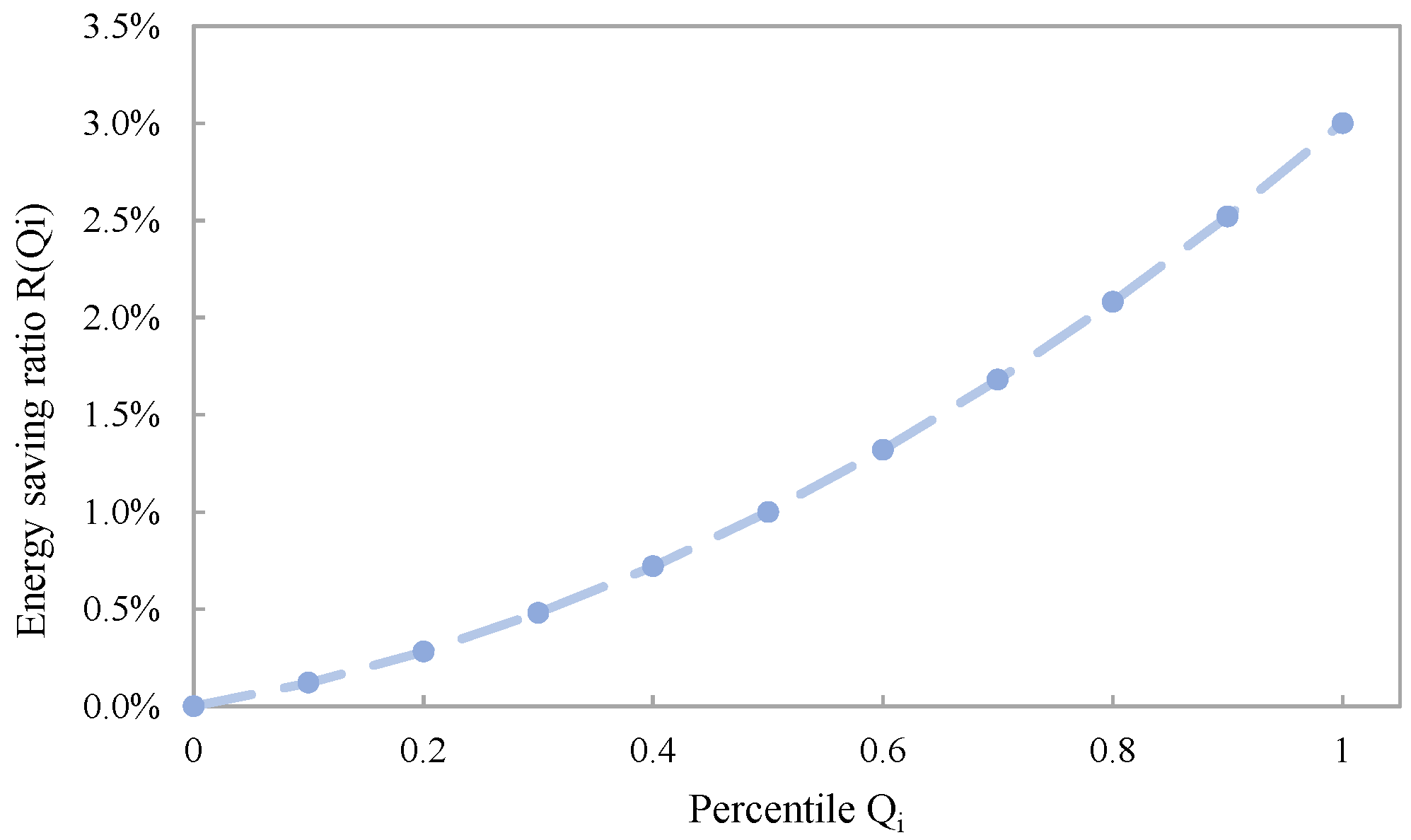
- Setting reasonable energy-saving pressure based on the percentile ranking: The lower Qi indicates that the building’s current energy consumption is relatively low within its group. This may be due to the implementation of many energy-saving improvements or good usage behaviors, so excessive demands must not be placed on it; instead, maintaining the current status or making minor optimizations is sufficient. Conversely, those with a higher Qi must bear a higher energy-saving ratio. Since buildings with a higher EUI generally have higher relative energy-saving potential and room for improvement, this effectively promotes overall building progress. However, attention must be paid to setting a reasonable magnitude for energy saving to ensure achievability, which must align with government energy-saving policy requirements.
- Alignment with government energy-saving policy goals: The government’s current energy-saving policy aims to improve overall building electricity use efficiency by 3% after three years, which simplifies to an average annual energy saving of 1% [8]. With this as a goal, reasonable energy-saving targets can be set for the percentiles. We set the energy-saving ratio for the median (Qi = 0.5) at 1% and the ratio for the worst-performing building (Qi = 1.0) at 3%.
3. Result and Discussion
3.1. The Actual EUI Distribution
3.2. Target EUI
4. Conclusions
Author Contributions
Funding
Institutional Review Board Statement
Informed Consent Statement
Data Availability Statement
Conflicts of Interest
References
- Yen, C.-J.; Lin, H.-T.; Lee, K.-P. Cost-Effectiveness Analysis of Nearly Zero-Carbon Office Buildings in Taiwan. Build. Environ. 2025, 267, 112270. [Google Scholar] [CrossRef] [Scilit]
- Oikonomou, V.; Becchis, F.; Steg, L.; Russolillo, D. Energy saving and energy efficiency concepts for policy making. Energy Policy 2009, 37, 4787–4796. [Google Scholar] [CrossRef] [Scilit]
- Chung, W. Review of building energy-use performance benchmarking methodologies. Appl. Energy 2011, 88, 1470–1479. [Google Scholar] [CrossRef] [Scilit]
- Chung, W.; Hui, Y.V.; Lam, Y.M. Benchmarking the energy efficiency of commercial buildings. Appl. Energy 2006, 83, 1–14. [Google Scholar] [CrossRef] [Scilit]
- Lee, K.; Lim, H.; Hwang, J.; Lee, D. Development of building benchmarking index for improving gross-floor-area-based energy use intensity. Energy Build. 2025, 328, 115103. [Google Scholar] [CrossRef] [Scilit]
- Turiel, I.; Craig, P.; Levine, M.; McMahon, J.; McCollister, G.; Hesterberg, B.; Robinson, M. Estimation of energy intensity by end-use for commercial buildings. Energy 1987, 12, 435–446. [Google Scholar] [CrossRef] [Scilit]
- Energy Administration, Ministry of Economic Affairs, Taiwan. Government Agencies and Schools Energy Conservation Reporting System. Available online: https://egov.ftis.org.tw/ (accessed on 30 October 2025).
- Energy Administration, Ministry of Economic Affairs, Taiwan. Government Agencies and Schools Electricity Efficiency Improvement Program (2024–2026); Ministry of Economic Affairs: Taipei, Taiwan, 2024. [Google Scholar]



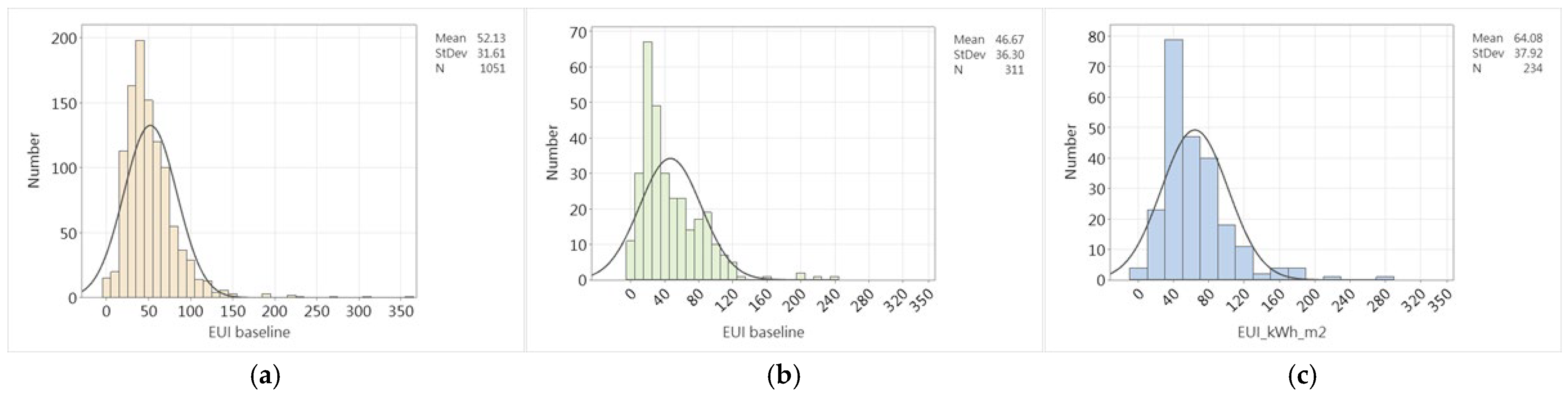
| Average Daily Operating Hours (Hours) | Data Quantity | Unit Type |
|---|---|---|
| 8 | 1051 | General local household registration offices, district offices |
| 10 | 311 | Central administrative agencies, county/city governments |
| 24 | 234 | Police agencies, fire departments |
Disclaimer/Publisher’s Note: The statements, opinions and data contained in all publications are solely those of the individual author(s) and contributor(s) and not of MDPI and/or the editor(s). MDPI and/or the editor(s) disclaim responsibility for any injury to people or property resulting from any ideas, methods, instructions or products referred to in the content. |
© 2026 by the authors. Licensee MDPI, Basel, Switzerland. This article is an open access article distributed under the terms and conditions of the Creative Commons Attribution (CC BY) license.
Share and Cite
Huang, K.-T.; Fang, P.-L.; Chang, H.-P. Advanced Electricity Use Efficiency Benchmarks for Governmental Office Buildings in Taiwan. Eng. Proc. 2026, 136, 10. https://doi.org/10.3390/engproc2026136010
Huang K-T, Fang P-L, Chang H-P. Advanced Electricity Use Efficiency Benchmarks for Governmental Office Buildings in Taiwan. Engineering Proceedings. 2026; 136(1):10. https://doi.org/10.3390/engproc2026136010
Chicago/Turabian StyleHuang, Kuo-Tsang, Pei-Lun Fang, and Hung-Peng Chang. 2026. "Advanced Electricity Use Efficiency Benchmarks for Governmental Office Buildings in Taiwan" Engineering Proceedings 136, no. 1: 10. https://doi.org/10.3390/engproc2026136010
APA StyleHuang, K.-T., Fang, P.-L., & Chang, H.-P. (2026). Advanced Electricity Use Efficiency Benchmarks for Governmental Office Buildings in Taiwan. Engineering Proceedings, 136(1), 10. https://doi.org/10.3390/engproc2026136010