Proceeding Paper

Impact of Device Location on User-Induced Pressure Transients: Investigation on a Full-Scale Laboratory Plumbing System †

1
Department of Engineering, University of Ferrara, 44122 Ferrara, Italy
2
Department of Civil and Environmental Engineering, University of Perugia, 06125 Perugia, Italy
*
Author to whom correspondence should be addressed.
Presented at II International Conference on Challenges and Perspectives in Urban Water Management Systems (CSDU-CSSI DAYS 25), Trieste, Italy, 18–19 November 2025.
Eng. Proc. 2026, 135(1), 8; https://doi.org/10.3390/engproc2026135008

Published: 1 May 2026

Abstract

Pressure transients generated by user activity are a potential, yet understudied, cause of failure in plumbing systems (PSs) and service lines (SLs). This study contributes to filling the knowledge gap by conducting a laboratory investigation at the Water Engineering Laboratory of the University of Perugia (Italy). In detail, a full-scale PS supplied by a representative portion of water distribution network was realized and instrumented with high-frequency pressure sensors and an electromagnetic flowmeter. Experimental data were collected by simulating demand variations at four distinct locations within the PS to replicate the activation of domestic devices. The resulting dataset provided valuable in-sights into the effective management of such systems and the development of appropriate protection measures.

1. Introduction

Pipe failures in water distribution networks (WDNs) can be caused by different fac-tors (e.g., environmental, structural, operational conditions), with water pressure being a critical operational variable [1]. Traditional methods for assessing pressure-related stress have primarily focused on steady-state conditions. However, recent studies, supported by advances in monitoring technologies, have challenged this conventional belief, revealing that dynamic pressure fluctuations occur far more frequently in WDNs than previously assumed [2]. Such fluctuations can induce material fatigue and accelerate deterioration of WDN components through repetitive cyclic loadings [3].
These pressure transients are not only the result of operational events (e.g., pump switches, hydrant activation for fire flows or WDN flushing). In fact, beyond these major events, very frequent pressure transients can also be due to routine user activities (i.e., domestic device activation), representing an underestimated source of structural stress on pipes and fittings. While these user-induced transients cause only minor pressure fluctuations (on the order of a few meters) in the main WDN [4], their effect on the so-called “minor systems”—including service lines (SLs) and private plumbing systems (PSs)—can be considerably more severe, imposing substantial and repetitive stress on the water infrastructure [5,6]. Overall, the effect of user-induced pressure transients on minor systems remains an understudied topic, despite their critical role as an interface between the WDN and the end user and their vulnerability to failure.
This work aims to address this gap by conducting a detailed laboratory investigation, designed to systematically characterize the effects of user-induced pressure transients on PSs. To this end, a full-scale PS was recently realized at the Water Engineering Laboratory (WEL) of the University of Perugia (Italy). The experimental program focuses on the impact of device location on the transient response of the system. High-frequency pressure data at multiple sections and flowrate at the inlet pipe were collected by simulating demand variations through the fast-acting of solenoid valves installed at four different PS locations to mimic domestic devices activation.
This paper is divided into two main sections: Section 2 (Materials and Method) de-scribes the experimental setup and the transient tests performed, while Section 3 (Results and Discussion) focuses on the analysis of the experimental data obtained.

2. Materials and Method

2.1. Full-Scale Plumbing System

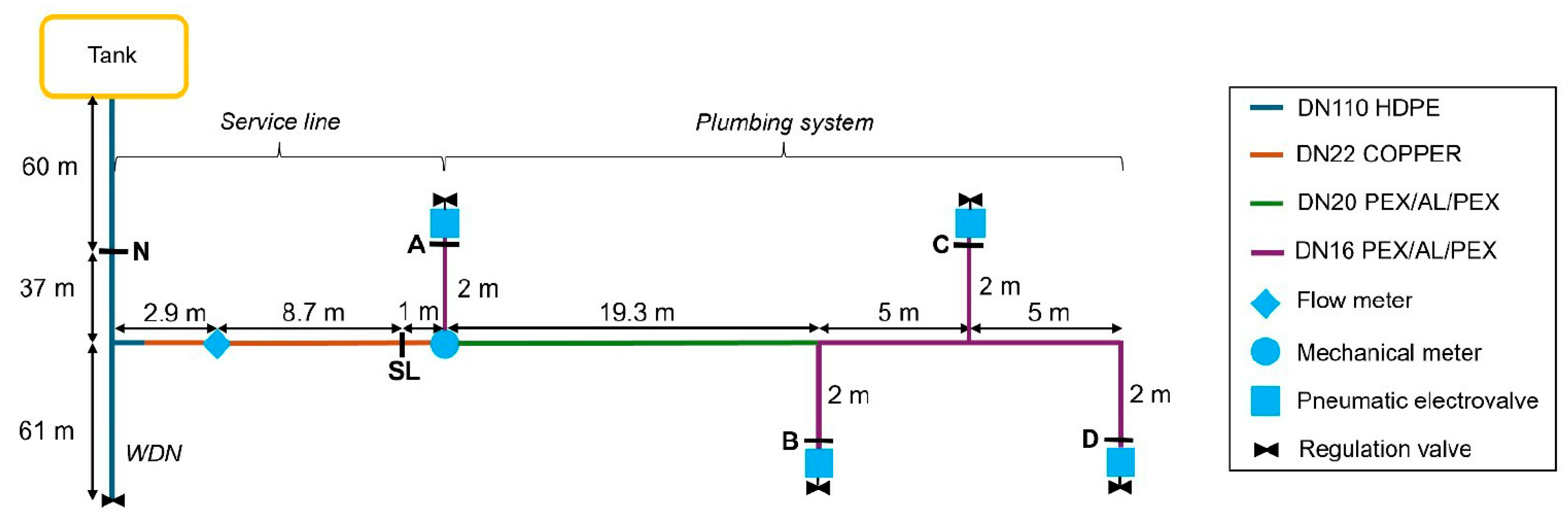
A full-scale residential PS supplied by a representative portion of a WDN was realized at the WEL (Figure 1). In detail, a pressurized tank supplies a DN110 high-density polyethylene (HDPE) main pipe by maintaining an almost constant 20 m supplied head. The DN110 pipe feeds a 12 m DN22 copper SL which, in turn, supplies the PS, realized with multilayer PEX/AL/PEX pipes and configured as a branched network with four discharge points (A–D). The topology, materials, and positions of the discharge points reproduce a real residential PS layout, including the location of domestic devices. To monitor the PS’s transient behaviour, high-frequency pressure transducers (sampling at 2048 Hz) were installed at six strategic locations (A, B, C, D, SL, and N), while an electromagnetic flowmeter was positioned at the inlet (i.e., in proximity of section SL).

2.2. Experimental Tests

The experimental tests are designed to simulate the use of domestic devices by activating one discharge point at a time through the rapid actuation of a solenoid valve coupled with a ball valve for discharge regulation. Each test spans a 6 min duration: an initial 2 min steady-state period, followed by a rapid opening maneuver, a subsequent 2 min stabilization phase, and a final closing maneuver followed by another 2 min interval for system stabilization. To ensure consistent conditions for comparison, an outflow of 0.26 L/s—representative of typical domestic water demand [7,8]—was maintained across all tests by adjusting the ball valve. Each test was performed twice to verify data reliability and repeatability.

3. Results and Discussion

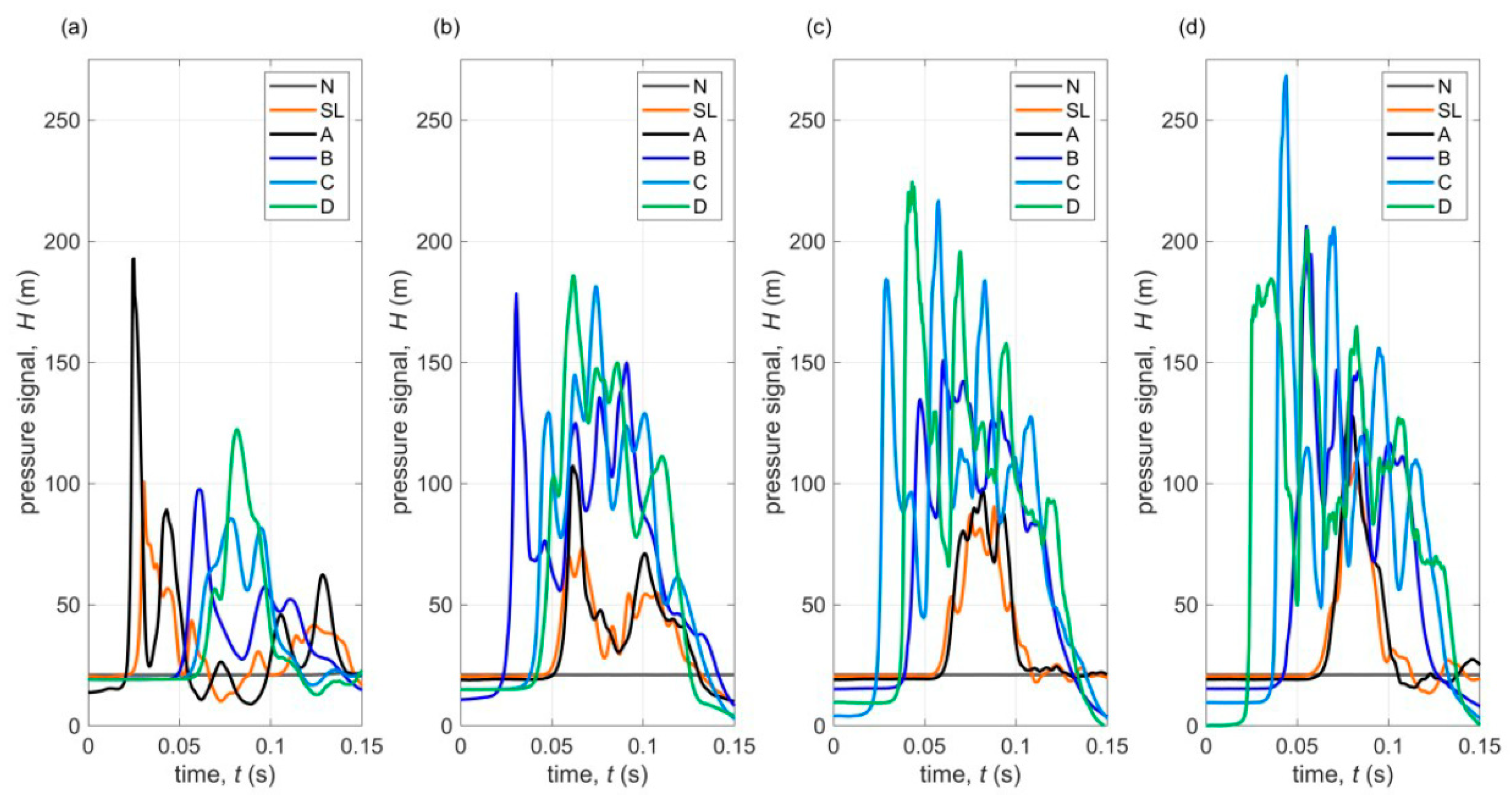
Test repeatability and data reliability were verified by comparing pressure signals from the two repetitions of each test. Subsequently, a primary analysis was carried out to investigate how the location of the activated device affects the propagation of transients within the system. To this aim, pressure signals recorded at sections A–D (within the PS), SL (along the service line), and N (in the main network) were compared for each test and reported in Figure 2.
The analysis reveals that the location of the activated device within the PS significantly influences pressure wave propagation. Specifically, as the maneuver is performed further downstream (e.g., progressing from B toward D, see Figure 1), the initial pressure variation tends to be entrapped within the PS pipes, creating a more severe stress condition compared to manoeuvres generated at A.
Interestingly, the most stressed section is not necessarily the one where the transient originates, but often an adjacent branch. For instance, a closure at D produced a pressure peak at B that was 1.6 times higher than the peak at D itself (Figure 2d). Furthermore, the terminal branches of the PS consistently experienced the greatest pressure variations, highlighting their vulnerability. This finding is particularly relevant because branched layouts are widely adopted in residential plumbing for both technical and economic reasons.
Moreover, the first pressure peak observed during a transient cycle is not always the largest peak recorded at a given section. This indicates that relying only on the initial pressure variation at the maneuver section as a safety reference could be misleading.
While the upstream sections (i.e., SL and N) experienced smaller and more uniform pressure variations—largely independent of the discharge point’s location—the dynamic response of the PS itself was highly dependent on this factor. This underscores the importance of investigating these phenomena in a highly controlled environment with multiple measurement points to fully understand their complexity.
Overall, this research provides a set of preliminary insights with important implications for the design, installation, and maintenance of PSs. The findings can inform new design standards, enabling engineers to select more resilient materials and configure layouts that mitigate the risk of premature failure, thereby improving the longevity and reliability of residential and commercial plumbing infrastructure.

Author Contributions

Conceptualization, V.M., D.F., C.C., F.M., S.A. and S.M.; methodology, V.M., D.F., C.C., F.M., S.A. and S.M.; software, D.F., C.C. and S.M.; validation, V.M., D.F., C.C. and S.M.; formal analysis, V.M., D.F., C.C., F.M., S.A. and S.M.; investigation, V.M., D.F., C.C. and S.M.; resources, S.A., B.B. and S.M.; data curation, D.F., C.C. and S.M.; writing—original draft preparation, V.M. and D.F.; writing—review and editing, V.M., D.F., C.C., F.M., S.A., B.B. and S.M.; visualization, V.M., D.F., C.C. and S.M.; supervision, S.A., B.B. and S.M.; project administration, S.A., B.B. and S.M.; funding acquisition, S.A., B.B. and S.M. All authors have read and agreed to the published version of the manuscript.

Funding

This research was jointly funded by MUR (Italy), FCT (Portugal), Fapesc (Brazil) in the context of the European Union’s Horizon Europe Programme under the 2022 Joint Transnational Call of the European Partnership Water4All within the project MORE4WATER (Grant n° 1010608749).

Institutional Review Board Statement

Not applicable.

Informed Consent Statement

Not applicable.

Data Availability Statement

Dataset available on request from the authors.

Conflicts of Interest

The authors declare no conflicts of interest.

References

  1. Barton, N.A.; Farewell, T.S.; Hallett, S.H.; Acland, T.F. Improving pipe failure predictions: Factors affecting pipe failure in drinking water networks. Water Res. 2019, 164, 114896. [Google Scholar] [CrossRef] [PubMed]
  2. Rathnayaka, S.; Shannon, B.; Rajeev, P.; Kodikara, J. Monitoring of pressure transients in water supply networks. Water Resour. Manag. 2015, 30, 471–485. [Google Scholar] [CrossRef]
  3. Jara-Arriagada, C.; Stoianov, I. Pipe breaks and estimating the impact of pressure control in water supply networks. Reliab. Eng. Syst. Saf. 2021, 210, 107525. [Google Scholar] [CrossRef]
  4. Marsili, V.; Meniconi, S.; Alvisi, S.; Brunone, B.; Franchini, M. Experimental analysis of the water consumption effect on the dynamic behaviour of a real pipe network. J. Hydraul. Res. 2021, 59, 477–487. [Google Scholar] [CrossRef]
  5. Marsili, V.; Mazzoni, F.; Alvisi, S.; Maietta, F.; Capponi, C.; Meniconi, S.; Brunone, B.; Franchini, M. Investigation of pressure transients induced on a real water service line by user’s activity. AQUA–Water Infrastruct. Ecosyst. Soc. 2023, 72, 2331–2346. [Google Scholar] [CrossRef]
  6. Meniconi, S.; Maietta, F.; Alvisi, S.; Capponi, C.; Marsili, V.; Franchini, M.; Brunone, B. Consumption change-induced transients in a water distribution network: Laboratory tests in a looped system. Water Resour. Res. 2022, 58, e2021WR031343. [Google Scholar] [CrossRef]
  7. Mazzoni, F.; Alvisi, S.; Franchini, M.; Blokker, M. Exploiting high-resolution data to investigate the characteristics of water consumption at the end-use level: A Dutch case study. Water Resour. Ind. 2023, 29, 100198. [Google Scholar] [CrossRef]
  8. Marsili, V.; Meniconi, S.; Alvisi, S.; Brunone, B.; Franchini, M. Stochastic approach for the analysis of demand induced transients in real water distribution systems. J. Water Resour. Plan. Manag. 2022, 148, 04021093. [Google Scholar] [CrossRef]
Figure 1. Layout of the full-scale plumbing system at the Water Engineering Laboratory of the University of Perugia (Italy).
Engproc 135 00008 g001
Figure 2. Pressure signals recorded at six different measurement sections (A–D, SL and N) during closure manoeuvres performed at discharge points (a) A, (b) B, (c) C, and (d) D, respectively.
Engproc 135 00008 g002
Disclaimer/Publisher’s Note: The statements, opinions and data contained in all publications are solely those of the individual author(s) and contributor(s) and not of MDPI and/or the editor(s). MDPI and/or the editor(s) disclaim responsibility for any injury to people or property resulting from any ideas, methods, instructions or products referred to in the content.