


Abstract
To reduce the environmental impact of aviation, airlines are offering Voluntary Carbon Offset (VCO) programs and Sustainable Aviation Fuel (SAF) contributions, which are rarely purchased by consumers. This quantitative survey study examines how passengers’ willingness to pay (WTP) for VCOs and SAF differs across ticket price levels and communication contexts. Findings indicate that, at higher ticket prices, lower stated WTP for carbon offsetting was observed when ticket price increases were presented within a more detailed communication context. Differences in communication context were not significantly associated with stated WTP for SAF, while SAF was indicated as a preferred mitigation strategy than VCOs. This study highlights the complexity of consumer decision-making regarding voluntary sustainable initiatives in aviation.
1. Introduction
In recent years, the aviation industry has come under pressure for its significant contribution to global greenhouse gas emissions. In 2022, the aviation sector was responsible for approximately 2.5% of global CO2 emissions [1].
Therefore, it is now facing mounting pressure to adopt sustainable practices and reduce its environmental impact. The aviation industry’s approach to decarbonization comprises a broad taxonomy of technical, operational, and market-based measures. These include technological innovations (such as the development of hydrogen or electric aircraft), operational improvements (like optimized flight trajectory management), and market-based instruments (such as the EU Emissions Trading System). Within this framework, Sustainable Aviation Fuel (SAF) and Voluntary Carbon Offsetting (VCO) serve as critical mid-term solutions.
SAF enables a circular carbon cycle by using biomass-based or waste-derived feedstocks whose CO2 uptake during growth or processing partially compensates for the CO2 released during combustion. As a result, SAF can significantly reduce the life-cycle carbon intensity of aviation fuel and is projected to deliver the largest share of emission reductions in aviation by 2050 [2]. Carbon offsetting mitigates emissions indirectly by funding external environmental projects, such as reforestation or renewable-energy initiatives, whose climate benefits typically unfold over long time horizons. Consequently, offsets provide potential emission reductions that are less immediate, often subject to uncertainty, and dependent on project implementation and verification [3]. Both carbon offsets and SAF blending contributions can often be purchased by passengers when booking a flight as an option to reduce one’s emissions. However, the adoption of these measures hinges on consumer acceptance and their willingness to pay (WTP) for such voluntary initiatives [4].
While various psychological and economic factors influence WTP, previous work highlights that low contribution prices are a crucial factor for positive responses within VCO programs [5], whereas higher base ticket prices may actually increase consumers’ stated WTP for carbon offsets. At the same time, airline ticket prices are highly volatile [6], and additional price increases are expected due to upcoming EU-level SAF mandates [7] and the possible introduction of a carbon tax [8] both of which could further influence consumer decisions.
In this context, it becomes important to understand how individuals perceive such measures when deciding whether to pay additional costs on top of their ticket price. While consumers tend to express support for carbon taxation—for example, Rodemeier’s (2024) [9] large-scale field experiment found that 67% supported a carbon tax, though this was not specific to the aviation sector—this may be different for involuntary price increases for SAF. Xu et al. (2022) [10] investigated the WTP for SAF and discovered that slightly more people agreed to pay for SAF when it was made involuntary compared to voluntary (28.4% vs. 25.6%). However, the differences were minimal and overall WTP remained relatively low. In both conditions, more participants declined to pay for SAF, while a similarly large portion expressed uncertainty about whether they would be willing to pay for it.
Communication and transparency may play an important role in shaping WTP. Previous work suggests that perceived lack of transparency in VCO programs seems to have a negative effect on WTP [5]. At the same time, airline pricing contexts are typically characterized by simplified choice environments in which voluntary mitigation options are presented with limited contextual information.
While there are already a few studies examining the WTP for SAF, these seem to remain in the minority compared to those focused on VCO programs. Recent work using stated-preference choice experiments has highlighted both low average WTP for SAF and substantial heterogeneity across consumer groups, as well as a gap between consumers’ stated WTP and the actual cost of SAF [11]. However, given its substantial contribution to the decarbonization of the aviation industry [2,12], it remains crucial to further examine how passengers evaluate SAF relative to other mitigation options. To study WTP for SAF and VCOs, a survey is a helpful tool to measure and understand WTP in relation to fluctuating ticket prices and transparency on ticket price increases due to environmental regulations, like an SAF mandate.
Against this background, the present study examines passengers’ WTP for voluntary aviation climate mitigation under different ticket price levels and communication contexts. Specifically, we compare WTP for carbon offsetting and SAF contributions when ticket price increases are presented with minimal booking-style information versus when they are embedded in a broader communication context that links price increases to environmental regulation, such as carbon taxation or SAF blending mandates and provides additional information about the mitigation mechanisms. By focusing on pairwise comparisons across ticket prices and mitigation mechanisms, this study provides insight into how communication context is associated with passengers’ WTP for voluntary climate action in aviation.
2. Methodology
2.1. Participants
A quantitative survey was conducted among European air travelers (N = 171) to assess WTP for VCOs and SAF. The sample was primarily recruited via social media and professional networks. The final dataset excluded participants who completed less than 25% of the survey to ensure data quality. The resulting pool was predominantly young and Western European, with 83% of respondents under 35 years old and most residing in the Netherlands, Germany, or Austria. Given these demographics, this research is an exploratory study of young European travelers rather than a generalizable study of all air passengers.
2.2. Materials and Procedure
The study employed a cross-sectional online survey design, using the Qualtrics survey platform [13]. The questionnaire began with an information page outlining the purpose of the study, followed by informed consent. Participants then completed questions on demographics, travel behavior, WTP for VCO programs and SAF, preferred climate mitigation method and prior experience with paying for SAF or carbon offsetting. The study involved anonymous survey data and did not require formal ethics approval under institutional guidelines.
The survey also included questions related to willingness to use three modes of transportation which are currently under development and not accessible for use. Only the outcomes of WTP for VCO programs and SAF are presented in this paper.
2.3. Measures
To assess WTP, contingent valuation questions were utilized. Participants were asked to indicate their WTP for VCO programs and SAF blending contributions. In contrast to discrete choice modeling, which requires respondents to evaluate multiple attribute combinations simultaneously, contingent valuation allows for a more focused assessment of stated willingness to pay using predefined payment ranges within simplified booking-style contexts. Given that the present study aimed to examine stated WTP under varying ticket price levels and communication contexts rather than to estimate marginal utilities of multiple attributes, the approach was considered appropriate.
Participants were presented with a hypothetical Amsterdam–Vienna flight. A base price of €150 was increased to €170 and €180 across repeated scenarios. In a between-subjects design, half the participants received enriched communication on a ticket price increase, either due to SAF mandates or carbon taxes, while the other half received only standard descriptions. All participants received a baseline description of VCOs and SAF.
The VCO baseline was described as follows:
“Voluntary carbon offsetting allows passengers to reduce the environmental impact of their flights by supporting carbon reduction initiatives. Airlines often provide passengers with the option to support specific projects during the booking process, supporting carbon reduction initiatives. Though carbon offsetting does not directly reduce emissions from flights, it enables passengers to support activities that capture carbon, as well as contribute to restoring biodiversity and ecosystems.”
The SAF baseline was described as follows:
“Another way to reduce the expected CO2 impact of a flight is by using Sustainable aviation fuel (SAF). Using SAF can reduce life-cycle emissions by up to 80% compared to traditional jet fuel, depending on the feedstock. However, current production is limited, making voluntary contributions vital for scaling its use. Airlines often provide passengers with the option to voluntarily purchase SAF to be blended into the kerosene. After payment, the SAF that passengers purchased will be blended into the airline’s jet fuels within 6–12 months (depending on Airlines’ policies).”
WTP was measured using a 5-point scale proportional to the ticket price. For the €150 base price, options included: €0, €1.50–€7.50, €7.50–€15.00, €15.00–€22.50, and >€22.50. In the enriched condition, surcharges were specifically framed as being “on top of” a carbon tax (for VCOs) or an SAF mandate (for SAF). Finally, participants ranked preferred mitigation strategies, including modal shifts and destination changes, and reported their prior offsetting behavior.
3. Results
3.1. Comparison of WTP for VCOs and SAF
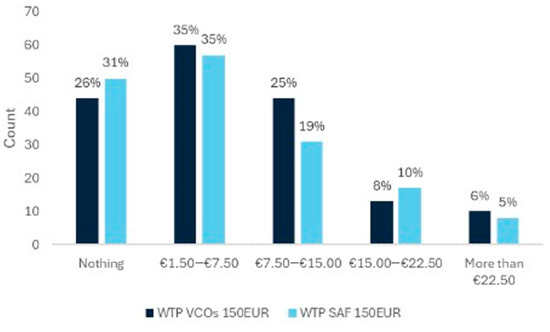
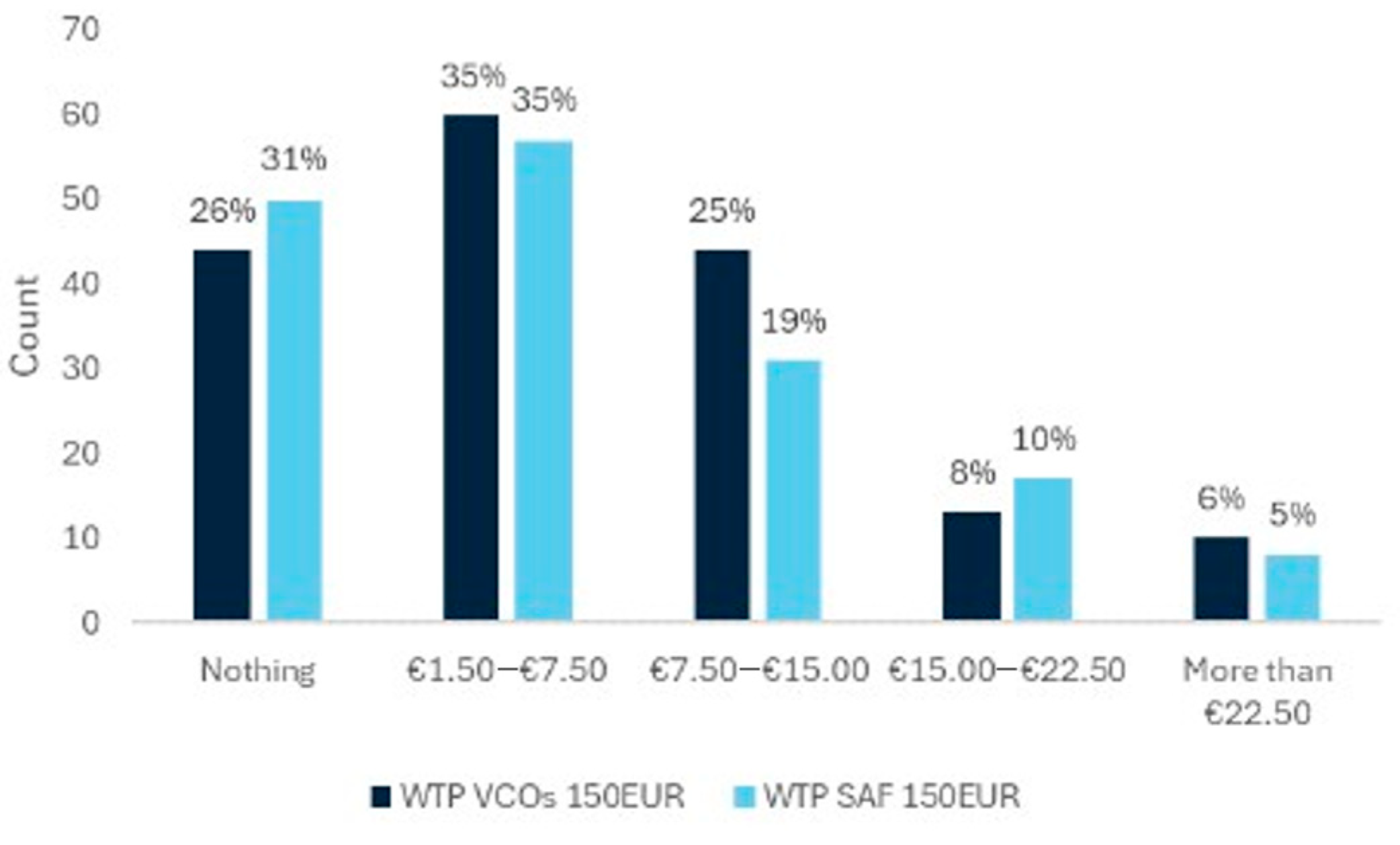
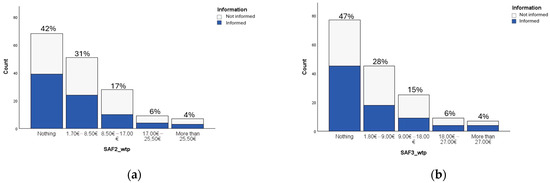
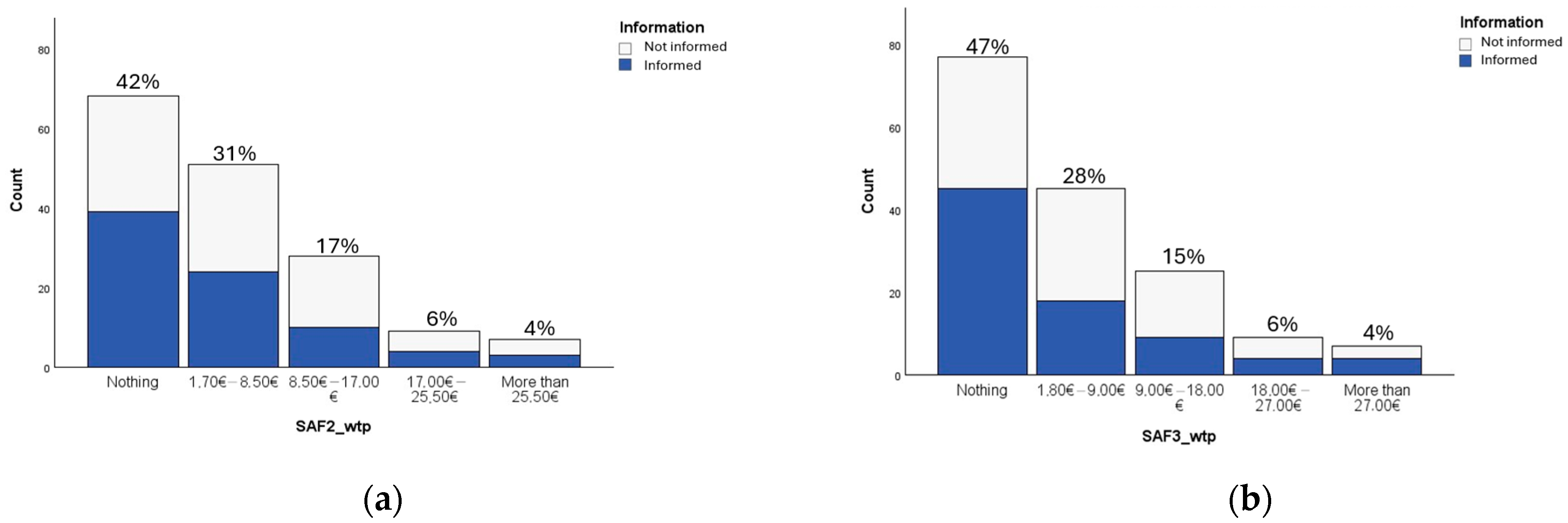
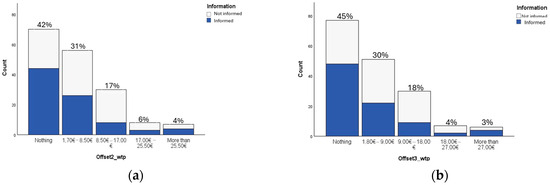
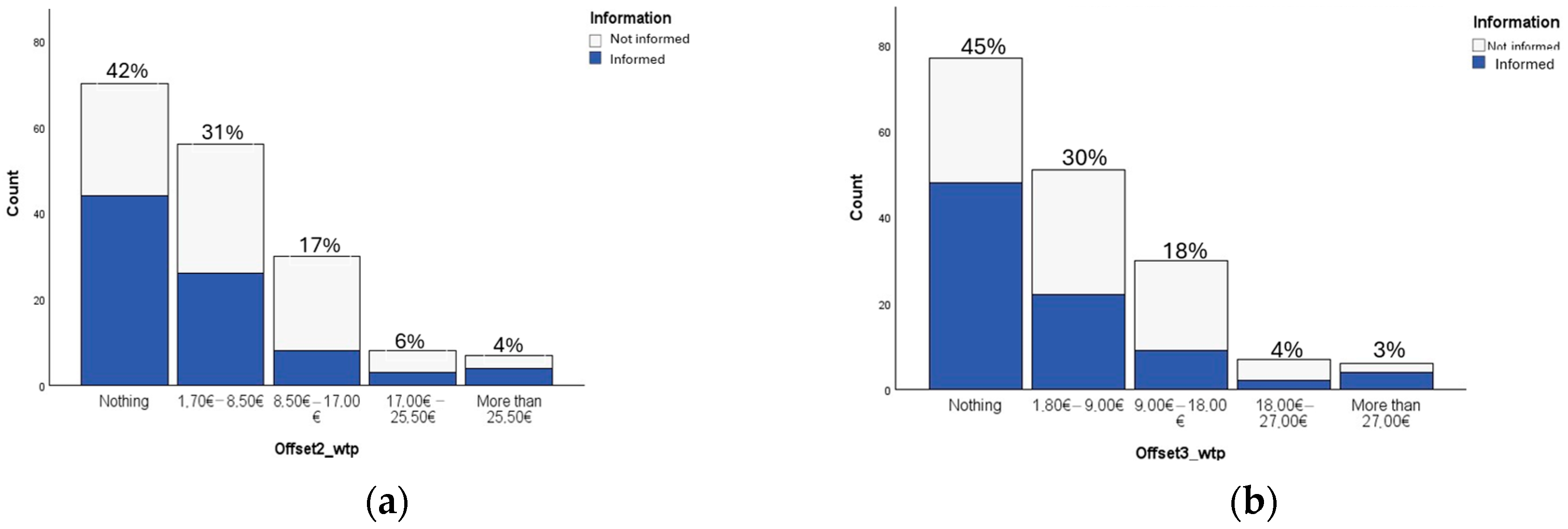
To compare participants’ WTP for SAF versus VCOs at three ticket price levels, three Wilcoxon Signed Ranks Tests were conducted. For the €150 ticket price, the WTP for SAF (Mdn = 1.00, n = 163) did not significantly differ from the WTP for VCOs (Mdn = 1.00, n = 171), Z = −1.42, p = 0.156, as seen in Figure 1. For the €170 ticket price, there was also no significant difference found between SAF and VCOs WTP, Z = −0.56, p = 0.578 (Figure 2a and Figure 3a). Similarly, for the €180 ticket price, the difference between SAF and VCOs WTP was not significant, Z = −0.54, p = 0.590 (Figure 2b and Figure 3b). Across all three price conditions, there was no statistically significant difference between willingness to pay for SAF and for VCOs.
Figure 1.
Indicated WTP for VCOs and SAF on top of a €150 ticket price.
Figure 2.
Indicated WTP for SAF on top of a €170 (a) and €180 (b) ticket price. The darker part of the bar indicates the enriched communication condition passengers on a ticket price increase due to a SAF mandate, while the lighter color indicates baseline-information condition passengers.
Figure 3.
Indicated WTP for VCOs on top of a €170 (a) and €180 (b) ticket price. The darker part of the bar indicates the enriched-communication condition passengers on a ticket price increase due to a carbon tax, while the lighter color indicates baseline-communication condition passengers.
However, with a ticket price increase, the difference in WTP for VCOs (M = 0.35, SD = 0.81) is larger than the difference in WTP for SAF (M = 0.25, SD = 0.61), Z = −2.02, p = 0.043. This means that with a €20 ticket price increase, the decrease in WTP for VCOs with a price increase is higher than for SAF.
3.2. WTP for VCOs and SAF After Providing Information on Ticket Price Increase
To examine whether communication context affected passengers’ WTP, four Mann–Whitney U tests were conducted: two for VCOs (+€20 and +€30 conditions) and two for SAF (+€20 and +€30).
For VCOs at +€20, participants in the enriched-communication condition (M = 0.79, n = 85) reported significantly lower WTP than those in the minimal-information condition (M = 1.17 n = 86), as indicated by a Mann–Whitney test, U = 2753.50, Z = −2.95, p = 0.003. Similarly, for VCOs at +€30, enriched-communication condition participants again showed significantly lower WTP than baseline-information ones, U = 2772.50, Z = −2.91, p = 0.004, as seen in Figure 2.
For SAF at +€20, the difference in WTP between enriched-communication condition (M = 0.85, n = 80) and baseline-information condition (M = 1.13, n = 83) participants was not statistically significant, U = 2784.50, Z = −1.88, p = 0.060. Likewise, for SAF at +€30, no significant difference in WTP was observed, U = 2778.00, Z = −1.93, p = 0.054. A trend (p < 0.10) is found between baseline-information condition and enriched-communication condition passengers’ WTP for SAF, as seen in Figure 3.
Overall, enriched communication was associated with lower WTP only for VCOs following ticket price increases, with enriched-communication respondents displaying lower WTP than those who were given the baseline information.
Because the present analyses rely on pairwise nonparametric comparisons at individual price levels, interaction effects between ticket price, mitigation mechanisms, and communication context were not formally tested.
3.3. Preferred Mitigation Strategy
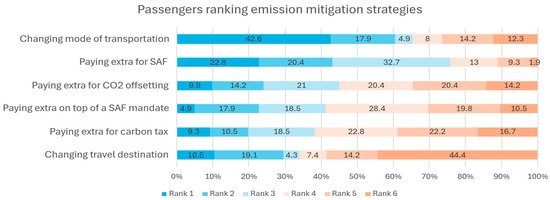
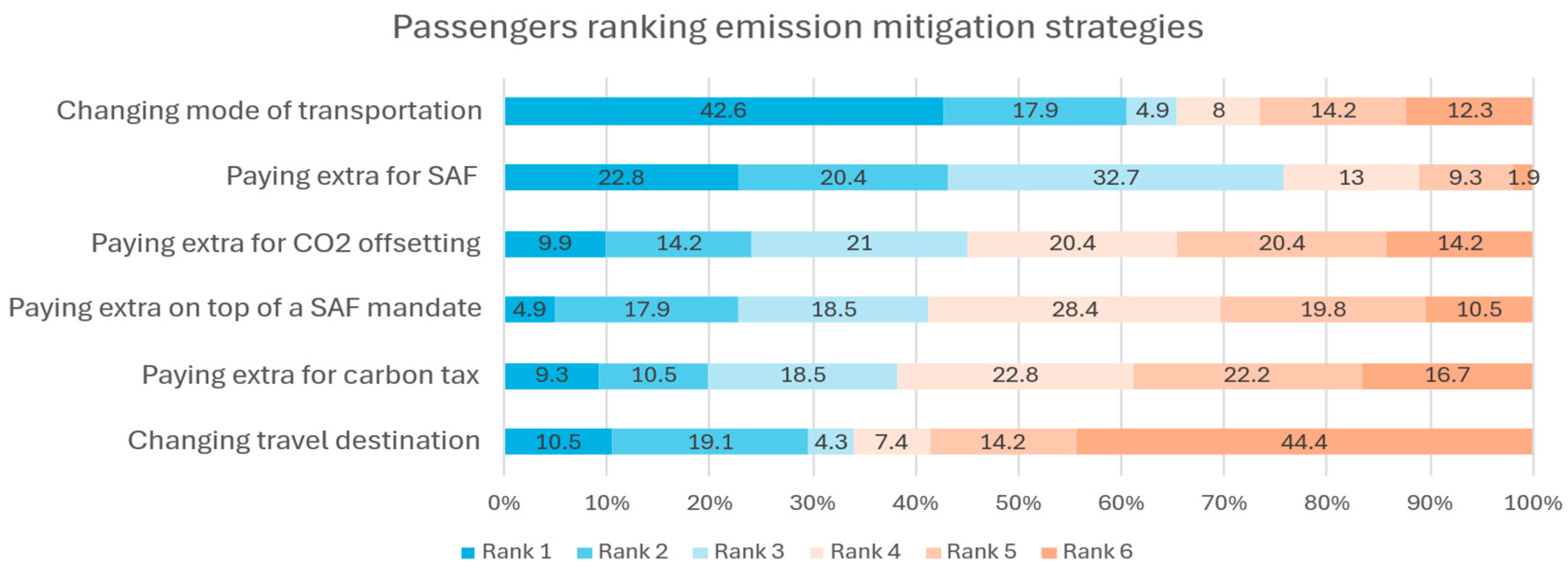
SAF was selected as the preferred mitigation strategy over VCOs, as seen in Figure 4. Here, 75% of the respondents placed a voluntary payment of SAF in their top three. More respondents, however, 42.6% chose the changing of destination as their top one preferred option, while only 22,8% chose a voluntary payment for SAF. The other mitigations were closely ranked, where interestingly the highest number 1 rank after SAF and changing mode of transport is changing the travel destination.
Figure 4.
Ranked preferred behavioral climate impact mitigation strategy.
3.4. Previous Payments for SAF or VCOs
When asked about previous payments, the overwhelming majority (62% of respondents) indicated to never having paid for a SAF surcharge or VCOs. The majority of respondents that did pay a voluntary contribution paid for carbon offsetting (24%), followed by a payment for both SAF and VCOs (10%) and lastly only for SAF (4%).
From all respondents that indicated that they have previously made a voluntary contribution to SAF, VCOs or both, most of these payments were made for short-haul flights.
The main reason participants indicated not contributing to SAF or VCOs was because of not seeing the option while booking, followed by financial constraints, skepticism of the effectiveness and other reasons.
4. Discussion
The study’s findings provide insights into passengers’ WTP for voluntary climate mitigation measures in aviation under varying price levels and communication contexts. While no statistically significant differences in WTP between SAF and VCOs were observed at specific ticket prices, descriptive patterns indicate that preferences may shift across price levels. In addition, SAF was selected as the preferred mitigation strategy over VCOs in the ranking task, suggesting that passengers may perceive SAF as a more effective means of reducing emissions. One possible explanation for this pattern is that SAF may be perceived as a more direct and tangible mitigation measure than carbon offsetting, which is often viewed as indirect and subject to uncertainty. Previous research has raised concerns regarding the effectiveness and credibility of carbon offset programs. For example, estimates suggest that the climate impact of offsets may be substantially overestimated [3], and analyses of airline sustainability claims indicate that a considerable proportion of offset-related statements are vague or potentially misleading [14]. Such misleading messages may contribute to generally low participation rates in VCO programs [15] and could also influence how passengers evaluate different mitigation options.
Interestingly, respondents indicated a higher willingness to change their travel destination over a voluntary SAF contribution, suggesting that destination choice may be flexible. The literature shows that the value of a flight is influenced by factors such as motive, experience, life stage, and situation, with nearly half (48%) of flights being considered to be of low importance [16].
Differences in communication context were also associated with differences in WTP, particularly for VCOs. When participants received additional information about the reason for the price increase and the mitigation measures, lower WTP for VCOs was observed. In contrast, the impact on WTP for SAF is less pronounced. One possible explanation for this pattern relates to how ticket price increases were framed in the communication. Prior research suggests the term “tax” can function as a negative frame because it taps into consumer aversion toward loss [17,18], distrust of government [19], and a tendency to view the mandatory payment as a fulfillment of their entire environmental obligation [20]. SAF blending mandates may be perceived as an industry-level compliance requirement, not directly linked to the consumer, potentially attenuating such negative responses. However, these interpretations remain speculative, as the present analyses do not allow for causal conclusions regarding framing mechanisms.
The impact of ticket price increases on WTP is also noteworthy. As ticket prices rise, passengers become less willing to pay for both SAF and VCOs. Across price categories, higher ticket prices were associated with lower reported WTP, suggesting that increasing ticket costs may discourage participation in voluntary sustainability initiatives.
This is consistent with prior research that overall passenger participation rates in voluntary sustainability payments are low [15]. The main reason for this low participation rate is that passengers often do not see the option to pay for sustainability initiatives during the booking process. Financial constraints and skepticism about the effectiveness of these initiatives are also significant barriers to participation. These findings highlight the need for airlines and policymakers to improve the visibility and transparency of sustainability initiatives by addressing concerns about their effectiveness in order to increase passenger participation and ultimately reduce the environmental impact of air travel.
Several limitations should be acknowledged. The present study relies on stated WTP measures derived from hypothetical booking scenarios. Such stated preferences may diverge from actual purchasing behavior, as hypothetical bias is well documented in pro-environmental contexts [21] where social desirability and the absence of real financial consequences can inflate reported WTP. Consequently, absolute WTP values should be interpreted with caution and not as direct estimates of real-world behavior. Instead, the findings are best understood as reflecting relative patterns and differences across mitigation mechanisms, price levels, and communication contexts.
The participant pool is also heavily skewed toward young adults, with approximately 83% of respondents being under 35 years old. This age distribution is not representative of the general flying population, which likely limits the ability to generalize these findings to air travelers at large. Additionally, the geographic scope was restricted to three Western European countries (the Netherlands, Austria, and Germany) which may not reflect the diverse attitudes and behaviors toward climate mitigation found in other global regions.
Due to the relatively small sample size of 171 respondents and the lack of a formal power analysis, the results should be interpreted with caution. Given these demographic and geographic characteristics, this research is best characterized as an exploratory study of young European travelers rather than a representative study of air traveler behavior in general. Future research should aim for a more diverse and globally representative sample to determine if these patterns hold across different age cohorts and cultural contexts
5. Conclusions
The study investigates passengers’ stated WTP for VCO and SAF contributions in air travel under varying ticket price levels and communication contexts. Across price conditions, no statistically significant differences were observed between stated WTP for SAF and VCOs, although SAF was more frequently selected as the preferred mitigation strategy.
Changes in stated WTP across increasing ticket price levels indicate sensitivity to overall travel costs for both mitigation options. Differences in communication context were associated with lower stated WTP for carbon offsetting, while no comparable association was observed for SAF. These findings suggest that passengers may evaluate voluntary mitigation mechanisms differently depending on both pricing context and the type of mitigation offered, although the underlying psychological processes were not directly measured in this study.
Author Contributions
Introduction, methodology, results, discussion and conclusions: N.S. and C.S. All authors have read and agreed to the published version of the manuscript.
Funding
This research received no external funding.
Institutional Review Board Statement
Ethical review and approval were waived for this study as it was conducted under the auspices of a university internship program that qualifies for exemption from the institutional review board according to Utrecht University’s research protocols.
Informed Consent Statement
Informed consent was obtained from all subjects involved in the study.
Data Availability Statement
The data presented in this study can be made available on request from the corresponding author due to privacy reasons.
Conflicts of Interest
The authors declare no conflicts of interest.
Abbreviations
The following abbreviations are used in this manuscript:
| SAF | Sustainable Aviation Fuel |
| VCOs | Voluntary Carbon Offsets |
| WTP | Willingness To Pay |
References
- European Commission. Climate Action: Reducing Emissions from Aviation. Available online: https://climate.ec.europa.eu/eu-action/transport-decarbonisation/reducing-emissions-aviation_en? (accessed on 27 October 2025).
- Destination 2050. A Route to Net Zero European Aviation. 2025. Available online: https://www.destination2050.eu/wp-content/uploads/2025/02/DESTINATION_2050_Roadmap_2025.pdf (accessed on 27 October 2025).
- Romm, J.; Lezak, S.; Alshamsi, A. Are carbon offsets fixable? Annu. Rev. Environ. Resour. 2025, 50, 649–680. [Google Scholar] [CrossRef] [Scilit]
- De Mello, F.P. Voluntary carbon offset programs in aviation: A systematic literature review. Transp. Policy 2024, 147, 158–168. [Google Scholar] [CrossRef] [Scilit]
- Cordes, H.; Baumeister, S.; Käyrä, M. Factors influencing the willingness to pay for aviation voluntary carbon offsets: A literature review. Eur. J. Tour. Res. 2024, 36, 3602. [Google Scholar] [CrossRef] [Scilit]
- Mantin, B.; Koo, B. Dynamic price dispersion in airline markets. Transp. Res. Part E Logist. Transp. Rev. 2009, 45, 1020–1029. [Google Scholar] [CrossRef] [Scilit]
- IATA. Net Zero 2050: Sustainable Aviation Fuels (SAF). 2025. Available online: https://www.iata.org/en/iata-repository/pressroom/fact-sheets/fact-sheet-sustainable-aviation-fuels/ (accessed on 27 October 2025).
- IATA. Taxes and Addressing CO2 Emissions. 2025. Available online: https://www.iata.org/en/iata-repository/pressroom/fact-sheets/fact-sheet-taxes-environment/ (accessed on 27 October 2025).
- Rodemeier, M. Willingness to Pay for Carbon Mitigation: Field Evidence from the Market for Carbon Offsets; Institute of Labour Economics: Bonn, Germany, 2024; Available online: www.iza.org (accessed on 27 October 2025).
- Xu, B.; Ahmad, S.; Charles, V.; Xuan, J. Sustainable commercial aviation: What determines air travellers’ willingness to pay more for sustainable aviation fuel? J. Clean. Prod. 2022, 374, 133990. [Google Scholar] [CrossRef] [Scilit]
- Li, D.C.; Beck, M.J.; Merkert, R. Willingness to pay for voluntary airline carbon offsets and sustainable aviation fuel. Transp. Res. Part A Policy Pract. 2025, 204, 104824. [Google Scholar] [CrossRef] [Scilit]
- Bian, S. A Critical Review of Decarbonization Strategies Among Major U.S. Airlines: Comparison Between Sustainable Aviation Fuel and Carbon Offsets. Front. Manag. Sci. 2024, 3, 56–66. [Google Scholar] [CrossRef] [Scilit]
- Qualtrics. Qualtrics XM: The Leading Experience Management Software. Available online: https://www.qualtrics.com/ (accessed on 27 October 2025).
- Guix, M.; Ollé, C.; Font, X. Trustworthy or misleading communication of voluntary carbon offsets in the aviation industry. Tour. Manag. 2021, 88, 104430. [Google Scholar] [CrossRef] [Scilit]
- Berger, S.; Kilchenmann, A.; Lenz, O.; Schlöder, F. Willingness-to-pay for carbon dioxide offsets: Field evidence on revealed preferences in the aviation industry. Glob. Environ. Change 2022, 73, 102470. [Google Scholar] [CrossRef] [Scilit]
- Gössling, S.; Hanna, P.; Higham, J.; Cohen, S.; Hopkins, D. Can we fly less? Evaluating the ‘necessity’ of air travel. J. Air Transp. Manag. 2019, 81, 101722. [Google Scholar] [CrossRef] [Scilit]
- Cherry, T.L. The acceptability of efficiency-enhancing environmental taxes, subsidies, and regulation: An experimental investigation. Environ. Sci. Policy 2012, 16, 90–96. [Google Scholar] [CrossRef] [Scilit]
- Carattini, S.; Carvalho, M.; Fankhauser, S. Overcoming public resistance to carbon taxes. Wiley Interdiscip. Rev. Clim. Change 2018, 9, e531. [Google Scholar] [CrossRef] [Scilit]
- Carattini, S.; Carvalho, M.; Fankhauser, S. How to Make Carbon Taxes More Acceptable. Grantham Research Institute on Climate Change and the Environment and Centre for Climate Change Economics and Policy, London School of Economics and Political Science. 2017. Available online: https://www.lse.ac.uk/granthaminstitute/wp-content/uploads/2017/12/How-to-make-carbon-taxes-more-acceptable.pdf (accessed on 27 October 2025).
- Pizzo, A.; Gravert, C.; Bauer, J.M.; Reisch, L. Cebi Working Paper Series: Carbon Taxes Crowd Out Climate Concern: Experimental Evidence from Sustainable Consumer Choices. 2024. Available online: https://www.econ.ku.dk/cebi/publikationer/working-papers/CEBI-WP_16-24.pdf (accessed on 27 October 2025).
- Murphy, J.J.; Allen, P.G.; Stevens, T.H.; Weatherhead, D. A Meta-analysis of Hypothetical Bias in Stated Preference Valuation. Environ. Resour. Econ. 2005, 30, 313–325. [Google Scholar] [CrossRef] [Scilit]
Disclaimer/Publisher’s Note: The statements, opinions and data contained in all publications are solely those of the individual author(s) and contributor(s) and not of MDPI and/or the editor(s). MDPI and/or the editor(s) disclaim responsibility for any injury to people or property resulting from any ideas, methods, instructions or products referred to in the content. |
© 2026 by the authors. Licensee MDPI, Basel, Switzerland. This article is an open access article distributed under the terms and conditions of the Creative Commons Attribution (CC BY) license.