Proceeding Paper

The Effect of Green Roofs on the Pressurization of Stormwater Collection Networks †
Department of Engineering, Università degli Studi della Campania “L. Vanvitelli”, 81031 Aversa, Italy
*
Author to whom correspondence should be addressed.
Presented at II International Conference on Challenges and Perspectives in Urban Water Management Systems (CSDU-CSSI DAYS 25), Trieste, Italy, 18–19 November 2025.
Eng. Proc. 2026, 135(1), 4; https://doi.org/10.3390/engproc2026135004
Published: 29 April 2026

Abstract

Growing urbanization influences the urban hydrological cycle by increasing stormwater runoff. Consequently, Stormwater Collection Networks may suffer troubling phenomena, such as pressurized flow conditions. One promising strategy to resolve this issue involves the adoption of green roofs. This study investigates the effect of green roof installation on the enhancement of sewer network behaviour. Numerical simulations were conducted using EPA SWMM 5.2. The model was varied by changing the hydraulic roughness and the slope of the drainage network conduits along with the green roof extension. Preliminary results revealed that green roofs can significantly mitigate the pressurization hazard in urban drainage systems.

1. Introduction

The transition from free-surface to pressurized flows in sewer systems represents a crucial and, unfortunately, quite common aspect of the hydraulic operation of existing Stormwater Collection Networks (SCNs). In particular, the sewers in urban catchment areas where urbanization has increased are frequently surcharged by the volume runoffs generated by the increasing impervious surfaces. In response to these challenges, Sustainable Drainage Systems (SuDSs) have emerged as a mitigation solution since they aim to return these urbanized areas to their pre-development hydrological conditions by promoting water infiltration, evapotranspiration and retention. The installation of SuDS techniques, such as green roofs, can alleviate the hydraulic load on the channels and manholes of the SCNs, thus enhancing their hydraulic performance [1].
The present study aims to assess and quantify the capacity of green roof installations to prevent the transition from free-surface to pressurized flows in the SCN pipes. For this purpose, the SCN model studied by [2] was considered as point of reference. The above-mentioned study analyzed the evolution of the pressurization process in SCNs with different topologies, slopes and roughness values through the evaluation of nondimensional indexes. Herein, a set of numerical simulations using the software EPA SWMM 5.2 [3] were conducted to test the effects of green roof installation, with different percentages of areal extension, on the hydraulic behaviour of the same SCN scheme modelled by [2]. Preliminary results highlighted the positive impact of green roof installation on the occurrence of the pressurization processes affecting the stormwater networks.

2. Materials and Methods

2.1. Stormwater Collection Network Characteristics

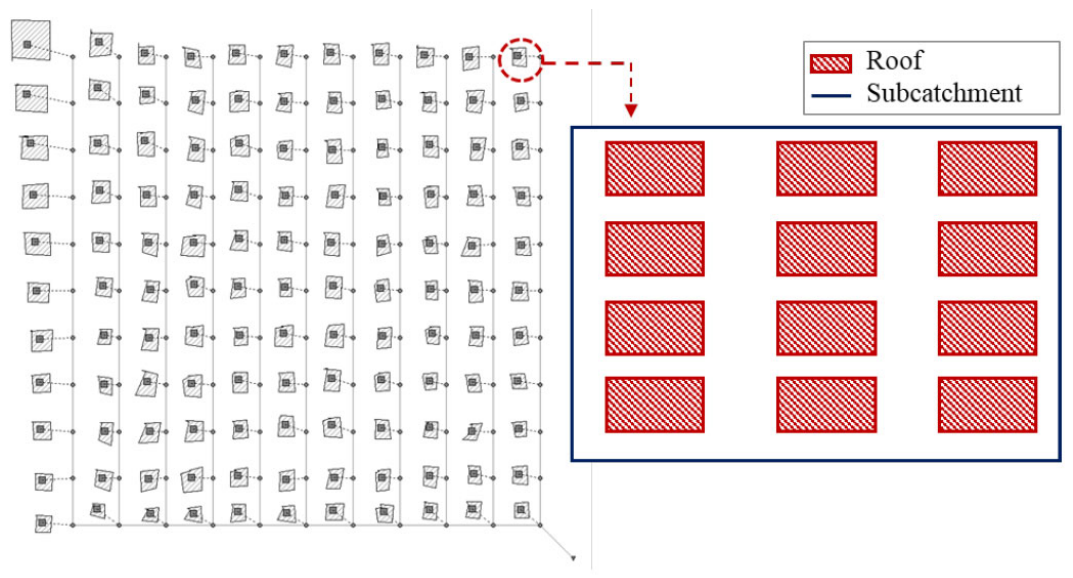
The SCN detailed in [2] presented a dendritic topology, characterized by 121 nodes and 120 circular conduits, with a diameter d = 1.00 m and a length L = 100 m. As shown in Figure 1, each junction node was linked to a sub-catchment with a total area Atot of 1.00 ha. The sub-catchments were fully covered by impervious surfaces, and the roofs occupied 50% of Atot. For each sub-catchment, the slope was set equal to 1%, and no storage depressions were considered. The Curve Number (CN) approach was utilized to assess infiltration losses, with CN = 98 in accordance with the hydrological soil group B. Furthermore, the Manning equation for surface runoff, the Dynamic Wave model for flow routing, and the Preissmann slot pressurization algorithm (SLOT) were chosen. Manning’s roughness coefficient for stormwater runoff was set at equal to 0.011 for all sub-catchments, similarly to [2].

2.2. Tested Conditions

Different geometrical SCN characteristics were considered, as shown in Table 1. The conduit roughness n values were uniformly set over the entire SCN, equal to 0.010 and 0.016, which correspond to the roughness coefficients chosen for plastic and concrete pipes, respectively. Slope values S0 equal to 0.25%, 0.5% and 1% were assigned uniformly to all the SCN pipes. In [2], a uniform inflow was entered in each junction of the SCN. The summation of all junction inflows generated the runoff Qinflow. In the present investigation, two distinct rainfall intensity values were fixed, and the corresponding constant-intensity hyetographs were applied to obtain the same values of Qinflow, as assumed by [2]. Moreover, increasing percentages of green roof extension were supposed, with six values of Effective Impervious Area reduction EIAred corresponding to an increase in the ratio AGR/Atot, where AGR denotes the area of the catchment designated for green roofs (GRs). All the tests reproduced the transition time from an initial empty SCN to a steady flow condition, achieved when the value of Qinflow approximated the flow in the outfall node. By definition, the SCNs was supposed to reach the steady condition when the outflow achieved 99% of Qinflow at time TQ99, which represents the time required to establish steady flow conditions. The remaining 1% did not impact the pressurization dynamics [2].

2.3. Nondimensional Indexes

The SCNs behaviour under pressurized flow conditions was analyzed through the evaluation of nondimensional indexes. Reference [2] introduced eight nondimensional flow indexes. In the current work, two of them were used: the average flow rate Q*avg and the non-dimensional time T*Q99. The first index represents the average flow rate across all conduits for a given configuration, and it was evaluated, as reported in Equation (1), as a function of the flow rate across the i-th pipe flow Qi and the idealized Chezy–Manning flow for a full pipe, Qf. Larger values of Q*avg were associated with a greater number of junctions where pressurized flow conditions occurred.
Q a v g * = 1 n i = 1 N c Q i Q f = 1 n i = 1 N c Q i ( 1 n ) π 2 10 / 3 d 8 / 3 S 0
Moreover, T*Q99 was introduced to evaluate time-varying behaviour across different simulations; this was related to TQ99 and the ratio between the total storage volume provided by the conduits VSCN and Qinflow (Equation (2)). Of note, according to [2], TQ99 denotes the time instant at which a quasi-steady state condition was achieved, with an outflow flow rate equal to 99% of the total Qinflow.
T*Q99 = TQ99/(VSCN/Qinflow),

3. Results and Discussion

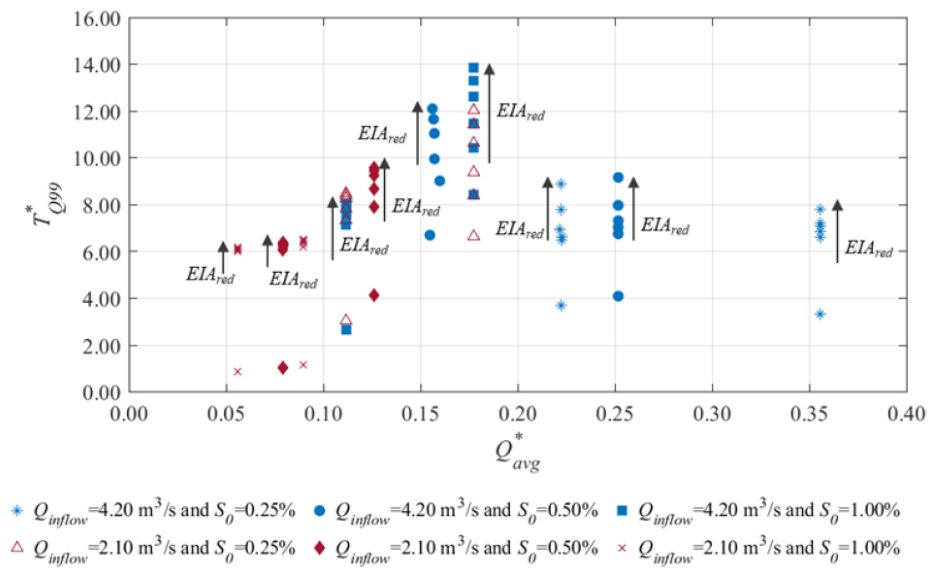
As illustrated by [2], T*Q99 showed a significant dependence on the conduit slope S0.
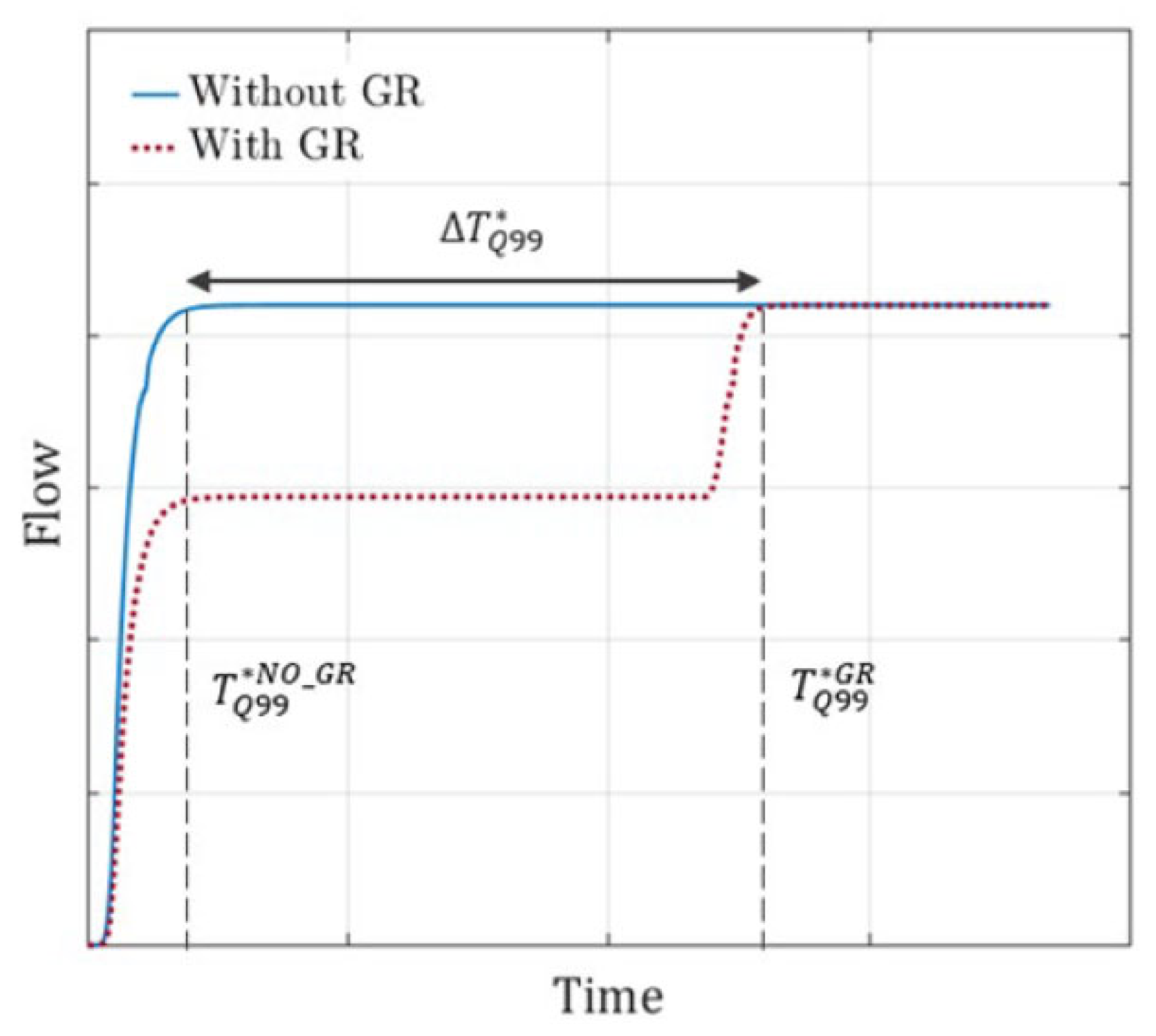
Specifically (Figure 2), for Qinflow = 2.10 m3s−1 and steeper slopes, the values of T*Q99 were small and increased with Q*avg; on the other hand, for Qinflow = 4.20 m3s−1, T*Q99 in-creased with Q*avg, and it reached a peak for Q*avg approximately equal to 0.18 before decreasing. This behaviour can be explained by considering the different pressurization types. In this regard, the recession branch involved a type of pressurization characterized by fast propagation; consequently, the values of T*Q99 were shorter than in the other types of pressurization. Figure 2 also shows the effect of GR implementation on T*Q99. With the increase in EIAred, corresponding to an augmentation of the surface covered by GR techniques, there was an increase in the values of T*Q99. This suggested that green roofs detained rainwater, and they slowly released it in the downstream sewer system; thus, there was a delay in the occurrence of the steady flow conditions. The delay in the occurrence of the steady-state conditions can be appreciated by comparing the simulated hydrographs at the outflow node in the scenario with implementation of GRs (EIAred = 0%) and in a generic scenario characterized by GRs implementation. As shown in Figure 3, the EIAred = 0% case reached the steady flow condition more quickly than in the scenario that implied the GR installation. The latter reached the first steady flow condition, with the value of the flow rate being smaller than the 99% of the Qinflow. Then, a second steady flow condition occurred, in which the flow rate reached 99% of the total Qinflow. According to these results, GRs intercepted the rainwater in their storage layer until the soil became saturated and the maximum water capacity was reached; then, they released the excess water as drain outflow, acting as an impervious surface.
In this regard, a nondimensional delay time ΔT*Q99 was introduced to quantify the delay in the achievement of the steady-state conditions obtained with the implementation of GRs. ΔT*Q99 was evaluated as the difference between T*Q99 in the scenario without GRs (EIAred = 0%) and T*Q99 in the other simulation scenarios that supposed GR installation (Equation (3)).
ΔT*Q99 = T*GRQ99 − T*NO_GRQ99,
The preliminary findings indicate that ΔT*Q99 increased with EIAred, varying from a minimum of approximately 2.00, at EIAred = 5%, to a maximum of 5.42, at EIAred = 50%. Our next research steps will focus on the creation of a chart that, given the hydraulic characteristics of the SCNs, will allow us to evaluate the delay in the occurrence of the steady-state conditions ΔT*Q99 for a chosen value of EIAred. Moreover, future investigations will assess the role of green roofs in reducing the runoff volume conveyed to the downstream drainage systems.

Author Contributions

Conceptualization, G.C. and C.G.; methodology, E.O., G.C. and C.G.; software, E.O. and L.P.; validation, E.O., L.P. and G.C.; formal analysis, E.O. and G.C.; investigation, E.O., L.P., G.C. and C.G.; resources, C.G.; data curation, G.C. and C.G.; writing—original draft preparation, E.O. and L.P.; writing—review and editing, E.O. and G.C.; visualization, E.O. and G.C.; supervision, C.G.; project administration, C.G.; funding acquisition, C.G. All authors have read and agreed to the published version of the manuscript.

Funding

The present research was supported by the Project Multi-Risk sciEnce for resilient commUnities undeR a changiNg climate (RETURN) funded under the National Recovery and Resilience Plan (NRRP), Mission 4 Component 2 Investment 1.3.

Informed Consent Statement

Not applicable.

Data Availability Statement

The data presented in this study are available on request from the corresponding author.

Conflicts of Interest

The authors declare no conflict of interest.

References

  1. Orsi, E.; Crispino, G.; Iervolino, M.; Gisonni, C. Hydraulic and Hydrologic Invariance: Effectiveness of Green Roofs and Permeable Pavements. J. Irrig. Drain. Eng. 2025, 151, 04025001. [Google Scholar] [CrossRef]
  2. Vasconcelos, J.G.; Geller, V.G.; Triboni, C.V.; Wright, D.B.; Hodges, B.R. Evolution and Characterization of Pressurized Flow Conditions in Stormwater Collection Networks. J. Hydraul. Eng. 2024, 150, 04024001. [Google Scholar] [CrossRef]
  3. Rossman, L.A.; Simon, M.A. Storm Water Management Model User’s Manual Version 5.2; United States Environmental Protection Agency: Washington, DC, USA, 2022.
Figure 1. SWMM schematization of the SCN (left); detail of one impervious sub-catchment (right).
Engproc 135 00004 g001
Figure 2. Relation between T*Q99 and Q*avg for the two inflow conditions.
Engproc 135 00004 g002
Figure 3. Simulated hydrographs for the scenario without GR implementation (solid line) and the scenario with GR implementation (dashed line).
Engproc 135 00004 g003
Table 1. Tested parameters range within the experimental program.
Variable and UnitsSimulation Range
S0 [%]0.25, 0.50, 1.00
Qinflow [m3s−1]2.10, 3.15, 4.20
n [m−1/3s]0.010, 0.016
EIAred [%]0.00, 5.00, 10.00, 20.00, 30.00, 50.00
Disclaimer/Publisher’s Note: The statements, opinions and data contained in all publications are solely those of the individual author(s) and contributor(s) and not of MDPI and/or the editor(s). MDPI and/or the editor(s) disclaim responsibility for any injury to people or property resulting from any ideas, methods, instructions or products referred to in the content.