Proceeding Paper

Investigating the Response of Blue Roofs Under Future Climate Scenarios †
by
Gaetano Buonacera
,
Alberto Campisano
,
Antonino Cancelliere
,
Aurora Gullotta
,
Nunziarita Palazzolo
and
David Johnny Peres
*
Department of Civil Engineering and Architecture, University of Catania, 95125 Catania, Italy
*
Author to whom correspondence should be addressed.
Presented at II International Conference on Challenges and Perspectives in Urban Water Management Systems (CSDU-CSSI DAYS 25), Trieste, Italy, 18–19 November 2025.
Eng. Proc. 2026, 135(1), 27; https://doi.org/10.3390/engproc2026135027
Published: 22 May 2026

Abstract

In this study, we evaluate the potential of blue roofs (BRs) to mitigate future increases in rainfall intensity projected by climate models. Using hourly EURO-CORDEX regional climate model data and a scaling-based methodology, we derived rainfall depth–duration–frequency curves for RCP4.5 and 8.5 for the future (up to 2100). The hydrological performance of a pilot BR tray in Catania, Italy, was then simulated under future design storms. Results show BRs can significantly reduce peak flows. Runoff volumes are reduced, but in most scenarios, they do not fully counterbalance the increase in rainfall intensity expected for the future. Peak attenuation ranges from 38% to 58%, depending on precipitation features and emission pathways, confirming BRs as effective adaptation measures.

1. Introduction

Urban flooding has increased in recent decades due to uncontrolled urbanisation, with climate change further intensifying risks [1]. To address these challenges, sustainable urban drainage systems (SUDs) have been widely adopted, also serving as climate change adaptation measures [2]. Blue roofs (BRs) represent one innovative solution: replacing conventional rooftops to reduce runoff impacts. Early trials in New York City tested configurations such as passive drains, flow restrictors, and modular trays [3]. Comparable to green roofs, BRs achieved retention efficiencies up to 62% [4], while full-scale installations in Catania reached 54% retention and 72% peak attenuation [5,6]. However, little is known about their performance under climate change. This study addresses this gap by simulating the hydrological response of a modular tray-based BR in Catania using future rainfall scenarios derived from EURO-CORDEX climate projections [7].

2. Methodology

The response of BRs to climate change is simulated using a modelling chain that integrates climate scenarios with a hydrological BR model.
Future depth–duration–frequency (DDF) curves were derived using the methodology in [7] from annual maxima series (2005–2100) at the Catania station. Hourly data came from three EURO-CORDEX GCM-RCM combinations: CNRM-RCA4, Had-RCA4, and MPIRCA4. DDFs were estimated by applying change factors to observations under the simple scaling hypothesis. A log-normal distribution was fitted and validated with the Anderson–Darling test. Design storms with 2-, 3-, and 5-year return periods were selected, as BRs aim to reduce drainage loads rather than manage events associated with extreme return periods. The BR model was tested with Chicago, rectangular, and triangular hyetographs derived from DDFs for current and future climates. Each storm had a 1 h duration, with exponent parameter n set to 0.5. Simulations assumed initially dry trays, consistent with BRs’ response to short storms.
The hydrological model of the BR installation, developed in [6], has been used to simulate BR response, based on experiments conducted on a real-scale experimental site at the University of Catania, described in [5]. The blue roof is modelled as the weighted sum of two contributions: one given by the tray-modules, the other given by the underlying terrace (terr). The response of this second component is modelled considering an initial abstraction and a runoff coefficient:
h n t e r r = C ( h t I a t e r r )
where h n t e r r is the net precipitation, h n is the total amount of rain for each event and I a t e r r is the initial abstraction. The single BR model routing instead is based on the continuity equation:
Δ S Δ t = Q i n t r a y ( t ) Q o u t t r a y ( t )
where ΔS[l] is the variation in the volume of the tray module with respect to the time step Δt, Q i n t r a y ( t ) and Q o u t t r a y t   [ l / s ] are, respectively, the flow entering and leaving within each tray. The outflow from the bottom orifice of each tray is computed with the equation:
Q o u t t r a y t = 0.0136 d [ 1 + 1.88 e x p 0.0001 t ]
where d[m] is the diameter of the bottom orifice. Finally, the total outflow is computed by simply adding the component from corridors and the outflow of the tray, multiplying the latter by the number of total trays installed in the BR:
Q o u t B R t = Q o u t c o r r t + n Q o u t t r a y ( t )
where n = 64 is the total number of tray modules installed in the pilot site. The BR model was validated against 14 rainfall events with totals exceeding 4 mm, recorded between September 2023 and June 2024. It showed satisfactory performance, achieving an RMSE of 2.42 mm for the final stored volume and 0.02 L/s for peak outflow. The hydrological response of the tray-module BR installation in future scenarios is assessed, comparing the runoff volumes and peak flow reduction index. The peak flow ratio is computed for each scenario and future period, computing the average along the return period and type of hyetograph considered. The peak reduction index (i.e., detention index) is computed with the following equation:
I D = Q P Q Q P
where Q p [l/s] is the peak outflow from an impulsive response of an impervious terrace, and Q [l/s] is the peak outflow from the tray-module BR system.

3. Results and Discussion

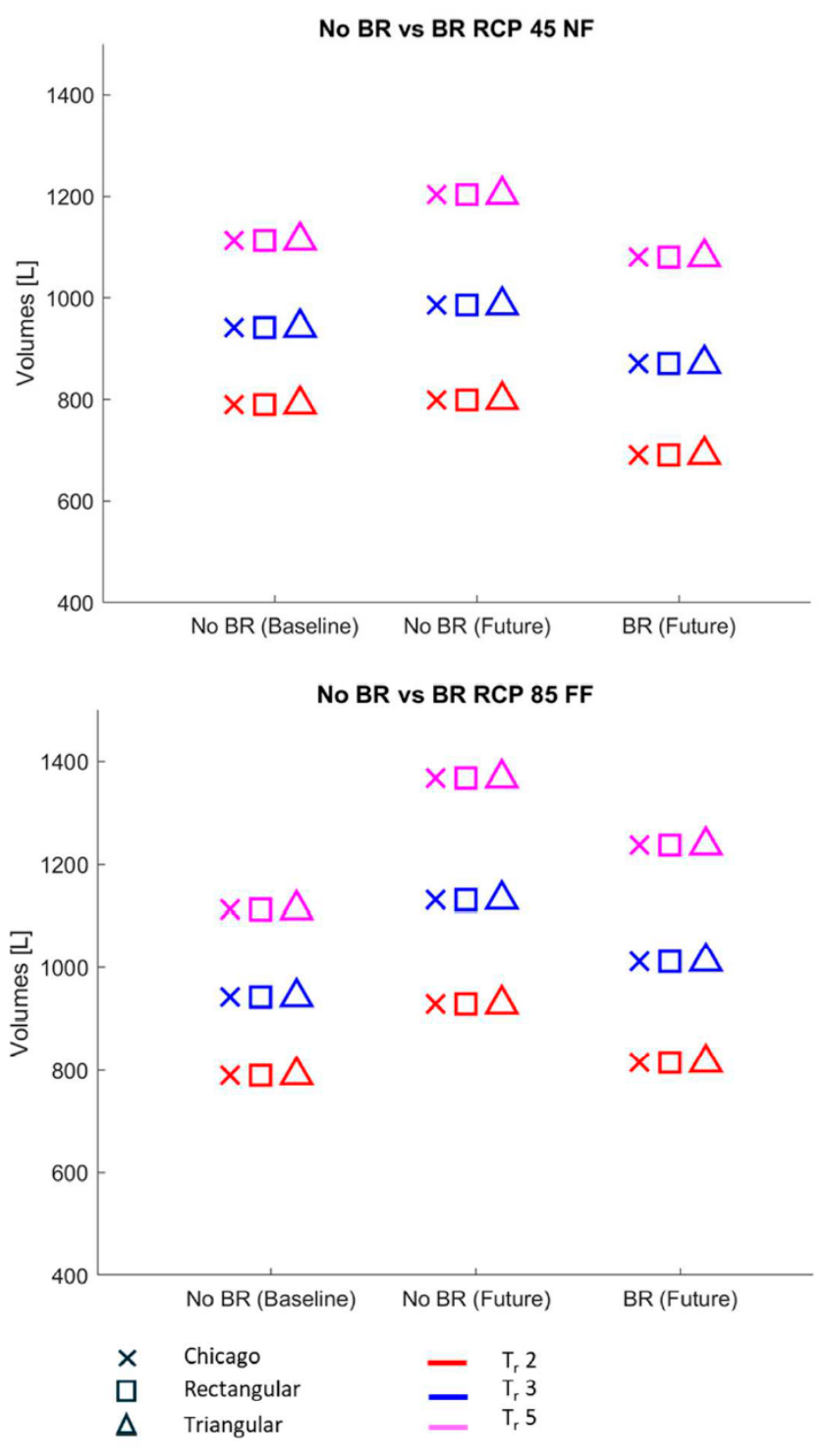
The BR system may effectively reduce the runoff volumes under future emission scenarios for scenario RCP4.5 in the near future (NF, 2021–2050), as shown in Figure 1. The type of hyetograph does not affect the performance significantly. For this scenario, the BR not only compensates for the impacts of climate change but also allows a reduction in runoff volumes with respect to the absence of the BR in the current climate, even given the increase in rainfall intensity in the future scenario. In the RCP8.5 scenario, the benefits of the BR do not always compensate for the increase in rainfall intensity, as shown in Figure 1, lower panel for the far future (FF, 2071–2100).
The peak reduction done by the tray-module BR installation, with respect to the impulsive terrace response, is consistent across all the combined scenarios, with a range between 38% and 58%, depending on the magnitude of the precipitation inputs and the inherent characteristics of each type of hyetograph. In future scenarios, the precipitation patterns could strongly influence the peak attenuation response of the tray-module installation. Indeed, where the inputs are in the form of the highest peak, there is a higher reduction. The highest reduction is registered for the Chicago inputs with an average peak attenuation of 58%, close to the triangular one 55% and the lowest average of 41% for the rectangular ones.
Regarding future changing scenarios, using the Chicago hyetograph inputs as an example, it is projected that peak attenuation will be lower for the intermediate emission scenario, RCP 4.5 and the near future (NF), with an average peak attenuation (ID) of 58%. This scenario shows a higher tendency for peak attenuation in the middle (MF) and far future (FF) periods. For the rectangular and triangular hyetographs, the trends remain similar with respect to emission scenarios and future periods.

4. Conclusions

This study aimed to assess the hydrological behaviour of a pilot tray-module blue roof (BR) under future climate scenarios. The system’s response was simulated for design storms with 2-, 3-, and 5-year return periods, considering multiple emission scenarios. Hydrological performance was evaluated through runoff volume reduction and peak flow attenuation. Results show that BRs consistently reduce runoff compared to impervious surfaces, though retention remains limited, confirming their design is more suited for detention. Peak attenuation, however, proved significant and strongly dependent on precipitation characteristics. Chicago hyetographs produced the highest average attenuation (58%), while rectangular hyetographs showed the lowest (41%). Under future scenarios, attenuation trends vary: for RCP 4.5, performance decreases in the near future but improves in the mid and far future, whereas RCP 8.5 shows stable performance with maximum attenuation in the far future. These results highlight the BR’s robustness under short, intense storms and its effectiveness in mitigating peak runoff during more severe precipitation events. Overall, the tray-module BR emerges as a promising SUD intervention for urban flood mitigation, supporting climate adaptation strategies through innovative rooftop solutions.

Author Contributions

Conceptualization, G.B., A.C. (Alberto Campisano), A.C. (Antonino Cancelliere), A.G., N.P. and D.J.P.; methodology, G.B., A.C. (Alberto Campisano), A.C. (Antonino Cancelliere), A.G., N.P. and D.J.P.; software, G.B., A.C. (Alberto Campisano), A.C. (Antonino Cancelliere), A.G., N.P. and D.J.P.; validation, G.B., A.C. (Alberto Campisano), A.C. (Antonino Cancelliere), A.G., N.P. and D.J.P.; formal analysis, G.B., A.C. (Alberto Campisano), A.C. (Antonino Cancelliere), A.G., N.P. and D.J.P.; investigation, G.B., A.C. (Alberto Campisano), A.C. (Antonino Cancelliere), A.G., N.P. and D.J.P.; resources, G.B., A.C. (Alberto Campisano), A.C. (Antonino Cancelliere), A.G., N.P. and D.J.P.; data curation, G.B., A.C. (Alberto Campisano), A.C. (Antonino Cancelliere), A.G., N.P. and D.J.P.; writing—original draft preparation, G.B., A.C. (Alberto Campisano), A.C. (Antonino Cancelliere), A.G., N.P. and D.J.P.; writing—review and editing, G.B., A.C. (Alberto Campisano), A.C. (Antonino Cancelliere), A.G., N.P. and D.J.P.; visualization, G.B., A.C. (Alberto Campisano), A.C. (Antonino Cancelliere), A.G., N.P. and D.J.P.; supervision, A.C. (Alberto Campisano), A.C. (Antonino Cancelliere) and D.J.P.; project administration, A.C. (Alberto Campisano), A.C. (Antonino Cancelliere) and D.J.P.; funding acquisition, A.C. (Alberto Campisano), A.C. (Antonino Cancelliere) and D.J.P. All authors have read and agreed to the published version of the manuscript.

Funding

This work was partially supported by the following projects: (1) SUNRISE—Sustainable Urban areas by Nature-based solutions implemented to mitigate climate impacts and achieve a Resilient, Innovative and Smart Environment, BAC of the Multi-Risk sciEnce for resilient commUnities undeR a changiNg climate (RETURN) project funded under the National Recovery and Resilience Plan (NRRP), Mission 4 Component 2 Investment 1.3, project code PE_00000005, project CUP E63C22002000002 and (2) PIA.CE.RI.2024–2026—PIAno di inCEntivi per laRIcerca di Ateneo 2024/2026—Linea 1—Progetti di Ricerca Collaborativa—Progetto ESTREMI funded by University of Catania.

Institutional Review Board Statement

Not applicable.

Informed Consent Statement

Not applicable.

Data Availability Statement

Dataset available on request from the authors.

Conflicts of Interest

The authors declare no conflicts of interest.

References

  1. Schreider, S.Y.; Smith, D.I.; Jakeman, A.J. Climate Change Impacts on Urban Flooding. Clim. Change 2000, 47, 91–115. [Google Scholar] [CrossRef]
  2. Fletcher, T.D.; Shuster, W.; Hunt, W.F.; Ashley, R.; Butler, D.; Arthur, S.; Viklander, M. SUDS, LID, BMPs, WSUD and More—The Evolution and Application of Terminology Surrounding Urban Drainage. Urban Water J. 2014, 12, 525–542. [Google Scholar] [CrossRef]
  3. NYC DEP. New York City Green Infrastructure Plan: Green Infrastructure Pilot Monitoring Report; New York City Department of Environmental Protection: New York, NY, USA, 2012.
  4. Almaaitah, T.; Joksimovic, D. Hydrologic and Thermal Performance of a Full-Scale Farmed Blue–Green Roof. Water 2022, 14, 1700. [Google Scholar] [CrossRef]
  5. Campisano, A.; Modica, C.; Gullotta, A. Long-Term Experiments for the Evaluation of the Potential for Storm Water Control of Modular Blue Roofs in Mediterranean Climate. Urban Water J. 2021, 18, 33–42. [Google Scholar] [CrossRef]
  6. Campisano, A.; Creaco, E.; Gullotta, A.; Modica, C.; Musmeci, F. Modelling Hydrological Response of Modular Blue Roofs for Storm Water Control in a Mediterranean Site. Urban Water J. 2022, 19, 1015–1024. [Google Scholar] [CrossRef]
  7. Buonacera, G.; Palazzolo, N.; Cancelliere, A.; Peres, D.J. Deriving Future Rainfall Depth-Duration-Frequency Curves from Hourly Regional Climate Projections and Simple Scaling in Sicily. Water Resour. Manag. 2025, 39, 5619–5635. [Google Scholar] [CrossRef]
Figure 1. Runoff volumes: without BR in the present climate (left), without BR in the future climate (centre), with BR in the future climate (right).
Engproc 135 00027 g001
Disclaimer/Publisher’s Note: The statements, opinions and data contained in all publications are solely those of the individual author(s) and contributor(s) and not of MDPI and/or the editor(s). MDPI and/or the editor(s) disclaim responsibility for any injury to people or property resulting from any ideas, methods, instructions or products referred to in the content.