1. Introduction
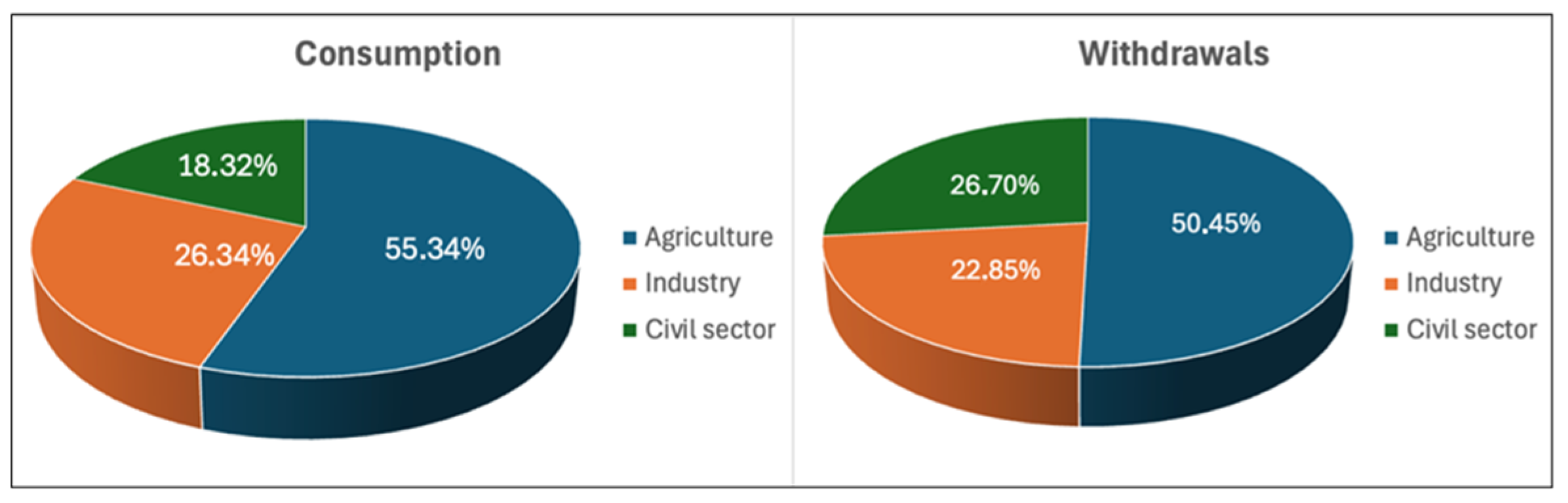
The reuse of urban wastewater is becoming an increasingly pressing and necessary issue to address the water emergency that has already affected several Italian regions in recent years and is expected to involve even larger areas of the country in the future. Even in territories where water availability is currently abundant, phenomena of aquifer depletion are being observed, with consequences that will become progressively more evident in the coming years. For instance, in Italy, taking 2015 as a reference year, water consumption amounted to 26.2 billion cubic meters, with more than 50% of withdrawals allocated to the agricultural sector, followed by the industrial and civil sectors (
Figure 1). To meet this demand, total withdrawals reached 33.7 billion cubic meters. Treated urban wastewater could replace part of these withdrawals and be employed both in agriculture and in industry [
1,
2,
3]. However, due to its origin and composition, it may contain significant concentrations of pollutants typical of domestic wastewater, which could pose challenges for subsequent reuse. To address these challenges, European legislation has introduced the possibility of implementing additional treatment stages within urban wastewater treatment plants, designed to further enhance water quality for subsequent applications (so-called quaternary treatments). While such treatments inevitably involve additional costs that must be carefully evaluated, they should not be regarded as an obstacle to the overarching objective that must be pursued in the coming years: the safeguarding of water resources. Within this perspective, the reuse of treated urban wastewater assumes a dual strategic role. On the one hand, it prevents the discharge of large volumes of treated effluent into marine or surface water bodies; on the other, it significantly reduces groundwater withdrawals for irrigation and industrial purposes. Such measures are therefore essential to promote a sustainable water management paradigm aligned with the principles of the circular economy and climate neutrality.
2. Regulatory Framework
The new Directive (EU) 2024/3019 [
5], concerning the treatment of urban wastewater, expands the scope of application compared to the previous Directive 91/271/EEC [
6]. The main innovations introduced include: the extension of the regulatory framework to small agglomerations, the introduction of a fourth treatment stage specifically targeting micropollutants, the transition of the sector towards climate neutrality by 2045, and the imposition of transparency and economic responsibility obligations on producers of polluting substances. With reference to Italy, the current legislative instrument, Legislative Decree 152/2006 [
7], must be updated through a transposition decree by 31 July 2027, in order to harmonize national legislation with the new European standards. The implementation of these provisions will require regional authorities to plan and update water protection programs; municipalities to cooperate with service providers to ensure compliance with the new standards; and Integrated Water Service operators to undertake technological upgrades of their treatment plants and to publish performance data.
3. Potential Uses of Urban Wastewater in Industrial and Agricultural Contexts
Climate change phenomena exert a significant impact on hydrological cycle processes. It is both physically and thermodynamically demonstrable that any variation in the average global temperature alters the mechanisms of evaporation, condensation, precipitation, and infiltration. In recent decades, an increase has been observed in the frequency and intensity of extreme meteorological events, with episodes of torrential rainfall alternating with prolonged droughts. These climatic dynamics critically affect existing hydraulic infrastructures, as:
Sewer networks are subject to hydraulic overloads and backflow phenomena;
Stormwater drainage systems are often undersized relative to new rainfall regimes;
Aqueduct and water abstraction systems are penalized by the lowering of aquifer piezometric levels, resulting in reduced water availability.
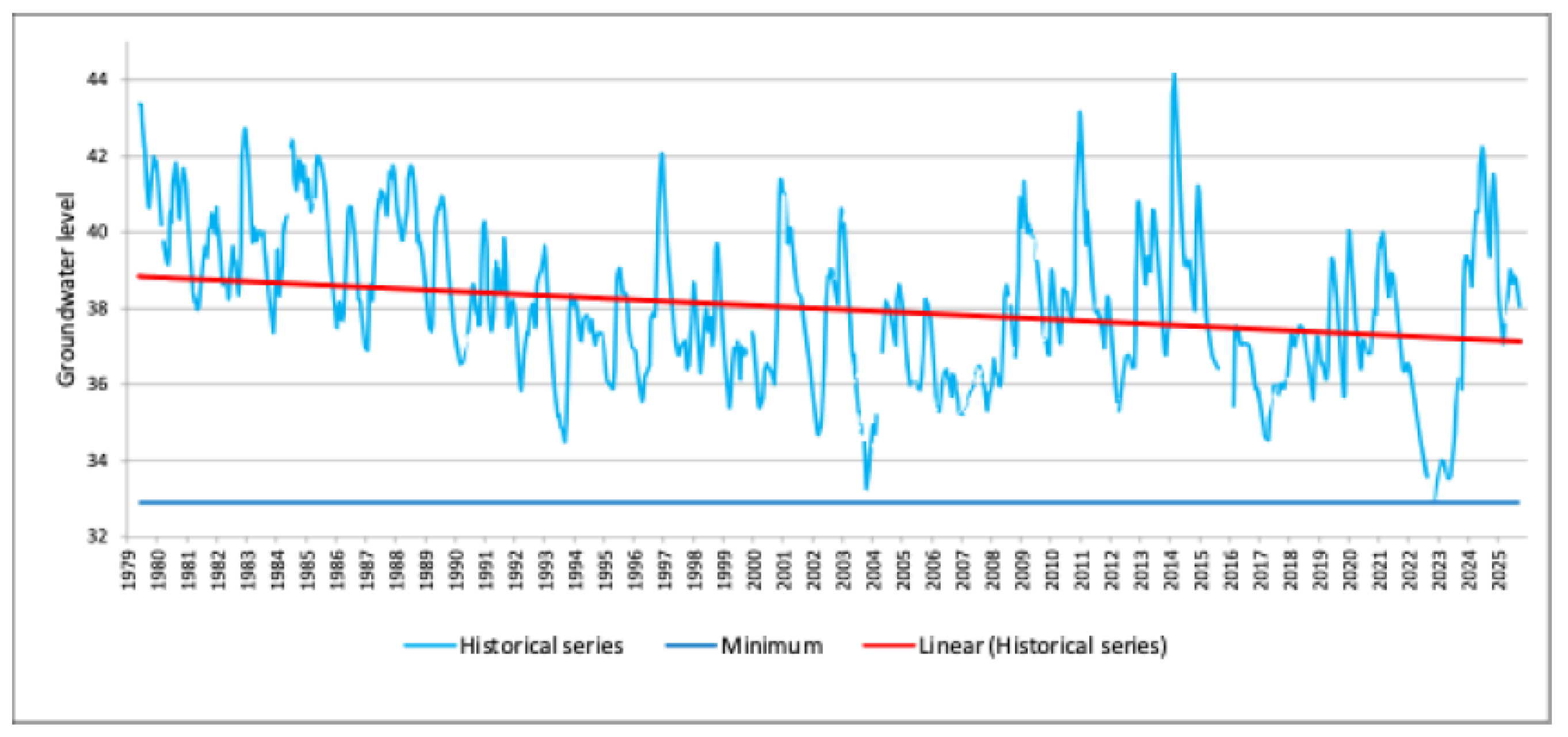
In the Italian context, the Autonomous Region of Friuli Venezia Giulia—characterized by a variable morphology with mountainous and hilly areas in the north and coastal plains in the south—has for years implemented a hydrogeological monitoring system based on an extensive network of piezometers. A notable example is the piezometric station of Forcate, located in the municipality of Fontanafredda (Pordenone), which provides essential data for analyzing variations in groundwater levels over time (
Figure 2).
Between 1979 and 2023, the groundwater level in the Friuli plain recorded an overall decline of approximately 3 m, decreasing from 39.5 m a.s.l. (above mean sea level) to 36.6 m a.s.l. This regressive trend, similarly observed at other piezometric stations within the monitoring network, provides objective evidence of the influence of climate change on the hydrological regime of the territory. In light of such evidence, it is imperative to adopt strategies oriented towards water conservation, sustainable management, and the reuse of available resources, both at the regional and national levels. It should also be noted that, at present, the reuse of treated wastewater in Italy remains largely experimental and is not yet widespread. The reuse of urban wastewater in industrial contexts can represent a significant source of supply, as considerable volumes of treated water may be employed as process water, cooling water, washing water, or firefighting water. This practice would substantially reduce withdrawals from wells or surface water bodies. Consequently, it is crucial to identify treatment and management approaches that facilitate water reuse within industrial sites. This entails defining the quality requirements that treated water must meet in order to be reused in production cycles, while ensuring compliance with the emission limit values for final discharges that industrial plants are obliged to respect under national and European regulations. A virtuous example of industrial reuse of wastewater originating from a civil treatment plant is found in Tuscany, Italy, at the “Aretusa” treatment facility. This plant receives effluents from the municipalities of Rosignano Marittimo and Cecina and, following appropriate treatments, transfers the purified water to the Solvay company. Solvay reuses part of this water in its production cycle and distributes the remainder to other industrial facilities co-located at the Rosignano site. The treatment plant transfers its effluents entirely to Solvay’s production facilities, amounting to approximately 4,000,000 m3 per year. This practice has led to a significant reduction in groundwater abstraction for industrial use, thereby increasing the availability of water for potable purposes and reducing the volume of treated effluents discharged into the sea.
The reuse of treated urban wastewater, particularly for irrigation purposes, represents a promising solution already regulated at the European level by Regulation (EU) 2020/741 [
8], which entered into force on 26 June 2023. This regulation establishes minimum requirements for water quality, monitoring, and risk management, with the aim of ensuring the safe reuse of treated wastewater for agricultural irrigation.
In the Autonomous Region of Friuli Venezia Giulia, a potential reuse pathway could involve exploiting the effluents from the Lignano Sabbiadoro (Udine) wastewater treatment plant for the irrigation of agricultural land in the surrounding area. This plant has a nominal capacity of 86,400 population equivalents and manages a mixed sewer network that conveys domestic wastewater, wastewater assimilated to domestic, and stormwater. During the summer period, characterized by high tourist inflows, the daily volumes treated by the Lignano plant increase and range between 14,000 and 17,000 m3/day. This period coincides with a growing demand for irrigation water in the neighboring agricultural zones, highlighting the potential synergy between wastewater treatment and agricultural water needs.
4. Environmental Benefits and Challenges of Urban Wastewater Reuse
The reuse of urban wastewater in industrial contexts represents an ideal application, considering that production processes require defined, significant, and continuous volumes of water throughout the year, unlike agricultural use, which is highly variable depending on seasonality and precipitation. Identifying potential industrial users in areas adjacent to urban wastewater treatment plants therefore constitutes a valuable resource. In this case, it becomes essential to define not only the volumes that can be directed towards production processes but, above all, the quality requirements that the water must meet in order to be used in industrial cycles. Water quality is not limited to the chemical-physical characteristics required for its specific use—whether as process water or cooling water—but must also ensure compliance with emission limit values prescribed for final discharges into receiving surface water bodies. These limits may pose challenges for industrial operators. Indeed, the reuse of treated urban wastewater, which by its nature and origin may contain non-negligible concentrations of pollutants typical of domestic effluents, could lead to exceedances of emission limit values in the final effluent. Such exceedances may occur due to evaporation and consequent concentration phenomena during industrial use and are not attributable to the industrial process itself but rather to the characteristics of the incoming water. The solution lies in subjecting urban wastewater to additional treatments aimed at reducing typical domestic pollutants (e.g., nitrogen, phosphorus, COD, total suspended solids), thereby ensuring that effluent concentrations comply with discharge standards. In agriculture, water availability represents a critical and indispensable factor: crops require carefully calibrated water inputs in terms of volume and timing, depending on crop type, seasonality, and microclimatic conditions of the production site. These variables necessitate adequate irrigation infrastructure and the effective availability of water resources dedicated to irrigation, with particular attention to sustainability and system efficiency.
Treated wastewater intended for agricultural reuse must comply with the microbiological and chemical-physical requirements established by Regulation (EU) 2020/741, which sets limit values for key quality parameters. Refinement treatments for urban wastewater destined for irrigation must ensure effective reduction of parameters such as BOD5 (biochemical oxygen demand at 5 days) and total suspended solids (TSS), as well as advanced disinfection to reduce bacterial loads.
Beyond quality requirements, economic considerations must also be taken into account. The cost of treated water is significantly higher than that currently borne by farmers irrigating with groundwater. This issue is particularly relevant in regions with abundant water availability, such as Friuli Venezia Giulia, where simple motor pumps can be used to withdraw water at low cost, given the favorable conditions of water concessions.
5. Conclusions
The reuse of urban wastewater represents an indispensable tool for water resilience and environmental sustainability. The adoption of a territorial methodology—based on authorization frameworks and cross-analysis of data from treatment plants and water demand from users—would enable the design of effective reuse schemes aligned with European and national regulatory frameworks.
The reuse of urban wastewater for irrigation reduces pressure on water resources, particularly during periods of heightened demand, such as the summer season, when agricultural needs increase substantially. However, such water must undergo appropriate treatments to ensure compliance with current regulatory requirements.
Similarly, the reuse of adequately treated urban wastewater in industrial plants represents a relevant yet still partially implemented practice, given the substantial volumes of freshwater required in production cycles. Water destined for this purpose must meet quality standards both for effective use in industrial processes and to ensure compliance with emission limit values for pollutants in final discharges, in line with national and European regulations.
The most significant limiting factor for the effective implementation of integrated wastewater reuse systems lies in the high costs of the treatments required to make the water suitable for subsequent use in agriculture or industry. Compared to groundwater abstraction, treated wastewater is often economically disadvantageous. Overcoming this barrier would require regulatory intervention, introducing a progressive restriction on groundwater use, thereby necessitating the adoption of recovered water sources—such as stormwater or adequately treated wastewater.




 ,
,